Theoretical-physics hub opens in South America

A new centre for theoretical physics has opened in Brazil that aims to become one of the leading research institutes in South America. The centre – named after the renowned International Centre for Theoretical Physics (ICTP) in Trieste, Italy – will be located at Universidade Estadual Paulista (UNESP) in Sao Paulo. Known as the ICTP South American Institute for Fundamental Research (ICTP-SAIFR), the new centre was officially opened on 6 February in a ceremony attended by the president of the Brazilian Academy of Science, Jacob Palis, as well as Peter Goddard, director of Institute for Advanced Study, Princeton, US.

The ICTP-SAIFR has been created in a collaboration between the ICTP, UNESP and the Sao Paulo Research Funding Agency. Its activities are modelled on those of the ICTP and will begin with the centre holding international schools and workshops. Among the first events will be a workshop on gravity and string theory in May and a school on astrophysics and cosmology in July.

Initially, there will be five permanent researchers as well as a director, who is the Brazilian physicist Nathan Berkovits. The centre expects to support about a dozen postdocs positions per year as well as playing host to a number of international visitors and students. Hiring for the permanent and postdoc positions is still on going, with the theoretical physicist Fernando Quevedo, who is director of the ICTP in Trieste, saying that selection will “follow the highest international standards and we expect to select simply the best candidates, independent of their origin”.

With a budget of about $1m per year, the institute also will have an active visitors’ programme. “We very much hope that this will be only the beginning of a great new project that will increase the scientific level of the region and that will play a major role in international scientific collaboration,” Quevedo told physicsworld.com. “I have the highest hopes [for this institute].”

Berkovits told physicsworld.com that the idea for the institute emerged eight years ago but accelerated once Quevedo became director of the ICTP in 2009. “The ICTP was crucial for the creation of this institute,” says Berkovits. “It is, of course, exciting and a great challenge to start this new institute.”

The opening of the new centre is part of a five-year plan to expand the ICTP into other countries, especially in the developing world. “Brazil, India and China are playing a more relevant role worldwide,” says Quevedo. “The scientific level of Brazil in very high and a centre located there can therefore play the same role for South America that ICTP has been playing worldwide.”
Physicists ponder flowering masonry


Efflorescence on a masonry wall (Courtesy: Mattes)

By Hamish Johnston

One thing you can say about most houses in the UK is that they are solid. All walls, including internal ones, tend to be made from masonry – bricks in Victorian and Edwardian homes, and cement blocks in more modern buildings. It’s rare to see the flimsy-looking wooden frames that miraculously become houses in North America, for example.

But there is a downside to this solid construction. Masonry – and older bricks in particular – tend to suck-up moisture from the ground. Indeed, this is such a common problem in the UK that they named a sitcom after it – Rising Damp.

One symptom of rising damp is efflorescence, which means “flowering out”. This refers to crystals of salts that grow out from the surface of masonry as the damp evaporates into the air. Efflorescence can be a real pain on interior walls because it can stain paintwork and push-off wallpaper. I should know, because we used to have it in the dining room!

Efflorescence has also fascinated physicists because, rather than emerging as a uniform coating of salt, the crystals tend to appear in clumps – but exactly why was a mystery.

But now, Marc Prat and colleagues at the University of Toulouse, France, have done experiments and computer simulations that suggest that several factors are involved in determining the locations of salt flowers.

One is that the rate of evaporation is often not uniform across a wall. Not surprisingly, moisture is drawn to regions of the surface where air currents or other factors boost evaporation, and this causes more efflorescence in these areas. The irony, of course, is that reducing humidity and increasing ventilation could actually encourage efflorescence!

Turning their attention to the network of tiny pores that exist in masonry, the team worked out that certain pathways are extremely efficient at transporting water to the surface, while others are not. The researchers concluded that the salt flowers form where these efficient pathways emerge at the surface. Once a crystal is established on the surface, its presence increases the flow of water through that particular pathway, further depriving surrounding less-efficient pathways of liquid. The result is regions with large crystals, and other regions with no salt.

Finally, they tried to explain why the salt crystals grow outwards from the surface, rather than spreading out. The reason, it seems, is that the moisture would rather travel through a salt crystal than along a masonry surface. Putting all of this together, the team believes that it has made a good first effort at understanding efflorescence.

The research is described in Phys. Rev. Lett. 108 054502 and you can read the paper here.

The sights and sounds of Fermilab

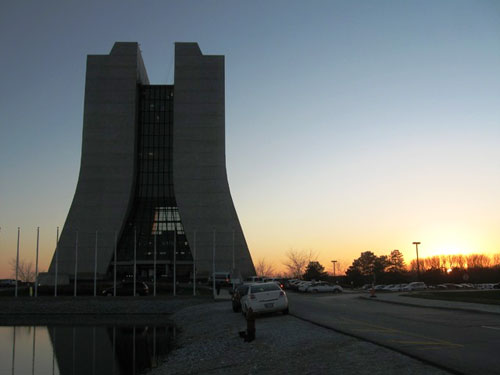
Wilson Hall at sunset

By Margaret Harris

Last autumn I visited Fermilab to learn more about the US particle-physics lab’s plans for the future now that its flagship particle accelerator, the Tevatron, has closed for good.

You can read more about those plans in this article, but if you’d like a slightly more visual guide to how the lab is changing, I’ve put some photographs from my trip on Physics World‘s Flickr page.

I’m hardly a professional photographer, but it’s easy to take good photos in a place as beautiful as Fermilab, with its spacious Midwestern skies, iconic structures, and famous herd of American bison. But even if pretty pictures aren’t your thing, the photos also illustrate some of the changes going on at the lab, with the empty, slightly forlorn-looking CDF control room contrasting sharply with the buzz of activity in Fermilab’s neutrino-research areas.

In other Fermilab news, the Chicago-based composer Mason Bates apparently found the lab’s soundscape as inspiring as its landscape. Bates is the composer-in-residence at the Chicago Symphony Orchestra, and last year he visited Fermilab to record material for a new composition called Alternative Energy. According to the website for the symphony, the piece blends ambient noises from the lab with percussion and orchestra, and it had its première on Thursday 2 February. You can watch a video of Bates making his recordings here.

Vertical graphene transistor avoids leakage

Physicists in the UK have found a way to overcome a major barrier blocking the use of graphene in electronic devices – how to prevent current leaking through a device when it is switched off.

Graphene is a sheet of carbon just one atom thick and has a number of unique electronic and mechanical properties that mean it could be used in electronic devices – at least in principle. There are, however, many challenges that must be overcome before commercial applications are possible.

Graphene is an extremely good electrical conductor, but its extreme conductivity is also a problem because devices made from the material remain conducting even when switched off. This not only wastes power, but also means that such devices cannot be packed onto computer chips because the electric current running through the graphene would melt the chips almost immediately.

Graphene is a semiconductor, but unlike familiar materials such as silicon, graphene has no energy gap between its valence and conduction bands. Such a band gap allows a semiconductor to switch the flow of electrons on and off. Researchers have proposed various schemes to overcome this problem – for example by using nanoscale ribbons or quantum dots, or chemically modifying graphene to make it semiconducting. Although both schemes work in principle, opening a band gap in graphene in this way also damages the material so much that finished devices no longer show either ballistic transport or high electron mobilities.

A layered approach

Now, Leonid Ponomarenko and colleagues at the University of Manchester have taken a step forward in overcoming this problem by making a new type of transistor from graphene that contains layers of boron nitride or molybdenum disulphide sandwiched between graphene sheets. The team doing the work also includes graphene pioneers Konstantin Novoselov and Andre Geim.

The layers act as vertical tunnelling barriers that minimize current leakage – even at room temperature. Called a vertical field-effect tunnelling transistor, the device is the first ever made from graphene that can be properly switched on and off – despite the absence of an energy gap in the material’s band structure.

The transistor is made of two graphene sheets sandwiched together with atomically thin insulators such as boron nitride (BN) or molybdenum disulphide (MoS2) that act as barriers for electrons tunnelling from one layer of graphene to the next. The advantage of this type of structure is that the current flowing perpendicular to the layers of the insulating material – that is, the tunnelling current – can be controlled with an external electric field. “Technically, this is because the electrons induced in the graphene by the external field have a higher probability of tunnelling and the number of such electrons increases with the field,” explains Ponomarenko.

Although any insulator can be considered as a tunnelling barrier, it is only when the barrier is a few atoms thick that the tunnelling current can be easily measured. BN and MoS2 are ideal for use in this respect because extremely thin flakes of the materials can be produced using the same “sticky tape” method used to obtain graphene.

Unique feature

The device works thanks to a unique feature of graphene whereby an external voltage can strongly change the energy of the tunnelling electrons, says Ponomarenko. “I think our work now opens the way to creating graphene integrated circuits,” he says.

“The demonstrated transistor is important but the concept of such layer assembly is probably even more so,” adds Geim. Novoselov agrees: “The tunnelling transistor is just one example of the inexhaustible collection of layered structures and novel devices that could now be created by such assembly.”

The team says that it will now look at whether graphene can be combined with other 2D materials. “It will also be important to know how our tunnelling transistors behave when their lateral size is reduced to the nanometre scale and to find out the highest frequencies at which the devices can operate,” says Ponomarenko.

The research is described in Science.

ESO – 'then and now'

ESO-then-now.jpg

By Tushna Commissariat

This year the European Southern Observatory (ESO) is celebrating its 50th birthday. In honour, ESO plans to release a monthly “then and now” comparison image that shows how much things have changed over the past half of a century at ESO’s two main observatory sites (La Silla and Paranal), at ESO offices in Santiago de Chile and at its headquarters in Garching, Germany.

February’s photos of choice (images above courtesy of ESO/J Dommaget) depict the La Silla Observatory in the late 1960s and the present day. Only one telescope is visible in the historical image – the ESO 1 m Schmidt telescope, which saw first light in 1971. The present-day image has two new telescopes visible – the MPG/ESO 2.2 m telescope (left) and the New Technology Telescope (NTT) on the peak to the right. According to ESO, the MPG/ESO 2.2 m telescope has been in operation since 1984 and its construction is apparently the reason why the modern-day photograph could not be taken from exactly the same spot as the one from the 1960s. It also points out that back in the day, astronomers would sleep in the huts running along the right-hand side of the road. Luckily, researchers now have the luxury of using a more comfortable hotel on the edge of the site.

It is also interesting to note the cars in both images. ESO informs me that the car in the historical image is a Volkswagen 1600 Variant, while now all ESO vehicles on site at La Silla – such as the Suzuki 4WD in the new image – are white, to improve visibility at night.

Keep an eye out for more “then and now” images from ESO in the months to come.

Cool sun could host habitable planet

An international team of scientists has discovered a potentially habitable super-Earth orbiting within the habitable zone of a cool star that is a member of a triple-star system. This discovery demonstrates that habitable planets could form in more varied environments than previously thought. This is the fourth exoplanet found within the habitable zone of a star – the first being Gliese 581d, which was discovered last May. Super-Earth planets are two to 10 times more massive than Earth.

Led by Guillem Anglada-Escudé and Paul Butler from the Carnegie Institution for Science in the US, the team studied public data released by the European Southern Observatory, as well as incorporating new measurements from the Keck Observatory’s High Resolution Echelle Spectrograph and the new Carnegie Planet Finder Spectrograph at the Magellan II Telescope. The researchers were looking for stars with small “wobbles” in their orbit – a common marker for an exoplanet that is caused by the pull of the planet’s gravity.

Hidden planets

Among the data was GJ 667C – an M-class dwarf star 22 light-years from Earth that had been known to have a super-Earth (called GJ 667Cb) that orbited the star in only 7.2 days. The planet’s exceedingly short orbit made it too hot to support life, previously rendering it uninteresting. Moreover, the other two stars in the triple system are a pair of orange K-class dwarfs with a concentration of heavy elements – those heavier than hydrogen and helium – only 25% that of the Sun. As such elements are the building blocks of rocky, terrestrial planets, astronomers had not expected the system to have an abundance of low-mass planets. But after carefully analysing the data, the team was surprised to find a clear signal of a new planet – GJ 667Cc – that has an orbital period of 28.15 days and a minimum mass of just 4.5 times that of Earth.

The new planet receives 90% of the light that Earth receives. However, because most of the incoming light for the M-class dwarf star is in the infrared, a higher percentage of this energy must be absorbed by the planet. Taking both these effects into account, the researchers believe that the planet absorbs about the same amount of energy from its star as the Earth absorbs from the Sun.

This means that the surface temperature is similar to Earth, in turn raising the tantalizing possibility that liquid water exists on the planet’s surface. Confirming this hypothesis will, however, require further information about the planet’s atmosphere. “This planet is the new best candidate to support liquid water and, perhaps, life as we know it,” says Anglada- Escudé.

Another home?

The team notes that the system might also contain two other planets – a gas-giant planet, like Jupiter, as well as a third super-Earth with an orbital period of 75 days. However, further observations will be needed to confirm these two possibilities. “With the advent of a new generation of instruments, researchers will be able to survey many M-calss dwarf stars for similar planets and eventually look for spectroscopic signatures of life in one of these worlds,” says Anglada- Escudé.

Lewis Dartnell, an astrobiologist from University College London, says that while the discovery of a new “potentially rocky exoplanet orbiting within a star’s habitable zone is very intriguing, it is important to note that the star in question is an M-class dwarf star”. He goes on to say that such stars can be rather unstable and this would spell trouble for an orbiting planet. “In addition, as such exoplanets would tend to be tidally locked, the climate on the planet would be extreme – with arctic-like conditions on the side of the planet where there is always darkness and never-ending day on the lit side. This might make life on such a planet all the more difficult,” he says.

The work is to be published in Astrophysical Journal Letters. A preprint is currently available on arXiv.

Spider webs strengthened by local sacrifices

The incredible robustness of spider webs, which lets them survive even the fiercest of storms, is down to a feature of the silk that localizes damage to small sections of the web. That is the finding of a group of researchers based in the US and Italy, which believes this property of spider silk could even help civil engineers to devise more robust structures.

The resilience of spider silk has long been noted by both bioscientists and physical scientists. Indeed, earlier analyses by physicists have shown that spider silk – owing to its combination of strength and extreme ductility – has a greater tensile strength than even high-grade steel. But these studies did not managed to explain how spider webs can remain relatively intact after being subjected to extreme loading such as hurricane-strength winds.

An answer to this question may now be at hand, courtesy of a team at the Massachusetts Institute of Technology (MIT) and the Polytechnic of Turin. The researchers, led by MIT’s Markus Buehler, have combined modelling with experiment to relate the nanoscale properties of spider silk to the large-scale integrity of spider webs.

Focus on failure

A spider’s silk is made from basic proteins, including some that form thin, planar crystals called beta sheets. When a stress is applied to a strand of spider silk, these sheets slide across each other until, eventually, the silk ruptures. To examine this process of structural failure, Buehler and colleagues have developed an atomic-scale simulation of silk from the Nephila clavipes – a species of golden orb-web spider native to the warmer regions of the Americas. The results were then validated by experiment.

The researchers discovered that when the spider silk is subjected to an applied load, the stiffness of the silk varies in a nonlinear fashion. Under light stresses, the silk responds in a fairly uniform way by softening and spreading the load across the entire web. But as this stress is increased, the material becomes stiffer near the applied load but remains soft elsewhere in the web.

When the failure point is eventually reached – at a stress of about 1400 MPa and strain of 67% – the stiff silk ruptures, but only in the region where the load was applied. In this way, the web is effectively sacrificing only a small section, which can then be repaired by the spider.

“When we started testing our webs via simulation, we noticed that – no matter how we plucked and pulled – the web would only fail where we applied the load. This was very unexpected and exciting,” Buehler told physicsworld.com. “To confirm that this was the behaviour of true webs, we found some webs in the natural environment and then plucked and pulled in the same manner. They failed just as our models had predicted.”

Spider-inspired designs

The manner in which spider silk sacrifices small sections contrasts with many other biological materials, including bone, which spread applied stresses broadly. Although it is often useful for a bone to spread the load, the downside is that structural damage is sustained along large parts of the bone prior to a break. Buehler believes that the spider silk’s alternative of localizing damage could be adapted by civil engineers to improve certain building designs.

“A building engineered with the same principles could be subject to a small fire, a car crash or a terrorist attack and only fail where these ‘loads’ were applied,” says Buehler. “The remainder of the building would remain functional.” Buehler believes that, more indirectly, the sacrificial nature of spider silk could also lead to improved infrastructure designs in many other sectors including power grids and the Web.

Philip LeDuc, an engineer at Carnegie Mellon University in the US, is impressed by the way that this new research connects the behaviour of spider silk across different scales. “The really challenging part that the researchers are consistently able to address is how fundamentals at the nanometre scale can translate into actual results that can be more than 10,000,000 larger,” he notes.

This research is described in Nature.

Closing the gender gap

female-data

By Matin Durrani
My eye was caught this morning by a new report from the Institute of Physics, which publishes physicsworld.com, about the number of physicists at UK universities.

Entitled Academic Physics Staff in UK Higher Education Institutions, you can read the full report here, but what I found particularly interesting were the data on women in physics.

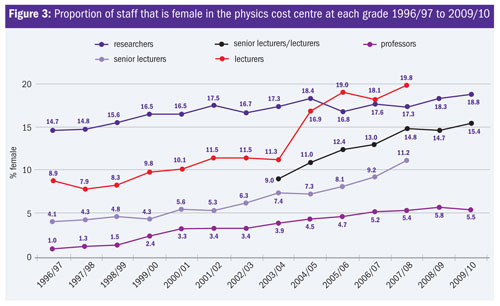
The report reveals that the proportion of staff in UK physics departments who are women has risen steadily from 13% in 2003/04 to 16% in 2009/10. (See figure above: data in it are from the UK’s Higher Education Statistics Agency.)

As one might expect, the biggest rises are at more junior levels, with the proportion of female lecturers going up from 11.3% to 19.8% over that period. Senior-lecturer numbers have increased from 9.0% to 11.2% and although the proportion of female professors has risen form 3.9% to 5.5%, women in these top positions are still very much in the minority.

Given that women make up about 22% of UK physics undergraduates, is it too much to hope that in 15 or 20 years’ time women will also make up a fifth or so of physics professors?

Another intriguing statistic concerns the highly international level of UK physics, particularly among women. According to the report, the proportion of female staff at UK universities who are not from the UK has risen from 46% in 2003/04 to 51% in 2009/10. This is much higher than the fraction of male non-UK nationals at UK universities, which has gone up from 31% to 40% in the same period.

Overall, across both men and women, the biggest proportion of non-UK staff working in UK physics departments come from Germany, followed by Italy, the US, China, Russia, France, India, Greece and the Netherlands. Make of that what you will.

You can read the full report here.

Magnetic fields put the brakes on millisecond pulsars

A researcher in Germany has revealed how “millisecond pulsars” – neutron stars with rotational periods ranging from 1–10 ms – slow over time. By exploring how a pulsar behaves when it stops accreting matter from a donor star, Thomas Tauris from the University of Bonn has shown quantitatively that it is the expansion of the pulsar’s magnetic field that helps to slow the star’s rotation. The finding may help astronomers to determine the age of radio millisecond pulsars, which is usually calculated based on the rate at which the pulsars’ rotation slows.

Pulsing stars

Neutron stars are highly compact remnants from exploding stars known as supernovae. As they retain most of the original star’s angular momentum but have much smaller radii, neutron stars rotate at very high speeds when they are formed. They also appear to pulse as they rotate, just like a lighthouse beam. The pulse arises from interactions between an electrical field created by the rotational energy of the neutron star and the star’s very strong magnetic field, which create an electromagnetic beam emanating from the poles of the magnetic field.

Pulsars can glow for 50 to 100 million years after the original explosion, emitting radio waves until they run out of energy and go dark. But for pulsars orbiting with companion stars, this does not spell the end. As the companion reaches the end of its hydrogen-burning phase, it begins to expand, allowing the neutron star to lift material from its surface. The filched plasma effectively breathes new life into the neutron star. The charged particles of the plasma get caught in its magnetic field and are funnelled along the magnetic field lines toward the poles. Heating through friction and impact with the pulsar’s surface causes the plasma to emit X-rays, which emanate most strongly from the magnetic poles.

Hidden transitions

As the mass moves in towards the star’s surface, the plasma also causes the star to spin faster, like a figure skater pulling in their arms. But when the companion star has given off all its envelope material, the pulsar begins to slow and emits radio waves instead of X-rays. Indeed, the 13 known accreting X-ray millisecond pulsars have an average rotation period of 3.3 ms, whereas the 200 known millisecond pulsars that emit radio waves – with spin periods of less than 20 ms – have a slower average period of 5.5 ms.

But little is known about what happens to these pulsars during this transition from emitting X-ray to emitting radio waves. Because the radio-emitting millisecond pulsars were once X-ray emitters, Alessandro Patruno of the University of Amsterdam in the Netherlands, who was not involved in the current work, says it is like accelerating a spinning top only to let it go and find it abruptly spinning more slowly. “For this to happen something must have slowed the rotation after you finished accelerating the spinning top,” he says. That braking seems to occur as the flow of matter from the donor star gradually shuts off.

Hit the breaks

What Tauris has done is to show that as the flow of plasma from the companion star tails off, the star’s magnetic field expands outwards to about 100 km, or roughly 10 times the neutron star’s radius. “The magnetosphere acts like a long lever arm, amplifying the effects of the last plasma,” explains Tauris. This means that interactions between the magnetic field and the plasma become magnified. For example, the field might blast away some of the matter away, instead of accreting it, and these interactions cut the star’s rotational energy by as much as half.

Fred Lamb, an astrophysicist at the University of Illinois, Urbana-Champagne, calls Tauris’s finding “a significant advance in our understanding of how accreting millisecond X-ray pulsars become rotation-powered millisecond radio pulsars”. He adds that while importance of this phase has been known for many years, “until this work by Tauris, no calculations modelling this phase had been performed”.

Synchronizing clocks

This slowing mechanism also sheds new light on the question of why radio millisecond pulsars seem so much older than their companions. After giving up most of its gas, the companion star can no longer burn hydrogen, but it is still hot – a white dwarf. The temperature of the white dwarf gives one measure of a binary system’s age. As a pulsar’s age is calculated based on how much its rotational period slows, this unexpected slowing leads to the age discrepancy.

In millisecond pulsars, Tauris says this method gives “ridiculous” ages such as 15 billion years – longer than the age of the universe. The dramatic deceleration as the neutron star is cut off from its donor can explain why these stars often appear much older than their companions. “There’s only one reliable clock and that’s the cooling of the white dwarf,” says Tauris.

Tauris acknowledges that the number of X-ray millisecond pulsars he could consider is relatively small as they were only discovered a decade ago. More observations of these stars, to be made with current and future X-ray satellites such as NASA’s Rossi X-ray Timing Observer, will put Tauris’s picture to the test.

The research is reported in Science.

Where should the International Linear Collider be built?

By Hamish Johnston

Japan has announced that it will bid to host the International Linear Collider (ILC), which is expected to be the next big experiment in particle physics after the Large Hadron Collider at CERN. The Japanese press is saying that the particle smasher – which is expected to cost about $8bn and stretch for 40 km underground – could be built on the island of Kyushu.

hands smll.jpg

The word on the street is that either Japan, CERN located on the Swiss-French border, or Fermilab in the US will play host to the massive project. Physics World‘s Margaret Harris was at Fermilab recently to find out what will become of the facility now that its premier collider – the Tevatron – has shut down. Margaret didn’t focus on the lab’s chances of bagging the ILC, but rather on the plethora of experiments that are ongoing or planned for the near future. Her article about the visit also includes a series of audio clips of Fermilab physicists describing their work.

So, do you think Fermilab is the place for the ILC? This week’s poll question is:

Where should the International Linear Collider be built?

At CERN (Europe)
At Fermilab (US)
In Japan
It should never be built

Have your say by visiting our Facebook page. And feel free to explain your vote, or suggest another location, by posting a comment on the poll.

In last week’s poll, we asked, “Do you believe that researchers will always view the scientific paper as the gold standard for sharing new results?”. 56% of you think that the scientific paper will endure, while the remaining 44% believe the paper will be replaced by other forms of communication. That’s hardly a ringing endorsement of something that has served science well for several centuries.

One thing that commenters could agree on is the importance of peer review in science communication. One voter, Robert Minchin, said “Peer review is far too useful, not just as a ‘gatekeeper’ for what gets into the literature, but also in preventing us from embarrassing ourselves: like most (if not all) scientists, I’ve had referees spot errors that I had been completely blind to.” He goes on to say that while the concept of a paper will endure, they “may not be anything like we have had in the past”. He added, “I would expect it to become standard for journal publishers to provide the ability to manipulate and search data tables, view them graphically, etc. as part of their value-added service.”

Another pollster, Jose Riera, agrees about the importance of peer review, writing: “The real question is peer-reviewed papers or not peer-reviewed. My answer is that only peer-reviewed papers could have some minimum standards or scientific value.”

Thank you for all your responses and we look forward to hearing from you again in this week’s poll.

Copyright © 2026 by IOP Publishing Ltd and individual contributors