In this episode of the Physics World Weekly podcast, Bluvstein and Lukin explain the crucial role that error correction is playing in the development of practical quantum computers. They also describe how atoms are moved around their quantum processor and why this coordinated motion allowed them to create logical qubits and use those qubits to perform quantum computations.
Physics World‘s coverage of the Breakthrough of the Year is supported by Reports on Progress in Physics, which offers unparalleled visibility for your ground-breaking research.
In this episode of the Physics World Weekly podcast, Neven talks about Google’s new Willow quantum processor, which integrates 105 superconducting physical qubits. He also explains how his team used these qubits to create logical qubits with error rates that dropped exponentially with the number of physical qubits used. He also outlines Googles ambitious plan to create a processor with 100, or even 1000, logical qubits by 2030.
Physics World‘s coverage of the Breakthrough of the Year is supported by Reports on Progress in Physics, which offers unparalleled visibility for your ground-breaking research.
A building may be little more than bricks and mortar, but behind the façade it can bring people together and catalyse change. That was the vision for the main facility of the UK’s National Quantum Computing Centre (NQCC), located on the Harwell Campus in Oxfordshire, which is designed to foster collaboration and accelerate innovation across all parts of the UK’s quantum ecosystem.
At the official opening of the building, held at the end of October 2024, the NQCC team showed how that original vision had been turned into reality. In the new experimental labs on the ground floor, NQCC scientists who were previously working as individual teams in borrowed facilities around the Harwell site are now working in an environment where they can swap notes with colleagues working on other hardware platforms.
“It is always useful to have other scientists around to share ideas and solve specific problems,” said Klara Theophilo, an atomic physicist who is setting up trapped-ion systems based on chips originally developed at the University of Oxford and the National Physical Laboratory (NPL). “Trapped-ion systems share some of the same challenges as hardware platforms based on neutral atoms, while the cryogenic engineering we need is also being used for systems based on superconducting qubits.”
Theophilo and her scientific colleagues are benefiting from state-of-the-art experimental facilities purpose-designed for building and testing quantum computers. “This lab has the best environmental control I have ever worked in,” she said. “To achieve high gate fidelities we need careful control of both the temperature and the humidity to ensure that our lasers can manipulate the qubits with high precision, and in our previous lab space there was a constant need to realign and recalibrate the lasers.”
Joining the NQCC technical teams will be scientists and engineers from commercial companies who are building their own systems for quantum computing. In the coming months, several firms are due to install prototype hardware platforms commissioned by the NQCC as part of its programme to establish seven experimental testbeds based on different qubit modalities.
Others will be hosted at the Innovation Hub, the NQCC’s other facility on the Harwell Campus, while quantum networking company NuQuantum is also preparing to establish a team within the main building for a three-year co-development project with the NQCC. The aim of this programme, called Project IDRA, will be to build a distributed quantum computing system that will connect together multiple hardware nodes by entangling the qubits in different quantum processors.
Into the labs Vivek Chidambaram of the NQCC introduces visitors to the superconducting technology being developed by his team for scalable quantum computers. (Courtesy: NQCC)
facility like the NQCC can act like an anchor for businesses to build around, creating a cluster of companies that form a supply chain for each other
Mark Thomson, executive chair of the Science and Technology Facilities Council (STFC)
For the NQCC and its backers, the longer term hope is that bringing these hardware companies into the national lab will catalyse the formation of a quantum cluster in and around the Harwell Campus.
“We have a unique ability on this site to connect academia and national infrastructure with start-up businesses and large enterprise,” said Mark Thomson, currently the executive chair of the Science and Technology Facilities Council (STFC) and soon to be the new director general of CERN. “A facility like the NQCC can act like an anchor for businesses to build around, creating a cluster of companies that form a supply chain for each other. We have already seen that in the space sector, and I genuinely believe that we will now see the same clustering effect for quantum technologies.”
Indeed, many of the hardware providers who are installing their prototype systems within the NQCC are eager to find new ways to work with the national lab and its growing network of academic and commercial partners. “Establishing a presence in the NQCC is a great way for us to become more connected with the UK’s wider quantum ecosystem,” said Alice Voaden, project manager for Rigetti, one of the testbed providers. “It puts us in a better position to identify future opportunities for collaboration, which could help us to explore how emerging applications and software strategies can work with our technology.”
Beyond the technical work, the new facility brings together the NQCC’s growing team of technical and innovation specialists under the same roof for the first time. Previously distributed among temporary office spaces across the Harwell Campus, around 80 people working across a diverse range of activities now have the chance to make new connections and forge a collective identity that will help to establish the NQCC as a focal point for quantum computing in the UK and beyond.
Indeed, since the NQCC was established in 2020 it has put an increasing emphasis on building a community of hardware providers, software developers and end users who can work together to explore the value of quantum computing for the benefit of society and the economy.
“The early vision for the NQCC was to address the issue of scaling in quantum computing, and originally we were primarily focused on technology development,” commented NQCC director Michael Cuthbert. “But increasingly we’ve been turning our attention to scaling the user community for quantum computing, and today is an opportunity for us to highlight our activities across the breadth of our programme.”
Those efforts include providing easy access to quantum computing resources, offering learning opportunities to boost the ranks of scientists and engineers with an understanding of quantum computers, and working directly with organizations in the public and private sectors to develop use cases where quantum computing can make a meaningful impact.
In one example highlighted at the inauguration, applications engineers from the NQCC are working with software company Unisys and the University of Newcastle to explore how today’s quantum computers could be used to optimize the loading of cargo onto aircraft, which can cut fuel costs and reduce carbon emissions.
“What happens here will create jobs and businesses, and it will benefit people across the UK and beyond,” said Science Minister Lord Patrick Vallance, who officially opened the building. “You have created something that will bring academics and people from industry together to harness the power of quantum computing to solve problems that really matter.”
Sure start Science Minister Lord Patrick Vallance officially opens the NQCC’s new facility on the Harwell Campus in Oxfordshire, UK. (Courtesy: NQCC)
Another element of the NQCC’s remit is to provide clear, trusted and impartial guidance to government, businesses and the ublic. It is already working with NPL and other government and industry bodies on standards development, with the NQCC spearheading the global debate around responsible and ethical quantum computing. “Gaining public trust is vital to drive user adoption,” said Cuthbert. “The NQCC is in a unique position to provide thought leadership on ethical considerations, which will ultimately benefit the whole community.”
While the inauguration of the UK’s newest national lab was focused on the prospects for quantum computing, there were also reminders that the NQCC is a direct result of the country’s established strength in quantum science and technology. Following decades of basic research across many contributing disciplines, the National Quantum Technologies Programme, which has seen more than £1bn of investment since 2014, has been created a collaborative culture in which academics work in tandem with start-up companies to translate scientific insights into innovative technologies.
“We know that quantum computing will be a long-haul journey that requires some patience, but the NQCC is already showing what can be achieved through collaboration and co-location,” said Peter Knight, the architect of the NQTP and the instigator behind the NQCC. “Bringing companies and academics into the facility will enable dialogue, drive future collaboration, and accelerate progress towards our mission of delivering quantum computing at scale.”
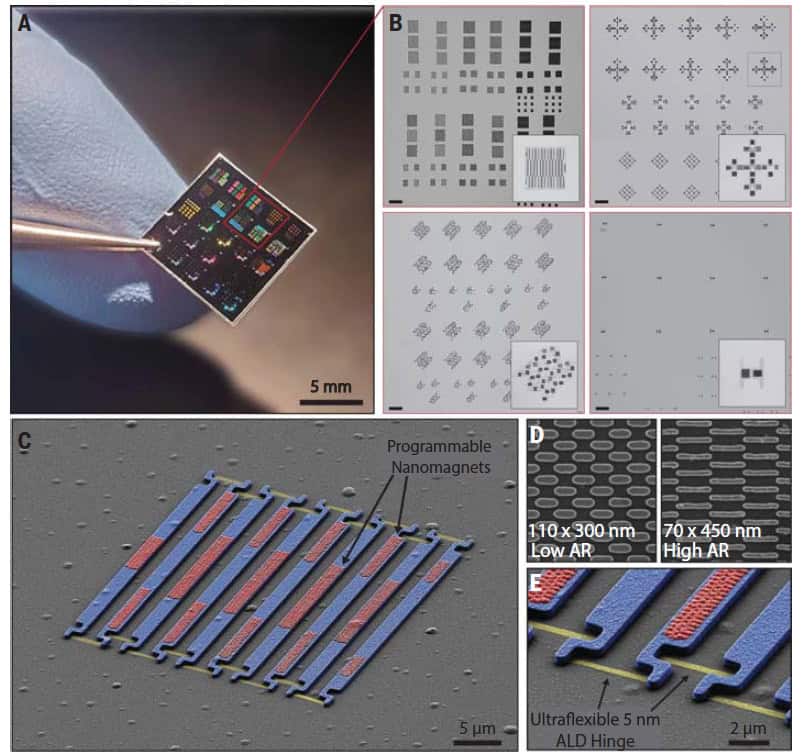
Diffractive robotics platform (A) 10×10 mm chip containing arrays of diffractive robots. (B) Close-up view of robots with varying sizes and numbers of panels. Scale bars, 50 µm. (C) False-coloured SEM image of the prototypical diffractive robot. (D) SEM of the nanomagnet arrays. (E) ALD hinges. (Courtesy: C L Smart et al. Science 10.1126/science.adr2177)
Microscopic robots with small-scale features that can control light at the microscale offer the potential to probe the microscopic world in more detail – with the scattering of light from such microbots able to induce diffractive optical effects.
To date, this combination of diffractive optics and tuneable mechanics has primarily exploited microelectromechanical systems (MEMS) devices, but creating actuatable microbots with features on the scale of the wavelength of light has been challenging.
To address this challenge, researchers at Cornell University turned to magnetically controlled microbots. While such robots have been developed at millimetre scales, the ability to perform magnetic actuation at the micron scale only became possible recently, due to the creation of protocols that encode magnetic information into microscale robotics and the use of atomic layer deposition (ALD) to create nanoscale hinges that make flexible micromachines capable of advanced navigation.
The team has now created magnetically controlled microbots that operate at the visible-light diffraction limit, so-called diffractive robots.
“A walking robot that’s small enough to interact with and shape light effectively takes a microscope’s lens and puts it directly into the microworld,” says team leader Paul McEuen in a press statement. “It can perform up-close imaging in ways that a regular microscope never could.”
New magnetic microbots
Using nanometre-scale mechanical membranes, rigid panels, programmable nanomagnets and diffractive optical elements, McEuen and colleagues created untethered microbots that are small enough to diffract visible light. They used the ALD hinges to connect the microbot’s rigid panels with magnetically actuatable joints, enabling them to reconfigure and move in millitesla-scale magnetic fields.
The core elements of the diffractive microbots comprise the light-diffracting panels with integrated nanomagnet arrays and the flexible hinges; the platform can also embed optical elements such as an optical diffraction grating. To enable the required mechanical, diffractive and magnetic performance, these integrated elements span several orders of magnitude in terms of their individual scales. The light diffracting grating panels were tens of microns in size, with each panel 1 µm wide, whereas the diffractive grating lines were on the scale of light wavelengths, the hinges had a thickness of 5 nm, and the magnetic domains were in the nanoscale realm.
The hinges played a crucial role, the researchers note, by providing a high degree of flexibility to an otherwise rigid robot. This flexibility allowed the microbots to rotate and reorientate themselves to dynamically change how light is diffracted, focused and redirected.
When manipulated with a magnetic field, the microrobots were able to simultaneously change shape, locomote along a surface and control diffracted light. This locomotion capability was due to the array of nanomagnets integrated into the light-diffracting grating panels.
By selectively controlling the aspect ratio of the nanomagnet domains and programming them using the strength of the external magnetic field, the researchers could control the movement of the microbots – including crawling forward on a solid surface and “swimming” through fluids while simultaneously steering and diffracting light.
“These robots are 5 microns to 2 microns,” says co-author Itai Cohen. “They’re tiny. And we can get them to do whatever we want by controlling the magnetic fields driving their motions.”
The researchers note that the tuneability of the optical elements could be further improved by adding more magnetic material to the microbots and/or increasing the size of the magnetic fields used to control them. And while this study centred around individual microbots, it should also be possible to use multiple microbots in magnetically actuated robot swarms to introduce collective optical effects.
Potential applications
As a generalized robotics platform, the microbots could easily be modified and produced with differing sizes, geometries and optical elements according to the intended application. Some key optical elements that could be integrated include meta-atoms, subwavelength apertures and plasmonic resonant probes.
The researchers have already demonstrated that the microbots have capabilities including force sensing with piconewton sensitivity, subdiffractive imaging using a type of structured illumination microscopy, and light beam steering and focusing using tunable diffractive optical elements. Other potential applications include endoscopic imaging and tissue ablation, high-resolution fluorescence microscopy of cells, and the high-resolution sensing of magnetic fields and current in integrated circuits.
Physics takes us from the far reaches of the universe to the subatomic scale. A passion for physics also takes us further than we imagined possible, building skills that set us up for life, no matter what path we follow in our careers.
If you’re a physicist or physics professional, your drive for the subject is invaluable. By sharing your passion, you show others how far physics could take them. It can be intimidating, but outreach is vital for nurturing the next generation of physicists, promoting public understanding of science and building a skilled physics community.
Outreach is also an important part of the mission of The Ogden Trust – a UK-based charitable organization that promotes the teaching and learning of physics. The trust has been supporting university physics outreach since 2005, with nearly all universities in England that offer physics undergraduate degrees – and several in Scotland and Wales too – having worked with the trust.
As well as providing funding for public engagement and outreach initiatives, the trust also supports universities through the Outreach Officer Network and annual Outreach Awards. So as a physicist, how can you get involved in outreach? Here are some tips and case studies to inspire you along your journey.
Starting out strong
Just as collaboration and shared tools are vital for physics research, there is also a wealth of support that physicists interested in outreach can draw on. No matter how ambitious your idea is, remember that others have been in your position before. Accessing shared resources and training will make starting out much easier (see box on the Physics Mentoring Project).
You could begin by signing up for The Interact Symposium, a biennial event for physical scientists seeking to gain new skills and share their experiences of public engagement. Run by the Science and Technology Facilities Council (STFC), the Institute of Physics (IOP), The Ogden Trust, the Royal Astronomical Society and the South East Physics Network (SEPnet), a bank of resources from the 2024 symposium is available online, including lots of examples of successful projects.
Meanwhile, many departments in universities, schools and workplaces have a specialist outreach co-ordinator whose experience you could tap into. If there isn’t, you might have a more experienced colleague who can advise you and share community or school links. You could also contact your local IOP branch committee or join the IOP’s Physics Communicators Group.
As with any scientific endeavour, it’s important to do your research. Attending local science festivals and community events will give you great ideas and inspiration. One day, they may even provide an opportunity to deliver your own outreach.
The Physics Mentoring Project
Set up in 2019, the Physics Mentoring Project is a collaboration across Wales – led by Cardiff University – that mentors school students, encouraging them to continue studying physics. It has so far delivered more than 7000 hours of mentoring in 36% of all secondary schools in the country.
Students at any of the eight participating universities who have a post-16 qualification in a physical science can sign up as a mentor. All receive a weekend of intense interactive training that covers mentoring theory, relationship building, and session planning, as well as safeguarding and health and safety.
Now in its seventh year, the project has developed into an active network. Mentors have access to an online community with peers and the project team. There are also “lead mentors” who give extra support to a small group of mentors (both new and experienced).
“[My] confidence in public speaking and the confidence in articulating points has come on leaps and bounds,” reported one mentor on the project. “Mentoring helped me understand a bit more about what teaching will be like,” added another.
Originally aimed at 15 and 16-year-olds, the project also mentors 17–18-year-olds doing A-levels and focuses on alternative routes into physics. Optionally, mentors can even take a Level 4 Unit in Increasing Engagement with Physics Through Mentoring, accredited by Agored Cymru as part of the Credit and Qualifications Framework for Wales.
The Physics Mentoring Project won an Ogden Outreach Award in 2022 for “supporting undergraduate ambassadors”.
Strategic thinking
So, you’ve tried outreach for the first time and are eager to do more. It’s tempting to jump straight in. But before making any big commitments, it is worth making a long-term strategic plan.
Your department might have an engagement-specific strategy or other priorities that could be linked to your activities. If there is a dedicated outreach or public engagement professional in your organization, they can advise on this. If your workplace doesn’t have a strategy for outreach and engagement, you could advocate for one to be written (see box on the Institute of Cosmology and Gravitation, University of Portsmouth, UK).
In the UK, the quality of research in higher-education institutions is assessed by the Research Excellence Framework (REF), the results of which informs research funding allocations. Part of the exercise considers the impact of research on people, culture and environment. In REF 2021 around half the impact case studies submitted featured outreach and engagement activities.
In 2021 The Ogden Trust released the Taking a Strategic Approach to Outreach guide. In partnership with the STFC, the trust also funds an annual leadership training course for outreach and public engagement which equips academics and teaching staff with the skills to plan and deliver effective outreach.
The Institute of Cosmology and Gravitation
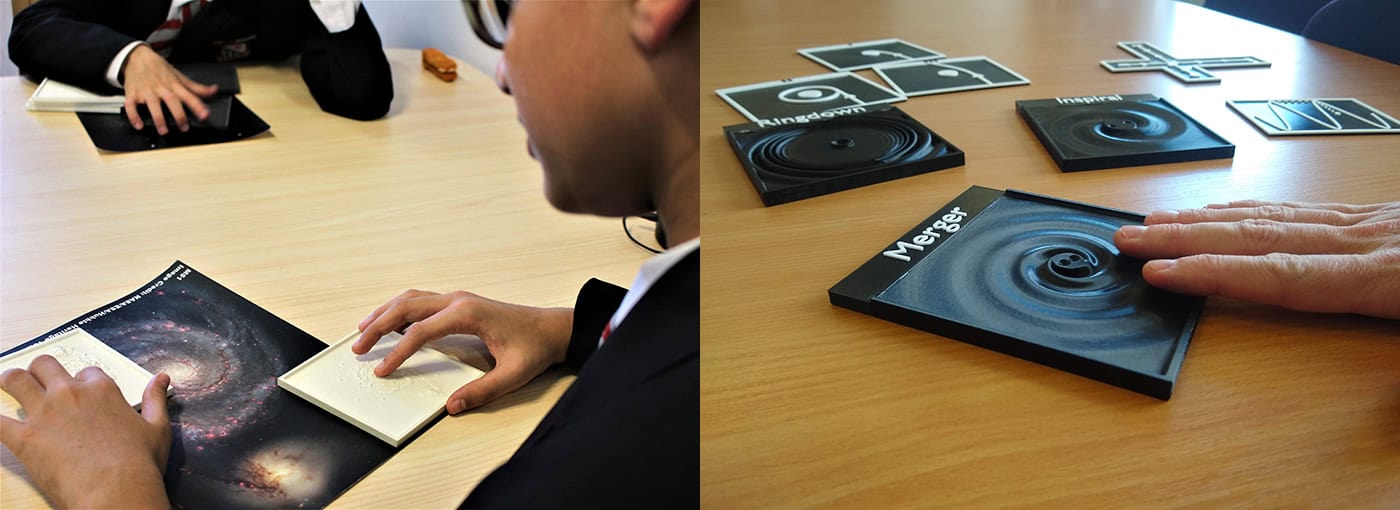
A feel for cosmology Students using 3D models of galaxies as part of the Tactile Universe outreach programme, which delivers events and resources to engage the visually impaired community with astronomy. (Courtesy: Glenn Harris, 2019; Coleman Krawczyk, 2023)
In 2017 the Institute of Cosmology and Gravitation (ICG) at the University of Portsmouth, UK, introduced an outreach and public engagement strategy, which has since guided significant changes in Portsmouth. The strategy was a short, easy-to-use resource, intended as a working document that could be updated if needed. It outlined outreach and engagement goals over a five-year period, with budget and staffing allocated accordingly.
A crucial part of the process involved consulting people across the department, particularly the ICG directors and those doing innovation and impact work, as well as external supporters of the department’s outreach and public engagement.
Since the strategy was introduced, the department has created a new school outreach programme focusing on a small number of schools where the need for outreach is greatest. The ICG has also invested significantly in Tactile Universe, a project that engages visually impaired school pupils with astronomy research (see pictures).
Thanks to this new approach, outreach and public engagement have become firmly embedded in the ICG. An updated OPE strategy was introduced in 2022.
At this point, you should also consider whether you have all the resources you need. It is often possible to deliver activities with equipment from your institution but, as you do more, the cost of travel, time and equipment can add up. You may be able to fund activities from your existing budgets, particularly if they are closely related to your work. However, you may also need to consider external funding opportunities.
Engagement funding is available through a number of organizations. For example, the STFC has created the Spark awards (£1000–15,000), Nucleus awards (£15,000–125,000) and other grants to engage the public with STFC science. The IOP public-engagement grant scheme awards £500-4000 to improve young people’s relationship with physics. The Royal Academy of Engineering, meanwhile, has its Ingenious grant scheme, which offers funding of £3000–30,000 for projects that engage under-represented audiences.
Remember that while one-off outreach activities can spark your audience’s interest, building long-term partnerships is often more effective. Outreach work with schools is ideally suited for this kind of approach – in fact, regular interactions with a school can tackle systemic inequalities in UK STEM education (see box on Orbyts).
Orbyts
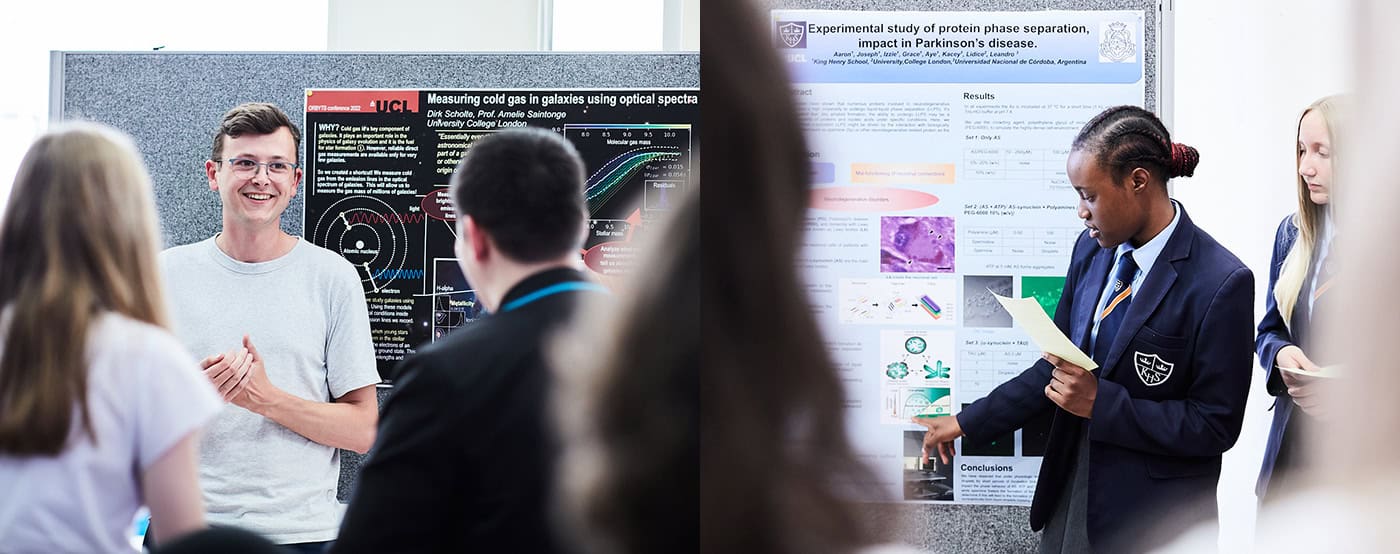
Out of this world Students participating in the Orbyts outreach programme, where universities partner with schools on research projects. (Courtesy: Orbyts)
Orbyts links university researchers with pupils in some of the most deprived areas of the UK, empowering them to do original research. Projects last a minimum of five months and involve regular meetings between pupils and researchers. Orbyts projects currently run in three universities across England and received funding from The Ogden Trust to scale their approach.
So far, Orbyts has created over 100 partnerships between researchers and schools, enabling more than 1500 school students to undertake research projects. Topics have included life in the universe, black holes, quantum computing and cancer. Here are some comments from those involved.
“In a tough year with significant professional challenges to overcome, this has been a real “get me out of bed in the morning” kind of project.” Orbyts partner teacher
“The high-level provision offered by the Orbyts researchers raised enthusiasm and interest in STEM disciplines among our students. The researchers introduced our students to Python programming, as well as analysis and interpretation techniques of large data sets, skills that are of fundamental importance at research level in all areas of physics and STEM. Several of the female students taking part in Orbyts decided to apply to physics at university. They were inspired by the content and the overall experience, as well as by the high-calibre female researchers from Orbyts who visited our school every week for several months and acted as role models for them. Most of the students who took part in 2021/22 are now studying physics, engineering or material science at universities. Their participation in Orbyts was pivotal in making informed decisions about their academic future.”
Physics and maths teacher, Newham Collegiate Sixth Form, UK
“I’ve been fortunate enough to have been a part of Orbyts for the last two years. It has helped me gain invaluable skills and develop as a researcher in more ways than I ever expected. Orbyts has enabled me to gain confidence and ownership in my research, as well as providing opportunities to project manage and improve my public speaking and teaching skills in a proactive yet fun way. Working with students on an Orbyts project has been one of the most rewarding experiences of my research career. It has been incredible to see the students become more confident in their work and become enthusiastic researchers themselves across the short 14-week programme.” Shannon Killey, space physics PhD student, Northumbria University
You should also think about your target audience. A lot of physics engagement takes place in schools but partnerships with community organizations can reach those who may not attend science festivals or talks. There may be an increased willingness to engage in physics outside of the classroom, where it can capture the imagination of young people who find a school environment challenging (see box on My Place, My Science).
My Place, My Science
My Place, My Science is an initiative to support young people of African and Black Caribbean heritage in the UK to enjoy science and build cultural connections. It is a partnership between the physics, rheumatology and biochemistry departments at the University of Oxford, the History of Science Museum and the community organization African Families in the UK (AFiUK).
Launched in 2023, My Place, My Science has delivered a programme of activities where participants learn about topics including stargazing, magnets and sickle cell disease. It was also the winner of the Ogden Outreach Award for Engaging Communities in 2024.
“AFiUK has a deep understanding of local needs, priorities, and challenges,” says Sian Tedaldi, outreach programmes manager in Oxford’s physics department. “This understanding continues to shape and inform the development of the project. They have provided a familiar and trusted organization for participants, leading to greater participation and impact.”
“I have developed a toolkit of interactive activities to engage audiences with planetary research. I have been able to reach thousands of young people, families and adults through my work and have engaged with traditionally under-represented groups within physics, such as girls and children from disadvantaged backgrounds. I love talking to young people about space and the opportunity to speak with the enthusiastic and curious AFiUK community has been incredibly rewarding.” Katherine Shirley, planetary-physics postdoc at the University of Oxford
Steps to success
As with any activity in which you are investing your time and energy, it is important to know whether you are achieving your outreach goals. Having a clear strategy will give you a clear idea of what success looks like, but effective evaluation should also be built into your project from the start.
This will also be valuable if you have to justify the time and money spent on a project or make funding applications. The STFC has a useful public engagement evaluation framework that you can follow. The Ogden Trust has also published an evaluation toolkit for working with young people that uses the science capital framework.
Bear in mind that evaluation doesn’t always mean surveys and quantitative data. You might instead get verbal feedback from participants or ask someone else to observe you. In a university, you could consult colleagues in education or social-science departments who are familiar with such methodologies. For larger projects or those for REF or business cases, you could turn to an external evaluator to provide an independent perspective.
Crossing divides University outreach officers at a meeting of The Ogden Trust’s Outreach Officer Network. The network provides an opportunity for outreach professionals to share good practice. (Courtesy: Katka Photography, 2022)
Physicists know that their subject impacts everything from space exploration to sustainable technology, but unfortunately many people don’t think physics is for them. Young people from disadvantaged backgrounds, in particular, struggle to see themselves as future physicists. Outreach can make a real difference by showing that you don’t need to belong to a specific group or demographic to be a physicist – all you need is a passion for the subject.
For more information about The Ogden Trust or to sign up for its Physics Outreach Network newsletter, visit its website or e-mail outreach@ogdentrust.com.
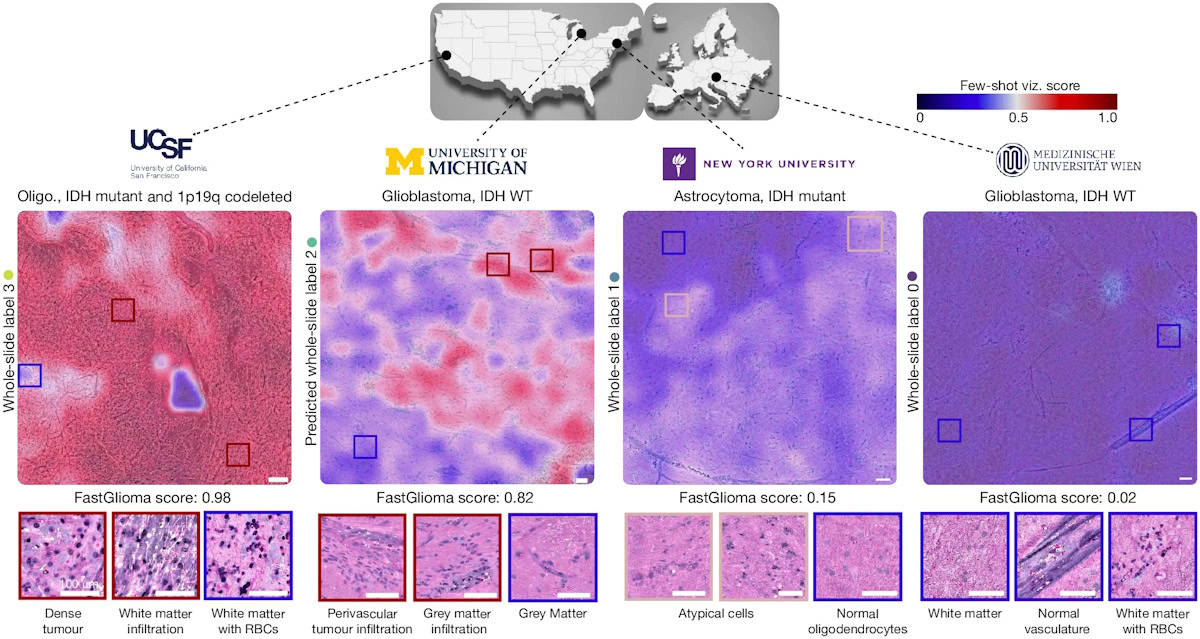
Fast and accurate FastGlioma is an artificial intelligence-based diagnostic system that can detect residual brain tumour that’s often missed during surgery. The image shows various diffuse glioma specimens from the four study centres. Scale bars, 100 μm. (Courtesy: Nature 10.1038/s41586-024-08169-3)
When surgery is performed to remove cancerous tissue, one question always lingers: “did the surgeon get everything?”.
In the case of brain tumour resection, the answer is often “no”. Residual cancerous tissue at the edges of a cavity where a malignant mass has been removed can visually resemble healthy tissue and be overlooked, or may be microscopic in size.
A new tool for neurosurgeons, designed for fast and accurate detection of microscopic brain tumour infiltration in unprocessed tissue samples from surgical margins, may lead to a new era of success for brain cancer surgery.
The developers of the new FastGlioma tool, at the University of Michigan and the University of California, San Francisco (UCSF), explain that it can predict if and the extent to which glioma remains in the brain while the surgical procedure is underway. FastGlioma also provides visual heat-map guidance of the location(s) requiring additional reaction for safe maximal tumour removal.
FastGlioma combines rapid, easy-to-use stimulated Raman histology (SRH) optical imaging with open-source visual foundation models (artificial intelligence models trained on massive, diverse datasets that can be adapted for a wide range of tasks) to perform a 10 s analysis of fresh tissue specimens in operating room suites. FastGlioma proved not only significantly faster and cheaper than conventional standard-of-care MRI- and fluorescence-based surgical guidance, but in head-to-head comparisons, it significantly outperformed them in detection of two types of glioma (IDH wild-type and IDH-mutant diffuse gliomas).
Training and validation
In a prospective multicentre clinical study, principal investigators Todd Hollon of the University of Michigan and Shawn Hervey-Jumper from UCSF and co-researchers trained and validated FastGlioma to detect microscopic tumour infiltration in an international cohort of patients. They explain that “foundation modelling had not been previously investigated in studies on the clinical applications of SRH”, adding that they focused on tumour infiltration “as the most clinically important and ubiquitous problem in cancer surgery”.
The researchers trained FastGlioma using 11,462 whole-slide SRH images, divided into around four million unique 300×300 pixel SRH patches, acquired from 2799 patients undergoing surgery for suspected central nervous system tumours and/or epilepsy. They validated the model using a dataset of 3560 whole-slide images (852,000 patches) from 896 patients. Diagnostic classes of the dataset included normal brain, high-grade glioma, low-grade glioma, meningioma, pituitary adenoma, schwannoma and metastatic tumour. A subset of these had tumour infiltration categorized, ranging from normal brain to dense infiltration.
The researchers also developed a rapid visualization strategy, called few-shot visualizations. Based on FastGlioma’s self-supervised training, few-shot visualizations use a small support set of physician-selected SRH patch examples, representing a diverse selection of diffuse gliomas and normal brain parenchyma. By comparing feature similarity between the support set and the tissue sample being analysed, FastGlioma creates both a tumour-infiltration score and infiltration heat maps.
Prospective clinical testing
To test the fine-tuned FastGlioma model, three medical centres – UCSF, NYU Langone in New York City and the Medical University of Vienna – enrolled 220 patients with suspected diffuse gliomas who underwent tumour resection.
FastGlioma could detect and quantify the degree of tumour infiltration with an average accuracy of 92.1%. The tool maintained accurate tumour-infiltration scores despite significant cytological and histoarchitectural differences related to tumour grade, molecular genetics, treatment effect or WHO subtypes.
The primary end point for the study, reported in Nature, was to validate the accuracy and reproducibility of FastGlioma across various patient populations, demographics, medical centres and World Health Organization (WHO) diffuse glioma molecular subgroups. Additionally, the team aimed to compare the performance of FastGlioma with standard-of-care methods for intraoperative tumour-infiltration detection during brain tumour surgery.
To achieve this, the researchers evaluated FastGlioma as a surgical adjunct in a subset of 129 patients. Neurosurgeons sampled surgical margins at their discretion. Following SHR-imaging during the surgical procedure, the resected specimens were preserved for subsequent microscopic analysis. Expert neuropathologists scored each SRH image postoperatively to provide ground truth tumour-infiltration scores. FastGlioma significantly outperformed conventional methods, with only a 3.8% tumour miss rate, compared with a 24% miss rate for current standard-of-care surgical guidance methods.
Another benefit is that the analytic speed of FastGlioma provides a rapid and scalable alternative to conventional intraoperative pathology methods. The researchers point out that visual foundation models like FastGlioma also minimize reliance on radiographic features, contrast enhancement or extrinsic fluorescent labels to optimize the extent of resection.
The researchers also note that FastGlioma can accurately detect residual tumour for several non-glioma brain tumours, including paediatric brain tumours. “FastGlioma represents the transformative potential of medical foundation models to unlock the role of artificial intelligence in care of patients with cancer,” they write.
Future research will focus on applying a similar workflow to other human cancers, including lung, prostate, head-and-neck and breast cancer.
A cutting-edge experiment that probes the internal structure of the neutron has been done at Jefferson Lab in the US. An international collaboration used the CEBAF Large Acceptance Spectrometer (CLAS12) to study the scattering of high-energy electrons from a deuterium target. The team measured generalized parton distributions, which provide a detailed picture of how the neutron’s constituent quarks contribute to its momentum and spin. A key innovation was the use of the Central Neutron Detector, a specialized instrument enabling the direct detection of neutrons ejected from the target.
“The theory of the strong force, called quantum chromodynamics [QCD], that describes the interaction between quarks via the exchange of gluons, is too complex and cannot be used to compute the properties of bound states, such as nucleons [both protons and neutrons],” explains Silvia Niccolai, a research director at the French National Centre for Scientific Research, who proposed the idea for the new detector. “Therefore, we need to use unknown but experimentally measurable functions called generalized parton distributions that help us connect the properties of the nucleons (for instance their spin) to the dynamics of quarks and gluons.”
The parton model assumes that a nucleon contains point-like constituents called partons – which represent the quarks and gluons of QCD. By measuring parton distributions, physicists can examine correlations between a quark’s longitudinal momentum — how much of the nucleon’s total momentum it carries — and its transverse position within the nucleon. By analyzing these relationships for varying momentum values, scientists create a tomographic-like scan of the nucleon’s internal structure.
“This experiment is important because it directly accesses the structure of the neutron,” says Gerald Miller at the University of Washington, who was not involved in the study. “A neutron [outside of a nuclei] will decay in about 15 min, so it is difficult to study. The experiment in question used a novel technique to directly examine the neutron. They measured the neutron in the final state, which required new detection techniques.”
Separating quark contributions
Protons and neutrons consist of distinct combinations of up and down quarks: up-up-down for protons and down-down-up for neutrons. Each type of quark is associated with its own set of generalized parton distributions, and the overarching aim of the experimental effort is to determine distributions for both protons and neutrons. This would enable researchers to disentangle the distributions by quark type, offering deeper insights into the contributions of individual quark flavours to the properties of nucleons.
While these distributions are vital for understanding the strong interactions within both protons and neutrons, our understanding of protons is significantly more advanced. This disparity arises from the electric charge of protons, which facilitates their interaction with other charged particles, unlike electrically neutral neutrons. Additionally, proton targets are simpler to prepare, consisting solely of hydrogen atoms. In contrast, neutron experiments target deuterium nuclei, which comprise a neutron and a proton. The interaction between these two nucleons within the nucleus complicates the analysis of scattering data in neutron experiments.
To address these problems, the CLAS12 collaboration utilized the Central Neutron Detector, which was developed at France’s Laboratory of the Physics of the Two Infinities Irène Joliot-Curie (IJCLab). This allowed them to detect neutrons ejected from the deuterium target by high-energy electrons for the first time.
By combining neutron detection with the simultaneous measurement of scattered electrons and energetic photons produced during the interactions, the team gathered comprehensive data on particle momenta. This was used to calculate the generalized parton distributions of quarks inside neutrons.
Spin alignment
The CLAS12 team used electron beams with spins aligned both parallel and antiparallel to their momentum. This configuration resulted in slightly different interactions with the target, enabling the team to investigate subtle features of the generalized parton distributions related to angular momentum. By analyzing these details, they successfully disentangled the contributions of up and down quarks to the angular momentum of the neutron.
The team believes their findings could help address the longstanding “spin crisis“. This is the large body of experimental evidence suggesting that quarks and gluons contribute far less to the total spin of nucleons than initially expected.
“The sum of both the intrinsic spin of the quarks and gluons still doesn’t add up to the total spin,” says Adam Hobart, a researcher at IJCLab who led the data analysis for this experiment. “The only missing piece to complement the intrinsic spin of the quarks and the gluons is the orbital angular momentum of the quarks.”
The team plan to do a new and more accurate experiment that will involve firing electrons at a polarized target in which the nuclear spins of the deuterium all point in the same direction. This should allow the physicists to extract all possible generalized parton distributions from the scattering data.
“More data are needed to get a fuller picture, but this experiment can be thought of as a big step in a huge experimental program that is needed to get a complete understanding,” concludes Miller. “I think that this work will clearly influence future studies. Others will try to build on this experiment to expand the kinematic reach.”
When the Voyager 2 spacecraft flew past Uranus and Neptune in 1986 and 1989, it detected something strange: neither of these “ice giant” planets has a well-defined north and south magnetic pole. This absence has remained mysterious ever since, but simulations performed at the University of California, Berkeley (UCB) in the US have now suggested an explanation. According to UCB planetary scientist Burkhard Militzer, the disorganized magnetic fields of Uranus and Neptune may arise from a separation of the icy fluids that make up their interiors. The theory could be tested in laboratory experiments of fluids at high pressures, as well as by a proposed mission to Uranus in the 2040s.
On Earth, the dipole magnetic field that loops from the North Pole to the South Pole arises from convection in the planet’s liquid-iron outer core. Since Uranus and Neptune lack such a dipole field, this implies that the convective movement of material in their interiors must be very different.
In 2004, planetary scientists Sabine Stanley and Jeremy Bloxhamsuggested that the planets’ interiors might contain immiscible layers. This separation would make widespread convection impossible, preventing a global dipolar magnetic field from forming, while convection in just one layer would produce the disorganized magnetic field that Voyager 2 observed. However, the nature of these non-mixing layers was still unexplained – hampered, in part, by a lack of data.
“Since both planets have been visited by only one spacecraft (Voyager 2), we do not have many measurements to analyse,” Militzer says.
Two immiscible fluids
To investigate conditions deep beneath Uranus and Neptune’s icy surfaces, Militzer developed computer models to simulate how a mixture of water, methane and ammonia will behave at the temperatures (above 4750 K) and pressures (above 3 x 10⁶ atmospheres) that prevail there. The results surprised him. “One morning, I opened my laptop,” he recalls. “When I started analysing my latest simulations, I could not believe my eyes. An initially homogeneous mixture of water, methane and ammonia had separated into two distinct layers.”
The upper layer, he explains, is thin, rich in water and convecting, which allows it to generate the disordered magnetic field. The lower layer is magnetically inactive and composed of carbon, nitrogen and hydrogen. “This had never been observed before and I could tell right then that this result might allow us to understand what has been going on in the interiors of Uranus and Neptune,” he says.
A plastic polymer-like- and a water-rich layer
Militzer’s model, which he describes in PNAS, shows that the hydrogen content in the methane-ammonia mixture gradually decreases with depth, transforming into a C-N-H fluid. This C-N-H layer is almost like a plastic polymer, Militzer explains, and cannot support even a disorganized magnetic field – unlike the upper, water-rich layer, which likely convects.
A future mission to Uranus with the right instruments on board could provide observational evidence for this structure, Militzer says. “I would advocate for a Doppler imager so we can detect the planet’s natural oscillation frequencies,” he tells Physics World. Though such instruments are expensive and heavy, he says they are essential to detecting the presence of the predicted two ice layers in Uranus’ interior: “Like one can distinguish between an oboe and a clarinet, these frequencies can tell [us] about a planet’s interior structure.”
A follow-up to Voyager 2 could also reveal how the ice giants’ structures have evolved since they formed 4.5 billion years ago. Initially, their interiors would have contained only a single ice layer, and this layer would have generated a strong dipolar magnetic field with well-defined north and south poles. “Then, at some point, this ice separated into two distinct layers and their magnetic field switched from dipolar to disordered fields that we see today,” Militzer explains.
Determining when this switch occurred would help us understand not only Uranus and Neptune, but also ice giants orbiting stars other than our Sun. “The most common exoplanets discovered to date are around the same size as Uranus and Neptune, so when we observe the magnetic field of such ‘sub-Neptune’ exoplanets in the future, we might be able to say something about their age,” Militzer says.
In the near term, Militzer hopes that experimentalists will be able to test his theory in extremely-high temperatures and pressure fluid systems that mimic the proportions of elements found on Uranus and Neptune. But his long-term hopes are pinned on a new mission that could detect the predicted layers directly. “While I will have long retired when such a detection might eventually be made, I would be so happy to see it in my lifetime,” he says.
The orbital angular momentum states of light have been used to relate quantum uncertainty to wave–particle duality. The experiment was done by physicists in Europe and confirms a 2014 theoretical prediction that a minimum level of uncertainty must always result when a measurement is made on a quantum object – regardless of whether the object is observed as a wave, as a particle, or anywhere in between.
In the famous double-slit thought experiment, quantum particles such as electrons are fired one-by-one at two adjacent slits in a barrier. As time progresses, an interference pattern will build up on a detector behind the barrier. This is an example of wave–particle duality in quantum mechanics, whereby each particle travels through both slits as a wave that interferes with itself. However, if the trajectories of the particles are observed such that it is known which slit each particle travelled through, no interference pattern is seen. Since the 1970s, several different versions of the experiment have been done in the laboratory – confirming the quantum nature of reality.
Richard Feynman once described this as “a phenomenon which is impossible, absolutely impossible, to explain in any classical way, and which has in it the heart of quantum mechanics. In reality, it contains the only mystery [of quantum mechanics].” This phenomenon is known as measurement uncertainty.
Partial particles
In 1979, William Wootters and his colleague Wojciech Zurek at the University of Texas at Austin showed that wave–particle duality is not a one-or-the-other phenomenon. Instead it is possible to observe partial particle and partial wave-like behaviour, with a trade-off between the two.
This echoes another baffling element of quantum mechanics, namely preparation uncertainty. This is typified by Werner Heisenberg’s uncertainty principle. This states that one cannot know the position and momentum of a quantum object beyond a certain degree of accuracy, and the more one knows about one, the more uncertain the other becomes.
Despite Feynman’s contention that quantum mechanics contains only one real mystery, however, there is no obvious theoretical connection between measurement uncertainty and preparation uncertainty. In 2014, however, Patrick Coles and colleagues at the National University of Singapore showed theoretically that the two were equivalent. This has never been experimentally demonstrated, however.
Conjugate variables
In the new work, Guilherme Xavier at colleagues at Linköping University in Sweden set out to test the relationship between the visibility and the distinguishability of opposite states – which according to Coles’ predictions should be conjugate variables analogous to position and momentum. They sent highly attenuated, mostly single-photon laser pulses in two possible orthogonal orbital angular momentum states down an optical fibre to an input beamsplitter. Photons with opposite angular momenta emerged through different output fibres.
The researchers then used a phase modulator to add a variable phase delay to photons travelling down one of the paths. They then directed the paths to meet again at a second, tunable beamsplitter.
By placing a second modulator before the tunable beamsplitter and thereby adjusting the phase with which the two paths met, it was possible to tune the extent to which the paths recombined. This allowed them to control the extent to which the second beamsplitter actually behaved as a beamsplitter.
“When the beamsplitter is fully inserted you get interference back – this corresponds to a value in the modulator of π/2,” explains Xavier, “When you have zero in the modulator the upper path will always go to one detector and the lower path will always go to the other.”
Fixed lower bound
This latter case corresponds to a particle picture, but it provides no information about which path a particular particle has taken through the detector. The only way one can obtain that information is to prevent one of the polarizations of light from entering the second beamsplitter completely – the equivalent of blocking one of the slits in the double slit experiment. However, in this case, half of the photons are never detected at all. There is thus an unbeatable trade-off between distinguishability and visibility. They found that, no matter what they chose as the phase, there was a fixed lower bound on the measurement uncertainty that was consistent with the theory presented in 2014 by Coles and colleagues.
The Linköping team plans to develop practical applications of its technology. “We can change the settings quite fast,” says Xavier, “so our goal is to look at the implementation of some actual quantum communication protocols using these kinds of measurements – we are looking at some delayed choice experiments based on this setup.”
Theoretical physicist Jonas Maziero of the Federal University of Santa Maria in Brazil is impressed by the work. “The experiment is innovative, it’s precise, it agrees very well with theory and it confirms an important result that’s been in the literature for more than ten years now,” he says.
He cautions, however, that the work does not fully confirm Coles’ predictions. “The result reported [by Xavier and colleagues] applies to distinguishability based complementarity-based relations that use which-path detectors to quantify the particle-like behaviour of the quantum system. There are others based on predictability and using entanglement that are not contained within this framework.” Extending the research to try to cover all cases would be interesting follow-up work, he says.
“The world is more volatile, the world is more unpredictable, and in many respects the world is a more dangerous place than it has been for a long time.”
In his opening speech at the 20th Appleton Space Conference on 5 December, UK Space Agency (UKSA) deputy chief executive Chris White-Horne seemed determined to out-gloom the leaden skies above the ESA conference centre in Harwell, Oxfordshire. Speaking to an audience of academics and industry professionals, White-Horne ticked off a long list of ways that this more dangerous world might affect the space sector and the people who rely on it.
“We have built an almost insidious dependence on space,” he observed. Severe space weather, accidents, system failures or deliberate damage by an adversary could all trigger a loss of satellite-based position, navigation and timing services. Even a single day without modern essentials like GPS would wreak havoc on the economy, while a longer outage would be devastating. “A day without space is just the beginning,” he warned, adding that the real challenge would start on the second or third day, when supply chains would be disrupted worldwide. “We saw in COVID how very fragile some of these systems are.”
While some might prefer to leave contingency planning to military officials, White-Horne argued that the vulnerability of space infrastructure makes it a challenge for the entire sector – government, academia, and manufacturers and operators of space systems and applications alike. “Very few people can say, ‘It’s not my problem’,” he said.
A changing sector
In his keynote speech later in the day, White-Horne’s boss, UKSA chief executive Paul Bate, struck a more hopeful note by focusing on changes in the space sector since 2004, when the first Appleton Space Conference was held. In that year, the world managed just 54 orbital launches, including 18 by Russia and 16 by the US. By 2024, the number had risen to 225 – and counting. This figure includes 118 launches by a private company, SpaceX, which did not achieve its first orbit until 2008. “How we get into space has changed dramatically,” Bate said.
Space as a team sport: UK Space Agency chief executive Paul Bate giving the keynote lecture at the 20th Appleton Space Conference as audience members and STFC RAL Space director Sarah Beardsley (right) look on. (Courtesy: STFC RAL Space)
Another positive change Bate highlighted is the industry’s demographics. At the start of the conference, Sarah Beardsley, who leads the Rutherford Appleton Laboratory’s space division (STFC RAL Space), displayed a photo of the organizers of the first Appleton Space Conference. The photo showed a smiling group of around a dozen men in dark suits and ties. “We let women in now,” she quipped, to general laughter.
The UKSA’s own demographics bear this out. According to Bate, 46% of the agency’s staff are women, while a fifth come from ethnic minorities. Still, Bate, who is white, acknowledged that the agency needs to do more to attract diverse talent to higher-level roles: “I spend time in far too many meetings with people who look just like me.”
Taken as a whole, Bate said that the UK space sector remains 86% white and 64% male, while the percentage of space-sector workers who were eligible for free school meals as children is half the national average. While some may see this as irrelevant, Bate argued that the opposite is true. Space, he said, is “a team sport” that needs to draw talent from everywhere, and its leaders must embrace diversity of thought and experience if they want to solve big, difficult problems. “It’s very tempting to see science as aloof from societal change,” he said. “The opposite is true.”