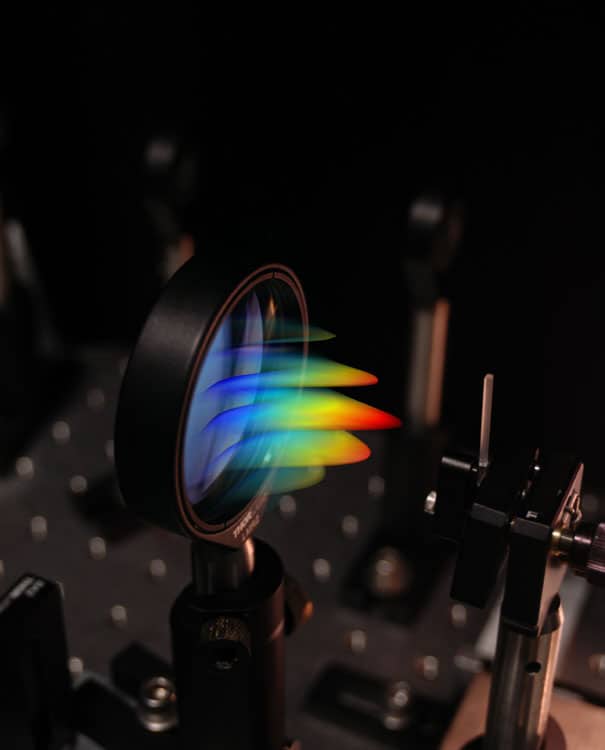
Between the lines

Stephen Hawking, iconoclast

When Kitty Ferguson wrote her first book about Stephen Hawking in 1991, she probably did not expect to write a sequel 20 years later. The world’s most recognizable cosmologist, however, has a knack for confounding expectations – not least those of his doctors, who diagnosed him with motor neurone disease nearly 50 years ago – and his contrarian spirit comes across vividly in Stephen Hawking: His Life and Work. Published to honour Hawking’s 70th birthday this month, Ferguson’s latest chronicle of his oeuvre is somewhat more personal than its predecessors, mixing explanations of wormholes, M-theory and the anthropic principle with brief accounts of his three children, two failed marriages and hectic life as an international scientific celebrity. She has also unearthed a few genuine stunners, including an anecdote about how Hawking “found ways to use shortcuts in taking data and faked parts of the experiments” as an undergraduate at Oxford. On the whole, though, this is very much an “authorized” biography. Ferguson’s tone is largely deferential, and though skirting around Hawking’s second divorce seems forgivable – why interrogate someone about their domestic troubles when you could be asking their views on the universe? – the uncritical marvelling that creeps into the book’s later chapters is a bit hard to take. On a brighter note, her description of Hawking’s evolution as a scientific thinker is really valuable. After his pioneering work on black-hole cosmology in the 1960s and 1970s, Ferguson writes, Hawking underwent a change of heart around 1980, when he told his longtime friend and collaborator Kip Thorne that he “would rather be right than rigorous”. That attitude goes some way towards explaining why Hawking has made grand claims for various unproven (and possibly unprovable) “theories of everything” over the years, and perhaps also why another friend, the physicist Leonard Susskind, once called him “the most stubborn and infuriating person in the universe”. This is not, however, to dismiss Hawking’s achievements. Few would dispute that he is one of the most influential physicists of his generation, and undoubtedly also one of the best at communicating big ideas to the general public. Wisely, Ferguson leaves (almost) the last word in her book to Hawking’s mother Isobel, who observes that “Not all the things Stephen says probably are to be taken as gospel truth. He’s a searcher, he is looking for things. And if sometimes he may talk nonsense, well, don’t we all?”

  • 2011 Bantam Press £20.00/$27.00hb 416pp

Radioactivity redux

The story of radioactivity began with Röntgen’s discovery of X-rays in 1895. Within a few years the Curies had isolated polonium and radium. By 1909 Rutherford was firing alpha particles at gold foil. His student Bohr came up with a working model of the hydrogen atom in 1913 and before too long, the Manhattan Project was building an atomic bomb. This simplified account of radioactivity’s early years will be familiar to many, but as the science historian Marjorie Malley demonstrates in the opening chapters of Radioactivity: a History of a Mysterious Science, it is only part of the story. Indeed, the overwhelming impression one gets from reading Malley’s tale is one of confusion, with everyone from future Nobel laureates to charlatans struggling to understand the strange “emanations” of these unsettled materials. Radioactivity itself has a somewhat confusing structure, with material about industrial applications, health and other topics hived off into separate chapters rather than integrated into the history. There are, however, plenty of interesting facts in these subsidiary chapters, including a lengthy (and, as Malley points out, far from exhaustive) catalogue of how early researchers were harmed or killed by radioactivity. One of the most shocking anecdotes concerns a pioneer of radium manufacturing, the chemist Friedrich Giesel, who ended up with so much radon in his lungs that his breath could discharge electroscopes; unsurprisingly, he died of lung cancer. This worthwhile if imperfect book does justice to him and many other less-well-known figures of early 20th-century science.

  • 2011 Oxford University Press £14.99/$21.95hb 280pp

Season’s greetings


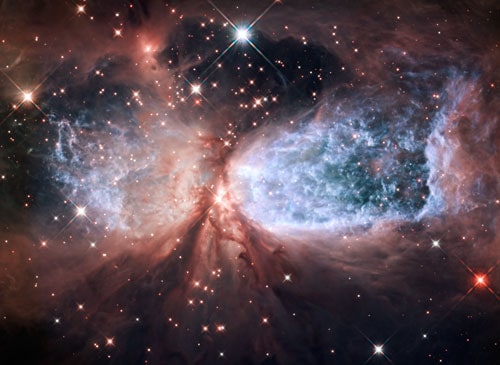
Hubble spots a “celestial snow angel”. (Courtesy: NASA)

By Hamish Johnston

Things are winding down for the holidays here at Physics World headquarters and staff are looking forward to a well-earned Christmas break.

While we are catching up with family and friends, there’s plenty to keep you amused over the holiday period – including this fantastic Hubble Space Telescope image of Sharpless 2-106. Experts will tell you that this is a “bipolar star-forming region”, but at Christmas time it becomes a “celestial snow angel” – at least according to NASA.

Back on Earth, don’t miss our top 10 breakthroughs of 2011. This year’s top slot went to Aephraim Steinberg and colleagues at the Universe of Toronto for their work on the fundamentals of quantum mechanics. We’ve also put together a special podcast counting down our top 10 physics books from the last 12 months.

You can also enjoy a selection of the most stunning pictures of 2011, our favourite videos and a collection of the quirky stories that made us laugh throughout the year.

If you fancy testing your knowledge of they year’s physics events, enter our Quiz of the year 2011 and you could win £100.

Finally, there’s our look forward to 2012, a year that promises so much – thanks in part to the tantalizing announcement last week by physicists working on the Large Hadron Collider.

See you all in the new year, and thanks for your dedicated interest throughout 2011.

What lies ahead for 2012?

For any soothsayer seeking to predict what will happen over the coming year, it is natural to begin by looking back over the previous 12 months – and equally tempting to give the year just gone more importance than it truly deserves. Yet surely historians will look back on 2011 as some kind of turning point, given the unprecedented popular uprisings across the Middle East that have led to new regimes in Egypt, Tunisia and Libya. Many of these protests were helped by the use of social-networking tools that appeared to allow protestors to join forces and co-ordinate their actions. These communication tools were also the theme of the “Occupy” movement against economic and social inequality, which took hold in more than 80 countries as the world’s economies faltered and share prices plunged amid a sovereign debt crisis across Europe.

Whether the use of social-media tools really were the driving force behind these events – some such as Malcolm Gladwell think otherwise – certainly the ability to communicate so easily and instantly is reshaping the world, and physics is no exception. Back in 1983 when physicists at CERN discovered the W and Z bosons, most of the discussion and debate between the two rival experiments at the Super Proton Synchrotron took place sedately behind closed doors, with the final results presented neatly in press conferences in the January of that year. Fast forward to today and as 2011 draws to a close, CERN’s scientists working with its current machine – the Large Hadron Collider (LHC) – no longer had that luxury as evidence began to emerge last week for the elusive Higgs boson.

Despite CERN’s attempts to control what researchers say in public, rumours began flying around of various possible peaks and non-peaks well before the 13 December meeting at CERN where the rival CMS and ATLAS teams presented their newest analyses of the LHC’s myriad proton–proton collisions. Although no definite “discovery” was claimed by either team, the evidence for a Higgs with a mass of about 125 GeV now seems pretty strong. So after years of hard work – most recently by physicists at the now-defunct Tevatron collider at Fermilab in the US and by the LHC – we can make our first prediction for next year: a gold-plated “5σ” sighting of a 125 GeV Higgs. This announcement may come as soon the Moriond winter conference at La Thuile, Italy, in early March, when a deeper and fuller analysis of the LHC’s data is due to be presented. As for the search for supersymmetry, which could unify the weak, strong and electromagnetic forces at energies of about 1016 GeV, watch this space for signs of the supersymmetric particles, or “sparticles”, that it predicts.

Fundamentally speaking

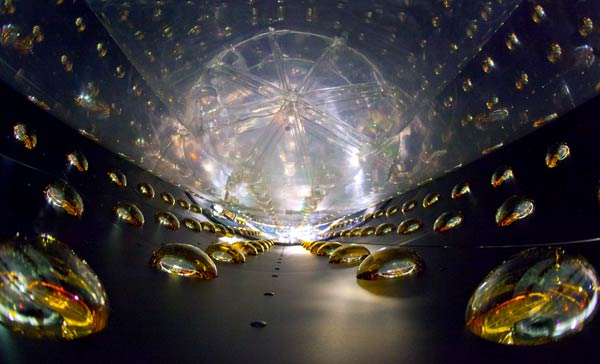
Elsewhere in fundamental physics, the controversy over possible faster-than-light neutrinos will rumble inconclusively on, while the various searches around the world for dark matter – the invisible stuff that makes up about 23% of the mass-energy in the universe – will report further findings but no clear breakthrough. China, though, which is very much a rising star in physics, will complete the final part of the Daya Bay Reactor Neutrino Experiment. Consisting of three underground experimental halls containing identical neutrino detectors, each filled with 20 tonnes of gadolinium-dope liquid scintillator, the experiment is designed to measure θ13 – one of three “mixing angles” that characterize how neutrinos transform, or “oscillate”, from one type to another.

Another subterranean lab nearing completion is the Sanford Underground Laboratory in the former Homestake gold mine in South Dakota, US, into which physicists will start installing their first two experiments sometime in the spring. One will join the effort to spot dark matter, while the other aims to detect the very rare process of neutrinoless double-beta decay, which would reveal that neutrinos are, bizarrely, their own antiparticle.

Get set for lift-off

Other predictions that we can make with reasonable confidence concern a number of intriguing missions in astronomy and space science. Projects in these field are generally planned and developed over years if not decades, with launch slots decided months in advance. First up in February will be NASA’s Nuclear Spectroscopic Telescope Array (NuSTAR), which will allow astronomers to study the universe in high-energy X-rays. August will see the launch of the agency’s Radiation Belt Storm Probes (RBSP) to help us understand the Sun’s influence on Earth and near-Earth space by studying the Earth’s radiation belts, while in December NASA’s Interface Region Imaging Spectrograph (IRIS) is due to take off with the aim of providing “significant new information to increase our understanding of energy transport into the corona and solar wind”. Not to be outdone, the European Space Agency is launching Swarm – a constellation of three satellites different polar orbits at altitudes of 450–550 km – to study the Earth’s magnetic field.

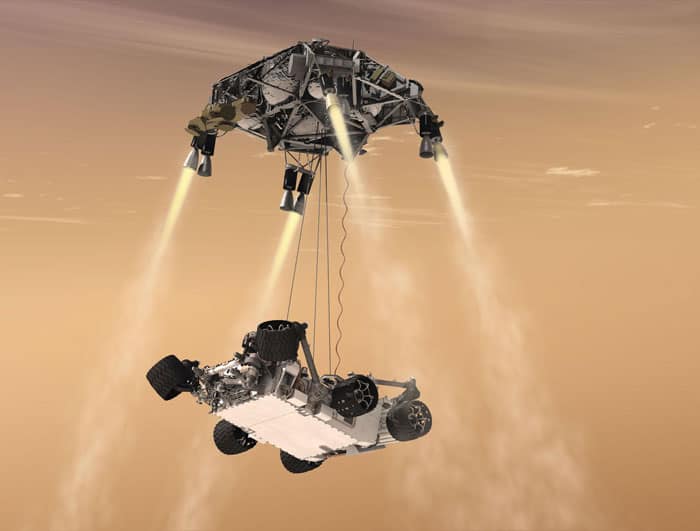
But perhaps the biggest astronomy story of next year will be NASA’s Mars Science Laboratory, which successfully blasted off in November and is due to land on the red planet on 6 August, with its rover Curiosity set to comb the Martian surface for signs of life. Going to Mars has never been easy, however, and with the failure of Russia’s Phobos-Grunt mission earlier this year, NASA will be hoping for better luck with its lander. The agency will also be taking a step into the unknown, for the first time using a private company to ferry supplies up to the International Space Station. NASA will be praying that SpaceX’s unmanned space capsule, Dragon, will do the job that the space shuttle did until it was retired earlier this year. As always, astronomers must hope for the best but be prepared for the worst.

Moments in history

Our next pair of predictions for 2012 are easy to make and concern two anniversaries that will take place next year. The first is the centenary of the discovery of cosmic rays by the Austrian scientist Victor Hess, for which he was awarded the 1936 Nobel Prize for Physics. His work will be commemorated at a number of meetings, including a major event at the University of Denver in Colorado. Next year will also see the centenary of the birth of the mathematician, code-breaker, logician and computer pioneer Alan Turing on 23 June 1912, which is to be celebrated at an international conference in Cambridge from 18–23 June. Although neither anniversary is quite as significant for physicists as this year’s centenary of superconductivity or the “50 years of the laser” celebrations in 2010, both events are still worth looking forward to and will be covered in Physics World magazine.

The forthcoming year will also see a very rare – although entirely predictable – astronomical event known as the transit of Venus, during which the planet will pass directly between the Sun and the Earth. Always occurring in pairs eight years apart, the last transit took place in 2004 and the next will definitely take place (barring some crisis of Newtonian physics) on 6 June next year. The transit can be safely observed with the naked, although protected, eye, so it is well worth watching as the next one will not occur for more than a century – December 2117 to be precise. To whet your appetite, there is even a transit of Venus phone app that will let you send your observations to a global experiment to measure the size of the solar system.

In politics, 2012 will of course see a US presidential election on 6 November at which Barak Obama will almost certainly stand for re-election against a yet-to-be-decided Republican candidate. Being politically neutral, we will not make a call on who deserves to win, but we predict that the Nobel-prize-winning laser physicist Steven Chu, who currently serves as President Obama’s energy secretary, will no longer seek to remain in the job. Four years as head of the US Department of Energy cannot be easy and Chu, 63, will no doubt want to get back to doing some research, with the attraction of his cold-atom lab bench being hard to resist.

Known and unknown unknowns

The beauty of physics is that no-one really has any idea what lies around the corner. If uncovering nature’s secrets were entirely predictable – if there were no “unknown unknowns” – it would not be research. Still, there are sure to be plenty of exciting developments – the “known unknowns” – to look forward to, particularly in the creation of new kinds of invisibility cloaks that can allow events, not just objects, to go undetected, and in the study of the fundamentals of the quantum world through the use of “weak measurements” that probe, but do not disturb, a quantum system. Both these fields were featured in the Physics World top 10 breakthroughs of the year.

We will be following all these – and other – stories on physicsworld.com and in Physics World. We have also got some great special issues of the magazine planned for 2012, focusing on Earth sciences in March, physics and the Olympics (July) and the physics of animals (November), as well as a series of six supplements and special reports on Japan, India, big science, optics, nanotechnology and vacuum science. And, as always, this website will offer another series of online lectures – the first featuring the author of our 2011 Book of the Year, Lawrence Krauss, speaking about Richard Feynman – as well our regular, quarterly books podcasts and video reports from the world’s leading physicists and physics labs.

So, whatever 2012 has in store for physics, you can be sure that we will have it covered.

  • Happy with our predictions? Annoyed at something we missed? Tell us what you think by commenting below


Best of the blog 2011

By Michael Banks

From an argument about whether magnetoreception exists in cows to investigating the best way to board an aircraft, the world of physics has produced its fair share of quirky stories this year. Here is our pick of the best from the physicsworld.com blog.

A load of bull, part 2
Beef over magnetic cows keeps on sizzling

cow.jpg


Do cows align their bodies along the Earth’s magnetic-field lines while grazing? Yep, that is the latest controversy and what zoologist Hynek Burda from the University of Duisburg-Essen in Germany is now calling a “holy war against magnetoreception”. The carfuffle began in 2008 when Burda and colleagues, led by Sabine Begall, shocked the bovine world by claiming that cattle prefer to align their bodies along the Earth’s magnetic field – that is, along north–south lines. Then, earlier this year, Jirí Hert from Charles University in Prague and co-workers reported that there is no evidence for such alignment, following a Europe-wide study of 3412 individual cows in 322 herds. In November Begall’s group hit back, re-analysing all the data used by Hert and co (Journal of Comparative Physiology A 10.1007/s00359-011-0674-1) and arguing that about half of Hert’s data are actually noise – that the resolution of corresponding images is too poor, or the cattle are on slopes or in other locales that could affect their orientation. Look out for the next salvo soon.

Hawking meets the queen of the galaxy

Stephen Hawking’s annual pilgrimage to the California Institute of Technology seems to be turning into quite a celebrity tour. In early February the 69-year-old cosmologist met the actress Jane Fonda – known for her starring role in the science-fiction movie Barbarella: Queen of the Galaxy. Hawking presented Fonda with a large bouquet of flowers backstage at the Ahmanson Theatre in Los Angeles, where the 73-year-old actress is starring in the play 33 Variations, which is about how Beethoven created the piano composition Diabelli Variations. Thanks to Fonda’s blog, we are treated to a toe-curling account of the meeting, which so thrilled the cast and crew that “Michael, the head of the costume department, was shaking with emotion”. After quizzing Hawking about how he has continued to work despite his illness, Fonda then gave “the great physicist” her e-mail address so she can meet him during his next trip to Caltech. The encounter ended with Hawking telling the Oscar-winning actress that she was his “heart-throb” for her performance in Barbarella. “I almost fainted and everyone broke into laughter,” recalled Fonda, who went home “enlivened and inspired”.

A sad end for the Superconducting Super Collider

ssc.jpg

Most physicists are, of course, a law-abiding bunch. However, during the March Meeting of the American Physical Society (APS) in Dallas, Texas, five physicists took a break from the gruelling conference schedule to break into the derelict site of the Superconducting Super Collider (SSC) just south of the city. Conceived in 1983, the SSC was to be the next big particle collider, with a circumference of 87 km and a maximum collision energy of 40 TeV. But 10 years later the project was cancelled, leaving a few buildings on the surface as well as tens of kilometres of tunnels deep underground. After getting into the site and investigating the abandoned buildings, the physicists, who wish to remain anonymous, blogged about their findings and posted photographs on the Web. “We wanted to see what was left after 17 years,” one SSC interloper told physicsworld.com. “What happens to a science experiment of this size when the government no longer chooses to fund it?” According to the clandestine intruders, the tunnels are well below the water table and are therefore flooded, while many unopened crates containing electronic equipment are lying around.

cake.jpg

Zero resistance to cake

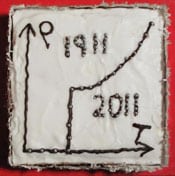
To mark this year’s 100th anniversary of the discovery of superconductivity Ted Forgan and his condensed-matter group at Birmingham University in the UK celebrated in style with their very own “zero-resistance cake”. Apparently, comments about the cake included “Does it contain super currants?”, “Does it contain pears?” and the less obvious “Is it a Butter–Chocolate–Sugar supercake? (maybe this depends on Tc, the cooking temperature)”. Clearly, superconductivity brings out the puns in everyone.

Mystery of the riderless bike thickens

The riderless bike is a fairly well-known quirk of mechanics. It refers to the fact that regular bicycles can keep going by themselves for long distances without ever toppling over. But a new bike created this year by researchers in the US and the Netherlands has cast doubt on our understanding of what causes this effect. The mechanics behind it are not as simple as one might think, but most researchers agree that the stability is caused by two features. First, there is gyroscopic motion, which causes the front wheel to correct itself like a spinning top. Then second, there is the “trail” or “caster” effect, which also explains why the front wheel of a shopping trolley automatically turns to follow the pivot. Now, a team including Andy Ruina at Cornell University has put conventional wisdom aside and created a bike that self-balances without relying on these forces – the first of its kind.

Gorilla inspired by the work of Roger Penrose

Tensor1.jpg

Say hello to Tensor. He was one of a band of 60 life-sized decorated gorillas that appeared around Bristol to celebrate Bristol Zoo’s 175th anniversary this year. In 2010 the organizers of this public art exhibition approached IOP Publishing (which publishes physicsworld.com) to ask if it would like to sponsor and design a gorilla for the show. The challenge was taken on by in-house artist Fred Swist, collaborating with art director Andrew Giaquinto, and the pair came up with the idea of using the graphical tensor notation – as inspired by the UK mathematical physicist Roger Penrose. These pictorial elements, used in physics and pure maths, comprise simple shapes connected by lines. In addition to entertaining Bristolians and visitors to the city, the exhibition was also designed to promote the zoo’s gorilla conservation project and Wallace and Gromit’s Grand Appeal, which raises funds for the Bristol Royal Hospital for Children.

How to board an aircraft in a hurry

Mumbai one month, Moscow the next. Physicists are used to flying to conferences, so it should come as no surprise that they have turned their attention to the issue of how to get on a plane as quickly as possible. In 2008 Fermilab physicist Jason Steffen devised a “theory” that the best way for passengers to board is back to front, but in such a way that adjacent passengers in the queue are seated two rows apart (12A followed by 10A and 8A, for example). By using a mock fuselage of a Boeing 757 aircraft, which contained 12 rows of six seats with one aisle running up the middle, Steffen has put his theory to the test in a pioneering experiment performed earlier this year. Using “passengers” ranging in age from 5 to 65, Steffen found boarding using his method took only three and a half minutes. Boarding the plane in row-number blocks – with passengers seated at the rear section going first – took around seven minutes. Glad that’s sorted then.

The Big Bang on the big screen

Did you manage to catch the noir film The Big Bang, which was released in the US in May? Starring Antonio Banderas as private detective Ned Cruz and directed by Tony Krantz, the film features Cruz searching for a missing stripper while contending with unsavoury Russian boxers and brash police detectives. And the physics connection? As well as an eatery called Planck’s Constant Café, the film features an underground particle-physics lab built by Simon Kestral (played by Sam Elliott) to search for the Higgs boson. The film has enjoyed less than favourable reviews – the New York Times called it a “jumble of notions tossed into a hat” with the movie being a “low point for Mr Banderas”. From the trailer, the physics in the film seems to be fairly accurate, which at least makes a change.

Space shuttle rap
Hubble rap
The climate science rap

No end of year review would be complete without a musical outro. So take your pick from the best that this year has had to offer. First up came the Edwin Hubble rap by the “science rapper” Zach Powers, which describes the discovery of the expanding universe. Then with the launch of the last and final flight of the Space Shuttle in July, a video emerged (see above) featuring a group of youths dressed in NASA jumpsuits rapping about the history of the Space Shuttle programme. Then finally there was the climate-change rap featuring lines such as “climate change is caused by people, Earth unlike Alien has no sequel”. We have probably missed some other rap videos that emerged this year, but that might not be such a bad thing.

You can be sure of more quirky stories – and raps – from the world of physics next year. See you in 2012!

Will the Higgs and superluminal neutrinos be confirmed in 2012?

By James Dacey

Physics World has unveiled its top 10 breakthroughs of the year with the top spot going to an ingenious experiment on the fundamentals of quantum mechanics, performed by a group of researchers at the University of Toronto in Canada. The nine runners up include breakthroughs across a range of physics, including astronomy, optics and quantum computing.

hands smll.jpg

Two things not on our list, however, are the recent announcements that have spurred great excitement both within the physics community and far beyond it. The first being the results of the OPERA collaboration in which neutrinos appear to travel faster than light when fired between the CERN particle-physics lab near Geneva and the Gran Sasso underground lab in central Italy. The second is the announcement last week that physicists working at CERN’s ATLAS and CMS detectors may have caught their first tentative glimpses of the long-sought Higgs boson.

Our reason for not including these results in our list is that while they pose some incredibly exciting questions for physics, they are not as yet bona fide research discoveries. But that is not to say that ongoing experimental and theoretical work will not lead to more concrete results next year. So we want to hear your thoughts on this matter. In the final poll of the year we are asking the following question:

Which of the following is most likely to become a confirmed discovery in 2012?

The Higgs boson
Neutrinos travel faster than light in a vacuum
Both
Neither

To cast your vote, please visit our Facebook page, and feel free to explain your answer by posting a comment.

In last week’s poll we asked you a question related to another of our end-of-year-lists, namely our top 10 popular-physics books reviewed in 2011. The honour of topping this list went to Lawrence Krauss for his biography of Richard Feynman, entitled Quantum Man. You can see the full list in this news article and you can hear about all the books in this special podcast presented by myself along with Margaret Harris (Physics World‘s books editor) and Matin Durrani (Physics World‘s editor).

One thing that came out of our debates when drawing up this list was the acceptance that there will always be an element of subjectivity in this kind of exercise. After all, the beauty of a great book is that it can inspire readers in different ways. So in our poll we asked you the question: When reading popular-science books, what do you find most stimulating?

The results showed that respondents appear unafraid of getting their teeth stuck into some solid science, as 48% of people chose the option “the technical details underpinning the science”. 24% said they get more inspiration from “the sense of wonder conveyed by the author”. 15% prefer to read about “the impact of science on culture and society”. Just 13% said they prefer to read about the “personal stories of the scientists”.

Patrick Andrews, one pollster based in the UK who opted for the technical details, commented: “The fact that this genre exists at all shows that many people want to understand. Why are so many science books so unpopular? Surely because they fail to deliver clear, pithy explanations.” A different perspective was offered up by Dean Smith, also in the UK, who favours writing that focuses on the impact of science on culture and society, and wrote: “If you wanted vast detail then you should read a journal. When the author describes the effect of a discovery on culture and society it is something everyone can read, understand and debate with reasonable understanding.”

Thank you for all your responses and we look forward to hearing from you again in this week’s poll.

Our favourite pictures of 2011


Nature’s building blocks brought to life

No, it is not a piece of modern art, though it would not be a stretch of the imagination to see these colourful images up on your wall. These figures are part of a new project to create a periodic table of shapes that could become a useful resource for mathematicians and theoretical physicists. It is a collection of shapes across three, four and five dimensions that cannot be broken down into simpler shapes. Researchers find these basic building blocks of the universe, known as “Fano varieties”, by looking for solutions to string theory, which assumes that in addition to space and time there are other hidden dimensions.

The Scholar and the Caliph

It is not often that comic-book-like illustrations appear in Physics World, but this story really leant itself to them. This panel is one of three that features in a fictional re-imagining of a 10-year period in the life of the medieval Muslim polymath Ibn al-Haytham (AD 965–1040), who is considered by many historians to be the father of modern optics. This year marks the millennial celebration of his magnum opus Kitab al-Manazir (Book of Optics).

Tiny water hammers bash blades

This colour-enhanced image shows a droplet of water being deposited on a “superhydrophobic” silicon surface. A pressure wave is beginning to pass through the drop. Pressure waves move through individual water droplets as they land on a surface, sending a shock wave of sorts through the drop that cause it to wobble and become deformed. While this is quite like the “water hammer” effect that is normally thought of as a plumbing nuisance, researchers in the US say that it might explain how water droplets penetrate surfaces.

Japan quake triggers nuclear rethink

The number 3 nuclear reactor of the Fukushima Daiichi nuclear plant is seen burning in this satellite image taken on 14 March. Reactors 1–4 can be seen from bottom to top. The catastrophe followed the 8.9 magnitude earthquake (on the Richter scale) and subsequent tsunami that struck Japan earlier this year, leaving thousands dead and causing significant damage to the nation’s infrastructure. Japanese authorities deemed the emergency at Fukushima to be level 7 on the International Nuclear Event Scale (INES) – at the maximum. The crisis caused governments around the globe to review their own nuclear programmes.

Relativity’s new revolution

We liked this graphic of two interacting black hole so much that we put it on the cover of the October issue of Physics World. The image is that of a simulation of two black holes grazing past each other and emitting gravitational waves. Rogue black holes kicked from their galactic lairs are among the surprising predictions made by physicists using powerful computers to solve Einstein’s equations of general relativity to understand more about these dancing black holes.

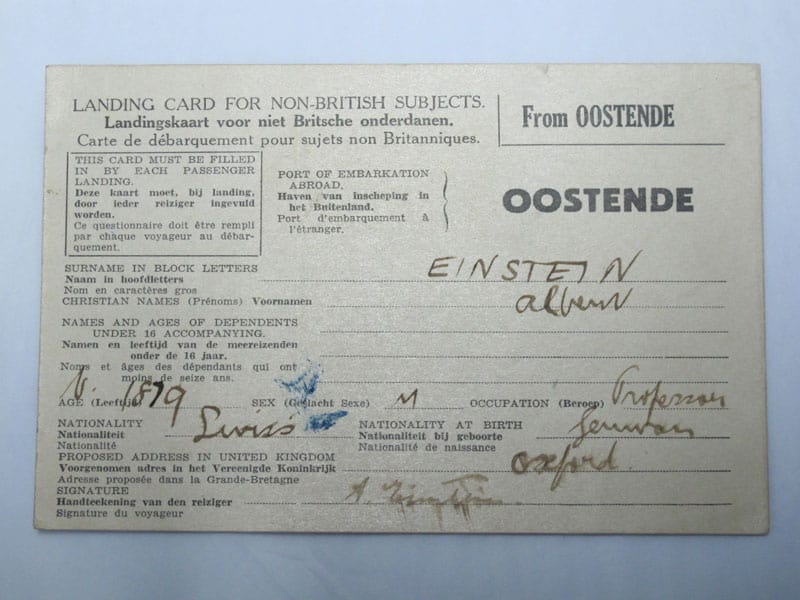
Einstein’s landing card resurfaces after 80 years

This unremarkable piece of paper belongs to a crucial chapter in one of the most extraordinary lives of the 20th century. It is the landing card issued to one Albert Einstein when he arrived in Britain in 1933 after fleeing Nazi Germany. The card went on public display for the first time in May this year, at the Merseyside Maritime Museum in Liverpool, after having been stored for nearly 80 years at Heathrow Airport. It is interesting to note that Einstein lists his nationality as Swiss, having renounced his German citizenship only weeks earlier in angry reaction to Nazi policies.

Fire at US underground lab

The action shot above might look like something out of a Hollywood movie, but in reality it is an image of firefighters sending foam and water down a mine access shaft after a fire broke out at the Soudan Underground Laboratory in March this year. The facility is home to a number of high-profile physics experiments, including the MINOS neutrino detector and the detector of the Cryogenic Dark Matter Search (CDMS) experiment. While some of the foam did enter the main lab, the electronics of the CDMS detector remained unscathed and the lab is now up and running once more.

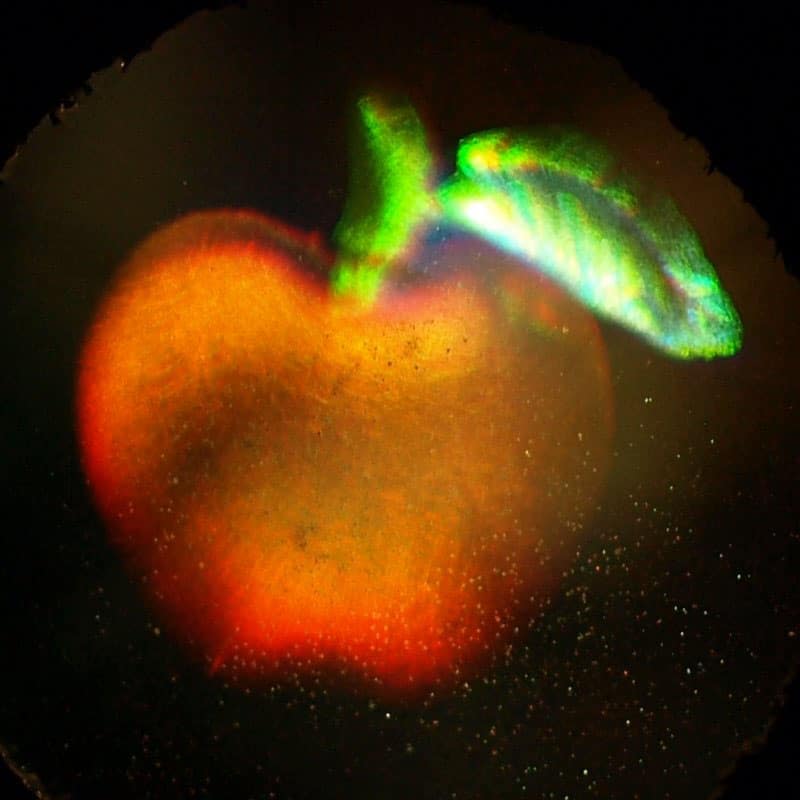
Holography sharpens up

This tasty-looking apple is not the latest ad campaign from the eponymous computer maker. This is an image of a new type of hologram developed by researchers in Japan, who have managed to depict true colours in holograms that do not change with viewing angle, as happens with most current holograms. Their technique exploits tiny vibrations in metallic surfaces known as “surface plasmons”.

Atlantis lifts off into history

Set to become an iconic image in years to come, above is a picture of NASA’s shuttle Atlantis, taken shortly after the rotating service structure was rolled back at Launch Pad 39A at the Kennedy Space Centre in Florida this July. Marking the last and final flight of the Space Shuttle programme – STS-135 – Atlantis and a four-person crew went on a 12-day mission to deliver more than 3.5 tonnes of supplies to the International Space Station (ISS), which should keep the station stocked for a year.

Magnetic Mecca

This strikingly beautiful image – called Magnetism 1 and created by the Saudi artist Ahmed Mater – caught our eye in July, when an exhibition called “Hajj journey to the heart of Islam” came to the British Museum in London. The photograph – representing the iconic scene of hundreds of thousands of hajj pilgrims circling the Ka’bah in Mecca, Saudi Arabia – is that of a bar magnet surrounded by iron filings. It will be familiar to anyone who has studied magnetism at school but also captures the essence of the Ka’bah circumambulatory.

Starry starry night

While at first glance this image might look like a typical Hubble picture, we at physicsworld.com are especially fond of it. That is because it was taken by amateur astrophotographer Alex Cherney. His prize for winning a major astrophotography competition was an hour using one of the largest optical telescope on the planet – the 10.4 m Gran Telescopio Canarias (GranTeCan), in the Canary Islands in Spain – plus the opportunity to attend and mingle with a “who’s who” of astronomy at the STARMUS festival, an astronomy event held in the Canary Islands in June. After much deliberation, Cherney decided to use his hour to observe and photograph Arp84 (above), a pair of interacting galaxies – NGC5394 and NGC5395.

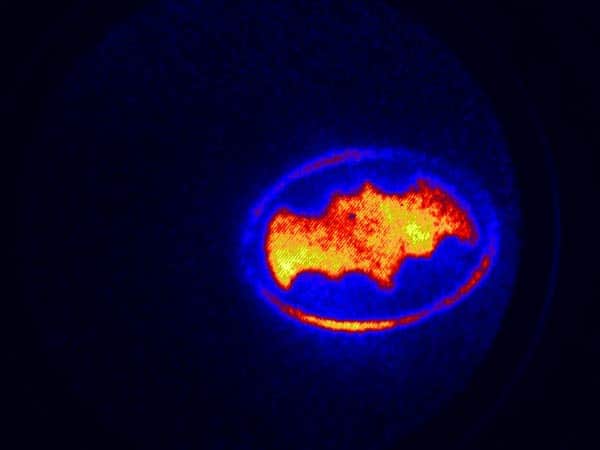
Batman appears in the cold

Batman motifs do not normally appear in physics journals, so this image really got our attention when it appeared in a Nature paper in August. It is a product of a new source of cold electrons that can image tiny structures at atomic-length scales. The source, which makes use of ultracold atoms, can deliver intense and coherent electron pulses with specific shapes – including the iconic Batman figure above.

BBC Radio profiles the man behind the boson

By Hamish Johnston

One of my favourite programmes on BBC Radio 4 is Profile, which presents bang-up-to-date biographies of people in the news.

Recent subjects have been as varied as the American politician Newt Gingrich, when he announced his interest in the Republican presidential nomination, and the singer Ian Brown, when he and his band members announced a Stone Roses reunion.

On Saturday it was the turn of Peter Higgs, famous for the eponymous boson that he predicted back in the 1960s. Last week physicists at the Large Hadron Collider caught what may turn out to be the first glimpse of the Higgs boson, inspiring Radio Four to profile its namesake.

The story begins with Higgs’ school days in Bristol, where he was at the same grammar school as Paul Dirac – although separated by about 30 years. The story goes that Higgs became fascinated with the work of his school’s Nobel-winning alumnus, sparking a lifetime love of theoretical physics.

You can listen to the biography here.

Our top videos of the year


The hunt for the elusive Higgs

Never underestimate the power of a good science demonstration. Some of the most celebrated science communicators – such as Richard Feynman, Carl Sagan and more recently Brian Cox – are incredibly good at explaining academic research using simple, everyday concepts. But while a few lucky people seem to be naturally adept at coming up with nifty demonstrations, most educators can always pick up some tips from the professionals. This film investigates how simple but effective demonstrations can breathe life into science education. It was recorded at the 2011 annual conference of the Association for Science Education, a UK-based organization that has been has been supporting teachers and science educators since 1900.

Physics World’s 2011 Books of the Year

10. Rising Force: the Magic of Magnetic Levitation by James Livingston
In the year in which condensed-matter physicists celebrated the centenary of the discovery of superconductivity and the 25th anniversary of high-temperature superconductivity, this delightful book just had to be in to our top 10. Condensed-matter physics often gets eclipsed in the popular-science stakes by astronomy, cosmology and particle physics, but Livingston shows that superconductivity can be just as interesting as these seemingly more glamorous topics. He quite rightly focuses on these materials’ great potential applications, especially their almost mystical ability to magnetically levitate objects – under certain conditions, of course. [MD]

9. The Hidden Reality by Brian Greene
This latest book from string theorist and popular-science author Brian Greene is about the multiverse – the concept that the universe we inhabit and observe might not be the only one in existence. It contains many of the elements that made his two previous books, The Elegant Universe and The Fabric of the Cosmos, into bestsellers, including clear writing, a gently humorous tone and a knack for conveying excitement about theoretical physics. As a bonus, Greene also does a good job of distinguishing between multiverse theories that have some scientific support and those that will probably remain purely speculative – making his book an excellent example of how to write well about uncertain science. [MH]

8. Lab Coats in Hollywood: Science, Scientists and Cinema by David Kirby
Books on the use (and misuse) of science in films and TV are not uncommon, but David Kirby takes an intriguingly different tack here – by examining the role of the “scientific consultant” to Hollywood. There may not be many such consultants, but they can play a powerful and invaluable role in helping to make plots believable. One only has to compare the scientific credibility of Deep Impact – a meteor-impact adventure that drew on the advice of a team of scientists – with the dreadful Armageddon, whose director Michael Bay mostly ignored the advice of his science consultant, to see just how badly things can go wrong. [MD]

7. Modernist Cuisine by Nathan Myhrvold, Chris Young and Maxime Bilet
This 2400-page guide to the science of cooking muscled its way into our top 10 list thanks to the innovative way it applies the principles – and often the tools – of physics to the task of making delicious and appealing food. Want to know how to find the “sweet spot” of your grill, where the heat input varies by less than 10% across the area of a cut of meat? Fancy incorporating ultrasonic baths, autoclaves and vacuum pumps into your kitchen? Keen to understand on a thermodynamic and molecular level what, exactly, happens to food as it cooks? Then (if you can afford it) this book is for you. [MH]

6. Measure of the Earth: the Enlightenment Expedition that Reshaped the World by Larrie D Ferreiro
In the early 18th century, nobody knew whether the Earth was flattened at its poles (as Newton had argued) or shaped like a rugby ball (as Descartes’ followers believed). The solution – which must have seemed elegantly simple to the Parisian academicians who dreamed it up – was to send expeditions to the equator and the far north to measure the local length of a degree of latitude. As this delightful and perceptive book makes clear, the equatorial expedition ran into some very modern-sounding troubles, from budget overruns to fights over who would get credit for the results. Scientific history has rarely been more entertaining, or seemed more relevant. [MH]

5. Radioactive: Marie and Pierre Curie, a Tale of Love and Fallout by Lauren Redniss
An unconventional biography about the lives of Marie and Pierre Curie, this book is as much a work of art as it is a piece of writing. The author, Lauren Redniss, uses both words and pictures to tell the story of how the Curies fell in love and carried out their pioneering studies. It is a highly quirky and original book; for example, Redniss has created her own font based on the notebooks of Marie and Pierre, and as a tribute to the couple’s work, many of the illustrations are created using a camera-less photographic technique called “cyanotype”. At times, it is very touching as well, as Redniss explores the impact of the Curies’ work on the world via cancer treatments, warfare and energy. [JD]

Engineering Animals by Mark Denny and Alan McFadzean
Engineering Animals

4. Engineering Animals by Mark Denny and Alan McFadzean
Why do slugs travel on a film of slime? How do bats echolocate? Why are bones generally hollow cylinders? And how can birds navigate using sunlight – even after the Sun has set? These and a myriad of other intriguing questions about the animal world are tackled in this fabulously thorough book that examines animal behaviour from a purely engineering and physics point of view. The book is perfect for physicists who feel that biology is a “messy” subject with so many exceptions to the rule that it is impossible to come to any clear conclusions. Denny and McFadzean show that this prejudice is far from justified. [MD]

3. Hindsight and Popular Astronomy by Alan B Whiting
How much should non-scientists trust what a scientist tells them about science? This question gets right to the heart of popular-science writing, and author Alan Whiting sets out to answer it by analysing nine books about astronomy that were written in the late 19th and early 20th centuries. It is amusing, as well as instructive, to see just how wrong scientific giants could be. But instead of laughing at their mistakes, Whiting focuses on whether they gave their readers enough information to know when they were speculating and when they felt they were on surer ground. The lessons he draws from this exercise are worth learning, and anyone with an interest in science communication should read this book. [MH]

2. The 4% Universe: Dark Matter, Dark Energy, and the Race to Discover the Rest of Reality by Richard Panek
Science writer Richard Panek must have thought he had hit the jackpot when this year’s Nobel Prize for Physics was awarded to Saul Perlmutter, Adam Riess and Brian Schmidt for the discovery that the expansion of the universe is accelerating. That is because the story of their finding – and its implication that the universe is filled with a mysterious gravity-defying “dark energy” – lies at the very heart of this lucidly written yet technically accurate book. The story stretches from the discovery of the cosmic microwave background in the 1960s right up to the present day, but Panek is at his best describing the discovery of the accelerating universe itself as it unfolded in 1997 and 1998, with chapter eight being almost novel-like in character. A remarkable book and a model for all would-be popular-science writers. [MD]

  • Buy now with 30% discount for physicsworld.com readers (enter promo code PW2011 at checkout)

Quantum Man: Richard Feynman's Life in Science by Lawrence Krauss
Quantum Man

1. Quantum Man: Richard Feynman’s Life in Science by Lawrence Krauss
Richard Feynman is a hero to many physicists, and books about him have become something of a cottage industry since his death in 1988. This one stands out because its author, the physicist and popular-science writer Lawrence Krauss, has really dug into what made Feynman tick as a physicist – even revisiting the famed theorist’s original papers in order to evaluate what made his work so important. The result is a very readable and clearly written account of Feynman as a creative and methodical thinker, one whose back-to-basics style of problem-solving would prove inspirational to students and colleagues, even as it probably deterred some potential collaborators. No Feynman biography would be complete without a few anecdotes, and Krauss’s is no exception. But by focusing on his subject’s scientific side, Krauss reminds us that Feynman’s caricatured public image as a bongo-playing, strip-club-visiting joker should not overshadow his contributions to 20th- and 21st-century science. This fresh and thoughtful book offers a new perspective on a well-known figure in physics, and it is Physics World‘s book of the year for 2011. [MH]

  • Buy now with 25% discount for physicsworld.com readers (enter promo code WN194 at checkout)

Physics World reveals its top 10 breakthroughs for 2011

The two physics stories that dominated the news in 2011 were questions rather than solid scientific results, namely “Do neutrinos travel faster than light?” and “Has the Higgs boson been found?”. However, there have also been some fantastic bona fide research discoveries over the last 12 months, which made it difficult to decide on the Physics World 2011 Breakthrough of the Year.

But after much debate among the Physics World editorial team, this year’s honour goes to Aephraim Steinberg and colleagues from the University of Toronto in Canada for their experimental work on the fundamentals of quantum mechanics. Using an emerging technique called “weak measurement”, the team is the first to track the average paths of single photons passing through a Young’s double-slit experiment – something that Steinberg says physicists had been “brainwashed” into thinking is impossible.

We have also awarded nine runners-up (see below). The choice between first and second place was particularly close this year because the number-two finding also involves weak measurement – this time to map the wavefunction of a bunch of photons. But we felt that Steinberg’s finding edged it. Other breakthroughs in the list include the first “space–time” cloak, a laser made from a living cell and a new way to measure cosmic distances.

1st place: Shifting the morals of quantum measurement

Steinberg’s work stood out because it challenges the widely held notion that quantum mechanics forbids us any knowledge of the paths taken by individual photons as they travel through two closely spaced slits to create an interference pattern.

This interference is exactly what one would expect if we think of light as an electromagnetic wave. But quantum mechanics also allows us to think of the light as photons – although with the weird consequence that if we determine which slit individual photons travel through, then the interference pattern vanishes. By using weak measurements Steinberg and his team have been able to gain some information about the paths taken by the photons without destroying the pattern.

In the experiment, the double slit is replaced by a beamsplitter and a pair of optical fibres. A single photon strikes the beamsplitter and travels along either the right or the left fibre. After emerging from the closely spaced ends of the parallel fibres, it creates an interference pattern on a detector screen.

How to ask a 'forbidden question'

The weak measurement is performed by passing the emerging photons through a piece of calcite, which imparts a tiny rotation in the polarization of the photon. The amount of rotation depends on the direction of travel of the photon – in other words, its momentum. The photons are then “post-selected” according to where they strike the screen, which allows the researchers to determine the average direction of travel of photons that arrive there.

The experiment reveals, for example, that a photon detected on the right-hand side of the diffraction pattern is more likely to have emerged from the optical fibre on the right than from the optical fibre on the left. While this knowledge is not forbidden by quantum mechanics, Steinberg says that physicists have been taught that “asking where a photon is before it is detected is somehow immoral”.

“Little by little, people are asking forbidden questions,” says Steinberg, who adds that his team’s experiment will “push [physicists] to change how they think about things”.

2nd place: Measuring the wavefunction

Second place goes to another group that has asked a “forbidden question”. Led by Jeff Lundeen at the National Research Council of Canada in Ottawa – a former colleague of Steinberg – a team has used weak measurement to map out the wavefunction of an ensemble of identical photons without actually destroying any of them. Quantum tomography, in contrast, maps out the wavefunction at the expense of destroying the state. As well as boosting our understanding of the fundamentals of quantum mechanics, the technique could prove useful in cases where tomography cannot be used.

3rd place: Cloaking in space and time

Coming in at third place are two teams – one at Cornell University in the US led by Alexander Gaeta, and the other at Imperial College London headed by Martin McCall. In early 2011 McCall’s team published a theoretical analysis of how an event in space and time could be cloaked, which he later described in a special Physics World feature. A few months later, Gaeta and colleagues built a device that uses two “split time lenses” to do just that. As well as changing our ideas about what can and cannot be cloaked, space–time cloaking could also be used in the perfect bank heist – at least in theory.

4th place: Measuring the universe using black holes

Fourth spot on the list goes to Darach Watson and colleagues at the University of Copenhagen, Denmark, and the University of Queensland, Australia, who have worked out a way of using supermassive black holes – which power active galactic nuclei (AGNs) – as “standard candles” for making accurate measurements of cosmic distances. The work is important because AGNs can be found just about everywhere in the universe, and unlike the supernovae currently used as standard candles, the light from AGNs endures for long periods of time.

5th place: Turning darkness into light

Christopher Wilson and colleagues of Chalmers University of Technology in Sweden together with physicists in Japan, Australia and the US have bagged fifth place because they are the first to see the dynamical Casimir effect in the lab. The effect arises when a mirror is moving so quickly through a vacuum that pairs of virtual photons – which are always appearing and then annihilating – are pulled apart to create real photons that can then be detected. As well as shedding new light on the Casimir effect, the team’s use of a superconducting quantum interference device (SQUID) as the mirror make this an extremely clever experiment.

6th place: Taking the temperature of the early universe

Just after the Big Bang, the universe was a complicated soup of free quarks and gluons that eventually condensed to form the protons and neutrons we see today. Sixth place in our top 10 goes to a team of physicists in the US, India and China that has made the best calculation yet of this condensation temperature: two trillion degrees Kelvin. As well as providing important insights into the early universe, the work also advances our understanding of quantum chromodynamics, which describes the properties of neutrons, protons and other hadrons.

7th place: Catching the flavour of a neutrino oscillation

Seventh place is awarded to the international team of physicists working on the Tokai-to-Kamioka (T2K) experiment in Japan. The researchers fired a beam of muon neutrinos 300 km underground to a detector, where they found that six neutrinos had changed, or “oscillated”, into electron neutrinos. While the measurement is not good enough to claim the discovery of the muon-to-electron neutrino oscillation, it is the best evidence yet that one “flavour” of neutrino can oscillate into another.

8th place: Living laser brought to life

In a fascinating bit of biophysics, Malte Gather and Seok Hyun Yun at Harvard Medical School in the US share eighth place for being the first to make a laser from a living biological cell. By shining intense blue light onto green fluorescent protein molecules inside an embryonic kidney cell, the molecules generate light that is intense, monochromatic and directional. The cells survive the ordeal and this amazing phenomenon could potentially be used to distinguish cancerous cells from healthy ones.

9th place: Complete quantum computer made on a single chip

Ninth place goes to Matteo Mariantoni and colleagues at the University of California, Santa Barbara for being the first to implement a quantum version of the “Von Neumann” architecture found in PCs. Based on superconducting circuits and integrated on a single chip, the new device has been used to perform two important quantum-computing algorithms. Its development moves us closer to the creation of practical quantum computers that solve real-life problems.

10th place: Seeing pure relics from the Big Bang

Michele Fumagalli and Xavier Prochaska of the University of California, Santa Cruz and John O’Meara of Saint Michael’s College in Vermont take 10th spot for being the first to catch sight of clouds of gas that are pure relics of the Big Bang. Unlike other clouds in the distant universe – which appear to contain elements created by stars – these clouds contain just the hydrogen, helium and lithium created by the Big Bang. As well as confirming predictions of the Big Bang theory, the clouds provide a unique insight into the materials from which the first stars and galaxies were born.

  • Happy with our choices? Annoyed at something we missed? Or do you just want to congratulate the winners? Tell us what you think of our top 10 breakthroughs by commenting below
Copyright © 2026 by IOP Publishing Ltd and individual contributors