Other-worldy tales

The 5th Dimensional Camera


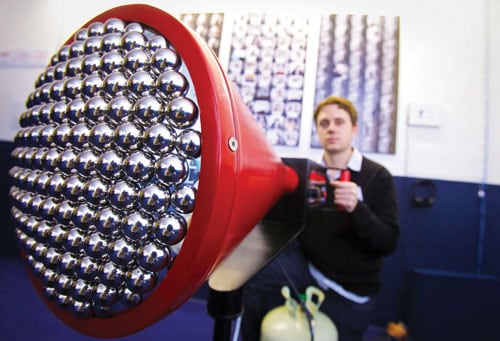
The artwork The 5th Dimensional Camera, which explores the theme of parallel worlds. (Courtesy: EPSRC Press Office)

By Matin Durrani

I’m sure we’ve all go our own personal wishes for a parallel universe – perhaps it’s a world where physicists are flush with cash, the Superconducting Super Collider had never been cancelled and CERN press conferences discussing the search for the Higgs had a bit more oomph about them.

But writing in the December issue of Physics World magazine, Stony Brook University philosopher and historian Robert P Crease examines how the idea of parallel universes and parallel worlds also appear frequently in art and literature.

We’ve all heard of Lewis Carroll’s beloved story Alice’s Adventures in Wonderland, of course, but did you know that Jorge Luis Borges described the concept of a “multiverse” in his 1941 anthology The Garden of Forking Paths? Or that Alan Ayckbourn wrote a series of plays called “Intimate Exchanges”, in which a single opening scene branches out into 16 different endings?

As Crease points out, the idea that parallel worlds should attract novelists is “perhaps not surprising” – after all, as he puts it, they deal with “events shaped by contingencies that unfold over time”.

But the theme of alternative worlds that are similar (but not identical) to our own, branching off from each other, has featured in films as well, including last year’s Rabbit Hole, starring Nicole Kidman, which was based on the celebrated 2005 play of the same name by David Lindsay-Abaire.

It also crops up in the new film Another Earth, which was released earlier this year. Examining the consequences of a promising student who causes a fatal car crash, the film has unfortunately received a bit of a panning, being dubbed by the Daily Mail as “pretentious twaddle” and by the Guardian as “ponderous and contrived”.

Still, let’s not forget that multiple worlds have even inspired some sculptors, including Jon Ardern and Anab Jain of the Superflux studio in London, who created an interesting work called The 5th Dimensional Camera, pictured above, which appeared last year in an exhibition called “Talk to Me” at the Museum of Modern Art in New York.

Members of the Institute of Physics (IOP) can read the article “Other-worldly tales” online free of charge via the digital version of the magazine by following this link or by downloading the Physics World app onto your iPhone or iPad or Android device, available from the Apple store and Android Marketplace, respectively.

If you’re not yet a member, you can join the IOP as an imember for just £15, €20 or $25 a year via this link. Being an imember gives you access to a digital version of Physics World both online and through the apps.

Higgs hunters close in on their quarry


The first solid experimental evidence for the existence of the Higgs boson has been unveiled today by physicists working on the Large Hadron Collider (LHC) at CERN in Geneva. Members of the ATLAS experiment revealed evidence that the Higgs particle has a mass of about 126 GeV/c2. Physicists working on the rival CMS experiment released similar – albeit weaker – evidence for a Higgs with a mass of about 124 GeV/c2.

However, ATLAS spokesperson Fabiola Gianotti cautions that the measurements are not good enough yet to claim the discovery of the particle.

Physicists are keen to discover the Higgs boson to complete the Standard Model of particle physics. The particle and its associated field are needed to explain how electroweak symmetry broke just after the Big Bang – which gave certain elementary particles the property of mass. The Standard Model does not, however, actually predict the mass of the Higgs, and successive experimental programmes at CERN’s Large Electron–Positron Collider, Fermilab’s Tevatron and now the LHC have sought to measure its mass.

If the current glimpse of the Higgs proves to be an illusion, and it – or a similar symmetry-breaking entity – is never found, all would not be lost, as physicists would be forced to concede that the Standard Model is incomplete and to look for “new physics” beyond it.

Evidence versus discovery

The ATLAS measurement was made at a confidence level of about 3.6σ, which means that the measurement could be the result of a random fluke just 0.1% of the time. While these might sound like fantastic odds, particle physicists normally wait until they have a confidence of 5σ or greater before they call it a “discovery”. Anything above 3σ is described as “evidence”.

There are several reasons why particle physicists require such high confidence levels. One is the “look elsewhere” effect that arises because the data are sorted into mass/energy bins to create a histogram – which could concentrate fluctuations. After the look elsewhere effect is considered in the ATLAS result, the confidence level drops to 2.3σ, according to Gianotti.

Another potential problem is that there could be unknown systematic errors lurking in the experiment that could be responsible for the apparent result, and therefore requiring a very high confidence could help avoiding such errors.

Despite the preliminary results announced at CERN today, unravelling the mystery of the Higgs will take some time. Assuming that the signal at 126 GeV/c2 survives further analysis, the next step for physicists will be to tease out the precise nature of the Higgs they have discovered. According to Matt Strassler of Rutgers University in the US, a mass of about 126 GeV/c2 could indicate many different things. These include a Standard Model Higgs, a Higgs that is best described by theories beyond the Standard Model such as supersymmetry (SUSY), a “little Higgs” or various other theories.

Different reactions

To gain a better understanding of the Higgs, Strassler says that several different reactions that produce the Higgs at the LHC must be studied, as well as several different decay channels of the particle. In particular, physicists must find out how closely the Higgs is described by the Standard Model, which involves studying interactions involving W and Z particles, top and bottom quarks, and tau leptons.

In total, he believes that seven or eight different measurements are required before physicists will have a handle on the Higgs. “Next year we could be in a position to say that we have a particle that’s reasonably consistent with the Standard Model,” says Strassler. This would allow physicists to eliminate theories – such as technicolor – that do not include the Higgs particle.

“By 2014/2015 we could have enough additional data to eliminate large classes of theories that attempt to explain the Higgs,” adds Strassler, although he warns that it could take as long as 10 years to gain a full understanding of the particle.

However, not all physicists believe that the road to understanding the Higgs will be a long one. Gordon Kane of the University of Michigan and colleagues have recently published a preprint on the arXiv server that calculates the mass of the Higgs using string theory – calculations that put the Higgs mass in the 122–129 GeV/c2 range. Kane told physicsworld.com that physics beyond the Standard Model has “jumped out as string theory”. “The game is over and we have won – we have landed on the shores of a new world,” he adds.

For more information about the search for the Higgs, watch our video with Guido Tonelli, spokesperson for the CMS experiment, and ATLAS researcher Pippa Wells.

Are pulsars giant ‘neutromagnets’?

Pulsars are created when a star collapses to form a neutron star in which the magnetic moments of the neutrons are frozen in a particular direction – much like the atomic moments in a permanent magnetic. That is the claim of two physicists in Sweden, who believe that their theory can account for many of the unexplained properties of these astronomical oddities.

First discovered in 1967, pulsars are astronomical objects that emit radiation pulses with astonishing regularity. Astronomers believe pulsars are rapidly rotating neutron stars that have very large magnetic fields. Just like the Earth, the magnetic dipole moment of the star is believed to be offset from its rotational axis. Jets of radiation are emitted from the star along its magnetic poles. Because the star is rotating about a different axis, the jet sweeps round like a lighthouse beam that appears as a regular pulse if it happens to strike Earth.

Beyond this basic description, however, little is known about the physics of pulsars and how they formed. One important question is the origin of the magnetic field, which can range from about 104 to 1011 T. That is huge compared with the Sun’s magnetic field, which is about 100 µT. Furthermore, the regular nature of the pulses suggests that a pulsar’s magnetic field must be extremely stable. In contrast, the Sun’s magnetic field is notoriously unstable because it is generated by the rotation of the star’s plasma, which is prone to instabilities.

Nuclear force favours alignment

“There is no good explanation for how the magnetic field is generated,” explains Johan Hansson of Lulea University of Technology, who put forward this latest theory with colleague Anna Ponga. Hansson and Ponga suggest that the magnetic moments of all the neutrons in the star point in the same direction in a state of matter called a “neutromagnet”. This is similar to the alignment of atomic magnetic moments in a ferromagnetic material. The researchers point out that the nuclear force that binds protons and neutrons together in nuclei favours the alignment of spins – an effect that they say could be enhanced in neutron stars, where neutrons are packed even more tightly together.

Hansson and Ponga assumed that the energy gained by two neutrons by aligning their spins in the same direction is about 10% of the total nuclear binding energy of the pair. This gives a Curie temperature – below which all the neutrons in the star align to become a giant magnet – of about 1010 K.

Because neutron stars all seem to have about the same mass, the maximum magnetic field that could result is about 1012 T. This would occur when all the neutrons are aligned in the same direction. However, just like everyday magnets, it is possible that different regions of the star have domains of neutrons – with each domain pointing in a different direction. This would reduce the overall magnetic field and could explain why some neutron stars have much smaller magnetic fields. According to Hansson, this maximum value of the magnetic field provides astronomers with a simple way of falsifying the theory.

Moment is frozen in

Hansson told physicsworld.com that their model also explains the fixed misalignment between the magnetic moment and the rotational axis of a pulsar. “The orientation of the magnetic field is set by the direction of the star’s magnetic field at the moment it collapses to form the neutron star,” he explains. “The direction is then ‘frozen in’ by the nuclear force”.

However, not all astronomers are convinced. “I don’t claim that the current ‘understanding’ is complete or free of contradiction – the problem is very hard – but I believe that the concept presented in this paper is not nearly as good as the standard models,” says Michael Kramer of the University of Manchester in the UK.

The work is described in arXiv:1111.3434.

Corrosion carves out 3D nanostructures

Researchers in Spain have invented a new technique for making hollow nanoparticles with sophisticated shapes and compositions. The method, which combines two well-known corrosion processes into a single step, modifies the shape of tiny nanoparticles after they have been created. The resulting nanostructures could find use in drug delivery, catalysis and even as structural components for nanorobots.

Nanobjects can be assembled from the bottom up, atom by atom or molecule by molecule, but this is usually a tedious process that generally involves picking up individual atoms or molecules with the tip of a scanning-electron or atomic-force microscope. The technique is also fiddly because the microscope tip has a tendency to “stick” to the nano-objects.

Now, Edgar Gonzàlez and colleagues at the Institut Català de Nanotecnologia have overcome this so-called sticky nanofinger problem using chemistry. The researchers have shown that corrosion processes such as galvanic replacement and the Kirkendall effect can be used to attack and pit nanoparticles from the “inside out”. The result being complex geometric interconnected multicavity hollow nanostructures. Corrosion is much more aggressive for nanoparticles – compared with larger structures – because the tiny particles have larger surface areas relative to their volume.

A variety of nano-objects

The structures produced by the team range in shape from molecular labyrinths or nanomazes (made from silver and gold or platinum) to gold fullerenes. Other structures, such as nanoboxes, porous nanotubes and nanoframes, can also be fashioned from silver and gold nanoparticles (see figure).

The Kirkendall effect occurs when there is a movement of vacancies in a metal that is in the opposite direction to that of natural atom diffusion. This flux leads to voids being produced in the material. Galvanic replacement is also a simple way to make hollow nanostructures of noble metals when silver nanostructures are used as sacrificial templates. It is a one-step process that dissolves metallic nanostructures to produce constructs that are enclosed by continuous or porous walls the thicknesses of which can be controlled.

Corroding objects in such a way would be impossible on the macroscale, says team leader Victor Puntes. “In the nanoworld, however, the effect occurs spontaneously if the corrosion ingredients and nanoparticles are mixed together properly,” he says. “The nanoworld is a billion times smaller than the ordinary world, and phenomena occurring there seem like pure miracles when compared with those happening on our everyday scale.”

Carrying cargo

The hollow nanoparticle capsules or cages can protect and carry different types of payload. They could be used to safely transport a drug to a target in the body – for instance to treat a tumour – or carry a specific catalyst to a reaction site. The capsules can also be open or closed, heated and manipulated by electromagnetic fields.

The researchers observed the structures they made using high-resolution transmission electron microscopy, which allowed them to analyse and visualize different shapes atom by atom.

The technique can also be readily adapted to industrial-scale production levels, adds Puntes.

Details of the work can be found in Science.

New ink prints graphene electronics

A new ink based on graphene has been used to print high-performance, transparent, thin-film transistors and interconnects. The ink was invented by researchers at the UK’s University of Cambridge, who say that the work could lead to better printed electronics, including flexible displays, solar cells and electronic paper.

Flexible electronics looks set to change the way we use technology in our everyday lives, with a wide range of devices already having been made. Inkjet printing is one of the best ways of making large amounts of plastic electronics, and a variety of components, such as transistors, photovoltaic devices, organic light-emitting diodes and displays, can be fabricated using this technique. Inkjet printing is also simple and only has a few processing steps.

The technique has been used to print thin-film transistors based on organic and semiconducting inks. However, these devices do not offer the same performance and reliability as standard silicon-based electronics.

Better transistors

Now, Andrea Ferrari and colleagues have taken an important step towards creating better devices. They have developed an ink based on graphene – sheets of carbon just one atom thick with unique electronic and mechanical properties. The ink is made by separating graphene flakes from pieces of graphite in a liquid. The process begins with treating graphite flakes in a sonic bath containing the solvent N-methylpyrrolidone for several hours. The flakes are then left to settle for a few minutes. Next, the team decants the dispersions and centrifuges the samples for an hour to filter out any flakes bigger than 1 µm across that might clog the printer nozzle.

The ink can then be used to print electronic devices such as thin-film transistors (TFTs) on a variety of substrates, including silicon dioxide and quartz. The first TFTs printed using this ink already seem to perform better than state-of-the-art inkjet-printed devices. The preliminary devices have electron mobilities of up to 95 cm2 V–1 s–1 for example. In comparison, inkjet-printed TFTs based on organic semiconducting polymers have mobilities ranging from just 0.01 to 0.5 cm2 V–1 s–1, but better on/off ratios of up to 105.

Compatible with existing technology

“Our technique is not new and the graphene ink produced should therefore be compatible with existing standard inkjet machines,” says Ferrari. “This will hopefully allow the ink to be used in existing printed electronics.”

The researchers – who report their work on the arXiv preprint server – now plan to optimize the process parameters. “We shall also be making contact with the major players in the printed-electronics industry to try and implement the ink in useful devices,” reveals Ferrari.

The work is described in arXiv:1111.4970.

Latest Fermi studies find no trace of dark matter

Independent analyses of data from the Fermi Gamma-ray Space Telescope have found no trace of low-mass dark matter – the mysterious substance thought to make up much of the universe. The results appear to go against recent direct evidence for low-mass dark matter, although some physicists believe there is no conflict.

Dark matter is an invisible substance thought to make up nearly a quarter of the mass/energy of the universe. While its gravitational pull is needed to explain the properties of massive structures such as galaxies, it does not interact strongly with light and has therefore yet to be observed directly. The most popular candidates for dark matter are so-called weakly interacting massive particles (WIMPs). To spot these WIMPs directly, researchers have built detectors in underground labs where the low background noise ought to allow any signals to stand out. These detector experiments include DAMA and CRESST, both based underground at the Gran Sasso laboratory in central Italy, and CoGeNT, based in the Soudan mine in the US.

For just over a decade, the team behind the DAMA experiment has claimed to see an annual modulation in its data that would be consistent with the Earth’s orbit passing through a prevailing “wind” of dark-matter WIMPs in our galaxy. Those signals were joined last year by hundreds of WIMP-like blips in the detectors at CoGeNT and, in September, a few dozen WIMP-like blips in the detectors at CRESST. Although the signals of these three experiments do not match perfectly, they seem to be pointing to a relatively light WIMP with a mass of the order of 10 GeV/c2.

Colliding WIMPs

If such a light WIMP does exist, it should leave additional, indirect evidence in data obtained by the orbiting Fermi telescope. This telescope, which is a joint mission between NASA and other international space agencies, ought to be able to record any gamma rays produced when WIMPs collide and annihilate one another. But now two independent analyses of the Fermi data have found – for at least two major types of annihilation – no gamma rays for light WIMPs.

The first analysis was done by Johann Cohen-Tanugi and others in the Fermi-LAT (Fermi Large Area Telescope) collaboration. The team used a computer model that calculates the output of known sources of gamma rays coming from the vicinity of our galaxy’s companion “dwarf spheroidal galaxies”. By comparing the model with the actual Fermi data, the researchers found no significant extra contribution from WIMPs with a mass of less than 30 GeV/c2 annihilating into either bottom quarks or tau leptons.

The second analysis was carried out by Alex Geringer-Sameth and Savvas Koushiappas of Brown University in the US. It also examines gamma rays coming from the Milky Way’s dwarf spheroidal galaxies, but it relies on a different method. The researchers use gamma rays recorded from regions surrounding the dwarf galaxies as the background, and then compare these with the gamma rays emitted from the direction of the dwarf galaxies themselves to look for a WIMP component. The analysis revealed no WIMPs with a mass less than 40 GeV/c2 annihilating into bottom quarks, and no WIMPs with a mass of less than 19 GeV/c2 annihilating into tau leptons.

Two analyses are better than one

“The two studies are complementary to each other, and they represent two different ways that one can approach the problem,” says Koushiappas. “In my opinion, the complementarity of these two papers makes the derived constraints much stronger than any single, one analysis could do.”

These constraints might appear to go against the evidence reported by DAMA, CoGeNT and CRESST, but those collaborations do not necessarily see any conflict. “One would be naively tempted to claim that there’s some tension there,” says Juan Collar, spokesperson for CoGeNT. But the type of annihilation considered by the Brown and Fermi-LAT researchers is not the one primarily being considered by those working on other dark-matter experiments. “When the exact meaning of those bounds and hints is examined, things look a lot less confusing,” he adds.

Rita Bernabei, spokesperson for the DAMA collaboration, says the DAMA signal is also compatible with WIMP masses above the new Fermi limits. “The results in the papers…are model-dependent and strong speculations should have been applied to derive such model-dependent limits,” she says. A spokesperson for the CRESST collaboration could not be reached for comment.

Underlying physics not yet understood

Michael Kuhlen, a theoretical astrophysicist at the University of California, Berkeley who was not involved with the research, also believes there is not necessarily any conflict between the Fermi data and those of the direct dark-matter searches. He says it is difficult to relate the annihilation probabilities used in the latest studies with the probabilities of WIMP interactions inferred by direct dark-matter searches without properly understanding the underling particle physics.

But are we now further from knowing what dark matter actually is? “Certainly we are not any closer,” adds Kuhlen.

The results of both the Brown group and the Fermi-LAT collaboration are due to be published in Physical Review Letters and are available as preprints at arXiv.org:1108.2914 and arXiv.org:1108.3546, respectively.

Do you like the element names livermorium and flerovium?

hands smll.jpg

By Hamish Johnston

The International Union of Pure and Applied Chemistry (IUPAC) has unveiled the proposed names for elements 114 and 116. Named after Georgi Flerov, founder of the Joint Institute for Nuclear Research (JINR) in Dubna, Russia, element 114 will, if approved, be called flerovium and have the symbol Fl. Element 116, meanwhile, will be named livermorium after the Lawrence Livermore National Laboratory (LLNL) and given the atomic symbol Lv.

The elements were created by researchers at the JINR back in 2004 and were both confirmed by scientists at the LLNL in California and the Centre for Heavy Ion Research (GSI) in Darmstadt, Germany.

Commenting on the suggested names has now opened to anyone for a five-month period, which will end in April. So what do you think? In this week’s _Facebook_ poll, we want you to answer the following question.

Do you like the element names livermorium and flerovium?

I like both of them
I like livermorium but not flerovium
I like flerovium but not livermorium
They’re both boring and unimaginative

To cast your vote, please visit our Facebook page; you are also free to suggest your own names by posting a comment.

In last week’s Facebook poll we asked you when you thought we will see the first working nuclear-fusion reactor supplying electricity to a grid? Nearly half of you (49%) chose the most optimistic option, saying that we could be running our toasters on fusion within 30 years. Some 21% foresee fusion reactors in 30–60 years and 7% think they will be a reality within 60–90 years. However, 23% of you believe that it’s unlikely ever to happen.

Commenting on a related Facebook posting about an article on the Canadian company General Fusion, Michael Simmons wrote “In high-school physics in 1968, I was told practical fusion power was 20 years away. In 1971, in college-modern physics, it was 20 years away. As a high-school physics teacher, I attended a conference on the energy future in 1985 and fusion was 20 years away. In 2005, at a local conference on future energy sources, fusion was mentioned as being 20 years from becoming economically feasible. I don’t believe it is never, but I have come to believe it won’t be in my lifetime.”

String theorist sparks a spat

By Matin Durrani

There’s nothing better in physics than a bit of a ding-dong, and you can, of course, rely on string theory to supply the ammunition for it.

String theory, after all, polarizes opinion seemingly like nothing else: its proponents deem it a rigorous framework that could unify the fundamental forces, while its critics dub it preposterous guff that makes no testable predictions of the world.

One of string theory’s masterminds – Michael Duff of Imperial College London – has now hit back at his critics with a paper in a special issue of the journal Foundations of Physics published to mark 40 years of the theory. You can read Duff’s 19-page paper either in Foundations of Physics, which is open to all until 31 December 2011, or as a preprint on arXiv.

Duff reckons that “much of the criticism has been misguided or misinformed” and goes on to outline why string theory is valid, before taking a pop at various critics – not only other researchers, notably Lee Smolin and Peter Woit (who he calls “a single-issue protest group”), but also the media, including Physics World.

Duff’s complaints about the media are a little confused in my eyes, stemming in part from the fact that journalists paid too much attention, in Duff’s eyes, to the work of Garret Lisi, who in 2007 published a (non-peer-reviewed) paper entitled “An exceptionally simple theory of everything” that controversially claimed to unify “all fields of the standard model and gravity”.

Although Duff says Lisi is “by no means a crackpot”, he complains that “journalists love [crackpots]” and seems to suggest it was for that reason that so much coverage was given to Lisi’s work, even though the latter does not have much to do with string theory. All I can say is that we at Physics World are no fan of crackpots either.

Duff’s paper has, not surprisingly, drawn a vigorous response from Woit himself, whose blog post can be read here. Woit thinks that attempts by Duff and other string theorists to respond to their critics has “damaged not just the credibility of string theory, but of mathematically sophisticated work on particle theory in general”.

If this little spat leaves you none the wiser, my advice is to read this Physics World feature on string theory by Matthew Chalmers.

Physics and biology: a match made in heaven

Traditionally, physics and biology have been viewed as separate disciplines, but the interface between the two sciences is an exciting place to be working right now. A new website called biologicalphysics.iop.org has been created to assist in the teaching of biological physics to undergraduate students.

In this video report, Physics World meets the project’s director Athene Donald in the Cavendish Laboratory at the University of Cambridge, where she is based. Donald explains why she believes physicists should look beyond narrow academic boundaries because they have the tools to tackle certain problems in biology. “The laws of physics apply to biological systems, so one could argue that the divisions are slightly artificial and certainly not necessarily very helpful now,” she says.

Donald, who worked in polymer physics before moving into the field of biological physics, explains that the idea for the new website emerged following the Engineering and Physical Sciences Research Council’s 2005 International Review of Physics. This review highlighted the fact that many undergraduate physics students get no exposure to biological physics and that this is partly because many universities do not have researchers with the relevant expertise. The new website is designed to help remedy this situation by providing resources for lecturers to use alongside their standard material; it is hosted by the Institute of Physics, which also publishes Physics World.

The Cavendish, of course, holds an important place in the history of biological physics, being the lab where Watson and Crick helped to uncover the double-helix structure of DNA. The lab was relocated in the 1970s from the centre of Cambridge to its outskirts, but despite this, Donald says that she still finds the lab’s history to be a source of great personal inspiration. “Everyday, when I walk to my office from where I park my bike, I walk past the museum, so it’s a constant reminder of all the great things that have happened here,” she says.

In a separate video report, Donald discusses her own group’s ongoing research into how proteins aggregate and how this process is involved in Alzheimer’s disease.

Then, in a final video, Physics World meets Pietro Cicuta, one of Donald’s colleagues at the Cavendish’s biological-physics lab. Cicuta’s group is interested in the mechanical properties of red blood cells and how they are affected by malaria parasites. Cicuta also explains how biological physics differs from biophysics, and how he developed an interest in the field after starting out as a physicist.

Lights, camera, science

Public outreach has long been a central component of the scientific enterprise. In the 19th century, travelling lecturers gave public scientific talks and demonstrations to general audiences – Michael Faraday’s 1860 “Christmas lecture” on the chemistry of candles being a notable early example. This tradition continued in the early days of radio (when audiences familiar with on-air interviews with real scientists found Orson Welles’ fictional War of the Worlds broadcast all too convincing) and moved on to television in the 1950s with programmes such as Mr Wizard, as scientists sought new ways of using mass-communication technology to reach a broader audience. Today, outreach-minded scientists have another option for communicating science and the scientific method: they can become consultants on big-budget Hollywood films.

A scientist who consults for a science-fiction or superhero film can easily reach an audience of millions – far more than will ever read the research papers he or she publishes in refereed journals. Hollywood’s demand for such consultants has increased in the past few years and the scientific community has responded. In the US alone, there are now two separate groups that aim to match academics with film and television creators: the National Academy of Sciences’ Science and Entertainment Exchange and the National Science Foundation’s Creative Science Studio. But are such arrangements beneficial for science? What is driving Hollywood’s interest in the opinions of scientists, and what do the scientists get out of it? And what are the advantages and pitfalls of this deal?

These questions are addressed in Lab Coats in Hollywood: Science, Scientists and Cinema by David Kirby. A senior lecturer in science communication studies at the University of Manchester, UK, Kirby has written that rare book: a scholarly work at the intersection of popular culture and serious science that is accessible and highly readable. In it, he provides a thorough history of the ways scientists have assisted filmmakers, beginning with Fritz Lang’s 1929 Woman in the Moon, which employed rocket-science pioneers Hermann Oberth and Wernher von Braun as consultants.

To uncover this history, he has interviewed an admirably broad cross-section of participants on both sides of the academia/Hollywood divide, including Jack Horner, paleontology consultant for the Jurassic Park films; the makers of the 1998 comet thriller Deep Impact and the scientists they relied upon; and Alex McDowell, production designer for Minority Report and Watchmen. (Disclosure: he also interviewed me, since I was one of the first participants in the Science and Entertainment Exchange programme and I have worked pro bono as a consultant for the Warner Bros films Watchmen, Green Lantern and next year’s The Amazing Spider-Man.)

Hollywood’s interest in telling engaging stories has brought filmmakers to the halls of academia because some of them realize that if the audience is noticing an egregious scientific blooper, or thinking that the scene they are watching is not an accurate representation of a real laboratory, they are not paying attention to the story. This can be fatal for science-fiction and superhero films, where it is crucial that once the audience has suspended disbelief and bought into the film’s fantastic premise, they are not subsequently jolted by obvious bad science.

Kirby documents various small ways that scientists can help filmmakers avoid such jolts, including making sure the set of a biological science lab contains a box of KimWipes. One of my favourite examples of little things “ringing true” is a scene in Iron Man (2008) where the actor Robert Downey Jr – playing the industrialist genius Tony Stark – is constructing a hi-tech suit of armour in his basement laboratory. We see Downey doing soldering on the suit – and he is doing it right, using the same soldering iron I have in my own condensed-matter physics laboratory. Although I am probably the only person who saw Iron Man and applauded the soldering, such attention to detail is necessary when creating a believable fake reality. Leave it out, and the audience may find it harder to accept that they are watching Stark create his superhero suit, and not Downey playing a role.

Scientists can also get involved in bigger issues, such as helping with script development. With Deep Impact, the filmmakers brought together a team of scientists to provide as much realistic information as possible, and their extensive and substantial suggestions were, for the most part, incorporated into the film. In contrast, the director Michael Bay mostly ignored the advice of his science consultant on Armageddon, a similar meteor-impact adventure that came out the same year. As a result, Bay’s film is riddled with bad science, though sadly this does not appear to have hurt it at the box office – demonstrating that, ultimately, engaging visuals and dramatic storytelling can trump scientific accuracy.

So what do the scientists get out of being consultants? Kirby’s answer is that interactions with Hollywood provide not only personal exposure and enhanced outreach opportunities, but sometimes also a chance to shift the terms of a scientific debate. Jack Horner’s proposals about the common ancestry of dinosaurs and birds, for instance, were controversial among paleontologists back in 1993, but you would not know it from watching the first Jurassic Park film, which treated his theory (more or less) as established fact. Similarly, the experts who consulted on Deep Impact disagreed about the appearance of a comet’s surface, the intensity of its outgassing and the size of debris in its coma; inevitably, the filmmakers went with the answers that made for more dramatic visuals. In some cases, Hollywood exposure can even help scientists bring about new technologies, such as space travel or virtual reality, using films as a vehicle to get public opinion behind increased research funding or better preparation for a deadly contagion. Such silver-screen arguments can reach more people and be much more persuasive than those that come from, say, NASA or the Center for Disease Control.

In the best-case scenario, as Kirby states, “scientists…can help filmmakers craft images and narratives that convey the excitement of scientific research or communicate a sense of awe about the natural world”. Crucially, it is in scientists’ interest to help bring about this best-case scenario, since less-credible “authorities” wait in the wings. It may be frustrating, though understandable, when sound scientific advice is ignored in favour of exciting visual story-telling, but as Kirby points out near the end of Lab Coats, the alternative is to leave the job to “individuals involved in fringe pseudo-sciences such as cryptozoology, UFOlogy and parapsychology [who] have jumped at the chance to consult on films”. Kirby makes a strong case that this predominant form of mass communication gives scientists the power to effect real, positive change in the public’s opinion of scientific research. And from the Spider-Man films, we all know what comes with great power.


Copyright © 2026 by IOP Publishing Ltd and individual contributors