Laser gyroscope measures the Earth’s ‘wobble’

An international team of researchers have developed a new type of gyroscope that is the first to measure the “wobble” in the rotational axis of the Earth from a ground-based laboratory. Astronomers normally track this wobble by continuously monitoring the position of distant objects, such as quasars. But this new method will provide a much simpler and cheaper alternative to these large-scale astronomical readings, the scientists claim.

The International Association of Geodesy, which was involved in this effort, maintains the terrestrial and celestial reference frames, which form an essential basis for navigation and the study of the Earth. The terrestrial reference frame is relevant to an observer on the Earth’s surface. For example, it describes why the Sun appears to be rising and setting every day, when we know that it is the Earth itself that rotates. The celestial reference frame – based at the centre of the solar system – is calculated using 212 distant astronomical bodies such as quasars and is used to determine the position of all the planets including the Earth.

Distant markers

The precise knowledge of Earth’s rotation and the orientation of the rotational axis as a function of time is necessary to link the two reference frames with sufficient accuracy. For many decades now, this has been done using radio telescope observations, based on a technique known as Very Long Baseline Interferometry (VLBI). Unfortunately, this is an expensive and a highly involved approach, spanning stations across the entire Earth, and until today this system cannot be operated continuously. Without the precise knowledge of the length of day and the orientation of the Earth, it is impossible to establish local positions from the Global Navigation Satellite Systems (GNSS) accurately enough.

Wobbling world

Tracking this orientation is complicated by the fact that the Earth wobbles about its axis. Both the Chandler and the annual wobble are small irregularities in the position of the Earth’s geographic poles and hence a shift in its rotational axis. The annual wobble is due to a small change in tilt as a result of the gravitational attraction due to the slight ellipticity of the Earth’s orbit. The Chandler wobble is a 435 day oscillation of the Earth’s axis attributed to factors such as ocean floor pressure variation and wind. Since the Chandler signal is particularly unpredictable, it is necessary to measure and keep track of it.

Now, Ulrich Schreiber at the Technical University of Munich and colleagues have used ring lasers – which have been used for aircraft guidance for many years now – and increased their sensitivity and stability over several orders of magnitude in order to make them suitable for monitoring the long-period changes in the Earth’s axis such as the Chandler wobble.

The ring

A ring laser uses two single-mode laser beams that propagate around a closed laser cavity in opposing directions. If a ring laser is rotating, the two opposing waves are slightly shifted in frequency and a beat interference pattern is observed, which is proportional to the rate of rotation. Since the sensor is rigidly attached to the Earth, it becomes capable of sensing small variations in the Earth’s rotational speed and the direction of the axis of rotation. “Our G-ring is orientated horizontally. If we would place it on the equator, we would see nothing – the projection vanishes – and on the pole the signal would be maximal, but polar motion would vanish,” says Schreiber.

The team designed a vastly upscale version of an aircraft ring laser. “The commercial devices are approximately 10 cm on a side, ours is 4 m on a side,” explains Schreiber. The device is placed in a temperature stabilized vault so that signals with a frequency as low as 25 nHz can be extracted. The mirror-making technology also needed to make a large leap forward for the gyroscope to work and Schreiber explains that their ring is capable of running constantly. Their device was made out of zerodur – a ceramic glass with very low thermal expansion.

Sense and stability

Thanks to the sensitivity and stability of large ring laser gyroscope, the team were able to directly measure the combined effect of the Chandler and the annual wobble of the freely rotating Earth. Their measured data was in excellent agreement with the independent measurements by using the astronomical method.

When compared to the tried and tested VLBI method, Schreiber says that it is still early days for their method. “We are still about a factor of five short of the VLBI performance and we still would need to reduce the sensor drift further. However, when we first proposed ring lasers for this purpose in the mid-nineties, all the reviewers flagged us away – the argument being that we cannot possibly reduce the drift over several orders of magnitude and that about six orders of magnitude gain in sensitivity was unrealistic,” says an enthusiastic Schreiber, suggesting that further developments will be made in the days to come.

The research is described in Physical Review Letters.

Asteroid has primordial core

The latest results from the Rosetta space probe reveal that asteroid 21 Lutetia might have a dense metal-rich core that formed at the very start of the solar system. The fact that such a primordial core lies beneath layers of rock challenges our understanding of what the solar system was like before the planets formed.

Rosetta was launched by the European Space Agency in 2004 and its final destination is the comet 67P/Churyumov–Gerasimenko in 2014. So far on its decade-long journey, it has also encountered two asteroids – 2867 Ṧteins and 21 Lutetia – in the main asteroid belt between Mars and Jupiter. Rosetta came to within 3200 km of 21 Lutetia in July 2010 and made detailed measurements of the asteroid. Today, astronomers have published three scientific papers based on those measurements of volume, mass and spectral features – with unexpected findings.

During the fly-by, 60 images from Rosetta’s Optical, Spectroscopic and Infrared Remote Imaging System (OSIRIS) instrument were used to determine that the asteroid measures about 121 × 101 × 75 km, an overall volume only 5% different from that predicted by ground-based observations. “I was very surprised by how well the two techniques matched,” explains Holger Sierks, from the Max Planck Institute for Solar System Research, Germany, and lead-author of one of the papers.

Feeling gravity’s tug

A second paper reports on 21 Lutetia’s mass, which is inferred from the gravitational influence the asteroid had on the approaching spacecraft. The velocity of Rosetta was altered by the asteroid’s tug and this manifested itself in Doppler shifts in the radio signals it returned to Earth. After taking the gravitational influence of other solar system bodies into account, 21 Lutetia changed the frequency of Rosetta’s signals by 36.2 mHz, which translates to a mass of 1.7 × 1018 kg.

Armed with the mass and volume of the asteroid, the researchers were able to calculate its density. What they found surprised them. “It turns out that 21 Lutetia is one of the densest known asteroids,” explains Sierks. With a bulk density of 3.4 g/cm3, it is denser than most meteorite samples. Most previously observed asteroids vary in density between 1.2 and 2.7 g/cm3. This is because most are “Humpty-Dumpty” asteroids: those that have been smashed apart by collisions before slowly being put back together again by gravity. The gaps between the recombined rocks cause these asteroids to have low densities – but the Rosetta results suggest that 21 Lutetia cannot be such an asteroid.

Researchers also used Rosetta’s Visible, Infrared and Thermal Imaging Spectrometer (VIRTIS) instrument to work out the asteroid’s composition, reporting the results in the final paper of the trio. They concluded that 21 Lutetia’s regolith – the layer of dust and soil that sits atop the underlying rock – shows similar thermal properties to the powder found on the Moon. Therefore, the asteroid’s regolith is likely to have a similar density of about 1.3 g cm–3. This means that the interior of the asteroid must be even denser than the overall figure of 3.4 g cm–3. VIRTIS also failed to find signatures of metal minerals on 21 Lutetia’s surface, which provides an important clue as to the origin of the asteroid.

Primordial core is intact

Sierks believes that the Rosetta results suggest that 21 Lutetia has a primordial origin. “A metal-rich core, formed just 1–2 million years after the formation of the solar system, would account for the high density and perhaps also explain why we don’t see metals on the surface,” he said. It would have to have formed that early in order for fast-decaying radioactive isotopes to keep the fledging asteroid molten, allowing the heaviest materials [metals] to sink toward the centre. “That would make 21 Lutetia a planetesimal [a building block of planets] and it would have initially been spherical,” he added. Billions of years of collisions with other bodies would have slowly chiselled 21 Lutetia into the gnarled body that it is today, leaving its primordial core remaining intact.

However, not everyone agrees with the dense-core explanation. “The data are great, but the interpretation is flawed,” warns Denton Ebel, meteorite researcher at the American Museum of Natural History in New York. “The inference of a metal-rich bulk planetesimal composition is a stretch,” he says.

However, if true, Erik Asphaug, of University of California, Santa Cruz, thinks the finding still causes problems. “The concept of having a highly differentiated body, that is at the same time covered in rock, doesn’t fit with our previous understanding of how the solar system was formed,” he says. “It seems Lutetia violates some of the holy precepts of solar system origins.”

The trio of papers are published in Science.

Should scientific papers be written in a first-person narrative?

By James Dacey

Yesterday, the Royal Society opened up its entire historical journal archive – making all papers more than 70 years old free for everyone to access, forever. Among the old papers available via a searchable database was Newton’s first published scientific paper in which the master physicist presented his New Theory of Light and Colors.

hands smll.jpg

The first thing that struck me when reading this old text was the relaxed first-person narrative adopted by Newton as he recalled his experimental exploits. Newton tells us how he recently procured a glass prism for some optics experiments in his house, and he even shares some of the feelings he had when carrying out the work.

And in order thereto having darkened my chamber, and made a small hole in my window-shuts, to let in a convenient quantity of the Suns light, I placed my Prisme at his entrance, that it might thereby be refracted to the opposite wall. It was at first a very pleasing divertisement, to view the vivid and intense colours produced thereby; but after a while applying myself to consider them more circumspectly, I became surprised to see them in oblong form, which, according to the received laws of Refraction, I expected should have been circular.

This is an extract from the full paper.

For me, it was fascinating because this style of writing humanizes the science and gives us an insight into the thought processes of this great physicist. The style is in stark contrast to modern scientific papers, which are largely written in the third person, where the scientist writes economically about “an experiment that took place”, where the results emerge seemingly without human input. One could argue that the modern scientific paper hides the scientific process and the essential toils of the experimentalist, thereby making it difficult for an independent party to come along and repeat the experiments from simply reading the paper.

On the other hand, Newton was operating in a very different time and there are also compelling reasons as to why scientific papers have been slimmed down to cut out all of the human trial-and-error. With the sheer volume of scientific research being published now, and the extra responsibilities that have come with the professionalization of science, researchers today perhaps do not have the time to read about all of the human activities that lead to a new scientific result.

But we want to know your thoughts on this issue. In this week’s poll, we are asking the question:

Do you think that scientific papers would be more informative if they were written in a first-person narrative where researchers told the “story” of their research as well as the scientific results? Yes or no?

To cast your vote, please visit our Facebook page, and please feel to explain your answer by posting a comment on the poll.

In last week’s poll we also looked at the issue of science writing as we asked you to select what you believe to be the most significant popular physics book from a list of five titles. There was no real surprise to see that Stephen Hawking’s A Brief History of Time emerged as the clear winner collecting 62% of responses. The other books on the list fared as follows:

22% The Elegant Universe by Brian Greene
9% A Short History of Nearly Everything by Bill Bryson
1% Longitude by Dava Sobel
5% The Physics of Star Trek by Lawrence Krauss

Naturally what was meant by most “significant” was open to interpretation. But in our original list, drawn up in 2008, we chose books that “broke new ground for science writing”. Others were chosen for “the depth of their ideas or the strength of their arguments”. And some were selected simply because they are “cracking good reads”.

Other books that did not make it onto our list but were mentioned by our Facebook followers included: Cosmos by Carl Saga; Hyperspace by Michio Kaku; Quantum by Manjit Kumar; and Surely You’re Joking Mr Feynman, a collection of reminiscences written by Feynman himself. Thank you for all of your responses and we look forward to hearing from you again on the Physics World Facebook page.

Nanotube springs make skin-like sensor

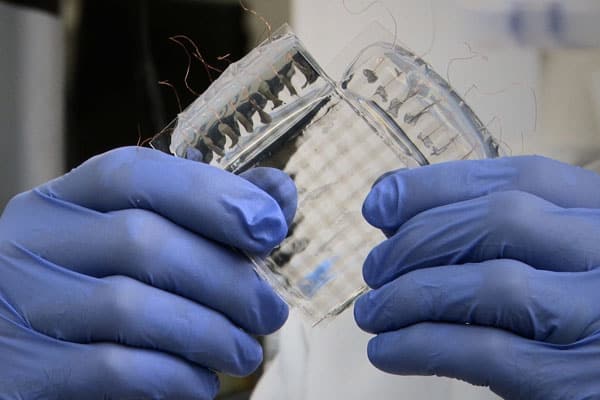
Researchers at Stanford University in the US have discovered a type of highly elastic, transparent thin film that conducts electricity extremely well. The film is made of wavy, spring-like carbon nanotubes and could be used as the electrode material in “skin-like” pressure and stretch sensors. Such devices might one day be used to help restore touch and pressure sensitivity to amputees, injured soldiers and burn victims, and also find applications in robotics and touch-sensitive computer displays, says the team.

Zhenan Bao and colleagues made their transparent elastic films by airbrushing a solution of carbon nanotubes onto the top and bottom surface of a flat silicone sheet. After coating, the researchers stretched the sheet. When the sheet then relaxed, the nanotubes naturally formed wavy, spring-like structures. These structures act as electrodes that can accurately measure the amount of force applied to the material.

In fact, the set-up behaves like a capacitor, with the silicone layer storing electrical charge, as a battery does. When pressure is applied to the sensor, the silicone layer compresses, which alters the amount of electrical charge that it can store. This charge is measured by the carbon nanotubes on top and below the silicone.

When the composite film is stretched again, the nanotubes straighten out in the direction they are stretched. The electrical conductivity of the thin film does not change as long as the material is not stretched beyond the initial stretch amount. Indeed, the film can be stretched up to two and half times its initial length, and in any direction without damage, always reverting back to its original dimensions, even after many stretches. When fully stretched, the film has a conductivity of 2200 S/cm and can detect a pressure of around 50 kPa, which roughly corresponds to that of a “firm finger pinch”, according to the researchers.

“Ours is probably the first stretchable, transparent, skin-like sensor – with or without carbon nanotubes,” says team member Darren Lipomi.

The film might find applications in a host of areas, including screens for mobile devices that can sense a range of pressures (not just touch); sensors for touch screens that are collapsible, stretchable and virtually indestructible; transparent electrodes for solar cells that could be wrapped around the curved surfaces of vehicles and buildings without wrinkling; and sensors for robots and artificial intelligence systems.

Other applications

“Other systems could also benefit – such as those requiring ‘biofeedback’ – for example, ‘smart’ steering wheels that could sense if the driver was falling asleep,” adds Lipomi. “Artificial skin made from the material might also be used to restore the sense of touch to amputees (if they were fitted with prosthetic limbs covered with the skin, for example), injured soldiers and burn victims.”

Spurred on by its preliminary results, the team now hopes to improve the sensitivity to pressure of its device. For the films made so far, the researchers mainly focused on making the structures stretchable and transparent and not on the sensitivity as such. They would also like to integrate the skin-like pressure sensors with neurons, as well as try out the electrodes in solar cells.

“In the future, it should also be possible to use such films to design organic, skin-like devices with other human – and ‘superhuman’ – characteristics, such as the ability to sense moisture, temperature, light and even chemical and biological species,” states Lipomi.

More details about work, which was funded by the US Intelligence Community, can be found in Nature Nanotechnology 10.1038/nnano.2011.184.

One toise at a time

On 12 May 1735 a ship, the Portefaix, set sail from the port of Rochefort on the Atlantic coast of France. Its destination was the West Indies, and its normal crew was accompanied by three members of the French Académie Royale des Sciences, an instrument maker, an engineer/cartographer, a draftsman/artist, two doctors, two assistants and a considerable quantity of equipment. This group would meet up with two Spanish naval officers in the West Indies before sailing on to Panama, where they would cross the isthmus, take another ship to the Peruvian coast, and then proceed by river and mountain roads to the equatorial city of Quito (now the capital of Ecuador). The aim of this Franco–Spanish mission was to measure, on the ground, the length of a degree of latitude, in order to decide once and for all whether the Earth was flattened at its poles (as predicted by Newton) or elongated like a rugby ball (as had been deduced from the theory of Descartes).

As the complexity of the journey indicates, this was never going to be easy, yet the potential rewards were huge. Controversy over the shape of the Earth had raged in the Académie for years, with strong positions being taken by both sides. Not only was the Earth’s shape a crucial distinction between Newtonian and Cartesian theories of gravity, ocean navigation also depended on knowing it, and experimental data obtained from measurements along the meridian in France were inconclusive. It had become clear that measurements must be made where the differences between the two theories would be greatest – namely, near the poles and near the equator. Hence, the Académie launched two geodesic missions, one to Lapland and one to Peru, each accompanied by its own standard of length. Known as the toise du Perou and the toise du Nord, the two standards were made of iron and had been constructed to be as close as possible in length. They would be compared again when they returned from Peru and Lapland to ensure that the two missions’ measurements were comparable.

This is how matters stand near the beginning of the narrative in Larrie Ferreiro’s Measure of the Earth, which takes as its subject matter both the Peruvian geodesic mission and the historical circumstances in which it took place. Ferreiro’s introduction sets the context of the story very well, as he describes not only the background to the scientific arguments, but also the political and national rivalries surrounding the mounting of such a mission. Some of the most important rivalries were, in fact, those that developed between the expedition’s participants as they jockeyed for position in the Académie. Competition between the main players is a theme that runs through the whole story – right up to the disputes about the publication of the results.

The Academicians who set off for Peru were Louis Godin, an astronomer and initially leader of the mission; Pierre Bouguer, an astronomer, mathematician and hydrographer who soon took over from Godin as leader; and Charles Marie de la Condamine, a scientist and adventurer whose name is now the one most associated with the expedition. Having arrived in Quito in May 1736, a year after setting sail, they immediately began laying out and measuring the length of a 10 km baseline that stretched along an east–west line near the equator.

This was a necessary first step for their overall plan, which was to lay out on the ground a set of 30 linked triangles stretching south for 300 km, representing about three degrees of latitude. The summits of the double column of volcanoes stretching due south from Quito would provide vantage points for triangulation. Once the baseline was complete, the next step was to measure the angle between each end of it and the first volcano. From these two angles and the length of the baseline, the researchers could calculate the lengths of the other two sides of this first triangle, and hence the position of the first volcano summit relative to the baseline. Using one of these other sides as a new baseline, they would repeat the operation with another volcano further south, until they had covered the full mountain range. The distance from the original baseline to the farthest summit could thus be calculated as a multiple of the length of the original baseline. The final operation was to determine the difference in latitude represented by this distance. This they did by measuring, from each end of the chain of triangles, the altitude of a particular star. Dividing the length of the chain by the difference in latitude would tell them the length of a degree of latitude.

They completed their baseline in October 1736, which might seem like fairly good progress, considering that they had only arrived in Quito that spring. However, according to the original schedule, by that time they should have already been halfway down the volcanic chain. Indeed, the entire mission was supposed to take only three years. In the event, the final star sightings were completed and the final result calculated only in January 1743, nearly four years late – and the scientists still had to get home.

One reason for the delay was that the scientists had severely underestimated both the difficulty of working at high altitude (Quito is 2800 m above sea level) and the vagaries of the weather, which meant that they sometimes waited months for a clear sight of a distant reference point. Worse, the local population was suspicious and hostile. Word had got around that the researchers were a band of adventurers intent on finding and stealing gold, so the arms they had brought to protect themselves from wild animals were more often used instead to protect themselves from local people. The ever-present bureaucracy also made life difficult for them, especially when the newly elected captain general of the region initially refused expedition members’ entreaties to cash letters of credit.

The final, and perhaps most severe, source of delay was that the senior members of the expedition quickly fell out among themselves. Even before they left France, it was clear that Godin had no idea how to treat his men, and he disputed endlessly with Bouguer and Condamine regarding the plans for the expedition. Soon after their arrival in Quito, his role was taken over by Bouguer. However, this was just the beginning of a series of rivalries, all of which Ferreiro recounts in great detail, basing his account on the many letters and reports that survive. There is a fascinating story here, and I particularly liked the wealth of additional information and comment in the extensive notes at the end, which are much more than simply bibliographic references.

The final extraordinary part of the story concerns the scientists’ journeys home. The French side of the expedition had been financed by the Académie, so the three Academicians all got back relatively quickly: Bouguer in 1744, La Condamine six months later and Godin, who carried the famous toise, in 1751. It transpired, however, that no arrangements had been made to bring home junior members of the expedition. As a result, they were essentially abandoned in Peru. Two never managed to get home at all, dying in South America many years later. Meanwhile, Godin’s young cousin, who was one of the assistants, spent 15 years waiting at the mouth of the Amazon because the Portuguese authorities refused to give him permission to travel up the river. The authorities would not even let him send a message to his wife, who had been stranded 1000 km upstream after becoming pregnant. She eventually managed to make her own way down (after all her children had died), and was finally reunited with her husband. They sailed back to France more than 30 years after the Portefaix had left Rochefort.

That the Geodesic Mission to Peru eventually succeeded in everything it set out to do, despite many difficulties, was a tremendous achievement for all concerned. The result, which confirmed the information obtained (with much less difficulty) by the Lapland mission, showed that Newton was right: the Earth is an oblate spheroid flattened at the poles. But perhaps more importantly, according to Ferreiro, theirs was the first truly international scientific project. Those of us who participate in modern international collaborations must be grateful that, even with airport delays, our journeys around the world take days rather than years, and family members do not end up stranded in the jungle!

  • 2011 Basic Books £15.99/$28.00hb 376pp

Dwarf planet brought into focus

A chance encounter with light from a distant star has given astronomers a wealth of information about Eris – a “dwarf planet” that is currently almost 100 times further from the Sun than the Earth. By using multiple telescopes to watch Eris move in front of the star, an international team of scientists has worked out the diameter of the dwarf planet and measured its ability to reflect light. The observations reveal that Eris is about the same size as Pluto, but denser and shinier, with the shininess suggesting that Eris is covered with a millimetre-thick layer of ice that renews itself in a 500-year cycle.

Discovered in 2005, Eris is one of the furthest known objects in the solar system. By studying the relative motion of Eris and its accompanying moon Dysnomia, astronomers have already worked out that Eris is about a quarter of the mass of our own Moon, making it about 27% heavier than Pluto. Astronomers therefore had thought that Eris also has a larger diameter than Pluto – but could not get any reliable estimates because Eris is so far away that it is just a point of light to even the most powerful telescopes.

Vanishing act

Now, however, Bruno Sicardy of the LESIA Observatoire de Paris and colleagues have used several telescopes in South America to track Eris as it moved between a star and Earth, revealing that Eris is in fact about the same size as Pluto. When such an occultation occurs, observers along a narrow path on the Earth’s surface see the star vanish for up to a minute – much like a solar eclipse. By measuring the time that the starlight is blocked at several different points on the path, the team can work out the radius of Eris. According to Sicardy, the main challenge is not making the measurements, but rather predicting exactly when and where the occultation will be visible.

This time the team’s painstaking calculations paid off because three telescopes in Chile – two at San Pedro de Atacama and the other several hundred kilometres away at La Silla – saw a pronounced dip in the light from the star as Eris moved across it in November 2010. A fourth telescope in Argentina, a few hundred kilometres from La Silla, did not see any dip – and together this information allowed the team to work out the diameter of Eris to be somewhere between 2314 and 2338 km. This is more accurate than our current estimate for the diameter of Pluto (2300–2400 km), which is complicated by blurring caused by Pluto’s atmosphere. Indeed, the occultation study could find no evidence of an atmosphere on Eris.

By measuring the light from Eris during the occultation, the team was also able to determine how much sunlight is reflected from its surface. The researchers were able to confirm previous observations that Eris is very shiny, showing that it has a “visible geometric albedo” of 0.96. This is much greater than Pluto’s, which is about 0.6. The shininess comes as a surprise because, thanks to its exposure to the solar wind, Eris was expected to be much darker.

Sublimating froth

Sicardy believes that the high albedo is caused by an extremely thin layer of frozen nitrogen “froth” just one millimetre thick on the surface of Eris. Although Eris is now nearly 100 astronomical units (AU) from the Sun, it has a very eccentric orbit that will bring it as close as 38 AU in about 250 years. As it nears the Sun, Sicardy believes that the thin layer of nitrogen will sublimate to create an atmosphere much like that of Pluto. When Eris then moves away from the Sun, the gas will refreeze to create a shiny new surface. Mike Brown from the California Institute of Technology, who was part of the team that discovered Eris, agrees with this idea of renewal. “It seems a very natural hypothesis to explain both the high albedo and the lack of apparent surface variations,” he says.

When the new result is combined with the known mass of Eris, it suggests that the density of the dwarf planet is about 2.5 g/cm3 – compared with Pluto at 2.0 and 5.5 for the Earth. According to Sicardy, this means that Eris is mostly rock covered in a 100 km thick layer of frozen nitrogen and methane. Pluto, on the other hand appears to have less rock and more ice. Brown, who was not involved in this latest work, says he finds “the remarkably high amount of rock in the interior of Eris compared to Pluto” to be “the most surprising thing” about the observation.

The observations are described in Nature 478 493.

Newton’s first paper among newly opened archive

By James Dacey

Newton’s first published scientific paper and James Clerk Maxwell’s paper describing his electromagnetic theory of light are among the Royal Society’s historical journal archive, which from today is permanently free to access online. More than 60 000 papers are available in a searchable database where all papers published more than 70 years ago (all 8000 of them) are free to view online or download.

royal society.bmp

Newton – who was president of the Royal Society between 1703 and 1727 – had his first paper published in Philosophical Transactions in 1671, in which he presented his New Theory of Light and Colors. Unlike the convention in modern scientific papers, Newton writes in the first person throughout and he begins with this meandering description of how this research came about:


To perform my late promise to you, I shall without further ceremony acquaint you, that in the beginning of the Year 1666 (at which I applyed my self to the grinding of Optick glasses of other figures than Sperical,) I procured me a Triangular glass-Prisme, to try therewith the celebrated Phenomena of Colours.

Newton went on to publish his full treatise on the behaviour of light in his famous book of 1704, Opticks.

Another incredibly important paper now freely available to the public is Maxwell’s Dynamical Theory of the Electromagnetic field , published in 1865. This paper came after Maxwell had first published his famous equations but it appears to have been the first time that Maxwell presented his argument that light is an electromagnetic field. The language in this paper is far more familiar to the modern English reader, as when he presents the basis of his idea in the introduction:

The electromagnetic field is that part of space which contains and surrounds bodies in electric or magnetic conditions. It may be filled with any kind of matter, or we may endeavour to render it empty of all gross matter, as in the case of GEISSLER’s tubes and other so-called vacua. There is always, however, enough of matter left to receive and transmit the undulations of light and heat…

The opening of the Philosophical Transactions archive comes during Open Access week, and it also follows shortly after the Royal Society announced the creation of its first ever open access journal – Open Biology. Other interesting papers in the archives include Benjamin Franklin’s account of his electrical kite experiments and geological work by a young Charles Darwin.

Q&A with Jim Al-Khalili

Jim Al-Khalili

By Margaret Harris
One of the highlights on physicsworld.com last week was an online lecture by the University of Surrey physicist and science communicator Jim Al-Khalili, who spoke on the subject of his recent book Pathfinders: the Golden Age of Arabic Science.

If you missed the live version of Al-Khalili’s lecture “On the shoulders of eastern giants: the forgotten contributions of medieval physicists”, you can watch an archived version of the hour-long event here. Be sure to stay all the way to the end, when Al-Khalili tackles some probing questions from audience members – including one asking why these physicists’ contributions have been forgotten in the West, and another wondering why science declined in the Arabic-speaking world after the medieval period.

As usual with these question-and-answer sessions, we ran out of time long before you ran out of questions. On this occasion, several of the ones we couldn’t fit in were so interesting that we asked Al-Khalili to send us written answers so we could share them with you. Below are his replies.

(more…)

Counting wrinkles reveals pressure

Poking a living cell and counting the number of wrinkles that form could provide scientists with a new way of measuring its internal pressure. That is the claim of physicists in the UK, the US and France, who have shown that the number of wrinkles that appear on a pressurized shell is determined by its internal pressure. The technique could be used to study how cells react to changes in their environment and improve tiny capsules used by the pharmaceutical industry.

If you push your finger into a beach ball, the indentation that you create will include a number of wrinkles that radiate outwards from your finger. However, if you do the same thing with a table-tennis ball, the result will be a much simpler three-lobed geometric pattern (see figure). An important difference between these examples is that the beach ball is pressurized and the table-tennis ball is not.

Dominic Vella of the University of Oxford and colleagues at Northeastern University in the US and the University of Lyon in France thought that this effect could be used to create a new technique for measuring the pressure inside such a shell – without the need to make a hole in it. Now, by using theory, computer simulations and experiments carried out on an exercise ball, they have worked out the relationship between the internal pressure of a shell, its elastic properties and the number of wrinkles that appear when it is prodded.

Pressure threshold

In its work, the team used a commercial software package for finite element analysis (called ABAQUS) to simulate a large shell of aluminium 1 m in radius and 2 mm thick. The simulations were performed at pressure differences between the inside and outside of the shell that ranged from zero to 15 MPa. The simulations suggest that, above a certain pressure, the number of wrinkles can be calculated from the square root of the pressure. Below this pressure, the three-lobed pattern seen in a table-tennis ball is predicted.

The computer simulations agree with both the team’s mathematical derivation of the relationship between wrinkle-number and pressure, and a small number of experiments done on a Pezzi exercise ball.

Vella told physicsworld.com that the team’s findings could be used to study how the pressure inside a living cell changes in response to changes in the local environment, such as the concentration of salt. If the thickness and elasticity of the cell wall or membrane is known, then the internal pressure can be determined by carefully poking the cell with a known force and counting the wrinkles. He also believes that the technique could be used to determine the internal pressures of tiny spherical capsules (about 100 µm in diameter) that are used to deliver drugs.

‘Beautiful’ finding

Pedro Reis of the Massachusetts Institute of Technology in the US describes the work as “an extremely elegant and thorough investigation of wrinkling in thin shells under pressure”, adding that Vella and colleagues’ technique is “beautiful”.

“It is an open invitation for experimentalists, biologists, physicists and material scientists alike, to get to the lab and use this new testing framework as a tool to measure the mechanical properties of synthetic and biological pressurized shells,” he adds.

The research is described in Phys. Rev. Lett. 107 174301.

Plasmonics produces extreme UV light

An international team of researchers has invented a simple way of creating ultrashort pulses of extreme ultraviolet (EUV) light. The system uses a new 3D metallic waveguide, or “nanofunnel”, that coverts pulses of infrared light to EUV.

EUV light has a wavelength of around 5–50 nm, which is about 100–10 times shorter than that of visible light. As a result, ultrashort pulses of EUV light are ideal for studying fundamental physics phenomena – such as how electrons move in atoms, molecules and solids.

However, it is difficult to produce EUV radiation using conventional methods that rely on using amplified light pulses from an oscillator (a source of laser light) to ionize noble gas atoms. The electrons liberated during this process are accelerated in the light field and their surplus energy is freed as attosecond (10–18 s) pulses of light of different wavelengths. The shortest wavelengths of light can then be “filtered out” to produce a single EUV pulse – a complicated process.

Simpler way of making pulses

Now, researchers at the Korea Advanced Institute of Science and Technology (KAIST), the Max Planck Institute of Quantum Optics (MPQ) in Germany and Georgia State University (GSU) in the US have come up with a different – and much simpler – way of doing things.

The new technique works by converting femtosecond (10–15 s) infrared pulses into femtosecond EUV pulses. The process exploits surface-plasmon polaritons (SPPs), which are particle-like collective oscillations that occur when light interacts with a metal’s conduction electrons.

The nanofunnel made by the KAIST-MPQ-GSU team was devised so that it concentrated incident infrared light pulses into a spot that is smaller than the wavelength of the incident light. The funnel is a metallic nanostructure made of silver that contains a hollow hole shaped like a tapered cone. The cone is just a few micrometres long and filled with xenon gas. The tip of the funnel is around 100 nm across.

Concentrating fields

The researchers sent infrared light pulses (at a rate of 75 MHz) into the funnel, which is designed so that it contains patches of metal that are positively charged, followed by patches that are negatively charged. This arrangement produces electromagnetic fluctuations on the inside walls of the funnel, which result in the creation of SPPs. These particles then travel towards the tip, where the conical shape of the funnel concentrates their fields.

“The field on the inside of the funnel can become a few hundred times stronger than the field of the incident infrared light,” explains Mark Stockman of GSU. “This enhanced field results in the generation of EUV light in the Xe gas.”

An important feature of the nanofunnel is that it can be produced at frequencies of up to about 75 MHz. Seung-Woo Kim, team leader at KAIST, where the experiments were carried out, adds: “Due to their short wavelength and potentially short pulse duration, EUV light pulses can be an important tool for exploring electron dynamics in atoms, molecules and solids. Electrons move very fast – on the attosecond timescale – and light flashes that are shorter than attoseconds long are therefore needed to image these particles. Although scientists routinely use attosecond light flashes for such studies, they have much lower frequencies. Our new nanofunnel could change all this.”

The results are detailed in Nature Photonics.

Copyright © 2026 by IOP Publishing Ltd and individual contributors