Venus: it’s now or never

One of the most exciting recent developments in astronomy has been our ability to detect planets orbiting stars other than our Sun. Astronomers have so far spotted more than 700 such exoplanets, which has made the eight planets in our solar system – 13 if you include the dwarf planets Pluto, Ceres, Eris, Haumea and Makemake – perhaps less special than we once thought. Most of these exoplanets are detected as they cross the face of – or “transit” – their parent stars. But spotting these planets from the faint dimming of their star’s light is a fiendish task because several things can, at least for a while, mimic this tiny dip. Indeed, of the thousands of additional possible planets we have seen, thanks in part to the French CoRoT and US Kepler spacecraft, some may just be sunspots.

What can aid our search for exoplanets, however, is studying examples of transits in our own solar system. Doing so not only yields an improved understanding of our own cosmic neighbourhood, but also verifies that the techniques for studying events on and around other stars hold true in our own backyard. In other words, by looking up close at transits in our solar system, we may be able to see subtle effects that can help exoplanet hunters when viewing distant suns. The snag is that, here on Earth, just two planets lie between us and the Sun – Mercury and Venus. And, moreover, they cross the Sun only very rarely.

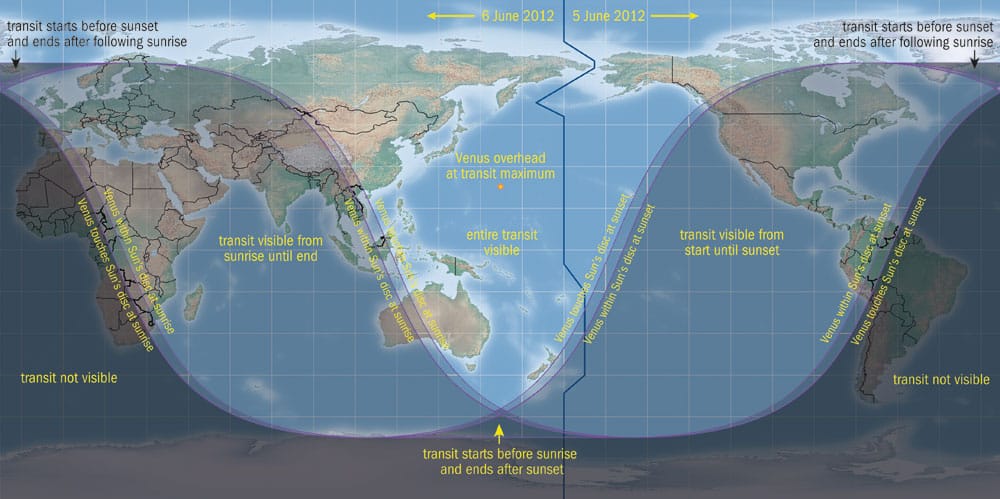
While transits of Mercury occur about 14 times a century, transits of Venus are even scarcer. They always take place in pairs eight years apart, with the gap between the second transit of one pair and the first transit of the next alternating between 105.5 and 121.5 years. In other words, the transits of 1631 and 1639 – around the time that Galileo was imprisoned by the Church – were followed, after a gap of 121.5 years, by a pair in 1761 and 1769, not long before the American Revolution. The next transits occurred 105.5 years later, in 1874 and 1882, and so, continuing this sequence, the transit of 2004 will be followed by another this year – on Tuesday 5 June in the Americas and Wednesday 6 June in Europe, Asia and Australia (figure 1). It will be an event well worth watching, as the next transit of Venus will not occur until December 2117, when most of us will be long gone.

Origins of a phenomenon

The notion that Venus could potentially pass across the face of the Sun, when viewed from Earth, can be traced back to the work of Nicolaus Copernicus, whose 1543 book De Revolutionibus held that only Mercury and Venus joined our Earth in orbiting around the Sun and thus could pass between those two bodies. In 1627 Johannes Kepler, best known for his three laws of orbits, published his Rudolphine Tables, which showed the superiority of the Copernican theory and allowed the positions of the planets in the sky to be calculated more accurately. This work led Kepler to predict that both Mercury and Venus would transit the Sun in 1631.
That year’s transit of Mercury was observed by the French scientist Pierre Gassendi, but that of Venus was not visible from Europe and so went unseen. (Although the Venusian transit could, in principle, have been observed in other parts of the world, it was only in Europe that astronomers had access to new-fangled “telescopes”.) A few years later, however, the English astronomer Jeremiah Horrocks, working in the village of Much Hoole in Lancashire, extended Kepler’s calculations and discovered that the next transit of Venus would occur in late November 1639. Horrocks informed one friend in London and another in Manchester, William Crabtree, of the prospective event.

On the afternoon of the big day, when Horrocks finally returned to Carr House in Much Hoole – having been delayed by a task that was no doubt to do with the local church on that Sunday – he found Venus already silhouetted on the surface of the Sun. Although it was much smaller than he had expected, by using a telescope to project the solar image, Horrocks was able to make careful drawings of what he saw. Crabtree, in Manchester, also saw the transit but was so excited to see Venus’s silhouette once the clouds had parted that he neglected to make any scientific observations. With clouds obscuring the view of Horrocks’ friend in London, it was Horrocks and Crabtree who therefore become the first two people in the world to see a transit of Venus.

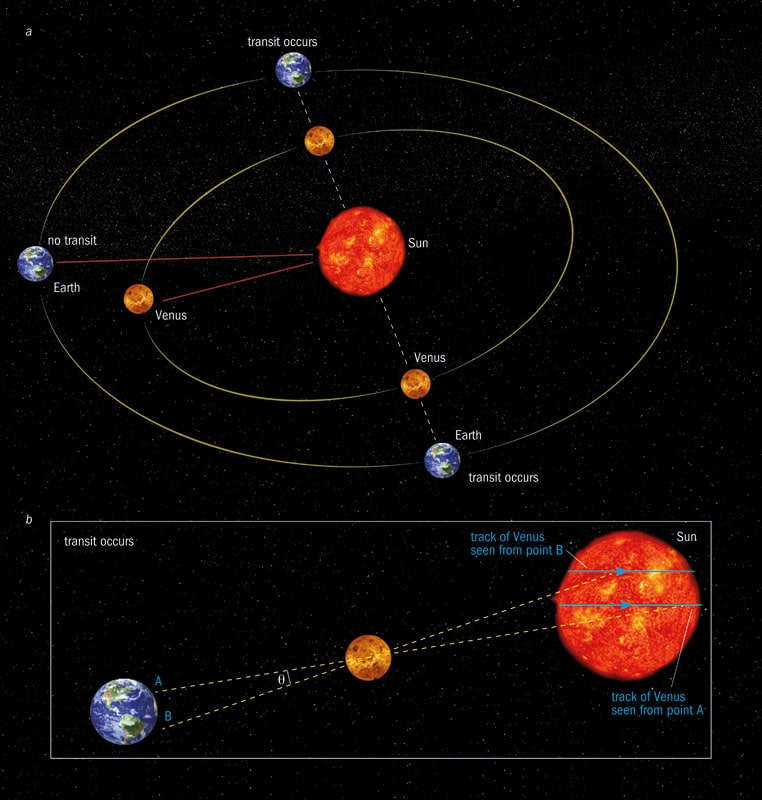
We now know that these transit pairs occur only when Venus’s orbital plane crosses the plane of the Earth’s orbit around the Sun, the two orbits being at a slight angle of 3.4° to one another (figure 2a). One can think of Venus’s path crossing the lower half of the Sun, then eight years later passing across the upper half of the Sun, before next time passing above the Sun (and so not being a transit). This process goes on for a further 100 years or so until the angle brings Venus around to the lower half of the Sun again.

Astronomical solution

But transits of Venus are much more than a curiosity. In 1716 Edmond Halley proposed using them to solve what George Airy – then Astronomer Royal – later called “the noblest problem in astronomy”: finding the distance between the Earth and the Sun, known as the astronomical unit (AU). At that time, distances in the solar system were known only proportionately – measured as fractions or multiples of an AU. Measuring the AU would mean that, for the first time, the absolute size and scale of the solar system could be determined.
Halley’s method relied on Kepler’s third law of orbits, which tells us that the square of the time it takes a planet to orbit the Sun (its period), P2, is proportional to the cube of the radius of the orbit, a3. Since we know how long it takes Venus and the Earth to orbit the Sun, then if it were possible to determine the distance to Venus, we could use Kepler’s third law to deduce all distances in the solar system, including the AU.

In practice, Halley’s method involved observing Venus from two different locations during a transit – one very far north on Earth and one very far south – and accurately determining when the planet first begins to cross the Sun “ingress”) and when it just leaves “egress”). A transit lasts about six hours and, if it were possible to time the duration to an accuracy of about 1 s, the distance to Venus could then be determined using the principles of triangulation (figure 2b). Later in the 18th century an alternative calculation involving accurate timing of only ingress or egress was developed by Joseph-Nicolas Delisle, although the method had its own problems, not least that it required knowing the longitude more precisely than was likely possible at that time.

With these methods in hand, hundreds of expeditions were sent all over the world to observe the 1761 and 1769 transits, including the ill-fated voyage undertaken by the French astronomer Guillaume le Gentil (see below). Perhaps the most famous was in 1769, when the British Admiralty entrusted a ship to a young lieutenant by the name of James Cook. Accompanied by former Greenwich astronomer Charles Green and others, Captain Cook took the Endeavour to the island of Tahiti in the South Pacific, where they successfully observed the transit under very clear skies at a site that is still called Point Venus. Having completed that task, which was the official reason for the voyage, Cook then opened a letter with secret orders that took him to explore farther south, searching for and mapping a “southern continent”, which turned out to be New Zealand and the east coast of Australia.

The black-drop mystery

Unfortunately, when Cook and Green looked through their telescope to time the precise moment of ingress – when Venus was just inside the outer edge (or “limb”) of the Sun – they ran into trouble. They noticed a dark band – linking the blackness of Venus’s silhouette with the blackness of the background sky outside the solar limb – that grew for about 1 min and then seemed, like pulled taffy, to pop. Now known as the “black-drop effect”, it meant that the accuracy of their timing was closer to 1 min than to 1 s, diminishing the accuracy of the calculated astronomical unit by about a factor of 60. Cook and Green mistakenly thought that Venus’s atmosphere was causing the uncertainty in the timing, but we now know that the atmosphere is much too small in diameter to cause much blurring.

The two transits of Venus in the 19th century – in 1874 and 1882 – were well observed all around the world. Photography was also used for the first time, although the black drop still foiled accurate attempts to measure the AU using Halley’s method, as it had done for the 18th-century transits. There having been no transits throughout the 20th century, Glenn Schneider of the University of Arizona’s Steward Observatory and I decided in 2001 – three years before the first transit of the 21st century – to try to solve the origins of the black-drop effect once and for all.

We sought to do this by analysing observations of the effect made by NASA’s Transition Region and Coronal Explorer (TRACE) spacecraft during the 1999 transit of Mercury. The black-drop effect, it turns out, has two different causes. One, which had been widely suspected, is down to the fact that no telescope is perfect and that even a point source will have a certain inherent fuzziness, known as the “point-spread function”. But the other cause, which had previously not been widely acknowledged, is the fact that the visible Sun is always darker near its edge, with the intensity falling off following roughly the path of a cosine curve. Indeed, the drop in brightness, known as “solar limb darkening”, is so severe in the final arcsecond or so at the edge of the Sun that the limb darkening merges with the point-spread function. Given that Mercury has no appreciable atmosphere and yet shows a black drop, our analysis showed that the black-drop effect need not have anything to do with the existence of a planetary atmosphere. Coupled with our current knowledge of the actual thickness of Venus’s atmosphere, we showed that Venus’s black drop cannot be caused by its atmosphere either.

With the next transit of Venus due to take place in June 2004, an International Astronomical Union symposium was scheduled to take place at Much Hoole, where Horrocks had observed the first transit all those years ago. Not wanting to take a chance on the notoriously capricious British weather, I took my colleagues and all our astronomy students from Williams College (with the help of a grant from the National Geographic Society, or NGS) to Greece, which lay deeper into the zone from which the whole transit would be visible. In the event, it was clear in Much Hoole after all, but from Greece we were able to observe the whole transit with telescopes and cameras, and I saw the black drop with my own eyes, which was an incredible experience.
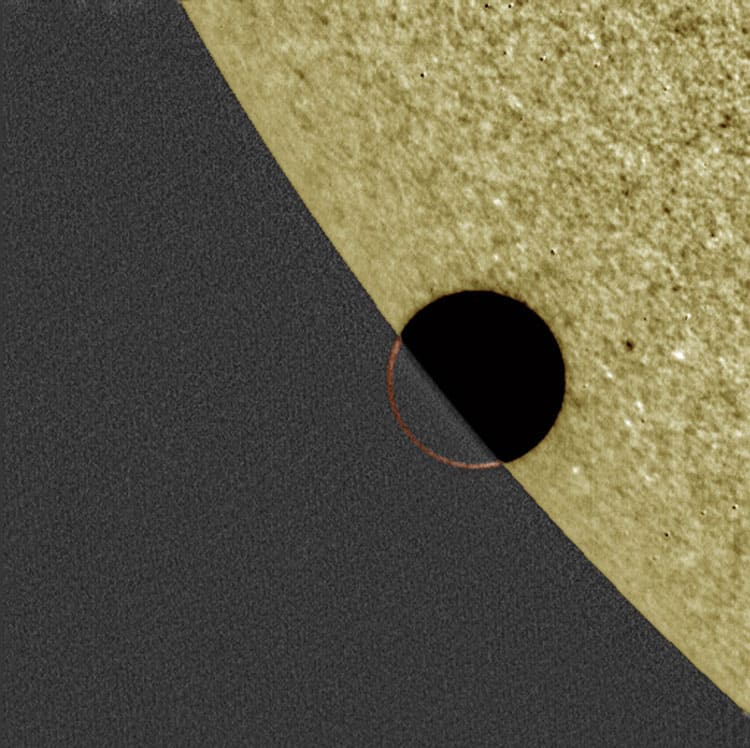
Earlier that year, while observing with Sweden’s 1 m Solar Telescope on La Palma, which itself went on to make successful observations of that year’s transit, I e-mailed the schedulers for TRACE to help them tailor their observations of the transit to meet our requirements. What we particularly wanted to do was to increase the rate at which photographs were taken of the black-drop effect at ingress and egress. But knowing that TRACE can only ever see about a sixth of the Sun at any one time, it was also vital that the craft was pointing in the right direction to see the edge of the Sun. Fortunately, when we got the results, we were relieved that everything had gone well. Moreover, while the planet was roughly halfway into the Sun at ingress, we were flabbergasted to see a bright rim appearing around Venus’s trailing edge that persisted and brightened asymmetrically (figure 3). It was, in fact, Venus’s atmosphere, which bent sunlight towards us. About six hours later, after Venus had traversed the Sun’s disc, we saw the same effect in reverse (2004 Proceedings IAU Colloquium 196 6 and 2011 Astronomical Journal 141 112).

What was also interesting about the 2004 transit was that it extended the study that Schneider and I carried out using measurements obtained by TRACE. William Sheehan and I had been intrigued by claims made by the famous 18th-century Russian scientist Mikhail Lomonosov that he had discovered the atmosphere of Venus after sighting a brief brightness at the edge of Venus during the 1761 transit (see “Atmospheric tales” by Robert P Crease). However, what Lomonosov reported did not match the 2004 observations studied by Schneider and me, and seemed more like the first appearance of the solar disc at the end of the black-drop effect. Sheehan and I therefore concluded that the Russian must have seen only artefacts and had not discovered Venus’s atmosphere itself. But because Lomonosov believed – as did many scientists of his era – that all planets had atmospheres, it is perhaps understandable that he thought he had discovered one around Venus. In the end, he had the right result, but without a proper train of measurement and reasoning.

The 2012 transit

For the upcoming transit of Venus this June we want to get the most complete set of data possible, so that the astronomers of 2117 will think that their forebears way back in 2012 did a fine job even with their relatively primitive instruments. On the ground, I will be at the University of Hawaii’s solar observatory on top of Haleakalā – a 3000 m-high dormant volcano – with a couple of my students, as well as Schneider and Bryce Babcock, all supported by a new NGS research grant. We will have several cameras, with the main aim of studying Venus’s atmosphere at ingress and egress, while also verifying our previous conclusion about the black-drop effect. Meanwhile, my former student Kevin Reardon of the Arcetri Observatory in Florence, Italy, will be at Sacramento Peak in New Mexico, using a giant imaging spectrometer on the vacuum tower of the Dunn Solar Telescope.

A major part of our research effort will be with telescopes in space, notably using NASA’s Solar Dynamics Observatory (SDO), which was launched two years ago as an improved replacement for TRACE. The SDO contains the Atmospheric Imaging Assembly, built by my colleague Leon Golub of the Smithsonian Astrophysical Observatory, which has pixels the same size as those of TRACE but can view the entire Sun at once. The other huge advantage of SDO is that it moves in a geosynchronous orbit and is always in view of a ground station in New Mexico, allowing it to send down eight individual filtered images six times a minute, 24 hours a day (with only a few minor 20 min outages each year when the Earth eclipses the Sun). We will also be co-ordinating our observations with those of colleagues at Stanford University, who run a second SDO instrument, the Helioseismic and Magnetic Imager, which has pixels of a similar size.

This summer Schneider and I will be working again with Richard Willson, who operates NASA’s Active Cavity Radiometer Irradiance Monitor satellite from California, in order to monitor the total brightness of the Sun as a way of studying the transit. It follows our successful collaboration in 2004, when we used the same craft to measure the tiny 0.1% drop in the total solar irradiance caused by Venus’s silhouette blocking that same fraction of the solar disc. Interestingly, two years later we were unable to detect the 0.003% drop in intensity from the 2006 transit of Mercury because the effect is smaller than the inherent uncertainty in the signal – information that should help exoplanet hunters to know what they might or might not be able to detect. This year’s collaboration will also involve Greg Kopp of the University of Colorado at Boulder, whose Total Irradiance Measurement instrument aboard NASA’s Solar Radiation and Climate Experiment spacecraft yields similar information.

Beyond 2012

Until recently we had thought that after June there would be no chance to observe any further transits of Venus until the 22nd century. But last autumn we discovered that David Ehrenreich of the Institut de Planétologie et d’Astrophysique de Grenoble, France, had won time on the Hubble Space Telescope to try to observe this June’s transit of Venus as it would be if viewed from the Moon. What he plans to do is to point Hubble at several areas on the Moon and monitor the extremely tiny fall in intensity of sunlight reflected off the Moon as Venus passes in front of the Sun. This is obviously harder than studying a transit directly because the intensities involved are so low. But the study is useful because it mimics the problems exoplanet hunters encounter, while still occurring in our solar system, where we know exactly what is happening.

But if Hubble could be used to detect the transit of Venus using the Moon, might it also be possible to observe transits of Venus by observing light reflected off the outer planets? After a meeting of the American Astronomical Society in Nantes, France, last October, my transit team met up with that of Ehrenreich to discuss that idea, along with Thomas Widemann of the Observatoire de Paris, Paolo Tanga of the Observatoire de la Côte d’Azur in Nice and Alfred Vidal-Madjar of l’Institut d’Astrophysique in Paris. Since then we have together submitted a proposal for time on Hubble to observe the transit of Venus using Jupiter on 20 September 2012. (If we miss this date, there will not be another transit of Venus from Jupiter until 2024 – long after Hubble’s demise.)

Another, even more exciting event will occur on 5 January 2014 when the Earth, as seen from Jupiter, will pass in front of the Sun. Although we cannot view the Earth directly from Jupiter itself, what we can do is to use Hubble to view the Earth indirectly by watching Jupiter’s clouds and studying how much of its light bounces off Jupiter’s main moon Ganymede. Detecting this transit and any spectral effect from the Earth’s atmosphere would be an astonishing feat – and a spectacular verification of our understanding of exoplanet transits.

If we can study transits via Jupiter, what about doing so with Saturn? As it happens, NASA’s Cassini craft is currently orbiting the planet and a transit of Venus, as seen from Saturn, is due to take place later this year on 21 December. Together with Phil Nicholson from Cornell University, we have obtained permission from the Cassini board to turn the craft towards the transit on that day, which will be our last chance to see a transit of Venus from Saturn until January 2028. We are fortunate in that we are truly living in a golden period of planetary transits and it is one of which I hope astronomers can take full advantage.

The strange tale of Guillaume le Gentil

There have been some intrepid journeys over the years to view transits of Venus, none more so than that of the 18th-century French astronomer Guillaume le Gentil. In 1761 he set out to observe that year’s transit from Pondicherry in south-east India, but the British held the area when he arrived and refused to let him land. Although he saw the transit in clear sky from his ship where he remained, his pendulum clock was useless on board. Le Gentil therefore decided that because the next transit was only eight years away, he would stay in Asia and wait for it to arrive.

Eventually, following spells in the Philippines and elsewhere, Le Gentil returned to Pondicherry for the 1769 transit. But after a promising day of good weather, disaster struck when, having waited eight years for the big day, Le Gentil’s view of Venus was spoiled by a cloud. To add insult to injury, on his return journey to Europe, he was shipwrecked and hospitalized for dysentery, before finding, on arriving in France 11 years after his departure, that his fiancée had married someone else and that he himself had been declared officially dead.

So incredible were Le Gentil’s efforts that the Canadian playwright Maureen Hunter dramatized them in a production called The Transit of Venus in 1998, which was later turned into an opera of the same name by the Canadian composer Victor Davies, with Hunter writing the libretto. Fortunately, Le Gentil’s tale had a happy ending, as he eventually regained his place in the French Academy of Sciences, got married and had children. He died in 1792 at the age of 73.

Single laser makes many colours

A new type of semiconductor laser that can be easily modified to create light over a range of different colours has been created by researchers in the US. The device is based on tiny particles called colloidal quantum dots (CQDs) that emit different colours of light according to their size – rather than their chemical composition.

Semiconductor lasers are found in a wide range of technologies, from DVD players to optical communications networks. While they are efficient and inexpensive to produce, their colour is defined by the electronic band gap of the semiconductor, which means that for every colour a different set of materials and structures is required. Integrating lasers of different colours into the same electronic device can therefore be very difficult.

What Arto Nurmikko and colleagues at Brown University in the US have managed to do is create a new type of semiconductor laser that, in principle, can produce light of different colours while being made of the same materials and design. The device is called a CQD vertical-cavity surface-emitting laser (CQD-VCSEL). The device is a variant of the VCSEL, which is a commercially available type of laser that uses a thin layer of compound semiconductor as its active optical medium.

Red, yellow and green

In Nurmikko’s prototype, the active material is a thin film of CQDs, which are nanometre-diameter spheres of the semiconductor cadmium selenide. In its studies, the team used CQDs with 4.2 nm diameters to create a red laser, 3.2 nm for green and 2.5 nm to produce blue light.

The CQDs are made using a wet-chemistry process, which creates a colloidal suspension of the spheres in a liquid. A tiny drop of this paint-like mixture is placed on the surface of a distributed Bragg reflector (DBR) – which is a special type of mirror used in VCSELs. A second DBR is then placed on top of the first and the drop is squeezed down to create a micron-thick active layer.

The team studied the devices by firing ultrashort pulses of light through the sandwich structures. This “pumps” the quantum dots into an excited energy state characterized by the presence of electron–hole pairs called excitons. An exciton can decay by emitting a photon, which can bounce back and forth between the mirrors and stimulate the emission of identical photons. As a result, the system will operate as a laser.

Too many excitons

But to excite enough of the quantum dots for this process to occur, a lot of power has to be delivered to the laser. This causes more than one exciton to occur in a dot and these are more likely to decay by emitting an electron (an Auger process) rather than a photon. This reduces the performance of CQD lasers, making them impractical.

To get around this problem, Nurmikko and colleagues coated cadmium-selenide quantum dots with an alloy of zinc, cadmium and sulphur. The team found that these latest quantum dots act as a laser when, on average, each dot has one or less excitons. This means that the laser requires a factor of 1000 less power to operate than previous devices based on uncoated cadmium-selenide quantum dots. This allowed the team to make the first working CQD-VCSEL.

“We have managed to show that it’s possible to create not only light, but laser light,” Nurmikko said. “In principle, we now have some benefits: using the same chemistry for all colours, producing lasers in a very inexpensive way, relatively speaking, and the ability to apply them to all kinds of surfaces regardless of shape. That makes possible all kinds of device configurations for the future.”

“Significant step”

Yury Rakovich of the University of the Basque Country in Spain described the work as “very well done and convincing”. He told physicsworld.com that Nurmikko and colleagues’ device is a significant step towards full-colour, single-material lasers. He said the next step in the development of practical devices is to determine whether the CQD-VCSELs will operate in continuous mode, rather than the pulsed mode studied by Nurmikko’s team. He also believes that researchers will have to gain a better understanding of the lasing processes that occur in such tightly packed films of CQDs – and in particular whether interactions between individual dots play an important role in the laser.

The lasers are described in Nature Nanotechnology 10.1038/nnano.2012.61 .

New material filters and polarizes terahertz radiation

A new material made from several layers of graphene is an effective shield for terahertz and microwave radiation, while letting visible light through. So say researchers in the US, who have created thin films that can be engineered to strongly absorb radiation in a specific band of the electromagnetic spectrum. Shields made of the material could be used to reduce external electromagnetic interference in sensitive electronic equipment and the team also claims that the material could be used to create terahertz filters and polarizers. Such devices could prove useful in the emerging field of terahertz imaging.

Despite being just one atom thick, graphene is a strong absorber of electromagnetic radiation over a wide range of wavelengths – particularly in the far infrared and terahertz parts of the spectrum. This is extraordinary because conventional materials normally need to be thousands of atoms thick to be as effective. This high absorption is a result of graphene’s unusual electronic properties, which result in its electrons moving extremely fast and behaving like relativistic “Dirac” particles with virtually no rest mass.

Phaedon Avouris and colleagues at IBM’s TJ Watson Research Center in New York have created a film comprising alternating layers of graphene and an insulator. The team has shown that a film containing just five layers of each material can shield electromagnetic radiation in the terahertz and microwave ranges by up to 97.5%, while remaining transparent to visible light.

Discs and ribbons

What is more, by making films that contain arrays of tiny graphene discs or ribbons, the researchers have found that they can create tuneable terahertz filters and polarizers. The discs and ribbons are just a few microns across and absorb light by confining it to regions that are hundreds of times smaller than the wavelength of the light by exploiting plasmons – quantized collective oscillations of electrons inside the structures – that interact strongly with light.

The team began by stacking large graphene sheets alternately with thin insulating layers to form a five-layer structure. Then they used electron-lithography techniques to create patterned regions that measured 3.6 × 3.6 mm. Finally, they measured the electromagnetic transmission spectra of the sample in the terahertz and infrared regions using a Fourier-transform infrared spectrometer.

The active elements in such a device are the graphene layers, explains team member Hugen Yan, lead scientist of this project, and it is the plasmons in the material that absorb and enhance the reflection of terahertz and microwave radiation. Plasmons are quantized excitations of the conduction electrons in the material. The plasmons inside the discs and ribbons oscillate with the terahertz light and, at certain frequencies, the two oscillate in resonance. “It is at this resonance that the shielding efficiency reaches its maximum,” Yan explains.

“Graphene could be used as a transparent terahertz and microwave-shielding material and so help prevent external electromagnetic interference in high-accuracy electronic equipment,” he says. “Such a shield could even help protect people from radiation at these wavelengths, which are hazardous to human health, according to the World Health Organization.”

Patterned graphene could also be used to make terahertz frequency filters and polarizers for photonics and optoelectronics applications, he adds.

The team is now looking at how the patterned graphene nanostructures respond to terahertz frequencies under high applied magnetic fields. “We will also study graphene plasmonics over a broader frequency range, including mid-infrared regions,” says Yan.

The current work is detailed in Nature Nanotechnology.

Metallurgy and the Armada

By Margaret Harris

One quirk of working for Physics World is that most staff members are assigned a British newspaper to skim each day in search of science news. The exact rationale determining which of us gets what paper is not entirely clear, but for whatever reason, I have ended up with that venerable mouthpiece of British conservatism, the Daily Telegraph.

As a result of this arrangement, I have become a connoisseur (if that’s not too flippant a word) of the Telegraph‘s obituaries page. My favourites are the obituaries of eccentric aristocrats straight out of P G Wodehouse, but the Telegraph‘s writers also have a nice line in honouring little-known heroes of World War II – and every now and then, I come across an obituary with a connection to physics.

Take yesterday’s entry on Sydney Wignall, an adventurer and marine archaeologist who died on 6 April at the age of 89. Wignall was best known for leading a 1955 expedition to the Tibetan Himalayas that ended with his capture and torture by Chinese troops, who suspected him (accurately, as it turned out) of being a spy. Later in life, however, he was instrumental in excavating two wrecked ships from the ill-fated Spanish Armada. In the course of this project, Wignall discovered that an inadequate understanding of materials science probably contributed to the Armada’s defeat.

To understand how, you first need to appreciate that when the Armada sailed in 1588, marine gunnery was still in its infancy. In fact, a proper science of ballistics would not appear until 150 years later, when a British military engineer, Benjamin Robins, began a systematic study of cannon-ball trajectories using Newtonian mechanics. To make matters worse, the stone, lead and iron shot available to 16th century gunners were anything but uniform. This non-uniformity meant that a cannon loaded in the same way, with the same amount of gunpowder (another notoriously non-uniform quantity), by the same people, elevated to the same angle and fired at the same point in the ship’s rolling motion would almost certainly not deliver its deadly package to the same place.

Wignall’s contribution was to show that Spanish gunners faced an extra difficulty. By performing X-ray analyses on shot brought up from wrecks on the sea floor, Wignall’s team was able to demonstrate that Spanish craftsmen had routinely poured cold water into the moulds after the shot was cast. This sped up the manufacturing process, but it also caused the outer layers of the shot to contract and become brittle. In addition, the archaeologists found that some of the Spanish 7-inch-diameter iron shot was partly composed of recycled 3-inch shot. These smaller metal spheres would melt only imperfectly during casting, which meant that the final product had a very non-uniform density and was unstable in flight.

It is probably for historians, not physicists or materials scientists, to determine how much this poorly made Spanish shot contributed to the Armada’s defeat. But it is pretty clear that it would have been, as a minimum, a source of immense frustration for the Spanish gun crews, who repeatedly watched their perfectly aimed shots veer away from their targets for no apparent reason – all for the want of better metallurgy.

Germany sends optical-clock signal over nearly 1000 km

Physicists in Germany have sent a burst of light over a distance of 920 km down an optical fibre – with its frequency remaining stable to the 19th decimal place. As well as supporting the development of highly accurate “optical clocks”, the breakthrough could also be used in a range of commercial and scientific applications including precision spectroscopy, geodesy and very-long-baseline astronomy.

Optical clocks are like conventional atomic clocks but operate at much higher frequencies – about 1015 Hz rather than 1010 Hz. They are therefore much more accurate than atomic clocks, which use a specific electronic transition frequency of an atom as a frequency standard, with the “ticks” being the oscillations between two energy states in an atom. Indeed, the best optical clocks have fractional uncertainties in their frequencies of around 10–18.

But for any clock it is important to be able to compare the frequencies of two or more instruments. In particular, nations set their time standard according to their own atomic clocks, which are compared to others around the world via satellite links to ensure that they all produce the same result. Comparisons are also important for basic research, particularly for testing the fundamental physical laws and constants that are involved in the operation of atomic clocks.

Flying clocks impractical

Unfortunately, satellite links are only able to compare clocks with fractional uncertainties of about 10–15 and therefore cannot be used to compare optical clocks. One alternative being investigated is the use of “flying clocks” that could be shuttled between facilities to compare time. However, unlike atomic clocks, which are amenable to miniaturization, optical clocks tend to be room-sized systems involving lasers and vacuum chambers.

Other groups are looking at how to use commercially available optical fibres to compare clocks. In 2009 Gesine Grosche and colleagues at the PTB standards lab in Braunschweig, Germany, transmitted an optical signal 146 km over a fibre with a fractional uncertainty of 10–19. Then in 2011 Atsushi Yamaguchi of Japan’s National Institute of Information and Communications Technology and colleagues compared two atomic clocks separated by 120 km of optical fibre at a fractional uncertainty of 10–19.

In the new work, a team including Grosche and Katharina Predehl at the Max Planck Institute for Quantum Optics (MPQ) near Munich has sent an extremely stable optical signal 920 km along fibres linking PTB with MPQ. The two fibres run in a buried conduit next to an underground gas pipeline and one is used to send signals from PTB to MPQ and the other to send signals in the opposite direction.

Amplitude and frequency

Predehl told physicsworld.com that transmitting the optical signal over 920 km posed two significant technological challenges. The first was to amplify the relatively weak signal at several points along the route to ensure that it could be measured upon arrival. The second was to ensure that physical disturbances to the optical properties of the fibre – caused by local changes in temperature or vibrations – do not shift the frequency of the signal.

Solving the first problem was relatively straightforward, according to Predehl. This was done by installing nine pairs of erbium-doped fibre amplifiers at nine locations between PTB and MPQ. Although each amplifier introduces some noise into the optical signal, this is distributed symmetrically across the frequency spectrum and therefore does not affect the frequency of the signal, Predehl explains.

Local changes to the optical properties of the fibre can shift the frequency of the transmitted signal and, if left unchecked, would limit the link to a fractional uncertainty of 10–15. The team corrected for these local changes using a feedback loop. Some of the light that arrives at MPQ, for example, is reflected back to PTB – a round trip that takes about 10 ms. This light is then compared with the light that is being sent and the frequency of the latter adjusted so that the two match – the result being that the same frequency is sent and received. By doing this, the team managed to limit the fractional uncertainty of the one-way trip to 4 × 10–19.

Precision spectroscopy

While the link is good enough to compare two optical clocks, that probably will not be its first application – for the simple reason that there is no optical clock at MPQ. Instead, its first practical use is likely to be precision laser spectroscopy, which requires access to an extremely stable frequency standard. While a signal from an atomic clock is currently suitable for MPQ’s spectroscopy research, Predehl says that they are approaching the point where they will need a signal from an optical clock. At that point the lab could use a signal from an atomic clock at PTB for its spectroscopy experiments.

Looking further into the future, Predehl believes that the network could be extended to other labs in Europe. This could allow researchers in standards labs in London, Paris and other locations to compare their optical clocks. Indeed, Giuseppe Marra, who works at the UK’s National Physical Laboratory, calls the PTB–MPQ link an “important step towards a pan-European fibre network for connecting optical clocks”. Indeed, in some European countries, scientists have already taken steps to ensure that they have access to the appropriate fibre networks.

While fibre networks should be able to connect optical clocks within Europe and within Japan, connecting these facilities with those in the US – and even connecting widely spaced labs within the US – could be a challenge. According to Predehl, the technique should work in principle over transatlantic distances – but not on existing links, which don’t have the appropriate amplifiers.

In addition to spectroscopy and metrology, such optical networks could be used in a range of fundamental science. The rate at which an optical clock beats is determined by the value of the fine structure, which should not vary by location or time. Comparing optical clocks in different locations could reveal variations in this constant, which could point to new physics. Optical clocks are also governed by Einstein’s theory of relativity and, for example, tick at slightly different rates when at different altitudes. Comparing clocks could reveal deviations from what is predicted by theory, and also lead to new physics.

The link is described in Science 336 441.

Quirky solar cell sets new efficiency record

Researchers in the US have built a new type of solar cell that emits light as well as absorbs it, making it the most efficient single-junction device ever developed. The efficiency of their prototype cell allows it to convert 28.6% of the Sun’s energy into electricity. This is a considerable increase from the previously recorded highest efficiency of 26.4%, which was achieved in 2010.

Scientists have known since 1961 that the absolute limit for the amount of energy that can be harvested from sunlight hitting a typical solar cell is about 33.5%. However, for almost five decades researchers have been unable to come close to achieving this theoretical efficiency. But now, Eli Yablonovitch and his graduate student Owen Miller from the University of California, Berkeley have designed and built a new type of solar cell that gets closer to that limit by mimicking the behaviour of a light-emitting diode. That is to the say the solar cell is highly capable of absorbing light as well as emitting it. In fact, it is the controlled emission of light that has boosted the efficiency.

The researchers have shown that the better a solar cell is at emitting photons, the higher its voltage is and the greater its efficiency. “[The result] is almost paradoxical and counterintuitive. It can be quite confusing to grasp at first,” says Yablonovitch, as he tells physicsworld.com that he and his colleagues discovered the connection while trying to resolve the large gap between the theoretical and achieved limits for solar-cell efficiency.

Managing photons

The solution lay in a mathematical connection between absorption and emission of light – a phenomenon better understood as “photon management”. Conventionally, photon management involves controlling the photons incident on a solar cell so that a photon ejects as many electrons as possible, thereby generating the maximum amount of electric current. “But there is another aspect to photon management, in that we manage not only the incident light, but also the emitted light. Emitted photons sometimes get ‘lost’ within the cell, so what we do is make sure those photons are emitted,” explains Yablonovitch. In a conventional solar cell, photons from the Sun hit a semiconductor material, knocking electrons loose and allowing them to flow freely. But this process can also generate new photons, in a process known as “luminescent emission”. As there is a fundamental thermodynamic link between absorption and emission, designing solar cells to emit light causes an increase in the voltage produced by the device.

The researchers’ novel concept has been put into practice by a company called Alta Devices, which was co-founded by Yablonovitch and California Institute of Technology physicist Harry Atwater in 2007. The firm was set up specifically to produce economic and high-energy solar cells. The new prototype solar cell is made of gallium arsenide, a material often used to make solar cells for satellites. The result is a device that operates at 28.6% efficiency.

First to put into practice

While the theory of luminescent emission causing an increase in voltage has been known for a while, it has never been put into practice. “It is somewhat puzzling why it has never been used in the field of solar-cell development until now. But a lack of certain requirements might explain that,” says Yablonovitch. He goes on to say that solar cells are “grown” on substrates that are generally of poor quality and act as “sinks” for the emitted luminescent photons, which are then lost. The new cell made by Alta Devices is separated from the substrate, which delivers a much better performance. “In fact, we separate the substrates on which the cells are grown and then re-use them. This not only helps with efficiency, but it also brings the cost of producing our cells down, and so it is a key factor,” says Yablonovitch. He explains that the cells are still as thin (1 µm) as traditional cells and so people are genuinely shocked to know the devices have been developed cheaply using gallium arsenide. Alta Devices is already producing the cells on an industrial scale, with samples being shipped to customers.

Yablonovitch says he hopes researchers will be able to use this technique to achieve efficiencies close to 30% in the coming years. And given that the work applies to all types of solar cells, the findings have implications throughout the field.

The team will present its findings at the Conference on Lasers and Electro Optics to be held in early May in California in the US.

The research is to be published in Journal of Photovoltaics.

Who is most likely to reach the next significant milestone in manned space exploration?

By James Dacey

50yearlogo.jpg
Today is being heralded as the 50th anniversary of the UK in space. That is because on 26 April 1962 the Ariel 1 satellite was launched, marking the nation’s first step into the final frontier and making it the world’s third space-faring nation. The Ariel 1 mission also signified the world’s first international space mission – while the mission carried six scientific experiments designed and built by UK space scientists, the satellite itself was built and launched on US soil, by NASA.

This bilateral mission may come as a surprise, because the space race of the 1960s is usually seen as a two-horse affair between the US and the USSR. The collaboration between the UK and the US resulted from the Eisenhower administration’s 1959 offer to launch allies’ space-science instruments, free of charge, on US rockets.

Of course, it was indeed the two superpowers, acting unilaterally, that reached the two most significant milestones of the space race. The Soviets had stunned the Americans when Yuri Gagarin became the first person in space in 1961. But a generation of US national investment paid off when Neil Armstrong took that first small step on the Moon in 1969.

Today, space exploration is no longer the domain of just two superpowers. Many other nations have space programmes, and satellites have been launched by more than 50 nations – everyone from Italy to Israel, via Morocco and Mauritius. The space industry has also matured, with the majority of space missions now take place for strategic or commercial purposes, such as launching global positioning satellites and instruments to collect environmental data. Space missions are also no longer carried out exclusively by national agencies; an increasing number of private enterprises are starting to invest in the space industry.

Looking to the long-term future of space exploration, there have been murmurings of a return to the Moon or even a manned mission to Mars, linked with both NASA and the China National Space Administration (CNSA). But many commentators have noted that without the “simplicity” of the political situation in the 1960s, it will be hard to generate the incentive to pour vast amounts of national money into expensive manned missions. And given the ongoing global financial crisis, the prospects for state-sponsored manned missions to space is unlikely to improve any time soon.

But those with a Promethean view of the space industry will be confident that humans will one day resume manned exploration of space. And when we do, who will be in the driving seat? In this week’s Facebook poll, we want you to let us know how you think this quest will continue.

Which of these is most likely to reach the next significant milestone in manned space exploration?

The US
Russia
An emerging space nation such as China or India
An international collaboration
A private company

Have your say by casting your vote on our Facebook page. And feel free to post a comment to explain your choice or to make an alternative suggestion. You can also read how US astrophysicist and science popularizer Neil deGrasse Tyson makes the case for space exploration in this recent interview with physicsworld.com.

In last week’s poll, we looked at a topic close to the hearts of many condensed-matter physicists. We asked you to select your favourite quasiparticle from a list of five. The most popular, picking up 48% of the vote, was the phonon. Others opted for the hole (19%), the spinon (14%), the exciton (13%) and the wrinklon (7%).

Given its amusing name, several people actually questioned whether the wrinklon is a real particle, including Facebook user Heather Williams, who legitimately asked “Is there really such a thing as a wrinklon? It sounds like some nonsene they’d put on anti-aging cream.” But despite its name, I can confirm that the wrinklon does exist, at least according to these physicists, who described the new quasiparticle in a paper published last June in Physical Review Letters.

Thank you for all your participation and we look forward to hearing from you in this week’s poll.

Einstein, the travelling physicist

Albert Einstein did not normally keep a diary, but he often wrote in travel notebooks. From 1921 to 1933 his itinerary included trips to New York, Hong Kong, Singapore, Malacca, Penong, Palestine, Rio de Janeiro, Buenos Aires, Havana, Palm Springs, Oxford, Panama, Honduras, Salvador and beyond. Josef Eisinger’s Einstein on the Road tells the story of these journeys, drawing mostly from Einstein’s unpublished notebooks.

After newspapers trumpeted the eclipse observations that supported Einstein’s theory of gravity, turning him into an international celebrity in 1919, people around the world clamoured to see him. The worsening political situation back home in Germany also led him to travel. At first, Einstein had appreciated the Weimar Republic as his political dreams come true, but growing hostilities there – including the 1922 assassination of his Jewish friend Walther Rathenau, the republic’s foreign minister – meant that he soon found reasons to travel outside “woeful Europe”.

The title Einstein on the Road is something of a misnomer, since most of Einstein’s journeys took place aboard cruise ships. Einstein did not want to give guest lectures anywhere. He despised photograph sessions, tiresome receptions and the barrage of journalists’ inane questions: “Define the fourth dimension in one word”, “Define relativity in one sentence”. But travel on board ship was different. Away from reporters and fans, he had some leisure time to think about physics, and to pay attention to little things. He noticed, for example, that younger people are more prone to being seasick than old people, and women more susceptible than men. Once, when his ship was in a storm, he stood on a bathroom scale and noted with interest that his weight oscillated between heaviest and lightest in the ratio of 3:2. From this, he computed the ship’s acceleration as it dropped into the trough between waves.

Einstein’s notes contain some clever moments, but also biases. I was particularly amused by the way he seemed to subscribe to the old theory that regional climates determine native behaviours. While travelling through the Strait of Messina, towards the Mediterranean, Einstein reacted to the heat and “severity” of the landscapes by speculating that the climate must have been different in antiquity, such that the Greeks and Jews inhabited a temperate zone more suitable for intellectual work. He also thought that the people of the island of Ceylon (Sri Lanka) and China were primitive and miserable because of their tropical climates. Tepid water in the equator, he argued, spread serenity and drowsiness.

On land, Einstein’s experiences and impressions were varied. In person, he was gracious, patient and clever. But in his travel books he recorded snippy thoughts too. He was delighted by the enthusiasm and friendliness of the people of Japan, but he disliked their music and inferred that the Japanese were more artistic than intellectual by nature. He was deeply affected by visiting Palestine, yet when he saw many Jews praying at the Wailing Wall he thought “the dull-witted fellow-members of the tribe” made a deplorable scene. Einstein thought that the Chinese, though modest and gentle, were the most unfortunate people on Earth: listless, cruelly abused and treated worse than cattle. Meanwhile, in Pasadena, California, people seemed to him like scentless flowers.

Thousands of admirers swarmed around Einstein, on docks, in the streets, in lecture halls. They bought expensive tickets to see him. Most did not understand what he said, in German or in French, yet they were fascinated. Einstein complained that he did not know why people were so interested in his theories. He made few public pronouncements at events and receptions, and told his wife, Elsa, that he felt like a con artist who did not give people what they expected. Unlike the work of Copernicus, he said, his theories of relativity did not effect any radical change of perspective on humanity’s place in the universe. Although he accepted honorary degrees, he did not wear the medals. He tolerated countless handshakes and journalists as a slow form of torture, recalling the German proverb “Anyone can get used to being hanged”.

Eisinger’s book records such amusing complaints, but it also gradually demolishes the old impression that Einstein wanted to be a recluse. He said that he did, but his actions give a different impression. He met scores of individuals and carried out a voluminous correspondence with them. He socialized until it made him physically ill. Though he claimed to be indifferent to social standing, he took especial care to befriend people who were wealthy and successful. He hobnobbed with presidents and royalty. He was accessible to famous musicians. With them, many times, Einstein played Mozart on his violin, to the extent that Mozart could have been a secondary character in the book.

Einstein on the Road is easy to read, and Eisinger, an emeritus professor who has worked on nuclear physics and molecular biology, makes a pleasant narrator. At its best, his book is an interesting travelogue. But at its worst, it illustrates a little too well the tedium Einstein suffered by constantly meeting boring strangers. The book is thin on scientific content, with just faint glimpses of Einstein’s work on physics, though perhaps more relating to astronomy and cosmology, such as his support of Richard Tolman’s model of a pulsating universe. Similarly, most of Einstein’s more intriguing encounters are mentioned much too briefly. Passing descriptions of meetings with Clarence Darrow, Winston Churchill and many others are gone in a blink. Eisinger also mentions books that Einstein read at sea – on Chinese wisdom, Jewish history and so on – but lacks discussion of their substance. It would have been better to select fewer anecdotes and develop them more.

Einstein on the Road includes 42 photographs but unfortunately most are already well known: Einstein as a child; at the patent office; with his first wife Mileva Mari? with Charlie Chaplin. Photographs of Einstein in the many countries he visited would have been much better. The book also suffers from minor mistakes, mostly in the background material. For example, Eisinger states that Einstein was recognized as a child prodigy entering the Zürich Polytechnic (he was not), that his daughter was “quietly given up for adoption” (we do not know what happened to her) and that his first paper of 1905 showed the equivalence of mass and energy (it was on the photoelectric effect). Nonetheless, Einstein on the Road is a welcome contribution to the literature as it illuminates how Einstein gradually departed from the isolated individual he once was.

Neil deGrasse Tyson makes the case for space exploration


One of the most common arguments against space funding is “We shouldn’t be spending money on space exploration until we fix things down here.” How do you respond that?

Often the person uttering that statement is missing important information. Let’s look at how much money we are spending “down here”. Typically, the person involved is concerned about the plight of the human condition, so maybe you would look at the US federal budget for monies that are allocated to social services or education. When you combine just those two, for example, you find that the US government allocates about 50 times as much money to those programmes than it does to NASA. So it is not an either/or. We are spending vastly more money on these things than we are on NASA. NASA is getting, as a fraction of the tax dollar, one-half of 1%. That paid for the space station, the space shuttles, the NASA centres, the astronauts, the Hubble Space Telescope and the Mars rovers. Now, you may not want to spend that money on space, but the very premise of the question is false.

What are the benefits of space exploration?

I know of no force of nature or culture as great as the urge to explore the cosmic unknown. If a nation says “We’re going to do this in a big way”, and in so doing advances the space frontier, that is a call to all the innovators who are out there who previously had no place to put their innovative energies. The NASA portfolio involves biologists, chemists, planetary geologists, astrophysicists, physicists, plus mechanical, electrical and aerospace engineers. All these frontiers are represented. If you stand in front of a classroom and say “We are going to Mars and I need all of these frontiers, who’s coming with us?”, you are going to get the best.

It is my opinion that if you go to space in a big way – and people know that requires innovation, discovery and achievements that are writ large in the daily newspapers – it will influence the culture in such a way that even if you are not personally engaged in space exploration, you will still want to innovate. Big, grand visions have the power to trigger a wave of innovation. If you go into space in a big way, it creates a seductive dream for the educational pipeline. You won’t need programmes to convince people that science is an interesting thing to do, they will be compelled to want to do it simply by reading the day’s headlines.

Does that also hold for other countries? There are a lot of other countries that have the economic base to reach for space and some are actually trying…

[Interrupting] No, no. They have the vision to reach for space, and their economic base grew. Yes, it helps if you have money in advance, but China has held designs on space for a long time. Their first astronaut was in 2003. They were thinking about space in the 1990s. In the late 1980s and early 1990s, were any of us thinking about China as an economic powerhouse? Well, they were! They also knew that investments in science and technology – and big, grand visions of your nation – will pump up that innovation culture and economy. It is no accident that they are making big inroads into space, and that they have the leading growth rate in the aerospace industry.

India also has plans for space, although not a manned programme that I know of. But you see India’s economy coming out of the doldrums. India was one of the big laggards among the democracies of the world. You look at graphs of their space and technology growth, and you see it is slower than that of China, but it is on its way up. They have a billion people to make it happen. Western Europe is also very active in space. Their astronauts are local heroes in every one of their countries, which is something we took for granted coming out of the Apollo programme here in the US.

The book cites the disturbing fact that one in five Americans think that the Sun revolves around the Earth. Your response is to say that “There is no excuse for thinking that the Sun, which is a million times the size of the Earth, orbits the Earth.” How do attitudes such as this change, and what do you see as your role in that process?

People say we need better education. Yes, that’s an eternal truth. I claim that if you put big visible goals up, people will want to get educated. They will not be content to be steeped in ignorance. By the way, you can’t deduce that the Sun is a million times bigger than Earth without the tools of science. That’s why it took so long for anyone to understand that. In the Bible, the Earth is created before the Sun, so this bias that the Earth is some significant object goes deep within our culture. It is a bias that is understandable because we live on the Earth, we don’t live on the Sun. We had no clue how big the Sun is or how far away it is – that only came after millennia of studies and research. So I can blame an incomplete education for the fact that someone doesn’t know the answer to that, but it’s not necessarily because they aren’t observant. You can make better teachers, but that is not going to solve the problem. What you need is to create the grand vision and then everyone will say “The universe is awesome, tell me more about it!” They will want to come to you to get the answers. Even the poet will want to understand it. They will be steeped in a culture that values that adventure.

You have this passage from a 2006 essay where you mention “Earth’s inexhaustible supply of things to notice”. What drives your curiosity?

I am certain it is because I’ve never grown up. Kids notice everything. You bring a kid into a new home – someone else’s home that doesn’t have kids – where the breakables are not protected. The kid will come in and everything is an exploration. What is this? What is that? Can I pick this up? Will this break? How much does this weigh? Can I get this dirty? Can I get this clean? Can I pull on the curtain? Kids are born curious. We beat it out of them by telling them “sit down, you might break it”. I think a scientist – speaking to other scientists – is a kid who has never grown up. It is not a question of what you have to do to keep a kid interested, it is what you have to do to the adults to get them out of the way so that the kid never stops being interested. That’s the challenge.

Buy Space Chronicles now with 25% discount for physicsworld.com readers (enter promo code WN207 at checkout)

Graphene emits infrared light

Physicists in the US have discovered yet another useful property of the wonder material graphene – it can function much like a laser when excited with very short femtosecond light pulses. The team has shown that the material has two technologically important properties – population inversion of electrons and optical gain. The findings suggest that graphene could be used to make a variety of optoelectronics devices, including broadband optical amplifiers, high-speed modulators, and absorbers for telecommunications and ultrafast lasers.

Graphene is a sheet of carbon atoms arranged in a honeycomb-like lattice just one atom thick. Since its discovery in 2004, the material has continued to amaze scientists with its growing list of unique electronic and mechanical properties. Graphene could find use in a number of technological applications – even replacing silicon as the electronics industry’s material of choice in the future thanks to the fact that electrons whizz through graphene at extremely high speeds, behaving like “Dirac” particles with no rest mass.

Ideal for photonics?

The material could also be an ideal candidate for photonics applications – especially optical communications, where speed is all-important. For example, it has an ideal “internal quantum efficiency” because almost every photon absorbed by graphene generates an electron–hole pair that could, in principle, be converted into electric current. Thanks to its Dirac electrons, it can also absorb light of any colour and responds extremely fast to light, which suggests that it could be used to create devices much faster than any employed in optical telecommunications today.

Researchers have already shown that they can make basic devices, such as solar cells, light emitters, touch screens and photodetectors from graphene. However, few studies have looked at what happens when the material is excited with femtosecond (fs) light pulses that create so-called non-equilibrium charge states – particularly the state consisting of extremely dense Dirac electrons. Materials that harbour such states have nonlinear optical properties that are important for making real-world optical devices, such as ultrafast modulators, amplifiers and wavelength converters.

Inversion and gain

In their experiments, Jigang Wang and colleagues at Ames Laboratory and Iowa State University excited high-quality, epitaxially grown graphene monolayers with pump laser pulses just 35 fs long and photon energy of around 1.55 eV. They then measured how much light was reflected by the samples. Because graphene is just one atom thick and has a zero-energy electronic bandgap, this measurement provides information on the amount of light absorbed by the material. This in turn depends on the optical conductivity of graphene, explains Wang.

The researchers found that the optical conductivity changes from being positive to negative as the intensity of the pump pulses increases. “This means that more light is coming out of the material than going in, something that indicates optical gain,” says Wang.

The team demonstrated that the intense external pump laser pulses excite electrons in graphene so that more of these charge carriers exist in the upper “Dirac cone” – the conduction band of the material – than in the lower cone. Once such a population inversion has occurred, a probe photon then stimulates these excited states to emit infrared light in a coherent cascade. “The coherent light emitted shows gain on the order of about 1%, a value that is much greater than those seen in conventional semiconductor optical amplifiers – a surprising result since graphene is merely one-atom thick,” says Wang.

A wide energy range

The team found that this optical gain could be observed over a wide range of energies – up to hundreds of millielectronvolts below the pump photon energy. Such a broad optical gain might be unique to graphene and related to the fact that photoexcited electrons in the material scatter extremely fast among themselves. What is more, an ultrashort pulse just 35 fs long is sufficient to produce this broadband gain – something that has never been seen before in any material.

The population inversion and resulting optical gain in the infrared part of the electromagnetic spectrum confirms graphene’s potential for applications such as broadband optical amplifiers, lasers and in telecommunications. However, there is still much to do before this happens, says Wang, who is now looking at further characterizing the photoexcited graphene states in the near-infrared to the mid- and far-infrared spectral regions. “We are also studying the effects of different sample configurations and growth methods,” he reveals.

The current work is reported in Phys. Rev. Lett. 108 167401.

Copyright © 2026 by IOP Publishing Ltd and individual contributors