Ultrasound waves with a twist

An international team of physicists has simultaneously measured the angular momentum and torque exerted by acoustic waves for the first time. It found that this ratio agrees exactly with the predicted theory for acoustic and optical waves. According to the researchers, their techniques may also have potential in medical imaging and treatment.

A fundamental principle of optics and acoustics is that waves carry momentum, and can therefore exert a force. Equally important is the notion that they can also carry angular momentum and exert a torque. The ratio between these two quantities – the push and the twist – is central to the physics of waves and has long been taken for granted without direct experimental proof of its validity.

Difficulties with optics

The concept of radiation pressure has traditionally been explored and exploited in optics – for example, it is the basis of the “optical tweezers” used to grab and manipulate microscopic objects in microbiology and nanotechnology. The force of a light beam is equal to its power divided by the speed of light. Its torque is proportional to the radiation pressure, which depends on the varying properties of acoustic and optical beams. Because the speed of light is extremely large, the force and torque exerted by a light beam are very small and therefore difficult to measure. To complicate matters further, it is hard for scientists to work out precisely how well an object absorbs linear and angular momentum from a light beam, and hence to calculate the forces and torques exerted.

Sound versus light

For these reasons, nobody has ever managed to measure simultaneously the force and torque of a light beam on an object. Fortunately, the same equations apply in acoustics, where the speed of light is replaced by the much smaller speed of sound. A sound beam of the same power therefore exerts both a stronger push and twist, making it easier to measure the ratio between the two.
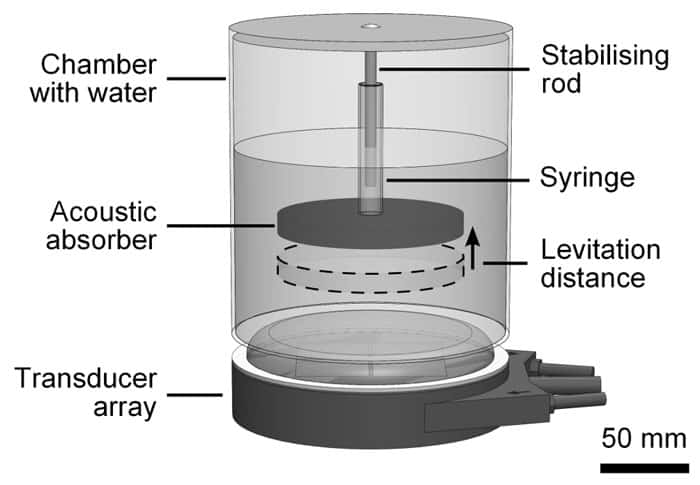
Now, ultrasound physicist Christine Demore, biophotonics researcher Mike MacDonald and colleagues from the Institute for Medical Science and Technology at the University of Dundee in the UK, together with Gabriel Spalding from Illinois Wesleyan University in the US, have levitated and twisted a rubber puck in water by bombarding it with a “vortex beam” of ultrasound – a twisted coil of sound shaped a bit like a DNA double helix. This was done to verify experimentally the angular momentum to torque ratio and directly prove this fundamental theory. The researchers found – as expected – that the ratio of the torque to the linear force on the puck was equal to the ratio of the number of intertwined helices per wavelength.

Applications beyond physics

“The key part of the paper is the fact that we’ve demonstrated that ratio,” explains MacDonald, “but the advance that we had to make to get that result was the level of control over the ultrasound beams, which hasn’t been possible before.” Demore adds that developing focused ultrasound has applications well beyond pure research. “There’s a whole field developing of using ultrasound to kill tumours completely non-invasively,” she says. There is also a project to develop “sonotweezers” that are based on optical tweezers but which are able to move larger and heavier objects.

Optical physicist Miles Padgett from the Glasgow University in the UK describes the work as “a beautiful experiment”. He feels that “people active in the field won’t be surprised by the ratio because essentially the results show are as one would expect”. “But if you never checked the things that we know, you’d never find the things that we don’t,” he says.

The paper has been accepted for publication in Physical Review Letters.
Quantum mechanics in popular-science books

As usual, the podcast is hosted by James Dacey, who is joined by Physics World‘s editor Matin Durrani and the magazine’s reviews editor Margaret Harris. The first part of the podcast addresses the question of why so many authors decide to write these books. The Physics World hosts are joined by physicist Chad Orzel, author of the bestselling book How to Teach Quantum Physics to Your Dog, which was released in 2010.

The middle section of the podcast looks in more detail at the process of writing these books. It features the established popular-science writer Marcus Chown, who describes his experience of writing the book Quantum Theory Cannot Hurt You, which was published in 2007. Chown admits that he found the Pauli exclusion principle to be the most challenging aspect of quantum mechanics to explain in everyday language. This leads on to an interesting debate about the pros and potential pitfalls of using metaphors to describe complex science and mathematics.

If scientists and science writers go through such pain to describe these features of the quantum world, then surely somebody without a scientific background should run a mile. But they don’t, instead they keep buying these books. In the final section of the podcast, the historian and philosopher Robert P Crease shares his thoughts on why the counterintuitive nature of quantum physics holds such a fascinating appeal for readers.

Graphene capsule reveals nanocrystal growth in action

Researchers in the US and South Korea have for the first time managed to image the process of nanocrystal growth at the atomic scale. Their technique, which involves placing the crystals inside a liquid cell bound by graphene sheets and imaging them with a transmission electron microscope, has revealed new and unexpected growth stages as they were occurring. The method might be used to study a variety of nanomaterials in solution, and even biological samples in their natural liquid environments.

The transmission electron microscope (TEM), which was first introduced in the 1930s, produces images at a significantly higher resolution than an optical microscope as it works using electron beams instead of light. However, liquids are notoriously difficult to image with a TEM because they need to be hermetically encapsulated in a solid material (usually silicon nitride or silicon oxide) to prevent them from evaporating, since the microscope operates under vacuum conditions. Such capsules, or liquid cells as they are known, can have membranes that are up to 100 nm thick. This is far too thick to penetrate successfully using an electron beam and means that objects can only be imaged with a spatial resolution of a few nanometres at best.

Now, Jungwon Park at the University of California, Berkeley and colleagues at the Lawrence Berkeley National Laboratory and KAIST in South Korea have shown that capsules fabricated from graphene can be used as see-through “windows” for liquid cells. The sub-nanometre walls of the capsule are effectively transparent because graphene is a sheet of carbon just one atom thick. Therefore, the graphene does not scatter the electron beam but instead lets it pass through. Graphene is also very strong and impermeable, as well as being chemically non-reactive, and so helps protects the sample in the liquid cell from the high-energy electrons in the microscope beam.

The researchers filled the graphene capsules with a solution containing platinum nanocrystals and studied the capsule using an aberration-corrected form of TEM. Park explains that his group was able to see particle nucleation and growth on the very high-resolution angstrom-scale (0.1 nm). He says that his team also observed new and unexpected stages of nanocrystal growth as they happened, in particular how certain nanocrystals frequently coalesce along the same crystallographic direction, modify their shape and form facets on their surfaces.

Park believes that electron-microscopy experiments using graphene liquid cells could be used to image a wide range of nanomaterials, such as nanoparticles, nanostructures and even biological samples in liquid. But the group’s next step will be to use its graphene liquid cells to study how nanocrystals other than platinum grow. “Watching real-time chemical reactions in liquids is a dream for chemists and physicists, and we now hope to study a variety of nanoparticles growing in solution using our liquid-phase electron-microscopy technique,” says Park.

The technique is described in Science.

Doing physics

reader photo


Mt Etna erupting by Andrea Rapisarda

By James Dacey

Thank you to everyone who took part in our last Physics World photo challenge. We asked readers to submit photos to our Flickr group relating to the theme of “portrait of our planet”. We had some great submissions, a selection of which are showcased in this article.

The theme for our new photo challenge is “doing physics”. We want you to submit your pictures of the process of science. It could be you or your colleagues working on an experiment in the laboratory, or perhaps out in the field collecting data, or maybe looking at the heavens through a telescope. Or perhaps you are more theoretically minded and you want to send us an image of your paper-littered office, or the chalkboard detailing the calculation that has been keeping you awake for the past two weeks. Be as creative as you like.

Please add your photos by Tuesday 8 May and then after this date we will choose a selection of our favourite images to be showcased on physicsworld.com. And feel free to write a caption to share the story behind the image. We look forward to your submissions.

Portrait of our planet – readers’ pictures

To celebrate the Earth’s spectacular geology, we asked readers to submit photos to our Flickr group on the theme of “portrait of our planet”. Thank you to everyone who took part. Below is a selection of the images we received.

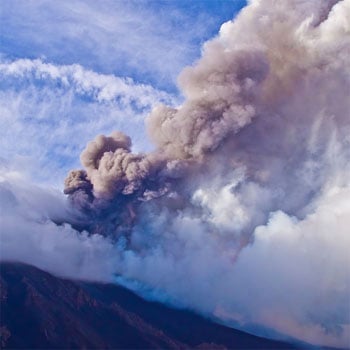
The tallest volcano in Europe, Mt Etna is an active volcano on the island of Sicily. On 8 October 2011, Flickr user Andrea Rapisarda took this spectacular photo of gas and volcanic ash spewing out from the side of this dark mountain. “A great show…but it was very cold and windy today over there!” Rapisarda remarked.

Volcanic ash can have far-reaching effects, from wreaking havoc with aviation to influencing global weather and climate systems. The ash can alter the way sunlight is scattered when it passes through the Earth’s atmosphere, leading to spectacular sunsets, such as this one photographed by Peter Shanks. This multicoloured sky above Mt Wellington in the Australian island state of Tasmania was caused by an eruption of Chile’s Puyehue volcano in June 2011.

Another time when the atmosphere can produce spectacular light shows is during electric storms, when bolts of lightning can emerge from clouds before shooting down towards the ground. These weather events can be menacing and dramatic, such as this one experienced by Flickr user MGCarter88 who took this shot of lightning striking Sandton City in South Africa.

You’ve seen fire, so now for some ice. Flickr user PipeSmoke submitted this intriguing image of an icicle, which appeared growing upwards from a bird bath. PipeSmoke speculates that the icicle formed due to the accumulation of a thin surface layer of oil in the middle of the water bowl. As the water froze from the edges of the bowl, the increased volume eventually forced water up through the oil, causing it to freeze as well.

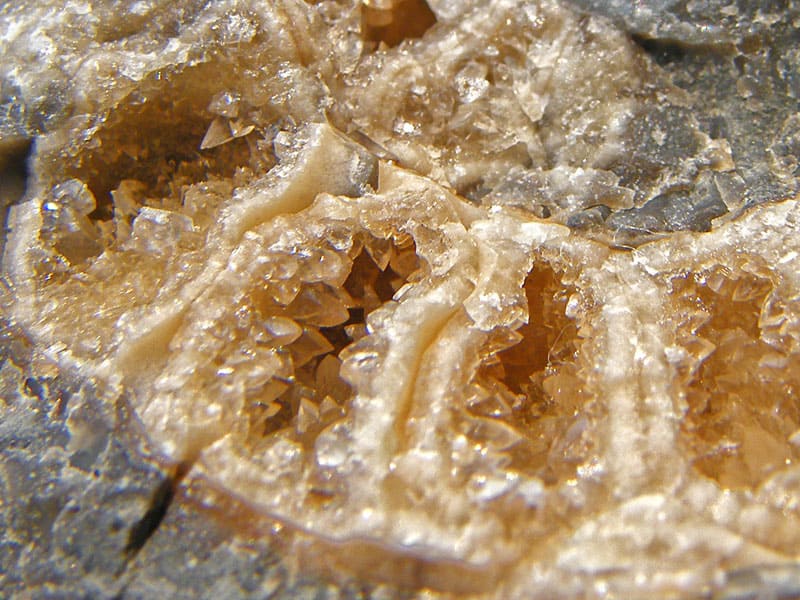
In addition to appreciating the beauty of the physical planet, scientists also see Earth as a puzzle to be solved. One way to do this is to collect samples in the field and return these to the lab where they can be examined in closer detail. This was the case for this zoisite mineral sample, photographed by James Gehrt on the premises of the Alumnae Association of Mount Holyoke College, in Massachusetts, US.

James Gehrt describes himself as a fine art photographer and that is evident in this image of Liocancha castrensis shells, which form part of the teaching collection at the Mount Holyoke College facility. “I captured the items as I would in my personal art work, and not as a scientist. They tend to have a portrait quality to them, showing the uniqueness in the objects,” Gehrt told physicsworld.com.

Fractures and planes are present in rocks and minerals across a range of different scales. Laura Tucker submitted this close-up of Navajo Sandstone cliffs, a geologic formation in Glen Canyon, Arizona. Tucker says that this area would have been a vast quartz sand desert in the Jurassic period, but today the red colours are due to the iron oxide hematite, and the black colours are due to the iron oxide magnetite. “Our guide for the trip told us people often see what looks like a girl on a swing on this section of the rock,” she adds.

This next image takes us back in closer to the fine detail of rocks. It reveals the crystal structures inside a fossilized ammonite, a type of invertebrate marine animal that existed 400–65.5 Ma. The image was submitted by Ian Jacobs, an adviser to the National Science Museum in Thailand, who says he collected the ammonite in Lyme Regis, a coastal town in the south-west of England noted for its large range of fossils, particularly from the Jurassic period (approximately 200–145 Ma).

Finally, we see a rather fairy-tale vision of the planet in this submission from Christine Kingsley-Kozima. This volcanic rock formation, along the Na Pali Coast of the Hawaiian island of Kauai, looks like something you might imagine in JRR Tolkien’s Lord of the Rings.

There were plenty of other striking images, which you can view in our Flickr group, the Physics World photo challenge. For more spectacular images of Earth, and for a range of feature articles, you can also download a free copy of Physics World‘s March issue, a special edition on the earth sciences

The theme for our next photo challenge is “doing physics”. We want you to submit your pictures of the process of science. It could be you or your colleagues working on an experiment in the laboratory, or perhaps out in the field collecting data, or maybe looking at the heavens through a telescope. Or perhaps you are more theoretically minded and you want to send us an image of your paper-littered office, or the chalkboard detailing the calculation that has been keeping you awake for the past two weeks. Be as creative as you like.

Please add your photos to our Flickr group by Tuesday 8 May and then after this date we will choose a selection of our favourite images to be showcased on physicsworld.com.

Rapidly spotting major earthquakes using GPS

Researchers in California have developed a system that can rapidly determine the size of an earthquake and the extent of its impacts within a fault zone, including its potential for triggering a devastating tsunami. The researchers have used the system – which is based on GPS measurements – to accurately model two historic earthquakes in Japan and northern Mexico.

The 2011 Japanese earthquake disaster showed that the first few minutes after an earthquake are critical. When the Tōhoku earthquake struck, it took geophysicists more than 20 min to compute that the earthquake was magnitude 9.0 on the Richter scale. Had the authorities known the full extent of the earthquake sooner, it would have given them valuable time to activate early-warning systems to help prepare people for the large tsunami that would inevitably follow.

The speed of response in current systems is constrained by the fact that instruments in seismic stations close to major earthquakes tend to be saturated by periods of intense shaking. Therefore, to determine the size and extent of earthquakes, seismologists need to look at data from a range of stations further afield. What is more, because instruments in seismic stations cannot measure the full range to which tectonic plates are displaced, earthquake magnitudes are often underestimated in the first minutes following an earthquake.

The view from above

An alternative approach that has been developed over the past two decades is to use GPS data to monitor the Earth’s crust from space. The basic principle is to create a regional network of GPS stations where geoscientists can then track the position of the stations within a given geographical area. Following an earthquake, scientists can examine the movements of these GPS stations relative to each other in order to work out the degree to which the land has shifted.

Brendan Crowell, Yehuda Bock and Diego Melgar at the Scripps Institute of Oceanography at the University of California, San Diego have now developed this approach into a system for modelling the extent of earthquakes in detail. The system is based on a mathematical model that enables the researchers to use regional GPS data to recreate fault planes and to characterize the activity within these zones during an earthquake. They claim that their system can ascertain the magnitude of an earthquake significantly faster than is possible with traditional seismic methods. It would have enabled seismologists to identify the magnitude-9 Japanese earthquake within 2 to 3 min, Crowell told physicsworld.com.

Crowell and his team say that the model can be run in two different ways. The first is to apply the model to a region where the network of faults is already well known to geoscientists. In the second approach, the model is applied to a region where the details of the fault zone are not so well established. In this second instance, the model is capable of using the GPS data to recreate the network of faults beneath the Earth’s surface by using a mathematical function known as a centroid moment tensor.

Recreating major quakes

Publishing their findings in a paper to appear in Geophysical Research Letters, Crowell’s team demonstrates its model for two large earthquakes. The first example used GPS data from 356 GEONET stations to build a picture of the magnitude-8.3 Tokachi-oki earthquake that struck 100 km offshore from Japan’s Hokkaido island. The second case used GPS data from 95 stations in the California Real Time Network (CRTN) to recreate the magnitude-7.2 El Mayor-Cucapah earthquake that struck the Baja California region of northern Mexico in 2010.

In both cases Crowell’s group was able to determine the earthquake magnitudes in less than 2 min, improving on traditional seismic methods by a factor of 10. The researchers found that in the case of the Japanese quake, the method of predefining the faults worked better because the fault system gets more complicated with depth. In the Mexican case study, the method of recreating the fault zone worked better too, partly because the dip angle of the fault does not change much with depth, allowing for a simple representation of the fault. Crowell told physicsworld.com that his group has also used this GPS method to model the 2011 Tōhoku earthquake and it is currently working on a separate paper to describe this work.

The research is funded in part by NASA, and Crowell says that his group is developing a prototype working system that will be deployed within the next year and monitored from the Scripps Institute. He cautions that the system should not be viewed as a true early-warning system, because that would require a response within seconds of an event. “It can, however, assist first-responders to locate the regions of greatest damage more accurately. For tsunami modelling, this method would work perfectly and could speed up the current modelling by tens of minutes,” he says.

In which TV show should Stephen Hawking make his next cameo appearance?

By James Dacey

Stephen Hawking appearing on the Big Bang Theory


Sheldon meets one of his heroes. Courtesy: CBS

Later today, fans of the hit comedy series The Big Bang Theory are in for a real treat, because the show includes a special guest appearance from Stephen Hawking. The 70-year-old theoretical physicist will be playing himself in an episode called “The Hawking Excitation”, which will be aired at 1900 (CST) on the CBS television channel. Details of the plotline are scarce, but this picture released by the CBS network shows the programme’s chief protagonist (or leading geek, I should say) Sheldon, meeting Hawking in a library.

These days Hawking is just as famous in popular culture as the epitome of intelligence as he is as a physicist. This rise to pop-culture icon was fuelled by the phenomenal popularity of Hawking’s popular-science book A Brief History of Time, which has sold more than 10 million copies worldwide since it was first released in 1988. But in recent years, Hawking has also made several appearances on television. In addition to appearing in science shows, he has also starred in Star Trek, as well as several episodes of The Simpsons, the ever-popular animated sitcom.

So here at the Physics World HQ, it’s left us speculating as to where Hawking might crop up next. After much agonizing and heated debate, we’ve managed to draw up a shortlist of four popular TV shows. In this week’s Facebook poll we want you to choose the one that you think would make the most entertaining viewing.

In which TV show should Stephen Hawking make his next cameo appearance?

Doctor Who
Glee
How I Met Your Mother
Red Dwarf

Have your say by casting your vote on our Facebook page. As always, please feel free to explain your response by posting a comment.

In last week’s poll we addressed the topic of alien life, as we asked you “How common is life in the Milky Way?”.

The question was prompted by recent results from the European Southern Observatory’s High Accuracy Radial velocity Planet Searcher (HARPS) instrument, revealing that our galaxy could be awash with rocky super-Earths orbiting within the habitable zones around faint red stars. The international team of researchers claims that there may be tens of billions of such planets in the Milky Way alone, and probably about 100 in the Sun’s immediate neighbourhood.

62% of respondents chose the option “We are by no means the most intelligent civilization in the galaxy”. 29% opted for “The galaxy is teeming with primitive organisms”, and just 9% believe that “We are alone in the galaxy”.

One voter, Peter Frederick Woolman, wrote “A galaxy teeming with primitive organisms is almost a certainty. I’d find it very surprising if we were the most intelligent civilization in the galaxy, but the existence of intelligence is still far less certain than the existence of primitive organisms.”

Taking a more hard-line stance was Dale Who, a voter who wrote “You’re not even the most intelligent civilisation on the planet”, which also raised some interesting questions about Dale himself.

Thank you for all your participation and we look forward to hearing from you in this week’s poll.

Quantum man, revisited

By Margaret Harris

Lawrence Krauss

Yesterday’s edition of the Physics World online lecture series saw the cosmologist Lawrence Krauss hold forth on one of his favourite subjects: the life and science of his intellectual hero, Richard Feynman.

Krauss has won awards for his work in science communication, and his biography of Feynman, Quantum Man, garnered Physics World‘s own Book of the Year gong for 2011, so it was no surprise to “see” almost 300 of you tuning in yesterday to learn more. But if you weren’t able to watch the lecture live, don’t worry: you can still watch Krauss’s talk on demand here, complete with images of Feynman’s calculus notebooks (a real highlight for me, personally) and Krauss’s eloquent explanation of how Feynman’s beloved first wife, Arline, shaped his way of thinking.

With Feynman as the subject, there were sure to be plenty of questions from audience members at the end of the lecture, and inevitably there wasn’t time for all of them. However, Krauss has now sent us written answers to a few of the most interesting ones, and I’ve pasted his replies below. Enjoy!

Audience member: Do you feel that only scientists like Feynman and Sagan who have an “outgoing” nature that augments the brilliant science they do will be remembered or revered in this day and age?
Lawrence Krauss: Ultimately, I think not. Their names will be most recognized by laypeople in the near term perhaps, but in the long run I believe scientists are remembered for their contributions to changing the way we think about the universe. It takes time for that historical perspective to be obtained, but I believe it arises eventually.

What would you regard as Feynman’s most negative characteristic?
I explain this in more detail in Quantum Man, but I think his persistent desire to redo everything himself (a plus) also meant that he did not follow the work of others as well as he should have. As the American theoretical physicist Sidney Coleman put it, “the other people are not all jerks”, and had Feynman been more aware of this other work, in a number of key areas, he could have had more breakthroughs than he did.

Feynman expressed regret at not reconsidering his involvement with the Manhattan Project after Germany was defeated, but do you think he felt guilt about the technology he helped to create?
I think he ultimately decided he was not responsible for the ills of the world, or what people did with his work. John von Neumann convinced him of this.

Did Feynman believe in any particular physical interpretation of quantum mechanics?
He developed his own, and as for philosophical questions, he avoided them as he got older – rightly, I believe. Amusingly, he said he never really understood quantum mechanics, which is one of the reasons he was hoping for a quantum computer, as that might reveal the quantum world in a way that would have given Feynman a more intuitive understanding.

As with most scientific presentations, it seems as if this one was preaching to the converted. How can we best reach out to a non-scientific audience?
I find it helps to use hooks that relate to things people are already interested in. I used Feynman the “character” as a hook to learn about his science; I used Star Trek as a hook to get people interested in modern physics in my first book; and most recently I have used the religious question of why there is “something rather than nothing” as a hook to teach about modern cosmology.

What area of physics did you talk about when you met Feynman? Also, can we have more details of the weekend you spent with him as an undergraduate?
I was talking about his lecture, which was about the theory of the strong interaction, quantum chromodynamics. I have written about the weekend a bit in the book, and I will leave it at that. My favourite Dirac joke is in the book, too.

Lawrence Krauss’s book Quantum Man: Richard Feynman’s Life in Science (2011 W W Norton) is available now in hardback

Split decision for SKA?

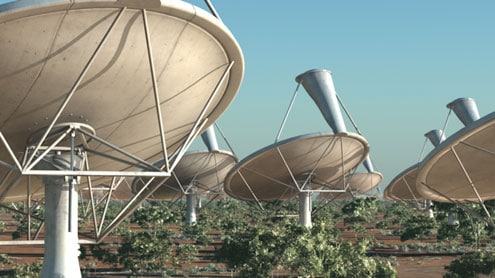
SKA


Artist’s impression of the dishes for the €1.5bn Square Kilometre Array.
(Courtesy: SPDO/Swinburne Astronomy Productions)

By Michael Banks

A decision on who will build the €1.5bn Square Kilometre Array (SKA) will have to wait after the SKA Organisation announced yesterday that no outcome had been achieved.

SKA is a massive next-generation radio-astronomy facility consisting of around 2000–3000 linked antennas that will probe the first 100 million years after the Big Bang for clues about galaxy evolution, dark matter and dark energy.

Two rival bids are going head-to-head to host the telescope: one led by Australia and the other by South Africa.

The eight members of the SKA Organisation – including China, Italy and the UK – have the final say in who will host the telescope. They met yesterday at Amsterdam’s Schiphol airport in the Netherlands to discuss the site selection advisory committee’s report, which according to leaks suggested that southern Africa had got the nod.

After the meeting the SKA Organisation issued a press release that gave no indication of a site choice, only saying that it “wished to move ahead with the site selection process”.

However, instead of going for a single winner, rumours on the blogs suggest that the SKA Organisation may opt for splitting the SKA antennas between Africa and Australasia. Indeed, this is already happening on a smaller scale via the two SKA prototypes: the Australian Square Kilometre Array Pathfinder in mid-west Australia and the MeerKAT array in the Northern Cape province of South Africa.

Yesterday’s press release alluded that the SKA Organisation may be heading in this direction. The statement says that the members “recognised that it is desirable to maintain an inclusive approach to SKA”, adding that “it is important to maximize the value from the investments made by both candidate host regions”.

The SKA Organisation has now set up a scientific working group to “explore possible implementation options that would achieve this”. The working group will report back to the SKA Organisation at a meeting in mid-May, when perhaps a final decision will be made.

Nanomachines could benefit from superlubricity

Researchers in China and Australia have observed superlubricity – the dropping of friction to near zero – on length scales much larger than before. They say that the phenomenon, which they measured in sheared pieces of graphite, could find applications in sensitive microscopic resonators or nanoscale gyroscopes.

Superlubricity is sometimes used to mean simply very low friction, but the original meaning is that the friction between two surfaces disappears almost completely. Proposed in the early 1990s by Motohisa Hirano, then at the Nippon Telegraph and Telephone Corporation in Tokyo, Japan, and others, it relies on a special arrangement of atoms on a material’s surface. In graphite, for instance, the surface atoms have a bumpy hexagonal arrangement like egg-boxes. In certain orientations, two surfaces of graphite can mesh in such a way that the “bumps” can slide past one other effortlessly – and friction drops towards zero.

Since it was first proposed, superlubricity has been observed on the nanoscale, mostly under high-vacuum conditions. Now, however, Quanshui Zheng at Tsinghua University and others have observed the phenomenon on the microscale, in ambient conditions.

“Big advance”

“This is a big advance beyond the nanometre-scale superlubricity experiments,” says Hirano, who was not involved with the latest study. “It could lead to implementing superlubricity [as a] lubricant for future practical use in mechanical engineering, including [devices for] saving energy.”

In its experiments, Zheng’s group used pyrolitic graphite, a type of graphite manufactured under high temperature that has particularly well-aligned crystal planes. Using lithography, the researchers made square columns – or mesas – of graphite up to 20 µm wide and up to 400 nm in height. They transferred these mesas to a scanning electron microscope or an optical microscope and, with a tungsten probe, sheared them into flakes, which they could rotate into different orientations.

Zheng’s group found that the flakes orientated symmetrically with respect to the underlying mesa stayed still, even when poked with the probe. However, when the researchers misorientated the flakes and poked them, the flakes retracted to their original, lowest energy position. This could only happen because of the extremely low friction, the researchers say – that is, because the surface “bumps” could mesh together and allow superlubricity.

Easy and practical

“The ultimate significance of these results is they imply that the conditions for superlubricity are more easily created, and more reproducible, than previously supposed,” says Zheng. “This implies a much wider practical significance for the phenomenon of superlubricity, for example in nano- and micromachines.”

Other specialists in superlubricity seem to agree. “I think this is very interesting and promising work, which could lead to a breakthrough in the field of superlubricity and more generally in the control of friction properties,” says Michael Urbakh of Tel Aviv University in Israel, who had previously published a theory suggesting microscale superlubricity is possible. “This work may open a new way for preparation of graphite lubricants with improved lubrication properties.”

Zheng points out that his group’s results may also be applicable to graphene – a single layer of graphite with superlative properties that was the subject of the 2010 Nobel Prize for Physics. However, for applications with regular graphite, he points to high-frequency microscopic resonators and nanoscale gyroscopes, to which superlubricity could offer reduced wear and lower actuation energies.

“The conventional wisdom so far has been that friction is a major hurdle to shrinking mechanical systems to the micro- and nanoscale,” he says. “This is because of the increasing surface-to-volume ratio of smaller components, which favours friction – a surface-dependent force. [Our work] provides new avenues to produce practical micro- and nano-scale mechanical devices that rely on the ultra-low friction of superlubricity.”

The paper is due to be published in Physical Review Letters.
Copyright © 2026 by IOP Publishing Ltd and individual contributors