Scientists want more children

By Margaret Harris

Women in science are more likely than men to have smaller families than they would like because of their demanding academic careers – but men are more likely to be unhappy about it. This is the striking conclusion of a new study that also demonstrated a strong link between concerns about family size and a desire among junior researchers of both sexes to leave science altogether.

The study, which was conducted by two Texas-based sociologists, Elaine Ecklund and Anne Lincoln, is unusual in that it examines the effect of scientific careers on men as well as women. Some of the similarities they found are as intriguing as the differences. For example, although scientists who have children work fewer hours per week than those who do not, the mothers in the data set were working as long as the fathers, averaging 54.5 and 53.9 hours per week respectively. Male and female faculty members were also equally likely (16.6% vs 17.1%) to report being somewhat or strongly dissatisfied with their lives outside work. Among graduate students and postdocs, Ecklund and Lincoln found no significant gender differences in respondents’ career satisfaction or the number of children they had.

However, some of their other results make sobering reading for those concerned about the “leaky pipeline” for women in science. Although male and female grad students and postdocs reported similar levels of career satisfaction, and were almost equally likely to seek jobs in industry or as research scientists, a gender gap opened up in the numbers seeking a tenure-track academic position. While 66.5% of male students said they wanted a faculty role, only 60.1% of women agreed; for postdocs, the gap was larger, 84% to 69.2%. And among survey respondents who had already made it to the top of the academic pyramid, women were somewhat more likely than men (15.% to 11.5%) to report being dissatisfied with their working lives.

(more…)

LEDs illuminate room with data

Researchers in Germany have created the first white-light data links, which they claim can transfer information at rates up to 800 Mb s–1. The team has demonstrated a simplified version of the technology in an office building, where it managed to broadcast four high-definition video streams from overhead lights.

Radio waves are very good at signalling over long distances – particularly when there are trees, buildings and other obstacles between sender and receiver. However, because radio waves are at the low-frequency end of the electromagnetic spectrum, their capacity for carrying data is limited. Furthermore, radio-frequency bands are already heavily used and highly regulated, making it difficult to find space for new services.

In contrast, visible light is much higher frequency and is entirely available to use. According to the team led by Klaus-Dieter Langer of the Heinrich Hertz Institute (HHI) in Berlin, this makes visible light an attractive option for transmitting high volumes of data over short distances. The HHI system works by encoding data by modulating the amplitude of the light. This is done 10,000 times faster than can be perceived by the human eye and therefore the team claims that the illumination system can double as room lighting.

Langer and colleagues used a white light produced by three light-emitting diodes (LEDs) – one each of red, green and blue. The researchers encoded data by varying the intensity of the light pulses from each colour. Three colour-specific photodiodes captured these signals and sent them through an oscilloscope, which digitized the signals so that they could be stored in a computer.

Record-breaking rate

In the interest of minimizing costs and maintaining the flexibility to change how the data are encoded, the data are read-out after they have been stored, rather than in real time. Even so, the red, blue and green data channels managed a combined raw data rate of 803 Mb s–1. When error correction and other protocols are implemented, the team reports that about 715 Mb s–1 remain for transferring data. Langer says this is a record-breaking rate for visible-light communications (VLC).

However, Gordon Povey, co-leader of the D-Light VLC project at the University of Edinburgh in the UK, points out that “the 800 Mb s–1 is a headline figure but it does not represent a practical scenario”. Still, he says it shows what may be possible – and that a high data rate in idealized conditions can translate to a moderate data rate in a realistic environment.

Earlier this year, Langer and colleagues began testing their system in just such a realistic setting. The team turned 16 ceiling lamps into data transmitters in a room at France Telecom’s Orange Labs in Rennes. Plain-white LEDs were used to simplify the encoding and decoding process so that a single photodiode could capture the signal. Although the set-up transmitted at a slower data rate of 100 Mb s–1, it was enough to broadcast four high-definition video streams, each about 20 Mb s–1, to the room.

Uplink is a challenge

While the team has shown that downloading data via room lighting is straightforward, uploading information would require computer-mounted LEDs, each shining towards an uplink diode. Another option would be to use a part of the electromagnetic radiation for the uplink. Next month Langer’s team will unveil a hybrid device that uses white light to send information from a webcam to a computer and infrared signals running from computer to webcam – both at a rate of 10 Mb s–1.

This type of data transfer works best in permanently lit environments, such as large office buildings, says Langer. It could also find uses in places, such as hospitals, where pervasive radio signals are unwanted. Indeed, operating theatres are often side by side, but robot-aided procedures need high-speed data transfer to send the surgeon’s orders to the robot and high-resolution images back to the surgeon. Visible-light communications could fit the bill by creating high-bandwidth links that do not disrupt data transferred at the same frequencies in the theatre next door.

3D cloak is first to work in free space

Physicists in the US claim to have created the first 3D invisibility cloak that can operate alone in free space. The cloak, based on a “plasmonic” shell, can hide a cigar-sized cylinder from microwaves – although it currently only operates for one microwave polarization.

Invisibility cloaks have been around since 2006, when a team led by David Smith at Duke University in North Carolina, US, produced a device that could guide microwaves of a very narrow frequency around an area a few centimetres in diameter. The device was based on a “metamaterial” comprising an array of resonators that altered the electrical permittivity and magnetic permeability throughout the cloak. Variations in these properties resulted in the microwaves bending round the hidden space like water around a stone, albeit only in 2D.

Since then, there has been a great deal of research into invisibility, with one goal being to develop a cloak that can hide a macroscopic object over the broad range of visible light frequencies and in 3D. Last year there was a big step towards this goal when Martin Wegener and colleagues at the Karlsruhe Institute of Technology in Germany developed the first 3D cloak, operating in the near-infrared. But this was a flat, “carpet” cloak, whereby the hidden object had to be placed on a surface, with the cloak itself laid on top. Ideally, a 3D cloak would allow an object to be positioned away from a surface, in free space.

Plasmonic cloaking

Now Andrea Alù and colleagues at the University of Texas at Austin claim to have made just such a cloak. Unlike previous metamaterial designs, the device is based on a plasmonic cloaking concept, in which the light scattered by an object is cancelled precisely by an exterior shell. Plasmonic materials have special properties at certain frequencies where the electromagnetic radiation can excite electron oscillations called plasmons. The shell works because it has a very low permittivity, providing it with a polarization opposite to that of the object. Any light scattering off the object is therefore cancelled out, and the object appears transparent.

Alù’s research group achieved this with a hollow dielectric cylinder 18 cm long and 2.5 cm in diameter constructed from eight segments. At a frequency of 3 GHz, the scattering of polarized microwaves was reduced by more than 9 dB for a 60° range of angles.

Martin Wegener thinks Alù’s group has indeed performed the first free-space demonstration, but he notes certain drawbacks. One is that the cloak can only hide a dielectric object, and not a metal object. Another is that the cloak only works for polarized microwave light, so an observer would “have to put polarizing goggles on to appreciate the cloaking”, he says.

Isotropic response required

Alù suggests there is a way to make a similar cloak for unpolarized light, however. “For ease of realization, we have picked a metamaterial design that is anisotropic, and therefore works only for one polarization,” he explains. “[But] one can, in principle, come up with other metamaterial designs, such as 3D wire media or isotropic arrays of inclusions, that would provide an isotropic response independent of the impinging polarization.”

Martin McCall, a theorist specializing in invisibility cloaks at Imperial College London, thinks the experiment is still a long way from the “dream” of a cloak that works in 3D over the broad range of visible light frequencies. “I would say this is an interesting development, but brings us only a small step closer,” he says.

The research is reported in the preprint arXiv:1107.3740.

Rutherford Centennial Conference kicks off in Manchester

rutherford jpg.jpg

By Hamish Johnston

Try to imagine the world before 1911, when the atomic nucleus was unknown. Much of what we now know about chemistry and nearly all of our understanding of nuclear physics was yet to come.

This was the year that Ernest Rutherford (pictured right) put forward his theory that most of an atom’s mass and all of its positive charge are concentrated in a volume that is tiny in comparison to the rest of the atom.

Although Rutherford was not the first to proffer such a “solar system” model of the atom, he was the first to back it up with experiment – the famous Rutherford back-scattering of alpha particles from gold foil.

This week, physicists are gathering in Manchester – where the back-scattering experiments were done in 1909 – to celebrate 100 years of nuclear physics.

As well as specialist talks, the Rutherford Centennial Conference on Nuclear Physics includes a series of evening lectures. Tonight’s lecture is entitled “From Rutherford to the Large Hadron Collider” and will given by David Jenkins of the University of York. Tuesday will see Alan Perkins of the University of Nottingham discussing “Nuclear medicine: atoms and antimatter matter in medicine” and on Wednesday the University of Manchester’s John Roberts will ask “Is there a safe future for nuclear energy?”.

All public lectures are at 19.30 and are free – but tickets must be obtained here ahead of time.

If you can’t make it to Manchester, Physics World‘s James Dacey will be there with a camera crew – so stay tuned for more from the event.

NASA launches mission to Jupiter

NASA has launched a mission to Jupiter that will shed light on the origin and inner structure of the largest planet in our solar system. The $1.1bn Juno probe was launched today from Cape Canaveral, Florida, at 12.25 p.m. local time and will now begin a five-year journey to the planet.

Juno, named after the wife of the Roman god Jupiter, is the second probe to orbit Jupiter. The first was NASA’s Galileo satellite, which launched in 1989 to the planet and its moons. Other craft have also since travelled near Jupiter on their way to other planets such as the Saturn-bound Cassini-Huygens mission, which was launched in 1997 by NASA and the European Space Agency.

While these missions did not deviate far from the equator of Jupiter, Juno will enter a highly elliptical orbit around the poles of the planet. “This will allow us to gain access to the entire volume of space around Jupiter for the first time,” says Jack Connerney, from NASA’s Space Goddard Flight Center, who is lead instrument scientist of the mission.

Looking for a lore

While in orbit, Juno will study the planet’s atmosphere, gravity and magnetic fields as well as attempt to answer how the planet formed and whether it has a rocky core. It will do this via nine onboard instruments, which include a camera, magnetometer, microwave radiometer and spectrometer.

Jupiter’s magnetic field is around 20,000 times greater than that on Earth, producing the largest magnetosphere of any planet in the solar system. It will be mapped in unprecedented detail by Juno, possibly revealing details about its origin. “We are sending to Jupiter the most capable and accurate magnetic observatory to ever venture into deep space,” adds Connerney.

Power from the Sun

Juno will use three solar arrays for propulsion, making it the furthest distance a solar-powered probe has travelled in the solar system. Previous missions such as Cassini-Huygens or the Pioneer craft generated power via the heat released from the decay of radioactive particles.

Juno will operate for a year, completing 32 orbits around Jupiter, which each take around 11 days. The probe will then be made to crash into the planet. In addition to the nine instruments, Juno is also carrying a plaque, provided by the Italian Space Agency, dedicated to the famous astronomer Galileo Galilei, as well as three 3.8 cm-tall LEGO figurines of Galileo, the Roman god Jupiter and his wife Juno.

The mission is the second spacecraft of NASA’s New Frontiers programme. The first was the Pluto New Horizons mission, which launched in January 2006 and is scheduled to reach Pluto’s moon Charon in 2015.

New microscope peers deep into tissue

Researchers in the US have developed a new microscopy technique that can pinpoint unlabelled molecules in biological tissue at depths of up to several millimetres. This is much deeper than current methods, which are limited to about 100 µm. Called vibrational photoacoustic (VPA) microscopy, the technique has been used to make 3D images of plaque lining arteries and could be used for diagnosing diseases such as atherosclerosis.

In recent years, scientists have developed microscopy techniques that can locate specific molecules in a biological sample without the need to label those molecules. Although techniques such as stimulated Raman scattering and coherent anti-Stokes Raman scattering have revolutionized biological imaging, their use is limited by their relatively small penetration depth.

Now, a team led by Ji-Xin Cheng at Purdue University has increased this depth by being the first to demonstrate VPA microscopy. Exploiting the photoacoustic effect in imaging and microscopy is not a new idea, but what the researchers do differently is to use the effect to target specific molecules.

Picking up vibrations

The technique involves firing a laser pulse at a sample to excite a specific vibrational mode associated with the carbon–hydrogen bonds that abound in body fat. The wavelength of the pulse is chosen so that absorption by blood and surrounding tissue is minimal. The laser pulses cause the fat molecules to heat and expand locally, thus generating pressure waves at ultrasound frequencies that are detected by a transducer. By scanning the laser over the sample in 2D and measuring the arrival time and intensity of the ultrasound at a number of different locations, the team is able to create a 3D image giving the location of fat in the sample.

“Targeting specific chemical bonds is expected to open a completely new direction for the field,” says Cheng. “Measuring the time delay between the laser and the ultrasound waves gives a precise distance, which enables you to image layers of tissue and create 3D pictures using just one scan.”

To demonstrate the potential of 3D VPA imaging, carotid arteries were removed from pigs with profound atherosclerosis. The team detected a strong VPA signal from fat molecules located 1.5 mm below the illuminated surface of the sample, allowing the identification of different levels of fat accumulation. The VPA technique clearly distinguished a number of different fatty deposits in the arteries. This is important in the study and diagnosis of cardiovascular diseases because fat combines with other substances to form artery-clogging plaque. The researchers also used VPA microscopy to map the distribution of fats in fruit-fly larvae.

Next step is miniaturization

The Purdue group is now looking to miniaturize its system and develop a catheter-based imaging device. “We are hoping to build an endoscope to put into blood vessels,” says Cheng. “This would enable us to see the exact nature of plaque formation in the walls of arteries and to better quantify and diagnose cardiovascular disease.”

Team member Han-Wei Wang adds that the spatial resolution of the VPA system is suitable for such future work. “The lateral resolution is very flexible from the order of a micrometre to tens of micrometres,” he says. “The resolution is an improvement compared with current clinical imaging methods such as intravascular ultrasound. Our spatial resolution will be enough for atherosclerotic applications, and will be a great option as a complementary imaging modality.”

Although the first area of interest for the Cheng group is cardiovascular disease, in the future the method might also be used to detect fat molecules in muscles to diagnose diabetes or other lipid-related disorders, including neurological conditions and brain trauma. The technique can also image protein fibrils, making it useful when studying collagen’s role in scar formation.

The work is described in Physical Review Letters.

Dark host harbours secrets

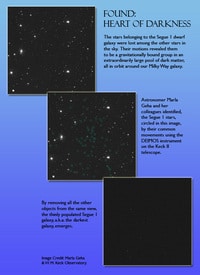
segue-1-mosaic.jpg

By Tushna Commissariat

This week has seen its fair share of intriguing space stories, with colliding moons, Trojan asteroids, more evidence for water on Mars and even a hint of evidence for bubble universes. But a press release about another interesting find from the Keck telescope in Hawaii that was seemingly lost in all noise caught my eye – astronomers in the US have discovered a cluster of about 1000 small, dim stars just outside the Milky Way, comprising what is now the darkest known galaxy. The dwarf galaxy is also said to have a treasure trove of ancient stars, some of the oldest ever seen. Using the 10 m Keck II telescope in Hawaii, the astronomers have been gathering data about the galaxy now dubbed Segue 1.

Interestingly, when they call it the darkest galaxy, astronomers are not referring to how much light the galaxy puts out, but the fact that the dwarf galaxy appears to have 3400 times more mass than can be accounted for by its visible stars. In other words, Segue 1 is mostly an enormous cloud of dark matter decorated with a sprinkling of stars. The initial claim of it being the darkest galaxy was made two years ago by Marla Geha from Yale University and Joshua Simon from the Carnegie Institution of Washington, and their colleagues. Their claim was based on data from the Sloan Digital Sky Survey and the Keck II telescope.

Initial observations indicated that the stars were all moving together and were a diverse group, rather than simply a cluster of similar stars that had been ripped out of the nearby star-rich Sagittarius dwarf galaxy. Because some astronomers were doubtful of the results, Simon, Geha and their group returned to Keck and went to work with the telescope’s Deep Extragalactic Imaging Multi-Object Spectrograph (DEIMOS) to measure how the stars move not just in relation to the Milky Way, but also in relation to each other. A paper with the new findings was published in the May 2011 issue of the Astrophysical Journal.

If the 1000 or so stars were all there was to Segue 1, with just a smidgeon of dark matter, the stars would all move at about the same speed, said Simon. But that was not what they observed. Instead of moving at a steady 209 km/s relative to the Milky Way, some of the Segue 1 stars are moving at rates as slow as 194 km/s while others are going as fast as 224 km/s. The mass required to cause the different star velocities that were observed has been calculated at 600,000 solar masses. But, oddly enough, Segue 1 only has about 1000 stars and they are all close to the mass of the Sun.

The galaxy’s collection of primordial stars is also of interest to the astronomers, as previous searches for primitive stars among the Milky Way’s billions have yielded less than 30. The researchers gathered iron data on six stars in Segue 1 with the Keck II telescope, and a seventh Segue 1 star was measured by an Australian team using the Very Large Telescope. Of those seven, three proved to have less than one 2500th as much iron as our own Sun. “In Segue 1 we already have 10% of the total in the Milky Way,” Geha said. “For studying these most primitive stars, dwarf galaxies are going to be very important.”

Thanks to all the interesting results from Segue 1, other researchers have been looking at it with the space-based Fermi Gamma Ray Telescope. They hope to catch a glimpse of gamma rays, which are predicted by current theories to be the marker for dark matter – they could be created by the collision and annihilation of pairs of dark-matter particles. Unfortunately, the Fermi telescope hasn’t seen any tantalizing flares from Segue 1, but that doesn’t mean that the dark matter is not present, explains Simon. “The current predictions are that the Fermi telescope is just barely strong enough or perhaps not quite strong enough to see these gamma rays from Segue 1,” he said. “So there are hopes that Fermi will detect at least the hint of a collision.”

In the meantime, Simon says that he is working on a study of the seven red giants in Segue 1 that will measure the abundance of elements other than iron in their atmospheres to learn about what Segue 1 looked like at the time those stars formed. But this data relies on new observations. “We have recently obtained much deeper imaging of Segue 1 that we will be using to determine its structure and search for stars that may have been stripped from the galaxy by the tidal forces of the Milky Way,” he says. It will be interesting to see if this dark host has any more secrets to reveal.

Reuse, recycle and thrive: used-equipment businesses keep growing

You need new vacuum kit but your equipment grant is not what it used to be – maybe you could save precious research money by buying a reconditioned unit? Or perhaps you have just upgraded your vacuum system and you have a cupboard full of perfectly good equipment that needs to be cleared out. What should you do – throw it away, pass it on to a colleague, or perhaps try to sell it? Fortunately, there are a number of companies ranging from large corporations to one- or two-person operations that buy and sell used equipment – reconditioning it along the way.

Enter “ion gauge” into eBay and RBD Instruments in Bend, Oregon is selling just what you need. Or perhaps you are in need of a hemispherical energy analyser and a colleague points you towards PSP Vacuum Technology in Macclesfield, UK, which specializes in reconditioning electron-spectroscopy equipment. Indeed, even large manufacturers such as Germany’s Oerlikon Leybold Vacuum see used equipment as an important market that has enjoyed steady growth.

Clear strategic value

Oerlikon Leybold Vacuum’s specialist in second-hand products Michaela Eberz explains: “In the mid-1990s, we started to offer used products – at first we took tentative steps into this market in order to gain experience and avoid any detrimental influences on quality issues and our normal business.” Today, says Eberz, the firm has developed an international expertise in the used-equipment market, which it supports via its worldwide service network. Indeed, Eberz says that “sales of used products have a clear strategic value” to the service side of Oerlikon’s vacuum business.

At the other end of the business scale, with four employees, PSP Vacuum Technology got into the used-equipment market via its business of reconditioning equipment for customers. According to co-founder Nick Palmer, the firm’s main business is manufacturing and selling new electron guns and energy analysers, and usually does reconditioning work on ultrahigh-vacuum (UHV) instruments such as electron spectrometers, X-ray sources, electron sources and ultraviolet sources. It also sometimes refurbishes general vacuum components such as feedthroughs and bellows assemblies, manipulators, electronic controllers and other UHV-related equipment that resides outside of the vacuum chamber.

According to Palmer, the firm often finds itself working on used equipment that has changed hands free of charge between academic researchers. He says it is often the case that universities are not interested in getting into the business of selling used equipment and instead the kit is passed around within the research community. For example, the firm is now refurbishing a hemispherical analyser built in the 1970s that was given to a researcher in Ireland by a colleague in the UK.

While such arrangements ensure that less hi-tech equipment ends up on the scrap heap, Palmer laments the fact that UK government funding bodies do not do more to promote the reuse and redistribution of vacuum equipment. “There is plenty of good stuff out there but a lot of it gets thrown away; many young researchers would like to get their hands on it,” he says. However, Palmer says that it is not easy for researchers in the UK to get funding approved for used equipment.

Warranty included

On the other side of the Atlantic, RBD Instruments takes a more proactive approach to used-equipment sales – a market that it has been in for more than 20 years, according to co-founder Randy Dellwo. “We specialize in surface-analysis instrumentation such as Auger, XPS and SIMS systems, but also deal with general vacuum systems as well,” he explains. The firm sources its equipment from both commercial and academic users. Many of RBD’s customers are start-up companies and academic users that buy refurbished kit when they cannot afford the much higher price of a new system. “The fact that we completely refurbish the systems and include a warranty is important,” he explains.

The obvious benefit in buying used equipment is price but Dellwo does not think that his customers are losing out on functionality. “Older systems can provide typically 80% of the functionality of a new system, at about 10% of the cost of new,” he claims. Dellwo also points out that like cars, older systems are easier to service than newer equipment because the older electronics are not based on surface-mount ICs.

Eberz agrees that price is an important issue. “The recent market crisis has led to increased demand for used products for all technical ranges and price levels,” she comments. Indeed, Eberz points out that used components have proven very popular in emerging markets in Eastern Europe and Asia. However, she adds that business in Western Europe, especially Germany, is growing.

According to Eberz, there are several other reasons why a customer will request a reconditioned product. When high demand or long purchasing times mean that a customer cannot receive a new product immediately, it may be quicker to ship a reconditioned unit to them. In other cases, a user may need to replace a component that the original supplier no longer makes.

Emergency pool

Reconditioned equipment may also be shipped by Oerlikon Leybold Vacuum to a customer to replace a unit that is either in the process of being repaired or is being returned under warranty. Used products even form the basis of an emergency pool of equipment, which can be made available to customers with critical applications.

Once a used item has been acquired, it is reconditioned for sale. Dellwo points out that with components that have been used as part of a well-maintained UHV system – which by their nature are extremely clean – there is often little cleaning to be done.

However, if contamination must be removed, Palmer says PSP uses cleaning processes similar to those used when preparing new equipment for UHV use. Typically, this involves a thorough degreasing in an ultrasonic tank, followed by assembly in a clean room. “Certain items require specific surface coating after cleaning,” he says. For example, X-ray anodes are coated with aluminium and magnesium. The surfaces of elements for electrostatic hemispherical analysers are coated in a graphite-based material, which ensures that the electric field is not affected by surface oxides.

So where does this used equipment come from? Although Oerlikon Leybold Vacuum sometimes buys used equipment when contacted by a seller, Eberz explains that most equipment is received by the firm in part exchange for new equipment or after a leasing contract has run out. Other equipment may have been on loan to customers or be demonstration models.

As for the future of the used-equipment market, Eberz believes that “it is an increasing business in general”. Dellwo echoes this sentiment and suggests that the business is by its nature recession-proof: “The used-systems business tends to thrive in both good and bad economies.”


Flowing water may exist on Mars

Liquid water might exist on Mars today, according to a group of scientists in the US. Images from NASA’s Mars Reconnaissance Orbiter (MRO) reveal that dark, narrow, finger-like structures follow slopes in certain regions of the southern hemisphere of the planet during its summer months. The researchers believe that these could be caused by flowing salt water and say the finding raises the tantalizing prospect that there might be life on Mars.

In recent years, satellites in orbit around Mars have shown that ice is likely to exist just below the surface of the planet in mid- to high-latitude regions. Satellite images have also revealed gullies on the walls of Martian craters that may have been created by liquid water flowing down the walls in fairly recent geological history – although some researchers do not agree. However, it is widely agreed that liquid water in the form of long-lived lakes could not be present on Mars today, given average surface temperatures on the planet of about –60 °C and extremely dry conditions.

Now, Alfred McEwen of the University of Arizona and colleagues say the Martian surface may be home to liquid water after all, even if in a somewhat transient state. The discovery came after one of McEwen’s colleagues, Lujendra Ojha, analysed two slightly offset images of the same point on the Martian surface taken by the MRO’s telescope, the High-Resolution Imaging Science Experiment (HiRISE). The idea was to construct a stereo image in order to perceive depth, but this proved problematic because the details in the images, which were taken at slightly different times, were not identical.

Changing with the seasons

The researchers quickly identified the presence of dark streaks just a few metres wide and up to several hundred metres long that extended down steep rocky slopes and the lengths of which changed over time. By referring to other archive images, and then confirming their discovery with fresh images from HiRISE, the researchers realized that these features were present in a few select places in the southern hemisphere, and that they appeared in Mars’ late spring, grew during the summer and then faded with the onset of autumn or winter.

Another team member, Shane Byrne, says that the researchers “thought long and hard” about what could be causing these streaks. They wondered whether the culprit might be dust avalanching down the slopes and exposing darker material below, but they ruled out this idea because the phenomenon is only visible on slopes that are practically dust-free. Another possibility is that the streaks are caused by melting ice, but the researchers dismissed this because in some of the regions studied the peak daytime temperature at the height of summer reaches 25 °C, which would prohibit the formation of ice for any length of time.

Instead, say the researchers, the streaks are best explained by flowing briny water. Salt, which is known to be widespread on Mars, lowers the freezing point of water, allowing it to exist in its liquid state at temperatures well below 0 °C. Salt also alters the evaporation properties of water, meaning brine can withstand Mars’ extremely dry conditions more readily than pure water. As for the darkened surfaces, McEwen and colleagues suggest that the liquid might be sticking fine-grained materials together and causing them to appear dark when usually they would be lighter, but the researchers admit that they cannot explain why the slopes return to their normal colour in winter.

Mysterious streaks

There are more unanswered questions regarding the streaks. Why, for example, have none been found in Mars’ northern hemisphere? The team suggests that this could be because of a greater abundance of suitable rocky slopes in the south and the fact that southern summers are warmer. Most importantly, however, the team does not understand where the water comes from. The researchers hypothesize that the water seeps out onto the rocky outcrops having travelled along cracks within the rock until it meets the surface. This suggests that the water is coming from underground, but, as Byrne points out, the temperature just a few metres below the Martian surface, even in the height of summer, is low enough to freeze all but the most exotic brines.

Michael Hecht of NASA’s Jet Propulsion Laboratory in California, who was not involved in the research, believes that the work provides “convincing and exciting” evidence for flowing water on the surface of Mars. He says that McEwen and colleagues are “entirely justified” in pinpointing brine as the explanation, pointing out that Mars is so dry that even at temperatures as low as –70 °C, water can still evaporate. “The only way to have persistent liquid water is to find a way for it to remain liquid near –70 °C,” he says. “Brines can do that.”

Hecht, however, thinks that the water is probably “scavenged” from the atmosphere, explaining that during the winter the steep slopes in the southern hemisphere are colder than any of the surrounding surfaces and so trap water by preventing it from evaporating.

To prove the brine hypothesis, however, a robotic landing craft will need to be sent to one of the regions with the newly identified features, says Byrne. A lander, he says, would be able to positively identify the existence of liquid water and, if it did so, establish the water’s composition to find out what kind of salts it contains. He adds that such a mission might also be able to hunt for signs of simple life forms, suggesting that unusual types of bacteria might conceivably live in brine water.

The research is published in Science 333 740.

Introducing the ‘antimagnet’

Researchers in Spain have proposed a new type of invisibility cloak that could hide objects from magnetic fields. The cloak – which has not been built yet – is designed to have a dual effect. It ensures that a magnetic field generated inside the cloak does not leak outside, and it ensures that the cloak and its contents cannot be detected by an external magnetic field. If it can be realized as a practical device, the technology could prove useful in industrial applications that require specific magnetic environments.

The first invisibility cloak was unveiled in 2006 and worked for electromagnetic radiation in the microwave range. It and subsequent cloaks have been based on metamaterials – materials that have been artificially engineered to have specific electromagnetic properties. In principle it should be possible to create a cloak that works for static magnetic fields – which are simply electromagnetic waves at zero frequency.

In 2008 John Pendry and colleagues at Imperial College London proposed such a magnetic cloak based on a metamaterial that has a magnetic permeability that is smaller than one in a given direction and larger than one in a direction perpendicular to it. While superconductors have a permeability of zero and ferromagnetic materials have a permeability greater than one, developing a material that has both properties simultaneously proved problematic. Pendry’s 2008 design involved a stack of superconducting plates that promised to screen weak magnetic fields but was not a complete cloak.

Magnetic shroud

Now, Alvaro Sanchez and colleagues at Universitat Autònoma de Barcelona have expanded on Pendry’s concept and come up with a design that they say can be easily built using practical metamaterials. Instead of calling the device a cloak, the researchers use the term “antimagnet”, which they define as having two key properties. The first is that any magnetic field created within the cloak (by a permanent magnet, for example) cannot leak outside the cloaked region. The second property is that the cloak and the cloaked region should not be detectable using an external magnetic field.

A design that meets these conditions involves repeating layers of different metamaterials – some of which have an isotropic response to a magnetic field and others that have an anisotropic response. The pattern begins with an inner superconducting layer with a magnetic permittivity of zero. The next layer is an isotropic ferromagnetic material with constant permeability. This layer could be made from ferromagnetic nanoparticles embedded in a non-magnetic medium. The next layer would be anisotropic while having a constant value of radial permeability. Sanchez and colleagues believe this could be built using the array of superconducting plates that Pendry proposed in 2008.

The team used a computer model to simulate the antimagnet as it enclosed a small single magnet. The researchers found that the cloak almost completely shielded the outside world from the internal magnet and vice versa.

While the current cloak design is cylindrical, the researchers say that it could be extended to other geometries. They believe antimagnets would be useful in many practical applications, including allowing patients with pacemakers or cochlear implants to access medical equipment based on magnetic fields, such as those used for magnetic resonance imaging. They also says that by tuning the working temperature of the device to above or below the critical temperature of the superconductor, one could switch the magnetism in a certain region or material off and on at will, potentially opening up more applications.

The research is available online at the arXiv preprint server.

Copyright © 2026 by IOP Publishing Ltd and individual contributors