Tōhoku quake coincided with sky ‘anomalies’

A preliminary analysis of the atmosphere and ionosphere over Japan in March reveals infrared and electron anomalies coincident with the Tōhoku earthquake, researchers in the US and Russia claim. The anomalies are the latest evidence for a possible link between seismic activity and changes in the atmosphere or ionosphere, although sceptics believe they are unrelated.

Seismologists have searched for early-warning signals of earthquakes for more than a century. These range from small tremors in the ground, to aurora-like lights in the atmosphere and even to bizarre animal behaviour. But despite a few records of such incidents coming before quakes – usually noted retrospectively – there has never been any consistent method to accurately predict when a major shock is going to happen.

Tell-tale signs?

Many scientists still monitor various parameters around quake-prone regions in the hope that they will improve forecasting, or perhaps open up avenues towards prediction. These parameters include infrared emissions in the upper atmosphere and the total electron content (TEC) of the ionosphere – the part of the Earth’s atmosphere between altitudes of 80 and 1000 kilometres that is made up of electrons and ions. Changes in both infrared emissions and TEC are known to occur for non-seismic reasons: the infrared varies with cloud cover, for instance, while TEC gets a boost during heightened solar activity. Yet researchers have still claimed that they can pick out anomalous behaviour in the infrared and TEC that coincided with various past quakes, such as the 2008 Sichuan earthquake in China and the 2010 Haiti earthquake.

Now Dimitar Ouzounov of Chapman University in Orange, California, and colleagues claim to have evidence of anomalous infrared and TEC signals shortly before the magnitude 9.0 earthquake that struck off the coast of Tōhoku, Japan, on 11 March this year. The researchers believe that the apparent anomalies could be evidence that major seismic activity is preceded by a release of radon gas that ionizes and heats the surrounding air.

Ouzounov’s group retrospectively analysed four parameters: the Earth’s outgoing infrared radiation, using satellite imaging; the ionosphere’s TEC, calculated from global positioning satellite signals; the cross-section or “tomography” of the ionosphere, using data from low-Earth-orbit satellites; and the density of upper-ionosphere electrons, calculated from signals taken at four Japanese ground-based ionosonde stations. The infrared data was analysed for the month of March over a period of eight years – from 2004 to 2011 – while the ionospheric data was analysed only for around the time of the Tōhoku quake.

The researchers found what they say is the first indication of an infrared anomaly on 8 March 2011, three days before the quake. By 11 March, the day of the quake, the location of the maximum infrared emission apparently fell exactly over the quake’s epicentre. Meanwhile, they also found an increase in electron density, reaching a maximum on 8 March. This day also showed an abnormal variation in TEC over the epicentre, according to the findings. On 3–11 March the ionosondes recorded a “large increase” in electron density.

Supporters and sceptics

“The results are interesting for me even though the physical mechanism is not clear,” says Katsumi Hattori, a geoscientist at Chiba University in Japan. “My opinion is that their approach is one of the hopeful ways to forecast seismic activity. I think the prediction – when, where and what magnitude – is difficult, but the monitoring of [infrared emissions] and TEC can provide information for seismic activity. They are just the same as the parameters for a weather forecast.”

Yet many seismologists are sceptical about the benefits of such analyses, believing that it is easy to find correlations when data is taken selectively. Ian Main, a seismologist at the University of Edinburgh in the UK, says signals in the atmosphere and ionosphere “fluctuate all the time, and it would be surprising is some fluctuation did not occur around the time of the earthquake”. He adds, “One of the things you can predict about earthquakes is that following the event there will be claims of precursory behaviour identified in retrospect.”

Thomas Heaton, a seismologist at California Institute of Technology in the US, is also sceptical of prediction. “Through the years I have seen dozens of reported anomalous geophysical signals,” he says. However, we have yet to discover a precursor to an earthquake that reliably produces a significant signal before it occurs. “In fact, the more we look, the more it seems as though a large earthquake starts similarly to a small earthquake,” he adds, explaining that due to the similarities, even an advance signal would not help to judge the intensity of an upcoming earthquake.

Still, Ouzounov and his group are hopeful that their work will help both forecasting and prediction. Ouzounov told physicsworld.com that they have listed more than 100 earthquakes during the last decade and have discovered a “systematic appearance of atmospheric and ionospheric signals in the same time frame we have shown for the Tōhoku earthquake”.

The preliminary results are available on the arXiv preprint server.

Nanoantennas target single particles

Researchers have, for the first time, used a single “nanoantenna” – a device that collects and focuses light – to demonstrate that it could be used to detect particles and atoms. The work, by scientists at the Lawrence Berkeley National Laboratory (LBNL) in the US and the University of Stuttgart in Germany, could be used to make extremely sensitive gas sensors and detectors.

Conventional antennas, widely used to transmit radio or TV signals, can be used at optical frequencies if they are shrunk to the nanoscale, which could have potential applications in nanophotonics. The nanoantennas can also be used to generate electronic surface waves known as “surface plasmons”. This is done by confining electromagnetic waves – typically at the interface between metallic nanostructures (usually made of gold) and a dielectric (usually air) – that have dimensions smaller than half the wavelength of incident light.

When the oscillation frequency of the created plasmons matches that of the incident electromagnetic waves, a phenomenon known as “localized surface plasmon resonance” (LSPR) occurs, which concentrates the electromagnetic field into an even smaller space – around 100 nm3. Any object brought into this so-called locally confined field – or “nanofocus” – will affect the LSPR in such a way that it can then be detected using a technique called dark-field microscopy – a technique where only scattered light makes up an image.

Many applications

Paul Alivisatos and colleagues have now used such a set-up to detect single particles and atoms. The researchers created a novel version of the set-up whereby they carefully placed a single palladium nanoparticle in the focus of a nanoantenna made of gold. The interaction between the gold and the palladium nanoparticle creates an LSPR so that any particle that is brought near the vicinity changes the dielectric function of the palladium particle as it absorbs or releases it. “Light scattered by the system can be collected by a dark-field microscope and the change in the LSPR read out in real time,” says LBNL researcher Laura Na Liu.

The antenna enhancement effect can be controlled by changing the distance between the palladium nanoparticle and the gold antenna. The shape of the nanoantenna is important too, so that antennas that form a pointed tip are especially good for plasmonic sensing.

The researchers say that the device could be used to detect flammable gases, like hydrogen, that might easily be ignited by electricity during measurements with conventional sensors. Detecting small amounts of hydrogen is becoming increasingly important for developing fuel cells, especially as the gas can explode or ignite at concentrations of as little as 4%. And replacing the palladium with other nanocatalysts, such as ruthenium, platinum or magnesium, means that it could be used to detect gases such as carbon dioxide and nitrous oxides.

Alivisatos says that the new device, and the way it is made, provides a general blueprint for amplifying plasmonic sensing signals using single particles that “should pave the road for optically observing chemical reactions and catalytic activities in nanoreactors.” The device could also serve as a bridge between plasmonics and biochemistry, adds Liu, because it offers a unique tool for probing biochemical processes using light. The technique employed dispenses with the need to use fluorescent markers to label molecules for subsequent detection.

“This work very elegantly shows that nanoantennas can be used to pick up very small changes in a satellite nanoparticle which may be optimised for specific chemicals,” says Otto Muskens from the University of Southampton in the UK, who was not involved in the work. “This is an important next step in plasmonic biosensing with many possible applications.”

The findings were detailed in Nature Materials.

Judgement without understanding

Back in the late 1930s the University of Chicago initiated a search for a top-flight physicist. When it sought advice from geophysicist Merle Tuve, then at Johns Hopkins University, he apparently replied “Now, if you want to get a genius, don’t get [Edward] Teller, get [George] Gamow. But geniuses are a dime a dozen. Teller is much better than a genius. He is a man who gets along with everybody, who helps everybody. He has…never got into a disagreement with a single person.”

Tuve’s advice is wonderfully ironic, given that Teller’s later life was defined by disagreement. He annoyed his fellow physicists when he enthusiastically promoted the building of the hydrogen bomb, then made himself into a pariah in 1954 when he provided damning testimony against his former mentor J Robert Oppenheimer during the latter’s security hearings. He also sowed animosity by opposing the nuclear test ban and by enthusiastically supporting US President Ronald Reagan’s “Star Wars” project. Aware of his incredible talent for causing acrimony, Teller, a lover of irony, rather enjoyed the fact that Tuve once saw him as “the paragon of the uncontroversial figure”.

So what happened? How is it that Teller became the physicist so many people loved to hate? He was, clearly, an enigma, and that is what makes him interesting. On the one hand, he was a devoted husband, a generous friend and an inspired teacher. On the other, he was intoxicated by power and ruthless in his pursuit of it. His judgement was occasionally superb, but often bizarre. Instances of integrity were overshadowed by moments of deceit.

Istvan Hargittai believes that the Teller enigma can be unravelled by carefully examining the evidence gathered from the latter’s long life. The truth, in other words, is out there, and Hargittai’s book, Judging Edward Teller, represents his best effort at finding it. As an example of diligent archival research, it is a very impressive work. Tiny episodes are reconstructed with evidence collected from far-flung sources and then gathered together into a precise narrative. Hargittai is particularly good at exposing inconsistencies in Teller’s life story, which arose from Teller’s habit of tailoring his recollections to the moment at which they were told and to the audience to which they were delivered. With these convenient lies, Teller constructed his own myths.

Dogged research and methodical organization are certainly admirable qualities in a biographer. But historians are not just evidence gatherers; they also have to process the evidence, using insight to guide the reader toward meaningful conclusions. This is where Hargittai falls short. Too often, rough diamonds of evidence are left uncut because of his failure to expand upon their meaning. What results is a rather dull book – packed with information, but lacking soul.

For example, midway through the book Hargittai relates a watershed moment in Teller’s alienation from Oppenheimer. It occurred in 1942, just after General Leslie Groves took over military direction of the Manhattan Project. According to Teller, at a private meeting in New York, Oppenheimer said “No matter what Groves demands now, we have to co-operate. But the time is coming when we will have to do things differently and resist the military.” Hargittai concludes that Teller “found such an attitude toward their own authorities unacceptable”. Presto – there lies the origin of the betrayal that took place 12 years later. But was this a difference of opinion over the need to respect authority, or was something more fundamental at work?

Hargittai does not say; in fact, he lets the matter rest there. But to understand this incident’s impact on Teller, we need to know what Oppenheimer actually meant. Was he expressing political opposition to those of Groves’ ilk, or was this about something more fundamental – namely his concerns at the way science was becoming the handmaiden of war? If the latter, was Teller unconcerned about becoming a slave to soldiers? Hargittai refuses to provide the interpretation essential to answering these questions and thus to understanding this incident. The answer lies not in the evidence (for there is plenty of that), but in the processing of it. The slow distillation of myriad facts (some of them unconnected) might have led to useful insights. Unfortunately, a similar unwillingness to interpret occurs throughout the book.

It is difficult to understand Hargittai’s reluctance to engage with his material, given that he clearly has great enthusiasm for his subject (whom he actually met). In his preface, he remarks on how similar his background is to that of Teller. He, like Teller, is a scientist, being a professor of chemistry at the Budapest University of Technology and Economics. He is also Hungarian, Jewish, the son of a lawyer and a man whose family suffered terribly in the Holocaust – all characteristics shared with Teller. Hargittai feels that “with my background, I might have some advantage in understanding Teller’s character and attitude and the conditions under which he grew up”.

That seems an entirely reasonable claim. Unfortunately, Hargittai appears reluctant to use that understanding. As a result, his narrative seldom strays beyond that which can be empirically proven from the evidence. It reads like a cold scientific report based on observable data. To a scientist, this may sound like a good thing, but history is not a science. In history, understanding arises from a combination of evidence and intuition. If the latter is lacking, the former does not reveal much.

Thanks to Hargittai’s research, we know a great deal more about Teller than we knew previously. But it is mostly just raw data. An understanding of Teller’s motives during the great controversies of his life remains elusive. As a result, we are nowhere nearer getting to grips with the man. Of particular regret is the way Hargittai refers repeatedly to the softer side of Teller, which is supposedly revealed in his letters to his lifelong soulmate, the physicist Maria Goeppert Mayer. These letters apparently show a deeply insecure man who craved approval, yet they are only briefly quoted, and never in a way that sheds light on the complexity of Teller’s character.

Hargittai concludes that there were probably two Tellers, and maybe more. That, however, seems a cop-out – an inability to explain conflicting characteristics in just one man. The title of the book, Judging Edward Teller, reveals its limitations. Judging an individual is relatively easy. Understanding him is much more difficult. After reading this book, I still do not understand Teller.

Attention, early-career physicists

By Margaret Harris

Do we have too many PhD students? Should we be training them differently? What can we do to improve prospects for early-career researchers? Should the government get involved, or is this something the scientific community should handle on its own?

These were just some of the questions debated on Tuesday evening at London’s Royal Institution, where a crowd of about 50 gathered to air concerns about scientific careers before a panel that included UK science minister David Willetts and the Cambridge physicist Athene Donald. Organized by the pressure group Science is Vital, whose founder Jenny Rohn also appeared on the panel, the event aimed to move beyond the perennial debate about science funding to highlight other problems in science careers.

Panel moderator Evan Harris – himself a former MP and one-time science spokesman for the Liberal Democrats – began by asking everyone to “concentrate on the negative”, and audience members obliged. Short-term contracts for postdocs make career planning hard and family life impossible, said one. The constant need to get recommendations for the next short-term job discourages us from reporting bullying, added another. Janet Metcalfe of the career-development group Vitae argued that there is “not enough honesty” when senior scientists discuss job prospects with junior colleagues. One audience member even compared the current system – in which many PhD students and postdocs chase a tiny number of permanent jobs – to a pyramid scheme.

Some partial solutions did crop up in the discussion, including the idea of creating permanent “senior postdoc” roles for researchers who want to remain in science, but don’t want to manage a group. The existence of such roles would prevent some talented, well-trained people from leaving science, Rohn observed. However, she also suggested that senior academics had little incentive to make it happen, because PhD students did the same work and were much cheaper. “There is an inherent exploitation element to science careers,” she concluded.

(more…)

New technique narrows electron dipole moment

Measuring a fundamental property that the Standard Model of particle physics says should be zero might seem like the ultimate waste of time. But if the electron does have a non-zero electric dipole moment (EDM), it would have profound implications and point to new physics. Now, Jony Hudson and colleagues at Imperial College London have made the most precise measurement of the EDM yet, reducing its known upper limit by about 50% – and providing more evidence that it is either zero or extremely small.

The Standard Model, in its simplest form, prohibits the electron from having an EDM because this would violate time-reversal symmetry. While more sophisticated versions of the Standard Model do allow for an EDM, they nevertheless suggest it would be much too small to measure in the lab. Although Hudson’s team has only been able to put an upper limit on the EDM, it claims the new technique could be refined to search for an EDM 100 times smaller still.

Polarized molecules

In their method, the researchers studied the outer (or valence) electrons in ytterbium monofluoride (YbF) molecules. The molecules are exposed to an electric field, which polarizes the molecules. This polarization creates a very large local electric field in the vicinity of the valence electrons. If the electrons have an EDM, then they too would be polarized by this large local field.

But instead of seeking to measure a tiny EDM directly, Hudson and colleagues tried instead to measure the effect that the polarization would have on the electron energy states of the molecules. They began with a pulse of ultracold molecules that had been set into a superposition of two quantum states. The molecules were passed between two parallel plates where electric and magnetic fields can be applied. The molecules are then detected as they emerge from the plates.

In the presence of just a magnetic field, the relative phase of the two quantum states is rotated. Varying the strength of the magnetic field causes quantum interference between the two states and the result is a series of interference fringes at the detector.

Switching the electric field on should only affect this interference pattern if the electron has an EDM because this would introduce a separate phase rotation. To test for this, the team looked for changes in the interference pattern that were correlated to changes in the applied electric field. This was done for 25 million pulses of YbF and found no evidence of a phase shift related to an EDM.

Less than a hair’s width

This allowed the team to place an upper limit on the EDM of 10.5 × 10–28 e cm with 90% confidence. According to the researchers, this means that if the electron were magnified to the size of the solar system, its EDM would be no bigger than the width of a human hair.

This is about 50% better than previous measurements using thallium atoms and the team believes that it could soon improve the result by as much as a factor of 100. The researchers are currently trying to cool the YbF molecules to even lower temperatures and gain better control of the pulses as they pass through the experiment.

The research is reported in Nature 473 493.

Astronomers put a new spin on the age of stars

Like some people, stars can be secretive about their age. But now, a team of astronomers has taken an important first step towards developing a new method to determine the age of a star – by measuring its rotation. “A star’s rotation slows down steadily with time, like a top spinning on a table, and can be used as a clock to determine its age,” says astronomer Søren Meibom of the Harvard-Smithsonian Center for Astrophysics. Meibom presented his findings at the 218th meeting of the American Astronomical Society, currently being held in Boston, Massachusetts.

Tell-tale spots

Being able to accurately determine the age of a star is essential in astronomy. It is particularly relevant for stars orbited by extrasolar planets. Meibom and his colleagues are working on a way to deduce the age of a star using information about its rotation, or “spin”, by establishing a correlation between three parameters – the spin period, age and mass of the star. “Ultimately, we need to know the ages of the stars and their planets to assess whether alien life might have evolved on these distant worlds,” says Meibom. “The older the planet, the more time life has had to get started. Since stars and planets form together at the same time, if we know a star’s age, we know the age of its planets too.”

The ages of stars that lie within star clusters are easy to determine, as most of the stars are formed at the same time. Astronomers plot the colours and magnitude of the stars and the pattern they see can be used to tell the cluster’s age. But most stars known to have planets are not part of a cluster, just like our own Sun, and determining their age is much more difficult.

Using NASA’s Kepler space telescope as part of the “Kepler Cluster Study”, Meibom and his collaborators measured the rotation rates for stars in a one billion year old cluster called NGC 6811. The rotation is detected by looking for tiny changes in the brightness of the star caused by “spots” on its surface rotating in and out Kepler’s sight. Kepler is designed to detect small changes in brightness and therefore able to measure the spin of a variety of stars, including older stars, which rotate slowly and have fewer and smaller spots.

Calibrating clocks

The rotation periods measured for stars in NGC 6811 represent an important step towards establishing a relationship between stellar rotation and age. When this is established, measuring the rotation period of any star can be used to derive its age – a technique referred to as “gyrochronology”. It uses a rotating star as a clock, and calibrates this clock using stars in clusters with known ages. Once the clock is calibrated it works as a celestial time keeper.

To find the age–rotation relationship for stars in the NGC 6811 cluster, Meibom and his colleagues spent four years carefully sorting out stars in the cluster from unrelated stars that appeared to be in the same direction. This preparatory work was done using a specially designed spectrograph “Hectochelle” mounted on the MMT telescope on Mount Hopkins in southern Arizona. The spectrograph can observe 240 stars at the same time, allowing the researchers to observe nearly 7000 stars over four years. Once the actual cluster stars were known, the team used Kepler data to determine their spins.

The astronomers found rotation periods ranging from 1 to 11 days, as compared with the 28-day rotation period of the Sun. Their results saw a strong relationship between stellar colour (a proxy for stellar mass) and rotation period, with little scatter. This suggests that the spin–age relationship can be established for stars over a range of masses – not only for stars like our Sun.

So the next step for the team is to measure the rotation periods for stars of different masses in even older star clusters with known ages to ensure that this “clock” is accurately calibrated to older ages. Those measurements will be more challenging because of the smaller and fewer spots on older stars, meaning that the brightness changes will be even smaller and more infrequent (see figure above).

“This work is a leap in our understanding of how stars like our Sun work. It also may have an important impact on our understanding of planets found outside our solar system,” said Meibom.

The work is detailed in Astrophysical Journal Letters 733 L9.

D-Wave sells its first quantum computer

PW2011-05-12-dwave-rose-th.jpg

By Hamish Johnston

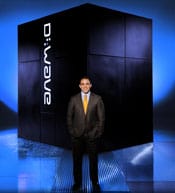
I’ve just received a press release from Canada’s D-Wave Systems saying that the firm has sold its first quantum computer.

The buyer is the US-based defence and security contractor Lockheed Martin and the company will use the system to address some of its “most challenging computation problems”, according to D-Wave. “The multi-year contract includes a system, maintenance and associated professional services,” says the company.

You may recall that earlier this month D-Wave scientists published a paper in Nature that showed that certain aspects of the firm’s “quantum annealing” scheme for quantum computation worked as predicted.

D-Wave was founded in 1999 and for many years the efficacy of the firm’s technology was a matter of much debate in the physics community.

Now it seems that things are looking up for the Vancouver-based firm.

Quantum computers tackle chemistry and biology

Physicists around the world are working very hard to develop practical devices for quantum computing and have already managed to perform a few very basic calculations. But what problems could scientists solve if they had access to more sophisticated quantum computers?

In this exclusive video interview Alán Aspuru-Guzik of Harvard University explains how quantum computers could solve a range of chemistry and biology problems much more efficiently than the best supercomputers of today.

Aspuru-Guzik explains how important questions such as how drugs bind to proteins or how proteins fold could be solved by quantum computers. While he is looking forward to doing calculations using an eight-quantum-bit computer developed by colleagues, he explains why at least 100-quantum-bit devices are needed to outperform classical computers at some tasks related to drug discovery.

Physicists find a new angle on blood spatter

If you are a fan of CSI or other forensic-investigation TV dramas, you could be forgiven for thinking that all the minute details of a violent crime can be deduced simply by looking at the pattern of blood spatter. The reality, however, is that investigators are often unable to work out important details like whether the victim was standing or sitting when attacked – a distinction that can be crucial to a claim of self-defence.

Now, though, physicists Fred Gittes and Chris Varney from Washington State University in the US have devised a new technique for analysing blood spatter that – under certain conditions – gives the height at which the blood emanated from a victim. That information could, in principle, be used to conclude that a person was sitting, standing or lying on the floor when stabbed or shot. Gittes and Varney add that even when conditions are not appropriate for using their method, it fails in a very specific way that would alert investigators.

Projectile motion

Forensics investigators study the elliptical shapes of blood stains, which reveal the angles at which blood droplets impacted the floor or other surfaces. By tracing back from several different stains, it is possible to conclude where on the floor a person was standing when they were shot. However, finding the height from which the blood emerged is more difficult because the velocity of the blood is not known and it may have been launched in one of many vertical trajectories.

Gittes and Varney have been able to work around this problem by considering the Newtonian equations of motion of the droplets under gravity and simplifying the problem by assuming that the blood spurts out of the body over a narrow range of polar angles (the angle between the horizontal and the initial trajectory of the blood). They calculated that the tangent of the impact angle, θ, should vary linearly with 2/r, where r is the horizontal component of the distance that that the blood has travelled. When θ versus 2/r is plotted, the slope of the graph is equal to the height at which the victim was shot.

To test their analysis technique, the pair built a “clapper” device – similar to those used in forensics training – that creates blood spatter by placing a pouch of liquid between two boards and slapping them together. Rather than using real blood, which would have been impractical and unpleasant, Gittes and Varney used a mixture of chicken-wing sauce and dishwashing liquid to simulate its properties.

“The [analysis] method worked so well, in fact, that we did some numerical simulations to see why aerodynamic drag was not a problem,” Gittes told physicsworld.com, referring to the researchers’ initial assumption that they would have to adjust their technique to incorporate drag. The simulations showed that the technique was, Gittes adds, “relatively insensitive to drag”.

Failing in a good way

Their method does fail, however, if the blood is launched over a wide range of polar angles. Gittes says that he and Varney had expected to see a series of parallel lines in their graphs of θ against 2/r – each for a different launch angle – but none was visible, possibly because they did not have enough data to go on. “Such an approach might work in plots with an enormous number of data points,” Gittes speculates. Still, the null-result even with limited data is useful because it means that an erroneous height will not be calculated.

So have Gittes and Varney been hailed as heroes by forensic scientists? Not yet, according to Gittes. “We were a bit surprised by the difficulty of initiating physics discussions with the forensics community,” he says. “A great deal seems to be at stake regarding what is or is not considered acceptable practice.” However, Gittes is not deterred and calls for “other physicists and students of physics” to take his ideas further.

The research is reported on arXiv and has been accepted for publication in the American Journal of Physics.

High-voltage beats

By Michael Banks

If my memory serves me right, my first introduction to physics came via a demonstration of the Van der Graaf generator.

Situated in the middle of the classroom one day stood a scary-looking contraption consisting of an upright metal stand with a large silver ball on top.

However, once our teacher stood up to give the hair-raising demonstration of the device, the fear of it being used as some kind of torture tool soon eroded.

While Van der Graaf generators are still widely used to teach students about static electricity, researchers at Case Western Reserve University in the US have now used a similar contraption – a Tesla coil – for an altogether different reason.

They have formed the Tesla Orchestra, which uses Tesla coils to convert music into lightning and sound.

In their set-up, an alternating current (AC) is used to generate each bolt of lightning produced by the Tesla coil. As it is made by AC, the bolt has a certain frequency, which can then be tuned to reproduce all of the notes on a keyboard.

Last month the group invited musicians to submit music so they could convert the tunes into sparks and the accompanying sounds. You can see the results in the video above.

On 11 June the Tesla Orchestra will select some of the best songs and perform them in a live show in the Masonic Auditorium in Cleveland.

If you are in the area that day don’t miss out on what is sure to be an electrifying show!

Copyright © 2026 by IOP Publishing Ltd and individual contributors