3D TV without glasses

“Wow, that’s amazing” was at least one visitor’s reaction to last year’s Summer Science Exhibition at the Royal Society in London. Their enthusiasm was not primarily due to the presence of the Queen, who had earlier opened the exhibition as part of the society’s 350th anniversary celebrations. Rather, their excitement was down to the latest liquid-crystal displays on show from Sharp Laboratories in Oxford. Viewers were able to watch moving images in 3D on a laptop – without the need for special glasses. They could see pigeons being fed in St Marks Square, Venice, with the birds apparently descending from their shoulders, or they could indulge in a 3D adventure as they pursued the bad guys in the interactive computer game Quake.

The glasses-free 3D display on show at the Royal Society was just the latest example of the revolution wrought by liquid-crystal displays, which now allow moving images to be viewed on everything from mobile phones and 46-inch flat-screen televisions to hand-held personal electronic games and the iPad and other tablet devices. Yet it is amazing to think that it is only 40 years since the key patent was filed that marked the birth of the modern liquid-crystal display – a technology so successful that its acronym, LCD, is instantly recognized even by non-scientists. Although organic light-emitting diodes (OLEDs), plasmas and “electronic ink” are also changing the nature of the modern display, it is the remarkable properties of liquid crystals that are now at the forefront of 3D display technology.

Imaging in 3D

Watching images in 3D without glasses is a truly astounding experience, but let’s first look at how this fits in with other 3D imaging techniques. There are three main techniques – stereoscopic, holographic and volumetric – all of which operate on the same principles regardless of whether the screen uses liquid crystals, plasmas or OLEDs. They each have advantages and disadvantages in terms of realism, complexity, size and cost, but the most commercially viable method, which is used in the bulk of the 3D televisions taking the high street by storm, involves showing a different perspective of an image to each of our eyes. This “stereoscopic” technique mimics the real world, where each eye sees a different perspective and the brain “fuses” the two images together to create a 3D perception of the surroundings (figure 1a).

The task of separately displaying images to the left and right eye has been tackled in a variety of ingenious ways over the years. Trialled at cinemas as far back as the 1950s, the approach that many people will be familiar with involves the user wearing glasses with separate red and blue coloured lenses on the left and right eye, respectively. The idea here is that an image is split into red, green and blue channels, with the left eye seeing only the red image and the right eye seeing only the green and blue images.

More recent systems do away with coloured lenses and instead use glasses that alternately transmit and block light to each eye. In other words, the lenses act as “optical shutters” so that at any one moment one eye can see a still image, but the other cannot. If we label the successive still images of a movie L1, R1, L2, R2, L3, R3 and so on, then the left eye sees only the “L scenes” and the right eye sees only the “R scenes”. These glasses require various bit of electronics to make them work, while the scenes themselves are updated at frequencies of typically 120 Hz or 240 Hz. (An alternative approach – common with projection screens found in pubs to watch sport on – is for the L and R scenes to be displayed with different polarizations, which requires the user to wear dark glasses containing lenses with different polarizations.)

The images produced using this stereoscopic approach can jump out of the screen with surprising realism. However, stereoscopic images are not perfect because all objects in them are in focus, regardless of their intended 3D position. In the real world, in contrast, different depths of a 3D image are in focus at different positions. One technique for creating 3D images that does deal with focus correctly is holography (figure 1b). Holograms are created by recording in a photosensitive material the interference pattern created when coherent reflected light from an object overlaps with a coherent reference beam of the same wavelength. The pattern is stored as a change in absorption, refractive index or thickness of the photosensitive material and a copy of the object can be recreated by illuminating the pattern with a read-out laser. A 3D hologram is essentially like having a stack of high-resolution 2D pictures, where each picture represents a different image plane.

The big advantage with a 3D hologram is that a viewer’s perception of three-dimensionality is total because to change from looking at an object near the front of the scene to an object at the back, the viewer needs to adjust their eyes’ focus. Unfortunately, creating and controlling optical wavefronts with sufficient precision to generate realistic holographic images requires displays with pixel densities typically thousands of times higher than are found in today’s commercial LCDs, as well as prodigious amounts of computer processing power to handle the volumes of data needed. So although their images are superior, further technical innovation is still required before holographic displays become a commercial reality.

Stereoscopy, in contrast, relies on the fact that our brains are good at deducing depth from our right and left eyes having different perspectives of an image. In practice this means that a stereoscopic display can create a 3D image using only twice the amount of data that a “normal” display needs to make a 2D image, which is why they are proving so commercially promising.

The third approach to making 3D displays is to do away with conventional 2D pixels arranged in a plane and instead use 3D, volumetric pixels, or “voxels”. One way of creating such voxels is to use projectors shining at a spinning screen (figure 1c). By synchronizing the projectors with the screen, light can be reflected off the screen at any position within the cylindrical volume that it sweeps out. Although volumetric displays can create a strong 3D impression, one snag is that the light projected into the volume of the display is free to propagate throughout this space. This can make items transparent, with objects supposedly hidden behind others tending to “shimmer through” those in front. Volumetric displays also tend to be fairly bulky.

Glasses-free stereoscopy

So far we have described glasses-based stereoscopic 3D displays, but what everyone wants is to do away with the glasses altogether. This is an active area of research being pursued by probably every major displays company and from which new consumer products are now starting to emerge. Nintendo, for example, has already released its glasses-free Nintendo 3DS games console, while 3D mobile phones are available from Sharp.
All such glasses-free displays are based on stereoscopy and the challenge is to ensure that different images are directed to each eye. There are three main methods of achieving this, each of which has its own advantages and disadvantages depending on what it might be used for. The most common approach is where the user has to sit in a fixed position in front of the screen, and this is used, for example, on the Nintendo 3DS, Sharp’s LYNX 3D SH-03C mobile phone and in the display on the back of Fujifilm’s W3 3D camera. The next approach involves the display tracking the viewing position of the user, and although there are currently no products using this currently on the market, prototype designs have been shown at industry exhibitions in recent years. The final tack is “multi view”, which is already found in some glasses-free 3D televisions, although they have not made big inroads into the market as yet partly because it is not easy to generate multi-view 3D without changing broadcasting standards.

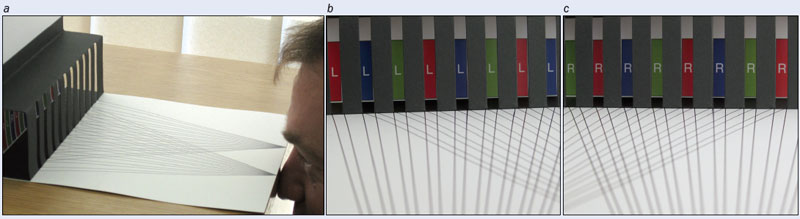
The “fixed-position” method assumes that the user views the display head-on so their gaze is at 90° to the display itself (figure 1a) – an assumption that is valid for most mobile devices. The image is separated into tiny stripes L, R, L, R, L, R, with all the L images being sent to the left eye and all the R images being sent to the right eye by means of a physical device known as a “parallax barrier” (figure 2). This technique, which has been known for almost 70 years, could of course be applied to any images – be they photos or paintings – not just an LCD display, provided of course that the left and right images can be interlaced into left and right image stripes to work with the parallax barrier.

A disadvantage of the parallax barrier is that because each eye is allowed to see only half the pixels, light travelling in the “wrong” direction – i.e. from an L stripe to the right eye or from the R stripe to the left eye – is absorbed by the barrier. This cuts the intensity from the display by about half and reduces the resolution. In practical terms, this means that when the display is being used in conventional 2D mode, the parallax barrier should be removed. In most 3D displays, such as Sharp’s 3D mobile phone, this is achieved by making the barrier from a liquid-crystal layer that can be turned on or off electrically.

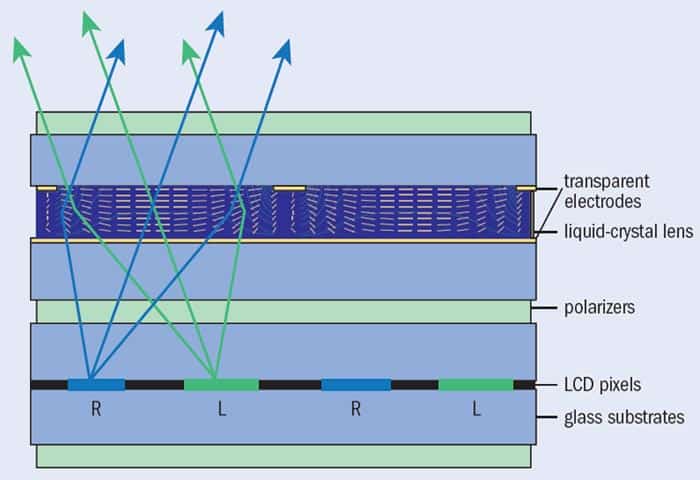
It would of course be much more efficient to dispense with a parallax barrier and instead use lenses, which are transparent, to redirect the L and R light to the appropriate eye. Indeed, researchers have already developed high-quality cylindrical lenses using liquid crystals that can do just that. The principle is simple: as the refractive index of liquid crystals varies with voltage, lenses made from these materials can be turned “on” when a voltage is applied and “off” when the voltage is removed. These cylindrical liquid-crystal lenses take the place of the parallax barrier, redirecting the light in the correct direction (figure 3). This technology is likely to double the efficiency of glasses-free 3D displays in the future, with many companies known to be actively carrying out research into them.
One drawback of parallax technology is that the user has to sit in a certain position relative to the screen. The “tracked viewing position” technique, in contrast, allows 3D screens to be viewed without glasses from any angle by tracking the user’s head position. This could be achieved by, for example, fitting a laptop with a forward-facing web camera to identify the location of the user’s face and eyes. Indeed, this technology is already common in many digital cameras sold on the high street to ensure that a face automatically becomes the centre of focus. All that is then needed for glasses-free 3D viewing is an automatically adjustable parallax barrier that can change the angle at which the left and right images are seen. The camera can then identify the position of the user, while the parallax barrier directs the left and right perspectives at the appropriate angle.

This adjustment can be carried out using face-tracking algorithms written onto image-processing chips, which operate very efficiently, meaning that not too much processing power is required. The camera can also monitor how far a user is sitting from the screen and adjust the images accordingly. In practice, the viewer can move up to 30 cm from the ideal viewing distance, while their side-to-side movement is limited to about ±30° from the normal. Accommodating more than one user is in principle possible, but the complexity of the system is significantly increased. In addition to the viewer being free to move around, the other advantage of the tracked-viewing-position system is that if the image happens to be from a computer-generated scene, the viewpoint could be adjusted according to the user’s position. For example, a viewer could literally look around the side of an object (a cube say) to bring previously unseen faces of it into view.

As for the third method for generating glasses-free 3D – multi-view – its goal is to work with a wide range of viewing positions and multiple viewers. To do this the display outputs not just two perspectives but typically eight or more. The user can then position their eyes to see perspectives 1 and 3, or 2 and 4, etc, so the 3D effect can be achieved from a wide range of angles. A multi-view system with, say, eight views requires eight times greater resolution than a 2D system, and some ingenuity is required to synthesize the eight views or transmit them in the available television bandwidth. Nevertheless, this technology is probably the strongest contender for glasses-free 3D television, with Philips and Toshiba both having already launched a multi-view television onto the market.

Fast forward

As we have discussed, Sharp has already designed and built a liquid-crystal screen on one of its mobile phones that functions as a switchable parallax barrier. Used in tandem with a conventional liquid-crystal display provided with stereoscopic input data, this system gives high-quality glasses-free 3D images. However, the electronic media industry has a vision of the future in which 3D displays are not just a niche product but an integral part of modern life. That means home-cinema systems showing 3D movies, computer games being played with an immersive 3D environment, and holiday photographs being presented with depth.

We can therefore expect a variety of 3D generation methods to become available for the different applications, and within each method we can expect improved optical technologies, and new related technologies such as those enabling 3D interaction. It is highly probable that all such devices will exploit the particular electro-optical properties of liquid crystals. The products on display at the Royal Society exhibition last summer, which are already coming on the market this year, are just the start.

Templeton caption competition

Templeton Prize HRH & Martin Rees.jpg
Martin Rees picks up the Templeton Prize from Prince Philip
(Courtesy: Clifford Shirley)

By Michael Banks

Can you guess what these two are saying to each other?

The photo, which was taken yesterday, shows the cosmologist Martin Rees from Cambridge University picking up the 2011 Templeton Prize at a ceremony at Buckingham Palace.

Rees was presented with the gong, which comes with a cheque for a whopping £1m, by Prince Philip, the Duke of Edinburgh, in a private ceremony that was also attended by seven former Templeton winners, including Paul Davis and George Ellis.

Yesterday also happened to be Prince Philip’s 90th birthday.

According to the Templeton Foundation, the prize is awarded for “progress toward research or discoveries about spiritual realities”.

The 68-year-old cosmologist was awarded it for his “profound insights” into the nature of the cosmos that have “provoked vital questions that address mankind’s deepest hopes and fears”.

There was some controversy around Rees being awarded the prize. Indeed, he told me he was “surprised” on hearing he had won and that he usually tries to avoid discussing science and religion with his views being “rather boring”.

There is not a £1m prize on offer from us, but physicsworld.com readers – can you guess what is being said between Rees (right) and Prince Philip in our caption competition?

If we have some funny submissions then we may be able to dig out a prize for the best one.

CDF bump almost gets a five-star rating

USPS.jpg
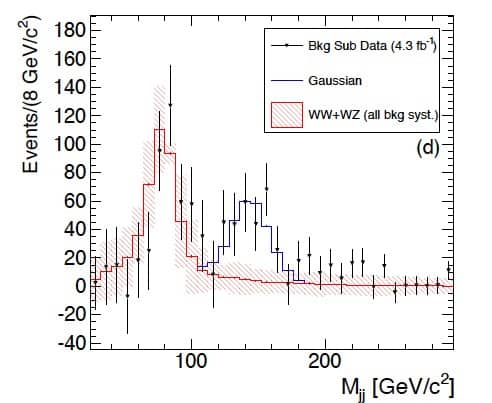
The graph shows the distribution of the “w-jj excess” as seen by the CDF experiment (Courtesy: Punzi/Fermilab)

By Tushna Commissariat

Two months ago, in early April, the particle-physics community was rife with speculation and excitement over a “bump” – a possible new particle – in the data that Fermilab’s CDF experiment was looking at. On Monday 30 May Giovanni Punzi, a CDF collaborator, presented an update on what is now referred to the “ W-jj” bump, as a part of his talk at the 23rd Rencontres de Blois Particle Physics and Cosmology conference currently being held in France. The update says that the bump is seen in more recent data with an even larger statistical significance.

At the time, CDF was looking for slightly rare di-boson pairs – W bosons produced in association with another W or a Z boson. It noted a bump between 120 and 160 GeV /C2 in the jets produced in the collisions with a statistical significance of about “three-sigma”, which meant that the result would not be considered valuable until a “five-sigma” statistical significance could be established. The new data, however, have established a significance that is officially “closer to five sigma” (unconfirmed sources suggest it is as close as 4.8) and that “it was not just a statistical fluctuation” and that it is now a “serious issue for CDF to understand this”, according to Punzi.

Interestingly, Punzi’s slides also say that it is almost impossible that bump is due to the Standard Model top-quark background, as suggested by some theoretical papers, as that would imply that previous measurements for SM top-quark background had huge errors. The next step forward would be if CDF’s sister experiment D0 or the LHC’s ATLAS or CMS experiments, none of which have found the bump in their data so far, manage to detect it.

This updated result has seen a variety of responses from physicists.

Adam Falkowski, who writes the Resonaances blog, seems rather jubilant. “In a collider experiment, such a huge departure from a Standard Model prediction is happening for the first time in the human history,” he writes. “I don’t have to stress how exciting it is.”

Peter Woit, author of the Not Even Wrong blog, feels that while a five-sigma significance is important, problems with background modelling might thwart the result. “The signal is being extracted from a huge background, so a small misunderstanding of the background could be its cause.” Only a detection of the same result by another experiment would make the case more compelling, according to him.

Tommaso Dorigo, a blogger and CDF collaborator, is still sceptical of the result and chalks it up to bad background modelling, like Woit. “No, it is not the Higgs. And it is not a new particle. It is, in my humble opinion, a problem in the modelling of backgrounds, one which was unnoticed before only because it is small enough to have escaped previous attempts at “tuning” the simulations.”, he writes in his blog.

So while it seems like we the path to “new physics” is full of “bumps”, the field of particle physics is a rather exciting one right now! Take a look at the slides Punzi used for his talk here.

Between the lines

Feynman the cartoon

Given Richard Feynman’s larger-than-life popular image, it was probably only a matter of time before someone literally turned him into a cartoon character. That, at least, would be the cynic’s view of Jim Ottaviani and Leland Myrick’s book Feynman, in which the writer-and-artist pair present the life and work of the late Nobel laureate in graphic-novel form. Unsurprisingly, perhaps, their account places heavy emphasis on Feynman’s bongo-playing, skirt-chasing side, and readers who feel that such anecdotes distract from Feynman the physicist (see above review) should steer well clear. Yet it is hard to be cynical for long about a book that, like its title character, simply bubbles with the pleasure of doing physics. The illustrations are crisp and memorable, and the pithy text captures Feynman’s inimical voice even when Ottaviani is not quoting him directly. Many of the anecdotes are, it is true, pretty well worn; the one about Feynman as Los Alamos safe-cracker, in particular, is as threadbare as an ancient stuffed bear with one ear missing. Those who prefer such anecdotes undiluted might be better off with Feynman’s own memoirs Surely You’re Joking, Mr Feynman! and What Do You Care What Other People Think?. However, there are some lesser-known stories here as well, drawn from the authors’ metre-high pile of published and unpublished Feynmanalia. Of particular interest is the recurring thread about Feynman’s sister Joan, who became a noted astrophysicist despite repeated discouragement from nearly everyone. After their mother tells Joan that women’s brains are “physiologically incapable of doing science”, Richard quietly slips her his astronomy textbook, urging her to “keep working through until you can understand the whole book”. The pair later make a pact: he can study anything he likes, as long as he leaves the Northern Lights to her. This Feynman may be a cartoon, but he has a heart as well as a brain.

  • 2011 First Second Books £18.99/$29.99hb 272pp

Explaining the unseen

Some popular-science books use pretty pictures or amusing anecdotes to get people interested in science. Others take readers’ interest as a given and concentrate instead on providing this (usually smaller) audience with the clearest, most rigorous explanations possible. In 101 Quantum Questions: What You Need to Know About the World You Can’t See, author Kenneth W Ford has opted decisively for the second option, trusting that readers will follow him as the book proceeds from simple questions such as “How big is an atom?” (no. 4) to complex ones like “What is entanglement?” (no. 95). Fortunately, Ford – a nuclear physicist and former director of the American Institute of Physics – is an accomplished teacher, and what his book lacks in gee-whizzery it makes up for in explanatory power. One reason for this is the author’s flair for analogies. In one early answer, he describes the changeable shape of an atomic nucleus by comparing it to “a balloon inside which a gerbil is running round and round”, noting that the balloon will distort to give the gerbil more room to run. Despite these advantages, however, the book is not a quick read, and casual readers will probably prefer to leave plenty of time to ponder each question before moving on to the next. Alternatively, Quantum Questions would make a good introduction for physics students who will find Ford’s book a useful beginners’ guide.

  • 2011 Harvard University Press £18.95/$24.95hb 304pp

Plane thoughts for a long flight

We’ve had the science of Santa, sport and superheroes. Surely there cannot be another new twist to this particular genre, whereby hard science is made digestible by showing its relevance to some facet of modern life? Step forward veteran UK science writer Brian Clegg with Inflight Science: a Guide to the World From Your Airplane Window. Aimed squarely at passengers looking for something to read on a long flight, Clegg describes relevant bits of science from the security checks at an airport, via take-off and cruising, to touch-down at your final destination. It is a clever tactic because it allows Clegg to touch on a wide range of otherwise disparate subjects, from X-ray scanning to how the flat-screen TV in the back of your headrest works. Ironically, those screens are the enemy of all in-flight reading and their temptations proved a constant distraction for your Physics World reviewer, who read the book on a long-haul flight to Beijing. Another drawback is that the level of scientific explanation is fairly low, which means that physicists will feel a little short-changed and perhaps even cringe at some of the over-simplifications. But, hey, if you thought you could have done better, unfortunately Clegg had the idea first.

  • 2011 Icon Books £12.99pb 212pp

New head for US nuclear-weapons lab

A physicist with more than 25 years’ experience in nuclear-weapons science and technology has become the 10th director of the Los Alamos National Laboratory in New Mexico. Charles McMillan, 56, succeeds physicist Michael Anastasio, who had been lab boss since 2006. Established in 1943, Los Alamos now has an annual budget of about $2bn and employs nearly 10 000 staff.

With a PhD in physics from the Massachusetts Institute of Technology, McMillan began his career in 1983 as an experimental physicist at the Lawrence Livermore National Laboratory (LLNL) in California. He later moved into computational science and management at the LLNL before joining Los Alamos in 2006 as principal associate director for its weapons programmes. That role involved him overseeing the safety, reliability and performance of the US nuclear deterrent, which is the lab’s main mission.

Los Alamos is one of three US nuclear-weapons labs – the other two being the LLNL and Sandia National Laboratories in New Mexico. McMillan’s responsibilities as head of Los Alamos will, however, go beyond developing and maintaining nuclear weapons. The lab also operates a national high-magnetic-field laboratory and works with other institutions including the Joint Genome Institute, which tackles genome mapping, DNA sequencing and related information science. Los Alamos also runs a research programme in systems-biology modelling.

“The lab is helping prevent pandemics, detecting and disabling improvised explosive devices, and developing alternative energy sources,” McMillan told physicsworld.com. “Today it leads research breakthroughs in areas as diverse as contributing to a possible AIDS vaccine and to fuel cell energy storage developments that could cut costs and speed commercialization. One of my goals is to build on these strengths to enhance the lab for the future.”

“In excellent hands”

In addition to becoming director, McMillan also becomes president of Los Alamos National Security (LANS), a public–private organization that manages the lab for the Department of Energy’s National Nuclear Security Administration (NNSA).

“Having known and worked with Charlie McMillan for more than a decade, I know Los Alamos is in excellent hands,” says NNSA administrator Thomas D’Agostino. “As we work to invest in the future and build the modern 21st-century nuclear-security enterprise required to implement the president’s nuclear-security agenda, Los Alamos will continue to play a vital role in pushing the frontiers of science and discovery.”

Meanwhile, LLNL director George Miller has announced that he will retire in October. Lawrence Livermore National Security, which operates the lab, is seeking his successor.

Richard Feynman: far more than a practical joker

In Quantum Man: Richard Feynman’s Life in Science, Krauss considers how Feynman’s ruthlessly bottom-up approach to science breathed fresh life into theoretical physics. Among other aspects, the book also considers the wider impact of Feyman’s work on other scientific disciplines including biology and computer science.

In this special audio interview with physicsworld.com reporter James Dacey, Krauss discusses his incentive for writing the book. “Feynman for me, like most scientists, was a sort of idol and it was a great opportunity to pay homage to him, and a personal homage because the last time I saw him I’d meant to tell him a few things and didn’t get a chance to,” he says.

Fresh perspective

Part of Krauss’ motivation for writing the book was his feeling that many earlier biographies aimed at the public have focused too much on Feynman’s personality, which can give the impression that science was something Feynman did “on the side”. “The public knows of [Feynman] as a curious character, and he is a fascinating human individual,” explains Krauss. “But what was clear to me is that people did not know why physicists revered him and I wanted to talk about his scientific legacy.”

Krauss explains that his own approach to physics was inspired by Feynman. “He often appeared to have results by magic, and what I also wanted to get across is how incredibly organized he was in his own thinking.

“The reason he could answer so many questions is that at some point or other he’d worked it out before. He’d have thousands and thousands of pages of notes in a very organized fashion.

“While he was a joker in life, when it came to science he was dead serious and he didn’t mess around.”

Book details

Quantum Man: Richard Feynman’s Life in Science
Lawrence Krauss
2011 W W Norton (available internationally)
£15.99/$24.95hb 350pp

Mapping forest carbon stocks

biomass map.jpg

By James Dacey

The distribution of stored carbon across the globe is considered to be a major uncertainty in greenhouse gas emissions calculations. But this map could help to improve the situation by detailing the spread of biomass carbon stocks over 2.5 billion hectares of forests across three continents – encompassing all tropical forests.

The map was created by researchers in the US, the UK and Gabon, who combined satellite data and ground-based observations to calculate above- and below-ground biomass quantities to a resolution of 1 km. To calculate forest heights, the researchers collected more than 3 million lidar shots using an instrument aboard NASA's Ice, Cloud,and land Elevation Satellite (ICESat).

Presenting their map in a paper published online yesterday in Proceedings of the National Academy of Sciences, the researchers say that forests in the study region contained 247 GT of carbon. Forests in Latin America, sub-Saharan Africa, and south-east Asia accounted for 49%, 25% and 26% of the total carbon stock respectively.

The regions with the largest carbon biomasses are highlighted in deep red, while the zones with the least carbon are coloured in violet.

The researchers say that the new data and accompanying map could help developing countries in the study area to implement climate change mitigation policies relating to deforestation and degradation (REDD).

NMR spectroscopy without the ‘M’

Nuclear magnetic resonance (NMR) spectroscopy is perhaps the most useful technique in the organic chemist's toolkit. But conventional NMR requires the sample to be placed in a very high magnetic field, which needs large and expensive superconducting magnets cooled by liquid helium. Now, an interdisciplinary group in the US has managed to accomplish NMR spectroscopy without magnets. The work could lead to portable NMR spectrometers, and possibly even small personalized spectrometers for medical diagnosis.

How it's done

The applied magnetic field serves several purposes in NMR. Most nuclei of interest in NMR have two states – spin-up and spin-down. When placed in a magnetic field, the spin-down state is at a higher energy level than the spin-up state. Conventional NMR works by bombarding the sample with radio waves and measuring the energy absorbed or emitted when nuclei flip between the two states. The same nuclei in different parts of a molecule have slightly different transition frequencies; so measuring these frequencies allows researchers to work out the location of particular atoms in the molecule.

The bigger the magnetic field, the easier it is to resolve these different frequencies, providing a better understanding of complex molecules. Furthermore, a larger magnetic field increases the proportion of nuclei that are spin-up, which in turn causes a larger perturbation between the states, which gives a stronger signal.

The bottom line is that the signal intensity in conventional NMR increases roughly as the square of the magnetic field strength. NMR spectrometers over the years have therefore become bigger, more powerful and more expensive. The alternative – NMR spectroscopy with no applied field – seems bizarre because it should mean no energy gap, no spin polarization and nothing to measure.

Spin couples

Fortunately, in addition to interacting with the magnetic field, the nuclear spins also interact with each other. This effect, called "J-coupling" or "spin-spin coupling" is much smaller, but it is still seen in a standard NMR spectrum as a splitting of the main absorption peaks. In the absence of an applied field, the J-coupling is all that remains. The researchers say that the signals resulting from pure J-coupling can impart plenty of information regarding chemical structure. "We have acquired zero-field J-spectra in dozens of molecules, and no two molecules have produced the same features," says atomic physicist Micah Ledbetter of the Nuclear Science Division at the University of California at Berkeley, who was part of the research. Nevertheless, since J-coupling is much weaker than the coupling to a strong applied field, the resonance associated with pure J-coupling is much harder to detect.

Solve and resolve

The current research at Berkeley builds on previous work in low and zero-field NMR and attacks this problem in two ways. First, the problem of spin coupling without an applied magnetic field can be overcome by employing a technique known as "parahydrogen-induced polarization". Parahydrogen is a spin isomer form of hydrogen with the anti-parallel spin alignment, forming a "singlet state" (see image above). The technique used by them transfers a special kind of polarization from to the sample molecule, resulting in enormous signal enhancement. While the phenomenon of parahydrogen-induced polarization has been known for some time, the current work is the first to successfully use it in zero-field.

The researchers then used an innovative technique to measure the faint magnetic fields. The detectors used in early experiments with low-field NMR needed to be cooled to near absolute zero, which defeated the purpose of removing the applied field in the first place. Instead, the researchers modified a different type of detector called an "optical atomic magnetometer" – which requires no refrigeration – for use at zero-field.

The team demonstrated its technique by distinguishing between several similar hydrocarbon molecules – the first time that zero-field NMR has been successfully used for such complex chemical analysis.

Bernhard Blümich, an NMR spectroscopist at Aachen Technical University in Germany, is impressed. "This is a milestone paper," he says, "All these components you need are not very expensive or can be made inexpensive in the future. You come up with an NMR spectrometer which is much less expensive than today's high-field spectrometers."

The research is published in Nature Physics.

Semiconductor shows its chameleon side

Physicists in Japan have shown how to make a semiconductor magnetic simply by applying a fairly modest voltage across the material at room temperature. Although the effect had been seen before, it previously required ultralow temperatures and massive voltages. Masashi Kawasaki of the University of Tokyo and colleagues say that their discovery could help to make MRAM memory chips more energy efficient, because a current would no longer need to be applied when writing data to the chips.

Magnetism plays a key role in much of condensed-matter physics, with metals such as iron and cobalt displaying permanent magnetism, or ferromagnetism, because the magnetic spins of their constituent electrons naturally align with one another. Semiconductors such as silicon, however, are instead paramagnetic, which means that their spins line up only when exposed to an external magnetic field.

But what Kawasaki's team has done is to show that the semiconductor titanium dioxide, doped with about 10% cobalt impurities, can be transformed from a paramagnet into a ferromagnet (and back again) when housed in an electrolytic cell and a voltage applied across it.

In the absence of an applied voltage, the three spins inside each cobalt ion align with one another but there is no alignment between ions, as would be expected in a paramagnet. But with an applied voltage, extra electrons can enter the material, conveying information about the electron spins within the cobalt ions from one ion to the next. The spins of the ions now line up with one another, which in turn orients the spins of the mobile electrons in the same direction.

Although the chameleon-like ability to turn magnetism on and off in a semiconductor had been previously demonstrated by Hideo Ohno and colleagues at Tohoku University in Japan in 2000, using a thin-film semiconducting alloy, they were only able to do it at the ultralow temperature of 25 K and with a massive 125 V.

But by incorporating an electrochemical cell into a field-effect transistor, Kawasaki's group has been able to add much larger densities of electrons to the semiconductor and so switch the material's magnetism on and off at room temperature using a potential difference of just 4 V.

The researchers confirmed the presence of ferromagnetism in the doped titanium dioxide by passing a current through the material and measuring the voltage generated across it. The predominance of one spin direction over the other forced electrons to scatter more to the left than to the right (or vice versa), thereby generating a potential difference at right angles to their path (a phenomenon known as the anomalous Hall effect).

Flipping great

Kawasaki says that his team's finding could boost the energy efficiency of MRAM memory chips, which consist of millions of pairs of tiny parallel ferromagnetic plates, with the plates in each pair separated by an insulator. The electrical resistance of these pairs is lower when the spins in each of the two plates are lined up in the same direction and higher when they are aligned in opposite directions, corresponding to a "1" and "0".

Writing data to the chips involves altering the relative orientation of the magnetic spins, which is currently achieved by sending a current down a wire and exposing the plates to a magnetic field. If, however, the spins could be made to flip simply by applying a voltage to the pairs of plates then this flipping could be carried out at much lower energies, says Kawasaki. Although he has not yet actually managed to flip the spins in a semiconductor, Kawasaki says this is next on his agenda.

He admits that energy consumption in MRAM chips is not currently a huge issue, simply because this kind of memory is still not widely used, being much more expensive than other types of storage technology, such as flash memory. But he says that if prices come down and MRAM devices become more popular (they are fast and durable) then their hunger for energy will become a problem.

At that point, he maintains, it would make more sense to use semiconductors that can be made ferromagnetic by applying a voltage. "IBM is aiming at doing away with hard drives and using MRAM instead," he says. "But its devices need a current to flip the memory."

Magnetic messengers

Other researchers also believe that the latest work may have significant practical pay-offs. Yuan Ping Feng of the National University of Singapore thinks it could "lead to technological applications in semiconductor spintronics", while Igor Žutić and John Cerně of the State University of New York in the US, writing in a "perspectives" piece accompanying the paper, argue that the new ferromagnets could "help us make more versatile transistors and bring us closer to the seamless integration of memory and logic".

Žutić and Cerně also point out that, unlike normal ferromagnets, in which heat is a problem because it tends to break up the spin alignment, the new material might actually enhance magnetism at higher temperatures because additional heat increases the number of charge carriers. "This could strengthen their role as magnetic messengers and could conceivably overcome the usual role of heat as the main foe of ferromagnetism," they say.

The research is reported in Science 332 1065.

Goodnight, Spirit

USPS.jpg
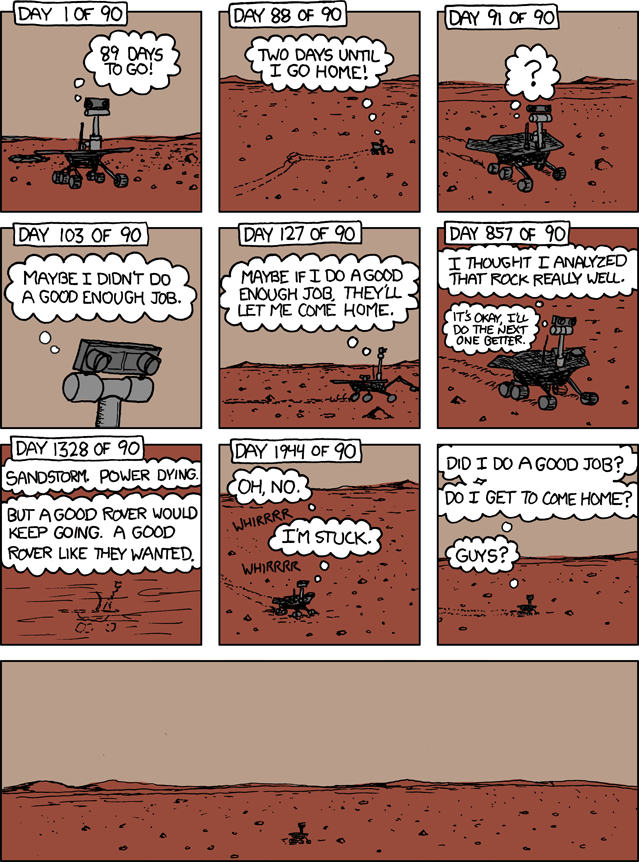
The "Spirit" comic strip on the xkcd.com webcomic (Credit: Randall Munroe/Creative Commons)

By Tushna Commissariat

The long and tumultuous journey for NASA's Mars rover Spirit has finally come to an end, as the space agency's engineers have ended attempts to regain contact with the vehicle, which has been out of touch since 22 March 2010. Now, Spirit's twin, Opportunity, will explore the red sands solo until the arrival of younger brother Curiosity – NASA's third rover, set to be launched in November.

The end of the road for Spirit came yesterday, when NASA engineers made a final and unsuccessful attempt to contact the rover. They had hoped that Spirit might rejuvenate as the solar energy became available once more, after a rather cold and dreary Martian winter without much sunlight. But without enough energy to run its survival heaters, the rover likely experienced colder internal temperatures last year than in any of its previous six years on Mars, possibly causing critical internal damage.

"Our job was to wear these rovers out exploring, to leave no unutilized capability on the surface of Mars, and for Spirit, we have done that," says Mars Exploration Rover Project manager John Callas of NASA's Jet Propulsion Laboratory in Pasadena, California.

Spirit landed on Mars on 3 January 2004 for what was planned as a three-month mission. After accomplishing its primary objectives, Spirit went on to explore a distance of 7.7 km, almost 12 times its initial goal. Spirit became the first robot to climb to the summit of a hill on another planet; and covered more than half a mile after its right-front wheel became immobile in 2006. Over time, it sent home more than 124,000 images, looked at 92 samples of soil and rock and unexpectedly discovered silica deposits in the Martian soil when it upturned soil due to a dragging back wheel. This was, ironically, one of the biggest discoveries made by a rover to date.

"What's most remarkable to me about Spirit's mission is just how extensive her accomplishments became," enthuses Steve Squyres of Cornell University, Ithaca, a principal investigator for Spirit and Opportunity. "What we initially conceived as a fairly simple geologic experiment on Mars ultimately turned into humanity's first real overland expedition across another planet. Spirit explored just as we would have, seeing a distant hill, climbing it and showing us the vista from the summit. And she did it in a way that allowed everyone on Earth to be part of the adventure."

Just in case you are about to shed a tear, you might enjoy the above image that Randall Munroe, a former physicist who is now behind the popular xkcd.com webcomic, drew sometime last year when contact was lost with the rover. A rather touching and prophetic image, he brings out the human side of our robot geologist.

Copyright © 2026 by IOP Publishing Ltd and individual contributors