Einstein's landing card resurfaces after 80 years

USPS.jpg
Courtesy: National Museums Liverpool

By James Dacey

This unremarkable piece of paper belongs to a chapter in one of the most extraordinary lives of the 20th century.

It is the recently discovered landing card issued to Albert Einstein in 1933 when he arrived in Britain after fleeing Nazi Germany.

On Tuesday the card went on public display for the first time at the Merseyside Maritime Museum in Liverpool, having been stored away for nearly 80 years at Heathrow Airport.

“We were keen on acquiring any documents relating to immigration but were stunned to find paperwork relating to such a prominent historical figure as Albert Einstein,” Lucy Gardner, curator of the exhibition about customs and immigration.

The document brings proof that Einstein arrived in Dover on 26 May 1933 after sailing from Ostende in Belgium. The “professor” states that he was heading for Oxford, a city he had visited previously during stays at Christ Church College.

Einstein lists his nationality as Swiss having renounced his German citizenship only weeks earlier in angry reaction to Nazi policies. In April 1933 Hitler’s party had passed a law barring Jews from holding any official positions, including teaching at universities. And during a visiting professorship at the California Institute of Technology, Einstein – who was Jewish by birth – had learned that his name had been added to a list of Nazi assassination targets.

Upon his return to Europe Einstein resided in Belgium for a brief time before sailing to Britain. Shortly afterwards, Einstein took up his position at the Institute for Advanced Study at Princeton an affiliation that lasted until his death in 1955.

“This tiny piece of paper brings to life Einstein’s escape from the Nazis to England,” said Gardner.

USPS.jpg
Curator Lucy Gardner with Einstein’s landing card

Quantum-computing firm opens the box

A small firm based in Canada that aims to build a commercially viable quantum computer has shown that an important part of its technology works. D-Wave Systems, which was spun-out of the University of British Columbia in 1999, has shown that a technique called quantum annealing can be used to make eight coupled quantum bits – or qubits – find their ground state. According to the firm’s chief technology officer Geordie Rose, the announcement is the first of several scientific results that D-Wave will be unveiling – including one that he claims is “mind blowing”.

Based in Vancouver, D-Wave was set up with the aim of creating a quantum computer that uses loops of superconducting wire as qubits. As the electrical current circulating within such a “flux qubit” is quantized, the two lowest states (i.e. electrons travelling clockwise and anticlockwise) can be assigned data values of “0” or “1”. The magnetic field associated with the currents is also quantized – pointing up and down for currents moving in opposite directions – and can be flipped using an external magnetic field.

Resisting heat and noise

Quantum computers could outperform a classical computer at some tasks – at least in principle – thanks to two key quantum properties. These are that a qubit can be in a superposition of two or more quantum states and that two or more qubits can be entangled. But the big challenge for D-Wave – and for everyone else trying to build a quantum computer – is how to create qubits and computing processes that are resistant to the destructive effects of heat and noise.

Using flux qubits is attractive in that quest because they are macroscopic structures that can be created using semiconductor-manufacturing processes and can be controlled using applied currents and voltages. A downside is that they have a multitude of quantum states, not just two. The task for D-Wave is how to place each qubit in a well-defined and useful quantum state without it being corrupted by heat or noise – essentially the analogue of writing data to a classical computer.

The method chosen by the firm to do this is called “quantum annealing” – and now D-Wave has shown that it can use this technique to place eight coupled qubits into the appropriate lowest energy state. The researchers began with eight superconducting flux qubits within one of D-Wave’s integrated circuits. These contain 128 flux qubits arranged into 16 units of eight. The system is then cooled to a temperature of 10 mK, which puts each qubit into a superposition of two quantum states with identical energy, i.e. current circulating anticlockwise (spin-up) and clockwise (spin-down).

Raising the barrier

This superposition is not, however, particularly useful and the next step is to manipulate each qubit into a pure spin-up or spin-down state. Each loop is broken by a structure containing two Josephson junctions and a magnetic coil. When a current is applied to the coil, an energy barrier rises between the spin-up and spin-down states. In a classical system, the loop would be forced into either the up or down state and could hop between states by absorbing heat from the surroundings. A qubit however, remains in a superposition of up and down as long as the barrier rises slowly enough.

Each qubit has a second magnetic coil, which is used to “tip” the qubit into the desired pure state. If the field is applied in the up direction, for example, the energy of the spin-up state drops below that of the spin-down state, thereby making it more likely that the qubit will become pure spin-up. The problem facing D-Wave is that this transition occurs both by quantum-mechanical tunnelling and by absorbing heat (thermal excitation). Thermal excitation destroys the quantum nature of the qubit, and so must be avoided during quantum annealing.

The two processes can be distinguished by raising the barrier until both tunnelling and heat-driven transitions stop (the qubit “freezes”) – and then repeating this process at different temperatures. The research team found that below about 45 mK, freezing is affected primarily by barrier height and not temperature, which is what is expected if annealing occurs by tunnelling alone.

Frustrated chain

The team then showed that it could anneal a unit of eight qubits. The researchers did this by adjusting the interactions between the qubits to simulate a 1D chain of magnets in which each qubit wants to point in the same direction as its two neighbours. The qubit at the right-hand end of the chain is set in the up direction and the qubit at the left-hand end in the down direction. The six qubits in the middle are then allowed to orient their spins according to that of their neighbours. The result is a “frustrated” ferromagnetic arrangement in which two neighbours must have opposing spins.

Finally, the qubits are all tilted in the same direction while the barrier is raised. This should result in the system moving towards one specific arrangement of frustrated spins – the ground state. Again, below about 45 mK, the system found its way to the ground state in a manner consistent with the spins flipping because of quantum-mechanical tunnelling, not thermal activation. “We’re very excited to see the remarkable agreement between what quantum mechanics predicts and what we see in these circuits,” says D-Wave’s Mark Johnson, who was lead scientist on the project.

Finding the ground state of an eight-spin system is a simple quantum calculation and therefore the D-Wave team has shown that its combination of hardware and annealing process is capable of the job.

“Important” first step

“This is the first time that the D-Wave system has been shown to exhibit quantum mechanical behaviour,” says William Oliver of the Massachusetts Institute of Technology, who was not involved in the research. Oliver told physicsworld.com that when combined with D-Wave’s ability to control precisely important parameters of the qubits, this latest work is “a technical achievement and an important first step”.

Looking beyond quantum computing, David Feder of the University of Calgary also sees the system as an effective quantum simulation of how electron spins interact in magnetic materials. “This work describes a nice approach to simulating the (ferromagnetic or antiferromagnetic) quantum Ising model, and this is interesting in its own right,” explains Feder. “I think that there is a lot of promise in the D-Wave architecture for simulating frustrated magnetic systems, and maybe more general strongly correlated systems, and this will benefit everyone. So, to me, it is a good step in the right direction.”

D-Wave currently employs about 60 scientists and engineers, of whom about 20 work on developing algorithms and 40 work on building hardware, according to Rose. This latest research was carried out by 25 of D-Wave’s employees along with researchers at the University of Agder in Norway and Simon Fraser University in Canada.

“This is the first time we’ve been able to open up the black box and show how [D-Wave’s devices] are harnessing quantum mechanics in solving problems,” says Rose. He told physicsworld.com that the firm now plans to do similar quantum-annealing experiments involving much larger numbers of qubits. He also says that the researchers will apply the process to “real problems” such as machine learning and artificial technology. Rose is adamant that D-Wave’s systems could be used in commercial settings as well as for doing basic research in quantum computing. “Our sales team is out selling at the moment,” he says.

According to Rose, the company will soon publish a number of journal papers about its research. However, he was unable to provide more details because the work is currently being peer-reviewed.


Massive partner flips hot Jupiter

Astronomers in the US believe they have discovered why a quarter of known “hot Jupiters” orbit their stars in reverse. The finding challenges our understanding of how planets form and may give us a clue as to how common solar systems like ours are.

More than 550 exoplanets – planets orbiting stars other than the Sun – have been discovered to date. Many of them have been dubbed hot Jupiters because they are about the same mass as the giant planet and orbit very close to their host stars. However, astronomers have wondered why one in four of these alien worlds orbit in the opposite direction to the spin of their star. This is unlike our solar system, where the planets bend to the will of the Sun, with their orbits all following its anticlockwise rotation. Now, astrophysicists at Northwestern University think they have the answer.

The team modelled a simple solar system with a Sun-like star orbited by a Jupiter-sized planet far from the star and a second large body (a planet or brown dwarf) even further away. When the model was run the gravitational interactions between the bodies began to change the orbit of the inner planet. “These are extremely weak gravitational perturbations that over millions or billions of years cause small, gradual changes in the planet’s orbit, which build up to become very large,” team member Fred Rasio told physicsworld.com.

Flipped over

Eventually, this changes the inner planet’s orbit from almost circular, like our Jupiter’s, to highly elongated – a journey that at times takes the planet very close to the host star. The gravity of the star then squeezes and heats the planet, causing it to lose orbital energy and shrinking its orbit. This part of the theory, which explains the planet’s proximity to its star, had been modelled before.

However, Rasio and his colleagues saw something new. “These perturbations also caused the inclination of the orbit to change,” Rasio explained. Inclination is the angle between the angular momentum of the spinning star and the orbital angular momentum of the planet. “In some cases the hot Jupiter became so inclined to its star that it completely flipped over it and orbited it in the other direction,” he adds.

The key player here is angular momentum – a quantity that must to be conserved. As the inner planet moves from a circular orbit to an elongated one, its angular momentum drastically decreases – in turn increasing the angular momentum of the perturbing outer body by the same amount. This loss of angular momentum makes the inner planet much easier to flip. “It only takes a relatively small force to flip a planet with a tiny angular momentum,” says Smadar Noaz, Rasio’s colleague.

‘Promising mechanism’

“This looks like a very promising mechanism,” Gordon Ogilvie at the University of Cambridge, UK, told physicsworld.com. “However, what is less clear is how often this mechanism occurs and whether this is sufficient to explain the majority of observed systems,” he adds. Other processes have also been suggested and it could turn out that a single mechanism isn’t causing all of the “flipped” hot Jupiters. “Further theoretical work is certainly needed to distinguish between these possibilities,” says Ogilvie.

The case could be settled by finding the smoking gun: the perturbing, outer planet in these systems. “It [the perturbing planet] should still be there; there is no easy way to get rid of it,” Rasio explains. “It could be very faint and hard to detect but it should be there,” he adds. Direct imaging of exoplanets, such as that of Beta Pictoris b, could find them (see “Exoplanet caught on the move”).

If confirmed, Noaz believes it tells us something important about our own solar system and our theories of planetary formation. “The picture of our solar system is very neat and beautiful. However, we see a whole zoo of different planetary systems out there, including planets that seem to flip over,” she says. “This not only means our solar system might be unusual but it emphasizes the need for a better understanding of how planets are formed,” she adds.

The findings are published in Nature 473 187.

Head in a CLOUD

Whenever you hear about CERN these days, it tends to be dominated by news about the Large Hadron Collider and its hunt for fundamental particles. But there are plenty of other experiments taking place at CERN, spanning a wide range of science.

One of them is the CLOUD experiment, designed to recreate processes in the atmosphere and their wider impact on Earth’s climate. The Cosmics Leaving OUtdoor Droplets project is designed to investigate the possible influence of galactic cosmic rays on Earth’s clouds and climate.

In this special video report for physicsworld.com CLOUD project leader Jasper Kirkby explains what his team is trying to achieve with its experiment. “We’re trying to understand what the connection is between a cosmic ray going through the atmosphere and the creation of so-called aerosol seeds – the seed for a cloud droplet or an ice particle,” Kirkby explains.

The CLOUD experiment recreates these cloud-forming processes by directing the beamline at CERN’s proton synchrotron into a stainless-steel chamber containing very pure air and selected trace gases.

One of the aims of the experiment is to discover details of cloud formation that could feed back into climate models. “Everybody agrees that clouds have a huge effect on the climate. But the understanding of how big that effect is is really very poorly known,” says Kirkby.

If you enjoyed this video, you can also learn about CERN’s hunt for the elusive Higgs boson in this recent video report from the ATLAS and CMS collaborations. Then in this separate video you can learn about how CERN’s ALICE experiment is trying to recreate the moments that existed just picoseconds after the Big Bang.

Quiz question of the week

By Matin Durrani

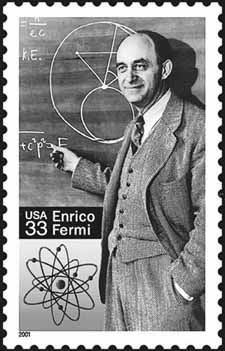
fermistamp.jpg

I always find it interesting when little-known anecdotes about some of the greatest figures in physics come to light.

So here’s one that I thought I’d share with you, courtesy of Uri Haber-Schaim, a retired physicist now living in Jerusalem.

Writing in the latest issue of Il Nuovo Saggiatore – the bulletin of the Italian Physical Society – Haber-Schaim recalls a summer school in high-energy physics that took place in Varenna, Italy, in 1954, which was attended by, among others, the Italian particle physicist Enrico Fermi.

During the morning break, one of the participants from France – A Rogozinsky – posed a mathematical problem concerning a priest and a sexton on a walk who encounter three people coming towards them.

The sexton asks the priest how old the three people are and is told that “the product of their ages is 2450 and the sum of their ages is twice your [i.e. the sexton’s] age”.

The sexton, saying that he needs more information to solve the problem, is then told by the priest that he – the priest – is “older than any of them”.

So the question is: what are the ages of the three people, the priest and the sexton?

Haber-Schaim recalls that everyone at the meeting realized that writing down equations would not get them anywhere and that he then suggested to Rogozinksy that he present the problem at lunch so that everyone could tackle it together.

Fermi, however, who was a notoriously good problem solver, proceeded to answer the puzzle within a minute.

So over to you, physicsworld.com readers. Can you solve the problem or – even better – beat Fermi and get the answer in under a minute?

For the record, I still haven’t figured it out.

Cosmic rays mapped across the southern sky


Physicists have produced the first complete map of the high-energy cosmic rays that bombard the Earth from the southern sky. The researchers have discovered an excess of cosmic rays coming from certain directions, which may link to nearby sources, including pulsars.

The data for the map were captured by IceCube, a neutrino detector in Antarctica that was completed last December after six years of construction. While IceCube was designed primarily to detect cosmic neutrinos, a team of researchers have been using the partially built experiment to detect cosmic rays originating from across the Milky Way. These charged particles are of interest to astrophysicists because they can reveal information about their sources and the intervening space through which they have travelled.

Cosmic rays arriving at Earth were detected by the 2.5 km vertical “strings” of light sensors contained within the IceCube detector, which is buried beneath the Antarctic ice. Or, more accurately, photomultipliers within the strings detect the Cerenkov radiation given off by muons produced by the interaction of cosmic rays with atomic nuclei on their journey to Earth.

Deep beneath the ice

Antarctica was chosen as the place to locate the IceCube detector because the ice serves as the detection medium in which muons and other charged particles travelling through it emit Cerenkov radiation. “The deep ice is very dark, so no other sources of light interfere in the detection,” said Marcos Santander, of the University of Wisconsin-Madison, who was involved in the mapping project.

Santander and his colleagues collected data between 2007 and 2009 when IceCube had just 59 strings and they mapped the relative intensity of cosmic rays coming from all directions in the southern sky. They found that the distribution of arrival directions of cosmic rays is highly anisotropic, suggesting that some regions of the galaxy are producing more cosmic rays than others. Santander says that he believes the cosmic-ray hotspots may be related to nearby pulsars between 150 and 300 parsecs away from Earth.

Santander said that the map is also consistent with what has been observed in the northern sky by previous cosmic-ray experiments such as the Milagro experiment near Los Alamos in the US. His group is currently carrying out the same analysis using newer data, captured when the detector had 79 strings. “We’re also exploring the possibility of doing a combined analysis with other experiments in the north,” he told physicsworld.com.

Santander presented the cosmic-ray map last week at the American Physical Society’s April meeting in Anaheim, California.

Probing potential PhDs

“You have two square potential wells of the same width,” my Stony Brook colleague Xu Du said to the candidate. “One is infinitely high, the other finite. Which has the higher ground-state energy? Explain the answer as you would to an undergraduate, in two or three minutes and without doing any calculations.” Du then added that as he was an experimentalist, the answer should be intuitive – no formal derivation was needed.

Du and I were in China interviewing students who had applied for admission to Stony Brook’s graduate programmes in physics and in several other disciplines. The admissions committees had found that many of the qualities that they were looking for in candidates – including knowledge, motivation and experience – could be assessed from the students’ records and recommendations. But one important duty of graduate students is to tutor undergraduates and serve as teaching assistants. To do this well, sheer knowledge of physics and a good command of English are insufficient. Gauging the promise of candidates in tutoring was therefore one task that Du and I had in conducting these interviews.

But how do you test the tutoring ability of a student from another culture, especially when we had only 15 minutes in total to talk to each candidate?

Du, who is a condensed-matter physicist, had devised a clever solution. He selected a set of special physics problems, and towards the end of each interview would randomly select one – asking the candidate not to solve it, but to explain how we would find the answer if we were undergraduates. They looked and sounded like ordinary textbook problems. They weren’t quite; they were deceptively challenging. To explain them in two or three minutes involved a little more speed than the typical textbook problem, a little more cleverness in identifying the conceptual issue, and a little more fluidity in couching the explanation.

Well put

Language difficulties sometimes delayed some students’ initial understanding of the problem. Nervousness momentarily paralysed others, until Du coaxed them into relaxing. Some candidates ritually began by writing down Schrödinger’s equation, whereupon Du would interrupt and remind them that the task was not to solve the problem but explain it as they would to an undergraduate or younger sibling, who would not know that method yet. Another incorrect approach was to simply announce the answer without explaining it.

How each candidate went about answering Du’s challenge, we found, seemed a fairly good indicator of their ability as a potential teaching assistant – and even of their style of thinking. Those students with an experimental bent often began by envisioning the extreme case – dropping the finite well to zero, in which case there would be a free wave and no ground state – to articulate the (correct) conclusion that the infinite case had to have the higher energy. More theoretically oriented students would invoke the uncertainty principle to settle the issue without calculation. Even here, many paths were available for brief explanations: the uncertainty principle means that a particle will not tunnel from the infinite well, meaning that it has higher energy; that Δx is smaller in the infinite well; that the wave equation extends beyond the finite well, and so forth. A promising teaching assistant, in short, would produce a principle and use it in a succinct way to convey what shapes the answer.

Another problem was the following. Consider a charged particle moving circularly in a magnetic field. Find the kinetic energy of the particle using classical mechanics plus the quantization of angular momentum (in what amounts to a Bohr-atom-like way). The candidate would then have to explain that finding the answer involves writing down two expressions that equal one another, one for the centripetal (Lorentz) force and the other for the centrifugal (mechanical) force: Qvb = mv2/r. Then you apply the quantization condition 2πr = nh/p. Again, this can be explained succinctly by a principle in many ways: it has to be a standing wave, the wave has to return to its beginning, and so forth.

The critical point

A few Chinese candidates startled us by referring to “plumbum”, “kalium”, “natrium” etc, using the ancient Latin names of elements (lead, potassium and sodium in this case) from which their current symbols are derived. Still, we found that, if we compensated for language difficulties among some students and nervousness among others, the Chinese students exhibited about the same range of abilities in successfully answering the questions as US students. Some, that is, had an extraordinary ability to explain principles and their application clearly and succinctly, while others had difficulty even when their general physics knowledge was outstanding. A good test question, it seems, is equally effective the world over.

The challenge questions that one looks for are those that do not involve calculation but conceptualization, or a general sense of the physics involved. The student must then convey the conceptualization and how it settles the problem swiftly and succinctly at the undergraduate level. These questions therefore test what I like to call “impedance matching”, or the ability to match the “load” of one’s explanation to the environment in which it must be understood. I imagine that there must be many such questions, and I invite you to send me your favourite challenge problems – or other means of evaluation. I shall discuss your responses in a future column.

  • What are your best methods for evaluating prospective PhD students? Send your thoughts to Robert P Crease at the address or e-mail below

Bubble trouble: how physics can quantify stock-market crashes

Wild fluctuations in the stock prices and currency exchange rates of countries around the globe in the last few years have had a huge impact on the world economy and the personal fortunes of millions of us. Tobias Preis introduces the concept of “econophysics” and examines whether this burgeoning field can be used to extract a law describing exactly how such financial crashes occur.

Date: Thursday 12 May 2011

Speaker: Tobias Preis
Dr Tobias Preis is a statistical physicist at the Department of Physics, Boston University, US, and at the ETH Zurich in Switzerland. He is also founder and managing director of Artemis Capital Asset Management GmbH.

Moderator: Matin Durrani, editor, Physics World

The webinar runs for approximately 45 minutes plus a Q&A session at the end.

Atomic clock is smallest on the market

Researchers in the US have developed the world’s smallest commercial atomic clock. Known as the SA.45s Chip Size Atomic Clock (CSAC), it could be yours for just $1500. The clock, initially developed for military use, is about the size of a matchbox, weighs about 35 grams and has a power requirement of only 115 mW. Not your everyday timekeeper, the team behind the clock claim that it could have varied and wide-ranging applications, from disabling bombs to searching for oil.

Atomic clocks use a specific electronic transition frequency of an atom as a frequency standard, with the “ticks” being the oscillations between two energy states in an atom. Generally, a feedback loop is used to lock the frequency of a light source to that of the transition, thus creating a stable frequency standard.

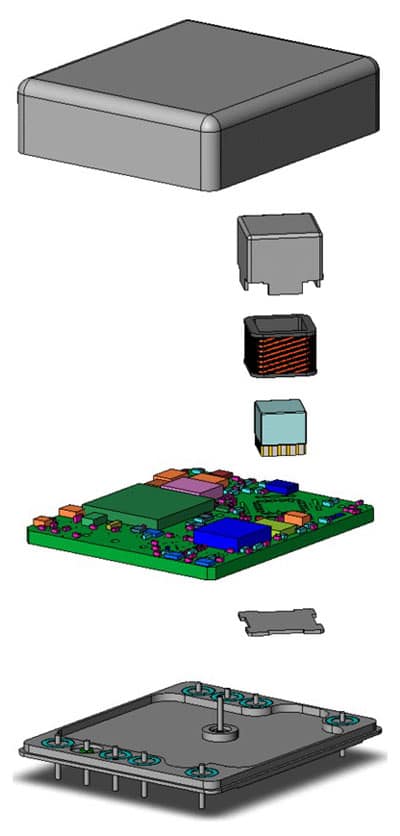
This latest clock has been jointly developed at Symmetricom, Draper Laboratory and Sandia National Laboratories in the US. The clock comprises a highly compact “physics package” that contains the caesium atoms used and sits on a circuit board within a tiny box. The caesium atoms are held within a resonance cell and are heated to a vapour state by plates situated at the top and bottom of the package.

Modulating microwaves

An optimized vertical-cavity surface-emitting laser (VCSEL) is shone through the vapour, causing excitation in the caesium atoms. The laser light is modulated by a microwave signal generator on the chip. This allows the laser’s single beam to excite the caesium atoms at two different energy levels. Interference between these two levels is then detected by a photodiode that forms part of a feedback loop. The loop optimizes the number of photons absorbed by the caesium atoms. The clock indicates that 1 s has elapsed after counting exactly 4596,315,885 cycles of the microwave oscillator signal.

The physics package is vacuum sealed and then covered by a layer of magnetic shielding, before being placed on the printed circuit board (PCB), which is then sealed so that it is airtight. The lid and base plate of the array both serve as a second layer of magnetic shielding.

All the components on the PCB are optimized for power efficiency at the smallest size possible. As a result, the circuitry around the physics package consumes about 95 mW, with the physics package itself consuming about 10 mW. Allowing for production faults, the CSAC has a total power consumption of only 115 mW, according to Steve Fossi, Symmetricom’s director of business development.

Idea born at NIST

In 2004 Physics World reported that John Kitching and his team at the US National Institute of Standards and Technology (NIST) in Boulder, Colorado, created what was then the most compact and portable chip-scale atomic clock. So what is different about this latest device? According to Kitching, this new product is essentially a commercial version of the work pioneered by his group at NIST between 2001 and 2005. “The Symmetricom collaboration also had an active research programme during that time that was funded in parallel with ours by the Defense Advanced Research Project Agency [DARPA].”

While the Symmetricom and NIST clocks are about the same size, the main advantage of this new clock is that the power required to run it is much less than any previous commercial atomic clock: 115 mW, compared with more than 1 W for all other atomic clocks. “This means it will open many new applications for precision timing, particularly those where only battery power is available,” says Kitching.

“Because few DARPA technologies make it to full industrial commercialization for dual-use applications, this is a very big deal,” says Gil Herrera, director of Sandia’s Microsystems and Engineering Sciences Application centre. “CSAC now is a product with a datasheet and a price.”

“The work between the three organizations was never ‘thrown over the wall’,” says Sandia manager Charles Sullivan, using an expression that has come to mean complete separation of effort. “There was tight integration from beginning to end of the project.”

Jamming roadside bombs

The clock could find a use in disabling improvised explosive devices (IED) or roadside bombs that are detonated wirelessly using everything from mobile phones to toy remote controls. Such bombs can be disabled using portable jammers that block all communications signals in the area. While this solves the immediate problem of the bomb, it also prevents friendly forces from using radio communications. The CSAC would provide the precise timing required to jam bomb-related communications while allowing friendly signals to get through.

The device could also be used in places where GPS timing signals are not available, for example in deep-sea diving, mining and seismic research. In particular, the clocks could be deployed in underwater sensors that rely on the precision timing of seismic signals for oil and gas exploration. In this case, the clocks on each sensor would need to be accurate, small and run on very low power so that the sensors could remain underwater for prolonged periods of time. The CSAC has only 10–20% of the power requirement of existing sensor clocks but is about a 100 times more accurate.

Fruit flies ‘swim’ through the air

Physicists studying the flight of the fruit fly have concluded that the tiny creature’s wing motions are much closer to the movement of swimming organisms than previously thought. This surprising result lends credence to the controversial suggestion put forward by some evolutionary biologists that flight could have evolved gradually from swimming as life left the oceans.

The wings of birds and insects are structurally quite similar to the fins and paddles of aquatic animals. However, flying and swimming seem to involve completely different physical processes. Flying organisms propel themselves using the lift forces generated as a wing slices through the air, while swimming organisms paddle forward using the viscous drag of water. As a result, some biologists have doubted that flight could have evolved from swimming.

Aeronautical inspiration

Flying creatures generate force (or lift) on their wings as they move through the air. Fruit flies remain airborne by sweeping their wings back and forth in the horizontal plane to generate lift. Propulsion can be achieved by tilting the angle of the wings with respect to the horizontal plane, thereby shifting some of the lift into the forward direction.

Drag hinders performance and as a result wings tend to be highly streamlined. But now a research team at Cornell University in New York has found evidence that fruit flies might also use viscous drag during flight.

Observing the wing motions of an insect is extremely difficult: a fruit fly flaps its wings 250 times per second. Using cameras recording 8000 frames per second, the team filmed fruit flies both hovering and in forward motion at various speeds. If the flies were propelling themselves purely by tilting their wings to shift the lift forward, the tilt should have increased as they flew faster. But the footage showed that, in some cases, the wings remained almost horizontal irrespective of flight speed.

However, the flies appeared to be adjusting the tilt of their wings in a more complicated manner. When they were hovering or flying slowly, the average angle of their wings was near-vertical, with the wing tilted in opposite directions on the forward and backwards strokes. Inevitably, the drag forces of the air on the wing also push the insect back and forth, but the two cancel each other out and overall the insect does not move far.

Maximizing drag

When they wanted to fly quickly, the fruit flies tilted their wings closer to the horizontal on the forward stroke to slice more cleanly through the air and then closer to the vertical on the backward stroke to maximize drag – effectively paddling through the air.

The team claims that this is the first indication of a flying organism deliberately manipulating drag forces to generate forward thrust. “These insects have a lot of drag forces acting on them and usually these forces cancel each other, but when the insect shifts its angle of attack a little, it is able to take advantage of them very rapidly,” explains group member Itai Cohen.

David Lentink of Wageningen University in Amsterdam and the California Institute of Technology, is impressed. However, Lentink, who was not involved in the research, does sound a note of caution. “It is difficult to say that all insects apply this mechanism, especially because, compared with some other insects, the fruit fly is more of a slow, forward hovering insect than a fast, agile forward flier,” he says. Cohen’s group is currently working on a comparative study across various creatures.

Cohen emphasizes that none of this proves that flying actually did evolve from swimming. “What we are showing with this work is that controlling your forward motion is basically the same regardless of what medium you are in, so at least that part of the jump would not have been that difficult,” he explains.

The research is described in Phys. Rev. Lett. 106 178103.

Copyright © 2026 by IOP Publishing Ltd and individual contributors