Mystery of the riderless bike thickens

By James Dacey

The riderless bike is a fairly well known quirk of mechanics. As the name suggests, it refers to the fact that regular bicycles can keep going by themselves for long distances without toppling over. Indeed, the surreal image of a riderless bike inspired this brilliant scene in Jour de Fête, a black and white French comedy from 1949.

But a new bike created by researchers in the US is and the Netherlands has cast doubt on our understanding of what causes this effect.

The phenomenon of bicycle self stability was first described analytically in 1897 by French mathematician Emmanuel Carvallo, and since that time many other scientists have contributed their two pennies worth.

While it quickly became clear that the mechanics behind the effect are not as simple as one might think, most researchers agree that the stability is due to two features of mechanics. Firstly, there is gyroscopic motion, which causes the front wheel to correct itself like a spinning top. Then secondly, there is the “trail” or “caster” effect, which also explains why the front wheel of a shopping trolley automatically turns to follow the pivot.

A team including Andy Ruina at Cornell University has created a bike that self-balances without relying on these forces – the first of its kind. The researchers published their findings in this week’s edition of Science.

Ruina told the Science podcast that the balancing must still be related to a mechanical effect that couples the forces involved in bike-leaning to its steering. While the bike currently looks more like a child’s scooter, Ruina sees no reason why it could not be rearranged to appear more like a familiar motorcycle or bike.

To see the bike in action, follow this link.

Brightest bubble bursting yet

Physicists in the US claim to have broken the record for the brightness of light generated by “sonoluminescence”, the imploding of a bubble when it is blasted with sound waves. With a peak power of 100 W, the light is 100 times as bright as seen in previous sonoluminescence experiments, and may help scientists understand how the strange phenomenon works.

Sonoluminesence was discovered in the first half of the 20th century but it was only in the 1990s that physicists began to investigate the phenomenon seriously. Although no-one is sure how it works, the basic idea is that sound waves are fed into a vessel containing one or more bubbles inside a liquid. The sound causes the bubbles to expand momentarily before water pressure takes over, imploding the bubbles in bursts of heat and light.

In many sonoluminescence experiments, the power of the generated light flash is just a few milliwatts. However, in 2004 Alan Walton and other physicists at the University of Cambridge subjected bubbles in a liquid column to vertical vibrations and produced flashes of light that peaked at 1 W. But now, a group led by Seth Putterman at the University of California, Los Angeles, has devised a new variation on the method to break that record and generate light that is 100 times as bright.

Shocking technique

In the California group’s experiment, the researchers fill a steel cylinder with phosphoric acid and position it almost a centimetre above a steel base. Using a needle at the bottom they inject a 1 mm-sized bubble of xenon into the tube and let it float towards the top. When the bubble reaches a height of 11 cm, the researchers let the cylinder drop and the resultant shock collapses the bubble in a brief flash. Analysis shows that this flash has a peak intensity of 100 W and a temperature of 10,200 K.

According to Putterman, this “one shot” method is more controllable than previous methods and should therefore offer a way of producing even higher-temperature and power-bubble collapses. It might also be a route to understanding sonoluminescence.

“Why does a diffuse sound field focus its energy density by such large factors to create sonoluminescence? In some set-ups this factor can reach one trillion,” asks Putterman, who believes that nonlinear processes are responsible. “We want to learn about these nonlinear processes and see if they can be generalized to other cases.”

No signs of fusion

In the past, sonoluminescence has proved a controversial subject. In 2002 Rusi Taleyarkhan, then at the Oak Ridge National Laboratory in Tennessee, US, and colleagues claimed to find evidence for nuclear fusion occurring alongside sonoluminescence. Although a few other research groups have since made similar claims, most nuclear scientists believe them to be misguided. Taleyarkhan has since moved to Purdue University, where in 2008 he was reprimanded by the university for “research misconduct” related to a paper on fusion.

Yet Putterman does not rule out the possibility of so-called bubble fusion. “This experiment is an important step in upscaling sonoluminescence with controlled bubble contents, but it has not yet yielded any sign of fusion,” he says. “The interior of the bubble would need to reach solid densities and temperatures greater than 10 million kelvin.”

Walton at the Cavendish Lab thinks that there is “little real prospect” for fusion in Putterman and colleagues’ experiment, but he does praise the general advance. “It will undoubtedly be of real use in making fundamental studies of the nature of sonoluminescence,” he says.

The research will be published soon in Physical Review E.

Tragic death of US physics student

By James Dacey

I was shocked to hear today about the tragic death of a physics student who was killed earlier this week in a machine shop at Yale University in the US.

Michele Dufault, just 22-years-old, died on Tuesday night after her hair got caught in a lathe as she worked late on a project in one of the university’s chemistry laboratories. In a statement issued on Wednesday, Yale’s vice president, Richard Levin, said that the girl’s body was found by other students who had been working in the building.

On Wednesday evening, the university held a memorial for Dufault in which friends and classmates were invited to light candles and offer words to comfort to each other.

The university said that Dufault was pursuing a B.S. in astronomy and physics, and that she intended to undertake work in oceanography after graduation. “By all reports, Michele was an exceptional young woman, an outstanding student and young scientist, a dear friend and a vibrant member of this community,” said Levin.

According to a report in the New York Times, Dufault died while carrying out experimental work for her thesis: investigating the possible use of liquid helium for detecting dark matter particles. A lathe is a machine tool for shaping metals and other hard materials, and it possesses a heavy spinning wheel for grinding.

Levin said that the safety of students is a paramount concern and the university has programs to train students before they use power equipment. He confirmed, however, that he has ordered a thorough review of all the university’s facilities that contain power equipment operated by undergraduates.

Flowing electrons magnetize graphene

Physicists in the UK have discovered another useful property of graphene – the material can be magnetized by simply passing a current of electrons through it. The effect could prove useful in creating spintronic or quantum-information devices that use the spin of the electron.

Graphene is a honeycomb-like 2D sheet of carbon just one atom thick. It acts as a semi-metal and is often touted as a “wonder material” with the potential to make extremely small electronic devices of the future.

This latest work was done by Andre Geim and Konstantin Novoselov at the University of Manchester in the UK, who shared the 2010 Nobel Prize for Physics for creating the first sheets of graphene. The research also involved scientists in the US, Russia, Japan and the Netherlands.

Spin currents

The researchers made their discovery by passing an electrical current along a piece of graphene in the presence of a small magnetic field. They found that spin-up and spin-down currents are produced in opposite directions, perpendicular to the direction of the electrical current. The effect is to magnetize the graphene sheet (see figure). The effect is important because it offers physicists a way of controlling spin using electrical current.

The researchers studied more than 20 devices, with two types of graphene – graphene grown on an oxidized silicon wafer and another system where crystals of hexagonal boron nitride were placed between the graphene and the silicon wafer.

While this is not the first time a form of graphene has been magnetized, it is the first time that net magnetization has been created in graphene using spin currents. The research also suggests that spins can be generated, even if graphene has no magnetic moment.

“The central [result] is that they can create large spin currents, which allow them to separate spatially the up and the down spins,” says Markus Mueller, at the Abdus Salam International Centre for Theoretical Physics in Italy. Mueller believes that the experiment offers a way to produce simple and robust spin-current sources, which could have many applications.

Imbalance at the Dirac point

Mueller explains that the effect is related to an unusual property of graphene – a Dirac or “neutrality” point where the valence and conduction bands meet. Particles above the Dirac point and holes below the Dirac point react in opposite ways to a magnetic field. The result is an imbalance explains Mueller. “You have more ‘up’ spins so that their Fermi surface lies in the particle-like region; and fewer ‘down’ spins, which at their Fermi level are hole-like. That’s all you need to create a strong spin current.”

Another peculiarity of graphene is that even a very small concentration of charge carriers will hold the magnetization. This is unlike normal substances in which opposite spins can be induced, but a large number of charge carriers are required to maintain the magnetization. If the concentration of charge carriers is decreased, most materials begin to act as insulators and the magnetization is lost. But as Geim explains, in graphene “the dominant phenomenon [of magnetization] still occurs… it even increases as the concentration of charge carriers is reduced, as it is inversely related and this is a salient feature of graphene”.

“Non-local quantum effect”

Another surprising finding is that the spins maintain their orientation for relatively long distances in the graphene – a property that is very desirable for spintronics and quantum-information applications. Antonio Castro Neto of Boston University believes that this “non-local quantum effect” is also related to the Dirac point. Writing in Science, he explains that “close to the Dirac point the charge of the electron behaves incoherently (and hence, classically) but its spin behaves coherently (and thus quantum mechanically)”.

Francisco Guinea at the Instituto de Ciencia de Materiales de Madrid says the results are very important for spintronic applications, especially as spin currents can be used to retrieve information stored in magnetic devices. Mueller agrees: “It seems this is a quite interesting way to transfer information to spatially different locations via voltage signals, which are easy to process and detect.”

The research is reported in Science 332 328 .

WIMP no-show casts a shadow over dark matter

It may not be quite the finding they were hoping for, but researchers at the XENON collaboration say that they have placed the most stringent limits yet on the properties of dark matter. The hotly anticipated results suggest that a discovery of an elusive dark-matter particle – if indeed it does exist – will stretch existing detectors to their limits.

Although dark matter is thought to make up more than 80% of all mass in the universe, it is invisible, so it has only been inferred from its gravitational effects. The most popular candidates for its make up are called weakly interacting massive particles, or “WIMPs”, which are hypothetical particles that could be heavier than atomic nuclei.

The XENON 100 experiment is looking for WIMPs using an incredibly sensitive detector hidden beneath the Gran Sasso mountain in central Italy. Its location was chosen to shield the experiment from cosmic radiation that is constantly bombarding the Earth. The detector itself consists of 62 kg of liquid xenon contained within a well-shielded tank, where a WIMP entering the detector should interact with the xenon nuclei to generate light and electric signals.

Three events found

Yesterday, the XENON collaboration released the results from 100.9 days of searching for WIMPs between January and June 2010. While the researchers have found three candidate events, two of these were expected to appear anyway because of background noise. They therefore admit that they have found no new evidence for the existence of WIMPs.

Detailing their findings in a paper submitted to the arXiv preprint server yesterday, the XENON collaboration say that the null result does, however, place the most stringent limits to date on the nature of WIMPs. In a statement released yesterday, the collaboration declared: “These new results reveal the highest sensitivity reported as yet by any dark-matter experiment, while placing the strongest constraints on new physics models for particles of dark matter.”

Alex Murphy, who works on ZEPLIN III, another liquid-xenon dark-matter detector based in the UK, says that he is “not surprised” by the new result, and he is still confident that a clear dark-matter signal could be just round the corner. He is concerned, however, that the data and other recent findings suggest that the nature of background cosmic noise could be more complicated than previously thought. “Until recently, dark-matter researchers were worried about gamma rays and neutrons interacting with xenon in simple ways, but we are starting to see more complicated interactions including gamma rays scattering several times to give unusual signals,” he says.

The findings also cast further doubt on findings from the end of 2009 by the CDMS II dark-matter collaboration in the US, which claimed to have spotted two dark-matter candidates. This experiment, located in a disused mine in Soudan, Minnesota, searches for WIMP signals using 30 detectors made of germanium and silicon cooled to temperatures close to absolute zero.

Life after the cuprates

A new wave of optimism buoyed the superconductivity community in 2008 when physicists in Japan unveiled the first iron-based superconductor. Physicists had been struggling for more than 20 years to understand high-temperature superconductivity in cuprate materials and the new iron superconductors offered a new way forward.

In this exclusive video interview with physicsworld.com at the March Meeting of the American Physical Society Dallas, Texas, Laura H Greene of the University of Illinois Urbana-Champaign explains how the discovery “broke the tyranny of the cuprates” by giving researchers a new family of superconducting materials to study.

This optimism is now stronger than ever, says Greene, who calls for a global collaboration of physicists to develop ways of designing new types of superconductors with predictable properties.

Greene has also written a feature article on superconductivity in the April 2011 issue of Physics World. Her article can be read via this link.

Taming serendipity

A century on from the discovery of superconductivity, we still do not know how to design superconductors that can be really useful in the everyday world. Despite this seemingly downbeat statement, I remain enthusiastic about the search for new superconducting materials. Although my own research in this area has had its share of null results and knock-backs, in that I am in good company with the true leaders in the field. Optimism abounds, and the past couple of years have seen a renewed passion, with researchers worldwide wanting to work together to find a way to design new materials that we know in advance will function as superconductors.

That would be very different from most of the discoveries in superconductivity, which have often been serendipitous. Indeed, the main quest of Heike Kamerlingh Onnes was to liquefy gases, and only after managing to liquefy helium in 1908 did he set his Leiden lab to work on a study of the properties of metals at low temperature. The choice of sample was fortunate – mercury was used because it is a liquid at ambient temperature and so could easily be purified. The discovery of its dramatic drop in resistance when cooled to 4 K, which we now know to be the critical temperature, Tc, was an unexpected and fortuitous surprise.

In subsequent years, increasing the critical temperature was achieved by systematic experimental tests of elements, alloys and compounds, predominantly led by Bernd Matthias from about 1950, who in doing so became the first researcher to discover a new class of superconductors. To begin with, the only known superconductors were elements, but Matthias found superconductivity in various combinations of elements that on their own are non-superconducting. The earliest of these was the ferromagnetic element cobalt combined with the semiconductor silicon to form CoSi2. What changed the game was the discovery by John Hulm and his graduate student George Hardy at the University of Chicago in 1952 of the vanadium–silicon compound V3Si, the first of the then-called high-Tc superconductors. This was a completely new class of superconductors – known as the A15s (a particular crystal structure of the chemical formula A3B, where A is a transition metal) – and it enabled Matthias to discover more than 30 compounds of this type, with values of Tc that ranged up to 18 K in the case of Nb3Ge.

Increasing the critical superconducting temperature is certainly what most interests the media, but it is not the only property with which to rank new superconductors. The A15s were the first family of superconductors that maintained a high critical current density, Jc, in the presence of strong magnetic fields, which is crucial for all current-carrying applications. In 1963 Hulm, then with co-workers at the Westinghouse Research Laboratories, developed the first commercial superconducting wires, based on random alloys of niobium–titanium, a material discovered at the Rutherford Appleton Laboratory in the UK. Although niobium–titanium alloys exhibit a lower Tc and Jc than the A15s, they were chosen for wires because they are malleable, reliable and can be used in nearly all practical applications, including the medical technique of magnetic resonance imaging (MRI). Despite the importance of a high Jc, achievements in this area receive little recognition compared with progress in increasing Tc. But as my former boss, John Rowell, stated at the retirement party of Jack Wernick, who is noted for the discovery of several A15s, “High-Tc wins Nobel prizes; high Jc saves lives.” So although the search for new families of higher-Tc superconductors is what makes the headlines, what really matters when it comes to applications is a high value of Jc and mechanical properties that are good for making wires.

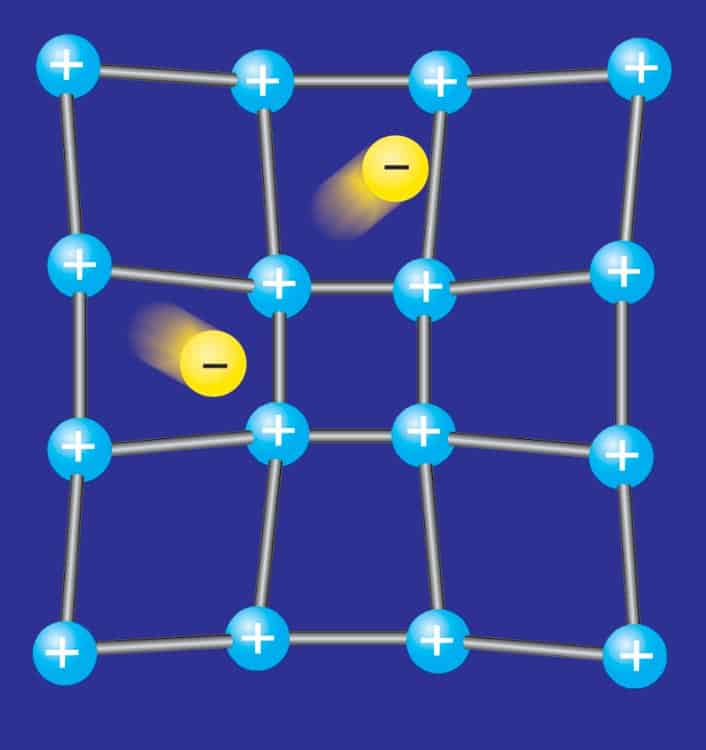
In 1979 Frank Steglish and colleagues discovered superconductivity in materials containing rare earths (elements with a 4f electron orbital) or actinides (those with a 5f electron orbital). These compounds are called the “heavy fermions”, because with antiferromagnetic ground states, and at low temperatures, the itinerant electrons behave as if they have masses up to 1000 times larger than the free-electron mass. This discovery was significant because the heavy fermions were the first truly tunable superconductors, through a competition between superconductivity and magnetic order. But what was even more important was that heavy-fermion superconductors did not follow the rule book: for the first time, the brilliant Bardeen–Cooper–Schrieffer (BCS) theory of superconductivity was shown to break down. BCS theory explains what is happening at the microscopic level – it involves paired electrons known as “Cooper pairs” travelling around the crystal lattice – and this part of the theory remains robust in all the known superconductors. But the microscopic mechanism for superconductivity in all previously found superconductors was attributed in BCS to electron–phonon coupling, which was not sufficient to cause the electron pairing in the new heavy-fermion superconductors (figure 1).

Before the heavy fermions were discovered, it was accepted that any kind of magnetism would harm the superconducting state. But in this new class of superconductor the magnetism appeared integral to the strength of the superconductivity. Another exciting aspect of this class is that higher-Tc heavy-fermion superconductors – in particular the “115” series beginning with the discovery of CeCoIn5 – were not discovered purely by serendipity, but driven by guidelines learned from many preceding substitution and pressure studies.

New classes

Enter the high-Tc oxides. First was the sensational revolution of the copper oxides, or “cuprates”: Georg Bednorz and Alex Müller discovered LaBaCuO in 1986 with a Tc of 40 K, and subsequently Maw-Kuen Wu and Ching-Wu (Paul) Chu discovered YBa2Cu3O7–d, or “YBCO”, with a Tc of more than 90 K. (For more about the high-Tc revolution, see “Resistance is futile” on page 33, print edition.) These transformative discoveries again relied on guidelines put together by thoughtful and talented physicists, but serendipity certainly played a factor. Indeed, I believe the only discovery of a high-Tc system that was driven predominantly by theory is Ba1–dKdBiO3, or BKBO (to date at least): Len Mattheiss and Don Hamann at Bell Labs used electronic-structure calculations of an earlier low-Tc system, Ba(Pb,Bi)O3, to predict and then make BKBO, for which their colleague Bob Cava drove the Tc to a respectable 30 K.

But what of materials with even higher transition temperatures? Through a tremendous amount of hard work worldwide by many talented physicists, transition temperatures in the cuprates have been pushed up to 135 K at ambient pressure and above 150 K at high pressure in HgBa2Ca2Cu3O8+d (also known as Hg-1223), which was discovered in 1993. We were then left with the idea that perhaps there were no other families of high-Tc superconductors. Could it be that the cuprate were the only high-Tc class we would ever find? The fear was that systematic studies had already found the highest possible Tc.

But we had guidelines and ideas. Many of these were published in a 2006 report for the US Department of Energy, Basic Research Needs for Superconductivity. Particularly of note in that report, which outlined the prospects and potential of superconductivity, was our canonical phase diagram (figure 2), which hinted that we knew where to look: at the boundary between competing phases. This personifies the concept of “quantum criticality”, where a phase transition occurs not because of thermal fluctuations as in a typical thermodynamic phase transition, but because of quantum-mechanical fluctuations at zero temperature. The phase diagram shows an antiferromagnetic insulator on the left and a normal metal on the right. Where they meet at the centre is the quantum critical point, and as that point is approached, the quantum fluctuations of the competing phases get stronger and a strange “emergent” state of matter appears – in this case, high-temperature superconductivity. The general rule was: the stronger the competing phases, the stronger the emergent phase. Those ideas remain, but where were these new families of superconductors? Had we hit a dead end?

Finally, in 2008, a second class of high-Tc superconductor was discovered. Hideo Hosono at the Tokyo Institute of Technology had discovered iron-based superconductors two years earlier, and in January 2008 his first “high-Tc” paper on these materials was published, which precipitated a renewed excitement and a frenzy of activity. Within four months, Zhongxian Zhao’s group at the Institute of Physics in Beijing created related materials that hold the record with a Tc of 58 K. Many of us were awestruck – here finally was a new class of high-temperature superconductors that broke the 22-year tyranny of cuprates, and in materials that no-one had predicted and were contrary to our basic notions of how superconductivity works. How could iron – the strongest ferromagnetic element in the periodic table – be a basis for superconductivity at all, let alone high-temperature superconductivity? There now exist whole arrays of iron-based superconductors – pnictides and chalcogenides – all found by clever, hard work, but originally discovered by serendipity.

Laying down the gauntlet

All of these families of superconductors have a great deal in common, yet also have unique properties. The physics seems to be growing more complex with time, and we continue to build more guidelines and structure into our search for new superconducting materials. Although the discovery of iron-based superconductors gave us a lot of research fodder, they will not necessarily tell us all we need to know about how to find new classes of superconductors. But one thing is for sure: the cuprates are not unique and as there is a second class of high-Tc superconductors, I believe there must be a third.

The discovery of iron-based superconductors – the first new class of high-Tc superconductors after more than two decades of only incremental progress – injected a new-found positivity into the field, rivalled only by the discovery of superconductivity in the cuprates. The resulting surge of global research, however, has a very different feel from that in 1986. In the early days of high-temperature superconductivity the competition was fierce – there was a real race to obtain higher transition temperatures. But now that zealous sense of urgency has been replaced by a more paced and considered approach.

Many scientists have been working on understanding novel superconductors for decades, often in productive collaborations. Recently, our research funding and support have been revitalized on a worldwide scale, in part because of the need to address the global energy crisis by significantly increasing the efficiency of power transmission. After 25 years of intense and fruitful work, the cuprates remain promising, but for various reasons may still not be the materials of choice to impact our power grid. The newly discovered iron-based high-temperature superconductors exhibit many positive aspects, but are likewise not yet in a position to impact power transmission. Another class of superconductors is needed.

For any one of us, putting all of our efforts towards attacking this problem of discovering a new superconductor is highly risky. If we want to find such a thing but do not manage this after three to five years – the typical length of most research grants – we seriously risk losing our funding. As a result, we focus most of our efforts on understanding the existing novel superconductors. So, I and my colleague Rick Greene (no relation) of the University of Maryland, aided by the Institute for Complex Adaptive Matter, have made a call to arms to the international community, which we are spreading via working groups at conferences and workshops: “It is time for us to join our expertise and resources together, on a worldwide scale, to search for that new class of superconductors.”

The gauntlet is being taken up with enthusiasm. With communication now flowing between different groups, and across funding and geographical barriers, we hope to soon reveal at last a clarified vision of high-temperature and novel superconductivity that will set us in the best possible stead in the quest for a new class.

It is gratifying to see superconductivity, at 100, finally growing up.

Chatting about the neutrino

By Hamish Johnston

Tune in to BBC Radio 4 at 9.00 BST this morning to hear Melvyn Bragg and company chat about the elusive neutrino.

Melvyn’s guests are the physicists Frank Close, David Wark and Susan Cartwright.

You can listen live here, and if you miss the programme you can catch up later here.

Physicists create a quantum mirror image

Physicists in Germany and Austria have shown that individual atoms can move forwards and backwards at the same time, thanks to photon emission and a carefully placed mirror. They say that this result improves our understanding of quantum coherence and could perhaps help to build a workable quantum computer.

Lying at the heart of quantum mechanics, superposition is the idea that a particle can be in two states at the same time. A simple example of this occurs when single photons pass through a double slit and build up an interference pattern on a screen beyond the slits. This demonstrates that individual photons pass through both slits at the same time.

An analogous result can be achieved by splitting a beam of atoms such that each of the atoms travels in two directions at the same time. To date, such a superposition of atomic momentum states has needed a macroscopic beam splitter such as a solid diffraction grating. But now superposition using a scheme based on single photons has been achieved by Markus Oberthaler and colleagues at the University of Heidelberg along with physicists at the Technical University of Vienna, Technical University of Munich and the Ludwig Maximilians University.

Very slight kick

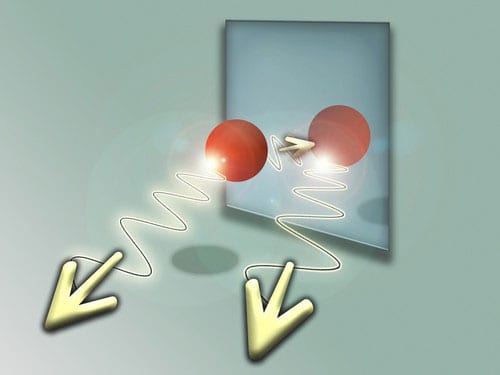
To do this, Oberthaler’s group passes a slow-moving, narrow beam of argon atoms very close to a mirror and then excites the atoms with a laser beam. As each atom drops back down to a lower energy level it emits a photon – and some photons bounce off the mirror. Each departing photon provides a very slight kick to the atom in the opposite direction to which the photon is emitted. As a result the photon’s trajectory reveals the direction of the atom’s recoil.

However, for those photons emitted at right angles to the mirror’s surface, it is impossible to tell the difference between a photon that travels away from the mirror as it leaves the atom and one that initially moves towards the mirror but then bounces off its surface. Quantum mechanics tell us that this indistinguishability places the atom into a superposition – it does not recoil either towards or away from the mirror but both towards and away from the mirror at the same time.

To prove that they created this superposition state, Oberthaler’s team took advantage of the fact that a beam of atoms has wave-like properties. The physicists exposed the argon atoms to a second laser beam, which was bounced off a second mirror to create a standing light wave across the argon beam. This standing wave acted like a diffraction grating and meant that after the atoms had passed the first laser and had their trajectories simultaneously bent very slightly towards and away from the first mirror, the two atom-states were each split into an undisturbed forward-travelling wave and a diffracted wave.

Interference spotted

The researchers then used an atom detector to measure the interference of the undisturbed wave from the first atom-state with the diffracted wave from the second atom-state, and vice-versa in a second detector. They find that the counts in both detectors rise and fall in a regular sinusoidal-like way as they changed the position of the second mirror. This means that the waves are interfering with one another coherently and that therefore they are coming from a single source – in other words, that the atom is indeed in the two momentum states simultaneously.

This experiment is analogous to the quantum-mechanical double-slit experiment, since the two undistinguishable photon trajectories play the part of the two slits – the atom responding to both at the same time. And like the double-slit experiment, this latest work shows that by determining which paths the particle took you destroy the superposition. Oberthaler and team demonstrate this by moving the beam far enough away from the first mirror so that in effect the mirror isn’t there. This means that the photons leaving the atom in opposite directions can be unambiguously distinguished. In this case the detectors no longer measured a series of peaks and troughs but rather a slightly noisy constant count rate. This indicates that the different atom waves arriving at the second laser are not coherent because they are associated with different atoms.

A path to stable qubits?

According to team member Jirí Tomkovic, physicists usually think of spontaneous emission from an atom as destroying coherence. This is because this emission acts like a measurement that tells you unambiguously what energy and momentum state the atom is currently in. But he says that the latest work shows how spontaneous emission of a single photon can create a superposition of states. By improving our understanding of quantum coherence, he believes this research may help in the creation of stable quantum-mechanical bits (qubits) for quantum computers. However, Tomkovic cautions that the work has more relevance for fundamental, rather than applied, physics.

The research is published in Nature Physics: doi:10.1038/nphys1961

Space flute tribute to Yuri Gagarin

By James Dacey

Today, people around the world have been celebrating the fiftieth anniversary of Yuri Gagarin’s flight into space. On 12 April 1961, the Russian cosmonaut inspired the world when he underwent a108-minute orbit aboard his Vostok (or “East”) spacecraft. To mark the anniversary, the US astronaut Cady Coleman has joined up with Ian Anderson, the founder of UK band Jethro Tull, for a special musical collaboration.

The pair performed last week via a satellite link up with Coleman aboard the International Space Station and Anderson in the Russian city of Perm. Both playing flutes, the pair played a section from Bouree, which Jethro Tull played while on a US tour during 1969, the year that Apollo 11 took Neil Armstrong to the Moon.

Copyright © 2026 by IOP Publishing Ltd and individual contributors