Trapped ions smash entanglement record

Physicists in Austria have smashed the record for entangled quantum bits – or qubits – that could one day form the basis of a quantum computer. Breaking their previous record of eight entangled calcium-ion qubits, the researchers entangled 14 calcium-ion qubits.

Quantum computing exploits the peculiar laws of quantum physics to process certain calculations, such as searching or factorizing, much faster than any of today’s computers. Whereas conventional bits of information can take only the values 0 or 1, a quantum computer’s qubits exist in a mixed-up superposition of both. This uncertainty allows any number of qubits, N, to be lumped together – or “entangled”, in quantum speak – to represent a huge 2N working dimensions, and then processed in parallel.

In 2005, a group of researchers led by Rainer Blatt at the University of Innsbruck in Austria set a new record by entangling eight qubits formed of calcium ions in an electromagnetic trap. That alone represents 28 or 256 dimensions and could potentially allow a calculation that would take a week on a classical computer to be performed in a few seconds.

16,384 dimensions

Now, Blatt’s group has again broken the entanglement record, this time with 14 qubits, or an equivalent of 16,384 dimensions. “If one wants to calculate the dynamics of such a system, it’s like simulating the bouncing of a ball in 16,384 dimensions,” says Thomas Monz, a member of Blatt’s group. “Such calculations on a classical computer are still possible but, depending on the quantum system under investigation, can take quite a long time to calculate… For current supercomputers, simulations [are limited] to approximately 43 qubits.”

The Innsbruck team performed the entanglement by manipulating the 14 calcium ions with laser light inside an electromagnetic trap. When they shone the laser on the particles, their spins became correlated in clockwise and anticlockwise directions, forming a coherent unit.

“This is a very beautiful experiment, which shows the mastery of the Innsbruck group in the manipulation of complex quantum systems,” says Serge Haroche, a quantum physicist at the Collège de France, in Paris.

Unwelcome side-effect

Yet, Blatt’s group did find an unwelcome side-effect of the entanglement. Usually, the entanglement decay in a linear fashion, which means that outside noise will destroy the entanglement in a process of “decoherence” at a speed proportional to the number of qubits. Double the number of qubits, and decoherence will act twice as fast. However, the researchers found that in their system the speed of decoherence is proportional to the square of the number of qubits – in other words, it’s much faster.

This so-called ‘superdecoherence’ has been observed before, but not “in a system specifically aimed at realizing quantum computation,” Hennrich says. It could pose a challenge for researchers hoping to use many ions for quantum computation.

Still, the experiment does show that quantum-physics rules do apply, even for 14 particles. This is significant because many physicists, notably Erwin Schrödinger, worried whether there should be some sort of new physics that prompts the transition from quantum, the world of the small, to classical, the world of the big.

The work “shows that at the level of 14 entangled particles, there is no evidence of unknown physics producing the quantum-to-classical transition that Schrödinger and others have agonized about,” says Dietrich Leibfried, a quantum physicist at the National Institute of Standards and Technology in Colorado, US. “The decoherence of up to 14 entangled spins can be completely explained by the mundane sources of noise present in the current implementation.”

The research is published in Phys. Rev. Lett. 106 130506.

Where next for superconductivity?

Few physicists have had the privilege of being at the height of their career when a major breakthrough in their field is made – putting them at the leading edge of the frenzy of research that follows. Paul Michael Grant was a physicist at IBM’s Almaden labs in California in 1986 when his colleagues at the firm’s site in Zurich discovered the first high-temperature superconductor. Grant has devoted much of his career to the study of superconductors, and since leaving IBM in 1993 he has become a leading proponent of using superconductors to distribute electricity.

In this exclusive video Grant chats with physicsworld.com editor Hamish Johnston at the American Physical Society March Meeting in Dallas about the commercial applications of superconductors – and whether the materials have lived up to the hype unleashed 25 years ago.

Grant has also written two feature articles on superconductivity in the April 2011 issue of Physics World. The first of his two articles can be read via this link.

Down the path of least resistance

Of all the discoveries in condensed-matter physics during the 20th century, some might call superconductivity the “crown jewel”. Others might say that honour more properly belongs to semiconductors or the elucidation of the structure of DNA, given the benefits that both have brought to humanity. Yet no-one would deny that when a team led by Heike Kamerlingh Onnes stumbled across superconductivity – the absolute absence of electrical resistance – at a laboratory in Leiden, the Netherlands, 100 years ago, the scientific community was caught by complete surprise. Given that electrons usually conduct imperfectly by continually colliding with the atomic lattice through which they pass, the fact that conduction can also be perfect under the right conditions was – and is – surely no less than miraculous.

The discovery of superconductivity was the culmination of a race between Onnes and the British physicist James Dewar as they competed to reach a temperature of absolute zero using ever more complex devices to liquefy gases. Onnes won after he successfully liquefied helium by cooling it to 4.2 K, for which he was awarded the 1913 Nobel Prize for Physics. (The current low-temperature record stands at about 10–15 K, although it is of course thermodynamically impossible to ever get to absolute zero.) But researchers did not only want to reach low temperatures just for the sake of it. What also interested them was finding out how the properties of materials, particularly their electrical conductance, change under cryogenic conditions. In 1900 the German physicist Paul Drude – building on the conjectures and experiments of J J Thomson and Lord Kelvin that electricity involves the flow of tiny, discreet, charged particles – had speculated that the resistance of conductors arises from these entities bouncing inelastically off vibrating atoms.

So what would happen to the resistance of a metal immersed in the newly available liquid helium? Physicists had three main suspicions. The first was that the resistance would keep decreasing continuously towards zero. The second was that the conductivity would instead saturate at some given low value because there would always be some impurities off which electrons would scatter. Perhaps the most popular idea, however – predicted by the emerging picture of discrete, localized atomic orbitals – was that the electrons would eventually be captured, leading to an infinite resistance. But before anyone could find out for sure, researchers needed a very pure metal sample.

Gilles Holst, a research associate in Onnes’s institute at Leiden University, thought it might be possible to obtain such a sample by repeatedly distilling liquid mercury to remove the impurities that were found to dominate scattering below 10 K. The Leiden lab had lots of experience in fabricating mercury resistors for use as thermometers, and Holst suggested enclosing the mercury in a capillary tube to keep it as pure as possible before finally submersing it in a sample of liquid helium. And so it was in April 1911 (the precise date is not known for sure due to Onnes’s unclear and uncertain notebook entries) that Holst and his lab technician Gerrit Flim discovered that the resistance of liquid mercury, when cooled to 4.2 K, reached a value so small that it is impossible to measure. This phenomenon – the complete absence of electrical resistance – is the hallmark of superconductivity. Ironically, had the Leiden team simply wired up a piece of lead or solder lying around the lab – rather than using mercury – their task would have been far easier, because lead becomes superconducting at the much higher temperature of 7.2 K. In fact, three years later, acting on a suggestion by Paul Ehrenfest, researchers at the Leiden lab were able to produce and measure “persistent” currents (which would last a billion years) in a simple lead-ring sample.

History credits – erroneously in my opinion – Onnes as the sole discoverer of what he, writing in English, called “supra-conduction”. (Where the work was first published is hard to decipher, although the first report in English was in the Dutch journal Communications from the Physical Laboratory at the University of Leiden (120b 1911).) Clearly, the discovery would not have happened without Onnes, but to publish the work without his colleagues as co-authors would be unthinkable today. At the very least, the announcement should have been made under the names of Onnes and Holst. As it happens, life panned out well for Holst, who became the founding director of the Philips Research Laboratory in Eindhoven and a distinguished professor at Leiden. But that does not mean that he and others should be forgotten as we celebrate the centenary of the discovery of superconductivity.

Conforming to type

After the 1911 discovery, research into superconductivity languished for several decades, mainly because duplicating the Leiden facility was difficult and expensive. However, research also stalled because the zero-resistance state disappeared so easily when a sample was exposed to even quite modest magnetic fields. The problem was that most early superconductors were simple elemental metals – or “type I” as they are now known – in which the superconducting state exists only within a micron or so of their surface. The ease with which they became “normal” conductors dashed early dreams, voiced almost immediately by Onnes and others, that superconductivity could revolutionize the electricity grid by allowing currents to be carried without any loss of power.

However, other labs in Europe – and later in North America too – did eventually start to develop their own liquid-helium cryogenic facilities, and as the monopoly held at Leiden slowly broke, interest and progress in superconductivity resumed. In 1933 Walther Meissner and Robert Ochsenfeld observed that any magnetic field near a superconducting material was totally expelled from the sample once it had been cooled below the “transition temperature”, Tc, at which it loses all resistance. The magnetic field lines, which under normal circumstances would pass straight through the material, now have to flow around the superconductor (figure 1). This finding, which came as a total surprise, was soon followed by the observation by Willem Keesom and J Kok that the derivative of the specific heat of a superconductor jumps suddenly as the material is cooled below Tc. Nowadays observing both these bizarre effects – “flux expulsion” and the “second-order specific-heat anomaly” – is the gold standard for proving the existence of superconductivity. (Legend has it in fact that the latter measurements were actually performed by Keesom’s wife, who was also a physicist yet did not get any credit at the time.)

The mid-1930s also saw the discovery by Lev Shubnikov of superconductivity in metallic alloys – materials in which the critical magnetic field (above which superconductivity disappears) is much higher than in simple elemental metals. The experimental and theoretical study of these alloys – dubbed “type II” – quickly dominated research on superconductivity, especially in the Soviet Union under the leadership of Pyotr Kapitsa, Lev Landau and Shubnikov himself. (The latter, who was Jewish, was imprisoned in 1937 by the secret police during the Stalinist purges and later executed, in 1945.) Soviet theoretical efforts on the statistical mechanics of superconductivity – and the related phenomenon of superfluidity – continued throughout the Second World War and the Cold War, led primarily by the late Vitaly Ginzburg, Alexei Abrikosov and Lev Gor’kov. Alhough much of it was unknown to the West at the time, the Ginzburg–Landau–Abrikosov–Gor’kov, or “GLAG”, model underlies all practical applications of superconductivity. The model is so useful because it is empirical and thermodynamic in nature, and does not therefore depend on the microscopic physics underlying a particular second-order phase transition, be it magnetism, superfluidity or superconductivity.

Towards BCS theory

Progress in unravelling the fundamental theory underpinning superconductivity advanced more slowly. In 1935 Fritz and Heinz London proposed a phenomenological “adjustment” to Maxwell’s constituent equations to accommodate the notion of a “penetration depth” of an externally applied magnetic field beyond the surface of a superconductor (see “The forgotten brothers” by Stephen Blundell on page 26, print edition). However, it was not until the mid-1950s that the theoretical web surrounding superconductivity was finally unravelled, having frustrated attempts by some of the 20th century’s brightest and best physicists, including Dirac, Einstein, Feynman and Pauli. This feat was eventually accomplished by John Bardeen, Leon Cooper and Robert Schrieffer, leading to what is now called BCS theory, for which the trio shared the 1972 Nobel Prize for Physics (see “Resistance is futile” by Ted Forgan on page 33, print edition). A key development was the determination by Cooper that a gas of electrons is unstable in the presence of any infinitesimal attractive interaction, leading to pairs of electrons binding together. Bardeen and his student Schrieffer then realized that the resulting quantum state had to be macroscopic and statistical in nature.

But where did the attractive interaction come from? In 1950 Emanuel Maxwell of the US National Bureau of Standards noticed that the transition temperature of mercury shifted depending on which of its isotopes was used in the particular sample, strongly suggesting that somehow lattice vibrations, or “phonons”, are involved in superconductivity. BCS theory proved, given the right conditions, that these vibrations – which are usually the source of a metal’s intrinsic resistance – could yield the attractive interaction that allows a material to conduct without resistance.

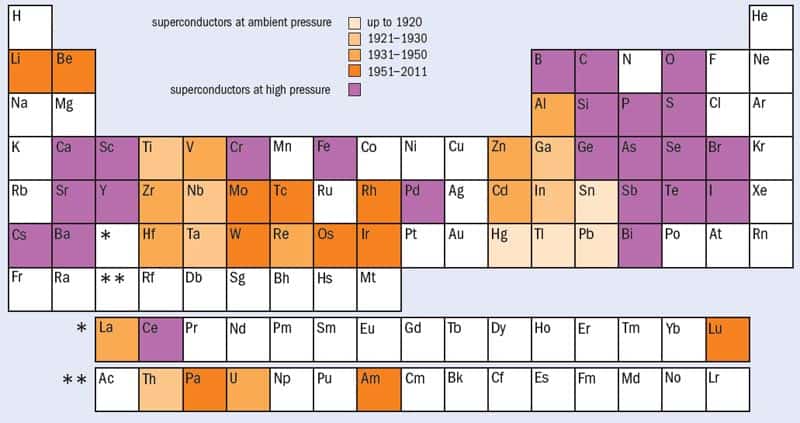
Quite simply, BCS theory ranks among the most elegant accomplishments of condensed-matter physics. Generally stated, it describes the pairing of two fermions mediated by a boson field: any fermions, by any boson. All known superconductors follow the general recipe dictated by BCS, the basic form of which is an extraordinarily simple expression: Tc _ Θ/e1/λ, where Tc is the transition, or critical, temperature below which a material superconducts, Θ is the characteristic temperature of the boson field (the Debye temperature if it is comprised of phonons), and λ is the coupling constant of that field to fermions (electrons and/or holes in solids). A material with a large value of λ is generally a good candidate for a superconductor even if it is, counterintuitively, a “poor” metal under normal conditions with electrons continually bouncing off the vibrating crystal lattice. This explains why sodium, gold, silver and copper, despite being good metals, are not superconductors, yet lead is (figure 2).

However, BCS is descriptive and qualitative, not quantitative. Unlike Newton’s or Maxwell’s equations or the framework of semiconductor band theory, with which researchers can design bridges, circuits and chips, and be reasonably assured they will work, BCS theory is very poor at pointing out what materials to use or develop to create new superconductors. For all that its discovery was an intellectual tour de force, it is the German-born physicist Berndt Matthias who perhaps summed the theory up best when he said (in effect) that “BCS tells us everything but finds us nothing”.

Later landmarks

Following the development of BCS theory, one of the next landmarks in superconductivity was the prediction in 1962 by Brian Josephson at Cambridge University in the UK that a current could electrically tunnel across two superconductors separated by a thin insulating or normal metal barrier. This phenomenon, now known as the Josephson effect, was first observed the following year by John Rowell and Philip Anderson of Bell Laboratories, and resulted in the development of the superconducting quantum interference device, or SQUID, which can measure minute levels of magnetic field and also provide an easily replicated voltage standard for metrology labs worldwide.

For the next landmark in superconductivity, however, we had to wait more than two decades for Georg Bednorz and Alex Müller’s serendipitous observation of zero resistance at temperatures above 30 K in layered copper-oxide perovskites. Their discovery of “high-temperature superconductors” at IBM’s Zurich lab in 1986 not only led to the pair sharing the 1987 Nobel Prize for Physics but also triggered a boom in research into the field (see “Resistance is futile” by Ted Forgan on page 33, print edition). Within a year M K Wu, Paul Chu and their collaborators at the universities of Houston and Alabama had discovered that an yttrium–barium–copper-oxide compound – YBa2Cu3O6.97, also known as YBCO, although the precise stoichiometry was not known at the time – could superconduct at an astounding 93 K. As this is 16 K above the boiling point of liquid nitrogen, the discovery of these materials allowed researchers to explore for the first time applications of superconductivity using a very common and cheap cryogen. The record substantiated transition temperature rests at 138 K in fluorinated HgBa2Ca2Cu3O8+d at ambient pressure (or 166 K under a pressure of 23 GPa).

With Bednorz and Müller about to pack their bags for Stockholm as the latest researchers to win a Nobel prize for their work on superconductivity, it was a happy time for those in the field. Literally thousands of papers on superconductivity were published that year, accompanied by a now legendary, all-night celebratory session at the March 1987 meeting of the American Physical Society in New York City now dubbed “the Woodstock of physics” at which those involved, me included, had one hell of a good time.

Technology ahead of its time

Alongside these advances in the science of superconductivity have been numerous attempts to apply the phenomenon to advance old and create new technologies – ranging from the very small (for ultrafast computers) to the very large (for generating electricity). Indeed, the period from the 1970s to the mid-1980s witnessed a number of technically quite successful demonstrations of applied superconductivity in the US, Europe and Japan. In the energy sector, perhaps the most dramatic was the development between 1975 and 1985 of an AC superconducting electricity cable at the Brookhaven National Laboratory in the US, funded by the Department of Energy and the Philadelphia Electric Company. Motivated by the prospect of large-scale clusters of nuclear power plants requiring massive transmission capacity to deliver their output, the cable attracted a good deal of attention. Although the cable worked, it unfortunately turned out not to be needed as the US continued to burn coal and began to turn to natural gas. Similarly, in Japan, various firms carried out demonstrations of superconducting cables, generators and transformers, all of which proved successful from a technical point of view. These projects were generally supported by the Japanese government, which at the time was anticipating a huge surge in demand for electricity because of the country’s growing population. That demand failed to materialize, however, and I know of no major superconductivity demonstration projects in Japan today apart from the Yamanashi magnetic-levitation test track, which opened in the mid-1970s using niobium–titanium superconductors.

In 1996 I published a paper “Superconductivity and electric power: promises, promises…past, present and future” (IEEE Trans. Appl. Supercond. 7 1053), in which I foresaw a bright future for high-temperature superconductivity. A large number of successful power-equipment demonstrations once more followed, with various firms developing superconducting cables, generators, conditioners (transformers and fault-current limiters), all of which proved successful. Although few – if any – of these demonstrations have been turned into working products, there is nevertheless a lot of good, advanced superconductor technology now sitting on the shelf for the future, if needed. Unfortunately, it has so far not had much of an impact on the energy industry, which is driven as much by politics and public perception as it is by technological elegance. When it comes to the electronics industry, in contrast, price and performance – say of the latest laptop or smartphone – are everything.

A somewhat similar story accompanies the application of superconductivity to electronics, a prime example being computers based on “Josephson junctions”, which promised to bring faster CPU speeds dissipating less heat than the bipolar silicon technology that dominated from the 1960s to the early 1980s. IBM and the Japanese government bet heavily on its succeeding, as it did from a technical point of view, but were blind-sided by the emergence of metal-oxide– silicon field-effect transistors (MOSFETs), which delivered both goals without requiring cryogenic packaging. (Other applications, including my personal top five, are given in “Fantastic five” on page 23, print edition.)

Cool that sample

In January 2001, exactly a year after the dawn of the new millennium, Jun Akimitsu of Aoyama-Gakuin University in Japan announced at a conference on transition-metal oxides the discovery of superconductivity in magnesium diboride (MgB2) – a material that had first been successfully synthesized almost 50 years earlier at the California Institute of Technology. Akimitsu and colleagues had actually been looking for something else – antiferromagnetism – in this material but were surprised to find that MgB2, which has a hexagonal layered structure and can be fabricated with excellent microcrystalline detail, became superconducting at the astonishingly high temperature of 39 K. The discovery prompted many other researchers to study this simple material and, over the past decade, high-performance MgB2 wires have been fabricated. Indeed, MgB2 has the highest upper critical field (above which type II superconductivity disappears) of any material apart from YBCO, with calculations suggesting that it remains a superconductor at 4.2 K even when subjected to massive fields of 200 T.

However, there is an interesting twist to the story. In 1957 the chemists Robinson Swift and David White at Syracuse University in New York measured the lattice specific heat of MgB2 between 18 K and 305 K to see if it depended on the square of temperature, just as other layered structures do. Their results, which showed no T2 dependence, were published in the Journal of the American Chemical Society not as a graph but as a table. When their data were re-analysed after Akimitsu’s 2001 announcement and plotted in graphical form, Paul Canfield and Sergei Bud’ko at Iowa State University (as well as the present author, working independently), were surprised to find a small specific-heat anomaly near 38–39 K, indicating the onset of superconductivity.

The question is this: if the Syracuse chemists had plotted their data and shown it to their physicist colleagues, would the history of superconductivity from the mid-20th century have taken a different course? To me it is likely that all the niobium intermetallics, such as the niobium–titanium alloys used in the superconducting magnets in CERN’s Large Hadron Collider, would never have been needed, or even fully developed (figure 3). High-field magnets would have been fabricated from MgB2 and perhaps even superconducting power cables and rotating machinery made from this ordinary material would be in use today.

The lesson is clear: if you think you have a new (or old) metal with unusual structural or chemical properties, do what Holst, Bednorz and Akimitsu did – cool it down. Indeed, Claude Michel and Bernard Raveau at the University of Caen in France had made 123 stoichiometric copper-oxide perovskites four years before Chu, but having no cryogenic facilities at their lab – and, finding it awkward to obtain access to others elsewhere in the French national research council system – missed making the discovery themselves.

Superconductivity arguably ranks among the ultimate in beauty, elegance and profundity, both experimentally and theoretically, of all the advances in condensed-matter physics during the 20th century, even if it has to date yielded only a few applications that have permeated society. Nonetheless, the BCS framework that underlies superconductivity appears to reach deep into the interior of neutron stars as well, with the pairing of fermionic quarks in a gluon bosonic field experiencing a transition temperature in the range 109 K. A century after Leiden, in the words of Ella Fitzgerald, “Could you ask for anything more?”

Martin Rees wins £1m Templeton Prize

The cosmologist Martin Rees, former president of the Royal Society, has won this year’s £1m Templeton Prize – the world’s largest annual award given to an individual. He was awarded the prize for his “profound insights” into the nature of the cosmos that have “provoked vital questions that address mankind’s deepest hopes and fears”. The 68-year-old will be presented the award by the Duke of Edinburgh at a ceremony at Buckingham Palace on 1 June.

As the author of more than 500 research papers, Rees has spent decades investigating the implications of the Big Bang, and the nature of black holes. He has also made important contributions to the origin of cosmic microwave background radiation, as well as to galaxy formation and the concept of “multiverses”. The Templeton Foundation has given Rees this year’s prize for raising such “big questions”, that “strike at the core of life, fostering spiritual progress that the Templeton Prize seeks to recognize”.

“The questions Lord Rees raises have an impact far beyond the simple assertion of facts, opening wider vistas than any telescope ever could,” says John Templeton Jr, president and chairman of the Templeton Foundation, in a statement. “By peering into the farthest reaches of the galaxies, Martin Rees has opened a window on our very humanity, inviting everyone to wrestle with the most fundamental questions of our nature and existence.”

Rees, an atheist, told physicsworld.com he was “surprised” by the award and that his views on science and religion are “rather boring” and that he tries to avoid discussing it. “I suppose I was awarded the prize because I have encouraged big questions to be asked such as is there life out there?” Rees says. He adds he had no qualms about accepting the award and that has not yet decided how he will spend the £1m prize money.

The questions Lord Rees raises have an impact far beyond the simple assertion of facts, opening wider vistas than any telescope ever could John Templeton Jr, president and chairman of the Templeton Foundation

Robert Williams, president of the IAS, who recommended Rees for the prize, told physicsworld.com that, although Rees does not explicitly write about religion, he does touch on the same important themes of origins and development of the universe through natural processes, which are at the core of the foundation of many religions.

“I consider it very forward thinking of the Templeton Foundation to acknowledge, through this award to Martin, the importance of carrying on these discussions in less directly religious language and context, as opposed to the more traditional manner of addressing these fundamental questions of ‘How did we get here?’ as a by-product of divine intervention,” he says.

Another scientist to nominate Rees was Virginia Trimble from the University of California at Irvine. She told physicsworld.com that her nomination “focused strongly on Martin’s enormous scientific contributions over a wide range of questions and answers, many of which bear on traditional human questions such as what is the world made of; how did it get to be that way; what will happen in the distant future.”

Our final century

Martin Rees was born in 1942 in York and grew up in Shropshire. In 1960 he went to Cambridge University to study mathematics and was awarded a bachelor’s degree in 1963. In 1967 he was awarded a PhD in theoretical astronomy and, after a spell in the US at the Institute for Advanced Study in Princeton and Harvard University, Rees returned to Cambridge in 1973. In 1992 he was knighted and three years later became Astronomer Royal. In 2005 he was appointed president of the Royal Society, a post he held until 2010. In the same year he was also made a life peer.

Rees is the author of several books, writing mostly about humanity’s future on Earth. In his latest book – Our Final Century: Will the Human Race Survive the Twenty-first Century? – which was published in 2003, he controversially estimated that the probability of extinction before 2100 was around 50% due to the possibility of accidental release of destructive technology. He is planning on publishing his next book soon, entitled What We Still Don’t Know. Rees, however, says he will not start writing about science and religion now that he has won the prize.

The Templeton Prize was established in 1972 by the late philanthropist Sir John Templeton. According to the Templeton Foundation, it is awarded for “progress toward research or discoveries about spiritual realities”. It is awarded by a nine-member committee currently chaired by psychologist Durre Sameen Ahmed from the National College of Arts in Pakistan. Physicists have been particularly successful in recent years: former laureates include Bernard d’Espagnat (2009), Michael Heller (2008), John Barrow (2006), Charles Townes (2005), George Ellis (2004), John Polkinghorne (2002), Freeman Dyson (2000) and Paul Davies (1995).

NASA’s research ability in space under threat

NASA is “poorly positioned” to carry out research on the International Space Station (ISS) due to several years of “dramatically” reduced funding for the agency’s life and physical sciences programme. That’s the view of a report released today by the US National Research Council. Written by an 18-member panel, the report’s authors say that they are “deeply concerned” about the state of NASA’s research programme and call for the agency to now provide a “funding base” for such research.

The report, co-chaired by mechanical engineer Elizabeth Cantwell from the Lawrence Livermore National Laboratory and medical researcher Wendy Kohrt from the University of Colorado, lays out a research agenda for the coming decade. It highlights two broad recommendations for research areas that should be strengthened. These are developing “exploration technologies” and research that takes advantage of the “unique aspects” of the microgravity environment.

Support for NASA’s life and physical sciences programme has fallen steadily over the last decade. In 1996 the agency awarded around $500m for research in advanced life support and advanced space suits to fundamental physics but this fell to around $300m in 2001 and just $150m by 2010. By then the only research that was carried out was in supporting “human exploration and ISS life”. The report says that the programme now has no “institutional home at NASA” and concludes that, as a result, the agency cannot take full advantage of the laboratory environment at the ISS.

Research highlights

The report calls for NASA to “elevate” the life and physical sciences programme to similar levels as in the late 1990s to carry out a much broader diversity of research. It adds that it is “essential” that researchers have a “reasonable level of confidence in research funding” if they are expected to devote time and resources to areas relevant to space exploration.

The report also highlights priorities in different research areas from plant biology to mental health. In the fundamental physics programme these include the study of complex fluids and soft matter in a microgravity environment; precision measurements of the fundamental forces and symmetries; investigating the physics and application of quantum gases; and the behaviour of matter near critical phase transitions.

Some, however, are critical of the science that has been performed by humans in space and at the ISS. “NASA’s science budget is already under severe pressure. In these straightened times the most cost effective way of getting science in space is robotic, not manned missions,” says astrophysicist David Clements from Imperial College London. “While I’m sure this programme will do good work, the scientific return from space for such work is far, far away.”

How to detect Fukushima fallout

nuclear.jpg

By Hamish Johnston

Since the stricken Fukushima reactors in Japan started emitting radioactive materials a few weeks ago, physicists in places as disparate as San Francisco and Glasgow have been reporting elevated levels of radioactivity. Given the tiny quantities involved, just how are they detecting this material?

If you have access to the sort of kit that you might find in an undergraduate demonstration lab, you can do the measurement yourself. And a good guide to follow is a paper posted recently on the arXiv preprint server.

In the paper Eric Norman, Christopher Angell and Perry Chodash describe how they analysed rainwater samples from the San Francisco Bay area for traces of fallout from Fukushima – which is about 8000 km away.

From their base at the nuclear engineering department of the University of California, Berkeley, the team collected rainwater from three locations and brought it back to the lab. Each sample was placed in a Marinelli beaker, which is a special vessel for measuring the radioactivity of liquids.

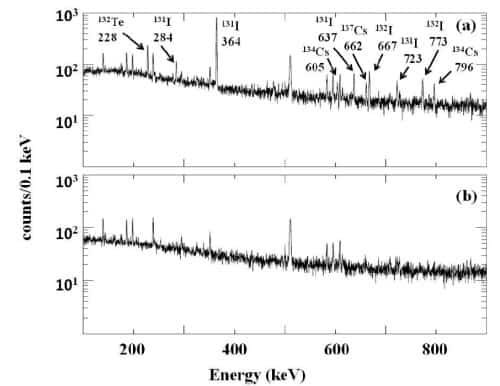
The beaker is placed over a high-purity germanium detector, which are used routinely to study gamma-ray spectra. Lead is used to shield the detector from background radiation. Gamma-ray spectra in the 0.02–1.58 MeV energy range are then collected for up to 24 hours. This range was chosen because it contains gamma rays emitted by radioactive isotopes of iodine, caesium and tellurium. These are produced by the fission of uranium and plutonium, both of which are used as fuel in the Fukushima reactors.

The team took its first samples overnight on 15 March and found no evidence for the three fission fragments. This allowed the team to set an upper limit on the concentration of iodine-131 in the samples of about 0.016 Becquerel per litre (Bq/l). The Becquerel is a unit of radioactivity pegged at one decay per second.

However, by 18 March evidence of radioactive materials began to emerge and the iodine-131 signal had risen to more than 5 Bq/l. The researchers also saw a corresponding rise in radioactivity associated with other isotopes of iodine, caesium and tellurium.

The top panel (above) is the gamma-ray spectrum of rainwater from 18 March, showing the presence of various isotopes. The bottom panel is the same spectrum of tap water.

The signal peaked on 24 March, with iodine-131 reaching 16 Bq/l. This is about four times the recommended level in drinking water. Radioactive iodine is dangerous because it concentrates in the thyroid gland. However, because of the relatively short half-life of iodine-131 (about 8 days), the Berkeley team doesn’t think that it will lead to significant exposure through drinking local water.

Thin film has ‘astonishing’ ability to rotate light

Physicists in Austria and Germany have taken the Faraday effect to a new extreme by rotating the polarization of light by 45° by passing it through an extremely thin film. This “giant Faraday effect” could someday be used to create optical transistors that switch light or to improve terahertz imaging systems.

Discovered in 1845 by Michael Faraday, the Faraday effect describes how a magnetic field shifts the polarization of light as the light passes through a medium. A material’s ability to rotate light is defined by its Verdet constant – the amount of rotation given per tesla of magnetic field strength and per metre of material. The previous record for the strongest Faraday effect was the semiconductor indium-antimony, which has a Verdet constant of about 104 radians per tesla per metre.

Now Andrei Pimenov and colleagues at the Vienna Institute of Technology in Austria and the University of Würzburg have shown that mercury-telluride has a Verdet constant of 106 radians per tesla per metre – which Pimenov described as “astonishing”.

A layered approach

To investigate mercury-telluride’s optical properties, the team layers the material over a thin piece of cadmium-telluride, which does not contribute to the Faraday rotation. Then linearly polarized light – with its electric-field electric component oscillating along a certain direction – is sent into the sample.

The oscillating electric field causes conduction electrons in the material to drift to and fro. When a magnetic field is applied to the material, the electrons assume circular orbits. These orbits affect the speed at which right and left circularly polarized light travels through the material. This has the effect of rotating the direction of polarization.

The researchers measured the effect by passing the emerging light through a polarizing filter – either aligned with the initial polarization or perpendicular to it. In the absence of the magnetic field, the aligned polarizer lets all the light through, while the perpendicular filter blocks it entirely. However, as the magnetic field is increased, less light comes through the aligned filter and more through the perpendicular filter. The proportion of transmitted light for each alignment told the researchers the degree to which the beam had turned.

‘Intriguing material’

For the film with a thickness of just 70 nm, the rotation reached a maximum of about 15° with a magnetic field of 1 tesla. However, a layer of mercury telluride 1 µm thick could rotate the light a little more than 45°. Sébastien Francoeur of École Polytechnique in Montreal called the semiconductor an “intriguing material” because electrons can travel relatively long distances without scattering and the electrons low effective mass – they behave as if they have just a 30th of their actual masses. Francoeur said these properties are “the special ingredients resulting in this giant magneto-optical effect”.

The effective mass of the electrons and the strength of the magnetic field help define the cyclotron frequency of the circular orbits. When the rotation of the light is greatest, the cyclotron frequency matches that of the light, suggesting that this resonance contributes to the giant Faraday effect.

To put the effect to use, the researchers suggest a transistor design for optical computing. “Using an external magnetic field, you can either switch on or switch off the transmission of the light,” says Pimenov. While an electronic transistor decides whether to let a current pass depending on the voltage applied to it, a mercury-telluride layer between two aligned linear polarizers would let light through when the magnetic field was off but not when it was on.

In order to make this device, the team would need to twist the light by 90° rather than just 45°. Pimenov says that multiple layers of mercury-telluride, separated by cadmium-telluride, should be able to rotate light by 360° or more.

One-way valves

With exactly 45° of rotation, the effect can also make for optical one-way valves. The light would pass through a linear polarizer and then be rotated by 45° on its way forward. If reflected, it would turn another 45° on its way back through the mercury-telluride. Now aligned perpendicular to the polarizer, it couldn’t pass.

The effect could also be used to perform terahertz imaging and spectroscopy in molecular biology, medicine, and security. According to Francoeur, terahertz light is “notoriously difficult to guide and it is challenging to manipulate its polarization state”. The giant Faraday effect in mercury-telluride makes a welcome addition to the toolbox.

The research is reported in Phys. Rev. Lett. 106 107404.

Celebrate the centenary of superconductivity…

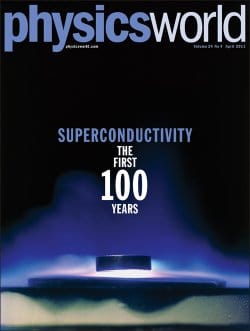
PWApr11cover-iop.jpg

By Hamish Johnston

In 1911 the Dutch physicists Heike Kamerlingh Onnes and Gilles Holst discovered superconductivity in mercury.

One hundred years later, physicists are still hard at work studying a growing number of superconducting materials.

Now you can celebrate the centenary by enjoying a free download of the April 2011 issue of Physics World, which is packed full of articles on superconductors.

The issue contains a handy wallchart showing the inexorable rise in critical temperature as more superconductors were discovered. The chart also highlights the six Nobel prizes associated with superconductors and other important events in the field.

Relive the key events of the last 100 years in the company of Paul Michael Grant, who also presents his top five applications of superconductivity with the biggest impact on society today.

Stephen Blundell examines the pivotal role in understanding these materials played by the brothers Fritz and Heinz London, while Ted Forgan recalls the euphoric early days of high-temperature superconductivity 25 years ago, and Laura Greene calls for a global collaboration to reveal the next generation of high-temperature materials.

Finally, don’t miss our profiles of three key industrial players – GE, American Superconductor and Oxford Instruments – as well as our fabulous superconductivity timeline.

You can download the special issue here.

Stolen invisibility cloak found!

By James Dacey

If you checked physicsworld.com this morning you may have been alarmed to read about the theft of the world’s first flexible invisibility cloak. Well, you will be relieved to hear that the cloak’s designer, physicist “Randy Katz”, has managed to relocate his precious garment, which he will now be wearing for the rest of his days. Yes folks, Randy nor his cloak really exist – it was a little joke for April Fools day.

Outlandish new technologies seem to have featured heavily among this year’s April Fools pranks. Here are my picks from the rest of the web.

Swedish furniture maestro Ikea hit the mark with its HUNDSTOL, a highchair for dogs to bring man’s best friend closer to the family at dinnertime.

Continuing the animal theme, The Sun newspaper (not known for its subtlety) ran with the story that gorillas were given iPads at a wild animal park in southern England. The head zookeeper was surprised when the gorillas started using the devices rather than “bang them on the rocks”.

British free daily newspaper, The Metro brought a chuckle with its edible newspaper, which came with the delicious headline: “Have we got chews for you”. Apparently pages were being printed on a corn starch mix that had a lovely light vanilla scent.

metropaper.jpg

Eco-friendly fitness fanatics may have got excited when they read about the Re-Cycle Cardboard Bike. Designed by German engineers, the technology was said to fold down into a small package that could be popped conveniently into a carrier bag.

cardbike.jpg

And finally, fans of 3D cinema will be gutted to learn that one-eye 3D TV will not be coming their way after all, as Toshiba’s new 3D monocle was indeed another joke.

For the record, here is our attempt at April Fool’s humour written by our prairie correspondent Minot Moorehead…

Invisibility cloak stolen from lab

Police in the US have launched an investigation after the world’s first flexible invisibility cloak was stolen early this morning. Physicist Randy Katz reported the carbon-based device missing from his lab at the University of Southern North Dakota at Hoople.

Invisibility cloaks use materials with negative indices of refraction to bend light around an object much like water flowing past a stone in a gentle stream. Previous cloaks, however, were made of rigid materials that could not be made into wearable garments.

In 2008 Johan Pendergast of University College Limerick calculated that flexible metamaterials woven from carbon could have a negative index of refraction for visible light. After two years of experimental work, Katz and colleagues say they were about to unveil the first such flexible cloak.

Rings and rods
The design is based on the conventional “rings and rods” metamaterial. Carbon nanotubes function as rod-shaped capacitors and fullerene buckyballs act as inductors. The nanotubes are woven into in a lattice with a spacing of several hundred nanometres, corresponding to the wavelength of visible light.

Katz told physicsworld.com “nanotubes are extremely strong and flexible, which makes the fabric tough yet wearable”. Indeed, Katz revealed that he was talking to a famous French fashion house about using the fabric in its Autumn 2011 collection. “They think invisible could be the new black,” he said.

Evil purposes
A rival fashion designer is one theory being investigated by police, but some physicists fear a more sinister motive. “This device is the Holy Grail of cloaking research,” said Wulf Tigerlung of St Antony’s University. “I have real concerns that whoever stole it could use it for evil purposes”.

North Dakota State Police have launched an investigation but are struggling to find any clues. “We are reviewing tapes from the university’s security cameras to identify anyone who entered the lab but didn’t appear to leave,” said trooper Crosby Cando. “It could also be an inside job,” he said. “Local fraternities would love to get their hands on such a cloak – just think of the pranks they could pull.”

Carbon nanotubes capture cancer cells

Researchers in the US have made a new device capable of detecting cancer cells and viruses. The device could eventually be developed into low-cost tests for doctors to use in developing countries where expensive diagnostic equipment is hard to come by, says team leader Mehmet Toner at Massachusetts General Hospital.

It is usually a challenge to detect single cancer cells in a blood sample because they are present in very small amounts – just a few cells per millilitre of sample. These “circulating” cancer cells, as they are known, are those that have broken away from the original tumour site and indicate that a cancer has metastasized, decreasing a patient’s chance of survival. It is thus crucial to be able to detect them. “Of all deaths from cancer, 90% are not the result of cancer at the primary site but from tumours that have spread from the original site,” explained team member Brian Wardle at Massachusetts Institute of Technology (MIT).

Toner and colleagues had made an earlier version of their device four years ago that consisted of thousands of nanometre-sized silicon “posts” confined inside microfluidic channels. The posts were coated (or “functionalized”) with antibodies that preferentially stick to certain types of tumour cell. When a blood sample was passed through the device (at around 2 ml per hour), tumour cells in the sample that came into contact with the posts became trapped.

Porosity is the key

However, the problem with this configuration was that some cancer cells passed through the device without contacting the posts at all. Toner’s team has now overcome this problem by making the posts porous instead of solid. In this way, the cells flow through the posts as well as around them. This means the cells have a greater chance of touching the posts and sticking to them.

The new porous posts were designed by Wardle, who is an aeronautics engineer. Such nano-engineered structures are usually studied with the goal of making advanced composite material for stronger aircraft parts.

The posts in the new device are made of vertically aligned carbon nanotubes instead of silicon and can collect cancer cells eight times better than the solid posts, say the researchers. Carbon nanotubes are rolled up sheets of carbon atoms and assemblies of the tubes are highly porous. Indeed, an array of carbon nanotubes – which can contain up to 100 billion carbon nanotubes per square centimetre – is 99% air.

As in the original device, the researchers functionalize the surface of each nanotube with different antibodies that stick to a particular type of cancer cell. But that’s not all: changing the configuration of the nanotubes also allows them to capture different sized objects – for example, cells that are around 10 µm in diameter, all the way down to viruses, which can be as small as just 40 nm.

Coated in antibodies

Toner and Wardle’s team has proved that its device works by detecting a variety of bacteria and viruses, including fluorescent labelled Streptococcus pneumoniae bacteria. The researchers did this by coating the micofluidic device with anti-S. Pneumoniae antibody. They also succeeded in detecting human leukocytes, taken from healthy volunteers, and coating the devices with anti-CD4 antibodies.

“Sample preparation and filtering is crucial when working directly with complex biological samples, such as blood,” commented Hatice Altug of Boston University, who was not involved in the work. “In this respect, it is very exciting to see that this device can very effectively capture and separate target bioparticles across multiple size scales, ranging from viruses to bacteria and cells.”

And, since the technology is also compatible with large-area and low-cost manufacturing, it could find a wide range of applications in diagnostics, she added.

The MIT team is now working on tailoring the device so that it can detect HIV, the virus that causes AIDS.

The current work was detailed in Small DOI:10.1002/smll.201002076.

Copyright © 2026 by IOP Publishing Ltd and individual contributors