North Atlantic strait at its warmest for 2000 years

A stretch of water east of Greenland, considered to be the Arctic’s main source of heat from the North Atlantic, is warmer now than it has been in at least 2000 years. That is the claim of researchers in Europe and the US who suggest further warming will amplify the effects of climate change in the Arctic region.

The new study considers water temperatures in the Fram Strait, a passage of seawater between Greenland and the Svalbard archipelago. Climate scientists have identified that conditions in this stretch of water will play a key role in determining whether the Arctic ice cap will survive future summers.

“Cold seawater is critical for the formation of sea ice, which helps to cool the planet by reflecting sunlight back to space,” says Thomas Marchitto, one of the researchers, based at the University of Colorado in the US. “Warmer waters could lead to major sea ice loss and drastic changes for the Arctic.”

Recent warming

Marchitto’s group has determined seawater temperatures in this zone for the past 2000 years. And the finding is that – having remained relatively stable until around 1850 – the average summer seawater temperatures have increased by around 2 °C since that time.

The warming signal being detected further bears out the growing body of evidence that Polar regions are in the frontline when it comes to feeling the effects of global climate change Robert Murray, Heriot-Watt University

Given that meteorological and oceanographic data from this region only dates back 150 years, the researchers had to reconstruct historic temperatures, which they did using the sediment record. They catalogued over 900 different species of the micro-organism foraminifera, assigning an age from the depth of sediments. Because different species of this organism exist at specific temperatures, they were able to build a comprehensive picture of past sea temperatures.

To confirm the data, the researchers applied a second dating method by documenting the magnesium–calcium ratio in the calcite shells of foraminifers, which directly correlates with temperature variability. “The methods we have applied for our records are well established and have been found to give very reliable results in many different ocean basins,” says Robert Spielhagen, another member of the group, based at the Academy of Sciences, Humanities and Literature, in Mainz, Germany.

Arctic amplification

Murray Roberts, a bioscientist at Heriot-Watt University in Scotland, who was not involved in the research, sees the findings as further evidence of the Arctic’s susceptibility. “The warming signal being detected further bears out the growing body of evidence that Polar regions are in the frontline when it comes to feeling the effects of global climate change.” Roberts does note, however, that the resolution of sediments used in the study is limited by the mixing of seawater and sediments.

Despite its modest size, the Fram Strait has an elevated role in the Arctic climate because it is its main source of heat from the ocean, and many scientists believe the Arctic is particularly vulnerable to climate change. Arctic temperatures near the land surface, for instance, have been nearly twice the global average in recent decades because of this “Arctic amplification”.

James Alexander Screen, an ocean scientist at the University of Melbourne, Australia, agrees that the Fram Strait will play a key role in deciding the fate of Arctic sea ice and he speculates about the effects on the local ecology. “Many aquatic plants like algae and plankton, and crustaceans and fish species are sensitive to water temperature and/or the presence of sea ice,” he says. Adding, “In turn, larger predators that feed on these organisms are sensitive to their distribution and abundance.”

Wider changes

Whether these circulation changes in the atmosphere and ocean are linked to human-induced global warming, we do not know Rune Rand Graversen, Stockholm University

Rune Rand Graversen, a meteorologist at Stockholm University, Sweden, believes that the dynamics of Arctic sea ice is also strongly intertwined with changes in atmospheric circulation. “[Atmospheric changes] may bring warm and humid air to Arctic Ocean areas that are vulnerable to become fast ice free. And they may cause increased ice export from the Arctic by changing winds” he says. “Whether these circulation changes in the atmosphere and ocean are linked to human-induced global warming, we do not know”.

While the researchers assert that it is difficult to relate local trends to wider ocean circulation, they acknowledge that it could be due to warming at lower latitudes, particularly in the Gulf Stream. “Generally speaking, the warm Atlantic water in the Fram Strait represents the northward extension of the Gulf Stream system. This system attains its heat in low subtropical latitudes,” says Spielhagen.

This latest study comes hot on the heels of a separate study published in Proceedings of the National Academy of Sciences, reported on physicsworld.com, which identified warming in the West Atlantic. The researchers in that case found that warming in the West Atlantic has caused the Gulf Stream off the coast of Canada to drift northwards from its historic position in recent years.

The researchers will now develop their research by trying to reconstruct temperatures in the Fram Strait for times when the total solar energy reaching the Earth’s surface was higher. One example is the time after the last ice age at about 9–10,000 years ago when solar energy influx was approximately 10% higher than it is today.

The findings are described in Science.

Between the lines

Illustration of a pen ticking a voting slip

The dark side of statistics

The more pairs of edible underwear that a nation’s people eat, the longer citizens of that nation will, on average, live. So does that mean that edible underwear makes you live longer? Not at all. Rather, this is a classic case of correlation not causation: longer lifespans and high edible-underwear consumption are both linked to a country’s wealth, but not to each other. However, some examples of what science journalist Charles Seife calls “proofiness” are harder to spot. In his book of the same title, Seife describes how proofiness, or “the art of using bogus mathematical arguments to prove something…is true, even when it’s not”, has infected science, business, journalism and politics. According to Seife, scientists who come up with absurd formulae for the perfect bum are guilty of a form of proofiness called “regression to the Moon”, meaning that they are disguising nonsense with mathematics to make it seem respectable. He also pokes fun at pseudoscientific statements made by manufacturers, including L’Oreal’s claim that Extra Volume Collagen Mascara gives lashes “12 times more impact”. (“Perhaps they had someone blink and listened to how much noise her eyelashes made when they clunked together,” he adds drily.) UK readers may detect some parallels with Ben Goldacre’s “Bad Science” columns in the Guardian newspaper; certainly, Goldacre’s fans will find plenty to enjoy in the book’s opening chapters. Later, though, Seife sets his sights on rather different targets. After devoting one chapter to risk mismanagement and another to misleading opinion polls, he arrives at the book’s polemical heart: proofiness in voting. Whether it pops up in inaccurate census data, gerrymandered election districts or the surprising impossibility of counting votes accurately, Seife is convinced that vote-related proofiness is a serious threat to democracy. His rhetoric can get overheated and he offers few solutions, but his underlying message is both fascinating and disturbing.

  • 2010 Viking Adult £16.70/$25.95 hb 304pp

A more-connected mess

If you think meetings are a waste of time, perhaps you should think again. After all, an observational study of molecular biologists found that most of the group’s important ideas emerged not as individual “eureka moments” at the microscope, but during their regular lab meetings. Such anecdotes feature prominently in Steven Johnson’s book Where Good Ideas Come From: The Natural History of Innovation, in which he describes how several factors – from hunches to error and, especially, networks – influence the innovation process. Full of unlikely links and a dizzying array of anecdotes about inventions, scientists and history, Johnson’s book is an excellent example of the sort of networked, connected thinking he advocates. It is unsurprising to learn that he wrote it with the help of a computer program called DEVONthink, a searchable repository of quotes, fragments and hunches that functions as Johnson’s 21st-century version of a Victorian “commonplace book”. But the downside of this type of thinking is also on display in the book: once you get past the tangled web of surface connections, what lies beneath is surprisingly insubstantial, and the results are often less than satisfying. There was a lot more to the controversy surrounding the discovery of DNA, for example, than the fact that Watson and Crick were interdisciplinarians who took long, rambling coffee breaks, while Rosalind Franklin was a more conventional biophysicist – but you will not find it in Johnson’s book. Moreover, the dark side of innovation is barely mentioned here, save in a footnote in which Johnson admits that the innovation-fostering atmospheres of big cities and the Internet also seem to make criminals and spammers work more efficiently. Ideas may want to be free, as Johnson claims, but the question remains: free for whom, and for what purpose?

  • 2010 Riverside $26.95 hb 336pp

Lawless but not flawless

It must be a temptation, after retiring as a physicist, to go beyond one’s research specialism and write a book outlining your “philosophy” of science and the scientific method. The latest offering in that mould is Lawless Universe by Joe Rosen who was, until retirement, a theorist at the universities of Tel Aviv and Central Arkansas with a particular interest in symmetry. After ploughing through the nature of science, theory and the difference between objectivity and subjectivity, Rosen then comes to the meat of the matter – his view that science, despite its successes, can only explain part of what the universe is about. So cosmology, for example, is metaphysics, not science, because we cannot run reproducible experiments on new universes; cosmology lets us describe the universe, but not explain it. Moreover, as quantum theory cannot be a literal description of objective reality, then, in Rosen’s view, objective reality must be mostly hidden from us. Reality, in other words, transcends nature and surpasses human understanding. Quite how scientific laws can then exist in an intrinsically orderless universe is a bit unclear, but Rosen is a genial enough guide through some mind-bending stuff.

  • 2010 Johns Hopkins University Press £39.00/$75.00 hb £15.50/$30.00 pb 184pp

50 years of Nuclear Fusion are free

iaea.jpg

By Hamish Johnston

In June 1959 the Scientific Advisory Committee of the International Atomic Energy Agency (IAEA) recommended that the agency publish a new journal on plasma physics and controlled nuclear fusion.

The next year, the journal Nuclear Fusion was launched. Now, 50 years after its debut, you can browse the entire archive of the journal and read any article you like free of charge – at least for the next 30 days.

I wasn’t around at the time, but I’m guessing that physicists – and even the public at large – were very keen on the idea of fusion-generated electricity.

cole.jpg

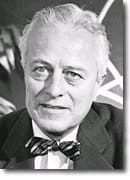
I was therefore surprised at the cautious tone of Sterling Cole’s foreword to the first ever issue of the journal. Cole (right) was the first director general of the IAEA and in 1960 he wrote:

“We believe this new journal will contribute to the improvement of cooperation between nations in the difficult task of finding ways to extract energy from controlled nuclear fusion. Even if the earnest and concerted efforts devoted to this task do not lead immediately to practical energy sources, the endeavor will greatly expand the knowledge of plasma physics besides broadening basic scientific knowledge. The effort will also undoubtedly lead to the invention of new and important peacetime devices.”

Those are wise words indeed.

While the first paper in the journal has the rather dull title “Plasma oscillations”, its authors I B Bernstein and S K Trehan are identified as members of the intriguing Project Matterhorn at Princeton University.

True to the theme of international co-operation, two of the five articles in the first issue are from the US, two from the UK and one from France (the latter published in French). Abstracts for all papers are available in English, Spanish, French and Russian – those were the days!

You can access the archive here.

And don’t forget that physicsworld.com has produced a series of videos on fusion including an interview with Chris Llewellyn Smith about why ITER is a fusion facility worth building.

Theorists turn to graphene for clues to Higgs

Could insights into the elusive Higgs boson – the particle being eagerly sought at CERN’s Large Hadron Collider (LHC) – come from a simple solid material? Yes, according to a trio of physicists in Spain, who argue that vital clues could come from looking at graphene – a sheet of carbon just one atom thick. They argue that ripples in this material arise from a spontaneous symmetry-breaking process similar to that which separated the weak and electromagnetic forces in the early universe.

At the high energies of the early universe, the weak nuclear force and the electromagnetic force are thought to converge into one electroweak force. As the temperature of the universe fell below a certain point, the two forces suddenly became separate. This “electroweak symmetry breaking” can be explained in terms of a field – the Higgs field – shifting from an effectively empty high-energy state to its ground state, filling space with a field that gives some particles their mass.

The yet-to-be-detected Higgs boson is the particle associated with vibrations of this field, and is currently being sought in the LHC. But what exactly drives the Higgs field between the high-energy and ground states? Although the parameters in the Standard Model of particle physics can be adjusted to force the symmetry-breaking, it is possible that the Higgs field may not need any coaxing. Pablo San-Jose and colleagues at Madrid’s Institute for Material Science now argue that studies of the emergence of ripples in graphene could shed some light on the process.

Hats off for the Higgs

Spontaneous symmetry-breaking lies at the heart of the analogy – graphene loses some symmetry in the transition from a flat shape to a rippled one, in the same way as the “activation” of the Higgs field is tied to the breaking of the electroweak symmetry. Compared with grand cosmological scales, sheets of carbon might seem a bit pedestrian, but San-Jose thinks otherwise. “Measuring the rippling of graphene under variable tension could give us information about the details of the intrinsic condensation of the Higgs,” he says.

Working with colleagues Francisco Guinea and Jose Gonzalez, San-Jose claims to have shown that the energy landscape of graphene rippling in 2D and that of the Higgs field in 3D, are described by similar “Mexican hat” potentials. Like a sombrero, the potential energy starts high in the centre but quickly falls away to a minimum in any direction. The negative curvature at the top ensures that symmetry will break spontaneously – any push from the centre sends the system down towards a stable point in the brim, just where the edge of the hat begins to climb again.

In the case of graphene, the negative curvature is a result of how graphene responds to being stretched or compressed. In particle physics, negative curvature is a result of the relationship between the Higgs field and the “bare” mass of the Higgs boson. In order to be unstable, this bare mass must be imaginary – the Higgs boson acquires a real, effective mass when the field reaches its true stable ground state.

According to San-Jose, studying how graphene responds to compression by buckling into ripples could give hints about how the Higgs condenses. Small, spontaneous ripples in the absence of compression, for example, would suggest that the Higgs field may condense without requiring an imaginary bare mass for the Higgs boson. Experiments could also probe the structure of the potential in cases where the ripples are larger, providing information about mathematically difficult details of the Higgs quantum field theory.

Tunable using electrons

Vitor Pereira, a condensed-matter physicist from the National University of Singapore, is interested in the Spanish team’s explanation for how these ripples arise in graphene, which it sees as being via interactions between electrons and deformities in the structure that soften the material. He suggests that graphene’s structure might be tunable through the control of electrons.

Pereira adds that graphene’s properties may mimic other experimentally difficult processes, such as how particle–antiparticle pairs arise in the vacuum. Although some researchers are sceptical about accuracy of such models, he thinks otherwise. “It is quite cool to use graphene, arguably the simplest of the condensed-matter systems, as a testbed for such sophisticated ‘high-energy’ phenomena,” he says.

The work is reported in Phys. Rev. Lett. 106 045502.

A message from Mercury

“Eric, do we have anything yet? The suspense is killing me!” I say into the speakerphone. “I know, Louise, it’s killing us too, but still nothing,” replies Eric Finnegan, systems engineer for the MESSENGER mission. He sounds as calm and in control as ever; I, on the other hand, have been pacing up and down for several hours, not knowing quite what to do with myself.

It is about 6 p.m. on 15 January 2008 and Eric, the rest of the MESSENGER team and I are waiting for the first images from the planet Mercury in more than 30 years. The images are being beamed from the MESSENGER spacecraft – an object about half the size of a small car but with solar panels 6 m in length attached to it – across 171 million kilometres of space to antennas at NASA’s Deep Space Network. From there the images will travel to our Mission Operations Center at the Applied Physics Laboratory (APL) in Maryland, where Eric is waiting. Finally, the images will be sent to me and my colleagues in the Science Operations Center across the APL campus. They should have arrived about 10 hours ago, but because two other spacecraft declared emergencies this morning, all the antennas for the deep-space network that were supposed to be returning MESSENGER data have been temporarily pointed elsewhere. So, we must wait.

Waiting is not unusual in my business. You could say that we have been waiting almost 12 years for these images to arrive, ever since the MESSENGER mission was first proposed. You could even argue that we have waited more than three decades: the only other spacecraft to visit Mercury – Mariner 10 – flew by the planet three times in the mid-1970s but was only ever intended to be a reconnaissance mission to pave the way for a Mercury orbiter. So, these images have been a long time coming, and I should not complain.

For a planetary geologist like me, it is hard not to get excited about MESSENGER. Mariner 10 orbited the Sun, not Mercury, and its trajectory was such that it saw the same hemisphere of the planet each time it passed it. As a result, only 45% of Mercury was mapped, leaving the rest as terra incognita. Still, much was learned about the innermost planet, including the fact that it is unusually dense; it has a core that is far larger than predicted; quite unexpectedly, like the Earth it has a magnetic field, which may be internally generated; and it appears that of all the terrestrial planets (Mercury, Venus, Earth, Mars), Mercury’s geological activity ceased the earliest. We have learned a few things since Mariner 10 as well. In particular, radar observations from the Earth in the 1990s showed that some peculiar deposits, possibly ice, may exist in permanently shadowed regions at Mercury’s poles.

But despite these developments, the planet has remained one of the least studied in our solar system, and many questions about it remain. This is particularly surprising given that Mercury is a terrestrial body and as such it formed from similar materials to the Earth and the Moon. I have heard Mercury described as being like an eccentric neighbour who you see from time to time, but about whom you know next to nothing.

Preparing to fly

The MESSENGER mission was first proposed in 1996, and three years later was selected as part of NASA’s Discovery Program. The science goals proposed for the mission included investigating Mercury’s geological history, the nature of the strange radar-reflective deposits at the poles, the planet’s magnetic field and interior structure, the reasons for its high density, and the nature of its tenuous atmosphere.

At the time, I was still a planetary-geology graduate student, cutting my teeth on data from the Galileo mission to Jupiter and barely thinking about anything that was not an icy satellite. Projects in this field tend to have very long lives, and it is not uncommon for those who work on a mission to join it at different stages during its lifetime. So, I was a comparative latecomer to MESSENGER, beginning work on the mission in 2001 as a postdoctoral researcher at APL.

The mission’s principal investigator, Sean Solomon, is based at the Carnegie Institution of Washington, but staff at APL designed and built the spacecraft and several of its instruments, and APL manages the mission. Initially, I worked as a deputy instrument scientist for the onboard cameras, but after a couple of years I took over the role of instrument scientist. Each of the seven instruments on MESSENGER has an instrument scientist associated with it, and they are responsible for taking the requirements from the mission’s science team – experts in numerous different aspects of Mercury science – and making sure that their instruments (and, to some extent, the spacecraft) are capable of meeting those goals.

Although my background is in geology and geophysics, working as an instrument scientist on the two cameras that comprise MESSENGER’s imaging system required me to get “down in the weeds”, learning more about instrument design, software, and spacecraft guidance and control than I ever imagined possible. In the years before launch, I wrote and revised countless documents, learned all the gory details about how the cameras worked, figured out how to assemble sequences of software code to command the instrument, and attended numerous meetings and reviews. Somehow, over the years, everything – subsystems, instruments and spacecraft – came together, until finally the whole assembly could be tested to make sure it could withstand the intense heat of Mercury and the deep cold of space, as well as the vibrations of launch.

Building any spacecraft is a challenging and risky business. If anything goes wrong after launch, you have only limited resources available to address the problem. But building a spacecraft that can orbit Mercury for one year – the standard length of a mission in NASA’s Discovery Program – is particularly challenging, given Mercury’s proximity to the Sun. Mercury’s average orbital distance from the Sun is about 58 million kilometres, and at that distance the solar radiation is 11 times more intense than it is on the surface of the Earth. Any spacecraft in orbit around Mercury must therefore be able to withstand significant thermal variations. Temperatures reach approximately 425 °C on Mercury’s sunlit surface, which is hot enough to melt zinc, but they also dip as low as –185 °C on its night side.

These thermal variations have driven both the design of the spacecraft and the planned shape of its orbit around Mercury. The spacecraft carries a 2.5 × 2.0 m sunshield made of a heat-resistant ceramic cloth, similar to the material that protects the tiles on the Space Shuttle. The sunshade is positioned such that it shields and protects almost all the instruments and subsystems – the temperature on the front of the sunshade can reach a scorching 370 °C, but behind it everything remains essentially at room temperature. However, in order for this protection to be useful, the sunshade obviously needs to be pointed at the Sun at all times, which limits the pointing range of the spacecraft’s instruments. Although it can be rotated a few degrees side to side and up and down, the spacecraft is primarily fixed in space and must orbit Mercury in this configuration – a constraint that creates some interesting challenges when trying to point instruments at the planet. MESSENGER’s laser altimeter, for example, is fixed in one position on the spacecraft, and it cannot always aim at the planet without moving the sunshade sideways and risking overheating.

The Sun, however, is not the spacecraft’s only heat problem. Mercury’s surface radiates solar heat back into space, and any spacecraft that hopes to fly over it and come out intact must take this into account. MESSENGER will address the problem of reflected radiation by staying in a highly elliptical orbit that ranges from an altitude of ~200 km at its closest point, about 25–30 degrees south of Mercury’s north pole, to about 15,000 km at its furthest point, 180 degrees away. This means that MESSENGER will not get as hot as it would if it were in a circular orbit close to the planet’s surface.

But while this elliptical orbit will help prevent the spacecraft from overheating, it will also make data acquisition difficult. Some instruments, such as the magnetometer and particle spectrometers, are measuring the in situ environment and will be able to make measurements wherever they are. Remote sensing in_struments generally need to be pointed at the planet, however, and some can only take data when they are close to it. For example, MESSENGER’s laser altimeter can only range to the surface when it is below an altitude of about 1800 km, and so can only make topographic maps of the northern hemisphere since the chosen orbit simply does not allow it to “reach” the southern hemisphere.

Launch day and beyond

After hundreds of people worked for thousands of hours building the spacecraft’s hardware and instruments; developing power, communication, propulsion, thermal and software systems; planning every detail of the spacecraft’s trajectory and how it would accomplish its science objectives; and generally not getting much sleep, it was 3 August 2004 and we were finally ready for launch. This was actually our second attempt to launch the spacecraft – the previous night’s attempt was cancelled at the last minute because of concerns about the weather – but now everything was looking good.

I was lucky enough to watch the launch from a beach near Cape Canaveral in Florida. Many MESSENGER team members were at the official launch site, but I had heard that the view from the shore was just as good and did not require one to be in position hours ahead of time, as was the case at the official viewing site. A lot of the MESSENGER engineers – seasoned launch veterans – were at the beach too, so there was quite a party atmosphere despite the fact that it was 2 a.m.

The launch went flawlessly, and MESSENGER was on its way to Mercury, albeit by a circuitous route. At the advent of the space age, it was thought that getting to Mercury was simply too difficult, because the Sun’s mighty gravitational pull implied that prohibitive quantities of fuel would be needed to get into orbit around the innermost planet. It was not until the 1960s that engineers at the Jet Propulsion Laboratory in Pasadena, California, discovered that the gravity of a planet could be used to help tweak a spacecraft’s orbit in one direction or another, depending on the angle of approach and the spacecraft’s velocity.

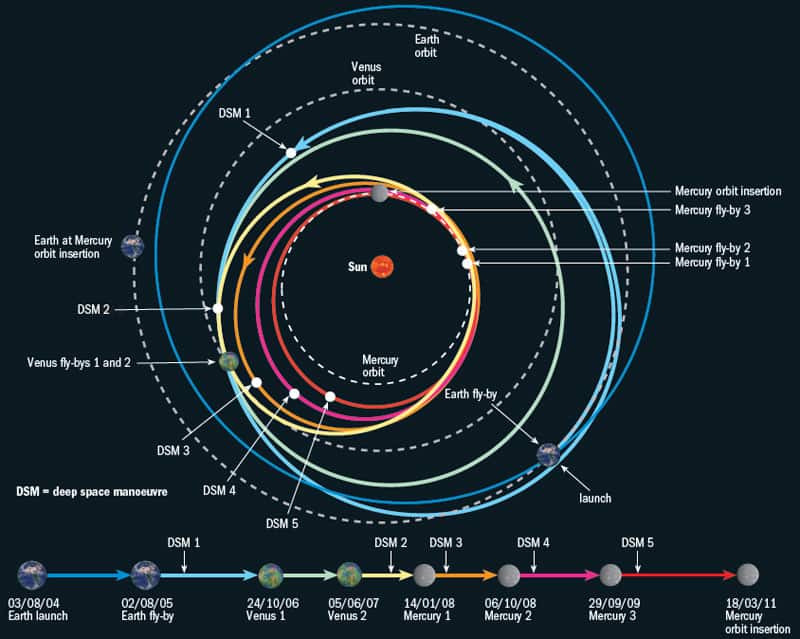
This slingshot approach, termed a “gravity assist”, can save a significant amount of fuel and is now commonly used by spacecraft missions, including MESSENGER. The downside of this approach is that it takes time. In order for MESSENGER to reach orbit around Mercury, six gravity assists are needed: Earth (once), Venus (twice) and Mercury (three times). All in all, it will have taken six and a half years to get MESSENGER in the right place at the right time – and travelling at the right velocity – to fire its motor and get captured in Mercury’s orbit (see “A sightseeing tour with a purpose”).

On the plus side, fly-bys of planets or other bodies offer tremendously useful opportunities for practising spacecraft operations and testing subsystems and instruments. The extra time also allows calibrations to be carried out, software for data analysis to be developed, and all manner of issues to be identified and resolved. In the case of MESSENGER, the fly-bys have also yielded a huge amount of new data – particularly after 14 January 2008, the day of the first Mercury fly-by.

Back to the big day

And so I found myself waiting on that evening back in 2008, pacing up and down as I anticipated the arrival of the images from that first fly-by. Our Science Operations Center, or SOC, and the surrounding corridors and rooms were full of science team members, APL managers, educators and members of the press. The fly-by itself had taken place on the afternoon of the previous day: the closest approach, 200 km from Mercury’s surface, occurred at 2 p.m. EST, and the radio signals we had received back from the spacecraft suggested that everything had gone well. It appeared that the spacecraft had received a perfect gravity assist and was right on target, and all the instruments had taken data exactly as planned. Now we were waiting for images to be processed onboard the spacecraft, and for them to get sent back to Earth, to the Mission Operations Center, then finally to the SOC.

The images we were expecting were of the hemisphere of Mercury that no-one had ever seen before, part of the 55% of the planet that Mariner 10 had not been able to observe. This is in itself thrilling – how often in your life do you get to see something completely unexplored? But as the instrument scientist, my main concern at that moment was whether the two cameras had operated as expected and whether we had pointed them at the right place.

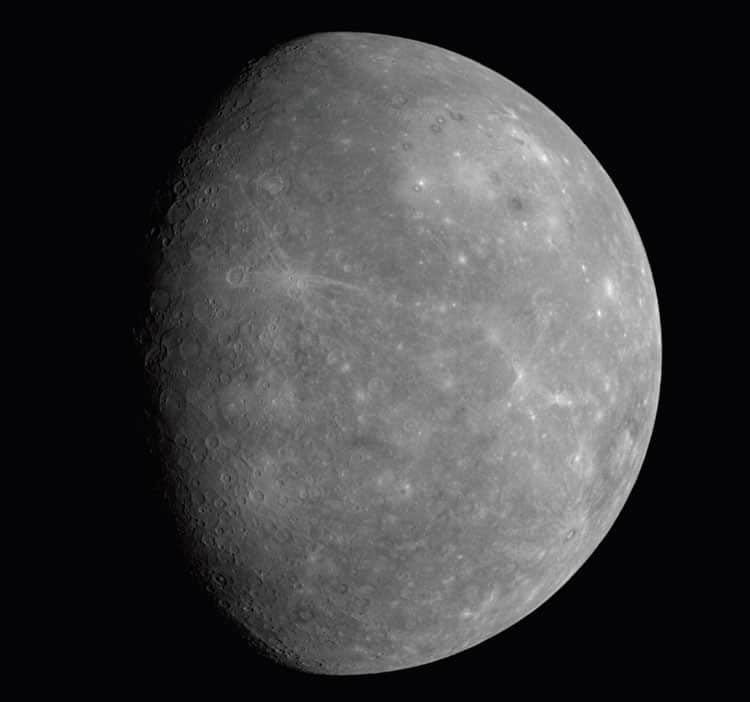
Our camera instrument engineer was sitting in front of one of the consoles in the SOC when, suddenly, the first image of Mercury appeared. My first feeling was one of complete joy and disbelief – a perfect, beautiful, gibbous Mercury filled the screen, showing an incredible level of detail. My second feeling was one of unabashed relief – the planet was perfectly centred in the image, so our pointing appeared to be spot-on and the instrument looked as if it was working perfectly. All those years of planning had paid off – we were finally taking images of Mercury! The whole room erupted into gasps, then cheers, and people started running in as they realized we had the first image on the ground. One of our science team members, septuagenarian Bob Strom, was a member of the original Mariner 10 science team and at times had doubted that he would ever see new images of Mercury. He was teary eyed as he looked at the screen. The rest of the evening was a happy, chaotic time, with numerous visitors coming in and out of the SOC, new images arriving and calls for press interviews.

Since that time we have completed two additional fly-bys of Mercury. The data collected from the three fly-bys have led to many discoveries and more than 60 scientific papers have already been published. Among other things, we have learned that Mercury’s volcanism persisted for far longer than previously thought, and we have evidence that some of it was explosive, giving clues to the amount and types of volatile gases in Mercury’s interior. We have confirmed that Mercury’s surface contracted globally as the planet cooled, and because MESSENGER has flown by both hemispheres of the planet, we now have a global view of the geometry of Mercury’s internal magnetic field. We also know more about how materials such as sodium and calcium are stripped away from Mercury’s surface by processes such as interaction with the solar wind. All of this is not insubstantial, considering the real reason for the Mercury fly-bys was to tweak MESSENGER’s trajectory – indeed, the science is all gravy!

Now, we are preparing for the finale: MESSENGER is on its way to rendezvous with Mercury and, if all goes well, it will enter orbit on the evening of 17 March at just before 9 p.m. EST. The first two weeks of orbit will be used to test the spacecraft’s subsystems and instruments, and to make sure everything is working well in the more hostile thermal environment of orbit. Once everything is checked, we will start taking science data, building up strips of images and taking other data day-by-day for a year. By then, MESSENGER will have gathered enough information to answer questions about Mercury’s origin, composition, interior structure and geological history – the real heart of the mission.

Postscript

In November 2010 I was returning from a business trip with a colleague who also works on the MESSENGER project. We had landed at Washington, DC’s Dulles airport and were on our way to collect our bags in the main terminal. Dulles recently built a new train to transport passengers between the terminals, and we were walking down a long, wide, well-lit tunnel towards the platform. When the train service opened, the walls of the tunnel were covered with large and beautiful photographs of Washington, DC, presumably intended to welcome visitors to our nation’s capitol. On this occasion, a new exhibition was on display: gorgeous photographs of the planets in our solar system. And there, right in the centre of the group, was MESSENGER’s first image of Mercury, as sharp and striking as when we first saw it, helping the planet to take its rightful place at last.

• For an audio interview with MESSENGER principal investigator Sean Solomon – and a report on the craft’s successful insertion into orbit around Mercury – click here


Creating Gyrangle

One warm and sunny weekend last October, tens of thousands of people congregated on the National Mall in Washington, DC – not for a political rally or protest, but to attend the first ever US Science and Engineering Festival. Laid out along the two-mile stretch between Capitol Hill and the Washington Monument were more than 1500 interactive scientific exhibits. The festive air was enhanced by stage shows and performances by comedians, magicians and musicians.

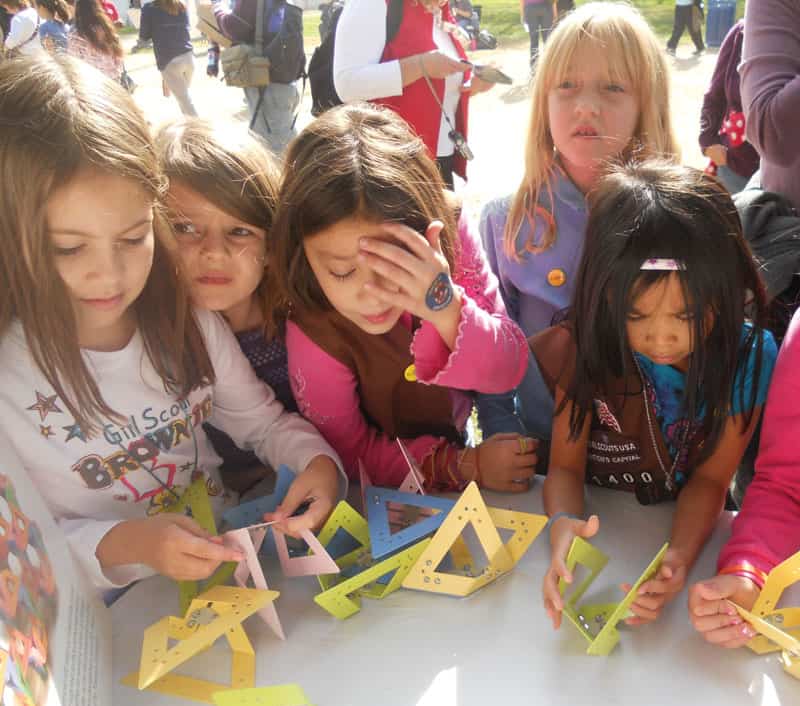
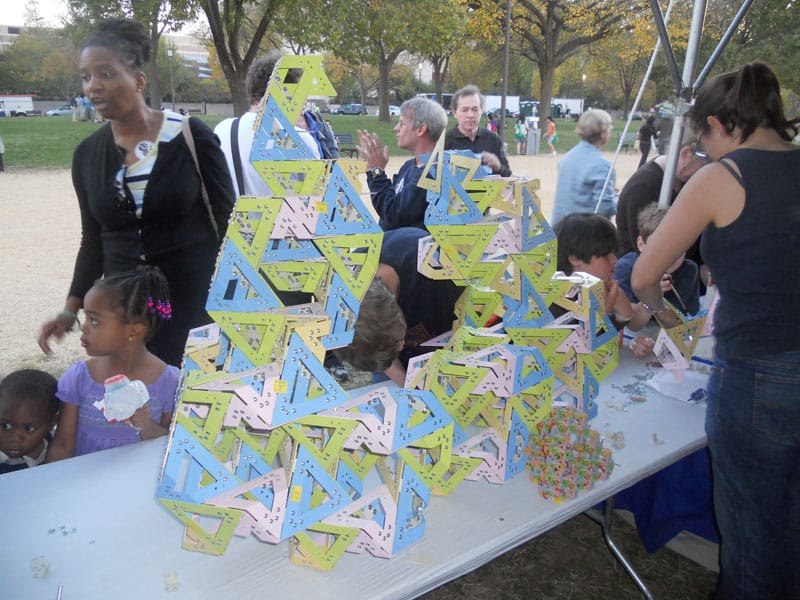
One of the most popular exhibits was a sculpture called Gyrangle, commissioned and sponsored by the American Mathematical Society (AMS). Swarms of children and adults helped to assemble the sculpture, designed by the computer engineer and artist (and my former Stony Brook colleague) George W Hart, who was on hand to supervise the volunteers. Just over a metre high, Gyrangle consists of 490 triangular pieces of laser-cut steel, each about 15 cm on a side.

Cool ideas

Hart, who is now “chief of content” for the recently founded Museum of Mathematics that will open in New York City in 2012, is internationally known for his pioneering applications of mathematics and computer engineering to sculpture. His books include Zome Geometry – a guide to creating structures in 3D space – and also the online Encyclopaedia of Polyhedra. Gyrangle is just the latest structure that Hart has designed specifically to be assembled by groups of people at events that he calls “barn raisings” and that are staged all over the world.

The sculptures typically involve simple shapes combined in simple ways to create highly complex mathematical structures. Gyrangle – which can be seen on Hart’s website at www.georgehart.com/DC – is a name he invented himself. “The structure is based on a minimal surface called a ‘gyroid’, which I put together with ‘triangle’,” Hart told me on the first day of the festival. “A gyroid is like the surface of a twisty soap bubble. A few years ago I discovered an approximation to the surface using triangles, which I thought was really cool. But instead of publishing a paper I thought I’d make a sculpture using it.”

The event in the National Mall was therefore the first public presentation showing how a gyroid surface can be made from triangles. Part of Hart’s inspiration comes from the Dutch graphic artist M C Escher, who once created a lithograph called Planaria (i.e. flatworms) that shows how octahedral and tetrahedral shapes can be put together in wonderful ways. “[Escher] really knew how to pack space – his brother was a crystallographer,” says Hart. “Gyrangle is another artistic application of that.”

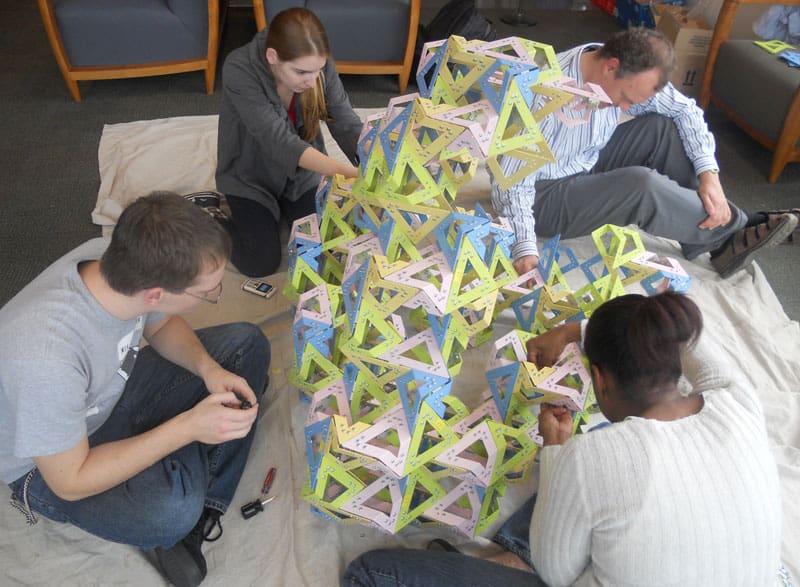
The 490 triangular steel pieces that make up Gyrangle each have a hollow interior; about half are flat and half have a 109.5° fold. The two triangle shapes come in four colours, thus creating a total of eight basic elements. These triangles were then fastened together with simple brackets and screws, using screwdrivers that were liberally scattered around the AMS booth. Four screws attached each bracket to two triangles in one of three dihedral angles: planar, tetrahedral and octahedral. Each pair of triangles attached to several other pairs to create a “submodule”, with submodules being combined to make modules, and dozens of modules comprising the final structure.

Gyrangle is in fact based on a (10,3)-a lattice – or, more accurately, on a cubic section of it made from hollow triangles. (A full description of the lattice was published in 2008 in Angewandte Chemie International Edition (47 7996).) The point of hollowing out the triangles is to see into the structure and its axes, and animations on Hart’s website display the different patterns revealed depending on whether a viewer is looking in the direction of the 2-, 3- or 4-fold axis of the lattice. The website also shows how to create the lattice from ball-and-stick Zome tools or from paper triangles.

Young children tended to spend about 10–15 minutes at the AMS booth. Deeksha, an eight year old from Maryland, put in four screws to connect two triangles, was delighted at her accomplishment, then moved to another booth. Teens tended to spend more time. Samantha, a 15-year-old junior-high-school student, was intrigued by the overall structure. She built a submodule out of eight pieces, then another identical one. “I wanted to put them together in two different ways to see which way was best,” she told me after spending half an hour at the booth. “I found the holes lined up better when you put the greens and yellows together first, rather than begin by making the flat blue plates parallel. But I’m coming back tomorrow to see the whole thing.”

By Sunday evening on the last day of the fair Gyrangle was still not entirely finished, even with the labour of hundreds of participants. Hart therefore took it to nearby Towson University, where the following day students and faculty members helped him complete it, and he gave a talk about its mathematical properties. The AMS then donated it to Towson’s mathematics department.

The critical point

Gyrangle is what I call a “deep object” in that it fulfils the ancient requirement that beauty be the appearance of the abstract and ideal in the realm of the visible. The more it draws you in, the more it delivers back in return. While younger children are content with putting together two of its parts by hand – finding satisfaction from the quick pleasure of completing a small part – older children and adults are drawn in by the sculpture’s design and construction, appreciating its elegance and patterns, and recognizing more levels of complexity than they anticipated. Quite simply, the Gyrangle barn raising is a great example of successful hands-on science.

Schrödinger's quantum kittens

cow.jpg
Erwin Schrödinger has proved a lasting inspiration to scientists and writers alike

By James Dacey

BBC Radio 4 is famed in the UK for broadcasting thought-provoking documentaries spanning the arts, sciences and just about anything that might be of interest to the “well-rounded intellectual”.

Yesterday was the turn of quantum mechanics via this 30-minute programme that explores the influence of Schrödinger’s cat paradox on science and popular culture.

It is an interesting show presented by UK broadcaster and comedian, Robin Ince, who talks with a handful of eminent physicists including Roger Penrose from the University of Oxford and Tara Shears from the University of Liverpool.

We are reminded that Schrödinger invented the paradox in an article of 1935 entitled The Present Situation in Quantum Mechanics as a response to the Copenhagen Interpretation of quantum mechanics that had emerged in the early 1930s. Schrödinger was bemused by the idea that all particles behaved as “fuzzy” entities until measured, and he was trying to stir a debate.

The cast discuss the appeal of the paradox and why it still fascinates scientists today. “It’s sort of a by-word for how the universe can be so amazingly complex and yet so perverse at the same time,” says Shears.

The programme also looks at how the paradox has inspired writers over the years, including Douglas Adams and more recently Philip Pullman. Writer Alan Moore explains how the multiple realities aspect of the paradox inspired a new wave of science fiction based on the idea of alternate histories.

And if you are left craving a more detailed discussion of the “Many Worlds” interpretation of quantum mechanics, you may also like to check out this webinar, part of the Physics World lecture series. It looks at the life and ideas of Hugh Everett III, who developed the idea in the 1970s.

LHC will run at 7 TeV in 2012

The Large Hadron Collider (LHC) will run at a total energy of 7 TeV for an additional year, said CERN bosses today in Geneva. The announcement was made after senior LHC physicists asked the lab to delay a 19-month shutdown of the LHC scheduled for December 2011. CERN, however, has rejected the scientists’ request to boost the energy of the collider by 1 TeV.

Last year the LHC ran at 7 TeV (3.5 TeV per proton beam) and CERN had planned to extend this run until December 2011. The plan was then to shut down the collider for more than a year to replace potentially faulty interconnects between its superconducting magnets.

“With the LHC running so well in 2010, and further improvements in performance expected to come, there’s a real chance that exciting new physics may be within our grasp by the end of the year,” explained CERN director-general Rolf-Dieter Heuer.

Indeed, Heuer believes that the extension will give LHC physicists a good chance at spotting the elusive Higgs boson, which is a main goal of the collider. He also said that an extended run at 7 TeV would also be useful in the LHC’s search for supersymmetric particles – the discovery of which could provide important clues regarding the unification of the strong and electroweak forces and other open questions in particle physics.

Staying at 7 TeV

CERN bosses have decided to keep the collision energy at 7 TeV throughout 2011–12, despite a request from physicists to increase it to 8 TeV in 2012. The lab’s director for accelerators and technology Steve Myers explained: “Although increasing by [1 TeV] would increase our sensitivity to new particles, a careful objective analysis of the situation showed that the risk is too high for the expected increase in sensitivity.”

The LHC was originally designed to run at a collision energy of 14 TeV but this was put on hold in September 2008 when the failure of a connector between two superconducting magnets shutdown the collider for more than a year. When it finally started up again in November 2009, the connector problem had not been fully solved – and CERN decided that the LHC could not safely run at total energies higher than 7 TeV.

A load of bull, part 2

cow.jpg
Heading north

By Michael Banks

Do cows align their bodies along the Earth’s magnetic field lines when grazing? What at first seems like a simple enough question is in fact becoming a hotly contested area of research.

In 2008 the answer was “yes” as zoologist Sabine Begall from the University of Duisburg-Essen in Germany and colleagues used images from Google Earth to study the patterns of 8500 cattle from 208 pastures around the world.

They found that regardless of where the cows came from, they aligned their bodies along the North–South of the Earth’s magnetic field. The effect was most obvious at high latitudes, they concluded, where the difference between magnetic North and geographical North are greatest (PNAS 105 13451).

There was a small snag, however, as the resolution of the images meant it was not clear whether it was the heads or tails of the animals that were pointing north – no doubt giving Begall and colleagues a case for further studies.

However, magnetoreception in cows has now been disputed by Jiri Hert from Charles University in the Czech Republic and colleagues who say there is no evidence for such alignment in their Europe-wide study of some 3412 individual cows in 322 herds (arXiv:1101.5263).

They claim that Begall and colleagues selected the herds and individual animals in an “inadequate way” and that “possible subconscious bias” could lead to the discrepancy between the studies as well as the use of poor-quality Google satellite images.

However, zoologist Hynek Burda from the University of Duisburg-Essen in Germany who was involved in the Begall study says it would be “useful” to see the images that Hert and colleagues have evaluated. “The images we have assessed were not of poor quality and there was no problem in determining the body axis [of the cows],” says Burda, who adds that their analysis has been supported at a forum held at the Royal Institute of Navigation.

“The case cannot be closed if only two studies come to different results,” Hert told physicsworld.com. “We hope that our study will provoke other scientists to repeat the analysis of the magnetic behaviour of cows and other mammals.”

Hert adds that he will not be studying the topic any further, however, but that his work will be “oriented in other directions” from now on.

Image problem puts bacterium in a spin

By Hamish Johnston

The bacterium in the video above has an image problem that’s forcing it to go round in circles.

I’m not speaking in metaphors; physicists in Italy are the first to notice that certain bacteria move in anti-clockwise loops when they swim close to the surface of a liquid.

Roberto Di Leonardo and colleagues also watched as E. coli swam in a clockwise direction when they were very close to the bottom of a water-filled dish – something that others had already seen.

This behaviour is puzzling because the little creatures manage to swim in straight lines when they are a good distance away from either the top or bottom of a dish.

Now, Di Leonardo and colleagues at the University of Rome Sapienza think they know why, and have published a paper in Physical Review Letters outlining their theory.

The bacterium propels itself by spinning a whip-like flagellum that acts much like a ship’s screw. The presence of a solid interface below – or an air interface above – the bacterium disrupts the movement of fluid around the bacterium. It turns out that the effect of this disruption can be modelled by removing the interface and replacing it with a mirror image of the swimming bacterium.

The effect of a mirror image is a torque on the real bacterium causing it to swim in a clockwise manner if it is close to the bottom. The image has the opposite effect when the bacterium swims close to the surface.

The analysis also suggests that long rod-like bacteria swim in larger circles than stubby bacteria.

Understanding this effect could prove very important in creating bacteria ratchets, which prevent some or all motile bacteria from passing through a barrier. Such ratchets could prove useful in preventing the spread of disease.

Copyright © 2026 by IOP Publishing Ltd and individual contributors