Physicists create ‘backward laser’

A team of physicists in the US has created an infrared laser beam at a point in mid air, by focusing a UV laser onto a tiny volume of oxygen molecules. Much of the emergent infrared laser light travels back towards the UV laser, sampling the intervening air as it returns. As such, this “backward laser” could potentially provide measurements of pollutants and other molecules in environments that would be hard or impossible to study with conventional laser systems.

There are a number of different ways in which lasers are used to measure the concentration of particular gases in the air, be it pollutants in the atmosphere or the trace gases given off by solid explosives. These techniques include Raman scattering, in which light returns with a shift in wavelength as a result of atomic or molecular laser excitation. However, the scattered light is extremely weak and therefore yields a very low signal. In “stimulated Raman gain”, the signal is enhanced by exciting the gas molecules so that they emit at the same frequency as the laser. This requires the detector to be positioned on the far side of the gas sample, which makes its use in some enclosed or remote environments very difficult.

One way to get round this limitation is to set up a laser in mid-air, its beam sampling the molecules along its path as it returns to the source. In 2004 a group led by See Leang Chin of Laval University in Canada used an infrared laser to ionize nitrogen atoms, the recombining ions and electrons then emitting light coherently. However, this approach calls for a very powerful laser, and Chin’s group obtained only a very small gain coefficient, which means the researchers had to ionize a long stretch of air to get any significant lasing action.

Population inversion

In the latest work, Richard Miles and colleagues at Princeton University used a different mechanism to set up mid-air lasing. By focusing a 226 nm wavelength laser beam onto a tiny volume of air at a distance of between 30 cm and 1 m, they were able to break down oxygen molecules into their constituent atoms and then excite these atoms. Getting these atoms to lase then relied on two crucial properties of the beam’s focus. Being very high intensity, this focus induces a population inversion in the oxygen atoms, ensuring that there are more excited than non-excited atoms.

In addition to this, the shape of the focus – being about a millimetre long and just a hundredth of a millimetre wide – means that any atoms undergoing spontaneous emission tend to stimulate emission in other excited atoms either in the forward or backward directions, rather than at some arbitrary angle to the beam. This leads to high gain in both forward and backward directions.

To confirm that they had indeed generated backward lasing, the researchers placed a CCD detector a metre behind the focus and then placed a more sensitive photomultiplier tube at arbitrary angles to the beam. They found that the brightness behind the focus was some million times higher than that in other directions.

Inspired by hot flames

According to Miles’s colleague, Arthur Dogariu, the inspiration for their backward laser came a few years ago when they were using the same 226 nm laser to study the creation of atomic oxygen inside hot flames. They were using the laser to excite and ionize the atoms liberated by the heat of the flame in order to measure the characteristic emissions of different flames. But what they noticed was that even when they turned the flame off they were still getting a signal – in other words, the laser was breaking up as well as exciting the oxygen.

The researchers now plan to optimize their set-up to see how much higher than can raise the gain of their backward laser. Then they will try and detect various molecules using a number of different detection schemes, including stimulated Raman gain. They say that their backward laser would, for example, make it much easier to scan the atmosphere for signs of methane in the case of a ruptured gas pipe. Alternatively, they say it could be used to enhance the detection of explosives by probing the air around suspect packaging, increasing the distance and reducing the concentrations at which such an analysis could be carried out compared with standard Raman scattering.

Real-world measurements

Chin describes the work as “very interesting” but says he is not yet convinced that such backward lasing could actually be used to detect pollutants and other gases. He maintains that the researchers have not adequately explained how the principle would work with molecules other than oxygen and also cautions that the small-scale laboratory results cannot necessarily be extrapolated to the much larger distances involved in real-world measurements.

Miles Padgett of Glasgow University shares Chin’s sentiment. He says the research is “quite fascinating,” but adds that “for my money the excitement is the effect itself rather than a possible application at this stage”.

The work is described in Science 331 442.

Strain and spin could drive ultralow energy computers

Tiny layered magnets could be used as the basic processing units in highly energy-efficient computers. So say researchers in the US who have shown that the magnetization of these nanometre-sized magnets can be switched using extremely small voltages that induce mechanical strain in a layer of the material. The resulting mechanical deformations affect the behaviour of electron spins, allowing the materials to be used in spintronics devices. These are electronic circuits that exploit the spin of the electron as well as its charge.

Hybrid spintronics/straintronics processors made from such magnets would require very little energy and therefore could work battery-free by harvesting energy from their environment. As a result they could find a host of unique applications, including implantable medical devices and autonomous sensors.

Modern-day computers store data on magnetic hard disk drives, in which the direction – “up” or “down” – of the magnetization in a small region of the disk corresponds to a binary bit (“1” or “0”, for example). Data are read by a magnetoresistance element and written by heating the bit with a laser and then flipping the moments with a magnetic field pulse from a tiny nearby coil.

Flipping bits with spin

More recently, researchers have experimented with the idea of exploiting “spin transfer torque”, whereby a current of spin-polarized electrons can flip the bits without the need for an external magnetic field. This idea can be taken further by using a current to move domain walls in a magnet and thus flip the bits in this way. However, the problem with all these approaches is that a relatively large amount of energy is needed for each bit flip – from fractions of a femtojoule to up to several femtojoules. Conventional transistor-based circuits dissipate similar amounts of energy per bit flip, giving no energy advantage to spin transfer torque devices.

Indeed, such a high energy requirement is a major obstacle to making ever smaller electronic devices that continue to obey Moore’s law – that the density of transistors integrated circuits doubles about every two years. So far, the silicon industry has kept the pace and transistors have exponentially decreased in size since down to about 20 nm today.

Now, Kuntal Roy and colleagues at the Virginia Commonwealth University claim that they can switch the magnetization of their nanomagnet-based devices with less than 0.4 attojoules of energy, a figure that is four orders of magnitude smaller than that for conventional transistors. “The energy requirement is so low that processors built with this technology could run by harvesting energy from their environment without needing a battery,” Roy told physicsworld.com.

Absorbing mechanical energy

The devices would do this by simply absorbing mechanical energy (in the form of vibrations) from their surroundings. This mechanical energy would be converted into electrical energy by electromechanical transducers that employ piezoelectrics, which are materials that generate tiny electric currents when stretched or compressed by vibrations.

Roy’s team designed a basic computer processing unit from a multiferroic nanomagnet consisting of a piezoelectric layer and a magnetostrictive layer in contact with each other. Magnetostrictive materials change shape when magnetized. When a voltage is applied to the piezoelectric layer, it generates a mechanical strain in the material. This strain is then transferred to the magnetostrictive layer, in which it causes stress, so flipping its magnetization.

Very small voltages

The amount of voltage needed to generate the necessary stress is extremely small, at around 10 mV, explained Roy. Since the energy consumed by the magnet is proportional to the square of the voltage, the energy required to switch a bit is also very small.

“Conventional transistors switch in 1 nanosecond by dissipating one million kT of energy in a circuit,” said Roy. “Our most recent results show that the multiferroic nanomagnets we used can switch in the same time while dissipating just 200 kT of energy in a circuit.”

Although previous research groups had also looked at encoding bits in magnetizations of nanomagnets, they did not use strain to switch the magnetization, but magnetic fields instead – something that requires a lot of energy. Indeed, the energy dissipated in these devices can be tens of millions of kT or more for switching in a nanosecond.

Monitoring brain waves

Potential applications for the new technology include medical devices, such as processors implanted in a patient’s brain that monitor brain waves to warn of impending epileptic seizures, said the researchers. “These devices would solely be powered by the head movements of the patient,” explained Roy.

Other applications include buoy-mounted computers, for example, that could follow temperature changes in the sea to help in weather forecasting. They would work by harvesting energy from the movement of sea waves. Processors mounted on bridges and other buildings could monitor structural deterioration by detecting acoustic vibration frequencies and so identify potentially dangerous fractures. “These devices would harvest energy from vibrations in the building structures caused by the wind or even passing traffic.”

The Virginia team is now busy fabricating real devices in the lab and hopes to demonstrate a working prototype very soon. It has also designed multi-state logic gates (four-state NOR gates) based on crystalline multiferroic nanomagnets. These devices could be used for “associative memory”, a type of device frequently employed for pattern recognition. “We should be able to build pattern recognizers that operate at very low energy cost – and so help contribute to so-called “green electronics”, added Roy.

Mimicking the human brain

And that is not all. Happily, the nanomagnets subjected to stress switch abruptly and the Virginia team believes that this behaviour could be used to design artificial synapses, which are central processing elements in neuromorphic networks that function by mimicking how the human brain works. The researchers are collaborating with a group from the University of Virginia and the University of Michigan to turn this idea into reality.

Some of the work mentioned here has been published in Applied Physics Letters while the rest is currently under review. Publications from the group can currently be read for free on arXiv.

Hubble catches a glimpse of things to come

hubble.jpg
The oldest galaxy ever seen? (Courtesy: NASA)

By Hamish Johnston

What will astronomers see when NASA launches the James Webb Space Telescope (JWST) in 2014? That question kept cropping up a few weeks ago at the 217th meeting of the American Astronomical Society in Seattle.

With it’s huge mirror – 2.5 times bigger than Hubble’s – the JWST should be able to spot faint and distant galaxies that formed just a few hundred million years after the Big Bang.

But thanks to a recent upgrade, Hubble has also managed to spy some of these ancient galaxies, providing a preview of things to come from the JWST.

The results are published today in Nature and include the discovery of what just might be the most distant, and therefore oldest, galaxy ever seen. Astronomers believe it is13.2 billion light-years away, which means that light from the galaxy began its journey to Earth just 480 million years after the Big Bang.

Garth Illingworth of the University of California, Santa Cruz, said of the galaxy: “We’re getting back very close to the first galaxies, which we think formed around 200 to 300 million years after the Big Bang”.

Using Hubble’s Wide Field Planetary Camera 3 (WFC3), the researchers studied galaxies over a period from about 480 to 650 million years after the Big Bang. They were amazed to find that the number of stars being created in the universe increased by a factor of 10 during this relatively short time period.

“This is an astonishing increase in such a short period, just 1% of the current age of the universe,” said Illingworth.

Hubble found a similar rapid increase in the number of galaxies over the same time period.

The findings provide astrophysicists with tantalizing clues about how stars and galaxies formed in the early universe – but researchers will likely have to wait until the launch of the JWST before this trickle of information becomes a flood.

Nanoparticles boost thermoelectric efficiency

Researchers in the US have unveiled a new high-temperature material that is 60% better at converting heat to electricity than comparable “thermoelectrics”. The material, which is a nanocomposite, is stable up to temperatures as high as 700 °C. It could therefore potentially be used to boost the fuel efficiency of cars by recovering energy from the vehicle’s exhaust heat.

As materials that can convert heat directly into electricity, thermoelectrics sound highly promising to reduce global energy consumption. In addition to possibly finding their way into cars, they could also be used to recover useful energy from waste heat from nuclear reactors. Other applications including improving the effectiveness of solar cells and cooling computer chips and other electronic devices.

To be of practical use, however, a thermoelectric material must be good at conducting electricity but poor at conducting heat. It must also have a large thermopower, which is the ratio of the voltage to temperature difference across a material to its temperature difference. These three requirements are expressed in the thermoelectric figure of merit ZT. Any practical material must also operate at the appropriate ambient temperature, which in the case of vehicle exhausts can be hundreds of degrees.

Go with the grain

One promising group of thermoelectric materials are the “half-Heuslers”, which are robust alloys of several metallic elements. They do suffer, however, from having relatively high thermal conductivities. One way of reducing their conductivity is to squish together a fine powder of the material to form a nanocomposite containing many tiny grains. Heat has a hard time travelling across the boundaries between grains, thereby reducing the overall thermal conduction of the nanocomposite.

Micrograph of a nanocomposite
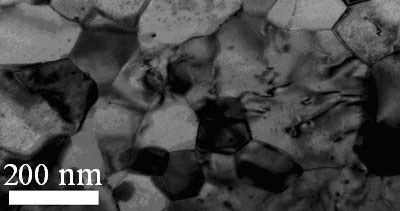
Micrograph showing grains in a half-Heusler nanocomposite. (Courtesy: Xiao Yan)

Now, Xiao Yan and colleagues at Boston College, MIT, the University of Virginia and Clemson University have used this technique on an extremely fine powder, producing a nanocomposite with the best ZT yet for a half-Heusler. The team began with a cast ingot of the half-Heusler Zr0.5Hf0.5CoSb0.8Sn0.2, which was then crushed to make a powder with a particle size between 5 and 10 nm. Heat and pressure were then applied to press the powder into millimetre-sized bars and discs. This was done very carefully to try to minimize the number of nanoparticles that fuse together to create much larger grains in the finished product.

The resulting solid had an average grain size of 100–200 nm. While this was larger than the original powder, it was about one-tenth the grain size of previous attempts at making similar materials. By measuring the thermopower of the nanocomposite along with its electrical and thermal conductivities, the team found that it had a ZT of 0.8 at temperatures of 700 °C, which is about 60% higher than the best previous value for a half-Heusler thermoelectric.

Off the gas

One reason for the high ZT was that the thermal conductivity was about 30% less than the cast ingot from which it was made. The ZT value was also boosted by a small increase in the thermopower of the nanocomposite compared to the cast ingot. Both these effects more than compensated for the small measured drop in the electrical conductivity of the material, which – all other things being equal – would have reduced the ZT.

Yan told physicsworld.com that the increased thermopower is probably caused by the preferential scattering of lower-energy charge carriers at grain boundaries, which increases the mean carrier energy in the material.

While other thermoelectric materials have ZT values greater than 1.0, these tend to operate a lower temperatures than the half-Heuslers. Other advantages of the material, according to Yan are that it has excellent thermal stability and good mechanical strength and is non-toxic and inexpensive. That could be good news for drivers. “Assuming a ZT of 0.8, gas mileage could be improved by 10%,” Yan reckons. He also believes that half-Heuslers thermoelectrics could also be used to generate electricity from heat from the Sun.

Akram Boukai of the University of Michigan in the US agrees that half-Heuslers are good candidates for vehicle-exhaust applications. “Half-Heusler materials have great potential for power generation since you can tune their electronic and thermal properties at will,” he says. Boukai, who was not involved in this latest work, adds that Yan’s research “achieves a remarkable improvement in efficiency by nanostructuring the bulk material”.

As well as optimizing the chemical composition of the half-Heusler, the team is looking at how to reduce the grain size of the pressed material. “Even lower thermal conductivity and higher ZT could be expected if grain size could be kept below 100 nm during pressing,” explained Yan.

Who is the best male tennis player of all time?

atmosphere.jpg
No, it’s not Tim Henman. (Courtesy: Wikimedia Commons)

By James Dacey

With the Swiss superstar Roger Federer looking like he may well scoop his 17th grand slam title this week at the Australian Open, it is a debate that will fill the stands in Melbourne.

In fact it’s a conversation sports lovers have all time and it usually results in heated exchanges ended by a friendship-saving “let’s agree to disagree”. And it gets even more farcical when you start comparing players from different generations: on the one hand professionalism and standards of equipment tend to increase as the years go by; on the other hand, a sportsperson is necessarily of their time and can only ever be asked to beat the opponent put in front of them.

Well, a researcher in the US has attempted to take a more scientific approach to this question for the case of tennis. Fillippo Radicchi a chemical engineering researcher at Northwestern University, Illinois, has scrutinized the results of all tennis matches played by professional male tennis players during the period 1968–2010. He has then represented these matches as basic “contacts” between “actors” in a complex network where multiple matches between the same players add weight to those specific connections in the network.

tennis network.jpg


By plugging in all the results, Radicchi has managed to rank players based on an algorithm similar to that used by Google’s PageRank in web searches. The algorithm places players in order based on their “centrality” in the complex network. And so the result is…

The number one greatest player in the history of tennis, according to this ranking, is Jimmy Connors, the American player who won 8 grandslam titles during a career that spanned from the early 1970s to the mid 1990s. Ivan Lendl and John McEnroe come in at number two and three respectively, making it an all-American top three. Meanwhile, Federer, who holds double the number of grand slams as Connors, comes in at a modest seventh place. You can see the full list here:

tennis rankings.jpg


The reason Connors topped the list is probably explained by his extremely long and successful career. “Among all top players in the history of tennis, Jimmy Connors has been undoubtedly the one with the longest and most regular trend, being in the top 10 of the ATP year-end ranking for 16 consecutive years (1973–1988),” explains Radicchi in his research paper, which has been posted on the arXiv preprint server.

Radichi also applies the same ranking algorithm to each decade independently and in this case Federer does come out top for the period 2001–2010. Likewise Pete Sampras bossed the 1990s, Ivan Lendl was the man to beat in the 1980s and Connors had his heyday in the 1970s.

So that’s it, the debate is settled? Somehow I doubt it…

The 'scandal' of the kilogram

By Matin Durrani

royalsociety1-fullwidth.jpg

With Tunisia in political turmoil, parts of Australia under water and dozens dead in a Moscow bomb blast, a meeting on SI units in the confines of the Royal Society in London might seem absolutely right at the bottom of anyone’s news agenda. Surely the conservative world of metrology, where physicists spend years sharpening up their measurements of the seven fundamental base units, is unlikely to cause much of a stir?

But the two-day meeting, which ended yesterday, did attract a dozen or so journalists, that led to reports in the Wall Street Journal, the Guardian, New Scientist and the BBC. They were no doubt attracted in part by the presence of the world’s top metrologists, but also by the meeting’s focus: to discuss whether to revamp the SI system of units so that it is based purely on the fundamental constants of physics.

The importance of the meeting was underlined by the fact that the organizers had managed to snare the UK’s minister for universities and science David Willetts, who in his opening remarks gave a good impression of at least seeming to understand what metrology is all about; he isn’t nicknamed “two brains” for nothing.

As Willetts pointed out (thanks no doubt to his speechwriters), metrology and the measurement system are important on three counts. First, it’s vital for us as consumers to be confident about what we buy – we don’t want to be ripped off at the checkout with an underweight bag of carrots or, more seriously, be given the wrong dose during radiotherapy for cancer treatment. Second, metrology is key for advanced technology – accurate timekeeping via atomic clocks has proved essential for GPS, for example. Third, and this is what the meeting was about, the work is essential if we are to define our measurement system entirely in terms of fundamental constants.

That’s the name of the game in metrology these days – finding a way of defining mass without just resorting embarrassingly, as we do now, to a lump of metal in the basement of the International Bureau of Weights and Measures (BIPM) outside Paris and saying “that’s a kilogram”. After all, periodic inspections of the lump have shown it’s been changing its mass slowly over time. As laser physicist Bill Phillips from the National Institute of Standards and Technology (NIST) told delegates during one question-and-answer session on Monday, “It’s a scandal that we’ve got this kilogram hanging around that’s changing its mass”.

In among the audience at the meeting was Physics World columnist Robert Crease from Stony Brook University in New York, who in December wrote about visiting the BIPM last autumn for what could be one of the last ever annual inspections of the kilogram. Crease was on hand to get the latest goings-on among the world’s metrology community for a feature on the redefinition of the kilogram in the March issue of Physics World magazine – so keep an eye out for that.

But redefining the kilogram is not that easy. One option is to take a large, nearly perfect silicon sphere, count how many atoms are in it (which determines Avogadro’s constant) and then multiply that number by the mass of each atom. If you’re interested, a new paper in Physical Review Letters provides the most accurate value for the Avogadro constant to within 30 parts in a billion – the result of a collaboration between eight different national metrology institutes around the world.

The other is to use a “Watt balance”, which does not require big collaborations, but is conceptually harder to understand. It involves balancing the force through a coil with the mass of an object, and then doing another bit of jiggery pokery involving the quantum-Hall effect (to measure resistance) and the Josephson junction (to measure voltage).

The plan is for the world’s metrology community – represented by the CIPM – to put forward a proposal at its meeting next October that the SI system should be revamped. That proposal will go to the organization to which the CIPM reports – the General Conference on Weights and Measures (CGPM) – which is basically a bunch of diplomats in a smoke-filled room (without the smoke). If they give it the nod, well then it’s time to rewrite the physics textbooks.

royalsociety2-fullwidth.jpg

In the current system, the kilogram, ampere, kelvin and the mole are all linked to exact numerical values of the mass of the international prototype kilogram in Paris, the permeability of the vacuum, the triple-point temperature of water, and to the molar-mass of carbon-12 respectively. The plan is to change all that so that these four units are linked to exact numerical values of the Planck constant, the charge of the electron, the Boltzmann constant and to the Avogadro constant respectively.

It’s likely that the CIPM proposal will seek to redefine the kilogram in terms of Planck’s constant when and if the experiments – the Watt balance and the Avogadro approach – come into reasonable agreement. Which they aren’t now. The metrologists clearly don’t want to play favourites regarding the technology, if only because they don’t want to get burned if one or the other doesn’t live up to promises.

As you can see, and as I soon discovered at the meeting, there’s more – much more – to SI units than meets the eye. And without wanting to steal Crease’s thunder – he’s busily putting the finishing touches to his Physics World feature on a plane back to the US as I write – I think I had better stop.

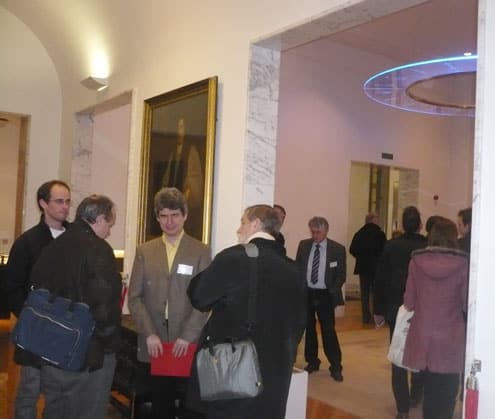
Just to say that on display in the foyer at the Royal Society are copies of what used to be known as the “standard yard” and the “standard pound” (see above), which made the venue a suitably appropriate place for this week’s meeting. I can’t help feeling, though, that despite the flaws of artefacts like the standard pound, there’s more of an emotional connection with a real object like it than a seemingly esoteric definition based on the Planck constant.

New Royal Society president explores Climategate in documentary

atmosphere.jpg
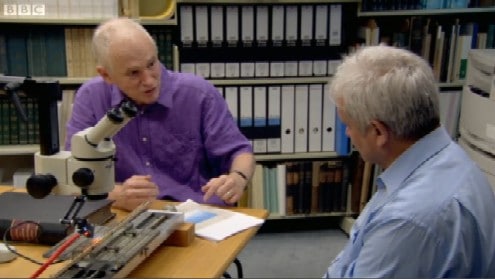
Climate researcher Phil Jones (left) discussing Climategate with Sir Paul Nurse

By James Dacey

At the end of November last year, the presidency of the UK’s Royal Society passed from cosmologist Martin Rees into the hands of the Nobel-prize-winning geneticist Sir Paul Nurse. Heading the world’s oldest scientific academy brings a responsibility to uphold the organization’s grand aim “to expand the frontiers of knowledge by championing the development and use of science, mathematics, engineering and medicine for the benefit of humanity and the good of the planet.”

And Nurse, it seems, is wasting no time in grabbing his presidency by the reigns. Last night he appeared on UK television presenting an episode of the long-standing documentary series Horizon, entitled “Science under attack”. The hour-long show explored the public’s relationship with science, as influenced by the media, and it focused primarily on climate science and the rise of public scepticism.

Towards the beginning of the show, Nurse cited a recent poll that found nearly half of people in the US, and more than a third of Britons, believe that manmade climate change is being exaggerated. “It’s this gap between scientists and the public that I want to understand,” proclaimed Nurse, teeing up the show.

For the next 50 minutes or so, Nurse then visited a selection of players on either side of the debate. It was framed within the narrative of a personal journey: an eminently reasonable scientist who knows lots about the process of science but not the specifics of climate science. And to his credit, Nurse played his part exceptionally well, showing that science involves personalities and conflicts just like any other human activity.

Naturally, the show came to focus on “Climategate”, the controversy that erupted in November when internal e-mails between members of the Climate Research Unit at the University of East Anglia, UK were leaked to the public. The main controversy blew up around an e-mail sent by the then CRU director Phil Jones to a colleague in which he referred to “Mike’s Nature trick”, describing the splicing of temperature data from direct and indirect sources.

“The [World Meteorological Organization] wanted a relatively simple diagram for their particular audience,” Jones explained to Nurse. When asked why he thought there had been such a huge reaction to the leaks, Jones is obviously still perplexed. “A number of the climate change sceptics or doubters or deniers, whatever you want to call them, just wanted to use these e-mails for their own purposes, to cast doubt on the basic science.”

Following his visit to UEA, Jones then paid a visit to a person firmly on the other side of the debate, James Delingpole, the online journalist who broke the “Climategate” story on his Telegraph blog. This led to the most captivating scene of the documentary when Nurse puts it to Delingpole that denying climate change is like ignoring the consensus medical view when choosing how to treat cancer.

Asking Nurse to change the topic, Delingpole retorts, “I think it’s very easy to caricature the position of climate change sceptics as the sort of people who don’t look left and right when crossing the road.” Adding that he “slightly resented” the way the analogy had been brought in.

UK viewers can watch the documentary at this link.

Exciting structures

Mark Denny’s latest book, Super Structures, is designed to help non-scientists share and enjoy the way that we scientists view and think about the world of physical structures. My first step in reviewing it, therefore, was to try it out on my non-scientist friends. Without exception, they were intrigued and wanted to read more.

The book is organized in a logical way, from basic theory to applications, and benefits from the author’s decision to focus on just one structural element: the truss. This is not, as Denny points out, a medical device, but an arrangement of beams and struts designed for mechanical stability. Concentrating on the truss is a neat idea, and it works. In the design of different types of truss, the balance of tensile and compressive forces that underlies successful structural engineering is seen at its simplest and most understandable. The author takes full advantage of this simplicity by first describing the balance of forces and then showing how it can be used to understand the stability of structures that range from Moorish arches and the Eiffel Tower to massive concrete dams.

In addition to these lofty structures, Denny also uses homelier illustrations to drive home his points. He describes, for example, the annual “spaghetti bridge” competition run by Johns Hopkins University, in which competitors build bridges from sticks of dry spaghetti glued together. The bridge that supports the greatest load is the winner, while, to make things more difficult, the bridge itself must weigh no more than 750 g. One recent winner designed a bridge on the truss principle that supported an impressive 56 kg, but this was far from a record: in a worldwide competition run by Okanagan College in British Columbia in 2009, a spaghetti bridge designed by the Hungarians Aliz Totivan and Norbert Pozsonyi supported a load of 443 kg despite weighing less than a kilogram itself.

Such illustrations catch the eye, but they do not really stand comparison with the masterly descriptions in J E Gordon’s Structures: Why Things Don’t Fall Down. Published in 1978, Gordon’s book set the benchmark for books on structural engineering, and few popular-science or engineering writers have yet matched his prose style. Consider Gordon’s description of the stresses in a pressure vessel: after explaining that in the wall of a cylindrical pressure vessel, the circumferential stress is twice the longitudinal stress, he notes that “One consequence of this must have been observed by everyone who has ever fried a sausage. When the filling inside the sausage swells and the skin bursts, the slit is almost always longitudinal.” It is a lovely example – simple, easily understood and vivid.

What Denny’s book lacks in this respect, however, it at least partly makes up for through its relative abundance of illustrations. These add considerably to the interest and clarity of the book, and encourage the reader to look at structures in a new way, recognizing that aesthetics resides as much in the balance of forces as it does in the actual shape. My favourite illustration (as a diagram accompanied by a practical example) shows how two barrel vaults intersect to give an intrinsically stronger groin vault – something that is not easy to put into words.

The real point of the book is to get the non-scientific reader thinking about structures in a new and scientific way. The profusion of illustrations certainly helps, and so does Denny’s undoubted mastery of the short description (even if it never quite rises to Gordon’s level). Almost every paragraph contains some point of interest that encourages the reader to keep reading, no matter where the book may have fallen open.

I confess to finding Denny’s approach somewhat patronizing at times. At the start, for example, I did not need to be told that the author “hope[s] that the title, Super Structures, gets across the subject that we will tackle”. However, non-scientists to whom I have shown the book have been impressed by its clear simplicity. Above all, they have been pleased by the absence of equations, which are confined exclusively to an appendix. Equations, it seems, are still a barrier to sales.

To his credit, Denny does a lot to overcome their absence by getting the reader to consider the balance of forces in a visual, “back of the envelope” way, and presents many interesting examples that are designed to get readers thinking. He points out, for instance, that if we could fit the Eiffel Tower neatly into a giant cylindrical box, the air in the box would weigh more than the tower. This example, as with many of his others, may be familiar to scientists and engineers, but to my non-scientist friends they were an exciting and original revelation.

Ultimately, books intended to make science and engineering more accessible have their greatest value when they not only explain the basic ideas and their applications, but also share the satisfaction and excitement that we scientists gain from understanding how things work. This is true whether those things are physical structures, biological organisms or the universe itself. If we are to succeed in making science an integral part of our wider culture, then we need more books that perform this task. Denny’s new book is perfused with this sense of excitement, which adds greatly to the enjoyment of reading it. On this account alone, as well as the clarity with which it is written, it is to be recommended.

Holographic video comes up to speed


Researchers at Massachusetts Institute of Technology (MIT) have demonstrated the highest frame rate yet for a dynamic hologram that can recreate evolving 3D scenes. The breakthrough means that holographic television is now tantalizingly close to industry frame rates at a time when 3D cinema is fully back in vogue.

A big appeal of holograms over established 3D image projection is that the viewer can see the effect unaided. They do not need to wear special glasses where each lens creates a slightly different image by letting through light polarized in different directions. Instead, holographic displays emit light in such a way that it produces many perspectives that allow the viewer to see the “object” from multiple angles.

In November, a group of researchers based at the University of Arizona and Nitto Denko Technical Corporation in California made the headlines when they unveiled the world’s first “telepresence” system capable of reproducing a changing 3D scene every 2 seconds. The system worked by surrounding an object with 16 cameras and writing these images into a polymer-based screen, which can project when illuminated with LEDs.

Filming deep scenes

Now, a group at MIT’s Media Lab under the leadership of Michael Bove Jr has raised the bar once again by creating a system that can reproduce a 3D scene 15 times every second. And the MIT system uses a novel design that only requires one camera – a commercially available range-finding camera that can record both the luminance and depth of a scene.

Bove’s team takes this footage and sends it via the internet to a PC that has been fitted with three graphics processing units. The units have been programmed with an algorithm that can compute the diffraction patterns needed to reproduce the moving 3D images. These patterns are then recreated on a projection screen using arrays of components known as “wafels”, which can control the intensity of light emitted in all directions.

Bove tells physicsworld.com that, having only started developing the latest version of the technique during the week after Christmas, the research has progressed at breakneck speed. “It was literally only last Wednesday that we managed to improve the performance from 7 frames per second to 15.” He says that he is confident that his team can boost this rate even higher to the 24 frames per second of feature films or the 30 frames per second of television.

Webcam hologram

Bove believes that, within the next few years, his group’s method of creating dynamic holograms could become available commercially at the scale of standard laptop screens. It could be used by scientists and other professionals to visualize data in 3D, as well as for communications and videogaming. “There’s something very compelling for me about the idea of having a hologram coming out of a computer, with images coming via webcam, for instance,” he says.

The group is looking to develop alternative versions of the diffraction screen at lower costs, and is seeking to design a laptop-scale screen that retails at around $200 (approximately £125). More difficult, however, will be scaling up the devices to the size of cinema screens, because it is difficult to generate complicated diffraction patterns on larger scales.

The idea of real-time telepresence has captured the imagination ever since the 1970s when the special effects used in the first Star Wars film included a hologram of Princess Leia making a distress call after her ship had fallen under attack by the Empire. Bove and his team recreate this scene in a demonstration of their technology, as can be viewed in the video above.

Bove is currently presenting his group’s holography system at Consumer Electronics Show, which is taking place this week in Las Vegas, US.

Physicists assemble spin ensemble


An international research group claims to have taken an essential step towards silicon-based quantum computing by entangling 10 billion identical quantum bits, or “qubits”, inside a silicon crystal. This is the first time that “ensemble entanglement” has been demonstrated in a solid-state device, they claim.

Where conventional computers store data as “bits” with value 1 or 0, in quantum computing data is stored as “qubits”, which can hold more than one value at the same time. Qubits are quantum states stored in photons or particles that can become “entangled” with other quantum states, allowing them to transfer information instantaneously regardless of their separation distance.

The upshot is that quantum computers could potentially store and process huge amounts of data at unprecedented speeds. This could enable them to tackle problems beyond the scope of even the most powerful modern computers, including simulating complicated biological processes and strange phenomena from the quantum world itself.

One promising approach to quantum computing is to dope silicon with impurities, which can donate single electrons to the silicon. In this way, quantum information can be stored in the spin state of both the electrons and the dopant nuclei and these particles can be entangled to become qubit pairs. A big advantage of this approach is that silicon is already used by the computer industry so many of the manufacturing processes are already in place.

High fidelity

Stephanie Simmons at the University of Oxford and an international team have now demonstrated the principle of this approach by producing qubits by doping a silicon crystal with phosphorous atoms. By cooling their material to 3 K and exposing it to radio and microwave pulses, Simmons and her colleagues were able to create 1010 pairs of entangled electrons and phosphorous nuclei in what they call a “spin ensemble”. They confirm the entanglement to a fidelity of 98% through the emission of microwaves from the silicon crystal.

“We are effectively creating billions of copies of the same quantum information where all spins behave in the same way,” Simmons told physicsworld.com. She says that part of the advantage of creating so many copies is to amplify the quantum information to make it easier for researchers to confirm that the particles are in fact entangled.

Jeremy O’Brien, a quantum information researcher at the University of Bristol, agrees that this is an important development. He adds that it will be important to demonstrate the same capability with a single phosphorous nuclear-electron spin system. “Individual control and readout will be essential to quantum computing, as will the ability to entangle many spin systems with one another,” he says. “You want the state of one spin system to affect the state of another to be able to really harness the power of quantum computers”.

Simmons says that her group is currently investigating ways of transporting information and that one approach is to send controlled electric pulses through the material to physically move electron qubits. She says that she is personally motivated by the possibility of quantum computing and the improved efficiency it could bring to scientific studies such as the study of protein folding – a key process is many biological interactions.

This research is published in Nature.

Copyright © 2026 by IOP Publishing Ltd and individual contributors