The secret lives of photons revealed

An international team of researchers has, for the first time, mapped complete trajectories of single photons in Young’s famous double-slit experiment. The finding takes an important first step towards measuring complementary variables of a quantum system – which until now has been considered impossible as a consequence of the Heisenberg uncertainty principle.

In the double-slit experiment, a beam of light is shone onto a screen through two slits, which results in an interference pattern on the screen. The paradox is that one could not tell which slit single photons had passed through, as measuring this would directly distort the interference pattern on the screen. “In most science, it is possible to look at what a system is doing presently and so, determine its past or future. But in quantum mechanics, it is considered inconceivable to consider the past at all,” says physicist Aephraim Steinberg of the Centre for Quantum Information and Quantum Control at the University of Toronto, Canada who has led this new research.

Now, using a technique known as “weak measurement”, Steinberg and his research team say they have managed to accurately measure both position and momentum of single photons in a two-slit interferometer experiment. The work was inspired by one of Steinberg’s colleagues, Howard Wiseman of Griffith University, Australia, who in 2007 proposed that it may be possible to use weak measurements to determine momenta and positions in the double-slit experiment. Steinberg was immediately fascinated and began to see how this would become experimentally viable.

Catching a glimpse

The theory of “weak measurement”, which was first proposed in 1988 and developed by physicist Yakir Aharonov and his group at Tel Aviv University, Israel, has seen a fair amount of interest in recent years. The theory states that it is possible to “weakly” measure a system and so gain some information about one property without appreciably disturbing the complementary property and so the future evolution of the entire system. Though the information obtained for each measurement is minimal, an average of multiple measurements gives an accurate estimation of the measurement of the property without distorting its final outcome.

In their experiment, the researchers sent an ensemble of single photons through a two-slit interferometer and performed a weak measurement so as to imprecisely measure the momentum of each photon. This was done using a piece of calcite, which serves as a polarizer. Depending on the direction of propagation, each photon is differently polarized and the direction is measured as a function of position. This was then followed by an extremely accurate measurement of the final position of where each photon hits the “screen”, which in their case was a camera. By combining the positions measured imprecisely at multiple points and the momentum precisely measured at the end for each photon, the researchers were able to accurately construct an entire flow pattern for the photons.

“This weak momentum measurement does not appreciably disturb the system, and interference is still observed. Both measurements had to be repeated on a large ensemble of particles in order to gain enough information for the whole system, but we did not disturb the outcome at all,” explains Steinberg. “Our measured trajectories are consistent, as Wiseman had predicted, with the realistic but unconventional interpretation of quantum mechanics of such influential thinkers as David Bohm and Louis de Broglie.”

The single photons they used in the experiment were emitted by a liquid-helium-cooled InGaAs quantum dot that is optically pumped by a laser; this was specially developed at the National Institute for Standards and Technology in Colorado, US. The dot then emitted single photons at a wavelength of 943 nm.

Past, present and future

The double-slit experiment heavily influenced the principle of complementarity devised by Niels Bohr. Complementarity states that observing complementary variables, such as the particle-like trajectories and the wave-like interference in the double-slit experiment, depends on the type of measurement made – the system cannot behave as both a particle and wave simultaneously. Steinberg’s recent experiment suggests this does not have to be the case – the system can behave as both.

So would either Einstein or Bohr be pleased or surprised that this seemingly impossible measurement has been made? “Well, I don’t think that Einstein would be surprised at all! But at the same time I do not think that this would make him more comfortable with the quantum mechanics of single systems,” says Steinberg, explaining that Einstein was eager to accurately measure all the parameters of a single quantum system, something that we are not capable of just yet. “Bohr is a different matter, I doubt that his contemporaries even understood exactly what he was trying to say,” says Steinberg. “But maybe this measurement would make him [Bohr] slightly more careful with his language while talking about complementarity.”

The research is published in Science 332 1170 .

Cool microscope feels the heat

Physicists in Germany have invented a new kind of microscope that uses a gas of extremely cold atoms to map the surface of nanoscale structures. The researchers say that their device is complimentary to atomic-force microscopes (AFMs) and that they ultimately hope to create a probe with precision that is limited only by fundamental quantum uncertainties.

AFMs work by running a tiny tip attached to a cantilever arm along the surface that needs to be imaged. As the tip moves up and down in response to the changing contours below, the cantilever is deflected and these movements are measured by a laser beam that is bounced off the cantilever. Finally, a plot of the laser deflection against tip position generating a map of the surface.

The latest device, built by Andreas Günther, József Fortágh and colleagues at the University of Tübingen, uses a gas of cold atoms rather than a solid tip to map surface contours. Objects selected for imaging are mounted onto a chip, which is placed above a sapphire substrate. The object and substrate are then sandwiched between networks of gold wires that generate a 3D magnetic field. Suspended within the field is a cloud of rubidium atoms, thanks to the fact that rubidium is paramagnetic, and then the field is adjusted so as to lower the atoms just above the objects under study.

Atoms ejected

As the cloud is scanned along the chip, a laser beam is shone through the atoms and the absorption of the beam is measured. With the atoms held at a temperature of less than 1 µK and the objects existing at room temperature, any contact between the two will impart a huge energy to the atoms, causing them to be ejected from the cloud. So as the gas moves along the surface, any reduction in absorption reveals the atoms, leaving the gas and therefore the presence of a surface.

Günther and co-workers used the “cold-atom scanning-probe microscope” to image a single carbon nanotube, with a diameter of several tens of nanometres, surrounded by other nanotubes arranged in a rectangular shape. They carried out the observations in both contact mode, measuring the loss of atoms from the cloud, and in dynamic mode, in which variations in the oscillation frequency of the centre-of-mass of the cloud reflect the changing contour below. They also performed the imaging with the gas both as a classical, or “thermal”, entity, and as a “Bose–Einstein condensate”, which is formed when identical atoms with integer spin are cooled until all of the atoms occupy the same quantum state. They found that they could achieve higher spatial resolution when the atoms existed as a condensate, partly because this enabled them to make the cloud smaller.

The researchers point out that because the microscope cannot reveal details smaller than the scale of the atom cloud, its resolution is at the micron scale, 1000 times higher than that of an AFM whose tips consist of a single atom. But they believe that the two kinds of microscope are complimentary, with AFMs imaging details closer to the surface and the cold-atom device able to measure forces further from the surface. This, they say, could enable the measurement of magnetic fields above nanoelectronic components in order to characterize the current flow in these devices. Alternatively, the microscope could be used to characterize various properties such as van der Waals forces of carbon nanotubes when they are used in biosensors to capture certain biological molecules.

Exploiting quantum properties

The next major step in the development of the microscope, says Fortágh, is to try and exploit the potential of the gas as a Bose–Einstein condensate.” In this latest research we used the condensate to reduce the size of the cloud,” he says. “But we didn’t exploit the quantum mechanical properties of the condensate.” He wants to use the quantum probe to make quantum-limited measurements, which are never possible in a classical system because of decoherence. He estimates that further reductions in the size of the cloud over the next 5–10 years might bring the resolution of the new microscope close to that of an AFM.

Martin Breitschaft of the University of Augsburg in Germany describes the latest work as “very intriguing”. He points out that the research could lead to improved designs of tips used in conventional scanning probe microscopes. These probes are often made by carving them out of bulk materials in a time-consuming process where the structure of the resulting tips is often poorly known and sometimes dominated by impurities. “Because the probe in the latest work is built up artificially from scratch, this or similar techniques might eventually enable the systematic design of probes with predefined microscopic properties,” he said.

The research has been published online on Nature Nanotechnology.

Silicon nanopillars steer infrared light

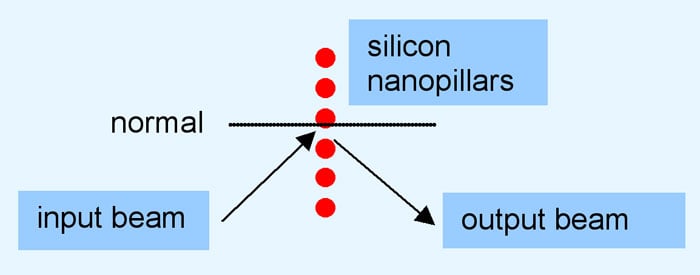
Theorists in China and the US claim that infrared light shone onto a line of silicon nanopillars can be bent by 90° as it travels through the material – without being reflected at all. This finding, if confirmed experimentally, would offer a novel approach to optical beam steering, which usually requires specially crafted “metamaterials”. The researchers say that the line of pillars could be used to bend beams of light in photonic circuits, possibly helping to steer light inside the components used in optical networks.

Junjie Du of the Chinese Academy of Sciences in Shanghai and his colleagues have considered the consequences of shining infrared light at two specific wavelengths – 1550 nm and 2362 nm – onto a line of 15 nanopillars at an angle of 45°. All of these half-micron-wide pillars are made from silicon, rather than the metal components typically found in metamaterials, because absorption losses are lower.

Resonating pillars

According to the researchers, each pillar will resonate when excited by infrared light to set up a standing wave inside it. The precise wave pattern is determined by the wavelength that the incident light has in silicon, which is about one-third of its value in air. Each pillar essentially behaves like an antenna, absorbing light and re-emitting it in a form possessing the symmetry of the standing wave inside the cylindrical nanostructures, with the light from the pillars interfering constructively or destructively, depending on the direction of the incident light.

Du’s team found that the pillars resonate like an electric dipole when excited by infrared light at 1550 nm. As the pillars are arranged in a line, emissions from each dipole interfere constructively when light of this wavelength is used and a single beam of light emerges from the same side of the normal as the incoming beam in what is known as negative transmission.

When 2362 nm light hits the line of silicon nanopillars, an isotropic standing wave is formed and radiation exits in four orthogonal directions. In contrast, working at a wavelength of 1550 nm creates a dipole symmetry in the pillars that completely suppresses the incident beam and its reflection – that is, the only beam transmitted is at right angles to the incident one and it is negatively refracted. “The outgoing beam makes a sharp turn and lies on the same side of the normal as the incident beam,” explains Du. “At the same time, the conventional reflected and transmitted beams disappear.”

Practical benefits?

Several technologies have already been proposed for steering light beams through photonic circuits. Two options are flat dielectric gratings and vastly scaled-down versions of a Yagi–Uda antenna, an aerial popular with amateur radio enthusiasts. However, Du says that the fabrication of both of these structures is challenging as they contain many elements of different sizes. Producing a nanopillar array is relatively easy, because each pillar has the same radius.

Another steering option is to use photonic-crystal structures, which guide radiation using an array of small holes with diameters similar to the wavelength of light in free space. However, Du believes that nanopillars have the upper hand, because light guiding is possible with arrays that contain fewer elements.

The team is now putting its theory to the test with an experiment involving 4 μm-high silicon pillars. “We are also planning to further explore the role of symmetry in other resonance modes to manipulating the optical beam,” says Du.

The research is published in Physical Review Letters.

A scientist, not a cartoon

Since his death in 1988, Richard Feynman has become something of an industry. In addition to several biographies, there are published collections of Feynman’s essays and lectures, including just about every scrap of paper he ever scribbled on. Much of this presents an image of the man as bongo drummer, player of practical jokes and major-league womanizer, who somehow turned out groundbreaking science in his spare time. But let’s face it: when it comes to Feynman’s personal life, we really do not know what to believe. Murray Gell-Mann, Feynman’s long-time colleague at the California Institute of Technology, once famously grumbled that Feynman “spent a great deal of time and energy generating anecdotes about himself”. Most of his adventures do little, if anything, to illuminate Feynman the physicist.

In Quantum Man: Richard Feynman’s Life in Science, the scientist, science writer and eminent spokesman for science Lawrence Krauss focuses on Feynman’s research, thus providing a much-needed corrective to this caricature. What emerges is a portrait of a man who worked long hours to understand physics. Physics was Feynman’s heart and soul, and Krauss has done a superb job of showing this in his book, taking us through Feynman’s oeuvre as if teaching a masterclass.

What has always interested me about Feynman was his creative power as a problem solver, which Krauss astutely describes. His keen intuition was honed by considering problems from many different angles, and from making mistakes and learning from them, instead of being discouraged – all hallmarks of high creativity. Again and again, what jumps off the page is Feynman’s keen eye for spotting what is a fundamental problem, and his single-minded concentration on solving it. This required great powers of compartmentalization, which involved blocking out of his mind anything and anybody other than the problem he was working on. As his second wife put it during their divorce proceedings, “He begins working calculus problems in his head as soon as he awakens. He did calculus while driving his car, while sitting in the living room and while lying in bed at night.”

Krauss argues persuasively for the importance Feynman placed on experimental data at every stage in his theoretical work. However, I must disagree with his claim that Feynman was unmoved by considerations of beauty, or that data were all that mattered. In 1957 Feynman and Gell-Mann worked out a theory of the weak interaction that conflicted with key experimental data. Feynman insisted, along with Gell-Mann, that the data were wrong: “There was a moment when I knew how nature worked. [Our theory] had elegance and beauty.” The experiment was redone and the data indeed turned out to have been wrong. This was a bold move with few precedents, although Einstein, with a similar aesthetic bent, had asserted in 1907 that data conflicting with the special theory of theory of relativity were incorrect. He was right too.

This approach was Feynman’s route to his first and greatest breakthrough in 1948, when he developed a theory of how light interacts with electrons, known as quantum electrodynamics (QED). This theory agreed with relativity and led to no infinite quantities: it contained only the finite measured experimental values for the electron’s charge and mass. Here, Feynman’s use of his signature “path-integral formalism” was crucial, and it ran through many of his other important insights like Ariadne’s thread.

As a graduate student at Princeton in the early 1940s, Feynman had gleaned the importance of this formalism from a 1933 paper by Paul Dirac, but Dirac drew no pictures. Feynman did, and his famous “Feynman diagrams” subsequently became part of the language of physics. They have achieved iconic status, decorating T-shirts and being emblazoned on Feynman’s own van. How Feynman discovered the diagrams that bear his name, though, has not always been clear. Based perhaps on physics “mythology”, Krauss writes that the “first Feynman diagram in print was actually [Freeman] Dyson’s”, referring to a 1948 paper by Dyson. But in fact, something very like a Feynman diagram had appeared five years earlier in a widely read book by Gregor Wentzel, then at the University of Zurich, entitled Einführung in die Quantentheorie der Wellenfelder [Introduction to the Quantum Theory of Wave Fields]. I give the German title because this is the version Feynman referred to in his 1949 paper “The theory of positrons”, citing it for a technical point concerning second quantization.

I came across Wentzel’s diagram in 1981, while researching the concept of visual imagery in quantum physics. In his book, Wentzel presented it as a didactic device to depict how neutrons and protons might interact by exchanging a charged meson. Also, in 1948, his book had not yet been translated. Yet even if Feynman could not read German (and I wager he could not), he may have seen Wentzel’s diagram, become curious and stumbled through Wentzel’s description of it. In this way, he may have had an epiphany: the way to give visual imagery to the mathematics of his version of QED. Certainly, his manuscripts indicate that this was what he was searching for. Alas, although I corresponded with Feynman, somehow I never asked him about Wentzel’s diagram and so this tantalizing episode remains unresolved.

Krauss writes insightfully about Feynman’s dissatisfaction with his renormalized version of QED. Rather than solving basic issues, Feynman believed it merely swept them under the rug by subtracting infinite quantities to produce finite ones. QED turned out to be valid up to a certain scale (distances greater than the electron’s Compton wavelength, 2.43 × 10–12 m); owing to this restriction physicists refer to it as an “effective theory”. Although string theory avoids the infinities involved in renormalization, Feynman disliked it because of the vague way it interpreted the necessary extra six or seven dimensions (in addition to the four dimensions we experience) and, as one would expect of him, its lack of contact with experimental data.

Feynman’s influence went far beyond physics per se, Krauss reminds us, extending into biology, physics education, nanotechnology and computer science; and into ingeniously ferreting out the cause of the Challenger space-shuttle disaster in 1986, two years before he died. He was always on the lookout for fresh fields with new problems to solve. “For a fearless and brilliant adventurer like Richard Feynman,” writes Krauss, “this was the reason for living.” In his book Krauss brings Feynman’s adventures in physics brilliantly to life, with never a bongo drum in sight.

3D TV without glasses

“Wow, that’s amazing” was at least one visitor’s reaction to last year’s Summer Science Exhibition at the Royal Society in London. Their enthusiasm was not primarily due to the presence of the Queen, who had earlier opened the exhibition as part of the society’s 350th anniversary celebrations. Rather, their excitement was down to the latest liquid-crystal displays on show from Sharp Laboratories in Oxford. Viewers were able to watch moving images in 3D on a laptop – without the need for special glasses. They could see pigeons being fed in St Marks Square, Venice, with the birds apparently descending from their shoulders, or they could indulge in a 3D adventure as they pursued the bad guys in the interactive computer game Quake.

The glasses-free 3D display on show at the Royal Society was just the latest example of the revolution wrought by liquid-crystal displays, which now allow moving images to be viewed on everything from mobile phones and 46-inch flat-screen televisions to hand-held personal electronic games and the iPad and other tablet devices. Yet it is amazing to think that it is only 40 years since the key patent was filed that marked the birth of the modern liquid-crystal display – a technology so successful that its acronym, LCD, is instantly recognized even by non-scientists. Although organic light-emitting diodes (OLEDs), plasmas and “electronic ink” are also changing the nature of the modern display, it is the remarkable properties of liquid crystals that are now at the forefront of 3D display technology.

Imaging in 3D

Watching images in 3D without glasses is a truly astounding experience, but let’s first look at how this fits in with other 3D imaging techniques. There are three main techniques – stereoscopic, holographic and volumetric – all of which operate on the same principles regardless of whether the screen uses liquid crystals, plasmas or OLEDs. They each have advantages and disadvantages in terms of realism, complexity, size and cost, but the most commercially viable method, which is used in the bulk of the 3D televisions taking the high street by storm, involves showing a different perspective of an image to each of our eyes. This “stereoscopic” technique mimics the real world, where each eye sees a different perspective and the brain “fuses” the two images together to create a 3D perception of the surroundings (figure 1a).

The task of separately displaying images to the left and right eye has been tackled in a variety of ingenious ways over the years. Trialled at cinemas as far back as the 1950s, the approach that many people will be familiar with involves the user wearing glasses with separate red and blue coloured lenses on the left and right eye, respectively. The idea here is that an image is split into red, green and blue channels, with the left eye seeing only the red image and the right eye seeing only the green and blue images.

More recent systems do away with coloured lenses and instead use glasses that alternately transmit and block light to each eye. In other words, the lenses act as “optical shutters” so that at any one moment one eye can see a still image, but the other cannot. If we label the successive still images of a movie L1, R1, L2, R2, L3, R3 and so on, then the left eye sees only the “L scenes” and the right eye sees only the “R scenes”. These glasses require various bit of electronics to make them work, while the scenes themselves are updated at frequencies of typically 120 Hz or 240 Hz. (An alternative approach – common with projection screens found in pubs to watch sport on – is for the L and R scenes to be displayed with different polarizations, which requires the user to wear dark glasses containing lenses with different polarizations.)

The images produced using this stereoscopic approach can jump out of the screen with surprising realism. However, stereoscopic images are not perfect because all objects in them are in focus, regardless of their intended 3D position. In the real world, in contrast, different depths of a 3D image are in focus at different positions. One technique for creating 3D images that does deal with focus correctly is holography (figure 1b). Holograms are created by recording in a photosensitive material the interference pattern created when coherent reflected light from an object overlaps with a coherent reference beam of the same wavelength. The pattern is stored as a change in absorption, refractive index or thickness of the photosensitive material and a copy of the object can be recreated by illuminating the pattern with a read-out laser. A 3D hologram is essentially like having a stack of high-resolution 2D pictures, where each picture represents a different image plane.

The big advantage with a 3D hologram is that a viewer’s perception of three-dimensionality is total because to change from looking at an object near the front of the scene to an object at the back, the viewer needs to adjust their eyes’ focus. Unfortunately, creating and controlling optical wavefronts with sufficient precision to generate realistic holographic images requires displays with pixel densities typically thousands of times higher than are found in today’s commercial LCDs, as well as prodigious amounts of computer processing power to handle the volumes of data needed. So although their images are superior, further technical innovation is still required before holographic displays become a commercial reality.

Stereoscopy, in contrast, relies on the fact that our brains are good at deducing depth from our right and left eyes having different perspectives of an image. In practice this means that a stereoscopic display can create a 3D image using only twice the amount of data that a “normal” display needs to make a 2D image, which is why they are proving so commercially promising.

The third approach to making 3D displays is to do away with conventional 2D pixels arranged in a plane and instead use 3D, volumetric pixels, or “voxels”. One way of creating such voxels is to use projectors shining at a spinning screen (figure 1c). By synchronizing the projectors with the screen, light can be reflected off the screen at any position within the cylindrical volume that it sweeps out. Although volumetric displays can create a strong 3D impression, one snag is that the light projected into the volume of the display is free to propagate throughout this space. This can make items transparent, with objects supposedly hidden behind others tending to “shimmer through” those in front. Volumetric displays also tend to be fairly bulky.

Glasses-free stereoscopy

So far we have described glasses-based stereoscopic 3D displays, but what everyone wants is to do away with the glasses altogether. This is an active area of research being pursued by probably every major displays company and from which new consumer products are now starting to emerge. Nintendo, for example, has already released its glasses-free Nintendo 3DS games console, while 3D mobile phones are available from Sharp.

All such glasses-free displays are based on stereoscopy and the challenge is to ensure that different images are directed to each eye. There are three main methods of achieving this, each of which has its own advantages and disadvantages depending on what it might be used for. The most common approach is where the user has to sit in a fixed position in front of the screen, and this is used, for example, on the Nintendo 3DS, Sharp’s LYNX 3D SH-03C mobile phone and in the display on the back of Fujifilm’s W3 3D camera. The next approach involves the display tracking the viewing position of the user, and although there are currently no products using this currently on the market, prototype designs have been shown at industry exhibitions in recent years. The final tack is “multi view”, which is already found in some glasses-free 3D televisions, although they have not made big inroads into the market as yet partly because it is not easy to generate multi-view 3D without changing broadcasting standards.

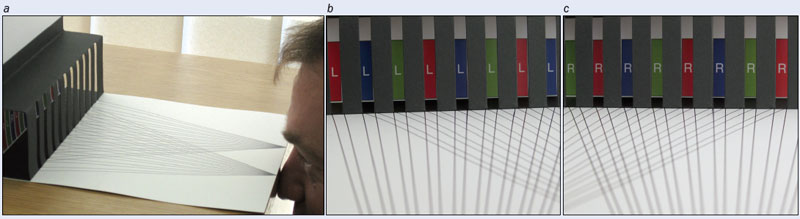
The “fixed-position” method assumes that the user views the display head-on so their gaze is at 90° to the display itself (figure 1a) – an assumption that is valid for most mobile devices. The image is separated into tiny stripes L, R, L, R, L, R, with all the L images being sent to the left eye and all the R images being sent to the right eye by means of a physical device known as a “parallax barrier” (figure 2). This technique, which has been known for almost 70 years, could of course be applied to any images – be they photos or paintings – not just an LCD display, provided of course that the left and right images can be interlaced into left and right image stripes to work with the parallax barrier.

A disadvantage of the parallax barrier is that because each eye is allowed to see only half the pixels, light travelling in the “wrong” direction – i.e. from an L stripe to the right eye or from the R stripe to the left eye – is absorbed by the barrier. This cuts the intensity from the display by about half and reduces the resolution. In practical terms, this means that when the display is being used in conventional 2D mode, the parallax barrier should be removed. In most 3D displays, such as Sharp’s 3D mobile phone, this is achieved by making the barrier from a liquid-crystal layer that can be turned on or off electrically.

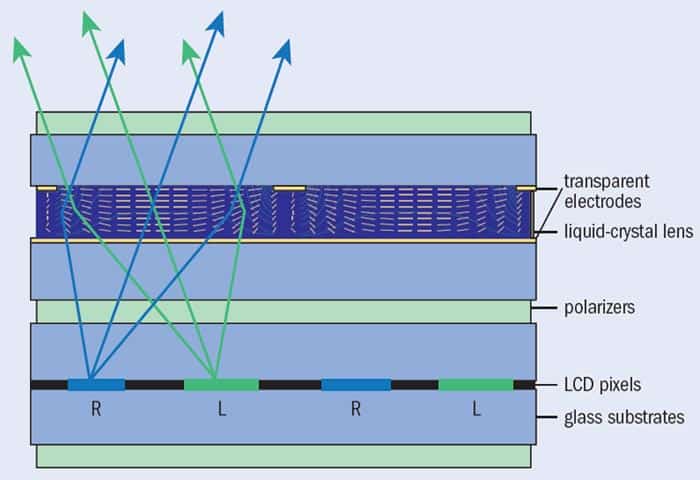
It would of course be much more efficient to dispense with a parallax barrier and instead use lenses, which are transparent, to redirect the L and R light to the appropriate eye. Indeed, researchers have already developed high-quality cylindrical lenses using liquid crystals that can do just that. The principle is simple: as the refractive index of liquid crystals varies with voltage, lenses made from these materials can be turned “on” when a voltage is applied and “off” when the voltage is removed. These cylindrical liquid-crystal lenses take the place of the parallax barrier, redirecting the light in the correct direction (figure 3). This technology is likely to double the efficiency of glasses-free 3D displays in the future, with many companies known to be actively carrying out research into them.

One drawback of parallax technology is that the user has to sit in a certain position relative to the screen. The “tracked viewing position” technique, in contrast, allows 3D screens to be viewed without glasses from any angle by tracking the user’s head position. This could be achieved by, for example, fitting a laptop with a forward-facing web camera to identify the location of the user’s face and eyes. Indeed, this technology is already common in many digital cameras sold on the high street to ensure that a face automatically becomes the centre of focus. All that is then needed for glasses-free 3D viewing is an automatically adjustable parallax barrier that can change the angle at which the left and right images are seen. The camera can then identify the position of the user, while the parallax barrier directs the left and right perspectives at the appropriate angle.

This adjustment can be carried out using face-tracking algorithms written onto image-processing chips, which operate very efficiently, meaning that not too much processing power is required. The camera can also monitor how far a user is sitting from the screen and adjust the images accordingly. In practice, the viewer can move up to 30 cm from the ideal viewing distance, while their side-to-side movement is limited to about ±30° from the normal. Accommodating more than one user is in principle possible, but the complexity of the system is significantly increased. In addition to the viewer being free to move around, the other advantage of the tracked-viewing-position system is that if the image happens to be from a computer-generated scene, the viewpoint could be adjusted according to the user’s position. For example, a viewer could literally look around the side of an object (a cube say) to bring previously unseen faces of it into view.

As for the third method for generating glasses-free 3D – multi-view – its goal is to work with a wide range of viewing positions and multiple viewers. To do this the display outputs not just two perspectives but typically eight or more. The user can then position their eyes to see perspectives 1 and 3, or 2 and 4, etc, so the 3D effect can be achieved from a wide range of angles. A multi-view system with, say, eight views requires eight times greater resolution than a 2D system, and some ingenuity is required to synthesize the eight views or transmit them in the available television bandwidth. Nevertheless, this technology is probably the strongest contender for glasses-free 3D television, with Philips and Toshiba both having already launched a multi-view television onto the market.

Fast forward

As we have discussed, Sharp has already designed and built a liquid-crystal screen on one of its mobile phones that functions as a switchable parallax barrier. Used in tandem with a conventional liquid-crystal display provided with stereoscopic input data, this system gives high-quality glasses-free 3D images. However, the electronic media industry has a vision of the future in which 3D displays are not just a niche product but an integral part of modern life. That means home-cinema systems showing 3D movies, computer games being played with an immersive 3D environment, and holiday photographs being presented with depth.

We can therefore expect a variety of 3D generation methods to become available for the different applications, and within each method we can expect improved optical technologies, and new related technologies such as those enabling 3D interaction. It is highly probable that all such devices will exploit the particular electro-optical properties of liquid crystals. The products on display at the Royal Society exhibition last summer, which are already coming on the market this year, are just the start.


Templeton caption competition

Templeton Prize HRH & Martin Rees.jpg
Martin Rees picks up the Templeton Prize from Prince Philip
(Courtesy: Clifford Shirley)

By Michael Banks

Can you guess what these two are saying to each other?

The photo, which was taken yesterday, shows the cosmologist Martin Rees from Cambridge University picking up the 2011 Templeton Prize at a ceremony at Buckingham Palace.

Rees was presented with the gong, which comes with a cheque for a whopping £1m, by Prince Philip, the Duke of Edinburgh, in a private ceremony that was also attended by seven former Templeton winners, including Paul Davis and George Ellis.

Yesterday also happened to be Prince Philip’s 90th birthday.

According to the Templeton Foundation, the prize is awarded for “progress toward research or discoveries about spiritual realities”.

The 68-year-old cosmologist was awarded it for his “profound insights” into the nature of the cosmos that have “provoked vital questions that address mankind’s deepest hopes and fears”.

There was some controversy around Rees being awarded the prize. Indeed, he told me he was “surprised” on hearing he had won and that he usually tries to avoid discussing science and religion with his views being “rather boring”.

There is not a £1m prize on offer from us, but physicsworld.com readers – can you guess what is being said between Rees (right) and Prince Philip in our caption competition?

If we have some funny submissions then we may be able to dig out a prize for the best one.

CDF bump almost gets a five-star rating

USPS.jpg
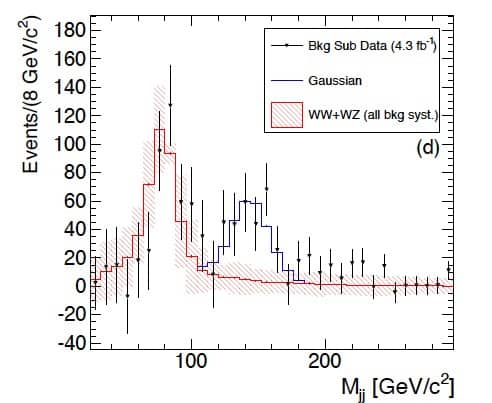
The graph shows the distribution of the “w-jj excess” as seen by the CDF experiment (Courtesy: Punzi/Fermilab)

By Tushna Commissariat

Two months ago, in early April, the particle-physics community was rife with speculation and excitement over a “bump” – a possible new particle – in the data that Fermilab’s CDF experiment was looking at. On Monday 30 May Giovanni Punzi, a CDF collaborator, presented an update on what is now referred to the “ W-jj” bump, as a part of his talk at the 23rd Rencontres de Blois Particle Physics and Cosmology conference currently being held in France. The update says that the bump is seen in more recent data with an even larger statistical significance.

At the time, CDF was looking for slightly rare di-boson pairs – W bosons produced in association with another W or a Z boson. It noted a bump between 120 and 160 GeV /C2 in the jets produced in the collisions with a statistical significance of about “three-sigma”, which meant that the result would not be considered valuable until a “five-sigma” statistical significance could be established. The new data, however, have established a significance that is officially “closer to five sigma” (unconfirmed sources suggest it is as close as 4.8) and that “it was not just a statistical fluctuation” and that it is now a “serious issue for CDF to understand this”, according to Punzi.

Interestingly, Punzi’s slides also say that it is almost impossible that bump is due to the Standard Model top-quark background, as suggested by some theoretical papers, as that would imply that previous measurements for SM top-quark background had huge errors. The next step forward would be if CDF’s sister experiment D0 or the LHC’s ATLAS or CMS experiments, none of which have found the bump in their data so far, manage to detect it.

This updated result has seen a variety of responses from physicists.

Adam Falkowski, who writes the Resonaances blog, seems rather jubilant. “In a collider experiment, such a huge departure from a Standard Model prediction is happening for the first time in the human history,” he writes. “I don’t have to stress how exciting it is.”

Peter Woit, author of the Not Even Wrong blog, feels that while a five-sigma significance is important, problems with background modelling might thwart the result. “The signal is being extracted from a huge background, so a small misunderstanding of the background could be its cause.” Only a detection of the same result by another experiment would make the case more compelling, according to him.

Tommaso Dorigo, a blogger and CDF collaborator, is still sceptical of the result and chalks it up to bad background modelling, like Woit. “No, it is not the Higgs. And it is not a new particle. It is, in my humble opinion, a problem in the modelling of backgrounds, one which was unnoticed before only because it is small enough to have escaped previous attempts at “tuning” the simulations.”, he writes in his blog.

So while it seems like we the path to “new physics” is full of “bumps”, the field of particle physics is a rather exciting one right now! Take a look at the slides Punzi used for his talk here.

Between the lines

Feynman the cartoon

Given Richard Feynman’s larger-than-life popular image, it was probably only a matter of time before someone literally turned him into a cartoon character. That, at least, would be the cynic’s view of Jim Ottaviani and Leland Myrick’s book Feynman, in which the writer-and-artist pair present the life and work of the late Nobel laureate in graphic-novel form. Unsurprisingly, perhaps, their account places heavy emphasis on Feynman’s bongo-playing, skirt-chasing side, and readers who feel that such anecdotes distract from Feynman the physicist (see above review) should steer well clear. Yet it is hard to be cynical for long about a book that, like its title character, simply bubbles with the pleasure of doing physics. The illustrations are crisp and memorable, and the pithy text captures Feynman’s inimical voice even when Ottaviani is not quoting him directly. Many of the anecdotes are, it is true, pretty well worn; the one about Feynman as Los Alamos safe-cracker, in particular, is as threadbare as an ancient stuffed bear with one ear missing. Those who prefer such anecdotes undiluted might be better off with Feynman’s own memoirs Surely You’re Joking, Mr Feynman! and What Do You Care What Other People Think?. However, there are some lesser-known stories here as well, drawn from the authors’ metre-high pile of published and unpublished Feynmanalia. Of particular interest is the recurring thread about Feynman’s sister Joan, who became a noted astrophysicist despite repeated discouragement from nearly everyone. After their mother tells Joan that women’s brains are “physiologically incapable of doing science”, Richard quietly slips her his astronomy textbook, urging her to “keep working through until you can understand the whole book”. The pair later make a pact: he can study anything he likes, as long as he leaves the Northern Lights to her. This Feynman may be a cartoon, but he has a heart as well as a brain.

  • 2011 First Second Books £18.99/$29.99hb 272pp

Explaining the unseen

Some popular-science books use pretty pictures or amusing anecdotes to get people interested in science. Others take readers’ interest as a given and concentrate instead on providing this (usually smaller) audience with the clearest, most rigorous explanations possible. In 101 Quantum Questions: What You Need to Know About the World You Can’t See, author Kenneth W Ford has opted decisively for the second option, trusting that readers will follow him as the book proceeds from simple questions such as “How big is an atom?” (no. 4) to complex ones like “What is entanglement?” (no. 95). Fortunately, Ford – a nuclear physicist and former director of the American Institute of Physics – is an accomplished teacher, and what his book lacks in gee-whizzery it makes up for in explanatory power. One reason for this is the author’s flair for analogies. In one early answer, he describes the changeable shape of an atomic nucleus by comparing it to “a balloon inside which a gerbil is running round and round”, noting that the balloon will distort to give the gerbil more room to run. Despite these advantages, however, the book is not a quick read, and casual readers will probably prefer to leave plenty of time to ponder each question before moving on to the next. Alternatively, Quantum Questions would make a good introduction for physics students who will find Ford’s book a useful beginners’ guide.

  • 2011 Harvard University Press £18.95/$24.95hb 304pp

Plane thoughts for a long flight

We’ve had the science of Santa, sport and superheroes. Surely there cannot be another new twist to this particular genre, whereby hard science is made digestible by showing its relevance to some facet of modern life? Step forward veteran UK science writer Brian Clegg with Inflight Science: a Guide to the World From Your Airplane Window. Aimed squarely at passengers looking for something to read on a long flight, Clegg describes relevant bits of science from the security checks at an airport, via take-off and cruising, to touch-down at your final destination. It is a clever tactic because it allows Clegg to touch on a wide range of otherwise disparate subjects, from X-ray scanning to how the flat-screen TV in the back of your headrest works. Ironically, those screens are the enemy of all in-flight reading and their temptations proved a constant distraction for your Physics World reviewer, who read the book on a long-haul flight to Beijing. Another drawback is that the level of scientific explanation is fairly low, which means that physicists will feel a little short-changed and perhaps even cringe at some of the over-simplifications. But, hey, if you thought you could have done better, unfortunately Clegg had the idea first.

  • 2011 Icon Books £12.99pb 212pp

New head for US nuclear-weapons lab

A physicist with more than 25 years’ experience in nuclear-weapons science and technology has become the 10th director of the Los Alamos National Laboratory in New Mexico. Charles McMillan, 56, succeeds physicist Michael Anastasio, who had been lab boss since 2006. Established in 1943, Los Alamos now has an annual budget of about $2bn and employs nearly 10 000 staff.

With a PhD in physics from the Massachusetts Institute of Technology, McMillan began his career in 1983 as an experimental physicist at the Lawrence Livermore National Laboratory (LLNL) in California. He later moved into computational science and management at the LLNL before joining Los Alamos in 2006 as principal associate director for its weapons programmes. That role involved him overseeing the safety, reliability and performance of the US nuclear deterrent, which is the lab’s main mission.

Los Alamos is one of three US nuclear-weapons labs – the other two being the LLNL and Sandia National Laboratories in New Mexico. McMillan’s responsibilities as head of Los Alamos will, however, go beyond developing and maintaining nuclear weapons. The lab also operates a national high-magnetic-field laboratory and works with other institutions including the Joint Genome Institute, which tackles genome mapping, DNA sequencing and related information science. Los Alamos also runs a research programme in systems-biology modelling.

“The lab is helping prevent pandemics, detecting and disabling improvised explosive devices, and developing alternative energy sources,” McMillan told physicsworld.com. “Today it leads research breakthroughs in areas as diverse as contributing to a possible AIDS vaccine and to fuel cell energy storage developments that could cut costs and speed commercialization. One of my goals is to build on these strengths to enhance the lab for the future.”

“In excellent hands”

In addition to becoming director, McMillan also becomes president of Los Alamos National Security (LANS), a public–private organization that manages the lab for the Department of Energy’s National Nuclear Security Administration (NNSA).

“Having known and worked with Charlie McMillan for more than a decade, I know Los Alamos is in excellent hands,” says NNSA administrator Thomas D’Agostino. “As we work to invest in the future and build the modern 21st-century nuclear-security enterprise required to implement the president’s nuclear-security agenda, Los Alamos will continue to play a vital role in pushing the frontiers of science and discovery.”

Meanwhile, LLNL director George Miller has announced that he will retire in October. Lawrence Livermore National Security, which operates the lab, is seeking his successor.

Richard Feynman: far more than a practical joker

In Quantum Man: Richard Feynman’s Life in Science, Krauss considers how Feynman’s ruthlessly bottom-up approach to science breathed fresh life into theoretical physics. Among other aspects, the book also considers the wider impact of Feyman’s work on other scientific disciplines including biology and computer science.

In this special audio interview with physicsworld.com reporter James Dacey, Krauss discusses his incentive for writing the book. “Feynman for me, like most scientists, was a sort of idol and it was a great opportunity to pay homage to him, and a personal homage because the last time I saw him I’d meant to tell him a few things and didn’t get a chance to,” he says.

Fresh perspective

Part of Krauss’ motivation for writing the book was his feeling that many earlier biographies aimed at the public have focused too much on Feynman’s personality, which can give the impression that science was something Feynman did “on the side”. “The public knows of [Feynman] as a curious character, and he is a fascinating human individual,” explains Krauss. “But what was clear to me is that people did not know why physicists revered him and I wanted to talk about his scientific legacy.”

Krauss explains that his own approach to physics was inspired by Feynman. “He often appeared to have results by magic, and what I also wanted to get across is how incredibly organized he was in his own thinking.

“The reason he could answer so many questions is that at some point or other he’d worked it out before. He’d have thousands and thousands of pages of notes in a very organized fashion.

“While he was a joker in life, when it came to science he was dead serious and he didn’t mess around.”

Book details

Quantum Man: Richard Feynman’s Life in Science
Lawrence Krauss
2011 W W Norton (available internationally)
£15.99/$24.95hb 350pp

Copyright © 2026 by IOP Publishing Ltd and individual contributors