Semiconductor memory stores spins

Physicists in the US and the UK have found a way to store and read data in nuclear spins using electronic pulses. The breakthrough could help in the development of spintronic systems that process information using spins – and could also find applications in quantum computation.

Spintronics is an emerging area of solid-state physics that attempts to use the spin as well as the charge of electrons to process data more efficiently. But a problem with electron spins is that they have a fairly short lifetime, which in practice would lead to corrupt data. For this reason scientists have been looking for new and better ways to store and retrieve information from spin systems.

One place to store spin-based information is in nitrogen-vacancy defects of a diamond crystal, and in recent years this has shown some promise. But the trouble with using diamond is that it is not compatible with conventional silicon-based electronics – a must if spintronic devices are ever to be integrated into computers.

Silicon-based breakthrough

Now, Dane McCamey of the University of Utah, Salt Lake City, and colleagues from Florida State University, Tallahassee, and University College London have found a way to store, and read, spins in a widely used semiconductor: phosphorous doped silicon (SiP). Their work marks the first time anyone has taken an electrical readout of data held in atomic nuclei.

Researchers have previously tried to map spin information (whether a spin is pointing up or down) onto nuclei and then read it, but had little success. The answer from McCamey’s group is to polarize all the conduction electrons in the SiP so that they are all in the same spin state. The do this by cooling the material to a few degrees above absolute zero and applying a strong magnetic field of some 8.5 T. They can then send in electromagnetic pulses near terahertz frequencies (1012 Hz) to write an up or down spin onto electrons orbiting the phosphorus atoms, before sending in radio waves to transfer those spins to the nuclei.

The team found the nuclei could store the spins for about 300,000 times longer than the typical electron spin lifetime. To read the spin information, the researchers simply did the reverse process: send in radio waves to transfer the spins from the nuclei back to the electrons, and then send in a final, near-terahertz pulse, which exhibited a greater current for an up-spin than a down-spin.

Must be flexible and easy to use

“Whether the scheme develops into further applications in spin quantum computation or spin electronics would depend a lot on whether this technique is flexible and relatively easy to use by the community,” said Sankar Das Sarma, a condensed-matter theorist at the University of Maryland. “It’s too soon to tell. What I can say is that I am quite impressed by the clever electrical read out technique used by the authors here, and I hope that this has a future in spintronics.”

According to John Morton, a materials scientist at Oxford University, the difficulty of developing the researchers’ scheme into applications might depend on what the application is. The low temperatures and high magnetic fields wouldn’t fare well with conventional computers, for which spintronics is destined. However, low temperatures might be less of a problem for quantum computers – that is, computers that exploit quantum physics to perform certain calculations much faster than computers in use today.

“Because a quantum computer is able to solve problems that a classical computer cannot in any reasonable amount of time, it doesn’t matter that you need to work at five Kelvin,” Morton said. “It doesn’t matter if you have a short lifetime and you need to keep running error-correcting algorithms – because you will be able to solve something that can’t be done elsewhere.”

McCamey told physicsworld.com that his group is now planning to scale down the number of nuclei used, so that they can isolate just a single nucleus to function as a memory element.

The research is published in Science 330 1652.

X-ray vision tracks lightning bursts

Blink and you’ve missed it. Researchers in the US have captured the world’s first X-ray images of lightning, by creating a special camera that can capture radiation at 10 million frames per second. They presented their new findings at the American Geophysical Union (AGU) Fall Meeting in San Francisco and they say that this new view of lightning could help to solve some of the mysteries of this spectacular natural phenomenon.

The research was carried out at the International Center for Lightning Research and Testing, located in Florida. It is one of the few sites in the world where lightning is initiated and studied under controlled conditions. By firing rockets with trailing wires into thunder clouds, scientists are able to generate electric fields that are large enough to trigger bolts of lightning, which then propagate back down towards the rocket launch tower.

Joseph Dwyer and colleagues at the Florida Institute of Technology became interested in the fact that lightning emits X-rays as it propagates through the air, a phenomenon that was only noted in the past decade. But given that X-ray sources in lightning travel through the Earth’s atmosphere at velocities approaching the speed of light, it is difficult to catch them on camera before they disappear. In addition, they cannot be imaged with standard mirrors and lenses because huge amounts of material are required to prevent X-rays and gamma rays from entering through the sides of a camera.

Tried and true method

Dwyer’s team has created a customized camera that has 30 detectors made from a combination of sodium iodide and photomultiplier tubes, each measuring 3 × 3 inch. The device, which is approximately the size of a standard refrigerator, is also equipped with a 3 inch pinhole aperture, and can record X-rays at 10 million frames per second. “This is actually a very old technique for making images, like that seen in a camera obscura,” Dwyer says.

We’re seeing lightning as Superman would see it with his X-ray vision Joseph Dwyer, Florida Institute of Technology

During July and August this year, Dwyer’s team studied four rocket-triggered lightning flashes at the Florida test site. Each flash lasted for approximately two seconds and the resulting sequences of images revealed that X-rays emerged primarily from the vicinity of the lightning tip as it propagated towards the Earth. As the lightning crashed into the control tower it also triggered large bursts of gamma radiation, which were also captured by the camera.

“For the first time we’re catching a glimpse of lightning in the X-ray emission,” says Dwyer. “We’re seeing lightning as Superman would see it with his X-ray vision”.

Dwyer hopes that the images can help to explain how bolts of lightning propagate through the air – a process that is still poorly understood. “When lightning propagates it moves in a halting manner called stepping. It will pause, then leap forward, pause, leap forward… We don’t know how or why it chooses to do this,” he says. “It is difficult to come up with models to explain this motion, since we don’t know what the basic picture is, but the images really help. They tell us where the charges are, where the high fields are and where the air is breaking down.”

Discussing bad science…Hollywood style

cover.gif
Courtesy: Paramount Pictures

By James Dacey at the AGU in San Francisco

A number of strange events including bizarre weather patterns and mass migrations of birds have led people to fear that something is going seriously wrong with the Earth’s magnetic field. In the US, a brilliant though dishevelled geophysicist believes the situation is due to a slowing in the rotation of the Earth’s core, the site where the field is generated.

When the US government caught wind of these claims, they had the scientist escorted to a secret meeting location where he delivered a short lecture on the fundamentals of geomagnetism. He warned that if the field vanishes entirely, the Earth will lose its protective shield and be exposed to a torrent of lethal radiation from the Sun.

Once they were sufficiently convinced by the passionate but uncooperative scientist, the government concluded that there is only one viable solution: they will drill down to the centre of the Earth and nuke the core into moving again.

Don’t worry. This is not a serious news story.

This is the plot to The Core, the 2003 disaster film, which grossed more than $70 million at the box office. On Tuesday night, The Core‘s director, Jon Amiel was talking at the American Geophysical Union (AGU) Fall Meeting here in San Francisco in a session about the representation of science in blockbuster films. In an entertaining presentation, Amiel discussed Hollywood’s obsession with geo disasters, from freak hurricanes to giant space rocks on collision paths with the Earth. He described how the idea of something going seriously wrong in the Earth’s interior appealed to him as another interesting spin on this theme.

After showing us some very funny clips from The Core, Amiel went on to discuss the question of whether Hollywood should try to represent science and scientists in an accurate way. Unsurprisingly, he believes that the success of a film comes from its ability to stir the emotions, and the aim of staying faithful to the science always comes second.

Amiel did, however, talk about his passion for the underlying science and all the geology he learned in making the film. “The Core articulates a good mystery story, like all great science,” he said.

Amiel was joined in the discussion by other speakers including Bruce Joel Rubin, who wrote the screenplay for Deep Impact, a film about a comet heading towards Earth, released in 1998. Rubin shared the same view about the importance of narrative but he believes there is no reason why film makers should shy away from including good science, so long as it is not to the detriment of the story. He described the extensive talks he carried out with geoscientists in predicting how a comet-impact with the Atlantic Ocean would trigger a tsunami that would wash away large parts of the US eastern seaboard and the low-lying areas of Europe.

“I really worked hard trying to make this film scientifically accurate,” he said. He contrasted his efforts to those of the makers of Armageddon, which was released in the same year and followed a similar plot. In this case, however, Bruce Willis is sent up to the approaching space rock to drill a bore hole and implant a nuclear device. He detonates the bomb, splitting the comet in half, and the world is saved.

Also on the panel was Sidney Perkowitz, condensed-matter physicist at Emory University in the US, who wrote this interesting article for Physics World back in 2006 about the way physicists are portrayed on screen.

Now you see it…now you see it again

cloak.jpg


By Hamish Johnston

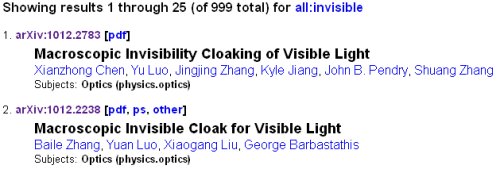
If you type the word “invisible” into the search engine on arXiv.org you get a very curious result. Two papers with nearly identical titles, uploaded three days apart.

A quick scan of both papers, which are by separate groups, reveals that they are both about roughly the same thing – the first invisibility cloak that works on large objects illuminated with visible light.

This promises to be a major breakthrough in the world of cloaking and I understand that one paper is destined for a prestigious journal; I’m not sure about the other.

We have a crack reporter looking into it. More later…

In the meantime you can read the papers here and here.

NASA spies storm stretching across the Sun

New findings from NASA’s Solar Dynamics Observatory (SDO) reveal that the Sun’s surface is an even more complicated web of physical and magnetic processes than previously thought. The finding was unveiled this week in San Francisco at the American Geophysical Union (AGU) Fall Meeting and could lead to better forecasts of radiation levels experienced by satellites.

The surface of the Sun is an incredibly volatile environment, which frequently ejects intense radiation and clouds of energetic radiation into space. These emissions pose a serious threat to astronauts and if they reach Earth they can wreak havoc with telecommunications satellites.

The research focuses on the analysis of an event that occurred on 1 August 2010 when almost the entire Earth-facing side of the Sun erupted in a tumult of activity, including solar flares and coronal mass ejections (CMEs). The event was captured by equipment on board the SDO, launched in February to investigate the causes of solar variability and how this creates a weather system in space.

Connected phenomena

While earlier missions have returned data from isolated active regions of the Sun, the SDO and its twin STEREO spacecraft were specifically designed to study magnetic activity over almost the whole star. This enabled Karel Schrijver and Alan Title of Lockheed Martin’s Solar and Astrophysics Laboratory to deconstruct the activities of 1 August to look for connections between the different phenomena.

We can see that solar storms can be global events, playing out on scales we scarcely imagined before Karel Schrijver, Lockhead Martin

The breakthrough came when the researchers discovered that bursts of solar activity appear to be connected via a system of magnetic fault zones known as “separatrices”. In a paper due to be published in the Journal of Geophysical Research, Schriver and Title break down the activity into 12 significant events over a 28-hour period spanning 180 degrees of solar longitude. “The 1 August event really opened our eyes,” says Schrijver. “We can see that solar storms can be global events, playing out on scales we scarcely imagined before.”

The researchers admit, however, that much work remains in order to unravel the causes and effects in these dynamic processes, and for this they will need to study more events. “Nor all eruptions are going to be global,” notes Title. “But the global character of solar activity can no longer be ignored.”

A more comprehensive understanding of solar processes could also lead to more accurate forecasts of space weather conditions, a development welcomed by Rodney Viereck of the US’s National Oceanic and Atmospheric Administration. “Solar flares can be particularly hazardous as they disturb high-frequency radio communications and GPS and the disruptions occur very quickly as the dangerous X-rays travel at the speed of light”.

Satellites reveal strain on Earth’s biological resources

modis.jpg

By James Dacey at the AGU in San Francisco

NASA satellite images have revealed that the biosphere is being placed under increasing strain as rising population on a global scale is accompanied by increased consumption of crops and animals per capita. If population and consumption continue to grow at present rates then by 2050 more than half of the new plant material generated on Earth each year will be required for humans. These findings were presented on Tuesday by NASA scientists at the American Geophysical Union (AGU) Fall Meeting here in San Francisco.

Marc Imhoff of the NASA Goddard Space Flight Center presented the results of a global survey for 1995–2005. Using data from NASA’s AVHRR and MODIS satellites, Imhoff and his colleagues tracked the amount of plant material produced on Earth. These satellites scan the Earth at 600 km per second, monitoring the colour of light emitted from the surface. Light near the green part of the spectrum is taken to indicate the presence of vegetation. A MODIS image of some of North America is shown above (image courtesy of NASA).

To create a “currency” for natural consumables, the researchers considered plants and animals in terms of the amount of carbon that they draw from the atmosphere – referred to as “net primary-production (NPP) carbon”. They discovered that between 1995 and 2005 the amount of NPP carbon used for human consumption rose from 20% to 25% of the total generated on land.

“These images tell us very dramatically that we do need to look at what kind of impact human consumption rates have on the ability of the biosphere to generate the supply,” said Imhoff.

He believes that the need for more plant products will have big implications for land management. As more land is required for agriculture, planning authorities will be faced with difficult decisions as they try to protect important ecosystems, such as boreal forest.

Rama Nemani, another member of the NASA team, is keen to stress that it’s not the role of Earth-monitoring programmes to suggest what should be done with global land use. He believes, however, that the next generation of Earth-monitoring satellites will play a key role in informing these discussions. These will include NASA’s National Polar-Orbiting Operational Environmental Satellite System (NPOESS) Preparatory Project and ESA’s Sentinel satellites.

Nemani told me that he would also like to see the creation of an international body to monitor global biodiversity, in the same way that the climate is assessed by the Intergovernmental Panel on Climate Change (IPCC).

Quantum theory survives latest challenge

Since quantum mechanics was first formulated, a string of physicists including Albert Einstein have been uncomfortable with the idea of entanglement – whereby a group of quantum particles have a closer relationship than allowed by classical physics. As a result, some physicists have proposed alternative theories that allow such close relationships without the need for quantum mechanics. While it has been difficult to test these theories, researchers in the UK have used “twisted light” to make an important measurement that backs up quantum theory.

Quantum theory seems foreign to our everyday experience because it defies our idea of “realism” – the expectation that objects have definite properties whether we’re looking at them or not. Quantum theory also seems to call for entities that can instantly react to an event occurring elsewhere – apparently defying the principle of locality, which forbids communication faster than the speed of light.

These oddities were expressed mathematically by the physicist John Bell in his famous inequality. Bell showed that a particular combination of measurements performed on identically prepared pairs of particles would produce a numerical bound (or inequality) that is satisfied by all physical theories that obey realism and locality. He also showed, however, that this bound is violated by the predictions of quantum physics for entangled particle pairs.

In Bell experiments two distant observers measure, for example, the polarization of entangled particles along different directions and calculate the correlations between them. This was done in the 1970s by Stuart Freedman and John Clauser and in the 1980s by Alain Aspect, who used entangled photons to confirm quantum theory.

Sacrificing locality for realism

Physics has generally accepted that the quantum world flouts “local realism”, but in 2003, Anthony Leggett of the University of Illinois at Urbana-Champaign tried to restore realism by sacrificing locality. If two entities can arrange their correlations through instantaneous communication, then perhaps it is still possible that they each have definite properties. Leggett’s real but non-local scenario passes the Bell test, but could it really describe the quantum world?

Four years later, physicists in Austria, Switzerland and Singapore answered with data. Instead of measuring the linear polarization states used to violate Bell’s inequality they looked for correlations between elliptical polarizations – combinations of linear and circular states. Even assuming that entangled photons could respond to one another instantly, the correlations between polarization states still violated Leggett’s inequality. The conclusion being that instantaneous communication is not enough to explain entanglement and realism must also be abandoned.

This conclusion is now backed up by Sonja Franke-Arnold and collegues at the University of Glasgow and University of Strathclyde who have performed another experiment showing that entangled photons exhibit entangled photons show stronger correlations than allowed for particles with individually defined properties – even if they would be allowed to communicate constantly. But rather than polarization, they studied the properties of each photon’s orbital angular momentum.

Twisting light

In photons, orbital angular momentum can be understood by imagining that the wave twists around the beam axis. It can draw a simple corkscrew pattern, a double helix or more complex helices with increasing angular momentum. Franke-Arnold and her team focused on the double-helix pattern.

Glasgow student Jacquie Romero did the experiment by firing an ultraviolet laser into an optical crystal designed to split the high-energy photons into pairs of entangled infrared photons. These went on to computer-controlled holograms, which were set to filter out roughly complementary orbital angular momentum states. Photons that passed the holograms were then counted by a single-photon detector.

The correlation between two entangled photons, one with a clockwise orbital-angular momentum while the other twists anticlockwise, is predicted by Bell’s and Leggett’s proposals as well as quantum theory. “We deliberately misalign our holograms from the complementary states and measure the resulting correlations,” explained Franke-Arnold. The coincidence counts in the detector occured too often to agree with Leggett’s theory. They did, however, match quantum predictions.

‘A philosophical result’

“The main outcome is really a philosophical result,” says Franke-Arnold. Entangled particles can’t be described as individual entities, not even with a telepathic connection to their partners.

Simon Gröblacher of the University of Vienna points out that these experiments rule out realism only for a large class of nonlocal theories – still others aren’t described by Leggett’s inequality. His team first showed the violation of Leggett’s inequality through photon polarisation, and he says that it’s nice to see the violation verified with another property of photons. “The experiments seem to be simpler,” he adds, noting that orbital-angular momentum offers options to test superpositions of more than two states.

The work is described in New Journal of Physics 12 123007.

How to walk through walls

Imagine being able to walk through a solid wall. That sort of trick might sound far-fetched, but it’s a little closer to reality now that researchers in China have created what they call an “invisible gateway”.

Huanyang Chen at Soochow University, Jiangsu, says that the effect is a bit like “platform nine and three-quarters” – that is, the fictional area of King’s Cross railway station in the Harry Potter books that is only accessible through a secret, illusionary wall. Although the researchers’ current demonstration is based on an electrical circuit for radio waves, Chen claims that it could also work for visible light.

The idea for the invisible gateway stems from so-called transformation optics, which gave us the first invisibility cloak back in 2006. Yet the invisible gateway is almost the opposite of a cloak: rather than bend light round an object to make the object invisible, the device makes an object – a wall – appear that isn’t really there. It is, according to Chen’s group, the first demonstration of illusion optics.

Network of capacitors and inductors

Chen, whose colleagues are based at the Chinese Academy of Sciences, Beijing, and the Hong Kong University of Science, created the invisible gateway using a network of capacitors and inductors. The network forms a channel that separates two electric conductors – the walls – one of which contains a slab of material with a negative index of permittivity and refraction. The combination of these two materials allows collective waves of electron, called plasmons, to form on the surface. The plasmons prevent electromagnetic waves from passing through the channel. To an observer, the channel looks like a continuation of the walls – so long as they are looking at electromagnetic radiation between 45 and 60 MHz.

This does demonstrate that the principle works Tom Driscoll University of California, San Diego

Tom Driscoll, a researcher who studies novel electromagnetic devices at the University of California, San Diego, calls the demonstration a “good step”, although he notes that the progression to devices that work with visible light and at human scales are “decades or more away”. “The total sample size is quite small compared with the wavelength used, so I would like to have seen a bigger example,” he says. “However, this does demonstrate that the principle works.”

Martin McCall, a theoretical physicist at Imperial College, London, also thinks that the invisible gateway is an interesting development. “It’s a viable addition to the pile of interesting electromagnetic structures being produced,” he says.

Chen and colleagues’ invisibility gateway is one of many ideas to have been realised used transformation optics in recent years. Last year, groups at Cornell University and the University of California at Berkeley independently created 2D cloaks that operated at optical wavelengths. Earlier this year, a team at the Karlsruhe Institute of Technology in Germany went one step further to produce a 3D optical cloak.

In 2008, Chen’s group proposed what might be the next step on these lines – a device that can cloak objects at a distance.

The research is available in Phys. Rev. Lett. 105, 233906

Nuclear reaction defies expectations

A novel kind of fission reaction observed at the CERN particle physics laboratory in Geneva has exposed serious weaknesses in our current understanding of the nucleus. The fission of mercury-180 was expected to be a “symmetric” reaction that would result in two equal fragments but instead produced two nuclei with quite different masses, an “asymmetric” reaction that poses a significant challenge to theorists.

Nuclear fission involves the splitting of a heavy nucleus into two lighter nuclei. According to the liquid-drop model, which describes the nucleus in terms of its macroscopic quantities of surface tension and electrostatic repulsion, fission should be symmetric. Some fission reactions are, however, asymmetric, including many of those of uranium and its neighbouring actinide elements. These instead can be understood by also using the shell model, in which unequal fragments can be preferentially created if one or both of these fragments contains a “magic” number of protons and/or neutrons. For example, one of the fragments produced in many of the fission reactions involving actinides is tin-132, which is a “doubly-magic” nucleus, containing 50 protons and 82 neutrons.

The latest work, carried out by a collaboration of physicists using CERN’s ISOLDE radioactive beam facility, investigated the interplay between the macroscopic and microscopic components of nuclear fission. It used what is known as beta-delayed fission, a two-step process in which a parent nucleus beta decays and then the daughter nucleus undergoes fission if it is created in a highly excited state. This kind of reaction allows scientists to study fission reactions in relatively exotic nuclei and was first studied at the Flerov Laboratory in Dubna, Russia, about 20 years ago, although the Dubna measurements did not reveal the masses of the fragments produced.

Firing protons at uranium

The experiment at ISOLDE involved firing a proton beam at a uranium target and then using laser beams and a magnetic field to filter out ions of thallium-180 from among the wide variety of nuclei produced in the proton collisions. These ions then became implanted in a carbon foil, where they underwent beta decay and some of the resulting atoms of mercury-180 then fissioned. Silicon detectors placed in front of and behind the foil allowed the energies of the fission products to be measured.

The researchers were expecting the fission reaction to be symmetric, with the mercury-180 splitting into two nuclei of zirconium-90, a result thought to be particularly favoured because these nuclei would contain a magic number of neutrons (50) and a “semi-magic” number of protons (40). What they found, however, was quite different. The energy of the fission products recorded in the silicon detectors did not peak at one particular value, which would be the case if only one kind of nuclei was being produced in the reactions, but instead showed two distinct peaks centred around the nuclei ruthenium-100 and krypton-80.

Collaboration spokesperson Andrei Andreyev of the University of Leuven, Belgium, (and currently at the University of West of Scotland) says that this asymmetric fission was unexpected because the observed fragments do not contain any magic or semi-magic shells. His colleague, theorist Peter Möller of the Los Alamos National Laboratory in the US had in fact devised a model of the nucleus that predicted that mercury-180 would undergo asymmetric fission. But he wasn’t able to explain why that is, having plotted a three-dimensional potential energy surface for the fission of mercury-180 and then identified a minimum in that surface, but he couldn’t identify which of the three variables were responsible for that minimum.

‘Beautiful experimental achievement’

Phil Walker of the University of Surrey in the UK, who is not a member of the collaboration, describes the research as a “beautiful experimental achievement” that has “an impressive theoretical outcome”. He says that the result will be mainly of interest to academics but believes that it might just have practical implications. “Much of our energy generation depends on nuclear fission,” he points out, “and if we want to make reactors safer and cheaper we need to be able to trust the basic theory of the fission process. I would say that the theory has been found to be sadly lacking, and it needs to be fixed.”

Andreyev agrees. “I hope that as a result of our paper theorists will start to think about this problem and tell us what is happening,” he says. “For the moment we don’t know.”

The research appears in Physical Review Letters.

Eric Cornell: an experimental maestro

Cornell won the 2001 Nobel Prize for Physics “for the achievement of Bose–Einstein condensation in dilute gases of alkali atoms, and for early fundamental studies of the properties of the condensates”. He shared the prize with his University of Colorado colleague Carl Wieman and Wolfgang Ketterle of the Massachusetts Institute of Technology. BECs are formed when identical bosons – particles with integer spin – are cooled until all particles fall into the same quantum state and behave as a single quantum particle. In June 1995 Cornell and Wieman succeeded in creating this extreme state of matter for the first time by using the newly developed techniques of laser cooling to take a cloud of rubidium atoms to near absolute zero. Ketterle repeated this feat a few months later with sodium atoms.

Was there a ‘eureka moment’ when you saw a BEC for the first time?

By the standards of physics experiments, it was not at all long and drawn out. The day we saw it, we also believed in it. It really seemed that it was a very clear signature. It was a more dramatic moment than these things usually are – over the course of a morning we came to believe it was there.

But did it take a long time to convince the rest of the community?

The day we saw it, we also believed in it.

Interestingly, when we first saw it, it was just a couple of weeks before a meeting in atomic physics that was happening on the island of Capri near Naples, so we had just a couple of weeks to convince ourselves that this was real enough to go public.

A week after that, there was a specialized talk on the topic of BECs near Strasbourg, and basically anyone who was interested in the BECs was there. It was a really rigorous meeting and there were a lot of probing and sceptical questions, but by the end I think we had pretty much everyone convinced.

Did you know this would be a Nobel-prize winning discovery?

I’ll say that the thought had crossed my mind. But in those days, as now, typically a discovery is made and the Swedes wait maybe 20 years before they decide they are convinced enough…so I certainly wasn’t expecting to get a telephone call early in the morning so soon.

How have BECs furthered our understanding of physics?

Maybe the most active area of research is to use the condensate to explore model systems in quantum mechanics. Basically, they put the atoms in a lattice of interfering beams of laser light and you get this optical lattice. And you get a small number of atoms, maybe one of two atoms in each optical lattice site, and then using clever analogies you can say this system has the same underlying physics as the source of magnetism in an exotic material, for example.

How did winning the prize change you – both personally and as a scientist?

What I’ve found I have to be careful about is that before the Nobel prize I was a young, slightly brash, not particularly cautious physicist. You know, someone would be describing an experiment and I’d say to my friends: “That’s stupid! It’s probably wrong.” And now, if I say that, it’s like: “Oh! Cornell says it’s wrong. Scandal!” So I have to be a little bit more cautious in that respect because people take me more seriously and therefore I have to be more serious, which is a little too bad.

Do you find that you spend a lot of more time doing things outside of science now?

Yes, but I don’t especially enjoy it. I mean, I like travelling, I like meeting people. But I don’t like getting more involved in administration. I’m to become chair of my institute in a couple of months and I can’t say that I’m looking forward to that. It seems to be something it’s hard to get out of.

What has your research focused on since winning the prize?

Apart from the BECs. I have another project going on, that I’ve been working on for six or seven years, which is getting at some of the same physics that they get at, at CERN, but using very different technology – looking for the asymmetry of the electron. As near as anyone can tell, the electron is a pretty symmetric particle, but we can’t tell that for sure. So we’re trying to do a much more careful study of whether the electron’s north pole and the south pole are the same or whether they could be slightly different.

Why does this fascinate you?

In nature, and in fundamental particles, there are some huge asymmetries and the biggest one is that if you just look around you the world is made up of electrons and protons and neutrons. It’s not made up of antiprotons and antineutrons and positrons – it’s a very imbalanced thing. If you look around the universe, there’s a very, very tiny amount of antimatter.

What can we learn from this?

We know that these basic violations of things like parity and charge conservation happen, and you can look around and mostly what you see are little tiny effects where you have to stare very hard at particles. Then you see immense, broad, crude effects, like we’re all made out of matter and not antimatter. And connecting those two is not easy to do. The people who try to do that in a theoretical way are convinced that there are more small asymmetries at the microscopic scale than we have found so far. One of their favourite predictions is that the electrons should have this asymmetry…it’s called the “electric dipole moment”.

How would you describe your approach to physics – are you motivated by the theory, or do you take a more practical approach?

I think if I’d ended up being an accountant, then I’d be a hobbyist – the sort of person who builds remote-controlled airplanes.

I’m not a chalk guy; I’m an oscilloscope and laser guy. But you can have experimentalists who are working on very practical or impractical things. And likewise, you can have theorists who are working on very practical things. For instance, my electron experiment has involved developing technology to measure things very precisely. So even if the research itself isn’t practical, maybe the equipment you develop might be.

If you had not become a Nobel-prize-winning physicist, what might you have done instead?

Well, I’ve always been a bit of a tinkerer. I think if I’d ended up being an accountant for a living, then I’d be a hobbyist – the sort of person who builds remote-controlled airplanes or something like that. But I was always interested in languages. I was never very good at it… I had a picture that I’d do something more involved in literature or politics. I’m still very interested in politics, but really just as a spectator sport these days.

So you’re not tempted to follow the same path as Carl Wieman who is now working as Obama’s associate director for science?

Carl Wieman and Steve Chu got out of the realm of the spectator sport and they put on their kit and their boots and they’re actually playing. I’ve never done that and I don’t really have an ambition to. But I do like to follow the game. My wife is much more involved in things like politics than I am, I wouldn’t be surprised if she went for office one day, and I could be sort of like Denis Thatcher. I could do that job!

Copyright © 2026 by IOP Publishing Ltd and individual contributors