Everyone from Aad to Zutshi didn't see an excited quark

atlasdata.jpg
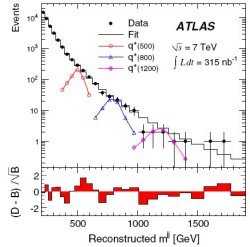
Data from ATLAS are the black dots that follow a relatively smooth curve. Excited quarks would appear as bumps that are illustrated by the three coloured curves. (Courtesy: PRL)

By Hamish Johnston

Unlike most people, particle physicists can get very excited about seeing absolutely nothing.

Indeed, one of the world’s most prestigious journals has published a letter from the ATLAS collaboration at the Large Hadron Collider (LHC) about how the multibillion-euro facility has found no evidence for an “excited quark” or any other unexpected particles.

And furthermore, it’s done a much better job at not finding an excited quark than its less energetic competitor, Tevatron at Fermilab in the US.

In the Standard Model of particle physics, quarks are fundamental particles. This means that they have no internal structure and therefore no excited states. By failing to find excited quarks (or other surprise particles) at masses up to 1.26 TeV, the ATLAS team have provided invaluable guidance to physicists who are developing theories beyond the Standard Model.

Tevatron had previously excluded excited quarks to about 0.87 TeV, which required 3500 times more data than the ATLAS measurement. This performance bodes well, and we can look forward to the LHC not finding many more particles – and who knows, it might even manage to find a new particle or two.

But what’s really incredible about this paper in Physical Review Letters is the author list, which begins with G Aad and ends with V Zutshi. Normally, letters are restricted to four pages, but this one stretches to 19 pages to include all the authors and their organizations. I gave up counting authors (I think there are about 3000), but there are 177 organizations listed.

Sadly, 19 authors passed away before seeing ATLAS’s first publication of results in PRL.

The letter is published at Phys. Rev. Lett. 105 161801.

Dad rockers riff on graphene

By Hamish Johnston

I know there’s nothing sadder than a middle-aged man rocking out with an electric guitar – especially if he’s singing about condensed-matter physics.

I tried to resist, but I was strangely compelled to watch this reworking of that classic-rock anthem “Cocaine” by a bunch of physicists at Georgia Tech in honour of this year’s physics Nobel.

Fortunately the viewer is spared the Jeremy Clarkson jeans and other dad-fashion faux pas that the band members are no doubt making; instead the tune plays over what looks like a selection of Andre Geim’s PowerPoint slides.

Highlights include the verses:

“If you got bad gates and need quantum states…graphene”

and

“Don’t forget Dirac, straight bands are a fact…graphene”

and the chorus:

“She goes fast, she goes fast…graphene”

Actually, it’s not a bad version with some smoking riffs by Mike Duffee on guitar and a smoky vocal by engineering professor Paul Neitzel.

Makes me think I should dust off my axe, slip into a pair of M&S ComfortFit jeans, and pen a little ditty. Or maybe an entire concept album called “Tales from Topological Insulators”.

Asteroid crash would devastate ozone layer

A mid-sized asteroid impact with the ocean could drastically deplete the ozone layer for many years, according to a team of US researchers. Such damage would expose the surface to levels of UV radiation up to three times more severe than anything currently recorded on Earth.

While large asteroids, such as the 15 km space rock implicated in the demise of the dinosaurs, are notorious for their destructive power, mid-sized asteroids, with diameters between 100 m and 1 km, also have the potential to inflict global damage to the biosphere. Conventional models have focused on mid-sized ocean strikes, analysing immediate effects, such as tsunamis, or climatic changes due to large amounts of dust ejected into the atmosphere. Now, a group of researchers, led by Elisabetta Pierazzo at the Planetary Science Institute in Arizona, US, are the first to model the effects on the ozone layer from a mid-sized asteroid ocean impact.

Pierazzo and her colleagues envisaged the fall-out from two separate mid-latitude impact scenarios: a 500 m diameter asteroid and one measuring 1 km, both hitting a 4 km deep ocean at 18 km s–1. Using a 3D shock physics model, it was found that 4.4 × 1012 kg and 4.2 × 1013 kg of water, a combination of liquid and vapour, would be ejected 1000 km into the atmosphere in the respective cases. A separate model was then used to predict the effect of this water on the chemistry and dynamics of the atmosphere, taking into account factors such incident UV radiation, auroral processes and ion drag.

Injecting chlorine and bromine

“You’re not just injecting water, you’re injecting sea water, which includes elements such as chlorine and bromine. These cause the ozone to become very reactive and be destroyed by their presence,” Pierazzo told physicsworld.com.

The model was run to simulate several years after impact and the results suggest significant, long-lasting damage to the ozone layer. For the larger impact the team found that: ozone depletion would reach more than 70% for more than two years at mid-high latitudes; there would be worldwide depletion of over 50% for more than a year; both hemispheres would experience continuous ozone depletion of greater than 40% for 3.5 years. “The effect is comparable to the recent ozone depletion caused by CFCs. Except, rather than being restricted to polar regions, it would be global, we’d see it everywhere: both at high and low latitudes,” Pierazzo explained.

With the ozone layer’s ability to block harmful UV radiation impaired, the biosphere would be significantly affected; changes to both plant growth and molecular DNA are among the possible consequences. Food production could also be negatively hit; estimates based on the CFC ozone hole suggest a 16% drop in ozone could cause a 5% drop in phytoplankton levels in the ocean, having the knock-on effect of reducing fishery yields by 7% or 7 million tonnes of fish per year.

Direct dangers

Humans would also be subject to direct dangers. The intensity of UV radiation, which commonly causes sunburn, is measured on the International UV Index (UVI). Radiation reaching values of 11 is classified as “extreme” and likely to cause sunburn within minutes. The highest UVI score ever recorded on Earth is 20 in the Puna de Atacama, in the Argentinian Andes; Pierazzo’s model predicts widespread UVI values of more than 20 for the first two years up to latitudes of 70°, peaking at a UVI of 56 around 27 °N after the 1 km impact.

These findings add to the immediate effects already modelled by previous studies to create a bigger picture of the aftermath of a mid-sized asteroid ocean strike. “As well as the effects outlined in this work, a 1 km asteroid hitting the ocean would strike with as much energy as 50,000 megatonnes of TNT. It would open a crater in the water over 15 km wide, creating a tidal wave with a peak height of almost 40 m,” Joanna Morgan, geophysicist at Imperial College, London, told physicsworld.com.

However, such events are likely to be rare. “A 1 km asteroid impact has not happened in recorded human history. But, such events are thought to have occurred in Earth’s past, probably with a frequency of roughly once every million years or so,” explained Alan Fitzsimmons, a near-Earth asteroid researcher at Queen’s University in Belfast.

The findings are presented in Earth and Planetary Science Letters (doi:10.1016/j.epsl.2010.08.036).

Unravelling the secrets of silk production

The secrets behind the mighty strength of silk could be unravelled by neutron-scattering experiments being carried out in France. Early results have revealed that silk worms spin their silky threads in a process that seems completely counterintuitive to what is expected. On a domestic note, the findings provide some practical tips for anyone wondering how to wash their silk products.

For such an elegant material, silk is incredibly durable, possessing a tensile strength comparable with steel. These properties combine to make silk a highly desirable product. But despite being ubiquitous in luxury textiles throughout the centuries, the process of silk formation inside the body of silk worms has remained something of a mystery, with different scientists proposing varying explanations.

One of the practical limitations when studying silk is that at any given time each silk worm has only minute amounts of silk’s precursor proteins inside its body. So any scientific programme to study silk requires the upkeep of large numbers of silk worms followed by the careful extraction of silk samples. Given these difficulties, previous silk studies have used “regenerated” silk proteins, obtained by breaking down silk worm cocoons with high salt concentrations then mixing samples.

Native silk

In this research, a team led by Cedric Dicko of the University of Oxford has for the first time studied the production of pure silk, extracted in small quantities from silk worms. Using a series of small angle neutron-scattering experiments at the Institut Laue-Langevin (ILL), the team was able to hone in on relatively small samples of the large biological molecules that form silk.

Dicko’s team discovered that proteins are abundant inside the worm, with concentrations of up to 400 mg/ml. Unusually for this concentration, the proteins showed very little interaction, instead forming a compact helical structure with a radius of gyration of 90 nm. However, the situation changed as the researchers diluted the silk solution with water, which caused the proteins to unfold to 130 nm and start to combine into the ordered filaments of silk.

“This is an extraordinarily high concentration for the proteins to remain stably dispersed throughout the solution,” says Dicko. “Even stranger, as the concentration drops the proteins begin to expand and flow, until they eventually clump together – this is the reverse of what we’d expected.”

Saving silk shirts

The finding that water plays such a key role in giving silk its strength has implications for those in possession of silk products. “Dry-cleaning silks can strip away the moisture and weaken the fibres in silk garments, leaving them more likely to get damaged,” says Phil Callow, one of the researchers, based full-time at the ILL. Callow provides reassurance, however, that if one were to make the mistake of dry-cleaning a silk shirt, they should be able to return it to its original condition by steaming it gently.

Callow explained that neutrons were used to examine silk because they offer advantages over other diffraction experiments, such as X-rays, which can damage the samples under study. He revealed that Dicko is set to return to the ILL in December to continue this research by investigating the effects of temperature variation on silk production.

The latest findings are described in a paper in Soft Matter.

Scientists march on the Treasury

SDC11489_2.JPG
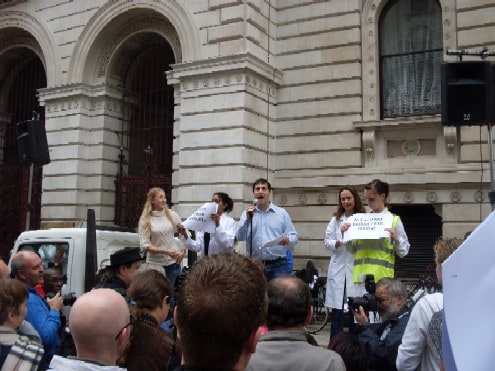
Scientists protest against impending cuts to the UK science budget

By Leila Sattary

On Saturday I joined more than 2000 scientists who gathered outside the UK Treasury in Westminster to attend the Science is Vital rally to protest against the expected cuts to the UK science budget.

I was one of the thousands of lab-coat-wearing protesters cheering and chanting below UK chancellor George Osborne’s window as he worked on the figures for the impending Comprehensive Spending Review, which is due to be published next week and set department budgets for the next four years.

It is unnatural for scientists to gather to talk about money, of all things, but that just shows the worry they feel about the likely spending cuts to the UK science budget. Politicians should recognize how very unusual it is for scientists to come out of the lab and on to the street to protest.

While many of the protesters who attended the rally were young scientists, obviously worried about their future careers in science in the UK, it was clear to me that most people were there because they are fundamentally concerned about the future wellbeing of our country and how the UK could fall without sustained funding for science.

Science is Vital was started by cell biologist Jenny Rohn. In a few short weeks, with the help of Facebook and Twitter, word had spread that scientists were mobilizing to support the future of science funding in the UK. In addition to the rally, Science is Vital has also organized a petition, which now has more than 25,000 signatures and will be presented to Parliament on Tuesday.

Evan Harris, a Liberal Democrat and science supporter, acted as coordinator and rustled the group of geeks into something that almost resembled a protest mob chanting “Hey, Osbourne, leave our labs alone.” He might not be much of a singer, but Evan certainly understands what makes politicians tick. Despite our attempts at chanting and being an angry horde the atmosphere was good spirited and festival-like with just as much laughing at nerd jokes as protesting.

Speakers at the rally included Colin Blakemore, former chief executive of the Medical Research Council, Imran Khan, director of the Campaign for Science and Engineering and Ben Goldacre, Guardian columnist and author of Bad Science.

Mark Miodownik, head of the Material Research Group at Kings College London, who is giving this year’s Royal Institution Christmas lectures also spoke and reminded scientists to stick together. He told us that in our fight against funding cuts we should avoid being divided by scientific faction by the desire to protect our own subject area, and instead work together to give a strong and unified message to government.

Overall, scientists were not whining and not threatening; in typical scientific style, they were stating the facts – science is vital.

Researchers crack the nanocrystal challenge

Researchers in the US are the first to use epitaxy to make nanometre-sized single crystals. Epitaxy is a standard process used in semiconductor fabrication and therefore the breakthrough could lead to the production of nanostructured thin films for a wide variety of applications, including solar cells.

Most nanostructures made from inorganic materials are either amorphous or polycrystalline, and scientists have struggled to make nanostructures from single crystals that grow in a well defined way with respect to a substrate. Such crystals could be used in a host of applications in which excellent charge transport over extremely small distances is called for. Single crystals are ideal for these applications because they don’t contain grain boundaries between the crystallites. These boundaries can act as trap or scattering sites for electrons and thus degrade the ability of a nanostructure to transport charge.

Now, Ulrich Wiesner and colleagues at Cornell University have developed a way of making single-crystal silicon or nickel monosilicide nanostructures with the help of a block copolymer self-assembly technique. The researchers say that, as far as they know, nobody had ever succeeded in combining polymer self-assembly with inorganic single-crystal epitaxy until now.

Self-assembly technique

To make their nanostructures, the team first create a hexagonal array of tiny pores on a silicon substrate. This is done using a block copolymer self-assembly technique that involves depositing a thin film of block copolymers and other materials. The sample is heated and some of the compounds evaporate, leaving a hexagonal array of tiny holes separated by about 30 nm.

The team then fill the pores of the template with an amorphous inorganic material such as nickel monosilicide or silicon. This material is converted into a single crystal by melting it for about 10 ns using short laser pulses. Upon cooling, the melt solidifies from below, so creating a single-crystal nanostructure growing into the template. This part of the process is known as epitaxy. The block copolymer template is then removed, leaving an array of tiny single-crystal pillars that can be as tall as 10 nm.

The laser employed by Wiesner’s team was a 40 ns XeCl excimer pulsed laser with a wavelength of 308 nm. Arrays of either isolated nanopillars or interconnected 3D nanostructures were produced depending on the template’s thickness.

Complex, nanocrystalline shapes

The researchers say that their experiment proves that single-crystal nanostructures can be fabricated using a simple laser processing step. The new method could be used to make a variety of complex, nanocrystalline shapes in the future. These could either be used for fundamental studies on nanocrystals or directly in applications.

“It will now be fun to find out how far we can push this process,” said. “For example, a particularly exciting aspect is to use our approach for limiting the contact between two inorganic materials that have a lattice mismatch to nanoscopic surface areas. This may allow us to grow single crystals of materials like germanium on single crystals of silicon – a very old and long-standing problem in the semiconductor industry.”

The work was published in Science 330 214.

Vacuum Expo 2010 launches in the UK


Simon Mansbridge of the Switzerland-based exhibitor and Expo stakeholder VAT Vacuum says that the event, for which Physics World is a sponsoring partner, “is an exciting opportunity to be involved in the creation of a new conference and exhibition dedicated to vacuum technology in the UK”. Bringing together representatives from industry, research and development, academia and the key suppliers in the industry, Mansbridge adds that Vacuum Expo “will be a valuable platform for exchanging information and establishing new links and contacts for all”.

The conference programme for Wednesday 3 November includes a meeting entitled Innovations in Vacuum Deposited Functional Metal Oxide Coatings, which will run from 10.00 a.m. to 5.00 p.m. The meeting will open with a session on “novel deposition techniques and processes”, which will include presentations from leading academics and members of industry. The session will kick off with a lecture by Andrew Flewitt of the University of Cambridge, who will speak on the low-temperature deposition of metal oxides for transparent microelectronics. Other speakers in that session will include Alistair Kean of Mantis Deposition Ltd, who will talk about the production and application of thin film nanoparticle coatings.

Running concurrently on Wednesday from 11.00 a.m. to 3.30 p.m is the Optical Micro & Nano Fabrication meeting, which is organized by the Optical Group of the Institute of Physics, which publishes Physics World. Speakers at this event include Patrick Salter of the University of Oxford who will describe the parallel optical fabrication of 3D micro-structures. A series of business seminars on innovation and investment will also be held on Wednesday.

Leak detection and RGAs

Anyone running a vacuum system needs to know about leak detection and residual gas analysers (RGA) – which is why the Institute of Physics Vacuum Group and RGA User Group have joined forces to organize a meeting on leak detection and RGA that will run from 10.30 a.m. to 3.10 p.m. The gathering includes an invited lunchtime lecture on “vacuum in the semiconductor industry” by Alan Webb of the optical components manufacturer Oclaro. Other speakers include Hugo Shiers of Diamond Light Source who will talk about the role of RGAs at the UK synchrotron lab and consultant David Hucknall of Low Pressure, who will provide an introduction to leak detection.

Doors to the trade exhibition open at 10.00 a.m. on Wednesday 3 November and firms with products and services on show will include UK-based Chell Instruments, which will be exhibiting a wide range of products including its precision CMV needle valves. Chell’s engineers have been designing and building custom UHV chambers and systems for over 30 years, and the firm has produced vacuum solutions for some of the most demanding applications. Chell also supplies thermocouples and cold cathode gauges from Hastings Instruments and capacitance manometers made by Barocel. These products are supplied complete with ISO17025 calibration in Chell’s UKAS laboratory, which the firm says has the lowest uncertainties for vacuum in the UK.

Manipulating and cooling

Also on hand will be UK-based UHV Design, which will be showcasing its instrumentation for the manipulation, heating and cooling of samples and devices within ultrahigh vacuum environments. UHV Design specializes in the development and manufacture of instrumentation for the manipulation, heating and cooling of samples and devices in ultrahigh vacuum environments. UHV Design’s product range includes linear shift mechanisms; magnetically coupled rotary drives; sample transfer probes; XYZ stages, analysis stages; and deposition stages for sputtering, CVD and MBE. All stages are available with manual or motorized actuation.

The Kurt J Lesker Company (KJLC), which is a manufacturer and global distributor of vacuum technology, will also be at Vacuum Expo 2010. UK-based customers of the firm are served by its European Headquarters in Hastings, UK, and the company has five global warehouse locations and a broad network of dedicated sales staff through the world. KJLC will showcase its new products and as well as its customization capabilities. KJLC’s experts will be on hand to answer questions about the company’s vacuum solutions.

MDC Vacuum Products LLC will be represented at the expo by its European division, UK-based MDC Vacuum Ltd. The company will be exhibiting its vacuum products worldwide including flanges, fittings, and valves. MDC staff will be on hand to discuss the firm’s manipulators, electrical feed-throughs, view ports, electron-beam evaporation and special fabrication technologies.

The exhibition runs until 5.00 p.m. on Wednesday 3 November and from 10.00 a.m. to 4.00 p.m. on Thursday 4 November.

Vacuum Expo 2010 will run alongside the Photonex Exhibition, which will play host to over 100 suppliers of photonics technology and services. Also running at the same time are a number of photonics-related meetings, a “technology investment forum” and the Machine Vision and Imaging Sciences (MVIS) meeting and exhibition.

Does dark matter trigger strange stars?

The energy needed to convert a neutron star into a so-called strange star may come from annihilating dark-matter particles. That is the conclusion of a new study by physicists in Spain, the UK and the US, who propose that this conversion mechanism may be a good way to put a lower limit on the mass of weakly interacting massive particles (WIMPs), a leading candidate for dark matter.

Once their nuclear fuel has burnt up, stars below a certain mass collapse to form neutron stars. These incredibly dense objects consist almost entirely of neutrons, the gravitational collapse having forced protons and electrons to merge. It has been proposed, however, that, given some kind of source of additional energy, neutron stars can convert to strange stars, objects consisting of strange matter – a soup of unbound up, down and strange quarks.

The idea is that adding this energy to a certain limited volume of the neutron star will unlock the up and down quarks confined inside the neutrons. Some of these quarks will then naturally convert into strange quarks, producing a region of strange matter known as a strangelet. If, as has been hypothesized, strange matter is in fact more stable than normal, nuclear, matter it will exist a lower energy. The excess energy given off by the conversion of normal matter into strange matter then unlocks more up and down quarks, leading to the creation of more strangelets.

A little energy is enough to transform a neutron star into a strange star Joseph Silk, University of Oxford

The result is a runaway process capable of converting an entire neutron star into strange matter within a second or less. “The neutron star is metastable, like someone on a mountain ledge,” explains Joseph Silk of the University of Oxford who was involved in the work. “Just as a little kick can push that person off the ledge and send them to the bottom of the mountain, so a little energy is enough to transform a neutron star into a strange star.”

Does strange matter exist?

While there is no clear evidence that strange matter actually exists, the observation of extremely brief but ultra-bright bursts of gamma rays from the cosmos suggests the existence of strange stars. Researchers have proposed that the enormous power needed to produce a gamma-ray burst could come from the formation of a black hole, but the large numbers of particles of normal matter surrounding a black hole could absorb much of that energy. The conversion of a neutron star into a strange star, however, could provide the required energy but without the surrounding matter.

However, that still leaves the question of where the neutron star gets its initial spark of energy. Some have suggested it simply comes from the energy of collapse or from very high-energy cosmic rays colliding with the star. Silk, however, points out that the former mechanism requires neutron stars to have a minimum mass and maintains that the latter mechanism is problematic because, he says, it would be unlikely to dump energy in the middle of the star, which is where it is needed to initiate the chain reaction.

Instead, Silk, Angeles Perez-Garcia of the University of Salamanca and Jirina Stone of the University of Tennessee, have calculated that annihilating WIMPs, which can accumulate in the centre of stars, could provide this energy. If confirmed, the mechanism would provide a new, independent lower limit for the mass of a WIMP. This is approximately 4 GeV (gigaelectronvolts), half of the minimum energy that the trio calculate is needed to initiate the neutron star conversion in this way (with each WIMP providing half of the mass-energy in each collision).

New way to find WIMPs

With direct, ground-based dark matter searchers able to go down to about 50 GeV, Silk says that this new approach could provide a useful complement to existing experiments. He points out that theory does not favour a WIMP mass of between 4 and 50 GeV but that a figure of about 10 GeV has been suggested by the recent, contested, results from ground-based detectors.

The team claims that two lines of observation could support their thesis and thereby help place a new limit on the mass of WIMPs. One would involve measuring the mass and radius of a strange star, obtained by studying the radiation of pulsars, and comparing these values with the predictions made by their model and those of alternative models. Evidence could also be obtained by creating and then measuring strangelets at the Relativistic Heavy Ion Collider in the US or in the Large Hadron Collider at the CERN laboratory near Geneva.

Paolo Gondolo of the University of Utah in the US believes that the new mechanism is plausible but has his doubts as to whether it could be used in the search for dark matter. “Even if a strange star is detected it might be hard to tell if it was formed by dark matter annihilation,” he says.

Cautious support for the dark-matter mechanism also comes from Dejan Stojkovic of the State University of New York in Buffalo, who says that this process “might be realized in nature”. But he maintains that the stability of the strange star in this scenario must be investigated. “If WIMP annihilation is too quick or too slow, the star may never reach thermodynamic equilibrium,” he says.

The work is described in Phys. Rev. Lett. 105 141101.

100 top UK scientists revealed

hawkingobama.jpg
Credit: Official White House photo by Chuck Kennedy

By Matin Durrani

The Times newspaper has today drawn up a list of the UK’s “100 most important scientists”.

If you haven’t seen the list, which appears in the paper’s excellent Eureka! monthly science magazine, I can reveal that the list is topped by the Nobel-prize-winning geneticist Sir Paul Nurse, who discovered the genes that control cell division. The Times dubs him the UK’s “superman of science”.

Second up is Sir Mark Walport, director of the biomedical charity the Wellcome Trust, which doles out a tidy £600m a year on research. According to the paper, Walport “sports a moustache to rival the legendary handlebars” of the trust’s founder Sir Henry Wellcome.

And if you’re wondering if there are any physicists on the list, don’t worry: there are plenty. In third place is Stephen Hawking, who needs no introduction to physicsworld.com readers, although in case you’re wondering, he’s the “cosmologist and best-selling author”.

The other physicists on the list are the president of the Royal Society Martin Rees (8th), who took part in a physicsworld.com video interview last February, Andre Geim, who only two days ago won this year’s Nobel Prize for Physics for his discovery of graphene (9th) and Philip Campbell, editor of Nature and founding editor of Physics World magazine (13th). (Eureka! obviously went to press before Geim scooped the Nobel gong as the entry on him doesn’t mention the award. Still it shows the list can’t be totally unreliable.)

Next up, in 15th, is Jocelyn Bell Burnell, who last week completed her two-year term as the first female president of the Institute of Physics, which publishes physicsworld.com.

In 17th you’ve got Cambridge University physicist Richard Friend, the “plastic electronics pioneer” whose work on light-emitting polymers has “contributed more to our enjoyment of life than almost any living physicist”. Apparently.

Popping up in 18th is another Cambridge physicist – David Mackay, chief scientific adviser to the UK’s Department of Energy and Climate Change. In case you missed it, check out our review of Mackay’s excellent book on the energy challenge.

Next on the list is Brian Cox – Manchester University particle physicist and TV presenter – who is in the 25th spot. Cox is so well known he even featured in physicsworld.com‘s own April fool earlier this year.

Still in the top 30, we find “alien hunter” Paul Davies (27th), who wrote a great feature for us and presented a superb webinar on the search for extraterrestrial life earlier this year, followed by the Nobel-prize-winning Sir Peter Mansfield (28th), who co-invented MRI.

Further down is the science writer and libel-reform campaigner Simon Singh (33rd), Peter Higgs (34th), climate scientist Sir John Houghton (42nd) and the Imperial College London invisibility-cloak inventor Sir John Pendry (48th).

In 51st is entrepreneur and founder of Acorn Computers Hermann Hauser, followed by Tim Berners-Lee (52nd), optical-fibre expert David Payne (56th) and Steven Cowley (58th) – the head of the Culham Centre for Fusion Energy and author of an excellent article in the October issue of Physics World on the prospects for fusion.

I hope you’re not nodding off by now, but in 62nd is Imperial College’s Jim Virdee – spokesperson for the Large Hadron Collider’s massive CMS experiment and who features in this physicsworld.com video. In 67th is Virdee’s Imperial colleague and all-round optics nice-guy Sir Peter Knight.

In 68th we find Lord John Browne – the former boss of oil giant BP turned “super adviser”, who wrote for us on the challenges of climate change. Cambridge University dark-matter expert George Efstathiou, meanwhile, is 69th, one place ahead of Robin Millar from the University of York in 70th, who is also the only science educator on the list and a winner of the Bragg medal of the Institute of Physics two years back.

Next up is Mark Welland, who makes an appearance in 85th as chief scientific adviser to the UK’s Ministry of Defence. Bringing up the rear in 99th is Steve Bramwell, “inventor of magnetricity” at the London Centre for Nanotechnology.

Right, and if you’re wondering who is responsible for this list, which no doubt you either strongly agree or disagree with, step forward The Times‘ four-strong panel. It is made up of Cambridge University physicist Athene Donald (and my former PhD supervisor), ex-UK science minister William Waldegrave, Imperial College science-communication lecturer Alice Bell and former Liberal Democrat MP Evan Harris.

They ranked a list of top scientists from a long-list drawn up by The Times‘ staff based on recommendations by the great and good in academia, business and public life.

So what do you think of the top 100? Comment below if you think the placings are all wrong, or if you think there is someone else from the physics community who should have made it onto the list. No doubt you’ll have your views.


Electrostatic trap catches tiny particles

Researchers in Switzerland have demonstrated an innovative way of trapping tiny objects using electrostatic fields. The device could allow scientists to scrutinize much smaller biological molecules than is possible with the more established trapping technique known as “optical tweezers”.

The ability to hold individual molecules in fixed positions can allow scientists to look in unprecedented detail at certain chemical processes and how single particles evolve over time. For instance, it can allow single binding events to be distinguished in chemical reactions, and it enables biologists to study processes occurring within basic biological structures. Engineers are also interested in these tools because they can enable them to fashion nanostructures with high precision.

Currently, the most popular trapping technique is optical tweezing, which works by steadying particles with beams of laser light. Since their invention about 40 years ago this technique has been used with great success in biophysics, helping researchers to unravel the complex elasticity and folding dynamics of DNA, for instance. But, because optical tweezers struggle to hold on to objects that are significantly smaller than the wavelength of light, they cease to work for objects that are smaller than 100 nm.

Charge rather than size

Now, a group at ETH Zurich has developed an alternative mechanism for trapping particles that does not suffer from the same limitation. The device works by suspending particles within an electrostatic field, whereby a particle’s susceptibility to becoming trapped is dependent on its charge rather than its size.

The device is 2 × 4 mm in its 2D profile, and comprises two parallel glass plates separated by a thin film of fluid, where one of these plates is flat while the other has little indentations on the surface. Glass surfaces are negatively charged when in contact with water and, since like charges repel, a negatively charged object in the gap feels strong repulsions from both the top and the bottom walls causing it to “wander around” in the gap.

However, when a particle glides past an indentation it experiences a decreased push from the walls causing it to remain at that spot. “Once there, the object hovers in space for several hours, giving us plenty of time to study its behaviour,” explains Madhavi Krishnan, lead author of the related research paper.

Assembling arrays

Once there, the object hovers in space for several hours, giving us plenty of time to study its behaviour. Madhavi Krishnan

The researchers have already tested their device by trapping several types of particles with diameters of just tens of nanometres, including gold nanoparticles and polymer beads. This concept could open a number of opportunities for biomolecular science, especially because it provides a way to sort proteins and macromolecules using an external driving force. It might also enable researchers in the physical and materials sciences to assemble rewriteable arrays of metal and dielectric objects for applications in photonics.

One major limitation of the device, as described in a related commentary article in Nature, is that the trapped particles remain at fixed locations that cannot be changed at will, as can be done with optical trapping. One other drawback is that the trapping mechanism requires extremely low salt concentrations in the particle carrying liquid to avoid trapping the wrong particles. Given that biological fluids tend to have high salt concentrations this might restrict applications.

Krishnan could not provide a timeframe for the commercialization of her group’s device, but she says the relative simplicity of fabrication and ease of operation are big advantages.

The research is described in a letter in this week’s Nature.

Copyright © 2026 by IOP Publishing Ltd and individual contributors