The theory of everything on a T-shirt

E8 2.jpg

By Hamish Johnston

It’s what chic geeks are wearing this year, a T-shirt emblazoned with Garrett Lisi’s E8 theory of everything.

On the front of the shirt is a 2D projection of the E8 lattice, which itself occupies eight dimensions. The vertices of the lattice are decorated with colourful shapes, each representing a fundamental particle.

On the back of the shirt you’ll find a series of equations and Lisi’s signature. Indeed, Lisi was involved in the design, according to Tess Smidt who runs the California-based fashion house BlondeGeek.

E8 3.jpg

Tess is an undergraduate physics student at MIT and seems to run BlondeGeek in her spare time – or maybe it’s the other way round.

The firm’s other T-shirts include one sporting two bonded glucose molecules and the caption “How Sweet!”. Yikes, that’s a bit too sickly for me but I do like their “Evil geniuses prefer blondegeeks!” take on “Gentlemen prefer blondes”.

Garrett Lisi, by the way, is an independent researcher who burst onto the scene in 2007 when he published “An exceptionally simple theory of everything” on the arXiv preprint server.

Lisi’s theory has received a mixed response, with some leading physicists including the Perimeter Institute’s Lee Smolin praising it while others like Jacques Distler of the University of Texas find fault with it.

Lisi’s 2007 paper has not been published in a peer-reviewed journal, apparently because it has never been submitted.

He posted a related paper to arXiv last year, and this paper was also submitted for publication in the proceedings of the Conference on Representation Theory and Mathematical Physics, which was held in 2009 at Yale University.

You can see the slides from Lisi’s talk at the conference here.

Relativity's flaws revealed on Twitter

greaves-495px.jpg
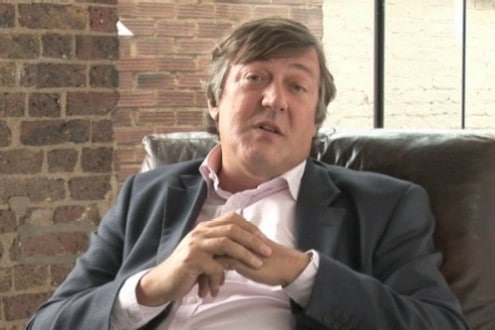
Stephen Fry, wit, actor, Twitter giant (Courtesy: Wikimedia Commons)

By James Dacey

I visualize the social-networking site Twitter as a giant cocktail party where multiple conversations, all taking place at once, result in a cacophony of chitchat. Strolling around this gathering you come across crowded pockets where fans huddle round their favourite celebrities, looking for some juicy gossip or dazzling insight into their everyday lives. At the heart of all this you might spot a particularly attentive crowd gathered around the English actor and comedian, Stephen Fry, as he dishes out his devilishly sharp one-liners, always within the limit of 140 characters.

In reality, most of what Fry writes on Twitter is, as the man would say himself, Quite Interesting. But he does sometimes come out with some obscure gems, like yesterday when he drew the attention of his 2 million+ fans to this hilarious entry on Conservapedia about the supposed flaws in Einstein’s theory of relativity. For those not familiar with Conservapedia, it is promoted as “the trustworthy encyclopedia”, and directly contrasts itself with Wikipedia, which it criticizes on a number of points.

The Conservapedia entry comprises a list of 33 “counter-examples to relativity”, and I thought I would just pull out a couple.

Number 9: “The action-at-a-distance by Jesus, described in John 4:46-54”.

Number 21: “The lack of useful devices developed based on any insights provided by the theory; no lives have been saved or helped, and the theory has not led to other useful theories and may have interfered with scientific progress. This stands in stark contrast with every verified theory of science.”

I hope this blog entry doesn’t sound too sneering of people who might hold religious beliefs. And it is certainly not a bad thing to hope that science can lead to useful technologies that can help improve everyday lives. But these “counter-examples” on this ridiculous website give a completely false representation of the process of science. Besides, to say that relativity has no practical use is just plain wrong , as the accuracy of GPS systems depends on relativistic corrections, and these systems help to save plenty of lives. But there is no point in arguing with some people.

My sense of unease intensified when I read that Conservapedia boasts over 200 million views and more than 810,000 edits. Among the website’s guidelines it states that “we are neutral to the facts” and “everything you post must be true and verifiable”.

Just to give you a flavour of the site, here is Conservapedia‘s entry for “a liberal”: “someone who rejects logical and biblical standards, often for self-centered reasons. There are no coherent liberal standards; often a liberal is merely someone who craves attention, and who uses many words to say nothing”. Yep, that sounds both neutral and verifiable.

As for why Fry felt the need to tweet about this entry now…well it’s probably no coincidence that his picture appears on the Conservapedia homepage alongside an article on “atheism and obesity”. And why I wrote this blog entry giving Conservapedia more oxygen? Well, I’m not quite sure. Guess I was just quite angry.

Bridging the gap between biology and electronics

Biology is soft, elastic and curvilinear, whereas conventional semiconductor electronic devices are rigid, planar and brittle. As disconnects go, this is a big one – although that may be about to change.

John Rogers and his team at the University of Illinois at Urbana-Champaign are working around the mismatch in mechanics and geometry to realize tissue-like electronic devices – bendy, waterproof and biocompatible – that could one day be implanted in the human body to open up new frontiers in biomedicine.

“Because you can’t change the biology, we as materials scientists have focused on new ways to use semiconductor materials in electronic devices that have the shape and mechanical properties of human tissue,” he tells Louise Mayor, features editor of Physics World, in our latest video report.

For Rogers and colleagues, the ultimate goal is a new generation of implantable bioelectronics with applications ranging from advanced surgical devices to light-activated drug delivery and accelerated wound healing. Just press “Play” to get the full story.

This interview forms part of a series filmed at the MRS Fall Meeting in Boston. See also “Living in a material world”, “Funding the frontiers of materials science” and “Spreading the word: why science outreach matters”.

Hubble rap

By Hamish Johnston

If you’ve ever wondered what Edwin Hubble would be like if he was reincarnated as an English rapper, you are in luck.

The “science rapper” Zach Powers has made a video of his interpretation of how the great astronomer would rap about his discovery of the expanding universe.

Hubble was an American mid-westerner born and bred, but Zach portrays him with an English accent. Hubble had spent a few years at Oxford and was apparently a bit of an Anglophile – although I doubt he ever affected a south London drawl.

Zach, by the way, describes himself as “a native New Yorker and professional scientist”. Zach is working towards a PhD at the Mount Sinai School of Medicine where he studies the structure of chromatin proteins.

The rap and video are pretty good, and the physics is spot on. One of my favourite lines is:

“I’m stark raving mad for what do I see? The farther the star, the greater the velocity.”

If you enjoy the science rapper, you might want to check out “The PCR Rap” – that’s polymerase chain replication – which celebrates the work and lifestyle of Nobel laureate Kary Mullis. In this rap Powers sounds a bit like Lou Reed, just what you would expect from a native New Yorker.

Cylinders of silence cloak in 2D

Researchers in the US have built the first practical device that can cloak an object from being detected by sound waves. The cloak, which is made from a cylindrical array of acoustic cavities, has been shown to operate in water at ultrasonic frequencies. The technology could in principle be adapted to cloak underwater objects from sonar.

Several research groups have already managed to build “invisibility cloaks” that hide objects from electromagnetic waves. Such cloaks are made from “metamaterials” – artificial structures with special optical properties such as negative indices of refraction. These structures are arranged such that incoming light waves flow smoothly around the cloak, joining up on the other side as if the cloak and object were not there.

The same principles can be applied to sound and in 2008 Nicholas Fang and colleagues at the University of Illinois at Urbana-Champaign in the US created an acoustic “superlens” using acoustic metamaterials. Now Fang and team claim to have built the first practical broadband and low-loss acoustic cloak.

Acoustic capacitors and inductors

The device comprises 15 concentric cylinders that vary in radius from 13.5–54.1 mm. Each cylinder contains an array of cavities connected by channels and these behave as acoustic capacitors and inductors. The size of the cavities and channels changes from one cylinder to the next and this gives the device the acoustic properties needed for cloaking.

To demonstrate their device, Fang and colleagues placed a solid object at the centre of the cloak and then fired sound waves at it. By detecting the sound that reached the other side of the cloak using a hydrophone, they showed that the cloak works across a range of acoustic frequencies from 52 to 64 kHz.

This “broadband” response is unlike many optical cloaks, which tend to function only over an extremely narrow frequency range. This narrow optical response is related to restrictions on how the speed of light can vary inside and outside the cloak. These restrictions do not, however, apply to sound waves.

Another benefit of the design is that that the metamaterial does not absorb much of the sound: if it did, the cloak might become apparent to an observer. This is unlike previous acoustic cloak designs, which relied on soft, absorbent materials.

Steve Cummer of Duke University in the US, who was not involved in the work, says that the research is an important breakthrough in the development of acoustic metamaterials. “This is the first real experimental demonstration that acoustic metamaterials that achieve the properties required by transformation acoustics can be designed and constructed using relatively simple building blocks,” he says.

Should work in 3D

One shortcoming of the design is that it is restricted to cloaking objects from sound that propagates in 2D – making it impractical for many real-life applications. However, Cummer told physicsworld.com that “the underlying theory of transformation acoustics applies to both 2D and 3D and the required material parameters are similar in these cases. Honestly I don’t see why it couldn’t be extended with 3D cavities instead of 2D ones”. The big challenge in making 3D devices, according to Cummer, would be fabricating the structure.

Although the design could be used to hide underwater objects from sonar, it does have its shortcomings. As Cummer points out, the cloaking shell is much thicker than the object it is cloaking: Fang’s cloak needs a 40 mm thick shell to hide an object about 13 mm in diameter. Such a thick shell would be impractical for shielding a moving object such as a submarine, although Cummer admits that lessons learned from Fang’s demonstration could lead to thinner cloaks.

The work is described in Phys. Rev. Lett. 106 024301.

Reality check at the LHC


If January blues are getting the better of you, cast your mind back to the summer of 2008 when speculation about potential discoveries at CERN’s Large Hadron Collider (LHC), which was then about to switch on, went into overdrive. The world’s media descended into a frenzy about what the LHC might cook up: new dimensions of space, “sparticles”, dark matter and – who could forget? – planet-eating black holes. Two and a half years later and – no surprise, really – planet Earth prevails. Yet so does our well-established picture of the fundamental workings of nature.

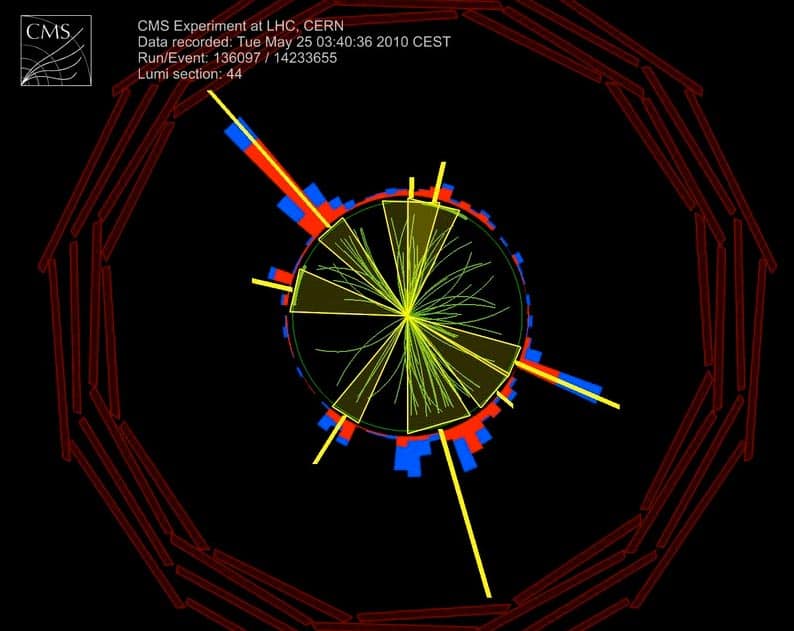
It is still early days at the LHC, but the 27 km-circumference machine’s first year of smashing protons into each other at record energies is beginning to tame theorists’ imaginations. Researchers on the Compact Muon Solenoid (CMS) experiment, for example, have reported that, at the energies probed so far, quarks do not exhibit substructure (arXiv:1010.4439), exotic particles such as colorons and E6 diquarks have not shown up (arXiv:1010.0203) – and nor have leptoquarks (arXiv:1012.4031) or new heavy gauge bosons (arXiv:1012.5945) either. Although these entities cannot be ruled out completely, LHC data have allowed them less room to hide – principally by allowing researchers to place stringent limits on the particles’ masses.

CMS scientists have also found no evidence for micro black holes in their 12,500 tonne detector (arXiv:1012.3375). This result, reported just before Christmas, will not have come as a shock to anyone who thinks such black holes will destroy the planet. (For them, it’s only a matter of time…) But it has not surprised many physicists either, given that miniature black holes could only appear at the LHC if space has more than three dimensions. So what does CMS’s black-hole blank mean for such outlandish pictures of space–time? Can we now simply start ruling them out?

“The fascinating science of black-hole production and evaporation still stands,” insists Steve Giddings of the University of California, Santa Barbara, who a decade ago co-proposed the possibility that the LHC might create black holes. “The CMS results begin to rule out the most extreme configurations of extra dimensions, although it is true that such configurations are believed unlikely by many. It’s still a possibility that black holes will be made at the LHC, but it’s not a prediction unless you know the configuration of the extra dimensions!”

Bridging the gap

The models of extra dimensions that underpin the black-hole prediction were originally proposed in 1998 by Nima Arkani-Hamed of the Institute for Advanced Study in Princeton and others to address what is known as the “hierarchy problem”: why gravity is more than 30 orders of magnitude weaker than the forces that govern the quantum world. They posit that everything bar gravity is confined to a 3D brane that exists in a higher-dimensional space from which the true strength of gravity leaks, reducing the Planck scale (at which gravity and the other forces have similar strengths, as is thought to have been the case in the first instants of the universe) from its conventional value of 1016 TeV to just a few TeV – exactly the energy the LHC is exploring.

The fascinating science of black-hole production and evaporation still stands Steve Giddings, University of California, Santa Barbara

In such a higher-dimensional universe, argue Giddings and others, micro black holes could be squeezed into existence at the rate of one per second at the LHC by particles encountering the true strength of gravity at short distances – before decaying almost instantaneously into a flash of regular particles. However, Arkani-Hamed says that he never thought the black-hole signal was plausible. “Even if extra dimensions exist, black holes would be the last thing you’d discover because you’d see other, larger effects at lower energies first, such as gravitational radiation into the extra dimensions,” he says. “Whatever the reduced Planck scale is, you would have to go to energies several times that to start making what you would recognize as a black hole.”

But Georgi Dvali of Ludwig-Maximilians Universität in Munich, Germany, who worked with Arkani-Hamed on large-extra-dimension models, insists that micro black holes do exist. “It follows from the existence of big black holes,” he told physicsworld.com. “A micro black hole is just what happens to a big one at the very last stage of evolution once it has all but evaporated via Hawking radiation. We know this should happen – we just don’t know at what length [i.e. energy] scale.”

The problem, Dvali points out, is that our current theoretical understanding of micro black holes is not sufficient to accurately predict their properties. To search for these (and other exotic entities) at the LHC, researchers have to model the background events that could mimic them, mostly involving copious jets formed by quarks and gluons – a process that itself is not precisely known theoretically. So far the CMS team has found no signal against this background, allowing researchers to exclude black holes with minimum masses of 3.5–4.5 TeV/c2.

A blow for string theory?

But is the lack of black holes seen by the CMS a setback for string theory? After all, this vast theoretical framework also invokes extra dimensions to connect gravity with the other three forces, describing elementary particles as facets of fundamental strings vibrating in a compact 6D or 7D space. However, Arkani-Hamed, for one, rejects the notion that string theory has been given a bloody nose, describing any such claim as “ridiculous”.

Lisa Randall of Harvard University, who in 1999 co-developed a similar extra-dimensional approach called “warped geometries” to address the hierarchy problem, explains that both hers and Arkani-Hamed’s large-extra-dimension (LED) models use string-theory ingredients and might even be derived from string theory, but that neither implies the other. “Ours are really effective theories that are defined at low energies,” she says. “These models don’t necessarily originate in string theory, and string theory doesn’t necessarily imply this low-energy realization.”

In fact, string theory illustrates how hard it can be to test mathematics linking gravity to the quantum world. String theory describes an inordinate number of possible compactifications of the extra dimensions, each corresponding to a different possible universe, many of which contain features of both LED and warped-geometry models. “In this much broader class of ‘more realistic’ compactifications it appears possible to have particular ones where gravity gets strong at the LHC,” says Giddings. “But there may be many more where it doesn’t.”

Before theoretical physicists get a reputation for being disconnected from the realm of measurement, Arkani-Hamed points out that even before experiment renders an ultimate verdict, consistency conditions – mathematical ones as well as consistency with existing experiments – are so tough to satisfy that the vast majority of new ideas die immediately. Models of large extra dimensions, which were the first new attempt to crack the hierarchy problem in nearly 20 years, are plausible in part because experiments have only tested the sanctity of 3D space at the relatively gargantuan scale of about 0.1 mm.

Calling the super-world

One hotly anticipated find at the LHC would, however, boost string theory and solve the hierarchy problem at one fell swoop: supersymmetry (SUSY), which posits new quantum dimensions to space–time that give rise to a whole spectrum of heavy partners to the known Standard Model particles, dubbed “sparticles”. “Supersymmetry is a much deeper idea than extra dimensions, and there are also strong circumstantial hints that low-energy SUSY is correct,” says Arkani-Hamed. “So if I had to bet, I would bet (by a lot) that some variation of SUSY will show up at the LHC.”

Even if extra dimensions exist, black holes would be the last thing you’d discover Nima Arkani-Hamed, Institute for Advanced Study, Princeton

Searches for SUSY at previous CERN colliders and at the soon-to-be-shut-down Tevatron collider at Fermilab in the US have turned up nothing, allowing physicists to place lower limits on the sparticle masses. The LHC’s higher-energy collisions allow the machine to produce heavier sparticles, should they exist. But earlier this month CMS reported that it had found nothing new so far, ruling out supersymmetric particles with masses of less than about 0.5 TeV/c2 (arXiv:1101.1628). And in November the experiment reported no signs of long-lived supersymmetric gluons (gluinos), which should arise if a more recent take on SUSY called split-supersymmetry is correct (arXiv:1011.5861).

CMS’s sister experiment, ATLAS, is expected to report on its own searches for such exotic new particles in the next few weeks, although it has already ruled out quark sub-structure (arXiv:1009.5069) and exotic particles lighter than 1.26TeV/c2 (arXiv:1008.2461). And with the LHC due to restart next month after its winter shutdown and accumulate data at an even higher rate – perhaps also at a higher energy – decades of theoretical research into physics beyond the Standard Model (along with, of course, the mechanism that gives elementary particles their mass) will soon be put squarely on the line.

“Given that the LHC is just starting to dig into the territory relevant for the hierarchy problem, it’s hardly surprising that the machine isn’t turning up evidence for anything new in the very first analyses of the data collected at half its ultimate energy,” says Arkani-Hamed. “But even if no extra dimensions are found, that would be perfectly fine by me – after all, we’re in the truth business!”


Heat engine may be world’s smallest

Physicists in the Netherlands have built a heat engine that might be the tiniest ever created. Based on “piezoresistive” silicon, and smaller than a typical biological cell, the engine could find applications in watch mechanisms or as a mechanical sensor.

Engines come in a variety of sizes. The smallest include biological engines such as the flagella that bacteria use for locomotion, which are driven by chemical reactions, or manmade electrostatic engines, which drive ions with electric fields.

But heat engines, which usually rely on the expansion and contraction of liquids or gas, are trickier to downscale. As the devices get smaller, engineers find it harder to design structures that can handle the high pressures and fluid velocities required for a reasonable power output. The efficiency also tends to decrease, because it requires large temperature differences as given by the famous Carnot heat-engine equations. For these reasons, liquid- or gas-driven heat engines rarely get smaller than around 107 µm3.

Driven by stress

In a paper published today in Nature Physics, however, Peter Steeneken and colleagues at NXP Semiconductors in Eindhoven easily overcome this threshold with a heat engine driven by the movement of a solid – in particular, a piezoresistive mass of crystalline silicon. Piezoresistive materials are unique in that their electrical resistance changes with applied stress: when a piezoresistive material is compressed, its resistance increases, and when it expands, its resistance decreases.

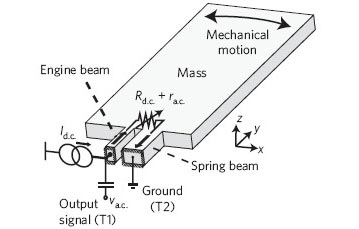
The tiny engine consists of a flat resonator of crystalline silicon, 1125 µm3 in size, with two small parallel beams, 0.34 µm3 in size, at one end – rather like a tuning fork with a heavy base. Both beams are anchored such that the compression or extension of one beam, the “engine” beam, heated by a DC current of just over one milliamp, bends the entire device up or down.

The key to the device’s operation is an interplay between the engine beam’s temperature, compression and resistance. When it is compressed (device bent up) its resistance is greatest, and this resistance, owing to the DC current, increases the temperature. But the increased temperature makes the engine beam expand (device bent down), which lowers the resistance and hence lowers the temperature. The low temperature again makes the engine beam compressed, and the process thereon repeats in an oscillatory motion of over 1.2 MHz.

“If the volume of the engine beam is taken, this is the smallest heat engine I know of,” says Steeneken. “[But] if the resonator is considered part of the heat engine, it is probably not the smallest in the world.”

A timely breakthrough

Steeneken thinks the device could replace the quartz oscillators and electronic amplifiers used in clocks and wristwatches, because, he says, mechanical devices are more stable than purely electrical oscillators. He also believes it could act as a sensor, because the oscillation frequency changes dramatically with mass, so you could tell if an object comes to rest on the device.

What is more, the heat engine can also double as a refrigerator. In this case, the engine beam must be connected to a voltage rather than a current source, so that any oscillation imposed on the device via Brownian motion – the thermal jiggling of surrounding molecules – is lessened, thereby cooling the surroundings. A tiny fridge could be used to cool other tiny mechanical sensors or mirrors, reducing thermal noise to improve their precision.

Richard Peterson, an engineer who specializes in heat engines at Oregon State University in Corvallis, US, believes Steeneken’s group has “hit upon a new micro-scale thermal engine having phenomenological interest”. But Peterson points out that the engine’s heat is supplied by electricity, which could just as easily perform the mechanical work directly. “When the authors demonstrate driving their oscillator with a thermal source, then I believe they will really have something,” he adds.

Life’s asymmetry may come from space


Processes taking place in outer space, and not on Earth, are likely to have led to the biological molecules found exclusively in either a left-handed or right-handed form. That is the conclusion drawn from recent experiments carried out at the SOLEIL synchrotron facility near Paris in which a number of simple molecules found in star-forming regions exposed to polarized radiation created amino acids with an imbalance of left- and right-handed molecules.

So-called chiral molecules can exist in two forms, with one being the non-superimposable mirror-image of the other, even though both have the same chemical make-up. Although laboratory experiments will tend to produce equal quantities of the left- and right-handed versions of a given chiral molecule, many of the chiral molecules found in living organisms come in only one variety. For example, the amino acids that make up proteins only exist in the left-handed form, while the sugars found in DNA are exclusively right-handed.

Result of evolution

Scientists have long debated the reasons for this asymmetry in living matter. Some have argued that equal numbers of both versions of each chiral molecule were present at the onset of life and that it was only during biological evolution that the imbalance occurred. That view has become increasingly unpopular, however, with the realization that the fundamentally important process of protein folding seems to require chiral imbalances, while for nature to have selected the left- or right-handedness of each molecule during evolution would involve extraordinarily complex processes.

The latest work, published in Astrophysical Journal Letters, provides further backing for the alternative view, that the asymmetry existed before life got going. A group of astrophysicists, physicists and chemists in France, led by Louis le Sergeant d’Hendecourt of the University of Paris South, irradiated molecules of water, ammonia and methanol at low temperatures using circularly polarized ultraviolet light at SOLEIL. The idea was to recreate the conditions found in star-forming regions, where partially circularly polarized light has been observed, and to test the hypothesis that this polarization could induce an imbalance in the creation of left- and right-handed versions of certain amino acids. Other researchers have previously shown experimentally that chiral organic molecules can be created in space-like conditions, and that organic matter might therefore have its origins in space, but could not induce any asymmetry because they lacked a suitable source of radiation.

D’Hendecourt and colleagues found what they were looking for. Irradiation of the interstellar-like matter created an organic residue that contained a noticeable asymmetry in the chiral amino acid alanine. Specifically, they found a 1.3% reduction or a 0.7% increase in the amount of left-handed alanine, depending on the orientation of the light polarization (with the lower magnitude in the second case, they say, being explained by a lower concentration of photons arriving at the sample). Using linearly polarized light, in contrast, they found no noticeable asymmetry.

Conjuring up chirality

The researchers therefore conclude that it is possible to create “asymmetrical molecules of life” in space-like conditions from a mixture that does not initially contain any chiral substances. Team member Laurent Nahon, who works at SOLEIL, points out that the figure of 1.3% is of the same order of magnitude as the asymmetric fraction of amino acids discovered in primitive meteorites and so lends further weight to the idea that chiral asymmetry originated in space.

Nahon says that previous laboratory experiments have shown how a slight imbalance such as this can then lead to 100% asymmetry in a chiral substance, but says it is too early to pin down exactly the mechanism that creates the initial imbalance. It is not clear, he points out, whether the polarized radiation creates more of one kind of handedness than the other or whether it creates equal quantities of both and then destroys one of them more readily, but adds that his group is carrying out additional experiments to try and resolve this.

Laurence Barron, a chemist at Glasgow University, believes that D’Hendecourt and co-workers have carried out a “most interesting” experiment but points out that circularly polarized light is not the only mechanism that has been put forward to explain living matter’s asymmetry. Indeed, he notes, there are a number of other candidates, including the combined effect of unpolarized light and a static magnetic field, spin-polarized electrons from beta decay, and even charge–parity violation. “Whether this latest work has anything to do with the origin of biological chirality is not clear,” he says. “But it certainly merits inclusion in future discussions of the problem.”

Electron beams do the twist


A new twist on transmission electron microscopy (TEM) could enable the technique to unlock even more secrets on the nanoscale. Researchers in the US have produced a helical-shaped beam of electrons that could produce significantly higher-resolution images than is possible with conventional TEM, and it could be used to capture images of hard-to-spot bacteria and proteins.

TEMs work by firing a beam of electrons through a material and measuring how it absorbs and deflects the particles to build up an image of the sample. A microscope equipped with twisted electron beams should be able to produce images with even greater resolution thanks to the fact that the beams exchange large amounts of orbital angular momentum with the materials they interact with.

Twisted beams are already in used in optical microscopy, but it is much more difficult to twist beams of electrons. That is because electrons, like all other particles, have an associated wave whose wavelength is much shorter than that of light, so electron waves need to pass through much tinier structures to become twisted.

A special hologram

This has now been achieved by a group of researchers, including Ben McMorran of the National Institute of Standards and Technology (NIST), who fire electron beams through a specially designed hologram, which causes the beams to diffract. The diffraction created an ordinary plane wave beam, along with several helical-shaped beams, and the researchers were able to confirm the shape of beams and analyse how they evolve in time.

Although there are other ways to produce helical electron beams, the researchers say they used diffraction holograms because they more easily generate controllable beams with precise quantized large orbital momentum. The holograms were fabricated using a very finely focused ion beam to cut a pattern of extremely small slits just 20 nm across though a thin silicon membrane 30 nm thick. The free-standing silicon nitride structures are also quite mechanically robust and can withstand irradiation by the 300 keV electron beam in a TEM. And, they are small enough to be placed in the microscope without having to modify the instrument.

In addition to biological applications, the twisted electron beams could also be ideal for imaging magnetic materials because they can induce torques on charges in a sample by transferring angular momentum to them. “At its most fundamental, magnetism in a material is entirely due to the angular momentum of constituent charges, so being able to probe that using these beams will provide a new way to look at magnetic samples with unprecedented resolution,” said McMorran. “Quite recently another group confirmed this effect, which is very encouraging to us.”

Building on recent work

Indeed, a separate team based in Japan recently described an electron vortex beam produced by a different method and provided data on a single set of fringes showing that, while the electrons had spiral wavefronts, they were not single quantized orbital states. And a third group, based in Europe, described a similar technique to NIST’s but the holograms made were on the micro-scale as opposed to the nano.

“We made more complex, tinier holograms that enable us to achieve 10 times the separation angle between beams – important for applications – and 100 times the orbital angular momentum on electrons,” explains McMorran. “This is possible because each grating in our hologram produces multiple beams with higher diffraction orders containing proportionally larger amounts of angular momentum.”

The team is now working on ways to make the holograms even smaller. “We are taking a more detailed look at the fundamental properties of these helically shaped electron beams too, which is interesting stuff in itself. And to top it all, we are developing theory to understand all of this,” says McMorran.

The Dougal effect and the Partridge

By Hamish Johnston at the AAS meeting in Seattle

The jetlag and non-stop astronomy must be getting to me because I can’t stop thinking about various aspects of astrophysics in terms of my favourite sitcoms.

For example, Father Ted brings us the “Dougal effect”, whereby the actual size of an astronomical object cannot be inferred from its observed size alone. Distance must also be considered and Ted explains this to Dougal using nearby toy cows and a distant herd of real cows. “These are small… but the ones out there are far away,” is the best way to define the effect.

Then there’s that astronomical unit of temperature defined in I’m Alan Partridge. Alan uses a microwaved apple pastry as a weapon, discovering “It’s hotter than the Sun”.  To calibrate your thermometer to one “Partridge” put a petrol-station pastry in the microwave for eight minutes and presto.

Well, that’s all from me in Seattle. I’m about to fly back to Blighty and I’ll be looking for astronomy references in The Inbetweeners, which is featured on the in-flight entertainment system.

Copyright © 2026 by IOP Publishing Ltd and individual contributors