An audience with the Pope's astronomer

By James Dacey

If you are a regular follower of this blog, you may remember that a few weeks ago I went to see the Pope’s astronomer, Brother Guy Consolmagno, who was giving a talk at the British Science Festival in Birmingham.

Here is a video of that talk in full in which Brother Guy discusses many things including science, religion and the Catholic church’s view on extraterrestrial life. On serious topics such as how he squares his belief with his rational scientific thought, Consolmagno was a lot more candid than I had expected. For instance, if you skip to just over 7 minutes in you can hear how his decision to become a Jesuit just before his 40th birthday was based on a botched calculation regarding his age.

The loudest laugh of the night came when Consolmagno dismisses the idea that Catholics read the Bible as if it were a literal truth, as if it were a science book. “That’s not a Catholic idea… that’s a protestant idea,” he says with a mischievous grin on his face. (See 11 min 30 sec in.)

Video credit: David Evetts from the Birmingham Astronomical Society

Secret of diamond polishing revealed

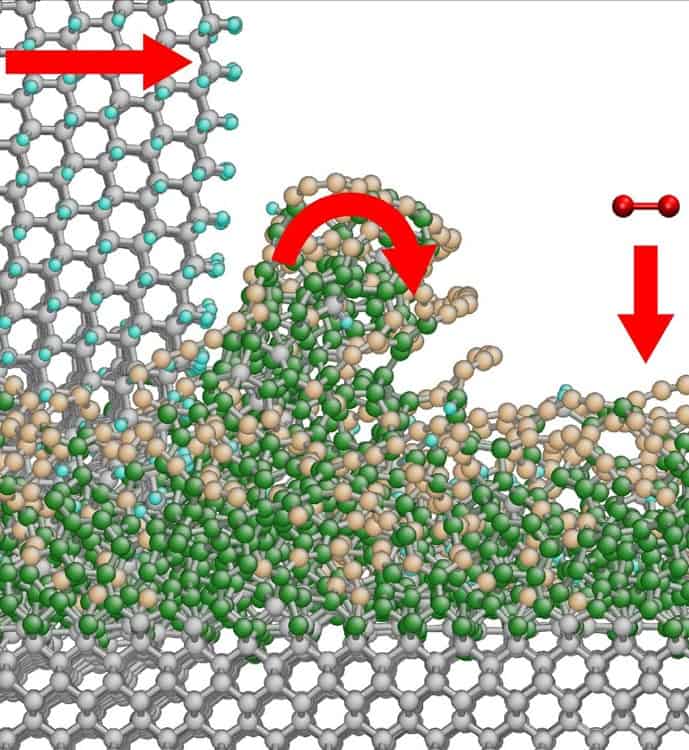
It is the hardest everyday material on Earth, so why does diamond glisten when rubbed against another diamond? Now, the ancient but mysterious process of diamond grinding may have been explained by physicists in Germany, who have created a model for explaining the frictional interactions at the molecular level.

For centuries precious-stone merchants have polished diamonds by grinding them with cast-iron wheels embedded with coarse diamond fragments. It is not clear why this procedure is so effective at cleaning diamonds, but experience suggests that it works far better when the diamond is fixed at certain angles to the wheel than others.

This directional dependence of diamond grinding has now been investigated by Lars Pastewka at the Fraunhofer Institute for Mechanics of Materials who set out to investigate the phenomenon. Working with colleagues at several other institutes across Germany, he has developed a quantum mechanical model to study the atomic interactions in “diamond-like” carbon films, which are often used in industry to reduce friction in machinery.

Diamond in the rough

But when the researchers applied their model to diamond itself, they were surprised to find that it accurately predicted the experimental wear rates for this material – even though the exact wear mechanism has so far remained poorly understood. “At this point we became very excited about this work and analysed our simulations in much more detail to uncover the details of the process,” Pastewka told physicsworld.com.

Pastewka’s team set about simulating diamond grinding using 70 computer processors running for a year, and discovered that during the grinding the diamond surfaces were being transformed into soft, amorphous layers. These thin films can then be easily removed by either chipping them away, or through carbon molecules bonding with oxygen in the atmosphere, leaving behind clean diamond surfaces.

This creation of the amorphous film occurs because of existing imperfections at the diamond surface, including the build-up of dirt over time. As a diamond atom slides over the surface it repeatedly pulls at the diamond crystal’s atoms, and sometimes removes an atom from the crystal surface, which becomes part of the amorphous layer.

Like a stack of paper clips

“Imagine you have a stack of paper clips neatly arranged on your desk,” explains Pastewka. “Now you take a magnet and move that over these clips at a certain height. You cannot keep the height ideally constant, so if the height is right you will pull some paper clips to your magnet and others will remain on the desk.”

Changfeng Chen, a materials scientist at the University of Nevada in the US is impressed by the research and its potential to boost industrial processes. “This research is of particular significance in nanotechnology where the orientations of nanoscale crystallites can be well defined and controlled,” he says. “The predicted orientation-dependent anisotropic amorphization wear mechanism may open doors to a new level of material processing, ranging from better designer jewellery to superior high-tech device components.”

To develop the work, however, Pastewka’s team intends to further investigate diamond’s surface chemistry, and is currently writing a paper on the oxidation of the amorphous layer.

This research is described in a research paper in Nature Materials.

Peering into the 'super microscope'

greaves-495px.jpg
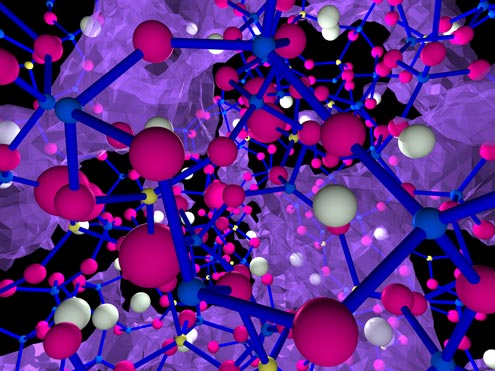
“Glass” (Courtesy: Neville Greaves/Aberystwyth University)

By Michael Banks

Make sure you do not miss a new exhibition at the Didcot Cornerstone Arts Centre in Oxfordshire, which starts today and runs until 9 January.

ISIS: Super Microscope features pictures of the ISIS neutron source taken by photographer Stephen Kill as well as images from some of the science performed at the facility.

The exhibition is aimed at raising the public’s awareness of the neutron source, which is at the Rutherford Appleton Laboratory in Oxfordshire and operated by the UK’s Science and Technology Facilities Council.

Completed in 1984, ISIS remains Europe’s only source of pulsed neutron beams. In 2008 the facility completed the construction of a second target station, which will see the number of instruments double to over 40.

Every year hundreds of researchers come to ISIS from around the world to study a range of materials from magnetic materials to biological samples.

One of the images on display is called “Glass” (shown above), which shows the atomic structure of glass as inferred from data collected in neutron experiments.

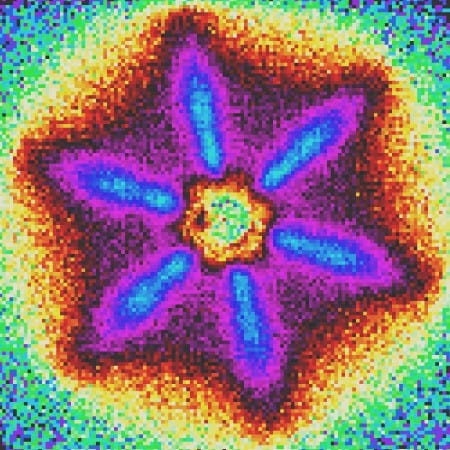
The image below, which has the appearance of a petal, is taken from raw data collected by a neutron camera at ISIS.

flower.jpg
The “flower” (Courtesy: Steve King/ISIS)

Flower
ISIS researcher Stephen King explains how the image was made using neutrons

Building a better bobsleigh run

bobsleigh.jpg


By Hamish Johnston

Much of Britain is under a thick blanket of snow – and there is even a light sprinkling of the stuff here in normally balmy Bristol. So it’s not surprising that our thoughts have turned to the physics of winter sports.

Louis Poirier is one physicist with both a practical and theoretical understanding of that subject. Poirier spent more than five years on Canada’s national bobsleigh team before starting a PhD in physics at the University of Calgary.

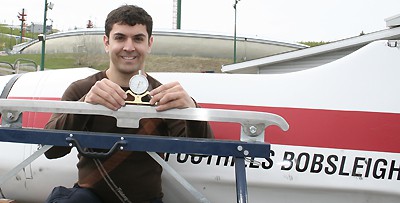
Poirier still has an academic interest in the sport and last year he published a paper in the journal Sports Engineering on “Optimization of handheld gauge sizes for rocker measurements of skate blades and bobsleigh runners”. That’s Louis pictured above with a gauge (photo courtesy of U of Calgary/Ken Bendiktsen).

Now, Poirier has turned his attention to making bobsleigh runs safer for athletes – an important issue for the sport after the death of a competitor in this year’s Winter Olympics. Tomorrow, Poirier will be at an international bobsleigh, skeleton and luge competition near Calgary armed with a radar gun.

Poirier told the Toronto Star that current models used to design tracks are not very accurate because they only consider the time the sled passes about six points along the run.

Using his radar data, Poirier hopes to work out the acceleration on the competitors as they whiz around bends in the track.

Interestingly, he says that speed isn’t always the problem – and that slow tracks can sometimes be more challenging (and dangerous) than faster ones.

Poirier hopes to be able to publish his findings but admits that it may be impossible to perform controlled measurements in a competitive event. You can read about his work here.

Spin ices slip into ground state

Physicists in the UK and the US are the first to encourage artificial spin ices – magnetic nano-structures analogous to water ice – into a square formation that is very close to the ground state. The discovery could help researchers to develop “bit pattern” data storage, where sheets of magnetic material are replaced by arrays of magnetic islands.

In spin ices, the interactions between atoms are “frustrated” so they cannot settle into a crystalline state where all interaction energies are minimized. Water ice is an example of such a frustrated structure. To form a perfect crystal, the hydrogen atoms would have to be located halfway between the oxygen atoms. However, each oxygen atom prefers to hold on closely to two hydrogens through short-range covalent bonds.

In fact, the solid only works when every oxygen is covalently bonded to two hydrogen atoms – those identified in the “H20″ – and two at a distance through long-distance hydrogen bonds. The result is a solid with a disordered distribution of short and long bonds between oxygen and hydrogen.

Artificial spin ices consist of analogous “atoms” made of tiny magnets, each a dipole that tries to align with its neighbours to satisfy interactions. They present a way to understand the frustrated structure of water because, unlike water, their interactions occur on a large enough scale to be studied through a microscope. Artificial spin ices could also be studied to figure out how to pack together magnetic dipoles for data storage, without letting interactions spoil the dipoles’ alignment.

Spin ice jam

Yet one of the troubles in working with artificial spin ices has been how to get them into a ground state, where the dipoles exhibit long-range order. Like coarse sand in a funnel, the dipoles tend to jam in a high-energy state during fabrication. In the past, researchers have tried applying rotating magnetic fields to encourage the dipoles into lower energy states – the equivalent of shaking up the sand – but this has not proved totally successful. “You get them into some low energy state, but not into the ground state, or anywhere close,” says Christopher Marrows of the University of Leeds.

Marrows’ group, which includes colleagues at Rutherford Appleton Laboratory in Oxfordshire and Brookhaven National Laboratory in the US, has now identified a square artificial spin ice in what seems to be the ground state – or very close to it. In their experiment, Marrows and colleagues placed a stencil on top of a silicon wafer and used an electron beam to deposit a nickel-iron alloy. When they removed the stencil, they were left with a square array of magnetic domains – the artificial spin ice.

Marrows’ group then used a technique called magnetic force microscopy to image the sample, and discovered that, unusually, it displayed the long-range order typical of a ground state. According to Marrows, the order probably arose because of thermal agitations that could shake the diploes towards the ground state while the spin ice was still thin. In the normal fabrication of artificial spin ices, he says, this can’t happen because a thick layer of magnetic alloy is etched away to form dipoles – there is no thin stage.

Square versus triangles

Oleg Tchernyshyov, an expert in spin ices at Johns Hopkins University in Baltimore, US, believes the development is not totally new, since other researchers have achieved ground-state ordering in spin ices with “kagome” (interlaced triangular) arrays of dipoles, as opposed to square arrays. Tchernyshyov adds, however: “To Marrows’ credit, it is much harder to get rid of defects in square ice than in its kagome counterpart.”

Marrows told physicsworld.com he next wants to investigate what happens with artificial spin ices on smaller scales, which might be able to show how thermal agitations shift the dipoles around. “Because you’ve built it using nanotechnology you can control everything,” he says. “You can tune the strength of all the interactions at will, just by making a slightly different pattern – a little bigger, or a little smaller. You can’t do that with the natural systems.”

The research is published in Nature Physics.

Happy birthday, Royal Society

By Matin Durrani

The Royal Society – one of the oldest scientific societies in the world – has been spending all this year marking its 350th anniversary.

The society was founded on 30 November 1660 and its outgoing president is the Cambridge University cosmologist Martin Rees.

Rees, whom I interviewed earlier this year (see video above), stepped down yesterday after five years in the hot seat, to be replaced by the Nobel-prize-winning geneticist Sir Paul Nurse, who was lured back to the UK after a stint in New York.

It takes a certain polished charm, coupled with a clear vision, to get appointed as Royal Society president – a quality that Rees has for sure, as you’ll see from the interview.

Nurse no doubt has those qualities too, insisting to the Observer in a recent interview that “scientists have to earn their licence to operate and that means getting out there to talk to people and explain what we do.”

To mark Nurse’s appointment, the Royal Society has also just released a new report entitled Science Sees Further: How Science Will Answer Some of the World’s Biggest Questions containing 12 articles on the “most exciting areas of science today”.

The topics are quite general – ageing and Web science being among them, with the most closely related to physics probably being those on, greenhouse gases, geoengineering and extraterrestrial life.

As for Rees, I doubt his life will get much quieter – he’s still president of Trinity College Cambridge and the UK’s Astronomer Royal after all.

Super-Earth’s atmosphere comes into view

A team of astronomers has made the first direct measurement of the atmosphere of an exoplanetary “super-Earth”. The findings suggest that the exoplanet named GJ 1214b has either an atmosphere swarming with clouds or one enveloped in water vapour.

Since the discovery of the first extra-solar planet – or exoplanet – in 1995, over 500 more have subsequently been unveiled. While most of these are gas giants like Jupiter, astronomers are getting better at finding smaller exoplanets that could be more similar to Earth.

GJ 1214b weighs in at 6.5 Earth masses and is a so called super-Earth because it tips the scales at between twice and ten times the mass of our own planet. Discovered in 2009, and circling a star approximately 40 light-years from Earth, the exoplanet’s low density implied that it is blanketed by an atmosphere. However, until this latest research, led by Jacob Bean at the Harvard-Smithsonian Center for Astrophysics, US, direct measurements of this atmosphere had remained elusive.

Bean and colleagues used a spectrograph, attached to the Very Large Telescope (VLT), to analyse light from the parent star as the planet passed in front of it. During such a transit some starlight passes through the planet’s atmosphere and can be soaked up by its constituent chemicals. This produces a spectrum containing tell-tale fingerprints – gaps at wavelengths where light is absorbed by the atmosphere. Crucially, Bean’s spectrum for GJ 1214b was featureless: there were no gaps in the data.

Cloud-free skies ruled out

Such a result rules out models suggesting the possibility of a cloud-free, hydrogen-rich atmosphere similar in composition to Neptune. Hydrogen, the lightest element, doesn’t cling very tightly to a planet, giving it a better chance of absorbing incoming sunlight. “A hydrogen-dominated atmosphere would be very ‘puffy’,” Bean told physicsworld.com. “It is this puffiness that would have given a very strong signature in the spectrum that we measured,” he added.

The lack of such a signature leaves two rival explanations fighting to explain Bean’s finding. “The featureless spectrum tells us that it is probably a very dense atmosphere. However, the alternative is that it does have a puffy atmosphere but with thick, high clouds that we can’t see through, similar to Venus, or [Saturn’s largest Moon] Titan,” explained Bean.

I think we’ll get the answer within a year, maybe even sooner Jacob Bean, Harvard-Smithsonian Center for Astrophysics

Should it turn out to be the former, the most likely chemical candidate is water vapour; GJ 1214b orbits so close to its host star that it could well be shrouded in steam. Bean is confident of nailing the answer soon: “I think we’ll get the answer within a year, maybe even sooner, we just need longer wavelength observations. Whilst clouds and hazes give a uniform absorption over the wavelength range we used, over very large wavelengths you would expect a difference,” he said.

However, some researchers are cautious. “They’ve done this looking through the Earth’s atmosphere, which is never a friend to astronomy,” Carole Haswell, an exoplanet researcher at the Open University, told physicsworld.com. “What they’ve done is very difficult; any slight systematic effects are going to have a huge effect on the conclusions that you draw. It’s good, solid and exciting stuff but I’d like to see it checked from space, e.g. with Hubble,” she added.

Should Bean’s findings be confirmed, Haswell sees this area of research as a crucial part of finding a “second Earth”. “If you can measure the composition of the atmospheres of planets like GJ 1214b then you are getting quite close to saying how similar they are to Earth. This is a big step in addressing the question of whether Earth is unique,” she explained.

This is a pretty major stepping stone in getting to the end goal of finding an Earth-like planet with signatures of life David Sing, University of Exeter

David Sing, who researches exoplanet atmospheres at the University of Exeter, agrees. “There have been a number of spectral studies of so-called ‘hot-Jupiters’ but this is the first time it’s been done for a terrestrial-type planet,” he said. “This is a pretty major stepping stone in getting to the end goal of finding an Earth-like planet with signatures of life,” he added.

And Haswell believes we’ve come along way in a short period of time, telling physicsworld.com: “The fact that in 1995 we didn’t know of any planets around other stars and now we’re measuring the atmospheres of planets in the same ball park as the Earth is amazing.”

The findings are described in a paper published in Nature 468 669.

Questions raised about giant piezoresistance

Four years after scientists in the US reported seeing “giant piezoresistance” in silicon nanowires, a team of researchers in France and Switzerland claims that this phenomenon may not exist after all.

Giant piezoresistance is a large change in electrical resistance that occurs when a material is stretched. After it was first reported in tiny silicon wires, claims were made that it could significantly improve nanoelectronic devices, such as nanoscale transistors, and help make ultrasensitive nanosensors.

Now, new work by Jason Milne and Alistair Rowe at the Ecole Polytechnique, Steve Arscott of IEMN-CNRS and Christoph Renner at the University of Geneva calls such applications into question.

Physicists have known about piezoresistance (PZR) – whereby the electrical resistance of a semiconductor changes when a small mechanical stress is applied to it – for many years. Giant piezoresistance occurs when there is a much larger change in resistance for the same applied strain. For example, the change in resistance per unit of strain (the “gauge factor”) typically ranges up to 100 in bulk silicon but in giant PZR, this value can reach several thousand.

Practical applications

Giant PZR would find many practical applications. For example, it might be used to detect motion in nanomechanical systems (NEMS) because traditional detectors lose their sensitivity at these length scales. Furthermore, because mechanical stress is currently employed to enhance the performance of electronic devices (in so-called “strain engineering”), it might also help enhance nanoscale transistors too.

The very act of measuring the resistance changes its value Alistair Rowe, Ecole Polytechnique

Four years ago Peidong Yang’s team at the University of California at Berkeley first observed giant PZR in silicon nanowires and the discovery created a flurry of interest in labs worldwide. Indeed, the researchers measured gauge factors up to almost 6000. The effect was thought to be a new phenomenon occurring in an otherwise well-characterized material resulting from the sample’s reduced size and characteristic surface states.

In a paper just published in Physical Review Letters, the France-Switzerland team claims that these observations were probably artefacts in no way related to the mechanical stress applied to the silicon nanowires. They were, instead, caused by surface trapping of charges induced by the voltage applied to measure the resistance. “In other words, the very act of measuring the resistance changes its value,” explained Rowe.

Non-stress-related drift

PZR is usually measured by performing a standard resistance measurement on a sample while gradually changing the applied mechanical stress on it. The trouble is that any non-stress-related drift in the value of the resistance cannot be separated from that caused by the applied stress.

The France-Switzerland team says it overcame this problem by applying an oscillating stress to its samples. In this way, stress repeatedly increases and then decreases as function of time. “This is a fairly standard technique (called heterodyne detection) in physics and engineering and is used to separate two or more signals and give artefact-free measurements,” said Rowe.

According to Rowe, scientists had never applied heterodyne techniques to PZR measurements before, so previous measurements revealed large (but not stress-related) resistance changes in the silicon nanowires. “This meant that the resistance drift due to charge trapping (also known as dielectric relaxation) was assumed to be the result of the applied stress”, he added. “This now appears to have been an incorrect assumption.”

Top-down or bottom-up?

Yang himself disagrees: “They are reporting PZR measurements on a collection of top-down micro- and nano-wires while our measurements were on bottom-up grown nanowires. Their results might not actually be that surprising as we now all know that bottom-up synthetic bridging nanowires have quite different strain levels, surface states and dopant profiles from those of top-down fabricated ones. In fact, the lack of giant PZR effect in such nanowires was already reported back in 2003. However, the lack of giant PZR effect in these new fabricated samples should not automatically imply the same in our synthetic bridging nanowires.

The observed PZR effect in our nanowires, whether it is intrinsic or from the surface states effect, has already proven to be useful Peidong Yang University of California at Berkeley

“After all, the observed PZR effect in our nanowires, whether it is intrinsic or from the surface states effect, has already proven to be useful,” he added. “For example, we recently demonstrated the first piezoresistively transduced very high frequency silicon nanowire resonators with on-chip electronic actuation at room temperature. We clearly showed that, for very thin silicon nanowires, their time-varying strain can be exploited for self-transducing the devices’ resonant motions at frequencies as high as 100 MHz. This simply would not be possible without the enhanced PZR effect.”

The debate looks set to continue.

Not slippery when wet

Ever wondered how a fly effortlessly lands and runs on your window without falling off? Judging by the natural curiosity of most Physics World readers, it is probably the sort of thing you thought about when you first started exploring the world around you as a child. However, as you might have noticed back then if you tried to get a better look, it is really hard to see those little insect feet in action without any form of magnification.

As the childlike curiosity of scientists never ends, it is somehow no big surprise that this apparently simple question – of how a fly sticks to a surface instead of just sliding off – was addressed in the 17th century by some of the pioneers of optical microscopy, including Robert Hooke. Better optical lenses suddenly allowed researchers to explore the world beyond the resolution of their eyes for the very first time.

Even back then, scientists knew that there is more to insects than meets the eye. While the most basic system of mechanical interlocking found in arthropods is the claw, insects do not merely have a miniature version of this. Many surfaces in the natural world are simply not soft enough to allow claws to be inserted, or are too smooth to provide a safe grip. The question of how insects stick, crawl and run on vertical surfaces and even upside down remains as hotly debated between scientists now as it was in the 17th century.

More than 300 years of scrutiny

One of the first books on microscopy was Experimental Philosophy, written by Henry Power in 1664. Along with detailed observations of various organisms, Power described and discussed the adhesive organs of the fly. He suggested that the fly’s feet can hold the creature upside down using a “whitish viscous liquor” secreted via tiny sponges on its feet.

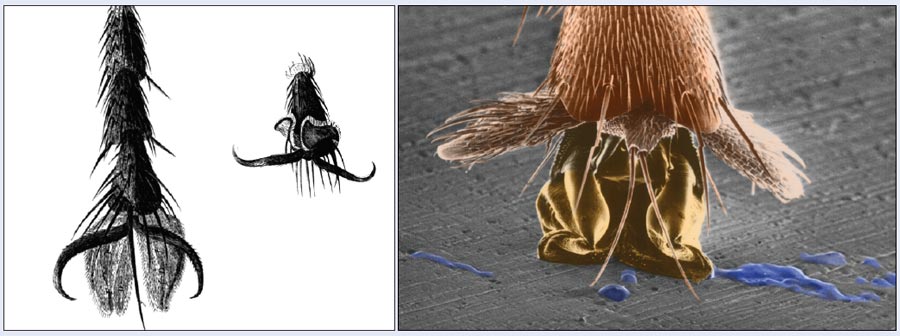
However, just one year later, Hooke (best known to physicists for his eponymous law of elasticity) sparked a heated debate by challenging Power’s wet-adhesion theory. In his respected book Micrographia, Hooke speculated that on the length scale of a fly’s foot, surfaces are rough enough that the feet can interlock and adhere using fine hairs (figure 1): “without the access or need of any such Sponges fill’d with an imaginary gluten, as many have, for want of good Glasses, perhaps, or a troublesome and diligent examination, suppos’d”.

After this rather personal dispute, many researchers proposed and tested the mechanisms of insect adhesion over the subsequent 200 years. Even Jonathan Swift, the passionate Irish natural scientist, mentions how insects stick in his well-known 1726 novel Gulliver’s Travels. Gulliver, exploring a land of giants during his second journey, is attacked by wasps one morning and complains that “these odious insects would sometimes alight upon my victuals, and leave their loathsome excrement, or spawn behind…which, our naturalists tell us, enables those creatures to walk with their feet upwards upon a ceiling”.

By the mid-19th century, most scientists had written off insect adhesion as fully understood, as Power’s theory of glue-based adhesion had been mostly accepted within the scientific community. Yet confusingly, in 1832 a different idea was introduced that, despite being proven wrong the following year, is still among the most popular “cocktail party” explanations. The idea came from German zoologist Herman Burmeister, who postulated that insects stick using “muscular suction cups”. To check this theory, in 1833 the British naturalist John Blackwall placed insects in sealed cylinders, out of which he then pumped the air. He found that the insects’ ability to adhere to the smooth inner surface was unaffected by the air pressure, and so dismissed Burmeister’s theory. However, despite the evidence, many scientists continued to pursue the suction-cup idea, and only a few investigated fluid adhesion in the years that followed.

Meanwhile, in further studies Blackwall noticed that placing small quantities of water vapour, oil, wheat, pulverized chalk or gypsum onto clean glass surfaces prevented insects and spiders from sticking to them. “These facts, far from corroborating the mechanical theory,” he concluded, “appeared quite inexplicable, except on the supposition that an adhesive secretion is emitted by the instruments employed in climbing.”

After this flurry of activity in the early to mid-1800s, scientists soon turned their attention and their microscopes towards other wonders of nature’s micro-cosmos, and insect adhesion became a largely forgotten quest – a backwater in the broader sweep of science.

Inspired by nature

Fast-forward to the present day, however, and the study of insects has come back into fashion. Elaborate instruments such as the scanning electron microscope and the atomic force microscope have allowed us to glimpse a new realm – the nano-cosmos. Scientists can now unmask even more of nature’s mysteries, and engineers have realized that taking inspiration from the natural world can be a neat route to developing innovative products. For example, the adhesive organs of insects, spiders and geckos are better than many artificial adhesives, at least in terms of their versatility (see “Stewed and digested”), and the fact that they are reusable and work in dynamic situations.

During their lifetime insects need to attach and detach their feet many millions of times. Each of these steps risks damaging or contaminating the insect’s feet, which would reduce their ability to stick. (Ever tried to reuse a Post-it note?) Insects get around this problem by using self-cleaning mechanisms, which rid the feet of any dirt to allow optimal stickiness, regardless of the number of steps taken. Such mechanisms have also been found in geckos.

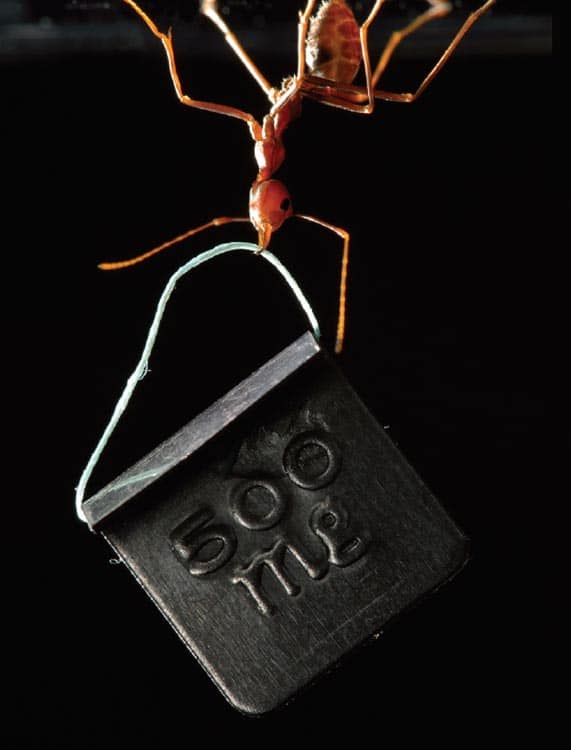
While some insects remain stuck to a single surface for almost their entire lifetime, others run quickly carrying heavy loads or jump between surfaces. This requires their feet to be dynamic – to stick one moment and release the next. An outstanding example of this is the weaver ant Oecophylla smaragdina, whose feet can support a theoretical maximum of 100 times its body weight, according to Walter Federle and Thomas Endlein from the Insect Biomechanics Workgroup at Cambridge University in the UK (figure 2). However, the ant can still almost immediately detach its feet to place its next step.

Endlein has also shown that some insects can mechanically unfold their feet passively – without neuronal signals – in fractions of a second. This overrides any possible delay and is useful in unexpected events of mechanical disturbance, such as raindrops or a gust of wind. However, the details of how insects control their feet so quickly are still not fully understood. In particular, the adhesion control during jumping, which can be a change from firm adhesion to complete detachment within a fraction of a second, is the focus of ongoing research.

Hairy or smooth, but always sweaty

All insect feet have foot pads that can be classed as one of two functional designs: “hairy” or “smooth”. In general, both types let the insect attach itself more strongly to a surface by conforming to substrates with roughness at different length scales. This explains why insects can stick to so many different surface types: from hard to soft; rough to smooth; on stone, glass, plastic and even Teflon.

Smooth adhesive pads can be found in many groups of insects – ants, bees, stick insects, grasshoppers, bugs and cockroaches. These insects possess a specialized organ, the arolium, which is located at the tip of the feet and consists of a very soft, cushion-like sac.

As already described by Hooke more than 300 years ago, the pads on the feet of flies, beetles and other insect groups are densely covered with flexible hairs arranged in arrays. Today, we know that similar structures can be found in many other creatures, such as geckos and spiders, indicating a general favourable design for adhesive structures. Although it is believed that hairy pads have several advantages over smooth ones, there is still an ongoing discussion in the biomechanics community about which is the better system (see, for example, J Bullock, P Drechsler and W Federle 2008 J. Exp. Biol. 211 3333).

Whether they are smooth or hairy, all insect feet have one thing in common: they use a nanometre-thin layer of fluid to help them stick to surfaces. Power already suggested that this is secreted using a “fuzzy kinde of substance like little sponges”, which the fly can squeeze liquid out of “at pleasure”. However, it was only recently that Federle and I were able to show that this 300-year-old idea is actually true for the smooth pads of insects. Using a motorized-stage to repeatedly (and carefully!) press the feet of insects onto smooth glass plates to simulate footsteps, we found that the amount of residue actually decreases with each step. Insects, in other words, have a limited volume of adhesive fluid in their feet. We also repeated the experiment using different walking speeds and it turns out that the sponges always refill at the same rate, no matter how fast the insects run. Nevertheless, it is still not known where the adhesive fluid is actually produced within the insect’s body.

As for the nature of this fluid, it is often thought to be a kind of sticky glue. But if this were the case, how would insects that place their sticky feet down ever lift them up again? The wet-adhesive mechanism is thought to result from three physical principles of fluid mechanics: the forces of surface tension; the pressure difference between the fluid and the surrounding air (Laplace pressure); and the viscosity of the fluid. But as you may know from walking with wet feet beside a swimming pool, a layer of fluid can reduce adhesion and friction forces. So why, then, do insects use fluid-based adhesion at all, if the additional fluid layer bears the danger of reducing their ability to walk on smooth surfaces?

To answer this question, a more detailed knowledge of insect-feet forces is required. Federle, and Patrick Drechsler from the University of Würzburg in Germany, were among the first to actually measure the forces generated by placing single insect feet on well-defined substrates. Using a custom-made force transducer on a 3D motor stage, they gently pushed and pulled insects’ feet along various smooth and rough surfaces. By comparing the forces generated on these substrates the researchers were able to show that an important function of the fluid appears to be filling in the gaps between the pad and the surface. This maximizes the contact area of the adhesive pad and increases adhesion to rough substrates.

Interestingly, Drechsler and Federle found that the sliding friction forces generated by insects’ wet feet were substantially greater than expected. The experiments also revealed a significant static-friction component, which prevents a resting insect from sliding on smooth surfaces. Unfortunately, neither of these friction forces can be explained by assuming a continuous “simple” fluid layer between the feet and the substrates. Chemical analyses of footprint droplets also revealed nothing that might help to explain the high friction observed in fluid layers where one would expect slippage. The fluids appear simply to contain long-chained hydrocarbons, fatty acids, carbohydrates and amino acids.

Not so simple

It was only when the fluid was observed in situ, in the moment it is secreted into the contact zone, that its secret was revealed. In 2002 Federle and collaborators from the universities of Würzburg, Glasgow and Berkeley used interference reflection microscopy to discover that the adhesive fluid of ants and stick-insects is not a simple fluid but consists of two components that together form an emulsion. The experiments demonstrated that the bulk component of this emulsion is an oily substance, which is stable even over several days at room temperature. (This is probably what was discovered in insects’ footprints about 300 years ago.) The second, smaller component is a highly volatile water-like substance that evaporates within fractions of a second when in contact with air, which explains why it had never been found in residues before. Federle and co-workers suggested that this two-phase structure might play an important role in the generation of friction forces.

To test this idea my colleagues and I again measured the forces generated by a single adhesive pad, but this time using a special polymeric surface. This smooth coating works like a selective sponge by only absorbing the short-lived watery phase of the emulsion and leaving the oily part behind. By making thick and thin polymer layers with different absorbing capacities, we were able to compare the forces generated with both fluids present with those with only the oily part present. Our results showed that the friction forces of smooth pads were significantly reduced without the watery phase present: the insects were slipping on their own oil. (We later put this finding to good use – see video.)

It turns out that both phases are vital, and together they form a non-Newtonian Bingham fluid. This means that the fluid behaves like a solid when at rest, but with a viscosity that decreases when it is sheared. It is this property that provides resistance to sliding, complementing the simple capillary adhesion.

• Watch the cockroaches slide like firefighters down a pole with the patented “Insectislide” technology, in this video.

Right from the start

From what we know today, Henry Power was surprisingly accurate with his first observations about the adhesive mechanisms of insects in 1664. Two centuries later, in 1884, the German scientist Hermann Dewitz paid late tribute to Power’s pioneering work by writing “Many different ideas [about insect adhesion] have been expressed so far; oddly enough, the correct one seems to be the oldest of them.”

Insects have been sticking around for the last couple of million years and, although their adhesive organs have been studied for about the last 300 years, their tricks have still not lost any of their fascination. To the attentive observer, and imaginative research-grant applicant, even such a “simple” thing as a fly running across the office window still demonstrates a great selection from nature’s box of tricks.

Stewed and digested

When an insect journeys thorough the world, it has to cope with a variety of different substrates with changing and unpredictable orientation, contamination, roughness and wettability. In fact, there are only a few known natural surface structures that insects cannot stick to – mostly carnivorous plants! One such plant is the carnivorous pitcher – so-named because it looks like a jug. Many varieties of the plant have a hydrophilic rim. When the rim is dry, ants are able to climb in to the pitcher to collect nectar from just under the rim’s mouth and then climb back out again. But as Holger Bohn and Ulrike Bauer from the University of Cambridge showed during their PhD work in the last few years, air humidity or rain can easily form a very thin water layer on the plant’s surface. This layer somehow foils the insect’s usually reliable feet and makes them aquaplane into the bottom of the pitcher, where they are destined to stew in the plant’s digestive juices. But surprisingly, some ants can walk on the plants when they are wet and do not slip at all. They can climb in and out of the pitcher with ease, and even swim within the digestive fluid.

• Watch some unlucky ants meet their fate, while others manage to avoid the deadly trap, in this video by Holger Bohn.


Avoiding an unholy marriage

Hanging on the bare-brick walls in the small, dimly lit basement of St George’s concert hall in Bristol, UK, is a series of 24 artists’ prints by the composer Edward Cowie. They appear in the aptly named Crypt Gallery, where visitors gather before shows, and were drawn especially to accompany each piano piece of Cowie’s latest work Rutherford’s Lights – a set of 24 “studies in light and colour for piano”. But as well as bringing together art and music, Cowie’s latest work seeks to marry together physical theories of light with music. Indeed, the inspiration for each of the 24 piano pieces came from the classic physics textbook The Theory of Light by Thomas Preston, which was first published in 1912.


Wave Motion (the 1st movement)

Cowie is no stranger to physics, having studied the subject at Imperial College London. Speaking to Physics World in the Crypt Gallery, Cowie shoots from the hip when talking about the many attempts to fuse physics and music. He says he likes to recite one of his favourite poems called “The Unholy Marriage”, written by the English poet David Holbrook, which describes a fateful crash when a motorcyclist takes his girlfriend for a ride around town. Holbrook, rather morbidly, describes the pair as having been “married” together by the high-speed collision.

“I would say that a lot of partnerships between art and science are the David Holbrook version,” says Cowie, 67. “If you put a scientist and a composer in a food mixer, would you say they have collaborated?”. One example of such an “unholy marriage”, in his view, was Constant Speed performed by Rambert Dance Company, which was inspired by Einstein’s scientific achievements and was commissioned by IOP Publishing (which produces Physics World) in 2005. “It was a fantastic thing to do and was very inventive,” says Cowie. “But if they ever claimed one was about the other, then they were wrong – the ballet was not about Einstein; the ballet was about ballet and the music was about entertainment.”

Cowie is hopeful that Rutherford’s Lights, released on CD last month by UHR and for which IOP Publishing paid him a composer’s fee, will not be seen as a David Holbrook version of an art–science collaboration – but rather as a musical piece that takes inspiration, as he puts it, from the “language of science”. “I wouldn’t say that physics influences my music,” says Cowie. “But I could not have written the work without my training in physics.”

A journey in music

Rutherford’s Lights has recently been on tour around the UK, including being performed at St George’s and culminating in a performance at the National Portrait Gallery late last month. The work, however, began its journey on the other side of the world, when Cowie was in Australia as director and founder of the Australian Arts Fusion Centre at James Cook University, Townsville. While in Queensland, Cowie was browsing in a bookshop when he was surprised to stumble across a copy of The Theory of Light. But he was in for an even bigger shock when he opened the book to find a message written in 1904 and signed by the nuclear physicist Ernest Rutherford himself to one of his students. Cowie promptly snapped it up – and for only $4.

Preston’s book, which remains one of Cowie’s most treasured possessions, is central to Rutherford’s Lights, and is integral in each of the 24 pieces. “It is a homage to Rutherford,” Cowie says. Each piece in Rutherford’s Lights is, however, based on a specific chapter from Preston’s book. The work is meant to be a journey through the book, beginning with simple descriptions of transverse waves at the beginning to more complicated theories of light later on. “There was an incredible division between the chapters in the book that I could see they were each separate pieces,” says Cowie. “What I liked about Preston’s book is that it is not dry. How he has constructed the language to describe physical properties is beautiful, almost musical.”

Compounding of Simple Vibrations (the 3rd movement)

The first piece in Rutherford’s Lights is called “Wave Motion”. Sitting in St George’s, Cowie pulls out a musical score of the piece in which the opening parts looks like a wave propagating along the page. “It is not difficult to talk about propagation and think acoustically,” says Cowie, who calls Rutherford’s Lights a “major breakthrough” in his music. Indeed, he says he would just sit at the piano with a chapter of Preston’s book open and just attempt to put the equations and meaning of Preston’s words into music. He would study the formulas and attempt to give their musical equivalence. “I am trying to make a piece of music whose quantity and quality is connected to light and its propagation,” he says.

Building bridges

Edward Cowie was born in Birmingham, UK, in 1943. By the age of seven, he had started teaching himself music and the piano. But it was the influence of his parents, who wanted him to do a “proper vocation”, that meant he went to Imperial to study physics. Cowie was still learning the piano and violin in his spare time, as well as doing the odd performance, which earned him money to pay for his education. “I didn’t really see a difference between physics and music,” says Cowie. “Everything has a numerical basis: music is about numbers just as much as maths is.” But Cowie’s love of music was still his driving force, and while at Imperial he also went to the Slade School of Fine Art at University College London to study painting as an external student.

After doing a Bachelors in music, in 1973 Cowie completed a PhD at Leeds University, which included studying music, physics and genetics. He was also awarded a Doctorate of Music by Southampton University in 1976. In the music world, Cowie obtained early recognition with the 1975 BBC Proms commission Leviathan for large orchestra, followed by popular works including the Piano Concerto (1976), the opera Commedia (1976) as well as Concerto for Orchestra (1982).

Various academic appointments in Germany and the US followed, eventually leading Cowie to take up a position as head of the School of Creative Arts at the University of Wollongong in Australia in 1983 and, six years later, as director of the Australian Arts Fusion Centre at James Cook University, Townsville. After losing funding for the centre, he finally returned to the UK in 1996 as director of research at Dartington College of Arts in Devon.

Following his retirement in 2008, Cowie is now hoping to foster more collaborations between science and the arts, beginning with Rutherford’s Lights. “The divisive language between arts and sciences are artificial,” says Cowie. “What we need is a bridge dialogue between them.” Cowie is currently in discussion with the Oxford University particle physicist Brian Foster about making a set of violin pieces that will trace a “timeline” for the subject of particle physics.

Music of the primes

Like many composers working in the early 1970s, Cowie came under the influence of the music of the “Second Viennese School”. This included a method of musical composition invented by the Austrian-born composer Arnold Schoenberg. It employs a row of 12 different notes in the chromatic scale – a musical range with 12 equally spaced pitches, each a semitone apart – that can be permutated and combined to enable a kind of “lattice and grid approach” to the placement of musical pitches. Schoenberg’s pupil, the composer Anton Webern, extended the idea further by applying combinatorial mathematics.

Natural Lights (the 18th movement)

In adopting these techniques, and with his understanding of mathematics, Cowie was able to write complex music. However, he felt that his music at that time was too “system based” and he abandoned the technique in the mid-1970s. However, the use of mathematics in music fostered the notion that they are inextricably linked. “Physics is about patterns, written through equations – the language of mathematics” says Cowie. “Music is also about patterns, so you can relate and link them.”

To demonstrate the links between music and mathematics, Cowie recalls the time in 2003 when he was commissioned by the BBC to produce a “sound portrait” of the Cambridge University physicist Stephen Hawking for the 125th anniversary of the National Portrait Gallery. Cowie travelled to Cambridge to meet Hawking to discuss the piece, who he knew liked music. After talking about music and physics for more than four hours, Hawking concluded that contemporary music had lost its way – it had no structure, he complained – and that he had no time for it. Cowie naturally did not agree. “If music has lost its way, then hasn’t mathematics as well?” he asked. After a pause from Hawking, he slowly typed “Touché”.

In person

Born: Birmingham, 1943
Education: BSc physics, Imperial College, London (1961–1964); Bachelor of music, Southampton (1970); PhD in music, Leeds University (1971–1974); Doctorate in Music, Southampton University (1976)
Career: Professor of composition, University of Lancaster (1973–1983); head of the School of Creative Arts at the University of Wollongong, Australia (1983–1988); director of the Australian Arts Fusion Centre at James Cook University, Townsville (1989–1994); director of research at Dartington College of Arts in Devon (1996–2008)
Family: Married, two daughters
Hobbies: Reading, sailing, bird-watching

Copyright © 2026 by IOP Publishing Ltd and individual contributors