Neutral positronium scatters like a charged particle


Positronium is the atom-like bound state of an electron and its antiparticle the positron – and therefore has no net electrical charge. But physicists in the UK are scratching their heads after finding that positronium interacts with matter as if it were a lone electron, with the mass and positive charge of the positron seemingly invisible. This surprising discovery will spur researchers to find an explanation, and may have consequences from medicine to astrophysics.

Positronium is often regarded as the lightest neutral atomic species. Like a normal hydrogen atom, its nucleus is orbited by a lone electron, but the proton of the nucleus itself is replaced by the positron.

Positronium is an important entity in various disciplines. In medicine, for example, positrons are used to image chemical-reaction pathways inside living cells, in a technique known as positron emission tomography (PET). Yet over 80% of the crucial gamma rays generated in PET scans are from decaying positronium. Meanwhile, in astrophysics, decaying positronium accounts for over 90% of the gamma rays coming from the Milky Way’s centre.

Scarcity of scattering knowledge

Since positronium lives long enough to scatter off other matter before decaying, scientists involved in such disciplines need to understand its scattering properties. Unfortunately, both theory and experiments on these have been hard to come by.

Now, Gaetana Laricchia of University College London and colleagues have recorded the first widespread velocity data for positronium scattering off a variety of atoms and molecules. In their experiment, they use electric and magnetic fields to guide positrons emitted from sodium-22, a radioactive source, to a gas cell. Some of the positrons pick up an electron from the gas, creating a beam of positronium that travels toward a gas target. The researchers used 10 different targets to scatter the positronium, including helium, nitrogen, oxygen and krypton.

The results were not what they expected. Despite positronium being neutral and twice the mass of an electron, its scattering cross section – a measure of the interaction probability as a function of velocity – always resembled an electron on its own.

‘Spectator’ particle?

Laszlo Sarkadi, a nuclear physicist at the Hungarian Academy of Sciences who has previously studied positronium scattering, says the discovery will prompt physicists to examine the detailed dynamics of the scattering, which he thinks cannot be approximated, like other collision systems, to a two-body interaction. Nonetheless, be believes the likely solution is that the positron in the positronium is merely behaving as a “spectator” particle. “The different behaviour of the electron [could be] explained by the polarization of the target during the collision,” Sarkadi adds.

Laricchia agrees that the positronium’s electron is somehow dominating the interaction, but says: “The reason is not yet known, and we hope that our work will stimulate further research.”

The research is published today in Science 330 789.
Flexible metamaterial springs to life

Physicists in the UK have made a new kind of flexible material that could enclose objects to render them and it invisible. Although unlikely to be of much use when it comes to shielding people and other large objects, it could, say the researchers, nevertheless hide small items and make contact lenses more powerful.

Over the last few years physicists have shown how to hide objects by placing them inside so-called invisibility cloaks. These cloaks are made from metamaterials – artificial, engineered materials that have unusual electromagnetic properties. The first such cloak was made from a cylinder consisting of copper rings placed in concentric circles, and enabled an object placed at its centre to be shielded against microwaves, the radiation flowing around the cloak and continuing along its original trajectory as if the cloak were not there. Researchers have since extended this concept to shorter wavelengths by making ever tinier features within the metamaterials, since the features have to be smaller than the wavelength of light used.

All cloaks to date, however, have used metamaterials rooted in hard substrates typically made from glass or silicon. Andrea Di Falco and colleagues at the University of St Andrews in Scotland have instead created a flexible metameterial, operating at visible wavelengths, which, they say, should give metamaterials a much broader range of practical applications. The inspiration was the kind of flexible electronic circuitry used in laptops to connect the screen to the keyboard, but in this case applied to optical structures.

Introducing Meta-flex

The researchers made their material, which they have dubbed “Meta-flex”, by placing a commercially available polymer known as SU8 onto a silicon substrate. They then deposited a 40 nm-thick gold layer onto the polymer and used electron-beam lithography to carve the desired metamaterial features into the gold, before immersing the structure in a suitable solvent to remove the substrate.

The researchers say they have been able to make pieces of Meta-flex as thin as 4 μm and having an area of 40 mm2. They tested the electromagnetic response of two different metamaterial configurations, known as nanoantennas and “fishnet” lattice, by exposing the material to a source of white light and then analysing the transmitted light using a spectrometer. They found that the absorption peaks matched those obtained with the equivalent rigid metamaterials, proving, they say, that Meta-flex can indeed function as an invisibility cloak.

Using this new material to carry out useful functions will require mounting multiple layers on top of one another. But doing so, cautions Di Falco’s colleague Thomas Krauss, will not lead to invisibility cloaks of the kind that could be used by real-life Harry Potters. Cloaks made from Meta-flex, he says, can be larger than the nanometre-scale features engraved into the the material but the size of these cloaks is limited by the need for the cloak to have a certain thickness. With a given fraction of the incident light absorbed by each layer, a thick cloak would absorb practically all of the light that fell on it. “We should be able to cloak objects on the sub-micron level,” he says. “And as we improve the material we should be able to increase this scale, but I find it hard to think that we will ever be able to cloak large objects”.

Better contact lenses

As an example of the kind of object that could be rendered invisible, Krauss suggests electrical cables integrated into clothing. However, he believes that Meta-flex will find more useful applications. For instance, he says, the material could be used to increase the correcting power of contact lenses, making lenses available to people who previously have had to make do with thick glasses. He points out that the ability to bend light is dictated by the variation in refractive index of the media that the light traverses, so making a metamaterial with a refractive index of close to zero creates a ratio of indices approaching infinity and therefore results in an extremely high corrective power. He says that although this principle has been demonstrated previously, it is the manufacture of a flexible substrate that renders it useful for the manufacture of contact lenses.

John Pendry of Imperial College in London, who has pioneered the use of metamaterials, describes the development of the new material as an “interesting and useful advance in metamaterial technology” but “very, very far from achieving a flexible cloak”. He points out that as the instantaneous shape of a cloak changes, so too do the electrical permittivity and magnetic permeability needed for invisibility. So a flexible cloak, he says, would require that the metamaterial be not only flexible but also one whose electrical and magnetic parameters can be continuously reconfigured.

Krauss acknowledges this point but maintains that as long as the shape of the cloak doesn’t change too much the metamaterial parameters can remain fixed. “For a Harry Potter cloak you would need to do what Pendry is saying, but for the kind of specific applications that we’re suggesting you could design a metamaterial of a certain curvature and leave it at that,” he says.

Meta-flex is described in New Journal of Physics 12 113006.

Obama’s dream of Mars at risk from radiation

Higher levels of space radiation between 2020 and 2040 could endanger US President Barack Obama’s vision for a manned mission to Mars, according to a NASA scientist. The result of two separate solar-activity cycles, which are both predicted to hit their maximum during the period, the increased radiation could cause radiation sickness and an increased cancer risk for any astronauts venturing away from the safety of the Earth’s atmosphere.

In April Obama laid out his plans for the future of US space travel: NASA would once again have the technology to carry humans beyond low Earth orbit by 2025, with an asteroid the first likely target. He went on to suggest that astronauts could be orbiting Mars by the mid-2030s. Obama’s plans sit alongside the ambitions of other countries to expand their human-spaceflight programmes; the head of China’s space agency has recently suggested a manned Chinese Moon mission might be possible by 2025.

However, John Norbury of the NASA Langley Research Center in Virginia suggests there might be an increase in solar activity over this period, possibly hampering the planned missions. In a review paper, published in the journal Advances in Space Research, Norbury brings together several previous studies on solar-activity cycles and applies the findings specifically to the period 2020–2040.

Radiation floods the solar system

Norbury first looked at the well-established Schwabe cycle, where sunspot numbers reach a peak roughly once every 11 years. The height of this activity, or solar maximum, sees a marked increase in solar flares, as well as coronal mass ejections (CMEs), both mechanisms for flooding the solar system with proton radiation. Norbury predicts the next three Schwabe maxima will occur in 2013, 2024 and 2035, with the later two dates coinciding almost exactly with America and China’s space-faring aspirations.

However, the intensity of each solar maximum is also thought to oscillate over a period, called the Gleissberg cycle, of roughly every 80–90 years. A Gleissberg maximum is then, in effect, a double maximum. But pinning down the exact length of this cycle is more difficult because sunspot records stretching back over previous centuries are either incomplete or not as accurate as modern-day data. Instead, information from sunspot records has to be combined with data from other “proxies”.

One such proxy is the carbon-14 record. During a solar minimum, fewer galactic cosmic rays are intercepted by the Sun’s lower magnetic activity, and so more bombard the Earth’s atmosphere, where they interact with atmospheric nitrogen that then decays into carbon-14. So a decrease in carbon-14 represents an increase in solar-activity levels.

Apollo astronauts were lucky

Norbury combined sunspot records with studies of carbon-14 trapped in tree rings, along with nitrate records from ice cores, to suggest the last three Gleissberg maxima occurred in 1790, 1870 and 1950. Such a pattern implies the next Gleissberg maximum should fall between 2020 and 2040, meaning more frequent solar events and a higher chance of those leaving low Earth orbit being irradiated, something the short NASA Apollo missions were fortunate to avoid.

“The Moon missions were just blind lucky,” explains Lewis Dartnell, an astrobiologist at University College, London. “The astronauts would have experienced radiation sickness and a higher risk of future cancer if they’d been hit,” he adds. However, crews travelling to an asteroid or Mars, journeys that take months rather than days, are subject to a much greater risk. “The worse-case scenario is that if you radiate a crew sufficiently, they’d all succumb to radiation sickness within a few days and essentially vomit and diarrhoea themselves to death within an enclosed capsule,” Dartnell told physicsworld.com.

Potentially there are ways to protect astronauts, including using polythene and the spacecraft’s water supply as radiation shielding, but there is a problem. “The particles are scattered by hitting nuclei within the water or polythene; it’s essentially a nuclear interaction and you end up producing secondary radiation,” Mike Hapgood of the Rutherford Appleton Laboratory in the UK explains. Hapgood and colleagues are currently working on an alternative technique that involves surrounding the spacecraft with a plasma shield to deflect incoming protons without creating secondary radiation. However, with the idea still in its infancy, Hapgood believes the chances of it being ready in time for Obama’s 2030s Mars shot “strongly depends on future investment”.

ITER – a fusion facility worth building

A dream for almost three decades, construction of the International Thermonuclear Experimental Reactor (ITER) is finally getting under way in southern France. This huge multinational experiment, which is a joint effort of China, the EU, India, Japan, Russia, South Korea and the US, seeks to create a deuterium-tritium plasma that can release 10 times more power than it consumes. The aim is to show that fusion can potentially be a sustainable source of energy here on Earth.

But with costs for ITER climbing to €13bn – and rising – is it money well spent? In this exclusive video interview with physicsworld.com, Sir Chris Llewellyn Smith, who was chairman of ITER’s council from 2007 to 2009, defends the project, saying that “we cannot afford not to develop fusion”. In his view, fusion – along with solar power and fission reactors – is the only feasible way to fill the gap between the energy available from conventional fossil fuels and the ever-rising total global energy demand. Llewellyn Smith, who was director-general of the CERN particle-physics lab in the mid-1990s, also shines a light on the tensions involved in ITER, bringing together as it does many different partners together in a large, complex and technically ambitious experiment.

LHC gears up to create mini big bangs

After seven months of successful proton collisions at 7 TeV in the Large Hadron Collider (LHC), researchers at CERN are now reconfiguring their famous machine to collide lead nuclei within the next few days. Collisions between these heavier particles will generate the highest temperatures and densities ever recorded on Earth, recreating the early universe moments after the Big Bang.

“This shows that the objective we set ourselves for this year was realistic, but tough, and it’s very gratifying to see it achieved in such fine style,” said Rolf Heuer, CERN’s director general.

The change in beamline marks the beginning of the main physics programme for the ALICE detector, which was specifically designed to track large numbers of particles. It can detect up to 15,000 particles per event, which may be produced from the collisions between lead nuclei occurring in the centre of the detector. The extremely high temperatures at the collision points will cause protons and neutrons to break down into a dense soup of subatomic particles known as a quark–gluon plasma, a condition thought to have existed shortly after the Big Bang.

Go ask ALICE

One of ALICE’s main scientific goals is to characterize this quark–qluon plasma in an attempt to find out more about the nature of the strong force, one of the four fundamental forces in nature. Despite being responsible for generating 98% of the mass of atoms, the strong force is still the most poorly understood of the forces.

We will be creating the highest temperatures and densities ever produced in an experiment in these mini big bangs David Evans

“We will be creating the highest temperatures and densities ever produced in an experiment in these mini big bangs”, said David Evans, leader of the UK team at the LHC’s ALICE experiment. “Although the tiny fireballs will only exist for a fleeting moment (less than a trillionth of a trillionth of a second) the temperatures will reach over ten trillion degrees, a million times hotter than the centre of the Sun.”

The LHC beamlines will be run at a centre of mass energy of 2.76 TeV per colliding nucleon pair, which will generate temperatures and densities that are an order of magnitude larger than the previous record held by the Relativistic Heavy Ion Collider (RHIC) at the Brookhaven National Laboratory in the US.

“At the LHC we’ll be continuing a journey that began for CERN in 1994, which is certain to provide a new window on the fundamental behaviour of matter and in particular the role of the strong interaction,” says Jurgen Schukraft, spokesperson of the ALICE experiment.

If all goes to plan, the LHC will begin circulating lead ions by the weekend before CERN engineers spend up to a week tuning the beamlines in preparation for the scientific programme. Researchers will then record data until 6 December when CERN will shut down for maintenance work over Christmas. “This will give us plenty of time,” says Evans. “At these energies, the lead collisions will generate more data in a month than proton collisions could generate in a year.”

Operation of the collider will start again with protons in February and physics runs will continue through 2011.

A day out in Telford

flir.jpg

By Hamish Johnston

Yesterday I was up in Telford – birthplace of the industrial revolution – for Photonex and the Vacuum Expo.

It’s the first time that a vacuum event has been run alongside Photonex, which not surprisingly is focused on photonics.

Physics World is a media sponsor of the Vacuum Expo – which wraps up today – and we had a booth at the exhibition.

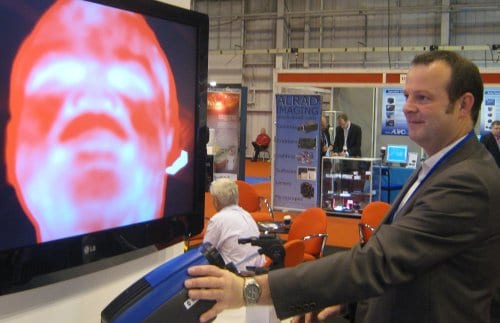
My first stop on the exhibition floor was the FLIR booth, where I met with Jon Chicken. Jon was showing off the firm’s latest infrared imaging systems – which you can see him demonstrating in the photo above.

Jon was very keen to talk about FLIR’s “super framing” technology – or as he prefers to call it “multiple integration time” or just “multi-IT”. The technique involves processing a stream of IR images, each with a different integration time. The technique is good for looking at subjects in which the local temperature varies over a wide range.

brenner.jpg

So, what are some exciting applications of this latest IR technology? It could be used, for example, to measure the temperature inside a fusion reactor. Indeed, Jon told me that the firm’s systems will be going into the ITER demonstration reactor that is currently being built in the south of France.

Continuing in the theme of fusion, my next stop was a booth promoting the laser fusion activities of the UK’s Rutherford Appleton Laboratory and the proposed HiPER laser fusion programme.

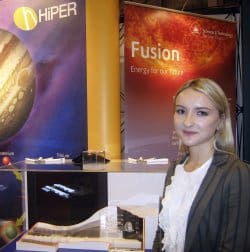
RAL’s Ceri Brenner (right) was there to explain how HiPER is expected to use powerful lasers to implode a tiny pellet containing deuterium and tritium – creating a dense hot plasma in which nuclear fusion can occur. If all goes to plan, 10 pellets per second will be ignited at HiPER, which will result in a net production of energy – which could someday power your toaster!

Ceri is also interested in developing another practical application of laser-plasma interactions – tabletop particle accelerators. In particular, she’s looking at how protons can be accelerated to tens and maybe hundreds of MeV using a laser. The idea is that an intense pulse of laser light separates electrons from ions in a plasma creating an extremely high electric field that can be used to accelerate changed particles such as protons.

joseph.jpg

Such a proton source could be very handy for medical therapies based on heavy charged particles. There are two challenges, however, that must be overcome. Current sources can only accelerate protons up to about 65 MeV. These could be used for treating the eye, but not for other applications, which need protons at 150–200 MeV. The other challenge is that the protons are produced over a wide energy range, but proton therapies are only effective if the particles have a very narrow energy distribution.

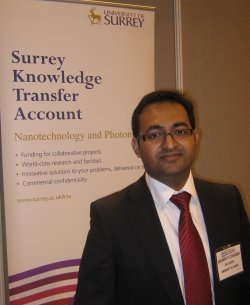
Laser accelerators are just one example of a technology that was first developed by academics and is now well on the road to commercialization. One person who has been down that road many a time is Tiju Joseph (right), who splits his time between the UK’s National Physical Laboratory (NPL) and the University of Surrey.

Joseph is a “technology translator” who tries to encourage academics to think about the commercial potential of their research. But it’s not about sitting back and waiting for eager scientists to approach him with ideas – he figures only about 5% of successful ventures start that way. Instead, it’s all about Joseph learning about what a scientist has done over the past ten years and then sitting down with the researcher and discussing avenues of commercialization.

You might think that the goal is always a spin-out company that is sold by the university once it has been established. According to Joseph, this is passé because it is just too cumbersome. Today, the goal seems to be to license the technology to an established firm with the ability to develop it rapidly.

connelly.jpg

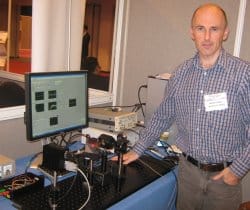
Now, it wouldn’t be a photonics show without a laser and a few optical components, and that’s just what the University of Limerick’s Michael Connelly brought to Telford. Michael (right) was showing off his “low-cost laser Doppler vibrometer”, which is a way of measuring vibration by firing a laser at the object of interest and comparing the reflected beam with a reference beam in an interferometer.

Also working on a practical application of photonics is Shijie Liang of the University of Manchester, who told me about her work on creating “long-period gratings” within polymer fibres. Such gratings cause light at certain wavelengths to be absorbed by the fibre cladding – a process that is very sensitive to environmental factors such as the temperature of the fibre. As such, long-period gratings can be used as temperature or other probes.

While such gratings have been made in silicon, such fibres tend to be very fragile, which is why Liang is keen on much more flexible polymers.

specs.jpg

With all those laser beams whizzing around, I felt I needed a pair of safety glasses. Fortunately Paul Tozer of Lasermet had a few fetching pairs on display that might even tempt Bono (above). The UK-based firm supplies a wide range of laser safety equipment and Paul talked about the company’s business, including the refitting of laser labs in the UK and beyond.

Star Wars ‘telepresence’ tantalisingly close

In 1977 audiences were wowed by the special effects of the first Star Wars film, which included a hologram of Princess Leia making a distress call to Obi-Wan Kenobi after her ship had fallen under attack by the Empire. Now, the idea of real-time, dynamic holograms depicting scenes occurring in different locations is almost a reality, thanks to a breakthrough at the University of Arizona and Nitto Denko Technical Corporation.

Current interest in 3D display technology is higher than ever, spurred by the demonstration of 3D TV and the release of films produced in this format, such as Avatar. The action appears to come out of the screen because two perspectives combine to generate a 3D image. But to see 3D images, viewers have to wear specialized glasses with two different lenses that let through light polarized in different directions.

Holography is different from this, producing many perspectives that allow the viewer to see the “object” from multiple angles. With this approach the amplitude and phase of the light are reproduced by diffraction, allowing the viewer to perceive the light as it would have been scattered by the real object. In practice this is achieved by creating a screen – out of materials such as silver halide films or photopolymers – that provides the viewer with a slightly different perspective, depending on the observation angle.

A new hope

Progress towards achieving more dynamic holograms, with the ultimate goal of real-time reproduction, took a major step forward two years ago when a team led by Nasser Peyghambarian created a monochromatic display that could produce a new image every four minutes. Now, with this latest work the researchers have taken a dramatic leap by unveiling a 17 inch display that can reproduce an object in colour every two seconds.

The system works by taking multiple images of an object with 16 different cameras positioned at a range of different angles. A computer processes all this information into “hogel data”, which is transferred to a second computer via an ethernet link. At this location three different holograms are written into the material at different angles. Illuminating the polymer with incoherent emission from red, blue and green LEDs creates colour images.

The key to the breakthrough is the material from which the screen is fabricated – a photorefractive polymer. Switching to this polymer has slashed the time taken for a laser to “write” on a holographic pixel, known as hogel, from a second to just six nanoseconds. “[The latest polymer] can also be erased with the same beams used to write the image, so a separate erasing set-up is not required,” explains lead author Pierre-Alexandre Blanche from the University of Arizona.

Towards telepresence

Peyghambarian believes that his team’s technology could aid medical operations. “The cameras would be sitting around where the surgery is done, so that different doctors from around the world could participate, and see things just as if they were there,” he says.

To commercialize the system, writing speeds must increase to 30 frames per second, and the display must be larger, deliver a better colour palette and have a higher resolution. “If you want a true, real-time telepresence you need to go to at least 6–8 feet by 6–8 feet, so that the human person can be demonstrated as they are,” says Peyghambarian.

The ultimate goal is to achieve “telepresence”, where you could chat with others via 3D replications. In moving towards this, the technology will have to improve its resolution as well as its speed.

The team details its work in Nature.

Quantum gravity corrects QED

So, whose citation index ranking is about to go into the stratosphere?

The paper was written by David Toms, a Canadian mathematical physicist and lecturer at Newcastle University in the UK.

What has Toms done?

He has shown that interactions between quantum gravity and quantum electrodynamics (QED) cause electric charge to vanish at very high energies (above about 1015 GeV). He told physicsworld.com that his technique can be generalized to apply to the two other “gauge couplings”, which define the strong and weak forces.

Why should electric charge vanish at high energies?

A major problem with QED, which describes the interaction between charged particles and photons, is that electric charge increases at higher interaction energies. This is a result of vacuum polarization, whereby the spontaneous creation of electron–positron pairs tends to screen the electric charge of a particle at low energies. At higher energies, however, the screening is much reduced and the effective charge increases – and this cannot be correct.

Can you explain?

Physicists already know that the strong force – which binds together quarks within hadrons – goes to zero at extremely high energies. This property is called asymptotic freedom and its discovery earned Frank Wilczek, David Gross and David Politzer the 2004 Nobel Prize for Physics. If it can be proved that quantum gravity makes QED asymptotically free then it could stand as a viable theory on its own.

Can you elaborate slightly?

The main reason why QED was viewed as incomplete, prior to Gross et al, was that without asymptotic freedom the electric charge becomes infinitely large at some energy scale and the theory is no longer reliable. For their calculations to be reliable at high energies, physicists expect the strong, weak and electromagnetic forces to become unified and become asymptotically free.

Hold on, didn’t Frank Wilczek and Sean Robinson establish gravity-induced asymptotic freedom of charge in 2006?

Yes, sort of. Robinson and Wilczek came up with the idea of gravity-driven asymptotic freedom and worked out that it applied to all three gauge couplings (Phys. Rev. Lett. 96 231601). It was later pointed out, however, that there were errors in their calculations. This caused a flurry of activity as other physicists tried and failed to do the calculation using different approaches.

Now, Toms has worked out a way of avoiding these errors by performing a set of careful checks to guarantee that the calculation meets certain mathematical and physical criteria. In doing so, he has shown that Robinson and Wilczek’s idea was correct all along.

So what do they have to say?

“Toms’ work is important equally as much because of the way in which he did the calculation as the result itself,” said Robinson who is a lecturer at Massachusetts Institute of Technology. He said that an important feature of the technique is that it is “demonstrably flawless”. He also pointed out that while Toms’ paper was under review at Nature, an independent group of physicists at Tsinghua University in China posted a preprint (arXiv: 1008.1839) using a similar “flawless” technique but a different set of cross-checks. The Tsinghua team obtained essentially the same result as Toms, illustrating the power of the technique.

That must be good news for physicists working on unification?

Sort of. Toms has shown that quantum gravity causes asymptotic freedom in all the gauge couplings. This is handy if you want to show that all forces unify in a single (very weak) force at very high energies. However, he treated quantum gravity by simply quantizing Einstein’s general theory of relativity. This approach breaks down at the very energies that unification is expected to occur. To take things further, physicists would need to integrate more exotic aspects of quantum gravity such as additional dimensions and supersymmetry.

Where can I find out more?

Steven Chu talks energy politics in Scotland

SDC11489_2.JPG

Steven Chu, speaking yesterday at Laserfest in Glasgow

By James Dacey

“I was getting increasingly concerned that the climate was changing and that it was being caused by humans.”

Those were the words yesterday of Steven Chu, the US secretary of energy, speaking in Scotland about why he decided to park his glistening academic career to move into politics.

Chu was in Glasgow where he gave the opening speech as part of a national day of celebration of the 50th birthday of the laser. His broad-sweeping talk began with an overview of laser-cooling – the work for which he was awarded 1997’s Nobel Prize for Physics – before moving on to a discussion of molecular biology and the “alien” physics that occurs within the human body.

Then, with about half his allocated time remaining, Chu made a sudden gear change and began to talk more plainly about his motivation for moving into politics. “There is no real credible argument why the Earth will not warm up over a 50–100 year time period,” he explained.

He went on to talk about the imperative of developed nations to act as we shift increasingly towards a carbon-strained world. “The development of clean energy technologies and the rebuilding of an energy-efficient infrastructure is actually a job growth thing – it’s a demand really needed that can actually spur economies all over the world and it will be essential for our economic prosperity”.

Chu acknowledged the fact that the US is still lacking a comprehensive climate and energy bill, but he talked with great excitement about his how he is spending the $90 billion allocated to developing clean energy sources as part of the US Recovery Act passed last year. This includes the Energy Innovation Hubs, which, Chu says are partly inspired by earlier hierarchy of facilities such as Los Alamos National Laboratory and Bell Labs, where the best young scientists were elevated to management positions to accelerate the science.

Chu warned that failure to do this would leave the US and other developed countries lagging behind China. He talked about his meetings with the Chinese premiere, Wen Jiabao. “They want to be leaders in every energy technology because they think it will lead to their future prosperity – and because there are a lot of engineers in their government”. As examples, he cited China’s plans to generate 100 GW of wind by 2010 and their plans to build 25 new nuclear reactors.

Do giant spiral galaxies thwart clusters of young stars?

Astronomers in Scotland and Germany say simple physics may explain a long-standing paradox: why large clusters of young stars tend to reside in relatively small galaxies and not in giants like the Milky Way. The reason, according to the astronomers, is that giant spiral galaxies, like the Milky Way, spin fast, shearing star clusters before they grow into monsters.

The stunning 30 Doradus complex is the most luminous nursery of young stars in the Local Group – a collection of several dozen nearby galaxies that includes the Milky Way. It stands to reason, therefore, that 30 Doradus would inhabit an equally impressive galaxy, either Andromeda or the Milky Way, the two largest galaxies in the Local Group.

But instead the stunning 30 Doradus complex lies in the Large Magellanic Cloud, a satellite galaxy of our own that emits only one tenth as much light. The newborn stars of 30 Doradus have set gas aglow over an area 700 light-years wide, 30 times the diameter of the well known Orion nebula.

Rotational inhibition

Now Carsten Weidner and Ian Bonnell of the University of St Andrews in Fife and Hans Zinnecker of the Astrophysical Institute of Potsdam have conducted computer simulations that model interstellar clouds of molecular gas which collapse to form star clusters. Says Weidner, “It seems that rotation inhibits the formation of very massive star clusters.”

Giant spiral galaxies spin fast. For example, the Milky Way rotates at about 230 kilometres per second, and the even larger Andromeda galaxy spins faster still. By contrast, smaller galaxies, such as the Large Magellanic Cloud, rotate slowly.

Weidner’s team ran four computer simulations, each with a different spin speed. “Each model took about a month to compute,” Weidner says. In the fast-spinning models, stars and clusters formed over a wide area, because the spin prevented the gas from collapsing into one gigantic cluster. By contrast, in the slowest-spinning model, the gas collapsed and gave birth to a single huge star cluster at the centre. That model might explain why the huge 30 Doradus complex arose in a galaxy much smaller than our own.

Colliding galaxies

This work also applies to colliding galaxies. Says Weidner, “In the collision region, you have less rotational support, so you would also expect more massive clusters.” In fact, the famous Antennae galaxies – two large spiral galaxies that are smashing together in the constellation Corvus – have created young star clusters far greater than any young clusters in either the Milky Way or Andromeda.

Bruce Elmegreen, a star-formation expert at the IBM Research Division in Yorktown Heights, New York, says the study is interesting, but he’s sceptical of the result. “The connection between galaxy spin and molecular cloud spin is vague,” he says. “Does galaxy spin correlate with the spin of molecular clouds? I’m not aware of an answer to that.” Weidner responds that fast-spinning galaxies should indeed have faster-spinning clouds, because the clouds interact with one another.

What about ‘ram pressure’?

Elmegreen also says that 30 Doradus may owe its great size to factors other than its home galaxy’s slow rotation. The Large Magellanic Cloud – which is only 160,000 light-years from Earth – is plowing through the Milky Way’s halo. Gas in the halo compresses gas in the Large Magellanic Cloud, a process called “ram pressure” that may have sparked the star formation in 30 Doradus.

Weidner acknowledges that ram pressure may have played a role. “30 Doradus is a complex object,” he says, “and we do not claim that we can explain every detail of it. We just say there might be a trend with rotation.”

Weidner and his colleagues will publish their work in The Astrophysical Journal and a preprint (arXiv: 1009.1618) is available.

Copyright © 2026 by IOP Publishing Ltd and individual contributors