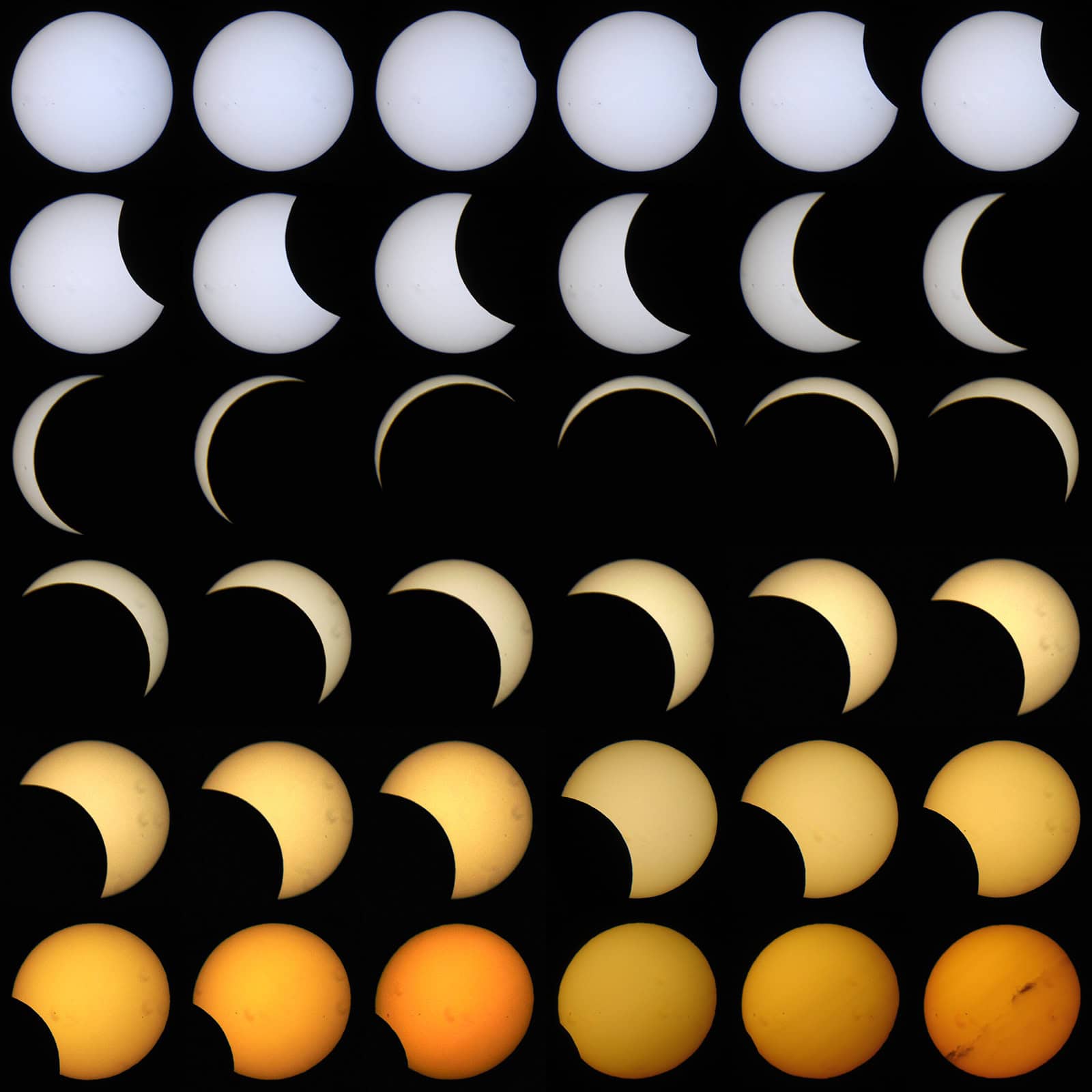
Packed with physics This photo montage of the 12 August 2026 solar eclipse as seen from the Isle of Wight, UK, holds a surprising amount of science. (Courtesy: Sean Ryan)
The UK’s hot, dry summer provided widespread clear skies for the solar eclipse that took place on Wednesday 12 August 2026. It was not a total eclipse – you had to be in northern Spain for that – but Britain still enjoyed a partial eclipse between around 6 p.m. and 8 p.m. BST, depending on location.
With typically more than 90% of the Sun’s disc covered – and with the event occurring after many people had finished work – the circumstances were ideal for a rare, immersive mass-engagement with physics.
Many people had got hold of eclipse glasses in advance or searched through kitchen cupboards for a colander to produce shadow patterns
Widespread public-awareness raising by professional and amateur astronomical societies had led to a strong build-up to the event in mainstream and social media. As a result, much of the public was aware the eclipse was coming, and many people had got hold of eclipse glasses in advance or, failing that, searched through kitchen cupboards for a colander to produce shadow patterns.
Here in the UK, friends and families gathered on west-facing hills, parks and village greens that evening with folding chairs, smartphones, cameras, telescopes and colanders, to enjoy the spectacle over a picnic tea. In built-up areas of towns and cities, many sought out west-facing windows of homes and offices.
I’m an old-school visual observer and recorded the eclipse sequence using 20-year-old equipment
While the eclipse on the UK mainland was deepest in Cornwall, I took my chances on the Isle of Wight, just off the coast of southern England.
Amateur astrophotography has been revolutionized over the last few years thanks to specialized high-sensitivity astronomical CMOS cameras, but I’m an old-school visual observer and recorded the eclipse sequence using 20-year-old equipment.
The montage presented here contains 36 frames spanning the entire eclipse sequence and packs in a wealth of physics. Besides the obvious relative motion of the Earth, Moon and Sun, three sunspot groups are visible, approximately delineating the solar equator; the camera was aligned with the sunspot groups and the equatorial mount maintained this orientation.
The Moon’s sharp-edged silhouette is a reminder that it has no atmosphere, whereas the Sun is brighter in the centre than the edge. Known as “limb-darkening”, it arises because of the temperature gradient of the tenuous solar photosphere – and is a reminder that the perceived edge of the Sun is merely a wavelength-dependent opacity transition.
While we often describe the Sun as yellow, the transmission profile with the OD5 solar filter that I used here gives it a slightly silvery-blue tinge. But as the Sun sank lower in the sky during the evening, wavelength-dependent extinction and scattering reddened the light, so the silvery disc progressively turns distinctly yellow and then orange.
Along with the colour change, the solar disc takes on an oblate form in the final row of frames due to differential atmospheric refraction close to the horizon. Terrestrial clouds close to the local horizon are seen in the final frame.
For many people viewing an eclipse for the first time, talk of intersecting orbital planes is perhaps already too much physics for one evening, but for those who wish to look a little deeper, more questions – and more physics – pop up the closer you look. What have you spotted in the montage that I haven’t?
The technical stuff
I took these images using a portable 90 mm diameter Maksutov-Cassegrain telescope (a Meade ETX-90) on an equatorial mount with a battery-powered drive, a full-aperture glass OD5 solar filter, and a 25 mm focal-length eyepiece paired in eyepiece-projection mode with a 5 megapixel Sony Cyber-shot CCD digital camera.
The camera was set for manual operation: minimum ISO (100), minimum aperture (f/5.6), fixed focus (achieved at f/2.8), and manually adjusted exposure time (1/400 – 1/13 s). Image processing was minimal, conducted using ImageJ software, which is widely used in biomedical imaging.
Shadowing of the sensor by dust on the lens surfaces was partially corrected by dividing through by a normalized clear-sky exposure. Frames were cropped manually and re-scaled in intensity to compensate for increasing atmospheric absorption as the Sun sank towards the horizon, and for changes of exposure duration.
A radiation shielding vest tested during the uncrewed Artemis I flight in 2022 has been shown to significantly reduce the radiation dose that future astronauts or deep-space tourists might receive.
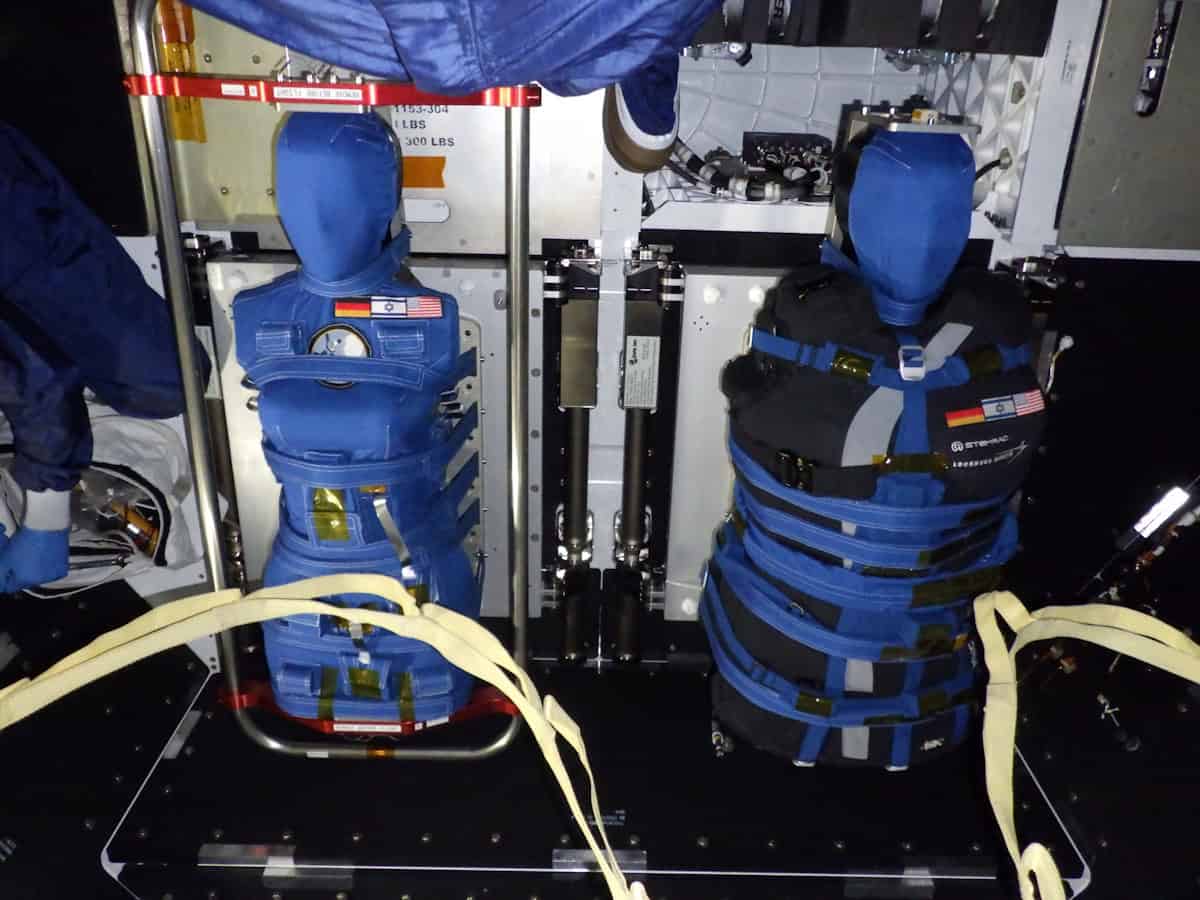
The data for this analysis were obtained via seating two human-tissue-equivalent female torso phantoms in the Orion crew capsule. While the “Zohar” phantom wore the new AstroRad vest, its travel companion “Helga” did not. Numerous radiation dosimeters placed in and on the phantoms allowed the received radiation dose to be compared.
“Exposure to radiation in space is unavoidable, and a single major solar particle event (SPE) can deliver more than one-third of NASA’s 600 millisievert career effective-dose limit. A three-year round trip to Mars would equal or exceed the career limit, which corresponds to a 3% mortality risk from radiation-induced cancer. So we developed the AstroRad vest to significantly reduce this hazard,” explains immunologist Oren Milstein, CEO of StemRad Radiation Protection, which began developing the vest with Lockheed Martin in 2015.
Dosimetry phantoms The Helga and Zohar (wearing the AstroRad vest) phantoms inside the Orion spacecraft at the NASA Vehicle Assembly Building prior to the launch of Artemis I. (Courtesy: NASA/Lockheed Martin/DLR)
The shielding thickness varies throughout the garment according to the radiation sensitivity of the underlying organs, with breasts, colon, lungs, ovaries, stomach and red bone marrow having concentrated shielding in the test vest. Milstein was inspired to develop this targeted architecture based on the experiences of his PhD supervisor, who treated the first responders to the 1986 Chernobyl nuclear power plant disaster.
With damage to bone marrow the accepted cause of death for all those emergency workers who lost their lives within months of the accident, “that heritage instilled in me a desire to protect people from radiation by selective shielding of the bone marrow,” Milstein explains, adding that the female focus of this experiment is because women have a higher predicted risk of radiation-induced cancer than men.
Astronauts currently shield from SPEs in “storm shelters” consisting of barricades of supplies, or by moving into areas containing more hardware against the walls. AstroRad provides a similar level of protection to the most robust shelter configuration while also “allowing the astronaut wearing it to move around the cabin and continue mission-critical tasks,” radiation physicist Jordan Houri, lead scientist for space exploration at StemRad, tells Physics World.
To maintain flexibility, the vest is constructed from thousands of hexagonal tessellated rods of high-density polyethylene (HDPE) sandwiched between two layers of elastic fabric. The shielding components can also slide past one another and stretch. HDPE was chosen for its high proportion of hydrogen – which is extremely effective at shielding against charged particle space radiation.
While Artemis I did not encounter a solar storm, Orion traversed the inner Van Allen belt, whose protons cover a similar energy range to those in SPEs. This enabled the team to construct a Monte Carlo model of the experiment for testing different radiation environments.
“We created digital twins of Helga and Zohar, the AstroRad vest, radiation detectors and spacecraft shielding,” explains Houri. “Using this model, we generated hundreds of billions of virtual protons and electrons representing the radiation environment of the inner Van Allen belt, before comparing the predicted detector responses directly with the measurements recorded during Artemis I.”
With close agreement found, the researchers then simulated measured SPEs from August 1972 and October 1989. As detailed in their recent Science Advancespaper, this revealed that wearing AstroRad would reduce effective dose by around 60% in an August 1972-type scenario, and by almost 40% for a 1989-type SPE – sparing astronauts the dose equivalent from up to 193 and 131 days of deep space travel, respectively.
Combining these results with those from previous experiments, which tested the vests’ ergonomics on the International Space Station, is allowing the researchers to improve comfort and ease of motion, and reduce mass. They are also exploring whether lighter, empty vests could be filled with recycled polyethylene after launch.
Alongside the health benefits, reducing radiation exposure makes economic sense as it extends astronauts’ careers, concludes Milstein, who hopes that the AstroRad vests can help “make lunar habitation and Mars travel truly sustainable and not just a dream”.
Quantum dot LEDs (QLEDs) are of interest because they emit bright light with highly pure colours, making them attractive for display and lighting applications. They also have the potential to be manufactured at lower cost using solution-processing techniques. However, producing high-performance QLEDs remains challenging because the quantum dots must be uniformly distributed within a densely packed film. Poor film uniformity can lead to lower efficiency and faster device degradation.
In this study, machine learning was used to identify solvent conditions that produce the most uniform quantum dot films. Several solvents were characterised using five key solvent parameters that influence how quantum dots arrange themselves as the solvent evaporates. Film uniformity was assessed using atomic force microscopy, which provides detailed information about surface morphology and roughness.
Three machine learning models were trained to predict film uniformity from the solvent properties. Support Vector Regression was found to provide the most accurate predictions and was subsequently used to identify an optimal mixed-solvent formulation. Grazing-Incidence Small-Angle X-ray Scattering confirmed that the resulting films exhibited more homogeneous quantum dot packing.
The optimised solvent formulation produced QLEDs with higher efficiency and longer operational lifetimes than devices fabricated using single solvents. Overall, the study demonstrates that film homogeneity is a critical factor in QLED performance and highlights the potential of machine learning as a powerful tool for optimising solution-processed optoelectronic devices.
Most quantum computers today do not work in isolation. They rely on carefully timed signals from classical electronics, lasers or magnetic fields to tell the qubits when to perform each operation.
In ordinary quantum-computing theory, the qubits are treated as the computer while these timing signals are treated as external infrastructure. When calculating the energy required to run a quantum computer, drawing a boundary around the qubits like this will inevitably hide part of the real-world energy cost. Draw the boundary around the whole computing machine, including its clock, and a new energetic cost appears.
This is the idea behind new research from a team of researchers from Austria. In a new study, they introduced the idea of an autonomous quantum processing unit (aQPU). The aQPU has four main parts: a memory where the calculation happens, an instruction register that stores the program, a tick register that counts the steps, and an internal quantum clock that drives the whole process. The idea is similar to a mechanical machine that, once started, runs without an external operator.
The team showed there is an inescapable trade-off between accuracy and thermodynamics. If the clock ticks at slightly uncertain times, the quantum gates are applied imperfectly, reducing the fidelity of the computation. The authors found that the error grows with the length of the program and shrinks as the clock becomes more accurate. But more accurate clocks generally dissipate more entropy, meaning they produce more thermodynamic irreversibility.
In practice, such entropy production is usually associated with dissipated energy, often as heat. For quantum computers, this is especially awkward because many platforms already need delicate cooling and isolation procedures.
The new study does not propose a practical computer yet. Instead it gives physicists a cleaner way to ask how much energy quantum computation fundamentally requires. Even when quantum gates are mathematically reversible, the physical act of controlling them with sufficient precision may not be thermodynamically free.
Wireless power transfer systems are used to transfer electricity without a physical cable, for example in wireless electric vehicle charging, medical implants and consumer electronics such as smartwatches. In real systems, poor alignment and variable distances can reduce efficiency, causing some of the transmitted energy to be reflected back towards its source rather than being absorbed by the receiver.
Wireless power transfer research tends to focus on engineering solutions such as improved coil designs, impedance matching and frequency tuning. However, in this work, the researchers investigate a more fundamental question: how can the physics of time-domain wave interference be used to control energy flow within resonant systems?
A phenomenon known as Coherent Perfect Absorption occurs when a system completely absorbs incoming energy with negligible reflection. However, this requires specific conditions and a system that is perfectly matched, operating at a point of equilibrium known as the steady state. Here, the researchers report a new effect called Transient Coherent Perfect Absorption. Rather than relying on a steady state, TCPA operates during the brief transition period immediately after a system is switched on.
During this transient period, a steady wave produced by the source coexists with a temporary, decaying wave created by energy stored within the system. These waves interfere with one another and both contribute to the reflected signal. When they are exactly out of phase, the reflected signals cancel out. As a result, a system that would normally reflect a significant amount of incoming energy can briefly behave as though it were perfectly matched, absorbing almost all of the incoming energy.
While this is fundamentally a physics study of wave behaviour and interference, it introduces a new way to suppress energy reflections in resonant systems. In the future, the approach could help improve the efficiency of wireless power transfer and other energy-delivery technologies by reducing losses under imperfect operating conditions.
For particle physicists, bigger has always been better. The first working cyclotron, which was built by Ernest Lawrence in California in 1931, was little more than 35 cm in circumference and accelerated protons to 80 keV. Compare that with CERN’s Large Hadron Collider (LHC), which is more than 27 km long and has been creating protons with energies of 7 TeV per beam – some eight orders of magnitude higher.
Only recently, though, have the burgeoning energy requirements of ever-larger accelerator facilities become a cause for concern. It was not until 2020 that CERN published its first-ever environmental report, which outlined to the public how the lab was reducing its energy consumption. Thanks to innovations in cryogenics, for example, CERN reported that the “data per joule” doubled between the LHC’s first and second experimental runs.
All good and well. Yet while their core mission of fundamental scientific discovery remains paramount, it’s clear that – if nothing changes – the environmental impact of new and upgraded accelerator complexes will track in tandem with the size, energy footprint and resource consumption of these large-scale research facilities.
The numbers are eye-watering. Particle-accelerator research centres currently consume hundreds of gigawatt-hours (GWh) of electricity per year – roughly the energy budget of a mid-sized European city. CERN’s unique array of accelerators, detectors, computers and technical infrastructure, for example, together account for about 95% of the lab’s total electricity use of 1290 GWh in 2024, with the LHC alone soaking up 695 GWh.
What if bigger isn’t better?
It’s not a good look given the climate crisis – and only made worse with oil and gas prices soaring after the effective closure of the Strait of Hormuz. Fortunately, the accelerator-science community is ramping up efforts to make its core technologies and facilities more sustainable. The aim is not only to cut the energy and resources that accelerators use, but also to understand – and, more importantly, minimize – their “whole-lifetime” environmental impact.
In fact, with CERN bringing the upgraded High Luminosity LHC online by 2030, mulling over a 91 km-circumference Future Circular Collider, and China eyeing up a 100 km collider of its own, now is a good time to embed environmental impact-reduction techniques into accelerator designs from the start.
That, at least, is the hope of a group of accelerator scientists and sustainability experts from the UK, Switzerland and Germany, who in June published a “living document” that puts environmental sustainability front-and-centre in the planning, construction, operation and decommissioning of large-scale accelerator facilities (EPJ Research Infrastructures10 12).
“We’re seeing a surge in interest from colleagues across the accelerator community, all of them eager to incorporate environmental sustainability into their work and to share lessons learned,” says Hannah Wakeling, lead author of the report. An accelerator physicist in the John Adams Institute at the University of Oxford, UK, Wakeling’s own research involves measuring the carbon footprint of particle accelerators, their use of raw materials and even their wider impact on biodiversity.
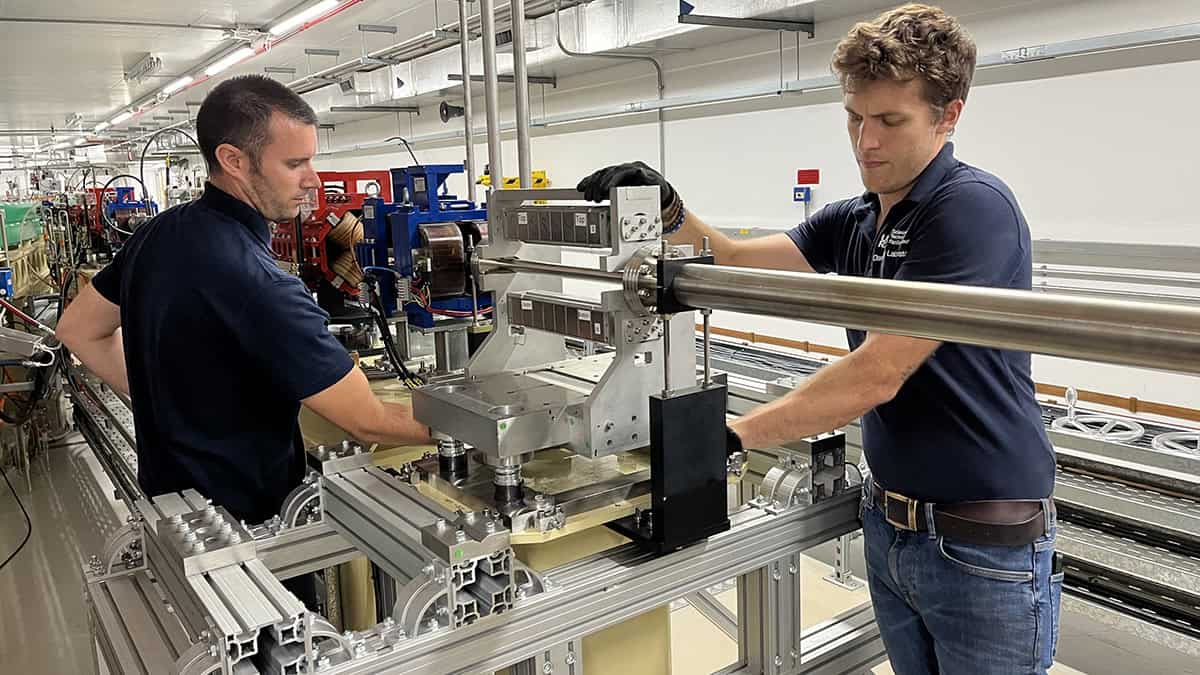
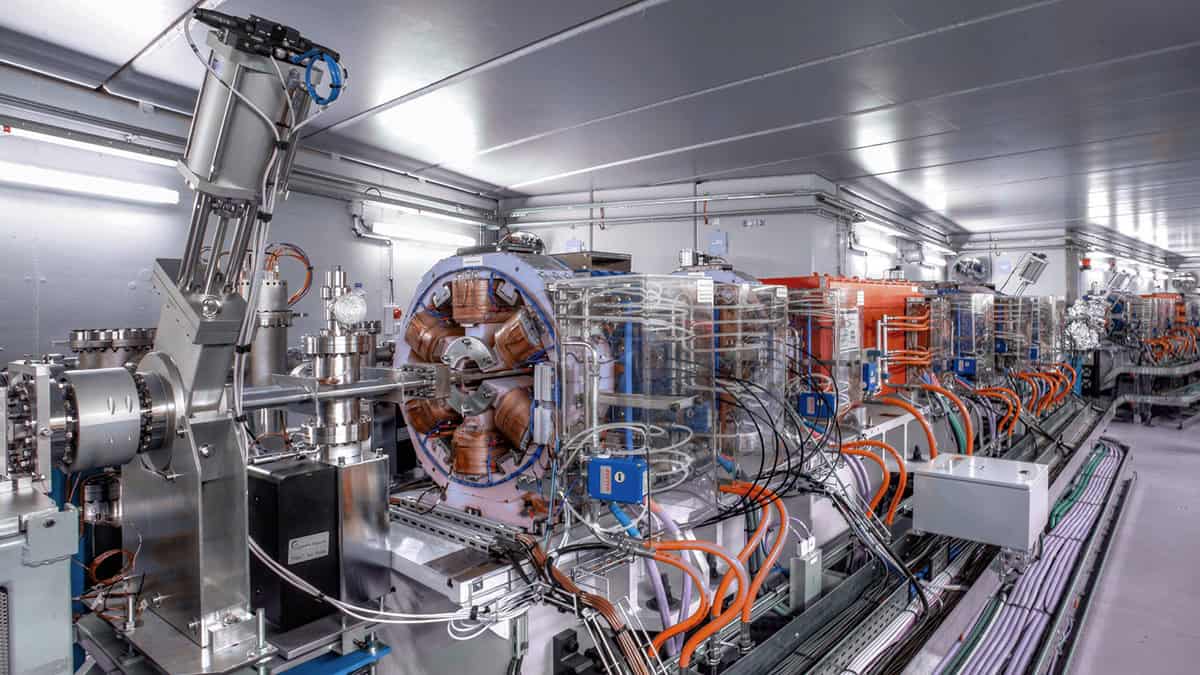
Permanent waves The UK’s Zero Power Tuneable Optics (ZEPTO) project is developing tuneable permanent magnets for accelerator facilities as an energy-efficient alternative to resistive electromagnets. Here engineers are installing a ZEPTO magnet on the booster-to-storage-ring transfer line at the Diamond Light Source synchrotron facility in Oxfordshire. (Courtesy: Science and Technology Facilities Council)
Trouble is, measuring and improving the environmental sustainability of accelerator facilities is not easy. Labs often don’t have enough funding, staff or time for such initiatives. Sustainability recommendations are either too generic or cannot be applied to accelerator science and technology. There’s also uncertainty about how to incorporate environmental sustainability into day-to-day operations.
We hope that the guidelines will help accelerator facilities make informed decisions that balance scientific progress with environmental responsibility
Hannah Wakeling, University of Oxford
Inspired by various initiatives in big science (see “Sustainable acceleration”, below), Wakeling and colleagues’ open-access resource has 110 practical sustainability recommendations for anyone building, planning or running accelerator facilities. It includes advice on procuring resources responsibly and reducing environmental impact through, for example, tunnelling, shielding, component design, waste management and green computing. There are also recommendations on skills, knowledge transfer and culture change, the latter being what the authors think will have most impact.
“Looking at accelerator programmes through the lens of sustainability gives us an opportunity to do things differently,” notes Wakeling. “We hope that the updated version of our high-level guidelines [v1.0 was published in 2025] will help accelerator facilities make informed decisions that balance scientific progress with environmental responsibility.”
Towards accelerator 2.0
In general, the biggest opportunity to make accelerators more sustainable is when they are still being designed and conceived. “At these crucial stages,” says Wakeling, “environmental impact assessments should be employed to highlight the areas of highest potential for impact reductions and more sustainable designs.”
What’s more, argues Wakeling, any decision to build or upgrade an accelerator shouldn’t depend just on its cost or scientific output but on how environmentally sustainable it will be too. That, in turn, means prioritizing R&D funding for enabling technologies that can make the most difference and co-ordinating efforts between large-scale facilities to avoid scientific duplication and to minimize the consumption of resources.
One relevant effort is a pan-European consortium called Research Facility 2.0 (RF 2.0), which is aiming to develop accelerator facilities that can run entirely on renewable energy – in effect, almost independently of the public power grid. A three-year, €5.6m initiative funded by the European Union’s Horizon programme and the Swiss State Secretariat for Education, Research and Innovation, RF 2.0 includes major accelerator labs like CERN, DESY and HZB (both in Germany), ALBA (Spain) and MAX IV (Sweden) plus the Karlsruhe Institute of Technology (KIT) and four high-tech SMEs.
Large-scale research infrastructures are a public good but they are inflexible and found wanting when it comes to environmental sustainability
Giovanni De Carne, director of KIT’s Institute for Technical Physics
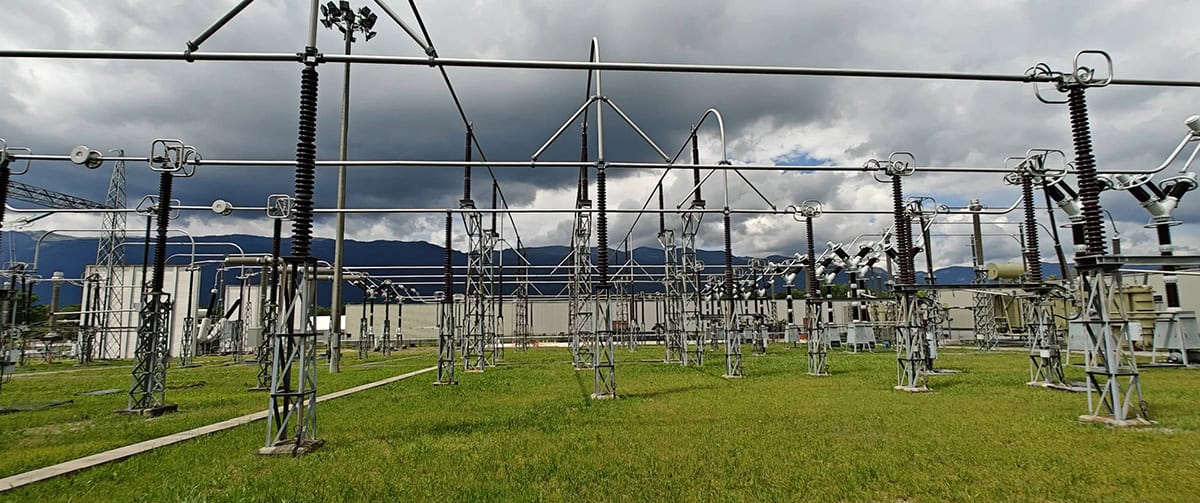
They’ve got the power RF 2.0 engineers from CERN and industry partner Zaphiro have installed 24 phasor measurement units to monitor disturbances in the Large Hadron Collider’s power network, including the BE1 400 kV switchyard (above), the main energy gateway to CERN. The demonstrator project aims to enhance the network’s resilience and energy-efficiency. (Courtesy: Nikolaos Sapountzoglu/CERN)
“The second problem is practical, but also philosophical,” De Carne adds. “Large-scale research infrastructures are a public good – driving scientific and societal impact – but they are inflexible and found wanting when it comes to environmental sustainability, consuming large amounts of raw materials during construction and regular operations.”
RF 2.0’s goal is therefore to analyse the many ways accelerators use energy – from components and systems to experiments and engineering – and to develop and test novel platform technologies in real-world settings. One notable RF 2.0 demonstrator project, for example, led to a redesign of permanent magnets that steer and focus beams at the MAX IV synchrotron, reducing energy use and heat losses by up to 40%.
Another involved retrofitting solid-state amplifiers with energy-efficient “active parameterization” controllers to enhance particle acceleration at the ALBA synchrotron; it yielded 18% energy savings in one year versus prior technologies. A parallel R&D track has also led to sustainable high-performance computing initiatives such as a summer energy-saving programme at DESY’s data centre, reducing the power draw during the hottest parts of the day.
Permanent attraction RF 2.0 partners have been exploring the long-term environmental and operational benefits of using permanent magnets (rather than electromagnets) in accelerator systems, including a demonstrator project in the storage ring of Spain’s ALBA synchrotron light source. Here the actual electromagnets are shown along with the electrical and cooling connections that won’t be needed with a permanent magnet solution. (Courtesy: ALBA)
Meanwhile at CERN, an RF 2.0 team has installed 24 phasor measurement units (PMUs) at the lab. These smart grid devices, which record the magnitude and timing of voltage/current fluctuations, are able to monitor harmonics, voltage sags and grid disturbances within the LHC’s power network.
By recording phenomena that would otherwise go unnoticed with traditional metering systems, the PMUs help engineers to implement counter-measures to make the accelerator grid more robust. In the first year of operation, the devices recorded 135 voltage sags and rapid voltage-change events, with 18 of these adversely impacting operation of the accelerator complex – mainly affecting magnets and radio-frequency (RF) acceleration schemes.
“RF 2.0 cannot work in one single direction – a multidisciplinary approach is key,” says De Carne. “We are bringing together physicists, engineers and technologists who, under normal circumstances, rarely talk to each other. The project provides a forum for them to connect and share insights on common problems but from their own unique perspective. It’s been a real game-changer.”
The RF 2.0 programme finishes at the end of 2026, after which De Carne hopes to secure follow-on EU funding for RF 2.0 to merge with another pan-European project called Innovate for Sustainable Accelerator Systems (iSAS). The two projects look like a neat fit, with iSAS consisting of 11 academic labs and six companies seeking to make superconducting RF cavities – a workhorse accelerator technology – more energy-efficient.
Sustainable acceleration
The following sustainability initiatives are a useful starting point for scientists and engineers who want to evaluate and lower the environmental impact of accelerator projects at an institutional, project or individual level.
Sustainable HECAP+ is a group of researchers in high-energy physics, cosmology, astroparticle physics and beyond who are promoting environmentally sustainable practices in areas such as computing, energy, mobility, research infrastructure, resources and waste.
The ICFA Panel on Sustainable Accelerators and Colliders is promoting “energy-efficient and sustainable accelerator concepts, technologies and strategies…and the use of accelerators for the development of carbon-neutral energy sources”.
Flexibility in RIs for global CArbon Neutrality (FlexRICAN) is a pan-European academic-industry consortium evaluating how research facilities can enhance energy flexibility for the European electrical grid and contribute to local heating networks through waste heat recovery.
ErUM Data Hub is a German initiative helping 20,000 scientists exploring “the universe and matter” to make data management, software and digital tools more environmentally sustainable.
Disruptive thinking, sustainable outcomes
Along another coordinate, there’s also top-down pressure for a more sustainable approach to future accelerators from the European Strategy Group for Particle Physics (ESG), which guides the future of the field in Europe. “Energy consumption and emissions must be minimized when realizing and operating facilities and projects,” is the ESG’s unequivocal message in the 2026 update to its third strategy paper. “The design of new particle physics infrastructures should be as sustainable as possible, balancing important sustainability aspects with cost and physics performance.”
The ESG argues that R&D funding should be allocated to platform technologies with the most potential to yield energy savings. These include systems that convert grid power to RF more efficiently for particle acceleration, with some studies suggesting it could be possible to quadruple the efficiency with which RF systems convert electrical power into radiant power. Other promising technologies include thin-film superconducting RF cavities operating at higher cryogenic temperatures (around 4.2 K or higher versus 2 K for bulk niobium cavities).
Also important are novel permanent and high-temperature superconducting magnets that minimize heat losses. “Comparing the carbon footprints of electromagnet and permanent-magnet quadrupoles,” says Wakeling in Oxford, “the higher manufacturing impact of a permanent magnet can, in certain cases, be offset by its lower operational impact in as little as one year. Worth noting as well that this conclusion only considers carbon and doesn’t compare other environmental impacts.”
Another sustainability pathway is the use of AI and machine-learning to optimize the efficiency of accelerator experiments – for example, by focusing on intersecting parameters tuned to improve equipment reliability, lifetime and resource consumption. In parallel, AI could cut the huge computational needs of particle physics by requiring fewer “events” to be stored and lowering computing time.
Longer term, researchers are prioritizing disruptive accelerator concepts that could slash the size, cost and carbon footprint of next-generation facilities. One example is the energy-recovery linac, in which superconducting RF cavities decelerate a “used” particle beam and recycle the kinetic energy to accelerate new particles to higher energies. Another is plasma-wakefield acceleration, which uses laser- or particle-beam-driven intense “plasma waves” as the accelerating medium, yielding electric fields up to 1000 times greater than in classical accelerators.
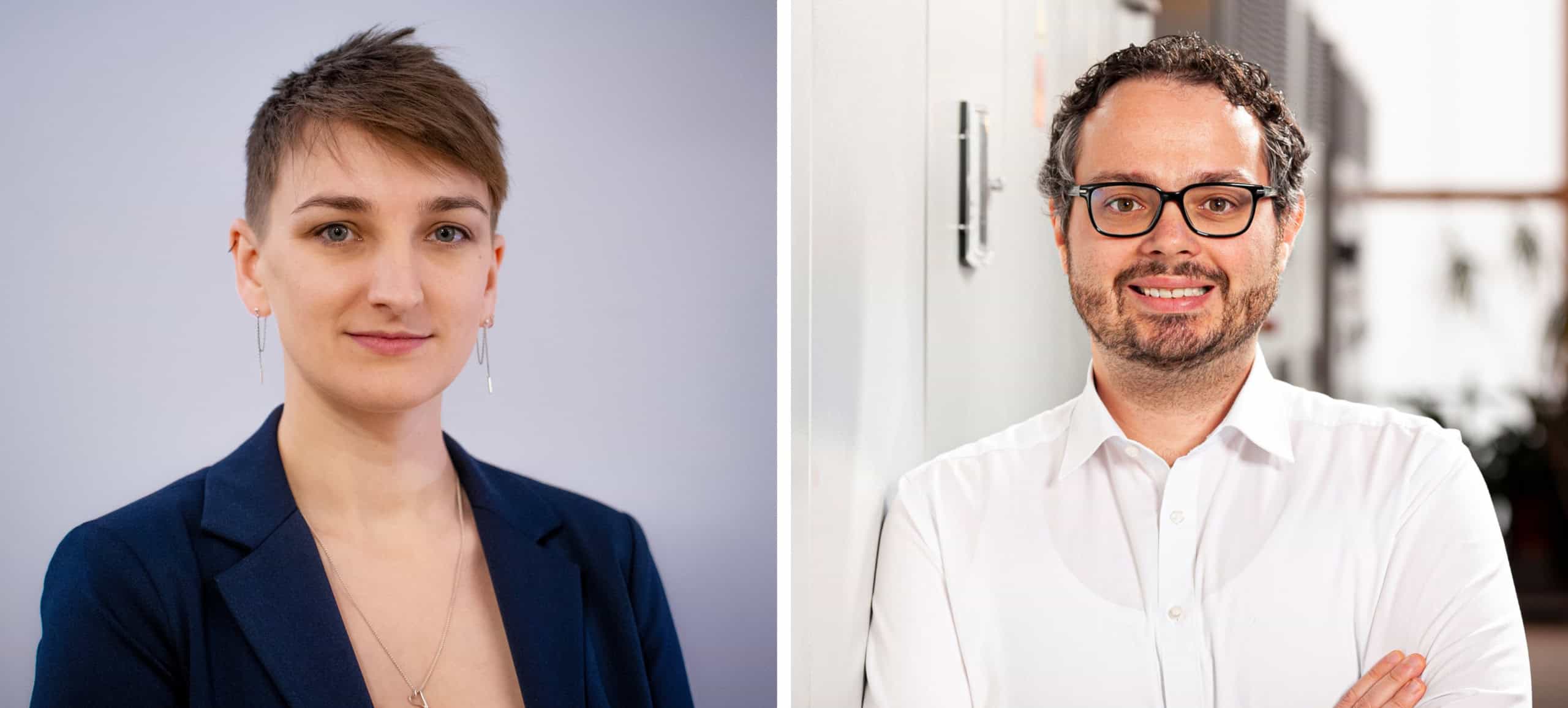
Innovate and accelerate Hannah Wakeling (left) from the University of Oxford is one physicist seeking to make accelerator programmes more sustainable. Giovanni De Carne (right), director of the Institute for Technical Physics at KIT in Germany, runs the European RF 2.0 programme, which aims to develop accelerator facilities that can run entirely on renewable energy. (Courtesy: John Adams Institute and KIT)
The best of all worlds
Notwithstanding all this technology innovation, so many factors influence accelerator design that the “best” decision in terms of its environmental benefits can’t always be made. “In the end,” says Wakeling, “this is all a balancing act: we want accelerator facilities to be cutting-edge in terms of their scientific output, but we also want them to be cutting-edge when it comes to environmental sustainability.”
As for next steps, Wakeling and co-authors now plan to assess the anticipated impact of their 110 recommendations – whether high, medium or low – and the potential difficulty of putting them into practice (by referencing technology-readiness level, for example). Work is also underway to incorporate more quantitative analyses, including target figures for selected recommendations based on case studies from the accelerator community.
Equally, when assessing an accelerator’s emissions over its whole life-cycle, Wakeling thinks there is much to learn from the space-science community, which has developed the Open-source Rocket and Constellation Lifecycle Emissions (ORACLE) GitHub repository. This initiative seeks to cut the carbon footprint of the space industry – especially large constellations of satellites – by allowing researchers to share code and data.
“We applaud efforts like ORACLE and wish to encourage and promote similar programmes within fields applicable to accelerator science,” says Wakeling. But it’s clear that significant research is still required to tackle the complex environmental challenges in accelerator science, with Wakeling and colleagues aiming to update their living document as new information and technologies become available.
“We invite contributions from colleagues within the accelerator community,” Wakeling concludes, “to ensure this resource remains relevant, comprehensive and impactful.”
A voting system with a high level of security intrinsically guaranteed by quantum mechanics has been demonstrated by two independent teams – one led by Federico Centrone at the Barcelona Institute of Technology and the other led by Rob Thew at the University of Geneva.
Their systems employ a quantum protocol that was first proposed by Centrone and colleagues in 2022 and uses a system of entangled qubits to ensure every voter has complete anonymity.
A conventional voting system – paper or electronic – could be hacked or corrupted at the counting stage, resulting in a rigged outcome or lack of anonymity. In 2007, Anne Broadbent and Alain Tapp at the University of Montreal proposed a possible solution: an e-voting protocol in which an election is broken into as many rounds as there are voters.
Before anyone casts a vote, Broadbent and Tapp’s system secretly assigns each participant to be the “real” voter in exactly one designated round. In that round, the chosen voter picks a value (either 0 or 1) representing their actual choice.
Secret ballot
In every other round, the system automatically submits a pre-assigned value on the voter’s behalf, engineered so the round’s total has a fixed parity – either always odd or always even. The real voter’s free choice then either flips this total to the opposite parity or leaves it unchanged, and the final odd or even result is recorded. Once every round is complete, each voter will have had their real say – but from the outside, the identity of the real voter in any given round is completely hidden.
Although this scheme is watertight in principle, there is still no guarantee that the e-voting system itself can be fully trusted. In 2022, a team led by Centrone proposed how this loophole could be closed by harnessing entanglement between quantum bits, or qubits.
In the quantum protocol, each voter is assigned a single qubit, prepared as part of one joint entangled state spanning all voters together. When measured, each qubit is randomly either a 0 or 1, But, because of the type of entanglement between the qubits, the total number of 1s across all voters is guaranteed to have the expected parity. Since not even the e-voting system itself can know the outcome of any individual measurement in advance, the protocol removes the need to trust whoever is distributing the values.
Easily adapted
Thew’s team realised that it could create this protocol in the lab. “We had just finished another experiment concerning distributed polarization entanglement and realized we could ‘easily’ adapt our setup to produce the entangled states required for the voting protocol,” says Geneva’s Joey Marcellino.
Both teams used spontaneous parametric down-conversion (SPDC) to create the entangled qubits, which were photons. Here, a laser is fired into a nonlinear crystal, splitting single photons into pairs of lower-energy photons that are entangled in terms of their polarization states.
SPDC is then repeated using the newly-entangled photons, chaining pairs together until reaching the same number of entangled photons as there are voters – albeit a small number in these demonstrations. The result is one single, large entangled state. Each individual photon then passes through a 50/50 beam splitter, is coupled into an optical fibre, and sent to a detector, where its state is measured.
Fidelity and success
In their first experimental tests of the technique, Centrone and colleagues were able to create the entanglement required for the voting protocol at success rate of about 96%. Meanwhile, Thew’s team achieved an 87% success rate.
Commenting on his colleagues’ result, Marcellino says, “This suffices as a proof-of-principle for the protocol and our modified approach, although obviously we would want to improve these numbers significantly for real-world applications”.
For now, the result demonstrates that e-voting systems with quantum-guaranteed security are achievable, using existing technologies including single-photon sources, detectors, and entanglement generation schemes.
“Moreover, in the end the protocol is just a way to anonymously distribute a bit with perfect security,” Marcellino adds. “While this is obviously useful for voting, it could also work as an anonymous message board, or to enable anonymous distributed computation.”
As the world of quantum computing grows and researchers work towards scaling up quantum systems, energy consumption is becoming a major concern. Beyond the small scale and high level of control in a laboratory environment, the lasers that power quantum systems result in a large energy cost that may act as a bottleneck for the integration of quantum technology.
Publishing their findings in Optica, researchers have demonstrated that sunlight can be used to generate pairs of entangled photons, providing a more energy efficient alternative to laser-pumped systems. This collaborative project combined theoretical research led by Robert Boyd at the University of Ottawa with technology developed by Hanieh Fattahi’s research group at the Max Plank Institute for the Science of Light in Erlangen, Germany.
Overcoming assumptions
Optical quantum computers use pairs of entangled photons as qubits, with the nonlinear optical processes used to produce them typically relying on lasers. This is largely due to two assumptions: firstly, that high optical coherence is required, meaning that the light waves maintain a steady phase relationship; and secondly, that lasers are the only way to achieve the necessary optical power density for these methods.
Sunlight, while naturally abundant, is largely incoherent and is difficult to collect in concentrations comparable to that of lasers. As such, this natural reservoir of optical input has been largely overlooked as a direct resource for nonlinear optical processes.
The researchers behind this latest study are challenging these assumptions with a new system that uses sunlight to fuel a process called spontaneous parametric down-conversion (SPDC). In this process, a pump beam – usually a laser but replaced here with solar light – interacts with a nonlinear crystal, splitting individual photons into entangled pairs.
To harness the plentiful yet highly dispersed sunlight, Fattahi’s team had to develop a device that focuses sunlight down to a point approximately 2 mm wide, to be coupled to a fibre as thin as a human hair. To achieve this, they used a Fresnel lens and spectral filter to collect sunlight, and a glass cone-shaped concentrator to funnel the light to a point, where it is coupled to the fibre. The fibre then directs the sunlight into the nonlinear crystal to induce SPDC.
Fattahi described the “significant practical challenges” involved with implementing such a system. Along with having to continuously track the Sun, the outdoor nature of the experiment left it vulnerable to both environmental effects and background light. Eventually compensated for by enclosing the system in a tent, the background light was initially offset by students beginning measurements at around 3 a.m. to make the most of the natural darkness.
Overcoming both theoretical and practical concerns, the system was able to successfully produce entangled photons. The states produced violate Bell’s inequality (as the photon correlations cannot be modelled classically) with an S value of 2.54, where S = 2 is the threshold for indication of quantum behaviour, and a 94% fidelity to the target entangled Bell state.
Significantly, when normalized in terms of the spectral bandwidth of the pump, sunlight-powered SPDC demonstrates a photon pair generation rate comparable to that of the laser-pumped process. This method eliminates the need for electrical-to-optical energy conversion, providing a viable path towards increasing energy efficiency.
The future of photon production
The development of quantum technology is vital for the future of secure communication, ultraprecise sensing and high-performance computation. Taking steps to develop a sunlight-driven method of photon pair production will potentially allow scaling of this technology without the major energy cost.
Minimizing energy consumption and system complexity would be a huge benefit for systems operating in demanding conditions, such as polar deserts. This research is particularly striking when considering space-based quantum technology. Sun-synchronous orbits could allow near constant access to a naturally occurring, reliable pump-source.
Fattahi and her team intend to develop a field-deployable version of this system, with a focus on greater integration which should “significantly improve mechanical stability, efficiency and overall practicality”. There is also potential to expand the portion of the solar spectrum used in this experiment. Fattahi described the “exciting possibility” of using different spectral regions to drive multichannel entangled-photon generation, increasing efficiency and capacity.
Research into new, energy-efficient photon production has the potential to remove a major barrier for the integration of quantum technologies and contribute to a brighter future for quantum computing.
When I went to university, I didn’t know what kind of career I wanted to pursue. I’d originally applied to study geophysics, but after a few weeks realized mineral exploitation wasn’t my thing and quickly switched to maths. Then, at the end of my first year, I had a range of degree options open to me and, whilst I preferred (and was better at) maths, I just didn’t feel it was my best choice for a career.
So I decided to switch again, this time to physics. During my degree, a few friends and I joined the Student Industrial Society (now known as the Bright Future Society). It gave us the chance to visit a range of companies – from micro-breweries and wine importers to TV studios, nuclear-power stations and semiconductor manufacturers. We also went to Llanwern steelworks in South Wales, where a closing session with a British Steel careers advisor really shook me up.
A feisty Yorkshireman, he started off by directly asking each of us what we planned to do after university. We were all put on the spot and our answers, which were embarrassingly unsure, failed to impress him. The advisor firmly suggested that if we didn’t know what our plans were by now, we had better find out before it was too late. For me, it was a wake-up call and when I got back to campus, I went straight to the careers office and started applying for summer student placements.
To my amazement, and despite my lack of experience, I was offered several positions and decided to take a summer job in Malvern at the Royal Signals and Radar Establishment, which is now part of the private defence-technology firm QinetiQ. Somehow, I managed to find something useful to work on and after 12 weeks had done enough to be as included as co-author on a peer-reviewed publication.
Summerlove sensation
After the placement, I continued with my physics degree, but began to feel something about physics wasn’t quite right for me. Whilst I loved the classical side of the subject and the real-world applications, I struggled with the less visible aspects, such as quantum and nuclear. So after a final-year project investigating the aerodynamics of cars – and finding myself more interested in my housemate’s mechanical engineering course – I wondered if I might be better suited to a career in engineering.
On the back of this growing interest, I applied to do a PhD in high-speed aerodynamics at the University of Southampton. My final-year project – coupled with my grounding in physics and the fact that I had a journal publication to my name – must have impressed my future supervisor, who picked me for the project. I had a great time on my PhD, which proved I loved engineering – particularly aerospace.
After four years in research, I realized an academic career wasn’t for me. But my PhD proved handy as it led to me getting a job with a small business called Stewart Hughes Ltd, which built vibration-monitoring equipment for use on mechanical machines. The company was looking for people with an academic background whose presence could help secure US government research funding. It turned out to be a sound strategy, as the firm built up a significant track record in winning high-value government grants.
My advice to you
These days I work a lot with interns and science or engineering students, who often ask me about my career path. As you can see, it wasn’t straightforward – and I believe a lot of people struggle making choices early in their careers. It’s easy to think you need to have everything mapped out in advance, which is rarely how things pan out. With that in mind, here are a few tips if you are starting out on your own career journey.
Top 10 tips
1 Even if you’re not sure what’s right for you – just try things out. Visiting industrial sites or attending topical lectures is great, even if it doesn’t lead to any work experience.
2 Be honest about what you like and don’t like – and don’t be afraid to change direction if things don’t feel right.
3Be prepared to stretch yourself to find out more. Go outside your comfort zone.
4 Remember your degree subject may not be the most important thing unless you’re aiming for a career needing specific vocational training to get in. It’s far more important to study a subject you enjoy.
5 Get yourself a mentor who can be a constant in your career. They don’t have to be more senior to you; they could be a peer or someone more junior (i.e. a “reverse mentor”).
6 It’s fine if you enjoy doing lots of different things – but it doesn’t mean you have to do them all at once.
7 Being happy in what you do is more important than ultimate career goals.
8 Career opportunities don’t arise exactly when you’d like them to so be prepared to jump in or try different options if they pop up. A lateral move can be just as effective.
9 Don’t be afraid to nominate yourself for awards and prizes. An award will look good on your CV and there are a surprising number of opportunities.
10 Network and use your friends’ and peers’ experience.
Doing the rounds
One interesting bit of advice was once given to me on a career session led by a senior human-resources executive who works for a global corporation. The exec told us how he’d been having a golf lesson and was about to hit the ball down the fairway when the coach stopped him and asked where he was aiming. After explaining he was hoping to land the ball on the green, the coach shot back: “Yes…but where exactly on the green?”
Set your goal, do your best to reach it, and don’t worry too much about potential pitfalls.
Obviously the exec said he wanted to get a hole in one, but he was also trying to avoid the bunker and the long grass. The coach went on to explain that golfers should aim at the target and not be distracted by obstacles. Stay focused and the ball will land at or near the target. The exec saw this as the perfect analogy for one’s career: set your goal, do your best to reach it, and don’t worry too much about potential pitfalls.
Now that’s easier said than done – in fact, my career journey has not been the epitome of this advice. There have been bumps and detours along the way, which haven’t necessarily been through lack of focus, but because it took me time to discover what I really wanted to do. To stretch the golf analogy to breaking point, my first green might have not been great, but I’ve certainly had fun making it round the course.
Sensors designed to record earthquakes can reveal insights into a very different natural hazard – how hurricanes evolve and intensify as they strike land. The surprising connection has been made by researchers in the US, who examined data from seismic sensors installed in Louisiana for studying the interior of the Earth. They found that the sensors, which collected data on pressure fluctuations, provided information about how Hurricane Isaac grew and intensified as it struck and devastated the state in 2012.
Earthquakes and hurricanes are very different in how they form, move and impact the Earth. The parameters governing these natural hazards – and the way that we measure them – are also distinct given that one is a geophysical phenomenon and the other atmospheric.
Hurricanes, which form over warmer tropical and subtropical ocean waters, are rotating systems of cloud and thunderstorms. They consist of a calm, central “eye”, a surrounding layer of tall thunderstorms, and strong winds called the “eyewall”. Spiralling away from the eyewall are bands of clouds and thunderstorms.
Forecasters describe the structure and evolution of hurricanes using three main parameters: track, intensity and the radii of the wind layers around the eye. But when hurricanes strike land, particularly important is the turbulence in the lowermost layer. That’s where momentum, heat and moisture mix between the atmosphere and the ocean or land.
Eyeing up hurricane path and intensity
Measuring the turbulence in this boundary layer is critical both for forecasting wind intensity and for developing and validating weather models. Such data are usually collected using reconnaissance aircraft, ocean buoys and onshore towers and radar. But flying planes into hurricanes is dangerous, while onshore towers are sparse, making data-gathering tricky. Continuous monitoring of a storm’s passage is not easy either.
In the new study, Qing Ji, Ipshita Dey and Eric Dunham from Stanford University processed data from seismic stations in Louisiana that are part of a network of 1700 stations across the US. Equipped with both infrasound sensors and seismometers, these “seismoacoustic” stations are designed to record seismic activity.
The infrasound sensors measure pressure fluctuations at the Earth’s surface, with the seismometers recording the resulting elastic response. But when the hurricane passed through the equipment, the winds were strong enough to leave an additional signal. In fact, the Stanford team found that the data revealed the calm eye and the turbulent eyewall – as well as the circular layers of thunderstorms and winds as the hurricane passed through the sensors.
“The infrasound sensors provide direct measurements of turbulent pressure fluctuations,” says Dunham. “We also used the seismometer data together with data from other atmospheric sensors to calibrate a computer model of hurricane turbulence.” The model provided space-time correlations of pressure fluctuations around the station, while the simulated pressure spectra matched the recorded data at station.
The researchers then calculated the Earth’s elastic response using the simulated pressure field, which aligned with the observed vertical displacement. More importantly, the simulations showed that the relevant parameter for calculating the Earth’s elastic response to pressure fluctuations is the velocity at which those fluctuations are carried downstream — rather than the near-surface wind speed as had been assumed.
Exploiting existing sensor networks
Dunham told Physics World that he hopes the study will draw attention to the potential of seismoacoustic networks for atmospheric sciences. “Perhaps this will lead to deployments of seismometers and infrasound sensors in areas where coverage is currently sparse, like in the southeastern US,” he adds.
Those hopes are echoed by Ji – now based at the University of Texas, Austin – who says there is a growing interest in the use of these “noise” signals for environmental monitoring. As Ji points out, the beauty of seismic stations is that they record data continuously and have a high sampling rate compared to other sensors.
Seismoacoustic stations have already been used to study various environmental and climatic phenomena, such as rising amounts of energy in ocean waves as waters warm and the evolution of tropical storms and accompanying winds. “The atmospheric imprints, however, are less studied partly due to the overall smaller amplitudes and the potentially more complicated nature,” Ji adds.
Dunham also sees an opportunity to add infrasound sensors and barometers, both of which measure atmospheric pressure, to existing seismometers. “Having multiple sensors at a single location opens up new opportunities for studying both the solid Earth and atmosphere,” he says.