LHC physics programme set to launch 30 March

CERN has announced that its Large Hadron Collider (LHC) will attempt the first collisions at 7 TeV on Tuesday 30 March – one week today.

Smashing together protons at this energy will set another benchmark for the highest energy yet achieved in a particle accelerator. More significantly, it will mark the beginning of the LHC physics programme, which will test and scrutinize the Standard Model of particle physics.

It’s a bit like firing needles across the Atlantic and getting them to collide halfway. Steve Myers, director for accelerators and technology, CERN

The announcement follows Friday’s news that two 3.5 TeV beams had been successfully circulated around the 27 km circumference of the LHC.

Playing down the hype

Despite the excitement at being so close to such a key milestone, CERN is careful to emphasize the uncertainties ahead. “The LHC is not a turnkey machine,” said CERN director general Rolf-Dieter Heuer. “The machine is working well, but we’re still very much in a commissioning phase and we have to recognize that the first attempt to collide is precisely that. It may take hours or even days to get collisions.”

This is a sentiment echoed by CERN’s director for accelerators and technology, Steve Myers. “Just lining the beams up is a challenge in itself: it’s a bit like firing needles across the Atlantic and getting them to collide halfway.”

Once 7 TeV collisions have been established, CERN’s plan is to run continuously for a period of 18–24 months, with a short technical stop at the end of 2010. Experiments will run throughout this time, with researchers expecting to accumulate one “inverse femtobarn” of data – roughly 10 trillion proton–proton collisions.

The broad aim of this research is to characterize the subatomic particles that emerge from these high-energy collisions, with perhaps the ultimate goal of confirming the existence (or non-existence) of the Higgs boson. This elusive particle is the last missing piece of the Standard Model of particle physics, and its discovery would confirm the most compelling explanation physicists have for how elementary particles acquire mass.

In pursuit of the Higgs

Although the Standard Model does not predict the mass of the Higgs boson, precision measurements of known Standard Model particles mean that its mass is unlikely to be more than 186 GeV. Meanwhile, direct searches made at CERN’s Large Electron–Positron Collider – the forerunner to the LHC – rule out a Higgs that is lighter than 114 GeV.

Running at 7 TeV, the LHC should have the best chance yet of confining the Higg’s mass, being 3.5 times more energetic than the Tevatron collider at Fermilab in the US, which until December was the world’s most energetic collider. What can be discovered, however, will depend largely on how heavy such new particles are and on how easy they are to spot among “background” processes taking place in the proton–proton collisions.

Following this current run, CERN plans to shut down the LHC in 2012 for a year or more to prepare it to go straight to maximum-energy 14 TeV collisions in 2013.
Spiders’ super-strong silk relies on its crystals

If you are a small insect and find yourself staring into the eight eyes of a hungry spider as it wraps you in its silk, unfortunately, your number really is up. This stringy substance may seem a bit flimsy but the more you struggle, the longer it gets, and it will not snap – its tensile strength exceeds that of high grade steel. Now, a group of researchers in the US and Korea are able to explain, numerically, how spider silk combines strength with extreme ductility to deadly effect.

A spider’s silk is made from basic proteins, including some that form thin, planar crystals called beta sheets. These sheets are connected to each other by hydrogen bonds, which are among the weakest types of chemical bond – far weaker, for example, than the covalent bonds found in most organic molecules. However, by stacking multiple beta sheets, a spider’s silk manages to fail gracefully, with hydrogen bonds breaking one by one under external force.

Markus Beuhler and his colleagues at Massachusetts Institute of Technology, working with researchers at Pohang University of Science and Technology, have studied this silk failure in the finest detail to date. Using a series of computer simulations they found that the strength of spider silk depends on a critical size of crystal within the beta sheets of around 3 nm. Once the crystals are allowed to grow beyond 5 nm, however, the silk suddenly becomes weak and brittle.

“This way of failing has clear advantages to the spider,” Beuhler tells physicsworld.com. “Simple hydrogen bonds make it much easier for a spider to repair damage to its web. A covalent bond, like glass, would break catastrophically.”

Beuhler says that these findings could be used to develop innovative applications, such as tough coatings for cars and non-poisonous surgical equipment. He also envisages the emergence of new materials that could possess the strength and flexibility of spider silk while being made from inherently stronger molecules, such as carbon nanotubes.

“The paper shows improved modelling and some more explanations in terms of shear deformation and involved hydrogen bonds being responsible for the mechanical behaviour,” says Mato Knez at the Max Planck Institute of Microstructure Physics, who was not involved in this research. Knez feels, however, that the work is just another step in a developing research field. “It gives some sort of improvement to the understanding of the model system, which was already present to a certain extent.”

This research is published in Nature Materials.

3D invisibility cloak unveiled

The first device to hide an object in three dimensions has been unveiled by a group of physicists in the UK and Germany. While the design only cloaks micro-scale objects from near-infrared wavelengths, the researchers claim that there is nothing in principle to prevent their design from being scaled up to hide much larger artefacts from visible light.

The origins of this design date back to 2006, when David Smith and colleagues at Duke University in North Carolina created a cloak that could bend microwaves around an object, like water flowing around a smooth stone. This early cloak was made using a metamaterial – an artificially constructed material with unusual electromagnetic or other properties – which consisted of a cylinder built up from concentric rings of copper split-ring resonators. This first cloak, however, only worked in two dimensions – in other words, looking at the cylinder from above revealed the presence of the shielded object.

Carpet cloak

Now Tolga Ergin and colleagues at Karlsruhe Institute of Technology in Germany, together with John Pendry of Imperial College in London, have overcome this problem by creating a “carpet cloak”. Proposed in 2008 by Pendry and Jensen Li, this involves hiding an object underneath a bump on the surface of an otherwise smooth material – just as something might be hidden under a carpet – and then smoothing out the resulting bump. This is achieved by creating a bump on a flat mirror and then placing onto the mirror a layer of metamaterial with optical properties such that light appears to reflect off the mirror as if the bump were not there.

This technique was demonstrated experimentally at two different wavelengths last year, with Smith’s group showing that it worked in the microwave region while researchers at Berkeley and Cornell University near New York obtained similar results at infrared wavelengths. However, these cloaks were also limited to just two dimensions.

Ergin’s group has made a carpet cloak in three dimensions by stacking nanofabricated silicon wafers on top of one another in a “woodpile” matrix and then filling in the gaps between the wafers with varying amounts of polymer. This achieves the desired distribution of refractive indices within the structure.

Hiding the bump

The cloak structure was then placed on top of a reflective gold surface containing a bump, leading to a cloaking effect using unpolarized light with wavelengths between 1.4 and 2.7 µm – the near-infrared. Importantly, this effect held for viewing angles up to 60 degrees (with zero degrees representing viewing in just two dimensions).

The bump, however, was very small – just 30 µm (10–6 m) × 10 µm × 1 µm. Team member Martin Wegener says it should be possible to use existing technology to make the cloak bigger in order to hide larger objects, but that this approach would be extremely time-consuming. “Faster nanofabrication tools will have to be developed allowing for three-dimensional structures,” he adds.

For Wegener the aim of the work is not about focusing all efforts on creating invisibility cloaks, but is about exploring a range of applications in transformation optics. This involves calculating what kind of material is needed to bend light in a certain way, by considering light trajectories as the result of the warping of space. Wegener says that transformation optics should lead, for example, to the design of better antennas or smaller optical resonators.

Smith describes the latest work as “very exciting” and agrees that its real importance lies in the development of transformation optics. “Demonstrations like these are paving the way for transformation optical design to become an established design methodology, like ray-tracing,” he says.

The research is published in Science.

‘Standard candle’ flickers too brightly

An international team of researchers has measured the mass of a distant exploding star system – and found that it weighs considerably more than the accepted mass limit for such bodies. As these type 1a supernovae are widely used as “standard candles” to measure distances in the universe, the finding could have important consequences in cosmology, particularly concerning theories of dark energy.

Type 1a supernovae occur when a white dwarf – thought to represent the end point of a star’s evolution – begins to gain mass by the accreting matter from a neighbouring star. Once the white dwarf reaches a critical mass of 1.4 solar masses, it will undergo a supernova explosion, which will always have the same brightness.

This stellar phenomenon proves very useful for astrophysicists because measuring the apparent brightness of a type 1a supernova infers its distance from our solar system, and measuring how this brightness changes over time can reveal the rate of expansion of the universe. Indeed, cosmologists have used this data to predict the existence of dark energy, which seems to be causing the expansion of the universe to accelerate.

Overweight candle

However, this study, led by Richard Scalzo of Yale University, reports that the white dwarf linked with SN 2007if, an established type 1a supernova, has a mass of 2.1 ± 0.2 solar masses, taking it far beyond the Chandrasekhar limit. The researchers arrive at this result after carefully examining the dimming of SN 2007if, which is occurring at a slower rate than would be expected for a supernova of this type.

The rate of dimming is determined by the efficiency of reactions taking place inside supernovae. Carbon and oxygen – the main constituents – are converted into radioactive nickel and then optical light. If there is more mass then the radioactive energy will be processed more efficiently and you’ll see a brighter supernova. “By watching the supernova fade away we can measure that efficiency and use it to estimate the mass,” Scalzo explained.

To make this discovery Scalzo and colleagues used ground-based telescopes in Chile, Hawaii and California to analyse the remnant of SN 2007if.

Having searched for several alternatives to explain this stellar heavyweight, Scalzo believes the likely candidate to be multiple white dwarfs, rather than a white dwarf and a neighbouring star. “If you have two white dwarfs they can slowly spiral inwards and eventually merge. When they merge they can potentially form something that is larger than the Chandrasekhar limit,” he said. However, the type of astrophysical objects that spawned this system remains unclear.

An opportunity, not a problem

Scalzo believes his findings might have opened the door to discovering more about this problem. “The question is whether there are other kinds of supernova that have similar physics but maybe are not as extreme. This might be telling us something about supernovae physics that we really need in order to standardize supernovae in future,” he tells physicsworld.com.

Even though Scalzo’s result indicates that not all type 1a supernovae are as neat and tidy as previously thought, dark energy is probably still safe, because there is still further evidence that it exists. “There is other observational evidence from the cosmic microwave background and galaxy surveys. Take any one of these away and dark energy still exists,” says Malcolm Fairbairn, a particle astrophysicist at King’s College London, who was not involved in the research. “However, it has been very worrying that we rely on type 1a supernovae as standard candles but we don’t really know exactly what they are,” he adds.

Scalzo agrees that a more detailed understanding of standard candles will be integral to the future of dark energy cosmology. “The implications are that the next generation of experiments require much greater precision than the generation that established the existence of dark energy. Then you might be able to say something about dark energy’s evolution with the expansion of the universe,” he said.

The findings have been accepted for publication in Astrophysical Journal.

LHC poised for key milestone

DACEY lhc.jpg
Energy record for the LHC

By James Dacey

The bars of Geneva may well be bustling with excited physicists tonight, as the Large Hadron Collider (LHC) is now on the brink achieving a key milestone – collisions at 7 TeV.

At 5.20 a.m. this morning, two 3.5 TeV proton beams were successfully circulated in the LHC, the highest energy yet achieved in a particle accelerator.

CERN says that the first attempt to collide these beams will follow on a date to be announced in the near future. This will mark the beginning of the full LHC research programme.

Experiments will then continue at this energy until its detectors have accumulated one “inverse femtobarn” of data – roughly 10 trillion proton–proton collisions – with the run ending after two years at the latest.

If all goes to plan, CERN will then shut the LHC down in 2012 for a year or more to prepare it to go straight to maximum-energy 14 TeV collisions in 2013.
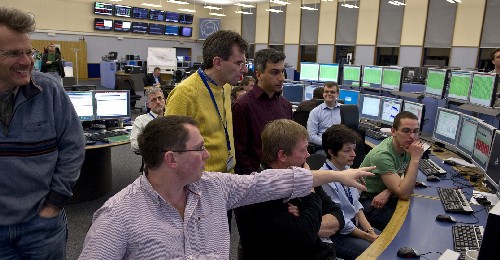
“Getting the beams to 3.5 TeV is testimony to the soundness of the LHC’s overall design, and the improvements we’ve made since the breakdown in September 2008,” says CERN’s director for accelerators and technology, Steve Myers. “And it’s a great credit to the patience and dedication of the LHC team.”

Happy birthday, Nanotechnology

cover.gif
Nanotechnology keeps on growing

By Hamish Johnston in Portland, Oregon

The hottest party in town last night was the Institute of Physics Publishing reception at the Hilton Hotel. This year we are celebrating the 20th anniversary of our journal Nanotechnology and group publisher Nina Couzin gave a nice talk on the history of the journal and plans for the future.

Late last year, a special issue was published to commemorate the 20th volume of the journal. Many of the papers are free, so make sure you have a good browse of the content.

And no mention of nanotechnology is complete without a nod to nanotechweb.org, where you will find the latest research news.

The reception is a great way to gauge what’s hot and what’s not. After three days of sessions, folks were still very keen on topological insulators. But the session that everyone was talking about was Eugenie Samuel Reich’s talk about the “Schoen affair”.

Sadly, I missed her talk because I had already read her article on the scientific fraudster, which appeared in Physics World last year – an electronic version is available to IOP members only.

The most interesting conversation I had was with a theorist who recently shifted his research interests from high-Tc superconductors to topological insulators and graphene. Why? It was the look of horror on potential graduate students’ faces when he started to explain what he did!

Quantum effect spotted in a visible object

Physicists in California have observed true quantum behaviour in a macroscopic object big enough to be seen with the naked eye. This is the first time this feat has been achieved and it could shed light on the mysterious boundaries between the classical and quantum worlds.

One of the fundamental principles of quantum mechanics is that objects can be in two states at the same time. This means that an electron can, for instance, be in two places at once. However, these “superposition” states are never seen in classical, macroscopic objects – one example being Schrödinger’s famous cat, who clearly could not be both dead and alive. Until now, such states have only been observed in atomic-scale objects and some larger molecules, such as a “buckyball”, which is made up of 60 carbon atoms.

Scientists have long wanted to demonstrate superposition in larger objects but a significant challenge here is to eliminate all thermal vibrations in the object, which mask or destroy quantum effects. To achieve this, the object needs to be cooled down to its quantum ground state – at which point the amplitude of vibrations reduces to close to zero.

A quantum drum

Andrew Cleland and colleagues of the University of California, Santa Barbara, have now achieved this for a substantially larger object than in previously experiments – an object so large in fact that it can just about be seen with the naked eye. The object is a mechanical resonator made of aluminium and aluminium nitride, measuring about 40 µm in length and consisting of around a trillion atoms. It is a thin disc, which resonates at about six billion vibrations per second.

In the experiment, Cleland’s team reduce the amplitude of the vibrations in the resonator by cooling it down to below 0.1 K. The high frequency of the aluminium resonator was key to the experiment’s success, because the temperature to which an object needs to be cooled in order to reach its ground state is proportional to its frequency. “A regular tuning fork, for example [with significantly lower frequency], would need to be cooled by another factor of a million to reach the same state,” Cleland said.

Next, the team measured the quantum state of the resonator by connecting it electrically to a superconducting quantum bit or “qubit”. The qubit acts, in fact, like a “quantum thermometer” that can identify just one quantum thermal excitation, or phonon. Once this has been done, the qubit can then be used to excite a single phonon in the resonator. This excitation can be transferred many times between the resonator and qubit.

Dead and alive, at once

In this way the researchers created a superposition state of the resonator where they simultaneously had an excitation in the resonator and no excitation in the resonator, such that when they measured it, the resonator has to “choose” which state it is in. “This is analogous to Schrödinger’s cat being dead and alive at the same time,” says Cleland.

“Unlike other measuring instruments, [the qubit] allowed us to measure the mechanical resonator while preserving all quantum effects,” Cleland told physicsworld.com. “Most measuring instruments disturb the mechanical object by heating it up, and so destroy the very quantum effects being sought.”

The experiments could have important implications for new quantum technologies, like quantum information processing, and for investigating the boundaries between the quantum and classical worlds – one of the least understood areas in physics.

“Another long-term prospect is testing the foundations of quantum physics,” writes Markus Aspelmeyer of the University of Vienna in a commentary in Nature. “For example, superposition states of massive objects may be used to test possible deviations from quantum mechanics, which have been suggested to eliminate the Schrödinger’s cat paradox.”

This research is published in Nature.

A radon detector for earthquake prediction

Recent events in Haiti and Chile remind us of the devastation that can be wrought by an earthquake, especially when it strikes without warning. For centuries, people living in seismically active regions have reported a number of strange occurrences immediately prior to a quake, including unexpected weather phenomena and even unusual behaviour among animals. In more recent times, some scientists have suggested other precursors, such as sporadic bursts of electromagnetic radiation from the fault zone. Unfortunately, none of these suggestions has led to a robust, scientific method for earthquake prediction.

Now, however, a group of physicists, led by physics Nobel laureate Georges Charpak, has developed a new detector that could measure one of the more testable earthquake precursors – the suggestion that radon gas is released from fault zones prior to earth slipping.

Spewing from the Earth’s guts

In the last decade, several studies have concluded that elevated concentrations of radon gas in soil or groundwater could be the sign of an imminent earthquake. It is believed that the radon is released from cavities and cracks as the Earth’s crust is strained prior to the sudden slip of an earthquake. In order to test this hypothesis, however, researchers would need to deploy several hundred detector devices along a fault zone. Although several commercial devices could, in theory, perform this task, these devices are too expensive for large-scale application. In addition, it is not clear whether many of these devices would still work in the presence of water.

Charpak’s alternative detector is based on established technology already in action in extreme conditions at laboratories such as CERN. It consists of a wire-type counter, which is the concept for which Charpak won his Nobel prize in 1992. In these devices, particles such as radon enter a gas-filled container and ionize some of the gas particles. The resulting ions and electrons are accelerated by a potential on the wire, causing a cascade of ionization that results in a current in the wire.

One key feature of this new detector design is that it works with ambient air, thus avoiding the need to keep refilling the detector’s ionization chamber with a particular gas. It also has a high efficiency, which was achieved by including multiple wires in the ionization chamber. In laboratory tests, the researchers report a radon count of 140 Bq.m–3 over one minute, which is comparable to that offered by commercial devices. The tests also show that the device still functions in 70% humidity, while single-wire detectors start to falter at just 30% (arXiv: 1002.4732v1).

Detecting success

“The instrument they propose is based on a very old and very well established detector technology,” says Ariella Cattai, a detector physicist at CERN. “What is very original with this work is the way they want to operate these detectors – in simple air and not in a complicated gas mixture like we normally use.”

Paulo Fonte, director of the Instrumentation Laboratory of Portugal (LIP), agrees that in using the ionization of air the researchers have “broken a taboo” in detection, and he does not foresee any major hurdles in developing this proto device into a commercially viable detector. “It detects alpha particles, which is all that is needed to detect heavy radioactive contaminants. I don’t know how well [this research] is funded, but even if the chances of succeeding are slim, the prize would be so important that it is for sure worth investigating.”

A member of Charpak’s team, Vladimir Peskov, who works at the National Autonomous University of Mexico, says that the group’s next step is to run more tests and develop a way of networking the detectors along a fault zone. They will also investigate ways of monitoring radon levels in groundwater.

Take me out to the (digitized) ball game

hits.jpg
Nathan’s results table

By Hamish Johnston in Portland, Oregon

Although college basketball’s “March madness” is about to start, it’s the physics of baseball that people are talking about here at the APS March Meeting.

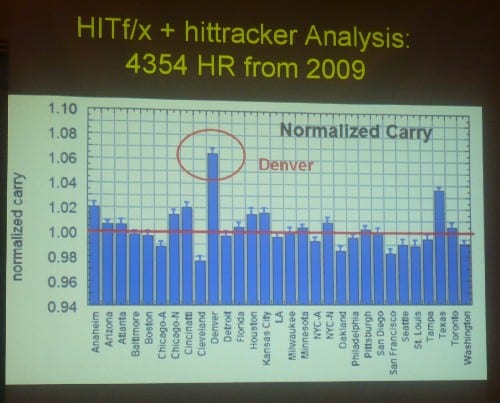
Alan Nathan of the University of Illinois at Urbana Champaign spoke about his analysis of data from the PITCHf/x and HITf/x systems that have been installed in all major-league ballparks by Sport Vision.

These systems track the speed and trajectory of the ball allowing, for example, digital reconstructions of plays for television viewers.

It turns out that all of these data are available to the public – and Nathan has used them to study the flight of the baseball.

One question he addressed is the widely held belief that hit balls travel further in the new Yankee Stadium in New York than in other ballparks.

Nathan defined the “carry” of a hit as the distance the ball actually travelled divided by the distance the ball would have travelled (given its velocity when hit) in a vacuum.

You can see the results above, and there is nothing special about the new Yankee Stadium – denoted “NYC-A” – indeed its carry is a little below average (the red line).

So what’s the story with Denver?

Here’s a hint – Denver’s Colorado Rockies used to play in Mile High Stadium.

John Updike meets The Sopranos

songs.jpg
Nan Haemer sings Updike

By Hamish Johnston in Portland, Oregon

My fondest memory of the 2010 APS March Meeting will be the soprano Nan Haemer’s performance of Updike’s Science – music by the physicist Brian Holmes and words by the late John Updike.

Brian is at the left of the photograph above, turning pages for Terry Nelson on the piano.

As well as being a condensed matter physicist at San Jose State University, Holmes is a professional French horn player and a composer.

Updike’s Science consists of musical settings of six poems by John Updike. Some of the poems make direct reference to science – “Cosmic gall”, for example, begins:

“Neutrinos they are very small…”

Other poems are included because they remind Holmes of science – “Lament for cocoa”, for example could be a lament for thermodynamics with the lines:

“The scum has come, My cocoa’s cold”

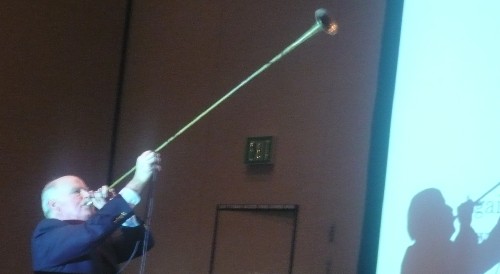
trumpet.jpg
Holmes blowing his horn

Before the performance Holmes entertained the crowd with a lively demonstration of the physics of brass instruments.

What did I learn? Well it seems that the pitch of a trumpet with a bell is higher than a similar instrument that ends in a plain tube. Although Holmes didn’t say so, the logical conclusion is that the bigger the bell the higher the pitch – but I would have thought bigger bells result in lower pitches.

The reason, I think, is that a larger bell means that the acoustic node of the instrument is further into the trumpet – which shortens the wavelength of the sound, boosting the pitch.

Copyright © 2026 by IOP Publishing Ltd and individual contributors