High-flying physicists ranked like WWI fighter pilots

german ace2.jpg
German aces Credit: Bernie Hengst

By James Dacey

How does one compare the achievements of Nobel Prize winning physicists?

Well, a couple of researchers at University of California, Los Angeles (UCLA) believe it can be done – look a physicist’s cyber-presence.

Mikhail Simkin and Vwani Roychowdhury open their arXiv paper by dismissing the two “standard” measures of scientific achievement:

Number of published papers – journals publish all sorts of nonsense.
Number of citations – “multiplicate by mere copying”.

They go on to propose a third way based on a previous study of theirs…

Back in 2006, these two electrical engineers published a paper demonstrating that fame of German World War I fighter pilots (measured as number of Google hits) grows exponentially with their achievement (number of victories).

In this latest arXiv paper Simkin and Roychowdhury have turned their method on its head by measuring scientific ‘achievement’ by the number of Google hits a physicist receives.

They ran Google searches for all 45 pre-WWII Nobel Laureates in Physics, and translated this into achievement using a simple logarithm.

Unsurprisingly, Einstein is the biggest cyber celeb – his 22,700,000 Google hits give him an achievement score of “1 Einstein”. Second was Max Planck whose 10,600,000 rate his achievement as 0.911 Einsteins. Third was Marie Curie scoring 0.850 Einsteins.

Just missing out on the top ten is the UK’s Paul Dirac whose 255,000 hits give him a web presence just 1% that of Einstein’s but this rates his achievement as 0.48 Einsteins.

To round things up, Simkin and Raychowbury argue that their findings are backed up by the “recent attention given to studies where very many non-expert opinions lead to estimates agreeing with reality as good or better than expert opinions”.

Hmmm… that’s a little bit vague isn’t it! And aren’t they assuming that there is an absolute measure of scientific achievement?

So, readers of physicsworld.com, a question for you to ponder:

Can you think of a better / fairer / more useful way of comparing physicists’ achievements?

NASA launches two missions to the Moon

Is there water on the Moon — and where is the best place to build a lunar base? These and other questions about our nearest neighbour could soon be answered by two unmanned missions that blasted off yesterday from Cape Canaveral in Florida.

NASA’s Lunar Reconnaissance Orbiter (LRO) and Lunar Crater Observation and Sensing Satellite (LCROSS) took off at 17:32 local time aboard the same Atlas V rocket. Both probes are expected to reach lunar orbit on 23 June.

The LRO is a $500m satellite that will produce maps of the Moon’s surface with the highest resolution yet. Costing $80m, LCROSS should crash into the Moon on 9 October in order to study its composition.

The missions are important precursors to NASA’s Constellation programme, which aims to send astronauts to the Moon and to create a lunar outpost as a stepping stone for a trip to Mars. As well as determining if water or other useful substances can be found on the Moon, the missions could help identify possible sites where a future manned mission could land.

Unseen details

We probably won’t be able to see the [US] flag. But we should be able to image what the Apollo astronauts left behind Richard Vondrak, NASA

The LRO will orbit 50 km above the lunar surface. It will have seven onboard instruments, including a camera that will map the Moon with a resolution of about 50 cm, revealing previously unseen details. “We probably won’t be able to see the [US] flag,” says Richard Vondrak, project scientist on the LRO and deputy director of NASA’s solar system exploration division. “But we should be able to image what the Apollo astronauts left behind, including the landing zones.”

To produce the lunar maps, the camera will be aided by an altimeter that will measure the gradients of slopes using five lasers beams. Also in preparation for future manned missions, a cosmic–ray telescope will measure the radiation exposure that crew members would receive once they had arrived at the Moon.

In order to remain in orbit, the LRO will need a short boost from its fuel tank every two weeks to stop it from crashing into the lunar surface. Once the fuel runs out after 15–18 months, the LRO will go to a higher orbit where it will operate for a further three years. “With more funding we could even continue doing measurements in a high orbit for up to 10 years,” says Vondrak.

Cold traps?

The remaining four instruments on board the LRO are all dedicated to finding water on the Moon. A radiometer will measure the temperature of the lunar surface to identify cold traps where water ice could exist. An instrument to measure the surface in the ultraviolet will search for surface frost in the polar regions, which is thought to be the best candidate location for water ice to be found. The third is a neutron detector and the only foreign-based instrument on board, having been built at the Russian Space Institute in Moscow. It will create a map of hydrogen deposits on the Moon with a resolution as fine as 10 km. The final instrument is a radar to image the polar regions.

“With these instruments, we will be able to detect hydrogen deposits down to a depth of 2 m,” says Vondrak, “possibly revealing, for example, if it is possible to extract the material and use it as propellant or fuel for a lunar base.”

LCROSS, will also try to discover whether the Moon has water. But while the LRO will enter a circular orbit around the Moon, LCROSS and the Centaur upper stage of the launch rocket will separate off and go into a highly elliptical orbit, initially moving away from the Moon and taking four months to return.

Best crash sites

This will give the LRO time to roughly map the best possible crash sites in the polar regions that could harbour water before LCROSS arrives back. When that happens, the Centaur will crash into the Moon four minutes before LCROSS arrives. As the Centaur hits the surface, it will gouge a 20 m crater into the lunar surface, throwing up a plume of dust that LCROSS will travel through.

With its three spectrometers, three cameras and radiometer, the mission will measure the dust for water content and transmit the data back to Earth before it too smashes into the surface. Although other missions have already found evidence for water ice, as yet there is no smoking gun.

Aerosol cooling overestimated, says new study

The effect of aerosols on modulating the sun’s radiation has been one of the biggest uncertainties in understanding climate change — with satellite data showing more aerosol cooling than computer models. New research reconciles the two different approaches and shows that official estimates of aerosol cooling have been too large, suggesting that any masking of overall warming will be smaller than previously thought.

Aerosols are small particles suspended in the atmosphere that either scatter or absorb solar radiation, a combined phenomenon known as the direct aerosol effect. Aerosols that scatter — such as sulphates, nitrates and organic carbon — tend to cool the Earth by sending some incoming radiation back into space, while absorbing aerosols, such as black carbon (formed from the incomplete burning of fossil fuels), heat up the Earth’s atmosphere.

Scientists know that scattering outweighs absorption, and therefore the direct aerosol effect leads to an overall cooling of the climate. Indeed, it may have contributed to a drop in global temperature around the middle of the 20th century. It may also have masked some of the current warming caused by increased greenhouse gas emissions, which could amplify future warming as strict controls on aerosol emissions come into effect.

Large margin of error

In its report of 2007, the Intergovernmental Panel on Climate Change (IPCC) estimated that the direct aerosol effect has a radiative forcing, or net cooling, of -0.5  Wm-2, which would offset warming due to anthropogenic carbon dioxide by almost a third. However, the margin of error was large – from -0.9 to -0.1  Wm-2.

This uncertainty was mainly caused by differences in the way that the direct aerosol effect is calculated. One option is to use computer modelling, which estimates emissions of the pollutants that produce aerosols and then models aerosol production and the absorption and scattering processes. The alternative is to use satellite measurements of the quantity of aerosols in the atmosphere combined with ground-based measurements of the relative strength of aerosol scattering to absorption. Satellite observations give larger estimates for the cooling.

Now, however, Gunnar Myhre of the Center for International Climate and Environmental Research in Oslo has used the Oslo CTM2 global aerosol model and measurements from the Moderate Resolution Imaging Spectroradiometer onboard NASA’s Terra and Aqua satellites together with data from the ground-based Aerosol Robotic Network of solar photometers to show that there are two main reasons for the discrepancy.

More black carbon

The first of these is the fact that calculations based on satellite measurements assume that the relative concentrations of different aerosols in the atmosphere have remained constant throughout the industrial age. This is a problem because calculating the cooling effect of anthropogenic aerosols involves subtracting the effect of aerosols naturally present in the atmosphere, in other words working out the relative strength of scattering and absorption before the industrial era. It turns out, in fact, that emissions of black carbon have increased by more than a factor of six whereas output of the various scattering aerosols has gone up by a factor of only three or four.

The second reason is that satellites have not been able to gather data on aerosol scattering above bright surfaces — such as polar ice caps — because light scattering from the surfaces themselves is so strong. This has tended to overstate global cooling because there are far lower densities of aerosols over the icecaps.

By bringing the two approaches into line, Myhre calculates a new best estimate of -0.3 Wm-2 for the cooling of the direct aerosol effect. He says that this will tend to reduce future projections of global warming. This is because the expected drop in aerosol production will not lead to as large a temperature rise as previously thought. Indeed, he estimates that the direct aerosol effect offsets only 10% of global warming. However, he points out that there is still some uncertainty in the vertical distribution of aerosols within the atmosphere, which is significant in so far as absorptive aerosols have a much greater effect when located above a cloud than when below.

Myhre also points out that the direct aerosol effect is smaller than another phenomenon known as the “indirect” effect, in which aerosols enhance scattering through cloud formation. The IPPC’s estimate for the indirect effect is -0.7  Wm-2, ranging from -1.8 Wm-2 to -0.3  Wm-2. Edwin Cartlidge

ITER fusion experiment faces three-year delay

The €5bn ITER fusion experiment currently being built in Cadarache, France, will not be able to test the possibility of generating fusion power until 2026 — three years later than intended — according to a new plan approved by ITER’s governing body.

At a council meeting this week in Mito, Japan, members of the ITER council said that the facility will begin experiments in 2018 as intended, but that certain components critical for running a deuterium and tritium (D–T) plasma will now not be installed when construction is complete.

“In order to substantially reduce overall risk, the primary components of the ITER machine will be assembled and tested together before the progressive installation of in-vessel components continues,” the council said an ITER statement.

Controlling D-T plasma

ITER involves heating and controlling a D–T plasma until it is so hot that the nuclei can overcome their mutual Coulomb repulsion and fuse to produce helium nuclei and 14 MeV neutrons. The idea for a fusion power station is to then to extract the heat of the neutrons, which would be used to boil water and drive a steam–powered electrical generator.

Once constructed, ITER will only use hydrogen for fusion to avoid activating the magnets when testing all the components. The original plan was that researchers would only start using deuterium and tritium in 2023 after five years had been spent testing ITER components with hydrogen. But because certain critical components will not be installed immediately the first D–T plasma is now set for 2026 — three years after the originally planned date.

‘Sluggish’ jet streams linked to quiet Sun

The unusually long quiet period of the Sun’s present activity may be due to the motion of “sluggish” jet streams beneath the solar surface, according to scientists at the National Solar Observatory (NSO) in Arizona, US.

The scientists’ observations, which show an east–west jet stream has taken a year longer to migrate south by 10° than in the previous solar cycle, also indicate that the sun is moving into its next cycle.

“We need to continue these observations for many, many more years to fully understand what is going on,” said NSO researcher Frank Hill yesterday at a meeting of the solar-physics division of the American Astronomical Society in Boulder, Colorado, adding: “We cannot at this point definitively say [the jet stream] is a real cause, but I think it is quite clear that it is associated.”

Charting activity

It is important to be able to forecast the Sun’s activity because it governs the space “weather” that surrounds Earth. During high solar activity, satellites and astronauts run the risk of being showered with lethal radiation.

Scientists have long known that the activity rises and falls in cycles that are roughly 11 years long. Having charted the number of sunspots, solar flares and interplanetary storms, they know that we are presently in a minimum or “quiet period” of activity towards the end of cycle 23. But this quiet period has already gone on for a year longer than scientists had anticipated, which raises the questions of what is causing the delay — and when we can expect cycle 24?

Hill, together with Rachel Howe, who is also at the NSO, employed two primary instruments in a relatively new science called helioseismology that traces sound waves to reveal conditions in the Sun’s interior. The first instrument, known as the Global Oscillation Network Group, or GONG, is a collection of six observatories located around the globe that can make 24–hour solar observations. The second, which is aboard NASA and the ESA’s Solar and Heliospheric Observatory (SOHO) spacecraft and which is called the Michelson Doppler Imager, or MDI, measures movement in the Sun’s outer layer.

Slow stream

The sound waves recorded by both GONG and the MDI enabled the researchers to track an east–west jet stream several thousand kilometres beneath the Sun’s surface. Such jet streams are generated at the poles every 11 years in accordance with the solar cycle, and gradually — over about 17 years — migrate towards the equator. When they reach a latitude of 22°, the jet streams coincide with the generation of new sunspots, and a new solar cycle begins.

Hill and Howe found that the present east–west jet stream has taken an extra year to cover the past 10° latitude, although it is now reaching 22°. The researchers inferred from this that the jet stream must be linked to — and possibly causes — the onset of solar cycles, and that therefore that the next cycle will soon begin.

“What we believe it means for the coming cycle — and I’m speculating a bit here, I would say — is that it will not be as strong as the previous one,” continued Hill at the Boulder meeting. “That is an active topic of discussion within the solar-physics community.”

Dean Pesnell of NASA’s Goddard Space Flight Center said in a press statement that the study finds another piece in the solar-activity puzzle. “It shows how flows inside the Sun are related to the creation of solar activity and how the timing of the solar cycle might be produced,” he added. “None of the forecasting research groups predicted the current long extended delay in the new cycle. There is a lot more to learn in order to understand how the Sun creates magnetic fields.”

Double helix is an ‘electric slide’ for proteins

DNA may contain the blueprint for life but it takes proteins to read the plan and build an organism. The mechanism of this vital biological process has remained a mystery but now researchers in France are proposing a physical model wherein individual proteins can “slide” freely along DNA strands in search of target sequences.

The team envision the process involving ‘DNA-binding proteins’ swarming around the iconic double helix on account of electric attraction — proteins have a net positive charge and DNA has a net negative charge. Miraculously, these proteins can then bind to exactly the right section of the long, coiling DNA so they can carry out vital functions such as copying genetic information and translating genes into templates for protein production.

Vincent Dahirel of the Pierre and Marie Curie University in Paris and his colleagues have reduced this complex biological set-up into more general physical shapes. Using Monte Carlo computer simulations, DNA was modelled as a long cylinder, and the protein as one of four solids: a sphere; a cylinder; or a cube or cylinder with a groove carved in one side.

Grooved cylinders

Dahirel and colleagues find that as the first three protein-shapes approach the DNA the electric attraction continues unabated. However, in the case of grooved cylinders, the proteins start to be repelled once they get to within 0.1 to 0.75 nm of the DNA.

Dahirel and his team attribute this force to the solution that bathes these biological molecules. As the protein approaches the DNA, positively charged ions in the solution become trapped in the gap, driving more water into the region as a result of osmosis. If the inward electric attraction is balanced by the outward water pressure, the protein can slide along the helix until it reaches its target. The hydrogen-bond attraction between DNA and protein then overpowers the osmotic barrier and the two bind together.

The research is published in Physical Review Letters.

Bringing FRIB to your crib

By Michael Banks

One of my favourite news stories last year was in the Sun newspaper just before the Large Hadron Collider (LHC) at CERN started up on 10 September.

“Boffins in ‘Doomsday’ rap” ran the Sun headline, which featured a grainy image of two people dressed in lab coats and hard hats in an underground lab.

The story began with “The team behind an experiment which boffins fear could destroy the world have worried sceptics further – by posting a RAP SONG about the procedure on YouTube.”

Of course, that was the “Large Hadron Rap” written by science writer Kate McAlpine, who together with a few colleagues, rapped about the LHC at CERN and what it hopes to find.

Now, however, McAlpine and her crew have released their second rap video — not about particle physics this time but nuclear physics.

The video is shot at the National Superconducting Cyclotron Laboratory (NSCL at Michigan State University, which produces high intensity beams of rare isotopes.

These isotopes are only known to exist in exploding supernovae and could provide insights into the forces between protons and neutrons in nuclei.

The song, with lyrics such as “and to put your nucleus on the nuclear map,
you’ll then measure it in a detector or trap”, is unfortunately not as catchy as the original LHC rap.

However, there are a lot of nice graphics — and corresponding rap — explaining the operation of NSCL’s new $550m Facility for Rare Isotope Beams (FRIB).

The video is even shot in high definition, so no need for any grainy images this time in the Sun.

Black-hole analogue traps sound

Physicists in Israel have created a black–hole analogue that can trap sound in the same way an astrophysical black hole can trap light. The system, which comprises a “density-inverted Bose–Einstein condensate”, may present one of the best chances yet to detect elusive Hawking radiation.

In an astrophysical sense, a black hole is a region of space so dense that the gravity at its centre approaches infinity. Surrounding this region is the so–called event horizon, beyond which nothing — not even light — can escape.

For a long time, the notion that black holes are totally black led scientists to think the objects could not be observed directly. But in the early 1970s, Stephen Hawking, building on work by Jacob Bekenstein of the Hebrew University of Jerusalem, showed that this need not be the case. Hawking’s calculations indicated that if a particle–antiparticle pair came into existence straddling the event horizon, the one closest to the black hole would fall inwards while the other would escape. The sum of escaped particles would constitute Hawking radiation, and could reveal the black hole’s presence.

The trouble is that the temperature of Hawking radiation would be much lower than the universe’s background radiation, and therefore would be difficult to make out. For this reason, several research groups have attempted to create analogues of black holes in the lab, where they can decrease the background temperature. However, so far none of these systems — which include optical fibres and quantum fluids — have yielded Hawking radiation that could be detected.

Two potentials

Jeff Steinhauer and colleagues of the Israel Institute of Technology “Technion” in Haifa have perhaps got a step further with their sonic black hole. Their system comprises a Bose–Einstein condensate (BEC), or a collection of cold atoms that move coherently in the same quantum state.

The BEC contains two potentials: one crater-shaped “harmonic” potential, which is formed via magnetic fields, and a deeper, superimposed “Gaussian” potential, which is formed with a laser beam. By shifting the potential sideways, the researchers found that atoms fell in and climbed out of the potential at a speed faster than sound in the medium, or about 1 mm/s.

This supersonic travel is key to the success of the system. If a sound wave approaches the atoms in the opposite direction as their movement, it will reach the atoms but will never be able to leave. In this instance, the moving atoms act as a sonic “black hole”, from which no sound can leave. Conversely, if the atomic flow “velocity gradient” is altered, the sound wave will never reach the atoms, in which case they act as a sonic “white hole”..

The Israeli group’s evidence for this effect came by mapping the density of the atomic clouds in and around the Gaussian potential minimum. Although they do not yet have evidence for Hawking radiation — which in this type of system would constitute packets of sound energy or “phonons” — they predict the Hawking temperature to be at a temperature in the region of 0.3 nK. Just an order-of-magnitude increase in this temperature should be enough to make the Hawking radiation visible, they say.

Good system

Renaud Parentani, a theorist at the University Paris-Sud in France who studies black-hole analogues, thinks the Israeli group’s experiment marks “a new step” towards seeing Hawking radiation in a condensed–matter environment. In particular, he has done calculations to show that this type of quantum–fluid system should suffer less from dispersion — which limits the production of particle–antiparticle pairs at the event horizon — than other recently tried systems, such as fibre optics.

Parentani says that if the researchers can achieve an order-of-magnitude increase in temperature, it could become easier to detect Hawking radiation. However, he points out — as do the researchers themselves — that they may still see it without such an increase if the black– and white–hole analogues work together to amplify the signal. In this theory, which was devised by Steven Corely of the University of Alberta, Canada, and Ted Jacobson of the University of Maryland, US, in 1999, the system behaves like a laser, so that the Hawking radiation becomes more intense than the temperature alone would imply.

The research is described in detail at arXiv:0905.0777.

Are we alone?

By Hamish Johnston

Last week I had aliens on my mind as I looked at whether it would be possible for next-generation telescopes to spy signs of life on distant exoplanets.

The answer — at least according to — Enric Pallé and colleagues — is yes.

But what should astrobiologists be looking for?

An international team of scientists has addressed that very question in a paper to be published in Astrobiology. You can read a preprint here.

Instead of focussing on planet-star systems like the Earth and Sun — which would be difficult to study, even with next-generation telescopes — the paper suggests we should look at “super-Earths”. These are planets up to ten-times the mass of Earth and therefore easier to find and study.

These super-Earths should be in the “habitable zone” — orbiting neither too near to, nor too far from, their stars. The limitations of next-generation instruments narrows this further to super-Earths orbiting relatively close to dim stars, rather than far from brighter stars.

Once a candidate has been lined up, scientists could try to look at visible and infrared light that has passed through the planet’s atmosphere for signs of chemicals associated with life. More precisely, this involves looking for combinations of chemical species that wouldn’t be expected to coexist without the help of life — oxygen, water and carbon dioxide (or methane) for example.

Astronomers will also have to work out the temperature of the super-Earth to understand chemical processes on the exoplanet. Its radius is another crucial parameter because this is related to plate tectonics and the existence of continents.

If we have a particularly good view of the exoplanet, we might even see spectral features associated with plant life. The existence of seas, continents or ice sheets could be revealed in differences in emitted light as the planet rotates.

So, when will astrobiologists spot the first signs of life on a habitable exoplanet? Many are confident that it will happen sometime after 2014, when NASA’s James Webb Telescope is up and running.

That is, if alien life doesn’t find us first!

'Telescope time without tears'

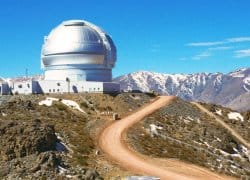
gemini.jpg
Form an orderly queue here: The Gemini South Telescope on Cerro Pachón in Chile (Courtesy: Gemini Observatory)

Hamish Johnston

Faced with the daunting task of spending a week evaluating a “bulging file of 113 telescope applications”, Michael Merrifield did what any sane person would do — he procrastinated.

But instead of tidying the tearoom down the hall from his office at the University of Nottingham, or putting all his textbooks in reverse alphabetical order, Merrifield joined forces with Donald Saari at the University of California Irvine to propose a distributed approach to peer review.

It seems that there is nowhere near enough telescope time to go around and as a result a small fraction of the astronomy community is burdened with deciding which proposals get the go ahead.

While most astronomers serve their time on such panels — Merrifield and Saari point out that others manage to avoid service. The pair also argue that one person cannot give a pile of one hundred or more applications the attention they deserve.

Their solution goes like this…if you want your telescope application to be considered, then you must chip-in and assess a few proposals yourself. The results would then be pooled to create a global priority list for a telescope.

The most controversial part of the Merrifield-Saari proposal is that the rankings submitted by individual astronomers will be compared to the global ranking — and those whose individual lists are in approximately the same order as the global list would be bumped up a place or two in the ranking.

Why? To “reward good refereeing” — the idea being that it would encourage astronomers to score proposals in line with “how the community would rank them, not her personal preferences”.

But is there a danger that this would make it even more difficult for more radical proposals to get telescope time?

Copyright © 2026 by IOP Publishing Ltd and individual contributors