

Electromagnetic software accelerates ahead

In 1975 Thomas Weiland was a physicist at the Technische Hochschule Darmstadt in Germany when he started working on numerical algorithms. He could not have imagined then that software born out of this first effort would help drive a multi-billion dollar mobile communications boom — and in the process help physicists to design invisibility cloaks.

Indeed, Weiland’s first objective was to solve the eigenvalue problem of arbitrarily shaped and filled wave guides. Weiland — who now runs the Computational Electromagnetics Laboratory at the Technische Universität Darmstadt — solved this problem by inventing the finite integration technique (FIT) for solving Maxwell’s equations.

FIT works by dividing a volume of interest up into a grid and solving an integral form of Maxwell’s equations along edges and on faces of these volumes. The first scientific publication introducing FIT followed in 1977. Since FIT is a very general approach to Maxwell’s equations it was next applied to solve 3D eddy-current problems.
Coded secrets

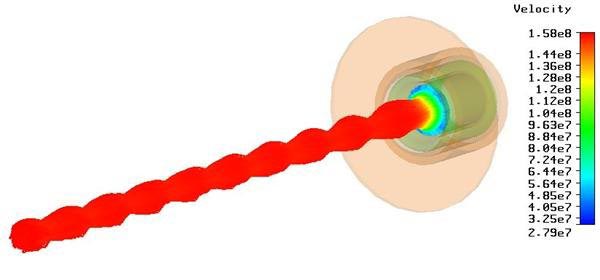
In 1979 Weiland left Darmstadt and worked for two years at the CERN particle-physics lab in Geneva. An important challenge at the time was to understand how the electromagnetic field created by a beam of charged particles interacted with the accelerating radio-frequency cavity itself — the so-called “wakefield effect” — and to work out what influence this had on beam propagation and quality. Weiland then moved on to the University of Hamburg, where he started working on the design of accelerators and on their components, such as cavities — all the time improving and extending FIT.

The resulting code later came to be called MAFIA (an acronym for solving MAxwells Equations using the Finite Integration Algorithm) and it was the first program that allowed accelerator designers to simulate in 3D how particle beams moved through a cavity while under the influence of rf fields from external sources.

Throughout the 1980s Weiland improved and commercialized MAFIA while working at several accelerator labs worldwide. During that time, MAFIA also began to get the attention of companies building equipment that operated at the same radio and microwave frequencies and power levels as the accelerator cavities.

Weiland’s first commercial customer was Siemens, which used MAFIA in different departments — for example in the design of nuclear-magnetic resonance (NMR) devices. However, in this period commercial users remained a small part of the business, with most being research scientists in over 25 countries around the world.

Wireless boom

The 1990s saw a boom in mobile communications and the need for software for designing radio-frequency and microwave antennas and other components. In 1992, Weiland therefore founded CST to commercialize MAFIA and focus on the telecoms industry.

In 1996, CST decided to implement the perfect boundary approximation (PBA) — whereby arbitrarilay shaped objects are conformally represented within one mesh cell in contrast to the conventionally used staircase approximation of other transient codes — into its simulation software. Unfortunately, MAFIA could not be easily adapted into a conformal code. In addition the Windows environment offered so many possibilities to improve usability that the decision was taken to build a new program from scratch, this time entirely in-house at CST.

The result was CST’s current flagship product CST MICROWAVE STUDIO (CST MWS), which was first released in 1998. By that time telecoms was dominating CST’s business and CST MWS was aimed squarely at people designing antennas and connectors for mobile phones and base stations.

Since then, the company has launched a series of products that integrate aspects of MAFIA. These fall under the collective banner of the CST STUDIO SUITE and include the CST PARTICLE STUDIO, which was launched in 2005 and is targeted at physicists who design accelerator components — including particle sources, and microwave tubes as well as accelerator cavities.

Rewarding applications

But the firm’s software is not just restricted to particle physics. Indeed, to encourage the use of its software by academics — and to honour the good work done at universities — CST launched its University Publication Awards in 2003.

For example, medical physicists charged with protecting the health of workers who operate magnetic resonance imaging (MRI) equipment use CST MWS to calculate the electromagnetic field strength inside the human body during a scan. In 2006, Jo Hajnal and colleagues at Imperial College London won an award for using CST’s software to calculate how much electromagnetic radiation is absorbed by a mother and foetus,which is helping practitioners ensure that absorption is kept within current guidelines.

CST MWS is also used by condensed-matter physicists to simulate the electromagnetic properties of nanoelectromechnical systems (NEMS). In 2005, for example, Xiang Zhang of the University of California at Berkeley won an award for developing a new lithography technique for creating nanometer-sized structures. The technique is based on the interference of surface plasmon waves, which are collective excitations of electrons on the surfaces of metals that can be simulated using CST MWS.

CST MWS has also played an important role in the development of “metamaterials” — artificially engineered structures that can be used to make superlenses, invisibility cloaks and other devices that seem to defy the rules of conventional optics. Andrea Alu and Nader Engheta of the University of Pennsylvania won a CST award in 2007 for their use of CST MWS to simulate metamaterial and plasmonic “covers” that could be used to cloak collections of objects by making them transparent to incident radiation.

The previous year Robert Moerland and colleagues at the University of Twente in the Netherlands won an award for their use of CST MWS to design a “near perfect lens” comprising a 20 nm thin metal film. Through a combination of simulations and experimental measurements the team were able to show that such a lens could image features much smaller than the wavelength of the illuminating light — something that a conventional lens cannot do.

And what about the MAFIA code itself? Its latest incarnation MAFIA 4 is still available from CST as an electronic computer-aided design (ECAD) package.

So, the next time someone asks you “what good has come out of particle physics?”, you can point to the latest mobile phone — and who know, maybe in a few years you could mention your invisibility cloak.

Electromagnetic software accelerates ahead

In 1975 Thomas Weiland was a physicist at the Technische Hochschule Darmstadt in Germany when he started working on numerical algorithms. He could not have imagined then that software born out of this first effort would help drive a multi-billion dollar mobile communications boom — and in the process help physicists to design invisibility cloaks.

Indeed, Weiland’s first objective was to solve the eigenvalue problem of arbitrarily shaped and filled wave guides. Weiland — who now runs the Computational Electromagnetics Laboratory at the Technische Universität Darmstadt — solved this problem by inventing the finite integration technique (FIT) for solving Maxwell’s equations.

FIT works by dividing a volume of interest up into a grid and solving an integral form of Maxwell’s equations along edges and on faces of these volumes. The first scientific publication introducing FIT followed in 1977. Since FIT is a very general approach to Maxwell’s equations it was next applied to solve 3D eddy-current problems.

Coded secrets

In 1979 Weiland left Darmstadt and worked for two years at the CERN particle-physics lab in Geneva. An important challenge at the time was to understand how the electromagnetic field created by a beam of charged particles interacted with the accelerating radio-frequency cavity itself — the so-called “wakefield effect” — and to work out what influence this had on beam propagation and quality. Weiland then moved on to the University of Hamburg, where he started working on the design of accelerators and on their components, such as cavities — all the time improving and extending FIT.

The resulting code later came to be called MAFIA (an acronym for solving MAxwells Equations using the Finite Integration Algorithm) and it was the first program that allowed accelerator designers to simulate in 3D how particle beams moved through a cavity while under the influence of rf fields from external sources.

Throughout the 1980s Weiland improved and commercialized MAFIA while working at several accelerator labs worldwide. During that time, MAFIA also began to get the attention of companies building equipment that operated at the same radio and microwave frequencies and power levels as the accelerator cavities.

Weiland’s first commercial customer was Siemens, which used MAFIA in different departments — for example in the design of nuclear-magnetic resonance (NMR) devices. However, in this period commercial users remained a small part of the business, with most being research scientists in over 25 countries around the world.

Wireless boom

The 1990s saw a boom in mobile communications and the need for software for designing radio-frequency and microwave antennas and other components. In 1992, Weiland therefore founded CST to commercialize MAFIA and focus on the telecoms industry.

In 1996, CST decided to implement the perfect boundary approximation (PBA) — whereby arbitrarilay shaped objects are conformally represented within one mesh cell in contrast to the conventionally used staircase approximation of other transient codes — into its simulation software. Unfortunately, MAFIA could not be easily adapted into a conformal code. In addition the Windows environment offered so many possibilities to improve usability that the decision was taken to build a new program from scratch, this time entirely in-house at CST.

The result was CST’s current flagship product CST MICROWAVE STUDIO (CST MWS), which was first released in 1998. By that time telecoms was dominating CST’s business and CST MWS was aimed squarely at people designing antennas and connectors for mobile phones and base stations.

Since then, the company has launched a series of products that integrate aspects of MAFIA. These fall under the collective banner of the CST STUDIO SUITE and include the CST PARTICLE STUDIO, which was launched in 2005 and is targeted at physicists who design accelerator components — including particle sources, and microwave tubes as well as accelerator cavities.

Rewarding applications

But the firm’s software is not just restricted to particle physics. Indeed, to encourage the use of its software by academics — and to honour the good work done at universities — CST launched its University Publication Awards in 2003.

For example, medical physicists charged with protecting the health of workers who operate magnetic resonance imaging (MRI) equipment use CST MWS to calculate the electromagnetic field strength inside the human body during a scan. In 2006, Jo Hajnal and colleagues at Imperial College London won an award for using CST’s software to calculate how much electromagnetic radiation is absorbed by a mother and foetus,which is helping practitioners ensure that absorption is kept within current guidelines.

CST MWS is also used by condensed-matter physicists to simulate the electromagnetic properties of nanoelectromechnical systems (NEMS). In 2005, for example, Xiang Zhang of the University of California at Berkeley won an award for developing a new lithography technique for creating nanometer-sized structures. The technique is based on the interference of surface plasmon waves, which are collective excitations of electrons on the surfaces of metals that can be simulated using CST MWS.

CST MWS has also played an important role in the development of “metamaterials” — artificially engineered structures that can be used to make superlenses, invisibility cloaks and other devices that seem to defy the rules of conventional optics. Andrea Alu and Nader Engheta of the University of Pennsylvania won a CST award in 2007 for their use of CST MWS to simulate metamaterial and plasmonic “covers” that could be used to cloak collections of objects by making them transparent to incident radiation.

The previous year Robert Moerland and colleagues at the University of Twente in the Netherlands won an award for their use of CST MWS to design a “near perfect lens” comprising a 20 nm thin metal film. Through a combination of simulations and experimental measurements the team were able to show that such a lens could image features much smaller than the wavelength of the illuminating light — something that a conventional lens cannot do.

And what about the MAFIA code itself? Its latest incarnation MAFIA 4 is still available from CST as an electronic computer-aided design (ECAD) package.

So, the next time someone asks you “what good has come out of particle physics?”, you can point to the latest mobile phone — and who know, maybe in a few years you could mention your invisibility cloak.

MRI guides radiotherapy beam

Researchers in the Netherlands have shown that a radiotherapy photon beam can be guided to a tumour using magnetic resonance imaging (MRI). In a step that the researchers claim will “open the door to start testing MRI–guided radiation therapy in the clinic”, the team showed that MR imaging with the radiation beam switched on does not degrade the performance of either the accelerator used to create the beam or the MR scanner.

Incorporating real-time image guidance into radiotherapy should boost tumour targeting accuracy, reduce the irradiation of sensitive neighbouring tissues and reduce side effects. Such guidance will be of particular benefit if a non-ionizing imaging technique such as MRI is employed. As such, a research team at the University Medical Center Utrecht in the Netherlands is working to integrate a linear accelerator with an MR scanner. Now the Utrecht team has demonstrated proof-of-concept operation of their system.

The prototype device comprises a 6 MV linear accelerator (linac) positioned laterally to a 1.5 T MRI system. The researchers modified both the MRI and accelerator to enable their simultaneous and unhampered operation. The linac was customized by replacing various steel components with non-magnetic versions, as well as mounting it on a wooden frame (instead of its steel gantry). This was done to ensure that the linac was not adversely affected by the high magnetic fields created by the MRI magnet.

Active shielding

The MR scanner was equipped with a replacement magnet and gradient coil that were designed to reduce the magnetic field strength in the region of the accelerator. The magnet is actively shielded, with most of the external field generated by the inner coils cancelled by a field generated from a pair of shield coils.

The team also redesigned the treatment room set-up. Instead of using the standard RF shielding method — placing the MRI inside a Faraday cage — shielding was achieved via two RF cages situated at either side of the MRI bore. In this design, the inner wall of the MRI cryostat becomes an integral part of the RF cage and the sample volume is shielded from the rest of the room, including the accelerator.

“Together, the magnetic decoupling and the RF decoupling made it possible to perform MRI with the radiation beam on,”, said Bas Raaymakers from UMC Utrecht’s department of radiotherapy.

“The key significance of this work is the fact that we show that real simultaneous irradiation and diagnostic-quality MR imaging is feasible,” said Raaymakers. “Before implementation in the radiotherapy clinic we obviously need to make a few more steps, but the proof is there that makes it worth investing in these steps.”

Proof of concept

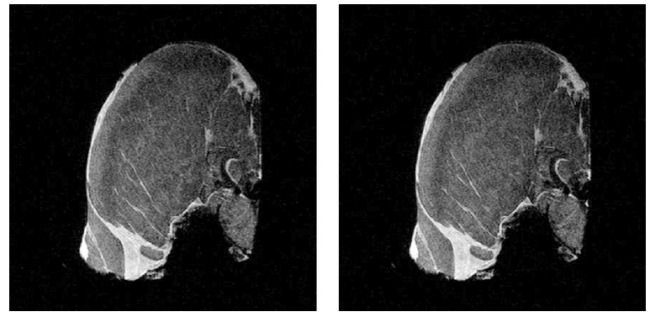
The researchers performed initial imaging tests on volunteers (with the accelerator switched off) using standard sequences for prostate, brain and kidney MRI. All images were of diagnostic quality. They then examined the simultaneous use of the MRI and accelerator systems, by performing 1.5 T MR imaging on a pork sample during irradiation. Images taken with the radiation beam on and off were identical, and no degradation of linac performance was seen.

Working towards a clinical prototype, the next step is to incorporate a multileaf collimator (MLC), which needs to be non-magnetic as it will be located outside of the system’s low-magnetic-field region. Meanwhile, constructing a gantry for accelerator rotation will facilitate treatments using an arc-therapy approach. Other plans include the development of megavoltage transparent RF coils that won’t cast a shadow in the radiation field, and determination of the optimal MR sequences for guiding radiotherapy.

The Utrecht team is currently working with equipment-makers Elekta and Philips on these tasks. “We hope to start the first clinical tests in a year’s time. Whether this involves patients remains to be seen,” Raaymakers said.

He continued: “We are currently discussing with our physicians what the best introduction scheme is. Should we start with palliative patients, start by using MRI as improved position verification or should we start with a novel strategy such as irradiation of liver metastases? This choice will determine the technical requirements such as, for instance, full gantry rotation, and the accompanying time schedule.”

Steven Chu says cutting emissions will be tough

By Hamish Johnston

The US Secretary of Energy told the BBC this morning that there is “considerable opposition” to cutting greenhouse gas emissions amongst the nation’s lawmakers. As a result, he believes it will not be possible to achieve President Obama’s goals on reducing the country’s carbon footprint.

On a bright note, the Nobel-Prize winning physicist said that the US was blessed with an abundance of sunlight — and a significant portion of its energy needs could be delivered by photovoltaic arrays in its south-western deserts.

However, he admitted that much work needs to be done before the technology is available.

You can hear the interview here, just scroll down to 0716.

Modellers predict doubly bad global warming

New findings predict that global temperature increases will be twice as high by the end of the century as previously forecast, unless international policy action is taken. That is the prediction of scientists using the Integrated Global Systems Model (IGSM), a project funded in part by the US Department of Energy.

IGSM is unique amongst climate predictors because it is underpinned by a flexible economic model that projects future changes in human activities such as trade between nations. Climate scientists at Massachusetts Institute of Technology (MIT) have used the model taking into account physical factors like the cooling effect of volcanic eruptions for the first time.

The researchers predict a 90 % probability that surface temperatures will be 3.5° to 7.4° higher by 2100, under a scenario involving no policies to specifically reduce greenhouse gas emissions. These temperature increases are more than twice those predicted under the previous version of IGSM, which was run back in 2003. The model was also run for different scenarios involving “strong” policies to curb emissions, and the temperature never rose above 2.5°, which is relatively unchanged from the 2003 prediction.

The findings are published this month in the American Meteorological Society’s Journal of Climate.

Living with uncertainty

“4° is a very, very dangerous amount of warming – that’s 8° Celsius of polar warming,” said Ronald Prinn, one of the MIT modellers speaking earlier this year at the European Geosciences Union Conference in Copenhagen.

The standard international reference for climate predictions is the SRES scenarios of the Intercontinental Panel on Climate Change (IPCC) – a body which shared the Nobel Peace Prize in 2007. However, whilst the IPCC make detailed predictions for the end of the 21st century, there is still a wide range of uncertainty within each prediction. What’s more, the IPCC scenarios are deliberately independent of policy and projected human responses.

Frustrated by the continued lack of clarity in climate change predictions, Prinn and his colleagues set out to quantify the likelihoods for specific climate outcomes. For each climate scenario, they carried out 400 runs, where each run involved slight variations in the input parameters with each set of parameters equally likely. In this way they reduced the uncertainty of both input parameters and climate responses.

The new standard?

The MIT scientists find that a business-as-usual approach to greenhouse gas emissions will result in 1400 parts per million of carbon dioxide equivalent by 2091-2100 leading to an 85 % chance of temperatures rising by more than 4°. However, in the case where carbon dioxide equivalent levels were stabilized at 552 parts per million, all 400 forecasts led to an increase of 4°. To further enhance the clarity of the results, Prinn and his colleagues conceptualize the scenarios as a game of roulette, in what they call the “climate gamble”.

The MIT researchers say that many factors contribute to the stronger warming in these latest predictions. In particular the models take into account for the first time volcanic eruptions, which helped to cool the Earth in the second half of the 20th century. They also say that a more sophisticated method for projecting growth in Gross Domestic Product (GDP) was used, which eliminated many low emission scenarios.

“Whereas the IPCC scenarios can reproduce climate histories very accurately, they don’t take into account all the uncertainties of such a complicated system,” says John Reilly, one the MIT scientists.

Richard Tol, an economist who looks at the impacts of climate change told physicsworld.com that these findings are an important development in climate modelling. “The study shows that the IPCC may have underestimated the size of the climate problem,” he said. However, he still has reservations about the economic predictions. “The model was calibrated in 2008, to data that had rapid economic growth and very energy-intensive growth at that,” he added.

Mountains on neutron stars could boost gravitational wave detection

Astrophysicists looking for gravitational waves should set their sights on mountainous neutron stars, according to a new numerical study by researchers in the US. The study also suggests that the crust of a neutron star is 10 billion times stronger than steel — and the researchers say that understanding why could lead to the development of stronger materials here on Earth

General relativity predicts that tiny ripples in the fabric of space time known as gravitational waves are created whenever a massive body is accelerated. Researchers look to space for gravitational waves because only the most massive bodies in the universe can create waves with measurable amplitudes. However, these ripples are still so faint that none has been detected to date.

One such object is a neutron star, the extremely dense core of a collapsed star in which most of the protons and neutrons inside normal matter have been forced together to form neutrons. Any irregularities — or ‘mountains’ — on the surface of a rotating neutron star will cause the star to radiate gravitational waves because the degree of curvature of space-time by a mountain changes slightly depending on whether the mountain is moving towards or away from an observer.

Are detectors sensitive enough?

Physicists are currently looking for gravitational waves using a number of enormous interferometers located around the world. However, researchers have been unsure as to whether current interferometers are sensitive enough to detect gravitational waves from neutron stars because of uncertainties in the size of their mountains.

Now Charles Horowitz of Indiana University and Kai Kadau of Los Alamos National Laboratory in New Mexico have shown that mountainous neutron stars should produce gravitational waves that are strong enough to be seen by existing experiments.

“Our results show that ongoing searches for gravitational waves may have a better chance of success than previously thought,” says Horowitz. “The detection of gravitational waves would confirm a fundamentally new prediction of Einstein’s general relativity and would almost certainly be considered for a Nobel Prize. Detecting gravitational waves from neutron stars would also tell us more about the behaviour of matter at extreme densities.”

Horowitz and Kadau have calculated precisely how high such mountains can be before they collapse under the extreme gravity of a neutron star. They used a computer program to simulate the long-range electrical forces between ions within a neutron star’s crust. These Coulomb interactions hold the crust together and therefore keep mountains in place. The ions themselves are formed from some of the protons that remain from the original star as well as some neutrons.

The physicists modelled how a neutron star’s crust deforms under shear stress. To do this they simulated multiple layers of ions interacting with thousands of their neighbours via the Coulomb force and then let the system evolve as they moved the uppermost and lowermost layers relative to one another. They found that when considering the crust as a pure single crystal the system had a breaking strain of between 0.1 and 0.15, in other words that the shape of the crust can be deformed by up to 10-15% before it breaks.

Strong enough for LIGO

They also showed that impurities, defects and grain boundaries do not reduce this breaking strain to below 0.1. Calculating the height of mountains and therefore the ellipticity that can be supported by such a breaking strain in a typical neutron star, the researchers concluded that such a star will generate gravitational waves that are strong enough to be detectable by LIGO, two pairs of interferometers located in the US.

Horowitz says that the simulation of crust breaking will also improve understanding of “magnetar giant flares”, extremely energetic gamma–ray bursts produced by neutron stars. Researchers believe that these flares result from the energy liberated when a neutron star’s magnetic field lines break the crust and then reconnect when the crust moves. “Now that we have a better understanding on how and when the crust breaks, we can improve this starquarke model to make more detailed comparisons with observations,” he adds.

In addition, Horowitz and Kadau claim that their work could lead to the development of stronger engineering materials. They point out that the enormous strength of a neutron star’s crust — some 10 billion times that of steel — is due to the very long-range Coulomb interactions between ions and the huge pressure exerted on the crust. The latter prevents the formation of voids, which might otherwise cause the material to fail. “It may be possible to design strong conventional materials with these two features,” says Horowitz.

The study is published in Physical Review Letters.

Did mineral 'antifreeze' help shape the Martian landscape?

By Hamish Johnston

Over the past few years, scientists have discovered more and more evidence that liquid water has shaped the surface of Mars.

However, there is also evidence that the average global temperature on the red planet has been well below the freezing point of water.

So how were those features formed?

Well, anyone who lives in a cold climate knows that adding salt to ice will cause it to melt at a lower temperature than pure water.

Now, an international team of scientists are saying that the same effect could be at work on Mars.

The researchers modelled the freezing and evaporation of Martian water, assuming that it contains the same minerals that had been detected by Martian landers.

They concluded that liquid could indeed flow on Mars at temperatures well below zero Celsius.

The study has just been published in Nature.

Happy World Metrology Day!

By Hamish Johnston

“A chance to celebrate measurement and precision”, that’s how the BBC’s Sarah Montague introduced an interview this morning with the National Physical Laboratory’s chief scientist John Pethica about World Metrology Day.

On this day in 1875 the “Metre Convention” was signed in Paris by 17 nations. It provides the basis for the international agreement on units of measurement that exists to this day.

While Pethica did his best to explain why we need to agree on standard units, Montague asked him if “people who like pounds and ounces should be sad today?”.

I thought it was rather silly to try to whip up controversy on World Metrology Day — and Pethica didn’t rise to the bait.

Instead he pointed out that regardless of what units are used locally, there should be a universal system of measurement.

That reminded me of the amazing Gimli Glider incident in 1983, when an Air Canada Boeing 767 ran out of fuel in mid-flight. Why? Someone forgot that the airline had just switched from measuring fuel in gallons to litres – yikes!

The crew decided to make an emergency landing on an abandoned airstrip in Manitoba. What they didn’t know is that had been converted into a dragstrip — and there was a race going on.

Amazingly no-one was seriously hurt — but now airlines take fuel metrology very seriously!

And what is NPL doing to mark World Metrology Day? It’s the formal opening of the National Measurement Office at NPL which is putting togehter a “coherent plan” for all measurements.

You can listen to the interview here — you’ll have to scroll down a bit to 0744.

Data storage enters the ‘fifth dimension’

The first DVD–sized discs with storage capacities well over one terabyte could be available in as little as five years, according to researchers in Australia who have invented a new storage technique. The concept, which the researchers have already demonstrated on test media, uses layers of gold nanorods to achieve ‘five–dimensional recording’.

Optical discs, such as CDs and DVDs, store data as a spiral track of microscopic pits etched onto their surface. To read the data, light from a laser diode is reflected from the surface and the reflected light drops in intensity every time the beam hits a pit.

With just one layer of pits the storage is two dimensional, and with multiple layers — a method employed in the highest capacity DVDs, providing capacities up to about 17 Gb (17 x 109 bytes) — the storage is three–dimensional.

More dimensions needed

To reach higher capacities, particularly above 1 Tb (1012 bytes) per disc, scientists believe they will need to be able to record in even more ‘dimensions’. In recent years there has been success in adding one extra dimension in the form of sensitivity to either the polarization or colour of the laser light, a technique called multiplexing.

Now, however, James Chon and colleagues from Swinburne University of Technology in Melbourne have combined both types of multiplexing for five–dimensional recording.

“Previously there has never been an effort to record in all five dimensions,” Chon told physicsworld.com. “This is due to a lack of material that can respond in all five-dimensional recording conditions — colour, polarization and spatial.”

Nanorods to the rescue

For its recording media the Swinburne group use gold nanorods, which respond to different colours and polarizations depending on their apparent size and orientation. When a collection of these nanorods are irradiated with laser light, only those that are aligned to the light’s polarization and have an absorption cross-section matching the light’s wavelength will absorb it, melt and change in shape. Because there are nanorods left unaffected after one recording, more recording cycles can still take place.

To read the data a laser again illuminates the nanoparticles, which begin to resonate with quasi-particles known as plasmons. The plasmon resonance is very sensitive to the incident light’s polarization and colour, and requires a laser that is only a hundredth as powerful, so no more melting takes place.

Compatible with existing technology

In tests using media with three layers of gold nanorods, Chon and colleagues achieved a data storage density of 1.1 Tbit per cubic centimetre, which would equate to 1.6 Tb for a DVD–sized disc. The researchers think that by using thinner spacers between layers the capacity could be increased to 7.2 Tb. Moreover, they say that recording speeds could be as fast as 1 Gbit/s, and the discs would be compatible with existing technology.

Chon says the group is collaborating with the electronics manufacturer Samsung to commercialize the concept, and hopes to see the first devices on sale in five years. “We have only conducted proof-of-principle experiments,” he adds. “It is our future work for this technology to be transferred to industry, where many challenges will have to be overcome.”

The work was reported in Nature.

The perfect formula for a talk

goldacre.png
Impassioned defender of scientific integrity Credit: communicatescience.com

By James Dacey

“Exhilarated but strangely depressed… without meaning to take anything from any of the previous speakers, I feel that was the best talk we’ve ever had at this Festival.”
These were the sentiments of last night’s host following Ben Goldacre’s presentation at Bristol’s Festival of Ideas.

Medical doctor by day, Goldacre is perhaps best known for his weekly Bad Science column in the Guardian in which he ridicules the mass media’s coverage of science, attacks quackery and debunks pseudoscience. Being a science reporter, I could have found certain aspects of Ben’s 70 minute tirade mildly uncomfortable, but I found myself completely agreeing with the host… it was a pitch perfect rant!

Amongst Goldacre’s many targets were the “churnalists” who simply rehash press material without checking the facts. His pet hate are the “mathematical formula” stories, which are invariably pumped out by corporate giants and invariably contain little or no scientific basis. “News editors love them” he said irreverently. Named and shamed were “the worst day of the year” sponsored by Sky Travel, and the “best day of the year”: an early summer’s day, it turns out, sponsored by Wall’s ice cream.

Had Goldacre curtailed the evening there, he may have come across as a bit of a killjoy for attacking something that is only really a bit of fun after all. However, this background provided a platform for the doctor to expose what sees as more sinister dealings, like those of a European pharmaceutical company who are currently suing Goldacre, The Guardian, and (astonishingly) Medecins Sans Frontiers, for accusations made against them.

“You know you’ve gone wrong somewhere when you wake up and realize you’re suing Meds Sans Frontiers,” Goldacre quipped.

An exceptional rant. This has really raised the bar for Michio Kaku, Freeman and George Dyson, the well-known physicists, who will be coming to Bristol to speak at the festival next week.

Copyright © 2026 by IOP Publishing Ltd and individual contributors