Beyond redshift eight

oldest1.jpg
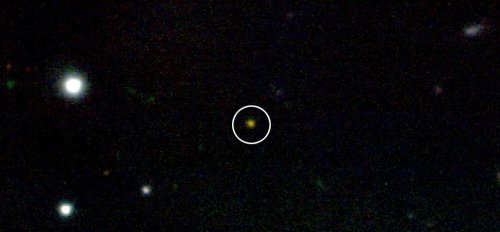
Ancient light as seen by Gemini (false colour)

By Hamish Johnston

One problem with reporting breakthroughs in astronomy is that someone is always claiming to have discovered the oldest/largest/brightest/dimmest/smallest object yet. And by the time you have written your story — someone else will claim to have done better.

That’s why my eyes rolled a bit when I read the press release “Farthest known object: New gamma-ray burst smashes cosmic distance record”, which arrived last night from the AAS.

However, upon closer inspection, this one really does look interesting.

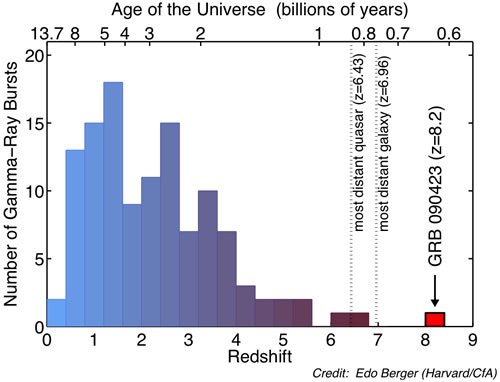
As its name suggests, GRB 090423 was discovered last Thursday and astronomers believe that the burst occurred more than 13 billion years ago — about 630 million years after the Big Bang.

That’s about 100 million years older than the previous record, which was held by a ancient galaxy.

Gamma rays from GRB 090423 were first spotted by NASA’s Swift satellite, which quickly turned its X-ray and ultraviolet instruments on the object. No visible light was seen, but Swift did manage to capture the burst’s fading X-ray afterglow.

Meanwhile here on Earth, astronomers were turning their telescopes to that patch in the sky. The Gemini North and UK Infrared telescopes in Hawaii managed to capture infrared light from the burst (above).

By analysing how much the wavelength of the light light has been red-shifted, astronomers worked out that the light has travelled over 13 billion light years before reaching Earth.

The chart below shows the age of GRB 090423 compared to other known objects.

You can read all about the search for gamma ray bursts in this article in Physics World.

oldest2.jpg
Beyond redshift eight

Glimpsing the energy future

sus energy.jpg
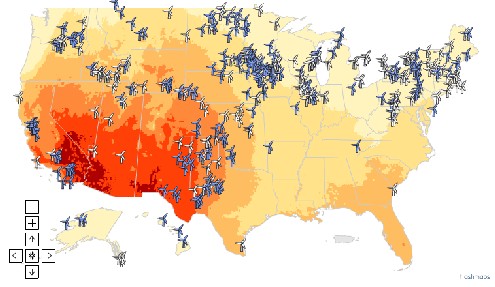
Solar power in the US: Dark red = highest potential. Pale yellow = lowest potential

By James Dacey

At the end of last week, Hamish drew attention to David MacKay – a UK physicist who is on something of a crusade to take the “hot air” out of the sustainable energy. Mackay’s approach is to explain the potential of each renewable technology option in everyday numerical concepts.

This week, in the US, a collaboration between Google Earth and the Natural Resources Defense Council (NRDC) is attempting to bring the same simplicity to the visual representation of renewable energy options.

They have launched an online interactive map of the US showing the best (and worst) regions to generate energy from the sun, wind, biomass from wood and crop waste, and biogas from animal waste at livestock and poultry farms.

“This new tool is designed to help regular people from farmers to politicians, financiers to reporters understand that renewables are here now and posed to become major players in our energy mix,” said Nathanael Greene, NRDC’s Director of Renewable Energy Policy.

Whether or not this map does have a big impact on professional stakeholders remains to be seen. Personally, I think the more important thing about the maps is their visual impact… as somebody commented on the associated blog:

“It makes a clean-energy future seem imminent, and eminently do-able”

From just glancing at the maps one thing that becomes quickly apparent is the reliance that the East may come to have on the sparsely-populated regions of the West where important sources like solar, wind and geothermal power have far more potential.

Invisibility cloaks go optical

Two independent groups of physicists claim to have demonstrated invisibility cloaks that operate for light at optical wavelengths.

Until now researchers had only been able to create invisibility cloaks for the microwave part of the spectrum. But last week Michal Lipson and colleagues at Cornell University uploaded a preprint on arXiv in which they describe the first demonstration of a cloak that can disguise objects from light in the near infrared to the far red. The following day Xiang Zhang and colleagues at the University of California at Berkeley uploaded a preprint in which they describe a cloak for just the near infrared.

Although Lipson’s group has submitted its preprint to Nature Photonics and is awaiting peer review, the work of Zhang’s group will soon be published in Nature Materials.

Rapid progress

The first invisibility cloak was demonstrated by a group at Duke University in the US in 2006. It was based on a metameterial — a manmade material with exotic electromagnetic properties — that could cause light to bend around an object in 2D like water around a stone.

But the cloak only operated over a narrow range of microwave wavelengths, and it was only at the beginning of this year that the same group managed to overcome this drawback with a broadband version.

Based on a design by John Pendry at Imperial College, London, the so–called carpet cloak used a different principle whereby a special conducting sheet appears to flatten the bulge of an object hidden underneath.It worked by reflecting light in such a way that it cancels the distortion produced by the curved surface, thus giving the illusion of a plane mirror.

The Cornell and Berkeley groups both claim to have improved on this type of cloak by fabricating metamaterials with nano-scale — as opposed to millimetre or centimetre scale — features, so that it operates over shorter wavelengths.

In the Cornell group’s device the metamaterial is an array of 50 nm–diameter silicon posts on a silicon–dioxide substrate, and the mirror is a textured pattern known as a distributed Bragg reflector (DBR). In the Berkeley group’s device, however, the metamaterial is an array of 110 nm–diameter holes in silicon dioxide, and the mirror is made from gold.

Devices are ‘very similar’

The cloaking properties of both devices substantially overlap. The California group claims their device cloaks between wavelengths of 1400 nm and 1800 nm, which is all in the near infrared. Meanwhile, the Cornell group claims their device cloaks at even shorter optical wavelengths, from 1975 nm, which is in the near infrared, to 1025 nm, which borders on the red.

The two groups could not comment to physicsworld.com about their own work because of Nature’s embargo policy. However, Lipson of Cornell said both groups’ devices are “very similar”, except that the DBR employed by her group should in principle reflect 100% of incident light.

Tomas Tyc, a theoretical physicist at Masaryk University in the Czech Republic, thinks the devices make a step towards true invisibility. “There is no doubt that the experiments are important and present very good achievements, but still are far from real full cloaking where a three–dimensional object looks like a zero-dimensional point, so it is invisible from any direction of view,” he said.

Another disadvantage with the carpet-cloak scheme is that the surface itself — that is, the “carpet” — remains visible. Early this year Tyc, together with Ulf Leonhardt of St Andrews University in the UK, put forward a cloaking scheme exploiting “curved space” geometries that is broadband and leaves no trace of a surface, but this has not yet been implemented.

The way we move and mobile phone viruses

By João Medeiros

One of the highlights of the “Science Beyond Fiction” conference in Prague was Lazlo Barabasi’s talk – “From Human Travel Patterns to Mobile Viruses”

Barabasi, author of the excellent book “Linked” , is one of the world experts on the topic of social networks.

In his talk, Barabasi presented novel insights about the science of human mobility patterns. The applications of such a study are incredibly wide-ranging, from understanding of how ideas and diseases spread, to the planning of traffic and urban spaces.

As one might guess, there is a huge element of randomness in the way we move.
Einstein, of course, was the first to theorize about random walk theory in the context of Brownian motion – the drunkard sailor paradigm (which constituted the first evidence for atoms).

The paradigm for how people move was first established by a series of studies by G.M.Vishwanathan on the mobility patterns of tagged birds and monkeys. What Vishwanathan found out was that animals do not follow the drunkard sailor pattern (ie, a Gaussian pattern) but instead follow a pattern compounded of lots of small steps with some big jumps, the so called Levy flight pattern, which is described as a power law distribution.

The first challenge in studying human mobility is how to get the data. Equipping millions of people with GPS track systems is prohibitively expensive (and probably ethically wrong).

But mobility data can be extracted from a variety of datasets which indirectly inform us of how we move.

For humans, this was first studied by Brockmann, who studied the motion of dollar bills (an explanation of their method can be found in their website whereisgeorge.com). What Brockmann found was that humans also obey the Levy flight pattern.
Barabasi also studied the mobility problem, using a mobile phone database composed of 7 million users, tracked between 2004 and 2009. His findings support the dollar bill findings.

Barabasi and collaborators (among whom is Cesar Hidalgo, who wrote a feature for PW last December) further discovered that the shape of human trajectories can be grouped into distinct categories according to typical ranges of motion, say one group for people who tend to move within a radius of 3 km, other for people who have radius of motion in the order of 100 km, etc.

What he found, was that within each category, the scaled patterns of motion are indistinguishable. This property – universality – means that all categories of human travelers can be described by one unified model.

This is important to understand many phenomena that derive from human mobility patterns. One such application is the understanding of mobile phone viruses.
Paradoxically, the first insight into the study of mobile phone viruses is to understand why mobile phone viruses are really not that relevant at the moment.

Experts estimate that there are approximately 600 varieties of mobile phone viruses. However, they exist only in smartphones, which, at the moment only detain 5% of the mobile phone marketshare.

These viruses spread in two ways. One, via Bluetooth, spreads in a manner similar to influenza, ie, related to physical proximity. The second mode of transmission is via MMS. These viruses spread in a manner akin to computer viruses and therefore have a capacity to spread non-locally.

In other words, the spread of Bluetooth virus depends on human mobility patterns, whilst MMS viruses depend on individual social networks. Understanding their modes of propagation leads us to understand their patterns of spreading. Simulations show that Bluetooth viruses may take days to reach everyone within a given region. MMS viruses, on the other hand, take only a matter of hours before reaching a maximum level of contagion. This saturation point is highly dependent on the level of market share of the smartphones.

MMS viruses are not dangerous below the level of 10% marketshare. Above that, however, we get a phase transition point and the virus can spread quickly everywhere within a matter of hours.

At the moment we are under that threshold, but when we reach that critical point, mobile phone viruses will become a serious threat to communications, especially since standard counter measures, such as anti-virus, are very difficult to install in smartphones due to the inherent memory capacity limitations on those phones.

Beyond the specific topic of mobile phone viruses, the work of Barabasi shows how mobile phones are quickly becoming a social experiment on itself, a gold mine of data in the study of social networks and human mobility patterns.


Obama outlines science vision

US President Barack Obama has pledged to increase the country’s spending on research and development to create an “Apollo era” push for research into renewable energy.

Speaking today at the 146th annual meeting of the National Academy of Sciences (NAS) in Washington DC, President Obama outlined a wide-ranging plan for science and technology including improving teaching of science in schools to reducing carbon emissions.

President Obama, who is only the fourth US president after George Bush senior, Jimmy Carter and John F Kennedy to address an annual meeting of the NAS, said that federal funding for science in the US has fallen by half in the last 25 years as a percentage of Gross Domestic Product (GDP).

Energy targets

Announcing new funding from the $787bn recovery and reinvestment bill, Obama said that he will guarantee that the US will spend at least 3% of its GDP on Research and Development (R&D) in the future. Last year, in contrast the US ploughed back 2.7% of GDP into research.

There are those who say we cannot afford to invest in science, but I fundamentally disagree. Science is as important now, than it has ever been before Barack Obama

“There are those who say we cannot afford to invest in science, but I fundamentally disagree,” Obama said. “Science is as important now, than it has ever been before.”

Obama also pledged to create an “Apollo era development” into renewable energy sources and added that energy “is our generation’s great project”. He also said this commitment could lead to a host of developments, which include making “solar cells as cheap as paint”.

Obama announced funding for the Advanced Research Projects Agency-Energy (ARPA-E) — included in the recovery and reinvestment bill — that will perform high-risk, high-reward research into energy, similar to the Defense Advanced Research Projects Agency (DARPA) that does research into military technology. He also said the US will aim to reduce carbon pollution by 80% by 2050 and double the nation’s capacity to produce renewable energy.

Challenging young people

During his 40-minute speech, Obama also said that 15–year-old Americans ranked 21st in the world league table for science education and that 60% of chemistry and physics students are taught by teachers with no formal qualification in those areas.

He pledged to increase the number of teachers in US schools who have a background in science or maths — although did not set any targets — and said US states that increase the performance of science students would be able to apply for extra federal funding. “Young people are ready to rise to the challenges of today,” Obama said, while noting that the average age of people in the control centre when Apollo 17 – the last manned lunar landing — was launched was 26.

Creating ‘green jobs’

Meanwhile, writing in this week’s edition of Science, the physicist John Holdren, who is President Obama’s science advisor, gives his top priorities for science and technology for the Obama administration.

In his editorial, Holdren, who introduced Obama at today’s meeting, says science and technology should be used to drive economic recovery as well as creating “green jobs”. He also says that the US should carry out R&D on alternative energy sources to “reduce energy imports” as well as verifying “the old and new arms control and non-proliferation agreements for national security”.

Holdren backed up his statements at the NAS meeting. “Obama wanted to bring science back into the centre of how the government thinks, what it says and what it does,“ Holdren told delegates, “and he is doing it.”

Multipolar dance could flip Earth’s magnetic field

Researchers in France have developed a new model of Earth’s magnetic field that includes a simple explanation for why it has flipped direction many times throughout Earth history.

Most geophysicists agree that the main component of Earth’s magnetic field is generated by convection currents in the molten iron of the planet’s core. This dipole field — which defines the Earth’s magnetic poles — has reversed polarity tens of thousand of times in the past. We know this because ancient field configurations are “frozen” into the rocks, as magnetic particles align with field lines.

Various theories have been put forward to explain the reversal mechanism but they are usually highly complex, where random variations in the flow of the liquid core are the main triggers.

A meeting of magnets

Now, François Pétrélis and his colleagues of the École Normale Supérieure and Institut de Physique du Globe have simplified the problem by reducing the Earth’s field to a set of basic equations, which show strong agreement with the predictions of more complicated models. They did this by focussing on the interplay between the dipole and and quadrupole components of the field.

“We are proposing that reversals result from the competition between the dipolar mode and a second, unstable, dynamo mode,” said Petrelis.

A geomagnetic field reversal takes approximately 10, 000 years — a very short period on a geological timescale — during which time, the field drops to approximately 10 percent of its normal intensity. In previous models, fluctuations in the flow of molten iron “switch off” the main dipole component and then regenerate it with the opposite polarity.

A deep-Earth salsa dance

In this new proposal, it is not the turbulent flow but a second field known as a “quadrupole” that drives the reversal. Leading up to the flipping of the poles, the dipole reduces in intensity as the quadrupole grows in strength. Once the dipole component has vanished it can start to grow again, as the quadrupole now drops in strength.

“This is a study — like a number of others — in the spirit of replacing a very complicated physical system by a highly simplified low-dimensional set of equations,” said Ulrich Christensen, a geophysicist at the Max Plank Institute for solar System Research in Germany.

Petrelis told physicsworld.com that direct measurements of the Earth’s magnetic field suggest that we are not due a reversal any time soon.

This research is published in Physical Review Letters.

Do you always unplug your phone charger?

COVER300.jpg

By Hamish Johnston

Are you feeling environmentally smug because you don’t leave your mobile-phone charger plugged in all the time?

Well I’m afraid that the physicist David MacKay wants to knock the wind out of your micro-turbine.

He says that this act of greenness is pointless because it only cuts your daily consumption of energy by less than 0.01%. That, by the way, is enough energy to run a car for about one second.

“But every little counts”, you may be thinking. That’s true, but in his book Sustainable Energy — without the hot air , the Cambridge professor argues that folks should focus on making meaningful changes like turning the thermostat down or improving their home insulation. Indeed, he managed to cut his heating gas consumption by a factor of four by doing so.

“Obsessively switching off the phone-charger is like bailing out the Titanic with a teaspoon”, he quips.

And what about roof-top micro-turbines? “An utter waste of resources”, he says. Indeed, a typical micro-turbine would, on average, generate enough electricity to power four idle phone chargers — bailing out the Titanic with a tablespoon. However, the Sun is strong enough in the UK for heating water and a roof-top system could supply about half a family’s hot water needs, he says.

MacKay was on BBC Radio 4 today explaining why we should pay more attention to exactly how much energy we consume and how that energy could be generated — in cold , hard units of kilowatt hours per day (a horrible unit, I know). You can listen to the interview here.

Also interviewed was Rebecca Willis of the UK government’s Sustainable Development Commission, who didn’t seem too impressed with MacKay’s book.

She seemed to be saying that turning sustainability into a technical debate “turns people off”.

The BBC’s Tim Harford — an economist by training — accused the Commission of promoting “style over substance” in its literature. For example, it recommends micro-turbines so that people can feel “connected” to electricity generation. After reading MacKay’s book, Harford said he felt “betrayed” by the Commission.

You can read MacKay’s entire book online here

Telescope hunts for cosmic explosions

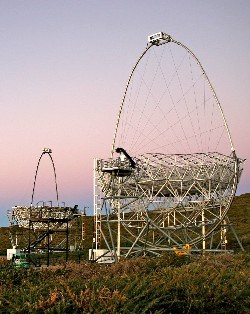
A telescope in the Canary Islands that is designed to study the most violent events in the universe is due to mark its “first light” at a ceremony tomorrow. Built at an altitude of 2200 m on the Taburiente volcano, the second Major Atmospheric Gamma Imaging Cherenkov (MAGIC-II) telescope is situated 85 m away from its predecessor MAGIC-I. A special scientific programme about the telescope’s work is taking place later today

MAGIC-II can detect the light produced when gamma rays with energies of about 25 GeV created by gamma-ray bursts, active galactic nuclei and supernova remnants interact with the Earth’s atmosphere. Known as Cerenkov radiation, these flashes of blue light occur when a charged particle travels faster than the speed of light in its medium. Studying this radiation enables physicists to detect the source of gamma rays emitted by celestial objects and thus pinpoint their locations in space.

MAGIC-II will work alongside MAGIC-I – both having 17 m diameter mirrors – but the combination of the two telescopes will be three times more sensitive than MAGIC-I alone. When a satellite such as NASA’s Fermi Gamma-ray Space Telescope detects a gamma-ray burst, it alerts a system on the ground so the telescopes can Robert Wagner, Max Planck Institute for Physics point to the emission and study the remnant Cerenkov radiation.

“In addition to being the world’s largest system of this kind, MAGIC-I and MAGIC-II can rotate within 40 s towards the point of emission,” says Masahiro Teshima, spokesperson for MAGIC-II and a director at the Max Plank Institute for Physics in Munich, Germany.

Focussing a dark art

MAGIC-I has yielded important results in high-energy physics, such as the discovery of high-energy gamma rays from quasar 3C279, which implied that the universe is more transparent to high-energy photons than expected. But one important advantage of MAGIC-II, explains Teshima, is that the system will provide a 3D reconstruction of the secondary showers produced by gamma rays in the atmosphere. This will improve the signal-to-noise ratio in observing gamma rays and allow fainter sources to be detected.

Since the facility’s threshold energy in gamma-ray detection is several times lower than its competitors – the High Energy Stereoscopic system (HESS) in Namibia and the Very Energetic Radiation Imaging Telescope Array System (VERITAS) in Southern Arizona in the US – physicists think it will make important discoveries in this range. “The greatest contribution may come in the discovery of sources at energies below 100 GeV and the facility’s excellent capabilities for rapid follow-up of gamma-ray bursts may lead to some unexpected breakthroughs,” says René Ong, VERITAS spokesperson.

About 150 scientists are expected to use MAGIC-II, many of them working in the nine countries that funded the telescope, which include Germany, Italy, Spain and the US. First results are expected in the early summer.

Metals toughen spider’s silk

Spider’s silk is already tougher than steel — but physicists in Germany have now found that it can be made even stronger by adding small quantities of metal. The discovery could help researchers understand why some biological structures containing metals — such as jaws and stingers — are so strong. It could also lead to new processes for making tougher natural and artificial materials.

Spider silk is a polymer material made of thin crystalline sheets of proteins bound together by amorphous layers of amino acids. Spiders make many different kinds of silk, but Mato Knez and colleagues at the Max Planck Institute of Microstructure Physics and Martin Luther University (both in Halle) studied “dragline” silk. This is the non-sticky stuff that spiders use to strengthen their webs and hang from.

The team began by harvesting silk from a live spider that they had caught in a nearby garden. Short silk fibres were then attached to a paperclip and dried in a vacuum chamber that the researchers normally use for atomic–layer deposition experiments.

The fibres were then exposed to a metallic vapour followed by water vapour, with the process repeated about 100 times. Between each cycle, the researchers tugged on some of the fibres, measuring the stress and strain until they broke. Stress and strain data were then used to derive the toughness of the fibres.

Eight times tougher

The experiment was repeated using vapours containing three different metals — diethylzinc; trimethlyaluminium; and titanium isopropoxide. The team found that the metal-treated silk could be as much as eight times as tough as the untreated material – with titanium appearing to have the greatest effect.

Knez and colleagues performed X–ray and nuclear magnetic resonance studies of the treated silk to try to understand where the absorbed metals were located and why they made the material tougher. In each case they found that the metals had migrated into the bulk of the fibres.

“We assume that the metal, after infiltrating the silk, binds to or crosslinks the proteins by covalent or metal coordinated bonding”, explains Knez. The team also found that the protein crystallites shrink in size after infiltration, while the amorphous regions get bigger, which Knez believes might also be related to the toughening. However, he says that a more in-depth study is required to understand these processes and tease out more details of the toughening process.

Infiltrating textiles

The team believes their processing technique, which they have dubbed multiple pulsed vapour–phase infiltration (MPI), could be use to toughen other biomaterials such including worm silk used in textiles. “It might even work with manmade materials”, he adds.

The researchers have just shown that collagen found in eggshells can be toughened using MPI — but not nearly as much as spider silk. They are currently doing similar studies of other biomaterials and polymers.

The research is published in Science.

Another eccentric physicist in the papers

invent.jpg
Tesla’s twilight years

By Hamish Johnston

You just can’t pick up the papers these days without coming across an eccentric physicist.

Now it’s Nikola Tesla, who is the hero of a book that has just been short-listed for this year’s Orange Prize for Fiction.

The Invention of Everything Else by Samantha Hunt is a fictional account of Tesla’s twilight years in New York City.

Tesla was one of the most famous inventors at the turn of the last century. He was a pioneer in wireless communications and the wireless transmission of energy. And of course, the SI unit of magnetic field strength is name after him.

He had many strange ways — apparently he only stayed in a hotel room if its number was a multiple of three — and neglected to secure the rights to many of his inventions. As a result, he lived out his later years in poverty and obscurity.

Copyright © 2026 by IOP Publishing Ltd and individual contributors