UK scientists respond positively to the annual budget

Darling.jpg
“Historic” budget

By James Dacey

Since Obama came to office, scientists in the US seem to be pretty happy with the way he is divvying up national funds.

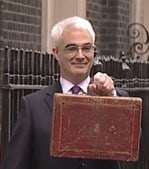
Yesterday, it was the turn of the UK Government to announce its annual spending plans as Chancellor of the Exchequer, Alistair Darling delivered the budget in Westminster.

If the morning papers are to reflect public opinion, it is fair to say that the “historic” tax increases and plans to borrow a further £348 bn over the next 2 years have gone down like a lead balloon.

“Darling’s Great Squeeze”, The Guardian
“Alistair’s living in wonderland”, Daily Mail
“They’ve ruined Britain”, The Daily Express

However, as part of the budget statement, Darling also revealed that £2.5 billion would be invested in “industries of the future”, including digital communications and biotech; £1.5 billion specifically for low carbon technologies; and the creation of a £750 million venture capital fund to help technology start-up firms prosper.

Early reactions from the scientific community have been positive.

“This is a budget that does recognise the need to invest in science and technology,” said Sir Martin Rees, President of the Royal Society.

Robert Kirby-Harris, chief executive at the Institute of Physics was also up beat:

“The Chancellor has called upon UK science to play a key role in ensuring we have a world-leading economic future. Money is being directed by the Government towards the industries which will help us to deliver on this agenda. This is commendable and we are confident that the UK science base is up to the challenge.”

Given the perilous economic conditions, it remains to be seen whether this investment will be to much or too little…

More traffic for the on-ramp

By Margaret Harris

La_city_hwys.jpg
The “On-Ramps Into Academia” programme aims to make the transition from industry to academia easier for women in science.

I saw an intriguing press release yesterday about a new programme, called “On-Ramps Into Academia”, that aims to help women who have PhDs and at least three years’ experience in industry make a transition back to an academic career. The programme’s first workshop is in Seattle, Washington this October (there’s an online application here , and applying before 15 May is encouraged), and participants can expect practical advice, networking and support from senior women researchers who have already switched to successful academic careers.

The rationale behind the workshops — which are funded by the US National Science Foundation — seems to make sense. The release quoted one of the programme’s co-investigators saying that current strategies to recruit more female scientists to work in US universities are a “zero-sum game”, because most rely on wooing them from one university to another. The new programme, by contrast, is similar to schemes in fields like law and business that aim to bring experienced women back into the workplace after extended absences (e.g. maternity leave).

Still, I had to wonder exactly what “industry” jobs would be suitable preparation for academia, and whether physicists might be at a disadvantage compared to scientists in disciplines like engineering or chemistry, where industry-academia links tend to be more widespread.

(more…)

Particulate pollution cuts carbon dioxide, model shows

Falling levels of aerosol pollution could make it much harder to curb the total amount of CO2 in the atmosphere. That is the conclusion of climate researchers in the UK and Switzerland, who have found that pollution in the form of aerosol particles gives a dramatic boost to plants’ photosynthesis.

Large amounts of aerosols have been linked previously to a period of “global dimming” from the 1950s to the 1980s, when the amount of visible sunlight reaching the Earth’s surface was fractionally reduced.

However, the new study shows that during the same period the aerosols were diffusing a lot of sunlight into shaded areas of vegetation. The result, which goes contrary to present climate models, is that more plants were able to absorb CO2 through photosynthesis and hence increase the size of the land carbon sink by almost a quarter.

This means that we are going to have to cut the [CO2] emissions even more than we thought Lina Mercado, Centre for Ecology and Hydrology

The study implies that if the levels of aerosol pollutants continue to fall, so too will some of the absorption of CO2. “This means that we are going to have to cut the [CO2] emissions even more than we thought,” says lead author Lina Mercado of the UK’s Centre for Ecology and Hydrology.

Less dimming, less photosynthesis

The global dimming of mid to late last century became recognized only a few years ago. It occurred mostly in urban and industrialized areas, which suggests its main cause was the release of sulphate aerosol particles, particularly from the unrestricted burning of sulphurous coal in the 1960s and 1970s. This is because most aerosols scatter light back into space, either from themselves or by preserving clouds, and thus reduce the total sunlight and heat on the Earth’s surface.

But aerosols also cause hazy atmospheres by diffusing light from the Sun, and this is the effect that Mercado’s group has now studied. They have modified part of a climate model used by the UK MET Office’s Hadley Centre so that it takes into account both direct and diffuse radiation on photosynthesis in shaded and sunlit areas. Then they tested the model using observations taken in broad-leaf, needle and temperate forests.

The improved model showed that, between 1960 and 1999, photosynthesis from diffuse light increased the global land carbon sink by 23.7%. The net effect, allowing for a decreased total radiation over the period, was a carbon sink increased by about 10% .

Lianhong Gu, an environmental scientist at Oak Ridge National Laboratory in the US, says he does not view the group’s findings as conclusive because computer models of clouds and aerosols on global scales tend to be subject to large uncertainties.

It highlights that climate mitigation scenarios must be evaluated from an Earth-system point of view Lianhong Gu, Oak Ridge National Laboratory

Still, he does think it is important research. “It points to the complexity of the driving forces for the terrestrial carbon cycle. It indicates that the two most uncertain factors in projecting climate change — clouds and aerosols — are more uncertain than we thought. [And] it highlights that climate mitigation scenarios must be evaluated from an Earth-system point of view,” he adds.

‘Steeper cuts required’

The study is likely to raise questions about how best to tackle climate change. Many governments have found it relatively easy to cut back on aerosol emissions — as opposed to greenhouse gas emissions — for the sake of the environment, yet present climate models only consider the negative effect aerosols have had on the land carbon sink.

Although the Mercado’s group is unable to say how much the lack of aerosols will affect total CO2 levels in the future, they do note that “steeper cuts will be required” in order to stabilize concentrations at 450 parts per million — the threshold after which many climatologists think there could be severe consequences.

Return to geoengineering?

The study might also bring certain “geoengineering” proposals back into serious scientific debate. One of most enduring proposals is that small quantities of aerosols could be purposefully injected into the atmosphere, in the same way the eruption of Mount Pinatubo in 1991 threw up vast clouds of sulphates and reduced global temperatures by about half a degree. But there are possible side-effects, such as the fact that aerosols provide surfaces on which stratospheric ozone can be destroyed.

Peter Cox, a climate modeller at the University of Exeter and co-author of the study, does not advise injecting aerosols yet. However, he says there is no reason now to think plant growth and crop yields would go down, which has been an argument against the proposal in the past. “If you were to put aerosols into the atmosphere, at least this particular concern — that is, crop yields would go down — is not something you should worry about. In fact, it would be a positive rather than a negative effect.” The results are published in the journal Nature.

Quo Vadis Quantum Information Science?

By João Medeiros

Just attended one of the best talks so far, here at the “Science beyond Fiction” conference in Prague — a really exciting, wacky and speculative talk by Artur Ekert, on quantum information science.

To Ekert, the questions that are used to “sell” quantum information science to “deciders” and funding bodies are usually of two kinds. A first argument, more scientifically motivated, sells the point that the true power of quantum computation is yet to be achieved, a computational capacity that will likely teach us much more about the fundamentals of nature. The second, more pragmatic approach, appeals to the exploration of the true fundamental limits in exploring quantum systems and what constraints they put on technology.

On the issue of framing the subject of quantum computation, Ekert says that it is really interesting how people from different cultural backgrounds react to the topic.

For instance when discussing the matter with computer scientists, Ekert uses a more philosophically inclined, logic based approach. According to him, computer scientists are naturally not really fond of atoms and messy quantum systems.

The question he asks his computer scientist collaborators is whether it is possible to construct a logic gate operating on a single bit, such that the same two consecutive operations produce a flip of the bit. Classically, of course, you cannot. But this is a possibility when using quantum systems.

Indeed, one of the fundamental differences between quantum and classical computational systems exists in the respective nature of the logical operations allowed by each system.

The bottomline realization is that information and computation are intimately linked to physics. Information is physical. This conclusion was to many computer scientists a shock and it marked the intellectual revolution that kickstarted quantum information science.

Physicists now realize that if you change the physics you change the nature of information. This has been a surprising revelation to many computer scientists, who since the work of Alan Turing have been playing with classical computer logic without a physical foundation, a logical framework which somehow worked.

INTERDISCIPLINARITY

Ekert also pointed out that quantum computation is one of the truly interdisciplinarity subjects.

Not only it has brought together mathematicians, computer scientists and physicists, but it has also brought people together within physics, scientists that beforehand would not talk to each other simply because they were using completely different jargon and codes. A common denominator was found in the language of quantum logic gates.

Ekert, who is based in Singapore, compared this situation with the way that sometimes Koreans and Chinese use to communicate: not by speaking, but via written characters.

QUANTUM SIDE OF LIFE

Ekert also mentioned that recent advances in the study of the quantum aspects of life, such as the study of the role of quantum coherence in photosynthesis, opens the door to discover quantum computation already happening in natural systems. This is a most fascinating topic that will be featured in an upcoming feature by Paul Davies for PW.

BIG QUESTIONS

The final aspect discussed by Ekert was the philosophical aspect of quantum computation, an side of science which has not been avoided by physicists. According to Ekert, quantum Information has elevated the questions about the nature of reality, randomness, complexity to the level of bona-fide scientific conundrums that should be addressed, rather than ignored.

Ekert himself is partial to question about the nature of randomness, the question of whether it is really possible to have events that have no underlying cause? What is so interesting about this question is that it essential goes against one’s understanding of science, which is intrinsically motivated by the notion of causality of phenomena in nature.

CARDANO, THE ORIGINAL WACKY QUANTUM SCIENTIST

In the next issue of PW, Ekert authors a feature about Girolamo Cardano, the “gambling scholar”. Cardano was a Renaissance mathematician which by himself discovered the basic notions of probability and complex numbers, two of the fundamental pillars of quantum theory.

In the future, Ekert will write again for PW about quantum information science.

Cycling into the light

beamline15.jpg
Fighting climate change with X-rays

By James Dacey

In the final day of my synchrotron sojourn I headed deep into the heart of the facility to meet some of the scientists hard at work.

In this dimly-lit environment, intense X-ray beamlines shoot off at tangents from the 844m electron beam as it screeches around the main storage ring – the giant polo you see from the air above Grenoble.

Researchers flock here from across the ESRF 12 member states (and beyond) to use these X-rays for probing all sorts of matter – to (hopefully) reveal new information about its fundamental properties.

Within this unusual office space, bicycle is the preferred way of getting around – as at many of the big-name particle colliders.

Highlight of the day for me was whizzing round on my red bike to beamline 15 – the most intense in the facility – to hear about the project taking place there. It had some very interesting environmental implications…

The researchers, from Germany and France, are using the X-rays to probe water-based crystal structures known as “hydrates”, which are capable of storing both hydrogen and carbon dioxide within their structures.

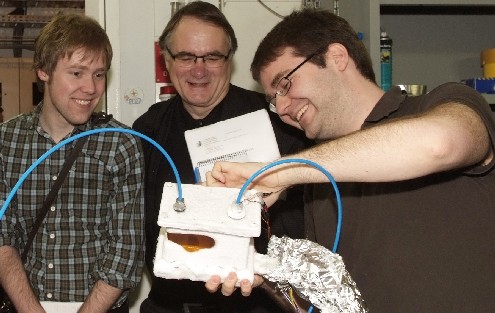
“If we can understand the chemistry and physics of how these hydrates form, this would be a great help for developing carbon sequestration technologies and feasible hydrogen-fuelled cars,” Felix Lehmkühler, one of the researchers, told me over lunch.

Since their latest publication , the researchers have been looking the effect of adding new compounds to their hydrates – the aim is to develop a structure that could store these important gases at everyday temperatures and pressures.

The good news for researchers like Lehmkühler is that the ESRF will be pouring 177 million Euros into upgrading all beamlines and research facilities over the next 6 years.

Meanwhile yesterday, over in California, the US Department of Energy were unveiling “the world’s brightest X-ray source” at the SLAC Accelerator laboratory.

“The science that will come from the LCLS will be as astounding and as unexpected as was the science that came from the lasers of a few decades ago,” said DOE Office of Science acting director, Patricia Dehmer.

With over 50 synchrotrons spread across five continents, and a road map in place to develop the first African facility, synchrotron research seems to be in a very healthy state right now!

Surely you're joking?

atomic.jpg
One too many Brits

By Hamish Johnston

One of the things that makes the British great is their love of eccentricity.

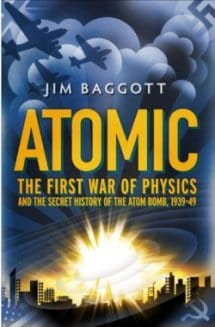
Which is why I was not particularly surprised when I came across a reference in Saturday’s Daily Telegraph to “the British physicist Richard Feynman”. The passage was in a review of Jim Baggot’s book Atomic: The First War of Physics.

Feynman was as American as they come — he was born in New York City and spent most of his career at Caltech near Los Angeles.

However, he was famously eccentric so I can understand why a Brit reading about his antics would assume Feynman is British.

I don’t think I am the only person to have spotted the error — but for some reason it has yet to be corrected in the online version

By the way, Physics World will be publishing its own review of the book shortly.

The future of science

By João Medeiros

I’m in Prague attending the European Future Technologies Conference — “Science Beyond Fiction”. It has so far been prolific in ideas and science-fictionish future promises, despite a bumpy start.

Viviane Reding, the European Commissioner for Information Society and Media, and Mirek Topolanek, the Czech PM, were the high profile names planned to open the proceedings. They were, however, conspicuous by their absence.

Topolanek, understandably, is perhaps more concerned with his political future than with the future of science right now, after losing a no-confidence motion in Parliament last month. The Czechs also presently hold the EU presidency, so the overbooking of Topolanek’s diary is understandable. One can only hope that he can multitask.

Reding, on the other hand, used cutting-edge European technology to address the delegates via a prosaic video-stream. Given that she is the Commissioner for Information Society and Media, the symbolism is laudable.

Speaking on a blue background of distorted stars and clouds dangerously resembling a psychedelic motif, Reding proposed to boost Europe´s high-risk research into future technologies by doubling the current level of funding by 2015.

“Europe must be inventive and bold – especially in times of crisis. Research seeds innovation which is key for Europe’s long-term global competitiveness. Scientific and revolutionary breakthroughs constitute enormous opportunities and we must bring the best brains together to make the most of them,” said Reding. “Combining efforts of the 27 EU countries and stepping up cooperation with global partners is essential for Europe to take the lead in future information technologies that can yield radically new solutions for European citizens in domains such as health, climate change, the ageing population, sustainable development or security.”

In other words, Europe needs catch up with the US, China and Japan.

Unlimited computing power, computers mimicking the brain, mind controlled wheelchairs and friendly robotic companions are all part of this European sized mega super project. This initiative comes in the context of the Future and Emerging Technologies (FET) programme to promote long-term and high risk research in quantum computing and communications, nanoelectronics, neuro- and bio- information science, advanced robotics and complex systems.

Some of the research that resulted from FET sponsorship is in show here at an Exhibition.

On the “friendly robotic companions” category, I saw NAO, an extremely self-conscious robot that talked non-stop whilst pushing boxes around (or in the words of the researchers involved, “learning physics”). It did not really convince me, but kudos for looking so helpless and cute.

I was also the only volunteer to test drive a simulator type head-set – immersive journalism at its best — and had to control a joystick to run over black squares on a virtual road. I’m still trying to figure out why.

The issues of high-risk research and funding of basic science, of course, were already timely featured in PW’s May issue, on the excellent article by Mark Buchanan, “In search of black swans”
Glad to see that PW is driving the European science agenda.

Highlight of the day: Anton Zeilinger’s talk on Quantum Information (more on that later)

Dark matter could come naturally from quantum gravity

A physicist in the US has calculated that dark matter — the unknown entity that makes up the vast majority of matter in the universe — could arise in a simple generalized quantum theory of gravity.

One of the most enduring problems of modern physics is that the theories of gravity and quantum mechanics do not readily mix. For over 90 years Einstein’s general theory of relativity has done a good job of describing gravity at large lengths scales, but it runs into trouble for all things very small, where quantum mechanics prevails. The trouble is in part due to the fact that quantum mechanics predicts the existence of fleeting “virtual” particles, which in Einstein’s equations cause awkward values of infinity.

Most physicists therefore believe we need a quantum theory of gravity. A basic way to explore this idea is by looking at an “effective field theory”, which describes the gravitational force as a well-defined series. In Einstein gravity the series would have just one term: a linear function of R, the curvature of space–time. However, to address quantum issues other terms can be added to the series, such as an R2 function. These higher-order terms contain other parameters, and for R2 one of those parameters is m2, where m is the mass of a new scalar particle or field.

Keep it heavy

A possible side-effect of introducing new terms is that the theory can create gravitational effects that experiments would have shown up already. Consequently theorists usually keep m heavy so that all new effects are hidden until below the so-called Planck length (roughly 10-35 m), where Einstein’s theory of gravity breaks down. Now, however, Jose Cembranos of the University of Minnesota in the US, has found that when he makes m much lighter, the particle can account for dark matter. The particle can be identified as a new graviton, and would operate at lengths of about 0.1 mm or less.

No-one yet knows what dark matter is, although explanations for it are frequently given as hypothetical particles or within modified versions of gravity. Cembranos told physicsworld.com his study is important because “it helps to get a general idea of what can be signals or observations if dark matter is related to the quantum completion of the gravitational interaction.”

“I think the R + R2 model is another interesting example of the similarity and difference of modified gravity versus ‘real’ dark matter,” says HongSheng Zhao at the University of St. Andrews in the UK. “I quite agree that it could be casted as a scalar field, which could clump. Such clumps could bend the orbits of stars like real dark matter, but it is not clear if they will bend the light as real dark matter.”

No need to mention gravity

However, Nemanja Kaloper, a physicist at the Univerity of California at Davis who studies alternative gravity theories says he is not excited about Cembranos’s study. He considers the type of effective field theory approach taken by Cembranos to be normal Einstein gravity with an extra scalar field that explains dark matter only by being fine tuned. “All this can be done without ever mentioning f(R) gravity,” he adds. “None is needed, and actually introducing it is making the story less predictive because the parameter that determines the scalar mass is not uniquely calculable but is very sensitive to the ultraviolet completion of the theory.”

The research is published in Physical Review Letters

I was expecting an 'exomoon'…

exobiggest.jpg
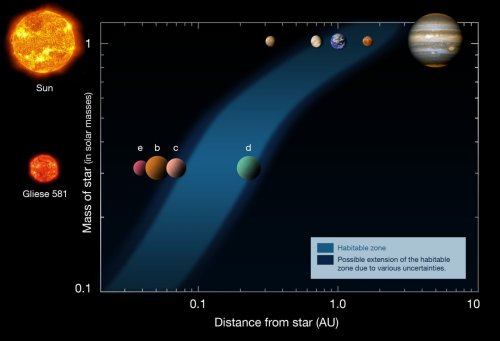
Us and them: ‘e’ is the smallest exoplanet yet and ‘d’ is in the habitable zone

By Hamish Johnston

Imagine my excitement last week when I received an email press release proclaiming:

“At 11:00 BST/12:00 CEST [21 April], a press conference will highlight a major and truly unique discovery in the field of exoplanets, made possible with ESO telescopes.”

“That’s got to be the first sighting of an exomoon”, I thought — a satellite of planet orbiting a star other that the Sun.

I now know I was jumping the gun on exomoons (more on this later) — it turns out that astronomers have found the smallest exoplanet yet, which is a mere 1.9 times more massive than Earth.

Now, I’m not trying to demean this discovery, but hundreds of exoplanets have already been discovered and this one just happens to be the smallest yet. And I’m guessing that in a few month’s time, a smaller exoplanet will be found.

Perhaps the most interesting thing about this exoplanet is that astronomers know it orbits the star Gliese 581 in the company of at least three other exoplanets.

Three of these planets (including the smallest) are too close to the star to harbour life, but the team has also revealed today that the fourth is inside the “habitable zone”, where life could exist. Indeed, at the press conference the team speculated that the planet could be home to “a large and deep ocean” and described it as the first serious “water world candidate” to be found.

(more…)

Where are the sunspots?

sunspots.jpg
The good old days

By Hamish Johnston

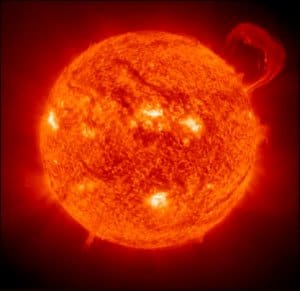
The Sun normally follows an 11-year cycle — waxing and waning in terms of its power output and the number of solar flares and sunspots at its surface.

But our star seems to be stuck in a slump — it should have hit a minimum in 2007-8 and should now be climbing rapidly to its next maximum in about 2013.

Despite a few false starts towards increased activity, the Sun is “bumping along the bottom”, according to solar physicist Mike Lockwood of Southampton University who was on BBC Radio 4 this morning.

You can listen to the interview here.

Lockwood pointed out that the power output of the sun is at a “record low”, but added that we shouldn’t expect a new ice age because solar power fluctuations are measured in hundredths of a percent.

Although solar output is expected to have some effect on Earth’s climate, Lockwood said that exactly how and why is currently a topic of debate.

(more…)

Copyright © 2026 by IOP Publishing Ltd and individual contributors