Web life: Clim’City

So what is the site about?

Like the popular SimCity computer-game series that inspired its name, Clim’City puts players in charge of a virtual city and allows them to choose how it develops. To win, players must reduce greenhouse-gas emissions by 75%, slash energy consumption by 40%, boost the share of renewable energy by 60%, and help citizens and businesses adapt to changing climate conditions – all within 50 years. The game offers a number of different ways to do this (developing wind power, insulating buildings, improving public transport, etc), but it is up to the individual player to decide which changes to implement, and in what order.

Who is behind the site?

It was launched in early 2009 by the Cap Sciences museum in Bordeaux, France. The full site is still only available in French, but the game itself has been translated (imperfectly but adequately) into English.

What is it like to play?

The main screen of Clim’City shows a model city with mountainous outskirts, a populous coastline and various structures in between. Clicking on these structures brings up menus of possible actions, along with information about their consequences. For example, at the city’s power station, you can choose to burn cleaner fuel oil or natural gas instead of coal, or to research (and then implement) carbon capture and storage. Some actions are contingent on others: you can also make the power station run on wood, but only if you have already developed the city’s biomass production facility. Each action consumes political, enterprise or citizen “points”, which represent the cost of getting different parts of the city to adopt your plans. When you run out of points, time moves forward by a year. A series of graphs lets you see your city’s chances of meeting its goals.

This is harder than it looks. Any tips?

The game provides numerical information about how long each action will take to implement, and how much energy consumption and/or emissions will fall as a result. Paying attention to these quantities – rather than simply picking actions that sound nice – will improve your final score. In addition, graphs showing how much energy/ pollution each sector of the economy is using/ producing can help players identify which areas require more action. It is also worth noting that a few actions, like reinforcing sea defences, do not reduce emissions or energy use. However, they can prevent players from losing valuable points if, say, a massive storm strikes the city later in the game.

Who is it aimed at?

With its cartoon interface and easily mastered gameplay, Clim’City looks like a kids’ game. Indeed, the French-language site contains a wealth of educational graphs, maps and interviews that are not yet available in translation; science teachers on good terms with their school’s French department might find some opportunities here for jointly taught lessons. But be warned: this game is far easier to play than it is to win, and adults as well as children will struggle to meet the demanding (some might say impossible) targets for victory.

How realistic is it?

Very – almost to the point of being discouraging. Consider the following. If you do nothing, both emissions and energy use will tick inexorably upwards, in line with current trends. Some of the most effective actions – like closing the city tip or producing hydrogen at the solar power station – are really expensive, and require action on multiple fronts. It is far easier to run out of “enterprise points” than any other type, so even when you have plenty of political will and an enthusiastic citizenry, there is still only so much change that industries can absorb each year. In fact, the game’s only unrealistic aspect may be the relative ease of meeting its target for “adaptation”; if the current furore over energy-saving light bulbs is any indication, people are far less willing to change their habits than this game assumes. Still, as a simple (and addictive) demonstration of the difficult energy choices facing the world, Clim’City is hard to beat – in more ways than one.
Fisheye gives new route to perfect images

A fisheye lens proposed over a century ago can produce perfectly focused images without using any exotic “negative refractive index” materials, a physicist in the UK has calculated.

Ulf Leonhardt of St Andrews University claims that a fisheye lens – of the type invented by the great 19th century physicist and mathematician James Clerk Maxwell – can focus beyond the troublesome diffraction limit, which precludes standard lenses from achieving a resolution finer than the wavelength of light.

Scientists thought perfect lenses were unattainable until 2000, when physicist John Pendry of Imperial College London showed that materials with a negative index of refraction – that is, those that bend light the “wrong” way – should beat the diffraction limit. But engineering such materials proved difficult, and it was only in 2005 that two groups in the US created the first “superlens” which could image features with a size just one-sixth the wavelength of light.

‘Unlimited resolution’

Now Leonhardt has shown that Maxwell’s idea, first published over 150 years ago, can give perfect images without negative refraction. “It is the waviness of light that limits the resolution of lenses,” said Leonhardt in a press statement. “Apparently, nobody had tried to calculate the imaging of light waves in Maxwell’s fisheye. The new research proves that the fisheye has unlimited resolution in principle, and, as it does not need negative refraction, it may also work in practice.”

Maxwell’s fisheye involved a refractive index profile that matches the geometry of a sphere. With this profile, light rays emitting from any direction on one point of the sphere would follow circles all the way round until they meet, perfectly, on the opposite side. Put a plane at the equator, however, and these rays would instead be mapped onto the plane’s two dimensions – rather like cartographers map the globe onto a flat sheet of paper. Again, this mapped image would in principle have perfect resolution.

Could this be done in practice? The problem, as Leonhardt points out, is that distortion inherent in the mapping would require light on one side of the sphere to travel faster than the speed of light in the vacuum – a known impossibility. A way around this, he says, would be to place a mirror around the sphere’s equator so that the rays give the illusion of travelling all the way round, when in fact they are reflected and are therefore travelling at subluminal speeds.

Slab of silica

Leonhardt describes how a researcher could make a flat, two-dimensional version of the lens. In would consist of a slab of silica with tiny air holes or silicon pillars to create the refractive index profile, with a circular mirror placed on top. Unlike a superlens, in which negative refraction tends to have the unwanted side effects of high absorption and a narrow wavelength-range of operation, the fisheye lens would have high light transmission and would work across a broad part of the electromagnetic spectrum.

There could be many applications of the fisheye lens. For example, if a researcher were to place a sliver of material with an unusual structure against the lens and shine a light through it, the sliver would act as a mask, and the lens could focus an image of the structure onto a light-sensitive surface such as a photoresist. This would enable a new breed of electronics with features at atomic resolution.

‘Work in progress’

Leonhardt told physicsworld.com that a group at Cornell University in the US is attempting to realize his design, although it is “work in progress for the time being.”

The research is published in the New Journal of Physics.

Nobel predictions

fert.jpg
Albert Fert: who will be the next winner?

By Hamish Johnston

Earlier this week I was at a Royal Society meeting on spintronics to film the latest in our series of interviews with high-profile physicists.

My first interviewee was the Nobel laureate Albert Fert, who shared the 2007 prize for his work on giant magnetoresistance. I asked Prof Fert for his predictions for this year’s prize — which will be awarded next Tuesday — and he tipped his Orsay colleague Alain Aspect.

In 1981, Aspect and colleagues were the first to demonstrate quantum entanglement at a distance — as defined by the violation of Bell’s inequality. Since then physicists including David Wineland, Peter Zoller, Juan Ignacio Cirac and Anton Zeilinger have invented ways of using entanglement as the basis of quantum cryptography and nascent quantum processors.

Indeed, Zoller and Cirac have been tipped by Thomson Reuters for the prize.

So how about Aspect plus two of Zoller, Cirac, Zeilinger or Wineland for this year’s award? But how to choose — and is it too early for a quantum-information prize, which will surely be given some day?

Another suggestion that came up in London is a prize for the 1995 discovery of the first planet orbiting a star other than the Sun. A long shot — but it would have exoplanet pioneers Michel Mayor and Didier Queloz packing their DJs for Stockholm.

What do folks around here think?

James Dacey predicts quantum cryptography — and Anton Zeilinger in particular.

Michael Banks says “Saul Perlmutter and Brian Schmidt for discovering that the expansion of the universe is accelerating. Outside bet is Andre Geim and Konstantin Novoselov for the discovery of graphene.”

“Yakir Aharanov for the Aharanov-Bohm effect and Michael Berry for the Berry phase,” says Physics World supremo Matin Durrani. “If I keep saying it often enough, it surely will happen. This year marks the 50th anniversary of the AB effect and 25 years since Berry’s paper so the timing is appropriate.”

So, what do you think?

New printing method takes a cue from nature

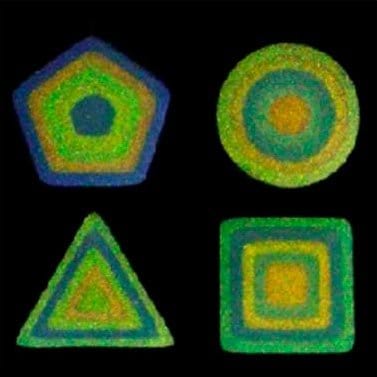
By mimicking the ‘structural colours’ found in butterfly wings and peacock feathers, researchers in South Korea and the US have developed a high-resolution patterning technique that produces multiple colours within seconds. If the technique is scaled up for commercial use, it could be used to prevent forgery and lead to the design of advanced materials, say the scientists.

“We have developed a simple, scalable way of producing structural colour,” explained Sunghoon Kwon, Seoul National University (SNU), who heads up the research. “We have overcome limitations in previous approaches to demonstrate rapid production of high-resolution patterns of multiple structural colours.”

Structural colours, such as those on butterfly wings and peacock feathers, differ from traditional pigments or dyes in that the colour results from the interaction of light with periodic structures on the surface of the material.

Cannot be mimicked or bleached

Among the advantages of structural colour are that it cannot be mimicked by chemical pigments or dyes and it is immune to photobleaching. What is more, multiple colours can be displayed using a single material simply by varying the dimension of the periodic nanostructures.

Such properties make structural colour printing attractive for a range of applications, including forgery protection and the design of new materials. To date, however, attempts to manufacture artificial structural colour have proved time-consuming. This is because they involve either the precise assembly of colloids of different sizes or the stacking and lithographic patterning of periodic dielectric materials.

Now, Kwon and colleagues at Seoul National University, working in collaboration with chemists at the University of California at Riverside, have found a way to produce a single ink of any desired colour within a few seconds. The material, dubbed “M-Ink”, changes colour when a magnetic field is applied. What is more, the colour can be rapidly locked into the material by shining patterned ultraviolet light onto its surface.

Aligning along magnetic field lines

“Under an external magnetic field, the CNCs are assembled to form chain-like periodic structures” Yadong Yin, UC Riverside

“M-Ink is a three-phase material system consisting of superparamagnetic colloidal nanocrystal clusters (CNCs), a solvation liquid and a photocurable resin,” explained UC Riverside’s Yadong Yin, an expert in nanomaterials chemistry. “Under an external magnetic field, the CNCs are assembled to form chain-like periodic structures, which align themselves along the magnetic field lines.”

In a similar way as periodic structures in conventional photonic crystal diffract light at specific wavelengths, so too do the particles that make up the CNCs. A shorter interparticle distance corresponds to a shorter diffracted wavelength. Because the this distance is determined by the applied magnetic field, the colour of the material can be altered simply by varying the magnetic field strength.

Frozen in the polymer network

Once the desired colour is obtained from M-Ink, it can be fixed by solidifying the photocurable resin through ultraviolet exposure. The chain-like CNCs are then effectively frozen in the polymer network.

“We can freeze the self-assembled photonic nanostructure fast enough to prevent distortion” Sunghoon Kwon, Seoul National University

“As our photocuring is instantaneous, we can freeze the self-assembled photonic nanostructure fast enough to prevent distortion,” commented Kwon. “This means that we retain the structural colour.”

The group hopes to commercialize the material in conjunction with companies in the electronics or material design industries.

The work is described in Nature Photonics.

Sociology of the Galaxy Zoo

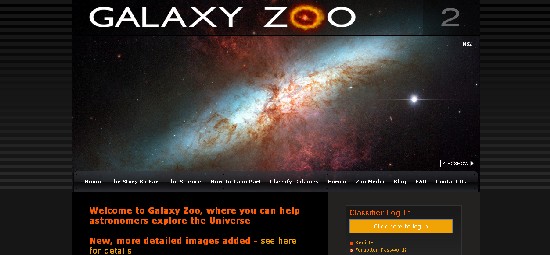
galaxy zoo.jpg
Stampede Galaxy Zoo has recruited 200 000 citizen scientists in its two year history

By James Dacey

Since its launch in 2007, the project known as Galaxy Zoo can only really be described as a roaring success. Its basic premise is that any “citizen scientist” with an internet connection can help professional scientists by classifying images of galaxies from the Sloan Digital Sky Survey.

As of April 2009, more than 200,000 volunteers had made more than 100 million galaxy classifications.

In practice the would-be “Zooites” are asked to follow a quick tutorial which describes the basic structures of spirals, ellipticals etc, before they are tested with some extra pictures. Get enough correct answers and they can join.

So what is it that attracts non-specialists to pass their spare time by sitting at a computer and classifying galaxies? This is a question explored by a group of public outreach specialists from the UK and the US, in a new paper on the arXiv preprint server.

22 Zooites volunteered themselves for an interview in which they were asked a series of questions including their impressions of the Galaxy Zoo website, their motivations for participating, and their experiences with and definition of science.

Following a series of analysis and discussions, the research team arrived at 12 motivational categories:

Contribute
Learning
Discovery
Community
Teaching
Beauty
Fun
Vastness
Helping
Zoo
Astronomy
Science

For elaboration on each category, check out the paper — it’s very “social-sciency”, but well worth a look if you’re into this kind of thing.

For more info on the purpose of the Galaxy Zoo, check out this feature written by two of the project’s founders.

Graphene works as a highly sensitive mass detector

Researchers at Columbia University in New York have made the first electrical-readout nanomechanical resonators made from graphene. The devices, which consist of vibrating sheets of graphene suspended over micron-sized trenches, could be used as highly sensitive, robust, mass detectors.

Graphene sheets are sheets of carbon that are just one atom thick. As well as having remarkable electronic properties, graphene is extremely stiff and strong. This means that the material can be made into bridge-like resonators that vibrate at very high frequencies. Because such a resonator has an extremely small mass, its resonant frequency changes each time a molecule is adsorbed onto its surface.

“Although graphene shares these advantages with carbon nanotubes, which have also been used to make highly sensitive mass detectors, it has the added bonus of being a 2D sheet that we can ‘carve’ into the shapes we want,” explained team leader James Hone. “This gives us more control over the properties of the finished resonators.”

Suspended graphene

The Columbia team made its devices by placing graphene sheets onto silicon/silica substrates, then patterning metal electrodes and etching away the silica to produce suspended graphene. The portion of each electrode that is in contact with the graphene is also suspended, which makes electrical readout easier later on.

The devices vibrate at megahertz frequencies, with a peak around 65 MHz that depends on the device geometry. The frequency can also be adjusted with a DC voltage applied to the gate, which introduces tension to the sheet. When an object is placed on the device, the frequency changes – and the change is detected with the electrodes, and used to calculate the mass of the molecule.

Sensitive to two gold atoms

“Our measurements indicate that the devices should be sensitive to around 1 zeptogram (10–21g), which is about two gold atoms, at low temperatures” Hone told our sister website nanotechweb. “They also show that the response is not as simple as expected because placing material on the graphene changes both the mass of the sheet and its tension – a new phenomenon that has never been seen before.”

The team is now experimenting with different geometries for the devices and looking at various readout techniques that will improve their performance.

The work was published in Nature Nanotechnology.

The pirate physicist

pirate.jpg
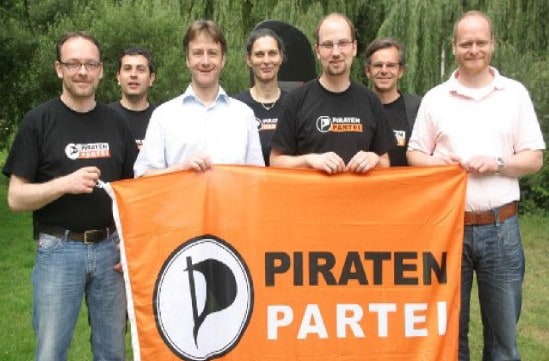
The pirate physicist: Jens Seipenbusch, third from left, with other members of the Piratenpartei

By Matin Durrani

It was all smiles for Angela Merkel in Germany’s general election as she won another term as chancellor. Her party, the Christian Democratic Union (CDU), and its Bavarian sister party the Christian Social Union (CSU), scooped 239 seats in the Bundestag — enough for Merkel to hold on to power through a new coalition with the pro-business free democrats (FDP). Her former partners, the social democrats (SPD), now face a spell in opposition.

Yes, all very interesting but what’s this got to do with physics? Well, as I’m sure you know, Merkel is one of the few political leaders to be a physicist too.

The 55-year-old Merkel studied physics at Leipzig University, in the former East Germany, between 1973 and 1978, before obtaining a PhD from the Berlin Academy of Sciences in 1986 for a thesis entitled “The calculation of speed constants of reactions of simple hydrocarbons”. She is also married to Joachim Sauer, a chemistry professor at the Humboldt University in Berlin.

Merkel’s background in physics is well known, but did you know that another German political leader is a physicist too?

Let’s say hello to Jens Seipenbusch , 40, who is founder and leader of the fringe Piratenpartei (Pirate Party), which was campaigning for increased freedom of speech, copyright reform and less intrusive government surveillance, particularly of the internet.

Seipenbusch studied physics at the University of Münster. He founded the party in 2006, serving as leader until 2007 before taking the top job again earlier this year.

I haven’t been able to find out too much about his physics career, but it appears that he was a research assistant at Münster from 1994 to 1998, having studied physics at the Ruhr University in Bochum from 1987 to 1989. From one website I stumbled upon, it looks like he used to be involved in non-linear and quantum optics.

Sadly for Jens, his party didn’t cross the 5% hurdle that you need to get seats in the Bundestag. The pirates ended up with about 2% of the vote, although they reached the giddy heights of 2.6% in Munich and 3.5% in Tübingen.

But that’s not even the end of the matter. I have been reliably informed by my wife, who is German, that the leader of the left-wing Die Linke (The Left) party, Oskar Lafontaine, is a physicist too. According to his party’s website , he has a master’s degree in physics from the universities of Bonn and Saarbrücken. His party got 76 seats from 11.9% of the vote.

It seems as if the Germans have a thing about physics political leaders.

Too good to be true?

matin 1.jpg
Who’s who of science and engineering

By Matin Durrani

This will be my last blog entry during my visit to KAUST — Saudi Arabia’s new research university, which opened on Wednesday.

The highlight of yesterday was the inaugural symposium entitled “Sustainability in a changing climate”, which is a key part of KAUST’s mission.

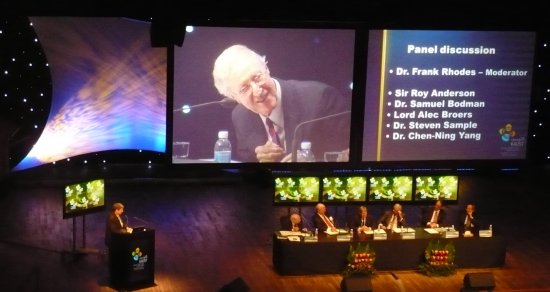
First to speak was George W Bush’s former energy secretary Samuel Bodman, who outlined four priorities for tackling climate change — increased energy efficiency, new-generation nuclear reactors, growing use of renewables and advanced biofuels, and better exploitation of fossil fuels such as clean coal.

Next up was Alec Broers, former president of the UK’s Royal Academy of Engineering, who discussed the importance of engineers in sustainability. “Scientists have sounded the alarm. Engineers need to find the solution”; he said. Mind you, he would say that — Broers trained as a physicist at the University of Melbourne before a career in engineering.

matin 2.jpg
Madly perfect?

After words from a couple of other heavyweights — Imperial College rector Sir Roy Anderson and University of Southern California president Steven Sample — on to the stage came Chen Ning Yang, the 87-year-old physicist who shared the 1957 Nobel prize with Tsung-dao Lee.

Remarkably young looking, Yang stressed the importance of basic research, pointing out how quantum theory in the early decades of the 20th century led to semiconductors, which led to transistors, which led to chips — without which computers, TV and the rest of modern life — would not exist.

Yang’s view, widely held, is that basic research leads to applied research in a linear path. Actually, things are a lot more complicated than that, but cosily ensconsed in my leather seat high up in KAUST’s vast auditorium, I kept quiet.

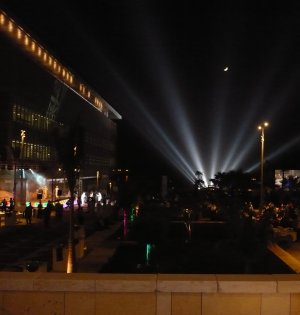
As I stepped out of the symposium into the warm evening air, the angular, university buildings were lit up beautifully and a troupe of singers could be heard singing in the main square where small tables lay with cold drinks. Guests pressed forwards to the music, and there, above the scene, as if by arrangement, was a half-crescent moon, the symbol of Islam. Like KAUST itself, the whole scene seemed madly perfect — and almost too good to be true.

Cue fireworks…

sweets.jpg
Are the KAUST celebrations getting a bit too sweet?

By Matin Durrani

I mentioned in my two blog entries yesterday that the King Abdullah University of Science and Technology (KAUST) in Saudi Arabia is not exactly short of cash – it has a $10bn endowment from the man himself.

One US physicist said he’d heard that the whole inauguration has cost $80m – flying in thousands of guests (including physics Nobel laureates Gerard ‘t Hooft and Chen Ning Yang) putting them up in the best hotels in Jeddah, and giving them all, myself included, nice little luggage tags with the KAUST logo.

A fair whack must have also gone on the fireworks that concluded the official launch party last night, which were probably enough to have kept most physics departments in business for a few years at least.

The event took place in what was dubbed “the tent” – a temporary structure about two football pitches in size with an exhibition hall, auditorium and vast dining area. Air-conditioned to the hilt, the plastic windows dripped with condensation on the outside. A troupe of drummers lined the stage as we waited for the king’s jet to land.

Once settled in his seat, there followed speeches from the likes of the minister for petroleum and KAUST’s president Choon Fong Shih, and then specially recorded films beamed onto the huge backdrop to the stage. One featured a boy on the sunlit beach, picking up stones – presumably a nod to Newton’s comment about just being like a boy on the shores of discovery – backed by rousingly cheesy music.

With the heads of state of Bahrain, Jordan, Malaysia and elsewhere — not to mention the Duke of York (aka Prince Andrew) — sitting alongside him, the King then mounted the stage, delivering a thankfully short address, which should soon be available here.

The drummers marched off stage right while the king pressed his hand into a weird tablet that shot out a puff of smoke in green-and-white Saudi colours. The back wall of the stage parted – and there, through the windows, was the university and its iconic tower lit up against the night sky

Cue fireworks.

“It’s like Disneyland” muttered one physicist later to me.

Welcome to dreamland

eastham.jpg
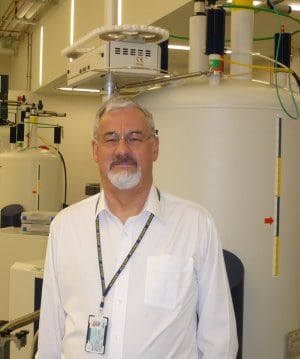
Tony Eastham shows off his new facilities

By Matin Durrani

I wrote yesterday about whether the King Abdullah University of Science and Technology (KAUST) in Saudi Arabia will attract researchers to the new venture.

One thing is clear: the facilities are second to none.

Tony Eastham, KAUST’s lab director, greeted me as I stepped off the media bus into the melting heat. First stop was the visualization “cave” — basically a white, walk-in room onto which colour images are beamed by four cinema-quality projectors. Put on a pair of goggles and the cave lets you see images of, say, protein molecules to look for possible binding sites or to view 3D fly-through of archaeological sites. Although such rooms exist elsewhere, this has apparently a better resolution than any other; it can even play sound, should you wish.

As we headed down to the nanotech facilities, Eastham, who used to be based at the Hong Kong University of Science and Technology, told me that KAUST has a whopping $1.5bn over its first five years for lab equipment. Tasty.

In one of the downstairs labs a total of 10 NMR spectrometers stood sentry, all unused so far. Then it was through a side door and down a corridor with tall doors leading off. Eastham opened one to reveal a state-of-the art electron microscope and then a second and then a third. Each boasted another microscope – five TEMs and five SEMs in all, each barely out of its packaging. Another room had a suite of confocal and Raman microscopes.

And so into the clean rooms – a total of 2000 square metres in all. All spotless so far. “KAUST,” claimed Eastham, “is the most exciting thing happening in academia anywhere in the world.”

Whether all the new toys can be used for anything useful, however, remains to be seen.

Copyright © 2026 by IOP Publishing Ltd and individual contributors