Fledgling site challenges arXiv server

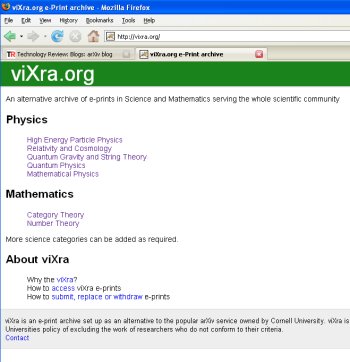
A physicist in the UK has set up a new website for sharing preprints following criticisms about the way that the popular arXiv.org preprint server is moderated. Called viXra.org, which is the reverse of arXiv, the rival server — unlike arXiv — places no restrictions on the sorts of papers that can be posted. “This is an experiment to find out what kind of stuff is not managing to get into the arXiv, as well as being a serious archive for people to put their research in,” says Philip Gibbs, an independent physicist based in the UK and creator of viXra.

Gibbs decided to set up viXra having listened to claims on blogs and the tell-all website archivefreedom.org that arXiv administrators, who are based at Cornell University in the US, unfairly reject certain manuscripts or transfer them to the server’s less reputable “general-physics” category. He claims that arXiv‘s moderation policy could mean that the site misses out on papers containing fundamental breakthroughs. “The arXiv is really trying to filter out the stuff that is not following the same line of argument that’s being followed already, [and] really you need to give people the freedom to try the approaches that they think will work,” he says.

Two-stage filtering

Cornell’s arXiv has its roots in xxx.lanl.gov, a server set up in 1991 by Paul Ginsparg, then at the Los Alamos National Laboratory, to share preprints in high-energy physics. The idea caught on fast, and by 2001, when Ginsparg moved to Cornell, the renamed server was stashing thousands of preprints in different areas of physics and maths every month. Now arXiv has over half a million preprints and is the first port of call for many physicists wanting to track the latest papers without having to wait for them to appear in conventional, peer-reviewed journals.

Librarians at Cornell use a two-stage filtering process to ensure that all the uploaded preprints are of at least “refereeable” quality. First, authors must gain the approval of a recognized endorser, who is typically someone with a prestigious academic affiliation or who has a proven track record of submissions. Second, the endorsed preprints pass under the eyes of a moderator to check that they are not nonsense and that they qualify for one of the 18 main subject categories. Of some 250 new submissions received every day, a Cornell librarian says just “a few” are rejected.

‘Blacklisting’ claims

One researcher who objects to this system is Marni Sheppeard, a theorist at Oxford University in the UK. She believes that her attempt six years ago to submit a highly speculative preprint left her “blacklisted”, which more recently barred her from uploading a serious paper, despite having a suitable endorser. Others, meanwhile, think the moderation is open to academic bias, particularly since — in the case of physics papers — it is performed by a fixed group of unnamed individuals.

For example, Columbia University mathematician Peter Woit claims there is a “pro-string-theory” bias among moderators because “trackbacks” to his entries on his blog Not Even Wrong that criticize preprints on string theory and multiverses are removed. (Trackbacks are designed to alert an author when their preprint is referenced online.) “On the trackback issue, I’ve seen a disturbing ideological bias and lack of transparency at the arXiv,” he says. At the same time, I’m quite sympathetic to the difficulties they face evaluating preprints in fields where research is often very speculative.”

Targeting the community

But Ginsparg, who now sits on arXiv‘s advisory board, denies the existence of any blacklist or system for automatically rejecting papers written by certain authors. He told Physics World that Cornell’s filtering system is only biased in the sense that it seeks “to accommodate the interests of people within the research community” and not “outsiders”. Indeed, he points out that many professional researchers think that there is already too much “garbage” on the site, while the “outsiders” think there is too little.

Tommaso Dorigo, a particle physicist at the University of Padova in Italy who has written on his blog about possible arXiv blacklisting, thinks that the Cornell moderators should always err on the side of inclusion. “The recipe is easy: if you don’t have a clear hunch, you should let it through,” he says.

But for now it looks like arXiv will not have to worry too much: as today there were just seven papers on the viXra site.

Should we 'split wood, not atoms'?

By Hamish Johnston

If you visit rural North America in the winter you might be surprised by how many homes are heated by burning wood in sophisticated “dual-fuel” central heating systems.

But is this good for the environment?

Yes — as long as the wood comes from sustainably managed woodlots, according to Paul Grogan at Queen’s University in Canada.

Writing in the Journal of Natural Resources and Life Sciences Education, Grogan and colleagues claim that a woodlot 3.5 hectares in size would provide an average household with carbon-neutral heating in perpetuity.

The reason, of course, it that carbon given off by woodburning is offset by new growth in the woodlot.

The usual objection to such biofuels is that they are derived from nasty monocultures that displace food crops. Not so in Grogan’s calculation, which is based on a woodlot of native species — so it’s good for the local ecosystem.

And in many parts of North America — particularly in the East — the amount of native woodland is actually increasing as unproductive farmland is taken out of production. So food crops are not being displaced…

…or are they?

I’m guessing that some of this farmland is going out of production because it is cheaper to grow food in say Mexico and then truck it across North America — than it is to grow the same crop 50 miles from New York City.

So, should we ‘split wood, not atoms’ as that old hippy bumper sticker says?

Michael Faraday, wagon wheels and sandpiles…

chuckwagon.jpg
Courtesy: WPCA

By Hamish Johnston

…what do they have in common?

The answer can be found it the latest issue of Physical Review Letters.

In 1831* Michael Faraday published a paper in the Journal of the Royal Institute of Chemistry about what has come to be called “the wagon wheel effect”. The most familiar example is the illusion that a spoked wheel rotates in the wrong direction as a wagon moves across the screen in a motion picture.

This effect can usually described as a simple function of the angular frequency of the wheel and the frame rate of the film. However, under certain conditions the illusion defies this simple explanation — suggesting that part of the effect is related to how our nervous system and/or brain processes flickering images.

Writing in PRL three physiologists at McGill University argue that the flickering images picked up by the eyes amount to a periodic forcing of nonlinear neural oscillations. These oscillations occur naturally in the nervous system at frequencies of 1-100Hz, whereas a movie projector usually operates at 24 frames per second — so there might be something to it.

1831 was a busy year for Faraday. He also published a paper in the Philosophical Transactions of the Royal Society that introduced “Faraday heaps” to the world. When a tray of sand is shaken up and down, a number of small heaps are formed. These combine into larger heaps and eventually the tray contains jut one large heap.

While physicists understand why the single heap is the most stable configuration — a mathematical description of the merging process had remained elusive….until now.

Writing in the same issue of PRL and international team filmed the evolution of Faraday heaps in the lab and used these data to derive a set of differential equations that describe the process.

So that’s two 178 year old mysteries solved…

*According to PRL Faraday’s wagon wheel paper was published in 1831 — but according to the Royal Society of Chemistry website, this journal only began in 1841. Another mystery to ponder!

How does SARA rank your publications?

By Hamish Johnston

How do you decide if one academic physicist is “better” than another — a tricky question that has perplexed funding agencies and hiring committees for years.

You could simply tote up how many times he/she is cited in papers by other researchers to give a measure of how an individual is contributing to the collective development of scientific knowledge.

Sounds easy enough, but the tricky bit is assessing the quality of those citations. Being name-checked by a Nobel-prize winner is presumably better than being cited by an obscure researcher, for example

It’s pretty complex stuff — so it’s not surprising that four physicists in the emerging field of complexity science have tackled the problem using “ranking algorithms developed in the context of the World Wide Web”. These are clever programs similar to those Google uses to rank a website in terms of how many other highly-ranked websites link to it.

You can read all about it in a preprint entitled Diffusion of scientific credits and the ranking of scientists by Filippo Radicchi, Santo Fortunato, Benjamin Markines and Alessandro Vespignani in Italy and Indiana.

The researchers looked at the entire Physical Review publication archive from 1893-2006 — that’s more than 400,000 papers and nearly 4 million references to other Physical Review papers.

They began by creating a “paper citation network” by looking at how one paper (call it a) cites one or more papers ( b and c say).

The team then broke the links down in terms of authors. If a has one author ( a1 ) and b has two authors( b1 and b2), then b1 and b2 would each get half a link from a1. The result is a “weighted citation network between authors” or WACN.

In order to get a measure of the impact of an individual physicist, the team devised the “science author rank algorithm” or SARA. Each author of a paper is given a “credit”, which is divided amongst all the other authors he/she has cited. These credits “diffuse” back in time — this is where the equations get a bit hairy — and the impact of an individual physicist is related to how many credits diffuse to him or her.

The team then used SARA to rate physicists. When they looked at the period 1967-1973, seven out of the top ten were Nobel laureates. The top five (Gell-Mann, Weinberg, Schwinger, Feyman and Lee) are mostly known for their work in particle physics. Philip Anderson in sixth place, is the highest condensed matter physicist in the ranking.

Fast-forward to 2003-2004 and there are only two Nobel winners in the top ten (three if you count Walter Kohn who bagged a chemistry prize in 1998). Philip Anderson took first place and Steve Weinberg is the only particle physicist in the top five — the rest are condensed matter researchers.

If you look a little further down the list you see leading lights in quantum information — Ignacio Cirac at sixth place and Peter Zoller in twelfth — a portent of things to come perhaps.

So can we conclude that leading condensed matter physicists are better than they were twenty years ago? Probably not. Remember that this study only looks at Physical Review journals, and maybe particle physicists aren’t publishing there anymore? Or maybe the citation cultures of particle and condensed matter physics have changed over the past twenty years.

Oh, and if your are wondering how SARA ranks you or your friends, just type your name in here.

Coasts confirmed as main source of Earth’s ‘hum’

Strange as it may seem, the Earth’s atmosphere rings out in a chorus of frequencies just below the reach of the human ear. Although we cannot hear these “infrasonic” waves — which have frequencies ranging from 0.01–10 Hz — we know they exist from acoustic recordings around the globe. About 10 years ago, however, researchers discovered another type of infrasonic background noise of 3–7 mHz believed to originate from the solid Earth itself.

Scientists have struggled to understand the mechanism of this intriguing phenomenon, known as the Earth’s “hum”. Now, a pair of physicists at the University of California claim to have the most convincing physical evidence yet to locate the hum’s origin. Using data from a wide-spread array of seismic recorders, Peter Bromirski and Peter Gerstoft have found the Pacific coast of Central America to be the dominate source of background noise, with the western coast of Europe acting as the main secondary supply.

The sound of silence

In the late 1990s, studies of this mysterious sound suggested that it was a direct result of fluctuations in the atmospheric pressure at the Earth’s surface. More recent work, however, suggests that the hum is caused by energy being transferred from winds in the atmosphere to the solid Earth via waves in the ocean.

Within this new view of hum, long-wavelength surface waves — known as ocean swell — act as the mediator between the sky and the sea. As the swell reaches shallower waters, a portion of its energy is then transformed by non-linear processes into infragravity (IG) waves, which have even longer wavelengths than the surface waves. Some of the energy from IG waves can then couple to the solid Earth, registering as blips at seismic recording stations around the world.

In their new paper Bromirski and Gerstoft explain how they study this phenomenon in detail by recording both infragravity wave activity and the seismic waves associated with background hum. They gathered data using the USArray EarthScope transportable array, which monitors seismic activity right across the US and its surrounding waters.

In search of the new sound

The physicists found a close relationship between the Earth’s hum, ocean waves and infragravitational waves, with coastlines being the dominant source of hum. Strong tides along the US Pacific are the biggest contributor to the hum, with the western coast of Europe being the strongest secondary contributor. The IG wave amplitudes are greatest over coastal shelves where water is relatively shallow because wave pressure decays exponentially with depth, say the researchers.

“None of the previous hum studies have included infragravity wave measurements, so that link has not been clearly demonstrated until now,” Bromirski told physicsworld.com. “Because storms generally propagate from west-to-east, long period swell energy is much higher along eastern boundaries of ocean basins, so that’s where the “dominant” hum signals are generated,” he says.

Barbara Romanowicz, a geophysicist at Berkeley Seismological Laboratory is impressed by the new work. “This study throws a much larger dataset at the problem giving a much more accurate picture of where the hum is coming from,” she says. She notes that the research does not give a complete explanation of the complex non-linear mechanism of the “Hum” generation, but believes it provides an important step in our understanding. “It strengthens the idea that we have to look for a mechanism involving interactions of ocean waves with shallow coastal seafloor,” she said.

Spahr Webb, a marine seismologist at Columbia University is less convinced by the new findings. He suspects the hum is forced by sources under most of the ocean floor and that these types of studies are biased toward detecting only the local sources. “The waves making up the hum signal are long wavelength with little attenuation so that they travel many times around the Earth before they are significantly attenuated,” he argues.

Bromirski told physicsworld.com that he is going to now develop this research by looking more closely at global hum variability and the distribution of hum source areas across the whole Earth.

This research has been published in Geophysical Research Letters.

Ultracold atom takes a quantum walk

Single atoms have been spotted doing the quantum version of the random walk by physicists in Germany. This sighting of a “quantum walk” could help in the design of quantum search algorithms, or in the understanding of the transition from the quantum, microscopic world to the classical, macroscopic world.

The random walk is a simple concept that has been used to describe many real-world systems from stock market prices to the Brownian motion of tiny particles floating on a liquid. It is usually described as a person who dictates his movements by the toss of a coin: get heads, for example, and he moves one step to the right; get tails and he takes a step to the left. After many coin tosses, the person’s position is random, but is most likely to be close to the start point.

The quantum walk was first proposed by Nobel laureate Richard Feynman and is almost the opposite of its classical cousin. After every toss, a quantum particle moves in both directions simultaneously, and adopts a “coherent superposition” of right and left. After many steps, the particle becomes blurred or “delocalized” over many different positions. However, the nature of this process means that, after more than one toss, the new superposition will overlap part of the old one, and will have the effect of either amplifying or removing that position. This is known as matter-wave interference, and means that the eventual position of the particle is most likely to be farthest away from the starting point.

True to Feynman’s proposal

Several groups have created systems that exhibit a form of quantum walk in the past, including the tunnelling of light through waveguides and the phase-space movement of trapped ions. But now Artur Widera and colleagues at the Institute for Applied Physics at the University of Bonn have realized Feynman’s original proposal — the quantum walk of a single particle with controllable states.

In their experiment, the researchers trap a single, cold caesium atom in two optical lattices that initially overlap (see figure). They begin using a laser pulse to prepare the atom in a superposition of two internal states. Next, they move the lattices in opposite directions, which makes the atom simultaneously “step” both to the right and left. When they repeat this manoeuvre, the superposition stretches over another step, but the position in the middle then contains two parts of the atom that interfere with each other.

After ten steps, the Bonn group used a high-resolution microscope to detect the fluorescence emitted by the atom, and thus cause it to settle in one position. The probability distribution of final positions built up from many experiments was anti-symmetric about the start point, which agreed with a computer model of a quantum walk. However, if the researchers destroyed the superposition at every step, the distribution reverted to the classical case — in other words, a binomial with the peak around the start point.

‘Groundbreaking results’

Tobias Schaetz, a researcher at the Max Planck Institute for Quantum Physics, also in Germany, who has previously performed studies into quantum walks, thinks the Bonn group’s results are “groundbreaking” because of the technical improvements required to access the effects of spatially delocalized atoms, and because they will help in the understanding of quantum effects in macroscopic systems.

The next step will be perhaps to implement a quantum-walk based algorithm Yaron Silberberg and Yoav Lahini, Weizmann Institute of Science

Yaron Silberberg and Yoav Lahini, who are both at Weizmann Institute of Science in Israel and who both study quantum walks, also praise the level of control demonstrated by the Bonn group. “Most importantly, this technique may enable a practical implementation of the quantum walk approach to quantum information science,” they write in an e-mail. “The next step will be perhaps to implement a quantum-walk based algorithm.”

Widera says that his group’s experiment is a proof of principle of such a quantum-walk algorithm. Moreover, he explains that it might help in the understanding of certain biological processes such as photosynthesis, which is often thought to have its high efficiency rooted in quantum mechanics. “Biomolecules are much too complicated to study this in detail,” he adds. “Our system, on the other hand, allows full control of all parameters, and could help to see if quantum walks can support such a highly efficient transport mechanism.”

This research appears in the latest edition of Science.

Nature supports science bloggers

By Hamish Johnston

More embargo-related cheek from a prestigious journal…

There is an editorial in today’s Nature about the effect that science bloggers and digital camera owners are having on the discussion of preliminary results at conferences.

You may recall the physics paparazzi incident in which conference attendees photographed slides of preliminary data from an experiment and then posted their analyses on the arXiv.

The editorial asks if it is desirable — or even practical — to stop conference goers from publicizing someone else’s preliminary results?

“Nature has made the case that blogging by researchers is good. Critical discussion of worthy results should not in principle be restricted to walls of a conference hall or even the pages of a journal”, says the editor.

But wait a minute, isn’t this the same journal that places embargoes on its papers, forbidding scientists from speaking to the public — and presumably blogging — about their work until the paper is published?

Indeed it is, and the editorial concludes that in some situations it is appropriate to ban blogging from conferences. The argument being that such closed shops would encourage the free exchange of controversial scientific ideas.

The same can’t be said about the journal’s embargo policy.

DNA sorts carbon nanotubes

Carbon nanotubes are relatively easy to grow, but sorting these tiny tubes according to their electronic properties is a time consuming and costly task. Now, however, researchers in the US have invented a way of isolating different types of nanotube by mixing them with DNA. Although the technique is currently too expensive to be commercially viable, the scientists believe that it could someday be used to create high-quality carbon nanotubes for electronics and other applications.

A single-walled carbon nanotube (SWNT) can be thought of as a sheet of carbon just one atom thick that has been rolled up into a tube with a diameter of about 1 nm. The atoms in the sheet are arranged in a hexagonal lattice and the relative orientation of the lattice to the axis of the tube — what is known as its “chirality” — dictates whether the tube is a metal or a semiconductor. Tubes that are about 1 nm in diameter have about 25 different possible chiralities.

The diverse properties of SWNTs have allowed researchers to build simple electronic devices such as transistors from these tiny tubes. Indeed, some scientists even believe that SWNTs could replace silicon in future electronic devices because they are tiny, but can still carry large amounts of current. An important challenge however, is that it has not yet proved possible to make just one type of SWNT at a time. Instead, mixtures of tubes with different chiralities have to be painstakingly sorted using expensive processes that are not commercially viable.

DNA to the rescue

Now, though, Ming Zheng and colleagues at the chemical firm Dupont have separated SWNTs by chirality by mixing them with a solution of DNA and then using a standard chemical separation process known as liquid chromatography. This technique involves sending molecules through a tube that is packed with beads. As every type of molecule reacts differently with the surface of the beads, the system can be adjusted so that one particular type of molecule travels rapidly through the tube, while the others lag behind.

The new technique involves mixing the SWNTs with a particular DNA sequence, which coats the surface of the nanotubes to form large, hybrid molecules. Zheng and colleagues found that the chromatography system could be adjusted so that hybrids containing SWNTs of a specific chirality are first through the tube — and could therefore be isolated. The DNA is then removed from the SWNTs, leaving a relatively pure sample.

SWNTs of a different chirality can be selected by using a different DNA sequence — with the team identifying a total of 12 DNA–SWNT combinations. This was not an easy task because they began with 1060 possible DNA sequences, which were winnowed down to 350 candidates using a series of chemical and structural criteria.

Chiral purity

Zheng’s team found, using an optical-absorption technique, that the chiral purity of the sorted nanotubes was between 70–90% (with an uncertainty of ±10%) depending on which chirality was targeted. When the electronic properties of one group of tubes with 90% ±10% purity were tested by using them to make field-effect transistors, 99% of them were semiconductors.

While this success rate suggests that the technique could be used commercially, Zheng told physicsworld.com that the high cost of making the DNA sequences means that it is not commercially viable. However, he believes that low-cost DNA sequences could become commercially available in the future if there is a demand from the nanoelectronics industry.

Another shortcoming of Zheng’s technique, according to Mark Hersham at Northwestern University, is that it is better at isolating semiconductor SWNTs than it is at finding metal nanotubes — something that the Dupont team says it doesn’t fully understand. “Further work is required to isolate both types equally using DNA”, says Hersham.

The research is published in the journal Nature .

Blacklisted?

vixra.jpg
The new arXiv?

By Hamish Johnston

Is the love affair with the arXiv preprint server on the wane?

In case you have never heard of it, the arXiv is a vast online repository of physics papers, most of which are uploaded before they have passed muster by peer review. It is seen by many as a shining example of how the Internet can be used to accelerate the dissemination of knowlege — and some see it as a key step in the evolution away from the traditional journal publishing model.

But not everyone is a fan of the Cornell University-based service.

Maverick blogger Tommaso Dorigo is leading a campaign to expose the alleged “blacklisting” of certain researchers, who claim that their papers are not being uploaded to the server — or being relegated to “graveyard” categories.

Oxford University’s Marni Sheppeard — who believes she may be on such a blacklist — has posted a link to an alternative to arXiv called viXra.org.

viXra has just been launched by Phil Gibbs (who I think is an independent physicist) and contains one paper — an essay entitled This Time – What a Strange Turn of Events! by Phil Gibbs.

Elsewhere in the blogosphere, David Bacon calls for more transparency in the arXiv’s editorial policies.

So, are Tommaso, Marni, Phil and David just a few dissenting voices in an otherwise happy physics community, or is the love affair with arXiv waning?

I’m sure this is a completely unrelated incident — but Bacon also asks has the arXiv been hacked?.

Thunderclouds accelerate cosmic electrons

As well as producing spectacular lightning shows, thunderclouds can also sometimes emit strange long-lasting bursts of gamma rays. Now, a group of researchers in Japan claims to have the best evidence yet that these gamma rays are produced by the clouds acting as enormous particle accelerators. The scientists reached this conclusion in the spirit of Benjamin Franklin by studying an electric storm from a mountaintop in Japan.

It has long been known that lightning strikes produce short bursts of gamma rays, but in the past few years scientists have also observed longer gamma-ray events, of up to 90 seconds, that cannot be explained by the same mechanism. Several research groups have linked these longer events with high energy electrons accelerating in the electric field of a thundercloud but there is little physical data to corroborate.

In 2007 Harafumi Tsuchiya of the Cosmic Ray Laboratory of Japan’s RIKEN research institute and colleagues set out to investigate the longer bursts experimentally. The scientists travelled to a nuclear power plant on the Japanese coast to take measurements of electromagnetic activity during a winter thunderstorm. They found — by analysing the energy distribution of the pulse — that the gamma rays do indeed originate from just a kilometre or so above the Earth’s surface.

Lightning strikes twice

With this latest research, Tsuchiya and his colleagues relocated to a Japanese mountaintop 2770 m above sea level in order to study this phenomenon in more detail. At this altitude the scientists were able to capture recordings of both photons and electrons and they say they have now confirmed the accepted theory of how gamma rays are generated.

The researchers observed cosmic electrons, which — after arriving at the Earth’s atmosphere — were accelerated to relativistic speeds in a thundercloud’s electric field. Occasionally these electrons collide with air molecules knocking off electrons which are also accelerated in the field. This can lead to a runaway or “avalanche” of electrons that can emit bremsstrahlung gamma rays if they reach relativistic speeds. “We made a simultaneous detection of gamma rays and energetic electrons arriving from thunderclouds” — the first such observation, Tsuchiya told physicsworld.com.

Researchers in the field are already excited by these new results. “This type of observation is very rare, thus any new observations further our understanding of the phenomena significantly,” said Jeremy Thomas a geophysical field researcher of the Bard High School Early College II, New York and the University of Washington.

Predicting the storms

David Smith at the University of California recognizes the historical significance of this study. “This work is extremely important to the field in that they have demonstrated that these “surges” of gamma rays have an energy spectrum that indicates they are caused by the acceleration of very energetic electrons — a phenomenon first predicted by [Nobel laureate] CTR Wilson in 1925”.

The relatively low intensity and scarcity of these prolonged gamma ray bursts means that they pose no real threat to aviation and communications. What’s more, weather forecasters could benefit from a more thorough understanding of this phenomenon. “These gamma rays may give us a tool for understanding how thunderstorms and lightning work, neither of which we understand very well,” said Joseph Dwyer a lightning researcher at the Florida Institute of Technology.

“This work is interesting because it distinguishes gamma ray bursts produced by specific lightning events from protracted electron and gamma ray production generated by thunderstorms between lightning flashes,” said Giles Harrison, an atmospheric scientist at the University of Reading, UK.

Tsuchiya and his colleagues now plan to construct a series of new detectors that measure the arrival direction of photons associated with lightning as well as thunderclouds. They will install these instruments over a wider area in order to increase the number of recorded events. “These plans would give better understanding of particle acceleration in thunderclouds and lightning,” said Tsuchiya.

This study was published in Physical Review Letters.

Copyright © 2026 by IOP Publishing Ltd and individual contributors