A one-way street called ‘Physics+Biology’

biolab.jpg
Physics of Medicine Institute in Cambridge

By Joao Medeiros

I’ve just spent the last couple of days in Cambridge for the opening of the new Physics of Medicine Institute (pictured right) at the Cavendish Laboratory. The new institute will serve as home for scientists who are essentially bilingual in biology and physics. The Grand Opening was part of the Physics of Living Matter conference, which displayed the rich variety of problems that biophysicists are trying to tackle: medical imaging, new materials for medical purposes, systems biology, the role of mechanical processes at the cellular level. This is stuff that could bring biology to the next level.

It’s interesting to notice that this Physics+Biology is only a one-way street. The physicists are bringing their quantitative tools to biology, not the other way around. Biologists are not quantitative scientists, and this, in the long run, is a recurrent problem in the field. Descriptive tools can only take you so far, and applied mathematics are fundamental to bring out the big picture on fundamental scientific questions. A biologist at the conference confessed to me that physicists are always needed when there is the impending need to renew the paradigm in biology.

(more…)

Random motion of bacteria could drive micromotors

A group of physicists in Italy believes that mobile bacteria could convert chemical energy into mechanical energy by pushing on the teeth of tiny gear wheels. The researchers used computer simulations to show that, unlike the thermal motion of inanimate particles, the chaotic movements of bacteria could be used to continuously rotate asymmetrically-shaped gears. Such micromotors could potentially be used as energy sources, they claim.

Scientists are increasingly looking to biology in order to build tiny devices. In particular, they are attempting to propel micrometre-sized structures using preassembled motors found in unicellular organisms. Recently, Yuichi Hiratsuka of the University of Tokyo and colleagues built a rotor 20 μm in diameter and rotated it using bacteria attached to its surface.

Luca Angelani, Roberto Di Leonardo and Giancarlo Ruocco of the University of Rome La Sapienza and the National Research Council, however, believe that it is not necessary to actually bind bacteria to a rotor. Instead, they claim, a suitably-designed asymmetric gear wheel can be set in motion spontaneously when it is immersed in a bath containing bacteria.

Modelling motion

To demonstrate this, Angelani’s team modelled the interaction of a collection of E coli bacteria with a saw-tooth gear (arXiv:0812.2375 ). Each E coli bacterium, just 3 μm long, contains a set of rotary motors that drive long filaments extending behind the bacterium that allow it to swim. Angelani and colleagues modelled the motion of an idealized bacterium, assuming that its motion can be impeded by a combination of tumbling, which involves reversing the motors, and direct contact with neighbouring bacteria. They ignored two minor factors — Brownian motion and flow currents induced by the swimming neighbours.

We are like mankind before the industrial revolution…In the absence of efficient micro-engines we have to resort to living organisms as power sources Roberto Di Leonardo, University of Rome La Sapienza

The team then worked out the net direction of the force imparted by the bacteria on the saw-tooth gear 50 μm in diameter. This involved balancing the force imparted by all bacteria striking the long edge of each tooth, tending to rotate the gear in a clockwise direction, with the force due to those bacteria becoming lodged against the short edge of each tooth, causing an anticlockwise rotation. The researchers showed that the net effect is an overall anticlockwise motion of about two revolutions per minute, with fluctuations in this speed as the gear rotates.

Di Leonardo says that the same result would not be obtained with an asymmetric gear immersed in a reservoir of atoms or molecules held at thermal equilibrium. What makes the difference, he says, is the self-propelled motion of the bacteria, tending to push the gear wheel rather than simply bouncing off it. Another way of looking at this, he points out, is to consider entropy. The continuous conversion of chemical energy into mechanical energy by the bacteria leads to a continuous increase in entropy within the system, and it is this rise in entropy that permits the system to violate time-inversion symmetry, in other words to evolve in a particular direction, i.e. an anticlockwise rotation. “Bacterial motions are governed by irreversible dynamical equations and they can therefore set asymmetrically shaped objects into motion,” he adds.

Modelling motion

Di Leonardo hopes that the group’s work might “stimulate discussion about the fundamentals of statistical mechanics and its extension to the non-equilibrium world of living organisms”. He also believes the research could have technological applications, by showing how bacteria could be used for material transport, propulsion and mechanical operation at the micrometre scale. And he says that bacteria might even be used as a new kind of energy source, by feeding them and then converting the resultant mechanical output. “We are like mankind before the industrial revolution, but at the microscale,” he adds. “In the absence of efficient micro-engines we have to resort to living organisms as power sources.”

The group is now looking to convert its computer simulation into experimental reality, by producing saw tooth gears and other asymmetric objects with dimensions of just a few tens of micrometres. Howard Berg, a biophysicist at Harvard University in the US, believes it is important that the group do this as their simulation could be oversimplified. “Bacteria behave in rather complex ways near surfaces,” he says. “E colitends to swim parallel to the surface along spiral paths.”

'In Our Time' tackles the physics of time

By Hamish Johnston

On Thursday mornings I drop my children off at school and walk to work listening to the BBC Radio 4 programme “In Our Time”, presented by Baron Bragg of Wigton — or Melvyn as he likes to be known.

Bragg is one of those rare intellectuals who seems completely at ease as a broadcaster and every week he somehow manages to get a panel of three academics into a lively discussion about just about anything from “St Hilda – the life and times of the Abbess of Whitby”, to “The Multiverse – the universe is not enough”.

This morning the subject was “The Physics of Time”, and the panel was Jim Al-Khalili, Professor of Theoretical Physics and Chair in the Public Engagement in Science at the University of Surrey; Monica Grady, Professor of Planetary and Space Sciences at the Open University; and Ian Stewart, Professor of Mathematics at the University of Warwick.

You can listen to the programme here and you can find an archive of all programmes here.

Top UK physics departments tumble in new assessment

Placing numerical scores on research by UK universities has always been a controversial task, and the new system of “quality profiles” used to evaluate departments in the 2008 Research Assessment Exercise (RAE) should keep number-crunchers busy through the holidays and beyond.

While previous RAEs ranked departments using single numbers on a seven-point scale, this year’s results, released on 18 December, instead give the percentage of research activity rated at each of five levels, from a “world-leading” 4* to an unclassified “below standard.” Without a single number, it is harder to distinguish RAE “winners” at a glance. However, a close examination of the physics results reveals a few surprises.

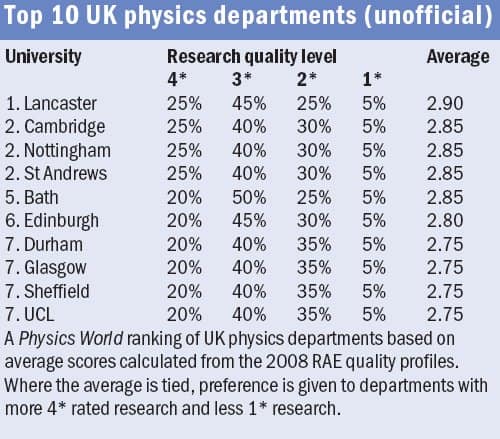
An unofficial Physics World ranking that lists departments according to their average research score shows Lancaster on top and Cambridge close behind. Both departments also received the maximum 5* rating in the last RAE in 2001, but the other 5* departments — Oxford, Southampton and Imperial College London — fell outside the top 10 this time round.

“The scores were very close, and there is not a lot of difference between the top few,” says Peter Ratoff, head of physics at Lancaster. Still, he adds, “our entire department is really pleased with the results.”

“We as a department are delighted with the outcome,” says Andrew Mackenzie, director of research in St Andrews’ physics department, which tied with Cambridge and Nottingham for the second-place average score. “Personally, I am a poignant combination of delighted and relieved”.

Missing out

Another indicator is the percentage of activity deemed “international quality,” a term that encompasses grades 2* and above. Within physics, 17 of the 42 departments — including Southampton, but not Oxford or Imperial College — demonstrated that 95% of their activity achieved this benchmark. Oxford and Imperial both produced high percentages of 4* research but also had 10% of their activity judged only “national quality.”

“It is difficult to comment on the results because there were so many variables,” says an Oxford University spokesperson. In league tables that factor in the number of academics submitted for evaluation, she noted, “Oxford physics has done extremely well.”

Switching to a more finely-graded RAE was a key recommendation of a review carried out in 2003 by physicist Gareth Roberts. Previous exercises drew criticism for creating a “cliff edge” effect, as departments that narrowly missed a particular score received much less funding from regional councils than their marginally better peers. David Eastwood, chief executive of the Higher Education Funding Council for England, which co-sponsors the RAE along with equivalent bodies in other UK regions, notes that the profile system lets members of the evaluating panels “exercise finer degrees of judgement” on research quality.

The raw data do not, however, distinguish between departments that have made improvements in research quality since the 2001 RAE, and others that may have benefited from a change in evaluation method. Jonathan Knight, head of physics at Bath University, notes that after receiving a 4* rating in 2001, his department “radically revised” their approach to research, in part by building larger groups and encouraging interaction between members. However, he adds that “we must have been a borderline case last time,” and the single-number system did not reflect that.

With such close clustering in the top third of the table, it seems the only fair way to divide funding between departments would be to make it proportionate to the number of researchers Tim Morris, University of Southampton

As for the crucial funding question, Tim Morris, head of physics and astronomy at Southampton, says that “with such close clustering in the top third of the table, it seems the only fair way to divide funding between departments would be to make it proportionate to the number of researchers”. An announcement on funding allocations based on the RAE results is not expected until March.

The task of comparing results between RAEs is complicated by the fact that the 2008 exercise was the last of its type. The RAE’s replacement, termed the Research Excellence Framework (REF), will include quantitative information like bibliometric data alongside expert opinions in evaluating research quality.


Experiment verifies Nobel-winning theory

A property of laser light first predicted in 1963 by the future Nobel laureate Roy Glauber has been verified by physicists in Italy.

Marco Bellini and colleagues from the University of Florence have shown that if one photon is removed from a beam of coherent laser light, the light remains in the same coherent state. According to Bellini, the ability to remove photons from light in this way could be used to develop quantum information and quantum metrology systems.

Despite being comprised of many photons, the output of a laser can often be described as a single quantum (or coherent) state. What Glauber did in 1963 — five years after the first laser was built — was to use quantum electrodynamics to show that the addition and subtraction of single photons from coherent light does not affect its coherence. Changing the number of photons only changes the amplitude of the beam.

Laboratory tour-de-force

Verifying this prediction in the lab has proved far from easy because it is very difficult to remove just one photon at a time from a beam. Another big problem has been actually measuring the coherence of the beam before and after the photon has been removed.

About five years ago, however, Bellini and colleagues started developing a way of removing single photons from a laser beam. In their experiments, which they report in New Journal of Physics, a relatively intense laser beam is first passed through a highly-reflective beam splitter, which deflects most of the light into a coherent reference beam.

The rest of the light travels straight through the beam splitter and emerges as relatively weak but still coherent beam. This beam is then sent through a second beam splitter, which is extremely inefficient and only occasionally diverts a photon away from the beam and into a very sensitive detector (see “One photon out”). When the detector “clicks”, the team can be fairly certain that just one photon has been removed from the beam.

Hearing a click

In their most recent study, the team then looked for any changes in the coherence of the beam by recombining it with the reference beam in an interferometer. With each successive “click”, the interferometer is used to measure a different aspect of the phase and amplitude of beam. These data are then analysed using a technique called quantum state tomography, which gives the complete quantum state of the light.

The team found that removing a photon from the light did not change its coherent state — verifying Glauber’s 1963 prediction.

In similar experiments Bellini and colleagues have worked out a way to add a single photon to a coherent state and have confirmed another pillar of quantum optics called “noncommutivity” — that removing a photon from a coherent state and then adding a photon is not the same as adding a photon and then removing a photon.

As a result, the team has assembled a “toolbox” for quantum optics that includes the “creation” and “annihilation” operators that add and remove photons, as well as establishing the noncommutivity of these operators. They have also shown that a coherent state is an “eigenstate” of the annihilation operator by showing that the state is not altered by the removal of a photon.

Bellini told physicsworld.com that these tools should allow physicists to engineer quantum-optical states that are optimized for a range of applications such as measuring very small changes in distance or the secure transmission of quantum information.

Physics exams go from the lab to the real world

By Hamish Johnston

Anyone who has lived in the UK for more than a few months knows that the British are obsessed with exams.

Indeed, this morning one of the lead items on the news was the resignation of “exam watchdog chief” Ken Boston (yes, the UK has an exam watchdog!) over the chaos that ensued earlier this year when many national tests called Sats were incorrectly marked and the results returned late.

A common theme in the discussion of exams is the “dumbing down” of the tests that some allege has occurred over the years — an allegation that often comes across as a variant of the familiar “youngsters have it so easy today”.

Now Cambridge Assessment, a firm that was set up 150 years ago to administer exams, has shed some light on this crucial national debate by releasing a study of physics exams for 16-year olds from 1867 to 2007.

Interestingly, there actually was no “physics” paper before 1927 — up until then a candidate’s knowledge of physics was covered in tests on topics such as “natural philosophy” and “mechanics”.

I wonder if the new topic “physics” was greeted with the same derision that “media studies” garners today?

(more…)

‘Uncontrollable’ nuclei sharpen up MRI

Researchers in France and the US have solved an important mystery surrounding magnetic resonance imaging (MRI). The team claims that the breakthrough, which explains why some MR images turn-out better than predicted by theory, could also lead to new imaging techniques.

MRI works by “flipping” the direction of nuclear magnetic moments using a sequence of radio pulses and watching as the moments relax to their equilibrium positions. According to theory, this flipping must be done in a controlled manner to ensure that the nuclei relax in an ordered way — resulting in a high-quality image. However, many control sequences that should not work in theory actually result in perfectly good images.

While this apparent good fortune has not overly concerned the MRI community, it has left some researchers wondering if the theory could be overhauled. Now, Philip Grandinetti of Ohio State University and colleagues at University of Orleans/CNRS and the University of Lyon in France have come up an alternative mathematical framework for describing the nuclei’s behaviour while being flipped (J. Chem. Phys. 129 204110).

Spinning around

A MRI scans involves applying a strong magnetic field to a sample, which aligns its nuclear magnetic moments in a specific direction. Then a sequence of radio-frequency pulses is applied flip the moments so they point in the opposite direction. The way in which the nuclei return to their equilibrium positions depends on their local environment — and this can be used to create an image of tissue or other material.

It was just a matter of finding the right mathematical framework to follow the process as it goes along this superadiabatic trajectory Philip Grandinetti, Ohio State University

Inversion is usually performed adiabatically, a method that “locks” the moments and drags them into the flipped state. The speed of the adiabatic process is critical. Too slow and signal will be lost — too quickly and the magnetization spirals out of control, compromising the desired inversion.

What had puzzled researchers was how it was possible to carry out perfectly good adiabatic inversions at speeds that theory said was too fast. The reason, according to Grandinetti and colleagues, is that when the nuclei appeared to be uncontrollable they were still under control but behaving superadiabatically. This means that instead of guiding the moments in one orderly movement from one orientation to another, the moments take a much more indirect (and seemingly more disorderly) route but still end up at the right destination. “It was just a matter of finding the right mathematical framework to follow the process as it goes along this superadiabatic trajectory,” he explained.

Less than perfect magnets

This new mathematical framework should help researchers develop even faster adiabatic inversion processes, thus boosting the MRI signal and improving image contrast. The revised theory could also be used to generate clinical-quality images in situations where the magnetic field is weaker or less homogeneous. One area of interest is stray field imaging, that is, performing MRI scans outside the magnet. Another possible application is the development of portable MRI systems, using magnets that are less “perfect” than those needed for existing clinical scanners.

“With this concept of superadiabaticity, we may be able to have better control and be able to manipulate the system in such a way that we can compensate for field inhomogeneities,” Grandinetti said.

Put to good use?

The team has no immediate plans to pursue any practical applications themselves. However, the revised theoretical framework could be put to good use immediately. Many MRI systems will indicate on a display panel if a programmed inversion process will not work well. This allows operators to alter the parameters accordingly before beginning imaging. These predictions of inversion success do not account for superadiabatic behaviour, and time can be wasted “fixing” perfectly good pulse sequences.

“If the companies did implement this, they could reduce the amount of time it takes for operators to optimize these processes. At the moment operators are guessing blind and saying: ‘I know I could do this faster than what the instrument is telling me.’ Now we understand why, we could fix that software,” Grandinetti said.

Michigan State will host rare isotope facility

The US Department of Energy (DOE) has chosen Michigan State University to build a Facility for Rare Isotope Beams (FRIB), which will generate isotopes that are only known to exist in exploding supernovae. The facility, expected to be completed within ten years at an estimated cost of $550 million, will provide insights into the forces between protons and neutrons — and could lead to applications in materials science and medicine.

Michigan State (MSU) won the contract against tough competition from the Argonne National Laboratory. A panel of academic and government experts appraised both institutions’ proposals. “Both applicants fully addressed all aspects of the rated criteria, and demonstrated a very good understanding of the major issues,” a DOE statement noted. “However, MSU’s application provided the strongest proposed budget that was reasonable and realistic.”

One key factor in the choice was the university’s offer to share in some of the costs of the project, thereby giving taxpayers some financial relief. “We’re very excited for the science,” Michigan State’s associate director of research Brad Sherrill told physicsworld.com. “It will be a challenge but we’re up to it.”

Researchers will hit the ground running

The facility will become part of MSU’s National Superconducting Cyclotron Laboratory (NSCL), whose head, Claus Konrad Gelbke, will take charge of the project. FRIB will be based on a high-intensity heavy-ion linear accelerator that will give scientists the ability to experiment with fast, stopped, and reaccelerated beams. NSCL will continue to operate during FRIB’s construction.

I’m so thrilled that a decision has been finally made, the community has been working for 19 years to get this Rick Casten, Yale University

By 2010, it will receive a scheduled upgrade that will include a new low-energy linear accelerator for beams of rare isotopes. “The research community will hit the ground running when FRIB turns on without missing a beat,” Gelbke said.” According to DOE, the completed facility will provide research opportunities for about 1000 scientists and graduate students.

Not surprisingly, Argonne lamented the choice. “We are disappointed in the decision not to site FRIB here,” the lab said in a statement. “Argonne has been a pioneer in accelerator physics for decades and much of the science for FRIB was developed at the laboratory.” However, the overall physics community welcomed the fact that DOE decided to award the contract after several years of vacillation. “I’m so thrilled that a decision has been finally made,” said Yale University physicist Rick Casten. “The community has been working for 19 years to get this.”

However, DOE’s current budget does not include a provision for FRIB because Congress failed to agree on a budget for the current financial year, which began on 1 October. But, the fact that the DOE has made the announcement indicates confidence that FRIB will receive the necessary financing.

Spinning drops could model black holes

Water droplets with two or three lobes have been made by physicists in the UK, who levitated and spun the liquid using a giant magnet. The experiment could help physicists gain a better understanding of rapidly-spinning nuclei, Kuiper belt objects and even black holes.

Surface tension is what makes a free-floating droplet of liquid form a spherical shape. However, when rotated the same drop will become distorted as centrifugal forces tend to pull it apart — resulting in a bulge along the equator and flattening at the poles.

The drop will become more and more oblate as its speed of rotation increases, until it reaches a point where the competition between surface tension and centrifugal forces causes its axially-symmetric shape to become unstable and it transforms into a two-lobed, or peanut-shaped, object. Further increases in rotation speed should then add a third lobe, and, beyond that, four lobes. Eventually, the droplet ought to become doughnut shaped.

More than a century ago the Belgian physicist Joseph-Antoine-Ferdinand Plateau tried to simulate fast-spinning planets and stars using spinning droplets. He reasoned that the cohesive force of gravity in such massive objects might act like the surface tension of a free-floating liquid droplet. He placed a droplet of olive oil in a mixture of water and alcohol with exactly the same density as the oil, thereby suspending the droplet. Then, by rotating the droplet to increasing angular velocities using a spinning shaft, he observed that the drop became ellipsoid and then twin-lobed.

Our experiment in the lab is on a human scale, you can see the droplet with the naked eye and you can poke it Richard Hill, Nottingham University

Although elegant, Plateau’s experiment has proven difficult to compare with theory because of the effects of drag by the surrounding liquid. More recently, physicists have tried to avoid this problem by levitating droplets in air using sound waves — creating three-lobed droplets that were very unstable. Experiments carried out in orbiting spacecraft, on the other hand, have succeeded in producing two-lobed but not three-lobed droplets.

Diamagnetic levitation

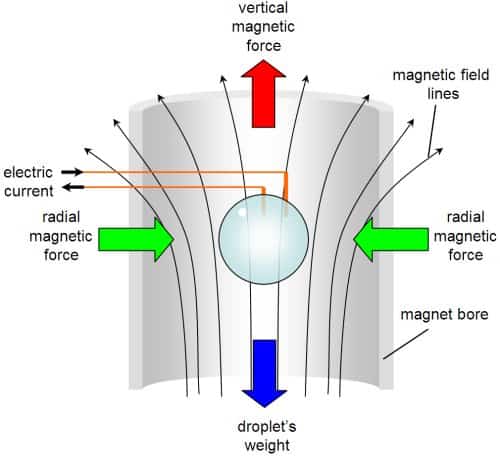
Now, Richard Hill and Laurence Eaves of Nottingham University have generated stable three-lobed water droplets here on Earth using diamagnetic levitation. They placed droplets inside the vertical bore of a 16.5 Tesla superconducting magnet with a field that decreases rapidly from the centre of the superconducting solenoid.

Their technique exploits the fact that water is diamagnetic, which means that when placed in a powerful and spatially-varying magnetic field droplets will be repelled from the high magnetic field generated by the solenoid, which in this case causes them to levitate. The droplets also had a pair of parallel, thin electrodes inserted into them in such a way that the magnetic force on the current passing between the electrodes exerted a torque on the droplets, which set them spinning (Phys. Rev. Lett. 101 234501).

The physicists watched as the droplets becoming ellipsoid and then peanut shaped. They were also able to use one of the electrodes to set up a travelling wave in motion around droplets that had a certain size and surface tension. This wave hindered the formation of two-lobed structures but acts to stabilize a three-lobed droplet, which would otherwise collapse almost instantaneously into the two-lobed variety.

Hill admits he doesn’t fully understand how the wave has this stabilizing effect, but points out that the rotation speed at which he initiated two- and three-lobed structures very closely matched theoretical predictions. He believes that the research could lead to breakthroughs in other areas of physics, noting that nuclear physicists used the liquid-drop model to describe the nucleus and that astrophysicists have recently observed rapidly spinning objects in the Kuiper belt that are likely to be ellipsoidal. “Our experiment in the lab is on a human scale, you can see the droplet with the naked eye and you can poke it,” he told physicsworld.com, adding “But we can use it to gain new insights into exotic objects on much smaller or larger scales.”

Three-lobed black hole?

In particular, this new research might prove particularly well suited to studying black holes, since cosmologists believe that a black hole’s event horizon acts as if it had a surface tension. Vitor Cardoso, a physicist at the Technical University of Lisbon in Portugal and the University of Mississippi in the US says that while black holes are not believed to form multi-lobed structures in our normal four dimensions of space time they may do so in higher dimensions. “People working in string theory and general relativity are looking to see if somewhere in their equations there is a solution describing a two- or three-lobed black hole,” he says.

Nobel laureate goes to Washington?

UPDATE: Barack Obama announced Chu’s nomination on 15 December.

The Nobel-prize-winning physicist Steven Chu will be Barack Obama’s nomination for Secretary of the Department of Energy (DOE), according to reports from the US President-elect’s transition team.

Chu, 60, is currently the director of the Lawrence Berkeley National Laboratory in California and professor of biophysics at University of California, Berkeley. If his nomination is confirmed by the US senate next year, Chu would be the first working scientist to run the DOE, which has a budget of about $25bn and is one of the largest sources of funding of scientific research in the US. Since 2005, the department has been headed by Samuel Bodman, a former professor of chemical engineering who spent many years as a venture capitalist before joining the DOE.

Unlike some in the outgoing Bush administration, Chu is a firm believer that humans are damaging the Earth’s climate. Indeed, he believes that climate change scenarios laid out in 2007 by the Intergovernmental Panel on Climate Change may be on the conservative side.

Science for a better environment

Chu also believes that science can play an important role in reducing emissions of greenhouse gases. He has been involved in the Berkeley-based Energy Biosciences Institute — a $500m facility, sponsored by oil giant BP, that aims to develop new energy sources from biomass, including biofuels.

Born in St Louis, Missouri, Chu did a PhD in physics at Berkeley and shared the 1997 Nobel Prize in Physics with Claude Cohen-Tannoudji and William Phillips “for development of methods to cool and trap atoms with laser light” — an accomplishment that has led to a renaissance in the study of the quantum mechanics of many-body systems.

In an interview with Physics World magazine earlier this year, Chu expressed his conviction that scientists could work together to save the environment: “Just as in the Second World War, when there were scientists who worked on radar or the bomb because they felt there was an emergency, so there are scientists today who want to work on the energy problem”.

Copyright © 2026 by IOP Publishing Ltd and individual contributors