Quantum dot liquid scintillator could revolutionize neutrino detection

Neutrino detectors contain up to tens of thousands of tonnes of liquid scintillator that emits a flash of light whenever it interacts with a neutrino. Such scintillators are typically organic compounds dissolved in organic solvents, so are toxic and highly flammable. By contrast, the water-based quantum dot liquid scintillator developed by a team headed up at King’s College London (KCL) in the UK, is non-toxic and non-flammable – making it less hazardous to work with, as well as more environmentally friendly.

Quantum dots (QDs) are tiny semiconductor crystals that confine electrons and behave like artificial atoms when absorbing and emitting light. The new scintillator contains commercially available 6.4 nm-diameter QDs – optimized to emit the blue light wavelengths preferentially detected by particle physics photon sensors – which the researchers dissolved in the organic solvent toluene before mixing with water and a stabilizing agent of oleic acid molecules.

This mixture was then “agitated to create an emulsion, similar to shaking a bottle of salad dressing to mix oil and vinegar,” explains Aliaksandra Rakovich, who co-led the research along with Teppei Katori. Finally, after settling, the water and oil phases separated and the water phase – now containing the QDs – was further diluted with water to reach the correct concentration for detecting particles such as neutrinos.

As detailed in their recent Journal of Instrumentation paper, the researchers measured the light emitted from a small sample of their liquid scintillator while cosmic rays (atmospheric muons) passed through it. This revealed a high scintillation yield, comparable to that from existing scintillators. The absorbance and emission spectra also remained stable over two years: an essential quality for neutrino experiments, which typically take several years to acquire data.

“The potential for our new scintillator is huge because quantum dots can have so many different types of core and different sizes, so you can choose all kinds of absorption and emission spectra,” says Katori, whose current work includes helping to design the Japan-based international Hyper-Kamiokande neutrino experiment due to start operating in 2027.

Katori hopes that within 5–10 years the new scintillator could not only replace those used in large-scale detectors for dark matter, neutrons or neutrinos, but could also form the basis for desktop-sized generic radiation sensors. It could also help monitor the neutrino spectrum close to the reactor core in nuclear power facilities: this spectrum alters if plutonium is being illegally extracted.

Next, the researchers aim to “develop methods for large-scale synthesis of QDs directly in water”, says Rakovich, adding that this will include removing cadmium and other toxic elements to “reduce the ecological footprint even further”. They also intend to carry out quantitative testing and optimization of stability, safety and performance in increasingly larger samples of their scintillator while under neutrino bombardment over long time scales.

Alex Himmel, a scientist at Fermilab in the USA, who was not involved in the research study, says that he finds this new scintillator promising. “For some time there has been substantial interest in making water-based liquid scintillators which have advantages in terms of safety and cost,” explains Himmel, who is co-spokesperson for Fermilab’s NOvA neutrino experiment, which currently uses an organic liquid scintillator.

“Safety is always a top concern when building particle physics experiments, both for the obvious reason that we don’t want anyone to get hurt, and because potentially dangerous materials typically require costly safety measures,” says Himmel. “If the materials themselves are less hazardous, it makes the experiments easier and cheaper to build and operate.”

Himmel says that the KCL researchers “estimate 4000 photons per MeV from their test sample”, noting that “our experiment operates today at similar light yields”. But he cautions that for this new liquid scintillator to be adopted by end-users it must “be produced cost-effectively at large scales and show a light yield that is stable over time”.

How ‘pop Newton’ can help inspire the next generation

The top two physics books on Goodreads are Stephen Hawking’s A Brief History of Time and Brian Greene’s The Elegant Universe. Both tomes focus on the quest for a “theory of everything” – physics so advanced it is not yet discovered. Much of the “shop window” of popular physics in bookshops is filled with ideas whose bewildering complexity underwrites their allure – strings, extra dimensions or multiverse cosmology. This is in contrast to music or art, where the classics tend to be more popular than avant-garde compositions.

For teachers and communicators of physics, it is easy to key into this fascination for novel ideas. After all, students are often more attracted to quantum mechanics than thermodynamics. Yet while relativity and quantum mechanics are classed as “modern physics” they are anything but. The decadus mirabilis in which quantum mechanics bloomed is a century old. The work of Erwin Schrödinger and Werner Heisenberg is now closer to Faraday’s discovery of electromagnetic induction than to the present day.

In the classroom, physics often gives far more space than other sciences to centuries-old ideas. As physicists, we know that new developments largely embrace and extend existing ideas. Indeed, about a third of most undergraduate first-year physics textbooks – statics, dynamics, circular motion and waves – are firmly “Newtonian”. But with a focus on new ideas, it can be a struggle to maintain students’ interest for the full depth of physics’ repertoire.

This need to make physics more appealing for newcomers was on our minds when we recently refreshed the University of Auckland’s physics curriculum. Beyond revamping the delivery of core material, we also challenged ourselves to create a “pop Newton” course that presents physics as a coherent whole and is open to any undergraduate, not just physics students.

The course treads similar ground to the well-known book – and widely taught course – Physics For Poets by Robert March, which is a breezy survey from Newton through to the Standard Model of particle physics, using only simple algebra. However, simply passing high-school algebra does not guarantee the fluency needed to draw insight from algebraic arguments.

Instead, we decided to work with metaphor and visualization, as happens already, for example, when describing black-hole mergers in an introductory astronomy course. There are many strategies to explain the nature of space–time without resorting to tensor calculus. Yet the simplicity of Newtonian mechanics seems to have prevented the development of similar explanatory tools when it comes to more everyday physics.

This was not so much physics for poets as it was physics via poetry.

From Newton to the LHC

Our approach began with two-body interactions on toy air-hockey tables. Students videoed collisions between plastic pucks and replicated them in a pre-programmed Javascript simulator that runs in a web browser. We explained that the simulator implemented Newton’s laws: nothing changes how it is moving unless it is pushed; the more you push the bigger the change, but the bigger the object the smaller the change; and if you push on something, it pushes back.

This exercise opened the door to discussions on a huge range of phenomena without using algebra, much less calculus. For example, does neutron decay make sense if it leaves only an electron and a proton? (Answer: it doesn’t.) Students could put many particles into the simulator and watch as their speeds take on the Maxwell–Boltzman distribution, showing the genesis of statistical mechanics. Mix one big particle and many little particles and then hide the little particles on screen and Brownian motion appears. This allowed us to replicate the arguments that led to the explanation of atoms.

Over a few weeks, we drew a conceptual line from the simplest two-body collisions through to CERN’s Large Hadron Collider. The emergent properties of many-body systems then led to a discussion of reductionist explanations of complex phenomena. We looked at materials science (including quantum mechanics), climate dynamics and infectious-disease transmission. We drew on the expertise of Auckland physicists who work on climate and who made key contributions to New Zealand’s COVID-modelling efforts. In that way, we also showcased the range of problems addressed via physics and its methods. Ironically, post-pandemic staffing constraints have made it difficult to replicate this pedagogical experiment. However, even as a one-off, it showed the clear value in an approach that foregrounds the coherence and historical sweep of physics.

Deep progress in physics is measured on a clock that ticks in centuries

We also wanted to avoid giving the impression that physics is “solved” at a fundamental level. Firstly, its applications continue to reshape the world. Quantum technologies are cutting edge, even though quantum mechanics existed alongside the Model T Ford and we can now illustrate Newton’s laws of motion with spacecraft as well as cannonballs. But it is true that a large majority of physicists are applying physics to new problems, rather than seeking “new physics”.

Deep progress in physics is measured on a clock that ticks in centuries. We believe we must highlight the long narrative arc of the field, which is a profound story of its own. While 95% of the universe is currently unknown to physics, the story comes full circle when we recall that the dark material in the universe is revealed in part via apparent inconsistencies with Newtonian mechanics on galactic scales.

And one last conclusion: a lab session with a roomful of students playing air hockey is noisy fun.

Physicists reveal the role of ‘magic’ in quantum computational power

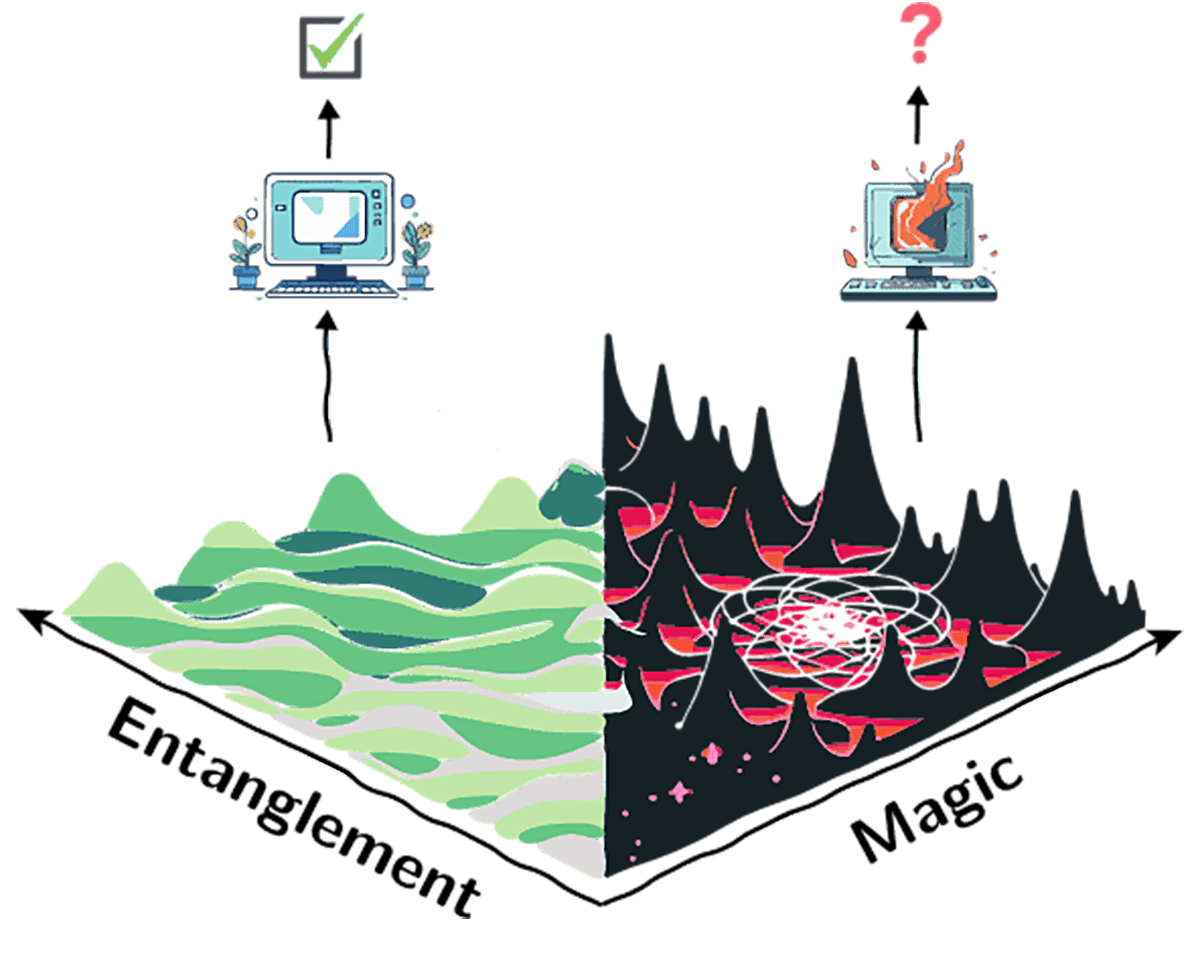
Cartoon showing a landscape divided between entanglement and magic. The entanglement part of the landscape is green, with gently rolling terrain, and a computer hovering above it with a green tick mark. The magic part is filled with spiky black mountains and fiery red pits, and the computer hovering above it is in flames

Entanglement is a fundamental concept in quantum information theory and is often regarded as a key indicator of a system’s “quantumness”. However, the relationship between entanglement and quantum computational power is not straightforward. In a study posted on the arXiv preprint server, physicists in Germany, Italy and the US shed light on this complex relationship by exploring the role of a property known as “magic” in entanglement theory. The study’s results have broad implications for various fields, including quantum error correction, many-body physics and quantum chaos.

Traditionally, the more entangled your quantum bits (qubits) are, the more you can do with your quantum computer. However, this belief – that higher entanglement in a quantum state is associated with greater computational advantage – is challenged by the fact that certain highly entangled states can be efficiently simulated on classical computers and do not offer the same computational power as other quantum states. These states are often generated by classically simulable circuits known as Clifford circuits.

To address this discrepancy, researchers introduced the concept of “magic”. Magic quantifies the non-Clifford resources necessary to prepare a quantum state and thus serves as a more nuanced measure of a state’s quantum computational power.

Studying entanglement and magic

In the new study, Andi Gu, a PhD student at Harvard University, together with postdoctoral researchers Salvatore F E Oliviero of Scuola Normale Superiore and CNR in Pisa and Lorenzo Leone of the Dahlem Center for Complex Quantum Systems in Berlin, approach the study of entanglement and magic by examining operational tasks such as entanglement estimation, distillation and dilution.

The first of these tasks quantifies the degree of entanglement in a quantum system. The goal of entanglement distillation, meanwhile, is to use LOCC (local operations and classical communication) to transform a quantum state into as many Bell pairs as possible. Entanglement dilution, as its name suggests, is the converse of this: it aims to convert copies of the Bell state into less entangled states using LOCC with high fidelity.

Gu and colleagues find a computational phase separation between quantum states, dividing them into two distinct regimes: the entanglement-dominated (ED) and magic-dominated (MD) phases. In the former, entanglement significantly surpasses magic, and quantum states allow for efficient quantum algorithms to perform various entanglement-related tasks. For instance, entanglement entropy can be estimated with negligible error, and efficient protocols exist for entanglement manipulation (that is, distillation and dilution). The research team also propose efficient ways to detect entanglement in noisy ED states, showing their surprising resilience compared to traditional states.

In contrast, states in the MD phase have a higher degree of magic relative to entanglement. This makes entanglement-related tasks computationally intractable, highlighting the significant computational overhead introduced by magic and requiring more advanced approaches. “We can always handle entanglement tasks efficiently for ED states, but for MD states, it’s a mixed bag – while there could be something that works, sometimes nothing works at all,” Guo, Leone and Oliviero tell Physics World.

Practical implications

As for the significance of this separation, the trio say that in quantum error correction, understanding the interplay between entanglement and magic can improve the design of error-correcting codes that protect quantum information from decoherence (a loss of quantumness) and other errors. For instance, topological error-correcting codes that rely on the robustness of entanglement, such as those in three-dimensional topological models, benefit from the insights provided by the ED-MD phase distinction.

The team’s proposed framework also offers theoretical explanations for numerical observations in hybrid quantum circuits (random circuits interspersed with measurements), where transitions between phases are observed. These findings improve our understanding of the dynamics of entanglement in many-body systems and demonstrate that entanglement of states within the ED phase is robust under noise.

The trio say that next steps for this research could take several directions. “First, we aim to explore whether ED states, characterized by efficient entanglement manipulation even with many non-Clifford gates, can be efficiently classically simulated, or if other quantum tasks can be performed efficiently for these states,” they say. Another avenue would be to extend the framework to continuous variable systems, such as bosons and fermions.

Heisenberg gets ‘let off the hook’ in new historical drama based on the Farm Hall transcripts

As the Second World War reached its endgame in Europe in 1945, Allied forces advancing towards Berlin raced to round up German scientists who’d worked on the Nazis’ “Uranium Project” to harness nuclear fission. Code-named the Alsos mission, it picked up the likes of Max von Laue, Otto Hahn (who’d led the experiments to discover fission in 1938), Carl von Weizsäcker, and the head of the uranium work Werner Heisenberg.

The Allied military were eager to prevent those eminent scientists from falling into Russian hands. But the Americans leading Alsos had little idea of what to do with these researchers, despite the mission having Dutch physicist Samuel Goudsmit as its scientific leader. The British forces, however, offered to take them off their hands, flying the scientists to England where they were interred in a country house in Cambridgeshire called Farm Hall.

Held for six months from July 1945, the scientists were well provided for and free to talk among themselves. Unbeknownst to them, however, British intelligence had bugged the house to assess if these men could be trusted to co-operate in the post-war reconstruction of Germany. Heisenberg, as arrogant and superior as ever, dismissed the idea of any such eavesdropping. “I don’t think they know the real Gestapo methods”, he said. “They’re a bit old-fashioned in that respect.”

We know precisely what the interned scientists discussed because full transcriptions of their conversations have been available for more than three decades, first appearing in the book Operation Epsilon (IOP Publishing 1993). It’s an episode that cries out for dramatization. You have the scientists’ anxieties about what they faced next, the unfolding of bitter rivalries and blame games, and the denouement of the Hiroshima and Nagasaki bombs, news of which was met with horror and disbelief. What’s more, Farm Hall was already virtually a theatrical stage set.

Farm Hall

No wonder, then, that the production of Farm Hall at the Theatre Royal Haymarket in London, written by playwright and historian Katherine Moar, has several precedents. The events were first dramatized by David Sington in BBC TV’s Horizon programme in 1992 and later formed the subject of a 2010 BBC radio play. There’s also been Operation Epsilon – a 2013 play by US playwright Alan Brody that ran at the Southwark Playhouse in London only last autumn.

Moar’s own play premiered last year at London’s Jermyn Street Theatre before touring and now returning to the grander Haymarket. The issues were also searchingly explored in Michael Frayn’s Copenhagen (1998), which depicts the meeting of Heisenberg with Niels Bohr in Nazi-occupied Denmark in 1941. Those issues include the culpability of the scientists in building an atomic bomb for Hitler and the wider moral tensions between science, governance and warfare.

The Farm Hall transcripts are something of a straitjacket for the dramatist, since in effect the script is already written

The Farm Hall transcripts are a remarkable resource for historians trying to deduce the real intentions and achievements of the German physicists who worked on the Uranium Project. But they are something of a straitjacket for the dramatist, since in effect the script is already written. While Moar’s own dialogue is sprightly, she is thus not really able to shed new light on the events.

The roles given to the German scientists do not differ much from those of previous dramatizations. Heisenberg loftily considers himself the intellectual leader and the future hope for German science. Von Laue (who did not work on uranium) is scornful of the others’ attempts to justify their support for a depraved regime. Hahn feels personally responsible for the horrors of Hiroshima.

Kurt Diebner, who led a rival uranium research team and was a Nazi party member, clashes with Heisenberg, while the younger Erich Bagge frets about having also joined the party for the sake of career advancement. Von Weizsäcker is the jovial socialite in Moar’s version, working with his hero Heisenberg to construct an extenuating story for posterity.

The key question is why the Germans, with so much expertise in nuclear science, failed to get close to making a bomb, or even a self-sustaining nuclear pile (like the one built by Enrico Fermi at Chicago in 1942). Here historians are divided. Heisenberg, as Moar acknowledges, sought to find a story that absolved the Germans of moral failure while also denying that they got the physics wrong.

At first he refused to believe the announcement of the American bomb, on the grounds that they could not possibly have succeeded where he had failed. However, he later spun a story in which the physicists had cleverly persuaded the Nazis to support the scientific work without overpromising about delivery. Later, Heisenberg even implied that he and others had deliberately falsified the maths to sabotage the bomb project.

The latter idea was popularized in the journalist Thomas Powers’ 1993 book Heisenberg’s War: the Secret History of the German Bomb, which influenced Frayn’s play but for which there is no firm documentary evidence. In fact, the US historian Mark Walker has called that version of events “tragically absurd”. To my mind, Moar also lets Heisenberg off the hook too easily.

In a slightly arch play on the uncertainty principle – a motif that Frayn also used – she has Heisenberg deliver a final soliloquy in which he answers the question “Did you try to build a bomb?” with: “On some days yes. On others, no.” I find it more probable that the German scientists lacked the conviction that they could achieve their goal soon enough to make a difference to the war. Not having argued the case strongly, they were simply not given the resources to make much progress.

What matters more in retrospect is that so few of the scientists, including especially Heisenberg and Weizsäcker but also Hahn, took responsibility for what they had done under the Third Reich. Perhaps the only researcher who did, ironically, was Lise Meitner, who famously interpreted Hahn’s results as nuclear fission after she had fled Berlin in 1938 because of her Jewish heritage.

“You did not want to see it”, she later wrote to Hahn. “It was too inconvenient.”

Cryo-electron tomography reveals structure of Alzheimer’s plaques and tangles in the brain

Imaging Alzheimer’s disease in the brain

Alzheimer’s disease is characterized by the abnormal formation of amyloid-beta peptide plaques and tau tangles in the brain. Although initially identified in 1907, the molecular structures and arrangements of these protein aggregates remain unclear. Now, a research team headed up at the University of Leeds has determined the 3D architecture of these molecules within a human brain for the first time, reporting the findings in Nature.

The researchers used cryo-electron tomography (cryo-ET) techniques to create 3D maps of tissues in a postmortem Alzheimer’s disease donor brain. They revealed the molecular structure of tau in brain tissue and the arrangement of amyloids, and identified new structures entangled within these pathologies.

“[These] detailed 3D images of brain tissue…for the first time bring clarity to the in situ organization of amyloid-beta and tau filament,” states Sjors Scheres, of the MRC Laboratory of Molecular Biology, in an accompanying commentary article.

Scheres explains that the research team had to overcome several major hurdles, including slicing thin enough brain tissue samples for electrons to pass through, freezing hydrated samples fast enough to prevent crystallization that can interfere with the cryo-ET imaging, and identifying relevant areas containing amyloid-beta and tau tangles to image.

For the study, lead author René Frank and colleagues examined freeze-thawed postmortem brain samples of the mid-temporal gyrus from an Alzheimer’s disease donor and a healthy donor. To identify areas of amyloid-beta and tau, they thawed the samples, sliced the brain tissues into 100–200 μm slices and added methoxy-X04 (a fluorescent dye that binds amyloid), before rapidly refreezing the samples.

The researchers then performed cryo-ET on 70-nm-thick tissue cryo-sections from a dye-labelled amyloid-beta plaque and a location enriched in tau tangles and threads. Using cryo-fluorescence microscopy to guide the cryo-ET, they acquired images from different angles and used these to computationally reconstruct a tomographic volume. They collected 42 tomograms in and around regions of amyloid-beta, 25 tomograms in regions containing tau tangles, plus 64 tomograms from the healthy brain tissue as controls.

To obtain higher-resolution structural information, the researchers picked subvolumes containing filaments for alignment and averaging. Subtomogram averaging of 136 tau filaments from a single tomographic volume generated the in situ structure of tau with 8.7 Å resolution.

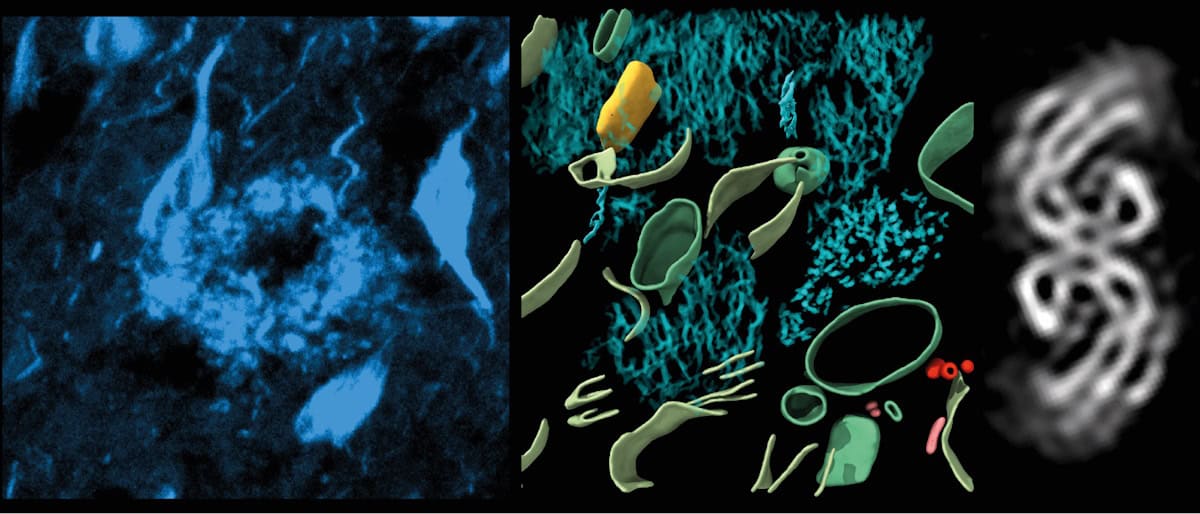
The researchers report that the amyloid-beta plaques had a lattice-like architecture of amyloid fibrils interspersed with non-amyloid constituents, including extracellular vesicles, fragments of lipid membranes and unidentifiable cuboidal particles. Because these non-amyloid constituents were not present in healthy brain samples, they suggest that they are also a component of Alzheimer’s pathology, and may be related to amyloid-beta biogenesis or a cellular response to amyloid.

The amyloid-beta plaques also contained branched amyloid fibrils and protofilament-like rods. The team speculates that these branched fibrils and rods may contribute to the high local concentration of amyloid-beta that characterizes plaques.

Frank and colleagues also identified tau clusters within cells and in extracellular locations. The tau filaments were unbranched and arranged in parallel clusters. They observed both paired helical filaments and straight filaments, which did not mix randomly with each other, but tended to be close to filaments of the same type, often arranged with the same polarity. The researchers suggest that the non-random arrangement may be caused by interactions between filaments or growth in parallel from neighbouring focal points.

The collaboration – also including researchers at Amsterdam UMC, the University of Cambridge and Zeiss Microscopy – represents new efforts by structural biologists to study proteins directly within cells and tissues, to determine how proteins work together and affect one another, particularly in human cells and tissues affected by disease.

“The approaches for obtaining 3D molecular architectures and structures of human tissues with cryo-CLEM [cryo-correlated light and EM]-guided cryo-ET in Alzheimer’s disease sets the ground for interrogating other common dementias and movement disorders,” says Frank. “These include frontotemporal dementia, amyotrophic lateral sclerosis (motor neuron disease) and Parkinson’s disease.”

Quantum sensors monitor brain development in children

Margot Taylor – director of functional neuroimaging at Toronto’s Hospital for Sick Children – is our first guest in this podcast. She explains how she uses optically-pumped magnetometers (OPMs) to do magnetoencephalography (MEG) studies of brain development in children.

An OPM uses quantum spins within an atomic gas to detect the tiny magnetic fields produced by the brain. Unlike other sensors used for MEG, which must be kept at cryogenic temperatures, OPMs can be deployed at room temperature in a simple helmet that puts the sensors very close to the scalp.

The OPM-MEG helmets are made by Cerca Magnetics and the UK-based company’s managing director joins the conversation to explain how the technology works. David Woolger also talks about the success the company has enjoyed since its inception in 2020.

Our final guest in this podcast is Stuart Nicol, who is chief investment officer at Quantum Exponential – a UK-based company that invests in quantum start-ups. He gives his perspective on the medical sector, talks about a company called Siloton that is making a crucial eye-imaging technology more accessible.

Fermilab is ‘doomed’ without management overhaul claims whistleblower report

A group of self-styled “whistleblowers” at Fermilab, the US’s premier particle-physics facility, is claiming that the lab is in “crisis” and that “without a complete [management] shake-up” it is “doomed”. Published in the form of a 113-page “white paper” on the arXiv pre-print server, the criticism comes as the US Department of Energy (DOE), which funds Fermilab, is preparing to announce a new contractor to manage the day-to-day running of the lab.

The paper has been written by disgruntled staff members and visiting experimentalists, who in December 2023 set up a think tank to help Fermilab overcome what they called its “mission and physics impasses”. The authors, who are anonymous, say they have based their report on interviews and surveys of employees at the lab. It has, however, been formally signed by Giorgio Bellettini, who worked at Fermilab in the 1980s and 2010s, and neutrino physicist William Barletta from the Massachusetts Institute of Technology.

A Fermilab spokesperson told Physics World that the lab’s leadership is taking “seriously” the issues raised in the report and the current dissatisfaction among some staff. “They are assessing the situation and working to improve staff satisfaction,” the spokesperson says, adding that current director Lia Merminga conducted a staff climate survey when she took up office in 2022. That resulted in “some of the most pressing issues” being addressed and led to a “culture of excellence initiative” being established that will begin in full next year. Its goal is a “measurable improvement” in staff satisfaction within a year.

Limited operations

With more than 2000 staff, Fermilab has been managed since 2007 by Fermi Research Alliance (FRA) – a group that combines the University of Chicago and the Universities Research Association (URA). Serving the DOE’s Office of Science, the group’s remit is to guide the scientific direction of the lab. With the Tevatron proton-antiproton collider having been decommissioned in the 2010s, Fermilab is now repositioning itself as a leader in neutrino science.

The lab’s accelerator complex is currently undergoing a major upgrade for the $1.5bn Long-Baseline Neutrino Facility, which will study the properties of neutrinos in unprecedented detail and examine the differences in behaviour between neutrinos and antineutrinos. It will do so by sending neutrinos towards the Deep Underground Neutrino Experiment (DUNE) in a former gold mine in South Dakota some 1300 km away.

Hopefully, the [report] will raise an aggressive discussion within DOE and the lab management leading to substantial improvements in how the lab programme is presently conceived and performed

Giorgio Bellettini

Despite progress on this front, the lab has recently faced a number of challenges. In a 2021 assessment, the DOE gave Fermilab an overall mark of “B”, which fell below the required “B+”. Meanwhile DUNE gained only a “C”, mainly owing to delays and cost overruns. Complaints also emerged in 2022 over Fermilab continuing to restrict access to its campus for scientists and members of the public, despite COVID-19, which had prompted the original restrictions, having become less of a concern.

The [whistleblower] document asserts various challenges at Fermilab, some of which are inaccurate, and others of which [the Fermi Research Alliance] has been working hard to address for some time

Lia Merminga

Then in mid-June, Fermilab’s leadership told an all-hands meeting that the lab would close a significant part of its operations between 26 August and 8 September to reduce a budgetary shortfall. During that time staff would have to take their holidays. Following protests over the decision and “through the active engagement of DOE and FRA”, Fermilab later announced that, rather than closing, it would instead undergo “a limited operations period” for maintenance and repairs during the week of 26 August.

”The majority of Fermilab staff will be on leave and the lab will be closed to the public”, bosses declared.

“Too many deficiencies”

In the new whistleblower report, the group claims there are “too many deficiencies in the culture and behavioural areas” at Fermilab. They point, for example, to the lab’s dismissal of an early-career researcher in 2023 who had alleged sexual assault in 2018, and raised several cover-ups by management of dangerous behaviour. The report also highlights a case of guns being brought onto Fermilab’s campus in 2023; a male employee’s attack on a female colleague using an industrial vehicle in 2022; and retaliation against an employee who had predicted and warned management about the failures of beryllium windows.

The report in addition accuses FRA of lacking state-of-the art processes for business, finances and procurement. This “management ineffectiveness”, the whistleblowers charge, has caused a series of “self-inflicted problems” including unfilled positions in important scientific and administrative leadership positions; “serious” budget overruns and delays in key experiments; and several administrative obstacles that slow down or even stop experiments’ scientific productivity. The consequence, the report concludes, is “budget insolvency, with the lab being very much in the red”.

The whistleblowers also say they recently carried out a survey of Fermilab staff, which supposedly found that “a large fraction” are “unhappy” with management and are “desperately looking for change”. The survey, the authors claim, also revealed “poor communication between management and employees, and a decline of trust in management”.

“After so many years at Fermilab, I have developed a deep sentimental involvement with the laboratory, and I sense a diffused lack of confidence in our future,” writes Bellettini in a foreword to the report. “The data of the past 15 years show that responding to demands for a change by delaying any incisive action is not productive. It is not leading to a rousing vision for [high energy physics] in the United States.”

Calling for change

Although Merminga was unavailable for an interview with Physics World for this story, in a message to Fermilab’s employees on 29 July, which has been seen by Physics World, she stated that “the [whistleblower] document asserts various challenges at Fermilab, some of which are inaccurate, and others of which FRA has been working hard to address for some time”. Merminga added that she plans to discuss the issues with staff and then “communicate some of the progress we are making.”

The Fermilab spokesperson also states that access to the Fermilab site for both staff and members of the public “has improved significantly over the last year with updated and streamlined processes” in a bid to improve confidence and trust in the lab.

The issues at Fermilab are, however, also hindering the DOE, which earlier this year called for bids on the contract to operate the lab. The University of Chicago and the URA have submitted a contract bid together with other partners. Associated Universities, Inc., which runs the US-based 100 m-diameter Green Bank Telescope and the Atacama Large Millimeter/submillimeter Array in Chile, has also thrown its hat in the ring. The DOE says it will announce the winner of the contract by 30 September.

The whistleblowers, however, are calling for more than just a change of contractor. They say management should replace Merminga given that she has “[failed] to respond effectively to setbacks [and has] only made things worse”. “A new management team, one hopes, would be motivated to solve problems and would enjoy a ‘honeymoon period’, enabling them to make positive changes more easily,” the report states.

Bellettini, meanwhile, told Physics World that he has not received a response to the report from Fermilab’s management. “Hopefully, the [report] will raise an aggressive discussion within DOE and the lab management leading to substantial improvements in how the lab programme is presently conceived and performed,” he says. “The time to act is now.”

  • This article was amended on 15 August 2024 to clarify the role of the FRA’s constituent organizations in bidding for the next contract, and to correct the date that Lia Merminga became Fermilab’s director. It was also amended on 19 August 2024 to make clear the report included the views of visiting experimentalists at Fermilab.

Superconductivity appears in nickelate crystals under pressure

Diagram showing that as pressure increases, spin-charge order is suppressed and bulk superconductivity emerges in La4Ni3O10−δ

Researchers from Fudan University in Shanghai, China, report that they have discovered high-temperature superconductivity in trilayer single crystals of nickel-oxide materials under high pressure. These materials appear to superconduct in a different way than the better-known copper-oxide superconductors, and the researchers say they could become a new platform for studying high-temperature superconductivity.

Superconductors are materials that conduct electricity without resistance when cooled to below a certain critical transition temperature Tc. The first superconductor to be discovered was solid mercury in 1911, but its transition temperature is only a few degrees above absolute zero, meaning that expensive liquid helium coolant is required to keep it in the superconducting phase. Several other “conventional” superconductors, as they are known, were discovered shortly afterwards, all with similarly low values of Tc.

In the late 1980s, however, physicists discovered a new class of “high-temperature” superconductors that have a Tabove the boiling point of liquid nitrogen (77 K). These “unconventional” superconductors are not metals. Instead, they are insulators containing copper oxides (cuprates). Their existence suggests that superconductivity could persist at even higher temperatures, and perhaps even at room temperature – with huge implications for technologies ranging from electricity transmission lines to magnetic resonance imaging.

Nickel oxides could be good high-temperature superconductors

More recently, researchers identified nickel oxide materials – nickelates – as additional high-temperature superconductors. In 2019, a team at Stanford University in the US observed superconductivity in materials containing an effectively infinite number of periodically repeating planes of nickel and oxygen atoms. Then, in 2023, a team led by Meng Wang of China’s Sun Yat-Sen University detected signs of superconductivity in bilayer lanthanum nickel oxide (La3Ni2O7) at 80 K under a pressure of 14 gigapascals.

In the latest work, researchers led by Jun Zhao say that they have found evidence for superconductivity in a nickelate with the chemical formula La4Ni 3O10−δ (where δ can range from 0 to 0.04). Zhao and colleagues obtained this result by placing crystals of the material into a diamond anvil cell, which is a device that can generate extreme pressures of more than 400 GPa (or 4 x 10⁶ atmospheres) as it squeezes the sample between the flattened tip of two tiny, gem-grade diamond crystals.

Evidence of superconductivity

In a paper published in Nature, the researchers report two pieces of evidence for superconductivity in their sample. The first is zero electrical resistance – that is, a complete disappearance of electrical resistance at a Tc of around 30 K and a pressure of 69 GPa. The second is the Meissner effect, which is the expulsion of a magnetic field.

“Through direct current susceptibility measurements, we detected a significant diamagnetic response, indicating that the material expels magnetic fields,” Zhao tells Physics World. “These measurements also enabled us to determine the superconducting volume fraction (that is, how much of the material is superconducting and whether superconductivity prevails throughout the material or just a small area). We found that it exceeds 80%, which confirms the bulk nature of superconductivity in this compound.”

The behaviour of this nickelate compound differs from that of the cuprate superconductors. For cuprates, Tc depends on the number of copper oxide layers in the material and reaches a maximum for structures comprising three layers. For nickelates, however, Tc appears to decrease as more NiO2 layers are added. This suggests that their superconductivity stems from a different mechanism – perhaps even one that conforms to the standard theory of superconductivity, known as BCS theory after the initials of its discoverers.

According to this theory, mercury and most metallic elements superconduct below their Tc because their fermionic electrons pair up to create bosons called Cooper pairs. This pairing occurs due to interactions between the electrons and phonons, which are quasiparticles arising from vibrations of the material’s crystal lattice. However, this theory usually falls short for high-temperature superconductors, so it is intriguing that it might explain some aspects of nickelate behaviour, Zhao says.

“That the layer-dependent Tc in nickelates is distinct from that observed in cuprates suggests unique interlayer coupling and charge transfer mechanism specific to the former,” says Zhao. “Such a unique trilayer structure provides a good platform to understand the role of this coupling in electron pairing and could allow us to better understand the mechanisms behind superconductivity in general and lead to the development of new superconducting materials and applications.”

A promising class of superconducting materials?

Weiwei Xie, a chemist at Michigan State University, US, who was not involved in this work, says that La4Ni 3O10−δ might indeed be a conventional superconductor and that the new study could help to establish nickel oxides as a promising class of superconducting materials. However, she notes that several recent papers claiming to have observed high temperature superconductivity in a different group of materials – hydrides – were later retracted because their findings could not be reproduced by independent research groups. “These papers are never far from our minds,” she tells Physics World.

In a News and Views article published in Nature, however, Xie strikes a hopeful note. “The (new) report has set the stage for a potentially fruitful path of research that could lead to an end to the controversy surrounding unreliable measurements,” she writes.

For their part, the Fudan University researchers say they now aim to identify other differences between the superconducting mechanisms in the nickelates and cuprates. “We will also be continuing to search for more superconducting nickelates,” Zhao reveals.

NIST publishes first set of ‘finalized’ post-quantum encryption standards

A set of encryption algorithms that are designed to withstand hacking attempts by a quantum computer has been released by the US National Institute of Standards and Technology (NIST). The algorithms, which should also protect against the increasing threat of AI-based attacks, are the result of an eight-year effort by NIST. They contain the encryption algorithms’ computer code, instructions for how to implement them and details of their intended uses.

Encryption is widely used to protect the contents of electronic information, with encrypted data able to be sent safely across public computer networks because it is unreadable to all but its sender and intended recipient. Encryption tools rely on complex mathematical problems that conventional computers find difficult or impossible to solve. Quantum computers, however, could outperform their classical counterparts and crack current encryption methods.

In 2016 NIST announced an open competition in which researchers were invited to submit algorithms to be considered as a “post-quantum” cryptography (PQC) standard to stymie both conventional and quantum computers.  In 2022 NIST said that four algorithms would be developed further. CRYSTALS-Kyber protects information exchanged across a public network, while CRYSTALS-Dilithium, FALCON and SPHINCS+ concern digital signatures and identity authentication.

The three final algorithms, which have now been released, are ML-KEM, previously known as kyber; ML-DSA (formerly Dilithium); and SLH-DSA (SPHINCS+). NIST says it will release a draft standard for FALCON later this year. “These finalized standards include instructions for incorporating them into products and encryption systems,” says NIST mathematician Dustin Moody, who heads the PQC standardization project. “We encourage system administrators to start integrating them into their systems immediately.”

Duncan Jones, head of cybersecurity at the firm Quantinuum welcomes the development. “[It] represents a crucial first step towards protecting all our data against the threat of a future quantum computer that could decrypt traditionally secure communications,” he says. “On all fronts – from technology to global policy – advancements are causing experts to predict a faster timeline to reaching fault-tolerant quantum computers. The standardization of NIST’s algorithms is a critical milestone in that timeline.”

Atomic clocks on the Moon could create ‘lunar positioning system’

Atomic clocks on the Moon. It might sound like a futuristic concept, but atomic clocks already abound in space. They can be found on Earth-orbiting satellites that provide precision timing for many modern technologies.

The clocks’ primary function is to generate the time signals that are broadcast by satellite navigation systems such as GPS. These signals are also used to time-stamp financial transactions, enable mobile-phone communications and coordinate electricity grids.

But why stop at orbits a mere 20,000 km from Earth’s surface? Should we establish a network of atomic clocks on the Moon? This is the subject of a new paper by two physicists at NIST in Boulder, Colorado – Neil Ashby and Bijunath Patla.

They say that their study was inspired by NASA’s ambitious Artemis programme, which aims to land people on the Moon as early as 2026. The duo points out that navigation and communications on and near the Moon would benefit from a precision time standard. One option is to use a time signal that is broadcast from Earth to the Moon. Another option is to create a lunar time standard using one or more atomic clocks on the Moon, or in lunar orbit.

Faster pace

The problem with using a signal from Earth is that a clock on the Moon runs at a faster pace than a clock on Earth. This time dilation is caused by the difference in gravitational potential at the two locations and is described nicely by Einstein’s general theory of relativity.

Using that theory, the NIST duo calculate that a clock on the Moon will gain about 56 µs per day when compared to a clock on Earth. What’s more, this rate is not constant because of the eccentricity of the Moon’s orbit and the changing tidal effects of solar-system bodies other than the Earth, which would also cause fluctuations in the difference between earthbound and Moon-bound clocks.

Because of these variations, the duo argue that it would be better to create a network of atomic clocks on the surface of the Moon – and in lunar orbit. This would provide a distributed system of lunar time, much like the distributed system that currently exists on Earth.

“It’s like having the entire Moon synchronized to one ‘time zone’ adjusted for the Moon’s gravity, rather than having clocks gradually drift out of sync with Earth’s time,” explains Patla. This could form the basis of a high-precision lunar positioning system. “The goal is to ensure that spacecraft can land within a few metres of their intended destination,” Patla says.

They also calculated the difference in clock rates on Earth and at the four Lagrange points in the Earth–Moon system. These are places where satellites can sit fixed relative to the Earth and Moon. There, clocks would gain a little more than 58 µs per day compared to clocks on Earth.

They conclude that atomic clocks placed on satellites at these Lagrange points could be used as time transfer links between the Earth and Moon.

The research is described in The Astronomical Journal.

Copyright © 2026 by IOP Publishing Ltd and individual contributors