Big prospects for small satellites

space.jpg
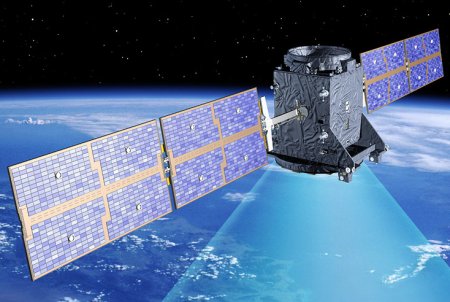
Artist’s impression of the GIOVE-A probe, which was launched three years ago. (Courtesy: ESA).

By Michael Banks

This morning, in the huge exhibition hall at this year’s International Astronautical Congress, I caught up with Martin Sweeting, chief executive of Surrey Satellite Technology Limited (SSTL) and chairman of the local organizing committee for this year’s event.

The company that he founded in 1985 at Surrey University focuses on building and operating “micro” satellites, which are around 100 kg in mass. Sweeting recalled how, back in the 1980s, people laughed at the idea of having smaller satellites. At the time, satellites were getting ever bigger, with larger scientific payloads on board. But the sceptics soon turned silent: the market for small commercial satellites has seen year-on-year growth, with SSTL itself having a market turnover of £21m in 2006.

In his talk yesterday evening at the congress, Sweeting compared the traditional large satellites as “dinosaurs” having themselves evolved from smaller satellites. Indeed, Sputnik – the world’s first artificial satellite – was the size of a beach ball.

I asked Sweeting if the comparison was apt, given that large satellites are still needed for landers to the Moon and Mars as well as for possible manned missions.

(more…)

Fly me to the Moon

griffin.jpg
Michael Griffin

By Michael Banks

When Physics World talked to NASA boss Michael Griffin in July – on the occasion of NASA’s 50th birthday — he noted that the agency hoped to have manned missions to the Moon by 2020 and Mars by 2050. Griffin reiterated that view in a session yesterday at the International Astronautical Congress in Glasgow with heads of agency and industry space leaders. However, he also warned about putting too much priority on a potential Mars mission. “We have had only 27 Earth days on the Moon,” said Griffin, referring to the previous six Apollo manned lunar missions. “But our dependents will think we are idiots; that we don’t know enough about the Moon, if we don’t revisit it.”

For anyone who thinks a mission to Mars would be the space equivalent of a walk in the park, Griffin put the potential mission in context. “Mars is an interesting place for human beings,” he said, “but we have to show that astronauts can survive the mission time by first putting them for seven months on the International Space Station (ISS) then 9-12 months on the moon followed by another 7 months on the ISS.”

(more…)

Sound technique to unplug oil

Oil may be slippery stuff, but when it is pumped from the seabed to the water surface it can cool and precipitate thick deposits that block the inside of the pipes used to transport it. Although engineers can clear such blockages by sending in robots known as pipeline inspection gauges or “pigs”, these sometimes get stuck themselves, forcing the engineers to find ways to remove them or even spend millions replacing the pipeline.

Now a Norwegian scientist has developed a simple technique that could substantially cut costs of clearing blockages. Jon Steinar Gudmundsson of the Norwegian University of Science and Technology uses the pressure pulses created when oil flow is shut off to work out the size and location of a blockage, so that engineers can know exactly what size of pig to send in.

Under pressure

Gudmundsson’s technique, which he is selling via a company he has set up, involves abruptly closing the valve at the end of the pipe, thereby cutting off the oil which is being forced upwards by the weight of the ocean and seabed. The resulting change in momentum initiates a pressure pulse within the oil, which travels back down the pipe at the speed of sound.

I always used to see the needle in the pressure gauge flicker and I was curious as to why it did so Jon Steinar Gudmundsson, Norwegian University of Science and Technology

The downwards pulse continuously halts the oil in its path, transforming the energy that is previously dissipated via friction through the pipe wall into new pressure pulses that travel back up towards the valve. In this way the oil pressure beneath the valve, which is already high when the valve is shut, continues to rise steadily as the backward pulses arrive.

Any blockages in the pipe superimpose an additional rise in pressure on the slowly increasing background. A pressure sensor positioned just under the valve will therefore reveal both the position and the size of a blockage — with the position related to the time of arrival of the pressure jump (given by the speed of sound through oil) and the size proportional to the magnitude of the jump.

Patented technique

Gudmundsson, who worked for many years on geothermal wells in Iceland, says the inspiration for the new technique came after noticing that the pressure at the head of a geothermal well always rose very quickly when the valve was closed. “I always used to see the needle in the pressure gauge flicker and I was curious as to why it did so,” he explains.

After visiting a number of offshore oil platforms in Norway and making use of their modern pressure transducers he realized he could quantify this pressure change and use it to measure pipeline blockage. He patented his technique and has now commercialized it via a company, Markland Technology, which he spun out from his university. He says the technology has already been used at several offshore oil platforms in the North Sea, and that he expects other platforms around the world to take it up.

In praise of Pendry and plasmons

By Hamish Johnston

Yesterday I had the pleasure of attending day two of “Pendry Fest”, a series of lectures at Imperial College given in honour of the physicist Sir John Pendry, who recently turned 65.

Pendry is probably most famous for his prediction in 2000 of the negative refraction of electromagnetic radiation by new manmade materials called metamaterials. This was confirmed experimentally by Duke University’s David Smith, who spoke yesterday, and Pendry and Smith went on to use this property of metamaterials to create an invisibility cloak in 2006.

Although making such metamaterials is a significant challenge of electrical engineering, Pendry realized that the physics could be described rather elegantly by borrowing ideas from Einstein’s general theory of relativity — a concept he dubbed “Transformation Optics”. Indeed, in his talk Smith credited Pendry with encouraging a generation of electrical engineers to read-up on general relativity.

(more…)

…And now for the next 20 years

In Physics World and also on our website physicsworld.com, we report on breakthroughs in physics and describe the latest research trends with in-depth features. This issue (pages 21, 29, 43, 49; print version only) contains some flashbacks to the big events that took place in physics over the last 20 years, but what are the burning questions in physics today?

These six answers are the most lucid and interesting replies to a survey we sent out to a number of physicists in different fields. Because theorists were happier to speculate than experimentalists, theoretical topics predominate. Many important areas — environmental physics, quantum computing, renewable-energy research and almost all of condensed-matter physics — are absent. The result is less a comprehensive overview of the future of physics than it is a series of snapshots. Yet with physics increasingly fragmented into sub-fields, some of which have only a tangential connection to each other (see pages 36–37, print version only), it is almost impossible, to capture the future direction of the subject as a whole. Indeed, one of the fields we profile here — network theory — was almost nonexistent two decades ago. Others, including string theory and (arguably) quantum field theory, were still in their infancy compared with where they are today.

So where will the future lead us? Predictions in physics can be problematic — witness the late 19th-century belief that the future of the subject lay in tying up a few loose ends — but here are the views of six researchers who were willing to go out on a limb.

Emergence of network theory

An important recent phenomenon in the field of complex systems has been the emergence of network theory. Most truly complex systems — from the cell to the Web and even social systems — have a network behind them that tell us how the system’s components interact with each other. Given the differences between these systems — both in the nature of the components and the function of the whole system — one would not expect there to be any intrinsic similarities between them. Yet, since the turn of the century, scientists have discovered that the underlying structure of these networks is rather similar: most have a scale-free topology (the number of links per node follows a power law), they display a high degree of clustering, and the distance between the nodes is small (the small-world property). We have realized that the network matters, and this has not only produced novel questions, but also led us to re-evaluate how we describe a complex system.

Another key question concerns human dynamics. The description and prediction of human behaviour may not initially look like physics questions, but recently the empirical tools of physics have begun to play a fundamental role in addressing these problems. The future of physics will be determined by our ability to address issues of fundamental importance to society. For physicists, such questions have traditionally involved finding new sources of energy or discovering new materials, but now the focus of the questions is slowly shifting towards increasingly interdisciplinary problems at the boundary of physics, social sciences, biology and engineering. If physics is to remain relevant, and maintain its leading role among the sciences, it will have to embrace these questions.

• Albert-Lâszlô Barabási is director of the Center for Network Science at Northeastern University, US

Developments in medical-imaging techniques

Over the past two decades, major advances have been achieved in the ability to image normal and diseased structures at the tissue and organ level, thereby substantially improving the ability to detect and treat macroscopic disease. These advances reflect developments in imaging methods such as magnetic resonance imaging, emission computed tomography, digital X-ray imaging, and imaging with ultrasound.

At the same time, the ability to study the structural and functional integrity of tissue at the cellular and multi-cellular level has made great strides, principally through the development of a number of opticaland nuclear-imaging techniques. These advances in what is termed “molecular imaging” provide the potential to distinguish normal cells from cancerous ones, and to determine the presence or absence of cancer within any microscopic region of tissue.

The biggest unsolved problem in medical physics is how to combine macroscopic and microscopic imaging advances so that the precise margins of cancers can be delineated during the planning and delivery of radiation treatment. A chasm exists between the visualization of the microscopic and macroscopic aspects of cancer, and this chasm must be bridged if advances in molecular imaging are to be used to improve the treatment of the disease with sources of ionizing radiation.

• Bill Hendee is a physicist at the Medical College of Wisconsin, Milwaukee, US

The quantum vacuum

At the beginning of the 20th century, Einstein replaced aether theory with relativity, but a 21st-century aether — the quantum vacuum — is still puzzling physicists today. The aether was originally thought to be an allpenetrating substance that carried light through space like air carries sound. Take away all the light, and the aether would still be there. Now, according to quantum field theory, the state of absolute darkness, the vacuum state, is still a physical state, filling space completely, much like the aether. There is an important difference, though: one does not notice motion at a uniform speed relative to the quantum vacuum, but during acceleration the vacuum should glow, due to friction. The quantum vacuum should also cause black holes to evaporate, because at the event horizon, particles are produced from the vacuum, at the expense of the black hole’s mass.

None of these phenomena have been observed yet — they are astronomically weak, although they could be demonstrated in laboratory analogues. However, some aspects of the quantum vacuum appear in daily life: the quantum vacuum causes things to stick. For example, a gecko can hang on a glass surface using only one toe, because the microhairs in its feet stick to the glass by ceaselessly exchanging virtual photons that bind the two together. The vacuum force is small and acts only at short ranges, so a gecko needs many hairs to suspend its weight. In some applications of nanotechnology, this stickiness has been a problem — particularly in microelectromechanical systems that integrate electronics with moving parts. Understanding the quantum vacuum is not only a challenge for 21st-century physics, but also for 21st-century technology.

• Ulf Leonhardt is a theoretical physicist at the University of St Andrews, UK

Water on other earths

Why does the Earth contain the exact amount of water it does? And do earths around other stars contain a similar amount? These issues are not moot. Water on a drier Earth would be absorbed into the silicate mantle, leaving a dry surface. In contrast, if the Earth had twice as much water, the continents would be submerged. Advanced, technological life would be inconceivable in the resulting water world, as no exofish or alien dolphins could invent metallurgy, computers or guitars. Does our Earth contain a “lucky” amount of water?

The Earth formed by accumulating particles of silicates, iron and water from the early protoplanetary disk in similar amounts. The original Earth accumulated many oceans worth of water (if not more) during its formation. But our present-day Earth has only a 1000th of its mass in water, far less than the silicates and iron. Where does this critical fraction of water come from?

Within its first 100 million years, the Earth was dramatically desiccated when a Mars-sized planet slammed into it, vaporizing the oceans and sending a huge plume of water into space. (The Moon also formed from this impact.) The Earth was left a parched planet, not unlike Mars today.

That dry Earth acquired its current complement of water from asteroids and comets that randomly slammed into it. Jupiter’s gravity acted as a slingshot and dispersed these objects in all directions, with a few sent toward the Earth, depositing their water upon splashdown. Thus the Earth lost its water, and then re-acquired some back, all by chance collisions during the early bumper-car era of the solar system.

Other earths may not be so lucky. Simulations show that they could acquire anywhere from 0.01 to 100 oceans of water. Only a tiny fraction of these earths contain just the right amount of water to have both oceans and continents. The great variation in water on these other earths stems from the orbit and mass of a Jupiter-like planet (if any) that disturbs the asteroids. The glancing blow by a Mars-sized planet to desiccate other earths is a freak event, without which they keep many oceans of water. Any binary-star companion would perturb the asteroids and comets differently, yielding different amounts of water. The presence of isotopes such as aluminium-26 can significantly change the heating inside, and hence the evaporation of water from, asteroids and comets.

In the random card game of planet formation, the Earth was dealt an aquarian straight flush, cashing in with Homo sapiens. But the good fortune is circular: if Earth were not just-so endowed with water, we would not be here to discuss it.

• Geoff Marcy is an astronomer at University of California-Berkeley, US

The future of cosmology

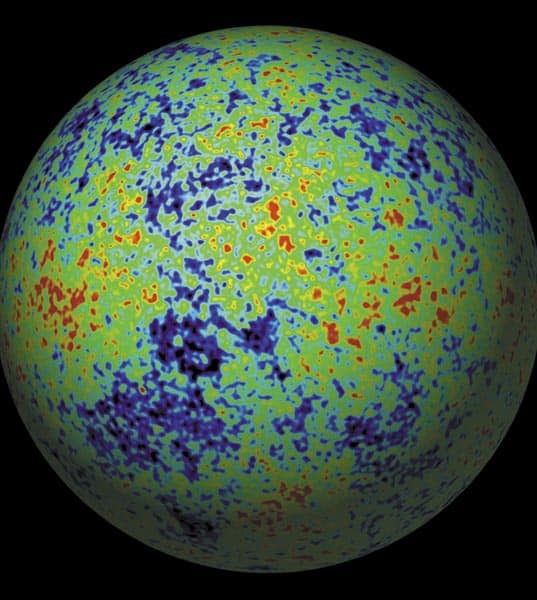
Cosmology may be on the verge of its most exciting decades — or its most boring. The last 20 years have seen the rise of a standard cosmological model, described by general relativity and the interactions of just a few components: normal matter, dark matter and dark energy, with hints of an early epoch of accelerated expansion known as inflation. The simplicity of this description is deceptive, since we do not know what kind of particles make up the dark components, nor do we know what mechanism is responsible for their relative amounts. The goal of the biggest upcoming cosmological projects — microwave background telescopes like the European Space Agency’s Planck Surveyor; groundbased surveys like the Large-Scale Synoptic Survey Telescope and the Square Kilometre Array; or future satellite telescopes like Euclid or the Joint Dark Energy Mission — is to understand these components by observing their effect on the overall expansion of the universe and the growth of structure within it.

Ideally, the next generation of microwave experiments will indirectly observe a background of gravitational radiation — a crucial signature of that early inflationary era. Detailed observations of distant supernovae and telescopes probing the local universe could allow us to measure the properties of dark energy, which seems to be causing the expansion of the universe to accelerate today. However, one very real possibility is that these observations will bring us a few digits of increased precision on the cosmological parameters describing the universe but no real understanding of the underlying physics of dark matter or dark energy, and few, if any, hints about the mechanism behind inflation or other epochs in the early universe.

Even in that scenario, what we will have in a few decades’ time is a phenomenally detailed map of the universe, over larger areas of the sky and reaching further away (and hence further back in time) with each new telescope, eventually to the very first objects to coalesce out of the primordial gas. But if these data are silent on the early universe and particle physics, then cosmology will continue the fragmentation that has already begun, between those applying theoretical tools and particle physics to the early universe and those using astrophysical techniques to understand the evolution of the objects within it.

• Andrew Jaffe is an astrophysicist at Imperial College London, UK

The holographic principle and the string-theory landscape

The big new ideas that have emerged from quantum gravity have been the “holographic principle” and the “string-theory landscape”. The holographic principle was an outgrowth of Stephen Hawking’s insight into the clash between the equivalence principle and the quantum principle of information conservation. The outcome is one of the most startling concepts in modern physics: the degrees of freedom of a region of space, instead of filling the region, reside on the boundary surface. A hologram is a 2D sheet of film that stores information in a 3D scene. If you look at the film through a microscope, then all you see is a random bunch of marks; but if you know the rules, then you can reconstruct the solid scene that it depicts. The holographic principle says that the 3D universe is like a reconstructed image stored on a distant mathematical boundary.

The holographic principle has radically restructured our ideas about quantum gravity, black holes, and the nature of fundamental degrees of freedom. At the same time it has closed a circle of ideas that began in the late 1960s. String theory started as the theory of hadrons — ordinary sub-nuclear particles like protons and neutrons — but the same mathematics describes objects like gravitons and black holes. Remarkably, the circle has now been closed and black-hole theory is now used to explain properties of colliding nuclei.

The string-theory landscape, meanwhile, grew out of the search for a string theory of elementary particles. The important thing about string theory is not that elementary particles are strings, but that it provides a kind of DNA that codes the properties of a universe, in the same way that the base-pair sequence in DNA codes the biological phenotype. Just as there is a huge landscape of biological designs — all the possible rearrangements of the tens of millions of base pairs in a DNA strand — string theory provides an enormous number of patterns for rearranging the elements that comprise a compactification of the extra dimensions. (The number 10500 is often quoted.) This has had a sobering effect on the ambition of finding a unique string theory of particle physics, but it fits extremely well with cosmological ideas.

The landscape naturally lends itself to speculations about an eternally inflating multiverse of “pocket-universes” isolated from one another by event horizons. On the other hand, the holographic principle suggests that ordinary quantum mechanics only makes sense within an observer’s horizon. So there is a serious tension between the two: how to describe a multiverse holographically?

• Leonard Susskind is a string theorist at Stanford University, US

Ending the great drought

With the Large Hadron Collider (LHC) springing to life at the CERN laboratory near Geneva, the great data drought in elementary particle physics is finally about to end. Not since the second phase of CERN’s Large Electron–Positron Collider (LEP) began operations in 1996 has the field been able to probe virgin territory and measure truly new and exotic phenomena. And that machine merely doubled the energy reach of electron–positron colliders into regions that had already been partially explored using the Tevatron at Fermilab in the US. Researchers at these colliders — the world’s most powerful for over a decade — could only chip away at the outer fringes of the unknown. But the LHC, built by installing thousands of superconducting magnets in the LEP tunnel, will permit physicists to strike deep into its dark heart. There they will almost certainly discover something distinctively different.

When it finally attains its design parameters, the LHC will have seven times the collision energy of the Tevatron. And the machine’s absolutely bruising proton–proton collision rate, what physicists call its “luminosity,” should eventually come in 100 times higher than the US facility. Taken together, these advances in accelerator technology will extend the experimental reach of high-energy physics almost as dramatically as did early particle colliders — ADONE in Italy, the CERN Intersecting Storage Rings (ISR), and SPEAR at the Stanford Linear Accelerator Center (SLAC) — during the 1970s, a tumultuous decade that culminated in today’s dominant paradigm of particle physics, the Standard Model. Expectations are high that the particles soon to appear at the LHC will equal or perhaps even exceed in importance the discoveries that led to this achievement.

It has been a long, long wait. During the intervening decades, particle theory has leapt far beyond experiment, to unattainable energy levels and correspondingly tiny distances that humans can never hope to experience — at least not directly. First came supersymmetry during the 1970s, an outgrowth of the gauge theories that had just proved so successful in unifying the weak and electromagnetic forces. These SUSY theories, as they came to be known, extended the unification programme by incorporating the strong and the electroweak forces into a grand, all-encompassing whole. They also predicted a plethora of detectable new particles with masses tens to hundreds of times greater than the mass of the familiar proton.

What left experiment hopelessly in defeat and completely unable to respond meaningfully were the string theories of the 1980s. In the absence of any agreed-upon criterion of verifiability to limit their population, those early string theories began to multiply unfettered like rabbits in Australia. The only criteria that limited their numbers were subjective ones like mathematical consistency and elegance. Historians of science began to note a subtle but important shift in the manner of doing physics, in which observations no longer seemed to matter as much — at least not to string theorists — in the process of justifying theories. Particle physicists could only complain, and some did so loudly, that the field was reverting to metaphysics and philosophy.

Rags to riches

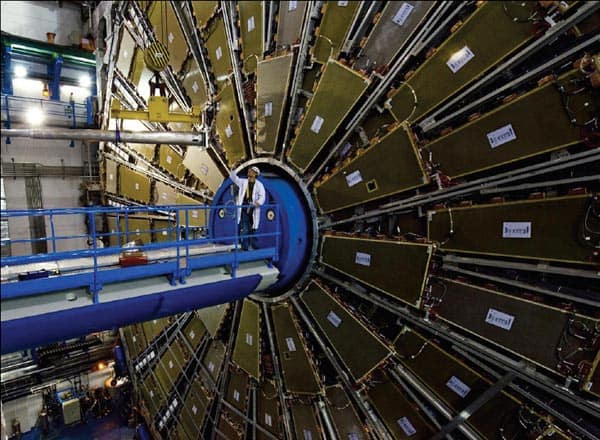
This sorry state of scientific affairs is happily coming to an end. The LHC’s two enormous detectors ATLAS and CMS — together sporting enough metal to rebuild the Eiffel Tower — will soon be clobbered by vast numbers of energetic particles spewing from the violent proton—proton collisions in their midsts. While the Tevatron gives physicists insights into the particles and processes occurring at energies up to a few hundred billion electron-volts and at distances down to almost 10–18 m, the LHC will permit them to observe what happens at several trillion electron-volts (TeV) and distances 10 times smaller.

One of the early targets will be the long-sought and much-touted Higgs boson (or bosons), the capstone of the Standard Model thought to imbue most of its fundamental entities with their intrinsic masses. Experiments so far at LEP and the Tevatron have constrained the mass of a single, standard Higgs boson to lie between 0.114 and about 0.150 TeV, a low and very narrow range of energies, given existing capabilities. But the Tevatron has nowhere near the LHC’s potential luminosity, which should prove crucial in tracking down this rare, elusive ghost. Fermilab researchers may still catch a fleeting glimpse of the Higgs boson in their remaining experimental runs, but its bona fide, full-fledged discovery will almost certainly require the LHC.

But the curiously low mass of the Higgs boson poses another puzzling conundrum, known as the “mass hierarchy problem”. According to quantum field theory, huge quantum corrections should boost the mass of the Higgs boson (and those of the other fundamental particles) to near the Planck-mass level of 1016 TeV, orders of magnitude higher than that required by precision experiments. What keeps its mass so low?

Supersymmetry provides a clever, if cumbersome, answer to this problem by predicting the existence of supersymmetric partners for all Standard Model particles — a photino for the photon, a selectron for the electron, a squark for every quark, and so on. Such exotic new particles naturally cancel out these nasty corrections in the theory and keep the masses of the Standard Model particles relatively low. Although these superparticles can weigh in substantially higher than their Standard Model partners, they cannot have masses above a few TeV or the delicate cancellations get out of whack. If supersymmetry is indeed the ultimate resolution of the hierarchy problem, these particles must finally turn up at LHC energies.

Actually discovering superparticles will not be easy, however. For one thing, there is a bewildering variety of possible theories, leading to a vast array of predictions for observable particles with a broad range of potential masses and decays. As SLAC theorist James “BJ” Bjorken once cautioned me, “SUSY is an awfully slippery lady!”

Another problem is that most superparticles will decay into invisible particles that escape the detector unobserved. Such occurrences will thus become manifest as missing transverse energy — an imbalance in the distribution of visible energy perpendicular to the beam direction. However, similar deficits can also be caused by invisible Standard Model particles such as neutrinos or by gaps in a detector’s angular coverage. In order to establish that a new and unusual particle has indeed appeared inside their detector, therefore, experimenters must accurately calculate and subtract all such backgrounds, which can be substantially larger than the signal that they are trying to extract. This is a hugely difficult task, compounded by the fact that the expected signal will probably not appear as a sharp resonance peak but will be broadened instead by the motions of other decay particles. And in the LHC, signals are diluted by helter-skelter motions of the quarks and gluons within the colliding protons — a messy process that theorist Richard Feynman once likened to “colliding garbage cans with garbage cans” to see what is inside.

In contrast, take the startling signals that led to the first evidence for quarks in the late 1960s and early 1970s. These were huge — orders of magnitude larger than the backgrounds that remained after simple cuts had been applied to the data to eliminate obvious junk. The first-generation ISR detectors, for example, were swamped by hordes of hadrons spewing out at large angles from hard collisions of the protons’ constituent quarks and gluons. And in November 1974, a narrow peak erupted in the hadron-production cross-section at the SPEAR electron–positron collider that was about 1000 times above baseline. These blockbusting signals were impossible to miss!

If they exist, superparticles will leave no such obvious footprints for the two industrial-strength LHC experimental collaborations, each involving over 1000 physicists. Tracking down such evanescent, elusive prey may well prove arduous work, fraught with ambiguity. Here is where subjectivity can creep into the experimental enterprise. Many physicists, theorists and experimenters alike, would dearly love to see supersymmetry proven true, for it solves so many nagging problems in a single stroke. Not only does it resolve the hierarchy problem, but it can also readily account for the mysterious dark matter in the universe, the indirect evidence for which has become overwhelming. And string theories absolutely require it. But the urge to be the first to make important discoveries can lead eager experimenters to tune data cuts, underestimate backgrounds, and thus unwittingly fabricate the very results they yearn to unearth.

Physicists who cried Higgs

This unfortunate process has occurred too often in the history of physics, and spurious Higgs-boson discoveries seem to be particularly recurrent examples. One false alarm occurred at LEP just before its scheduled shutdown in 2000. In this episode, which made front-page headlines in major newspapers such as the New York Times, three of the four LEP collaborations reported excess events — six or seven, all told — that were eagerly interpreted to be decays of a 0.115 TeV Higgs boson. The evidence was intriguing, but not conclusive enough to convince the CERN management to extend LEP’s life into 2001 and so delay construction of the LHC. When the dust began to settle months later, it turned out that certain experimenters had underestimated the possible errors in their measurements and thus exaggerated the statistical significance of the apparent signal. What they finally concluded was only that the mass of the Higgs boson must lie above 0.114 TeV, with a confidence level of 95%. There is still an outside chance that the apparent phenomenon was indeed real, but few physicists are betting on it.

More recently, there was a similar surge of rumours that a Higgs boson with a mass of 0.160 TeV had been glimpsed at Fermilab in early 2007 (see “The tale of the blogs’ boson”). The possibility that such a boson could readily be accounted for by a SUSY theory after minor tuning of its theoretical parameters added fuel to these rumours — which erupted after the results were tentatively revealed at an informal January workshop appear to matter that this was only a “2σ” effect, a fluctuation of two standard deviations above background levels, which can occur at random with a probability of 5%. As 2σ fluctuations happen all the time, sceptical experimenters usually do not take them very seriously. Three standard deviations is the absolute minimum, corresponding to only a 0.3% chance of a random fluctuation, and 5σ is the “gold standard” for particle physics. But the allure of finding evidence for supersymmetry, abetted by journalists eager for a scoop, must have proved too difficult to resist.

While similar rushes to judgment may well occur at the LHC, I suspect the innate scepticism of the experimenters will restrain them and eventually win out, as it did in the above cases. Experimental particle physicists have developed truly powerful analysis techniques, such as use of neural-network analysis software that learns on the job and improves as the data roll in — to cope with the suffocating backgrounds encountered at hadron colliders. They have begun employing “blind” data analyses, in which the end results are deliberately not viewed until after enough data have come in, to limit the subjective tuning of experimental cuts. And the cautious vetting processes of these huge collaborations, in which tentative discoveries run a gauntlet of internal reviews before ever becoming official, further mitigates against releasing incorrect results. If any doubt remains, the LHC’s tremendous experimental reach should act as the final judge. For this collider can generate events with TeV missing energies, where most Standard Model backgrounds plummet. If a SUSY signal is indeed present, it should ultimately stand out rather distinctively in this domain.

Gravity’s rainbow

Another area of intense theoretical and experimental interest is the possibility — raised in the last decade or so — of observing gravity at work in particle collisions. All string theories involve extra spatial dimensions beyond the three familiar ones, but in certain classes of string theories that have been studied since the mid-1990s, some of these hidden dimensions are far larger than the usual 10–35 m Planck scale. They can be curled up, or “compactified,” at length scales up to about 10–18 m and still not violate existing short-range tests of Newtonian gravity. These lengths correspond to the TeV energy scale that the LHC is about to explore. This is tantamount to dragging the Planck scale down to a much lower energy level, thus making gravity much stronger there than we experience at macroscopic distances. If these more recent string theories are valid at such lengths and energies, then exotic new phenomena should begin to appear at the LHC. For hardened sceptics like me, this is a truly fabulous turn of events. String theories — or at least some of them — may have made testable, falsifiable predictions!

A possible manifestation of large extra dimensions would be the appearance at the LHC of single jets — tightly collimated sprays — of hadrons recoiling against an invisible particle, leading to missing energy in the opposite direction. Such “monojet” events could be interpreted as production of a gluon plus a graviton (the hypothetical elementary particle that mediates the gravitational force), which occurs because gravity is so much stronger at this scale than previously imagined. But like SUSY events, these monojet events suffer from huge Standard Model backgrounds, and experimenters would have to distinguish any excess from the emergence of SUSY itself. About the only way to do so is by determining the spin of the invisible particles (gravitons have spin-2), which may be a tricky affair with the LHC.

Fortunately, there is a distinctive signal required by theories with large extra dimensions that should be observable if they indeed exist: Kaluza–Klein excitations. Predicted way back in the 1920s by Theodore Kaluza and Oscar Klein, who worked with 5D field theories, these are multi-TeV versions of the photon and Z-boson. They would decay to electron–positron or muon pairs that should stand out sharply from the LHC’s choking hadronic backgrounds — just like the famous J-particle did at the Brookhaven National Laboratory in the US in late 1974. In fact, there could be observable “towers” of these excitations, repeating series of them stretching to ever higher energies. But here again, even if such tantalizing excesses of these lepton pairs turn up, the LHC researchers will still have to find ways to distinguish them from other possibilities.

There are many other potential theories and phenomena under consideration by physicists as they await the great data flood expected at the LHC over the next few years. If gravity does indeed grow strong enough at the multi-TeV scale, for example, micro-black-holes may be created profusely. What will appear at the LHC is still any theorist’s guess. Most likely, something completely unexpected will eventually show up in ATLAS and CMS. Whenever the experimental reach is extended so far, history suggests, something usually does.

And there will, of course, be the usual blind alleys and wrong turns taken by too-eager experimenters trying to beat the competition and establish their scientific reputations. That is to be expected in the normal course of such a thrilling scientific endeavour. But with a healthy, active intercourse re-established once again between theory and experiment, I am confident that the truth will ultimately emerge from any such confusion — along with a strikingly new physics landscape that few could have anticipated.

Have PhD, will travel

What do you call someone with more skills than an apprentice but not enough to be a master? Europe’s medieval guilds recognized such people as journeymen, skilled workers paid by the day (in French, journée) who travelled between masters, gaining the experience needed to set up their own workshops. Modern academia uses another name — postdoctoral researchers.

Despite important differences between postdocs and their medieval predecessors (regular pay, for starters), the basic rationale for seeking a postdoc position has not changed. Newly minted PhD graduates may be well on their way to becoming experts in their fields, but most will have little experience in planning new research projects or managing students. A stint as a postdoc can fill this experience gap. By working with an established mentor for a short period of time (typically 1–3 years), new researchers gain not only subject-specific training but also help with “soft skills” like preparing grant applications and giving presentations — just what fledgling physicists need to develop into independent researchers. The results can be impressive: a 1999 survey by Science found that 43% of articles published in the journal that year had postdocs as the first named authors.

One reason for this prominence is that the expertise postdocs bring to their new research group often allows them to tackle existing problems in a new way. Another is the greater independence postdocs enjoy relative to PhD students. Although both work under the direction of a more senior scientist, postdocs are far more likely to set their own research agendas within a defined project — especially when the permanent faculty member is busy, senior or fond of attending conferences.

Recipients of funded postdoctoral fellowships — such as the research fellowships available in the UK from the Engineering and Physical Science Research Council (EPSRC) or the Royal Society — enjoy even greater autonomy. These awards provide an independent source of research money, allowing fellows to run their own mini-groups of PhD students and a postdoc or two. Above all, a postdoc position allows new researchers to focus on the science, without needing — as established academics do — to juggle teaching and administrative responsibilities.

What to look for

The most important thing to consider when evaluating a postdoc position is the research topic. “A physicist undertaking a postdoc should understand why they’re there, because the expectation is that they get off to a quick start,” says Mildred Dresselhaus, a nanophysicist at the Massachusetts Institute of Technology in the US and past president of the American Physical Society. The topic is also important because researchers are more likely to pursue careers related to their postdocs, rather than their PhD subjects, she believes. “[Postdocs] hone in on what they’re best at and what interests them the most,” she says.

Less obvious factors can also influence the outcome of a postdoc. A 2005 survey of US-based science postdocs by the research society Sigma Xi found positive correlations between postdoc satisfaction and the levels of training and structure universities provide. Postdocs in programmes that were structured also rated their faculty advisors more highly, reported fewer conflicts, and, intriguingly, published more papers per year than their counterparts in more informal environments.

Levels of training and structure vary between universities, although efforts are under way to improve this situation. In June 2008 a consortium of UK universities and funding bodies adopted a set of principles, the The Concordat to Support the Career Development of Researchers, aimed at promoting good practice in training early-career scientists. A similar initiative, the European Charter for Researchers, was adopted by the European Commission in 2005.

At a more local level, some universities have dedicated offices or ombudsmen for postdoc affairs, who can help solve non-research-specific problems like conflicts with senior staff or difficulties adapting to a new environment. Others have active branches of groups like the UK National Research Staff Association, EURODOC or the US National Postdoctoral Association. Such groups can help individuals address problems where they arise, and often assist new postdocs with settling in and building a social life.

In addition to preparation for a research career, a postdoctoral position can offer the chance to experience a new culture for a few years, particularly if one moves abroad. The advantages can be both personal and professional, with the opportunity to raise one’s profile and make important contacts internationally going hand in hand with the fun of living somewhere pleasantly exotic.

Indeed, for physicists from small countries, a move is often an essential step towards obtaining a permanent post. This was certainly the case for Arttu Rajantie, a native of Finland who did a postdoc at the University of Cambridge in the UK. “There is a very good group in my field in Helsinki, but one has to go abroad to develop as a researcher,” says Rajantie, who is now a lecturer in theoretical physics at Imperial College, London.

Bumps on the road

The down side to life as a modern journeyman is that too much mobility can be destabilizing. This is particularly the case for researchers with families, who often face the “two-body problem” of finding employment for both adults. They may also be reluctant or unable to move children to a new city or country. For those who find themselves doing multiple postdocs in the hope of finding something more permanent, these problems are compounded — particularly if the sought-after post is never obtained.

Interestingly, the number of years spent as a postdoc varies significantly between fields. A survey by the Institute of Physics in 2000 found that nearly a third of astronomers, astrophysicists and particle physicists spent more than seven years in non-permanent positions. For physicists in other sub-disciplines the figure was just 15%.

The stark truth is that in most cases a postdoc is not a ticket to a permanent academic job. The Institute’s poll found that although three out of five physics postdocs wanted a permanent faculty position, only one in five had secured such a post 5–10 years later. A similar fraction were still stuck in postdoc positions.

“Keep in mind that a postdoc is supposed to be a fixed-term position and is unlikely to lead to a permanent position, no matter what the job ad says,” cautions Damian Audley, a research associate working on cryogenic detectors in Cambridge University’s astrophysics group. “Think about how it fits into your career goals and what your next step will be.”

The employment picture from the poll was not all gloomy. Of those surveyed, 91% had found jobs that used their research skills, even though more than half were no longer working in higher education. Common employers for former physics postdocs included IT and financial firms, as well as government and industrial research labs. The survey also indicated that industry placed a high value on the presentation, self motivation and problem- solving skills that postdocs developed.

As for salaries, postdoc pay is relatively poor. The Sigma Xi study found that while a postdoc in their early 30s (the median age for postdocs) could expect a median salary of $38,000, the comparable figure for a young thirty-something with only a bachelor’s degree was $45,000. With grim humour, the authors noted that after factoring in their median 51 hour working week, a postdoc’s hourly wage is only slightly better than that of a janitor or caretaker at Harvard University.

However, the study included responses from postdocs in the life sciences as well as physics, and median salaries for physicists tend to be higher. Postdocs working in government labs can also expect a bigger paycheck; salaries for postdocs at the Los Alamos National Laboratory, for example, currently start at $67,400. Surprisingly, the Sigma Xi study did not find any relationship between salaries and postdoc satisfaction: better-paid postdocs were no happier than their poorer peers, published only marginally more papers per year, and were slightly more likely to report conflicts.

Other directions

Physics postdocs whose long-term interests lie outside the ivory tower (including the 40% who never seek an academic post) have traditionally had the option of doing a postdoc in industry. That avenue is more limited today. Dresselhaus, who has been involved in numerous studies of scientists’ career paths, cited the demise of Bell Labs (see page 39, print version only) as both a cause and an indication of reduced industry opportunities for physicists doing pure research. However, postdocs involving collaborations between industrial and university partners are still possible, and funding bodies are keen to promote such cooperation.

“The research councils are trying to exploit the research that they support such that we create wealth and have an economic impact,” says Alan Thomas of EPSRC. Thomas, whose job is to build business-focused skills for researchers, notes that all EPSRC-funded postdoctoral fellowships can be done in partnership with industry. “People’s familiarity with the industrial environment and the drivers there will stand them in good stead in the future,” he says.

Whether in industry or academia, life as a postdoc has its advantages. “The opportunity to be paid for thinking about the early universe and continue to do this for a real career was too good to miss,” says Steven Gratton, a postdoc in theoretical cosmology at Cambridge University. “I’ve had the chance to interact and collaborate with some really inspiring people [and] I’ve learned all sorts of skills, including computer programming and giving presentations.” Despite the stiff competition, Rajantie thinks that if you are serious about doing research, a postdoc is essential. “You should go for it…it is worth trying, and in any case you will gain some valuable experience.”

Further information

Statistics and surveys:

Postdoc organizations:

Once a physicist: Theo Jansen

Why did you originally choose to study physics?

I actually wanted to become a pilot but I wore glasses and in those days you couldn’t be a pilot if your eyes weren’t perfect. I had a nice physics teacher, so instead, to please him, I studied physics at the University of Delft. I didn’t enjoy it at all, however, especially in the beginning. I just didn’t get on well with university life. Despite staying there for seven years I didn’t get very far with my studies. I started painting and one day in 1975 I decided not to study physics any more and to concentrate on being an artist.

When did you move on from painting?

I painted for a long time, and then at the beginning of the 1980s I had the idea to make a flying saucer that floated on helium, to surprise people and distract them from daily life. I launched it over Delft and it caused panic in the streets. A film of it was broadcast on TV and after that I was famous for several months here in the Netherlands. After tasting so much fame I couldn’t sit still and paint anymore. Instead I decided to make machines, drawing on my physics background. At first I made a painting machine — essentially a spray gun that was sensitive to light — that reproduced what it saw in a room onto a wall. Then I read a book by Richard Dawkins that inspired me to make new forms of life.

How did you go about that?

I started with the idea that I could make wind-powered “animals” that would live on the beach and build up the dunes to save us from rising sea levels in the coming century. The creatures needed to be able to survive all the dangers of the beach, such as the water and the swamps, on their own. As I worked on these challenges I became more interested using the creatures to understand existing forms of life, and now that I’m getting older the motivation has changed again — I hope that when I die that I will live on through the beach animals.

How are these animals constructed?

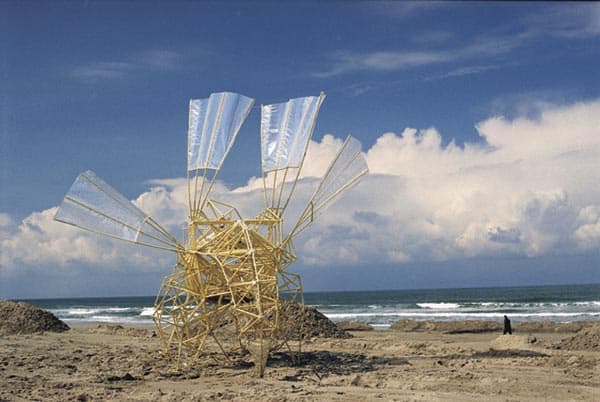
The basic material of my new nature is the plastic conduit normally used to house electrical cables. I play with it and something is created. For instance, the animals have “muscles”, which are essentially pumps made of tubes of different sizes that are put together like pistons; and “senses”, in the form of a tube that trails over the ground sucking in air. When an animal arrives at the sea it swallows the water and feels the resistance of it, which prompts it to run out again.

Can the animals move when it is not windy?

The beach animals have now developed to the stage where they can store the wind, which is important because if the wind died down and the tide came up, then the animals would be washed away. As the wind sweeps over the back of the animal, it fills up empty soft-drinks bottles. The animals can use this spare energy to power their muscles to get back to the dunes. The muscles are linked together in a network — when filled with air they stretch, and when stretched they can open a valve, which allows another muscle to stretch, and so on. I’m about to hook this network up to a “brain”, which would also be connected to the animal’s senses. This will allow them to count their steps away from the sea using binary digits — once they know their position relative to the water they can avoid it.

How far away are self-sufficient animals?

I think it will take another four years before the animals can survive on the beach because storms, especially, are very mean. I need to add a clock so that the animals can predict the tides and run away before the water comes up. Also they don’t like pits on the beach, so they need to be able to detect those, and they need to be able to make their sails smaller when the wind is strong and to anchor themselves in the sand so that they don’t blow away.

Surely your physics training must help you with this work?

Yes. For example, to develop the leg system I wrote a genetic algorithm to calculate the length of the tubes needed. I’ve also needed to know about geometry, pneumatics and the logic networks that you can make with binary digits. I also think that a lot of physicists are more like artists than they might want to acknowledge. You need a lot of imagination to understand the world.

Do you still keep up to date with physics?

Not really. I don’t read very much about physics. Instead, I try to find it out for myself. Sometimes this leads me into awkward situations — for instance, for many years people told me to use o-rings to make the pistons. I always ignored their advice until someone made a piston for me and it turned out to work much better than the way I used to make them. But this is the way I prefer to work.

• For pictures and videos of Jansen’s beach animals in action visit his website strandbeest.com

The global-village pioneers

The students whom I currently teach regard Al Gore as a Nobel-prize winner and think Google invented the Internet. They view 1998 as ancient history, whereas those of us in mid-career can remember 1988 (at least) as well as yesterday. And while each generation regards itself as somehow unique, in certain regards, some are more unique than others. In the case of my generation, there are objective reasons to believe that we have witnessed a fundamental change in the way that information is accessed, and how it is communicated to and from the general public, and among research professionals. And that is undoubtedly one of the most important paradigm shifts in recent history.

Mine was the first generation to have ready access to computers starting in what was then known as junior high school in the late 1960s. That meant a 100 baud teletype connected to a remote time-sharing system via an acoustically coupled modem, with paper punch tape as a storage medium for programs written in Basic and PL/I. By high school, I had been exposed to Fortran programming on punch cards, submitted in batch mode for line-printer output the next day, and had the edifying experience of multiply reloading a boot sequence into a PDP-8’s octal switches. Of course, all of this is gobbledegook to the iGeneration.

I first used e-mail on the original ARPANET — a predecessor of the Internet — during my freshman year at Harvard University in 1973, while my more business-minded classmates Bill Gates and Steve Ballmer, the future Microsoft bosses, were already plotting ahead to ensure that our class would have the largest average net worth of any undergraduate year ever. We were also the last generation to have experienced the legacy print system, and I paid what was then known as a secretary to type my doctoral thesis at Cornell University in 1981. The photocopy machine was a prime component of the distribution system back then, and I fondly recall teaching a recently retired Hans Bethe a thing or two about applied technology one slow weekend by helping him to clear a paper jam.

But significant elements of change were already in the air in the late 1970s. My thesis advisor, Ken Wilson, later a Nobel laureate, repeatedly promoted to us the need for massive parallel processing, and for the standardization of operating systems so that travellers to different institutions could immediately set to work without needing to learn a new interface. In the early 1980s, Wilson participated in the task force that advised the US National Science Foundation (NSF) to network together its soon-to-be-established supercomputer sites using the TCP/IP protocol. That NSFNet backbone hastened the federation of existing networks, and sparked the dawn of the current Internet era.

The use of e-mail became a more regular habit in the early 1980s, first within local computer systems and then via the growing primordial networks. Back at Harvard in that period, I once explained with some effort to my colleague Sidney Coleman the then non-obvious phenomenon of receiving an e-mail message via DECNet from the exterior, in this case from a former Harvard PhD student since moved to Berkeley. Struggling to grasp the far-reaching implications, he furiously paced in a circle and, then, with dawning comprehension, presciently summarized: “The problem with the global village is all the global-village idiots.”

The TeX generation

Following the appearance of Donald Knuth’s TeXbook in 1984 — the word-processing program that is today widely used to produce scientific papers — we switched en masse to computer typesetting our own articles. The transition for the then-younger generation was virtually instantaneous, since the new methodology was an improvement in both process and quality of final result over what had preceded it, namely bribing a secretary to cut and paste with scissors and glue. To facilitate cross-platform compatibility, Knuth intentionally chose plain text as TeX’s underlying format, in addition providing a standard code for transmitting mathematical formulae in informal e-mail communications. Back and forth e-mail exchanges would frequently become the first draft of an article. Nonetheless it took me real effort (and many years) to get Harvard’s physics department wired so that its VAX mainframe could be accessed from terminals in our offices. The prevailing sentiment among the senior physics faculty was that their seminal work had been possible without computer access, and the desperate need of a digital crutch was no doubt evidence of the incorrigible feeblemindedness of a younger generation.

As the various pre-existing networks melded into the Internet by the late 1980s, e-mail connectivity had reached critical mass in my own research community of high-energy physics. In those halcyon days, every message was from someone one knew personally, and contained useful content. It was thus not common practice to advertise one’s e-mail address, but in late 1987 two collaborators and I first included our e-mail addresses along with physical addresses in a preprint, initiating that now-universal trend.

The exchange of completed manuscripts to personal contacts directly by e-mail became more widespread, and ultimately led to distribution via larger e-mail lists. The latter had the potential to correct a significant problem of unequal access in the existing paper-preprint distribution system. For purely practical reasons, authors at the time used to post photocopies of their newly minted articles to only a small number of people. Those lower in the food chain relied on the beneficence of those on the A-list, and aspiring researchers at non-elite institutions were frequently out of the privileged loop entirely. This was a problematic situation, because, in principle, researchers prefer that their progress depends on working harder or on having some key insight, rather than on privileged access to essential materials.

By the spring of 1991 I had moved to the Los Alamos National Laboratory, and for the first time had my own computer on my desk, a 25 MHz NeXTstation with a 105 Mb hard drive and 16 Mb of RAM. I was thus fully aware of the available disk and CPU resources, both substantially larger than on a shared mainframe, where users were typically allocated as little as the equivalent of 0.5 Mb for personal use. At the Aspen Center for Physics, in Colorado, in the summer of 1991, a stray comment from a physicist, concerned about e-mailed articles overrunning his disk allocation while travelling, suggested to me the creation of a centralized automated repository and alerting system, which would send full texts only on demand. That solution would also democratize the exchange of information, levelling the aforementioned research playing field, both internally within institutions and globally for all with network access.

Thus was born xxx.lanl.gov, initially an e-mail/FTP server. It was originally intended for about 100 submissions per year from a small subfield of high-energy particle physics, but rapidly grew in users and scope, receiving 400 submissions in its first half year. (Renamed in late 1998 to arXiv, it has accumulated roughly 500,000 total submissions and currently receives another 60,000 new submissions every year.) The system quickly attracted the attention of existing physics publishers, and in rapid succession I received congenial visits from the editorial directors of both the Institute of Physics and American Physical Society (APS) to my tiny office.

The birth of the Web

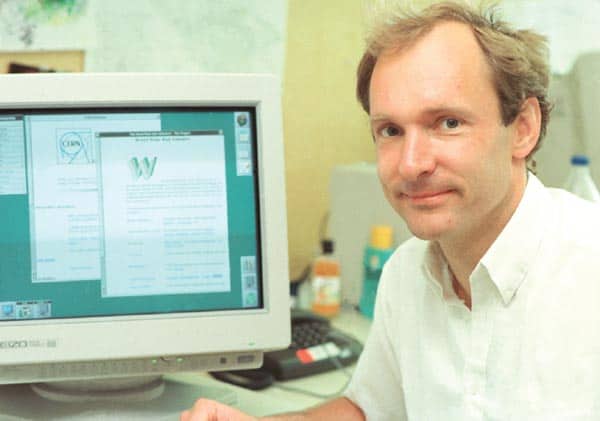
In the autumn of 1992, a colleague at CERN e-mailed me: “Q: do you know the world-wide-web program?” I did not, but quickly installed WorldWideWeb.app, coincidentally written by Tim Berners-Lee for the same NeXT computer that I was using, and with whom I began to exchange e-mails. Later that autumn, I used it to help beta-test the first US Web server, set up by the library at the Stanford Linear Accelerator Center for use by the high-energy physics community. Use of the Web grew quickly after the Mosaic browser was developed in the spring of 1993 by a group at the National Center for Supercomputer Applications at the University of Illinois (one of those supercomputer sites initiated a decade earlier but poised to be replaced by massive parallelism), and it was not long before the Los Alamos “physics e-print archive” became a Web server as well. Editorial control of the repository was barely necessary in those days, with the Internet still something of a private playground for academics, subject to few intrusions from the outside world.

Not everyone appreciated just how rapidly things were progressing. In early 1994 I happened to serve on a committee advising the APS about putting Physical Review Letters online. I suggested that a Web interface along the lines of the xxx.lanl.gov prototype might be a good way for the APS to disseminate its documents. A response came back from another committee member: “Installing and learning to use a World Wide Web browser is a complicated and difficult task — we can’t possibly expect this of the average physicist.” So the APS went with a different (and short-lived) platform.

In the summer of 1994 Tim Berners-Lee, on his way out of CERN to found the World Wide Web Consortium at the Massachusetts Institute of Technology, kindly hosted me overnight at his home. We discussed the implications of personal-computer chips suddenly leapfrogging over heavy-duty workstations in performance, and the attendant dawning era of ubiquitous webservers. We marvelled at how the Mosaic browser’s support of in-line graphics had transformed the perception of the Web’s utility, and foreshadowed the rise of advertising.

During 1995, the penetration of our formerly private academic resources into the popular neocortex accelerated, with some form of “gee whiz” Internet news story almost every day; including how the World Wide Web had become the killer app, coupled with Netscape’s public offering, the sky-is-the-limit futures of recent start-ups such as Yahoo, Time magazine’s scare stories on the effects of cyberporn on children, and ending with 1995 being named the “year of the Internet” by Newsweek magazine. While in Paris for a conference in 1996, I was struck by all the URL addresses adorning the sides of vans and buses, signalling in a most public way the encroachment of commercial skyscrapers into our little academic playground. The new “information superhighway” was heavily promoted for its likely impact on commerce and media, but the widespread adoption of social-networking sites facilitating file, photo, music and video sharing was not widely foreseen.

Fast-forwarding through the first dot-com boom and bust, and the emergent Googleopoly, the effects of the technological transformation of scholarly communications infrastructure are now ubiquitous in the daily activities of typical researchers, lecturers and students. We have ready access to an increasing breadth of digital materials difficult to have imagined a decade ago. These include freely available peer-reviewed articles from scholarly publishers, background and pedagogic material provided by its authors, slides used by authors to present the material and videos of seminars or colloquia on the material — not to mention related software, online animations illustrating relevant concepts, explanatory discussions on blog sites, often-useful notes posted by third-party lecturers of courses at other institutions, and collective wiki-exegesis.

A major lesson of the past decade has been that relatively simple algorithms and ample computing power applied to massive datasets result in resources the utility of which far exceed the naive sum of their conceptual components. Web-search heuristics, hyperlinked journal references and citations, together with search indexes, social-networking sites, Amazon and other commercial sites, are all examples of this. There are also threshold effects, in which seemingly minor improvements in software can have an overwhelming impact, for example using customized Web browsers instead of FTP or e-mail transponders. Similarly, blogs are fundamentally no different from the websites of a decade ago, but the pre-packaged software and tools for creating, linking and maintaining them crossed some critical threshold and resulted in a new phenomenon. Recently, glancing over my shoulder at someone in his 20s blogging a seminar, I was struck by how a native laptop-user can navigate text and search windows faster than the eye can follow, and assemble references, photos and graphics from multiple sources, simultaneously replying to comments, and in the end spending far less time to assemble a set of useful pedagogic pages, accessible to the entire world, than I spend writing problem-set solutions for a small class.

Tales of the unexpected

While looking ahead, it is also useful to assess some recent mistaken expectations. In the mid-1990s, full-text searching appeared to many of us as a bootless exercise. Search engines of the time — such as AltaVista — sort of worked due to the comparatively small amount of online information, but the methodology could not possibly scale as more info came online: if 10 times the number of pages meant that every query would bring up 10 times as many results, then any signal would be smothered by the overload. But we have since learned that a relatively simple, yet nonetheless ingenious, set of heuristics can be used to order the search results, making use of the link structure of the Web in addition to the text content of pages, so that for many typical queries the desired information appears among the top 10 results returned, and there is no need to peruse the many thousands of others.

That sceptical attitude regarding the potential efficacy of full-text searching carried over to my own website’s treatment of crawlers as unwanted nuisances. Seemingly out-of-control and anonymously run crawls sometimes resulted in overly vociferous complaints to network administrators from the offending domain. I was recently reminded of a long-forgotten incident involving test crawls from some unmemorably named stanford.edu-hosted machines in mid-1996, when both Sergey Brin and Larry Page graciously went out of their way to apologize to me in person at Google headquarters for their deeds all those years ago. Whatever was the memorable action taken by their system administrators, they were apparently not deterred for long.

More recently, it was tempting to argue that a Wikipedia-like entity could not possibly work in the long run, that as soon as it became sufficiently popular it would devolve to a Usenet newsgroup cacophony of opinion and potential misinformation. Yet after some publicly noted mishaps, the primary Wikipedia site has evolved its policies to encourage academic practices such as citation of sources, and in the short-term remains surprisingly useful for a variety of academic and non-academic purposes.

In the direction of less-than-anticipated change, a decade and a half ago I certainly would not have expected the current metastable state in physics publications, of preprint servers happily coexisting with conventional online publications, the two playing different roles. And it was not obvious two decades ago that a new generation of equation-intensive scholars would still be coding TeX by hand, without a proper WYSIWYG interface. In part, that is because newer methodologies have not been improvements in all relevant regards, as TeX was over its predecessors.

Physicists have been quick to adopt widespread prerefereed distribution of scientific papers, but that has not been the case in other fields. While quick and efficient information processing is a central component of scientific communication, scientific communities are also subject to internal social norms, which shape the use of new technologies. In the biomedical and life sciences, for example, adoption of preprint servers may be impeded by a long-standing tradition of regarding only refereed journal publication as a legitimate intellectual priority claim, together with concerns about public-health implications of the distribution of potentially misleading unrefereed results.

The future and beyond

The new electronic infrastructure is moreover most frequently used as little more than a new means of distribution, and even the underlying document formats have not sufficiently evolved to take advantage of significant new opportunities. We are only slowly moving from a situation in which the title, authors, references and other dependencies of documents have to be guessed by cutting-edge artificial-intelligence techniques to newer formats that automatically expose all such relevant metadata for standard query interfaces. The current network benefits to readers will be increasingly shared by authors, as a new generation of network-aware authoring tools will analyse draft document content in progress, suggesting links to related external text and data resources, including semantic linkages. Paraphrasing Marvin Minsky, the visionary co-founder of the AI Lab at the Massachusetts Institute of Technology, someone should soon ponder “Can you imagine they used to have an Internet in which authors, databases, articles and readers didn’t talk to each other?”.

Scholarly journals were the earliest example of “Web 2.0” methodology, insofar as it describes the deployment of some skeletal infrastructure into which users deposit content, the value of which in turn is increased by general accessibility. But academic researchers have been slower to incorporate the latest round of social-networking tools into their regular practices. When the Internet was essentially an academic monopoly, new developments were naturally adapted to the needs of researchers. The focus is now elsewhere, and the vast resources invested in commerce and entertainment have left scientists momentarily behind the forefront of interactive Web phenomena. The very nature of scholarly pursuits could leave academics slightly displaced from the bleeding edge, with the shift of the centre of mass towards popular consumption resulting in an ever-smaller percentage of new resources directed, or well adapted, to academic pursuits.

Many useful lessons can nonetheless be inferred from the popular arena. For example, no legislation is required to encourage users to post videos to YouTube, whose incentive of instant gratification comes through making personal content publicly available (which parallels with the scholarly benefit of voluntary participation in the incipient version of arXiv in 1991.) If scholarly infrastructure can be upgraded to encourage maximal spontaneous participation, then we can expect not only an increasing availability of materials online for algorithmic harvesting — articles, datasets, lecture notes, multimedia and software — but also qualitatively new forms of academic effort. Adding comments and explanations to texts and linking papers to databases, will become increasingly important, acting to glue different components of knowledge together. Such work will need to be credited as scholarly achievement, along with the future analogue of conventional journal publication. The goal is the creation of a semi-supervised and self-maintaining knowledge structure, which can be more naturally navigated, without redundancy and ambiguity. Our browsing of the literature will become far more comprehensive; and our reading of individual papers that much more incisive, guided by links to explanatory and complementary resources tied to words, equations, figures and data.

The result will be a transformation in the way we process scientific information, much as the availability of interlinked network resources has led to new “non-linear” reading strategies, and the availability of networked mobile devices has altered the way we use our short- and long-term memories. The Internet, World Wide Web, search engines and other developments described here all initially stemmed from the academic community’s need to transmit, retrieve and organize information. It is exciting to project that new research and cognitive methodologies to be developed for academic use may ultimately be adopted as well by the general public for the creation and dissemination of knowledge.


Two decades and counting…

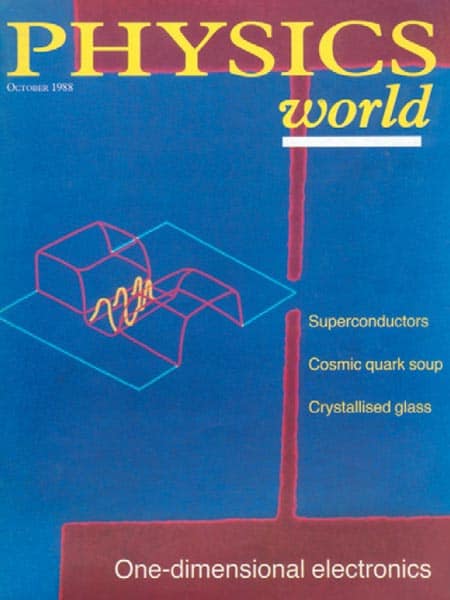
Sitting on the shelves of the Physics World office is a line of green, bound volumes, looking a bit like PhD theses, each containing a whole set of back issues of this magazine from a particular year. It is a strange and rather sobering feeling to take down the first volume and look back at that very first issue of Physics World in October 1988. What is striking is just how much — and yet how little — physics has changed over the last 20 years.

Back then physicists in the UK were grumbling about subscription fees to the CERN particle-physics lab near Geneva. Members of the House of Lords were calling for an underground repository for nuclear waste that has still not been built (under the great headline “Lords opt for deep dumps”), while researchers were desperately trying to understand high-temperature superconductors, which had been discovered just two years earlier. Yet who then could have foreseen the rise of the Internet, the discovery of dark energy, or the incredible progress in quantum computing and communication?

As for Physics World itself, we too have changed in those 20 years, although our core values and principles remain essentially unchanged. Articles are now, as then, timely, accurate, well written and global in outlook. Some articles are by practising physicists, while others are written by our own editorial staff or by freelance science correspondents. But thanks in part to advances in desktop-publishing software, Physics World now looks far better visually and typographically, with colour images throughout.

What has also changed is that feature articles, though still rigorous, are easier to understand than they were 20 years ago. Through careful editing, our aim is to ensure that a physicist from one field of the subject can understand a feature on another area from beginning to end — no easy task given that medical physicists and cosmologists, say, are worlds apart.

Challenged by the Web

But in this age of the Web, what is the purpose of a monthly magazine like Physics World? Does it still have a function when the Internet can provide more information than one might want, or even care, to have? Who needs Physics World when Wikipedia, say, has perfectly adequate introductions to Bose–Einstein condensation, magnetic resonance imaging or superfluidity?

Back in the early days, we had the luxury of knowing that Physics World was one of the few sources of reliable, timely and easily understandable information about physics. As a specialist magazine, we could provide access to physics news that would be difficult, or even impossible, for the average reader to gain otherwise. Readers could, in principle, demand that press releases be faxed to them from physics labs or sift through every new journal in the library, but in practice that was a difficult, if not Sisyphean task.

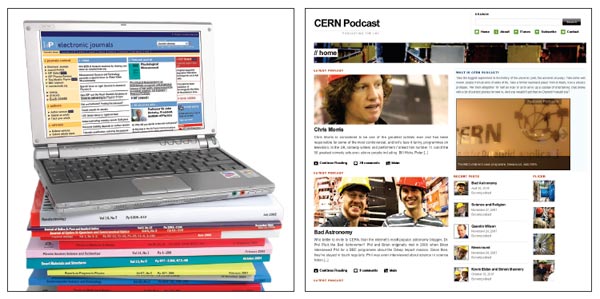
We still do, of course, pride ourselves in being a key source of information — be it details of this year’s Nobel prize or the latest grants from the European Research Council — but physicists, should they so wish, could find such material from other sources at the click of a mouse. Press releases, journal papers, gossip, views, opinion and debate can all be found in an instant on the Web. There are physics blogs, wikis, podcasts, videos, all of which are easily — and usually freely — available to anyone.

We, as one might expect, are convinced that Physics World still has a vital role to play. While it is true that information is now a commodity that can be easily and rapidly accessed online, there is simply so much stuff out there that it can be hard for anyone — physicists included — to know who or what to trust. What Physics World can do is provide sane, balanced, independent analyses of what is going in physics. We can filter all that excessive material on your behalf — ignoring, say, many of the scientifically dubious preprints on arXiv — and package the essential stuff into informative, entertaining and well edited articles.

We can provide great graphics and visuals, top-name authors and lucid science writing. We can report on trends, provide forward looks, and, occasionally, unearth scoops, like our news story about a Russian firm that mysteriously wanted to look for oil in the English Midlands using “microleptons”. We can provide information about developments around the globe and insights into fields that you might not otherwise come across.

And, of course, we have our own website physicsworld.com too. Our team has been providing daily reports on the latest research papers in physics for over a decade now, but we used not to pay as much attention to more general science news. That is now changing. While we still do provide timely coverage of the most important papers from the likes of Nature, Science and Physical Review Letters, in recent months we have, for example, also looked at the US presidential candidates’ policies on science and had detailed coverage of the start-up of CERN’s Large Hadron Collider.

Users of physicsworld.com can comment on articles, search for jobs via the dedicated careers channel, read our regularly updated blog, or access specialist industry focuses. There is also a “digital” version of the print magazine that can be read for free by members of the Institute of Physics, which publishes Physics World. Identical to the print issue, it allows copies of the magazine, back to May last year, to be accessed any time, anywhere via the Web.

The next 20 years

As for the future, without a doubt the Web will grow ever more important. Physics World has always been a benefit to members of the Institute but already from this month all new student members will only get free access to the digital version of the magazine, but not a print copy. Who knows, perhaps one day Physics World will only exist in a digital form, downloadable to your $5 flexible, polymer-based electronic paper.

The challenge for us is how to ensure that as the demand for instant information and comment grows, the values of Physics World — clarity, accuracy and timeliness — remain true. That can be tricky if we want to write a 500-word story about, say, the discovery of the Higgs boson if we only have a few hours to get it up on our website before all other rival media outlets have reported on it first. That is where a monthly magazine has the edge over a website, by allowing more time to get under the skin of stories and provide a deeper analysis.

As you would expect, we are not resting on our laurels. We need to do more to boost our coverage of physics in industry, which is not easy when many potential authors are too busy, unwilling or not permitted to write for us — or are simply prevented from doing so because of commercial confidentiality. There is much going in the emerging superpowers of physics — China and India — that we need to unearth. And, of course, we have to remain vigilant that all areas of physics are covered, not just the more “sexy” areas of particle physics and cosmology.

It will be intriguing to think what my successor in 20 years’ time — assuming that Physics World still exists — will make of this status report. By then, practical quantum computers could well be used for research and high-temperature superconductors will be common in power cables. The International Linear Collider is likely to be up and running, and fusion power should be nearing as a commercial reality. Computing and the Internet will have infiltrated even more into our everyday lives. But it is safe to say that those green, bound volumes of Physics World will still be sitting on the shelves; and that physicists will still be grumbling about CERN subscriptions.

Physics World milestones

October 1988

Physics World launched as a successor to Physics Bulletin
November 1994
Launch of the Physics World Electronic News e-mail service
September 1995
Peter Rodgers replaces founding editor Philip Campbell
January 1997
100th issue special
November 1997
Physics World is redesigned and its website physicsweb.org is launched
December 1999
104-page “millennium issue”
January 2005
Einstein special issue marks International Year of Physics
September 2005
Second major redesign
March 2006
Matin Durrani appointed editor; Archive of all past articles made available to institutions
July 2007
Redesign and relaunch of website as physicsworld.com; Launch of a digital version of the magazine

To celebrate Physics World’s 20th anniversary, we have nominated our favourite 20 magazine covers. Now it’s your turn to let us know what you think. Cast your vote for the best Physics World cover.

Copyright © 2026 by IOP Publishing Ltd and individual contributors