A resolvable contradiction

“Boston…is America’s science town,” began David Baltimore at a breakfast buffet this morning. He was speaking to a room full of journalists in the Hynes Convention Center with the intention of giving a taster of his formal address later this evening. Before he started I had just got a quick introduction with the few other people at my table. On my right, a retired local freelancer who wrote, not to make ends meet, but to “pass the time”. On my left, my colleague Liz Kalaugher from environmentalresearchweb.org, and beyond her a couple of excitable Georgian reporters.

Baltimore’s brief talk centred on the growing amount of science research being performed in developing countries; potentially bad news for the US as the current leading research nation. Home to almost half of the world’s population, China and India have a long-term advantage over the West if they are to benefit from a research-driven economy. Last year, China produced a million science graduates. “Europe and the US will lose our advantage if we don’t pay attention to development in the future,” Baltimore said.

So which is more important: having a stronger global scientific community, or having that community strongest in the US? “It’s not an irresolvable contradiction,” he went on to explain. In essence, Baltimore advocates the encouragement of scientific research both nationally and globally — presumably as long as the bias stays right. “The world has gotten flatter, but it is still tipped toward the West,” he added.

Siblings of Jupiter and Saturn discovered

Astronomers have discovered a pair of planets orbiting a star 5000 light years away that together look remarkably like a scaled-down version of our own solar system. The planets, which were spotted using a technique called gravitational microlensing, are both smaller than Jupiter and Saturn and are orbiting a star about half the size of our Sun. The discovery suggests that star systems like our own might be more common than we think.

Astronomers have so far found nearly 250 extrasolar planets using a variety of techniques, such as studying how fast pulsars rotate or watching how a parent star dims as a planet passes in front. But most of these planets were much closer to their parent stars than Jupiter and Saturn are to our Sun, which led astronomers to wonder if star systems similar to ours might be rare.

The two new planets have been discovered by researchers from 11 countries, who are part of the Optical Gravitational Microlensing Experiment (OGLE) (Science 319 927). The other teams involved are MicroFUN, MOA, PLANET and RoboNet. The larger planet is a slightly smaller version of Jupiter, having about 70% of its mass. The other planet is only about 30% of the mass of Jupiter, making it closer in size to Saturn.

The new planets are also much closer to their parent star. In our solar system, Jupiter lies about 5.2 times as far from the Sun as the Earth does — i.e. it is a distance of 5.2 Astronomical Units (AUs) from the Sun — while Saturn lies about 9.5 AUs away from the Sun. In the new solar system, however, the larger planet is 2.3 AUs from its sun, while the smaller planet is 4.6 AUs out.

The sun at the heart of the new solar system is also dimmer than our Sun but the temperatures on the two planets are probably similar to those on Jupiter and Saturn because they are closer to their star.

Gravitational microlensing

The star at the heart of the new planetary system is known as OGLE-2006-BLG-109L and was found when it crossed in front of a more distant star being observed from Earth. Thanks to gravitational microlensing, the gravity of the star and its orbiting planets acted as a lens, bending and magnifying the light from the background star.

For two weeks in March and April 2006, OGLE-2006-BLG-109L magnified the light from the background star by a factor of 500. The properties of the star and the planets were then determined by analyzing how the complex patterns of the magnified background light change as the planetary system passes in front of the background star.

Solar-system analogue

Lead author Scott Gaudi told physicsworld.com that he and his colleagues should be able to detect systems similar to one they found “fairly regularly” — if such systems are indeed common. “As far as finding systems with Earth-like planets, in the parts of their systems where we expect liquid water, this will have to wait until a space-based mission,” he says.

“Our method is currently sensitive to Earth-mass planets with longer orbits, that is at several astronomical units (AU),” he added. An AU is the distance from the Earth to the Sun. “If these are common, we should be finding them very soon.”

Common throughout our Galaxy

The new planets are only the fifth and sixth to have ever been detected using gravitational microlensing and the planets could not have been found with any other technique. “This is the first case in which a Jupiter-mass planet was detected where we had significant sensitivity to additional planets,” said Gaudi. “You could call it luck but I think it might just mean that these systems are common throughout the Galaxy.”

The astronomers say they now have data from another six new planets, discovered last year, which they will be analysing over the next few months. They will also continue looking for other new planets as soon as the new season of observations begins. “In the more distant future, we hope to set up a ‘next generation’ microlensing survey that will detect Earth-mass planets at the rate of several per year,” revealed Gaudi. “We might even be able to get a complete census of planetary systems throughout our Galaxy.”

Napoleon not murdered, say physicists

The idea that Napoleon Bonaparte was murdered by arsenic poisoning appears to have been ruled out by new research by nuclear physicists in Italy.

The team analysed samples of the French emperor’s hair that they had irradiated with neutrons and found that it contains about the same amount of arsenic as hair from several of his contemporaries — suggesting that the poison probably came from environmental sources such as wallpaper dyes, rather than from a malicious poisoner.

The official cause of Napoleon’s death in 1821 is stomach cancer, but the idea that he was murdered gained scientific credibility in 2001 when forensic experts in France found levels of arsenic in samples of the emperor’s hair about 40 times higher than found in modern hair. This seemed to support theories that had emerged in the 1950s that Napoleon had been poisoned either to prevent him from regaining control of France, or to make him so ill that the British allowed him to return to France from exile on the island of St Helena in the South Atlantic Ocean.

Research reactor

Ettore Fiorini of the Milano-Bicocca University and colleagues at Milano-Bicocca, Pavia University and the laboratories of the Italian National Institute of Nuclear Physics (INFN) in Milan and Pavia analysed a range of hair samples using a research reactor at Pavia. These samples included Napoleon’s own hair from: when he was a child in Corsica in around 1770; when he was exiled on the island of Elba in 1814; on the day of his death on St Helena; and on the day after his death. The researchers also analysed several strands of hair from Napoleon’s son and his first wife, the Empress Josephine — as well as hair from people living today.

Each individual hair was placed inside a container and subject to a large neutron flux inside the reactor. In this way, arsenic nuclei in the hair (arsenic-75) could gain a neutron, become unstable, undergo beta decay and then, in an excited state, emit high-energy gamma rays.

Ultra-sensitive germanium detectors

The challenge for the researchers was to pick out these gamma rays from a host of environmental gamma radiation, and they did so by using ultra-sensitive germanium detectors based on technology also used in the Cuore nuclear physics experiment under construction at the Gran Sasso underground laboratory in central Italy. The work is described in a forthcoming paper in the journal Il Nuovo Saggiatore.

Our conclusion is that the death of Napoleon was probably natural Ezio Previtali, INFN Milano-Bicocca

The analysis allowed the team to conclude that arsenic was not administered maliciously to Napoleon. The scientists found that all of the hair samples from 200 years ago contained arsenic at levels — around ten parts per million — that are about 100 times greater than those in the hair of people living today.

Green wallpaper

The Italian researchers do not know exactly where the arsenic came from but they believe their results clearly indicate that Napoleon absorbed arsenic thoughout his life rather than being administered a fatal dose. For example, while on St Helena, Napoleon may have absorbed some of the substance from green colouring in wallpaper, say the researchers.

“Our conclusion is that the death of Napoleon was probably natural,” says Ezio Previtali of INFN Milano-Bicocca. “However,” he adds,” this is unlikely to be the end of the story. There are plenty of others who will still believe he was murdered.”

Fibres could generate electricity from body motion

‘Power dressing’ could take on an entirely new meaning thanks to novel energy-scavenging textile fibres created by researchers at the Georgia Institute of Technology in the US. They claim that a pair of trousers worn by a hiker or a tent fluttering in the breeze could generate enough electricity to charge a mobile phone, if they were made from fabric woven from the fibres.

The fibres consist of millions of 100 nm-diameter zinc oxide nanowires grown on the surface of much larger Kevlar strands. The nanowires are about 3.5 µm long and radiate outwards from the surface of the Kevlar, which can then be twisted together to create thicker fibres and ultimately woven to make a durable fabric.

Piezoelectric material

When such a fabric is stretched, crumpled or otherwise disturbed, the nanowires would rub against each other and bend. Because zinc oxide is a piezoelectric material, this bending causes several millivolts to develop along the nanowire.

According to Georgia Tech’s Zhong Lin Wang, who led the project, the key challenge in designing fibres for such a “piezotronic” material is how to extract tiny amounts of electricity from lots and lots of nanowires (Nature 451 809).

Twisted pair

To prove that they could do this, the team coated one Kevlar-nanowire strand with gold and twisted it around a second bare Kevlar-nanowire strand. Since gold is a good conductor and zinc oxide a semiconductor, a Schottky barrier is formed where the nanowires touch. This means that current can flow in one direction across this barrier allowing an electrical circuit to be made and electrical energy extracted from the bare nanowires.

The team connected an ammeter between the gold and bare strands and the entwined strands were flexed so that one strand rubbed against the other. For entwined strands several millimetres long, Wang and colleagues measured a peak current of about 4 nA. The team estimate that a fabric made of the material would contain millions of such strands and that it could generate as much as 80 mW per square metre. However, Wang cautioned that connecting up all these strands to extract a useful amount of energy remains a significant challenge.

Wind energy

According to Wang, such a fabric would be strong and light weight and several layers could be designed into a garment that could power a portable electronic device or charge a mobile phone from the wearer’s movements. It could also be incorporated into tents, curtains or flags that could harvest energy from the wind.

Wang has applied for several patents and has just set up a company called Nanopiezotronics to commercialize the technology. While he wouldn’t say how much it would cost to make his fabric, it is likely to be expensive and as a result Wang believes that the military will be the first to use the technology.

Theorists weigh up new route to neutrino mass

When it comes to weighing elementary particles, a set of scales is not much use. The mass of the electron, for instance, is about 10-30 kg and can only be determined by relying on its mathematical relationship with other properties that can be measured in experiments. But weighing neutrinos, which are at least a million times lighter than electrons, presents an even greater challenge. This situation has prompted three physicists in the US to suggest a new method to try and pin down their mass.

“If the neutrino has mass then it must have a magnetic moment,” says team member Michael Schmitt of Northwestern University. “We have turned this logic around to see whether it is possible to infer the neutrino mass by observing such a small magnetic moment.”

It would seem, however, that the chances are slim.

Neutrino oscillations

Exactly why neutrino masses are so small compared to those of other elementary particles is a mystery. In fact, before 1998, neutrinos — which come in three types — were thought to be massless in accordance with the standard model of particle physics. But that year researchers at the SuperKamiokande experiment in Japan found that the ratio of electron– type to muon– type neutrinos produced by cosmic rays striking the atmosphere on one side of the Earth was different to the ratio it detected from those striking the other side. This verified earlier suspicions that neutrinos can change identity as they propagate, which means they must have mass.

We hope that some imaginative experimenters might have a great idea based on our paper Michael Schmitt, Northwestern University

Neutrino oscillations provide the only real handle researchers have on the masses of these ghostly neutral particles. But since the probability that one type of neutrino will oscillate into another is proportional to the difference between the squares of their masses, neutrino oscillations do not allow the masses of individual neutrino types to be determined. Even a poor measurement of the neutrino masses would therefore be a huge step forward to solving the mystery of their origin, perhaps also improving physicists’ knowledge of other neutrino-oscillation parameters.

Schmitt along with Armen Apyan of Northwestern University and his son Aram Apyan, who is currently an undergraduate at Illinois Institute of Technology, have now calculated the size and shape of the electrical pulse that would be produced in a loop of wire if a neutrino were to pass through it (Phys Rev D 77 037901). Behaving like tiny bar magnets, neutrinos would change the magnetic flux through the loop and induce a certain current in accordance with Faraday’s law. Since the magnetic moment of the neutrino is directly proportional to its mass, that current would allow the mass of each neutrino type to be inferred directly.

Very small

The team’s calculations, which had to be fully relativistic and were mostly performed by the junior Apyan while he was still at high school, suggest that the pulses would be miniscule. Assuming the current upper limit on the neutrino mass (1 eV or about 10-36 kg) and a magnetic moment of 10-10 ”Bohr magnetons”, the amplitude of each pulse from a passing neutrino turned out to be 16 orders of magnitude smaller than the voltage of a 1 V battery. “This is much smaller than any signal that I know of in a real experiment,” says Schmitt. To make matters worse, the pulses would last for just 10-21 s — which Schmitt says makes them faster than a bolt of lightning.

So could an experiment ever detect such a signal? According to Sunil Somalwar now at Rutgers University, who in the 1980s used a similar (but real) apparatus to search for magnetic monopoles, it may be possible to use superconducting quantum interference devices (SQUIDS) to detect currents all the way down to 1 fA (10-15 A). “But that’s a far cry from the 10-45 A predicted here, even if lots of neutrinos were bunched together in the beam from an accelerator,” he adds.

Although Schmitt accepts that the neutrino signals are too small to be observable with current technology, the team points out that its technique could allow researchers to test how how the magnetic moment of other particles behaves under Lorentz transformations. “We hope that some imaginative experimenters might have a great idea based on our paper,” he says.

Science and technology from a global perspective

The 2008 meeting for the American Association for the Advancement of Science (AAAS) is perhaps the biggest general science fair of the year. Not only is it a chance to catch up on all the latest breakthroughs in physics, it is a chance to see physics as it should be: seamlessly integrated with all the other sciences.

David Baltimore, AAAS president and co-recipient of the 1975 Nobel Prize for Medicine, puts it better than I can. In the introductory blurb for the press programme, he writes that the theme of the meeting, Science and Technology from a Global Perspective, “emphasizes the power of science and technology as well as education to assist less-developed segments of the world society, to improve partnerships among already developed countries, and to spur knowledge-driven transformations across a host of fields.”

Clearly, not everyone has either the opportunity or time to go to Boston, but even those of you who are going to attend the meeting will be unable to sit-in on every talk (and I’ll refrain from making a hackneyed quip here about quantum superposition). Needless to say, neither can a lone reporter for physicsworld.com, though I can invite you to experience my own random walk through the symposia. So, from global warming to gamma-ray bursts, from nanotechnology to nuclear power, from optics to open access, from planets to particle physics, from radiation to religion and from quantum information to questionable ethics — over the next five days I will report on as much of it as possible.

Firms call for support of ‘nanophotonics’ R&D in Europe

An organization representing many of Europe’s leading photonics firms and research labs has drawn up a roadmap recommending that the European Commission (EC) boost its support for research into improving the fabrication of photonic devices based on quantum dots, carbon nanotubes and other nanometre-scale technologies.

The European Roadmap for Photonics and Nanotechnologies is the culmination of a two-year effort coordinated by the Merging Optics and Nanotechnologies (MONA) group, which includes firms such as Aixtron and ASM; labs such as Belgium’s IMEC; and the 78 members of the European Photonics Industry Consortium. The 161-page document offers recommendations for the next 5–10 years of nanophotonics R&D and includes contributions from more than 300 experts in the field.

Key markets

The roadmap calls for the EC’s Seventh Research Framework Programme (FP7) — which coordinates the funding of research in the European Union until 2013 — to support the development of nanoscale technologies for seven key markets for photonics devices.

The need to improve the fabrication of quantum dots is a strong theme of the roadmap, which predicts that these tiny semiconductor devices will have a major impact in almost all photonics markets. It is currently very difficult to make large numbers of quantum dots that are all the same shape and size — something that is crucial for industrial applications.

Quantum dots

One important recommendation is that quantum dots based on compound-semiconductor materials such as gallium arsenide should be developed for us in solar cells. This is because such dots have been shown to be much more efficient at converting light into electricity than standard photovoltaic materials.

Imaging, lighting and data storage are three other applications where quantum dots could have an impact, says the roadmap. And quantum dots and wires integrated with silicon devices will also be important for optical communications, UV sensors and multi-junction solar cells, according to MONA.

Photonic crystals

The report calls for intensified R&D in lighting applications, where technologies such as quantum dots, photonic crystals and nanostructured materials are expected to offer efficiency improvements in light-emitting diodes (LEDs). This is seen as important strategic area for European research, with both Osram of Germany and Philips of the Netherlands playing on the world stage.

Imaging is another field where Europe can already boast a strong research base and global market presence. For visible imaging, the roadmap highlights the need for nanostructured lenses, most likely based on plasmonic devices, to produce CMOS image sensors with ever smaller pixel sizes. And infrared imaging specialists such as Sofradir and CEDIP are hoping to use quantum dot structures in a new generation of detectors that will replace existing quantum-well infrared photodiodes (QWIPs).

Other important areas earmarked for future research funding include microstructured fibres for telecom and sensor applications, organic nanostructures for displays and photovoltaics, and photonic integration for telecom and optical interconnects. Carbon nanotubes also feature as an important nanomaterial for future field-emission displays.

Secret of sandcastle building revealed

Making a sandcastle is child’s play because adding a seemingly random amount of water to dry sand makes a sticky material that is easy to work with. However, exactly why sand is sticky over a wide range of water content had been a mystery, with important implications in civil engineering and especially the prevention of landslides. Now, an international team of researchers thinks that it has the answer, based on a microscopic study of exactly how water glues sand grains together.

This glue is thought to be the familiar capillary force that causes water to move up the edge of a container. However, the structures that are formed when the grains stick together are extremely complex and vary greatly with how much water is in the sand. This has made it very difficult to understand exactly how the mechanical properties of sand are affected by water.

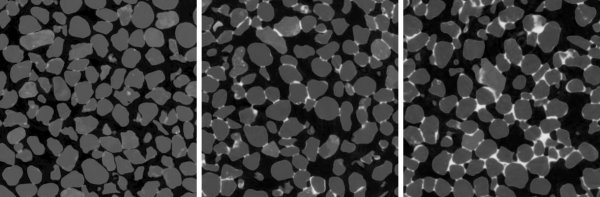
Now, Stephan Herminghaus of the Max Planck Institute for Dynamics and Self Organization in Göttingen, Germany, and colleagues have tackled this problem by studying 3D images of wet glass beads using X-ray microtomography (Nature Materials 7 189). The beads were of a similar shape and size as natural sand.

sand

When a liquid was added to the dry beads, liquid structures called “capillary bridges” were seen to form between grains. As more liquid was added to the beads, small bridges grew into larger structures. As these bridges grew, the surfaces of individual beads came into contact with more water, which tends to increase the binding effect of the water. However, the size of the capillary forces decreases as the bridge structures get bigger and the team believe that these two effects cancel each other out, so that the forces binding the beads together remain the same as the moisture content changes.

As the water content is further increased, the bridges between beads coalesce and act to bind several beads together into larger structures. These structures grew as more water was added but their mechanical properties — including stickiness — remained the essentially the same.

This was confirmed by the team by measuring how the material responded to an applied stress.

“Our work gives a clear and detailed physical understanding of how a wetting liquid is distributed within a granular pile and how it influences its mechanical stability by virtue of capillary forces,” team member Ralf Seemann told physicsworld.com. “The result explains why the mechanical properties are unaffected by the amount of liquid in the sample and is valid for non-spherical grains, like sand, as well as spherical ones.”

The imaging technique could lead to a better understanding how grain–liquid–air interfaces interact in granular materials. Such knowledge could be used to prevent powders from forming clumps or even understanding and preventing landslides.

The team, which includes scientists from the ESRF in Grenoble, France, and the Australian National University, will now explore the limits of the behaviour they have observed by looking more closely at the packing geometry, packing density and wetting angles of the water–sand structures. It will also perform time-resolved studies of what happens a sheering force breaks these structures and the liquid is redistributed, which could shed light on the dynamics of how wet sand flows.

Seeing the hidden fresco

Spread over a 16 m-wide wall in the Palazzo Vecchio town hall in Florence, Leonardo da Vinci’s The Battle of Anghiari is a magnificent fresco depicting two horse riders in combat. Also impressive are la America Tropical by the Mexican muralist David Alfaro Siqueiros in the Italian Hall in Los Angeles, and the numerous frescos adorning the ancient Hagia Sophia church in Bulgaria. Unfortunately no one can see these paintings: they are all hidden beneath a layer of plaster.

If studies by a team of scientists from the US and France continue to prove successful, however, then it could be only a matter of time before such frescoes, which have often been covered for religious or political motives, are exposed. Although plaster is opaque to visible light, in the much lower frequency terahertz (1012 Hz) it all becomes clear. “Most non-polar, dielectric materials are transparent in the terahertz spectral range,” says Bianca Jackson, a physicist at Michigan University in the US. “Therefore, with enough power, terahertz can penetrate ‘infinitely’ thick, optically opaque materials such as concrete or wood.”

Jackson and her colleagues are collaborating with researchers from Picometrix — a photonics company based in Ann Arbor, Michigan — as well as the National Higher School of Advanced Techniques (ENSTA) and the Centre for Research and Restoration in the Louvre Museum, both in Paris. Their system involves scanning a pulse of terahertz light over a surface and then measuring how the amplitude of the reflected signal changes with time. Because materials have different dielectric properties, which determine how much light is reflected, these measurements can tell how dissimilar materials are layered on top of one another (Opt. Commun. 281 527). This makes it ideal for imaging frescos — a technique that won favour during the Renaissance in which pigments are painted into wet plaster.

No drawbacks

Although art historians regularly employ ultraviolet, infrared and Raman spectroscopy to examine the surfaces of murals, these techniques cannot probe deeper than a millimetre into plaster. On the other hand, X-rays and microwaves can penetrate many layers, but X-rays cannot distinguish between the layers and microwaves have a poor spatial resolution. Terahertz radiation has none of these drawbacks and, because it is non-ionizing, should not damage a painting either.

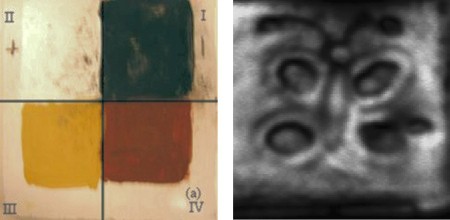
The Michigan team has already tested Picometrix’s “T-ray 4000” system on a graphite sketch of a butterfly imbedded in a 4 mm layer of plaster-of-Paris. After focusing the T-ray transceiver onto the back of the plaster, they found that they could make out the 2 mm wide graphite lines of the butterfly. The team is now planning to take the system next month to the St John the Baptist church in Vif, France, where there are believed to be many hidden frescoes.

Irl Duling, director of terahertz business development at Picometrix, says that the company is already shipping the T-ray system to customers. “T-ray 4000 is the only full-featured, portable time-domain terahertz system.”

Knee brace harvests ‘negative work’

When you walk, one set of muscles drives your legs forward, while another does “negative work” by pulling in the opposite direction to control your stride. Now, researchers in Canada and the US have built a device that can convert this negative work into electricity. They claim that the device, which straps onto the leg around the knee, can generate 5 W of electricity — enough to power several mobile phones or even an artificial limb.

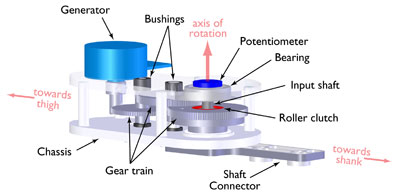
The electricity-generating knee brace has been designed and built by Max Donelan and colleagues at Simon Fraser University in British Columbia along with researchers at the Universities of Pittsburgh and Michigan (Science). It consists of a standard knee brace rigged with a generator and clutch system.

Rotary motion

The brace has a flexible joint that allows the wearer to walk and the rotary motion at the joint drives a set of gears, which are connected to an electrical generator.

The clutch can be adjusted so that energy is only harvested towards the end of a stride, when the body does negative work to stop the leg swinging forward just before it touches the ground. According to Donelan, this allowed the team to overcome a major challenge in harvesting negative work — how to ensure that the device helps the body slow down a limb without otherwise hindering its motion.

The brace can also work in a second mode in which energy is harvested throughout the stride.

1.5-kg device

The team tested the 1.5-kg device by strapping it on six volunteers who then walked on a treadmill. The electrical output of the brace was monitored along with the amount of oxygen inhaled by the subjects — which is a measure of the metabolic energy expended while walking.

When harvesting just negative work, the brace generated nearly 5 W of power while the wearer had to expend an additional 5 W — making it a very efficient way of converting muscle power into electrical power. By contrast, a hand-cranked generator requires more than 6 W of human effort for every Watt of electricity.

When the brace was used in the second mode, subjects were able to generate electricity at 7 W, while expending an additional 18 W of metabolic power. The maximum electrical power that could be generated was about 13 W.

Donelan told physicsworld.com that a 5–18 W increase in effort while walking is not significant — most people expend about 300 W walking without the device.

A major problem with the brace, however, is that just walking with the clutch permanently disengaged and generating no electricity costs about 60 W.

High cost of carrying

Walter Herzog, who is an expert in biomechanics at the University of Calgary, told physicsworld.com that when the relatively high energy cost of carrying the device is considered, the brace is really no more efficient than other schemes for generating electricity from walking. These include shoes with special soles that generate electricity when compressed and backpacks with oscillating weights connected to a generator.

Donelan counters that the brace was designed to make the experiments easier — not to minimize the effort required to wear it. He told physicsworld.com that the team are currently working a next-generation device that will be about half the weight of the original brace and that much of the weight will be shifted to a more comfortable location higher up the leg of the wearer. This, he claimed, could reduce the extra effort required to wear the brace to as little as 15 W.

As well as powering portable electronic devices — something that could be very important to soldiers and others who spend long periods of time in remote areas — both Donelan and Herzog agree that the most likely application of the brace is to power artificial limbs and other prosthetic medical devices, reducing the number of heavy batteries that users would have to carry around.

Donelan and colleagues have formed a company called Bionic Power that now aims to develop braces for the military and medical markets.


Copyright © 2026 by IOP Publishing Ltd and individual contributors