Multi-skilled As the head of research and development at QLM Technologies, Andrew Weld has to combine technical knowledge with leadership skills. (Courtesy: Andrew Weld)
What skills do you use every day in your job?
In terms of physics, I manage most of our research and development projects, so I have to be able to give a technical overview of our work and explain how everything fits within the company’s goals.
In a small start-up, those goals and priorities change rapidly. This can be based on feedback from customers, but when you’re trying to get a new product to market there are always going to be fires to put out and technical issues to solve, whether that’s hardware, software or component supply.
Also, while the technical aspects of my job are important, I need to have a good feel for time and budget, and be adaptable and flexible as circumstances change.
For example, we recently had an issue where some of our components came back from the supplier and weren’t working correctly. In the long term, you can consider other suppliers or you can work with your current supplier to find a solution, but you also need to fix the immediate problem.
We found that we could change the way we were driving the component, which meant the performance wasn’t optimal but we could still sell the products at a concession or use them for demonstrations. Managing those kinds of trade-offs is a big part of bringing a product to market.
The other important thing is people skills – I’ve found that just a little bit of diplomacy goes a long way. Working out how to handle people is quite a skill, and it’s something that not everyone has.
What do you like least and best about your job?
My favourite aspect of working at QLM is that I believe we are on a worthwhile mission. We want our technology to be part of the solution to climate change, and that provides an extra bit of motivation.
I also get to work with highly skilled scientists and engineers to develop our products and push the boundaries of our technology. It’s also great to be part of the industry community and represent QLM at industry events.
The other thing I enjoy is problem-solving. This is still a fundamental part of my job, but in my current role I will often delegate rather than tackling the problem myself. This can be less satisfying but I have realized that sometimes it’s more effective to use your experience to steer things in the right direction, rather than doing the frontline work.
QLM’s lidar systems have a lot of components that need to function well together. So I’ll often use my experience to guide junior staff, who will perform labour-intensive stages of assembling, programming and testing of our hardware.
What do you know today you wish you knew when you were starting your career?
You have to decide whether you’re happy in your job. Sometimes the best thing to do is to recognize that if something’s not working out for you, it’s time to change.
It’s easy to let yourself stagnate if you keep thinking “I’m sure this is going to change soon”. That’s something that we’re trying very hard to not let happen at QLM but it’s an issue I’ve seen elsewhere. We try to support our staff to develop new skills and to grow with the company, and we seek feedback from them to make sure they are happy in their work.
I look back and think I should have been a bit more ambitious, instead of staying in the lab doing the technical work. I would probably go back and tell myself: “You know what? You recognize that you’ve hit the limit of what you can achieve in that role”. At QLM I enjoy being part of the senior leadership team, where I have responsibility both for developing the hardware and shaping the evolution of the company.
So my advice would be, don’t be afraid to push for personal development with your line managers. If that doesn’t work, you might need to look elsewhere to put your career first. You’re probably going to be working for over 40 years, so make sure you enjoy what you do.
A group of 24 plasma physicists has called for the construction of a stellarator fusion facility in the US. The so-called Flexible Stellarator Physics Facility would test different approaches to stellarator confinement and whether some of the designs could be scaled up to a fusion plant.
Tokamak and stellarator fusion devices both emerged in the early 1950s. They use magnetic confinement to manipulate plasmas but they differ in the containment vessels’ geometries to confine the plasma. Tokamaks use toroidal and poloidal magnetic fields that are generated by magnets and the electric current that flows through the plasma, while stellarators apply a helical magnetic field, produced by external coils.
Those different geometries give each approach a specific advantage. Tokamaks maintain the plasma temperature more effectively while stellarators do a better job of ensuring the plasma’s stability.
The ITER fusion reactor, currently being built in Cadarache, France, is the largest and most ambitious of the roughly 60 tokamak experiments worldwide. Yet there are only a handful of stellarators operational, the most notable being Germany’s Wendelstein 7-X device, which switched on in 2015 and has since achieved significant experimental advances.
The authors of the white paper write that delivering the “ambitious” US decadal strategy for commercial fusion energy, which was released in 2022, will require “a persuasive” stellarator programme in addition to supporting tokamak advances.
Tokamaks and stellarators “are very close relatives, with many aspects in common,” says Felix Parra Diaz, who is the lead author of the white paper, “physics discoveries that benefit one are usually of interest to the other.”
Yet Parra Diaz, who is head of theory at the Princeton Plasma Physics Laboratory and carries out research on both tokamaks and stellarators, told Physics World that recent advances, especially at Wendelstein 7-X, are propelling the stellarator device as the best route to a fusion power plant.
“Stellarators were widely considered to be difficult to build due to their complex magnets,” says Parra Diaz. “We now think that it is possible to design stellarators with similar or even better confinement than tokamaks. We also believe that it is possible to construct these devices at a reasonable cost due to new magnet designs.”
Multi-stage process
The white paper calls on the US to build a “flexible facility” that would test the validity of theoretical models that suggest where stellarator confinement can be improved and also where it fails.
The design will focus on “scientific gaps” on the path to stellarator fusion. One particular target is the demonstration of “quasi-symmetry” magnetic configurations, which the paper describes as “the most promising strategy to minimize both neoclassical losses and energetic particle transport.”
The authors of the white paper propose a two-stage approach to the new facility. The first stage would involve exploring a range of flexible magnetic configurations while the second would involve upgrading the heating and power systems to further investigate some of the promising configurations from the first stage.
“It will also serve as a testbed for methods to control how the hot fusion plasma interacts with the walls of stellarator pilot plants,” adds Parra Diaz, who says that designing and building such a device could take between 6 to 9 years depending on “the level of funding”.
At the same time alternative tokamak technologies continue to emerge from commercial fusion firms. Tokamak Energy of Abingdon, Oxfordshire, for example, is developing a spherical tokamak design that, the company claims, “is more efficient than the traditional ring donut shape.”
Our first guest in this episode of the Physics World Weekly podcast is Derek Sutherland, who is head of FuZE-Q physics at the US-based company Zap Energy. He explains how the US-based firm is designing a fusion system that does not rely on magnets, cryogenics or high-powered lasers to generate energy. We also chat about the small-scale fusion industry in general, and about career opportunities for physicists in the sector.
This episode also features an interview with theoretical physicist and author Claudia de Rham. She talks to Physics World’s Matin Durrani about her new popular-science book The Beauty of Falling. They also chat about her research, which addresses a range of fundamental problems associated with gravity – from quantum to cosmological scales.
This episode is supported by Pfeiffer Vacuum. The company provides all types of vacuum equipment, including hybrid and magnetically-levitated turbopumps, leak detectors and analysis equipment, as well as vacuum chambers and systems. You can explore all of its products on the Pfeiffer Vacuum website.
The Diamond Light Source, which opened in 2007, is a 3 GeV synchrotron that provides intense beams of light that are used by researchers to study a wide range of materials. Diamond serves a user community of around 14,000 scientists working across all manner of fundamental and applied disciplines – from clean-energy technologies to pharma and healthcare; from food science to structural biology and cultural heritage.
And now you are planning a major upgrade, Diamond-II – what does that involve?
Diamond-II will consolidate our position as a world-leading facility, ensuring that we continue to attract the best researchers working in the physical sciences, life sciences and industrial R&D. At £519m, it’s an ambitious programme that will add three new beamlines – taking the total to some 35 – along with a comprehensive series of upgrades to the optics, detectors, sample environments, sample-delivery systems and computing resources across Diamond’s existing beamlines. Users will also benefit from new automation tools to enhance our beamline instrumentation and downstream data analysis.
What is the current status of Diamond-II?
Right now, we are in the planning and design phase of the project, although initial calls for proposals and specifications for core platform technologies have been put out to tender with industry suppliers. We will shut down the synchrotron in December 2027, with the bulk of the upgrade activity completed in summer 2029. From there, we will slowly ramp back up to fully operational by mid-2030, although some beamlines will be back online sooner.
What roles are other advanced light sources playing in Diamond-II?
Even though synchrotron facilities are effectively in competition with each other – to host the best scientists and to enable the best science – what always impresses me is that collaboration and partnership are hard-wired into our community model. At a very basic level, this enables phased scheduling of the Diamond-II upgrade in co-ordination with other large-scale facilities – mainly to avoid several light sources going dark simultaneously.
How is this achieved?
Diamond’sMachine Advisory Committee – which comprises technical experts from other synchrotron facilities – plays an important networking role in this regard, while also providing external challenge, sense-check and guidance when it comes to review and iteration of our technical ambitions. In the same way, we have engaged extensively with our user community – comprising some 14,000 scientists – over the past decade to ensure that the users’ priorities underpin the Diamond-II science case and, ultimately, that we deliver a next-generation facility with analytical instruments that meet their future research needs.
You’ve been chief executive officer of Diamond since October 2023. What does your typical day look like?
Every day is different at Diamond – always exciting, sometimes exhausting but never dull. At the outset, my number-one priority was to engage broadly with our key stakeholders – staff teams, the user community and the funding agencies – to build a picture of how things work and fit together. That engagement is ongoing, with a large part of the working day spent in meetings with division directors, senior managers and project leaders from across the organization. The task is to figure out what’s working, what isn’t and then quickly address any blockers.
I want to hear what our people really think; not what they think I want to hear
How do you approach this?
Alongside those formal meetings, I try to be visible and available whenever possible. Ad hoc visits to the beamlines and the control room, for example, mean that I can meet our scientists, technicians and support staff. It’s important for staff to have the opportunity to talk candidly and unfiltered with the chief executive officer so that I can understand the everyday issues arising. I want to hear what our people really think; not what they think I want to hear.
How do you attract and retain a diverse workforce?
Diamond is a highly competitive research facility and, by extension, we are able to recruit on a global basis. Diversity is our strength: the best talent, a range of backgrounds, plus in-depth scientific, technical and engineering experience. Ultimately, what excites many of our scientists and engineers is the opportunity to work at the cutting edge of synchrotron science, collaborating with external users and translating their research objectives into realistic experiments that will deliver results on the Diamond beamlines. One of my priorities as chief executive officer is to nurture and tap into that excitement, creating a research environment where all our people feel valued and can see how their individual contribution is making a difference.
How is Diamond optimizing its engagement with industry?
Industry users account for around 5% of beamtime at Diamond – and we co-ordinate that effort on multiple levels. To provide strategic direction, there’s the Diamond Industrial Science Committee, with senior scientists drawn from a range of industries advising on long-term applied research requirements. At an operational level, we have the Industrial Liaison Office, a multidisciplinary team of in-house scientists who work closely with industrial researchers to address R&D problems across diverse applications – from drug discovery and catalysis to aerospace and automotive.
A brilliant place The Diamond Light Source, the UK’s national synchrotron research facility, is located at the Harwell Science and Innovation Campus in Oxfordshire. (Courtesy: Diamond Light Source)
What about equipment manufacturers?
Our scientists and engineers also maintain ongoing collaborations with equipment manufacturers – in many cases, co-developing custom technologies and instrumentation to support our infrastructure and research capability. Those relationships are a win-win, with Diamond’s leading-edge requirements often shaping manufacturers’ broader product development roadmaps.
Has Brexit had any impact on Diamond?
While Diamond’s relationship with Europe’s big-science community took a hit in the aftermath of Brexit, we are proactively rebuilding those bridges. Front-and-centre in this effort is our engagement in the League of European Accelerator-based Photon Sources (LEAPS), a strategic consortium initiated by the directors of Europe’s synchrotron and free-electron laser facilities. Working together, LEAPS provides a unified voice and advocacy for big science – engaging with funders at national and European level – to ensure that our scientists feel more valued, not only in terms of career pathways and progression, but also financial remuneration.
Is the future bright for synchrotron science?
We need big science to tackle humanity’s biggest challenges in areas such as health, medicine, energy, agriculture and sustainability. These grand challenges are a team effort, so the future is all about collaboration and co-ordination – not just between Europe’s advanced light sources, but other large-scale research facilities as well. To this end, Diamond has been, and remains, a catalyst in bringing together the global light sources community through the work of Lightsources.org.
Astronomers have found strong evidence that 21 Sun-like stars orbit neutron stars without losing any mass to their binary companions. Led by Kareem El-Badry at the California Institute of Technology, the international team spotted the binary systems in data taken by ESA’s Gaia satellite. The research offers new insights into how binary systems evolve after massive stars explode as supernovae. And like many scientific discoveries, the observations raise new questions for astronomers.
Neutron stars are created when massive stars reach the end of their lives and explode in dramatic supernovae, leaving behind dark and dense cores. So far, over 99% of the neutron stars discovered in the Milky Way have been solitary – but in some rare cases, they do exist in binary systems with Sun-like companion stars.
In every one of these previously discovered systems, the neutron star’s powerful gravitation field is ripping gas from its companion star. The gas is heated to extreme temperatures as it accretes onto the neutron star, causing it to shine with X-rays or other radiation.
No accretion
However, as El-Badry explains, “it has long been expected that there should be similar binaries of neutron stars and normal stars in which there is no accretion. Such binaries are harder to find because they produce no X-rays.”
Seeking these more elusive binaries, El-Badry’s team scoured data from the ESA’s Gaia space observatory, which measures the positions, distances, and motions of stars with high precision.
The astronomers looked for Sun-like stars that “wobbled” in the sky as they orbited invisible companions. By measuring the wobble, they could then calculate the size and period of the orbit as well as the masses of both objects in the binary system.
El-Badry explains that Gaia is best at discovering binaries with widely separated orbits. “Gaia monitors more than a billion stars, giving us good chances of finding even very rare objects,”
Gravitational influence
In total, Gaia’s data revealed 21 cases where Sun-like, main sequence stars appear to be orbiting around unseen neutron star companions, without losing any material. If this interpretation is correct, it would be the first time that neutron stars have been discovered purely as a result of their gravitational influence.
The researchers predict that these systems are likely to evolve in the future when their Sun-like stars approach the end of their lives. “When the [Sun-like] stars evolve and become red giants, they will expand and begin transferring mass to the neutron stars, so these systems are progenitors of X-ray binaries,” El-Badry says.
On top of this, the sizes of the orbits observed by team could provide clues about the magnitudes of the supernovae that formed the neutron stars. “The wide orbits of the binaries in our sample would get unbound if the neutron stars had received significant kicks during the supernovae from which they are born,” El-Badry explains. “These objects imply that some neutron stars form with weak kicks.”
Could be white dwarfs
The team’s results throw up some important questions about the nature of these binaries and how they formed. For now, it remains possible that the unseen companions could be white dwarfs. These are the remnants of relatively small stars like the Sun – stars that have exhausted their nuclear fuel and then fade out, rather than exploding to form neutron stars.
If a companion is indeed a neutron star, its progenitor star would have experienced a red supergiant phase before going supernova. This would have created an envelope of gas large enough to affect the binary system. It is not clear why the two stars would not have drawn much closer together or even merged during this phase. Later, when the larger star exploded, it is not clear why the two objects did not go their separate ways.
El-Badry’s team hope that future studies of Gaia data could answer these challenging questions and explain how these curious binary systems form and evolve.
With the 2024 Paris Olympics just days away, sports fans are braced to see who will run, jump, row, fight and dance themselves into the history books. One of the most exciting moments will be the 100 m sprint finals, when athletes compete to become the fastest man or woman on Earth.
Over the years we have seen jaw-dropping performances from the likes of Usain Bolt and Florence Griffith-Joyner. Scientists have been captivated by top sprinters – trying to understand how physique, technique and nutritional intake can help athletes push the limits of human ability. In this episode of the Physics World Stories podcast, we tackle the more speculative question: could an Olympic-level athlete ever run on water?
Grappling with this question is our guest Nicole Sharp, engineer and science communicator specializing in fluid dynamics. She runs the fluid dynamics blog FYFD and authored the recent Physics World feature “Could athletes mimic basilisk lizards and turn water-running into an Olympic sport?“. Basilisk lizards are famed for their ability to skitter across water surfaces, usually to escape predators.
It won’t surprise you to know that scientists have already grappled with this question. For instance, a team in Italy studied whether it was possible in reduced gravity conditions equivalent to the Moon. Sadly, a water race on the Moon is unlikely due to the absence of pools of liquid on the lunar surface.
One place that could provide the setting for a liquid sprint are the ethane and methane lakes on Saturn’s moon Titan. These are the only large stable bodies of surface liquid in our solar system found outside Earth. If such an event were to happen tomorrow, perhaps the gold medal favourite would be US sprinter Sha’Carri Richardson – the current 100 m world champion who weighs just 45 kg.
Listen to the podcast to discover whether Richardson would sprint or sink at the inaugural Titan Olympics.
Gamma imaging is a nuclear medicine technique employed in over 100 different diagnostic procedures. Also known as scintigraphy, the approach uses gamma cameras to image the distribution of gamma-emitting radiopharmaceuticals administered to the body, with applications including thyroid imaging, tumour imaging, and lung and renal studies.
Most clinical gamma cameras are large devices designed for whole-body scanning and located in their own dedicated room. While such systems offer high sensitivity and a large field-of-view (FOV), they are not ideal for patients who cannot attend the nuclear medicine department. A small gamma camera, on the other hand, could enable scanning of more patients in far more scenarios.
Made to meet this challenge, Seracam is a new portable gamma camera developed and designed by UK medical imaging company Serac Imaging Systems. Just 15 cm in diameter, 24 cm long and weighing 5 kg, the hybrid optical–gamma camera is designed for small-organ imaging within outpatient clinics, intensive care units, or even in operating theatres during surgery.
“Gamma imaging is no longer confined to the nuclear medicine department,” explains Sarah Bugby from Loughborough University. “The system has a much smaller footprint, it could be stored in a cupboard and brought out only when needed.”
Bugby and colleagues have now performed a detailed assessment of Seracam’s clinical potential, reporting their findings in EJNMMI Physics.
System evaluation
Seracam uses a CsI(Tl) crystal scintillator to convert incoming gamma photons to optical photons. This light is then captured by a 25.5 x 25.5 mm detector, divided into 245 x 245 pixels, and analysed in real time to create an image of the gamma counts.
Hybrid optical–gamma camera The compact Seracam from Serac Imaging Systems. (Courtesy: CC BY 4.0/EJNMMI Phys. 10.1186/s40658-024-00659-7)
The camera integrates four pinhole collimators, with pinhole diameters of roughly 1, 2, 3 and 5 mm. The physics of collimation means that smaller pinhole diameters provide better spatial resolution but lower sensitivity, while larger pinholes provide higher sensitivity but with a trade-off in image resolution.
“With Seracam, you can change the collimator at the press of a button in just a second or so,” Bugby explains. “In traditional gamma cameras, collimators must be changed manually, which is time consuming as they’re about 60 cm square and made of lead. This means that, when imaging a patient, you’re locked into the initial collimator choice. Seracam offers the flexibility to adjust these trade-offs on the fly.”
Another novel feature is Seracam’s hybrid gamma and optical imaging. A gamma image simply comprises bright spots on a dark background, there are no anatomical landmarks for context. Seracam overlays the optical and gamma images to show both gamma and anatomical information.
Bugby and colleagues evaluated Seracam in a series of performance tests using 99mTc – the most common isotope used in nuclear medicine. Measurements of parameters including spatial resolution, sensitivity and image uniformity demonstrated that the device is suitable for clinical use.
Clinical scenarios
Next, the team performed experimental simulations of two clinical scenarios: thyroid imaging, used to assess the function of thyroid tissue, nodules and tumours; and a gastric emptying study, used to time stomach emptying after ingestion of a radiolabelled meal.
For thyroid imaging, the researchers examined a Picker phantom, an acrylic block with a thyroid-shaped well filled with 99mTc. They also imaged a head-and-neck phantom with fillable head and thyroid volumes, simulating hyperthyroidism and a normal thyroid with a hot nodule.
Seracam produced good quality images for both phantoms, showing its suitability for thyroid scintigraphy. The researchers note that the Picker phantom image quality was similar to that achieved with a traditional large-FOV camera, but using significantly lower counts and a larger imaging distance than employed in a clinical setting.
Hyperthyroidism simulation Hybrid Seracam images acquired using 1, 3 and 5 mm collimators show the thyroid shape, location and activity distribution. The smaller pinholes enhance spatial resolution, but at the expense of photon statistics. (Courtesy: CC BY 4.0/EJNMMI Phys. 10.1186/s40658-024-00659-7)
For gastric emptying, the team simulated a human stomach using a 500 ml flask filled with 99mTc and gradually emptied via syringes. At each emptying step, Seracam acquired a 120 s image using the 5.00 mm pinhole. The simulation showed that Seracam could produce a gastric emptying curve with the expected linearity at clinically relevant activities.
“We intentionally chose challenging rather than best-case scenarios, so the fact that we saw good performance is a really strong indicator,” says Bugby. “Gastric emptying isn’t a small-organ scenario, so in this case Seracam outperformed our expectations. Of course, this all needs to be validated in the clinic.”
The team concludes that Seracam can provide effective small-FOV gamma imaging within a clinical setting with excellent spatial resolution, although with reduced sensitivity compared with large-FOV devices. “Our results show that Seracam is well suited for the kinds of clinical tests it was designed for,” Bugby points out.
Seracam’s small camera head can be positioned in places that larger camera heads on conventional systems cannot reach. This flexibility in positioning could itself improve image quality: moving the camera closer to the patient helps compensate for the sensitivity that’s sacrificed by making such a small device.
“Combining this manoeuvrability with other beneficial features unavailable in large FOV systems, such as hybrid gamma–optical imaging and instant collimator changes, opens up new approaches to imaging,” says Bugby. “It’s easy to imagine a scenario that begins in a high-sensitivity ‘survey mode’ before switching to a high-resolution ‘imaging mode’ to investigate identified uptake sites. We’re excited to see how experienced clinicians will take advantage of these novel features.”
The researchers are now simulating other clinical applications, such as sentinel lymph node biopsy, and Seracam is being trialled at clinical sites in the US and Malaysia. Co-funded by the UK’s innovation agency, Innovate UK, Loughborough University researchers are also working on new image analysis and display techniques to enable Seracam’s use in radioguided surgery.
“We’re hopeful that these new innovations will be trialled by a team at the University of Malaya Medical Centre and others very soon,” Bugby tells Physics World.
Physics at the extremes provides the raison d’être for the JEM-EUSO research collaboration – or, in long form, the Joint Exploratory Missions for Extreme Universe Space Observatory. Over the past 20 years or so, more than 300 scientists from 16 countries have been working collectively towards the JEM-EUSO end-game: the realization of a space-based, super-wide-field telescope that will scan the night sky and enable astrophysicists to understand the origin and nature of ultrahigh-energy cosmic rays (upwards of 5 x 10¹⁹ eV). In other words, JEM-EUSO promises to open a unique window into the Universe at energy regimes far beyond the current generation of man-made particle accelerators.
Looking at the sky from above
For context, cosmic rays are extraterrestrial particles comprising hydrogen nuclei (around 90% of the total) and helium nuclei (roughly 9%), with the remainder made up of heavier nuclei and electrons. Their energy range varies from about 109 to 1020 eV and beyond, while their flux is similarly spread across many orders of magnitude – ranging from 1 particle/m2 per second at low energies (around 109 eV) out to roughly 1 particle/km2 per century at extreme energies (around 1020 eV).
While it’s possible to detect cosmic rays directly at low-to-intermediate energies (up to 1015 eV), the flux of particles is so low at higher energies that indirect detection is necessary. In short, that means observing the interaction of cosmic rays (as well as neutrino decays) with the outer layers of the atmosphere, where they produce cascades of subatomic particles known as “extensive air showers” (or secondary cosmic rays).
With this in mind, the JEM-EUSO collaboration has rolled out an ambitious R&D programme over the past decade, with a series of pathfinder experiments geared towards technology validation ahead of future space-based missions (aboard orbiting satellites) to observe cosmic rays at their highest energies. Projects to date include ground-based installations like the EUSO-TA (deployed at the Telescope Array site in Utah, US); various stratospheric balloons (the most recent of which is EUSO-SPB2); and MINI-EUSO (Multiwavelength Imaging New Instrument for the Extreme Universe Space Observatory), a telescope that’s been observing the Earth from inside the International Space Station (ISS) since 2019.
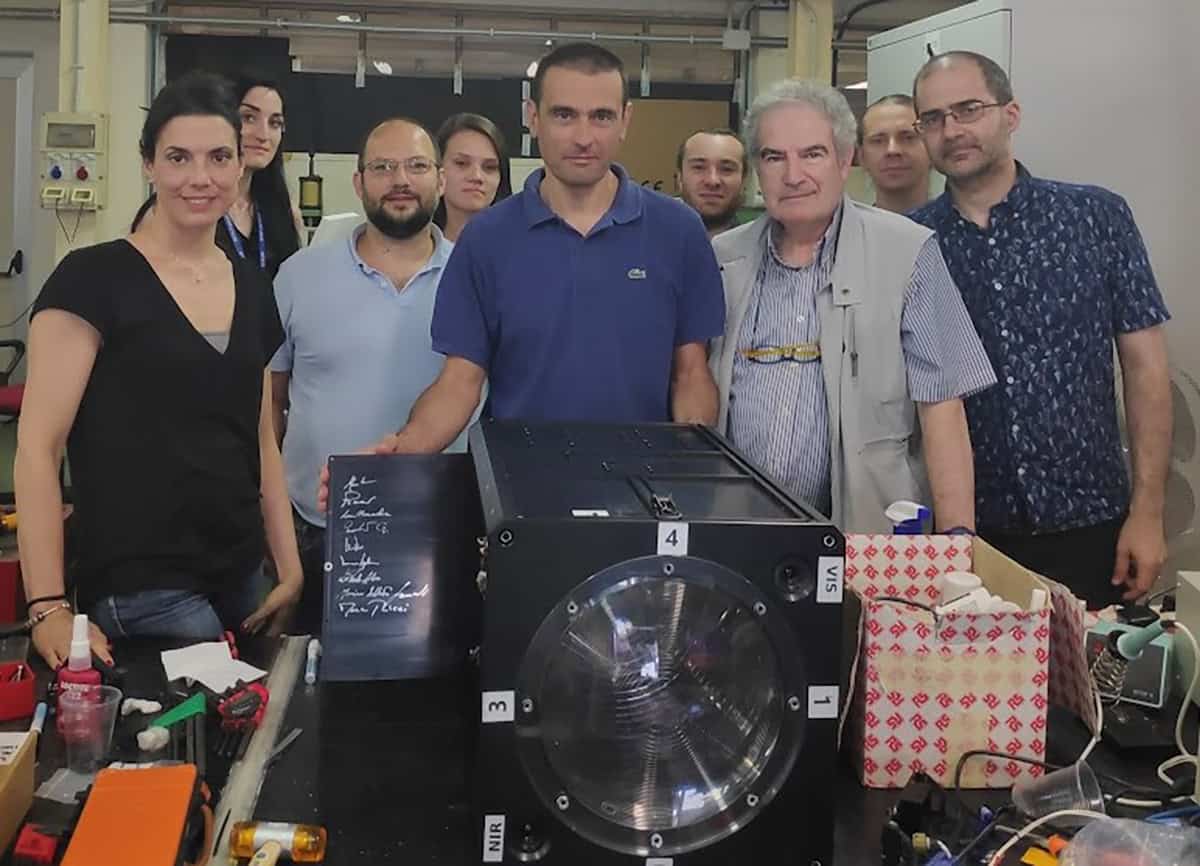
Proof of principle The JEM-EUSO collaboration has rolled out an ambitious programme of pathfinder experiments over the past decade. Above: Marco Casolino (far right), co-principal investigator on JEM-EUSO, and members of the Mini-EUSO development team with their assembled detector module. (Courtesy: JEM-EUSO)
All of these experiments operate at night and require clear weather conditions, surveying regions of the sky with low-artificial-light backgrounds. In each case, the instruments in question monitor Earth’s atmosphere by measuring the fluorescence emissions and Cherenkov light produced by extensive air showers. The fluorescence originates from the relaxation of nitrogen molecules excited by their interaction with charged particles in the air showers, while ultrahigh-energy particles traveling faster than light in the air create a blue flash of Cherenkov light (like the sonic boom created by an aircraft exceeding the speed of sound).
Operationally, because those two light components exhibit different durations – of the order of microseconds for fluorescence light; a few nanoseconds for Cherenkov light – they require dedicated detectors and acquisition electronics: multi-anode photomultiplier tubes (MAPMTs) for fluorescence detection and silicon photomultipliers (SiPMs) for the Cherenkov detectors.
The win-win of technology partnership
So where do things stand with JEM-EUSO’s implementation of current- and next-generation detectors? Among the programme’s core technology partners in this regard is Hamamatsu Photonics, a Japanese optoelectronics manufacturer that operates across diverse industrial, scientific, and medical markets. It’s a long-standing collaboration, with Hamamatsu engineers co-developing and supplying MAPMT and SiPM solutions for various JEM-EUSO experiments.
“We have a close working relationship with Hamamatsu’s technical staff in Italy and, through them, a direct line to the product development team in Japan,” explains Marco Casolino, a research director at the National Institute of Nuclear Physics (INFN), Structure of Rome “Tor Vegata”, and the co-principal investigator on JEM-EUSO (as well as project leader for Mini-EUSO).
The use of MAPMTs is well established within JEM-EUSO for indirect detection of ultrahigh-energy cosmic rays via fluorescence (with the focal surface of JEM-EUSO fluorescence telescopes fabricated from MAPMTs). “Yet although MAPMTs are a volume product line for Hamamatsu,” Casolino adds, “the solutions we employ [for JEM-EUSO experiments] are tailored by its design engineers to our exacting specifications, with an almost artisanal level of craftmanship at times to ensure we get the best product possible for our applications.”
That same approach and attention to detail regarding JEM-EUSO’s evolving requirements also guide the R&D partnership around SiPM technology. Hamamatsu engineers are working to maximize the advantages of the SiPM platform, including significantly lower operating voltage (versus MAPMTs), lightweight and durable structure, and compatibility with magnetic fields. Another plus is that SiPMs are immune to excessive levels of incident light, although the cumulative advantages are offset to a degree by the strong influence of temperature on SiPM detection efficiency (and the consequent need for active compensation schemes).
Massimo Aversa “Our collaboration with JEM-EUSO is a win-win.” (Courtesy: Hamamatsu Photonics)
Currently, JEM-EUSO scientists are focused on an exhaustive programme of test, measurement and calibration to optimize their large-scale SiPM detector designs – considering geometry, weight, packaging and robustness – for mass-critical applications in satellite-based instrumentation. “We are being very cautious with the next steps because SiPM technology has never been tested in space using very large detector arrays [e.g. 1024 x 1024 pixels],” explains Casolino. “Ultimately, it’s all about technical readiness level – ensuring that SiPM modules can handle the harsh environment in open space and the daily swings in temperature and radiation levels for the duration of a three- or four-year mission.”
Those priorities for continuous improvement are echoed by Massimo Aversa, senior product manager for MAPMT and SiPM product lines in Hamamatsu’s Rome division. “Our collaboration with JEM-EUSO is a win-win,” he concludes. “On the one hand, we are working to develop higher-resolution SiPM detector arrays with enhanced radiation-hardness – products that can be deployed for observations in space over extended timeframes. By extension, the lessons we learn here are transferable and will inform Hamamatsu’s SiPM development roadmap for diverse applications in high-energy physics.”
The SiPM – also known as a Multi-Pixel Photon Counter (MPPC) – is a solid-state photomultiplier comprised of a high-density matrix of avalanche photodiodes operating in Geiger mode (such that a single electron–hole pair generated by absorption of a photon can trigger a strong “avalanche” effect). In this way, the technology provides the basis of an optical sensing platform that’s ideally suited to single-photon counting and other ultralow-light applications at wavelengths ranging from the vacuum-ultraviolet through the visible to the near-infrared.
Hamamatsu, for its part, currently supplies commercial SiPM solutions to a range of established and emerging applications spanning academic research (e.g. quantum computing and quantum communication experiments); nuclear medicine (e.g. positron emission tomography); hygiene monitoring in food production facilities; as well as light detection and ranging (LiDAR) systems for autonomous vehicles. Other customers include instrumentation OEMs specializing in areas such as fluorescence microscopy and scanning laser ophthalmoscopy.
Near term, Hamamatsu is also focused on emerging applications in astroparticle physics and gamma-ray astronomy, while further down the line there’s the promise of at-scale SiPM deployment within particle accelerator facilities like CERN, KEK and Fermilab.
Taken together, what underpins these diverse use-cases is the SiPM’s unique specification sheet, combining high photon detection efficiency with ruggedness, resistance to excess light and immunity to magnetic fields.
When the gravitational wave detectors LIGO and VIRGO observed signals from merging black holes with masses much higher than those of black holes that form from the collapse of stars, scientists were intrigued. Had these unusually massive black holes formed when the universe was very young? And might they contain large amounts of dark matter?
According to new analyses of 20 years of data from the Optical Gravitational Lensing Experiment (OGLE) survey, the answer to the second question is a firm “no”. At most, members of the survey say that these cosmological structures contain only few percent of the universe’s dark matter – the mysterious substance that emits no light and can only be detected thanks to its gravitational pull, but is nevertheless thought to make up 95% of all matter. Indeed, the survey results casts doubt on the very existence of early-origin black holes, sending researchers back to the drawing board for explanations.
A different origin for some black holes?
Since the first detection of gravitational waves from a pair of merging black holes in 2015, LIGO and VIRGO have spotted more than 90 such events. These black holes are 20 to 100 times more massive than our Sun, making them four to five times more massive than any black hole previously detected within our Milky Way galaxy.
One possible explanation for why the universe might contain different masses of black holes was put forward by the Soviet physicists Yakov Zeldovich and Igor Novikov in 1966, and independently by the British physicist Stephen Hawking in 1971. They proposed that some black holes could have formed in the very early universe, before the first stars appeared. The mechanisms that created these so-called “primordial” black holes would be different from those that produce black holes via stellar collapse, which would remove some constraints on their masses.
Gravitational microlensing
In the OGLE survey, a team led by Andrzej Udalski of the Astronomical Observatory of the University of Warsaw, Poland, analysed light from nearly 80 million stars in the Large Magellanic Cloud, a nearby satellite of our own Milky Way. Their goal was to find characteristic brightenings of stars due to an effect known as microlensing. This effect occurs when a massive object (either dark matter or normal matter) passes between an observer on Earth and a source of light in such a way that the three objects line up almost perfectly.
At that point, Udalski explains, Einstein’s general theory of relativity means the intermediate object “can act as a lens – it gravitationally bends the light so more rays arrive to the observer and the source star is brighter,” he says. “The changes of brightness are very characteristic and very rare, but they can be detected.”
The duration of this brightening depends on the mass of the lensing object: the heavier it is, the longer the event. Microlensing events involving solar-mass objects typically last several weeks, whereas those that feature black holes 100 more massive than the Sun would last a few years.
Only 13 events detected
Previous gravitational microlensing dark-matter surveys (including the US-led MACHO and French EROS as well as OGLE) indicated that black holes lighter than one solar mass comprise less than 10% of dark matter. However, these observations were not directly sensitive to extremely long-timescale microlensing events, so they were not sensitive to massive black holes like those recently observed via gravitational waves.
To address this gap, Udalski and colleagues re-analysed their data. If black holes of 10 solar masses made up all the dark matter in our cosmic neighbourhood, they calculated that OGLE should have detected 258 microlensing events. If dark matter was instead composed of 100- or 1000-solar-mass black holes, the survey should have yielded 99 or 27 microlensing events, respectively. “During the 20 years of our experiment we should have registered over 500 microlensing events,” Udalski tells Physics World. “In reality, however, we detected only 13.”
The explanation, he says, is simple: the dark matter in the galactic “halo” between the Milky Way and the Large Magellanic Cloud cannot contain the kind of primordial black holes that would cause microlensing events. “All of the 13 events we registered can be nicely explained as events caused by nearby galactic stars or stars in the Large Magellanic Cloud located somewhat in front of that galaxy,” Udalski says. “This indicates that massive black holes can compose at most a few percent of dark matter.”
More specifically, the team’s calculations revealed that black holes of 10 solar masses may comprise at most 1.2% of dark matter. For 100-solar-mass black holes, the number increases to 3%; for 1000-solar-mass black holes, it is 11%.
An “important impact” on astrophysics and cosmology
Udalski thinks the team’s findings will have an “important impact” on astrophysics and cosmology. “The first conclusion is that there is no empirical proof that primordial black holes ever existed,” he explains. “Because it is supposed that they were formed in the very early universe, our picture of the beginnings must be revised. Secondly, as dark matter does not contain classical bodies that can cause microlensing events, it still remains a mystery what this matter is.”
While OGLE in its present form is nearly finished, the team still plan to investigate putative black holes with very low, planet-scale masses. “This will allow us to fully exploit the potential of the microlensing observations of the Large Magellanic Cloud,” Udalski says.
“Read this,” said my boss as he dropped a book on my desk sometime in the middle of the year 2000. As a dutiful staff writer at CERN, I ploughed my way through the chunky novel, which was about someone stealing a quarter of a gram of antimatter from CERN to blow up the Vatican. It seemed a preposterous story but my gut told me it might put the lab in a bad light. So when the book’s sales failed to take off, all of us in CERN’s communications group breathed a sigh of relief.
Little did I know that Dan Brown’s Angels & Demons would set the tone for much of my subsequent career. Soon after I finished the book, my boss left CERN and I became head of communications. I was now in charge of managing public relations for the Geneva-based lab and ensuring that CERN’s activities and functions were understood across the world.
I was to remain in the role for 13 eventful years that saw Angels & Demons return with a vengeance; killer black holes maraud the tabloids; apparently superluminal neutrinos have the brakes applied; and the start-up, breakdown and restart of the Large Hadron Collider (LHC). Oh, and the small business of a major discovery and the award of the Nobel Prize for Physics to François Englert and Peter Higgs in 2013.
Fear, black holes and social media
Back in 2000 the Large Electron-Positron collider, which had been CERN’s flagship facility since 1989, was reaching the end of its life. Fermilab was gearing up to give its mighty Tevatron one more crack at discovering the Higgs boson, and social media was just over the horizon. Communications teams everywhere struggled to work out how to adapt to this new-fangled phenomenon, which was giving a new platform to an old emotion.
Fear of the new is as old as humanity, so it’s not surprising that some people were nervous about big machines like the Tevatron, the Relativistic Heavy Ion Collider and the LHC. One individual had long been claiming that such devices would create “strangelets”, mini-black holes and other supposedly dangerous phenomena that, they said, would engulf the world. Before the Web, and certainly before social media, theirs was a voice in the wilderness. But social media gave them a platform and the tabloid media could not resist.
Comms boss James Gillies, shown here in 2013, ran CERN’s media relations with the world from 2003 to 2016. Courtesy: CERN)
For the CERN comms team, it became almost a full-time job pointing out that the LHC was a minnow compared to the energies generated by the cosmos. All we were doing was bringing natural phenomena into the laboratory where they could be easily studied, as I wrote in Physics World at the time. Perhaps the Nobel-prize-winning physicist Sam Ting was right to switch his efforts from the terrestrial cacophony to the quiet of space, where his Alpha Magnetic Spectrometer on the International Space Station observes the colossal energies of the universe at first hand.
Despite our best efforts, the black-hole myth steadily grew. At CERN open days, we arranged public discussions on the subject for those who did not know quite what to make of it. Most people seemed to realize that it was no more than a myth. The British tabloid newspaper the Sun, for example, playfully reminded readers to cancel their subscriptions before LHC switch-on day.
There were lawsuits, death threats and calls for CERN to be shut down
But some still took it seriously. There were lawsuits, death threats and calls for CERN to be shut down. There were reports of schools being closed on start-up day so that children could be with their parents if the world really did end. Worse still, in 2005 the BBC made a drama documentary End Day, seemingly inspired by Martin Rees’s book Our Final Century. The film played out a number of calamitous scenarios for humankind, culminating with humanity taking on Pascal’s wager and losing. I have read the book. That is not what Rees was saying.
We were now faced with another worry. Brown’s follow-up book, The Da Vinci Code, had become a blockbuster and it was clear that Angels & Demons, after its slow start, would follow suit. I therefore found myself in a somewhat surreal meeting with CERN’s then director-general (DG) Robert Aymar mulling over how CERN should respond. I suggested that the book’s success was a great opportunity for us to talk about the real physics of antimatter, which is anyway far more interesting than the novel.
To my relief, Aymar agreed – and in 2005 visitors to CERN’s website were greeted with a picture of our top-secret space plane that the DG uses to hop around the world in minutes. Or does he? Anyone clicking on the picture would discover that CERN doesn’t actually have a space plane, but we do make antimatter. We could even make a quarter of a gram of it, given 250 million years.
More importantly, we hoped that visitors to the website would learn that the really interesting thing about antimatter is that nature seems to favour matter and we still don’t know why. They’d also discover that antimatter plays an important role in medicine, in the form of positron-emission tomography (PET) scanners, and that CERN has long played an important part in their development.
Thanks to our playful, interactive approach, many people did click through. In fact, CERN’s Web traffic jumped by a factor of 10 almost overnight. The lab was on its way to becoming a household name and, in time, a synonym for excellence. In 2005, however, that was yet to come. We still had several years of black-hole myth-busting ahead.
Collider countdown
A couple of years later, an unexpected ally appeared in the form of Hollywood, which came knocking to ask if we’d be comfortable working with them on a film version of Angels & Demons. Again, the DG agreed and in 2009 the film appeared, starring Tom Hanks, along with Ayelet Zurer as a brilliant female physicist who saves the day. Fortunately, much of the book’s dodgy science and misrepresentation of CERN didn’t make it onto the screen (see box below).
Of course, the angels, the demons and the black holes were all a distraction from CERN’s main thrust – launching the LHC. By 2008 Fermilab’s Tevatron was well into its second run, but the elusive Higgs boson remained undiscovered. The mass range available for it was increasingly constrained and particle physicists knew that if the Tevatron didn’t find it, the LHC would (assuming the Higgs existed). The stakes were high, and a date was set to thread the first beams around the LHC. First Beam Day would be 10 September 2008.
Angels & Demons: when Hollywood came to CERN
Movie magicAngels & Demons was previewed to the entertainment press at CERN in February 2009. Lead actors Tom Hanks (left) and Ayelet Zurer (centre) attended, while director Ron Howard (right) spoke to the press. (Courtesy: CERN)
Dan Brown’s 2000 mystery thriller Angels & Demons is a race against the clock to stop antimatter stolen from CERN from blowing up the Vatican. Despite initial slow sales, the book eventually proved so successful that it was turned into a 2009 movie of the same name, directed by Ron Howard. He visited CERN more than once and I was impressed by his wish to avoid the book’s shaky science.
In the movie version, which stars Tom Hanks and Ayelet Zurer, CERN is confined to the pre-opening title sequence, with the ATLAS cavern reconstructed in CGI. Howard’s team even gave me a watermarked script and asked for feedback on the science. Howard also made a short film about CERN for the movie’s Blu-ray release. Ahead of that event, we found ourselves fielding calls from Howard’s office at all times of day and night about the science.
The movie was officially launched at CERN to the entertainment press, with Howard, Hanks and Zurer in attendance, who all gushed what an amazing place the lab is. Handled by Sony Pictures, the event proved much more tightly controlled than typical CERN gatherings, with Sony closely vetting which science journalists we’d invited. My colleague Rolf Landua and I ended up having dinner with Hanks, Zurer and Howard – something I could never have imagined happening when Angels & Demons first came out.
Any big new particle accelerator is its own prototype. Switching such a machine on is best done in peace and quiet, away from the media glare. But CERN’s new standing on the world’s stage, coupled with the still-present black-hole myth, dictated otherwise. Media outlets started contacting us – not to ask if they could come for the switch-on, but to tell us they would be there. Outside the CERN fence if necessary.
Another surreal conversation with the DG ensued. Media were coming, I told him, whether we liked it or not. Lots of them. We could either make plans to invite them in and allow them to follow the attempts to get beams around the LHC, or we could have them outside the lab reporting that CERN was starting the doomsday machine in secrecy behind the fence.
Around 1000 media professionals representing some 350 outlets descended on the lab
The DG agreed that it might be better to let them in, and so we did. Around 1000 media professionals representing some 350 outlets descended on the lab. Among them was a team from BBC Radio 4. Some months earlier, a producer called Sasha Feachem had rung CERN to say she’d been trying to persuade her boss, Mark Damazer, to do a full day’s outside broadcast from CERN, and would I come to London to convince him.
I tried, and in an oak-panelled room at Broadcasting House, failed completely to do so. But Damazer did accept an invitation to visit CERN. After hitting it off with the DG, Radio 4’s Big Bang Day was approved and an up-and-coming science presenter by the name of Brian Cox was chosen to anchor the BBC’s coverage. It was the first time a media team had ever broadcast wall-to-wall from a science lab and I don’t think Radio 4 has done anything like it since.
Journalists were accredited. A media centre was set up. Late-coming reporters were found places in the CERN main auditorium where they could watch a live feed from the control room, along with the physicists. We even installed openable windows in the conference room overlooking the control room so that TV crews could get clean shots of the action below.
Global interest Around 1000 media professionals representing some 350 outlets arrived at CERN in September 2008 to see the first proton beams enter and travel round the Large Hadron Collider. (Courtesy: CERN/Maximilien Brice)
A time was set early that September morning for the first attempt at beam injection into the LHC, and the journalists were all in place. Then there was a glitch, and the timing was put back a couple of hours. Project leader Lyn Evans had agreed to give a countdown, and when the conditions for injection were back, he began. A dot appeared on a screen indicating that a proton beam had been injected.
After an agonising wait, a second dot appeared, indicating that the beam had gone round the 27 km-long machine once. There were tears and laughter, and the journalists who were parked in the auditorium with the physicists later said they’d had the best seats in the house. They were able to witness the magnitude of that moment alongside those whose lives it was about to change.
It was an exhausting but brilliant day. On my way home, I ran into Evans as he was driving out of the lab. He rolled down his window and said: “Just another day at the office, eh James!” Everyone was on top of the world. Media coverage was massive and positive, with many of those present telling us how refreshing it was to take part in something so clearly genuine in a world where much is hidden.
From joy to disaster
The joy proved short lived. The LHC has something like 10,000 high-current superconducting interconnects. One was not perfect, so it had a bit of resistance, which led to an electrical arc that released helium into the cryostat with enough force to knock several magnets off their stands. Nine days after switch-on, CERN suddenly had a huge and unexpected repair job on its hands.
The Higgs boson was still nowhere in sight. The Tevatron was still running and the painstaking task began of working out what had gone wrong at the LHC. CERN not only had to repair the damaged section, but also understand why it had happened and ensure it wouldn’t happen again. Other potentially imperfect interconnects had to be identified and remade. The machine also had to be equipped with systems that would release pressure should helium gas build up inside the cryostat.
What happened here? CERN had a job on its hands in 2008 explaining to the world how a damaged superconducting interconnect led to the Large Hadron Collider breaking down just nine days after the first beams had entered the machine. (Courtesy: CERN/Maximilien Brice)
My mantra throughout this period was that CERN had to be honest, open, trustworthy and timely in all communications – an approach that, I think, paid dividends. The media were kind to us, capturing the pioneering nature of our research and admiring the culture of an organization that sought not to attribute blame, but to learn and move on.
When beams were back in the LHC in November 2009, they cheered us on. By the end of the year, the first data had been recorded. LHC running began in earnest in 2010, and with the world clearly still in place, the black-hole myth gave way to excitement about a potential major discovery. The Tevatron collided its last beams in September 2010, leaving the field clear for the LHC.
As time progressed, hints of something began to appear in the data, and by 2012 there was a palpable sense of expectation
As time progressed, hints of something began to appear in the data, and by 2012 there was a palpable sense of expectation. A Higgs Update Seminar was arranged at CERN for 4 July – the last day possible for the spokespeople of the LHC’s ATLAS and CMS experiments to be at CERN before heading to Melbourne for the 2012 International Conference on High-Energy Physics, which is always a highlight in particle physicists’ calendars.
Gerry Guralnik and Carl Hagan – early pioneers of spontaneous symmetry breaking – asked whether they could attend the CERN seminar, so we thought we’d better invite Peter Higgs and François Englert too. (Robert Brout, who had been co-author on Englert’s 1964 paper in Physical Review Letters (13 321) predicting what we now called the Brout–Englert–Higgs mechanism, had died in 2011.) Right up to the last minute, we didn’t know if we’d be making a discovery announcement, or just saying “Watch this space.” One person, however, did decide that he’d be able to say, “I think we have it.”
As DG since 2009, Rolf-Dieter Heuer had seen the results of both experiments, and was convinced that even if neither could announce the discovery individually, the combined data were sufficient. On the evening of 3 July 2012, as I left my office, which was next to the CERN main auditorium, I had to step over people laying out sleeping bags in the corridor to guarantee their places in the room the next day.
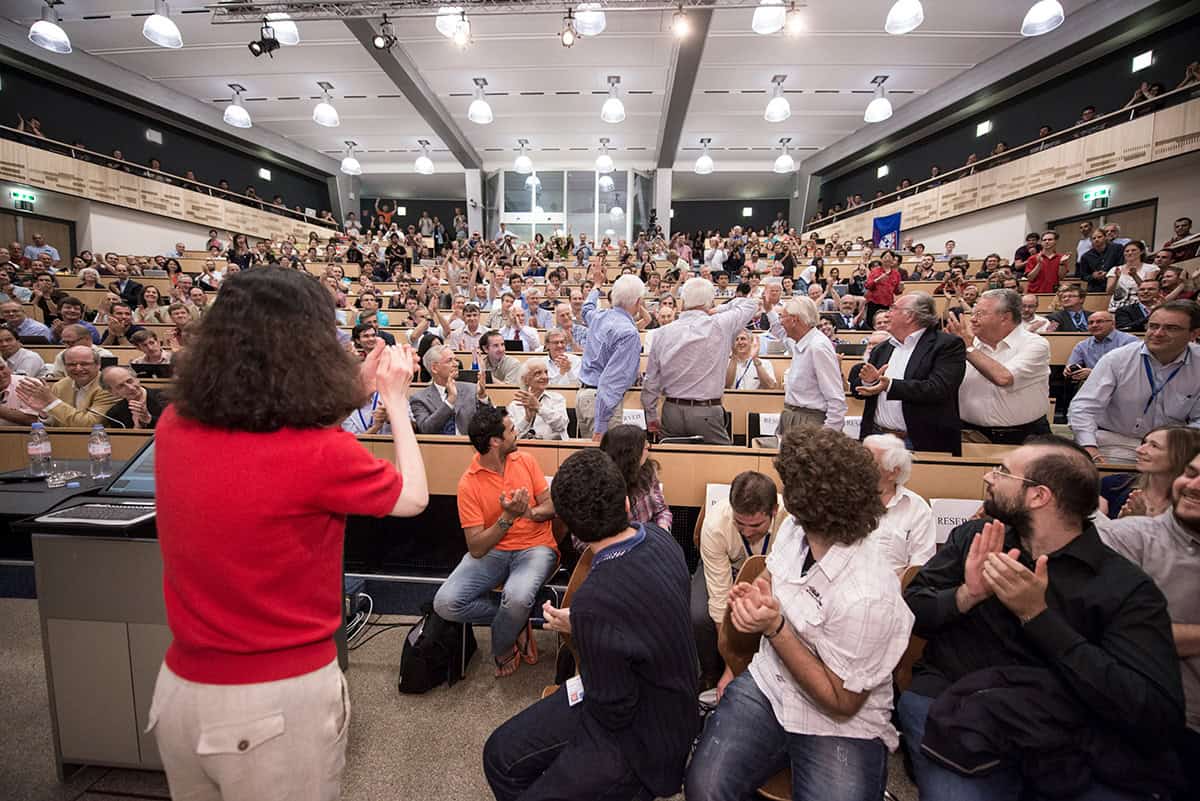
One famous day The discovery of the Higgs boson, announced on 4 July 2012, was the highlight of James Gillies’ career as CERN’s comms chief. Fabiola Gianotti (foreground, wearing red top) leads the applause in the packed CERN auditorium. (Courtesy: CERN)
As it turned out, both experiments had strong enough measurements to make a positive statement on the day, though the language was still cautious. The physicists talked simply about “the discovery of a new particle with features consistent with those of the Higgs boson predicted by the Standard Model of particle physics”. Higgs and Englert heard the news seated side by side, Higgs famously wiping a tear from his eye and saying that it was remarkable that the discovery had been made in his lifetime.
The media were present in force, and everyone wanted to talk to the theorists. It’s a sign of the kind of person Higgs was that he told them they’d have plenty of opportunity to talk to him later, but that today was a day to celebrate the experimentalists.
Nature versus nature
The Higgs discovery was undoubtedly the highlight of my career in communications at CERN, but the Higgs boson is just one aspect of CERN’s research programme. I could tell you about the incredible precision achieved by the LHCb experiment, seeking deviations from the Standard Model in very rare decays. I could talk about the discovery of a range of composite particles predicted by theory. Or about the insights brought by a mind-boggling range of research at low energies, from antimatter to climate change.
“Have you checked all the cables?” said one of our directors to the scientists involved, in a meeting in the DG’s office. “Of course,” they insisted. As it turned out, there had been a false reading – not strictly speaking from a poorly chosen cable, but a faulty fibre-optic connection. The laws of physics were safe. Unfortunately, this was not before a seminar was held in the CERN Main Auditorium in September 2011.
Had they held the seminar at Gran Sasso, I’m sure they’d have got less coverage. Our approach was to say: “This is how science works – you get a measurement that you don’t understand, and you put yourself up to scrutiny from your peers.” It led to a memorable editorial in Nature (484 287) entitled “No shame“, which concluded that “Scientists are not afraid to question the big ideas. They are not afraid to open themselves to public scrutiny. And they should not be afraid to be wrong.”
Nature caught us off guard, not once but twice, when animals brought low the world’s mightiest machine
That remark in Nature was a positive outcome for CERN from a potentially embarrassing episode, but nature of another kind caught us off guard, not once but twice, when animals brought low the world’s mightiest machine. First, breadcrumbs and feathers led us to believe that a bird had had a lucky escape when it tripped an electrical substation. Later, a pine marten, which also caused a power outage after gnawing through a live cable, was not so lucky. It has now joined the gallery of animals that have met unusual ends in the Rotterdam Museum of Natural History.
Different worlds Visits are vital for CERN, which has hosted everyone from pupils and politicians to pop stars and artists – including Antony Gormley, whose metal sculpture Feeling Material XXXIV hangs in the lab’s main building. (Sculpture donated by the artist. Photo courtesy: CERN/Benoit Jeannet)
There were also visitors. Endless visitors, from school children to politicians and from pop stars to artists. On a return visit of my own to Antony Gormley’s London studio after having given him a tour of CERN, he spontaneously presented me with one of his pieces. Feeling Material XXXIV – a metal sculpture that’s part of a series giving an impression of the artist’s body – now hangs proudly in CERN’s main building
There was an incredible moment at one of the TEDxCERN events we organized when Will.i.am joined two local children’s choirs for a rendition of his song “Reach for the Stars”. And there were many visits from the late landscape architect Charles Jencks and Lily Jencks who produced a marvellously intelligent design for a new visitor centre in the form of a cosmic Ouroboros – like a snake biting its own tail, it appeared like two mirror-image question marks forming a circle. One of my only regrets is that we were unable to fund its construction.
For a physicist-turned-science-communicator such as myself, there was no better place to be than at my desk through the opening years of the 21st century. CERN is a unique and remarkable institution that shows what humanity is capable of when differences are cast aside, and we focus on what we have in common. To paraphrase Charles Jencks, to whom I’m leaving the last word, CERN is perhaps the last bastion of the enlightenment.