Venus flytrap inspires adaptive optics

It may be best known for ensnaring flies, but now the Venus flytrap has also captured the attention of some materials physicists in the US. Alfred Crosby and colleagues at the University of Massachusetts at Amherst have been inspired by the carnivorous plant’s unusual jaw structure to create a new material that can rapidly change its shape when stimulated by pressure, heat or electrical current. The team claims that the material could be used to create surfaces that change their reflectivity or lenses that switch between focal lengths.

The movement of the Venus flytrap relies on a “snap-buckling instability”, a common phenomenon that can be demonstrated for any rubbery hemisphere. Slice a tennis ball in half, for example, and then hold one of the halves by the edges so that it is convex, or dome-shaped. Applying pressure with your thumbs will deform the ball — up to a certain critical point when it flips to the concave, or bowl-shaped, state.

In a Venus flytrap this lethal flipping from convex to concave occurs when a fly crawls between the open jaws and touches one of many tiny hairs located inside, although botanists are divided on exactly how the hair triggers the signal. “This plant can change the shape of its lobes from concave to convex at very high speeds — around 100 ms,” Crosby told optics.org, sister website of physicsworld.com.

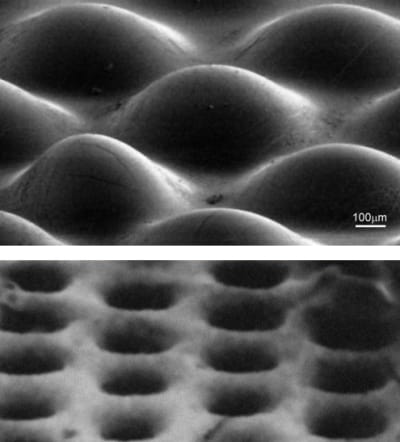
Crosby’s group sought to create a structure that could exhibit this behaviour on small scales throughout. They began by moulding an array of circular protrusions onto a 1-mm-thick silicone layer. They then stretched the layer, and bonded another layer of unmoulded silicone underneath to create pockets or air. It is these air pockets combined with the rubbery nature of the material that gives way to the snap-buckling instability, so that all the protrusions can be triggered between the convex or concave state (Adv. Mater. 19 3589).

Many triggers

Unlike the jaws of the Venus flytrap, the Massachusetts group’s material can be triggered by pressure, heat or an electrical current. When the individual protrusions — which are like tiny lenses — change from convex to concave, the entire surface is modified in its reflectivity and focal length. This means that the material could be used in outdoor signs where the reflectivity of the surface keeps changing, or as an adaptive lens that can focus by itself.

Each protrusion in the surface can be fabricated in pretty much any shape or size. In this work, the Crosby’s group built them with diameters ranging from 50 µm to 500 µm and spaced them 10 to 50 µm apart. At these sizes the transition speeds are 30 ms or faster, and as the lenses get smaller, the speeds go up.

“[The material] could potentially be applied in arrays of on/off operating devices, such as optical switches and as actuators that control other components.” said Hongrui Jiang of the University of Wisconsin, who last year produced a liquid lens that mimics the human eye. Jiang added that the fabrication process must now be improved to produce lenses with highly uniform shapes and smoother textures.

This article originally appeared on optics.org

Wet sand flows better than dry

As any child knows, the best way to build a sandcastle is to use wet sand because it sticks together nicely, whereas a castle made from dry sand will collapse under its own weight. Now, however, physicists in Germany have turned this law of the playground on its head by showing that — under some circumstances at least — wet sand can flow better than the dry stuff.

Christian Wagner and colleagues at the University of Saarland came to this surprising conclusion after measuring the force needed to push an idealized form of sand through a circular tube (arXiv:0711.2972v1). The “sand” consisted of an aqueous slurry of tiny glass beads with a diameter of 145 microns, which is roughly that of a grain of sand. The researchers found that less energy was required to push sand through the tube if it was wet than if it was dry.

Dry sand usually flows freely because air voids can form between the grains, which keeps them apart and reduces friction. But when the sand is packed in a tube, there is no room for voids to occur and therefore air cannot lubricate the flow. As a result, friction causes the dry sand to jam.

If the sand in the tube is wet, the water initially acts like glue, causing individual grains to bind together, just as in a sandcastle. But if sufficient force is applied, the bonds between grains are broken and the water acts as a lubricant, causing the sand to flow more easily. The team was able to see this happen by measuring the movement of the sand as it was subjected to an increasing force.

According to Wagner, wet sand is an example of a “yield stress” fluid, which — like toothpaste — will begin to flow only when sufficient force is exerted on it. Wagner believes that their study should provide a better understanding of some industrial processes involving the movement of granular materials.

Although the wet sand used in the experiment contained about 3% water by volume — less than for wet sand on a beach — Wagner believes that the ideal sand for sandcastles should also behave as a yield stress fluid.

A dark future for cosmology

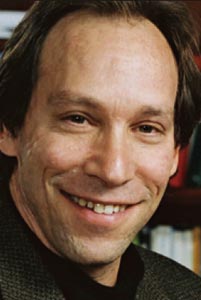
The discovery 10 years ago that the expansion of the universe is accelerating, which implies that most of the universe is made up of a gravitationally repulsive substance called dark energy, was one of the most profound observations in cosmology. Several of us theorists had actually argued a few years earlier that something like dark energy must exist — the reason being that such a substance could iron out inconsistencies in, for example, measurements of Big Bang nucleosynthesis and of the age of the universe. But the direct observation of cosmic acceleration via measurements of distant supernovae demonstrated to the entire community that our understanding of cosmic evolution required a major overhaul.

We have no explanation whatsoever for the measured density of dark energy based on our fundamental theories of particle physics. Since the initial conditions of the universe were presumably determined by such fundamental laws, understanding what dark energy is will undoubtedly force us to question our knowledge of the earliest moments of the Big Bang. This is why it is so exciting to try and solve the mystery of both the origin and nature of this exotic form of energy that seems to permeate empty space.

The problem, however, is that it is quite likely that future observations — limited by both experimental uncertainties and the lack of any theoretical guidance on what to look for — will shed little new light on these all-important questions. Instead, we may require new theoretical ideas to resolve the nature of dark energy, and these are often harder to come by than new observations.

Preposterous prediction

Although we do not have a theory that allows us to predict the observed value of the density of dark energy, we do have a likely candidate for its origin: the cosmological constant. Proposed by Einstein in 1917 as an extra term in his equations of general relativity to make possible a static and eternal universe (which was the prevailing wisdom at the time), the cosmological constant is a form of “antigravity” that permeates all space.

Since the 1960s, however, such a constant term has had an alternative theoretical underpinning. Quantum mechanics, combined with relativity, implies that empty space is full of a wild brew of virtual particles that pop in and out of existence so quickly that we cannot directly detect them. Nevertheless, these particles leave a measurable imprint on everything from the spacing between atomic energy levels to the Casimir force that draws together metal plates brought very close to one another.

One might expect these virtual particles to contribute an energy to empty space, which would result in an identical term to Einstein’s original cosmological constant that would lead to universal repulsion and hence an accelerating universe. This form of “vacuum energy” is gravitationally repulsive because it possesses a negative pressure that is equal and opposite in magnitude to its energy density. In other words, the ratio of the pressure to the energy density — called the “equation of state” parameter, w — has a value of –1.

Such a fundamental, microscopic explanation for dark energy is just what cosmologists are looking for. But there is one huge catch: when we attempt to estimate the magnitude of the vacuum energy based on our current understanding of elementary particle physics, we get a value that is 120 orders of magnitude larger than the measured value! This means that if dark energy corresponds to a cosmological constant that arises from a non-zero vacuum energy, then there is something fundamentally wrong with our knowledge of particle physics. On the other hand, the source of dark energy may only mimic a cosmological constant at the present time, and may actually be something more complicated that varies as a function of time. Indeed, it could be that such a dark-energy source disappears completely at some time in the future, which may imply that nature’s fundamental vacuum energy is precisely zero. We could then understand such a value as being due, perhaps, to some new symmetries of nature that exactly cancelled out the contributions of all the virtual particles.

But therein lies the rub. The only way we can determine from observations that dark energy is not a cosmological constant is to somehow measure its equation of state parameter, w, and find that it is not, or was not, equal to –1. If the measured value is indistinguishable from –1 within experimental uncertainties, then we have not learned anything at all because dark energy could either be a cosmological constant or something else less (or more) exotic that behaved very much like it. The observational challenges in distinguishing between these scenarios are daunting in the extreme.

The observational challenge

Existing data show that –1.2 < w < –0.8, which means that we know w is very close to the cosmological-constant value of –1. But since we have no theory whatsoever to guide us if w turns out not to equal –1, either today or earlier in cosmic history, we have to allow for the possibility that w varies arbitrarily with time. When this theoretical uncertainty is combined with the likely systematic uncertainty of observations — for example due to difficulties in determining the absolute brightness of supernovae — it will be very hard to tell whether the equation of state of dark energy actually deviated from –1 at any time in the past.

Earlier this year I, along with Dragan Huterer at the University of Chicago and Kate Jones-Smith of Case Western Reserve University, calculated that even if 3000 supernova observations were made with a measurement accuracy slightly better than anything that has been possible thus far, then the constraints on the measured value might improve by at most a factor of 2 once the theoretical uncertainty in w is incorporated. In other words, –1.1 < w < –0.9 (New J. Phys. 9 141).

But let us say, for the sake of argument, that the true value of the equation of state parameter is w = –0.96. Then, even if we are able to improve the existing uncertainty in w by a factor of 10 using a variety of proposed techniques beyond simply measuring distant supernovae, a value of w = –1 will only be two standard deviations away from the best fit value (which may not even correspond to w = –0.96). Unfortunately, such confidence intervals occur routinely in physics and, while suggestive, are not sufficient to claim a discovery.

This does not mean that we should give up on efforts to measure w. It just means that observers will have to work very hard to reduce systematic uncertainties in, for example, supernova measurements to below current levels. And even if experimentalists manage such a feat, we have to live with the distinct possibility that making significant progress — i.e. answering the question of whether dark energy is a cosmological constant or something else — may be beyond our experimental reach.

A very special time

If we cannot answer this question, then our ability to constrain models in fundamental particle physics will be limited because we will not know if dark energy is due to vacuum energy or something else. But such ignorance will also make it difficult to predict the longterm future of the universe. Indeed, if dark energy really is a cosmological constant, then scientists 100 billion years or so from now will lose all evidence that we live in an expanding universe dominated by dark energy. This is because by then the cosmic acceleration will have caused distant galaxies and supernovae to recede at velocities greater than the speed of light, thereby taking these markers of cosmic dynamics forever out of view.

It therefore seems that we are living in a very special time, namely the only time in the history of the universe that we might actually be able to infer the existence of dark energy itself. Perhaps, therefore, we should not feel too bad if observations in the coming decades do not allow us to untangle the mystery of the nature and origin of dark energy. After all, it is often the mysteries themselves that keep scientists going, energizing theorists to continue to speculate about the ultimate nature of reality and motivating observers to seek out new tools to probe it.

Dark energy: the decade ahead

A decade ago, the universe was diagnosed with a severe — possibly even terminal — case of “dark energy”. Based on observations of very distant supernovae, at the beginning of 1998 two teams of astrophysicists announced the astonishing conclusion that the cosmic expansion is actually accelerating — and not slowing under the influence of gravity as might be expected. The implication was almost beyond belief: in order to account for the acceleration, about 75% of the mass— energy content of the universe had to be made up of some weird, gravitationally repulsive substance that nobody had ever seen before. This substance, which would determine the fate of the universe, was dubbed dark energy.

Like a person confronted with the diagnosis of a life-threatening illness, the scientific community progressed through five stages of reaction to the discovery of dark energy: denial, anger, bargaining, depression and acceptance. Thanks to a number of independent observations, we are now well over the first stage.

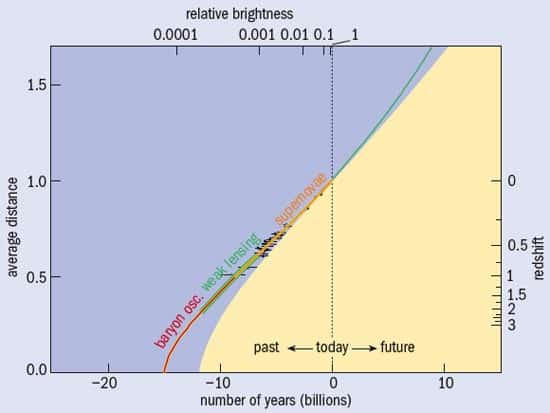
For a start, measurements of the cosmic microwave background — the bath of microwave radiation left over from the Big Bang — made in 2000 by the Boomerang and MAXIMA balloon experiments, and in 2003 by the WMAP satellite, have provided independent support for an accelerating universe. Further evidence has come from the Sloan Digital Sky Survey, which in 2005 measured “ripples” in the distributions of galaxies that were imprinted in acoustic oscillations of the primordial plasma 360,000 years after the Big Bang when the universe had cooled sufficiently to allow matter and radiation to decouple. Astronomers have also shored up their evidence for an accelerating universe by studying gravitational lensing — the way light from distance sources is bent by the gravitational fields of massive intervening galaxy clusters. Finally, the original supernova approach itself has been extended and strengthened by including more objects, measured more accurately and across a greater range of cosmic history, with the help of both ground-based telescopes and the Hubble Space Telescope (see “Supernovae as distance markers”).

Together, these observations have led cosmologists to a description of the universe called the concordance model. In this picture, 75% of the cosmic mass energy exists as a mysterious, gravitationally repulsive accelerating component, while the remaining 25% has attractive gravitational interactions. In fact, the majority of this 25% (about 5/6) is not even normal matter but rather some additional unknown substance — called dark matter — that gravitates normally yet does not couple to electromagnetic radiation. In all, the concordance model shows that we only understand a somewhat shameful 4% of the content of our universe.

Facing up to data

By the end of 2003 denying the cosmic acceleration was no longer an option. By that time, however, frustration or anger had begun to set in. Just as a patient might cry “why me, why now?”, so did physicists trying to understand why the universe was accelerating at all, and in particular why it was doing so now. This is because while the supernova observations could not tell us precisely what dark energy is, its effect on tearing the universe apart is tantalizingly similar to what one would expect if the universe is permeated by Einstein’s long-abandoned cosmological constant.

Just after Einstein had unveiled his general theory of relativity in 1915 — which describes the dynamics of the universe and the evolution of the matter and energy in it — he introduced a constant into his equations to counteract the attractive pull of normal matter. He did this because he wanted his new theory to fit the then belief that the universe was static. But when, in 1929, Edwin Hubble showed that the universe was expanding, Einstein was forced to take the cosmological constant out again. Nevertheless, ever since then the possibility of gravitationally repulsive energy has remained in Einstein’s theory.

Intriguingly, although a “cosmological constant” is ultimately a source of intense frustration for physicists, it is also predicted by the physics of the very small: quantum mechanics. Quantum field theory predicts that even empty space has an energy density due to the spontaneous creation and annihilation of elementary particles. Based on the particles that we know to exist, however, the vacuum energy density according to quantum mechanics should be an embarrassing 10120 times larger than the value that is required to explain the cosmic acceleration.

Adding to the conundrum of having such a natural candidate for dark energy that is 120 orders of magnitude too large, the cosmic acceleration also appears to have begun only recently in cosmic history. Presumably the cosmological constant could have overtaken the gravitational influence of matter at any time during the last 13.7 billion years during which the universe expanded by a factor of 1028 or so. Yet it kicked in only during the last factor of two expansion — a coincidence with odds of just 2 in 1028! These absurdities seem arranged purely to drive scientists crazy, or to an anthropic explanation in which the laws of nature are somehow linked to our presence.

Physicists countered the anger with bargaining: perhaps we are not dealing with a true cosmological constant but a varying quantum field that adjusts the energy density of the vacuum as the universe expands. This would also be reminiscent of inflation — a period immediately after the Big Bang during which the universe expanded by a factor of perhaps 1026 in just 10–33 s. Maybe the magnitude of the measured cosmological constant is small because the universe is old, and perhaps the reason why acceleration occurred so close to the present time is because matter only came to dominate over radiation and form dense structures fairly recently.

Since 1998, theorists have investigated a wide variety of such models, for example involving new quantum fields such as “quintessence” and extensions of general relativity (see “The mysterious vacuum”). Great progress has been made in winnowing through the garden of models, but a lush thicket remains. The difficulty in deciding among the many proposals for dark energy — coupled with the fact that most measurements we can perform to try and understand its properties rely on the complicated astrophysics of distant objects — has brought some of the community to the stage of depression.

However, advances in the last few years show that there may be light at the end of the tunnel. A combination of next-generation experiments, theory and computation should soon lead researchers to the stage of acceptance, and hopefully beyond this to an understanding and appreciation of the nature of our accelerating universe.

Learning to walk

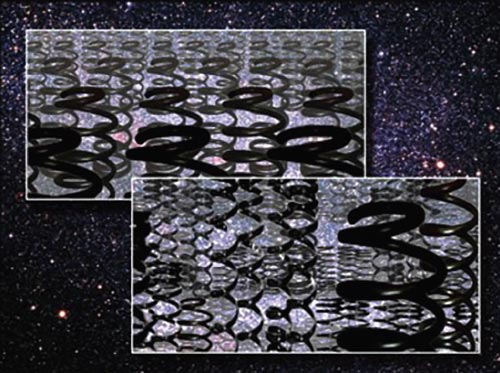
In the 10 years since the discovery of the cosmic acceleration, researchers have learned the basics of how to walk and talk. Much of this has involved determining the “equation of state” for dark energy. Einstein showed that in addition to mass, all forms of energy contribute to gravity. In particular, general relativity predicts that the strength of gravitational attraction is governed by a particular combination of the energy density, ρ, and the pressure, p, in the form: ρ + 3p. However, if the pressure is negative (as it is when two objects are separated by coiled springs, for example), this combination can have a value less than zero, thus turning gravity from an attractive to a repulsive force.

Physicists therefore often define the equation of state in terms of the quantity w = p/ρ, where w has to be less than –1/3 to cause cosmic acceleration. Einstein’s cosmological constant corresponds to w = –1, since a situation in which the pressure is equal and opposite to the energy density is the only way to achieve a unique energy density that does not change in space and time, as Einstein had thought. But in trying to understand the nature and origin of dark energy, researchers have moved beyond this simplest of equations of state and investigated other values of w and in particular now seek to understand the dark-energy properties as a function of time, w(t).

Thanks to the data collected via ground- and space-based observations over the last decade, we know that w averaged over the last 7 billion years — from when the universe was half its present size — is within 10% of Einstein’s cosmological constant, w = –1. The period of acceleration appears to have started about 5 billion years ago, before which dark energy was scarce enough that gravity dominated and caused gradual slowing of the expansion of the universe (i.e. cosmic deceleration).

Our understanding of how dark energy actually arose and whether it varies with time is much more modest. For example, all we can conclude so far is that w has not varied by much more than a factor of two over the last 7 billion years. The challenge now is to turn our knowledge of w into a precision measurement, with an uncertainty of a couple of per cent, and to know how it varies with time to a precision better than 10%. Then we will have a much better guide to what new physics has taken over our universe.

One way to achieve this is to collect more types of data using direct and well-understood cosmological probes. Simply obtaining more data of the sort we already have is insufficient; we need to observe supernovae and galaxies that lie deeper into space, and thus further back in time. We also need to be able to separate much more cleanly than we can at present the true properties of the universe from imperfections in our observations. For example, a supernova could appear to us as dim either because it lies further away or because its light has been scattered by dust in the galaxy where it resides, and gravitational lensing can be mimicked by the blurring of the telescope image due to the Earth’s atmosphere.

Because many of the properties of dark energy are mixed up with other quantities, such as the density of matter in the universe, it is also vital to use several different observational techniques. Furthermore, since dark energy has both direct effects on cosmic distances and indirect effects on the growth of galaxies and clusters of galaxies (since it is hard for clumps of mass to grow if the space between them is being rapidly pulled apart), complementary techniques can also help answer the important question of what flavour of new physics is required (see “Multiple approaches”, below). This could be a new physical ingredient such as a quantum field energy, which would affect cosmic distances and galaxy growth in the same way, or a new physical law that extends Einstein gravity, which might affect distances and growth differently.

If we look at astronomers’ track record of discovering new physics, we can see why we need new observations to resolve the issue. The 18th-century puzzle over the motion of planets in the outer solar system was solved by adding a new physical ingredient — the planet Neptune, which was discovered in 1829. The 19th-century puzzle over the motion of the inner planet Mercury, on the other hand, led to an extension of Newtonian gravity: general relativity. The 20th-century puzzle over motions of stars within galaxies will probably be solved by the discovery of a new ingredient — dark-matter particles, although we have not found them yet. For dark energy, which is currently the most pressing problem in cosmology, the mystery of new ingredient versus new law can only be decided through carefully planned experiments.

Tuning in to the early universe

There are four main experimental techniques that will allow us to shed light on the mystery of dark energy. The first is to look for ripples in the distributions of galaxies, which originated in acoustic oscillations of baryonic (i.e. normal) matter when it was bound up with the cosmic background radiation before matter and radiation decoupled. Like leaves (the baryons) floating in a pond (the background radiation), ripples in the water are revealed in the pattern of leaves. Since we can measure the wavelength of the ripples from the pattern of temperature fluctuations in the cosmic microwave background, we can compare them to observations of the galaxy pattern across the sky to determine the distances at which those galaxies lie.

Because only 1/6 of all matter is baryonic, while the rest is in some dark form that gravitates but does not couple to light (like stones in the pond that are unaffected by the motion of the water), the baryonic oscillation pattern is much more subtle than the temperature fluctuations we see directly in the microwave background using probes such as WMAP. However, in 2005 the Sloan Digital Sky Survey, which is based on data taken by a 2.5 m telescope located in New Mexico looking back 4 billion years, detected the faint baryon ripples. Indeed, as stated earlier, the fact that the galaxy patterns agreed with the concordance model supports the discovery of the accelerating universe.

To improve the precision of the measurements we now need to extend such galaxy surveys to much larger volumes. Starting in 2009, the Baryon Oscillation Sky Survey is scheduled to begin surveying one-quarter of the sky out to a redshift z = 0.8, when the universe was half its present age, as well as a slice of the universe at about z = 2.5, when it was one-sixth its present age. (The redshift is due to the stretching of light as the universe expands and thus provides a distance measure: z = (λobs – λ0)/λ0, where λobs is the wavelength of light detected and λ0 the wavelength of the light when it was emitted.) The Hobby–Eberly Telescope Dark Energy Experiment (HETDEX), which is planned to begin observations in 2010, will concentrate on this latter slice in more detail.

The baryon-acoustic-oscillation method is mostly sensitive to the matter density of the universe. This is because such measurements require a comparison between the observed size of acoustic ripples to the size expected from the cosmic microwave background, which originated in an era when the gravitational attraction from matter should have dominated over the gravitational repulsion from dark energy. When combined with supernova observations, however, this plays an important role in separating out the matter-density from dark-energy properties.

A second technique for tackling dark energy is to study the cosmic microwave background itself. The temperatures and spatial extents of the hot and cold spots in this sea of electromagnetic radiation provide a superb probe of the primordial universe some 360,000 years after the Big Bang. Since the early universe should be dominated by matter, with little dark energy, the microwave background says relatively little directly about the properties of dark energy. But, like the baryonic acoustic oscillations, it plays an important role in separating out the role of the matter density.

In addition to ongoing data from WMAP and groundbased experiments, a new generation of cosmic-microwave- background experiments such as Clover, EBEX, PolarBear, QUIET and Spider — which will either be built in the high Atacama Desert in Chile or flown on balloons — are expected to collect data between 2008 and 2010. These observations — not to mention data from the Planck satellite, which is due for launch in 2008 — will allow us to measure the polarization of the cosmic microwave radiation and perhaps allow us to use a form of weak gravitational lensing, the fourth technique that is discussed below, to find out more about dark energy.

The cosmic microwave background also provides a “backlight” to detect clusters of galaxies through their “shadows” as microwave photons scatter off the hot electrons in the cluster core. Known as the Sunyaev–Zel’dovich effect, several research groups hope to use this to measure the size of clusters and hence their distances in order to investigate dark energy. Experiments such as ACT and APEX-SZ in Chile and at the South Pole Telescope are just becoming operational to try this approach.

Supernovae revisited

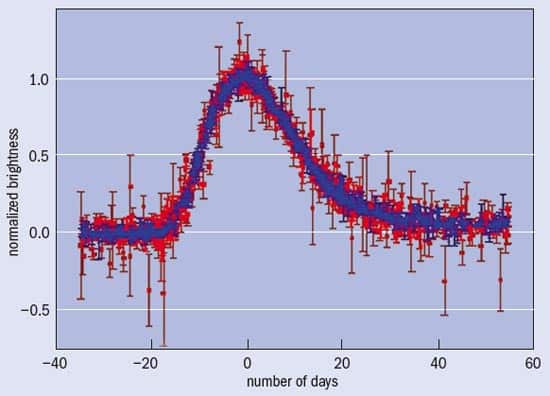
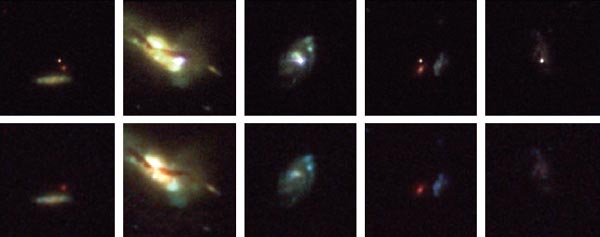
The most direct way to measure cosmic expansion is the same technique that was used to discover dark energy in the first place: observations of distant “Type Ia” supernovae. Remarkably, all measurements of these exploding stars show that they have the same standardized brightness no matter whether they occurred yesterday or 10 billion years ago (their intrinsic brightness may vary, but once the time it takes for their light to peak and fade is taken into account, their brightness appears quite standard). As such, the measured brightness of supernovae — which can be seen right out to the depths of the universe — tell us how far away they are (see “Studying supernovae”, below).

The discovery of the accelerating universe 10 years ago was based on observations of a few dozen supernovae, but since then researchers have measured several hundred and obtained a rough picture of the last 10 billion years of cosmic expansion. Further progress in supernova cosmology requires even more accurate and detailed measurements over this full time period. This is similar to the way one might build a picture of the Earth’s climatic history by studying tree rings, with wide rings pointing toward a warmer year. To obtain the clearest picture of the climate, one does not only want to examine more trees but to gather enough data from different types of tree in different environments to create a more accurate understanding.

For the immediate future, surveys such as the ongoing Nearby Supernova Factory will study supernovae from just the most recent 1 billion years in exquisite detail, while PanStarrs starting in 2008 in Hawaii and the Dark Energy Survey in 2010 in Chile will probe about 7 billion years back in time, although in less detail. However, it will be difficult to distinguish between various models for dark energy until an experiment combines the best qualities of each type of survey: in other words, a highly detailed examination of individual supernovae over the entire period that dark energy has been influencing the universe. For distant sources, light is redshifted to near-infrared wavelengths, so this goal requires a space-based observatory.

In 1999 the Supernova/Acceleration Probe (SNAP) was proposed to deliver a detailed “tree by tree” comparison for some thousands of supernovae spanning the last 10 billion years. NASA and the US Department of Energy have since agreed to carry out a Joint Dark Energy Mission, and there are now at least two additional proposals. These include the Dark Energy Space Telescope (Destiny), which would study supernovae and weak lensing, and the Advanced Dark Energy Physics Telescope (ADEPT), which would study baryon acoustic oscillations and supernovae. Both are vying with SNAP for funding, and the successful mission will take off in 2014 at the earliest (see Physics World October p8, print edition only).

The final weapon we have to tackle dark energy is weak gravitational lensing, which involves measuring patterns in the distortion of light emitted by distant galaxies due to the gravitational fields of intervening mass concentrations such as galaxies. Imagine someone holding a lens between you and a wall covered with patterned wallpaper; the distortion will depend on both the strength of the lens and how far it is from both your eyes and the wall. Weak lensing therefore probes dark energy both directly via the stretching of distances and indirectly via the mass of galaxy clusters, since the faster the expansion the harder it is for gravity to pull mass together. When taken together, the largest and deepest surveys undertaken so far image about 1/400 of the whole sky, mostly from data taken by the Canada–France–Hawaii Telescope Legacy Survey.

Surveys some ten times larger, to various depths, will be carried out over the next few years by the Kilodegree Survey in Chile, PanStarrs and the Dark Energy Survey. A new ground-based Large Synoptic Survey Telescope (LSST), starting in 2013 or later, is also planned to survey half of the entire sky, while the SNAP mission also includes a space-based weak-lensing survey that can cover 1/10 of the sky deeply and with high resolution.

Such data, especially when combined with a pure distance probe such as supernova surveys, should be able to provide precise tests of dark-energy properties — including shedding light on the key question of whether dark energy is a new ingredient of the universe or a manifestation of new laws of gravity. This is because the warping of light imaged by weak gravitational lensing is affected by both the acceleration of the universe and the strength of gravity, while supernova distances only depend on the acceleration of the universe — regardless of whether it is driven by new gravity or a new quantum field. Only by using both a distance probe like supernovae and a growth probe like weak lensing can we separate these effects and discover the real physical origin of our immensely puzzling, accelerating universe.

A bright future for dark energy

In the next 10 years we can be optimistic about advances in our understanding of dark energy. The sophisticated next-generation experiments being designed will greatly improve the accuracy of dark-energy measurements using a range of techniques, many of which complement one another and therefore take us closer to understanding the properties of dark energy. In 10 years’ time we should be able to determine the equation of state to a precision of 2% and see if it varied by more than 10% over the last 10 billion years, while also testing whether the new physics involves a new quantum field or a new theory of gravity (see “Constraining dark energy”).

With such advances we should be able to move firmly into the stage of accepting the new physics of our accelerating universe. Perhaps we will even appreciate that the puzzles of why dark energy exists and why it exists now have simple solutions that reveal something beautiful about the underlying physics. But we should also not forget that the field of dark energy is very young, and that we may have a long and exciting period of exploration ahead before it matures.

Understanding the equation of state for dark energy could also dramatically alter our knowledge of the fate of the universe. For example, continued acceleration would lead to an ever less-dense and colder universe, with the horizon of the visible universe closing in around each observer and ultimately leaving us in a truly dark universe. But a better understanding of dark energy could raise other profound questions, too.

If the accelerated expansion is indeed a window on new theories of gravity, for instance, could it reveal hidden dimensions of space–time? Is dark energy completely dark, uncoupled to matter and other quantum fields? Can the clumping of dark energy — a necessary adjunct to any variation of dark energy over time — be detected? Do its spatial perturbations travel at the speed of light, as for the simplest scalar-field explanations, or perhaps slower or even faster than light? And is there a related variation in what we thought were fundamental constants, such as Newton’s gravitational constant or the mass of the electron?

The pursuit of answers to the outstanding questions about the nature of our universe requires theory, simulation and observations to go hand in hand. In the quest for dark energy we will unavoidably and delightedly gather data on and develop understanding of the more familiar astrophysical universe too: stars, galaxies, clusters, cosmic radiation backgrounds, neutrinos and discoveries not yet imagined. The way forward is challenging. But cosmologists have clear ideas for implementing advanced probes to continue the remarkable progress in the physics revolution of the accelerating universe.

Studying supernovae

By measuring the universe’s expansion using exploding stars — supernovae — as distance markers, scientists hope to answer some of the most fundamental questions of existence, such as whether the universe is infinite, whether it is going to continue to expand forever, or whether gravity will slow the expansion so much that the universe will eventually begin to contract and ultimately end in a “big crunch”. Supernovae are useful in this regard because they are so bright that they can be seen here on Earth even if their light has been travelling for 10 billion years before it reaches us. Moreover, there is a certain class of supernovae — known as Type Ia — all of which brighten to the same peak value before beginning to fade. Since we know the speed of light, we can calculate how long ago these explosions occurred simply by measuring the apparent peak brightness of the supernovae today.

What scientists need though are supernovae with a variety of apparent brightnesses, in other words, those that are at a range of different distances from Earth. Supernovae emit mostly short-wavelength blue light that is stretched to longer, redder wavelengths as the universe expands. By measuring the size of this “redshift”, one can determine the size of the universe when the explosion occurred relative to its size today. Although the astronomers Walter Baade and Fritz Zwicky had already suggested in the 1930s that such a measurement could be made, supernovae at any given redshift have a variety of actual brightnesses, which meant that the idea languished till the mid-1980s when the more homogeneous Type Ia supernovae were recognized. Advances in computing and camera technology also helped revitalize this approach: the latest cameras were not only much more sensitive than photographic plates, but were also digital, which meant that their images could be easily analysed by computer. In particular, one could search for supernovae by scanning through many galaxies in one night.

Even so, it was not clear in the late 1980s that very distant supernovae could be found and studied by carrying out supernova searches. Indeed, a team of astronomers in Denmark, led by Hans Nørgaard-Nielsen, had already carried out a huge supernova search between 1986 and 1988 that had yielded just one distant Type Ia supernova; worse still, it had already faded well past its peak brightness.

A decade more of effort was needed to crack the case (see “Critical Point: Dark energy”), including new techniques to find and study entire batches of distant Type Ia supernovae before they reached their peak brightness. In presentations at scientific conferences at the start of 1998 and through papers submitted later that year, two teams — the High-Z Supernova Search team led by Brian Schmidt from the Australian National University and the Supernova Cosmology Project led by one of the present authors (SP) — presented startling results. Although they had been trying to measure the extent to which the cosmic expansion was slowing down, both teams had found signs that the expansion was speeding up. To see a supernova that had been redshifted by a particular amount, both teams found it was necessary to look at fainter and more distant supernovae than expected. In other words, the universe must be expanding faster now than in the past.

Now, a decade later, scientists still have no idea why the universe’s expansion is accelerating. Perhaps it is a sign that Einstein’s general theory of relativity will have to be revised. But if the acceleration is due to so-called dark energy, then we are left with an equally difficult problem — namely that almost three-quarters of the stuff in the universe is made from something we know nothing about.

At a Glance: Dark energy

  • Discovered 10 years ago from observations of supernovae made by two independent international teams, the cosmic acceleration is one of the most profound discoveries in cosmology
  • The driving force behind cosmic acceleration is often attributed to “dark energy” — an unknown substance that is gravitationally repulsive and makes up a staggering 75% of the mass–energy content of the universe
  • Current data suggest that dark energy could be some kind of “cosmological constant”, which was first proposed by Einstein in 1917 and which has a quantum-mechanical interpretation as vacuum energy
  • The key question facing researchers today is whether dark energy is indeed a cosmological constant or something else more exotic. Resolving this involves measuring the equation of state parameter, w, much more precisely
  • More accurate measurements of supernovae, baryonic acoustic oscillations, the cosmic microwave background and weak gravitational lensing should help answer this question in the next decade
  • Dark energy could ultimately leave our universe in total darkness by causing objects to recede from the Earth ever more quickly until they fade from view

More about: Dark energy

R R Caldwell 2004 Dark energy Physics World May pp37–42
R R Caldwell and P J Steinhardt 2000 Quintessence Physics World November pp31–37
E V Linder 2007 Resource letter on dark energy and the accelerating universe arXiv:0705.4102v1 Am. J. Phys. at press
S Perlmutter 2003 Supernovae, dark energy, and the accelerating universe Physics Today April pp53–60
A G Riess and M S Turner 2004 From slowdown to speedup Sci. Am. 290 62–67
Gravity and the expanding universe: www.teachersdomain.org/resources/phy03/sci/ess/eiu/expand
Universe Adventure: UniverseAdventure.org


Dark passions

Every so often a scientific discovery comes along that is so profound and significant that it has “Nobel prize” stamped clearly across it. That is surely the case for the discovery made 10 years ago by two teams of scientists that the expansion of the universe is accelerating. The discovery — made by members of the High-Z Supernova Search Team and the Supernova Cosmology Project (SCP) — points to the existence of a weird, gravitationally repulsive “dark energy” that is driving the acceleration and may account for some 75% of the entire mass–energy content of the universe.

The problem is that no-one knows what this dark energy is or whether it is changing with time. The most conventional explanation is that dark energy is some kind of “cosmological constant” that arises from empty space having a non-zero “vacuum energy” due to the spontaneous creation and annihilation of elementary particles. But if that is the case, then there must be something fundamentally askew with our knowledge of particle physics: given the particles we know exist, the vacuum energy density is then 10120 times larger than the value needed to account for the observed cosmic acceleration.

This issue of Physics World marks the 10th anniversary of the discovery of the accelerating universe by examining how our understanding of dark energy may develop over the next decade. Saul Perlmutter, the astrophysicist who headed the SCP team, is upbeat about our prospects of solving the mystery of dark energy, which will be the focus of numerous projects set to come to fruition in the next few years (see “Dark energy: the decade ahead”). Cosmologist Lawrence Krauss, however, is more gloomy: he fears that experiments may never be able to tell us if dark energy is a cosmological constant or something more exotic (see “A dark future for cosmology”).

But just as fascinating as the science of the accelerating universe is the story of the discovery itself, which involved two fiercely competitive groups. As Robert P Crease describes (see “Dark energy”), it is not easy to be sure when the discovery was made, to whom it should be credited, and even how it happened. Although the two groups mulled over the first hints of cosmic acceleration in autumn 1997 in private discussions and in early 1998 at public meetings, outsiders will probably be more comfortable in thinking the discovery “occurred” when the refereed papers were published — September 1998 in the case of the High-Z team’s paper and June 1999 for the SCP team. But is that fair? Perhaps the discovery occurred when the papers were posted online, which was several months earlier in both cases. Or did it occur when someone first told the media about it or first wrote it down in their notebook? Then there is the issue of which team’s analysis was fuller or more complete.

Assigning credit for a scientific discovery is never easy, especially when two rival, interacting teams of scientists are involved. Some members from both teams have been particularly worried about Crease’s article, which is one of the first attempts by a historian to examine this discovery in detail and went through over 20 drafts. Crease found it hard enough to present this hornet’s nest of a story as fairly as possible within the constraint of a short magazine article. But what his article reveals is how deeply scientific progress is indebted to ambition, desire, pride, rivalry, suspicion and other perfectly ordinary human passions.

Once a physicist: Alastair Reynolds


Why did you originally choose to study physics?

I had always been interested in science, but the thing that pushed me into considering a career in it was seeing Carl Sagan’s TV series Cosmos in the early 1980s. At this time I was also an avid reader of science fiction, and I had begun to read some of Isaac Asimov’s and Arthur C Clarke’s non-fiction books about science. Together with a deep fascination with the night sky that I had retained from an early age, this prompted me to do a degree in physics and astronomy at Newcastle University in the UK.

How much did you enjoy the subject?

Most of the time I found it enjoyably challenging, rather than enjoyable in the fun sense — I am not a naturally mathematically minded person, so acquiring the necessary numerical skills was always a bit of an uphill struggle for me. Nevertheless, I went on to do a PhD at St Andrews University on optical spectroscopy of massive X-ray binary stars, which contain a normal star like the Sun, only heavier, and a compact object like a black hole or neutron star. Basically I was using Doppler measurements to determine the masses of the component stars.

What did you do next?

After finishing my thesis, in 1991 I moved to the Netherlands and went to work for the European Space Agency (ESA). Among other things, I worked on the development of a new kind of photoncounting optical camera that could measure the energies and arrival times of individual photons. We used this instrument to make ground-breaking observations of cataclysmic variables (binary stars containing a white dwarf). Apart from a two-year stint as a postdoc at Utrecht University, I stayed at ESA until 2004, when I gave up science to become a full-time writer.

How did you get into writing fiction?

I had been writing short stories almost since I could read. In my early teens I started a novel, and when I was about 16 I became determined to establish myself as a published writer. But I was really only thinking in terms of it being a hobby. I noticed that many of the writers I enjoyed — Clarke, Gregory Benford, Joe Haldeman — were either practising scientists, or had studied physics and astronomy at some point. That galvanized me to take my studies even more seriously.

When did your writing career really take off?

It was ticking over nicely until my first novel Revelation Space was published in 2000. From that point on, there was a lot more interest — it’s the old thing of going from trying to sell stories to sceptical markets, to having those markets coming to you and inviting you to contribute. It was also about this time that I started breaking into the US magazine market, which was a big step in reaching new readers.

What made you decide to give up physics to become a full-time writer?

I was struggling to balance the two jobs — one had to go. I’d had a great time working for ESA, but I was also finding that I didn’t have enough time in the day to do all the writing I wanted. I was turning down interesting writing projects even though I used to dream about just being asked. I knew I was going to miss the intellectual challenges and social stimulation of working within a scientific team, which I have, but I still don’t regret my decision.

How does your physics training help with your writing?

Less than people imagine. I think the most important attribute for a science-fiction writer is to be fascinated by science — in all its manifestations. It’s not necessary to be able to understand all the details, but just to be inspired and stimulated. Most of the ideas that have fed into my writing have come from reading popular articles on subjects far away from my own very limited specialization, such as neuroscience or biology.

What advice do you have for physics students thinking of a career in science-fiction writing?

Write short fiction, and keep working at it until you break into the science-fiction magazine market. Many of the big names made an initial splash in the magazine market, and it’s often how they caught the eye of editors and publishers. I published my first stories when I was working towards my PhD and the contacts I established from those early days eventually led to my getting a contract to write novels. Also, make the most of your scientific literacy. Editors like to see “hard science-fiction” stories — fiction where the science plays a strong role in the narrative, even if it’s wildly speculative. They never see enough of this type of story, and so are more than willing to forgive minor deficiencies in characterization, plotting, style and so on, provided the ideas are fascinating. But that doesn’t mean you shouldn’t work hard at those things as well — no one gets a get-out-of-jail-free card!

The business of medical physics

I have now been a medical physicist at the University of Wisconsin for more than 20 years. My academic career, like that of most other scientists, revolves around research, teaching and chasing grant money. Unlike most of my fellow academics, however, I am also an entrepreneur. My quest for research money has led me to start two companies, one of which — TomoTherapy Inc. — is a Nasdaq-traded public company with more than 600 employees, many of whom are physicists. This gives me a unique perspective on medical physics — a field that has very close links between hospitals, universities and industry.

Medical physics is one of the fastest growing areas of employment for physicists. They play crucial roles in radiology, nuclear medicine and radiation oncology, while many medical physicists also work in cardiology and neurology. These fields use very sophisticated and expensive equipment, and physicists are responsible for much of its design, testing and quality assurance. Medical physicists can be found in universities doing basic research into topics such as how radiation affects tissues; in industry, using these results to build new imaging and therapy systems; and finally in hospitals, maintaining this equipment and planning radiation treatments.

My first company developed a system for planning radiotherapy treatments that uses data from a computed tomography (CT) scanner to accurately compute the distribution of the radiation dose received by the patient during a treatment. The key feature of the system was dose-calculation algorithms that used data from Monte Carlo simulations of photons interacting with water in order to improve the computational accuracy.

The initial research for this system was funded by the University of Wisconsin Hospital, but it was unable to pay for the work to be brought to market. In 1992 I and three colleagues therefore started Geometrics Corporation to complete the development. After receiving approval to market the product from the US Food and Drug Administration (FDA), we sold the company to Philips Medical in 1996 and our system subsequently became the best-selling radiation therapy treatment-planning software of all time.

TomoTherapy was started for similar reasons. The TomoTherapy technology marries a clinical linear accelerator (linac) with a CT scanner. A TomoTherapy linac provides both the X-ray beam for treating the patient with radiotherapy and a lower-energy X-ray beam that can be used to obtain a CT scan of the patient. A patient can therefore be scanned with the low-energy X-rays — and thus the tumour precisely located — immediately before the treatment (high-energy X-rays) is administered.

The development of this technology was funded for the three years from 1994 by General Electric Medical Systems. In 1997, however, the firm decided to get out of the radiotherapy business, so I and my colleague Paul Reckwerdt founded TomoTherapy to get the first research prototype built. With the help of some very savvy business people and medical-device professionals, TomoTherapy has grown beyond our wildest dreams. I still serve as chairman of the board, and as a result I have reduced my academic commitments at the University of Wisconsin by 25%.

Getting in

So how can you become a medical physicist in industry? As far as TomoTherapy is concerned, we need staff with a broad range of experience, including those from traditional fields like nuclear physics, particle physics and astronomy. A knowledge of radiation detection, accelerator physics and materials science is sought-after for roles in both product development and customer service. Some medical-physics firms recruit students directly after they finish their PhD because their research topic is relevant to the company. But many organizations — particularly in radiotherapy — tend to recruit medical physicists who have spent a few years working in a clinic because these companies value the real-world skills that such experience instils.

Most older medical physicists entered the clinic through the “back door” — i.e. they were hired by a hospital while working in a basic discipline and then learned on the job. But that is getting rarer and is even being actively discouraged by the American College of Radiology. Instead, training is increasingly being provided via clinical “residencies”, during which prospective medical physicists learn the necessary clinical skills under the supervision of experienced mentors. Typically these residencies are two years long and the pay is comparable to a postdoctoral fellowship. These programmes usually require you to have a PhD in physics, although some will accept candidates who have only a Masters degree.

These days, many medical physicists get into the field via an accredited medical-physics graduate programme. In the UK, for example, physics graduates can complete a taught MSc in medical physics either directly or by becoming a clinical-scientist trainee in the National Health Service. These courses — which are accredited by the Institute of Physics and Engineering in Medicine — take about two years to complete and involve lab work and practical experience in a hospital, as well as lecture-based learning. There are similar programmes in the US, which are accredited by the Committee on the Accreditation of Medical Physics Education Programs. Graduates of these courses are often hired directly into clinics as entry-level faculty members or as employees.

Lives in your hands

A major difference between medical physics and most other areas of physics is the level of regulation. Patients’ lives are at stake, so the key to success is attention to detail — sloppiness in thought or action cannot be tolerated. A huge fraction of the costs incurred by medical companies stems from the need for stringent quality assurance and testing to make sure their products comply with regulations. The attitude and skills required of a medical physicist are not too different from what is demanded of a good experimental physicist, but the consequences of inaction or inattention may be much more serious.

This level of responsibility is accompanied by many benefits, however. Industrial physicists working in the medical field have many opportunities to advance to a high-level managerial and business role. Potential barriers — such as a lack of business knowledge — can be overcome by taking an MBA or one of the short courses in, say, accounting, finance or marketing that are focused on the career needs of scientists working in industry.

Another attraction of working in industry is the wide variety of people you encounter. A physicist working in a university lab often has a rather narrow range of experiences, often associating only with their group, both at work and socially. This is certainly not true in the medical field. Industrial medical physicists are required to work with doctors, medical administrators and technicians in hospitals, as well as service engineers and assembly personnel within their company.

The financial and personal rewards for physicists in the medical-device business are also high and the quality of the work environment is generally better than in a university. Ultimately, though, nothing can beat the job satisfaction of knowing that your work has an immediate human benefit.

The land before time

“Before time? What do you mean before time?” says the Doctor to the Beast in a recent episode of the TV show Doctor Who entitled “The Satan Pit”. The intrepid Time Lord, as we all know, lives in what we might call the conventional universe, which has a definite beginning, no end and nothing — not even time — exists otherwise. But is this picture true? Endless Universe is a highly readable account of two scientists’ struggle to imagine the universe, and what emerges is that this conventional picture is by no means the final word in cosmology.

Our quest to understand the universe has a long and venerable history. But the real thrill of trying to understand nature is that although we come to the table with an incomplete set of tools, we can still fashion theories that are remarkably accurate and effective. Over 70 years after Einstein claimed that the most incomprehensible thing about the universe was that it was comprehensible, his comment still holds true.

The early years of cosmology were heady times. On the one hand, the frontiers of observation and measurement were pushing outwards at an incredible rate, showing that the universe was a dynamic and evolving place. On the other, the application of the new quantum theories was giving a concrete picture of how elements were synthesized in the early universe, which, when put together with Einstein’s new theory of gravity, gave a compelling history of the universe. Yet this new “cosmology” was a marginal area of science, because adding up the numbers between observation and theory was fiendishly difficult.

Gradually, however, these details were refined and the rough and ready Big Bang model was spectacularly confirmed. There was just one niggling problem: the universe had to have started out in such a precise — and unlikely — state that it seemed as if it must have been created rather than just having happened. Such a conclusion is perhaps theologically acceptable, but, as the authors of this book are at pains to point out, science is about what can or cannot be proved, not about what we wish to be true.

The real narrative of the book begins at this point, with the theory of inflation — the first attempt to take the Big Bang beyond the frontier of tested physics. Inflation was an attempt to take ideas from (then) contemporary high-energy physics and apply them to the early universe to provide a moderating effect. The result was a kind of cosmic smoothie maker that could take a wide range of possible beginnings, and churn out very similar cosmologies. Yet inflation does not answer the question of the beginning, and — like the Doctor — we are left wondering if anything could indeed happen “before time”.

Paul Steinhardt and Neil Turok ask us to contemplate the startling possibility that this question has meaning. Having built the case for inflation, they proceed to pick at the detail, describing how inflation has its own “niggling problems”, and they argue that the time is ripe for a new idea. One by one they show that the problems inflation was designed to solve can also be solved by an alternate idea: the cyclic universe. In this model, the universe has been in existence forever — dying and then undergoing a cosmic rebirth every trillion years or so. This may sound far-fetched as it is difficult to see how we can go through a singularity where everything, including space and time, ceases to exist, but as the authors explain, this difficulty arises because we are used to thinking in three dimensions.

String theory — the biggest theoretical advance in cosmology since inflation was suggested — has brought with it a new understanding of space and time. It achieves Einstein’s goal of bringing gravity under the quantum umbrella, but it does so at a price. In order to be consistent with quantum mechanics we need to live in 10 (or even 11) dimensions! For many years, string theorists avoided cosmology because it was not possible to build a realistic universe, but recent developments in the understanding of the structure of these extra dimensions, as well as a revolution in the way we deal with them, meant the time was ripe for a radically new cosmological model.

Steinhardt and Turok stepped in to provide one. In their model, the universe is simply a slice (known as a brane) through these extra dimensions, and the Big Bang was a collision of branes — a huge cosmic thunderclap. This model builds on an idea called M-theory, in which the strings live on two walls at the end of an 11D space–time. Applying the usual rules of string theory leads to a general picture in which these walls can move across the canyon separating them, and occasionally (every trillion years or so according to Steinhardt and Turok) slam into each other. It is this slamming together that is responsible for what we see as the Big Bang, although from a higher-dimensional point of view it is a collision rather than a singularity.

This book may not convince you that the authors are right. In fact, it is only fair to point out that most of the scientific community does not accept their model; and that many key tenets have not been proven. Nevertheless, this book captures excellently the excitement of scientific advance, and the real thrill of coming up with a new idea. One message the authors communicate clearly is that we should never accept something simply because most people say it is true, but should constantly challenge and look for alternatives to any picture that cannot be rigorously proven.

New boss selected for ESRF

Francesco Sette has been selected as the next director general of the European Synchrotron Radiation Facility (ESRF) in Grenoble, France. Sette, who is currently a research director at the ESRF, will take over from William Stirling when his eight-year term as lab boss finishes at the end of 2008.

The 50-year-old Italian-born physicist first joined the ESRF in 1991 after a spell at AT&T Bell Laboratories in Murray Hill, New Jersey. While at the ESRF, Sette developed a new generation of inelastic scattering beamlines to study the motion of atoms and the electronic properties of solids.

Sette, who has been director of research at ESRF since 2001, has played a key role in encouraging more scientists to use the lab, with the total now exceeding 4000. Sette is also a member of the advisory committees of major light sources at DESY in Hamburg and at the Stanford Linear Accelerator Center in the US.

Neutrinos could probe Earth’s structure

In the absence of a 6,000 km-deep hole to conduct observations, scientists hoping to learn about the internal structure of the Earth presently have few options but to monitor seismic waves. However, this technique, which relies on models of how waves are affected by rock properties, is indirect and so potentially unreliable. A truly direct method, suggest researchers from Spain, Japan and the US, might be to monitor the proportion of atmospheric neutrinos that are absorbed while passing through the Earth.

This isn’t the first time that atmospheric neutrinos, which are produced when cosmic rays collide with atomic nuclei in the upper atmosphere, have been proposed to probe the Earth’s structure. Although these chargeless, almost massless particles pass straight through the Earth unimpeded when they have a low energy, at energies above 10 TeV (1013 eV) they are very occasionally absorbed.

Since this absorption depends on the density of the neutrino’s travelling medium, a neutrino travelling through a slice of the Earth close to the surface, for example, would be less likely to be absorbed than a neutrino travelling straight through the dense core. So by counting how many neutrinos come through different slices, it should be possible to see where the transition between the core and the inner mantle occurs, or between other structural layers.

It would be better to have a localized beam rather than a disperse one, but there is no such beam in nature that is intense enough

Scientists widely dismissed the idea of using atmospheric neutrinos to probe the Earth’s structure, however, because they mostly occur at lower energies. Although they had hoped that higher-energy cosmic neutrinos generated by supernovae and other astrophysical sources would be suitable, observations at the AMANDA neutrino telescope in the Antarctic have shown that such sources are too rare.

Now, Concepcion Gonzalez-Garcia from the University of Barcelona in Spain and colleagues say that atmospheric neutrinos may have been dismissed too hastily. Their calculations show that, although the proportion of atmospheric neutrinos above the 10 TeV absorption criterion is low, the sheer number of them could make up for it (arXiv:0711.0745). “It would be better to have a localized beam rather than a disperse one, but the point is that there is no such localized beam in nature that is intense enough,” Gonzalez-Garcia told physicsworld.com.

Cold observation

Not any neutrino detector is up to the job, though. The researchers think that sufficient numbers of atmospheric neutrinos could only be detected with AMANDA’s successor, known as IceCube — a network of about 70 light sensors on strings that are currently being buried two-kilometres deep into the Antarctic ice.

Neutrinos passing through ice will occasionally have a chance interaction with an atomic nucleus and produce a subatomic particle called a muon, which travels at high speed while producing so-called Cerenkov radiation. When this radiation reaches one of IceCube’s light sensors, it registers the presence of a neutrino.

To calculate the number of atmospheric neutrinos that could be recorded in this way, Gonzalez-Garcia’s group integrated the area of IceCube and multiplied it by the flux of atmospheric neutrinos produced on one side of the Earth given by a theoretical model. They then had to reduce the value to allow for various attenuating factors: the varying density of the Earth, inelastic scattering, and the possibility of oscillation — that is, a neutrino fluctuating in type or “flavour” over long distances.

The researchers estimate that about 1000 neutrinos would have to be detected to observe the density transition from the Earth’s core to its mantle with 99% accuracy. Given that IceCube now has installed just 13 of the 70 sensor strings and will not be completed before 2010, this observation could take from four years to a decade.

Although this seems like a long time for information that has already been revealed by seismic measurements, Gonzalez-Garcia’s group point out in their paper that such measurements rely too heavily on models that have not been verified by independent methods. “The case for direct observations using an alternative method is compelling,” they say.

Copyright © 2026 by IOP Publishing Ltd and individual contributors