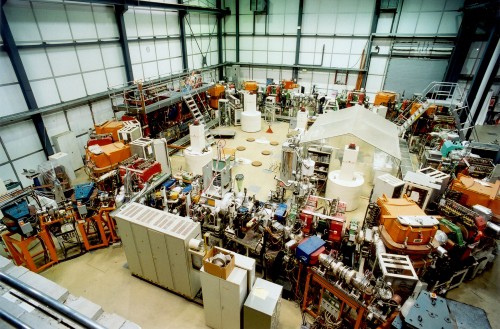
Results question merit of axion experiments

The first results from a series of “shining a light through the wall” experiments have put stringent limits on the properties of the axion — a hypothetical particle that could explain elusive dark matter. The results, which were taken by the BMV experiment in Toulouse, France and the GammeV experiment at Fermilab in the US, call into question the merit of similar experiments in the pipeline.

The only evidence for axions came in 2005, when researchers at the PVLAS experiment in Italy noticed a slight rotation in the polarization of a laser beam passing through a magnetic field. Although the researchers subsequently found that it was in fact an artefact of the apparatus rather than a true axion signal, many other experiments had already begun construction to see if there really could be an axion with the type of parameters suggested by PVLAS — ALPS at the DESY lab in Germany; OSQAR at CERN; LIPSS at the Jefferson Lab in the US; and BMV and GammeV.

These experiments have now just scratched a bit of previously unknown territory

The principle of all these experiments is to shine a laser beam through a magnetic field onto a thick wall that has a photon detector on the other side. Normally none of the beam photons would pass through the wall, but if one of the magnetic-field photons were to combine with another in the beam to produce an axion, the axion would travel through the wall unimpeded. Once through, this axion would be converted back into photons to register a signal on a detector, thus proving the axion’s existence.

The BMV and GammeV experiments have detected no such signal. The BMV team rule out the existence of an axion with PVLAS’s mass and photon-coupling parameters with 99.9% certainty (Phys. Rev. Lett. 99 190403), while the GammeV team increase this certainty to 99.9999% (arXiv:0710.3783v1). The GammeV team also put the strongest constraint on the strength of the axion’s coupling to photons — assuming it has a mass of roughly 1 meV — of less than 5 × 10⁻⁷ GeV-1.

‘Redundant’ tests

Carlo Rizzo of the BMV team told physicsworld.com that this makes the other axion experiments, which are yet to publish their first data, largely redundant. “As far as I understand, there are no more special reasons to look for axion-like particles in the range of mass and coupling constant that have already been excluded,” he said.

But this opinion is not shared by Andreas Ringwald at DESY. He points out that DESY’s ALPS experiment and others will be more than an order of magnitude more sensitive to mass, and so might be able to detect particles other than axions. These include new light particles such as those predicted in “supersymmetric” extensions of the current Standard Model of particle physics. With a little modification, he said, the experiments might also be able to detect hypothetical “chameleon” particles. Such particles, which change their mass depending on the density of the matter they inhibit, might explain the accelerated expansion of the universe.

“I think that these [axion] experiments have now just scratched a bit of previously unknown territory,” Ringwald said. “Further experiments such as ALPS or OSQAR have the potential to really dig deep into previously unexplored parameter space.”

Protein calms the waters

Living organisms contain both proteins and water and the complex interactions between the two are thought to be the driving force behind many biological processes.

Now, biophysicists in the US have discovered that a protein called myoglobin can coordinate the motion of surrounding water molecules, slowing them down significantly – perhaps to allow certain interactions to occur (PNAS 104 18461). The team has also shown that the motion of these water molecules can be associated with the shape and function of the protein – information that could improve computer simulations of protein dynamics and lead to a better understanding of diseases like Alzheimer’s and Parkinson’s, which involve drastic protein shape changes.

Proteins are long strings of amino acids that fold into compact structures. They are found in all living organisms, where they perform myriad tasks from chopping food into its molecular constituents to contracting the muscles that allow us to move. In order to do their jobs, most proteins must stay folded but also change their shapes in controlled ways – despite being jostled relentlessly by the rapid thermal motion of surrounding water molecules.

Fleeting interactions

Biophysicists have long suspected that the interactions between proteins and surrounding water molecules – a process called protein hydration – play important roles in protein folding and function. However, these interactions had been very difficult to study because they are so fleeting – sometimes lasting less than a billionth of a second.

Over the past few years Dongping Zhong and colleagues at the Ohio State University have developed a way to study protein hydration using ultrashort pulses of laser light. Their technique involves the amino acid tryptophan, which occurs naturally in proteins. When tryptophan is excited by a laser pulse, it emits light with properties that depend on how the tryptophan is interacting with nearby water molecules.

The team prepared proteins called myoglobins (proteins that carry oxygen in muscles) with tryptophans at known locations along the protein strands. The team then fired 90 fs (9*10-14 s) pulses of ultraviolet light at the proteins. By observing the light emitted from the tryptophans, they discovered that water next to the proteins moves in two very distinct ways.

Collective motion

One mode of motion is the “slow” collective movement of a layer of only water three molecules thick that surrounds the protein. This “slow” motion occurred on timescales of 20-200 ps (20-200 * 10-12 s) and was distinct from the “fast” (1-8 ps) movement of individual water molecules that the team detected at greater distances from the protein. Both types of movement are significantly slower than the motion of water molecules in the absence of proteins.

Zhong and colleagues also discovered that the value of the slow timescale had a strong association with changes in certain local surface properties of the myoglobin including electrical charge and flexibility. Both of these properties are known to be important factors that determine how a protein changes its shape.

Although the exact speeds of the “fast” and “slow” motions differed over the protein’s surface, the two types of motion were present at all tryptophan locations and even persisted when the protein’s structure was disrupted with a mild acid. Zhong told physicsworld.com that this means that that the two modes are likely to be a general property of all proteins. “We are now testing other types of proteins with different structures,” he said.

While water has a simple molecular structure, biophysicists have struggled to understand how it interacts with proteins on the lengths and timescales investigated at Ohio State, and instead have relied mostly on computer simulations. According to Zhong, his team’s discovery of a slow collective motion of water puts into question the validity of these computer models – particularly the timescales used. “We are pretty confident that the simulations need to change”, he said.

Analysis confronts model of universe’s formation

Tiny temperature variations found in maps of the cosmic microwave background are commonly thought to be proof that stars, galaxies and other large-scale structures grew from density perturbations in the early universe. But one physicist in the US is controversially claiming that these observed variations are in fact caused by hydrogen atoms in our own galaxy. If he is right, cosmologists will have to drastically rethink their models of the universe’s evolution.

In the early universe’s hot plasma, light left over from the Big Bang could not travel far without being scattered by electrons. But by the time the universe was some 380,000 years old, it had cooled enough to let electrons and protons combine and form hydrogen atoms. Photons could then travel freely over long distances without being scattered, stretching in wavelength as the universe expanded to become the cosmic microwave background (CMB) — a map of the early universe’s structure frozen in time.

Data taken by the COBE satellite in 1993, and to a greater extent by the Wilkinson Microwave Anisotropy Probe (WMAP) in 2003, showed that tiny temperature variations permeated the CMB. These proved that the early universe was not an even distribution of mass, but had dense regions that — as cosmologists’ models suggest — were to seed the galaxies and other structures we see today.

Wrong source

Gerrit Verschuur, a physicist from the University of Memphis in the US, disagrees. He has noticed that the temperature variations recorded by WMAP tend to coincide with radio emissions from neutral hydrogen in the Milky Way. In other words, the fluctuations may not be part of the CMB at all (Astro. J. in publication; preprint available at arXiv.org:0704.1125v2).

My approach now is to determine what I can learn about interstellar physics in studying these cases, and not to worry about statistical arguments

Verschuur made his discovery while studying the Leiden-Argentina-Bonn (LAB) survey, a map of radio emissions from neutral hydrogen in the Milky Way that was completed for the entire sky in 2005. “So many data are daunting and users of the all-sky LAB survey still tend to extract only the data for the small area they are interested in,” he told physicsworld.com. “I had been working with the data over a large area.” In his paper Verschuur notes six areas where he has found visual correlations between the LAB and WMAP surveys, though he says that he has since found around 200 more correlated areas.

If his analysis is correct, it would undermine the widely established “cold dark matter” model of the universe’s evolution, which says that large-scale structure grew from small density perturbations in the early universe. According to studies of the WMAP survey, normal matter makes up just 4% of the universe, with mysterious dark matter and dark energy accounting for 24% and 72%, respectively. Although WMAP scientists had to carefully subtract known contributions from physical processes in the Milky Way, Verschuur points out that the correlating hydrogen emissions could be originating from an unidentified process.

Statistical analysis

Not everyone agrees with the US physicist’s inferences, however. Kate Land at the University of Oxford in the UK and Anže Slosar at the University of Ljubljana in Slovenia compared various maps from the LAB and WMAP surveys at different frequency bands and scales using computer “Monte Carlo” techniques, but found no statistically significant correlations (Phys. Rev. D 76 087301).

The results are somewhat anecdotal

As for the reliability of visual inspections, Land and Slosar recall the urban myth that a certain point in the WMAP survey contains Stephen Hawking’s initials. “Correlations by eye are very misleading,” they conclude.

Undeterred

Even so, Verschuur is keen to continue his analyses. “My approach now is to determine what I can learn about interstellar physics in studying these cases, and not to worry about statistical arguments,” he said.

But Gary Hinshaw, a physicist on the WMAP mission team at NASA’s Goddard Space Flight Centre, also disputes Verschuur’s conclusions. “My impression is that it is primarily based on a visual comparison of the maps and not on a rigorous statistical analysis, so the results are somewhat anecdotal,” he told physicsworld.com. Referring to the study by Land and Slosar, he added: “I think this paper really puts the claim to rest.”

UK plans to withdraw from Gemini

Astronomers in the UK are shocked at plans by the Science and Technology Facilities Council (STFC) to withdraw from the Gemini Observatory, which consists of two eight-metre optical and infrared telescopes in Hawaii and Chile. The STFC, which intends to finalize its decision on 21 November, says it has to pull out from Gemini because of the “current financial climate”. The council has a total budget this year of £678m, but this will only increase in line with inflation in 2008 following the government’s recent comprehensive spending review.

The UK has invested a total of £35m in the Gemini North and Gemini South telescopes, which saw first light in 1999 and 2000 respectively. The country was a founding member of the project and has a 23% stake in the project. Withdrawing from the observatory would save the STFC about £4m per year in running costs. Although the UK has access to similar facilities in Chile operated by the European Southern Observatory, they provide no access to the northern skies.

“We had no warning of this decision and I can’t find anyone else who has,” says Michael Rowan-Robinson from Imperial College London, who is president of the Royal Astronomical Society. “Our international partners in the Gemini project will be equally stunned.” He now intends to talk to the STFC and government ministers to try to get the decision reversed. One option could be to reduce the UK’s participation in the project or allow the UK to sell time on the telescope to other partners.

The plan to withdraw from Gemini was discussed at a meeting of the observatory’s international board earlier this week. According to an STFC spokesperson, the government’s spending review had been a “contributing factor” in the plan to withdraw from Gemini. The council, which has not given its partners formal notice of its withdraw plan, wants the pull-out to be achieved “in a way that minimises damage to our longstanding partnership and the impact on the observatory, its programme and the UK research community.” The STFC also plans to release full details of its forward programme early next month.

‘Nanosoldering’ makes a clean contact

Physicists in the US have developed a technique for soldering nano-sized objects without contaminating them. The technique could be used to make clean electrical contacts between advanced structures such as graphene in the making of tiny transistors and nanomachines.

Most researchers make electrical contacts on nanostructures using electron beam lithography — an expensive and time-consuming technique that involves scanning a beam of electrons across a surface masked with a polymer “resist”. Importantly, the resists and solvents used in the process leave residues that contaminate samples, sometimes adversely affecting their final properties.

No mess

Now, Alex Zettl and Caglar Girit at the University of California at Berkeley have come up with a cheap, quick “nanosoldering” technique that overcomes these problems. They begin by placing the sample to be contacted on one side of a holder with a small bead of indium — a metal known to adhere to many surfaces — on the other. While watching through a microscope, the researchers heat the holder above indium’s melting point and dip a room-temperature tungsten tip into the molten indium bead using a mechanical “micromanipulator” to slowly pull out a spike of solder.

In the final step, they use the micromanipulator to position the solder spike over the sample and quickly raise the holder, which fuses the solder spike onto the sample as the two come into contact. Once contact is made, the sample heater is turned off and the contacts solidify (Appl. Phys. Lett. 91 193512).

Low resistance

Zettl and Girit have already used nanosoldering to contact graphene. This material, which comprises a single sheet of graphite, has interested scientists because it can be both a semiconductor and a very good electrical conductor, making it useful for certain nanoscale electronic devices. After soldering nine different graphene devices, the researchers found that the resistance over the contacts varied from 190 to 1700 Ω with a mean value of 680 Ω, comparable to the best electron-lithography contacts.

According to the researchers, the new technique can be used to contact nanotubes and nanowires as well as graphene. Moreover, they say it could open the way to building nanomachines piece-by-piece by fusing small components together, rather than using complicated chemical methods.

Physicists spot unusual charged meson

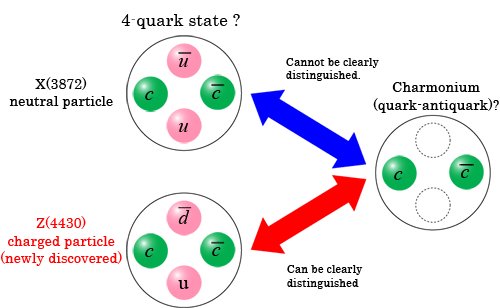
Physicists at the Belle experiment at the KEK laboratory in Japan have discovered a new particle that provides the best evidence yet that some mesons contain four quarks rather than the usual two. Dubbed Z(4430), the new particle is the latest of several mesons discovered at Belle that seem to defy the “quark model”, which has been very successful at classifying mesons in terms of two constituent quarks.

Introduced in the 1960s by the future Nobel laureate Murray Gell-Mann, the quark model has allowed physicists to make sense of the myriad particles produced in successive generations of accelerator experiments. As well as describing the familiar protons and neutrons, which contain three quarks, the quark model had been successful at classifying the many mesons that contain two quarks – or more accurately one quark and one antiquark – held together by the strong force.

However, things started to go wrong about four years ago when two experiments — BaBar at the Stanford Linear Accelerator Center in the US, and Belle at the KEK laboratory in Japan – began to discover mesons that did not appear to be simple pairs of quarks and antiquarks. These peculiar mesons were made at both facilities by smashing electrons and positrons together.

Four quarks

Some physicists have suggested that these rogue mesons — of which at least four have been seen — could be made of four, rather than two quarks. Others believe, however, that the particles are simply excited states of the “charmonium” meson, which contain one charm quark and one anti-charm quark.

However, charmonium is electrically neutral, whereas Z(4430) is the first rogue meson to be discovered with an electrical charge. As a result, Z(4430) is unlikely to be charmonium. Instead, the Belle physicists believe that it could be a four-quark state comprising up, anti-down, charm and anti-charm quarks. This is consistent with the observation that Z(4430) decayed instantly into a charmonium meson and a pi-meson (which contains up and anti-down quarks). If true, Z(4430) would be the first meson that cannot be described in terms of two quarks (arXiv 0708.1790v2) .

The discovery of Z(4430) could mean that physicists have to re-examine the theory of quantum chromodynamics (QCD), which explains why quarks and anti-quarks are bound together in mesons and other particles.

However not everyone is convinced. Eric Swanson of the University of Pittsburgh in the US told physicsworld.com that while the Z(4430) data look convincing, other such particles will need to be discovered before he accepts that four-quark mesons are a reality. “I can’t find a plausible way to explain [Z(4430)],”, he said.

Nanotube fibres toughen up

Physicists in the UK are the first to make fibres from carbon nanotubes in a simple one-step process that could be adapted for commercial production. The fibres, which are just a few micrometres across, are claimed to be stronger than any known material and consist of hundreds of thousands of nanotubes bound together. According to its inventors at the University of Cambridge, the new material could find use in a host of applications from bullet-proof vests to flat-panel displays.

Despite having walls only a few atoms thick, carbon nanotubes are remarkably strong yet lightweight strands that could someday be made into fibres that could be woven into extremely durable fabrics. While several techniques have been developed to spin nanotubes into larger fibres, these are all multistep processes that are not viable on an industrial scale.

Now, Cambridge’s Krzysztof Koziol and colleagues have come up with a much simpler one-step process to make nanotube fibres (Sciencexpress 1147635). The team start with a hydrocarbon feedstock, such as ethanol, hexane, methane or diesel. Next, they inject this feedstock into a furnace along with a small amount of iron-based catalyst called ferrocene. The feedstock breaks down into hydrogen and carbon and the carbon is then restructured on particles of iron catalysts as long, thin-walled nanotubes.

Aerogel-like structure

The nanotubes grow very quickly in the furnace and form an aerogel-like structure. As the furnace is open at one end, the aerogel can be pulled out with a metal rod, which stretches the fibre into a fine thread that can be wound continuously. Winding is done at a rate of up to 50 metres per minute and several kilometres of the fibres can be made in a day.

“At gauge lengths below 2 mm, some of our fibres have strengths greater than any material known to mankind,” Koziol told physicsworld.com. “The average strength is similar to Kevlar — the material that most body armour is made of.”

Apart from good mechanical properties, strength and toughness, the materials also have high electrical and thermal conductivities. They retain their mechanical properties at temperatures of up to 300°C in air too, which is impossible for other such fibres. “Moreover, knots on these fibres do not influence mechanical performance either — something that is a huge issue with other high-performance carbon and polymeric fibres,” explains Koziol.

“One of main applications for this new material is in super-strong bullet-proof vests,” says team leader Alan Windle, also at Cambridge. “Related applications include strong containment surrounds for the fan blades of jet engines: if the blade becomes detached, the fibres would prevent it from flying out of the engine and damaging the aircraft.”

The fibres could also find use in bomb-proof bins and in blast protection for tank engines and other armoured vehicles. “Hi-tech smart fabrics may be on the agenda too,” adds Koziol. “There is also a great potential to provide an alternative to copper or aluminium conductors for electric power transmission.” The nanotubes might even be collected as transparent conductive films for use in flat-panel displays and solar cells.

The team, which includes researchers from the US Army, is now busy exploring how to achieve super-high strength in longer lengths of fibre. “We’re going to develop the fibre’s chemistry, try to get rid of any defects and work on the manufacturing process,” says Windle. “To make commercial use of this material, we now need to upgrade the process to an industrial level.”

Negative refraction ‘could trap rainbows’

Since their invention in 2000, exotic materials called metamaterials have revealed many uses such as perfect lenses or invisibility cloaks. But now computer simulations performed by physicists in the UK suggest another application — slowing down a “rainbow” of light to a standstill. Their idea could be the first route to storing broadband, optical communications at room temperature.

“Slow light” does not refer to the actual speed of photons, but to the speed of a wave packet, which is the transmission of energy in a light wave. It isn’t a new trick — structures containing alternating regions of high and low refractive index called photonic crystals can reduce the group velocity to a crawl, and a technique called electromagnetically-induced transparency (EIT) can stop light altogether in gases of ultracold atoms.

Potentially, slow light could be used to replace electrical devices that store communications signals, thus avoiding time-consuming conversions from one medium to another. But currently EIT cannot be performed in a room-temperature gas, and both EIT and photonic crystals are unable to slow light at anything other than a narrow range of frequencies. This limits their usefulness in communications, which are typically broadband.

Bright idea

Stopping light inside a solid-state device was thought to be infeasible

Ortwin Hess and colleagues at the University of Surrey and the University of Salford in the UK say the answer to storing communications signals at room temperature and at a range of frequencies could lie in metamaterials — artificial materials displaying unusual electromagnetic properties such as negative refraction. They have performed a computer analysis of light rays passing through a metamaterial comprising a tapered, negatively-refracting waveguide encompassed by positively-refracting material (Nature 450 397). “Until now, stopping light inside a solid-state device was thought to be infeasible,” said Hess.

Whenever light travels through a waveguide the rays bounce between the limits of the waveguide in a zigzag fashion. In a waveguide made of a positively refracting material — such as a fibre optic — surrounded by a positively-refracting medium, there is always a small positive phase shift at each reflection, which makes the ray “jump” a little farther ahead. If the waveguide is negatively refracting, the phase shift is negative, and the jump is backwards. The key finding of the UK group’s ray analysis is that if such a waveguide gets narrower, the light covers less and less distance between reflections, and eventually the backwards jumps will dominate — so the group velocity is stopped in its tracks.

The stop point would not be the same for all colours of light, however. Because the electromagnetic properties of a metamaterial depend on the wavelength of the light, the blue component would be stopped first and red last, with a “trapped rainbow” in between. This, says Hess, means that an optical storage device based on the idea could be used to separately process different components of light. “Naturally, our immediate plans include the experimental implementation of the ‘trapped rainbow’ method,” he added.

New calculations target brightest-ever supernova

In September 2006 the brightest exploding star — or supernova — ever seen was spotted in a galaxy 240 million light years from Earth. Dubbed SN 2006gy, it was 100 times brighter than a typical supernova, leading some astrophysicists to conclude that it was created during the death throes of a star 90 or more times massive than our Sun. Now, however, researchers in the Netherlands think they know how such a massive star could have formed in the first place, while an independent team in the US has worked out how the explosion could have taken place. Both results are published in this week’s issue of Nature.

As a star gets older, it burns off all of its hydrogen and is left with a core of helium and heavier elements. If this core is more than twice as heavy as our Sun, astrophysicists believe that the star will collapse, causing a spectacular supernova explosion that leaves behind a black hole or neutron star. Several solar masses worth of material are ejected into the interstellar medium during a supernova, producing a fantastic display of light and colour.

However, the fate of massive stars with cores that are 40 times as heavy as our Sun is not well understood — making the origins of SN 2006gy a genuine mystery. The leading candidate is a theory that has been around for some time called “pulsed pair instability”. This suggests that the supernova was created not by a single massive explosion, but by the collision of two pulses of matter ejected from a massive star by two successive explosions.

Now, Stan Woosley and colleagues at the University of California at Santa Cruz claim to have shown that SN 2006gy was created in such a way. The instability is believed to occur when a massive star has exhausted its helium and starts to burn carbon and oxygen. This causes the star to contract and become much hotter than before, boosting the energy of the photons it produces. Indeed, the photons become so energetic that they can change into pairs of electrons and positrons.

Pressure drop

This process, in which kinetic energy is converted into matter, causes the pressure of the core to drop. The star responds by contracting further and burning even hotter until the pressure generated by this ferocious burning is so high that the star explodes and several solar masses of material are ejected. Woosley told physicsworld.com that this would produce a relatively small “supernova”, which in the case of SN 2006gy, would probably go unnoticed here on Earth.

After ejecting matter, the star begins to contract and the process repeats itself, ejecting matter for a second time. However, Woolsey believes that the fireworks really begin when the second pulse of matter catches up with the first and the collision produces an extraordinary burst of light. According to Woosley, such a collision could produce up to 100 times more light than an ordinary supernova because the collision occurs some distance from the star and its powerful gravitational attraction. As a result, most of the kinetic energy of the ejected particles can be converted into light. In a normal supernova, by contrast, 99% of the kinetic energy is consumed by overcoming gravity.

Woosley and colleagues tested their hypothesis by doing a computer simulation of the death of a star that began life at 110 solar masses, which suggested that such a star would explode twice in about 5.4 years and then collapse into a neutron star or black hole about 15 years after the first explosion. The team also calculated the light that would be emitted in the days after the second explosion, which they claim compares favourably to measurements made on SN 2006gy.

Colliding stars

While Woosley and colleagues have explained how such a bright supernova could occur, the question of how such a massive star could form in the first place has been addressed by Simon Portegies Zwart and Edward van den Heuvel of the University of Amsterdam in the Netherlands.

Most astrophysicists believe that massive stars were common in the early Universe, but it would be very unlikely for such a star to form much later on — as the SN 2006gy must have done if it exploded a mere 240 million years ago. An important clue as to the origin of the SN 2006gy star is that the supernova light suggests it had an abundance of hydrogen. This is puzzling because massive stars near death should have already burned off all their hydrogen.

Portegies Zwart and van den Heuvel believe that instead of being a massive isolated star that has grown old, the SN 2006gy star was the product of a series of “runaway” collisions between stars in a dense and young stellar cluster. Such collisions could cause a large star to get bigger and bigger by absorbing young hydrogen-rich stars. Eventually, such a star could become large enough to become a supernova — but it would also have a significant amount of hydrogen from the last star it absorbed.

Portegies Zwart and van den Heuvel performed computer simulations of runaway collisions, which showed that stars greater than 100 solar masses could be created by collisions over several million years. And if the last collision with a young star occurred about 100,000 before the supernova, there would be enough hydrogen left over to explain its presence in SN 2006gy. Portegies Zwart told physicsworld.com that once the supernova fades in a year or so the cluster should become visible, which will provide them with a way of testing their hypothesis.

Relativity passes new test of time

Einstein’s famous tenet of special relativity — that time slows down on a moving clock — has been verified 10 times more precisely than ever before. The result comes from physicists in Germany and Canada, who have timed the “ticking” of lithium ions as they hurtle around a ring at a fraction of the speed of light.

Sit two clocks side by side and, if they are accurate, they will always show the same time. But if one clock is moving rapidly, it will appear to an observer standing next to the stationary clock to be ticking too slowly. This “time dilation” effect, which was predicted by Einstein in his special theory of relativity in 1905, has been verified many times — first to within 1% of predictions in an experiment by Herbert Ives and G R Stilwell in 1938, and more recently by comparing the times of atomic clocks on Earth with those of orbiting global-positioning-system (GPS) satellites.

Such measurements haven’t stopped scientists from suggesting deviations from special relativity, however. For instance, those that are looking for explanations why there is much more matter than antimatter in the universe often invoke a violation of “CPT theorem”, which says that the laws of physics remain the same if the charge, parity and time-reversal properties of a particle are inverted together. CPT violation can justify the observed excess of normal matter, but it might also imply the equations underlying the Standard Model of particle physics, which are based on special relativity, are incomplete.

Testing times

Experiments by Gerald Gwinner from the University of Manitoba in Canada, together with colleagues from various German institutions, give no hint of such deviations from special relativity and thus physics beyond the Standard Model. To test Einstein’s theory, they improved on a technique called laser saturation spectroscopy to measure the time dilation of groups of lithium-7 ions injected at high speed into a magnetic storage ring, based at the Max Planck Institute for Nuclear Physics in Heidelberg (Nature Physics advance online publication).

It means that at the sensitivity level of our experiment, and all others that look for evidence of new physics beyond the Standard Model, is not high enough yet to see anything

When at rest with respect to an observer, lithium-7 ions have an electronic transition between energy levels that always takes place at a frequency close to 546 THz — effectively a “ticking clock”. In principle, the amount time dilation changes this frequency for speeding lithium-7 ions could be found by illuminating them with a laser from behind and noting the laser frequency that incites the transition — shown by the ions “fluorescing” or absorbing and re-emitting photons in all directions. In practice, a group of ions in a storage ring have a distribution of velocities, which limits the measurement precision.

Two observers

The researchers avoid this limitation by aiming a second laser into the beam of ions. Although this laser also makes all the ions fluoresce, those in the centre of the velocity distribution receive so many photons that their fluorescence saturates causing a local dip in the spectrum so that ions of only one velocity are “marked”.

Gwinner and colleagues then take the product of the two lasers’ frequencies, which — according to special relativity — should be equal to the square of the transition frequency when the lithium-7 ions are stationary. But because this transition frequency isn’t known accurately enough for their needs, the researchers repeat the experiment for lithium-7 ions travelling at both 3% and 6.4% of the speed of light and check the products are the same.

As expected, the products were indeed the same. But the accuracy of Gwinner and colleagues’ experiment, which is quantified by a “Mansouri-Sexl parameter” of less than 8.4 × 10⁻⁸, is over 10 times better than the GPS tests of special relativity. “It means that at the sensitivity level of our experiment, and all others that look for evidence of new physics beyond the Standard Model, is not high enough yet to see anything,” Gwinner told physicsworld.com.

Copyright © 2026 by IOP Publishing Ltd and individual contributors