Sand could shed light on quark-gluon plasma

What do sand and quarks have in common? The answer, according to physicists in the US, is that they both behave like liquids under certain circumstances. When Sidney Nagel and colleagues at University of Chicago fired jets of sand-like granular materials at solid targets, some of the resulting spray patterns were very similar to what has been seen when heavy nuclei collide to produce a “quark-gluon plasma”. The discovery could shed light on why such a plasma appears to behave like a liquid rather than a gas – something that has puzzled physicists since the behaviour was first seen in 2005.

In their experiments, the team fired jets of tiny glass or copper beads at a solid cylindrical target and captured the resultant spray patterns using high-speed photography (Phys. Rev. Lett. 99 188001). They found that after hitting the target, the jet behaves like a liquid by spreading out in directions perpendicular to incoming jet. The team also discovered that when they used targets with diameters smaller than the diameter of the jet, the beads flowed around the target, creating a bell shape on the other side. It turns out that this is exactly what happens when a jet of water hits a similar target and such “waterbells” were first seen in the 19th century .

Rebounding particles

These sheets and bells of beads might seem odd if you think of the jet as a collection of independent particles, which would each strike the target and just bounce back. However, if the density of the jet is high enough, incoming particles can collide with rebounding particles in the region of the target and these collisions would cause the jet to behave like a liquid. According to Nagel, the incoming stream of particles creates a pressure on this “liquid”, causing it to squirt out in directions perpendicular to jet.

The team measured the angle between the initial direction of the jet and the final trajectories of the particles for a number of different targets with cross-sectional diameters both larger and smaller than the jet itself. They found that the relationship between the angle and target diameter was identical for jets made of glass or copper beads – and for water jets with high velocities. As a result, Nagel and colleagues concluded that the sand jets behave as a liquid.

Liquid-like plasma

Furthermore, Nagel and colleagues believe that this liquid-like behaviour of colliding particles has been seen before — at the Relativistic Heavy Ion Collider (RHIC) at Brookhaven National Laboratory in the US. Two years ago, researchers at the RHIC smashed together pairs of gold nuclei to create multi-particle “quark-gluon plasma”. Such a plasma is believed to be present in the early Universe – just before it has cooled enough for quarks and gluons to combine and form protons and neutrons.

The RHIC researchers were surprised to discover that the plasma behaved more like a liquid than a gas. This was evident when the nuclei underwent glancing collisions, which created rugby-ball or almond -shaped plasma that expanded more rapidly along certain directions. This came as a surprise because quantum chromodynamics (QCD) – the theory describing quark-gluon interactions — predicts that the plasma should behave like a weakly-interacting gas rather than a strongly-interacting fluid.

Nagel and colleagues tried to simulate the RHIC collisions by firing sand jets with a rectangular — rather than circular — cross section at a cylindrical target. This resulted in a liquid that also expanded in preferred directions. They measured this anisotropy using the same dimensionless parameter used to characterize the RHIC plasmas and found them to be very similar.

According to Nagel, the similarities between the two experiments mean that it could be possible to describe the liquid properties of the quark-gluon plasma in terms of the very rapid collisions of a dense collection of hard spheres – just like the particles in the jets of sand. “All physics is related”, he told physicsworld.com. “Studying one branch elucidates effects in a seemingly disconnected area of physics”.

‘Wormholes’ could be made from exotic materials

A proposal for such a wormhole comes from Yaroslav Kurylev at University College London in the UK and colleagues in the US and Finland, who came up with the idea by building on the mathematical theory that gave us the invisibility cloak — a device that was realized for microwaves last year. Whereas in an invisibility cloak rays of light are guided around a cylindrical or spherical volume like water flowing around a stone, a wormhole would have light guided around a more elaborate, tubular shape. The device would appear solid at most wavelengths of light, but at cloaking wavelengths it would disappear, and light entering the tube at one end would emerge at the other with no visible tunnel in-between (Phys. Rev. Lett. 99 183901).

Warping space

In empty space, which has a uniform refractive index, light travels in straight lines according to cartesian co-ordinates. The trick to bending light around an invisibility cloak or a wormhole is to design a material with a non-uniform refractive index that transforms these cartesian co-ordinates into curved co-ordinates. Handily, the mathematics required to produce such arbitrary co-ordinate transforms can be found in the geometry underpinning Einstein’s theory of general relativity, which can be combined with Maxwell’s equations for describing the propagation of electromagnetic waves.

Since results for the wormhole are parallel to those for cloaking, progress in cloaking can be transferred to wormholes

Kurylev and colleagues call the transformation for an invisibility cloak “blowing up a point” because it is essentially stretching an infinitesimally small region into a sphere. To make a wormhole, therefore, all one needs to do is “blow up a curve”. And, as with the invisibility cloak, the researchers say the device could be made by creating metamaterials — exotic, manmade materials with strong electromagnetic properties — that have the necessary non-uniform refractive index profile.

Optimistic plans

“What they propose is definitely an interesting idea,” Ulf Leonhardt, one of the physicists who first dreamt up the invisibility cloak, told physicsworld.com. But he added that, since only cylindrical invisibility cloaks have actually been created, the next step will be to create a truly 3D cloak. “Making a wormhole is even more complicated,” he said.

Still, were their idea to be realized, Kurylev and colleagues have a list of potential applications including “optical cables” for measuring electromagnetic fields without disturbing them, or making a 3D video display. By placing a bar magnet close to one end of a wormhole, the magnetic field would emerge seemingly from nowhere at the other end and become a magnetic monopole, although Kurylev does not know what it could be used for.

The researchers also admit that, because the optical properties of current metamaterials change rapidly as a function of wavelength, a practical wormhole would probably only work at a narrow range of wavelengths. This means that, as with invisibility cloaks, a wormhole working over the entire visible light spectrum is some way off. “There are already first results on invisibility in the optical scale,” said Kurylev. “Since results for the wormhole are parallel to those for cloaking, progress in cloaking can, in principle, be transferred to wormholes.”

Cosmic-ray mystery solved at last

First discovered in the early 1960s, ultrahigh-energy cosmic rays (UHECRs) are the most energetic charged particles in the Universe. They are also exceedingly rare – the Pierre Auger Observatory has only detected about 27 particles with energies above 5.7 *1019 eV since it started taking data in 2004.

Because they have such high energies, UHECRs are likely to be produced in extremely violent astrophysical events. The leading contenders are active galactic nuclei (AGN), which are believed to have black holes at their centre. Such black holes pull in vast quantities of matter, which forms an extremely hot plasma before disappearing into the abyss. It is thought that magnetic instabilities in this plasma produce electromagnetic shock waves that could travel some distance away from the black hole, where they could accelerate protons or heavier nuclei to ultrahigh energies. However, the exact nature of the acceleration process is not understood.

Such shock waves could also be produced by turbulence in intergalactic space, “fossil” (or invisible) black holes or supernovae. However, UHECRs lose energy very easily because they scatter off the cosmic microwave background, which means that they do not travel very far through space. This rapid fall in the number of such cosmic rays above a certain energy — known as the Greisen-Zatsepin-Kuzmin (GZK) effect — means that UHECRs are much more likely to come from nearby sources such as AGNs relatively close to Earth. Indeed, Venya Berezinsky of the Gran Sasso National Laboratory in Italy told physicsworld.com that UHECRs with energies above about 6*1019 eV cannot have travelled further than about 100 Mpc – or about 300 million light years.

New discovery

Now, however, a team of researchers has used the Pierre Auger Cosmic Ray Observatory in Argentina to find the first compelling evidence that UHECRs do indeed come from nearby AGNs. The Auger Observatory detects cosmic rays by observing the particle “showers” that are produced when cosmic rays interact with air molecules.


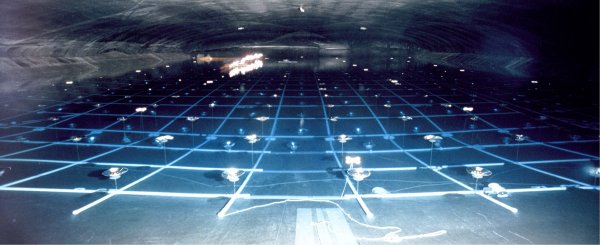
The observatory consists of an array of 1600 tanks of water that detect the Cerenkov light generated by particles in the air shower. The sky above the tanks, which are separated from one another by 1.5 km, is monitored by four atmospheric fluorescence detectors that can track the particle showers as they pass through the atmosphere on dark nights.

After taking data for over three and a half years, the observatory detected 27 cosmic rays with energies greater than about 5.7 * 1019 eV. Twenty of these could be traced back to within 3.1 degrees of AGNs closer than 75 Mpc from Earth. According to the team, it is highly unlikely that 20 UHECRs coming from random directions would appear to all come from known AGNs.

Energy spectrum

Auger spokesperson Alan Watson of the University of Leeds told physicsworld.com that the team has spotted five “pairs” of cosmic rays that each appear to originate from the same AGN. He hopes that by detecting a number of UHECRs from the same source, physicists will be able to build up an energy spectrum that could explain exactly how the cosmic rays are produced. “As we collect more and more data, we may look at individual galaxies in a detailed and completely new way” he says. “As we had anticipated, our observatory is producing a new image of the universe based on cosmic rays instead of light.”

The snag is that any decent spectrum would require the detection of hundreds of cosmic rays from the same AGN, which would take the Auger Observatory hundreds of years to obtain. Astrophysicists are planning to build a second observatory called Auger North in Colorado in the US. Although Auger North is intended to be 3.5 times bigger than its southern partner, Watson hopes that the team’s positive results will lead to a decision to make Auger North being 10 times larger than Auger South – something that he says is possible in principle, but could be very difficult and expensive to build and maintain.

Watson told physicsworld.com the knowing the precise source of UHECRs could help astrophysicists gain a better understanding of our own galaxy’s magnetic fields. This is because the charged particles are deflected slightly by magnetic fields, which could be studied as a function of a particle’s energy and origin. In addition, by studying the collisions between UHECRs and nuclei in the atmosphere, physicists could study matter at much higher energies than any current or planned particle accelerator. The Large Hadron Collider at CERN, for example will accelerate protons to energies of only 7 TeV (7 * 1012 eV)

Two is a crowd for quantum particles

The wave-like, or quantum, behaviour of individual particles is rarely seen because particles tend to interact with their environment — for example, via gravity, electrical interactions or thermal radiation. These interactions result in a transition from quantum to classical behaviour called decoherence. Decoherence has been observed in electrons, atoms, small molecules and more recently in macroscopic objects, such as C60 and C70 molecules.

All these experiments involve passing the highly isolated particles or molecules though a double-slit and watching as the interference pattern — which is a signature of quantum behaviour — becomes weaker as the particles interact with their environment.

However, researchers were unsure as to the minimum level of interaction needed for decoherence to occur. Now, Reinhard Doerner of the University of Frankfurt in Germany and colleagues have helped answer this question by studying what they call the “simplest ever double-slit” — a hydrogen molecule, which comprises two electrons and two protons.

The researchers began by firing a single high-energy photon at a hydrogen molecule, which ejects the two electrons from the molecule. One of these electrons and the two protons form a simple particle/slit system. This electron forms a quantum interference pattern as it passes through the slit. The second electron, which moves much slower than the first, acts like a minimal environment for the other electron. It interacts with the first electron via Coulomb interactions, leading to a loss of contrast in the interference fringes observed in the angular distribution of this electron.

The experiment demonstrates that only a very small number of particles is needed to turn a quantum system into a classical one. “The fragmentation of the hydrogen molecule is a four-body problem that can also be solved numerically using today’s computers,” Doerner told physicsworld.com. “Our results could now provide a benchmark for some of the most advanced theories in few body physics.”

Next, the team, which includes scientists from the US, Spain and Russia, plans to look how interference is destroyed by breaking the symmetry of the hydrogen molecule. They will do this by substituting one of the hydrogen atoms for its heavier isotope deuterium.

FAIR gets the go-ahead

FAIR, which will be one of the world’s largest accelerator centres, will allow a wide range of research to be carried out, ranging from nuclear and plasma physics to medical physics and materials science. The new facility will consist of two synchrotrons with a circumference of 1100m built on top of one another in an underground tunnel.

Ions from GSI’s existing 200m circumference synchrotron will then be fed into the new double-ring facility, which will multiply the intensity of the ion beams by a factor of 100, giving up to 1011 ions per second. The new rings will also increase the maximum energy of the beams by a factor of 20 up to about 35 GeV.

Researchers working at the new facility will use the accelerated ions to generate beams of novel, unstable nuclei by firing the ions at a target such as beryllium. Other experiments will use beams of antiprotons to study the study the strong force, while heavy nuclei will also be collided at high energies to generate a “quark-gluon” plasma — the state of matter that is believed to have existed in the first moments after the Big Bang.

Plasma physicists, meanwhile, hope to use a high-powered laser that is also being built at GSI to create plasmas inside bulk materials with temperatures and densities approximating those inside giant planets such as Jupiter. Atomic physicists will also use the facility to explore the properties of antihydrogen, which consist of an antiproton and positron.

Germany’s federal government will provide 65% of the total funding for the project, with a further 10% coming from the German state of Hesse. The remaining 25% will come from the other 14 partner countries, which include China, France, the UK and India. The project, which was first proposed back in 2001, aims to be completed by 2015.

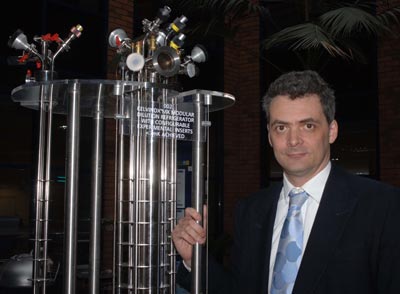
Firm claims a ‘dry’ cryogenics first

According to the company, the system is designed to allow the magnetic and thermal properties of samples to be investigated at temperatures down to 300 mK while subjecting them to magnetic fields as high as 17 T. Unlike most other cryogenic measurement systems, the new device does not rely on liquid helium to cool either the sample or the magnetic coils. As well as making it easier to maintain than traditional liquid-cooled instruments, the system can also be used by researchers who do not have easy access to liquid helium, for example those in the developing world.

Cryogenic has already delivered its first 17 T system to Stockholm University, and according to the firm’s director of sales Renny Hall, it will soon ship systems to customers in India and Denmark.

Cryogenic’s previous record for a completely cryogen-free system is its 14 T system, which uses one GM cooler. To get that extra 3 T, the company added a second GM cooler that allows that magnets to be operated at higher currents. The system can operate at fields of up to 6 T on one cooler, with the second required to reach higher fields.

The firm has also made improvements to the design of the magnetic coils in order to reduce the stresses caused by such high magnetic fields, thus further boosting the amount of current that the superconducting coils can carry. Most 17 T magnets are cooled to 2 K, but through careful design the new system could work at 4 K, where it could be operated efficiently using the GM coolers.

The GM coolers can get the sample temperature down to about 1.6 K, and then it can be further chilled to 300 mK using a helium-3 insert, which cools by condensing a small quantity of helium-3 gas. The system is supplied with both a resistivity and Hall-effect probe with sample rotation, and an AC-susceptibility probe with a compensated pair of pick-ups. The magnetic field can be adjusted with a resolution of ±50 mT and the instrument can be supplied with an optional vibrating sample magnetometer for the measurement of DC magnetic moments, plus an optional AC calorimeter for making heat-capacity measurements.

Plug-and-go systems

According to managing director Jeremy Good, a physicist who founded Cryogenic in 1970 and began developing cryogen-free magnets in the mid-1990s, dry cryogenics is facilitating a huge change in how low-temperature physics is being carried out. “Buying, storing and recycling liquid helium is a huge operation,” he says. While researchers in the West have ready access to suppliers and liquefaction facilities, this is not always the case in the emerging economies of eastern Europe, India and China, where dry cryogenics is often the only option for researchers. Good believes that a system that simply plugs into the wall will be a boon to researchers in these regions.

Another import trend, according to Good, is the “tremendous interest in developing new magnetic materials for data storage”. While commercial data-storage devices must operate at room temperature, preliminary research on new materials is often done on very cold samples using the high magnetic fields generated by superconducting magnets. According to Good, a lot of the researchers who are now studying such materials have little prior experience of liquid-helium cryogenics — chemists, for example.

As a result, a dry cryogenics system is very attractive to those who are new to the technique. Good also believes that there is a growing concern about a looming shortage of helium and of rising prices. “Researchers are slowly coming round to dry systems,” he says.

Universe could have a fifth less mass than current estimates

Scientists have known for more than a decade that galaxy clusters emit an unusually large amount of “soft” or low-energy X-rays. A possible explanation is that the centres of the clusters contain vast regions of warm, thermally-radiating gas. If this is the case then spectra of soft X-rays from clusters should contain emission lines — peaks of intensity at certain wavelengths — corresponding to the composition of atoms in the gas. Trouble is, the spectra are generally smooth.

An alternative explanation is that electrons in galaxy clusters are colliding with photons in the cosmic microwave background, which is radiation left over from the Big Bang. After these collisions — known as the inverse Compton effect — some photons would have energies sufficient to be soft X-rays. Now, Max Bonamente at the University of Alabama in Huntsville and colleagues at the same institution and in Finland have calculated how much such a process could account for the abundance of soft X-rays (Astrophys. J. 668 796).

Losing weight

The researchers modelled the range of frequencies that would be produced in electron-photon collisions as a “power law”, and found that by adjusting the size of the power and normalization they could make the distribution fit the spectrum of Abell 3112 — a galaxy cluster for which the Chandra X-ray Observatory has particularly good data on soft X-ray emission. This showed that up to 50% of the soft X-rays coming from the cluster could be coming from electron-photon collisions rather than from atoms in warm gas. Because electrons are much lighter than atoms, this would mean that galaxy clusters, and hence the universe itself, could have up to 20% less mass than we currently estimate.

Extraordinary claims need extraordinary evidence

If this bold claim is true, it might be that galaxies and galaxy clusters do not need as much mass to hold themselves together as our accepted theories of gravity, given by Newton and Einstein, suggest. Scientists would therefore have to look into alternative theories, such as modified Newtonian dynamics, or MOND, that make mass more gravitationally attractive. On the other hand, the “missing” mass could be hidden in dark matter, which is believed to make up some 95% of gravitating mass in the universe.

Other options

The researchers, however, are careful to point out there is much work to be done before their conclusion can be verified. “We want to be sure this is a sound analysis by looking at other clusters,” Bonamente told physicsworld.com. “Extraordinary claims need extraordinary evidence.”

Bonamente added that there could be other explanations for the lack of emission lines besides electron-photon collisions. Unlike other forms of spectroscopy, he said, X-ray spectroscopy has a very poor resolution, so the emission lines from heavy atoms could be indistinguishable. It is also possible that the gas clouds are there, but are “primordial” in the sense that they only contain the light elements hydrogen and helium, which do not produce emission lines in the soft X-ray part of the spectrum. “But most astrophysical plasmas [gases] have been enriched [with heavier elements], so this would be an exception,” he said.

Andrew Fabian, an astrophysicist at the University of Cambridge, UK is not convinced by Bonamente and colleague’s study, however. He points out that the researchers have used outdated absorption values for our own galaxy’s interstellar gas, which affect the level of soft X-rays received from Abell 3112. “Results from a newer survey could make the abundance of soft X-rays disappear in that cluster,” he said.

Physicists learn to forecast harmful ozone events

Hocking and colleagues came to their conclusion by monitoring the position of the tropopause — the region separating the troposphere, which extends from ground level, and the stratosphere — at stations in Montreal and Walsingham in Canada. To do this they used “windprofilers”, a type of radar operating at frequencies around 50 MHz that detect whether the air is stable, as in the tropopause, or turbulent. They also released over 100 balloons lifting devices called ozonesondes, which continually sample the air for ozone levels as they rise upwards.

The tropopause varies in altitude between 7 and 28 km, but usually resides at around 8 to 10 km. The researchers found that, on occasion, the tropopause altitude changed rapidly — a drop followed by a quick climb — which would be followed by a significant intrusion of ozone into the troposphere, sometimes all the way to ground level. According to Hocking, scientists should therefore be able to use radar to give a forewarning, 12 hours to two days in advance, of ozone intrusion events that might reach the ground. This would enable people with breathing difficulties or with eyes prone to watering to keep indoors.

Martyn Chipperfield, an atmospheric scientist at the University of Leeds in the UK, told physicsworld.com that the study also shows it could be possible to find out how often ozone intrusions occur and thus how much they contribute to the amount of ozone in the troposphere. However, he added that this would also require knowledge of the mass of transported ozone during an intrusion event, which is not indicated in Hocking and colleagues’ study. “That would be a challenge,” he said.

Let the cooling begin at the LHC

Most particle physicists do not have to worry about how to unload tonnes of liquid nitrogen from trucks arriving at a rate of one per hour for two weeks solid. But that is what CERN’s Laurent Tavian has to look forward to when he begins to cool 37,000 tonnes of equipment for the Large Hadron Collider (LHC), which is scheduled to start up in May 2008. According to Tavian, it will take 10,000 tonnes of liquid nitrogen costing about $1.3m to cool the equipment down to a temperature of about 80 K. Then, liquid helium will take over to chill some parts of the accelerator to temperatures as low as 1.9 K.

And do not think that Tavian will simply be pouring dewars of nitrogen down a pipe into the tunnel that houses the accelerator — nitrogen is banned from the accelerator because when it evaporates, the cold gas tends to accumulate in the tunnel, lowering oxygen levels and thus possibly asphyxiating anyone working there. Instead, the nitrogen will be fed into eight heat exchangers housed above the tunnel that will chill helium gas. This cold gas will then be circulated in a closed system to cool the accelerator from room temperature to about 80 K.

Once this initial cooling phase is complete, Tavian will turn on the LHC’s eight “cryoplants” located in buildings above the accelerator tunnel. The 27 km circumference of the LHC consists of eight sectors each 3.3 km in length. Each sector is served by a cryoplant, in which is housed a helium refrigerator with a cooling power of 18 kW at 4.5 K.

Supercritical helium

The cryogenics for each sector is a closed loop holding a fixed amount of helium that is cooled at the cryoplant and distributed throughout a sector. The warm helium is then captured and returned to be cooled again. While liquid helium could in principle be produced at the cryoplants and then distributed along the length of the sector, this would be tricky because it is so volatile. Instead, the cryoplants will produce high-pressure supercritical helium gas at 4.6 K, which will be distributed along the sector to a number of local cooling loops. There, the supercritical helium will be expanded into a lower-pressure environment, which causes it to liquefy at either 4.5 K or 1.8 K. This liquid will then be used to cool the superconducting magnets.

Working flat out, each cryoplant system can liquefy 4000 litres of helium per hour — more than a litre per second. The entire inventory of helium at the LHC will be about 120 tonnes, which Tavian claims is less than 1% of the total annual helium production worldwide. Even so, it will not come cheap, because helium gas prices have been rising for sometime — at today’s prices the entire inventory is worth over $4m.

Working flat out, each cryoplant system can liquefy 4000 litres of helium per hour — more than a litre per second.

CERN has already taken delivery of about half of the inventory of helium, with the other half arriving between now and April 2008, when the cryogenic system will be turned on. Despite recent rumours suggesting that this delivery target will not be achieved, Tavian says that CERN has signed a new contract with two suppliers — Air Products and the Messer Group — to supply the remaining helium. CERN also has two further suppliers on standby in case Air Products and Messer cannot meet demand.

Different parts of the LHC will be cooled to different temperatures. The thermal shields that surround the coldest parts of the accelerator will be held at temperatures of between 50 K and 75 K. The beam screens, which shield the magnets from the radiation given off by the proton beams, will be kept between 5 K and 20 K. Most of beamline and the superconducting magnets will operate at a chilly 1.9 K using superfluid helium. While the superconducting dipole magnets can function at 4.5 K, Tavian says that it is possible to get an extra 3 T of magnetic field strength out of the devices by cooling them by an additional 2.6 degrees. As a result, the main dipole magnets will be able to deliver a field strength of 8.3 T.

Regular top-ups

Although the helium cryogenics for the LHC is a sealed system, Tavian expects to lose about 25% of the helium inventory every year due to leaks, and regular top-ups will be required to make up the deficit. While this might seem a lot, it is much better than previous CERN accelerators such as the LEP, some of which lost their entire inventory over the course of a year. Tavian thinks that the key to reducing losses is to minimize the amount of helium that is flowing in the closed loop at any given time. In the LHC, two-thirds of the helium will not be flowing but instead will remain stationary in the magnet coldmasses.

Tavian told physicsworld.com that CERN had to initiate the development of two new technologies to create the cryogenics systems. The first is a new compressing system that is capable of generating a large refrigeration capacity at a temperature of 1.9 K — so-called cold compressors. CERN started work on this technology 10 years ago because at the time such compressors were available from only one company and the lack of competition made the equipment very expensive. Thanks to CERN’s efforts, there are now three companies building cold compressors and the price has dropped while performance has improved.

Another important technology developed for the LHC concerns the heat exchangers that remove heat from the very-low-pressure helium between 1.9 K and 4.5 K. When the project was first muted, there were no commercial heat exchangers available, so those used on the LHC were developed by CERN in collaboration with industry. The result is that there are now three companies that are able to design and build sub-cooling heat exchangers, according to Tavian.

Atlas and CMS

In addition to the beamline, two of the four main experiments at the LHC have significant cryogenics requirements: Atlas and CMS. Both experiments use superconductors cooled to 4.5 K to create large magnetic fields and each experiment has its own cryogenics system that is completely separate from that of the accelerator itself. Tavian says that this will allow an experiment to be shut down for repairs without this disrupting the operation of the accelerator or other experiments.

Tavian is also involved in the Global Design Effort (GDE) for the International Linear Collider (ILC) — a next-generation particle-physics experiment that could be up and running by 2019. The cryogenics requirements of the first stage of the ILC will be similar to those of the LHC. The ILC will require 10 cryoplants like the eight used by the LHC. The electrons and positrons in the ILC will be accelerated by superconducting cavities cooled to 2 K using superfluid helium, and therefore the ILC will also need cold compressors. The second stage of the ILC would see the length of the collider double and the number of cryoplants rise to 20.

However, CERN has chosen to scale back its contribution to the ILC design and instead focus on getting the LHC up and running by next May — which is exactly what Tavian will be doing over the coming months.

Making physics profitable


In many ways Oxford Instruments is the archetypal physics-based company. What relationship do you have with physicists today?

We have many strong ties with the physics community. We recruit heavily from universities and some of the best physics graduates come to work for us. We also have close links with leading universities such as Oxford, Cambridge and Imperial College, where we sponsor students, fund R&D and are involved in collaborative research programmes to push back the frontiers of science. When a breakthrough shows commercial potential, we will often work with researchers to commercialize it. Finally, many of our customers are physicists – either working in academia or industry.

Good relations with the physics community are crucial to our business model.

Good relations with the physics community are crucial to our business model. Most physicists first encounter our equipment when training in university labs. Some then get jobs in academia and need to buy equipment – and we are the first company that they think of. Others go on to be captains of industry and their organizations tend to buy our instruments because that is what they have spent their professional lives using.

How exactly do you plan to double the size of your business?

It would be very difficult to double the size of the business by simply selling more equipment to academics. We already have more than 50% of the market for much of the equipment we sell – and the demand for equipment in universities is not fast growing because government research grants tend to rise in line with a country’s gross domestic product. As a result we are moving more towards industrial markets, where we see greater opportunities for growth.

Is this where the company’s innovations process fits in?

We are constantly looking for bright ideas from both inside and outside the company that can be commercialized using the technological know-how of Oxford Instruments.

The innovations process provides a mechanism to sift through the ideas and find the ones with commercial potential. We focus on developing new ideas, commercializing them to make revenue, and then use that money to invest in the next idea. To do this, the company must be both innovative and profitable.

In your view what makes a good idea?

In addition to looking like it will deliver a financial return on our investment, an idea must fit into the areas that we have identified for growth – these are the technologies related to industrial processes, security, energy or the environment. In addition Oxford Instruments has to be able to contribute beyond just funding the idea – a venture capitalist could do that – so it has to be an area that we have expertise in. This could be our physics knowledge, our distribution network or our manufacturing skills.

What security-related projects are you working on?

One area that we believe has great commercial potential for Oxford Instruments is the development of terahertz detectors for use as security scanners in airports. Unlike current security systems, which are limited to detecting metal objects and sniffing out explosives, terahertz radiation could be very useful in detecting a wide range of materials, including explosives.

So far, terahertz systems have been under-utilized because the best detectors must be cooled to within a few degrees of absolute zero using liquid helium. This would be very difficult to implement in airports for health and safety reasons alone. However, deployment in airports would be possible if the terahertz detector were cooled with a cryogen-free system that does not need a constant supply of liquid helium but instead uses a small quantity of helium gas in a closed system.

Oxford Instruments already has expertise in terahertz detection and our interest in commercializing this technology was one reason why we bought VeriCold, the German manufacturer of cryogen-free cooling systems, earlier this year. Such systems will also be crucial in the development of quantum computers – another area that we have identified as having commercial potential.

There is a lot of work going on in physics labs to develop quantum computers. The most promising technologies for quantum computing must operate at very close to absolute zero and our equipment is becoming the de facto standard for research in this field.

How do you see quantum computers developing?

While the technology is still in its infancy, I believe that quantum computers will become a standard commodity product in years to come. As a physicist, I believe that quantum computers will definitely happen because there is so much funding going in to the research and the theoretical argument for it is just so overwhelming. The key breakthrough required could happen many years in the future or it could happen tomorrow. There are people who claim to have working quantum computers today. While their devices are not nearly as practical as conventional computers, I’m sure that we will get there.

While a practical quantum computer won’t be invented at Oxford Instruments, its development will be done using our tools. When quantum computers become commercially available, there will be a need for cryogenic cooling in a huge variety of locations – perhaps even in every home. That is a fantastic market for us – it’s where we have a very strong commercial lead.

As a major supplier of superconducting wire, you must see fusion reactors as a major opportunity in the energy sector?

Yes, the upcoming experimental fusion reactor ITER [International Thermonuclear Experimental Reactor] alone will increase world demand for superconducting wire by a third – and we are increasing our manufacturing capacity specifically for that reason by investing heavily in our wire factory in New Jersey, in the US.

At the moment, most wire is used for magnets in magnetic resonance imaging scanners and we are seeing a large growth in the market for this equipment in China.

What other energy-sector projects are you looking at?

High brightness LEDs [light-emitting diodes], which are currently being used mostly in the personal electronics and automotive sectors, are something that we see as having great potential. LEDs are very efficient compared with traditional light sources and could reduce the UK’s carbon footprint dramatically, overnight, if everyone used them in standard lighting applications. Unfortunately, at the moment LEDs are very expensive – £50 for a replacement bulb for the home – but we expect this price to come down as the technology matures.

The key to reducing the cost of these components is to improve the yield and throughput of the semiconductor process used to manufacture the LED devices – and we are continually improving our process tools to help manufacturers do just that.

How hard is it for your company to find the right kind of people to work on such a diverse range of projects?

There is absolutely not an adequate supply of such people. The most valuable employees are those who understand the underlying physics of a product to some degree and who can also communicate it effectively to a wider audience including our customers and shareholders – these are the people that really rise in the organization.

The problem is that the people with these broad skills don’t go into industry. They go into the City where short-term earnings can be higher.

What can Oxford Instruments offer such people?

We can give these people the thrill of inventing something. They get to turn a newly discovered physical phenomenon into an instrument that will be used by scientists to further our understanding of nature – our people get a fantastic buzz out of that.

Copyright © 2026 by IOP Publishing Ltd and individual contributors