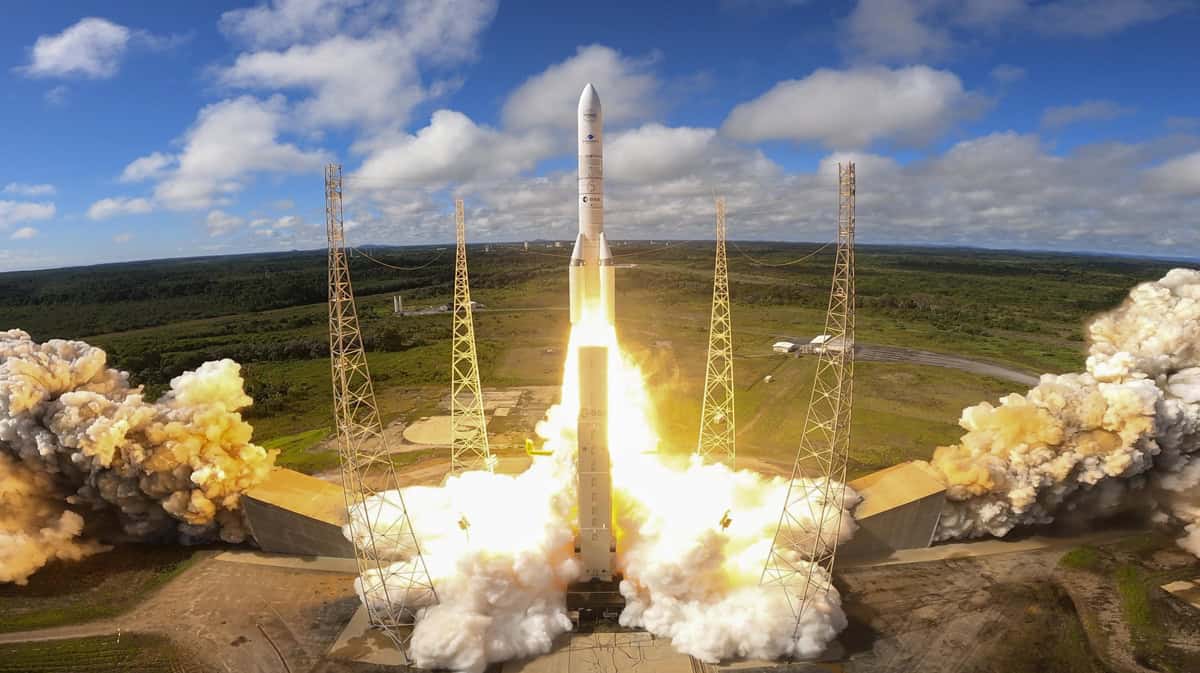
Multinational missions Ariane 6 is the latest rocket in a long history of launchers – demonstrating the power of multinational co-operation for more than five decades. More than 3000 staff are working at ESA to implement space missions for exploring the universe, protecting our planet or serving our daily life. (Courtesy: ESA)
The European Space Agency (ESA) is globally recognized for its iconic space missions that push the boundaries of science and technology, whether it’s a rendezvous with a comet, landing a probe on Saturn’s giant moon Titan or mapping the stars of the Milky Way in unprecedented detail. But ESA does so much more than these headline-grabbing scientific and exploratory endeavours.
“Space is no longer solely a playground for curious minds,” says Eric Wille, ESA Head of the Opto-Electronics Section. “It’s really important for our everyday life too.” In fact, modern society relies on space technologies.
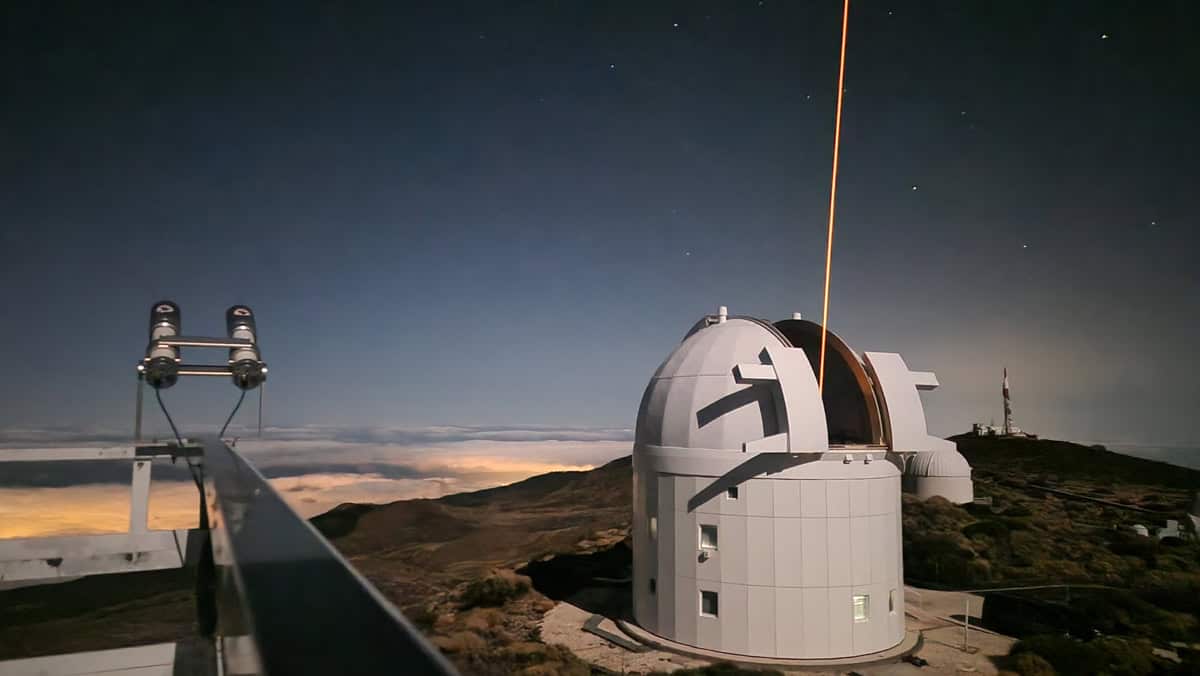
Project management The ESA Optical Ground Station in Tenerife is used to develop laser technologies for high-speed data links or quantum communication. The laser beam projects a guide star to control an adaptive optics system that improves the beam quality of the optical communication link. It is one of several ESA laboratories managed by Eric Wille and the opto-electronics section for testing optical systems for space. (Courtesy: ESA)
Satellite-based environmental monitoring, weather forecasting and global navigation are obvious examples, but there are many other important applications. For instance, the global financial system could not function without atomic clocks aboard satellites time-stamping millions of stock trades and digital payments every second. Similarly, when natural disasters strike, satellite networks become essential lifelines: mapping floods, tracking wildfires and helping with the co-ordination of emergency response efforts on the ground.
Fulfilling all of these roles and ESA’s bold space ambitions – from seeking answers to big questions about the universe to watching over our precious planet – requires a highly dedicated, technically proficient and multi-skilled workforce made up of scientists, engineers and various other professionals.
Diverse and challenging work
When Wille joined ESA as an optical systems engineer in 2009 after completing his PhD in experimental quantum optics, it was the sheer diversity of challenging work that attracted him. “Working in an international space agency, you’re partly a researcher, partly a project manager, partly also someone with ambassadorial skills,” he says. “That mixture is really something which I found at that time very attractive and I still like today, very much.”
Charlotte Pachot also craved a technically challenging role after her master in optics. She found it at Thales Alenia Space in France as a space engineer working on optical instruments. But after a few years, her interactions with ESA staff through joint projects convinced her to join the Agency as an optical engineer. She is now Lead Payload Engineer for the Laser Interferometer Space Antenna (LISA) mission, intended for launch in 2035, which will be the first gravitational wave detector in space.
Both Wille and Pachot have found that the technically challenging work at ESA is particularly satisfying because it has real-world impact. The first 10 years of Wille’s ESA career were largely spent on Athena (Advanced Telescope for High ENergy Astrophysics; now renamed NewAthena), a powerful X-ray observatory set to launch in the late 2030s that will provide fresh eyes on a wide range of hot and energetic processes in the universe.
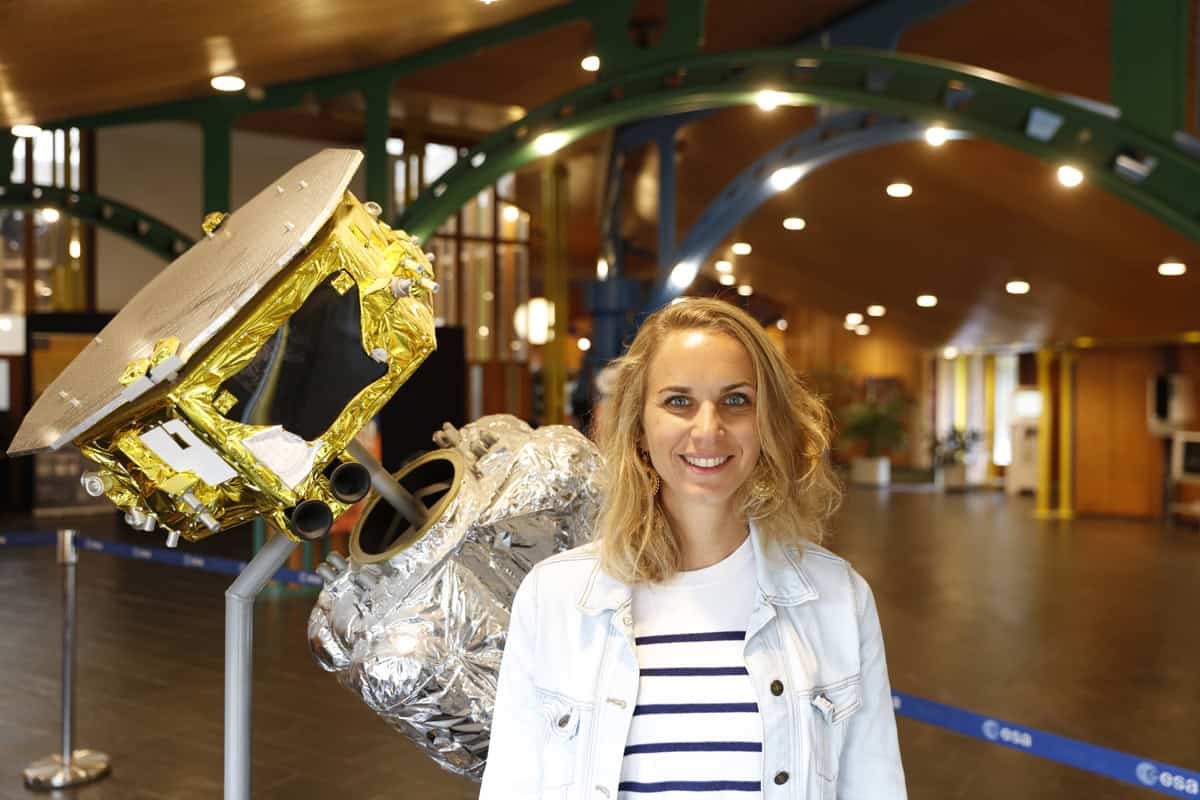
Charlotte Pachot is overseeing the LISA optical bench assembly. Next to her is a model of LISA Pathfinder that tested critical technologies in space in 2016. (Courtesy: ESA)
In this role, Wille and the ESA team collaborated with an industrial consortium led by Dutch measuring instrument supplier cosine to develop a completely new type of optics, called silicon pore optics. Using techniques perfected by the semiconductor industry, cosine bonded and stacked many silicon plates on top of each other. By shaping the plates, a lightweight mirror to focus X-rays was created; in fact, 10 times lighter than the ones flying on current X-ray missions XMM-Newton and the Chandra X-ray Observatory.
Like Athena, LISA will also provide fresh eyes on cosmic events, but through the unique prism of gravitational waves. This will be achieved through a completely new approach involving a triangle of three satellites spaced 2.5 million kilometres apart.
Understandably, LISA calls for a unique optical bench, which Pachot is managing from design to manufacturing and testing. She sees her role as being like that of a conductor of an orchestra: a lot of her time is spent co-ordinating team members and partners, while also helping to solve technical, budget and schedule problems. For Pachot, tackling these daily friction points is part and parcel of working on real-world big science. “The instruments are very complex technically, very challenging, but they are also real pieces of hardware as part of a real project,” she says.
International community
As Wille and Pachot’s stories show, ESA selects talent from different career stages. The Agency offers several programmes that support students, graduates and experienced professionals in finding the right role for their profile and interests.
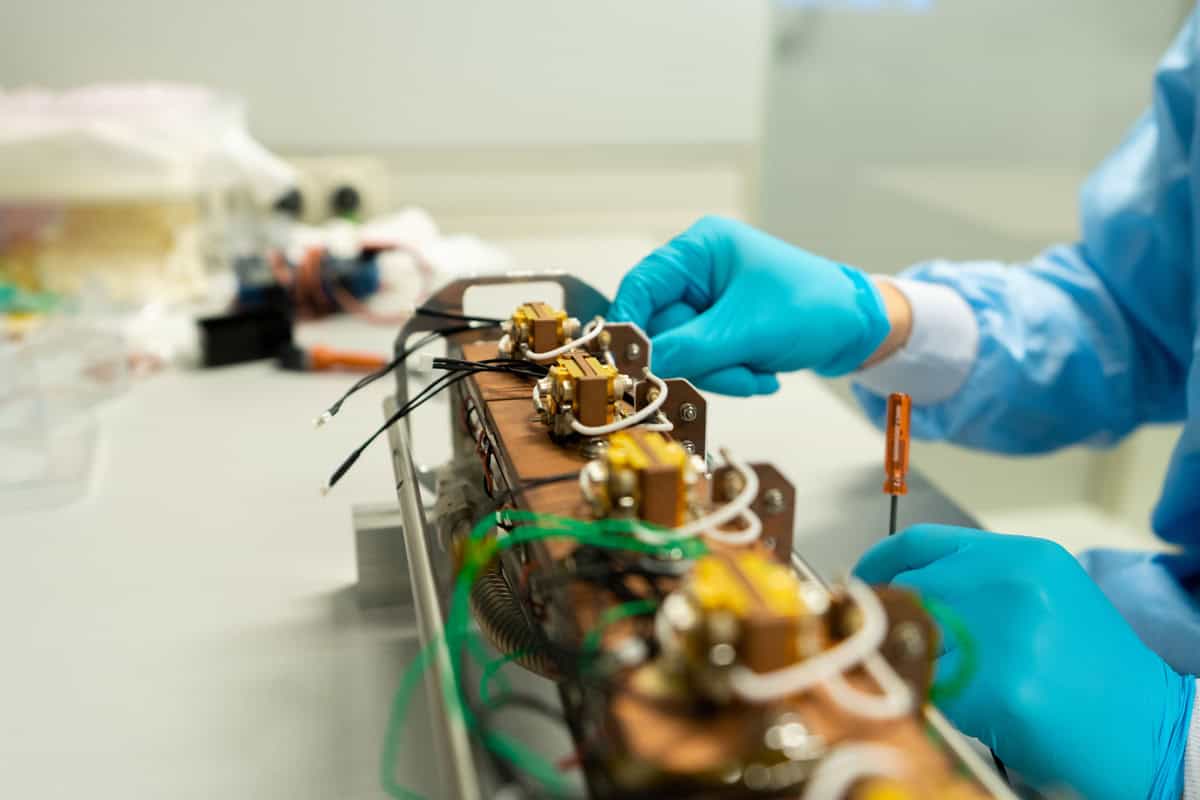
Device testing Lasers are used in many different space applications. Igniting launchers, high-speed optical communication, LIDARs for atmospheric measurements or for measuring gravity waves with LISA. The opto-electronics laboratory at ESTEC is frequently used to characterize the lifetime and performance of high-power diode lasers.(Courtesy: ESA)
For example, university students can benefit from ESA Academy sponsorship, such as participating in hands-on projects or training sessions. They can also join ESA as interns. Graduates can apply to ESA’s Graduate Trainee Programmes where they can gain experience on actual ESA projects and develop technical and professional skills. And for those currently in industry with less than three years’ experience, the Junior Professional Programme allows them to join ESA as staff members for four years and benefit from tailored learning and development opportunities to prepare them for a long-term position.
Whichever pathway they take, once new recruits get started in their first role, an excellent employment package – including competitive salary and pension scheme, hybrid working and flexible hours, and professional development training opportunities – comes as standard.
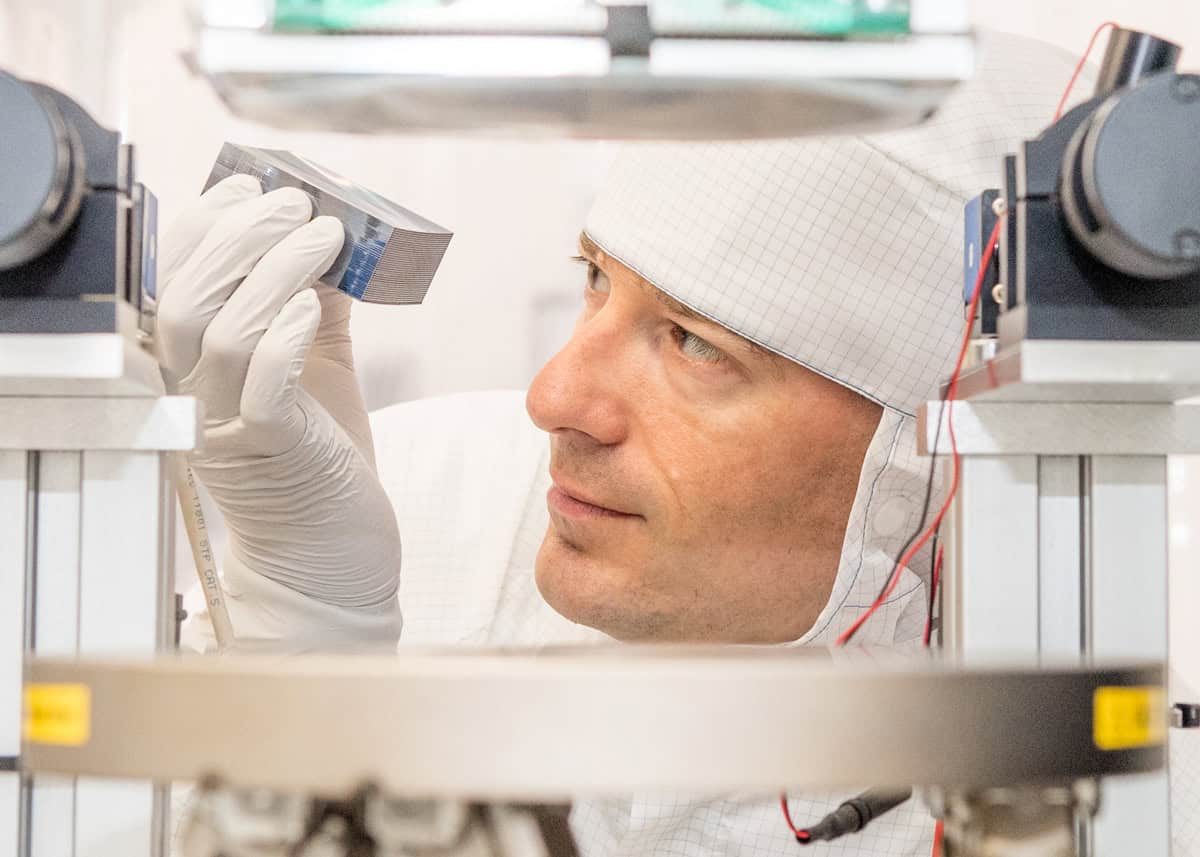
Eric Wille inspecting a new X-ray mirror using stacked silicon plates. The mirror was assembled using an automated stacking robot partially visible in the foreground. (Courtesy: ESA)
What sets ESA apart is the multicultural work environment. Team members might come from any of ESA’s 23 Member States and nine further Cooperating States and Associate Members. And recruits can be based in more than nine locations in seven countries (France, Germany, the Netherlands, Italy, Belgium, Spain and the UK). This makes for a melting pot of cultures.
“There’s a very lively expat community,” says Wille. “At the European Space Research and Technology Centre (ESTEC) and other big sites, it’s like a small Europe.” This cultural diversity is of course intentional. “The problems we have to solve require teamwork,” says Pachot. “And this is made easier at ESA because we all see problems in a different way depending on our culture.”
Working life at ESA
Want to learn more about working at ESA? Take a look at life at ESA and what ESA offers. Quickly find out which programme could be the best fit for you by following the pathways to ESA on this flowchart.
Modern computation ranks among the great technical achievements of the 20th and 21st centuries and touches nearly every area of human activity. Today digital computing uses billions of transistors etched onto semiconducting silicon chips to work as tiny switches that represent binary 0 or 1. The technology underlies personal phones and laptop computers, and extends to supercomputers that perform nearly one quintillion operations per second (1018 floating point operations per second, or FLOPS) and manipulate up to 100 petabytes of data.
Supercomputers can simulate otherwise intractable problems in science, from climate and weather patterns to protein folding and even black-hole interactions. However, further progress in scientific and general computation is approaching saturation because of fundamental limits, while the explosion in artificial intelligence (AI) based on large language models (LLMs) is clearly showing where computation needs to be improved. Physics is essential for this effort.
Nearing the physical limits
Back in 1965, Intel co-founder Gordon Moore famously predicted that the number of transistors we could fit onto a silicon chip would increase exponentially. He later forecasted that the number would double roughly every two years. Moore’s law has held for decades, albeit at a lower rate since the mid-2010s. More transistors meant increased computing power per chip, as well as faster computing.
That’s because smaller transistors switched between binary states more quickly, and higher transistor densities reduced the distance signals had to travel. These factors made it possible to increase “clock speed” – the frequency at which a computer’s central processing unit (CPU) synchronizes its internal operations – which helps determine computational speed. That frequency grew from tens to hundreds of megahertz in the 1970s–1990s until it reached gigahertz levels.
But by the early 2000s, the increase in clock speed with density of transistors no longer held. Transistors that switched more frequently used more power, generating heat beyond what could easily be dissipated. Essentially, clock frequencies have stagnated at 3–5 GHz.
Within this limitation, the strategy for faster computing has been to design chips for parallel processing. Modern CPUs contain “cores”, which are separate processing units on a chip that independently read and execute instructions. In a CPU with four cores, each operates at the clock rate of 5 GHz, say; but since they operate in parallel, the throughput can approach a fourfold increase.
Another, more specialized form of parallel processing was introduced in graphics processing units (GPUs). While a CPU typically has between four and 32 powerful cores that have been optimized for flexibility in carrying out different tasks, a GPU has hundreds to thousands of simpler cores, designed to deal with many data elements for such tasks as rendering images or multiplying large matrices.
GPUs have become essential for supercomputers, but they also face limits. Trouble is, not all computational tasks can be broken into parallel operations, while adding more transistors to a chip still requires more power and generates yet more heat.
Large scales and rising costs
Supercomputer-level capabilities, however, are needed to support the rising use of LLMs such as ChatGPT, which are trained on huge data-sets and can create content based on natural language. Other LLMs followed, and by 2025 up to a billion individuals, corporations and governments were using AIs globally. This enormous scale of usage is highly demanding of computational and electrical power.
LLMs need two kinds of computation. First there is training computation, which analyses massive amounts of text from books, articles and websites containing trillions of tokens – words or parts of words. The training’s aim is for the model to learn statistical patterns in a given language, and estimate the probabilities for the next token in a given sequence.
Training the largest LLMs can take up to 100,000 GPUs using tens to hundreds of megawatts, comparable to the biggest supercomputers. A few dozen of these centralized installations are estimated to be operating around the world, concentrated in the US and China.
The second type of computation is inference, where an already trained model responds to user prompts. Inference processing needs less computational and electrical power, but runs continuously to serve users. It must also respond with little latency, the time delay between request and response, so inference infrastructure is geographically distributed, not centralized.
Of about 12,000 general data centres operating globally, hundreds to a few thousand now support a large AI cluster for inference, with the number rapidly growing. With this scale of continuous operation, inference is expected to dominate long-term AI energy use.
By 2030, global data centres, driven largely by AI, are expected to consume some 1000 TWh per year, corresponding to an average load of roughly 100 GW. This is a few percent of global electricity use and the resulting waste heat must be removed, requiring millions of gallons of water for some facilities. This heat discharge, along with the necessary additional electricity generation, will have a significant impact on the environment.
That’s provoked reactions to AI infrastructure, both from communities objecting to local data centres and governments concerned about national power grids. Scaling today’s relatively few specialized supercomputers to many large AI centres around the world carries significant costs, not to mention AI’s uncertain societal impact. As AI stretches resources, researchers are keen to rethink the very nature of computation.
Building a better bit
The use of electronic circuits to carry out binary logic, which defines modern computation, was mathematically formalized by the US mathematician Claude Shannon. In 1937 he showed that on/off electrical switches, arranged in what we now call a “logic gate” (based on the true/false logic George Boole invented in the 19th century), can carry out arithmetic as well as logical decision-making.
This approach has been embodied in computers, first using electromechanical relays, then vacuum tubes, followed by discrete transistors, and finally CMOS (complementary metal-oxide-semiconductors) integrated circuits. Each succeeding generation has slashed the energy required for a single binary switching event – for example, from nanojoules for an older discrete transistor to femtojoules for a transistor in a modern CMOS chip.
But this gain has been far outstripped by the rapidly growing volume of computation. Despite improved energy efficiency, our increasingly computerized world demands more electrical energy. Fortunately, there are other, more efficient ways to encode binary information using physical systems that support two stable states: the horizontal or vertical polarization of a photon; the up or down orientation of the spin magnetic moment of an electron; or persistent superconducting currents circulating in opposite directions.
Each approach has its own advantages and drawbacks. Photon-based computing offers high speed and reduced resistive heating; but it is difficult to store photons. Superconducting currents offer high speed, and require low energy per operation. But the energy cost for cryogenic cooling at 4 kelvin, hundreds of watts per one watt of heat removed, diminishes or wipes out the energy advantage.
“Spintronics” technology, however, has been the most successful of the three. Its basic device is the magnetic tunnel junction (MTJ), where a thin insulating barrier separates a “reference” and a “free” magnetic layer. The device’s electrical resistance depends on whether the magnetizations of the layers are parallel or antiparallel.
Universal memory Magnetoresistive random-access memory (MRAM) stores data in magnetic domains. Its main benefit is that it can retain data even when the power is turned off. (Courtesy: Shutterstock/luchschenF)
MTJs exist in hard disk drives and can also serve as read-write units in a magnetoresistive random-access memory (MRAM). To read, a small current is passed through the MTJ, and the resulting voltage shows the state of the bit. To write, a larger current is applied. The fixed layer polarizes the spin of the electrons, which carry angular momentum as they tunnel into the free layer.
This flips that layer’s magnetization, switching the magnetic bit, whose state survives even without power. That’s a key advantage of MRAMs compared to volatile CMOS RAMs, which require power and lose their stored data without it. MRAMs are not yet competitive with CMOS RAMs, but are already used in automotive, aerospace and other applications where their non-volatile nature is essential to reduce power needs and maintain their data under extreme conditions.
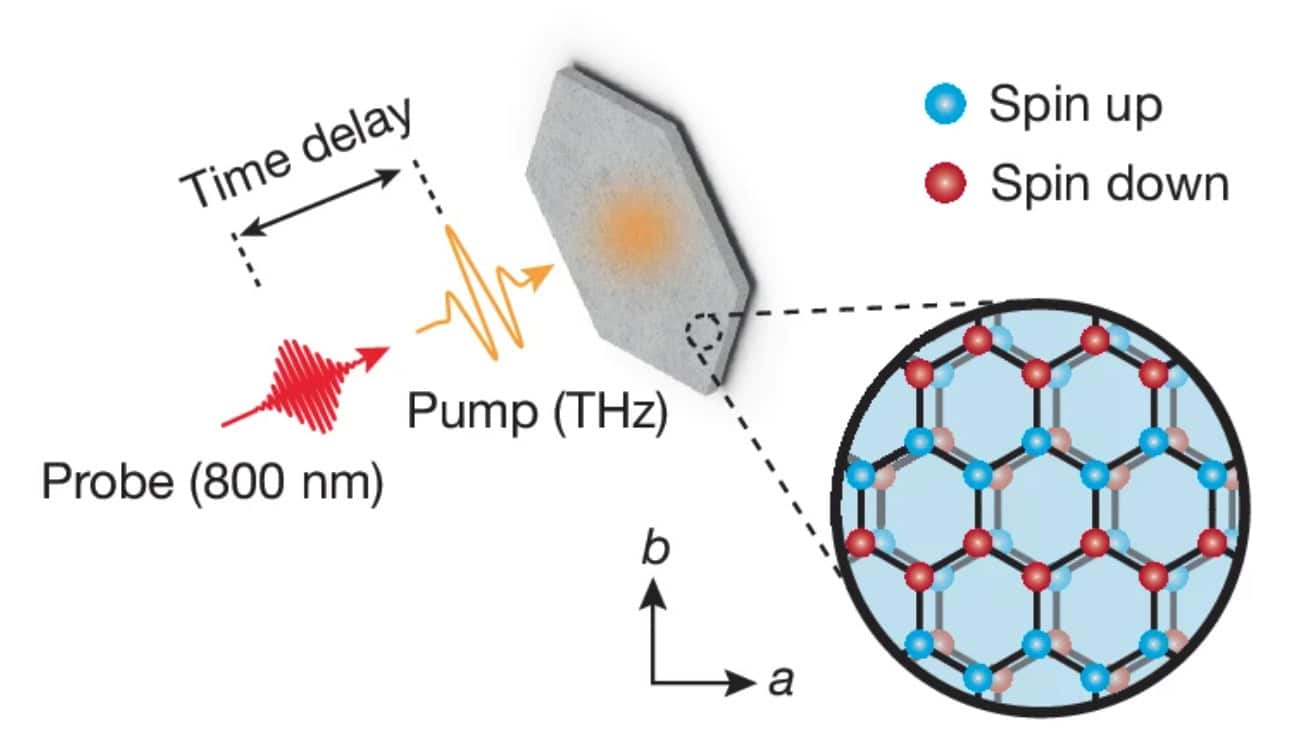
Along with this benefit, new possibilities for spintronics are emerging. In 2024 Nuh Gedik at the Massachussetts Institute of Technology (MIT) and colleagues reported that they had rapidly induced magnetism in iron phosphorus trisulfide with light (Nature636 609). FePS₃ is an antiferromagnet where atomic spins in opposite directions result in little or no net magnetic field. The researchers found that picosecond pulses of terahertz light produced magnetic states that persisted for milliseconds – far longer than any other reported light-induced magnetism (see box below).
Metastable magnetization
(Courtesy: Ilyas, B, Luo, T, von Hoegen, A et al. “Terahertz field-induced metastable magnetization near criticality in FePS3” Nature636 609 (2024) Springer Nature)
Shown here is the experimental set-up that an international team of physicists use to produce a long-lasting, light-driven magnetic state in a material such as iron phosphorus trisulfide (FePS3), which becomes antiferromagnetic when cooled below about 118 K. They used an intense terahertz-frequency (THz) pulse (orange) to drive low-energy collective excitations, which induce transient changes in optical properties that can be probed with an 800 nm probe pulse (red). Fe2+ ions form a hexagonal lattice and their spins arrange ferromagnetically along the zig-zag chain (a-axis) and antiferromagnetically between the adjacent chains (the structure in the circle). The magnetic coupling between the layers is antiferromagnetic together with a small interlayer shear distortion along the a-axis. The THz pulses put the material in a metastable magnetic state that lasts for more than 2.5 milliseconds even after the light source is switched off.
Earlier this year, researchers at Beijing Normal University in China found that light-induced magnetic transitions consume little energy (ACS Nano20 9051). If magnetic bits become competitive with electrical ones – activated by light or otherwise – they would unite working memory and long-term storage in one computational stage rather than two as we now have. Magnetic bits could also play a role in a bigger change in computer structure.
Bringing it all together
A novel form of computer architecture could also remove a famous bottleneck in computing that dates back to the influential 1945 proposal by the mathematician John von Neumann for a general computational design. He suggested using separate processing and memory (first put forth in 1837 by Charles Babbage for his mechanical “Analytical Engine”) but added the idea of the stored program.
By holding the instructions for computer operations in memory along with data, a computer program makes computation more flexible but has one big drawback. Data and instructions have to shuttle between processor and memory along the same channel, reducing computing throughput and using more energy than processing – the “von Neumann bottleneck”.
Novel computing: liquids, soft solids and deuterium
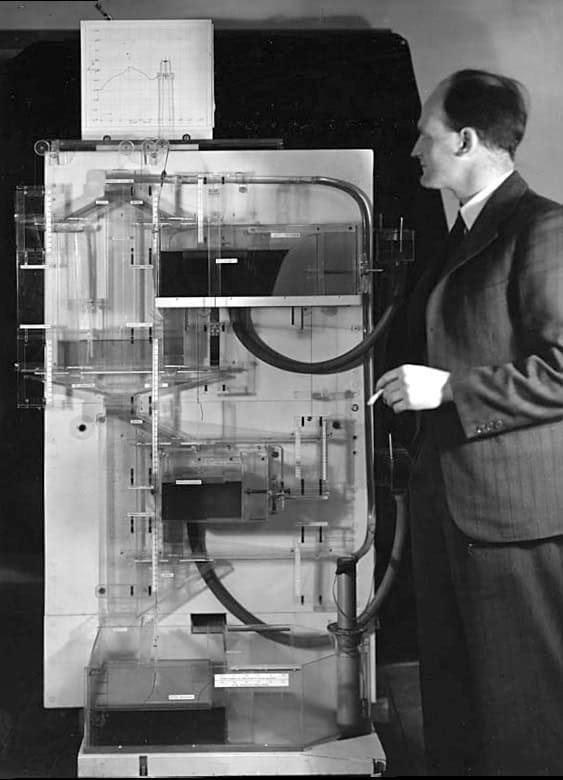
Financial flows London School of Economics economist AWH (Bill) Phillips with his eponymous machine, also known as the MONIAC analog computer, that modelled economic theory with water flows. (No known copyright restrictions, LSE Library archive)
At the heart of modern computing technology are ultra-pure silicon wafers. These nearly perfect regular crystalline solids form the substrates for integrated circuits, making it all the more surprising that less ordered materials – such as liquids and soft solids – have their own history in computation.
In 1949, for example, the UK-built Monetary National Income Analogue Computer (MONIAC) simulated the flow of money within a national economy using coloured water moving through transparent tubes under gravity. Water levels representing economic conditions were set by pumps and valves. As the water negotiated the system, it dynamically illustrated how parameters such as tax rate affect an entire economy, eventually settling into equilibrium.
Another liquid – mercury – also appeared in the early days of electronic computing. The first commercial unit in the US, UNIVAC I (1951), stored nine kilobytes of data as sound pulses continually recirculating in tubes filled with liquid mercury acting as delay lines. The units, which were bulky and heavy, provided serial rather than random access because the pulses travelled in sequence. Timing was crucial, and the mercury was held at a constant 40 °C to keep the speed of sound stable. Another early computer, EDVAC, also stored data in liquid mercury.
Since the 2000s researchers have shown that tiny droplets of oil, moving through small channels filled with water, can implement binary logic. If a droplet blocks a channel, a second droplet arriving behind it is diverted into another channel, representing a “decision”. Proper design can emulate the Boolean logic that underlies conventional computing. With channels only 100–200 µm across, microfluidic logic could route and process small samples, providing a lab on a chip for chemical analysis, biological research or medical diagnostics.
Yet another liquid – one more exotic than mercury – and a soft solid were apparently at least considered for computation in the same era as UNIVAC 1. According to Iain Dey and Douglas Buck’s 2017 biography The Cryotron Files: the Strange Death of a Pioneering Cold War Computer Scientist, the MIT scientist Dudley Buck once worked on a data storage system using magnetic pulses in liquid deuterium held at cryogenic temperature. In that Cold War era, US government money was available for any research that might help America and the authors describe how some of it also went on studies into a soft, wobbly foodstuff, lemon Jell-O as well as the viscous semi-liquid hair preparation Wildroot Creme Oil, which might also support sound waves in a memory unit. None of this Cold War research panned out, although at least the Jell-O experiments could treat the entire lab team to dessert.
One solution is to carry out processing and memory functions in the same physical element, potentially using a new type of electric circuit element originally proposed in 1971 by the US electrical engineer and computer scientist Leon Chua. Its resistance depends on the accumulated charge and, since charge is the time integral of current, therefore carries a memory of the device’s past electrical activity.
Chua dubbed his new element a memory resistor or “memristor” – and the concept can be used when a read-write MTJ holds a memory of past electrical activity as a magnetic bit. In 2026 Shahar Kvatinsky at the Israel Institute of Technology and colleagues showed that small MRAMs formed from MTJs can perform logical operations inside memory (Adv. Electron. Mater.12 e00348).
In principle, therefore, this could also provide arithmetic processing inside memory, thereby removing the von Neumann bottleneck. The non-volatile memory would also save energy relative to CMOS memory. Problems remain though, such as reducing noise and producing large-scale MRAMs – but the ability to merge memory and computation within MRAMs has been established at small scales.
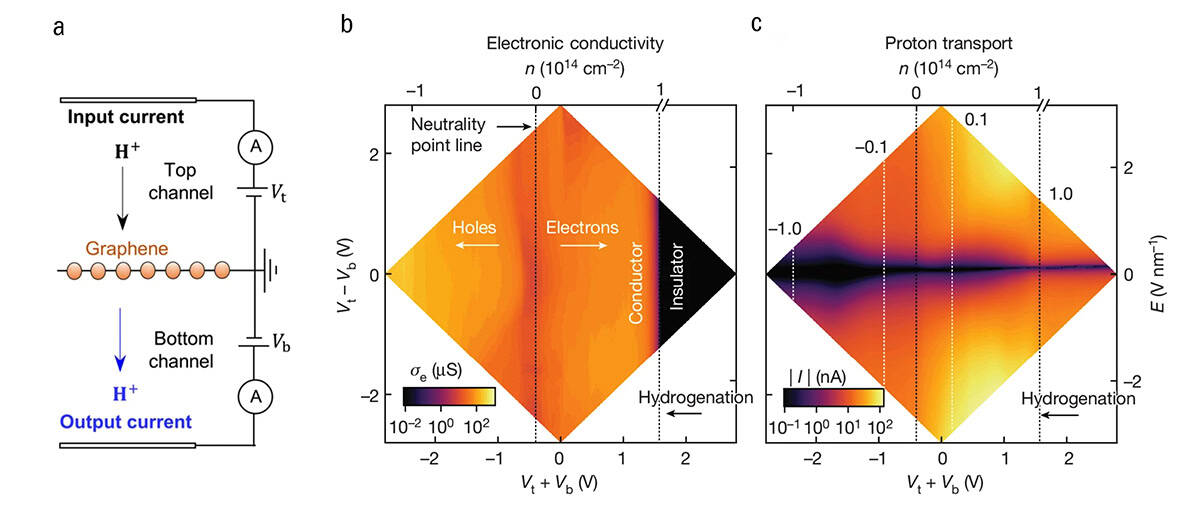
Certain material structures can also play a dual function. The wonder-material graphene – a 2D hexagonal lattice of carbon atoms – is electrically conductive when a voltage is applied in its plane, driving the electrons. If the graphene sheet is also placed between proton-conducting electrolytes, a second voltage applied across the sandwich produces a proton current (a flow of positive charge) perpendicular to the plane.
In 2024 Marcelo Lozada-Hidalgo at the University of Manchester and colleagues found that certain values of electron density in this structure make the graphene an insulator (Nature 630 619), producing a reversible change from conducting to insulating that forms a non-volatile two-state memory. Their set-up allowed the researchers to perform logic and memory operations in a single device for the first time.
As graphene, MRAMs, and other approaches are under study for in-memory computing, another method emulates a natural process – and is perhaps the biggest departure from conventional computing.
Dual purpose
(Courtesy: M Lozada-Hidalgo, Nature630 619. CC BY 4.0)
(a) Graphene is well known to be a good electrical conductor, but in 2024 an international team of researchers used the 2D substance to make a new electrically-controlled switching device that supports both memory and logic functions. The device exploits graphene’s ability to conduct protons as well as electrons. The team showed that placing a sheet of it between proton-conducting electrolytes also produces a proton current perpendicular to the plane, with the proton and electron transport allowing independent control of field and charge density. Shown here are the top and bottom voltages and the direction of electron and proton flow. (b) Map of in-plane electronic conductance, σe, as a function of electric field E and charge density n. The left and bottom axes show that these variables are controlled by the difference and sum of the top and bottom electron voltages, respectively). (c) Map of proton transport current, I, as a function of E and n.
Copying biology
In the 1980s, Carver Mead – a Caltech physicist and engineer who had been instrumental in developing integrated circuits and deeply understood the physics of computing – made a radical proposal. Instead of building computers around centralized digital logic, we should instead design them to imitate the strategies that make the human brain highly efficient. He coined the term “neuromorphic” computing for this approach and is widely considered its founder.
Using specific biological and biophysical features, the brain performs its cognitive and sensory tasks at the modest power of 20 watts. Its 86 billion neurons do not constantly use energy, but act sparsely in response to events, firing brief electrical spikes at definite timings and rates. A system like this can be expected to save energy compared to a conventional computer, which steadily consumes energy at the CPU clock rate.
Also, there is no von Neumann bottleneck in the brain. Information is stored as changes in synapses: the ~1014–1015 connections among neurons that control signal flow. As a spike arrives, a synapse immediately applies its stored information. The modified signal is passed on to neurons that repeat the cycle. Storage and processing occur together within this closely linked 3D network, which also operates in a massively parallel manner.
Mead had envisioned an analogue neuromorphic design, but in practice the biological features are expressed digitally to match CMOS technology. For example, in 2017 Intel introduced its Loihi chip with event-driven spiking and closely connected computation and memory. A later model was reported in 2025 (arXiv:2503.18002) that trebled the throughput for matrix multiplication – the main computationally-intensive operation needed to train an LLM – with half the energy a standard GPU chip uses.
Similarly, in 2014 IBM built and tested a chip that emulated spiking behaviour, while a later version, dubbed NorthPole, does not use spiking. In 2025, meanwhile, IBM researchers reported that 288 linked NorthPole chips could carry out AI inference on certain sizes of language models at favourable speeds and power usage.
Chip off the old block Intel’s Loihi 2 chip is an example of a neuromorphic chip, based on how the human brain functions. With linked computation and memory, it can carry out AI inferencing considerably faster than standard chips, making it more energy efficient. (Courtesy: Walden Kirsch/Intel Corporation)
The future of computing and AI
Most of the novel approaches are in the proof-of-principle or pre-commercial phase and may never reach wide use, for both economic and engineering reasons. The investment in CMOS technology and the associated computer architecture is enormous. Any overall change would be a massive undertaking. Although a neuromorphic chip might be more efficient, it would require huge investment to be formally adopted by today’s markets and chip-making industry.
Even so, there are valuable lessons to be learned from the research into novel approaches – such as better integration of memory and computation. There is also a consensus that hybrid solutions can yield immediate benefits. An accelerator unit, such as a bank of neuromorphic chips, integrated with CMOS technology, could increase speed and decrease power use for the critical matrix multiplication stage. Upgrades like these can be included as new supercomputers and AI centres are being built, improving general and AI computation and reducing their energy costs.
We should also think of the problem from the other end: yes, we can now produce a form of AI based on LLMs. But this is ultimately a brute-force approach that demands a great deal of time, money and resources. It should continue to be refined, but there should also be space for bold ideas that may lead to better and more sustainable forms of AI, and of the computation it requires.
How many times have you wanted to throttle a journalist? Do you ever get incensed about articles, podcasts or videos that simplify, dumb down or belittle your research? Don’t you ever want to teach a science writer the basics?
Earlier this summer the US quantum physicist Christopher Fuchs got the chance. Thanks to some funding at the end of a grant cycle, Fuchs arranged a face-off between science journalists and writers, and a philosopher (me) at Royal Holloway, University of London. But the meeting wasn’t all about Fuchs having a big fat moan; he also gave the journalists the chance to push back.
Fuchs, who is from the University of Massachusetts, Boston, is the principal expositor of QBism, originally an acronym for “Quantum Bayesianism”, a research programme devoted to trying to figure out what the world must be like if quantum formalism is correct. But even top-flight writers, Fuchs thinks, get it wrong. And so emerged his idea for the workshop, called “Communicating QBism”.
Attendees at the workshop, besides Fuchs himself, included his collaborator Rüdiger Schack from Royal Holloway – the gracious host of the meeting. There was also John DeBrota, who’s a postdoc at Ludwig Maximilian University, Munich, and Matthew Liefer, associate professor at the Institute for Quantum Studies at Chapman University, California.
The science writers were all experienced. One was Philip Ball, the author of some 30 books who has a PhD in physics and contributes regularly to Physics World. Jo Marchant, the sole female writer to attend, has a PhD in genetics and medical microbiology and is a New York Times bestselling author who recently wrote for New Scientist on QBism.
The four other writers were Robert Henderson, who has a PhD in quantum field theory; George Musser, who has a PhD in planetary science and is a contributing editor at Scientific American; Ulf von Rauchhaupt, a science editor at the Frankfurter Allgemeine Zeitung who has a PhD in extraterrestrial physics; and Zack Savitsky, a physics correspondent for Science.
I was invited at the last minute as a philosopher and writer who might find value in the event. I did.
Pugnacious and self-deprecating
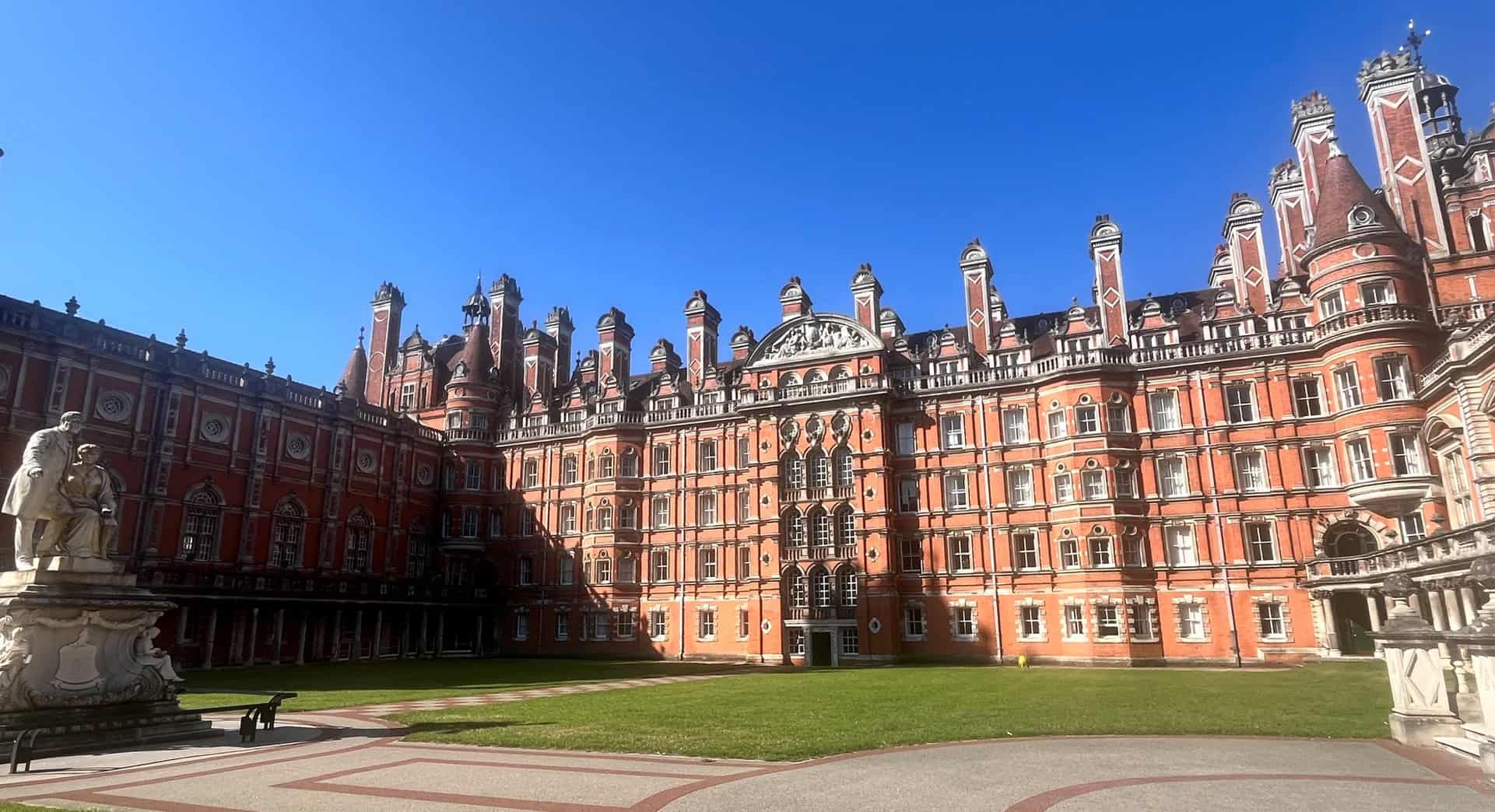
Royal Holloway’s wooded campus on the western outskirts of London is dominated by the Founder’s Building, a beautifully ornate late-19th-century red-brick castle-like structure modelled on a French chateau with a central courtyard. But that’s only where we ate. Fuchs’s face-off, which took place on June 18–19, was holed in a modest modern science building down the hill.
Fuchs, whom I’ve met and written about several times, including for Physics World and a philosophy journal, is charmingly pugnacious. He approaches talks and conversations with unwavering zest and easily out-talks critics. He is relentless in pointing out even years-old mistakes to journalists and writers [editor’s note: I can confirm this]. Yet Fuchs can also be endearingly self-deprecating.
If you didn’t know Fuchs, you might be forgiven for thinking that he had an inquisition in mind. “I explain the ideas until I’m blue in the face,” the invitation ran, but you journalists are “pretty deficit in getting QBism right”. He continued, “What is it that makes QBism so damned hard to understand for journalists and the lay public?”
Fuchs then described himself as “communication impaired” – which was disingenuous. Based on Shack’s estimate, he’s sent about 150,000 QBism-related e-mails, he’s got “3 Million Miler” status from American Airlines thanks to his trips to give talks, and he was a lead speaker at the Helgoland conference on the centenary of quantum mechanics last year.
Some invitees were cautious, even sceptical. “QBism isn’t just another quantum physics interpretation”, Marchant replied to Fuchs’s invitation. “You’re challenging ideas of what physics is even about and requiring a radically different conception of what nature is”. Ball, meanwhile, perceptively reminded Fuchs that QBism is so novel that “the misrepresentations don’t just come from journalists”.
As for Musser, he warned Fuchs that the encounter may not be pleasant. “We will need to have free, open and frank discussions”, he responded, that may be “infuriating to you”. He counselled Fuchs to bring “plenty of plushy toys” for participants to safely throw at each other.
Fuchs’s invitation, however, also expressed warm and genuine respect for the coterie of science writers, who all agreed to come. Still, Fuchs brought a box of plushies just in case.
Speaking about science
On the meeting’s first day, the writers listened and learned. Schack opened the workshop by going over QBism’s vocabulary. “Probability” is not a property of things but refers to the expectations that an experimentalist has about outcomes of an action they are about to take. “Measurement” is that outcome.
“Quantum formalism”, meanwhile, is a tool that any experimentalist can use for making the best estimate they can about which outcome they will get. “Quantum states” are not properties of the world but compendia of probabilities to inform the agent about which actions they ought to take to achieve their goals.
Scene of the action Royal Holloway, University of London, was the venue for the stand-off between scientists and science journalists. (Courtesy: Robert P Crease)
After Schack, Fuchs gave a talk showing that QBism is neither a philosophical add-on to quantum theory nor something motivated by an attempt to resolve issues to do with entanglement, Bell inequality violations, and so on. Rather, QBism is the only satisfactory coherent account of what the world must be like if the quantum formalism is correct.
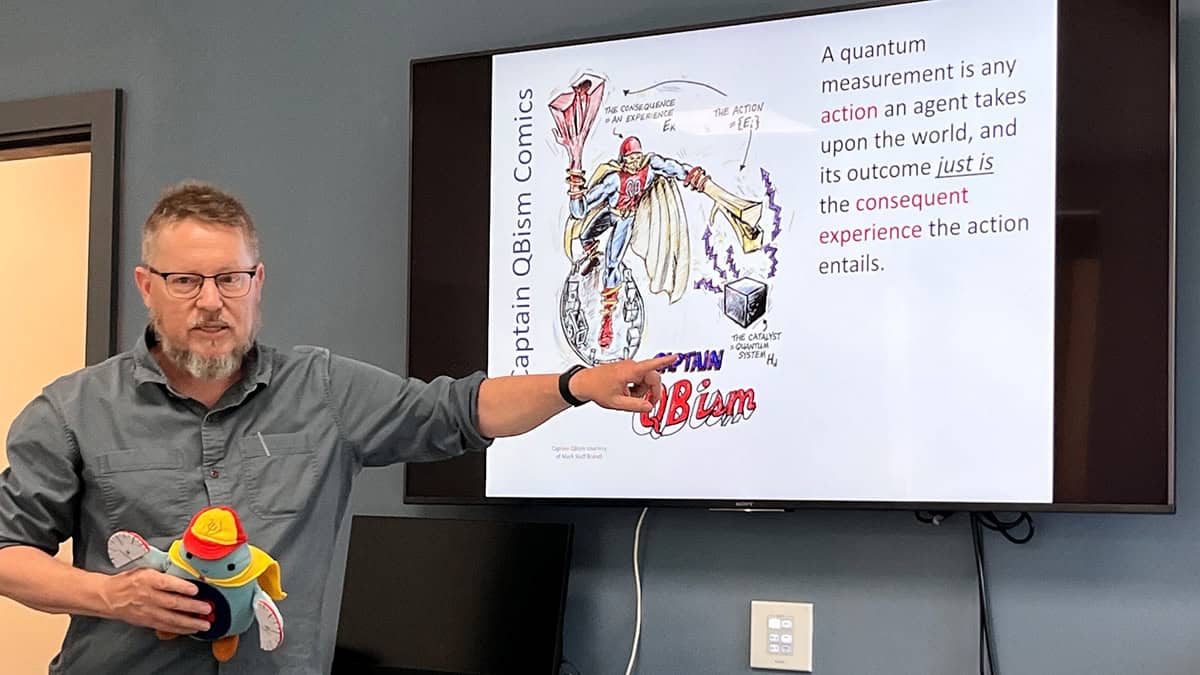
Fuchs quashed the idea that QBism is solipsistic; quantum formalisms, he pointed out, have been hammered out for a century and can be picked up by anyone as the best guide to their laboratory experience. He vented ire over stories that use the word “observe” and visual images to characterize what experimentalists do as if they were flies on the wall rather than actors in measurement events.
When Fuchs complained about a clause in an article by Savitsky which suggested such an interpretation, the writers cried “Foul!”. They accused Fuchs of “niggling” about a few words in a lengthy 4000-word article. When Fuchs replied, “I want to niggle over words!” he dodged a plushie.
Learning about writing
On the second day of the meeting, it was the scientists’ turn to listen and learn. Henderson talked about his struggle to “think like a QBist”, explaining how, during the Covid-19 pandemic, he joined Fuchs’s weekly Zoom sessions known as “QBukis”. These made him feel like he had come across “a more advanced civilization of aliens maybe, to whom premises I’d never thought to question were deemed antiquated and naïve”.
Henderson had an epiphany one day when he saw a bird hopping across his snow-covered lawn. The bird, he realized, was not a thing-in-itself but “the designation of a bundle of expectations” that he was bringing to bear to recognize it. What’s most challenging in learning to think like a QBist, Henderson concluded, is that QBism is “playing a different game than the rest of physics, or even science”.
Marchant followed with a talk entitled “Why QBism keeps getting misheard”, in which she showed a picture of a tennis player about to smash a rocketing tennis ball. What was happening, she said, wasn’t just body movements and ball trajectories – but a process of unfolding and continually updated predictions of actions.
QBism sees experimentalists like that tennis player, Marchant said, shepherding new events into the world, but it’s unintuitive to think that way. “QBism isn’t just another quantum physics interpretation,” Marchant said; “you’re challenging ideas of what physics is even about and requiring a radically different conception of what nature is and how we are related to it”. This, she concluded “is always going to be difficult”.
Ball pointed out that journalists are forced to keep in mind “mental attractors” that entice the public, journalists and even scientists to think in classical rather than quantum terms.
Between talks, the writers cited other constraints, such as time, money, audience and the space allotted by editors, all of which shape and dictate their output. Furthermore, writers are sometimes forced to use words whose meanings vary from their technical use.
At one point Fuchs showed a slide of Marchant’s New Scientist article and complained about the word “perspectives” in the standfirst. But Marchant and others objected that Fuchs’s “Gotcha!” play was again committing a foul; writers must lead readers gently into difficult stories with prose that sometimes must violate what researchers mean. “We have to write so people keep listening,” Marchant pointed out.
Impressed, Fuchs had to admit that he does something similar in his lectures, not leading with his most radical ideas but holding off until later.
One scientist then asked why writers don’t routinely run stories by sources before publication. Even if you accurately regurgitate the sources’ words, the writers replied, they often insist on changes, demand that their editors alter or retract the story, heap abuse on you, or even threaten to sue, causing the magazine to drop your article.
Tread carefully QBism is an alternative interpretation of quantum mechanics, but woe betide anyone whose explanation of it fails to live up to Christopher Fuchs’s standards. (Courtesy: Robert P Crease)
When a writer asked why scientists should even care about representations of their work in the media, the answers were difficult to synthesize. They ranged from the noble wish to nurture a scientifically literate public to the self-interested hope that good coverage might influence public perceptions and thus lead to more money from funding agencies.
But what’s hardest writing about QBism, explained the writers, has to do with Henderson’s “civilization of aliens” and Marchant’s “keep ‘em listening” points. Readers instinctively think, contra QBism, that the world has permanent residents and chiselled-in laws. The tennis player’s dive for the ball can always be reconstructed afterwards from a god’s-eye perspective in terms of classical physics, and it’s second-nature for both the public and even scientists to assume that the end of physics is to make such reconstructions.
The critical point
Years ago I wrote a column “The press is a foreign country” whose message was that communicating science is like engaging with another culture. Science and the media, I wrote, are separate institutions with different values, traditions and methods and reasons for seeking and justifying knowledge. The cross-cultural interaction, though, cannot always be made trouble-free, with all conflicts reconcilable by facilitators or relationship counsellors.
Given the qualifications of the participants at “Communicating QBism” – all but Zack had PhDs – one might have thought that the cross-cultural interaction at the workshop would be relaxed. It was, for the most part. But good scientific communication, it emerged, is not always a matter of clear explanations, demonstrations of relevance, dazzling imagery, or scientifically literate journalists.
Positive interactions may require constantly negotiating trade-offs between accuracy and comprehensibility, as well as setting up flinty encounters in which both scientists and writers actively hunt down and expose their own assumptions. These encounters must risk conflict and discomfort on both sides. Good science communication, in short, can use some genial pugilism, and Fuchs’s workshop was an excellent example.
By analysing the signals from extragalactic fast radio bursts, astronomers at the Massachusetts Institute of Technology (MIT) say that the “missing matter” in the universe is distributed further away from galaxies than most theoretical simulations predict. Their finding – which is counterintuitive since the gravity from galaxies tends to pull everything closer to them – could help us better understand how highly energetic galactic activities, such as jets from supermassive black holes and explosions from old dying stars, impact the formation of cosmological structures.
“Ordinary” matter, which is built from atoms and their protons and neutrons (collectively known as baryons), makes up stars and galaxies and everything we see around us. However, the best models of the universe we have today suggest that close to 90% of this baryonic matter is “missing”.
The radio signals of FRBs are stretched
As their name implies, fast radio bursts (FRBs) are brief, intense bursts of radio waves spanning multiple wavelengths. They were first detected in 2007 and since then, astronomers have spotted thousands of others, including some within our own galaxy. They are thought to originate from cataclysmic processes involving compact celestial objects such as neutron stars and typically last a few milliseconds or even less. And these FRBs can be used to probe the missing baryonic matter.
As they pass through the missing matter, the radio signals of FRBs are stretched (or “dispersed”) over time – that is, their overall duration becomes longer. The more missing matter they pass through, the more the signals are dispersed. The missing matter has an extremely low density – of just a single proton per cubic metre – so it is extremely difficult to identify, but researchers recently found that they could use the dispersion effect to detect it. In that previous study, they confirmed that intergalactic space, which contains most of the universe’s baryons, is home to tenuous clouds or filaments of diffuse plasma that make up the missing matter.
Data from CHIME and DESI
In the new work, a team led by astrophysicists Haochen Wang and Kiyoshi Masui has now gone a step further and mapped the extent to which this plasma extends. They did this by cross correlating the locations of millions of galaxies with the dispersion of nearly 3000 background FRBs on length scales of 0.1 to 50 Mpc.
The researchers used data from the Canadian Hydrogen Intensity Mapping Experiment (CHIME) catalogue and the Dark Energy Spectroscopic Instrument (DESI) survey. CHIME, a large radio telescope located in British Columbia, scans the entire northern sky for incoming radio waves and it can detect ultrashort, ultrabright radio signals. Indeed, it has detected about 4000 FRBs since it became operational. DESI, for its part, is an instrument mounted on the Mayall Telescope at Kitt Peak National Observatory, near Tucson, Arizona. It makes detailed measurements of the light coming from over 30 million galaxies – originally to provide estimates of dark energy, the mysterious force that is driving our universe’s expansion.
In all, the researchers detected 2870 FRB signals with CHIME and correlated these with the locations of around six million galaxies with DESI.
Missing baryonic matter scattered across a large radius
Their analyses revealed that on scales smaller than about 1 Mpc, the missing baryonic matter was indeed found around galaxies and galaxy clusters, but rather than being close to galaxies in a dense ball as expected, it was scattered across a large radius. “A galaxy is maybe a few 100,000 light years across, and we found missing matter out to about four million light years,” Masui says. “That’s further than the simulations predict.”
The new result backs up the idea that missing matter is projected out from a galaxy through highly energetic events, such as jets from supermassive black holes and explosions from old dying stars. These processes could be much more energetic than we think, note Wang and Masui, and they are stronger and much more violent.
The work, which is detailed in Physical Review Letters, proves that FRBs are a good way to study large-scale structures in the universe – in a similar way to how cosmologists have been using galaxies and the cosmic microwave background for decades, says Wang. “It has helped to establish FRBs as a new cosmological probe, especially for detecting the missing matter.”
FRBs will only become a more popular tool in this context, he adds, especially given that several new radio telescopes, with upcoming surveys such as CHORD, DSA-2000 and the SKA, are being constructed around the world to offer much better FRB data in the coming years. “Indeed, we have already received more FRB data from our telescopes and are working on expanding our study,” Wang tells Physics World.
And that is not all: the researchers say they are also busy improving their analysis technique. “Until now, we have mostly examined the dispersion of FRBs but we are now working on extracting information from FRBs’ spatial positions relative to galaxies. This will reveal more details on how the missing matter is distributed in the universe.”
Exceptional points occur in open physical systems where two or more resonances merge so completely that both their measured values and their underlying states become identical. (Technically speaking, the eigenvalues and the eigenvectors coalesce.) Exceptional points are different from ordinary degeneracies, where two frequencies may be the same but the corresponding states remain separate.
Near an exceptional point, a tiny change in the system can produce a relatively large change in the resonances. That is why exceptional points have been proposed for sensitive devices such as optical sensors. But there is a catch: a large response is not automatically useful if quantum noise also increases at the same time.
In a new paper, researchers Jan Wiersig and Stefan Rotter tackled this problem using quantum Fisher information. This is a quantity that sets the best possible precision of a measurement under ideal conditions.
Their approach treats the sensor as a scattering device, where incoming coherent light is transformed into outgoing light, and asks how much information about a small perturbation can be extracted from that change.
The results are, unsurprisingly, complicated – but that complexity turns out to be revealing.
For several years, different groups have reached seemingly contradictory conclusions about whether exceptional points actually improve sensing at the quantum limit, with some studies reporting a clear advantage and others finding none. Wiersig and Rotter’s analysis helps explain these disagreements: the answer depends on the physical assumptions and, in particular, on how the input light, losses and perturbation are matched to the resonant modes.
The analysis therefore does not yield a simple yes-or-no verdict. Under suitably matched conditions, exceptional points can provide substantially more quantum Fisher information. For example, a factor-of-four enhancement for a second-order exceptional point in a two-microring system, and an even larger enhancement in the third-order case.
What’s more, the optimum operating point need not be the exceptional point itself. Moving slightly away from it can produce linewidth splitting, creating a longer-lived mode that interacts more strongly with the perturbation and thereby increases the useful signal.
The take-home message is that exceptional points are not magic sensitivity boosters. They can provide an advantage when the light field, perturbation and resonant mode are well matched. Internal losses may weaken or remove this advantage, although small losses do not destroy the overall picture.
Future exceptional-point sensors will therefore need to be designed as complete measurement systems, rather than around the exceptional point alone.
Chemical reactions are usually modelled as random, statistical events, with particles bumping into each other and rearranging according to energy and probability. But at extremely low temperatures, atoms and molecules can behave as coherent matter waves, meaning many particles share a common quantum phase. In this setting, a reaction can look less like classical chemistry and more like wave mixing in optics.
In order to learn more about this phenomenon, a team of researchers from the University of Chicago studied a gas of caesium atoms, cooled down to 11nK to form a Bose–Einstein condensate.
Their approach was to use a Feshbach resonance to initiate the chemical reaction. This resonance is a way of using a magnetic field to tune how strongly ultracold atoms interact with each other.
At this point, two atoms can couple strongly to a bound molecular state, so pairs of atoms can be converted into weakly bound caesium diatomic molecules. Using this technique, they were able to transform an atomic Bose–Einstein condensate into a molecular Bose–Einstein condensate, consisting of about 10,000 molecules.
Their key result is the observation of phase doubling. This is the matter-wave version of phase matching in second harmonic generation, where two red photons in a nonlinear medium combine to produce one blue photon with twice the frequency and twice the momentum. Here, two atomic matter waves combine into a molecular matter wave whose phase is twice the atomic phase.
They also showed that molecules formed from atoms in different momentum states were enhanced beyond a classical expectation. This allowed the team to identify non-separable, entangled two-atom momentum states created during the reaction.
This work is one example of quantum many-body chemistry, where reactions are governed by the shared quantum phase of many atoms and molecules. This is also similar to how the direction of a Josephson supercurrent is determined by the phase difference across its junction.
Remote uncrewed aerial vehicles (UAVs), or drones, equipped with solar cells could be wirelessly charged using laser beams directed at them from the ground, rather than relying on traditional onboard batteries. The problem until now, however, has been keeping the drones cool – since laser light heats them up, so reducing the efficiency of the photovoltaic cells they carry on their wings. A team of researchers at the Civil Aviation University of China has now overcome this problem by incorporating a heat blocking technology based on antimony selenide (Sb2Se3) nanorods into these solar cells.
As drones take on longer missions, battery life has become one of the biggest barriers, explains Jianhua Han, who led this new research study. “Our team has been looking into laser wireless power transmission, which is a leading approach for long-distance wireless energy transfer, to replace these batteries.”
Laser wireless power transmission is particularly suited to aerospace applications such as UAVs equipped with photovoltaic cells. Perovskite solar cells show much promise in this context because they are cheap to manufacture, absorb light strongly in the visible part of the electromagnetic spectrum and have long charge-carrier diffusion lengths.
A perovskite laser cell-thermoelectric tandem device
In the new work, detailed in Matter & Light, Han and colleagues studied a type of solar cell known as a perovskite laser cell-thermoelectric (PLC-TE) tandem device, which consists of a carbon-based CsPbBr3 perovskite as the PLC and bismuth telluride (Bi2Te3) as the TE material. The TE module is directly fixed beneath the laser cell and a carbon electrode is attached to its negative terminal to create a series connection. When laser light is shone onto the device, the carbon electrode converts a portion of the incident laser energy into heat. The TE then harvests this heat, converting it into electricity through the thermoelectric effect.
And that’s not all: since one side of the device ends up being warmer than the other, this temperature gradient also helps convert the thermal energy into electricity. The larger the temperature gradient, the more electricity the TE layer can generate.
There is a problem though: while the carbon in the hybrid structure dissipates some of the heat produced by the laser, the structure can still heat up – reaching temperatures of up to 90°C, says Han. “That was much higher than we expected and made us realize that heat buildup was a far more serious problem than we had imagined.”
Sb2Se3 behaves like a thermal barrier
To overcome this problem, the researchers turned to Sb2Se3, which is a promising photovoltaic material. As well as its good optoelectronic properties, this semiconductor also has a low thermal conductivity, which allows it to behave like a thermal barrier when embedded in a device.
Han’s team synthesized nanorods from the Sb2Se3 and incorporated them into the upper portion of the CsPbBr3 layer. The Sb2Se3 reduces heat dissipation in the carbon electrode and so helps maintain a significant temperature gradient in the TE device, thereby improving its overall energy conversion efficiency. Its thermal barrier properties also help decrease the PLC’s overall operating temperature during prolonged laser exposure.
The team then inserted the tandem device containing the Sb2Se3 nanorods beneath the wing of a stationary drone and carved out air channels through the wing to simulate real-world airflow conditions. When illuminated with high-power green laser light with a wavelength of 520 nm, they found that the device converted 38.49% of the incoming laser energy into electricity and successfully powered the drone’s propellor blade. This power conversion efficiency, says Han, is among the highest reported for this class of technology operating under similar conditions.
Device could help UAVs stay airborne for longer
“In terms of concept, this is the first time that a system-level scheme of the devices has been applied to a UAV power supply, expanding the work from pure materials research to application-oriented system design,” Han tells Physics World. “It demonstrates that powering UAVs with light is not just a theoretical concept, but an engineering pathway that can be practically implemented.”
The device could help UAVs stay airborne for longer, something that will be useful for applications like forest patrol, disaster monitoring and delivering packages, he says. But there is still much work to do before such applications become a reality. For one, the researchers will need to integrate the PLC-TE device into a lightweight drone for flight testing outdoors and to assess the safety of their technology. They will also need to find a way of accurately tracking moving drones with laser beams.
“Going from the ground-based proof stage to the real flight validation stage will require solving many engineering challenges,” says Han, “but our technology is a good starting point and verifying its viability is the core objective for the next phase in our study”.
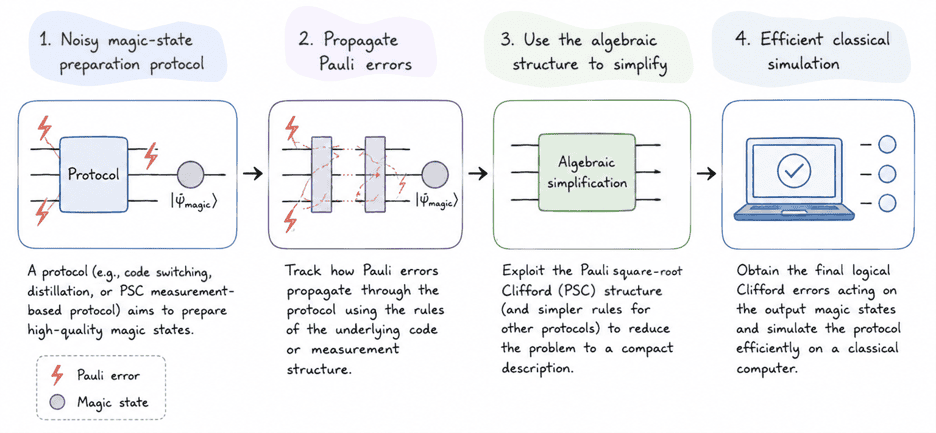
Step by step: A simplified schematic of the simulation framework, showing how circuit-level Pauli errors in noisy magic-state preparation protocols can be propagated and simplified using the underlying algebraic structure, reducing the problem to efficiently simulable logical Clifford errors acting on the output magic state. (Courtesy: Yousra Farhani)
Building a useful quantum computer is not simply a matter of adding more qubits. The greater challenge is making these qubits reliable enough to perform long computations without errors overwhelming the result. Quantum error correction addresses this problem by encoding each logical qubit across many physical ones, but it comes at a cost: many of the operations required for a general-purpose or “universal” quantum computer become highly resource intensive once fault-tolerant error correction is introduced.
To address this resource challenge, researchers at the University of California, Davis, US have developed a classical simulation method that efficiently models the preparation of some of the most demanding quantum states. The method, which they describe in PRX Quantum, works even for large, high-fidelity protocols that were previously beyond reach.
Building a universal quantum computer
Logical operations in fault-tolerant (that is, error-corrected) quantum computing architectures fall into two broad categories. The first category is a set of operations known as Clifford gates that are relatively straightforward to implement and, importantly, can be simulated efficiently on a classical computer. By themselves, however, Clifford gates are not computationally universal. For that, you also need non-Clifford operations, which lie outside the set of classically-simulable gates and provide the missing ingredient for universal quantum computation.
To realize these non-Clifford operations in a fault-tolerant way, some qubits need to be in a special state known as a magic state. Preparing these magic states with sufficiently high fidelity is expected to dominate the cost of large-scale error-corrected quantum computers, so quantum computing theorists are searching intensively for more efficient preparation protocols. The problem is that this search contains a challenge of its own: how can we compare the efficiency of these approaches?
To assess a magic-state preparation protocol, we need to simulate it under realistic levels of error-inducing circuit-level noise. Yet the same non-Clifford operations that make magic states indispensable for quantum computation also make them difficult to simulate. Existing methods therefore become prohibitively expensive as protocols grow, limiting exact simulations to relatively small logical circuits.
Simplifying a difficult simulation
Rather than searching for a more efficient simulation algorithm directly, the UC Davis team of Samyak Surti, Lucas Daguerre and Isaac Kim first asked a more fundamental question: what mathematical structure do these protocols share?
Their framework for answering this question encompasses three broad classes of logical magic-state preparation protocols: code switching, magic state distillation, and Pauli-square-root Clifford (PSC) measurement-based protocols. In the first two classes, error propagation is relatively straightforward to analyse, but PSC protocols require a more sophisticated mathematical treatment. Rather than viewing these protocols simply as quantum circuits, Surti, Daguerre and Kim characterized their underlying algebraic structure, showing that Pauli errors (the fundamental types of qubit errors) propagate in a highly constrained and predictable way under sequential commutation. This commutation preserves the algebraic relationships between errors and logical operators, while anti-commuting operations exhibit predictable transformations rather than generating uncontrolled complexity.
These properties mean that commuting operations can be systematically reordered without changing the outcome, allowing much of the circuit’s complexity to be absorbed into its algebraic structure. Hence, rather than tracking an exponentially large quantum state, the simulator follows how a compact description of logical Pauli and Clifford errors evolves through the protocol.
The paper formalizes these ideas through a sequence of lemmas, propositions and theorems that establish the mathematical properties of PSC protocols. The result is a series of algorithms for simulating realistic, noisy, logical magic-state preparation protocols with a computational cost that scales polynomially with both the number of qubits and what is termed the stabilizer rank of the target magic state, which is a measure of its non-Clifford complexity. Since the standard single-qubit magic state has a stabilizer rank of only two, this complexity remains manageable even as the underlying error-correcting code grows, in marked contrast to state vector simulations that scale exponentially with qubit number. The team’s advance therefore makes large-scale logical simulations practical for the first time.
Accelerating fault-tolerant quantum computing
Although the new framework does not reduce the physical resources required to prepare logical magic states, it does change how those protocols can be analysed and designed. By exposing the algebraic structure underlying a broad class of logical magic-state preparation schemes, the UC Davis team transformed a computationally hard problem into one that admits efficient classical simulation. Researchers can therefore evaluate, compare and refine candidate preparation protocols under realistic circuit-level noise without resorting to exponentially expensive simulations or uncontrolled approximations.
“The main motivation behind our work was to speed up the development of fault-tolerant quantum computer,” Kim tells Physics World. “I believe there is a large amount of uncertainty in how we will design and optimize magic state factories, which will likely remain as a bottleneck in the foreseeable future.”
As quantum computing progresses from proof-of-principle demonstrations to large-scale fault-tolerant architectures, the ability to characterize and benchmark logical operations efficiently will become increasingly important. This work offers more than just a faster simulator; instead, it provides a new theoretical foundation for designing one of the most resource-intensive building blocks of future quantum computers. “My hope is that this line of work can help us better design the fault-tolerant quantum computers we will be getting over the next few years,” Kim says.
The first direct glimpse of vacuum birefringence has been claimed by astronomers who have studied X-ray and radio emissions of a neutron star that is both a magnetar and a pulsar. A central, but unconfirmed prediction of quantum electrodynamics (QED), vacuum birefringence involves the polarization of the quantum vacuum by powerful magnetic fields.
Made by a US-led international team, the observation could lead to the use of magnetars as natural laboratories to study other extreme-field phenomena of the quantum vacuum. However, another group headed by researchers in Italy remains unconvinced that the data constitute a “smoking gun” for vacuum birefringence. They believe that alternative explanations remain viable.
Birefringence occurs when the refractive index of a medium depends on the polarization of the radiation passing through it. When refraction occurs at such a medium, there is an angular separation of the two differently-polarized waves. This occurs with certain crystals such as calcite and lithium niobate, where the anisotropic lattice structure interacts differently with oppositely polarized photons. Birefringence can also arise from the interaction of photons with magnetic fields in plasma.
Virtual pairs
A key prediction of QED – first made in 1935 by Werner Heisenberg and Hans Euler – is that sufficiently strong magnetic fields can make a vacuum birefringent by polarizing the virtual electron–positron pairs that fluctuate in and out of existence. Ninety years on, however, vacuum birefringence had not been observed because the huge fields required cannot be generated in the laboratory.
“Having a natural lab already existing that could look into some of these effects is something that would be very beneficial,” says astronomer Rachel Stewart of George Washington University in the US. “That’s something people have probably been looking into for decades.”
Stewart and colleagues’ natural lab is a magnetar. These objects comprise a rare subtype of neutron star that have extreme magnetic fields of up to 1011 T. This makes magnetars the most magnetic objects observed in the universe and bright sources of X-rays. Data from NASA’s Imaging X-ray Polarimetry Explorer (IXPE) telescope have shown that this radiation is often polarized.
This is not surprising because the surface of a magnetar is likely to be surrounded by magnetized, birefringent plasma. The plasma’s field, however, should be tangled and variable, so the net polarization imprinted on light emitted into the far field should be relatively small.
Magnetic axis
If the magnetar’s intense magnetic field polarizes the vacuum of empty space, then the birefringence polarization imprinted onto the X-rays should follow the orientation of the magnetic poles into the far field as the magnetar rotates. Disentangling the two effects is difficult, however, because it is not generally possible to ascertain the orientation of the magnetic poles with respect to the direction of our observation.
A very few magnetars, however, are also pulsars that emit narrow beams of radio waves from their magnetic poles. The magnetic and rotational poles of a pulsar are misaligned, which causes the radio beam to sweep around like a lighthouse beam. If Earth happens to be in the path of the beam, we observe radio pulses.
In the new research, Stewart and colleagues observed the magnetar 1E 1547.0−5408, which is unique among observed objects for having persistent, bright radio emission alongside its X-ray emission. They combined observations from two space-based X-ray telescopes – IXPE and the Neutron Star Interior Composition Explorer (NICER) – with radio observations from Australia’s Murriyang telescope.
The radio observations allowed the team to the work out the angle between the magnetar’s magnetic and rotational poles and the angle between the rotational pole and the direction of our observation. This gave them the information needed to disentangle the two birefringence effects.
Large polarization
The researchers found a high degree of polarization in the detected X-rays – up to 80% at photon energies 2–3 keV in energy. They point out that this high degree of polarization is consistent with vacuum birefringence being driven by the magnetar’s powerful field.
The X-ray emission is closely aligned with the radio emission, which the researchers believe is naturally explained by the magnetic poles of the star being closely aligned with the rotational poles – and difficult to reconcile with alternative explanations.
However, another recent paper challenges this interpretation. Roberto Taverna of the University of Padova in Italy, who led the work, says that pairing the radio emission data with the X-ray observations was “very smart”, but he says that “it is not obvious to me whether the two observations – the radio and the X-rays – are compatible or not.” He says that, if the X-ray emission all emerged from one small region such as a hotspot slightly away from the radio polarization axis, the X-ray radiation would be polarized in the absence of vacuum birefringence. As a result he does not believe the observation is a “smoking gun”.
George Younes of NASA’s Goddard Space Flight Center in Maryland – part of the US group – argues that Taverna and colleagues are “ignoring about 60 years of radio pulsar science…They are hiding behind the fact that magnetars are different from pulsars, so we don’t know exactly where the radio emission comes from and all results are on the table,” he says, “but there are fundamentals that we should not ignore.”
The US-led team is now investigating further to see whether they can find more evidence for vacuum birefringence. Nuclear astrophysicist Hoa Dinh Thi of Rice University in Texas, who led the theoretical effort, is now modelling QED effects of magnetism on radiation in the plasma. “In the far future we also plan to use machine learning in the model so we can explore the different sources together and understand better the properties of neutron stars and magnetars.”
A laser-ranging technique has allowed physicists to measure the frame dragging of the Earth with an uncertainty approaching one part in a thousand, representing the highest precision yet for this parameter. The new result not only provides one of the most stringent confirmations of Einstein’s theory of general relativity in the near-Earth environment to date, it also sets stronger constraints on some alternative theories that have been put forward to explain the unsolved mystery of the universe’s accelerated expansion.
Frame dragging, also known as the dragging of inertial frames, is one of the predictions in Einstein’s theory of general relativity. Here, a massive, rotating object not only curves spacetime, it also drags it around as it rotates. The effect is very large around huge objects like black holes but is much smaller around Earth. It can be detected, however, by monitoring the motion of certain satellites in orbit around our planet.
There is a problem though in measuring the very tiny shift of the orbital plane around the Earth predicted by general relativity because the Earth is not a spherically symmetrical body, explains Ignazio Ciufolini of the Chinese Academy of Sciences, who led this new study. He and his colleagues overcame this difficulty by analysing motion data from the recently launched Laser Relativity Satellite 2 (LARES-2), developed by the Italian Space Agency, and its predecessor LAGEOS.
The combined orbits of these satellites act like a huge gyroscope and their position can be measured via laser ranging: a laser pulse is emitted towards the satellite and reflected back from the retroreflectors covering its surface. “By measuring the time it takes the laser light to come back, we can very precisely determine the position of the satellite,” says Ciufolini.
LARES-2 is a small, spherical satellite with a radius of 0.212 m and it is extremely heavy, weighing in at nearly 295 kg. Its orbit, he notes, is therefore perturbed only by the Earth’s gravitation and to a much lesser extent by non-gravitational effects, such as the push of the photons from the Sun and the Earth.
Removing the influence of Earth’s lunisolar tides
One of the difficult steps in the measurements, Ciufolini explains, was removing the influence of Earth’s lunisolar tides. These are the subtle distortions in the Earth’s gravity field caused by the tides raised by the Moon and Sun, which would otherwise hide the signal the researchers were looking for. “The most challenging part was to get rid of the orbital influence of Earth’s ‘K1 tide’, which biases the precision of the frame-dragging measurement,” he says.
“Thanks to this precise measurement, which is an order of magnitude better than previous Solar System measurements, we have been able to set stronger limits of validity to some theories alternative to general relativity proposed to possibly explain the great mystery of the accelerated expansion of the universe,” he tells Physics World. “Some of these theories predict something that may be related to quintessence (a mysterious time-dependent scalar field).”
While these theories predict the same so-called post-Newtonian weak-field effects as general relativity, they predict a different frame-dragging effect, he adds. Increasing the accuracy of frame-dragging (and indeed other tests of general relativity) can therefore place further limits on these other theories. It could also shed more light on phenomena like the flow of time around rotating black holes, where frame-dragging is extremely pronounced.
Laser-ranged satellites remain in orbit for many decades (LAGEOS was launched by NASA in 1976) and will carry on providing data for a very long time. “The more time we have, the more observational data we can obtain and therefore tests of general relativity (not only frame-dragging but also other tests) can be carried out with much increased precision,” says Ciufolini. “This data could also improve our knowledge of the Earth and allow, for example, improved determinations of the Earth tides and its centre of mass, which is useful for the Global Positioning System.”