

Fancy some more? Check out our puzzles page.
Seismic waves reflected from Earth’s core moved parts of Japan 5 mm east
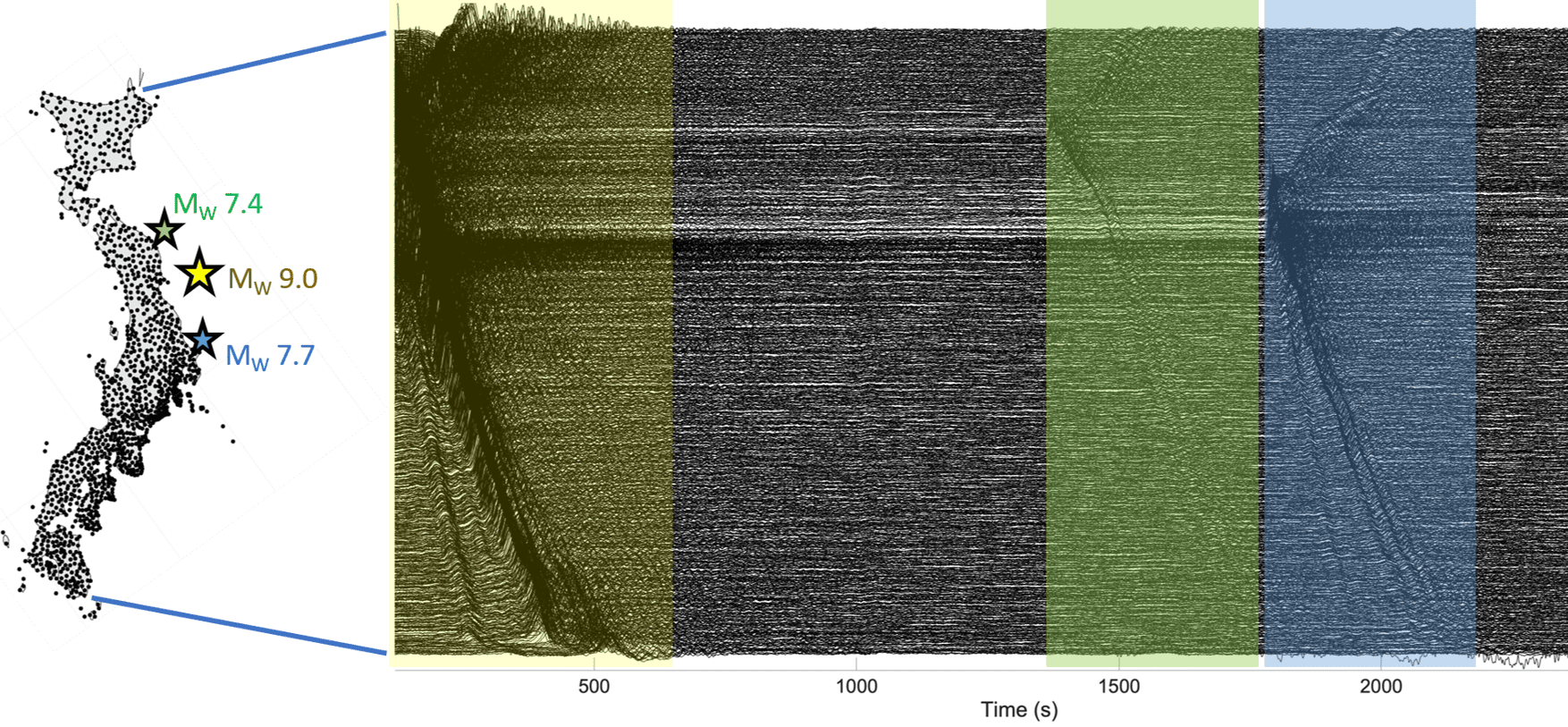
A previously unrecognized source of seismic hazard caused parts of Japan to move eastwards by up to 5 mm within minutes of the 2011 Tohoku-Oki earthquake. Conventionally, such shifts occur when seismic waves generated by rupturing tectonic plates cause the plates to slip, triggering movements of the land mass and the ocean floor. But a new study finds that in the Tohoku-Oki quake, the real culprit was waves that travelled down to Earth’s core and back – a phenomenon more usually associated with efforts to image structures deep inside the Earth.
The 2011 Tohoku-Oki quake occurred at the boundary between the Pacific plate and the North American plate, with an offshore epicentre around 130 kilometres east of Sendai. At magnitude 9, it was one of the largest recorded earthquakes in history, and it caused widespread devastation, including thousands of fatalities. The tsunami that followed exacerbated this damage, with meltdowns of three out of six nuclear reactors at the Fukushima Daiichi power station releasing radioactive caesium into the air and water and prompting a large-scale evacuation with long-term health impacts.
The earthquake was bigger than most models estimated, which compelled seismologists to examine and revise existing models of the largest possible earthquakes and their frequencies in the boundaries of tectonic plates. Instrumented records of this earthquake are still revealing new information about geophysical processes in the boundaries of tectonic plates.
Surface to core and back
In the new work, researchers led by Sunyoung Park at the University of Chicago, US studied shear waves recorded following the earthquake in Japan’s dense network of high-rate Global Navigation Satellite System instruments. Along with the expected seismic waves from the earthquake rupture, the team found so-called ScS waves that travelled thousands of kilometres through the Earth, bounced off the core and travelled back to the surface, arriving across Japan almost simultaneously 13 minutes after the main shock. “The name ScS reflects that path: S[hear] through the mantle, c for reflection at the core-mantle boundary, and then S again on the return path,” Park explains.
Although seismologists have studied ScS waves extensively, they have mostly done so for the purpose of imaging the deep Earth. “Because [ScS waves] reflect from the core-mantle boundary, they have helped constrain the depth and properties of the core-mantle boundary; the structure of the lowermost mantle; attenuation and anisotropy in the mantle; and source characteristics of large earthquakes,” Park explains.
The team’s study offers the first evidence that ScS waves can also trigger significant displacement-causing slip after an earthquake, meaning that earthquake hazard researchers may need to consider these waves to fully capture consequences of earthquake ruptures on the land as well as deep within tectonic plates.
A high-quality, high-resolution dataset
Two aspects of the Tohoku-Oki earthquake made it an incredible opportunity to study the role of ScS waves in triggering a slip event. The first is the nature of the earthquake itself. As well as releasing tremendous amounts of energy, it occurred on a shallow tectonic fault that is dipping down. This combination sent strong shear wave energy travelling nearly vertically down to the core, generating ScS waves strong enough to trigger movement in the tectonic plates.
The second was the quality and resolution of data. “Because Japan is so densely instrumented, we can look for small, coherent signals that would likely be invisible elsewhere,” Park says. “This made it a natural case in which to ask whether delayed seismic phases might trigger additional deformation.”
Working with Hiroo Kanamori at the California Institute of Technology (Caltech), US, and Luis Rivera at the University of Strasbourg, France, Park considered whether Earth’s elastic response to the main shock could explain Japan’s 5-mm displacement. To better understand this possibility, they calculated displacements at all the instrumented locations for many possible configurations of the earthquake rupture. However, the results did not reproduce the observed eastward motion.

The researchers then simulated possible slip scenarios across the tectonic plate interfaces, hoping to better characterize the levels and spatial extent of the slip that caused the eastward displacement. “The inferred slip event likely involved interfaces where the Pacific plate subducts beneath the Okhotsk Plate, and where the Philippine Sea plate subducts beneath the Eurasian plate,” Park says. Exactly how far this slip propagated, however, is still unknown because of the paucity of instrumented locations beyond Japan.
A slow-motion slip
Although the most memorable earthquakes and tsunamis are the ones that manifest havoc on Earth’s surface, the tectonic plates underneath are in perpetual but slow motion. At higher depths, these slow-moving plates produce earthquake events that unfold over days or weeks. Such events are called slow-slip or silent earthquakes and are important for accumulating and releasing stress as part of the earthquake cycle.
Rough faults generate slow earthquakes
Read more

Rather than triggering a fast earthquake rupture, the ScS waves from the Tohoku-Oki quake appear to have set off a slow slip event spread over a very large area at intermediate depths of 20–60 km. This is the depth range where seismologists commonly observe silent earthquakes, and it provides avenues for understanding the dynamic processes that impact the earthquake cycle. This continuous flux in Earth’s deeper layers is a source of curiosity for many seismologists, including Park.
“A broader motivation for me is a general interest in deep-shallow interaction in the Earth,” Park tells Physics World. “I am especially interested in cases where processes or wave propagation involving the deep interior can influence faulting and deformation in the shallow lithosphere or vice versa.”
The researchers report their findings in Science.
New image captures glowing shock waves in the Helix Nebula
Astronomers have created a spectacular composite image of a dying star’s remains in the act of being recycled.
The image shows the Helix Nebula, a bright ring of gas that is located 650 light-years from Earth in the constellation Aquarius.
Resembling a giant human eye, its familiar ring formed from material expelled by a star near the end of its life. The remnant of that star, a white dwarf, lies at the nebula’s centre.
Astronomers trained the Modular Optical Telephoto Hyperspectral Robotic Array (MOTHRA) on the nebula while it was still being constructed at the El Sauce Observatory in Chile’s Coquimbo Region.
When complete later this year, MOTHRA will use 1,140 high-end telephoto lenses and filters that function as a giant 4.8-m aperture refractor telescope to detect the extremely faint glow of gas across large swaths of the sky.
In the image above, the MOTHRA data are shown in black and were collected in November 2025 using 190 or so lenses. These have been combined with previous observations made by the Hubble Space Telescope and the Kitt Peak 4 m telescope, which are shown in colour.
The MOTHRA data reveal a collection of 22 complete or partial arc-shaped glowing shock waves on the eastern side of the nebula.
Dubbed bow shocks, the waves resemble those that form in front of a boat moving through water. In the Helix Nebula, mostly invisible clumps of stellar debris dart rapidly through the thin gas among stars. The glowing bow shocks mark where those clumps collided with the surrounding gas.
By studying the image, astronomers traced the star’s debris as it is stripped, broken apart and gradually mixed into interstellar space.
“We are seeing material shed near the end of a star’s life being broken apart and returned to the galaxy,” notes Yale University astronomer Pieter van Dokkum, who led the study. “That handoff – from recognizable stellar debris to the diffuse gas between the stars – has been very difficult to observe.”
Motivation is key to the public’s trust in science, study reveals
Credibility is a cornerstone of modern science and concepts such as reproducibility and peer review have evolved to ensure that the knowledge produced by scientists is high quality. However, for science to thrive and benefit everyone, scientists themselves must be seen as credible to the general public.
This episode of the Physics World Weekly podcast features Shumaila Bhatti and Dara Wald who are social scientists at Virginia Tech in the US. They have done a comprehensive study that reveals that the perceived motivation of a scientist plays an important role in how credible they appear to the public.
The study involved nearly 1000 subjects in the US and a key result is the identification of five audience classes that differ in terms of their perceptions of scientific credibility. Wald and Bhatti talk about their motivation for doing the study and its interpretation. One of their findings is that people in all classes don’t tend to doubt the expertise of scientists, but they would prefer scientists to honest and motivated by the public good.
The paper discussed in this episode is “There is not one public: divergent perceptions of scientists’ source credibility in the United States”.
‘Kinetic electronics’ make self-connecting circuits
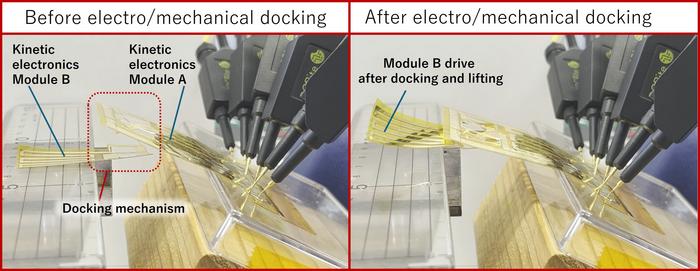
Researchers at Kyushu University in Japan have developed a flexible electronic circuit that can connect itself to another electronic circuit and then disconnect from it. The prototype structure is an important step towards electronic devices that can reconfigure and even repair themselves, and it could have applications in wearable sensors, soft robotics and medical devices.
Most of today’s electronic devices are fixed, or “non-modular”, explains study leader Fumihiro Sassa of Kyushu University’s Department of Electrical and Electronic Engineering. Typically designed for specific tasks or environments, they are not readily adaptable to new ones, and they often cease to function if even a single component in their electronic circuitry fails. This leaves them dependent on human operators or external robotic systems if it becomes necessary to expand their functionality or repair damage.
“This can be a serious limitation inside very small machines, in space equipment, in devices requiring specialized handling, such as wearable chemical sensors, or in systems containing very large numbers of wires and electronic elements,” Sassa explains. “In such cases, in-situ repair can be difficult. The whole system may need to be replaced.”
Connection and disconnection
To overcome this problem, the Kyushu University researchers have been developing what they term “kinetic electronics” modules. These consist of electronic circuits and actuators that deform when an electrical current is applied to them so that they can mechanically and electrically connect to other modules. Before this connection takes place, different modules are separate, but after connection or “docking” takes place, one module can independently deform another when power is supplied through the point that connects them.
In this way, explains Sassa, the circuits can rearrange their own hardware structure. “Such functions have traditionally been used in mechanical systems, such as spacecraft, trains and modular robots, but we have now applied them to an electronic device.”
Sassa and colleagues fabricated their electrothermal bimorph actuators from polypropylene and polyimide films with heater electrodes and electrical circuits formed on them through a two-dimensional top-down process. Because the two polymers expand differently, Sassa explains that Joule heating causes selected actuator sections to bend. “Prescribed sequences of these motions produce docking and undocking and once docked, passive mechanical engagement maintains the connection without continuous power being supplied,” he says. “Undocking requires a separate actuation sequence.”
Towards miniaturization and more intelligent control
The researchers say they are working on miniaturizing their system and looking how to control it more intelligently. In the present study, which is detailed in npj Flexible Electronics, they demonstrated the docking mechanism using a small number of millimetre-scale independent sensors and actuators formed together on the circuit, with motion being controlled in sequence by an external microcontroller. They are now developing photolithographic processes to further decrease the size of these components and have already fabricated actuators smaller than 100 μm using these techniques.
“In a similar way to large-scale integration in conventional electronics, doing this will allow us to integrate very large numbers of these sensing and actuation elements, allowing the electronic circuit to form and change much more complex mechanical structures and functions,” says Sassa.
“We are also interested in so-called distributed control, in which the central controller does not need to specify every movement,” he adds. “Instead, many elements would follow relatively simple local control rules, from which advanced self-reconfiguration and self-organization could emerge.”
Word flower puzzle no. 7
How did you get on?
12 words Warming up nicely
16 words Getting hot, hot, hot
20 words Top dog!
Fancy some more? Check out our puzzles page.
Researchers propose ‘economic Q’ metric for judging fusion power plant viability
Researchers in the US have proposed a new metric to determine the economic viability of future fusion power plants. The measure is similar to one used by fusion researchers to ascertain the output of fusion reactions, which is known as the Q factor.
Nuclear fusion, which powers the stars, involves two light nuclei binding to form a heavier nucleus, releasing huge amounts of energy in the process. Harnessing fusion on Earth using the hydrogen isotopes deuterium and tritium could lead to an environmentally friendly and almost limitless energy source.
In the 1950s, the engineer and physicist John Lawson laid out what became known as the “Lawson criterion” for fusion. It describes the combinations of temperature, plasma density and energy confinement time that can produce net energy from the plasma due to fusion, regardless of its absolute power or volume.
Specifically it calculates a factor known as “plasma Q”, which is the ratio of fusion power produced to the external power required to sustain the plasma, with a Q = 1 meaning break-even.
When it comes to magnetic confinement, in which magnetic fields are used to contain a high-temperature plasma, the Joint European Torus based in Oxfordshire, UK, which ended experiments in 2024, achieved a Q of 0.67 in 1997.
The ITER experimental fusion reactor, which is currently being built in Cadarache, France, aims to have a Q of 10 when fully operational towards the end of the 2030s.
Developments in industry have also sped up in recent years and just last month the Fusion Industry Association released a report finding that private fusion companies raised almost $4.5bn in funding over the past year – a 70% increase over the previous year.
The report discovered that 71% of the 65 companies surveyed expect the first fusion plant to deliver commercial electricity by the 2030s. Others, however, remain unconvinced that fusion will soon be a viable energy source.
With that in mind, researchers are now proposing a framework for understanding what is required to make fusion energy commercially viable in the marketplace.
While the costs of basic experiments can be easily documented, estimating the costs of a fusion reactor is somewhat more challenging.
“It’s challenging to reduce complex scientific and engineering requirements to economic consequences,” says economist Andrew Lo from the Massachusetts Institute of Technology (MIT), who co-authored the new study (J. Fusion Energy 45 49). “But if we don’t do that, we’re not going to get the funding we need to achieve the impact we want.”
A new ‘Q’
The new framework includes 10 parameters that evaluate the economic viability of a fusion energy power plant. Some of these are scientific and physical, dealing with the energy consumed and produced in a given plant.
Other parameters are based on engineering and economics, such as the costs of plant construction, returns from invested capital, the efficiency of converting fusion power into an economic product as well as the durability of components used in the energy conversion.
The “economic Q” is then given as the ratio of capital gained to that expended.
MIT nuclear engineer Dennis Whyte, who also co-authored the study, says that the framework is about what it takes to achieve a net-positive economic return with the economic Q needing to be greater than 1 for basic viability.
Whyte, who was yesterday appointed chief executive of the United Kingdom Atomic Energy Authority, adds that the parameters do not depend on the size of the reactor being built, so any inputs can be scaled to a given project or power output.
“When you’ve got a framework to evaluate it in a quantitative way, it tells you about the literal worth of making a particular design decision,” adds Whyte. “That seems to me at this moment of fusion development absolutely critical, and what we’ve been missing.”
Crystal symmetry controls hydrogen’s quantum tunnelling
The quantum tunnelling of hydrogen atoms plays a central role in many physical, chemical and biological process, but a practical means of controlling it has proved elusive. Researchers from the University of Tokyo, Japan have now demonstrated that the way hydrogen permeates through a material depends on the degree of symmetry in the material’s crystal structure. By controlling this symmetry, scientists could therefore gain control over hydrogen’s ability to tunnel, potentially leading to safer and more efficient media for storing this industrially important clean-burning fuel.
“We found that hydrogen undergoes pronounced quantum tunnelling in a highly symmetric crystal environment, whereas the tunnelling is strongly suppressed when the symmetry is lowered,” explains Katsuyuki Fukutani, who led the research together with colleagues Takahiro Ozawa and Sudhansu Sekhar Das. “This is particularly exciting because it identifies crystal symmetry as a fundamental principle for controlling the quantum behaviour of hydrogen in materials, opening new possibilities for tailoring hydrogen transport.”
A model hydrogen-storage material
The researchers, who work at Tokyo’s Institute of Industrial Science, obtained their results by studying how hydrogen atoms move through a model hydrogen-storage material, vanadium, at low temperatures. To do this, they combined two complementary techniques. The first is called nuclear reaction analysis and it measures the hydrogen’s depth distribution directly with high resolution. The second involves measuring electrical resistance, which sensitively monitors how the hydrogen redistributes itself over time.
These measurements revealed that at temperatures of around 70 K, hydrogen atoms begin to migrate through vanadium’s crystal lattice, hopping between its interstitial spaces. At low hydrogen concentrations, this hopping occurs within a highly symmetric structure known as α-phase vanadium, and the hydrogen atoms easily tunnel between neighbouring lattice sites. At higher hydrogen concentrations, however, vanadium’s crystal lattice distorts, forming a β-phase. Under these conditions, the hydrogen atoms must overcome an energy barrier (of 148 meV in this case) before they can tunnel to neighbouring sites.
Quantum tunnelling or classical thermal activation?
Based on changes to vanadium’s electrical resistance, the researchers were able to calculate the diffusion coefficient of hydrogen over a wide range of temperatures, including those for which quantum tunnelling is important. They then interpreted these results using quantum-mechanical calculations of hydrogen motion, which revealed that the crystal symmetry determines whether hydrogen moves by quantum tunnelling or by classical thermal activation. They found that in the α-phase, hydrogen’s ground states are delocalized over tetrahedral sites thanks to tunnelling. In the β-phase, in contrast, the uniaxial strain produced by the distortion of the crystal lattice leads the quantum states of the hydrogen atoms to localize around certain (Oz) sites in the material.
Hydrogen is the lightest element, so Fukutani says it’s not surprising that it exhibits pronounced quantum behaviour. However, while quantum tunnelling had long been assumed to play an important role in hydrogen diffusion, it was difficult to obtain direct experimental evidence for it because we cannot easily observe hydrogen inside materials using conventional techniques. “We wanted to clarify how hydrogen actually behaves in the quantum regime and identify the factors that control its tunnelling,” he explains.
New possibilities for controlling hydrogen permeation and storage
“Our findings suggest that hydrogen transport can be controlled by tuning quantum tunnelling through crystal symmetry — for example by applying external strain,” he adds. “This capability opens up new possibilities for controlling hydrogen permeation, storage and even catalytic reactions.”
More broadly, Fukutani says the team’s work establishes crystal symmetry as a new design principle for tailoring quantum hydrogen behaviour in functional materials. The Tokyo researchers now plan to extend their work to a wider range of hydrogen storage media, including metal alloys and oxide materials. “Ultimately, we hope to establish a universal framework describing how local atomic structure and crystal symmetry govern the quantum behaviour of hydrogen,” Fukutani tells Physics World.
They report their present work in Nature Communications.
Knowing through uncertainty: probability and the evolution of our cosmos

All scientific inquiry involves some kind of uncertainty, but the uncertainties in cosmology are particularly daunting. As well as being complex and difficult to describe, the systems cosmologists investigate are almost by definition out of reach. In these conditions of uncertainty, how confident can we be in the models we’ve built? How can we come to know how galaxies form, how the universe began or how much dark matter it contains?
In The Random Universe: How Models and Probability Help us Make Sense of the Cosmos, cosmologist and astrophysicist Andrew Jaffe offers a masterful and refreshing take on these questions. As the director of the Centre for Inference and Cosmology at Imperial College London, UK, and a past co-investigator on ESA’s Planck satellite that provided us with so much new information about the cosmos, Jaffe is well-equipped to walk readers through the tools that allow us to learn about the world despite its uncertainties. Anchoring his insights in beautifully narrated episodes from the history of physics, astrophysics and cosmology, he sheds light on how our theories of the universe evolved into our current best cosmological model – which nonetheless still has limitations.
Jaffe is particularly good at recounting how we refined, revised and even replaced some of our assumptions in light of incoming evidence such as the first measurements of stellar distance; the discovery of galaxies beyond our own; and precise measurements of cosmological parameters. Throughout this journey, he engages thoughtfully with a rich philosophical tradition that runs from David Hume in the 18th century through Willard Van Orman Quine, Imre Lakatos and Paul Feyerabend in the 20th.
Bayes’ theorem is important because it tells us how to update our degree of belief in light of new evidence
The book’s main protagonist, though, is the mathematician Thomas Bayes. For Jaffe, Bayesian probability is key to dealing with uncertainty, and even to solving Hume’s notorious problem of induction: how do we justify inferences from a finite set of observations to generalizations that go beyond them? Bayes’ theorem is important, Jaffe argues, because it tells us how to update our degree of belief in light of new evidence. It shows us why and how, even in an uncertain world, “the more observations we make, the surer we become”.
Of course, before we can use probability to deal with uncertainty, we first need a model. As Jaffe puts it, “Absent a model, I can’t assign a probability, and absent a probability, I can’t quantify my uncertainty about the world.” So, what exactly is a model? I found Jaffe’s answer to be one of the most captivating elements of the book. As the title of a subsection of chapter five puts it, “a model is a story about the world”. Without models, Jaffe tells us, our world would be an unexplained series of unrelated events. Models are also what allow us to take a finite set of data and use it to create something new. Without this leap, Jaffe suggests, we cannot learn anything about the world, because “you can’t make sense of an experimental result unless you have some model to interpret it”.
Of course, if the way we interpret data depends on our model, then different people may well obtain different interpretations depending on which model and which prior probability they choose. This charge of subjectivity is a longstanding accusation against Bayesians, but Jaffe offers at least a partial solution: “If you and I agree on the model, we should assign the same probability.” This, Jaffe argues, is where objectivity emerges, writing that “we come to the same conclusions if we start from the same premises”.
Models allow us to understand the world by bridging subjectivity with objectivity, and the personal with the collective
Many contemporary philosophers are at odds with the idealized view of science as an objective and linear enterprise that produces theories from a God’s-eye view. Instead, they strive to portray it as something that is social and human, but reliable nonetheless. Jaffe’s own views seem to align with this endeavour; as he puts it, “the scientific coupling of models and observations is a living, breathing, subjective endeavour, simultaneously collective and personal”. Through their interplay with data, he argues, models allow us to understand the world by bridging subjectivity with objectivity, and the personal with the collective.
Not everyone will agree with Jaffe that Bayesian probability offers a solution to Hume’s problem of induction. Personally, I (or perhaps the hardcore rationalist in me) was not convinced. Nevertheless, I found the book’s thesis – that uncertainty is not a hindrance to knowledge, but an opportunity to learn (and learn more) about the world – simultaneously liberating, humbling and empowering. I recommend The Random Universe to scientists, philosophers and anyone interested in better understanding the role of probability in science; the philosophical problems with how we handle uncertainty; and how our standard cosmological model came to be. I also hope it will encourage more collaborations between philosophers and scientists. There are many questions we can explore further if we work together.
- 2025 Yale University Press, £25hb, 288pp
Physicists extend Hawking’s black hole laws to dynamical objects
The event horizons of black holes that are far from equilibrium can now be described by the first and second laws of thermodynamics thanks to new work by theoretical physicists at Pennsylvania State University in the US. The result augments the work of the late Stephen Hawking and others who showed in the 1970s that these classical concepts have applications in idealized, static black holes.
Black holes are objects so dense that their gravitational pull prevents anything – even light – from escaping them. The “point of no return” of any object falling into a black hole is called the event horizon, and it represents the black hole’s mathematically defined “edge”.
Although black holes can be described using concepts from quantum mechanics and Einstein’s general theory of relativity, some 50 years ago physicists like Hawking and Jacob Bekenstein showed that the equations governing them are also astonishingly similar to the fundamental laws of thermodynamics. “This seminal observation sparked a rethinking of black holes in thermodynamics terms,” explains Abhay Ashtekar, a physicist at Penn State’s Eberly College who led the new study. In particular, Ashtekar says it meant that black holes could be assigned an entropy that is equal to the area of their event horizon.
The problem, he continues, is that technically, these relationships are only valid for black holes in equilibrium – that is, those that are stable and do not change over time. In contrast, real astrophysical black holes are constantly changing: they form, merge and eventually evaporate because of quantum effects.
“In these dynamical objects, event horizons are ‘teleological’, meaning that we need to know how a black hole will behave for all of eternity to be able to define its entropy today,” Ashtekar explains. “This notion of black hole entropy is therefore physically untenable. Indeed, this limitation was already recognized in the 1990s and it has been the elephant in the room since then.”
Extending the laws of thermodynamics
In their new work, Ashtekar and colleagues sought to overcome this limitation by replacing static event horizons with an alternative concept known as dynamical horizon segments. These segments are characterized by the physical properties of a black hole at a given moment in time, and other researchers have employed them in numerical simulations of black hole mergers and gravitational collapse. Indeed, Ashtekar and various colleagues had previously shown that dynamical horizons were a physically admissible replacement for event horizons.
However, Ashtekar says that these earlier studies had not addressed two central questions. These involved defining intensive parameters – analogues of pressure and temperature in ordinary thermodynamics systems such as gases – and defining the energy of a black hole by itself in a highly curved region of space-time at a given instant.
“Our study now shows that Einstein’s equations imply that these dynamical horizons also satisfy equations very similar to the first and second laws of thermodynamics,” Ashtekar tells Physics World. “What is more, the change in thermodynamical quantities of these horizons at any given moment in time are caused directly by fluxes of energy and changes in the angular momentum of the black hole at that instant.”
The researchers’ new calculations show that even when black holes are very far from equilibrium, their evolution defines specific trajectories in the space of different equilibrium states. “This allows us to transport observables from these states to instantaneous non-equilibrium ones,” explains Ashtekar. “Such a procedure cannot be applied to conventional thermodynamics systems; black holes are very special in this regard.”
Event horizons “entirely absent” when quantum effects are included
According to team member Daniel Paraizo, the new work treats the event horizon as a dynamical horizon segment that forms in a gravitational collapse and then evaporates because of quantum effects. Intriguingly, Paraizo says that within this framework, event horizons vanish entirely when quantum effects are included – a fact which, he says, “removes a great deal of confusion currently surrounding the issue of information loss from a black hole, for example”. This same finding, he notes, also supports an idea that Hawking advocated shortly before his death in 2018: the possibility that a “true” event horizon never actually forms.
The Penn State researchers now plan to build on their present work with theories involving both classical and quantum gravity. Team member Jonathan Shu says that such theories may provide a thermodynamic explanation of several puzzling features that have been observed in numerical simulations of black hole mergers. “We have also already extended our results to theories of gravity beyond general relativity,” he reveals. “For quantum gravity, dynamical horizon segments have been successfully deployed in the so-called semi-classical phase of black hole evaporation and work is underway to address still unanswered questions about the final stages of the process using a theory known as loop quantum gravity.”
The researchers report their work in Physical Review Letters. Ashtekar will also be speaking on this subject at Penrose Fest@95, which is due to be held in Oxford, UK in September.
Copyright © 2026 by IOP Publishing Ltd and individual contributors