Key to the quantum industry

As theories go, quantum mechanics has certainly been successful. Despite its many counterintuitive predictions, it has provided an accurate description of the atomic world for more than 80 years. It has also been an essential tool for designing today’s computer chips and hard-disk drives, as well as the lasers used in the fibre-optic communications of the Internet. Now, however, the ability to manipulate the quantum states of individual subatomic particles is allowing us to exploit the strange properties of quantum theory much more directly in information technology.

We are used to thinking of information as being abstract, but in fact all information requires a physical medium for its processing, storage and communication. The basic unit of information – a bit that is either “0” or “1” – can be represented physically by, for example, the current in a circuit or light in an optical fibre. As information is represented by ever smaller physical systems, quantum effects become increasingly important. The ultimate limit comes when bits are represented by the quantum state of a single particle, such as the polarization of a photon.

Applied to information, quantum theory throws up some very odd predictions. These are not only interesting as a test of quantum mechanics, but can also bring us practical applications that are simply impossible with “classical” information technology. For example, a quantum computer would work with bits that can be both “0” and “1” at the same time, allowing it to solve certain mathematical problems – such as factorizing very large numbers – that are virtually intractable using an ordinary computer.

Although practical quantum computers will take many years to develop, one manifestation of quantum information technology is already a reality: quantum cryptography. This ultra-secure way of sending messages is based on the fundamental postulate that measuring a quantum state will, in general, alter it. Thus, if we encode messages in individual quantum states, such as the phase of photons whizzing down an optical fibre, an eavesdropper who tries to intercept the message cannot avoid changing it. We can therefore test if the message has been read before it reaches the intended recipient – something that is impossible using classical signals.

The commercial potential of quantum cryptography has attracted private investment in several start-up companies in the US and Europe. The firm id Quantique, for example, spun out from pioneering research at the University of Geneva; while in the US, commercial developments are led by MagiQ Technologies, based in New York and Massachusetts. Recently a third start-up called SmartQuantum has been established in Brittany, France, and major corporate players such as HP, IBM, Mitsubishi, NEC, NTT and Toshiba all have active quantum-cryptography programmes. With several quantum-cryptography products already on the market, the quantum information industry has arrived.

The key to security

Cryptography is a vital part of today’s computer and communication networks, protecting everything from business e-mails to bank transactions and Internet shopping. Information is generally kept secret using a mathematical formula called an encryption algorithm, together with a secret “key” that the sender uses to scramble a message into a form that cannot be understood by an eavesdropper. The recipient then uses the same key – typically a long binary number – with a decryption algorithm to read the message.

Although modern algorithms such as the Advanced Encryption Standard (AES) are very hard to break without the key, this system suffers from an obvious weakness: the key must be known to both parties. Thus the problem of confidential communication reduces to that of how to distribute these keys securely – the encrypted message itself can then safely be sent along a public channel (figure 1). A common method is to use a trusted courier to transport the key from sender to receiver.
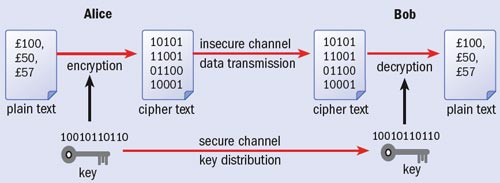
However, any distribution method that relies on humans is vulnerable to the key being revealed voluntarily or under coercion. In contrast, quantum cryptography, or more accurately quantum key distribution (QKD), provides an automated method for distributing secret keys using standard communication fibres. The revolutionary feature of QKD is that it is inherently secure: assuming that the laws of quantum theory are correct, we can prove that the key cannot be obtained by an eavesdropper without the sender and recipient’s knowledge. Furthermore, QKD allows the key to be changed frequently, reducing the threat of key theft or “cryptanalysis”, whereby an eavesdropper analyses patterns in the encrypted messages in order to deduce the secret key.

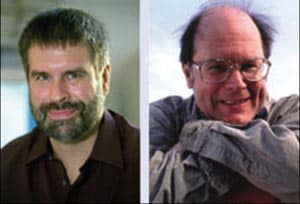
The first method for distributing secret keys encoded in quantum states was proposed in 1984 by theoretical physicists Charles Bennett at IBM and Gilles Brassard at the University of Montreal. In their “BB84” protocol, a bit of information is represented by the polarization state of a single photon – “0” by horizontal and “1” by vertical, for example. The sender (Alice) transmits a string of polarized single photons to the receiver (Bob) and by carrying out a series of quantum measurements and public communications they are able to establish a shared key and to test whether an eavesdropper (Eve) has intercepted any bits of this key en route.

The BB84 protocol allows us not only to test for eavesdropping, but also to guarantee that Alice and Bob can establish a secret key even if Eve has determined some of the bits in their shared binary sequence, using a technique called “privacy amplification”. Imagine, for example, that Eve knows 10% of the key bits shared by Alice and Bob. Being aware of this, Alice and Bob could then publicly agree to add together (using modular arithmetic) each adjacent pair of bits to form a new sequence of half the length. Eve may also do this, but since she will need to know both bits in a pair in order to correctly determine their sum, she will find that she now shares a much lower fraction of the new bit sequence with Alice and Bob.

So much for the principle. In practice, generating the pulses of single photons required for BB84 is not easy. Despite recent progress using single atoms or semiconductor quantum dots to generate single photons (see Physics World February 2003 “Single photons on demand”), most practical QKD systems use weak laser pulses to send the bits that make up the key. This method has an Achilles heel: the laser will sometimes generate pulses containing two or more photons, each of which will be in the same quantum state. As a result, Eve could split off one of these photons and measure it, while leaving the other photons in the pulse undisturbed, thus determining part of the key while remaining undetected. Even worse, by blocking the single-photon pulses and allowing only the multi-photon pulses to travel through to Bob, Eve could determine the entire key.

Until true single-photon sources become available commercially, the most common defence is to strongly attenuate the laser to limit the rate of multi-photon pulses. However, this also means that many pulses contain no photons at all, reducing the rate at which the key can be transmitted. In 2003 a new trick to get round this problem was proposed by Hoi-Kwong Lo at the University of Toronto and Xiang-Bin Wang at the Quantum Computation and Information Project in Tokyo, based on earlier work by Won-Young Hwang at Northwestern University in the US.

Their idea was to intersperse the signal pulses randomly with some “decoy pulses” that are weaker on average and so very rarely contain a multi-photon pulse. If Eve attempts a pulse-splitting attack, she will therefore transmit a lower fraction of the decoy pulses to Bob than the signal pulses. Thus by monitoring the transmission of the decoy and signal pulses separately, Eve’s attack can be detected. This means that stronger laser pulses may be used securely – for instance, last year at Toshiba we demonstrated a 100-fold increase in the rate that keys can be transmitted securely over a 25 km fibre. The decoy-pulse protocol has caused great excitement in the QKD community, with four independent groups having just reported experimental demonstrations of the technique.

Weak laser pulses are not the only way to carry out quantum cryptography. For example, QKD using a true single-photon source has recently been demonstrated at Stanford University, the CNRS in Orsay and Toshiba. Furthermore, in 1991 Artur Ekert, while a PhD student at the University of Oxford, described an alternative to the BB84 protocol that exploits another counterintuitive prediction of quantum mechanics: entanglement. Pairs of entangled photons have quantum states that are strongly correlated, such that measuring one photon affects the measurement of the other. If Alice and Bob each have one of the pair, they can therefore use their measurements to exchange information. This technique has been demonstrated by researchers at the University of Vienna, the Los Alamos National Laboratory and the University of Geneva, and was even used in 2004 to transfer money between Vienna City Hall and an Austrian bank. However, weak-laser QKD is the most mature approach, and the basis of the commercial QKD systems that are now coming on the market.

Practical QKD

Information can be encoded in the quantum state of photons in several different ways. The first laboratory demonstration of QKD by Bennett and Brassard in 1989 over 30 cm of air used the polarization state of photons. However, transmitting photons along an optical fibre can randomize their polarization, so a better approach pioneered by Paul Townsend, formerly of BT Labs in the UK, is to alter the phase of the photon. In this method, weak laser pulses are injected into an interferometer by Alice. By applying different voltages to a “phase modulator” in one arm of the interferometer, Alice can encode bits as a phase difference between the two emergent pulses sent to Bob – for example with 0° representing “0” and 180° representing “1”. Bob then passes the pulses through another interferometer and determines which of his two detectors, corresponding to “0” and “1”, they emerge at (see figure 2).
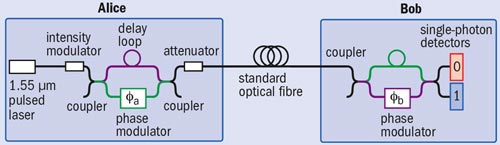
For this scheme to work, we must keep the relative lengths of the interfering paths in Alice and Bob’s interferometers stable to a few tens of nanometres. However, temperature changes of just a fraction of a degree are enough to upset this balance. An ingenious solution to this problem was introduced by the Geneva group in 1997, which led to the first QKD system suitable for use outside the lab. The idea is to send the laser pulses on a round trip from Bob to Alice and then back to Bob so that any changes in the relative arm lengths are cancelled out. A QKD system based on this design is currently available for about €100,000 from the University of Geneva spin-out company id Quantique.

At the Toshiba lab in Cambridge, we have developed an alternative compensation technique that allows pulses to be sent just one way, by sending an unmodulated reference pulse along with each signal pulse. These reference pulses are used as a feedback signal to a device that physically stretches the fibre in one of the two arms of the interferometer to compensate for any temperature-induced changes. In trials with the network operator Verizon, the one-way QKD system was continuously operated for over a month without requiring any manual adjustment.

We can assess the performance of QKD systems by the rate at which secure bits can be exchanged. The faster the secure-bit rate, the more frequently the key can be changed, thus inhibiting cryptanalysis. Typical secure-bit rates for complete QKD systems are in the range 10–50 kbit s–1 for a 20 km fibre link. Although this may seem low compared with the rate data are transferred in optical communications (typically 1–40 Gbit s–1), it is enough for up to 200 AES encryption keys (each of which comprises 256 bits) to be sent per second – sufficient for most cryptographic applications.

The secure-bit rate that can be achieved decreases with the length of the optical link due to the scattering of photons from the fibre. For this reason, the best performance is usually achieved using photons with a wavelength of 1.55 µm, at which standard optical fibre is most transparent. Even so, when the fibres get so long that the signal rate becomes comparable to the rate of false counts in Bob’s photon detector, sending a secure key is no longer possible. For the standard indium gallium arsenide (InGaAs) semiconductor detectors used to detect 1.55 µm photons, this distance is currently about 120 km. Recently the Los Alamos group has used low-noise superconducting detectors to extend secure key distribution to fibres 150 km in length. Significantly, these distances are long enough for almost all the spans found in today’s fibre networks.

Although the risk of cryptanalysis is mitigated by using QKD to frequently refresh the encryption key, it is not eliminated entirely. However, this can be achieved by encrypting the message using a “one-time pad”, which requires a random key that contains the same number of bits as the message. Each bit of the message is then encrypted by adding it to the corresponding bit in the key using modular arithmetic. Provided that the key distribution is unconditionally secure, as it is using QKD, and that the key is never reused, the one-time pad is completely immune to attack. The downside is the length of the key that must be exchanged. QKD bit rates are already sufficient to allow unconditionally secret voice communication using the one-time pad. In the future, higher bit rates will allow this security to be extended to other forms of data.

Today’s secure-bit rates are limited by how often the InGaAs detectors can detect a photon   currently once every 100 ns. Silicon-based photon detectors can operate almost 1000 times faster, but they are only sensitive to shorter-wavelength photons. As the quality of InGaAs detectors improves over the next few years, we can expect their frequency to catch up with that of silicon, leading to QKD bit rates that are orders of magnitude higher. In the interim, there are encouraging results showing that non-linear crystals may be used to shift 1.55 µm photons to shorter wavelengths for which the faster silicon detectors may be used. Higher detection rates have also been demonstrated using superconducting nanowire detectors, and recent advances with detectors based on quantum dots are also encouraging.

Towards a quantum network

One of the first real-life applications of QKD has been to secure fibre links between corporate sites in a city. Companies are increasingly using high-bandwidth optical connections between offices, data centres, server farms and disaster-recovery sites to obtain the speed and convenience of a local area network over a larger geographical area. In the early days of fibre deployment, immunity to “tapping” of sensitive data was often cited as a key advantage of fibre over copper cable. But in fact, eavesdropping on optical fibres can be accomplished by simply introducing a small bend in the fibre to extract a portion of the light; and, in the absence of quantum cryptography, it is almost impossible to detect.

At Toshiba, we have developed a “link encryptor” that can send data at 1 Gb s–1 between corporate sites, combining AES data encryption with secure key distribution using one-way QKD (figure 3). Meanwhile, id Quantique announced that it will install its “Vectis” link encryptor between the two centres of data-hosting company IX Europe in Zurich. In the US, MagiQ Technologies has recently developed its own encrypted link, targeted at government applications including the military, intelligence gathering and homeland security.

An important next step will be extending QKD from single point-to-point links into a “quantum network” for key distribution. Networks allow a company to connect multiple sites securely and to add new sites for an incremental cost. Moreover, they allow the range of QKD to be increased from the length of a single fibre link to any distance covered by the network, and safeguard against outages of individual links by automatically routing traffic around them.

In October 2003 BBN Technologies set up a primitive but pioneering QKD network in Cambridge, Massachusetts, linking their site with Harvard and Boston Universities. The firm showed that it was possible to direct the stream of single photons between different receiving units using an optical switch, and it also introduced the idea of “key relay” along a chain of trusted nodes. Here, each pair of adjacent nodes in the chain stores its own local key. A global key may then be sent from one end of the chain to the other, over any distance, by using the local keys and a one-time pad to encrypt each hop.

A more sophisticated system is currently under development by the European SECOQC consortium, a collaboration of academic and industrial QKD researchers, classical cryptographers and telecoms engineers. It is developing the protocols required for routing, storage and management of keys within a meshed network that could in principle be very large. A trial implementation of the quantum net is planned in 2008 that will allow any two users at several sites across Vienna to establish a shared key.

These QKD networks assume that the intermediate nodes are secure, which is realistic if the network is operated by a single service provider. In the future, however, we can relax this condition using a device called a “quantum repeater”. Quantum repeaters are based on the principle of quantum “teleportation”, whereby a quantum state is transferred from one location to another, in principle over an arbitrary distance, using a pair of entangled particles. Recent developments such as a semiconductor device for generating entangled photon pairs and the teleportation of quantum states between photons and atoms bring the quantum repeater closer to becoming a reality.

Meanwhile, an alternative to using a fibre-optic network to send quantum keys over long distance may be to use free-space links to low-orbit communication satellites. In 2006 a collaboration between researchers at the universities of Vienna, Munich and Bristol implemented a free-space link over 144 km between Tenerife and La Palma.

Selling quantum cryptography

From the first laboratory demonstrations over 30 cm of air to the latest fibre-based systems operating over 100 km, QKD has certainly come a long way in the last two decades. The technology has shrunk into compact units the size of typical network equipment and is fully automated. But despite the technical progress there are significant barriers to the adoption of new cryptographic technologies.

A particular problem for QKD is selling technology based on quantum mechanics to clients who often know little about physics and are used to traditional cryptography. Another hurdle is the lack of a security certification process for the equipment. Users need reassurance not only that QKD is theoretically sound, but also that it has been securely implemented by the vendors. It is encouraging that there are several initiatives under way to establish common security standards for QKD.

As the market for QKD develops, we can expect that the price of equipment will drop significantly. Within 10 years we may see QKD used not only in corporate and government networks, but also in networks serving home users. Optical fibres are already used to deliver television, phone and Internet services to domestic users in several countries. Although current QKD systems are too expensive for such applications, they may become viable if miniaturization to microchip-scale and mass-production lead to the expected price reductions. The days when the products of the quantum-information industry serve every household may not be too distant.

The BB84 protocol
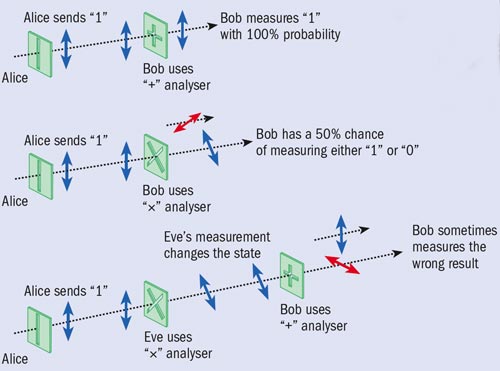
Quantum cryptography is a way of generating a shared secret key that can be used to encrypt and decrypt messages, for example by encoding information in the polarization state of individual photons. In the BB84 protocol, the sender (Alice) transmits photons to the recipient (Bob) in one of four different polarization states: horizontal (H), vertical (V), diagonal (D, 45°) and anti-diagonal (A, –45°). For each photon she sends, Alice randomly selects one of these polarizations, with H or D representing the bit value “0” (red) and V or A representing “1” (blue), depending on the “basis” she chooses. To measure the photons, Bob is equipped with an analyser that can distinguish either between H and V (+) or between A and D (×). He randomly (and independently from Alice) chooses which analyser he will use to measure each photon. If Bob selects the analyser that is compatible with Alice’s choice (top), he will determine the photon’s polarization, and thus the bit value, with certainty. If, on the other hand, Bob measures with the “wrong” analyser (middle), he will obtain a random result.

It seems problematic that half of Bob’s measurements result in a random bit value. However, Alice and Bob have a cunning solution. After Bob’s measurements have taken place, he reveals the sequence of analysers that he used. Alice then tells him which times he used the correct analyser, without revealing the bit that she sent. They can then discard all the measurements for which Bob used the wrong analyser, ensuring that they share the same bit sequence without any errors (in the absence of noise or imperfections).

This post-selection leaves an eavesdropper (Eve) at a disadvantage since she must guess which analyser to use to measure each photon (bottom). Inevitably Eve will sometimes select an analyser that is incompatible with Alice’s choice of polarization, and thus may obtain a result that differs from the bit Alice sent. The key to the secrecy of quantum cryptography is that by making this measurement, Eve inevitably changes the quantum state of the photon. Therefore, when Bob receives the photon, he will sometimes determine an erroneous bit value even when he and Alice used compatible measurements. By examining a small sample of their bit sequence for errors, Alice and Bob can therefore determine whether an eavesdropper was present.

At a Glance: Quantum cryptography

  • The quantum states of individual subatomic particles can be used to encode information, opening up applications in communication and computing
  • The most mature application of quantum theory to information processing is quantum cryptography, with products already on the market
  • Quantum cryptography, also known as quantum key distribution, allows us to send encrypted messages the secrecy of which can be guaranteed by allowing an eavesdropper to be detected
  • Secure messages have been sent over distances in excess of 100 km using quantum cryptography with photons carried by optical fibres
  • The next step will be to establish a “quantum network” that could allow quantum cryptography to cover cities and eventually the globe

More about: Quantum cryptography

Toshiba Research Europe’s quantum-information group
A wiki for quantum-information research
The SECOQC consortium
Once a physicist: Elon Musk


How did your interest in physics develop?

My father was an engineer so I grew up in a technical household, and physics was always what I was good at in school. I was also inspired by Richard Feynman’s lectures and books. When I was 17, I moved from South Africa to Canada, and then to the University of Pennsylvania to study a dual degree in business and physics. It was an unusual combination, and I enjoyed the physics more. I’m not sure I would study business again if I could replay things.

How did your career progress from there?

I was offered a place at Stanford University to do postgraduate research into high-energy-density capacitors. But then the Internet came along, and I wanted a piece of the action. It’s a common story – Google, Yahoo and several other firms were started by people who dropped out of their graduate programmes at Stanford. My first company, Zip2, provided online-publishing software for news organizations. Running a business is definitely stressful, especially managing lots of people. You don’t really have to deal with those issues in physics – you can be an introvert and still do fine.

Do you think you were lucky to sell Zip2 and then PayPal for such large sums of money?

It is unusual to win the lottery twice – from a physicist’s standpoint, it is unlikely that luck was the only factor.

Why did you decide to start up a space firm?

I believe we have a duty to expand to other planets to preserve life against a natural or man-made calamity. With SpaceX, I’m hoping I can do as much as possible to further that goal. We’re starting by developing a satellite launch vehicle that we hope will be 10 times cheaper than the current options. Although our first test launch last year failed, we learned a lot from it. We’re currently getting ready for a second test launch and two more are scheduled for later this year. We’re also developing vehicles that can carry crew – SpaceX won the contract from NASA to design and operate the successor to the Space Shuttle, which is very exciting.

How did you learn enough about rockets to be the lead designer for SpaceX?

I learn fast. But maybe it was my fault that the rocket blew up – that will teach me! What other projects are you working on? When I was in college, I decided that the three areas I would like to work on were the Internet, space exploration and clean energy. As well as SpaceX, I have an electric-car company called Tesla and another company called Solar City that designs and installs solar-power systems.

How has physics helped you in your career?

I think physics gives you a mental framework for problem solving. It also teaches you to be willing to admit you’re wrong.

The costs of replacing Trident

This month the UK parliament will vote on one of the most important defence issues the country has faced: whether or not to replace its Trident nuclear-weapons system when it reaches the end of its lifetime some 20 years from now. Britain, along with the US, Russia, China and France, is one of the original nuclear powers, having first exploded a nuclear bomb in 1953. A decision in favour of replacing Trident would mean the UK retaining its nuclear capability into the 2040s. But there are strong arguments against such a decision, a move that would set in motion the UK’s eventual departure from the nuclear club.

Opponents to renewing Trident tend to base their case on two issues: security, arguing that a replacement system would seriously damage international arms control; and economics, focusing on the huge investment (about £20bn) and annual operating costs (almost £2bn) of replacing Trident that could be better spent on other areas. But there is a third case against replacing Trident: that it could divert people with vital skills, such as physical scientists and engineers, away from more beneficial and urgent technology-based areas like tackling climate change.

The Trident nuclear-weapons system, which was phased in from 1994, has three main components: the launch platform, the missiles and the warheads. The launch platform is made up of four nuclear-powered Vanguard-class submarines, each of which can carry up to 16 Trident ballistic missiles. A single missile is allowed to carry up to three warheads, each packing a punch of about 100 kilotonnes or eight times the destructive power of the Hiroshima bomb. The UK’s stockpile of nuclear warheads is currently a little under 200. Of the current system, the submarines and warheads are British but the missiles are leased from the US, which also uses submarine-based Trident missiles as part of its own nuclear capability.

The government maintains that a decision about replacing Trident needs to be taken now because the submarines that currently carry the weapons will start reaching the end of their serviceable lives from the early 2020s, and because we need enough time to design and build a successor. In its White Paper on a Trident replacement published in December last year, the government proposes that a new fleet of submarines should be designed and built (at the BAE Systems shipyards in Barrow, Cumbria) and that these would carry the US-leased Trident missiles mounted with warheads maintained by the Atomic Weapons Establishment (AWE) at Aldermaston in Berkshire.

The problem is that in order to both maintain the current Trident system and deliver a replacement, the nuclear-weapons sector – which includes the AWE, much of the UK submarine industry and a number of smaller companies – would need to recruit a large number of engineers and physical scientists in order to replenish the current aging workforce and to meet the demands of expansion. Several thousand such people are likely to be required.

Physicists would be especially important for work on the nuclear-warhead programmes at AWE and also for developing the nuclear reactors to power the new submarines, which very likely would be built by Rolls Royce. Indeed, AWE has already started a major recruitment drive as it installs a new laser facility, supercomputer and hydrodynamics laboratory. Many, not least the Defence Committee of the House of Commons, have criticized the decision to start building these new facilities in advance of a parliamentary verdict on a Trident replacement.

Supply and demand

Government ministers and industry chiefs have long been concerned about whether enough physical scientists and engineers are being trained in order to support UK industry in general. For example, there is a major concern in the nuclear and radiological sector – both military and civilian – about the rapidly growing decommissioning workload. Nine nuclear power stations are already being or are about to be decommissioned, while seven more are planned to close over the next 11 years. In addition, four nuclear-powered Swiftsure-class submarines are being (or are about to be) retired.

In 2002 a report from the government’s Department for Trade and Industry (DTI) sounded the alarm over this situation, pointing out that the workforce was aging, that industry was finding it hard to recruit new staff and that there were already skills shortages in some key areas. The report estimated that the nuclear and radiological sector needed to recruit about 50,000 new staff over the following 15 years just to deal with the planned workload. Since then, the government has opened the door to a new generation of nuclear power stations – perhaps six or more – based on a design not yet commissioned anywhere in the world. And now we have the impending decision on Trident’s replacement. This is an awful lot of new staff to recruit over quite a short time period, and will lead to significant competition between the civil and military industries for new recruits.

Meanwhile, other fields are also clamouring for physical scientists. The urgent threat of climate change, for instance, has triggered a range of technological initiatives to assist in the transition to a low-carbon economy. In addition to new nuclear power stations, the UK government is pushing for a rapid expansion of the renewable-energy sector – with a 2004 DTI report projecting a workforce expansion of as much as 27,000 by 2020. In addition, other technologies such as carbon capture and storage, and hydrogen-powered fuel cells are also being strongly encouraged. Physicists are in demand in all these areas, not least to develop efficient solar photovoltaic cells.

But there are serious doubts about whether there are enough new physical scientists and engineers coming up through the ranks to supply this demand. For example, the number of UK pupils studying A-level physics fell by 34% between 1991 and 2004, which led to a 26% drop in the numbers of UK students taking degrees in the physical sciences and engineering. Although the number of physics undergraduates is now stabilizing, the problem is exacerbated by the closure of 18 university physics departments in the last 10 years. A further restriction for the nuclear industry is that, for obvious security reasons, some jobs are only open to UK citizens. Indeed, the government has recently decided to put foreign postgraduates studying nuclear physics in the UK through tough new security checks to prevent them gaining knowledge that could be used in the proliferation of nuclear weapons.

Unhealthy competition

It is clear that if Trident is replaced – a decision that seems likely – we will have a large and increasing demand for physical scientists and engineers yet falling numbers qualifying in these disciplines. Competition between sectors will be inevitable. Some people will argue that this is healthy, but it will not be so welcome if staff shortages delay the replacement project and lead to spiralling costs. Moreover, such competition could lead to skills shortages that slow our technological response to climate change. Global warming is such a major, scientifically well-established threat and the switch to a low-carbon economy so urgent that it would be foolish indeed to compromise this for the sake of a new nuclear-weapons system that even former defence ministers are not convinced would contribute to UK and global security.

The government, in conjunction with industry, has recently begun reorganizing a number of science and technology teaching programmes to make them more effective with aim of expanding the “skills base”. But given the figures involved, it really is a tall order to expect that such efforts will be enough for all these major technological programmes to happen together. There is also a further potential problem with this approach: some young people could be deterred from studying the physical sciences because of the continued close association between these subjects and unsavoury military projects such as the development of nuclear warheads, which are in essence weapons of mass destruction. For example, a recent survey of young people’s attitudes towards a career in science carried out by the Nestlé Social Research Programme revealed that girls were just as interested as boys, but that girls were rather more likely to be put off by ethical concerns.

Many have argued that a decision to replace Trident – at a time when the UK is safer from large-scale military attack than at any period in its history – would be misguided. Worse, that it would seriously undermine global efforts to convince other nations not to go down the road to nuclear weapons. Once the enormous price tag is factored in – the cost of replacing Trident could, for example, more than completely pay for all of the UK’s 16 million badly insulated homes to be raised to the latest energy-efficiency standards – the argument to retain a nuclear-weapons system becomes even more suspect. Add to that the shortage of physical scientists and engineers, at a time when they are so urgently needed in many other areas such as tackling climate change, and the case for replacing Trident becomes completely untenable.

The Trident solution

Life is far from simple in the post-Cold War world. The neat US-Soviet divide is long gone, having been replaced by a more complex geopolitical reality in which countries like North Korea and Iran have fledgling nuclear programmes. So what should a country like the UK do about its nuclear weapons? The answer for the British government is simple. Its view is that as no-one knows what the world will be like politically in 30 years’ time, the UK needs to keep an independent nuclear deterrent as an “insurance policy” against the uncertainties and risks of the future. That argument makes sense, but it is not clear why this means we need to replace the UK’s Trident nuclear-weapons system, as the government recommended in a White Paper last year.

Brought on-stream in phases since 1994, the Trident system consists of four nuclear-powered Vanguard submarines at least one of which is on patrol at any given time. Each vessel can carry up to 16 Trident ballistic missiles and each missile can carry up to three nuclear warheads. The government wants to build a new fleet of four submarines to replace the Vanguard vessels, which the Ministry of Defence says will reach the end of their lives by the early 2020s. According to the government, we need to decide now whether to replace Trident because it will take at least 15 years to design and build a successor. It estimates that building four new submarines, replacing or refurbishing the warheads and paying for the related infrastructure will cost a total of £15–20bn.

The House of Commons will be given the chance to vote on the matter, probably some time later this month. The problem is that no-one is really sure of the true costs, much of which are shrouded in secrecy by the military. MPs are therefore being asked to vote for a replacement system that has not been fully costed. It is not even clear if the UK has enough skilled scientists and engineers at places like the Atomic Weapons Establishment to fulfil the project, which could lead to delays and cost overruns (see “The costs of replacing Trident”).

A much more sensible way forward would be to refurbish the Vanguard submarines rather than replace them altogether. The US physicist Richard Garwin – a long-time adviser to the American government on nuclear weapons – has argued that it would be technically simple to extend the submarines’ life so that they last for 45 years rather than the estimated 25 or 30 years. Indeed, the US has extended the service lives of its Trident-carrying submarines and it seems odd that the UK cannot do the same. After all, the Vanguard submarines are already subject to a continuous maintenance programme. Appearing before the House of Commons defence select committee earlier this year, Garwin estimated that refurbishment would save the UK up to £200m a year – and give Britain time to consider what sort of nuclear arms it needs, if any at all. He is rightly sceptical of the military’s view that the vessels will wear out within 25 years, pointing out that America’s B52 planes, for example, are still in service even though the US government originally claimed that they would not last much beyond 1970 because of problems like metal fatigue.

Given the political make-up of the House of Commons, it seems likely that a majority of MPs will vote to build a replacement. A better solution, however, would be for MPs to vote against the proposals, which would give us more time to consider the refurbishment option.

Microscope “fingerprints” atoms

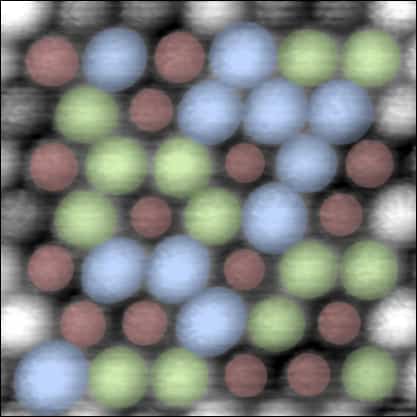
The AFM – invented some 20 years ago – is the best eye scientists have for examining atoms on the surfaces of both insulators and conductors. In the most refined “dynamic” mode a tiny, vibrating diamond probe is passed over a material that monitors varying chemical forces through changes in resonant frequency. These varying forces then allow scientists to produce a 3D, topographic map of the surface. But although this technique is adept at distinguishing different atoms, until now it has been unable to divulge their actual chemical identity, making it difficult to understand atomic structure.

Now Óscar Custance from Osaka University in Japan together with colleagues from Spain and the Czech Republic has shown that AFMs can indeed ascertain chemical identity if one already knows the basic composition of a material. This information gives the relative concentrations of atoms on a surface, which can then be correlated with the AFM’s normal topographic map to deduce which atoms lie where.

The key challenge with this approach, however, is that the attractive chemical forces responsible for the topographic map are heavily dependent on the quality of the probe’s tip – put simply, there is no way to give atomic species a “fingerprint” that remains consistent between measurements. Custance’s team got over this hurdle by inventing a sensitive calibration method that begins by taking detailed readings of how the force on the tip varies with distance for different atoms, amassing numerous force-distance curves. The physicists then pinpoint the values of maximum attraction on each curve and compare them to get relative values for each atomic species.

Because relative values have no dependence on external factors such as the probe’s tip, they can reliably serve as atomic fingerprints for characterizing the surfaces of different materials. “The capability of identifying atoms at surfaces could multiply the already outstanding possibilities that [dynamic AFM] offers,” said Custance.

Custance also told Physics Web that since publication they have even been able to manipulate single atoms, a technique that has been achieved before but without the added ability to identify several species. This opens up applications in fields including semiconductors, allowing engineers to manufacture better performing electronic devices by selectively doping nanoscale transistors.

Quantized magnetoresistance observed for the first time

Ballistic electrons move through very thin wires much like a bullet through the barrel of a gun – they are constrained to move in one direction and encounter little or no resistance along the way. If the wire is only a few atoms thick, its ability to conduct electrons – its conductance – becomes quantized as an integer (N) multiple of the conductance of a single electron. This is because the energies of the electrons in the wire are constrained to narrow “bands” and N corresponds to the number of bands that cross the Fermi energy level, where conduction occurs.

In 2005, Evgeny Tsymbal and colleagues at the University of Nebraska predicted that the number N could be changed by applying a magnetic field to a very thin wire made out of a metallic magnet. In such materials the conduction electrons are magnetic and an applied field should shift the position of the energy bands relative to the Fermi energy – thereby changing N. Since the conductance of the wire is proportional to N, the researchers predicted that a stepwise change in conductance (and also resistance) should be seen. They dubbed this effect “ballistic anisotropic magnetoresistance” (BAMR) – “anisotropic” because the effect is dependent upon the relative orientation of the magnetic field and the direction of conduction.

Now, Bernard Doudin at the Institute of the Physics and Chemistry of Materials in Strasbourg and colleagues at the University of Nebraska have seen BAMR in a number of different atomic-scale wires made from the magnetic metal cobalt. In one sample, the researchers measured a change in conductance consistent with N going from 6 to 7 as the field direction was changed. N was also observed to jump by twos and fours in other samples. The researchers say that this range of responses is related to atomic-scale differences in the structures of the nanowire samples and can be explained by Tsymbal’s BAMR theory.

BAMR could someday be exploited to create extremely small heads for reading data stored on magnetic disks and other media. In theory, this could push magnetic storage densities to the atomic limit. However, Doudin warns that the effect’s sensitivity to structural differences would mean that devices would have to be fabricated with atomic-scale accuracy – something that cannot be done today.

European Research Council launched today

The ERC is part of the European Union’s massive €54.6bn Seventh Framework programme, which is designed to boost Europe’s competitiveness and increase economic growth. Although the bulk of the money will be spent on large multinational projects in areas such as nanotechnology, IT and energy, this is the first time that Framework cash is being given directly to individual scientists working alone or in small teams.

Based in Brussels, the ERC will provide “starting grants” for postdocs and other young scientists who want to set up their own research groups. These will be worth up to €2m over five years. The ERC is also offering “advanced grants” to established researchers of any age, worth up to €2.5m over five years.

Grants will be awarded in all areas of science and selected on the basis of peer review, with scientific excellence being the sole criterion for selection. Scientists from any country can apply for the money provided that they carry out the research at a university or institute in Europe. They will be able to start applying for money from 19 March this year, with the deadline for the first call for proposals being 25 April.

Today’s launch conference is being attended by some 300 scientists from some 30 countries and hosted by the German Research Council. Apart from Merkel, other dignitaries in Berlin include Europe Union research commissioner Janez Potočnik, the British government’s chief scientific adviser David King, and CERN boss Robert Aymar.

Limits set on size of dark matter clumps

When physicists look up at the sky, they notice that there’s not nearly enough visible matter to hold the universe together assuming our understanding of gravity is correct – in fact, up to 95% appears to be missing. That is why many advocate the idea of dark matter, an elusive substance that could account for the “missing” mass, but that is invisible to modern telescopes because it doesn’t interact strongly with light.

According to the most popular model, dark matter could either be an accumulation of as-yet unseen heavy particles (“WIMPs”, or weakly interacting massive particles), or large clumps of dense ordinary matter that do not emit large amounts of observable radiation (“MCOs”, or massive compact objects) – or even a mixture of both.

Now Benton Metcalf from the Max Planck Institute for Astrophysics in Germany and Joseph Silk from the University of Oxford in the UK have attempted to see just how large these MCOs can be. The physicists analysed the light from supernovae so distant that the light took up to five billion years to get here. If an MCO had strayed through the path of one of these light beams, the light would be measurably dispersed by the MCO’s gravitational field in an effect known as “gravitational lensing”.

Because of the huge time lapse, the chances of a large MCO straying through would have been fairly high. But despite data hoarded from almost 300 supernovae, the physicists could find no dispersion caused by MCOs larger than one-hundredth the mass of the Sun, implying there is an 89% certainty they do not exist at all. Moreover, they claim that MCOs larger than one-tenth the mass of the Earth can be confidently “eliminated” as the sole constituent of dark matter.

This news might come as a shock to some cosmologists who had been considering faint stars, neutron stars and black holes as significant constituents of dark matter. Instead, Metcalf and Silk suggest that dark matter is more likely made of WIMPs.

“Chemical origami” shrinks 2D discs into 3D objects

It’s quite easy to see how simple 3D objects could be created using the principle. For example, if the solution were only applied to the edges, only they would shrink when heated, and the disc would form a bowl-shaped object. But more complex “chemical origami” would need an intricate application pattern, and it is difficult to predict 2D patterns that will accurately translate into the 3D objects desired.

The problem is that surfaces in 3D do not follow the same “Euclidean” geometry as those in 2D. In non-Euclidean geometry, the angles of a triangle do not add to 180°, and parallel lines are not straight but curved. This is why, for example, it is impossible to draw a map of the Earth on a flat sheet of paper without compressing the polar regions – in other words, the grid formed by the lines of latitude and longitude has squares that become distorted in size. What engineers would be keen to do, however, is the opposite: design a structure as a grid on a flat 2D object and then “activate” the third dimension by giving each grid square the right amount of a certain stimulus.

Eran Sharon and colleagues from the Hebrew University of Jerusalem have now done just that by calculating a “metric” – a tensor that characterizes how local distances ought to vary over a surface when activated. Using this metric as a blueprint, the physicists applied the monomer solution N-isopropylacrylamide (i.e. the stimulus) in varying spatial concentration over the surface of the disc. When the disc was then heated over 33 °C, the regions of higher concentration shrunk more (in other words, local distance was reduced) and hence created deeper bends under the resultant stress.

Sharon’s team created a range of structures varying in complexity, from slightly wavy crisp-like objects to those that look like a sombrero. Randall Kamien, a physicist from the University of Pennsylvania, told Physics Web that the technique could be used in the engineering of prototypes. “You could imagine a printer that prints a metric into a flat sheet, which you heat, and it forms the desired 3D object,” he said.

Islamic ‘quasicrystals’ predate Penrose tiles

Girih tiles

Islamic architects and mathematicians were creating quasi-crystalline patterns some 500 years before similar patterns were described in the West, claim two physicists in the US. Peter J Lu of Harvard University and Paul Steinhardt of Princeton University say that sets of special tiles developed around the 13th century allowed artisans to use complex mathematics to create the fantastic geometric patterns that adorn mosques, palaces and other buildings in the Muslim world. These patterns include “nearly perfect” Penrose patterns, which the researchers claim are similar to the first quasicrystals described in 1974 by the British mathematical physicist Roger Penrose (Science 315 1106).

Quasicrystals are patterns that fill all of space, but do not have the translational symmetry that is characteristic of true crystals. In two dimensions this means that sliding an exact copy of the pattern over itself will never produce an exact match (but rotating the copy will often produce a match). They were first described by Penrose in the guise of the famous Penrose tiles. About ten years later Danny Schechtman at Israel’s Technion University showed that the positions of atoms in a metallic alloy had a quasi-crystalline structure. Since then, hundreds of different quasicrystals have been discovered in nature

Penrose tiling is very reminiscent of “girih” – the elaborate patterns used in Islamic architecture. While travelling in Uzbekistan, Lu noticed motifs with 10-fold rotational symmetry, which is a hallmark of some Penrose tiling. This inspired him to search through thousands of photographs of Islamic patterns to try to find a quasi-crystalline pattern – and this led him to a wall of the Darb-i Imam shrine in Iran, built in 1453.

Although Lu describes the Darb-i Imam pattern as a “nearly-perfect” Penrose tiling, he told Physics Web that the defects could be removed by “flipping a few tiles”. He believes that the pattern’s designer had perfection in mind, but the pattern may have been distorted during construction or repair.

Archway from the Darb-i Imam shrine with two overlapping girih patterns

Creating a quasi-crystalline pattern would have required the application of a complex set of mathematical rules, seemingly beyond the grasp of the artisans that created the tiling. Lu says that Islamic mathematicians embodied their knowledge of quasicrystals into a set of five girih tiles of different shapes including a hexagon, bowtie and rhombus. Each tile is decorated with several lines, and when the tiles are laid edge-to-edge the lines connect to form a continuous pattern – something that Lu believes could be done by a worker with little mathematical training.

The researchers used different combinations of girih tiles to create a wide range of complex patterns including the Darb-i Imam pattern. They claim that the outlines of the five tiles can be seen in a 15th century scroll now held in a museum in Istanbul. The researchers also claim that the scroll and the Darb-i Imam shrine bear examples of how the tiles can be used to perform a “self-similarity transformation” to create overlapping patterns at different length scales – another example of how the tiles embody highly sophisticated mathematics.

This is not the first time that a link between girih and Penrose tiling has been made. In 1992 the Danish crystallographer Emil Makovicky published a claim that a pattern found elsewhere in Iran was Penrose tiling with several defects. However until Lu and Steinhardt’s work, scholars had believed that the creation of such patterns was accidental.

Copyright © 2026 by IOP Publishing Ltd and individual contributors