


Seeing with electrons

Electronic eyes

How many students are told, perhaps during their first science lessons at school, that atoms are too small to see? Indeed, with typical diameters of 10-10 m, atoms were for a long time considered articles of faith by many scientists. We cannot see atoms, we are later taught, because diffraction places a fundamental limit on the resolution of an image. Roughly speaking, we cannot see anything smaller than the wavelength of the light used to produce the image. And since the wavelength of visible light is some 10,000 times larger than the typical distance between two atoms, we cannot see individual atoms.

But other forms of electromagnetic radiation have much shorter wavelengths than visible light. The X-rays used in crystallography, for example, have wavelengths of less than a nanometre. The problem is that it is extremely difficult to focus X-rays. Luckily, quantum mechanics provides an alternative way to view the microscopic world: subatomic particles.

Quantum mechanics dictates that all particles have a de Broglie wavelength of λ = h/p, where h is Planck’s constant and p is the momentum of the particle. For example, an electron that has been accelerated to 0.78 times the speed of light has a de Broglie wavelength of 2 pm (2 × 10-12 m), which is about 100 times smaller than the typical interatomic distance in a solid. Moreover, because electrons are charged they can be deflected by electric and magnetic fields.

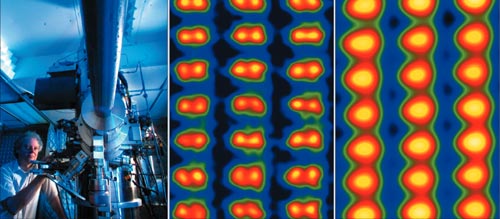
By combining such electromagnetic “lenses” with an electron gun, and adding some sort of electron-detection system, we have an electron microscope. For the last 70 years these instruments have provided researchers across numerous disciplines with valuable and often beautiful images of the ultra-small. Today, one of the world’s most powerful microscopes is capable of resolving individual atomic columns in materials such as silicon (see figure 1). This particular microscope, which is over 10 years old, was able to achieve this unprecedented level of resolution (about 78 pm) thanks to the commercial availability of special components known as “aberration correctors”.

Adding an aberration corrector to a microscope is like fitting it with a pair of glasses, allowing microscopes to see things that they could not see before. This has revolutionized the study of material properties. For example, being able to detect defects in the atomic arrangement in crystals can mean the difference between a microelectronic device working or not working. And the ability to “see” the precise atomic arrangement in materials is crucial for nanotechnology, in which devices might be constructed from just a few atoms.

Microscopes in focus

Electron microscopes come in a variety of flavours. The first to emerge was the transmission electron microscope, which was invented in 1933 by Max Knoll and Ernst Ruska at the Technical College in Berlin. The transmission electron microscope is the electronic cousin of the transmission light microscope: a beam of electrons passes through a thin sample followed by a series of lenses, forming a highly magnified image of the sample on a screen. Knoll and Ruska found that they could focus their electron beam with a magnetic lens that was produced by sending the beam through a current-carrying coil. Modern transmission electron microscopes usually consist of a beam column that is about 2.5 m tall with a diameter of about 30 cm, and they are able to achieve a resolution of about 0.2 nm. The addition of aberration correctors, however, has more than doubled this performance.
Perhaps the most ubiquitous electron microscope is the scanning electron microscope, which was pioneered in the late 1940s by Charles Oatley and co-workers at Cambridge University. In these microscopes the lenses are placed before the sample, allowing electrons to be focused onto a small spot that is then scanned across the surface to build up a 2D image. (The beam electrons can also ionize atoms that then decay and emit characteristic X-rays, therefore enabling composition analysis.)

The ability of the scanning electron microscope to image bulk samples makes it extremely versatile. Whereas the resolution of the transmission electron microscope is limited by the wavelength of the electrons and the quality of its lenses, the resolution of the scanning variety is limited by the relatively large interaction region between the beam and the sample. However, transmission electron microscopes are capable of studying defects in crystals at the atomic scale.

A hybrid of these two instruments is the scanning transmission electron microscope (STEM), developed in 1970 by Albert Crewe at the University of Chicago. By scanning a focused electron beam that passes through a thin sample with little spreading, the STEM has excellent local chemical-analysis capabilities like the scanning electron microscope because only a small part of the sample is illuminated by the small focused spot. And like transmission microscopes, it also has good enough spatial resolution to produce images of atoms.

Despite all this development, electron microscopes were not, in fact, the first instruments to “see” atoms. Erwin Müller and co-workers at Penn State University achieved that breakthrough in 1955 using the field ion microscope. In this device, a large electric field is applied to a sharp metal tip in a low pressure gas such that the gas atoms arriving at the tip are ionized and then accelerated away until they hit a screen. Because this process is more likely to occur at certain places on the surface of the tip, such as at steps in the atomic structure, the resulting image represents the underlying atomic structure of the sample.

A more versatile instrument for imaging atoms on surfaces was the scanning tunnelling microscope (STM), invented by Gerd Binnig and Heinrich Rohrer at IBM Research in Zurich in 1982. Although the STM is an electron microscope, it does not depend on an electron beam in a vacuum like the transmission or scanning electron microscope. Instead, it relies on the quantum-mechanical tunnelling of electrons between a sharpened tip and a conducting surface. The number of electrons that can tunnel through this gap is extremely sensitive to its width, allowing very high-resolution images of the atomic “corrugations” on the sample surface to be formed. The STM has also spawned a range of scanning probe “bench-top” microscopes such as the atomic force microscope and the magnetic force microscope. Binnig, Rohrer and Ruska shared the 1986 Nobel Prize for Physics for the development of these devices.

Electromagnetic limits

The goal of electron microscopy has long been to reach a resolution of one ångström (1 Å or 0.1 nm). Although this may seem a somewhat arbitrary figure, a transmission microscope capable of resolving 1 Å is able to reveal most interatomic spacings of interest in a crystal. So why has it taken almost seven decades of research to reach a resolution that is still 50 times worse than the fundamental limit imposed by the de Broglie wavelength?

The answer is diffraction: the Rayleigh criterion states that the resolving power of a microscope with a circular lens aperture is d = 1.22λ/θ, where λ is the wavelength and θ is the angle subtended by the aperture as seen by the sample. In order to achieve a resolution of 78 pm using electrons with a wavelength of 2 pm, the aperture of the lens that controls the width of the beam must therefore subtend an angle of more than 1.8 ° at the sample.

Since the typical focal length of an electron lens is 2 mm, the width of the beam must be just 62 μm. And for accurate focusing, the lens needs to shape the wavefront over this distance with a precision better than one quarter of the wavelength (i.e. 0.5 pm). In units that are slightly easier to comprehend, this is equivalent to engineering a surface the width of the US with no variations in height greater than 3 cm!

The challenge appears even more difficult when you consider that the only tool available to shape the electron beam is a magnetic or electric field. Unlike a glass lens, which we can grind and polish as desired, the shape of a lens in an electron microscope is dictated by Maxwell’s equations. This prevents us from making a field with precisely the right shape and results in aberrations that limit the performance of the microscope. Indeed, soon after the invention of the transmission electron microscope, the German Otto Scherzer showed that a perfect, time-invariant, circularly symmetric lens can never be formed by an electric or magnetic field in free space: there will always be inherent spherical aberration.
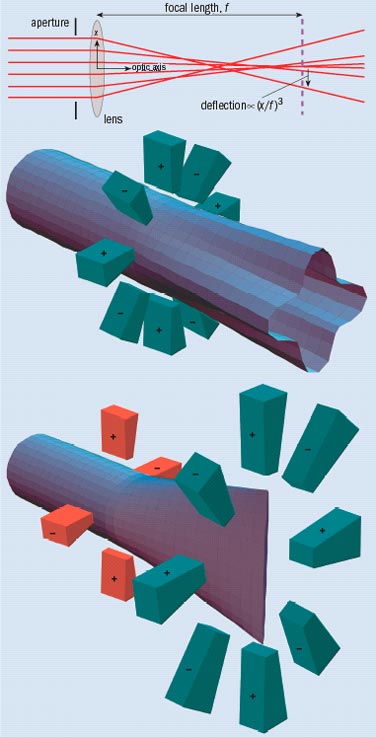
The term spherical aberration was first applied in light optics and arises from the blurring that is seen when lenses or mirrors with spherical surfaces are used. In an electron lens, spherical aberration causes rays at large angles to come to a premature focus (figure 2). The resulting beam therefore has a “waist” that, if it were imaged on a screen, would form a blurry disc. Spherical aberration is a third-order effect, which means that angular deflection of a ray with respect to the optic axis depends on the cube of the angle.

Room for improvement

In his famous lecture “There’s plenty of room at the bottom” in 1959, Richard Feynman devoted some time to our need for better electron microscopes. Realizing that round electron lenses always suffer from spherical aberration, he asked a simple question: why must the lenses be round? The use of non-circularly symmetric lenses has been the key to correcting spherical aberration in the electron microscope. Indeed, Scherzer had already realized in the 1940s that the necessary third-order correction could be provided using a combination of octupole and quadrupole fields.

An octupole has eight alternating poles: positive and negative potentials in the case of an electrostatic octupole, and north and south poles in the case of a magnetic octupole (figure 2). The resulting field lines have a profile with fourfold rotational symmetry, but most importantly the field strength increases as the cube of the distance from the centre of the octupole. As a result, electrons are deflected away from the beam axis in two perpendicular directions but towards it in the directions in between, therefore adding to the existing spherical aberration.

This can be corrected by placing a quadrupole before the octupole. A quadrupole provides a first-order deflection that converges in one direction and diverges along another, which means that it can stretch a round beam into a “line crossover”. If this line matches up with one of the divergent axes of the octupole, then we will get the desired third-order correction in that direction. But we still need to provide the third-order correction in the other perpendicular direction, which is performed by using a second quadrupole-octupole configuration rotated at 90 ° to the first. This combination of lenses actually leaves the round beam looking a bit square, but this can be taken care of using a third octupole.

Two small companies – Nion near Seattle in the US and CEOS in Heidelberg, Germany – are currently the market leaders in spherical-aberration correctors. Indeed, the image in figure 1 is possible thanks to a Nion device based on three octupoles and four quadrupoles.
Nion was founded in 1997 by Ondrej Krivanek and Niklas Dellby, building on research carried out while they were researchers at Cambridge University in the UK. So far, the company has concentrated on retrofitting existing STEM instruments with aberration correctors based on a design originally developed by Crewe and co-workers. However, it is currently testing an entirely new STEM instrument in which a cutting-edge aberration corrector comes as standard.

CEOS, which was founded in 1996 by Maximilian Haider and Joachim Zach, has built on substantial prior experience with aberration correctors, particularly on the work of Harald Rose of the University of Technology in Darmstadt. The company has concentrated on supplying sextupole-based correctors to existing TEM manufacturers, most of which now offer aberration correctors with their top-end microscopes.

The correctors developed by Nion and CEOS have increased the resolution of electron microscopes from about 0.2 nm to better than 0.1 nm over the past decade. However, given that Scherzer derived the principle of the multipole correctors in the 1940s, you may wonder why it took so long to achieve this. Once again, the reason lies in the precision required to shape the electron beam correctly.

If the octupoles that generate the negative spherical aberration are not perfectly aligned, large parasitic aberrations will arise that may overwhelm any benefits from the corrector. The fields must be aligned better than 0.1 μm, which is well beyond the mechanical tolerances that can be maintained over the length of a corrector (which is typically 10-20 cm). This problem was recognized from the outset by both CEOS and Nion, and the solution has been to add extra multipole fields such as dipoles in order to steer the beam accurately through the corrector. Indeed, the Nion quadrupole/octupole corrector discussed earlier employs no less than 33 separate windings and power supplies!

You can imagine the horror of a microscope user if they were confronted with a further 33 knobs on their console, each of which had to be precisely adjusted in order to achieve a high-resolution image. The key to making this technology usable has been the development of desktop computers powerful enough to correct the parasitic aberrations automatically, much like the use of adaptive optics in astronomy. Indeed, given that the electron microscope itself has been key in developing the electronic devices leading to this computing power, this is a real case of technologies in a symbiotic relationship.

At a Glance: Electron microscopy

  • The electron microscope was invented in 1933 and is based on the principle that electrons have a wavelength that is inversely proportional to their momentum
  • There are two basic types: transmission electron microscopes and scanning electron microscopes, plus a hybrid of the two
  • The lenses in an electron microscope are provided by electromagnetic fields, but they suffer from spherical aberration
  • The addition of octupole and quadrupole corrector fields has improved the resolution of the electron microscope to better than 0.1 nm in the last decade
  • The next step is to correct for chromatic aberration, after which the resolution of the microscope will probably be limited by the size of the atom itself

Resolution in sight

After decades of work, aberration correctors are now enabling researchers to routinely break the 1 Å resolution barrier. But what are we going to use all this microscopy power for, and is there anything to actually see at the sub-ångström scale? The answer is an overwhelming “yes”, as can be illustrated by several recent applications.

One area in which aberration-corrected transmission electron microscopes (TEM and STEM) have had an enormous impact is in determining the structure of defects and interfaces in crystals. Transmission microscopes provide images of a projection of the sample, which means that the atoms may appear to be closer together than they really are. For many years, for example, it was only possible to image the individual atomic columns in silicon with the crystal aligned along the [100] direction, which is parallel to an edge of its cubic-unit cell. Steady improvements in resolution meant that by the 1990s the columns in the [110] direction (which is at 45 ° to the [100] direction) could be resolved so that defects, such as grain boundaries, aligned in this direction could be studied. The latest aberration-corrected STEMs can now resolve all the atomic columns in a silicon crystal at complex orientations such as [112], where the intercolumn spacing can be as small as 78 pm.

The correction of spherical aberration also helps microscopists image lighter elements such as oxygen and carbon, which do not scatter electrons as strongly. This is because conventional high-resolution TEM relies predominantly on phase contrast, whereby an image is built from changes in the phase of electrons as they pass through a sample. In order to “see” this phase, which is another manifestation of the wave nature of electrons, the lens of the TEM must also introduce a phase change to the scattered electrons. Being able to create negative spherical aberration in a lens, for example, allows us to increase the phase contrast and therefore the visibility of the atoms.

Aberration correction also increases the visibility of individual atoms, rather than the projections of atomic columns in a crystal. For example, a common imaging mode in an STEM is to plot the number of high-angle electron-scattering events as a function of probe position. These processes occur mainly via interactions with the nuclei of the sample atoms, which makes them very sensitive to the atomic number of the atoms.

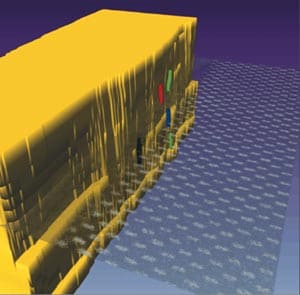
Furthermore, aberration correction can help provide 3D information about the location of atoms because it allows wider beams to be used in the main imaging lens. This improves the lateral resolution while reducing the depth of field, much like using a larger aperture does in optical photography, and therefore allows us to carry out optical sectioning in materials. For example, Klaus van Benthem, Steve Pennycook and co-workers at the Oak Ridge National Laboratory in the US have recently used this technique to produce a series of images at different focus settings in order to obtain information about the depth of atoms in devices such as transistors (figure 3).

The correction of spherical aberration in transmission electron microscopes is clearly paying dividends, but many of the TEM columns available today were never designed for use at such ultra-high resolutions and may be limited by mechanical or electrical instabilities. The situation has been described as being like fitting a Ferrari engine in a Ford Escort! As a result, the main TEM manufacturers – FEI, Zeiss, JEOL, Hitachi and Nion – are working hard to improve their existing columns or even develop entirely new ones into which aberration correctors can be fitted.

But there is also more to electron microscopy than reaching ever higher resolutions, and in the longer term I suspect that aberration-correction technology will lead to other experimental opportunities that will be equally as exciting. For example, the larger apertures that can now be used in STEM instruments increase the current in the illuminating probe by a factor of 10 or more, speeding up the imaging process and possibly allowing dynamical processes to be observed in real time. Furthermore, because lens aberrations increase with the focal length of the imaging lens, the gap between the magnetic poles in a lens has always been kept as small as possible – constraining the space available for experiments. But aberration correction could lead to new lens geometries that may even realize Feynman’s dream of observing nanostructures assemble atom by atom.

The 10 key moments on the path to atomic resolution

  • 16th century The development of the compound optical microscope
  • 1873 Ernst Abbe presents a detailed theory of image formation in the microscope
  • 1896 Lord Rayleigh defines the resolution limit for an optical system by considering diffraction of waves in the lens aperture
  • 1933 Knoll and Ruska invent the transmission electron microscope
  • 1936 Otto Scherzer shows that electron lenses are limited by intrinsic spherical aberration
  • 1955 Erwin Müller uses a field ion microscope to obtain the first images of atoms
  • 1970 Images of single thallium atoms achieved by Albert Crewe and co-workers using a STEM
  • 1970s Resolving crystal lattices using a transmission electron microscope starts to become routine
  • 1982 Binnig and Rohrer invent the STM, which is capable of imaging atoms on surfaces; other scanning probe microscopes follow
  • 1998 onwards The development of spherical-aberration-correction technology starts to revolutionize TEM performance and brings about routine sub-ångström-resolution imaging

The next revolution

With the correction of spherical aberration now impressively achieved, researchers are turning to the next limiting factor in the resolution of an electron microscope: chromatic aberration. Like the spread of wavelengths inherent in visible light, an electron gun produces a beam with a spread of energies and therefore different electron wavelengths. Chromatic aberration arises from the inability to focus all the wavelengths at the same time, leading to a further blurring of the image.

The amount of blurring varies depending on the type of electron gun used, but chromatic aberration is already beginning to become important at the ultra-high-resolution frontier. Although Scherzer also pointed out a method for correcting chromatic aberration in the 1940s, it is difficult to apply to transmission electron microscopy. However, it is easier to apply to scanning electron microscopes, which operate at lower beam energies. CEOS already offers a combined spherical plus chromatic aberration corrector for these instruments, and is currently developing a version for transmission electron microscopes. An alternative approach being explored by Nion is to reduce the wavelength spread of the beam with careful electron-gun design.

The race for better resolution through aberration correction is definitely still on. With the 1 Å barrier convincingly broken, the goal is now is to reach half an ångström – which corresponds to the Bohr radius of the hydrogen atom. Once we have reached this level, it will be the size of the atom itself – not the microscope – that will limit the resolution of electron microscopy.

More about: Electron microscopy

P E Batson et al. 2002 Sub-angstrom resolution using aberration corrected electron optics Nature 418 617-620

U Falke et al. 2004 Atomic structure of a (2 × 1) reconstructed NiSi2/Si(001) Interface Phys. Rev. Lett. 92 116103

M Haider et al. 1998 Electron microscopy image enhanced Nature 392 768-769

C L Jia and K Urban 2004 Atomic-resolution measurement of oxygen concentration in oxide materials Science 303 2001-2004

P D Nellist et al. 2004 Direct sub-angstrom imaging of a crystal lattice Science 305 1741-1741

K van Benthem et al. 2005 Three-dimensional imaging of individual hafnium atoms inside a semiconductor device Appl. Phys. Lett. 87 034104

Putting children off physics

About a year ago my 15-year-old granddaughter asked me to explain something in her physics homework. The previous time she had sought my help she had wanted to know how far individual electrons in the AC mains moved backwards and forwards; this time she was less demanding. But it was more than half a century since I had been a 15 year old doing physics homework, and having spent the bulk of my career as a research physiologist, I thought I ought to find out what 15 year olds are meant to learn today.

I therefore bought and read copies of the five GCSE physics textbooks that were on the shelves of two of Cambridge’s biggest bookshops. These books are aimed at pupils in the two years before they take their GCSE exams at the age of 16. What I found may go some way to explaining why there has been a 35% decrease since 1991 in the number of pupils who go on to take A-level physics at schools in England, Wales and Northern Ireland.

Strange new order

All of the books were, as you would expect, handsomely produced – good paper, clear print, attractive diagrams and illustrations. But my initial impression of excellence faded when I began to read the text. Most surprising was the extraordinary variety in the order in which different topics were discussed. You might think that it would be natural to start with forces and motion, so introducing the concepts of mass, length and time. In fact, of the five books, only two started in this way; one started with astronomy, one with electricity, and one with light.

In the book that started with astronomy, I was amazed to find pupils being taught about how the Moon causes tides, and about the effect of gravity on the direction of motion of a satellite, before there had been any discussion of forces and motion. And how can a pupil who has only the vaguest notions about the wave theory of light understand why the redshift is evidence for the expansion of the universe?

Starting with electricity is even more difficult. We are told on the first page of this particular book that an electric current is a flow of charge, but the concept of charge is not explained until static electricity is discussed five chapters later. Early on, we learn that when charge flows around an electrical circuit, the voltage or potential difference across each component indicates how much energy it is converting. We are then introduced to the law of conservation of energy, even though we have not yet learned what physicists mean by work or energy.

By comparison, starting with light (and putting off wave theory as long as possible) is relatively trouble free. When waves are eventually introduced, though, it is confusing to be told about electromagnetic radiation before there has been any discussion of either electricity or magnetism.

Shaky explanations

Within individual fields, explanations are sometimes sloppy. There are, of course, real difficulties. It is confusing, for example, that we use the kilogram as a unit of weight in ordinary life but as a unit of mass in physics; yet only two of the five books point out this source of confusion, and it is only these two that specifically mention inertia. A middle-school textbook is probably not the appropriate place to introduce gravitational mass and inertial mass, but children do need to understand the concepts of gravity and inertia.

To do that they need to be told about Galileo’s experiment of dropping balls of different weights from the Leaning Tower of Pisa – even if the involvement of the tower may be mythical. They can then understand why astronauts on the Moon have only a sixth of their normal weight, yet the same inertia and momentum as they would have on Earth. This peculiar situation explains why those astronauts fell over so easily, why they found it impossible to walk quickly or run, and why they adopted a long, loping gait.

And coming back to Earth, though all five books discuss Newton’s laws of motion – and the concepts of kinetic energy and momentum – two of them fail to explain how those laws show that kinetic energy equals ½mv2. Another of the five does not explain how it follows from Newton’s laws that momentum is conserved in a collision. These omissions are thoroughly muddling.

The concepts of energy and of the conservation of energy are also treated inadequately. Physicists have traditionally defined energy – the word comes from the Greek words for “in” and “work” – as the capacity to do mechanical work (i.e. the work that is done when an object is moved by a force). Yet four of the five books introduce the concept of energy before they have introduced the concept of mechanical work. Energy is either left undefined or is inadequately defined as what makes things move or makes changes happen. There always have been difficulties about the concept of energy, which, unlike mass, cannot be measured directly; but today’s textbooks make these difficulties worse by ignoring the traditional definition.

Often the best and the most interesting way to introduce a new concept is to describe the historical experiments that led to it, yet these books are curiously arbitrary in their use of history. All five mention Faraday’s discovery of electromagnetic induction, yet none of them mentions his discovery that electric currents in aqueous solution are carried by charged particles, which he called ions (after the Greek word for “wanderer”). All five mention electric cells, but only one discusses Volta and his electric “pile” – the first device to deliver a continuous current and still the French word for battery.

None of the books mentions concentration cells. These are electric cells in which a membrane that is selectively permeable to certain ions separates two solutions containing different concentrations of those ions. Invented in the 19th century, and subsequently found to occur naturally, concentration cells are not only easy to understand but are also the immediate source of energy for the electrical events that underlie all nervous activity. Even more surprisingly, there is no mention of Galvani and his seminal experiments on animal electricity. At a time when so many of those teaching physics in schools are biologists, these omissions seem particularly sad.

The dangers of relevance

It is fashionable nowadays (as well as sensible) to emphasize the relevance of physics to everyday life, and all five books do that. Much of what is included is interesting and worthwhile, but there are two snags to this approach. First, it does not help pupils to understand new concepts if the book is so anxious to be relevant that applications are interpolated at every opportunity. For example, it is bizarre for lasers and their uses to appear in the fourth paragraph of the first chapter of a GCSE physics textbook.

The other snag is that bright children can find it very off-putting if an application is only half understood. For example, all but one of the five books talk about the way photocopiers work (or used to work), yet none of them explains why the charge on the surface of the drum leaks away faster from areas that are illuminated than from areas that are dark. Reluctant (for good reason) to tackle the nature of photoelectric phenomena at this stage, the authors leave the crucial step in the photocopying process as a mystery.

And there are extraordinary omissions. In discussing sound, all five books relate pitch to frequency, loudness to amplitude, and timbre to waveform, but only two of them point out that raising the pitch of a note by an octave doubles the frequency; and none of them mentions that two notes sound well together only if the ratio of their frequencies can be represented by the use of small numbers. Pythagoras knew this 2500 years ago and wondered why; Helmholtz eventually provided the answer. The effect is dramatic, easily demonstrated and fundamental to musical composition, yet it seems to be thought irrelevant for children taking GCSE physics.

Even more remarkably, only one of the five books explains how an internal-combustion engine works. In our car-dominated world, the simple, ingenious, easily comprehensible, four-stroke petrol engine is largely ignored in school physics. And though horse power is still the unit of power used by the car industry, it too is mentioned in only one of the books. Horses do not graze in silicon valley.

Getting back to basics

The blame for some of these deficiencies should perhaps be directed less to the authors of the textbooks than to the peculiarities of the curriculum. In the 2005 curriculum for GCSE physics, for example, electric cells and batteries are mentioned five times, yet there is not a word about how they work. Nor is there any mention of internal-combustion engines or the physical basis of musical harmony.

More worrying than gaps in the curriculum, which can be (and often are) ignored by judicious writers of textbooks, are its insatiable demands. The sensible desire to give pupils a greater general understanding of astronomy, geology and environmental problems is in danger of elbowing out explanations of basic physics. It is, then, vital to restrict unnecessary detail in these peripheral areas. It is far more important for pupils of GCSE physics to understand Newton’s laws of motion and gravitation, the evidence for the wave theory of light, and how electric motors work than for them to become familiar with the subtleties of the movements of tectonic plates or the nature of supernovae.

Children can be put off by failing to understand things, or by being swamped with facts. The current bloated, yet inadequate, curriculum adds to both risks.

A life of genius and tragedy

Robert Oppenheimer

Most young people today will associate the name J Robert Oppenheimer – if they recognize it at all – with the Manhattan Project and the atomic bombs that were dropped on Japan in the last days of the Second World War. However, those of us who lived through those momentous times will remember much more about this great physicist. In particular, we will recall the famous 1954 Personnel Security Board hearing, which centred on Oppenheimer’s advice on the hydrogen-bomb programme and his loyalty to the US. The board decided he should no longer advise the government on nuclear weapons.

But 50 years have passed since those days. When today’s younger readers encounter the bomb project and its consequences, they will probably see those events blended into a seamless fabric of history, uneven in detail and devoid of nuance. This lack of historical awareness is certainly what I encountered when leading student discussions regarding Michael Frayn’s play Copenhagen, which dramatizes the wartime meeting between Niels Bohr and Werner Heisenberg.

So to whom, then, will these two interesting new books appeal? For their book American Prometheus, Martin Sherwin and Kai Bird have interviewed well over 100 of the major participants in the events they describe. Sherwin has studied Oppenheimer’s career for a quarter of a century and the result is a monumental and impressive work, supported by extensive documentation. The authors, who are judicious in their treatment of Oppenheimer’s strengths and personal weaknesses, have written what I consider to be the best overall survey of his life, achievements and problems.

They start with an excellent description of Oppenheimer’s early years – his cosseted youth in a wealthy family in New York City, his burgeoning academic career and his postgraduate days in Europe. They then cover his return to the US, including his joint academic appointments at the California Institute of Technology and the University of California at Berkeley, where he established the first US school of theoretical physics. There follows a good description of the left-wing political scene at Berkeley in the 1930s. Oppenheimer moved in those circles and had many close friends among the communists and fellow travellers. This period was to play a critical role in Oppenheimer’s later troubles. Without this background material by Sherwin and Bird, it is impossible to understand why people were later suspicious about Oppenheimer’s personality and his loyalty to the US, and why he gave such opaque responses when questioned by intelligence officers and Groves about his brother’s and friends’ membership of the Communist party.

Despite having little administrative experience, Oppenheimer’s selection as scientific director of the Los Alamos Laboratory was as surprising as it was inspired. In this role, he displayed his ability to master every aspect of the Manhattan Project – both scientific and technical – and led it brilliantly (see “J Robert Oppenheimer: Proteus unbound” Physics World February 2001 pp39-46). It is interesting to note that General Leslie Groves, who was the overall leader of the project, knew of Oppenheimer’s early flirtation with radical politics – yet never questioned Oppenheimer’s loyalty to the US nor his selection to head the project.

After the war, Oppenheimer was appointed director of the Institute for Advanced Study (IAS) in Princeton. One young colleague at the institute was Abraham Pais, who went on to lead a distinguished career in theoretical physics and wrote major biographies of both Bohr and Einstein. He also began a biography of Oppenheimer, but died in 2000 with the book only partially complete. J Robert Oppenheimer: A Life has now been finished by Robert P Crease, a philosopher at the State University of New York at Stony Brook (and a columnist for this magazine). Based on Pais’ extensive notes, Crease has written the last four of the 27 chapters. Pais’ treatment is idiosyncratic. One chapter consists of a single page and several are only four pages long. He omits the Berkeley background, but does provide much insider detail on Oppenheimer’s physics and the IAS. He includes the text of Oppenheimer’s farewell address at Los Alamos that is not otherwise easily available. The address is typical Oppenheimer: it offers a sweeping view of the impact of nuclear weapons and the role of scientists, despite being occasionally rambling and opaque. In general, though, this book will be of most interest to readers already familiar with Oppenheimer and the hearing.

Two particular events were central to the later vengeful and politically motivated pursuit of Oppenheimer. First was President Harry Truman’s decision to undertake a “crash” programme to develop a hydrogen bomb, against the unanimous advice of the General Advisory Committee, which Oppenheimer chaired. The committee rejected such a programme because at the time there was no known way of achieving fusion; the successful “Teller-Ulam process” emerged only several years later.

The other key event was Oppenheimer’s brief conversation in 1943 with his close friend Haakon Chevalier, who was a Marxist and professor of French at Berkeley. This led to two key questions. Did Chevalier offer to pass information of the bomb project to the Soviet consulate? And why did Oppenheimer lie about this conversation when questioned in 1943 by military intelligence officers Colonels Boris Pash and John Lansdale?

Bird and Sherwin provide excellent treatments of both of these subjects. The hydrogen-bomb decision has been well documented, for example by Gregg Herken in his fine book Brotherhood of the Bomb (2002 Henry Holt). However, we may never know the true content of the Chevalier-Oppenheimer conversation, just as we may never know what Bohr and Heisenberg said to each other at Copenhagen in 1941. Pais does not cover the Chevalier conversation but goes into considerable detail about the 1949 GAC review.

A sea-change in national defence policy occurred when President Dwight Eisenhower’s Republican administration took office in January 1953. The GAC’s advice against a crash hydrogen-bomb programme, which Truman had ignored, was now viewed as an attempt by Oppenheimer to hinder the development of the bomb. Coupled with latent suspicions of disloyalty based on Oppenheimer’s earlier political affiliations, Lewis Strauss – chairman of the Atomic Energy Commission (AEC) – decided in December 1953 to suspend Oppenheimer from any further involvement in nuclear weapons.

The Personnel Security Board was then convened to conduct an investigation. Following its hearing in 1954, the board recommended that Oppenheimer’s security clearance should not be restored. The conduct of this hearing – and its later confirmation by the AEC – were travesties of the judicial process. Oppenheimer’s phone conversations were tapped, his letters were opened, and he was clandestinely followed. The FBI passed transcripts of phone conversations to the prosecutor. Official documents were made available to the prosecutor and the hearing board but not to Oppenheimer and his lawyers. There was continual collusion between the board and the prosecution.

Bird and Sherwin’s detailed treatment of the hearing is excellent. Although Pais only got as far as setting the stage for the hearing, Crease provides a good and extensive description. The hearing and the verdict provoked many protests. For example, in 1957 the philosopher Georgio de Santillana compared the hearing to “an Inquisitional trial de vehementi“.

The situation was summed up nicely by the lawyer Charles P Curtis in his 1954 book The Oppenheimer Case. In it he quotes from George Bernard Shaw’s play Saint Joan, in which Charles VII tells Joan that her judges “were full of corruption and cozenage, fraud and malice”.”Not they,” replies Joan, “they were as honest a lot of poor fools as ever burned their betters.”

  • 2005 Knopf 721pp $35.00hb

A journey too far

Next month science ministers from across Europe will meet in Berlin to discuss Aurora – an ambitious plan by the European Space Agency (ESA) to explore the solar system, with Mars and the Moon as the main targets. The first stage of exploration would be done by robots, to be followed by humans after 2015. Costs have not been mentioned yet but they are sure to be astronomical. With the US thinking along similar lines, the first point that needs to be made is that the world does not need two competing programmes for exploring the solar system. Indeed, does the world need even one manned mission to Mars and beyond?

The UK has traditionally been opposed to manned space exploration, which is why the Royal Astronomical Society (RAS) recently asked a commission of three eminent scientists to answer the following question: “Will having people in space materially advance our knowledge, especially of astronomy and geophysics, in ways that are otherwise impossible or less certain?”

None of the commission members – Frank Close of Oxford University (a particle theorist), John Dudeney of the British Antarctic Survey (an ionospheric physicist) and Ken Pounds of Leicester University (an X-ray astronomer) – had strong views on human space exploration. Indeed, if anything, they were sceptical about the scientific value of such projects. It came as a surprise, therefore, to find that they had changed their minds by the time they came to write their report: “We find that profound scientific questions relating to the history of the solar system and the existence of life beyond Earth can best – perhaps only – be achieved by human exploration on the Moon or Mars, supported by appropriate automated systems.”

The commission felt that there were three compelling reasons why the UK should be involved in human space flight: to map the history of the solar system, including the Earth and the Sun, by drilling beneath the surface of the Moon; to search for life on Mars; and to carry out a detailed, planet-wide exploration of Mars. Other reasons included increased interest in science among young people and benefits for industry. Overall the commission reckoned that it would cost the UK about £150m per year for at least 20 years to be involved in such a programme (assuming that it pays for about 15% of any European initiative).

However, the commission’s report can be no more than a first small step in a possible British U-turn about sending humans into space to do science. Before the government commits to spending the enormous sums of money involved, it must conduct a much wider-reaching inquiry into this question. The panel that conducts this inquiry must be bigger and more broad-based. For instance, questions about the best way to explore the origins of life on Earth require input from the life-sciences community. Would the public be so seemingly keen if they knew about the costs involved? Indeed, does the whole astronomy and space-science community buy into the idea? And if the UK – or any other nation for that matter – has an extra £150m per year to spend on a really big science-based problem, what else could it spend the money on? The development of new energy sources that do not harm the environment would seem to be a higher priority. Humans should only do science in space if they can be put there without costing the Earth.

Could sound move at the speed of light?

Waves moving in a dispersive medium are described by a phase velocity and a group velocity. The phase velocity is the speed at which a wave of a single wavelength moves, and is typically about 1.5 kilometres per second for sound waves in water. However, pulses of light or sound actually contain a range of wavelengths that all move at different speeds: the group velocity is the speed at which the pulse itself moves.

In recent years, it has been shown experimentally that the group velocity of a laser pulse can exceed the speed of light in vacuum — 300,000,000 metres per second — in certain situations. However, special relativity is not violated in these experiments because they do not involve the transfer of information, matter or energy.

Mobley has now calculated that the group velocity of a pulse of high-frequency sound waves could be increased by five orders of magnitude by sending it through a small chamber that contains about 8 millilitres of water and some 400,000 tiny plastic spheres. This means that the group velocity would exceed the speed of light in vacuum. The spheres have diameters of about 0.1 mm and account for about 5% of the volume of the water-bead mixture.

The increase in speed is caused by dispersion — the phenomenon that causes different wavelengths to move at different phase velocities. When the pulse enters the mixture it experiences severe dispersion, which causes the different wavelengths that make up the pulse to travel at very different speeds. This changes the shape of the pulse and can result in the pulse itself moving faster than the speed of light. However, the dispersion also significantly reduces the intensity of the pulses.

“It has long been recognised that such velocities should be possible with acoustic waves,” Mobley told PhysicsWeb. “My work shows that it can be done in a specific and very simple system and that extreme conditions are not necessary.”

Mobley is now planning experiments to observe the superluminal velocities at the National Center for Physical Acoustics at Mississippi. The main challenge will be to increase the signal-to-noise ratio so that it is possible to detect the pulses, which will have been greatly reduced in intensity by the dispersion.

Richard Smalley: 1943-2005

Smalley discovered buckyballs while working at Rice University in the US in 1985. “In my view, this was a singular event in the history of nanotechnology,” said Neal Lane of Rice University. “It not only created a whole new field of fullerene chemistry, it immediately made feasible the notion of making things from the bottom up, just as physicist Richard Feynman had predicted 50 years earlier.”

Smalley began his career by studying chemistry at Hope College, Michigan, followed by the University of Michigan. He completed a PhD at Princeton University after working for Shell Chemical Co for four years. Postdoctoral research at the University of Chicago followed, before Smalley moved to Rice University in 1976.

At Rice, as well as his work on fullerenes, Smalley helped to found the Rice Quantum Institute and the Center for Nanoscale Science and Technology. He was also director of the Carbon Nanotechnology Laboratory and founded nanotube start-up company Carbon Nanotechnologies in 2002.

“Rick made great contributions to science,” says Robert Curl of Rice University. “While fullerenes and nanotubes dominated the end of his research career, he had made many contributions of towering magnitude before then.”

According to Lane, Smalley played a crucial role in getting the US National Nanotechnology Initiative approved by Congress. From 2002 to 2004 he campaigned for the use of nanotechnology in producing cheap clean energy.

“Rick cared little about honours and much more about how applications of nanoscience might help resolve pressing human problems in energy accessibility, food supplies and medical diagnosis and treatment,” says Malcolm Gillis of Rice University. “In meetings with Rick in the past year, it was clear to me his primary reasons for his determined battle against his disease had first to do with his family and second with his desire to witness at least a few of the social benefits he expected from buckyballs, buckytubes and other nanoparticles.”

Beating the sub-wavelength limit

Classical particles can only pass though an aperture if they are smaller than the aperture. Quantum particles like atoms can only pass through an opening if their de Broglie wavelength is smaller than the opening. If the de Broglie wavelength is larger than the aperture, the atoms cannot pass through, even if their physical size is smaller than the aperture. Similarly, light can only pass through a slit if its wavelength is smaller than the width of the slit.

In 1998 researchers showed that light could pass through a metallic film perforated with an array of sub-wavelength holes with the help of surface plasmons — localised pools of excited electrons around the holes. Now, Esteban Moreno, Antonio Fernandez and Francisco García-Vidal of the University of Madrid, Luis Martin-Moreno in Zaragoza and Ignacio Cirac at the Max Planck Institute for Quantum Optics in Garching have applied similar ideas to cold rubidium atoms.

Moreno and co-workers modelled a thin film that contained an array of slits that were 50 nm wide and separated by 800 nm. Since the de Broglie wavelength of the atoms was around 800 nm, transmission through the slits should have been negligible. However, by carefully tuning the van der Waals interactions between the atoms and the surface, and also the dipolar repulsion created by optical fields in the structure, they showed that 100% of the atoms should be able to pass through the slits with the help of surface matter waves. These waves are the atomic analogue of surface plasmons and may appear when a dielectric surface presents a potential well for the atoms. They are running waves that are confined in the direction perpendicular to the surface but they propagate in the parallel direction.

The group says that the experiment it proposes could soon be possible thanks to recent advances in nanotechnology and the control of cold atoms. “Our work could open a new line of research in the field of atom optics,” says García -Vidal. “In photonics, people talk of plasmonic circuits that will be able to carry light at very short length scales. Our finding translates this concept to matter waves and perhaps these ideas could be used to implement atomic circuitry.”

Tragedy at CERN

Mr Pereira Lages and co-workers were positioning a cabinet containing electrical switchgear in the LHC tunnel at the lab when the accident happened. “For reasons as yet unknown, the cabinet slipped on its support and fell on him,” said Robert Aymar, Director-General of CERN, in a statement. “CERN’s emergency services were on the scene immediately, but were unfortunately unable to help.” The statement added that “the operation being undertaken was a common one.”

All work of a similar nature at CERN has been stopped until further notice and separate enquiries into the accident have been launched by CERN’s security commission, the Geneva works inspectorate and the Geneva police.

Mr Pereira Lages, who was leader of the LHC general services team at points 1 and 8 in the LHC tunnel, had a reputation of being one of the best forklift truck drivers at CERN. The latest issue of the CERN Bulletin contains an article that describes how he won the individual unloading event at the recent French Forklift Championships. A team led by Mr Pereira Lages, who was one of 200 DBS employees working at CERN, also finished second in the team event.

Transport and handling work at the lab was suspended for 24 hours as a mark of respect and the lab has sent its condolences to Mr Pereira Lages’ family.

Shelf life: John Rigden

What are the three best popular-science books?

Any reader’s response to a book is influenced by the intellectual and emotional urgencies of the moment. I have read many books I judge good or excellent, but they slip from my mind as I never have the desire, or the reason, to go back to them. The following three books, however, have an ongoing presence in my mind and my regard for them has been sustained over many years.

Arthur Koestler’s The Sleepwalkers gives the reader a first-hand account of great science in the making. Koestler brings together in dramatic fashion 2000 years of man’s evolving view of the universe. His treatment of Kepler and his laws of planetary motion is simply stunning. I have recommended this book to many non-science acquaintances, and, without exception, they are delighted by it and go out of their way to thank me for bringing it to their attention.

As a guide to the early moments of our universe, Steven Weinberg’s The First Three Minutes cannot be beaten. It is one of those books that I go back to again and again.

My final choice is Thomas Kuhn’s The Copernican Revolution. The impact of the Copernican revolution on the mind and spirit of the human species cannot be overemphasized, and Kuhn opens up this momentous scientific advance for the reader. The wonderful graphics alone stay fixed in my mind as they synthesize an array of daily and annual observations. The book explains the subject in a far less abstract way than his much-heralded book Structures of Scientific Revolutions.

What science books are you currently reading?

The most recent science-type book I read is Philip Kitcher’s Science, Truth, and Democracy.I believe this is an important book, but for me it was difficult reading.

What else are you reading?

I just finished J Robert Oppenheimer: The American Prometheus by Kai Bird and Martin Sherwin, and am now reading The Evolution-Creation Struggle by Michael Ruse.

Which popular-science book have you never read, but feel you ought to have tackled, and why?

For some time I have intended to read Abraham Pais’s book Niels Bohr’s Times, In Physics, Philosophy, and Polity. I am perhaps in a minority of one among physicists in believing that the Danish physicist is overrated. I have not read Bram’s book because it is a typical physicist’s worshipful account of Bohr. But I expect that I shall read it soon.

• A review of Bird and Sherwin’s book will appear in the next issue of Physics World.

What do Einstein, Darwin and emails have in common?

Earlier this year Albert-László Barabási of the University of Notre Dame and Harvard University showed that the length of time it takes people to reply to emails can be described by a power law. Now Barabási and Joāo Gama Oliveira, who is based at the Universidade de Aveiro in Portugal and Notre Dame, have shown that the response times of Einstein and Darwin to letters can also be described by a power law, albeit with a different exponent. The results suggest that there is a global pattern for human behaviour in correspondence that also applies to famous scientists like Einstein and Darwin (Nature 437 1251).

Both Darwin (1809-82) and Einstein (1879-1955) wrote and received many letters during their lives: Darwin sent at least 7591 letters and received 6530, while Einstein sent more than 14500 and received 16200. Oliveira and Barabási have shown that although times have changed with the advent of email, communication dynamics have not. However, the time scales involved are much shorter for email.

Oliveira and Barabási analysed data about letters in the Darwin Correspondence Project and the Einstein Papers Project and calculated the response time, τ – the number of days between Einstein or Darwin receiving a letter from someone and then sending a reply. Oliveira and Barabási found that the probability that a letter will be replied to in τ days, P(τ), can be described by a power law, P(τ)≈τ-α, where α=1.45±0.1 for Darwin and 1.47±0.1 for Einstein, compared with α=1 for email. This means that Darwin and Einstein sent more than half of their replies within ten days, but sometimes took months, or even years, to reply.

“What I find most remarkable is that the response pattern observed for both Darwin and Einstein is similar, despite the fact that they both lived in different eras,” Oliveira told PhysicsWeb. “This suggests that the observed pattern is not characteristic of either of them, but is rather a global pattern for human behaviour.” Oliveira and Barabási have since observed a similar pattern in the letters of Sigmund Freud.

Copyright © 2026 by IOP Publishing Ltd and individual contributors