Supercool helium ions make their debut

Established laser cooling techniques do not work for helium so Stephan Schiller and colleagues at Heinrich-Heine University in Düsseldorf had to use a technique called “sympathetic cooling” instead. This involved cooling the ions with a gas of beryllium ions that had already been cooled with lasers (B Roth et al. 2004 arXiv.org/abs/physics/0412053).

Schiller and co-workers began by loading large numbers of beryllium-9 ions, produced by electron impact ionisation, into a linear radio-frequency trap. An ultraviolet laser was then used to cool these ions until they underwent a phase transition from the fluid state to an ordered phase known as a “Coulomb crystal”.

Next, they loaded the helium-4 ions — which had also been generated by electron impact ionisation — into the trap. A dark core of ultracold helium ions was observed in the centre of the beryllium ion crystal. Schiller and co-workers were able to cool as many as 150 helium ions to a temperature of about 20 millikelvin.

The team has also demonstrated sympathetic cooling with helium-3 ions and is now applying the technique to other species, including diatomic molecules made of hydrogen and deuterium.

“Helium ions are important for measurements of the fundamental constants and tests of QED because they are complementary to hydrogen,” team member Bernhard Roth told PhysicsWeb. “Using cold ensembles of HD+ ions we hope to measure the ratio of the electron to the proton mass, and test if it remains constant over time.”

Science selects “Water on Mars” as breakthrough of the year

Mars was explored like never before in 2004. NASA landed two rovers — Opportunity and Spirit — on the red planet, while the European Space Agency placed Mars Express in orbit around our near neighbour. Only the Beagle 2 lander failed to overcome the curse that has plagued so many Mars missions in the past. All three missions found evidence for ancient water on the planet.

Images from Opportunity revealed numerous layered outcrops, similar to sedimentary rocks on Earth, suggesting that liquid water had once flowed through the rocks. Meanwhile, on the opposite side of the planet, Spirit found signs that water may have altered volcanic rocks at Gusev crater. Moreover, the OMEGA instrument on board Mars Express obtained the first direct evidence for frozen water on the surface of Mars by analysing the near infrared spectrum of sunlight reflected from the planet.

Highlights in low-temperature physics included the creation of a new “supersolid” phase of matter by Eun-Seong Kim and Moses Chan of Pennsylvania State University. Supersolid helium-4 behaves like a superfluid — a liquid that flows without resistance — but has all the characteristics of a crystalline solid.

Elsewhere in the low-temperature world physicists at the JILA laboratory in Colorado created the first “fermionic condensate” when they persuaded fermionic atoms — which obey the Pauli exclusion principle — to form bosonic pairs, which don’t. This allowed the atoms to “condense” into the same quantum ground state. The ultimate goal of such research is to gain a better understanding of superfluidity and superconductivity, and physicists at the University of Innsbruck in Austria took a major step forward in this direction when they observed the equivalent of a superconducting energy gap in a low-temperature gas for the first time.

Meanwhile astronomers at the Parkes telescope in Australia and the Lovell telescope in the UK discovered the first ever double pulsar system. Pulsars are extremely dense, rapidly rotating neutron stars that are a million times more massive than the Earth, yet measure just tens of kilometres across. The discovery will allow physicists to perform the most stringent ever tests of Einstein’s general theory of relativity.

PhysicsWeb will publish its highlights of 2004 next week.

Molecular orbitals come into view

“Most techniques for studying molecular structure, such as X-ray diffraction and electron scattering measure the total electron distribution,” Villeneuve told PhysicsWeb. “We were able to isolate a single orbital from among the many in the nitrogen molecule. Furthermore, we detected the wavefunction itself rather than the more usual square of the wavefunction.”

Villeneuve and colleagues from the NRC, the University of Ottawa, the INRS lab in Varennes and the Japan Science and Technology Agency used two laser pulses in their experiments: the first aligned the molecules in a chosen direction, while the second — which had a duration of 30 femtoseconds (30 x 10-15 seconds) — removed an electron from the highest occupied molecular orbital. About 1.3 femtoseconds later the electric field of the second laser changed direction, which caused the electron to accelerate back towards the parent molecule and collide with it. This released an energetic X-ray photon that could be detected.

By changing the angle between the molecule and the laser beam and repeating the experiment, the scientists were able to build up a 3D image of the molecular orbital. This involved developing a mathematical model to relate the X-ray emission spectrum to the shape of the molecular orbital. The model was similar to those used in medical tomography.

“Since the images are recorded in only about 30 femtoseconds, we can also resolve simple molecular processes such as dissociation,” said Villeneuve. “We now hope to be able to see the character of the orbital change as the molecule breaks apart. This may shed more light on how molecular bonds are made and broken in chemical reactions.” It might also be possible to observe the motion of electrons on attosecond (10-18 seconds) time-scales with the technique.

Red blood cells are go!

Several groups have already shown that optical forces can be used to make micron-sized objects rotate, but these objects all had to be made with complicated microfabrication techniques. The advantage of the Tata approach is that it exploits naturally occurring materials.

“Close collaboration between biologists and physicists made it possible for us to overcome the need to microfabricate specially designed shapes for the ‘rotor’,” Mathur told PhysicsWeb. “The use of biological matter, in the form of red blood cells, allowed nature to do all the hard work for us as far as fabrication was concerned.”

Red blood cells are normally disk-shaped but the forces generated by the laser beams in an optical trap deform the disks into cylinders (see figure 1). These cylinders align themselves so that they are edge-on with respect to the direction of the incident laser beam, and then begin to rotate by following the polarization of the beam.

Mathur and co-workers found that the red blood cells — which came from humans and from mice — could rotate at up 42 revolutions per minute without being damaged, and that larger cells rotated faster than smaller ones. The speed of rotation could also be increased by increasing the laser intensity, although the cells were destroyed when the laser power exceeded about 100 milliwatts (see figure 2).

The group is now repeating its experiments with cells from different species. The elasticity of the cell membrane is central to the process because it governs how the cells deform in the laser beam.

“The torques generated in our ‘motor’ are enormous,” says Mathur,” but the key question is: can we use such a single-cell motor to perform tasks on the micron level? We await the answer with bated breath!”

A microscopic “fountain pen”

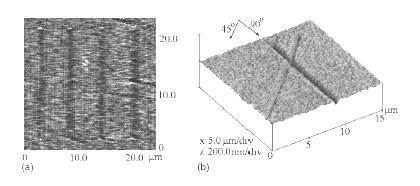
Atomic force microscopes (AFMs) were originally designed to study surfaces but they are now routinely used for surface modification as well. In the new device built by Elwenspoek and colleagues, the ink flows from a reservoir through a channel in the cantilever that supports the tip and on to the tip itself (figure 1).

Using 1-octodecanethiol as the ink, the Twente team drew lines just 0.5 microns wide on a gold substrate. The ink reacts with the gold to produce a stable monolayer structure on the substrate. In separate experiments with a commercial etchant, the tip was able to etch trenches just 0.3 microns wide and 14 nanometres deep in a chromium surface (figure 2).

The team used the technique to draw and etch straight lines but any pattern could, in principle, be created. It might also be possible to reduce the width of the lines and the trenches further by sharpening the AFM tip.

Elwenspoek and co-workers say their device is an improvement on existing AFM-based surface-modification techniques, such as “dip-pen lithography”, because it can hold more ink and the flow of this ink can be better controlled. Moreover, by creating a local environment around the tip, the operation of the device is not affected by humidity in the atmosphere.

“The fountain pen will extend the possibilities of probe-based nanolithography,” team member Szabolcs Deladi told PhysicsWeb. “It could be used in new nanofabrication techniques like local electrochemical etching and deposition to create 3D nanostructures.”

The Twente team now plans to do further work on the device itself and also on the ink, including improvements to its viscosity and wetting properties.

Ups and downs for superconducting films

Modern electronic devices are often made of thin films. According to the “particle-in-a-box” model of quantum mechanics, electrons confined in a perfectly uniform thin film are quantized into discrete energy levels known as quantum well states. The formation of these states can modify the distribution of electrons near the Fermi level, and therefore have an influence on the physical and chemical properties of the film.

Xue and colleagues in Beijing, the University of Texas at Austin and the University of California at Berkeley grew crystalline films of lead on silicon substrates at 145 Kelvin. The films contained between 10 and 30 monolayers, although only films containing odd numbers of layers were stable below 22 monolayers. Xue and colleagues then cooled the films and measured the superconducting transition temperature, Tc, below which they lost their resistance to electric current.

The China-US team found that the transition temperature generally increased with film thickness up to 21 monolayers, before starting to oscillate, with films containing even numbers of monolayers having higher values of Tc than those containing odd numbers (see figure).

According to the Bardeen-Cooper-Schrieffer (BCS) theory of superconductivity, the transition temperature depends on the electron distribution at the Fermi level and on the interactions between electrons and phonons (vibrations of the crystal lattice). Xue and co-workers calculated that the density of states was higher near the Fermi level for films containing an odd number of layers, and argue that the oscillations in the transition temperature must therefore be closely related to the formation of quantum well states.

The results suggest that other properties of the films could also be modified by controlling this effect.

Physicist solves desert mystery

“Singing dunes are one of the most puzzling and impressive natural phenomena I have ever encountered,” says Andreotti. “The sounds produced can be heard up to 10 kilometres away and resemble a drum or a low-flying jet.” The sounds can be as loud as 105 decibels and have frequencies between about 95 and 105 Hertz.

The French physicist took his equipment from Paris to the Atlantic Sahara in Morocco, which contains more than 10,000 crescent shaped dunes known as barchans. The wind in the desert can erode the back of these dunes, causing sand to build up at the top of the dune. When too much sand has accumulated, an avalanche occurs and the dunes start to “sing”.

Andreotti simultaneously measured vibrations in the sand bed and acoustic emissions in the air, and then extracted information about the frequency, amplitude and the phase of these signals. He found that the vibrations in the sand behaved like slow-moving elastic sound waves that were localized at the surface of the dune and had an amplitude that was about a quarter of the diameter of an individual grain of sand.

“The sounds result from avalanches in which the grains drum on one another, exciting elastic waves on the dune surface, with the vibration of the sand bed tending to synchronise the collisions,” he told PhysicsWeb. “In many ways the surface of the sand bed acts like the membrane in a loudspeaker.”

Andreotti now plans to study the effect in more detail in the laboratory and with computer simulations. The results could also be relevant to the behaviour of granular materials in general.

Magnetic effects seen in water

Water has many unusual properties: it has relatively high melting and boiling points for a small molecule, and the liquid state can also be denser than the solid state. These properties are thought to arise from the 3D network of hydrogen bonds in the molecule.

Recently, it was discovered that the near infrared spectrum and refractive index of water can be affected by a strong magnetic field. Some researchers have suggested that the magnetic field somehow strengthens hydrogen bonds, but the exact mechanism behind these results remains a mystery.

Inaba and co-workers measured the melting temperatures of ordinary water and heavy water – in which the hydrogen atoms are replaced by deuterium – with a highly sensitive differential scanning calorimeter (DSC). The changes in the melting points observed with the DSC were proportional to the square of the magnetic field, and also about three orders of magnitude larger than those calculated using the so-called magneto-Clapeyron equation.

“Since water is diamagnetic, it should not be affected by a magnetic field,” Inaba told PhysicsWeb. “We believe that the thermal motion of the partially charged atoms in the water gives rise to a Lorentz force when a magnetic field is applied. By suppressing the thermal motion, the Lorentz force makes the hydrogen bonds stronger, which could account for the increase in the melting points.”

The Chiba team now plans to investigate the effect of magnetic fields on phase transitions in other diamagnetic materials including gallium, indium, mercury and benzene.

New look for nanofabrication

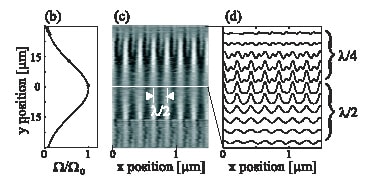
Standard approaches to atom lithography employ off-resonant standing waves. However, the diffraction limit of light restricts the minimum feature size that can be fabricated with this approach to about half the wavelength of the laser beam used to create the standing wave. Oberthaler and colleagues have now shown that nanostructures with smaller feature sizes can, in principle, be fabricated if the laser beam is resonant with an electronic transition in the atoms.

The experiment involves passing a tightly focused beam of chromium atoms through a resonant standing wave, which is produced by reflecting a linearly polarized laser beam from a mirror (figure 1). After passing through the standing wave, the chromium atoms are deposited onto a silicon substrate and the resulting pattern is analysed with an atomic force microscope (AFM).

The Konstanz-Heidelberg team found that nanostructures with feature spacings of half the wavelength of the laser light were produced when the laser was tuned far from its resonance frequency. However, when the laser was almost resonant with a transition in the chromium atoms, a complex structure containing additional features – each separated by a quarter of the wavelength of the laser light – was seen (figure 2).

According to the team, these features are produced by quantum interactions between the atoms and the laser beams, and by the quantum motion of the atoms. “The most significant impact of this work is the ‘direct’ observation of quantum mechanical atom-light interaction properties,” Oberthaler told PhysicsWeb. “However, the experiment has also shown that the combination of deposition and AFM allows us to study quantum motion on the nanometre scale.”

Quantum cryptography wins Descartes prize

The IST-QuComm collaboration is made up of research groups in Sweden, Germany, France, Switzerland, Austria and the UK, plus a team at the Los Alamos National Laboratory in the US. Quantum cryptography allows two parties to share a secret “key” that could make communications between them much more secure than existing cryptographic techniques by encoding the key with single photons. Any attempts by a third party to eavesdrop on the communications can be readily detected. Quantum cryptography could have applications in electronic communications, e-banking and e-voting.

Progress in quantum cryptography and related areas – such as entanglement and teleportation – has been rapid in recent years. Last year, for instance, physicists at the University of Vienna succeeded in sending entangled photons 600 metres across the river Danube, while a group at the University of Geneva recently demonstrated quantum teleportation at telecom wavelengths through a 4-kilometre optical fibre cable. The IST-QuComm consortium also performed the first ever quantum cryptographic bank transfer over a 6-kilometre fibre link in Vienna this summer.

The prizes were awarded in Prague today by Janez Potocnik, EU commissioner for science and research.

Copyright © 2026 by IOP Publishing Ltd and individual contributors