There are incremental innovations (think continuous improvement of existing product lines) and then there are disruptive innovations (think platform technologies that rewrite the rulebook). A case study in the latter is the ORCA®-Quest, a scientific camera that has been turning heads since its commercial release in 2021, opening up cutting-edge imaging applications in disciplines as diverse as quantum computing, atomic physics, synchrotron science, Raman spectroscopy and super-resolution microscopy.
Developed by Hamamatsu Photonics, a specialist manufacturer of high-sensitivity, low-noise cameras for fundamental and applied research, the ORCA®-Quest is a quantitative CMOS (qCMOS) camera with unique “photon-number resolving” functionality – determining the number of photons incident on each pixel (in a 9.4 megapixel array) by accurately measuring the number of photoelectrons generated on a per-pixel basis.
Innovative design, advanced fabrication
It’s this granular ability to count photoelectrons that underpins the ORCA-Quest’s game-changing performance as an imaging system. “To realize photon-number resolving, we had to make some modifications to the pixel structure itself,” says Brad Coyle, OEM camera product manager at Hamamatsu Photonics.
Specifically, that means fabricating deep-trench structures in the semiconductor layers between each pixel to ensure that a photon that impacts on a given pixel registers exclusively on that pixel. “The trench structure suppresses the flow of photoelectrons between neighbouring pixels,” Coyle adds, “so we get really high fidelity and linearity at the level of the individual pixels.”
Equally important in this regard is the work of the Hamamatsu development team to reduce the noise-floor of the ORCA-Quest. Conventional scientific CMOS (sCMOS) cameras, for example, come with a low readout noise – though still larger than the photoelectron signal, which makes it difficult to count photoelectrons.
Brad Coyle “We get really high fidelity and linearity at the level of the individual pixels.” (Courtesy: Hamamatsu Photonics)
“What we found, theoretically, is that in order to quantify the number of photoelectrons generated per pixel, we have to reduce the noise floor below 0.3 electrons,” notes Coyle. In terms of practical implementation, this necessitated a redesign of the detection and readout circuitry of the ORCA-Quest to achieve 0.27 electron RMS read noise (while ensuring stable performance versus temperature and time as well as individual calibration and real-time correction of each pixel value).
Another notable feature of the ORCA-Quest is its high-speed readout – in other words, how many pixels the camera can read out per second (number of pixels × frame rate). In standard scan mode, for example, the ORCA-Quest offers a higher data rate (>1100 megapixel/s) and lower readout noise compared with conventional sCMOS cameras (approx. 400 megapixel/s). In ultraquiet scan mode, meanwhile, the camera offers photon-number resolving with a x10 faster data rate (approx. 250 megapixel/s) versus single-photon counting with electron-multiplying CCD cameras
“With the full 9.4 megapixel array [4096 x 2304] and high-speed readout, users are able to image a large number of objects with exacting temporal requirements,” notes Coyle. “The high-bandwidth interface means it is also possible to extract real-time feedback from the camera system – which is mandatory for emerging R&D applications in quantum computing and quantum communications.”
Quantum imaging, quantum insights
Among the early-adopters of the ORCA-Quest in the quantum science community is Dolev Bluvstein, a PhD student and team member of Mikhail Lukin’s Quantum Optics Laboratory at Harvard University (Cambridge, MA). Within a diverse programme of theoretical and applied research, Bluvstein and colleagues are working on aspects of quantum computing and quantum simulation using arrays of individually trapped rubidium-87 (Rb) atoms.
At a schematic level, individual atoms are trapped independently in vacuum by optical tweezers, such that highly focused laser beams enable real-time control of each atomic position in space. “Once the atoms are prepared in their programmed positions and pumped into their ground electronic states,” says Bluvstein, “we introduce interactions among them by using lasers to excite them to their Rydberg states [in which an electron is excited into a very large orbital state].”
In this way, the Rb atoms are aligned one-by-one in an array to be utilized as qubits for quantum computing operations, while the qubit states are determined by observing the laser-induced fluorescence (or absence of fluorescence) from each atom. It’s here that the ORCA-Quest provides a core building block in Bluvstein’s experimental set-up, ensuring spatial diagnostics of the entire atom array as well as quantum-state detection for each atomic qubit – all while combining ultralow-noise measurements and high-speed readout (at a frame rate of every 100 μs).
“The camera is the only way to see where the Rb atoms are and to extract qubit information rapidly out of the quantum system,” says Bluvstein. “In a sense, the camera is the main input/output interface between the classical and quantum worlds.”
At the end of last year, Bluvstein and colleagues published a landmark paper in Nature, detailing work on a quantum processor architecture based on reconfigurable atom arrays. The laboratory testbed – which was developed as part of Bluvstein’s PhD work within a wider collaboration involving scientists at NIST/University of Maryland, Massachusetts Institute of Technology (Cambridge, MA) and QuEra Computing (Cambridge, MA) – features high-fidelity entangling gates, local qubit control, mid-circuit readout and any-to-any connectivity for hundreds of atomic qubits.
By grouping atomic qubits together to form error-corrected logical qubits, the team is exploring early fault-tolerant quantum computation with up to dozens of logical qubits and hundreds of logical entangling gates. The ultimate end-game: a neutral-atom, error-corrected quantum computer – at scale – with of the order of 10 million atom qubits imaged every 100 μs on a 24/7 basis while logging their individual quantum states.
“The ultrafast readout speed of the ORCA-Quest over large regions of interest is mission-critical for our research,” explains Bluvstein. “What’s also impressive is that when we installed the camera in our experimental set-up, the signal-to-noise of our atomic imaging improved by a factor of two. All of which advances the rate at which we can do this classical/quantum interfacing and, ultimately, the path to large-scale quantum computation.”
Continuous improvement
Disruptive innovation, inevitably, begets incremental innovation. Earlier this year, Hamamatsu Photonics unveiled the ORCA-Quest 2, offering end-users enhanced functionality along a couple of key coordinates. For starters, there’s a x5 improvement in frame rate when the camera is operated in ultra-quiet scan mode for photon-number resolving (i.e. 25 frame/s for the full 4096 x 2304 array). The ORCA-Quest 2 also offers higher quantum efficiency in the UV region (around 280–400 nm) thanks to an advanced antireflection coating on the sensor window (with no change to the efficiency in the visible and near-IR regions).
It’s early days, however, and the search is on for new applications and market segments for the ORCA-Quest 2. “We’re looking to hear from partners who may have a unique application for this camera,” concludes Coyle. “This is still a new technology and we’re trying to learn where the best fit is going to be across basic research and industry R&D.”
Understanding how birds react to each other’s songs can shed light on their behaviour and communication in the wild. But such studies require a way to generate realistic-sounding synthetic birdsong. To achieve this, a team from the University of Buenos Aires has used mathematical modelling to synthesize a fake birdsong that’s credible enough to prompt wild birds to respond.
The researchers – Roberto Bistel, Ana Amador and Gabriel Mindlin – studied the rufous-collared sparrow, a highly territorial songbird. The sparrow’s song comprises a brief theme composed of 2–4 notes, followed by a trill, with the entire song usually lasting about 2 s. During the breeding season, the male sparrow sings roughly three times each minute, with each bird singing its own unique theme. If the sparrow hears song from another bird of the same species, it typically responds by increasing its rate of singing.
To create realistic artificial birdsong, the team used a mathematical model based on the physics of avian sound production. The model describes the dynamics of the two pairs of syringeal labia (located at the junctions between the bronchi and the trachea) that modulate airflow and create the sound waves. These sound waves are then filtered as they pass through the bird’s trachea, oro-oesophageal cavity and beak.
By defining the muscle activity and subsequent filtering during birdsong production, the low-dimensionality model can generate sounds with temporal and acoustic properties that emulate a given song. For their study, the researchers used the model to generate 11 synthetic themes based on previous in-the-field recordings from rufous-collared sparrows.
In the field
Lab-based tests of songs generated by the model showed that the synthetic songs generated similar neural responses to those evoked by the bird’s own song. But to fully assess the degree of realism, the team moved on to studying the behaviour of birds in the wild. This involved playing both synthetic and real birdsong to male sparrows and recording their behavioural response, classified as the number of songs that the auditory stimulus elicited.
Working in a roughly 0.4 km2 area within Parque Pereyra Iraola (a UNESCO Biosphere reserve) in Buenos Aires, Argentina, the researchers first identified the locations of birds with moderate singing activity, studying a total of 26 individuals in 15 sites. During each 13 min test, they recorded natural sound for 2 min, repeatedly played a song for 1 min, and then continued the recording for 10 min. In total, the birds were exposed to 256 tests, 90 with real songs, 81 with synthetic songs and 85 with songs from three different bird species.
To quantify the birds’ responses, the team processed the recorded audio files with a noise reduction filter and a band-pass filter to focus only on the sparrow’s frequency range and then computed corresponding spectrograms. Two independent observers inspected the spectrograms to count the number of songs per minute produced by each individual. As every bird sings a unique song, the team could confirm each bird’s identity in the recordings.
At the start of each test, the birds sang three to four songs per minute. While the recording was played, the singing performance increased significatively. Once the playback stopped, the original singing rate gradually returned. The researchers note that there was no significant difference between the birds’ responses to real and synthetic songs in the field. Songs from other species, however, failed to evoke a response.
Bistel, Amador and Mindlin say that the model provides a valuable tool for investigating a wide range of biological questions. “This work paves the way for manipulating auditory stimuli in an interpretable way, allowing to address a series of questions that can greatly benefit from the flexibility in the generation of acoustic stimuli permitted by our physical model,” they write.
One potential application could be to test the performance hypothesis, which proposes that two attributes of singing (the frequency of syllable production and the spectral range of syllables) are reliable indicators of the quality of the singer. Another option is to study how wild birds can learn via playback, through the use of automatic audio players.
“The success of our approach instils confidence in the hypotheses underpinning the model and provides a valuable tool for investigating a wide range of biological questions,” the researchers conclude. They plan to continue their fieldwork, further evaluating behavioural responses to synthetic songs generated by the model.
“On one hand, we plan to modify certain parameters in the model to identify which acoustic characteristics make a song more intimidating to other males, and which make it more attractive to the females,” Mindlin tells Physics World. “We hope that the interpretability of the model will allow us to understand the anatomical or physiological features underlying these acoustic properties.”
Papers introducing concepts that have since become common knowledge are often under-cited by researchers, skewing those articles’ true impact. That’s the conclusion of new study using machine learning to identify “foundational” work in science that is often not properly cited. Being able to count such hidden citations could provide more accurate bibliometric measures of impact, the study says. (PNAS Nexus 3 pgae155).
The number of times a paper is cited is widely seen as a marker of its scientific credibility. But some concepts or ideas are so well known that no-one cites them. It would be unusual for an article on, say, general relativity to refer to Albert Einstein’s original 1915 paper on the subject. Xiangyi Meng, a physicist at Northwestern University in the US, who led the new study, calls such non-references “hidden citations”.
In their work, Meng and colleagues used a machine-learning model to analyse one million papers on the arXiv preprint server. It detected catchphrases that suggest specific discoveries and then linked each to at least one foundational paper. The researchers identified 343 topics in physics that accumulate hidden citations, each of which has at least one catchphrase.
The researchers found that the ratio of hidden citations – i.e. citations that should have been made but were not– to actual citations for foundation papers was, on average 0.98:1, suggesting that papers usually acquire hidden citations at the same rate as citations.
Some publications, however, acquire much higher rates of hidden citations. Alan Guth’s 1981 paper that introduced cosmological inflation theory, for example, has 8.8 times more hidden citations than actual citations.
In another example, their model predicts that the phrase “quantum discord” – a quantity that relates two subsystems of a quantum state – should in principle be accompanied by a reference to a 2001 paper by Harold Ollivier and Wojciech Zurek.The algorithm found that hidden citations account for 34.6% of all detectable credit for the “quantum discord” paper.
Foundational papers that acquire hidden citations are nevertheless still highly cited, with an average of 434 citations, compared with an average of 1.4 citations for all physics papers.
Meng adds that when they count hidden citations, the order of the top 100 cited papers in physics changes. Many publications drop down the pecking order, such as Juan Maldacena’s 1999 work on anti-de Sitter/conformal field theory. Lying top for explicit citations, it falls to second in the revised charts mostly because it has a large number of hidden citations.
A few papers with high numbers of hidden citations show significant increases. Guth’s 1981 paper, for example, jumps from eighth place to top spot, overtaking Maldacena’s paper. “Without hidden citations, citation ranks don’t really mean anything,” Meng adds.
Community acceptance
To explore the impact of hidden citations on authors, the researchers used Microsoft Academic Graph’s “author saliency” metric. It judges the academic impact of scientists using a range of metrics, such as the connectivity of articles, authors and journals as well an author’s citation count.
The team found that authors with more hidden citations also have a higher author saliency, with this effect particularly notable for those with lower numbers of citations. In other words, while these authors have credibility and reputation, citation counts are not fully capturing the true impact of their work.
“Authors with more hidden citations actually have a higher impact, they appear to be more reputational than those authors with fewer hidden citations,” says Meng. “If you have hidden citations, it means that your concept, your work has been widely accepted by the community.”
Mang explains that hidden citations are also inevitable given that it is difficult for researchers to cite every paper or concept used in their work, which is why, he says, it is important that they are counted in some way.
In this episode of the Physics World Weekly podcast we chat with Lily Ellis-Gibbings, who is a higher scientist at the UK’s National Physical Laboratory. She talks about her passion for building scientific instrumentation for fields as diverse as radiotherapy, astrochemistry and mass spectrometry. Ellis-Gibbings also shares her top tips for physics students who aspire to careers in instrumentation.
Also in this episode, the astrophysicist Alex McDaniel talks about a new study of dwarf galaxies. While at Clemson University in the US, McDaniel and colleagues observed evidence that dark-matter particles in the galaxies are annihilating to create gamma-rays. While well below the statistical threshold to be called a discovery, the observation provides a tantalizing hint about the nature of dark matter.
This podcast is sponsored by Thyracont Vacuum Instruments, which provides all types of vacuum metrology for a broad variety of applications ranging from laboratory research to coating and the semiconductor industry. Explore their sensors, handheld vacuum meters, digital and analogue transducers as well as vacuum accessories and components at thyracont-vacuum.com.
Man of many talents Bruno Touschek pictured in 1955, a decade after escaping death in Germany. By this time he was a successful theorist who had already proposed building the world’s first electron–positron collider. (Courtesy: CC-BY-3.0: https://cds.cern.ch/record/135949)
One sunny day in May 1966, I entered the grounds of the Frascati National Laboratory near Rome for the first time. I had just graduated with a degree in physics from the University of Rome and had a fellowship to work in Frascati’s theoretical-physics group. It was led by Bruno Touschek, who six years earlier had famously proposed building a new kind of particle accelerator that was to become a prototype for many future devices around the world.
His idea did not involve smashing particles into fixed targets or colliding electrons with each other. Instead, Touschek wanted to show you could store enough antimatter in the form of positrons and collide them head-on with electrons in a circular device, with the resulting annihilation revealing new secrets of the particle world. His dream became reality in 1963 when the Anello di Accumulazione (AdA), or “storage ring”, came online.
AdA was such an extraordinary accomplishment that similar electron–positron colliders were soon built elsewhere too. Now, in 1966, Touschek was overseeing construction of ADONE – an even more powerful and beautiful machine – that would collide electrons and positrons with a centre-of-mass energy higher than any other accelerator in the world. I can still remember the emotion I felt when Touschek took me to a large hall, in a round building across the Via Enrico Fermi, where an enormous crane was putting ADONE’s first magnets into position.
Neither I – nor most of his colleagues at the University of Rome – were aware of Bruno Touschek’s dark and dramatic past
I was to spend the next year working in Touschek’s research group but neither I – nor most of his colleagues at the University of Rome – were aware of his dark and dramatic past. To most students, the Austrian-born Touschek was best known for the wonderfully clear lectures he gave on statistical mechanics, which he delivered carefully and precisely, using delightful turns of phrase and in a beautiful, neat script.
For me and many others, Touschek was a genius. Totally confident in his abilities as a physicist, he wasn’t arrogant but didn’t suffer fools gladly and liked his students to be smart and hard working. There was an aura about him that he richly deserved, having brought the AdA storage ring to fruition. The true story about Touschek’s turbulent early life only emerged years later, following his death in 1978.
I was shocked when I heard the news. It soon emerged that Touschek’s death, at the age of 57, had been caused by liver failure brought on by many years of excessive drinking. His addiction issues were well known to those around him, but it was not something that any of us really questioned. The reasons for them had only started to surface in the months before his death as Touschek began to open up about his early life to his friend and mentor, the physicist Edoardo Amaldi.
In the years that followed, much more was to come to light from his friends and colleagues, who spoke out in various articles, books, lectures and video documentaries. But the fullest story of his remarkable life only emerged in 2009 after the historian Luisa Bonolis and I came across a cache of letters that Touschek had written to his father (see “Bruno Touschek’s family letters” box).
Bruno Touschek’s family letters
Dramatic times Touschek’s drawing of a bombed building from a letter to his father in 1943. (Courtesy: Touschek family)
In the spring of 2009, the science historian Luisa Bonolis and I visited Bruno Touschek’s widow, Elspeth Yonge, who lived in a small villa perched in the hills outside Rome. Bonolis knew from an earlier visit that Touschek had written many letters to his father and asked if we could see them. Yonge came back with a large cardboard box. Amongst various photographs and yellowed newspaper cuttings, was a folder of thin typewritten letters.
The letters, which are currently in the possession of the Touschek family, are written in German and had been carefully dated and collected by Bruno’s father. Passed back to Bruno after his father’s death in 1971, these letters describe Bruno’s years in Germany in gripping detail, including his role in the betatron “death-ray” project, his imprisonment and escape from death in 1945.
Not yet published in full, the letters formed the basis of my book Bruno Touschek’s Extraordinary Journey: From Death Rays to Antimatter (2022 Springer) and the contents of this Physics World article. Bonolis, who is currently based at the Max Planck Institute for the History of Science in Berlin, Germany, has also written a paper with a full list of references to many of the articles, books, videos and lectures about Touschek’s life (arxiv:2111.00625).
The shocking truth was that despite being Jewish, Touschek had been made to work for the Nazis during the Second World War. Commandeered to help build a scientific device that could emit military-grade “death-rays”, his was an incredible story that is described in detail in my book Bruno Touschek’s Extraordinary Journey (Springer 2022). Touschek, who was later imprisoned and sent to a concentration camp, displayed immense courage under the worst of circumstances. Despite those traumas, he was to make vital fundamental contributions to particle physics, which he carried out with determination and vision.
Tragic times
Born on 3 February 1921 in Vienna, Touschek was the only son of the Jewish artist Camilla Weltmann and Franz Xaver Touschek – a Catholic officer in the Austrian army who had fought in Italy during the First World War. It was to be a childhood marred by tragedy. His mother died from the after-effects of “Spanish flu” when he was nine and then, in 1934, his maternal uncle killed himself following Hitler’s rise to power.
Life worsened when Austria was annexed by Nazi Germany in early 1938. Touschek was a pupil at the prestigious Piaristengymnasium school and was due to take his final exams the following year. Although his mother had converted to Catholicism to marry Bruno’s father, Touschek was regarded as a Jew and forbidden from sitting the exams with his fellow students. He had to switch to the Schottengymnasium – a private, Catholic school – where he passed his exams in February 1939.
With Europe heading towards war, Touschek now decided to go to Rome, where his maternal aunt Ada lived. There he attended a course on mathematical physics at the University of Rome, which was the first sign of his growing interest in theoretical physics. But Touschek’s time in the Italian capital was spent with “more enthusiasm than profit”, as Amaldi later wrote in a 1981 CERN report, The Bruno Touschek legacy.
Discouraged from continuing to study in Italy by the antisemitic racial laws enforced by Mussolini, Touschek instead applied to do chemistry at the University of Manchester in the UK. The reason for switching subjects isn’t clear but Touschek was probably drawn by the fact that Chaim Weizmann – later Israel’s first president – had been a lecturer in Manchester’s chemistry department. The city also had a strong Jewish community, which must have offered the prospect of a safe haven.
Wisdom and warfare Touschek’s initial interest in theoretical physics was formed at the University of Rome, where he studied with Europe heading towards conflict in 1939. (Courtesy: iStock/rarrarorro)
But for reasons that remain unknown, Touschek did not – or could not – take up his offer of a place in Britain. Instead, in September 1939, just as war was breaking out, he began studying physics back home at the University of Vienna, where he excelled in its famous school of theoretical physics. His professors there included Hans Thirring, best known for developing the “Lense–Thirring” frame-dragging effect of general relativity.
Touschek was aware of the dangers of staying in Vienna but, with the war now on, his options were limited. Despite his mixed Jewish/Catholic background, the Nazi authorities deemed Touschek to be a “first-class” [i.e. fully] non-Aryan and, at the end of his first year, he was suspended from the university. In January 1941 he was expelled entirely. Touschek’s chances of continuing to live and study in Vienna were disappearing fast.
To the heart of Germany
But Touschek then found protection and encouragement from the eminent German physicist Arnold Sommerfeld. Based at the University of Munich, Sommerfeld, then 72, was still an influential figure in the German physics community despite having been ostracized by the Nazi government for not complying with antisemitic policies. He had also refused to adhere to the notion of Deutsche Physik, such as denouncing relativity (which was deemed “un-German”).
Touschek had got in contact with Sommerfeld after writing to him to point out some errors he’d spotted in one of his books. The ensuing correspondence saw Touschek travel to Munich in November 1941 with Paul Urban, a physicist from Vienna who was giving a seminar there and who’d mentored Touschek following his suspension and then expulsion from the university. Won over by Touschek’s courage and determination, Sommerfeld crafted a plan for him to move to the University of Hamburg.
One of his former students would help Touschek continue his studies, with financial support from another ex-student, who now ran an electronics firm in the city. Moving to Germany might seem bizarre, but Hamburg was not as dangerous as Vienna, where his precarious status as a Mischlinge (mixed-race person) was well known. In any case, Austria was now effectively part of Germany and emigration – even to Italy – was not an option. Touschek simply hoped he could carry on with his physics, unnoticed.
Crucially for Touschek, there were scientists in Germany trying to protect their Jewish colleagues by hiring them for jobs in firms that were building equipment or devices for the Nazi military. Those scientists could claim that their Jewish friends’ activities were indispensable to the success of the war effort. Such a ruse would keep Jewish scientists away from the attention of the Gestapo and prevent them from being sent to concentration camps.
That at least was the hope. As it turns out, the Gestapo was fully aware of the employment of Jewish scientists. The Nazi authorities tolerated the practice, knowing that as soon as the projects were completed, those scientists would be arrested and dispensed with. Unaware at the time of those dangers, Touschek packed his bags and headed for Germany.
Berlin and the betatron
After visiting Sommerfeld in Munich and receiving his “blessings” for the journey, Touschek arrived in Hamburg on 1 March 1942. Immediately he contacted the company and scientific colleagues Sommerfeld had recommended, before looking for somewhere to live. Money was tight and his studies progressed, albeit slowly. Touschek was then distraught to learn that his grandmother had been taken to the Theresienstadt concentration camp where she died.
Depressed, and with Hamburg and other cities starting to be fire bombed by Allied forces, in November 1942 Touschek was on the move once again, this time to Berlin. Closer than ever to the dark heart of the Nazi regime, he got a job with Löwe Opta, an electronics firms with links to the military. At Löwe, Touschek came to hear of a project to build a 15 MeV betatron – a machine that could accelerate electrons to high energies.
It was being commissioned by the Reich Ministry of Aviation, which had sought the help of the Norwegian physicist Rolf Widerøe, who in 1928 had invented the principle by which such accelerators operate. The Nazis hoped the device would be powerful enough to create “death-rays” – beams of electromagnetic radiation that could strike down enemy aircraft in military operations.
Devices to produce death-rays had first been proposed in the 1920s by several scientists – supposedly including even Guglielmo Marconi and Nikola Tesla – and betatrons had later been suggested as a possible source. In 1941 the US physicist Donald Kerst built the first betatron as a research tool at the University of Illinois – and Widerøe wanted his betatron to be as good, if not better. In their hearts, though, every member of Widerøe’s betatron project knew it was unlikely that a betatron could ever really be put to military use.
Touschek formally joined Widerøe’s team at the end of 1943, where his knowledge of theoretical physics made him a vital member of the project. Aware that he was under surveillance by the Gestapo, Touschek wrote to his father to say he had signed his own “death contract”. In early 1944 he was summoned to the all-powerful Todt Organization, which senior Nazi engineer Fritz Todt had set up to build Germany’s concentrations camps and provide industry with forced labour.
Aware that he was under surveillance by the Gestapo, Touschek wrote to his father to say he had signed his own “death contract”
Luckily, his colleagues successfully appealed his call-up to the organization, insisting that Touschek was indispensable to the betatron. Despite further summons following – the last being in November 1944, when he was asked to appear with “blankets and warm underwear” – in each case Touschek managed to remain on the project. In one case his colleagues even appealed directly to General Erhard Milch, a close associate of armaments minister Albert Speer.
A march towards death
The betatron was completed at the end of 1944. But as 1945 dawned, it started to become obvious that Germany was going to lose the war. Orders came for the country to save important infrastructure and facilities from the advancing Allied armies. The betatron – a prized device – could still be of use and a plan was hatched to move it from the factory in Hamburg where it had been built to Wrist, a small village about 30 km north of the city.
Touschek and Widerøe completed the task on 15 March 1945. The following day, Touschek returned to Hamburg, arriving at his flat at midnight. At 7 a.m. the next morning, he was awoken by the Gestapo, who took Touschek away to the infamous Fuhlsbüttel prison, where he was kept for four weeks, initially in such miserable conditions that he thought of suicide.
Colleagues from the betatron project came and briefly managed to improve Touschek’s situation, even bringing him some of his physics books. He was promised that a release would come soon. It did not. Instead on 15 April 1945, all 200 Fuhlsbüttel prisoners – Touschek among them – were ordered to march to the Kiel concentration camp, roughly 100 km north of Hamburg.
Unwell and weighed down by the physics books that he was carrying with him, Touschek fainted and collapsed on the road near Langenhorn on the outskirts of Hamburg. An SS officer accompanying the prisoners fired at Touschek, shooting him twice as he fell in a trench at the roadside. Blood pouring from his head, the officer and other prisoners continued their march, leaving Touschek for dead.
An SS officer accompanying the prisoners fired at Touschek, shooting him twice as he fell in a trench at the roadside
His wounds fortunately proved superficial. Touschek regained consciousness and was taken to hospital and then another prison, from which a betatron colleague had him released at the end of April 1945. Touschek would later tell his close friends this remarkable tale, which Amaldi also described in a letter from Widerøe who had visited him in prison. Lengthy descriptions appear as well in two letters Touschek wrote to his father in June and October 1945 (see Eur. Phys. J. H36 1 for English translations).
Touschek never properly explained why he was arrested, offering different explanations to different people in the years that followed. In my view, he simply would not – or could not – account for his involvement with a classified project financed by the Minister of Aviation of the Reich. His work for the Nazi regime was not something that Touschek could ever easily come to terms with or forget.
Göttingen, Glasgow and Rome
After the war, the Allies permitted German science to restart under the guidance of Werner Heisenberg at the University of Göttingen, provided it was directed only for peaceful purposes. But with the Manhattan atomic-bomb project making particle accelerators a useful source of nuclear isotopes, Touschek’s experience with Widerøe’s betatron caught the eye of the British, who occupied the Hamburg region. Recognising his mix of theoretical and practical know-how, a plan was drawn up to bring him to the UK.
Peaceful progress After the Second World War Touschek (left) moved to the UK, gaining his PhD from the University of Glasgow in 1949, where he extended his now growing knowledge of particle accelerators. He is seen here with Samuel Curran, a colleague from the newly established synchrotron group at Glasgow. (Courtesy: Touschek family)
Aware that Touschek’s formal education was lacking, he was first allowed to obtain his diploma (master’s) in physics at Göttingen, where he did a thesis on the theory of the betatron. In 1947, after a further six months in Heisenberg’s research group, Touschek moved to the University of Glasgow, where he did a PhD supervised by John Gunn, with Rudolph Peierls as external advisor. He then spent a further three years there as a Nuffield lecturer.
Touschek’s five years in Glasgow were fruitful both scientifically and personally. He extended his knowledge of particle accelerators by following the construction of the Glasgow 350 MeV synchrotron and advising UK groups in Birmingham and elsewhere who were building their own devices. On the theoretical physics side, he came to know Max Born, who had found refuge at the University of Edinburgh after leaving Germany in 1933.
Touschek collaborated with him on the second edition of Born’s famous Atomic Physics book and discussed various physics problems with him, sometimes even explaining Heisenberg’s newest papers. In this period Touschek began to work on the so-called “infrared catastrophe”. Involving low-frequency photons emitted by accelerated charged particles, it was a phenomenon that was later to be relevant to all high-energy particle accelerators.
Grounds for optimism Bruno Touschek proposed and successfully built AdA at the Frascati National Laboratory near Rome, where the original device is now on display to visitors. (Courtesy: A Srivastava, INFN)
His credentials as a physicist now firmly established, in 1952 Touschek accepted a job offer from Amaldi as a researcher at the University of Rome. Returning to the city he had visited many times before the war – and where his aunt Ada had built a villa in the Frascati hills – Touschek found a vibrant intellectual atmosphere in the university’s physics institute. It played host to numerous distinguished international visitors including the Nobel laureates Patrick Blackett and Wolfgang Pauli.
With the war now firmly in the past, numerous national and international physics projects were starting up. One was CERN, the European particle-accelerator centre near Geneva, which Amaldi strongly supported and served as its first director-general. Rome was also home to two significant, new Italian projects – the Institute for Nuclear Physics (INFN) and the Frascati lab – both of which were to play an important role in Touschek’s future.
Particle accelerators were fast becoming a fundamental research tool and were being used to discover a whole “zoo” of new particles. Touschek became interested in their symmetry properties and started studying neutrinos, proposing chiral symmetry transformations. At Rome, he worked closely with Wolfgang Pauli, who was trying to prove the charge–parity–time (CPT) theorem, according to which particle states don’t change if the particles become their anti-particles, if spatial co-ordinates are reflected or time is reversed.
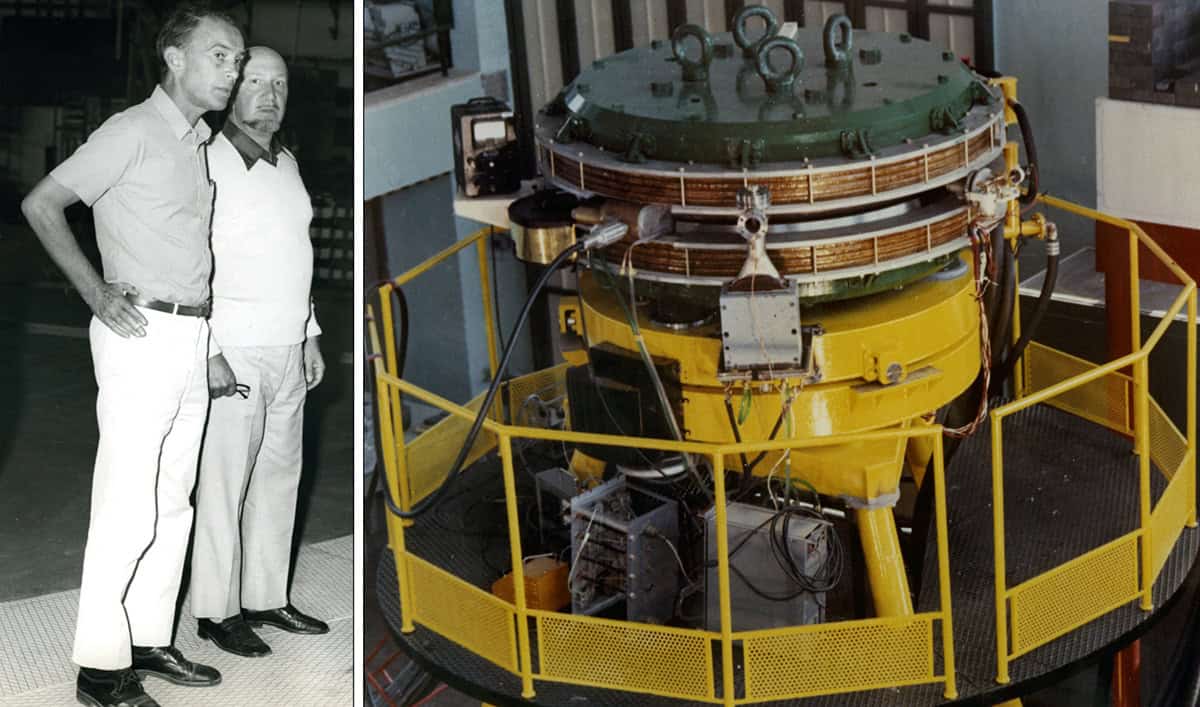
Collision course Left: Touschek in 1966 with Italo Federico Quercia, director of the Frascati National Laboratory, overseeing the construction of the ADONE electron–positron collider. ADONE was a higher energy evolution of the AdA collider (pictured right), which Touschek had spearheaded and was to become a prototype for many future devices around the world. (Courtesy: INFN–LNF)
Touschek’s understanding of CPT led him to realize that electron–positron colliders, which accelerate matter and antimatter along the same orbit but in opposite directions, would be vital for the future of physics. Convinced by the CPT theorem that electrons and positrons could be smashed into – and annihilate – each other, in 1960 he started leading a team of Frascati scientists to build a prototype. This was AdA, which began operations in February 1961.
To prove its feasibility as a research device, the 1.3 m-diameter device was transported to the Orsay lab near Paris where the first electron–positron collisions were observed by a team of French and Italian researchers in late 1963. Key to AdA’s success was the exceptional cadre of young theoretical physicists at Rome and the technical and scientific staff both in Frascati and Orsay. Although it never led to annihilation or produced novel particles, AdA was a testbed for a new breed of machines.
Lasting legacy
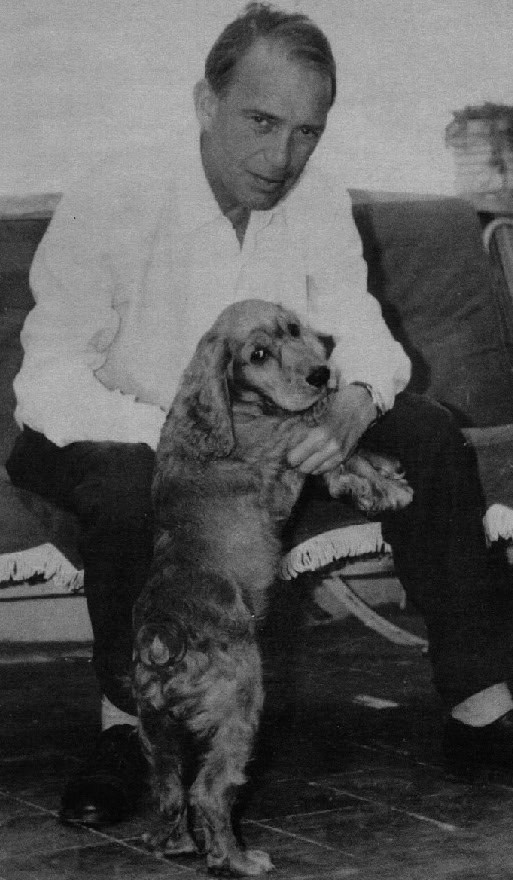
Down time Touschek relaxing at his home in Rome in 1970 with his cocker spaniel Lola. (Courtesy: Touschek family)
Touschek’s visionary thinking soon inspired other large physics labs in France, the Soviet Union and the US to build similar electron–positron colliders, opening the door to the discovery of new particles. AdA thus laid the foundations to the Standard Model of particle physics and changed the face of physics itself. Touschek was able to see some of these great events, such as multihadron production at ADONE and the discovery of charm quarks.
In 1977 he spent a year’s sabbatical at CERN, where the Super Proton–Antiproton Collider and the Large Electron–Positron collider (LEP) were going to be built. Not a fan of big international enterprises, which Touschek felt were becoming too bureaucratic and complex, he nevertheless enjoyed keen discussions with Carlo Rubbia about stochastic cooling – a technique to create a stock of antiprotons that could be annihilated with protons to discover the carriers of the weak force.
However, in February 1978 Touschek’s health started rapidly declining. After a number of hospitalizations, he asked CERN’s then director-general, Léon Van Hove, for a car to drive him to Innsbruck in Austria. The country of his birth, it was a place he had loved all his life. Touschek, who died on 25 May 1978, never got to witness the renaissance of particle physics – the experimental discovery of the W and Z bosons, the top quark and the Higgs boson – in the years and decades that followed.
But his legacy as a visionary scientist, who showed wisdom, stamina and perseverance – despite all the odds – lives on.
The European Space Agency (ESA) has released the first science results from its €1.4bn Euclid mission. Today, the space agency has released five spectacular images of the cosmos along with 10 scientific papers as part of Euclid’s early release observations.
Euclid was launched in July 2023 and is currently located in a spot in space called Lagrange Point 2 – a gravitational balance point some 1.5 million kilometres beyond the Earth’s orbit around the Sun. The Euclid Consortium comprises some 2600 members from more than 15 countries.
Euclid has a 1.2 m-diameter telescope, a camera and a spectrometer that it uses to plot a 3D map of the distribution of more than two billion galaxies. The images it takes are about four times as sharp as current ground-based telescopes.
In November, following weeks of calibrations, Euclid released its first full-colour images of the cosmos. Then in early 2024 it began science operations, studying 17 astronomical objects including distance galaxies and nearby dust clouds.
The images and resulting science findings released today were produced with only a single day of observations. They reveal 11 million objects in visible light and a further five million in the infrared. Some of the new discoveries include free-floating newborn planets, newly identified extragalactic star clusters and new low-mass dwarf galaxies.
The five images include a breathtaking image of Messier 78, which is a star nursery that is enveloped in interstellar dust and lies some 1300 light-years away in the Orion constellation. This marks the first time that the region has been taken as this width and depth.
“It’s no exaggeration to say that the results we’re seeing from Euclid are unprecedented,” says ESA science director Carole Mundell. “Euclid’s first images, published in November, clearly illustrated the telescope’s vast potential to explore the dark Universe, and this second batch is no different.
The other four images released today are shown below.
Galaxy cluster Abell 2390
Galaxy cluster Abell 2390 (courtesy: ESA/Euclid/Euclid Consortium/NASA, image processing by J-C Cuillandre (CEA Paris-Saclay), G Anselmi; CC BY-SA 3.0 IGO)
This image of galaxy cluster Abell 2390, which lies 2.7 billion light-years away in the Pegasus constellation, reveals more than 50,000 galaxies. This giant conglomeration of galaxies contains a huge amount of mass, much of it being in the form of dark matter. This makes the cluster an ideal place to study the dark universe.
Galaxy cluster Abell 2764
Galaxy cluster Abell 2764 (courtesy: ESA/Euclid/Euclid Consortium/NASA, image processing by J-C Cuillandre (CEA Paris-Saclay), G Anselmi; CC BY-SA 3.0 IGO)
This image shows the galaxy cluster Abell 2764 (top right), which lies a billion light-years away in the direction of the Pheonix constellation. It comprises hundreds of galaxies within a vast halo of dark matter. Also seen here is a very bright foreground star, known as V*BP-Phoenicis, which lies within our own galaxy and is almost bright enough to be seen by the human eye.
Galaxy NGC 6744
Galaxy NGC 674 (courtesy: ESA/Euclid/Euclid Consortium/NASA, image processing by J-C Cuillandre (CEA Paris-Saclay), G Anselmi; CC BY-SA 3.0 IGO)
NGC 6744, which lies some 30 million light-years away, is a typical example of the kind of galaxy that is currently forming most of the stars in our local Universe. Euclid’s large field-of-view covers the entire galaxy, capturing not only spiral structure on larger scales but also smaller details such as lanes of dust emerging from “spurs” from the spiral arms. The dataset will allow Euclid to identify clusters of old stars and search for new dwarf galaxies.
Dorado galaxy group
Dorado galaxy group (courtesy: ESA/Euclid/Euclid Consortium/NASA, image processing by J-C Cuillandre (CEA Paris-Saclay), G Anselmi; CC BY-SA 3.0 IGO)
Euclid captures galaxies evolving and merging ‘in action’ in the Dorado galaxy group, which lies some 62 million light-years away. As Dorado is a lot younger than other clusters, several of its constituent galaxies are forming stars and are still interacting with each other. Scientists are using these images to study how galaxies evolve and collide over time.
Tackling the big questions
Over the coming six years, Euclid will continue to study the large-scale structure of the universes, creating the largest cosmic 3D map ever made, with the aim of understanding how the universe evolved following the Big Bang.
“This space telescope intends to tackle the biggest open questions in cosmology,” notes Euclid project scientist Valeria Pettorino. “And these early observations clearly demonstrate that Euclid is more than up to the task.”
Euclid’s next data release will focus on its primary science objectives and is currently slated for March 2025 with a wider data release scheduled for June 2026.
The fate of so-called “hot Jupiter” exoplanets is as fiery as it is inevitable. Over billions of years, these exoplanets – which have about the same mass as the familiar giant planet Jupiter, but much smaller orbits – will gradually spiral in towards their host stars until they collide with them.
For some hot Jupiters, though, this moment of reckoning isn’t happening as quickly as theory predicts – and now astrophysicists think they know why. According to a team led by Craig Duguid of Durham University, UK, the stars’ magnetic fields may be partially dissipating the gravitational tides responsible for the “doom spirals” of orbiting hot Jupiters. This explanation, which the team obtained by analyzing models of stars with convective cores, is consistent with observations of the exoplanet WASP-12b, which is destined to crash into its host star in just a few million years.
Of the more than 5000 exoplanets discovered to date, hot Jupiters are by far the most common type. This is partly due to limitations in observational techniques: because hot Jupiters are so massive, and orbit so close to their host stars, it is relatively easy to spot their effects with powerful telescopes. But their closeness is also their downfall, as it subjects both the hot Jupiters and their hosts to powerful gravitational tides. These tides transfer orbital energy from the exoplanet to the star, causing the planet’s orbit to decay until the planet is “swallowed up” by its host.
A wave-breaking hypothesis
WASP-12b, discovered in 2008 by the SuperWASP planetary transit survey, is a prime example of a doomed hot Jupiter. Thanks to its decaying orbit, it is due to collide with its host star, WASP-12, in a few million years, which is quite soon in astronomical terms.
The problem is that current theories of gravitational tides cannot fully explain WASP-12b’s orbital decay. One hypothesis that might resolve the discrepancy involves internal gravity waves (IGWs) that propagate towards the centre of the host star. Strong gravitational tides are known to excite IGWs, and recent work has shown that if IGWs reach the centre of the star, they can break in the same way as water waves break on a beach. Wave breaking is an extremely efficient source of tidal dissipation, as all the energy in the IGWs is lost to turbulence and heating. Indeed, it could provide enough dissipation to explain WASP-12b’s orbital decay – except for one thing.
“Wave breaking cannot occur if the star has a convective core – and WASP-12 does,” Duguid says, adding that it belongs to the family of F-type stars, which are 1.2 to 1.6 times heavier than our Sun and have convective cores.
This discovery left the tidal and observational community stunned, he says. “No other tidal theory could predict anything close to the amount of dissipation required for the rate of orbital decay observed – for example, my own study would suggest billions of years rather than a few million – but if the tidal theory was right, then the observations were wrong.”
A magnetic explanation
As an alternative, Duguid and colleagues focused on WASP-12’s magnetic field. Previous studies of how IGWs might convert into magnetic waves were carried out in a non-tidal context, but Duguid thinks such a conversion could happen for tidally excited IGWs, too – with important consequences. “Instead of the IGWs needing to reach the centre where they could break, they need only encounter a strong enough magnetic field that will cause them to be converted into outwardly propagating magnetic waves,” he explains. “These are then dissipated into heat.”
The mechanism is as efficient as wave breaking, he adds, since all the IGW energy is again lost to heat and turbulence. And importantly, it should still operate in stars that have convective cores – and probably won’t in stars that don’t. “The reason is that a convective core is likely to have a convectively driven dynamo able to generate a strong magnetic field,” he tells Physics World. “For WASP-12b, this mechanism can exist and hence explain the orbital decay rate while still agreeing with the observations.”
New mechanism for tidal dissipation
The Durham researchers, who detail their work in The Astrophysical Journal Letters, obtained their result by using the MESA code to assess whether IGWs could convert into magnetic waves for other F-type stars using estimates of the magnetic fields produced by a convective dynamo in the stellar cores.
“As well as being consistent with the observed inspiral of WASP-12b, we found that this previously unexplored source of efficient tidal dissipation can also operate in such stars over a significant fraction of their lifetimes,” Duguid says.
More generally, it could play an important role in how the orbits of hot Jupiters – and indeed other planets with ultra-short orbital periods – evolve over time, he adds.
“One important implication is that this new mechanism can guide observers to promising targets to detect tidally-driven orbital decay. Currently, only the orbit of WASP-12b has been confirmed to be decaying, but we expect many other planets orbiting F-type stars should be, too.”
Given the novelty of this mechanism for tidal dissipation, Duguid says there is much work to be done to understand the details of the fluid dynamics behind it and find out where the dissipated tidal energy goes within the star’s interior. “It is also quite exciting that the mechanism might be observationally tested within our lifetime,” he adds.
Three new protocols for generating verifiable quantum entanglement between two nodes in a network have been developed independently by teams in China, Europe and the US. The research, which allows distant quantum memories to exchange quantum information, may constitute a step towards a quantum version of the Internet in which photons travelling down standard optical fibres are used to entangle spatially separated quantum computers.
The delicate nature of quantum information means it does not travel well. A quantum Internet therefore needs devices known as quantum repeaters to swap entanglement between quantum bits, or qubits, at intermediate points. Several researchers have taken steps towards this goal by distributing entanglement between multiple nodes.
In 2020, for example, Xiao-Hui Bao and colleagues in Jian-Wei Pan’s group at the University of Science and Technology of China (USTC) entangled two ensembles of rubidium-87 atoms in vapour cells using photons that had passed down 50 km of commercial optical fibre. Creating a functional quantum repeater is more complex, however: “A lot of these works that talk about distribution over 50, 100 or 200 kilometres are just talking about sending out entangled photons, not about interfacing with a fully quantum network at the other side,” explains Can Knaut, a PhD student at Harvard University and a member of the US team.
Excited atoms
In their latest work, which is published in Naturealongside that of the Harvard team, Bao and colleagues present a more practicable system. At each node, they use a scheme called the Duan-Lukin-Cirac-Zoller (DLCZ) protocol that involves injecting a laser pulse into each of their atomic ensembles. This “write” pulse is composed of many photons, Bao explains, and there is a small chance that it will excite one atom to another state. The excited atom then spontaneously emits a photon, becoming entangled with a collective state of the atomic ensemble in the process. The emitted photons are then sent to a central node, where a measurement is performed that entangles the two ensembles.
The catch is that the DLCZ protocol requires the write pulses at each node to be phase-coherent, which is hard to achieve in spatially separated nodes. In their 2020 work, the USTC researchers did it by sending pulses from the same laser through a beamsplitter, but this would be impractical for real-world networks. In the new work, they stabilized the phases of independent lasers in three locations approximately 12.5 km apart around a central node and demonstrated that they could entangle ensembles at all of them. “By using atomic ensembles it is rather easy to convert from atomic qubits to single photons,” Bao notes.
Diamond memories
The other two teams worked with solid-state quantum memories made from vacancy centres in diamond. The first, headed by Ronald Hanson at QuTech in the Netherlands, stores the state of the qubit in the electronic state of a nitrogen-vacancy centre, as described in a recent arXiv preprint. The second, led by Harvard’s Mikhail Lukin, uses silicon-vacancy centres. These have a much more stable and coherent optical transition than their nitrogen counterparts, but their electronic spins are less stable, losing coherence within about 200 μs.
This short coherence time is problematic because entanglement cannot be used to transfer information unless the entangled states remain coherent long enough for the entanglement to be “heralded” – that is, for information to travel down a classical channel and confirm the success of the entangling operation: “If you cannot store your entanglement longer than a couple of hundred microseconds it’s essentially useless, because at the point when you want to start using it it’s already gone,” Knaut says.
The Harvard team circumvented this problem using something called a photon-nucleus entangling (PHONE) gate, which members of Lukin’s group invented in 2022. “This PHONE gate utilizes the electron spin, but only temporarily as an interface: it immediately transfers the information to the nuclear spin, and the nuclear spin is very long-lived,” Lukin says.
Lukin and colleagues also avoided the need to measure the photons at a central node. Instead, they used a serial entanglement protocol. “When the photon comes to the first node, it gets entangled – you basically do a gate operation between the photon and one of the qubits in the memory,” explains Lukin. “Then the photon comes to another node, you do another logic gate between the photon and the memory, and then eventually you measure a photon. It’s like a distributed quantum computer.”
The flexibility of this scheme enabled them to avoid keeping track of the phase of the photon emitted directly from the vacancy. Instead, they encoded the state of the qubit into two “time bins” – peaks in the electomagnetic field spaced 142 ns apart: “It’s a single photon conceptually but it is a superposition of two time bins,” Knaut says.
Telecom progress
Chris Monroe of Duke University, US, who was not involved in any of the works, finds one aspect of them interesting: “Quantum systems are very discriminating: they work with very specific colours of light, and they don’t typically tend to be telecom [wavelengths],” he says. “Each of these groups has converted the native photon to a telecom photon and that has allowed them to go over a long distance.”
Apart from this, however, he is sceptical. “The ‘quantum Internet’ are two buzzwords that don’t mean a hell of a lot,” he says. “To build a big computer you’re going to need a quantum network, but it can be on one chip…We’re going to use photons to scale up, period. In a sense, this recent work is sort of irrelevant to that pursuit.”
With a puffy structure rather like candy floss, WASP-107 b is a giant exoplanet 200 light-years away from Earth in the constellation Virgo. Almost as big as Jupiter, but less than one-tenth the mass, it is one of the least dense exoplanets known.
But two independent teams of researchers have now had some other surprises. After analysing spectral data from NASA’s James Webb Space Telescope (JWST), they discovered that WASP-107 b has far less methane, is much hotter and has a much bigger core than previously thought.
In the first study, led by David Sing from Johns Hopkins University, the researchers analysed the transmission spectrum of WASP-107 b from the JWST’s Near-Infrared Spectrograph (NIRSpec). They found that the planet’s methane levels were a thousand times lower than expected.
The measurements, reported in Nature, suggest that methane transforms into other compounds as it flows upward from the planet’s interior and interacts with other chemicals and starlight in the upper atmosphere.
The researchers propose that it’s the planet’s hot core driving this strong, convective mixing, with hot gas from deep in the planet mixing vigorously with cooler layers higher up and causing the chemistry of the gases to change. Indeed, the NIRSpec data also revealed the presence of sulphur dioxide, water vapour, carbon dioxide and carbon monoxide.
The findings represent the clearest connection that scientists have been able to make about the interior of an exoplanet and the top of its atmosphere, the researchers say.
“Looking into the interior of a planet hundreds of light-years away sounds almost impossible, but when you know the mass, radius, atmospheric composition, and hotness of its interior, you’ve got all the pieces you need to get an idea of what’s inside and how heavy that core is,” says Sing in a press statement.
Data analysis Transmission spectrum showing the amounts of different wavelengths of starlight blocked by the atmosphere of WASP-107 b. The spectrum shows clear evidence for H2O, CO2, CO, CH4, SO2 and NH4 in the atmosphere. (Courtesy: Illustration: NASA, ESA, CSA, Ralf Crawford (STScI); Science: L Welbanks (ASU) and the JWST MANATEE team)
In a parallel study, also published in Nature, a team headed up by Luis Welbanks from Arizona State University (ASU) combined observations from the JWST’s Near-Infrared Camera and Mid-Infrared Instrument with those from Hubble’s Wide Field Camera 3. As found in Sing’s study, the researchers measured surprisingly little methane in the atmosphere of WASP-107 b, indicating that the interior of the planet is significantly hotter than originally thought.
They attribute the unexpected high temperature to a process called tidal heating. Here, the planet’s slightly elliptical 5.7-day orbit results in a continuously changing gravitational pull, which physically distorts the planet and heats it up.
The spectra also enabled the researchers to estimate the size of the planet’s core. Using the energy in the planet and the ratio of heavier elements (carbon, nitrogen, oxygen and sulphur) to hydrogen and helium, they calculated the core mass, finding it to be at least twice as massive as originally estimated.
Together, the data suggest that WASP-107 b comprises a relatively large core surrounded by a relatively small mass of hydrogen and helium gas inflated by tidal heating of the interior. The findings help solve the mystery of the planet’s unusual structure – puffy planets are not uncommon, but WASP-107 b is significantly cooler and more Neptune-like in mass than most other low-density planets studied.
“The Webb data tell us that planets like WASP-107 b didn’t have to form in some odd way with a super small core and a huge gassy envelope,” explained ASU’s Michael Line. “Instead, we can take something more like Neptune, with a lot of rock and not as much gas, just dial up the temperature, and poof it up to look the way it does.”
Whenever the quantum community comes together, there is always one thing that everyone can agree on: the need for more scientists and engineers with the specialist skills needed to build and operate quantum computers. While increased investment into the sector is certainly helping to swell the ranks of PhD students and early-career researchers with experience of both quantum hardware and software, their numbers are still likely to fall short of rising demand across academia, the burgeoning start-up sector, and larger organizations that are now looking to develop their own capability in this transformative technology.
Skills development and training has therefore become a crucial priority for the UK’s National Quantum Computing Centre (NQCC) as it works to build a quantum-ready economy. “Our aim is to build a talent pipeline that offers accessible routes into quantum computing for people at all stages of their career,” says Abby Casey, Quantum Readiness Delivery Lead at the NQCC. “We want to lower the barrier to entry, ensure that quantum computing is perceived as a desirable and attainable career option, and make it easier for people to imagine themselves as part of the future quantum workforce.”
Inspiring and upskilling
Some of the NQCC’s activities are clearly aimed at inspiring and supporting the next generation of quantum scientists and engineers. A summer school organized in collaboration with the University of Oxford offers sixth-form students an early insight into quantum computing, and includes visits to local quantum companies to show how such a futuristic technology has become a commercial reality. The NQCC also offers a growing number of summer placements across its technical and innovation teams, providing undergraduate students with direct experience of working in the quantum sector. “We want to provide opportunities for young people to participate, and to help them figure out whether this is a career they might be interested in,” explains Casey.
At the post-graduate level, meanwhile, Casey and her team are now scoping wide-ranging support packages for a new clutch of Centres for Doctoral Training (CDTs) that will be focused on quantum technologies – with the UK’s National Quantum Strategy aiming to train 1000 new PhD students across all areas of quantum science and engineering by 2033. Dedicated tutorials and training workshops will be run at the NQCC to help the students develop specific technical skills, and to provide them with a wider understanding of the quantum ecosystem and the impact of the technology on society. More tailored support to meet the needs of each CDT could include collaborative project work, access to quantum computing resources, community events, or placements at the national lab.
Equally important will be to enable technical specialists already working in adjacent fields – such as computer science, mathematics or physics – to develop the specialist skills and knowledge needed to work with quantum computers. “The numbers of fresh PhD students are relatively small compared with the existing workforce of scientists and engineers,” says Casey. “We want to provide upskilling opportunities for people with different backgrounds and experiences, and to offer them greater clarity on potential pathways into specific jobs within the quantum ecosystem.”
As a starting point, the NQCC has launched a non-mathematical, self-paced online course that offers a flexible and interactive learning environment for exploring the underpinning physics through to programming a quantum computer. For those who want to take a deeper dive, two intensive short courses are being run in partnership with the University of Bristol, with the NQCC offering a number of bursaries to cover the costs of the training. The first six-week programme provides a thorough grounding in quantum information theory, while the second builds on that knowledge to enable participants to understand key quantum algorithms and error-correction techniques.
“These courses are now in their third year, with participants including industry professionals, academic researchers and staff from the public sector,” comments Casey. “People who complete the training gain the skills and competencies that are highly relevant for a wide range of quantum roles.”
Building a pipeline With the UK’s National Quantum Strategy aiming to train 1000 new PhD students by 2033, the NQCC is developing support packages for new Centres for Doctoral Training focused on quantum technologies. (Courtesy: NQCC)
Alongside these formal courses, the NQCC also offers opportunities for industry professionals to experiment with emerging quantum algorithms and hardware. Through its SparQ user engagement programme the national lab has convened workshops focusing on particular industry sectors, including financial services, healthcare and pharmaceuticals, to explore the potential of quantum computing for tackling specific use cases. This has led to a number of pilot studies that are enabling end users to work alongside quantum experts to tackle problems that are relevant for their industry.
Ready, steady, hack
Learning and skills development are also central themes for the UK’s Quantum Hackathon, an annual event organized by the NQCC that this year will run for the third time at the University of Warwick on 22-24 July. During the event teams of hackers are challenged to devise quantum solutions to real-world problems posed by end users from different industry sectors, and to test their solutions using quantum processors based on different technology platforms. “There’s nothing like writing a piece of code, and running it on a real quantum computer, to engage with the technology and to understand its capabilities,” says NQCC director Michael Cuthbert.
For the hackers, most of whom are graduate students or early-career researchers, the open and collaborative working environment offers a way to exchange ideas, enhance their existing skills in quantum computing, and understand how different algorithms could be used in a range of practical scenarios. “It’s really good take a use case and connect it back to the quantum algorithms that could be used to solve the problem,” comments Maria Violaris, a PhD student at the University of Oxford. “Working with people from different backgrounds and with different levels of experience has been a great way to accelerate learning.”
For the industry mentors, meanwhile, the event offers a valuable opportunity to gain direct experience of using quantum hardware and software, and to explore emerging tools and techniques with expert assistance from the technology providers and the NQCC’s applications engineers. While some of the industry partners may have already taken steps to establish their own capability in quantum computing, for others it offers some early experimentation to understand the current capabilities of this rapidly evolving technology and how it could be used in their industry.
It’s clear to me that everyone who takes part in these events can learn something that they can take forward into their own work and future careers
In another important learning point, the teams are also challenged to explore the wider societal context of their solutions. “Responsible and ethical innovation, which aims to anticipate potential impacts, mitigate harms, and maximize the benefits, is increasingly recognized as a critical component of the innovation process,” comments Casey. “By introducing the teams to some key concepts at the start of hackathon, and asking them to build those ideas into their solutions, it is more likely that they will consider this important perspective as part of their own development work.”
The shared learning and knowledge exchange enabled through such an interactive and inclusive event epitomizes the overall ethos of the SparQ programme. “We want our teams to explore the types of problems that can be tackled by quantum computers, and to find out whether the technology offers the scale, performance and maturity to approach the use cases provided by our industry partners,” says Cuthbert. “It’s clear to me that everyone who takes part in these events can learn something that they can take forward into their own work and future careers.”