Superconducting wire turns to electrical power

The discovery of superconductivity at 39 K in the metallic compound magnesium diboride two years ago created quite a stir. Since then, physicists and chemists have come a long way in understanding the curious set of circumstances that lead to such a high critical temperature in this widely available material. At the same time, metallurgists, engineers and entrepreneurs have been focusing on the commercial potential of magnesium diboride as superconducting wire, which was the subject of a one-day meeting in Cambridge, UK, in April.

Superconducting wire made from magnesium diboride could make “second- generation” electrical machines commercially viable.

Read this article, by Philip Sargent of Diboride Superconductors, in the June issue of Physics World.

Big break for charge symmetry

Symmetry breaking is often seen as a bad thing. The greater the asymmetry in our faces, so we are told, the less attractive we appear to others. However, if nature did not break a subtle symmetry called charge symmetry to a very small extent, the implications would be somewhat more severe. Protons and neutrons would weigh the same, and the Sun would never have shone.

Symmetry is a crucial concept in the theories that describe the subatomic world because it has an intimate connection with the laws of conservation. For example, the fact that physics is the same – or invariant – everywhere in the universe means that linear momentum is conserved. Some symmetries, such as rotational invariance, are perfect. Others, such as parity, are broken by small amounts, and the corresponding conservation law therefore only holds approximately.

The theory of the strong interaction between quarks – quantum chromodynamics – is approximately invariant under what is called charge symmetry. In other words, if we swap an up quark for a down quark, then the strong interaction will look almost the same. This symmetry is related to the concept of “isospin”, and is not the same as charge conjugation (in which a particle is replaced by its antiparticle).

Charge symmetry is broken by the competition between two different effects. The first is the small difference in mass between up and down quarks, which is about 200 times less than the mass of the proton. The second is their different electric charges. The up quark has a charge of +2/3 in units of the proton charge, while the down quark has a negative charge of -1/3.

If charge symmetry was exact, the proton and the neutron would have the same mass and they would both be electrically neutral. This is because the proton is made of two up quarks and a down quark, while the neutron comprises two downs and an up. Replacing up quarks with down quarks, and vice versa, therefore transforms a proton into a neutron. Charge-symmetry breaking causes the neutron to be about 0.1% heavier than the proton because the down quark is slightly heavier than the up quark.

The electrostatic repulsion between quarks, however, should make the proton heavier, since it contains two up quarks with charges of +2/3. This makes the electromagnetic interactions inside the proton stronger than those inside the neutron, so they should contribute to a greater mass. But the mass difference between the quarks wins over their electrostatic repulsion by a factor of about two, making it the dominant cause of charge-symmetry breaking.

Mass effect

The neutron-proton mass difference has important consequences for the structure of the universe because it means that a neutron can decay into a proton (plus an electron and an antineutrino) in radioactive beta decay. When protons and neutrons combined to form elements in the first few minutes after the Big Bang, the resulting elemental abundances depended on the neutron-proton mass difference. All the neutrons that survived were bound inside nuclei, which left many protons free. It is the interactions between these protons that are the main source of energy in stars like the Sun.

It should be possible to calculate the masses of the neutron and proton using quantum chromodynamics (QCD) and electromagnetism. But QCD is an untamed beast. The interactions between quarks are so strong that it makes calculations extremely difficult, and capturing the small effects of the up-down quark mass difference is akin to finding gold in a mountain of sand. The only way to improve the current state of our knowledge is to perform difficult experiments.

Physicists had already elucidated certain aspects of charge-symmetry breaking, but our spirits were raised greatly when we heard of the recent work of Allena Opper of Ohio University in the US and co-workers at the TRIUMF laboratory in British Columbia, Canada. Her team has been trying to observe a small charge-symmetry-breaking effect for several years, using neutron beams at the TRIUMF accelerator. The researchers studied the production of neutral π-mesons (pions) when a neutron is captured by a proton in a hydrogen target to form a deuteron. The probability, or cross-section, for this n + p → d + π0 reaction to occur depends on the angle, θ, between the momentum of the outgoing pion and that of the incident neutron beam (see figure 1).

Interchanging a neutron and a proton under charge symmetry is identical to changing the angle of the outgoing pion by 180°. The observed cross-section should therefore be symmetric about 90° if charge symmetry is an exact symmetry, which means that finding a slight asymmetry in the n + p → d + π0 cross-section would provide strong evidence for charge-symmetry breaking. But this is not easy. The TRIUMF team had to overcome the technical challenge that the pions do not have sufficient energy to escape from the hydrogen target. Instead the researchers relied on detecting the deuterons, which have more energy and do escape.

But how does the mass difference between the up and down quarks in protons and neutrons relate to neutral-pion production in the first place? The pion consists of up and down quarks and antiquarks, and its wavefunction, uu-bar-dd-bar, becomes -(uu-bar-dd-bar) under the charge-symmetry operation. In the the n + p → d + π0 reaction, charge symmetry allows the production of a similar particle to the pion called an eta-meson, η, which has a wavefunction uu-bar-dd-bar. Unlike the pion, the η wavefunction is unchanged by the charge-symmetry operation, which means that charge-symmetry breaking sometimes causes the η to transform into a π0 as it flies out of the reaction. This is the quantum-mechanical analogue of transforming an apple into a pear as it falls from a tree.

Backwards and forwards

Charge-symmetry breaking also manifests itself in the interactions of pions with protons and neutrons in a very interesting way that is linked to the neutron-proton (and hence, up and down quark) mass difference. Because the masses of the up and down quarks are almost zero, another approximate symmetry of QCD called “chiral” symmetry comes into play. This symmetry relates to the spin angular momentum of fundamental particles. Quarks can either be “right-handed” or “left-handed”, depending on whether their spin is clockwise or anticlockwise with respect to the direction they are moving in. Both of these states are treated approximately the same by QCD.

Two years ago the present authors teamed up with Jouni Niskanen from the University of Helsinki in Finland to see how the different manifestations of charge symmetry are revealed in the TRIUMF experiment. Mixing between η and π mesons causes an asymmetry in the direction of the incoming (forward) neutron beam. But we predicted that chiral symmetry would cause pion interactions to overcome the η-π mixing and generate a preference for pions to emerge in the backward direction.

We anxiously waited while the experimentalists were busy at work, and they have now just announced their results – an asymmetry in pion production of about a two parts in 1000 towards the backward direction. But the game is not over yet. The effect is smaller than we expected so there is still something that we do not understand. Enter another experimental team, led by Andy Bacher and Ed Stephenson at Indiana University in the US.

Since the 1950s experimentalists have been trying to detect the formation of a neutral pion and an alpha particle in the fusion of two deuterons, d + d → α + π0. The wavefunctions of both the deuteron and the alpha particle are invariant under the interchange of up and down quarks but recall that the pion wavefunction is not. The initial state of the reaction is therefore “even” under charge symmetry, but the final state is odd. In other words, charge symmetry would prevent this reaction from ever occurring.

Bacher and Stephenson noticed that the exquisite capabilities of the Indiana University Cyclotron Facility (IUCF) could allow a measurement of this reaction for the first time, provided it had the cross-section that we had estimated. In the IUCF set-up, a deuterium beam is focused onto a target of the same material, and the high precision of the accelerator means that the beam energy can be set at the correct energy to produce neutral pions – without producing any other particles. Sensitive detectors can track the alpha particles produced and capture the two photons that are produced when the pion subsequently decays.

The experiment was approved and everything was set and ready, except for the fact that the IUCF was already scheduled to be transformed into a materials and medical research facility. Bacher and Stephenson’s team worked frantically for two months and finally produced two separate observations of a beautiful peak at exactly the right pion energy. Their experimental cross-section is almost the same as our estimate, and this measurement of such a small charge-symmetry-breaking probability is an immense technical achievement.

Up and down

Now the ball is back in the theorists’ court. A large group, including Antonio Fonseca at the University of Lisbon in Portugal, Anders Gardestig and Chuck Horowitz at Indiana University, Andreas Nogga at the University of Arizona, and the present authors, is carrying out the task of turning the initial estimate of the cross-section of the d + d → α + π0 reaction into a reliable calculation. The same charge-symmetry-breaking mechanisms contribute to both the TRIUMF and IUCF experiments, which means that together they can provide important information on the mass difference between up and down quarks.

The origin of the quark masses is not fully understood. In the Standard Model of particle physics, the Higgs mechanism allows the generation of such masses but it cannot predict the actual mass values. This is like having a recipe to make cookies that will work with either chocolate chips or nuts. Why are the masses of the up and down quarks almost the same, and why are the masses of the other four quarks so very different? No fundamental understanding of this mass hierarchy exists. But the TRIUMF and IUCF experiments mean that nature’s violation of charge symmetry can now be used to tackle at least the up-down piece of this puzzle.

The many worlds of Murray Gell-Mann

Murray Gell-Mann’s reputation precedes him as he walks through the lobby of the Shelbourne Hotel in Dublin for an interview with Physics World. Gell-Mann received the Nobel prize in 1969 for his contributions to elementary particle theory, most notably for the development of the quark model, and there are countless stories about how clever he is. “He has a more profound knowledge of a wider range of subjects than anyone living” wrote fellow Nobel laureate Philip Anderson in a review of Gell-Mann’s popular book The Quark and the Jaguar.

In his prime, Gell-Mann enjoyed a “two-decade reign as emperor of elementary particles” according to Sheldon Glashow, also a Nobel laureate in particle theory. But there is another side to him, as Glashow explained in a review of Strange Beauty, a recent biography of Gell-Mann written by George Johnson of the New York Times. “Not only did Gell-Mann devise the lion’s share of today’s particle lore,” wrote Glashow, “but on first acquaintance you would soon learn, through his painfully in-your-face erudition, that he knew far more than you about almost everything, from archaeology, birds and cacti to Yoruban myth and zymology.”

There are countless myths about Gell-Mann, and every time a book or an article by or about him is published, more stories and anecdotes are added to the legend. Indeed there are so many stories about Gell-Mann that it would be easy to write an article about him without ever actually meeting him. And at one stage it looked as if that might happen as Gell-Mann – trying to complete a lecture that he was due to give the following day – cancelled an interview with Irish radio and re-arranged his encounter with Physics World for a second time.

But when Gell-Mann does arrive, it is hard to disagree with Johnson’s claim in the prologue to Strange Beauty that “contrary to so many of the legends, Gell-Mann likes people and conversation”. However, his mood changes towards the end of the interview when the conversation turns to Johnson’s biography. Has he read it? “I have looked through it,” Gell-Mann winces, “but it is so painful.”

So what is the truth about some of the most famous myths? Did Gell-Mann really not write up his Nobel lecture? “I did have a written version of the lecture that I gave in Sweden, but I was not satisfied with it and did not submit it,” he explains. “I tried to write a better one, including an adequate discussion of quarks, and agonized over it for months, but in the end, I did not finish it in time for it to be included in the volume.”

Gell-Mann says that he often agonizes over writing projects. “On many occasions it has delayed my writing up research, often by a year or more. By that time, it has sometimes happened that another theorist has had a similar idea and has written it up more quickly.” Why does he agonize? “I often have a neurotic difficulty with deciding how to put things and in what order. It may stem from my father’s criticism of my writing when I was young – he was a perfectionist and I became one too.”

Quirks and quarks

Another common claim is that Gell-Mann did not actually believe that quarks were real physical entities. “That is baloney,” he says. “I have explained so many times that I believed from the beginning that quarks were confined inside objects like neutrons and protons, and in my early papers on quarks I described how they could be confined either by an infinite mass and infinite binding energy, or by a potential rising to infinity, which is what we believe today to be correct. Unfortunately, I referred to confined quarks as ‘fictitious’, meaning that they could not emerge to be utilized for applications such as catalysing nuclear fusion.” Gell-Mann says that he “did not want to get into debates with philosophers over whether particles that cannot emerge singly can be regarded as real”.

So did Gell-Mann get on with the late Richard Feynman when they were both at Caltech and probably the two most famous physicists in the world? “I was initially a great admirer of Dick Feynman, and I know that he thought highly of me and of my research,” he recalls. “We worked together for a number of years, but I found that he had difficulty thinking in terms of ‘us’. He acted as if the only thing that mattered was his understanding of what was going on. It was all ‘I, I, I,’ and eventually it got on my nerves.” Matters came to a head when Feynman published a book of anecdotes called Surely You’re Joking, Mr Feynman. “Some of the sentences in the book were outrageous and I made him change them in the paperback version.”

Gell-Mann’s contributions to particle physics are immense, as Sidney Coleman of Harvard University made clear in a review of The Quark and the Jaguar: “Strangeness, the renormalization group, the V-A interaction, the conserved vector current, the partially conserved axial current, the eightfold way, current algebra, the quark model, quantum chromodynamics – and this is the shortlist.”

Does Gell-Mann still follow developments in physics? “I do not keep up with the details of particle physics,” he says, “but I try to have a general idea of what is going on.”

When he wrote The Quark and the Jaguar back in the early 1990s, Gell-Mann was confident that superstring theory would ultimately be successful in combining the general theory of relativity with quantum mechanics. Is he still confident that superstring theory – now known as M-theory (see Physics World March 2002 p8) – will ultimately be successful? “I still think that it is very likely,” he replies, “but it is essential to describe M-theory and to extract its predictions.” And does he think that progress in superstring theory is moving fast enough? “You know how it is with human endeavours,” he replies. “Enthusiasm is followed by disappointment and even depression, and then by renewed enthusiasm.”

So when and why did Gell-Mann move away from the simple – if quarks and the Standard Model of particle physics can be called simple – and start getting interested in the complex? “I have been interested in phenomena involving complexity, diversity and evolution since I was a young boy,” he says, “but it so happened that I took up elementary particle theory. Now, at the Santa Fe Institute, I can do research on both the simple and the complex.” Gell-Mann chose the title of his book – The Quark and the Jaguar – to reflect his interest in both the simple and the complex, and also his concerns about sustainability and the maintenance of biological and ecological diversity

So what is complexity? “There are many different definitions of complexity,” he says, “but when we talk about it in ordinary conversation – and in most scientific discourse as well – we really mean what I call ‘effective complexity’. This is the algorithmic information content – a kind of minimum description length – of the regularities of the entity in question.”

Gell-Mann illustrates what he means with his neck tie. “A simple pattern – say one with regimental stripes – has regularities that take only a short time to describe. The regularities of a complex necktie – like one designed by the late Jerry Garcia [leader of the Grateful Dead rock band] – require a much longer description,” he explains. “But how do we know that the regularities we are discussing are those of the pattern? What about the soup stains, wine stains and so on? If you are a dry cleaner, you might be interested in those and not in the pattern.”

Radio astronomy is another example. “We tend to think of music on the radio as regular,” says Gell-Mann, “while static is random. But when researchers at Bell Labs discovered that static tends to come from particular places in the sky, the whole field of radio astronomy opened up.”

Some researchers have dismissed effective complexity as being too context dependent, or even subjective, but Gell-Mann disagrees, pointing out that similar judgements are routinely made in statistical mechanics.

Language

Gell-Mann has always been interested in languages and recently received funding to organize a group of linguists to explore distant relationships among human languages. The idea is to place the acknowledged families of languages – such as Indo-European, Uralic and Austronesian – into “superfamilies” and so on back to a possible proto-language for the whole world. The project also involves archaeologists, physical anthropologists and geneticists.

Gell-Mann confesses that “many professors of historical linguistics claim that this kind of work is unscientific”, but, not surprisingly, he disagrees. Critics of Gell-Mann’s approach claim that the evidence for larger families of languages is too sparse. It is not possible, they say, to establish relationships between different languages that involve “time depths” of greater than the six or seven thousand years.

But if his critics are correct, Gell-Mann counters, then the evidence for the language families that are widely accepted would be marginal. “But we know that is not the case,” he says. “The evidence for Indo-European, Uralic, Austronesian and so on is overwhelming, and there is no reason not to go deeper.”

Gell-Mann explains that the project – which relies both on powerful computer techniques and the expertise of professional linguists – has to cope with the fact that both the meaning and the sound of a word can change over time. “Take the root of the word for ‘woman’ in many Indo-European languages,” he says. “It is ‘gyne’ (as in gynaecology) in ancient Greek, ‘zhena’ in Church Slavic, ‘bean’ (as in banshee) in Irish and ‘kvinna’ in Swedish.”

Final words

Gell-Mann’s interest in words was evident at an early age. He was only 10 years old when he first leafed through a copy of Finnegans Wake – the novel by James Joyce that later provided him with the word “quark” – and was able to study Joyce’s original manuscript for the novel during a visit to Dublin in the middle of last year (see Physics World September 2002 p9).

But if Joyce is one of Gell-Mann’s favourite writers, then his biographer George Johnson is anything but. If you are not Murray Gell-Mann, Johnson’s biography is an engrossing portrait of a brilliant physicist who happens to be a complex and, at times, troubled character. Strange Beauty was greeted by glowing reviews and is more than a match for James Gleick’s acclaimed biography of Gell-Mann’s great rival Feynman.

Gell-Mann, however, was not impressed. “He got many things wrong about physics, about my family and my personal life, and about my motivations in writing papers the way I did. I could so easily have set him straight,” he says. “He even got wrong the part of New York where I lived when I was a baby. A number of reviews were headlined ‘Boy from the Lower East Side’.”

Despite his misgivings about the biography, Gell-Mann has no plans to publish an autobiography, although he might write a book of anecdotes with a collaborator. He is also writing up his Ulam lectures on simplicity, complexity, regularity and randomness – which he gave at the Santa Fe Institute in 1999 – at a popular level.

Gell-Mann also continues to work on at least one physics problem – an interpretation of quantum mechanics that is suitable for quantum cosmology. However, he is no fan of the standard or Copenhagen interpretations of quantum theory. “The idea that quantum mechanics depends on having a physicist outside the system making repeated measurements – or measurements on repeated copies – is clearly absurd when you are talking about the universe,” he says. “Is it imaginable that in the 13 or 14 billion years before human life appeared there was no quantum mechanics? That is ludicrous.”


Ireland invests in the future

About a decade ago magazines like Physics World published a spate of articles with headlines like “Little to smile about in Ireland” (December 1993 pp57-58). Ireland was languishing near the bottom of international tables of R&D spending, programmes to support basic research were underfunded and oversubscribed, researchers were heavily dependent on funding from the European Union, and grants for PhD students were, according to one physics professor, “completely inadequate – students would be much better off on the dole”.


10 years later all that has changed. Ireland has invested substantial amounts in basic research in universities and the Irish economy has grown faster than any other in Europe. However, contrary to prevailing wisdom, the investment in basic research came after the growth, not before it.

There is general agreement on why the Irish economy has been able to grow so fast – especially in hi-tech areas like information technology and pharmaceuticals – despite the low levels of investment in R&D. First, Ireland’s universities have produced a highly educated workforce. Second, the government offered substantial incentives to attract inward investment from multinational companies. And third, Ireland received significant support for infrastructure from the EU.

While all this growth was going on in the second half of the 1990s, a variety of funding bodies and committees of the great and the good came and went as the Irish government struggled to find a way to support and promote basic research. A Science, Technology and Innovation Advisory Council was set up in 1994 and a White Paper on science, technology and innovation appeared at the end of 1996. But nothing happened, and in June 1998 the science minister of the time announced that he was going back to square one to set up a working group to examine the future funding arrangements for basic research.

Things finally started to happen at the end of 1998 when the government launched a three-year €200m programme of support for research equipment and infrastructure in third-level institutions. More good news followed: Science Foundation Ireland was set up in 2000 with a budget of €646m over six years to support research in information and communication technology and biotechnology; and in 2001 a new Irish Council for Science, Engineering and Technology was given a budget of about €80m over six years to provide adequate grants for postgraduates and postdoctoral researchers, and support research in universities.

The establishment of Science Foundation Ireland (SFI) was crucial in demonstrating that the Irish government was serious about science and technology. And if the government is to be congratulated on finally seeing the scientific light, the Irish physics community is to be applauded for the way that it has responded to the opportunities presented by SFI. Over one-third of the major grants for information and communication technology awarded by the foundation so far have gone to physics departments.

But not everything is rosy in Ireland. Investment in infrastructure has ground to a halt, and, like everywhere else in the world, students of all ages are turning away from the physical sciences. Last year a task force set up to look at the latter problem recommended a strategy that would cost €178m to implement and €66m per year to run (see Physics World June 2002 p9 print edition only ). The government has accepted the report and has started to change curricula, but it does not seem to have the funds to implement the recommendations in full. The task force’s report also echoed calls by the Irish Research Scientists Association for the appointment of a chief science adviser to the government to make sure that science has a voice at the highest levels.

Most alarmingly, the global economy is in recession and Ireland is not immune to this downturn. However, Ireland’s investment in SFI and elsewhere means that it will be in a better position than most to survive the recession – which should give it plenty to smile about in the future.

Scientists spy on growing nanoparticles

“Nanoparticles are very important for the future of nanotechnology and their new properties (either semiconducting, photonic, magnetic or catalytic) depend strongly on their shape, size and ordering,” said Gilles Renaud of the Commissariat à l’Energie Atomique Grenoble. “These characteristics are in turn defined by the growth conditions.”

To carry out the technique, the researchers used grazing-incidence small-angle X-ray scattering (GISAXS). Examining the scattering of the X-ray beam from a surface on which nanoparticles are forming provides valuable information about their properties, such as particle height, particle lateral size, morphology and average island separation. According to Renaud, the tool can characterize the shape and ordering of nanoparticles in situ in a fully quantitative way.

The scientists developed their apparatus at the European Synchrotron Radiation Facility. They coupled an ultrahigh-vacuum chamber directly with the synchrotron ring, a feature that enabled them to avoid scattering elements along the pathway of the X-ray beam. The team was able to record scattering patterns in a few tenths or hundredths of a second, allowing them to show the nanoparticle growth as a movie in real time.

“Potential applications would be for people involved in the elaboration of assemblies of nanoparticles for the micro-electronic or catalysis industries,” added Renaud. “They could develop similar experimental setups that would allow them to characterize the morphology of their systems precisely while they are grown, whatever the environment.” Now the team is trying to find new systems that undergo self-organized growth, and to apply the technique under catalytic conditions. “Our technique is very sensitive to the organization of the particles, and hence will be useful in tuning the growth parameters to achieve self-organized growth,” explained Renaud.

Viscount Ilya Prigogine 1917-2003

Ilya Prigogine was born in Moscow in 1917. He moved to Germany with his family in 1921, and then to Belgium eight years later. He graduated with a PhD in chemistry from the Université Libre in Brussels in 1941 and remained there to continue with his research in thermodynamics.

Prigogine is best known for extending the second law of thermodynamics to systems that are far from equilibrium, and demonstrating that new forms of ordered structures could exist under such conditions. Prigogine called these ‘dissipative structures’ because they cannot exist independently of their environment. According to the second law of thermodynamics, ordered systems disintegrate into disordered ones. However, Prigogine showed that the formation of dissipative structures allows order to be created from disorder in non-equilibrium systems. These structures have since been used to describe phenomena such as the growth of cities and the physics of car traffic.

Prigogine received many awards and prizes during his life, including the Medaille d’Or (France) and the Imperial Order of the Rising Sun (Japan). He wrote almost a thousand research articles and many books, which include “Order out of Chaos” (1989) and “The End of Certainty” (1997).

Starquakes shed light on stellar evolution

Stars are made up of several gas layers with different temperatures, pressures and chemical compositions. Asteroseismology allows astronomers to study these layers by analyzing ‘starquakes’ – or the oscillations of a star’s outer crust. These oscillations show up as variations in the star’s brightness and their frequencies can be used to probe the structure of specific internal layers in the star.

HD 129929 has a well-developed core but it is not known how this extends into the more stable upper layers. This movement depends on two mechanisms: ‘core overshooting’, which is the mixing of material from the core to the upper layers, and the rotation of the star itself. These two effects are difficult to separate but are important in determining how a star evolves.

Aerts and colleagues analyzed data from the 0.7 metre Swiss telescope at La Silla Observatory in Chile during three-week periods over 21.2 years. The researchers measured six oscillation frequencies and found evidence for core overshooting that could not be caused by the star’s rotation. This is because it rotates at about 2 km per second, which is too slow.

“The extent of overshooting, which was unknown so far, directly determines the lifetime of the star,” Aerts told PhysicsWeb. As core overshooting is not considered in star evolution calculations, the researchers hope that their results will help to improve these models.

Positronium puzzle is solved

Positronium consists of an electron and a positron – the positively charged antiparticle of the electron – orbiting around each other. If the spins of the two particles point in the same direction, the system is called orthopositronium. During this orbit, the two particles approach each other more and more closely until they finally annihilate one another as they convert to high-energy gamma rays. Measuring these annihilation decay rates provides unique tests of quantum electrodynamics (QED).

QED predicts that positronium has a lifetime of about 142 nanoseconds but previous experiments always measured decay rates that differed from this by over 0.1%. To explain such discrepancies, theorists had to resort to exotic explanations such as the existence of millicharged particles, forbidden numbers of gamma rays and even mirror universes.

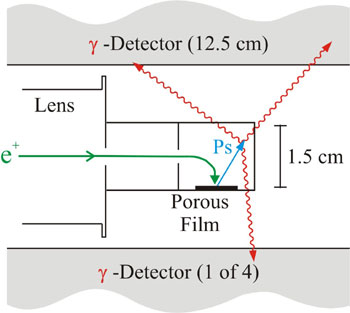
Richard Vallery and colleagues created orthopositronium by firing a low-energy positron beam into a special micron-thick nanoporous silica film. Orthopositronium is formed when positrons that have been slowed down by the film capture electrons. The researchers were able to measure how long this took by detecting the annihilation gamma rays in a scintillator. This set-up overcame problems encountered in previous experiments to measure decay rates, performed at Michigan in 1990. These experiments sometimes measured energetic positronium annihilating on the cavity walls of the detector. In the present experiment, only positrons that annihilate their bound electrons are detected.

The researchers measured a lifetime that “is in very good agreement with the current QED calculation” with a decay rate that differs by only about 0.014% from the theoretical value. “We now taking more data to further reduce our systematic and statistical errors with the goal of reporting a final decay rate value with an error of about 0.01%,” Vallery told PhysicsWeb.

Supermassive black hole binary might lurk in nearby galaxy

Astronomers believe that supermassive black holes, billions of times heavier than the Sun, lie at the centre of every galaxy. Moreover, it is thought that some galaxies might even contain two supermassive black holes as a result of two smaller galaxies colliding and merging over the course of galactic evolution. However, today all evidence for supermassive black hole binaries has been indirect.

Although black holes do not emit light, the gravitational field of a supermassive black hole is strong enough to alter the motion of surrounding objects in a characteristic way. The Japanese team observed the orbital motion of 3C 66B, which lies close to a suspected supermassive black hole pair, between March 2001 and June 2002 with the very-long-baseline array of the National Radio Astronomy Observatory. They found that the core of the radio galaxy traced a well-defined ellipse with an estimated orbital period of about 1.05 years.

Sudou and co-workers also calculate that the black hole pair is more than a billion times heavier than the Sun. This value is consistent with 3C 66B being a giant elliptical galaxy and suggests that it was formed by two galaxies merging.

Transistors go transparent

Semiconductor oxides are widely used as passive coatings in applications such as display panels and solar cells. Although most of these oxides are transparent, they do not conduct electricity and cannot therefore be used as the active components in devices. If such oxides could be made to conduct, this would help create ‘invisible circuits’ that could lead to a whole host of new optoelectronics applications.

Ideally, a field-effect transistor (FET) should have a high mobility but FETs made from transparent oxide semiconductors – such as zinc oxide – have mobilities of about 1 to 3 square centimetres per volt per second at room temperature. Now, Hosono and co-workers have created a transparent FET with a mobility of 80 square centimetres per volt per second. The FET has a high mobility because it is made from a single crystal film and so is free from defects.

Although the transistor would be too expensive to manufacture at present, the result proves that transparent devices with very large mobilities can be made.

Copyright © 2026 by IOP Publishing Ltd and individual contributors