A nova is a star that suddenly becomes tens of thousands of times brighter in a matter of days, and then gradually fades. These outbursts are thought to take place in binary systems in which a star and a white dwarf – the dense, burnt-out remnant of a star – orbit their common centre of mass.
Astronomers believe that white dwarfs in such systems accrete matter from their companion stars until they have gathered enough matter to spark nuclear reactions. These reactions are thought to trigger a nova explosion that can be detected as a jump in the brightness of the white dwarf over a wide range of wavelengths.
Although the visible light usually dims within weeks of the nova explosion, X-rays can be detected for much longer – up to tens of thousands of years according to existing theories. But many recent observations have shown that this period can last just a few years, which suggests that our understanding of the accretion and burning processes is seriously flawed.
In their study, Hernanz and Sala used the XMM-Newton satellite to monitor the low-energy – or ‘soft’ – X-rays emitted by nova V2487 Ophiuchi after it exploded in 1998. These soft X-rays are generated by nuclear ‘hydrogen burning’ of the accreted matter, so the duration of the soft X-ray emission is linked to the amount of matter the white dwarf has collected. To their surprise, Hernanz and Sala found that hydrogen burning in V2487 ceased just 2.7 years after it exploded.
The researchers then compared their measurements of high-energy – or ‘hard’ – X-rays with observations made in 1990, in which a source of hard X-rays was spotted in the same place as nova V2487. Hernanz and Sala discovered that the spectra and the fluxes of the pre-explosion X-rays matched their own data, which strongly suggested that the earlier study saw nova V2487 before it exploded. “This is the first time that a nova has been seen in X-rays before and after its explosion, ” Hernanz told PhysicsWeb.
Since hard X-rays are thought to be generated by the accretion process, Hernanz and Sala concluded that nova V2487 started to accrete matter as soon as it stopped burning hydrogen. “We have unambiguously discovered the reestablishment of accretion onto a white dwarf, only 1000 days after its explosion as a nova,” says Hernanz.
Hernanz and Sala hope that their findings will help astronomers to refine current models of nova explosions, and the accretion of matter in the ‘cataclysmic variable’ systems that give rise to them.
Although vast numbers of neutrinos are produced by the Sun, they are very difficult to detect because they interact very weakly with matter. Ray Davis, now at the University of Pennsylvania built the first experiment to detect neutrinos from the Sun – a giant underground tank containing 600 tonnes of dry-cleaning liquid. However, Davis only detected about one third of the flux of neutrinos predicted by theory. Masatoshi Koshiba of the University of Tokyo later built the gigantic Kamiokande detector in Japan and confirmed Davis’s results.
Now it is known that the electron neutrinos produced in the Sun can oscillate into other types of neutrino – such as muon and tau neutrinos – that could not be detected by these experiments. Recent experiments, such as SuperKamiokande in Japan and the Sudbury Neutrino Observatory in Canada, have confirmed that oscillations do indeed occur. This means that neutrinos have mass, which requires new physics beyond the Standard Model of particle physics.
Riccardo Giacconi was one of the pioneers of X-ray astronomy. Since X-rays from the Sun and other sources are absorbed by the atmosphere, X-ray astronomy can only be carried out from space. Giaconni was the first astronomer to detect X-rays from outside our solar system and also the first to prove that the universe contains an X-ray background. X-ray astronomy is now one of the most active areas of astrophysics and two large observatories – Chandra and XMM Newton – have been launched in recent years.
Giacconi received his PhD from the University of Milan in Italy and played a key role in the Einstein Observatory in the 1970s. He has been director of the Hubble Space Telescope Science Institute in the US and director general of the European Southern Observatory. In 1999 he was appointed president of Associated Universities Inc, the not-for-profit body that operates the National Radio Astronomy Observatory in the US.
All three prize winners have previously received the Wolf Prize. Davis and Koshiba shared the prize in 2000, while Giaconni shared the 1987 Wolf Prize with Herbert Friedman of the US Naval Research Laboratory and Bruno Rossi of the Massachusetts Institute of Technology.
The winners will share the cash prize of 10 million Swedish kroner – around £700 000 – and will receive their gold medals and diplomas in Stockholm on 10 December.
Leike used three types of beer in his experiment – Erdinger Weissbier, Augustinerbräu München and Budweiser Budvar. To collect his data he filled a cylindrical beer mug with a freshly opened bottle of beer and then measured the height of the froth 15 times over a period of six minutes. He then used a chi-squared test to check if his prediction that the froth decays exponentially agreed with the data. At the time Leike said that he wrote the paper because he felt that students did not understand the techniques that must be used to check the consistency of theoretical models with experimental data. “Of course,” he added, “I drank the beer afterwards.”
This is the third time in less than a decade that the physics Ig Nobel has been awarded for a paper published in the European Journal of Physics. Robert Matthews was recognized in 1996 for a paper which showed why toast often lands buttered-side-down when it is dropped, and two years ago Andre Geim and Michael Berry were recognized for their research into the magnetic levitation of living objects – most famously a frog.
The Nobel Prize for Physics will be announced tomorrow morning.
Quantum encryption keys are based on the laws of quantum mechanics and unlike other encryption codes based on mathematical number theory, they are impossible to intercept or break. As a result, two parties can use a successfully transmitted key to encode and decode secure messages with complete confidence.
Earlier this year a team of scientists from the Los Alamos National Laboratory in the US reported that they had transmitted a quantum key over 10 km in the mountains of New Mexico. In the latest trial, single infrared photons at a wavelength of 850 nm were sent between a group of lasers located on the summit of Zugspitze (at an altitude of 2950 m) and a telescope on the summit of Karwendespitze (at an altitude of 2244 m). The experiment was carried out at high altitude to avoid problems with air turbulence and took place at night in order to minimise the effects of background light.
“Using slightly bigger telescopes, optimized filters and anti-reflection coatings we expect to be able to build a system which is stable up to 34 dB of loss and capable of maximum ranges exceeding 1600 km, suitable for satellite key upload,” says John Rarity of QinetiQ. “The main problem now is not loss but pointing and tracking from the ground and from the satellite with sufficient accuracy.”
Britain’s nuclear deterrent currently consists of four submarines, each carrying up to 16 Trident missiles equipped with nuclear warheads. The British Pugwash Group — part of an international movement of scientists working for world peace — says that not replacing Britain’s 200 Trident missiles at the end of their life would show that the government is serious about multilateral nuclear disarmament. Such a decision would establish a timetable over which the UK would meet its disarmament obligations under the terms of the United Nations’ Nuclear Non-Proliferation Treaty. It would also encourage other nuclear-weapons states to announce disarmament measures of their own.
The Atomic Weapons Establishment (AWE), meanwhile, should no longer be required to retain the capability to design and develop new warheads, according to the report. It says that AWE — which is based at Aldermaston in Berkshire — should instead focus on “verifying” that other countries are not testing or building nuclear weapons. AWE should also be opened up as a central facility to enable UK researchers to take advantage of the lab’s scientific expertise in areas such as high-energy density physics and computational modelling. AWE should in addition contribute to US initiatives to make nuclear materials in the former Soviet Union safer.
“[Not building a successor to Trident] could prove at least as useful as the decision in 1956 that the UK would no longer develop chemical and biological weapons,” say the report’s authors, who include the physicists John Finney, Sebastian Pease and the Nobel laureate Joseph Rotblat. “Were the UK to show a more determined commitment to nuclear disarmament, it could expect to become a leading member, if not the leader, of the group of states actively working for creation of a nuclear-weapon-free world.”
Transparent electrical conductors would be a huge asset in many fields of optoelectronics. Circuits made of such conductors could control liquid crystal displays in optical devices without the need for unsightly conventional chips. However, most clear substances are electrical insulators.
Now practical invisible circuits are a step closer thanks to the material developed by Hayashi’s group. Based on calcium oxide and aluminium oxide, its crystal lattice consists of ‘cages’ that have a positive charge. When the researchers heated these crystals in hydrogen, they found that hydride ions – which have a single negative charge – became trapped in the cages. The crystals were still clear after cooling, and electrical tests showed that they were still insulators.
But when the team shone ultraviolet light onto the substance, they found that its electrical conductivity leapt by a factor of 109, and remained at this level even after the light was switched off. The researchers realized that this effect would allow invisible circuits to be created: by shining ultraviolet light onto the material through a mask, electrical ‘wires’ and electrodes could be forged while the unexposed regions between them would remain insulating.
To establish the origin of the effect, Hayashi and co-workers measured the electrical properties of the material as it was heated and cooled. They found that its conductivity dropped sharply at a temperature of 320°C, but returned to its original level upon cooling. But at a temperature of 550°C, the material released its trapped hydrogen – and permanently lost its sensitivity to light.
This led Hayashi and colleagues to believe that the material owes its electrical characteristics to its trapped hydride ions. The researchers suggest that the ultraviolet light makes these ions eject their ‘extra’ electrons, which are then attracted to the positively charged empty cages in the crystal. But this attraction is so weak that the electrons can hop from cage to cage, creating a ‘sea’ of electrons that allows the crystal to conduct electricity.
As well as applications in optoelectronics, Hayashi’s group believes that the new material could be used to develop high-density optical memory. They also speculate that a similar approach could work for other ‘main group’ metal oxides.
These are the dramatic opening sentences of a recent article, “Physics in crisis”, by Sidney Nagel, professor of experimental condensed-matter physics at the University of Chicago*. Nagel is worried by a lack of unity in the physics community that manifests itself as a lack of interest in, and appreciation of, the work of colleagues in other sub-disciplines of the subject. He blames this problem on five splits in the physics community: the split between sub-disciplines, between big and small science, between basic and applied physics, between the emergent and reductive approaches to science, and between theory and experiment in all areas of physics.
As an example of the problem, Nagel ventures that “a colloquium talk with the words Standard Model in its title would not be immediately engaging to a condensed-matter physicist, nor would one with the words high-temperature superconductivity be attractive to a community of particle physicists (nor for that matter to a group of soft-condensed-matter physicists). Such division is clearly not good but I think it is a shocking and unfortunate fact. We are, it seems, very parochial.” Of course, it is a full-time job keeping up with your own narrow field, but there are many occasions – most of them related to funding – when it is vital for the physics community to present a united front.
Of the different splits identified by Nagel, the one between the reductive and emergent approaches is the most philosophical. In simple terms, particle physics exemplifies the reductive approach, whereas condensed-matter physicists favour the emergent, collective or “more is different” approach (see Physics World December 2001 p5). This is hardly something to worry about, but the fact that the fences between particle physics and condensed matter – the two biggest sub-fields in physics – have not been fully mended in the US since the cancellation of the Superconducting Super Collider almost a decade ago is a cause for concern.
The overall thrust of Nagel’s argument is sound. We must, he argues, rediscover what different areas of physics have in common, and we must identify and articulate the big questions that have still to be answered. He also calls for changes in the educational system that will “instill in students some sense of the breadth and interrelatedness as well as the depth of physics”.
Communication is central to Nagel’s analysis: he finds it “disheartening” that physicists who try to convey the excitement of physics to the general public receive “grudging acknowledgement at best” from other physicists. But attitudes to communications within the physics community also need attention. As an example he returns to departmental colloquia that are difficult for specialists to understand, never mind the general audience for which they are intended. (We often encounter a version of this problem when editing articles for Physics World, which is intended for a general physics readership.) This could be the familiar catch-22 problem: speakers will not pitch their talks at a general audience when there are only specialists from their own field in attendance, and the general audience will only turn up when speakers stop talking for the specialist.
Nagel concludes with some homework assignments for his readers: organize a symposium on an experimental topic that will bring condensed-matter and particle physicists together; repeat this task with a theoretical topic; and, finally, answer honestly why someone from outside your subfield should be interested in what you are doing. Then, GIVE THOSE REASONS CLEARLY IN ALL YOUR TALKS (his capitalization). Benjamin Franklin, one of America’s first scientists, outlined the alternative at the signing of the declaration of independence: “We must indeed all hang together, or, most assuredly, we shall all hang separately.”
Particle physicists from all over the world met in Amsterdam recently for the International Conference on High Energy Physics (ICHEP), the flagship conference of the field. One result that stood out at the conference came not from the big collider collaborations working at the highest energies, or even from the new “B factories” that explore charge-parity violation, but from SELEX – an experiment at Fermilab in the US. In the SELEX experiment a 600 GeV particle beam strikes a fixed target made of copper or diamond foil to produce interactions of relatively modest energy.
Fixed-target experiments like SELEX have long been the poor cousins of particle physics, but in Amsterdam, James Russ of Carnegie Mellon University in Pittsburgh, the co-spokesman of the SELEX collaboration, presented the first evidence for doubly charmed baryons – particles that contain two charm quarks ( ICHEP:paper HQ-6-5).
Baryon basics
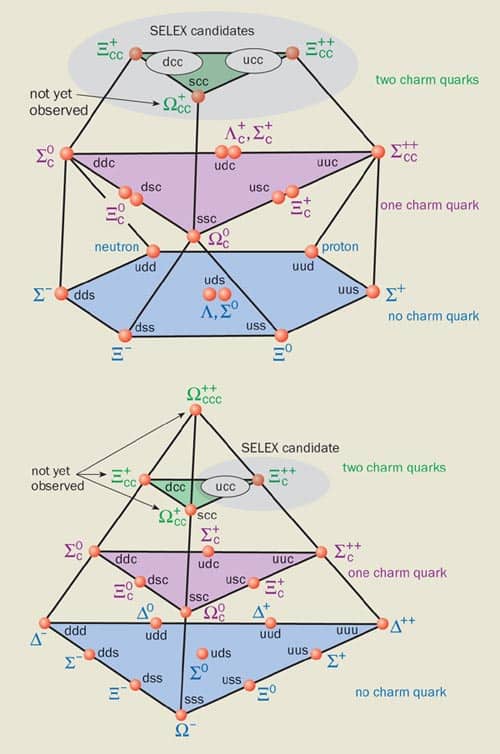
We are all well acquainted with the two most basic baryons, the proton and the neutron, and these make up the majority of the matter we see around us. However, there are many other baryons, such as Δ++, Σ+, Ξ0 and Ω– to name just four. Although all these baryons are incredibly tiny, to a particle physicist they are a big complicated mess of quarks whizzing around in a sea of gluons.
It was the quark model that brought some order to the chaos of the “zoo” of particles discovered in the 1950s and later formed the basis of the Standard Model of particle physics. In the Standard Model, all baryons contain three constituent quarks and, similarly, any combination of three quarks can form a baryon. Only three types of quark – the up (u), the down (d) and the strange (s) quarks – were needed to explain the particles known in the 1950s.
However, all quarks also have an intrinsic angular momentum or “spin” that is equal to 1/2, and this means that baryons can also exist in excited states. A proton, for instance, contains two up quarks and one down quark, and has an overall spin of 1/2 because two of the spins essentially cancel each other out. However, if all three spins point in the same direction, an excited state known as a Δ+ state is created (see figure 1). Many of these excited states are short-lived, which means, according to the Heisenberg uncertainty principle, that they have ill-defined masses. Since their mass is not well defined, these states are not graced by the description “particle” but instead are known as “resonances”.
In 1974 evidence for a fourth quark, the charm quark (c), was found. It immediately became clear that there must exist a whole family of charmed baryons, each containing a single charm quark and two “light” quarks (as the up, down and strange quarks are collectively known). The dynamics of charmed baryons are very appealing from a theoretical standpoint. The charm quark stays effectively at rest inside the baryon because it is much more massive than the up, down and strange quarks. The two light quarks can be considered as a “di-quark” pair and they bounce around inside the baryon at high speed.
Although still complicated, charmed baryons are simpler to analyse theoretically than light baryons because one of the constituents (the charm quark) is effectively at rest. A charmed baryon is in many ways analogous to a hydrogen atom, which consists of a proton, which is heavy, and a much lighter electron. By finding the energies of the excited states of a hydrogen atom, we can get an insight into the electromagnetic forces that bind it together. Similarly, the masses of the excited states of charmed baryons can provide us with information about the strong force that holds the quarks together.
The first charmed baryons were found in the late 1970s and 22 different states have now been catalogued. Most of these states were discovered at fixed-target experiments similar to SELEX and at electron-position colliders working at energies that are now considered rather modest. In particular, the CLEO experiment at the Cornell Electron Storage Ring (CESR) in upstate New York has discovered more than half of the known charmed-baryon states – the most recent being a charmed baryon with a mass that is more than 25% higher than that of the ground state, yet stable enough to be well defined (Phys. Rev. Lett.86 4479).
The properties of charmed baryons are complicated but orderly and comprehensible. The discovery of doubly charmed baryons opens up the door to a whole new spectroscopy, complementary in nature to the one already studied. In this new regime there will be a heavy di-quark, effectively at rest, with a single light quark buzzing around inside the baryon.
A double surprise
Particle theorists enthusiastically use models to predict the masses of the states they know must exist and then wait for the experiments to confirm or reject their models. However, the claim that doubly charmed baryons have been discovered has created as much controversy as it has excitement. It is not that anyone doubts that they must exist, or that they should live briefly and then decay to, among other things, a singly charmed baryon, a kaon and a pion, as has been observed by SELEX. (Kaons and pions are examples of particles known as mesons, which contain a quark and an antiquark.)
However, there are aspects of the new results that are surprising: indeed, some physicists say they are too surprising to be believed. First is the issue of mass. The SELEX group believes that it has seen the signatures of two doubly charmed baryons – one containing two charm quarks and an up quark, Ξ++, and the other containing two charm quarks and a down quark, Ξ+. Although both masses reported by the SELEX team are quite reasonable in their own right, the difference between the two (about 2% of the total) is amazingly large.
The up and down quark are very similar, and add essentially identical mass to the system, and so the masses of the two new doubly charmed baryons should only differ by a tiny amount. Maybe it is this problem that has led the SELEX collaboration to submit the discovery of only one of the particles – the Ξ+ (ccd) baryon – for publication (M Mattson et al. 2002 ArXiv.org/abs/hep-ex/0208014).
The second amazing fact is that enough doubly charmed baryons were produced by the collisions for the SELEX team to have found them. They estimate that 40% of the singly charmed baryons they see are the result of the decay of doubly charmed baryons. However, this is one or two orders of magnitude greater than would be expected from simple hand-waving arguments.
Is this evidence of a new production mechanism that had not previously been considered? The FOCUS experiment at Fermilab has also studied charmed baryons in a beam-dump experiment. At the Amsterdam conference the FOCUS team presented null results in a search for doubly charmed baryons in 21 different decay chains. The CLEO collaboration has not yet presented any data on its search for doubly charmed baryons, but the researchers surely would have noticed if 40% of their charmed baryons were the decay products of ccu and ccd particles.
Unfortunately, it impossible for either the FOCUS or CLEO experiments to rule out the SELEX result because the processes by which the particles are made are different. Maybe there is something in the SELEX beam – a 600 GeV beam that contains both protons and strange baryons – that preferentially produces doubly charmed baryons. The situation is not likely to be completely clarified for some time.
The last of the singly charmed baryon ground states, the Ωc (css) baryon, was first reported in 1974. However, it was only in the last two years that results from CLEO, FOCUS and the BELLE experiment in Japan have converged to give consistent and universally accepted measurements of its mass. It could take many years of careful measurements and re-measurements before the doubly charmed signals can be verified and understood. These particles only live for about 10-13 seconds, but their study can occupy a lifetime.
Whether we want to or not, we all play games – and not just at Christmas. Every day we face situations that require us to make the best decision based on our knowledge and past experience. The trouble is that our information is often incomplete, situations change, and – worse still – there may be hundreds of other people trying to do the same thing. Many aspects of life, such as trying to find a seat on a train or playing the stock market, can be viewed as a competitive game that we repeatedly try to “win”. There are also many situations where it is better to co-operate, for instance at work or in a sports team.
Game theory provides a way of dealing with very simple forms of such games. In general, these theoretical approaches consider so-called static games without any repetition or learning from the past. They also contain just a limited number of players, all of whom have access to the same strategies.
Game theory is not new: back in 1928 the Hungarian mathematician John von Neumann published the fundamental theorem of “zero-sum” games in which one player’s loss is equal to the second player’s gain. He went on to co-author Theory of Games and Economic Behaviour with Oscar Morgenstern in 1944, and in so doing formally gave birth to the field of game theory. Since then applications have been considered in fields as diverse as military warfare (in particular during the Cold War, when there were only two major players), anthropology, social psychology, economics, politics, business and philosophy.
Most applications in science have focused on biology at the macroscopic scale – in particular the competition and co-operation between “players” at the level of species or individual animals. However, Paul Turner and Lin Chao at the University of Maryland recently made the exciting discovery that an RNA virus – a primitive yet fundamental microbiological structure – may also engage in simple two-player games. This finding prompts the question: could there be a more fundamental connection between basic science and games?
Playing with games
Game theory has recently made it big in Hollywood with the movie A Beautiful Mind, which charts the tortured life of Nobel-prize-winning mathematician and economist John Nash. But to understand why Nash’s work is so important, we first need to understand what is meant by a game. In classical game theory, a game consists of a set of players, a set of strategies that dictate what actions a player can take, and a “pay-off function” that specifies the reward for a given set of strategy choices. A reward could be monetary or more spiritual, such as an increase in happiness. The corresponding pay-off to each player is represented by a numerical value. If you are one of the players, the aim is, of course, to optimize your own pay-off. However, if everyone else is trying to do the same, how should each player actually play the game?
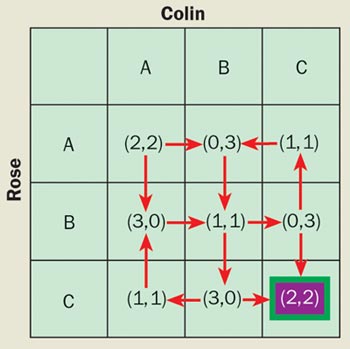
1 Nash equilibria: beautiful but problematic The pay-offs to the two players in this simple, non-zero-sum game are indicated for each possible combination of strategy choices. The rows designate Rose’s choice of strategy (A or B) while the columns designate Colin’s choice of strategy (A or B). The entry (a,b) indicates that Rose receives pay-off a while Colin receives b. In real life this game might correspond to a situation in which two enemies are deciding whether to live in city A or city B. The pay-off is happiness – each player wants to live in the nicer city and without their enemy nearby. Colin and Rose both prefer city B. However, city B is smaller than city A, and it is therefore easier for them to run into each other. On the other hand, city A is bigger and so it is rather unlikely that they would run into each other – yet the city itself is less appealing. We can model the scenario as shown in the pay-off table, where greater happiness is indicated by larger values. The players have perfect knowledge of the pay-off table, and can be thought of as making their moves at the same time. If Colin chooses A, Rose will gain 1 with strategy A and 5 with strategy B, so she cannot profitably deviate from strategy B (as indicated by the downward arrow in column A). If Colin chooses B, Rose will gain 2 with strategy A but only -1 with strategy B, so she cannot profitably deviate from strategy A (as indicated by the upward arrow in column B). Colin will also reason this way: if Rose chooses A, he should choose B (as indicated by the horizontal arrow to the right in row A). If Rose chooses B, he should choose A (as indicated by the horizontal arrow to the left in row B). A Nash equilibrium is the set of strategy choices that provides the optimal pay-off for each player individually. Therefore, both (A,B) and (B,A) represent Nash equilibria (purple boxes) where the first entry denotes Rose’s strategy and the second Colin’s. Rose prefers (B,A) while Colin prefers (A,B). How can they choose between them without prior communication? If Rose tries for (B,A) and thus chooses strategy B, while Colin tries for (A,B) and also chooses strategy B, they will end up with the inferior pay-off (-1,-1).
Enter John Nash: he proved that every static game with a finite set of strategies for each player has at least one equilibrium. This “Nash equilibrium” is the set of strategic choices that provides the optimal pay-off for both players – in which no player can do better by changing their strategy while the other player’s strategy remains unchanged.
Game theory would have been perfect if only every game had a unique Nash equilibrium. However, the world is more interesting than that. Although certainly beautiful, Nash’s work does not show us how to compute such an equilibrium, nor does it indicate how many such equilibria exist. Even very simple games can possess multiple Nash equilibria and there are no general tools for singling out any particular one. Figure 1 illustrates the problem for a non-zero-sum game with two players. How will the players ever know which equilibrium to aim for? If both players make a decision in an attempt to maximize their own pay-off, then they may end up with the worst outcome for both.
Figure 2 illustrates a further problem with such classical games: even if they choose a strategy that corresponds to a Nash equilibrium, the two players may actually squander a far larger pay-off. This is the case in the famous “prisoner’s dilemma”. In this game, we imagine that two people have been arrested on suspicion of having jointly committed a crime. The suspects are placed in separate rooms for questioning, without being able to communicate with one another. If one of them confesses to the police while the other remains silent, then the one who defects (i.e. confesses) will be freed while the one who remained silent is sentenced to three years in prison; if each betrays the other by defecting, both will be sentenced to two years in prison. However, if both suspects remain silent, they will effectively be co-operating with each other against the police: both will then get away with just one year in prison.
In the prisoner’s dilemma, the Nash equilibrium is when both suspects defect by confessing, even though the situation in which they both co-operate against the police by remaining silent yields a better pay-off for each player. As shown in figure 2, if we interpret pay-offs as energy gains, it is possible to illustrate the prisoner’s dilemma in terms of a simple physical model for two electrons in the electronic shells of an atom.
So do games have anything deeper to say about physics, or vice versa? Maybe. Most surprisingly, the connection might arise at the most fundamental level of all: quantum physics. Let’s start with some circumstantial evidence. As well as being the father of game theory, von Neumann also made seminal contributions to the fields of quantum mechanics and computation. Furthermore, an experiment in physics can arguably be viewed as a “game” against nature in which the observer tries to maximize the informational output while nature evolves relentlessly toward increased disorder (entropy). In short, the common link with physics is information: games, quantum mechanics, computation and, ultimately, physics are all concerned with information. So what would happen if we combined quantum mechanics with games? This idea occurred to David Meyer of the University of California at San Diego, and in 1999 he initiated the study of quantum games.
Profiting from a quantum edge
The story starts with Captain Picard’s showdown with Q on the bridge of the Starship Enterprise. Meyer imagined both Star Trek characters playing a coin-flipping game as follows. Q has a coin, which he prepares and gives to Captain Picard; Picard can either flip the coin or leave it unchanged before handing it back to Q. Before they both look at the outcome, Q is allowed to flip the coin again if he wants to, but he does not have to. Picard loses if the final outcome is heads, but wins if it is tails. However, Q is allowed to use “quantum strategies” while playing the game whereas Picard is restricted to classical strategies. To Picard’s dismay, and to the detriment of the entire galaxy, Q manages to win every time because he can exploit these quantum strategies to his advantage.
2 The prisoner’s dilemma and physics In this electronic version of the prisoner’s dilemma, two electrons are each trying to minimize their own energy. Each electron wishes to be close to the nucleus, but does not want to experience too much Coulomb repulsion from the other electron. The pay-offs are chosen to represent how well the energy is minimized in relative terms, but are not supposed to be quantitatively accurate. Suppose the red electron chooses the inner orbit (B) while the blue electron chooses the outer orbit (A). The red electron experiences a large attraction to the nucleus but a small repulsion from the blue electron. Hence the pay-off for the red electron is large (i.e. 3). However, the blue electron is far from the attractive nucleus and is also shielded by the red electron: hence the blue electron’s pay-off is 0. A similar argument applies to the pay-off (0,3). If both electrons choose the inner shell, the attraction is large but the repulsion is also large, hence the pay-off is (1,1). If both electrons choose the outer shell, both the attraction and repulsion are smaller (2,2). Given that the attraction and repulsion will in general have different functional dependencies, the pay-offs shown are physically realizable. Although (B,B) is a Nash equilibrium (purple box), having the two electrons in the outer shell (A,A) would have given a larger, so-called Pareto optimal pay-off (green box). Physics tells us that (A,A) will be the one adopted by the electrons. At first sight, it seems that Pareto optima are therefore preferred over Nash equilibria. However, since the two electrons interact with each other, their wavefunctions are entangled, which renders the game co-operative. Consequently, co-operative game theory can be used to show that the Nash equilibrium and the Pareto optimum coincide in this scenario.
To see how Q wins we must replace the classical coin – which can be in one of only two states – with a quantum coin that can be in an infinite number of states. For instance, we can think of the quantum coin as the spin of an electron: we can define heads as the spin pointing along the +z axis and tails as the spin pointing along the –z axis. However, the spin can also point along the x or y axes.
Captain Picard can only perform the classical action of flipping the spin – which is equivalent to rotating the spin about the x axis – or not flipping the spin. However, Q can perform a whole range of quantum operations. For instance, he can use a so-called Hadamard operation to prepare the spin so that it is pointing along the +x axis. This means that if Picard flips the spin about the x axis, it will still point in the +x direction; and if he does not flip the spin, it will obviously remain pointing in the same direction. Once Picard completes his move and returns the spin to Q, the latter can simply rotate the spin so that is pointing along the +z axis (i.e. heads) and win the game.
Loosely speaking, we can say that Q wins by using quantum mechanics to prepare the coin in a state that is both heads and tails at the same time – which is like saying that the classical coin is standing on its edge – and that Picard always loses because he is unable to change this state by flipping the coin.
Steven van Enk at the California Institute of Technology later showed that Meyer’s Star Trek game could be simulated classically and is therefore not purely quantum mechanical. But this did not stop many researchers from diving into the new field that Meyer had created.
In the same year, Jens Eisert, Martin Wilkens and Marcus Lewenstein at the University of Potsdam in Germany proposed a quantized version of the prisoner’s dilemma game (figure 3). They claimed that the resulting game possessed a unique Nash equilibrium that also yielded the maximum possible pay-offs – the game was said to be “Pareto optimal”, a concept invented by the Italian economist Vilfredo Pareto. The players in the quantum game apparently managed to resolve the prisoner’s dilemma!
This particular conclusion was later criticized by Simon Benjamin and Patrick Hayden of Oxford University on the grounds that the quantum strategies considered were limited in an unphysical way. However, the theoretical framework introduced by Eisert and co-workers is unaffected by this criticism and, in addition, underlies most of the subsequent research in quantum games. We will therefore discuss the underlying idea in more detail.
Quantum dilemma
Playing a game boils down to performing an action: this action is based on a strategy that is chosen after the players consider the pay-offs. We can imagine the existence of a referee whose sole aim is to collate the actions of the players and then to compute the pay-offs. These actions may be encoded as numbers – for example in the prisoner’s dilemma game of figure 2, the players use the value “0” to represent their decision to co-operate (strategy A) and “1” to represent their decision to defect (strategy B).
We can therefore think of the referee initially producing two coins, each with 0 on one side and 1 on the other. The referee then passes one coin in the 0 state to each player (i.e. with 0 facing up). The players then decide whether to return the coin unchanged – and hence co-operate with each other – or to flip the coin to yield the value 1 and hence defect. The game is therefore equivalent to one in which the referee issues pairs of binary coins or “bits”.
In the quantum version of this game, the referee issues qubits rather than bits. A qubit is a two-level quantum system, such as the spin of an electron or the ground state and excited state of an atom. Continuing with the prisoner’s dilemma game as an example, the referee passes a qubit to each player (figure 4). Two qubits are therefore involved in the quantum prisoner’s dilemma game, as opposed to the single qubit (i.e. single coin) used in Meyer’s Star Trek game.
The referee can exploit the full weirdness of quantum mechanics by “entangling” both qubits before giving them to the players. Entanglement is a purely quantum effect that many physicists believe is the essential ingredient for unleashing the potential power of quantum information processing and quantum cryptography – indeed Albert Einstein considered entanglement to lie at the heart of the fundamental “spookiness” of quantum mechanics.
3 The Eisert way to play The effect of entangling the initial state in the quantum version of the prisoner’s dilemma game can be mimicked by including an additional quantum-mechanical strategy C to the pay-off matrix. As far as these three strategies are concerned, (C,C) is now a Nash equilibrium (purple box). Since no player can gain by lessening the others’ pay-off, it is also Pareto optimal (green box). Hence the prisoner’s dilemma is apparently resolved in the quantum world.
To render the prisoner’s dilemma game quantum mechanical, we have to entangle the two qubits. When two qubits are entangled, we mean that they are linked or correlated in a highly complex way. For instance, it is possible to create pairs of photons that have their polarizations entangled: if the first photon is circularly polarized in a right-handed sense, then the second photon is polarized in a left-handed sense, and vice versa. In the quantum version of the prisoner’s dilemma, flipping one qubit is equivalent to flipping the other qubit while leaving the first one unchanged. Indeed the distinction between the two qubits becomes so blurred that they are no longer identifiable as individual objects. This strange but powerful correlation is purely quantum mechanical, and may be harnessed to co-ordinate an improved pay-off. (To achieve the same results classically would require the players to somehow cheat, thereby rendering the game non-competitive.)
The players act on their individual qubits using any available quantum operation. Leaving the qubit unchanged corresponds to the identity operator I, while flipping the qubit corresponds to the Pauli spin operator X. In addition there are an infinite number of other quantum operations. To visualize this concept, think of a pencil held at one end, which is free to rotate through any angle in three dimensions. The pencil represents heads when it points vertically up, and tails when it points vertically down. When the pencil is horizontal, it represents an unphysical state for a classical bit (like a coin on its side) but this is a perfectly acceptable quantum-superposition state. The player can therefore be co-operating and defecting at the same time.
At the end of the game the referee collects the final state of the two qubits. First the referee “undoes” the initial entanglement operation, in order to avoid introducing any bias into the quantum game with respect to the classical version, and then measures the final state to determine the players’ pay-offs. In principle, the resulting pay-off can be higher than in the classical game (see figure 3). Remarkably, Jiangfeng Du and collaborators at the University of Science and Technology of China in Hefei have recently demonstrated the quantum prisoner’s dilemma game experimentally using a nuclear-magnetic-resonance quantum computer.
Two’s company, three’s a crowd
Like most of quantum game theory to date, we have focused on two-player games. Following the controversy surrounding the search for a truly novel quantum advantage in such games, one of us (NFJ) conjectured that new phenomena should emerge for quantum games with three or more players. After all, the novel phenomenon of chaos in classical systems only appears for three or more particles. And there are special quantum systems that only exist for three or more electrons, such as the special states proposed by the Nobel laureate Robert Laughlin of Stanford University to explain the fractional quantum Hall effect.
In addition, numerical simulations on repeated classical games have shown that novel co-operative phenomena can arise in the many-player limit. An example of such a co-operative effect is a crash in a financial market, which occurs when a group of traders suddenly decides to sell at the same time.
Benjamin and Hayden took our conjecture seriously, and subsequently constructed a three-player version of the prisoner’s dilemma. Their game is equivalent to the two-player game except that the referee now gives and receives three qubits. Remarkably, the three-player game does indeed exhibit a novel coherent quantum state in which the pay-offs to the players are higher than anything that could be achieved classically. This superior outcome arises when one player co-operates, another defects and the final player does something quantum mechanical in between.
However, the problem of co-ordination still arises: in particular, two players have to accept a pay-off that – while larger than the classical result – is smaller than that of the third player. But in the absence of prior communication, how do the players decide who receives what? Roland Kay, also at Oxford, addressed this question by considering a repeated game. He allowed the players to evolve their strategy by choosing a new one from a fixed set of strategies if they found themselves losing too often. Kay’s work showed that one of the several possible coherent quantum states would be reached eventually.
All this assumes that the players have a reliable source of qubits, just like an unmarked deck of cards in a casino. But what happens if the deck is marked? Putting this in a physical context, one could imagine a “demon” who corrupts the supply of qubits but whose actions are unknown to the players (just like a corrupt croupier in a casino). Such a demon can be thought of as injecting noise into the system. One of us (NFJ) set up this model, and investigated the effect of noise within the three-player quantum game.
It turns out that the quantum advantage becomes a disadvantage above a critical value of the corruption rate or noise level. In particular, the coherent quantum effects impede the players to such an extent that the classical game outperforms the quantum game. Given a choice, the multiplayer system eventually does better if it adopts classical, rather than quantum, behaviour. The “optimal” choice of game therefore changes from quantum to classical as the noise level increases: the crossover occurs when the noise level corresponds to the energy separation of the two levels of the qubit.
Remarkably, this finding coincides with the physicist’s basic rule of thumb that classical phenomena supersede quantum effects when the temperature exceeds the relevant energy separation of quantum levels in a system. It also suggests that noisy quantum games may provide new insight into the physics of decoherence, which destroys the quantum-mechanical nature of fragile qubits.
In search of the killer application
First the bad news: in spite of the interesting results that have been achieved, there is a basic problem with most of the studies of quantum games to date. Whatever the quantum game does can usually be accounted for within classical game theory, simply by appealing to a more complicated game structure. This is because quantum games can ultimately be represented by a classical number of players, strategies and pay-offs – precisely the objects studied in classical game theory. Quantum games therefore do not appear conceptually different from their classical counterparts.
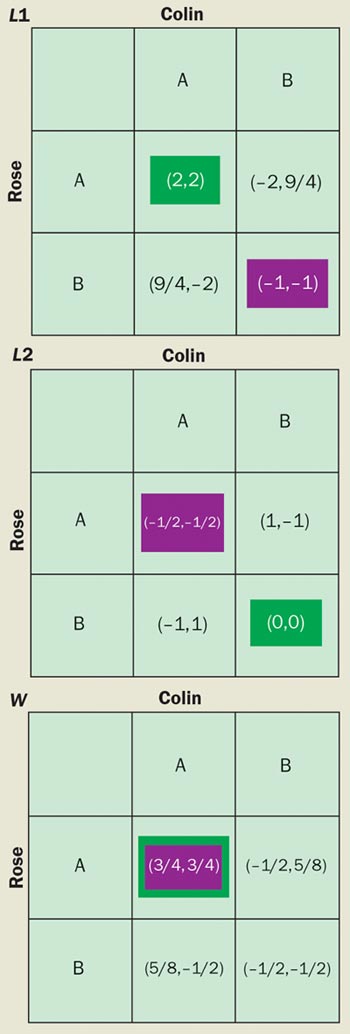
4 Winning by losing Consider two games of the prisoner’s dilemma type with different pay-off tables. The first, L1, has a Pareto optimal (green box) with pay-off 2 to each player, but a Nash equilibrium (purple box) with pay-off -1 to each player. Game theory predicts that both players would choose strategy B, hence the game is given the value -1. The second game L2 has a Pareto optimal (green box) with pay-off 0 to each player, but a Nash equilibrium (purple box) with pay-off -1/2 to each player. Both players would play strategy A and the game is therefore given the value -1/2. Players in each game L1 and L2 will hence lose. However, if we combine the playing of games L1 and L2 randomly, the pay-off matrix becomes the average of the two pay-off matrices for L1 and L2. The Nash equilibrium (purple box) of this combined game W is now Pareto optimal (green box), yielding a positive pay-off of 3/4 to each player. By combining two losing games randomly, we have created a winning game. This is an example of the so-called Parrondo effect. This effect will hold for other choices for the numerical pay-offs in games L1 and L2 as long as the two resulting pay-off tables have a similar structure to those in this example.
Now for the good news: although classical and quantum games fall under the dictum of classical game theory, we have recently shown that it can be more efficient to play quantum games. If we entangle the qubits shared between the players, then the players have a greater number of strategies to choose from than in classical games. In other words, less information needs to be exchanged in order to play the quantized versions of classical games. This improvement in efficiency alone makes the whole subject worth studying.
Apart from the issue of efficiency, quantum games may also be at work on a more fundamental level in nature. Game theorists have long realized that it does not take a perfectly rational being to recognize a “best strategy” and they have therefore applied their techniques to model the behaviour of both animals and bacteria. Quantum game theory may eventually provide the tools to help understand the interactions of fundamental particles or molecules if we treat them as individuals as in figure 2. Indeed some search algorithms – such as simulated annealing and adiabatic algorithms – may be seen as methods for persuading individual qubits to co-operate collectively in order to achieve the optimal global pay-off. Consequently, there is likely to be a strong connection between evolutionary games and games derived from the dynamics of physical systems.
In the computation community there is a widespread feeling that game-theoretic techniques provide the only general tools that can prove lower bounds in classical algorithms. For example, in tree-evaluation problems – in which the value on each leaf of the tree represents the input – we can view the algorithm designer and the input feeder as players in a zero-sum game. In particular, the designer is trying to minimize the running time of the algorithm while the feeder is trying to maximize it. The “minimax” theorem from classical game theory can hence provide us with a tight bound on the running time of any randomized algorithm that solves the tree-evaluation problem. A similar approach could provide some much needed insight for the case of quantum algorithms.
A particularly interesting application may arise from an effect that was recently discovered in classical games ( figure 4). To illustrate this so-called Parrondo effect, let’s take another look at the prisoner’s dilemma game. Randomly switching between two prisoner’s dilemma games in which the players “lose” should prompt the players to choose the Pareto optimal and thus increase their global gain (i.e. they now win). The Parrondo effect could even be applied to the design of quantum algorithms and to control qubit decoherence. In related work, Derek Abbott and Adrian Flitney of Adelaide University introduced a quantum Parrondo game within the Eisert scheme described earlier, while David Meyer has discussed a version with a so-called Brownian ratchet.
Going to the limit of very large numbers of particles, which is the case most commonly found in physical systems, leads us into the realm of many-player or many-agent games where each particle is treated as a player. Such games suggest that physics can add greater value to game theory, and vice versa. For example, consider political elections, which are a popular topic in game theory. Let’s assume that voters interact with each other just as electrons do in the well-known Ising model in statistical physics. The study of phase transitions has shown that infinitesimal changes in the initial conditions of a system can lead to large qualitative changes in the outcome. Hence a candidate who is ranked almost equal with his or her rival in a presidential election campaign could win overwhelmingly simply by seizing the additional support of one small town. The effect of quantum fluctuations on such phase transitions is an area of active study in physics, suggesting that the quantum version of many-voter games could also prove very fruitful.
Continuing in the realm of fundamental physics, we reiterate our belief that a deeper understanding of the relative advantage between classical and quantum many-player dynamical games may eventually shed some much-needed light on the connections between quantum and classical many-particle systems. It is possible that pay-offs could be used to represent energies, while the entangled state of the many-player quantum game could represent some exotic many-particle wavefunction. As discussed above, an external demon’s actions could then be used to mimic environmental decoherence. A related idea was recently presented by Roy Frieden of the University of Arizona. Frieden showed that physical laws can be derived by considering the information content of a physical quantity, implying that the process of making a measurement represents a game against nature. It turns out that the observer can never “win”, in the sense of obtaining complete information about a particular physical phenomenon. Instead, the phenomenon under study takes on an all-powerful, but malevolent, force – the information “demon” who is looking to increase the degree of “blur” of information, and against whom the observer is forced to play.
Outlook for quantum gaming
We have given a very brief overview of the recent birth of quantum game theory, and the extent to which physics and games are related. Quantum game theory is now a toddler: tantrums aside, it is likely to grow at a steady pace. Quantum games have superior efficiency compared with their classical counterparts. Moreover, their study may lead to a deeper understanding of quantum algorithms and quantum information processing, and could even shed light on the great divide between quantum and classical physics.
We believe that quantum game theory adds another perspective to physical problems. As Richard Feynman once said: “Physicists of any good should know six or seven different methods to solve the same problem”. There seems little harm in applying game theory on such occasions.
But to what extent will quantum game theory eventually say something novel about physics? Maybe it will turn out that nature, including physics, can in fact be viewed as just one big game that spans classical and quantum multiplayer systems. Such ideas are highly speculative, and being a researcher in such a fledgling field is clearly a big risk. But life is full of risks. And life, after all, is just a game.
So ran many newspaper headlines worldwide two years ago, reporting on the initial operation of the Relativistic Heavy Ion Collider (RHIC) at the Brookhaven National Laboratory in the US. The stories were generally accompanied by a beautiful picture of particle tracks spewing outward from a point, like a wheel with thousands of thin, multicoloured spokes. But the first collision? Not exactly. And therein lies a tale.
First collision at RHIC
RHIC is designed to create head-on collisions between gold ions in two counter-revolving circular beams with a 4 km circumference. The beams intersect at six points, with detectors at four of these.
Early in 2000 the magnets of the superconducting rings were cooled down and the first ions injected. Beams made turns in the rings and their orbits were corrected. The beams were stored, captured by the radio-frequency system, and stabilized. They were accelerated from the 10 GeV injection energy to 70 GeV. They were “steered” so that bunches crossed each other in the same place, and “cogged” so that they crossed at the same time. They were “tuned”, or made to oscillate optimally. They were “beta-squeezed”, or shrunk in size to maximize the likelihood of collisions.
This was arduous, round-the-clock work. A breakthrough at each stage often meant having to fiddle with previous stages in a complex, nonlinear struggle to boost performance. But the lab management knew from bitter experience with a previous collider that delays can be embarrassing and even fatal. It was anxious to portray the commissioning as a supremely confident process in which Brookhaven’s scientists were en route to a finale as definitive as a rocket blast-off.
In May the New York Times quoted lab director John Marburger as saying: “When the time comes, [the operators] push a button, and there will be the first ion collisions.” Mocking scientists in the accelerator control room installed a large black button on the control panel labelled “COLLISIONS”, with wires that led conspicuously nowhere. “If that button really worked”, said one operator to me at the time, pointing to deep bags under his eyes, “we wouldn’t have these!”
By June the operators had the two beams counter-revolving simultaneously at injection energy. Some collisions were undoubtedly occurring at this point, but the detectors were not ready. Do collisions occur when no one sees them? Evidently not: the first collision would have to photographed.
On 12 June 2000 a clear-cut collision occurred in the STAR detector at about 9.00 p.m. When it showed up on the big plasma screen in the detector control room, everybody applauded. The log reads: “Champagne event.” But STAR’s magnets were not working – which is why the lines are not curved but straight – making particle identification impossible. The collision also took place at 30 GeV, not at full acceleration. But it was clearly in the intersection region, had some acceleration, and resembled a Monte Carlo simulation. It counted.
The next morning, a carefully worded press release referred to “the first spectacular images of particles streaming from a collision point” at STAR, and “high-energy collisions” at another detector. A three-minute video ran on a monitor in the lab cafeteria. But after grumblings from the other detector groups, a sentence was added to the release, saying that the other detectors “will soon begin collecting collision data as well” and the original video was replaced by one mentioning all four detectors.
First collisions elsewhere
But does this kind of stage-managing only happen at Brookhaven? The first big particle collider – CERN’s Intersecting Storage Rings (ISR) – was so daring that its creators worried more about achieving collisions between protons than recording them. Its initial detectors were inadequate even by contemporary standards and collisions were no doubt occurring long before they were detected in 1971.
When Fermilab near Chicago finished its proton-antiproton collider in 1985, only one of the detectors was ready. Internal politics did not therefore cloud the issue of which saw collisions first.
Four years later CERN turned on the Large Electron-Positron (LEP) collider, which had four detectors. The electron and positron beams were brought together on 11 August 1989, and some detectors saw collisions before others. However, the public relations were carefully stage-managed, and an announcement that all four detectors had seen collisions was made on 14 August, accompanied by a great party.
The first collisions at the HERA collider at DESY in Hamburg took place on 19 October 1991, as revealed by the luminosity monitors of one of its detectors. But scientific work could not begin for another year because of problems controlling the beam – precisely the kind of embarrassment that Brookhaven would later be anxious to avoid.
The critical point
The truly unprecedented event is rare, perhaps even non-existent; nearly always it is a case of repetition with a difference. First moments in science – as in other human endeavours – are often manufactured, defined by social and political forces.
So why does nobody object to the pretence? It is because of a happy intersection of the needs of different groups. Science administrators look for an excuse to show off a new programme. Politicians look for opportunities to appear at the birth of something important. Reporters seek a “hook” for a story and historians want a short-hand way of dating the appearance of something. Scientists, meanwhile – whose work mostly consists of lengthy preparations, calibrations and executions without significant landmarks – look for an excuse to pause and celebrate achievement.
The working practices, values and interests of these groups are usually so far apart that they are effectively quite different cultures. In this one artifice, these groups have finally found an opportunity that jointly satisfies their needs without requiring any group to compromise. This opportunity may well be a, ah, first.