Binary asteroid appears on the radar

Since 1995, a handful of binary asteroids – which consist of two objects in orbit around their common centre of mass – have been discovered in the main asteroid belt between Mars and Jupiter. But pairs of impact craters found on Earth and the fluctuating light curves of several near-Earth asteroids had previously led astronomers to speculate that such binaries might exist closer to home. Asteroids in the near-Earth belt have well-defined orbits that cross those of the planets nearer the Sun.

Asteroid 2000 DP107 was not identified as a binary when it was first discovered in 2000 by astronomers at the Massachusetts Institute of Technology. But Margot’s team subsequently studied its reflectivity at wavelengths of 3.5 and 13 cm – using the Goldstone and Arecibo radars – and built up a picture of the asteroid with a resolution of about ten metres. This revealed a primary body about 800 metres in diameter and a smaller body about 300 metres in diameter.

Margot and colleagues found that the components of the binary are about 2.5 kilometres apart, and have an orbital period of 1.8 days. This allowed the researchers to calculate that the mass of the entire binary is about 5 x 10¹¹ kilograms at the most. Assuming that the bodies have a composition similar to that of previously studied asteroids, they estimated the density to be about 1.7 grams per cubic centimetre.

Simulations have shown that binary asteroids are probably created when an asteroid passes through the gravitational field of a planet, which produces tidal forces in the asteroid that break it up. According to Margot, this suggests that such binaries are likely to be aggregates, loosely bound by their own gravity.

Margot’s team has since discovered four more binary asteroids in the near-Earth asteroid belt. Together with other studies, this suggests that binaries could account for around 16% of these asteroids, compared with around 2% of the asteroids in the belt between Mars and Jupiter. Margot and colleagues believe that they are more abundant in our region of the solar system because asteroids encounter planets more often. But the researchers also concede that it may just be harder to spot more distant binaries.

“Each discovery of an asteroid moon is a scientific bonanza as valuable as a spacecraft mission,” Margot told PhysicsWeb. “Because binary systems allow direct measurements of fundamental asteroid properties, they have a considerable impact on planetary science.”

Hydrogen metal on the horizon

Both the structure and electrical conduction of solid hydrogen have been intensively studied since the 1930s, when the existence of its metallic state was first proposed. Experiments conducted in the early 1990s squeezed the element to pressures of 250 GPa but failed to detect this state. More recent investigations at higher pressures have proved inconclusive, partly because the pressure cell starts to interfere with the measurements.

Now the French team has succeeded in compressing hydrogen to 320 GPa, at a temperature of 100 kelvin. They filled a specially designed diamond pressure cell with hydrogen, and measured its absorption of light across the spectrum as they increased the pressure. This technique – based on Raman spectroscopy – produced an absorption pattern that revealed the vibrational and rotational energy levels of the hydrogen molecules, providing information about the structure of the solid element.

At 290 GPa, LeToullec and colleagues discovered that the hydrogen sample turned white, then yellow, orange and red, before becoming opaque at 320 GPa. They also established that its structure remains stable above a pressure of 160 GPa.

Above 300 GPa, they found evidence for an energy bandgap – a well-known feature of semiconductors. This bandgap narrowed as the pressure rose to 320 GPa, the highest value reached in the experiment. By extrapolation, the team calculated that the bandgap would disappear at 450 GPa to become an atomic metal.

The team believes that this estimate is more reliable than earlier predictions of around 620 GPa, which were based on larger extrapolations. LeToullec and colleagues now hope that their technique could be extended to study pressures in the 400 GPa range, where it could detect solid hydrogen metal for the first time.

Bright future for UK laser

Following the upgrade, Vulcan will have a power of 1 petawatt – 1015 watts – which can be focused to give an intensity in excess of 1021 watts per square centimetre. When such an intense beam strikes a solid target, it instantly produces a plasma that the laser continues to interact with. As the laser beam travels through this plasma it can accelerate electrons and these high-energy electrons can, in turn, give rise to intense beams of protons or ions.

The increase in the intensity of Vulcan will result in a number of new applications. By accelerating electrons to energies of several giga-electronvolts (109 eV) over distances of a few millimetres, Vulcan could serve as a prototype for a new kind of intense X-ray source. It will also be used for research into the “fast ignition” approach to inertial-confinement fusion, and the high intensities available could make it possible to observe new phenomena such as pion production.

The £5m upgrade has been paid for by a grant from the Engineering and Physical Sciences Research Council and through the provision of specialized optical components from the Lawrence Livermore National Laboratory in the US. Users will have access to the new-look Vulcan from November.

Microscopes move to smaller scales

Scientists long believed that the maximum resolution of a microscope was about half the wavelength of the light used to illuminate an object – a constraint known as the diffraction limit. One way to improve the resolution of microscopes is to use radiation with shorter wavelengths – such as X-rays – but this method does not overcome the diffraction limit, and is unsuitable for some biological samples. ‘Scanning probe’ techniques – in which the sample is illuminated by a tiny light source – have recently reached high resolutions beyond the diffraction limit.

Now Hell and Dyba have combined two techniques to image bacteria labelled with an optically active dye in unprecedented detail. Both of these methods – which are known as stimulated emission depletion and 4Pi confocal microscopy – have shown that the diffraction limit can be beaten.

First, a laser pulse illuminates the smallest possible area – determined by the diffraction limit – of the bacteria sample, and excites the dye molecules. A second laser pulse then illuminates an area that partly overlaps with the patch of excited molecules. This forces the excited molecules in the overlapping region to emit their excess energy as light, and return to the ground state. Some time later, the remaining excited molecules relax naturally, emitting light from a region smaller than the diffraction limit would allow. Alone, this technique has achieved resolutions around one-tenth the wavelength of the light used.

But Hell and Dyba increased this resolution further by modifying the ‘natural relaxation’ step. When the dye molecules are about to emit light, two more laser pulses illuminate – but do not excite – the sample. These pulses are reflected by the sample and are then combined to produce a standing wave with a single central minimum. This standing wave acts as a filter and transmits only the light emitted by a tiny fraction of the dye molecules. In effect, the size of the light emitting area is reduced to just 1/23 of the wavelength of the laser pulse.

“This is the first time that a focusing light microscope has reached the tens of nanometres regime, which so far has been considered virtually impossible,” Hell told PhysicsWeb.

Hell and Dyba used pulses of visible and near-infrared light, which were suitable for the energy gap in their dye. But they are optimistic that a resolution of around 17 nanometres could be reached in a system tuned to respond to ultraviolet light. According to Hell, the technique could be transformed into a practical device within two or three years. The researchers believe that such a device could be useful in microlithography and optical data storage, two fields in which physicists are trying to access ever-smaller length scales with visible light.

Ultrasound targets brain surgery

Ultrasound was first proposed as a method for destroying brain tumours in the 1940s, but progress has been hampered by unwanted heating caused by the ultrasound waves, and the difficulty of focusing the waves accurately onto the desired part of the brain. Researchers recently found that heating could be reduced by using an array of transmitters attached to the skull to distribute the ultrasound energy evenly.

To tackle the focusing problem, Clement and Hynynen developed an algorithm based on the thickness, density and orientation of the skull to control a hemispherical array of ultrasound transmitters. The pair tested their technique on ten human skulls – donated for medical research – that had been filled with water to simulate brain tissue. Microphones were placed in the water to detect the position of the focus of the ultrasound waves.

Clement and Hynynen determined the physical characteristics of the skulls by taking X-ray images using computed tomography. These details were then fed into the algorithm, which calculated the phase of the wave that each ultrasound transmitter must emit to produce a focus at the chosen location. The researchers found that their technique produced a focus at an average distance of about half a millimetre from the desired position.

Clement and Hynynen admit that there is some way to go before their method can be used on patients, but they are pleased with the preliminary results. “We believe our focusing method and array system together present the first clinically feasible approach to non-invasive trans-skull ultrasound surgery,” says Clement. The pair now hope to refine their model to take into account refraction effects inside the skull and the effects of internal layers of bone.

Sound check for the Sun’s magnetic dynamo

Scientists have long known that the Sun’s surface rotates faster near the equator, where it rotates about once every 25 days, than it does near the poles, where it rotates about once every 33 days. Previous studies have also shown that the higher-latitude bands of rotation drift towards the poles, while the lower-latitude bands drift towards the equator, as the eleven-year cycle proceeds. These flow patterns could therefore shed light on the processes that give rise to the Sun’s magnetic cycle.

Thompson and co-workers used the Michelson Doppler Imager onboard the Solar and Heliospheric Observatory (SOHO) satellite to measure oscillations of sound waves inside the Sun. This technique is known as helioseismology and provides a picture of the internal structure of the Sun. By analysing measurements taken every five minutes between May 1996 and January 2002, Thompson’s team was able to build up a picture of how this structure changed over a significant portion of the solar cycle.

Earlier studies had suggested that the bands of faster and slower flow penetrated the Sun’s surface to a depth of about 10% of its radius. But Thompson’s group has shown that the whole of the Sun’s ‘convective’ region – the turbulent outer shell of the Sun, which occupies about 30% of its radius – is swept along by these flows.

The Sun’s magnetic field is thought to be generated in and below this convective region, and according to Thompson, the new results suggest that the flow patterns are a response of the plasma in the convective region to the magnetic fields.

The researchers also found that the migration of the flow patterns follows a cycle that lasts about 3.5 years, together with its link with the well-known eleven-year cycle. “These findings provide new and stringent conditions on models of the Sun’s magnetic dynamo,” Thompson told PhysicsWeb. “We are still far from understanding, let alone predicting, the solar interior. But our results are a step towards a better grasp of the complex processes in the deep inside the Sun.”

A Fermi gas of atoms

When the 2001 Nobel Prize for Physics was awarded to Eric Cornell and Carl Wieman from JILA in Boulder, Colorado, and to Wolfgang Ketterle from the Massachusetts Institute of Technology, they were recognized for creating and studying Bose-Einstein condensates – dilute gases of atoms that are all in the same quantum state. Their remarkable achievement enabled “quantum gases” to be studied experimentally for the first time, and jump-started new sub-fields of research, including gaseous superfluidity, atom lasers and matter-wave optics.

Cornell, Wieman and Ketterle’s research centred on atoms that were bosons – particles with integer spin. But physicists have since extended their work to create Fermi gases made from atoms that are fermions – particles with half-integer spin. Interestingly, the constituents of matter – protons, neutrons and electrons – are all fermions, whereas a composite particle, such as an atom, is a boson if the total number of protons, neutrons and electrons is even, and a fermion if the total number is odd.

1 Quantum gases

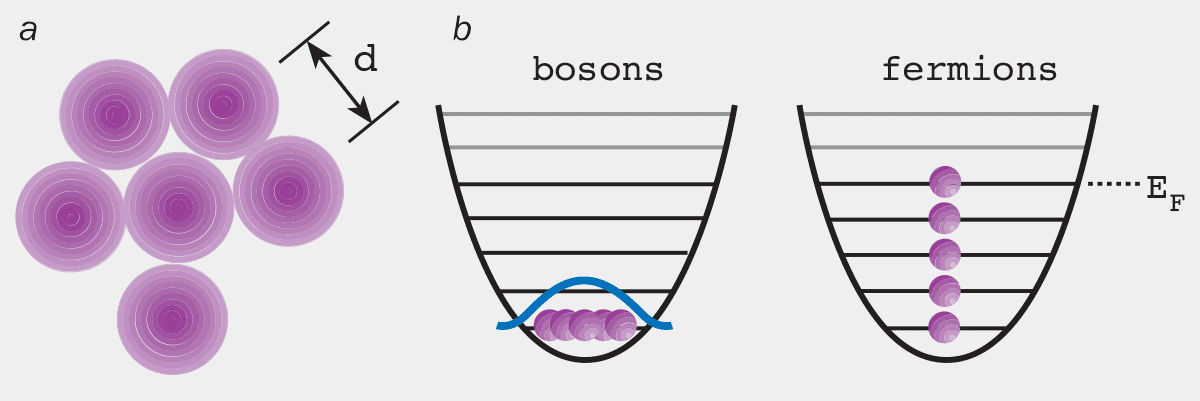
Diagram showing a cloud of atoms, matter waves and energy state

(a) A gas of atoms reaches quantum degeneracy when the matter waves of neighbouring atoms overlap – i.e. when the thermal de Broglie wavelength, λ, which increases as the temperature falls, becomes about as large as the mean spacing, d, between atoms. The gas then exhibits quantum behaviour, such as Bose–Einstein condensation (for bosons), and Fermi pressure and Pauli blocking (for fermions). (b) At absolute zero, gaseous boson atoms all end up in the lowest energy state. Fermions, in contrast, fill the available states with one atom per state – shown here for a one-dimensional harmonic confining potential. The energy of the highest filled state at T = 0 is the Fermi energy, EF. The Fermi temperature, TF = EF/kB, where kB is Boltzmann’s constant, marks the crossover from the classical to the quantum regime. At about TF/2, λ is equal to the mean interparticle spacing.

Fermions and bosons are very different at the quantum level. As Wolfgang Pauli’s famous exclusion principle states, identical fermions cannot occupy the same quantum state at the same time. Bosons, however, can share quantum states. But to observe this fundamental difference, gases of bosons or fermions have to be chilled to ultra-low temperatures, where individual quantum states have a high chance of being occupied. At these low temperatures, bosons will eagerly fall into a single quantum state to form a Bose-Einstein condensate, whereas fermions tend to fill energy states from the lowest up, with one particle per quantum state (figure 1). At high temperatures, in contrast, bosons and fermions spread out over many states with, on average, much less than one atom per state.

Another difference is that fermions do not undergo a sudden phase transition in the ultra-low temperature regime. Instead, the quantum behaviour emerges gradually as the fermion gas is cooled below the Fermi temperature TF = EF/kB, where EF is the Fermi energy – the energy of the highest filled state – and kB is Boltzmann’s constant. TF, which is typically less than 1 µK for atomic gases, marks the crossover from the classical to the quantum regime.

The odd quantum behaviour of fermions permeates all of physics, and is responsible for phenomena ranging from atomic structure to the stability of neutron stars. But unlike other Fermi systems found in nature, a Fermi gas of atoms occurs in a new, ultracold, low-density regime where interparticle interactions are weak. Dilute gases of atoms also provide an exquisite environment in which to investigate, probe and control quantum phenomena – as has been amply demonstrated by the wealth of beautiful experiments carried out on Bose-Einstein condensates in recent years (see Triple first for Bose condensates by Christopher Foot Physics World May 2001 pp21-22).

Cooling fermionic atoms

The main experimental challenge in creating a fermionic gas is to chill the atoms to ultra-low temperatures. Given the fact that physicists have been able to cool bosons to microkelvin temperatures since 1995, when Bose-Einstein condensates were first created, one might think that experiments to cool fermions would have followed soon afterwards. However, cooling a gas of fermionic atoms is difficult because of their strange collision properties.

In general, collisions play a crucial role in the physics of quantum gases. Elastic collisions, for example, keep the gas in thermal equilibrium as it cools. These collisions also affect many of the properties of both Bose-Einstein condensates and Fermi gases by determining the interparticle interactions. However, differences in the collisional behaviour of bosonic and fermionic atoms arise at temperatures well above those that are required for the gas as a whole to behave quantum mechanically.

Typically, atoms in an ultracold gas will only collide if they approach each other head-on in what is known as an “s-wave” collision, where there is no relative angular momentum between the two atoms. But due to the Pauli exclusion principle, these s-wave collisions are forbidden for fermions that are in the same internal quantum state – i.e. that have the same spin-state. This lack of collisions makes it impossible to cool such a fermionic atomic gas efficiently.

However, fermionic atoms that are in different internal states can collide through s-wave collisions (see box). This means that it is, after all, possible to cool fermions to near absolute zero, as my colleague Brian DeMarco and I showed in 1999, when we created the world’s first quantum-degenerate Fermi gas of atoms.

The strange collision properties of atoms

A pair of colliding atoms can be described by a quantum-mechanical wavefunction, Ψ, that contains two parts – one part describing their spin and the other their relative spatial location, Ψ = χspinΨspace. The wavefunction of bosons is “symmetric” – in other words when the bosons swap places in the wavefunction, then the wavefunction stays the same. When two identical fermions are exchanged, however, the wavefunction picks up a minus sign and is said to be “antisymmetric”.

To see how this explains why the collision properties of bosons and fermions are so different, note that Ψspace can be expanded as a series, in terms of the relative angular momentum L between the atoms, Ψspace = Ψs-wave(L = 0) + Ψp-wave(L = 1) + higher-order terms. The first term of the wavefunction Ψs-wave, which corresponds to particles colliding head-on, is symmetric, whereas the second term, Ψp-wave, is antisymmetric.

It turns out that as atoms are cooled, a “centrifugal barrier” causes the higher-L terms to slowly vanish, until – at the limit of absolute zero – only the first (s-wave) term remains. However, two fermions in the same spin-state are not allowed to collide through an s-wave collision because both χspin and Ψs-wave are symmetric. The number of collisions between fermions in the same spin-state therefore falls almost to zero as they are cooled.

Two fermions in different spin-states, however, can undergo these symmetric s-wave collisions, because χspin can be antisymmetric. The overall wavefunction, which is the product of the spin and the space parts, therefore remains antisymmetric. As fermions in different spin-states are cooled, the collision rate remains high. The bottom line is that fermions in the same spin-state become less likely to collide at low temperatures, whereas fermions in different spin-states continue to have a high chance of colliding. This fact enables a gas of fermions in two different spin-states to be cooled to ultra-low temperatures.

Fermi gases in practice

In our experiments, we adapted techniques that had already been developed by physicists to create Bose-Einstein condensates. We began by collecting a sample of potassium-40 atoms from a room-temperature vapour and cooling them in a “magneto-optical trap”. This gave us about 500 million atoms at a temperature of 150 µK. We then loaded atoms in two different internal spin-states into a magnetic trap where they could be cooled still further.

However, holding atoms with two different spin-states in a magnetic trap is tricky. The trap has a field minimum and can therefore only confine those atoms with a magnetic moment that points in the opposite direction to the magnetic field – so-called weak-field seeking states. In our experiments at JILA we used potassium-40 atoms in the lowest energy hyperfine ground state, where the total atomic spin, f, is 9/2. A particle with spin 9/2 has 10 spin-states (mf = -9/2, -7/2, -5/2…+9/2), the energies of which are split in a magnetic field by the Zeeman effect; half of these spin-states are weak-field seeking and could, in principle, be confined in a magnetic trap. We decided to use the two spin-states with the largest magnetic moments – mf = +9/2 and mf = +7/2 – because they do not undergo inelastic collisions that would leave them in the lower-energy states that cannot be trapped.

Once we had stably confined the mixture of atoms with two spin-states in the magnetic trap, we evaporatively cooled them to below 300 nK. This technique works in much the same way as a cup of hot coffee cools: the highest energy atoms in both spin-states in the experiment are removed from the trap, lowering the temperature of the remaining gas in the process. Once the Fermi gas had reached the quantum regime, we obtained information about it by turning the magnetic trap off, allowing the gas to expand and measuring the shadow of the gas cast by a laser. These absorption images let us determine the energy, temperature, number and momentum distribution of the atoms in the gas.

This approach, pioneered by my group at JILA, is not the only way of obtaining ultracold Fermi gases. Randy Hulet and his group at Rice University (see Truscott et al. in further reading), as well as Christophe Salomon and co-workers at the Ecole Normale Supérieure (ENS) in Paris (see Schreck et al. in further reading), have used a technique known as “sympathetic cooling”, in which a gas containing a mixture of isotopes – rather than a mixture of spin-states – is cooled. Both groups have used this approach to cool mixtures of lithium-6 and lithium-7 atoms. The lithium-7 atoms, which are bosons, are evaporatively cooled in the usual way. Meanwhile, the simultaneously trapped lithium-6 atoms, which are fermions, cool simply by being in thermal contact with the boson gas – just as hot coffee would cool if placed in contact with ice.

Sympathetic cooling has also been used to create Bose-Einstein condensates using bosons with two different spin-states or two different isotopes. As well as introducing another method of cooling fermionic atoms, these experiments have enabled mixtures of bosons and fermions to be studied. In a third experiment, using lithium-6, John Thomas and co-workers at Duke University have used an all-optical trap to confine and cool a mixture of atoms in two spin-states (see O’Hara et al. in further reading).

Quantum degeneracy

Using these novel experimental techniques, physicists have been able to cool Fermi gases of atoms into the quantum-degenerate regime below the Fermi temperature, TF. But because the effects of quantum statistics become stronger as a gas is cooled further into this regime, the ultimate cooling limit is an important issue. Experiments at JILA using potassium-40 in two spin-states, and at Rice and the ENS in Paris using lithium-6, have so far cooled atoms to about 20% of TF. We do not yet know why potassium-40 atoms cannot be cooled any further, although the quantum nature of fermions as well as technical challenges could both play a role.

In the experiments on lithium at Rice and the ENS, however, sympathetic cooling is limited by the formation of lithium-7 Bose-Einstein condensates. The effectively attractive interactions between lithium-7 atoms make the condensate collapse, causing atoms to leave the trap. The fermions can therefore no longer cool by being in contact with the boson gas.

The quantum behaviour of an atomic Fermi gas was first revealed in thermodynamic measurements. At JILA we study the atomic Fermi gas by analysing absorption images of the expanded gas. As the gas expands, fast atoms travel further from the centre of the gas than slow-moving atoms. An optical image of the gas therefore reveals the momentum distribution of the atoms: those atoms with low momentum remain near the centre of the cloud, while atoms with high momentum appear at the edges.

2 Quantum degeneracy of a Fermi gas

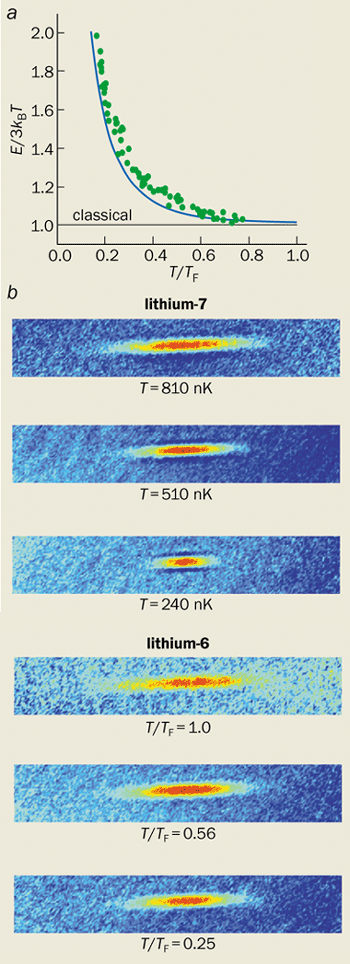
Quantum degeneracy of a Fermi gas

(a) Cooling a Fermi gas of potassium-40 atoms to ultra-low temperatures reveals its quantum nature. The y-axis shows the mean energy per particle, E, divided by 3kBT – the value expected from classical physics. The x-axis shows the temperature of the gas divided by the Fermi temperature, TF. As the gas cools below TF, the mean energy rises well above the classical value because no more than one fermion can occupy the same quantum state and so the fermions have to fill states of higher and higher energy.

(b) Absorption images of a gas of lithium-6 atoms (fermions) and a gas of lithium-7 atoms (bosons). The fermions have a higher energy per particle, which means that they move faster and further than the bosons. The Fermi gas therefore becomes bigger than the Bose gas as both are cooled in a magnetic trap.

We have used this technique to show how a Fermi gas of potassium-40 atoms enters the quantum regime. When the gas is cooled below TF, the number of particles with low momenta (i.e. near the centre of the image) falls below the value expected from classical physics. This is a sign of quantum behaviour. Only one fermion is allowed to occupy each quantum state, which means that the low-energy states are quickly filled and the other fermions must therefore fill states of higher and higher energy. Indeed, experiments reveal that the mean energy per particle rises well above the classical value (figure 2a).

Hulet and co-workers at Rice, as well researchers at the ENS, have carried out similar experiments to show the differences in size between a Fermi gas (lithium-6) and a Bose gas (lithium-7). In the quantum regime, the mean energy per fermion rises above the value expected from classical physics or in a Bose gas. The fermion atoms have more kinetic energy, which means that the trapped Fermi gas spreads over a larger volume than the Bose gas (figure 2b). This quantum phenomenon, called Fermi pressure, is seen in astrophysics and is responsible for stabilizing white-dwarf and neutron stars against their gravitational potential.

Interactions in a Fermi gas of atoms

Physicists studying Bose-Einstein condensation soon realized that interactions between the atoms play a key role in determining properties such as the size and even the stability of the condensates. Indeed, the differences between condensates made from rubidium, sodium or lithium atoms depend simply on the strength of the interparticle interactions at ultra-low temperatures and whether these interactions are attractive or repulsive. Such interactions can also play an important role in Fermi gases. In our work at JILA, for example, we have used potassium-40 atoms in two spin-states to create a two-component interacting Fermi gas, in which we have observed the effect of a strange phenomenon known as “Pauli blocking”.

Occurring in all Fermi systems, Pauli blocking is a consequence of the fact that identical fermions can never occupy the same quantum state. A fermionic atom can therefore only change energy – in a collision, for example – if the final energy state is unoccupied. But in the quantum regime, it is highly likely that low-energy states are already occupied. Pauli blocking therefore tends to suppress any process in which atoms change energy states.

3 Pauli blocking in a Fermi gas

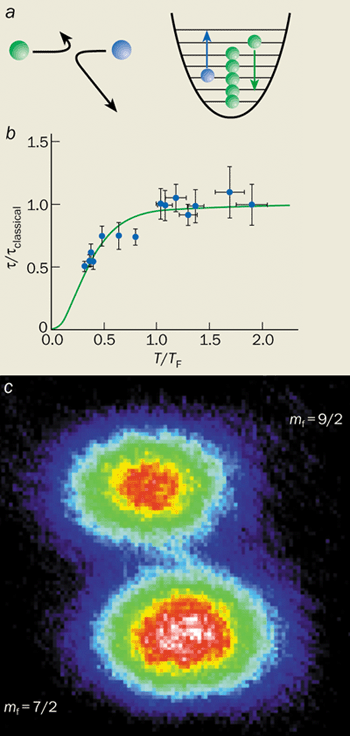
Pauli blocking in a Fermi gas

(a) The phenomenon of “Pauli blocking” suppresses elastic collisions in a Fermi gas. The high-energy green atom, for example, can only lose energy (green arrow) when it collides with a low-energy blue atom if it there is an unoccupied, lower-energy final state for the green atom to enter. However, all the low-energy states in the Fermi sea of atoms are already occupied, which means that this collision cannot occur.

(b) Pauli blocking observed by studying “collective excitations” in a gas of potassium-40 atoms with two different spins, denoted by the Zeeman quantum numbers mf = 9/2 and 7/2. The excitations are density oscillations, or sound waves, excited by perturbing the trapping potential. The damping time, tau, which is a measure of how fast the collective excitations fade away, falls below the classical value, tauclassical, as the temperature, T, of the gas drops below the Fermi temperature, TF. This indicates that the collisions required to establish the collective nature of the excitation have been suppressed by Pauli blocking.

(c) An absorption image of the two-component Fermi gas after it is released from the magnetic trap and allowed to expand. The relative motion in the horizontal direction of the two different types of atoms was measured by vertically separating them with a magnetic field.

We have observed Pauli blocking by measuring “collective excitations” of the trapped gas (figure 3). These excitations, which are essentially sound waves, involve small relative motions between the two different gases in our samples. They provide valuable information about how the atoms in a Fermi gas collide. Indeed, collective excitations have proved to be a very valuable way of studying other quantum fluids. They have been widely used to characterize Bose-Einstein condensates – for example to investigate interactions, to probe finite temperature effects, and even to detect superfluidity and vortices. In an atomic Fermi gas, Pauli blocking of collisions is revealed by changes to the “damping time” for collective excitations. What is particularly interesting about Pauli blocking is that it is a quantum-mechanical effect in which collisions are affected by atoms that are far away from one another.

Fermi gases – the future

Even though the study of Fermi gases of atoms is still in its infancy, it is clear that this new field complements research into Bose-Einstein condensation. While experiments on Fermi gases have already revealed a number of striking effects of quantum statistics, cooling the gas further into the degenerate regime could enhance the quantum effects still further. Several other quantum effects that have been predicted – such as a dramatic change in the interaction of the gas with light – remain to be explored experimentally.

So where do we go next? The lack of collisions in a single-component Fermi gas of atoms could be exploited for precision measurements of these atoms, while recent experiments on two-component Fermi gases have begun to study the interplay of interactions and quantum statistics in determining behaviour. Fermionic atoms could also be loaded into “optical lattices” – three-dimensional egg-box-like arrays of potential wells created by the interference of multiple laser beams. This would give researchers an almost ideal model of solid-state systems, with the potential wells acting like lattice sites in a crystal and the fermionic atoms sitting in the wells.

Yet another new opening is the study of Bose/Fermi hybrid systems. In addition to the mixed-isotope lithium experiments discussed previously, several experimental groups are working toward realizing Bose/Fermi mixtures with different atoms. Ketterle and co-workers at MIT, for example, have recently demonstrated quantum degeneracy in a mixture of bosonic sodium atoms and fermionic lithium atoms. Other researchers, such as Massimo Inguscio and colleagues at the European Laboratory for Nonlinear Spectroscopy in Florence, Italy, as well my group at JILA, are working with mixtures of rubidium and potassium atoms.

Arguably the most exciting prospect in the study of Fermi gases is the possibility that there might exist a new phase transition to a superfluid state. Even before Fermi gases of atoms were created in the laboratory, this notion had been explored by theorists such as Marianne Houbiers and Henk Stoof from the University of Utrecht in the Netherlands. Similar phase transitions exist in many condensed-matter systems, including the transformation of liquid helium-3 into a superfluid. The eerie phenomenon of superfluidity – flow without viscosity – was first seen in liquid helium-4, where its appearance was relatively easy to explain. The superfluidity is due to the fact that helium-4 atoms are bosons and so can occupy a single quantum state by forming a Bose-Einstein condensate. Superfluidity in liquid helium-3, however, cannot be explained as simply because the atoms are fermions.

Another example of this type of phase transition for fermion systems is the technologically important phenomenon of superconductivity. Here the fermionic condensates occur through the creation of a small number of “Cooper pairs”, each consisting of two weakly correlated fermions. Although fermions have half-integer spin, the two together have integer spin, making the Cooper pair a “composite boson”. Just as in Bose-Einstein condensation, the Cooper pairs can fall into a single quantum state and thus cause a phase transition to a superconducting or superfluid phase.

Cooper pairing of atoms in a gas would provide a new and unique example of a fermionic condensate. In all known examples of this quantum phenomenon, the pairing interaction is extremely weak and the phase transition occurs at temperatures many orders of magnitude below the Fermi temperature. However, recent theoretical work by Murray Holland at JILA and by Eddy Timmermans at the Los Alamos National Laboratory in New Mexico has suggested that a superfluid phase-transition temperature, Tc, in an atomic gas could be as high as TF/2. Ironically, compared with condensed-matter examples of fermionic condensation, the predicted phase transition in a Fermi gas of atoms would have both the highest relative temperature (compared with TF) and the lowest absolute temperature.

4 Superfluids in Fermi gases

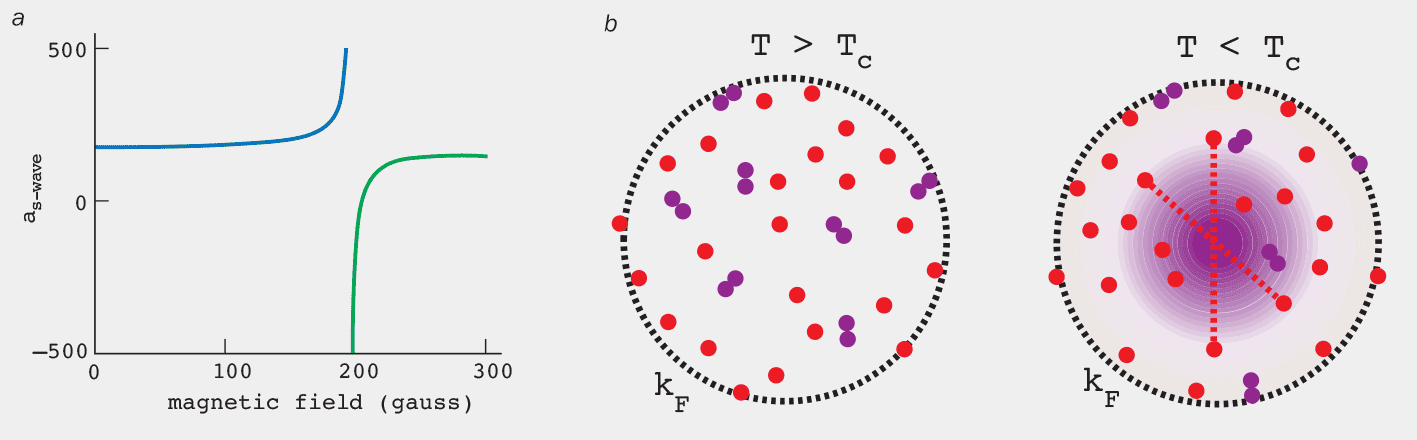
Graph showing the scattering length of head-on collisions of ultracold potassium-40 atoms; plus two diagrams showing the strong interactions between atoms and the molecules thereby formed

(a) Theory predicts that a new phase, called “resonance superfluidity”, could be created in a Fermi gas of atoms. An atomic scattering resonance such as the one shown here could be used to create the relatively large and effectively attractive interaction required to form “Cooper pairs” of fermions. This graph shows the predicted “scattering length” of s-wave (or head-on) collisions of ultracold potassium-40 atoms, as-wave, as a function of applied magnetic field. The effective interactions between the colliding atoms are attractive if as-wave > 0 and repulsive if as-wave < 0. The collision cross-section is proportional to the square of as-wave. This predicted scattering resonance has recently been seen in experiments at JILA. A magnetic field of about 200 gauss would create the large, attractive interaction required for the atoms to form Cooper pairs.

(b) At temperatures above the superfluid phase-transition temperature, Tc, the strong interactions between atoms (red spheres) lead to a small number of molecules (purple). Below Tc, Cooper pairs (dotted red lines), which cause the superfluidity, form near kF, the momentum at the Fermi energy. The bound molecules in the gas form a condensate (fuzzy region) that co-exists alongside the Fermi superfluid.

Such a high-Tc system would require a complex, non-trivial theory and the fermionic atom condensate is likely to have many exciting new properties (see Holland et al. and Timmermans et al. in further reading). The system could be created by using a “scattering resonance” to enhance the interactions between the fermionic atoms. This would lead not only to Cooper pairs of fermionic atoms, but also to a small number of bound molecules in a condensate that exists alongside the Cooper pairs (figure 4). By varying the resonant interactions, it may be possible to explore – in the same system – the crossover from physics based on the Bardeen-Cooper-Schriefer theory of superconductivity to the physics of Bose-Einstein condensates made from tightly bound composite bosons.

Experimentalists are already trying to realize this transition to a superfluid state. If they succeed, it could help us to understand not only high-temperature superconductivity, but also the underlying connection between it and Bose-Einstein condensation. It is clear that research into Fermi gases still has very much to offer.

Doubts about bubble fusion

Taleyarkhan and co-workers had not found a way to initiate fusion reactions at room temperature – in other words there was nothing cold about their experiment. Rather, they had found a relatively simple way of achieving the extreme temperatures needed for fusion in a table-top experiment. However, like the case of the two electrochemists who claimed in 1989 to have demonstrated fusion in an electrolysis cell at room temperature, other experts in the field were not convinced by the number of neutrons produced in the alleged bubble-fusion reactions (see article).

Whereas cold fusion was announced in a blaze of publicity about endless sources of cheap energy and was first published in a journal read by few, if any, fusion scientists, Taleyarkhan and co-workers are to be commended for sending their manuscript to a high-profile journal that rejects many more submissions than it accepts. Their paper reports how they used high-energy neutrons to create tiny bubbles of gas in a beaker of deuterated acetone, and then used an acoustic field to force the bubbles to expand and collapse. They claim that temperatures in excess of 106 K were produced when the bubbles collapsed, leading to the fusion of two deuterium nuclei to produce either a tritium nucleus and a proton, or helium-3 and a neutron. No effect was observed when “ordinary” acetone was used.

The management of the Oak Ridge laboratory is also to be commended for asking two other physicists at the lab – Dan Shapira and Michael Saltmarsh – to repeat the experiment. If Shapira and Saltmarsh had been able to confirm the phenomena, it would have kick-started a wave of activity in an exciting new sub-branch of physics. But when they failed to find enough neutrons or tritium nuclei, questions should have been asked. The paper published in Science was modified in the light of the Shapira and Saltmarsh results, and includes a reference to them (and to a rebuttal by Taleyarkhan et al.). Doubts about the paper increased when it emerged that it had been seen by 13 or 14 referees during the peer-review process.

In an editorial about the paper, Donald Kennedy, the editor-in-chief of Science, defends the decision to publish: “Our mission is to put interesting, potentially important science into public view after ensuring its quality as best as we possibly can. After that, efforts at repetition and reinterpretation can take place in the open. That’s where it belongs, not in an alternative universe in which anonymity prevails, rumor leaks out, and facts stay inside. It goes without saying that we cannot publish papers with a guarantee that every result is right…What we ARE sure of is that publication is the right option, even – and perhaps especially – when there is some controversy.”

While Kennedy makes a strong case for publication, one must wonder why Science declined to peer review the paper by Shapira and Saltmarsh for possible publication in the same issue. Shortage of time is not a convincing reason: the research had already been performed and the results written up; the original paper had been with the journal for about a year, so a few weeks would have made little difference; and electronic publishing allows research papers to appear on line as soon as they have been sub-edited and proof-read, removing the delays associated with print.

The emission of light by bubbles subjected to acoustic waves sounded like science fiction when it was first reported in the early 1990s, but “sonoluminescence” is now universally accepted, if still not fully understood. Bubble fusion may have an equally illustrious future – but the signs are not good.

Facing Up: Science and its Cultural Adversaries, Steven Weinberg

Steven Weinberg inhabits a bleak world infested with adversaries that he is impelled to combat. He faces up to them with scientific rigour and lawyerly precision, as readers of this fascinating book of essays will discover with pleasure. His opponents range from his peers in other areas of physics – such as Philip Anderson, the Nobel-prize winning condensed-matter theorist who successfully opposed the now-defunct Superconducting Super Collider project – through to the enemies of reductionism, proponents of vitalism, methodological anti-realists, critics of the scientific method and people with religious convictions.

Weinberg is a private person, and his Manichean world must be rather lonely sometimes, offering little emotional comfort. But, as he writes in this book: “Melancholy…is not without its own consolations.” Weinberg is an object of intellectual respect, rather than a matey type one might go for a beer with. He becomes momentarily more approachable when he describes his discovery of the electroweak theory that bears his name while tooling along in his red Camaro, a welcome autobiographical sketch.

Weinberg’s starting point is his affirmation that science is a liberal art that is an integral part of the history of humanity. He is determined not to dwell monastically in some reductionist ivory tower, but to sally forth to do battle under reductionist colours. He soon nails these firmly to the mast: Newton’s dream, which has morphed into particle physics, is more fundamental than other sciences. Debating Freeman Dyson, Weinberg does not deny others the right to drink the “orange juice” of emergent phenomena – the idea that a system with many mutually interacting parts can lead to novel macroscopic behaviour – but he asserts vigorously his right to drink the “gin” of reductionism.

Many readers will enjoy Weinberg’s comments on emergence, the anthropic principle and the Copenhagen interpretation, among other chestnuts. Personally, I was less convinced by the “civilized egalitarian capitalist” utopia he proposes: even Weinberg is less than fervent about it.

Among the essays I valued most were his gleeful wades into the furore generated by Alan Sokal, who published a now famous hoax article in the journal Social Text parodying the sloppy thinking of some sociologists and philosophers. It is hard for physicists to resist chuckling over this, and groaning at the solecisms of the Post-Modernists skewered in a couple of Weinberg’s essays. Who can resist deriding Derrida?

I also appreciated his thoughtful dissection of the good and bad in Thomas Kuhn’s interpretation of the scientific process, notably his critique of Kuhn’s later deconstruction of “paradigm shifts” – the very concept for which Kuhn had originally made his name. Having myself been severely disappointed by a leading gladiator of the so-called strong programme of the Edinburgh school of “sociologists of science” – after he parodied the emergence of the quark paradigm in particle physics, despite my having discussed it with him at length – I particularly enjoyed the essay on Ian Hacking, whom Weinberg dissects in one of his final essays. “The philosophy of science”, writes Weinberg, “is no help to the practising scientist.” I wonder whether it is even a hindrance?

Weinberg’s stance as a “philistine philosopher” resonated with me, but I had less patience with his jousts with religion. I do not perceive contemporary Western religion as a threat to the scientific enterprise – a role that I do assign to sociologists of science. I prefer, therefore, not to stimulate unnecessary antibodies by positing strong scepticism of religion, as Weinberg does. His defence of Zionism also seems out of place and jarred at least my sensibilities. And what would moral philosophers take of his assertion that “for good people to do evil – that takes religion”?

The central essay in this book may be the ninth, where Weinberg describes his “night thoughts” of a quantum physicist. The Standard Model of particle physics works very well in describing the data available from accelerators, and there are high hopes for new discoveries with the Large Hadron Collider, which is currently being built at CERN. However, the Standard Model is clearly unsatisfactory and incomplete. Weinberg’s nightmare is that direct experimental tests of the “theory of everything” – or “final theory” as he calls it – may lie beyond our reach.

However, I have another nightmare, which should also trouble Weinberg. What if the glorious reductionist enterprise succeeds and we formulate a unified description of all the fundamental constituents of matter and their interactions? Unlike India confronting Alexander the Great, there would be no more reductionist worlds for us to conquer. Would we be reduced to practising condensed-matter physics, sociology, Post-Modernism or religion in order to keep body and soul together?

This is a hypothetical question, whatever string theorists may say. For the foreseeable future, our fellowship of fundamental physicists has a long, narrow and winding reductionist road ahead. As company on our way, we should be grateful to Weinberg for his swashbuckling assaults on the demons threatening our quest, as well as being stimulated by the barbs in this excellent book. Those of you who are engaged in other quests will find this book full of fascinating insights into the mind set of one of the leading contemporary scientific intellectuals.

I, for one, share his outspoken confidence that research at the limits of science is destined to become part of everyone’s intellectual heritage, along with Newtonian physics. We are surely getting closer to the truth, just as jumbo jets land closer to their destinations when general-relativistic effects are included in their Global Positioning Satellite navigational calculations. No matter what the sociologists of science may say, we do need to take Einstein and quarks into account. Weinberg is a noble warrior in the science wars. His destruction of the sociological Taliban is clinical and thorough. Read this book.

Buy the book
Facing Up: Science and its Cultural Adversaries: Amazon UK/Amazon US

This is your philosophy

Everybody – including scientists – makes seat-of-the-pants practical judgements about what’s real and what’s not. The common-sense assumptions underlying these judgements can be unrecognized, inconsistent and even untenable; they can be home-grown, inherited and absorbed from others. But when someone is engaged in an activity as complex as science, it is almost impossible to avoid making such practical judgements. No matter how implicit and readily revised these judgements may be, they are based on preconceptions of what the world consists of and what the world’s most important distinctions and categories are – in other words of how it all hangs together.

Professional philosophers analyse these preconceptions and up the ante on them. They formally rework the assumptions into consistent, fully articulated and intellectually supportable positions. They then give them names, such as realist, antirealist, critical realist, constructivist, hermeneutical realist, and so on. To qualify as a philosophical position, it has to be advanced in clear words, articulated in appropriate detail and depth, and be defensible against criticism when scrutinized in a philosophical peer review.

Why philosophy shouldn’t be avoided

I’ve often heard scientists call philosophical attention to their field irrelevant at best, and confusing and destructive at worst. Indeed, many scientists advise that philosophy should be avoided altogether. Steven Weinberg, for example, named a chapter in his book Dreams of a Final Theory “Against the philosophers”. Murray Gell-Mann, meanwhile, has remarked that philosophy “muddies the waters and obscures [the theoretical physicist’s] principal task, which is to find a coherent structure that works”. He then added that having a philosophical bias may cause a physicist “to reject a good idea”.

But such reactions misconstrue philosophy, however much they may have been triggered by the excesses of philosophers themselves. Scientists cannot avoid making judgements about what is real and what is not, and philosophical analysis seeks to expose and clarify this process.

I’ve also heard that science inclines its practitioners towards a specific philosophical position. Scientists, it is said, tend towards realism because it makes them better scientists – a conviction that has also influenced philosophers. When Ian Hacking, for example, once asked a physics colleague what he was doing, the physicist replied that he was “spraying photons”. Impressed, Hacking wrote: “From that day forth I’ve been a scientific realist. As far as I’m concerned, if you can spray them, then they are real.”

In his book Faith, Science and Understanding, physicist-turned-Anglican-priest John Polkinghorne remarked that “virtually all scientists” – including himself – adhere to a brand of realism known as critical realism. A reviewer in Physics World, who doubted Polkinghorne’s bold assertion, later suggested that I poll readers, hoping to elicit information to settle the issue. I therefore carried out a survey in which I listed a number of different items and asked readers to say whether or not they considered them to be real things, or whether they were unsure (Physics World October 2001 p18). Having received more than 500 replies, the statistics (see tables) do indeed cast doubt on Polkinghorne’s claim.

Different brands of realism

Realism is the view that things in the world exist that are not of our own making – independent of human perception and thought – and that scientific theories are true if they faithfully correspond in some way to these things. Indeed, one of the strongest lines of reasoning for realism, termed the miracle argument, is that – as the philosopher Hilary Putnam once put it – “realism is the only philosophy that doesn’t make the success of science a miracle”.

But a tension lurks in the meaning of “real”. People who insist that real things are the sort incorporated into the fabric of human experience – i.e. order as human beings experience it – adhere to a brand of philosophy that has been called phenomenal realism. They view what things are like, apart from that experience, as unknowable.

Meanwhile, those who argue that we can, in fact, come to know something about structures that underlie the fabric of human experience – i.e. nature’s order – adhere to what is known as noumenal realism. These structures may be material (Democritean) or abstract and formal (Platonic), such as (in this view) electrons and protons. What is truly real – for noumenal realists – are particles and forces, say, rather than sticks and stones. In this view, what human beings experience is not of reality as such, but rather the means and clues by which we can know underlying, fundamental structures that are not given in experience.

Different branches of realism evolved partly in response to this tension. Critical realism – Polkinghorne’s pet idea – is a term that covers several different perspectives, combining aspects of phenomenal and noumenal realism. What these perspectives share in general is the view that what we directly perceive and know is not the real object itself – an electron, say – but rather a sign or datum by which we can infer the existence and properties of the object. These inferences, however, may often fail to capture the object’s details and even its essence.

Polkinghorne’s views fit this loose orientation. By realism, he says he means that science “faithfully represents” the world, giving an “increasingly verisimilitudinous account of what the physical world is like”. This does not mean that Polkinghorne thinks that the world is intuitively graspable – after all, he admits that it contains strange entities like quarks and superstrings, and that mathematics is its natural language. And to explain what he means by the word critical, Polkinghorne says that “scientific understanding is not just read out of nature but…attained by a creative interpretive process”.

Different brands of antirealism

But a strict definition of realism quickly runs into trouble from several directions. One is that scientific theories are often about prediction and control, not explanation and portraiture. Another problem is that scientific theories and practices change in non-trivial ways, forcing adherents into the awkward position of having to dismiss most past science as false, and of having to prepare to say the same about present-day science should future theories of a radically different character replace those of today.

Yet another difficulty with realism stems from the fact that much of what scientists study is a product of their theories. As J Robert Oppenheimer once put it, 20th-century science “forced us to reconsider the relations between science and common sense, [and] forced on us the recognition of the fact that we were in the habit of talking a certain language, and using certain concepts did not necessarily imply that there was anything in the real world to correspond to these”.

Such counter arguments led to the development of so-called antirealist positions. Empiricists are antirealists who argue that the purpose of scientific theories is not to correspond with some basic structure of the world, but to organize data. Constructivists stress the extent to which concepts and theories are socially constructed – much like the rules of a game – rather than discovered in nature. Operationalists say that reality can be attributed only to observable elements by virtue of operations that can be performed on them. Instrumentalists hold that concepts and theories are tools to be evaluated for their usefulness rather than truth value.

The most significant challenge to realist positions is to account for non-trivial theory change. The biggest challenge for antirealist positions is to explain the stunning success of science, why some theories are so hard to change or abandon, and why we have such little control over which theories seem right.

Hermeneutical realisms

Yet another alternative philosophy of science – besides realism and antirealism – is hermeneutical realism, which comes from the Greek hermeneutikos, meaning interpretation. Hermeneutical realists think that existing forms of realism and antirealism start off on the wrong foot by presenting us with a dualistic series of forced options. Either theories (inside us) represent things in the world (outside in nature) or they do not. Either we (inside) have direct access to something independent of us (outside), or we do not. Either theories are successful because they contact the real world (over there) or because they order the data (in here).

Hermeneutical realists do not think that we are faced with those choices. They see the real as the relationship between ourselves and our surroundings, not as a subset of the things that we find in those surroundings. In other words, hermeneutical thinkers do not begin with isolated knowers and knowns. Instead, they say that it is impossible, in that relationship, for us to peel away theorizing and what there is from each other. They then examine the practical judgements involved in that relationship.

Hermeneutical thinkers insist that to perceive something as real – rather than illusion or error – does not merely involve data taking (phenomenal-realist style) or deciphering a clue that tells us something about another, somehow more real world beyond what we experience (noumenal-realist style). Perception is neither an event in the head nor code-cracking. Instead, we perceive something to be real – in science as in everyday life – if we find it to behave in a predictable, law-like way within a particular background context or horizon, fulfilling (or not) our expectations.

When we see a profile of George W Bush on the street, say, we perceive it to be a cardboard profile or the real person by walking round to view it from other angles. For the hermeneutical realist, scientific data (about electrons, say) are like profiles of the real George W Bush. Data provided by different experiments – or by variations of the same experiment – designed by the same theory and within a common (scientifically controlled) background context are found to cohere in a predictable way as the object is sampled from different directions, allowing us to “read” these samplings as profiles of the same object.

As we develop and improve empirical practices (the instrumentation and techniques for handling electrons) and the background horizon (electromagnetic theory), data and object will appear differently. Four decades ago, the reality of the big bang was considered to be confirmed by the measurement of uniform background radiation; a decade ago, it was considered to be clinched by the measurement of deviations from uniform background radiation.

Hermeneutical realism is not a constructivism because the objects that we perceive to be real exhibit invariances that are not under our control. Yet it accounts for non-trivial changes in the history of science. In the hermeneutical perspective, scientific knowledge evolves from – and at the same time transforms – historically inherited practices and judgements. There is something unavoidable about this insight; if it didn’t happen, science would be impossible or trivial.

Your views

I’d like to thank all of the 534 people who replied to the poll, some of whom wrote lengthy accompanying letters. Some Italian physics students at the University of Bari even gave it to their professors to fill in. I’m gratified that many participants found the poll harder to answer than they thought it would be – including the reader who had originally allotted himself, speed-chess style, five seconds for each answer.

Some people said that they changed their minds, or grew more uncertain, or realized that their answers were inconsistent, while doing the poll. (It made them think!) A handful of people even stopped in despair partway through. Yes, the phlogiston button was broken and viscosity was misspelt. And to those who complained that “it depends”: precisely! The philosopher’s task is to discover the variables and how they affect the outcome.

The results reveal a full spectrum of positions. A handful of people were fellow travellers of Weinberg and Gell-Mann, including the person who called the poll “a trap for the unwary” and the physicist who archly informed me that “in the last 40 years, [you] philosophers still have not found a way to ask a physicist a ‘real’ question”. Each, with admirable consistency, returned the poll conspicuously blank. The person who wrote that “a scientist who is not a realist is either lying or incompetent” was a realist fundamentalist.

A few people said they were operationalists or constructivists, but most who explicitly labelled themselves said they were realists. What I learned from the poll was that it was difficult to tell from people’s answers what kind of position they adhered to. Sometimes it was easy. I’d classify as a naive realist the person who simply wrote “I’m a realist” on his poll, and ticked off everything accepted by contemporary science as real and everything else as not real.

I’d identify as phenomenal realists those who shared the views of the person who wrote: “I take objects that I can ‘touch’ directly or not, as real. I take concepts as unreal.” Such people were usually (though, surprisingly, not always) among the 10% or so of respondents who rejected things like quarks and electrons.

People whose working definition of real things was anything that – as one respondent put it – “had an existence in the real world even if not observed” were realists in either the phenomenal or noumenal sense. These people were among the 43% and 32% who believed that hallucinations and after-images are not real.

Those who said that real things were made of matter or had mass were Democritean noumenal realists – and were therefore among the third or so of respondents who rejected the reality of the gravitational constant G, as well as numbers. The physicist from the Lawrence Livermore National Laboratory who wrote: “I think that what I’d call ‘real’ are concepts that work,” was an instrumentalist. So were the large fraction of people whose criterion for reality was usefulness, such as the person who measures the reality of an idea by “how well it can predict the outcome of a bet”. A large number of people said that the real was the measurable, which could be a sign of realism, operationalism, or hermeneutical realism.

The large overlap between those who believed in the reality of colours (50%) and light waves (68%) is revealing. When it came to saying what was real about light, these people evidently did not think that they had to choose between something necessarily experienced and something abstract and third person. They were comfortable with the fact the phenomenon of light appears differently in different background contexts.

Another person who felt no need to distinguish between what is experienced and what is abstract was the retired scientist who told me that kinetic energy is real “when considering the effects of bullets and sledge hammers, but…not real when considering changes of frames of reference”. And so did the people who worried whether quarks, wavefunctions and electrons will go the way of phlogiston.

Names like quark, electron and even atom are ambiguous, another reason why it’s difficult to tell a person’s philosophical allegiance from their choices alone. For in a distinction insisted on by hermeneutical realists, these names can be taken to refer to abstract terms in a theory – like notes on a musical score – or to actual objects manipulated in the laboratory, like a note in a concert hall. It’s interesting, therefore, that more people believed in the reality of atoms and electrons (84%) than quarks (68%), even though all three are accepted theoretical elements. Evidently the fact that quarks cannot appear singly makes them unreal for some people.

Terms like the Bohr atom, the Copernican system, and so on, are also ambiguous. Those who said that these were real (or not) because they were useful (or not) were instrumentalists, while those who said they were real (or not) to the extent that they correlated with measurements were operationalists. And those who said they were real (or not) because they represented the world with reasonable accuracy were realists.

My overall impression from the poll results and associated comments is that many (and perhaps even most) respondents could well accept the basic tenets of a Polkinghorne-style critical realism – namely that the purpose of a theory is to represent, that the world includes abstract and sometimes counterintuitive objects, and that mathematics is its natural descriptive language. However, there are sizable fractions of the sample who clearly disagree with such a view. Some people, for example, insist on tangibility as a criterion of the real, while others think that models and theories are real only if they are useful or operationally successful, rather than descriptive.

Still more significantly, a large fraction of respondents cannot be classified as critical realists because they recognized, while answering the poll, that their answers were philosophically indeterminate. Indeed, the most heart-warming letter I received said: “At the end of [your original] article, you said that a low response will indicate either that you have no readership or that scientists don’t care about the issues raised. After 48 hours of discussions we have to suggest a third category – those who would like to reply but in attempting to answer the questionnaire have found their ‘gut’ philosophical position to be wholly inadequate and inconsistent.” Her poll, too, was blank – but it seemed a product of a sensitivity to the seriousness and significance of philosophical issues rather than a repudiation of them.

The critical point

Einstein once wrote that, to the philosopher, the scientist appears as an “unscrupulous opportunist”, for “he appears as realist insofar as he seeks to describe a world independent of the acts of perception; as idealist insofar as he looks upon the concepts and theories as the free inventions of the human spirit (not logically derivable from what is empirically given); as positivist insofar as he considers his concepts and theories justified only to the extent to which they furnish a logical representation of relations among sensory experiences”.

Einstein implied that one need not have a consistent philosophical position to be a good scientist. Philosophers may suppose that scientists, being rigorous and conceptually savvy, must have fully worked out positions. Scientists, meanwhile, may assume that the views they hold about reality correspond to the positions that philosophers have found to be the most rational. But fully articulated positions are only for those being needlessly rigorous and consistent.

Furthermore, it would be difficult to translate everyday assumptions into such positions, just as it would be difficult to translate an average person’s political and religious views directly into a systematic political programme or theology. Even philosophers may not commit themselves to worked-out positions, for philosophers are less holders of positions than examiners of them. Nevertheless, as in politics and theology, a position does not need unconditional subscribers for there to be value in formulating and examining it.

What is this value? A fully articulated position would relate the kinds of practical judgements and decisions (and their underlying assumptions) that scientists make to those that human beings make in other kinds of activities. A convincing account of this relationship would make it possible to critically examine the stories – told by scientists and science’s critics alike – about what science is and what it does. These stories are not harmless. They can provide false impressions of what science can and cannot accomplish, and can promote a false sense of the promise and danger of scientific activity in human affairs.

By articulating the relationship between scientific practice to other kinds of human activities, a fully articulated philosophical position would make scientific judgements and decisions appear less abstract, strange and arbitrary to outsiders. This would help to re-establish a dialogue between the scientific community and its clients, supporters, academic interpreters and the public at large. There is a danger – not only to science but also to the public – if this dialogue breaks down. The so-called science wars are only the most recent manifestation of the breakdown of this dialogue.

Unless the dialogue is restored, there will be other, even more serious, breakdowns.

What’s your philosophy? – results

Table 1 shows the percentage of poll respondents who considered each item to be a real thing, along with the percentage who did not and those who were not sure. Respondents who did not reply make up the remaining proportion, the total adding up in each case to 100. Respondents were also asked to say what they thought the average professional physicist (table 2) and the average citizen (table 3) would think. A total of 534 replies were received.

1. What physicists think

  Real  Not real Not sure No reply
The Earth 93 3 2 2
Stones 93 3 2 2
Colours 50 36 9 3
Wavelengths 72 19 5 4
After-images 42 32 21 5
Hallucinations 40 43 13 4
Emotions 49 20 26 5
Genes 83 8 4 5
Atoms 84 7 5 4
The Bohr atom 18 68 10 4
Excited states of atoms 77 14 4 5
Electrons 84 9 3 4
Quarks 68 11 16 7
Higher-order infinities 26 32 37 5
Light waves 68 20 7 5
Viscosity 66 23 7 4
Kinetic energy 67 23 5 5
Electrical resistance 70 20 5 5
Mass 76 8 11 5
G (gravitational constant) 49 34 13 4
Real numbers 66 26 3 5
Imaginary numbers 43 44 9 4
The Ptolemaic solar system 9 70 16 5
The Copernican solar system 43 43 9 5
Wave-function (state of system) 42 43 10 5
Direction of time 43 38 15 4

2. What physicists think the average professional physicist thinks

  Real  Not real Not sure No reply
The Earth 93 0 1 6
Stones 93 1 1 5
Colours 45 37 13 5
Wavelengths 73 14 7 6
After-images 32 37 26 5
Hallucinations 24 54 16 6
Emotions 42 34 20 4
Genes 88 5 2 5
Atoms 88 3 5 4
The Bohr atom 20 57 18 7
Excited states of atoms 81 9 4 6
Electrons 86 3 6 5
Quarks 84 4 7 5
Higher-order infinities 32 49 15 4
Light waves 74 9 12 5
Viscosity 72 10 14 4
Kinetic energy 73 10 13 4
Electrical resistance 73 8 14 5
Mass 83 7 6 4
G (gravitational constant) 69 14 13 4
Real numbers 64 19 12 5
Imaginary numbers 63 20 12 5
The Ptolemaic solar system 6 71 13 10
The Copernican solar system 50 26 20 4
Wave-function (state of system) 50 19 27 4
Direction of time 51 18 26 5

3. What physicists think the average citizen thinks

  Real  Not real Not sure No reply
The Earth 94 0 1 5
Stones 93 0 0 7
Colours 81 6 8 5
Wavelengths 34 21 39 6
After-images 26 32 37 5
Hallucinations 29 47 19 5
Emotions 75 10 10 5
Genes 64 22 10 4
Atoms 82 2 12 4
The Bohr atom 21 10 64 5
Excited states of atoms 19 12 63 6
Electrons 67 4 24 5
Quarks 31 21 43 5
Higher-order infinities 13 32 49 6
Light waves 60 10 34 6
Viscosity 60 11 25 4
Kinetic energy 57 13 26 4
Electrical resistance 56 9 30 5
Mass 84 7 4 5
G (gravitational constant) 27 19 50 4
Real numbers 69 11 15 5
Imaginary numbers 8 68 19 5
The Ptolemaic solar system 7 73 16 4
The Copernican solar system 43 6 46 5
Wave-function (state of system) 12 41 42 5
Direction of time 69 8 18 7
Copyright © 2026 by IOP Publishing Ltd and individual contributors