An English proverb states, “A cat has nine lives. For three he plays, for three he strays, and for the last three he stays.” In the quantum world, however, objects can be in a superposition of states simultaneously. Therefore, a quantum cat could exist in a superposition of playing, straying, and staying all at once.
Though the literal quantum cat might sound like science fiction, so-called “cat states” – semi-classical states that exhibit properties of quantum superpositions – are real. What is more, they could be central to the development of quantum computers, which are machines that leverage the power of quantum mechanics to solve problems. The challenge is finding ways to control them, and researchers at the EPFL in Switzerland recently made a breakthrough in this field. By optimizing a particular control parameter, they identified a way to make quantum bits (qubits) based on cat states much more resilient to certain types of errors.
A famous thought experiment
The concepts of cat states was inspired by Erwin Schrödinger’s famous thought experiment in which a cat is both alive and dead until it is observed. The paradoxical picture represents a bridge between the microscopic quantum world of atoms and molecules and the macroscopic classical world.
Moving computing across that bridge would represent a paradigm shift in our computational capabilities, as a large-scale quantum computers could solve problems beyond the reach of classical machines. Yet, today’s quantum devices grapple with significant scalability challenges.
Central to the journey toward fully functional and scalable quantum hardware is the battle against noise, which compromises the reliability of quantum computations and necessitates sophisticated strategies for correcting noise-induced errors.
Schrödinger cat states: quantum superpositions as information carriers
Schrödinger cat states stand out as a particularly promising way of combatting these errors. In many platforms, these cat states are created by superimposing a coherent (mostly classical) state of light that has a defined phase (say, the “alive” state) with another state of opposite phase (the “dead” state). While the coherent states encode the equivalent of 0 and 1 in classical logic, the power of quantum computing lies in the possibility of accessing any superposition of the two – that is, the cat states, which are the states of a quantum harmonic oscillator.
A Bloch sphere representation of a cat state operating in a metastable regime where the detuning of the driving field and non-linearity due to the dissipative phase transition compete. The competition produces a critical slowing down of photon injection, enhancing the system’s error suppression capabilities. (Courtesy: Luca Gravina et al., “Critical Schrödinger Cat Qubit”, PRX Quantum4 020337 https://doi.org/10.1103/PRXQuantum.4.020337)
One factor that distinguishes qubits based on cat states from other proposals to encode quantum information is their intrinsic resilience to so-called bit-flip errors, which occur when the system passes randomly between the logical 0 and 1 state. Such passage can be envisioned as a pendulum, where the state 0 is to the left of the equilibrium point and state 1 is to the right. Implementing “cat codes” that exploit this resilience, however, poses several challenges, as it is difficult to generate cat states while maintaining compatibility with everything the operators needed to perform quantum computations (such as quantum gates and readout measurements).
Innovations in error suppression
In the recent work, Luca Gravina, Fabrizio Minganti and Vincenzo Savona of the EPFL’s Laboratory of Theoretical Physics of Nanosystems identified an additional and largely overlooked control parameter: the detuning, or difference in frequencies, between the force driving the “pendulum” and the resonant frequency of the quantum harmonic oscillator. This parameter has drastic influence over cat qubit properties, and getting it right enhances the qubit’s resilience to bit-flip errors by several orders of magnitude.
The EPFL researchers thoroughly investigated the nature of such an improvement in all operational regimes of the qubit. In particular, they tied it to the presence of dissipative criticality in the form of a first-order dissipative phase transition. In the context of cat qubits, dissipative criticality is a scheme that combines a two-photon drive and a two-photon loss to stabilize the operation of such qubits.
The researchers demonstrated that it is possible to access a peculiarly favourable regime of operation in these driven-dissipative non-linear resonators operated near the phase transition. The metastable nature of this encoding also makes it possible to draw parallels between quantum information and dissipative criticality, connecting the concepts of noise suppression in cat states and the spectral theory of Liouvillians, which is normally used to described critical phenomena.
The EPFL team’s findings underscore that carefully tuning the various parameters (non-linearity, two-photon dissipation and detuning) that characterize the devices where cat states are generated can enhance the performance of cat codes beyond current levels. This, in turn, would pave the way towards the realization of scalable quantum devices.
In the future, Gravina and colleagues aspire to simulate how non-linearity, dissipation and higher-order non-linearities can be resources. As well as applying their findings to a variety of physical models, they expect to investigate the role of dissipative criticality and use the results to explore how different codes can achieve an analogous enhancement in performance.
Humanity has a remarkable drive for exploration. We have sent astronauts 384,400 kilometres out into space to walk on the Moon; delivered rovers and helicopters roughly 225 million kilometres away to survey Mars; and sent probes a whopping 24.3 billion kilometres out to the furthest reaches of our solar system. It is remarkable, then, that when it comes to our own home, we have literally only scratched the surface – the deepest hole ever dug reached less than 1% of the distance to the centre of the Earth.
The question of how we get to grips with the other 99% of what lies under our feet – not to mention beneath the surface of other worlds – is the subject of this sparkling new book, What’s Hidden Inside Planets? by Sabine Stanley, a physicist at Johns Hopkins University
Starting with an imagined journey down to the centre of the Earth in a hi-tech travel capsule, Stanley explains how, even though we have only ever drilled about a third of the way through the crust, phenomena on the surface can be used to infer the structure of the rest of the planet. The seismic waves that follow an earthquake change speed and direction as they pass through the Earth, which tells us that the interior has distinct layers – the mantle, the liquid outer core and the solid inner core. In addition, diamonds found on the Earth’s surface can tell us about the hot, high-pressure conditions below the surface where they were formed.
Stanley’s focus soon sweeps out to explore the rest of the solar system. Though we can’t send probes to the centres of other planets, clues to their interior composition sometimes fall at our feet in the form of meteorites. These are remnants of the early solar system that tell us about the conditions in which the planets formed.
The book also explains why Venus is at least one planetary scientist’s bête noire given that it resists all the techniques used to investigate planetary interiors. The planet has an atmosphere that is opaque to remote optical observations and the extreme conditions on the surface make it incredibly challenging to operate seismometers.
Stanley also includes a spin through upcoming planetary science missions and what they might tell us – from the Mars Sample Return Mission, which could shine more light on the red planet’s geology, to the Jupiter Icy Moons Explorer, to various missions to study the surface and interior of Venus. She finishes with a reflection on the importance of looking after the Earth as our home.
The chapter I most enjoyed was “Curious planetary elements”, which explores the weird-and-wacky phenomena believed to occur on and within other worlds, from helium rain and metal volcanoes to exotic phases of water and diamond icebergs.
I was intrigued to encounter for the first time the term “precovery”, which is when fresh information on astronomical objects is found in archive data and images that predates the actual discovery. As Stanley notes, for example, “Pluto was officially discovered in 1930, but astronomers digging through archives since then have found evidence of its discovery going farther back, at least to 1914, and possibly to 1909.”
Stanley also takes the reader through one of my favourite episodes in the history of science, and the reason we have reached that aforementioned 1% down into the Earth. This was the space race’s geological counterpart, the contest to drill the deepest possible hole into the Earth. The US broke ground (both literally and metaphorically) in 1961 with “Project Mohole”, which aimed to collect samples from the Mohorovičić (Moho) discontinuity, the boundary between the crust and mantle identified some 50 years previously via its impact on the velocity of seismic waves. Beset by mismanagement, the endeavour was abandoned after its first phase, reaching just 183 metres beneath the ocean floor. In 1979 the Soviet Union picked up the gauntlet to bore, within a decade, to a depth of more than 12.2 kilometres; this is about a third of the way through the crust at the site on north-west Russia’s Kola Peninsula.
The strength of Stanley’s work lies in her engaging, conversational, almost conspiratorial writing style
The strength of Stanley’s work lies in her engaging, conversational, almost conspiratorial writing style, which – amid a slew of running jokes, anecdotes and charming food-based metaphors – makes light work of considerable scientific ground that, in less deft hands, could easily have become a painful slog.
However, I feel the preface has far too much of the author’s personality and life history. Some of the introduction sets up later preoccupations – a family background in restauranteering, for example, fits the conceit of comparing planets to soup, cake, pudding and fruit. However, other details venture too far into “Dear Diary” territory. Details of childhood friends, teachers, fictional idols and university mentors, for example, do little to advance the book’s theme and might have been better gently edited into the acknowledgements section instead.
My only other real criticism is that while the journey is engaging, the destination of the book isn’t entirely clear. The final chapter touches on how our home is unique, how there is no Earth 2.0 to retreat to amid the growing chaos of anthropogenic climate change. This is an important take-home message, but not one that the rest of the book feels like it was working towards. I cannot help but feel that a stronger through-line could have set up this conclusion to a more satisfying effect.
2023 Johns Hopkins University Press 272pp £14/$16.95 pb
Following almost three decades of planning and construction the world’s highest observatory has begun operations. The University of Tokyo Atacama Observatory (TAO), which is located at an altitude of 5640 m on the summit of Cerro Chajnantor at Atacama in northern Chile, officially opened today. The infrared telescope will be used to better our understanding of the universe as well as the origin of life.
At such a height, the clear skies and little water vapour in the atmosphere make Atacama one of the best places in the world for ground-based infra-red astronomy. Built by the University of Tokyo, the telescope, which can be remotely controlled, includes a 6.5 m primary mirror that has been developed at Richard F. Caris Mirror Lab at the University of Arizona.
The observatory features two spectrographic instruments. The Simultaneous-color Wide-field Infrared Multi-object Spectrograph (SWIMS) will cover a wavelength range of 0.9 to 2.5 micrometres to observe a large areas of the sky. SWIMS will be used to study galaxies as well at the evolution of supermassive black holes that exist at their centres.
The Mid-Infrared Multimode Imager for gaZing at the UnKnown Universe (MIMIZUKU), meanwhile, will operate between 2-38 micrometres. MIMIZUKU will be used to better understand the chemical nature of organic dust in the universe, which can reveal details about the evolution of different materials, including those that led to the creation of life.
Takashi Miyata, from the University of Tokyo who is managing the observatory’s construction, has been working on the TAO for over 20 years and says he is “very excited” about the start of observations.
“Thanks to the height and arid environment, TAO will be the only ground-based telescope in the world capable of clearly viewing mid-infrared wavelengths,” he adds. “This area of the spectrum is extremely good for studying the environments around stars, including planet-forming regions”.
Given the issues working at such an altitude, Yuzuru Yoshii from the Univeristy of Tokyo notes that construction “was an incredible challenge”. He adds there were also political issues that had to be respected.
“I have liaised with Indigenous peoples to ensure their rights and views are considered, the Chilean government to secure permission, local universities for technical collaboration, and even the Chilean Health Ministry to make sure people can work at that altitude in a safe manner,” notes Yoshii. “Thanks to all involved, research I’ve only ever dreamed about can soon become a reality, and I couldn’t be happier.”
The lack of observed gamma rays from a recent supernova has cast doubt on the generally-accepted idea that exploding stars are a major source of cosmic rays. The observation was made using NASA’s Fermi Gamma-ray Space Telescope.
Cosmic rays are high-energy charged particles (mostly protons) that arrive at Earth from beyond the solar system. Their exact origins are a long-standing mystery because their trajectories are deflected by the magnetic fields that they encounter along the way.
The particle’s high energies suggest that they are born in violent astrophysical events such as supernovae (exploding stars) – a theory first proposed 90 years ago.
“This idea has been very successful in explaining cosmic rays within the Milky Way,” explains Guilleme Martí-Devesa at the University of Trieste, Italy, who led the research. “However, it has been seriously challenged by observational data in the last two decades.”
Gamma-ray clues
High-energy protons from supernovae are expected to create gamma rays, which do travel in straight lines and therefore offer ways of determining the origins of cosmic rays. In 2013, the Fermi telescope observed two remnants of nearby supernovae that exploded more than 10,000 years ago.
These objects have blast waves and expanding clouds of debris that are expected to create cosmic rays. Indeed, the observed gamma-ray spectra of the objects matched that expected if high-energy protons were colliding with debris to produce pions – which then decay to produce distinctive gamma rays.
While this provides evidence that cosmic rays are produced by supernovae, the gamma-ray observations suggest a much lower rate of production than is needed to explain the cosmic-ray flux impinging on Earth. In particular, the 2013 study could not explain the observed the abundance of particles with petaelectronvolt energies, which are close to the middle of the cosmic-ray energy spectrum.
One explanation of this shortcoming is that more cosmic rays are created in the days and weeks following the initial supernova explosion. Confirming this, however, would require a nearby star to explode.
“Unfortunately, supernova events are quite rare, and those detected with ease by optical telescopes in other galaxies are too far away for our most sensitive gamma-ray detectors,” Martí-Devesa explains.
Fortuitous explosion
But astronomers got lucky on 18 May 2023, when a star exploded in the nearby Pinwheel galaxy, which is about 21 million light–years away. Dubbed SN 2023ixf, the explosion was the brightest supernova ever observed by the latest generation of gamma-ray space telescopes – including Fermi.
This was the ideal opportunity to search for evidence of cosmic rays produced in the immediate aftermath of the explosion. However, what Martí-Devesa and colleagues observed was not what they had expected. They saw no relevant gamma rays.
“When we attempted to model the underlying cosmic ray population, we found that no more than 1% of the supernova’s energy was used to accelerate cosmic rays,” Martí-Devesa recalls. “This was a surprise, as we expected it to be close to 10%.”
The result suggests that contrary to decades of predictions, early-stage supernovae may not be a primary source of cosmic rays – leaving a glaring gap in the cosmic ray spectrum. For Martí-Devesa and colleagues, there are several possible reasons for this negative result, which will all require further investigation.
“Perhaps our modelling approach was too unrealistic? Was this supernova peculiar in some way? Or are we looking at the wrong sources?” Martí-Devesa speculates. “We need to explore further the physics of supernova shocks, to see whether supernovae play or not the central role we thought for the origin of cosmic rays.”
A novel detector designed to search for so-called “dark” photons has placed unprecedented constraints on where this type of dark matter might be found. The detector uses a coaxial dish antenna to trap and funnel photons, and its US-based developers say it could easily be scaled up and made more sensitive in the future.
Current theories of physics suggest that dark matter makes up roughly 85% of the universe’s mass. This form of matter may have played an important role in the formation of galaxies thanks to its gravitational pull, but we have not been able to detect it directly as yet. Indeed, scientists are not sure what form dark matter might take, or even where precisely to look for it. The main approach involves using detectors that search for particles with a specific range of masses (or frequencies) in the hopes that even if they see nothing, we will at least learn more about what dark matter is not.
Searching a broader band of masses
Researchers led by David Miller of the University of Chicago and Andrew Sonnenschein of the Fermi National Accelerator Laboratory (Fermilab) have now put forward a slightly different approach involving a detector that searches over a broader range of masses, albeit with slight less precision. Known as the Broadband Reflector Experiment for Axion Detection (BREAD), this experiment looks for dark matter in the form of particles known as axions and dark photons. These particles are extremely light and can be converted into visible photons under certain circumstances. For example, when they hit a metallic wall, visible photons are emitted in a direction perpendicular to the wall.
BREAD consists of a cylindrical metal tube that traps and funnels dark photons, and the outer part of this cylindrical tube corresponds to the wall, explains team member Stefan Knirck, a physicist at Fermilab. “The photons are focused onto a small spot behind which you can place a light detector or antenna to search for a signal,” he explains. “In BREAD, the combination of an inner teardrop-shaped reflector and the outer cylinder take care of the focusing.”
Very high sensitivity in the chosen frequency range
The team describe the results from the experiment in its present form as “very promising”, noting that it shows very high sensitivity at frequencies from 10.7 to 12.5 GHz. In this range, the detector exceeds existing constraints by a factor of ~100, placing the most stringent bound yet on dark photons at these frequencies.
The UChicago/Fermilab team is now developing the technology to make it more sensitive and scalable. “At present, the experiment is sensitive to only quite contrived dark matter models,” Knirck says, “but, ultimately, the method might enable us to explore other axion models.”
To make the detector sensitive to these other axionic versions of dark matter, Knirck notes that he and his colleagues will need to add a magnetic field parallel to the wall. They plan to do this by placing the instrument in a metre-scale, high-field (multi-Tesla) solenoid magnet, and they are currently performing trials using a 4T magnet at the Argonne National Laboratory.
“We are also building more prototypes combining the concept with different cutting-edge quantum technology to be sensitive to single particles of light at the focus,” Knirck tells Physics World. “At Fermilab we soon expect to receive an even more powerful magnet which will make our experiments much more sensitive. The long-term goal is a large-scale experimental program with a setup on the 10-metre scale inside a huge magnet.”
Optics and photonics serve as enabling technologies in various industries, including communication, medical technology, sensor development, quantum computing, and manufacturing. In these fields, simulation helps accelerate and reduce the cost of R&D of optical components, which can range in size from the sub-wavelength scale to optically large. Utilizing multiphysics analysis is an important aspect of R&D in this area, as it involves accounting for electro-optical, stress-optical, and plasmonic effects, in addition to ubiquitous thermal effects in optical systems.
In this webinar we will discuss recent applications of COMSOL Multiphysics in the design of photonic devices and components in both industry and academic research. The webinar will include a live demonstration showing how to model surface plasmonic effects, and will conclude with a Q&A session during which you are welcome to ask questions.
An interactive Q&A session follows the presentation.
Nathaniel Davies joined COMSOL in early 2020 as an applications engineer specialising in electromagnetism. He studied at Oxford University, completing an undergraduate degree and PhD in condensed matter physics with a research specialism in novel magnetic and superconducting materials.
Market strengths Being so strong, light and such a good conductor, graphene has a myriad of applications, but the biggest will be in electronic devices, batteries and composite materials. (Courtesy: plane Shutterstock/muratart; phone Shutterstock/Andrey Suslov; batteries Shutterstock/PabloUA)
Unless you’re directly involved in graphene research and development, you might only have a vague notion of what this supposed “wonder material” is all about. Yes, you’ll remember the early excitement when Andre Geim and Konstantin Novoselov first isolated graphene in 2004 and how, six years later, they won the Nobel Prize for Physics. But you could be forgiven for thinking all the noise about graphene was nothing more than media hype.
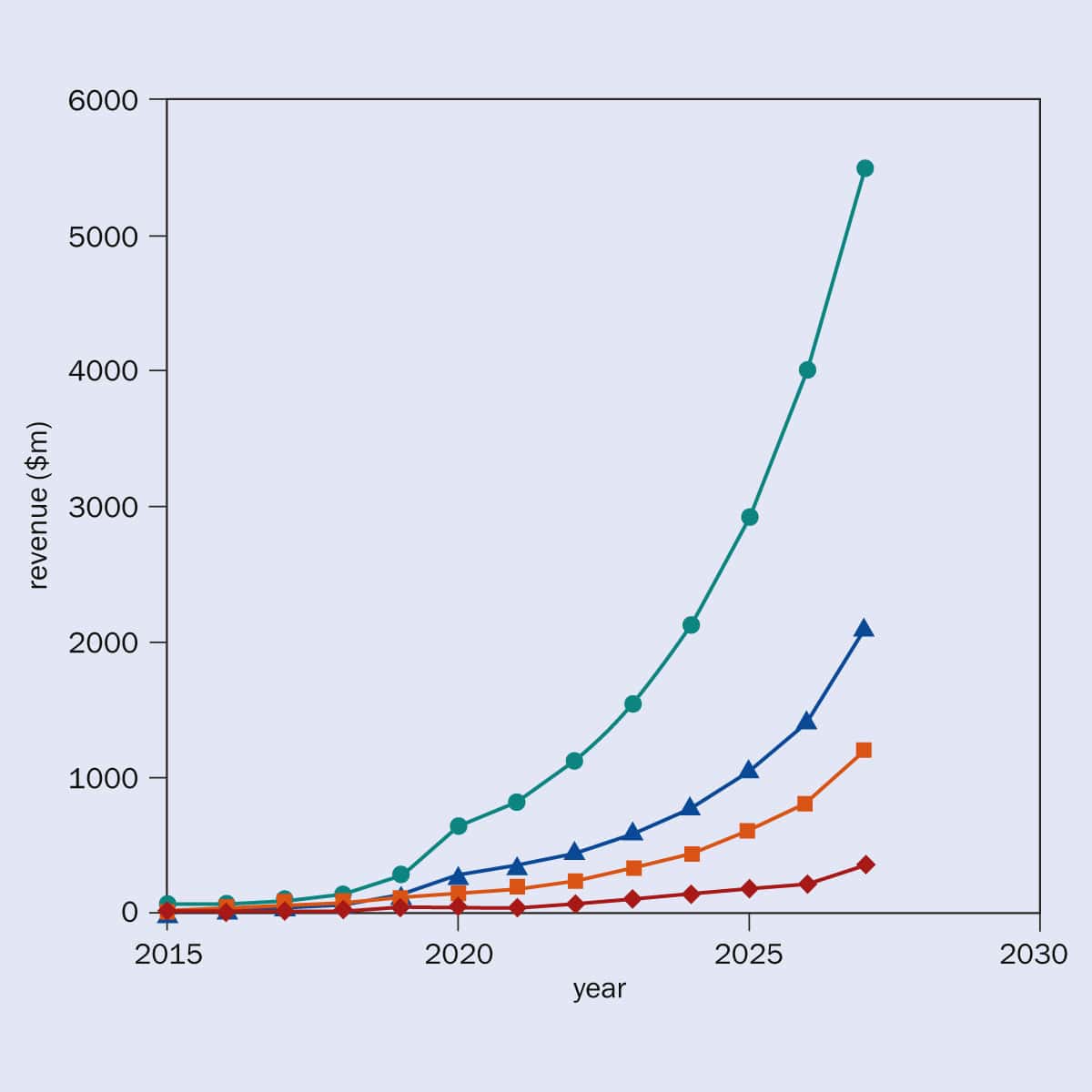
However, I recently came across a roadmap in the IOP Publishing journal 2D Materials (11 022002), which declared that the market for graphene applications could be worth $5.5bn by 2027. Now, from my experience, reports on markets for materials are seldom useful. If you tried to size the market for, say, silicon-related materials, you’re in danger of lumping in everything from optical fibres, electronics and solar cells to glass, building sand (silicon dioxide) and sunglasses too.
But this new report on graphene is excellent, with more than 200 detailed references. In fact, I think its aggregated estimation of the market size of graphene, which is based on 130 separate analyses, is probably about right. Sure, it’s not like you can buy graphene products on Amazon, but the applications are far more subtle and pervasive than you might think. Indeed, I’d say they follow the storyline of the original hype relatively faithfully.
Written by Henning Döscher and colleagues at the Fraunhofer Institute for Systems and Innovation Research in Karlsruhe, Germany, the new report emerged from the EU’s huge €1bn Graphene Flagship project. It was launched in 2013 and tackled everything from examining the health impacts of graphene (nothing of major concern just in case you were worried) to developing applications and teasing out new markets for graphene.
From material to market
I first got a glimpse of graphene’s potential back in 2011 when I was running an LED lighting business and was asked to attend a workshop on the impact of graphene in lighting. At the time, LEDs put more heat out the back than they emitted light out the front. So it seemed reasonable to ask if graphene – a material with near diamond-like thermal conductivity that was potentially cheap to make – could be useful.
Sadly, it wasn’t to be a killer app for graphene. The influential LED efficiency technology roadmap, published in 2010 by the US Department of Energy, had predicted that by about 2015 companies would be routinely making light bulbs from plastic that consumed less than 10 W of power. But by 2020 LED bulbs had got even better, requiring just 5 W to produce the same amount of light while emitting barely 2 W of heat. Thermal management, in other words, wasn’t really a problem for lighting any more.
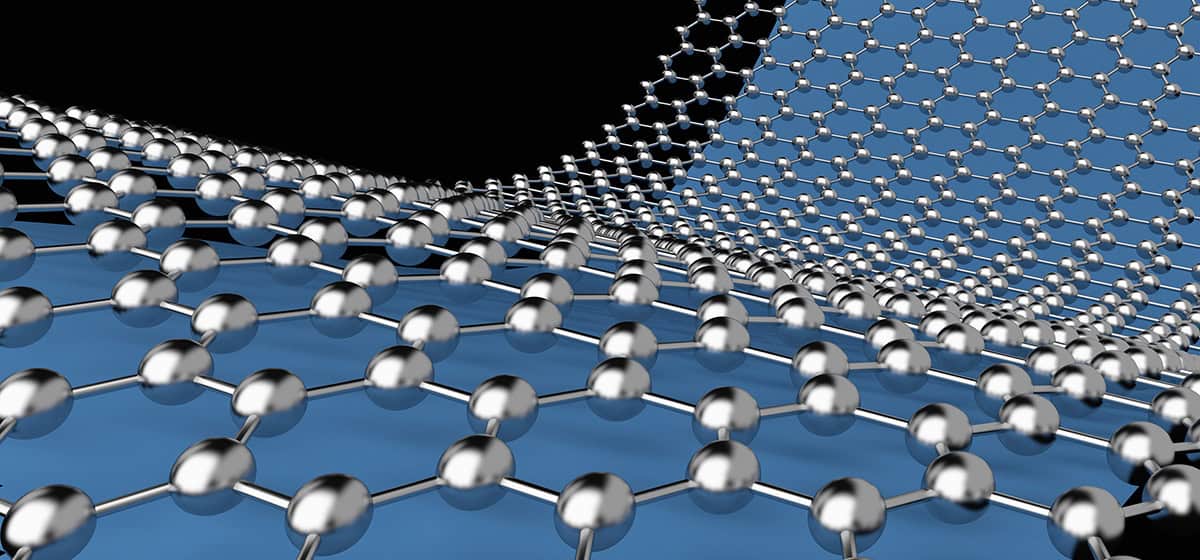
What that 2011 workshop did do, though, was give me a glimpse of graphene’s amazing properties. As you probably know, graphene is a single layer of carbon atoms arranged in a strongly bonded hexagonal honeycomb lattice. It’s very thin too – just 0.345 nm deep. These properties are what enable graphene to break so many records in terms of strength, electrical conductivity and heat transfer.
Graphene and hype have gone hand in hand ever since Geim and Novoselov originally created the material at the University of Manchester using the famous “Scotch tape method” – a simple and cheap exfoliation process that involved using sticky tape to pull carbon layers from the top of a graphite block. Since then, other, more sophisticated and more expensive methods have been developed to make larger and/or more uniform graphene materials for different applications.
1 Going for growth
Based on 103 individual market reports, a meta-analysis in the journal 2D Materials (11 022002) gives the estimated global market for graphene between 2015 and 2027 in millions of US dollars. Likely to lie somewhere between the minimum and maximum prediction, the true market size will probably be close to the average or median curves. (Courtesy: 2D Materials11 022002, IOP)
As such a great conductor and being 200 times stronger than steel, it’s obvious why there was so much excitement about graphene. But for anyone familiar with the “Gartner hype cycle”, it’s no surprise that graphene’s early promise was soon followed by a “trough of disillusionment” as people lost interest and enthusiasm. However, as the Gartner cycle so wonderfully predicts of any new tech, we’re now reaching the “plateau of productivity”, where real applications and products are starting to emerge.
Market segments
Over the last 20 years, countless scientists and engineers have been developing applications of graphene, filing thousands of patents and building hundreds of businesses based on it. The new 2D Materials report helpfully categorizes the many applications into three sub-markets. These are: graphene electronics (exploiting its unique electrical properties); graphene composites (focusing on its hardness and strength); and graphene batteries (where it could potentially outperform every other material).
The report estimates that the graphene market was worth about $100m in 2022 and is rising at a compound annual growth rate of 20–30%. The biggest potential applications, the authors reckon, lie in graphene electronics, where the market could be worth up to $1bn in the next few years. Growth rates of up to 40% are predicted – and potentially even higher over the longer term.
According to researchers at the UK’s National Graphene Institute in Manchester, graphene could lead to a new generation of electronic components, including faster transistors, more powerful semiconductors and even “bendable” phones. But one area where graphene will soon be commercialized is optoelectronics – and specifically touchscreens, liquid crystal displays (LCDs) and organic light emitting diodes (OLEDs).
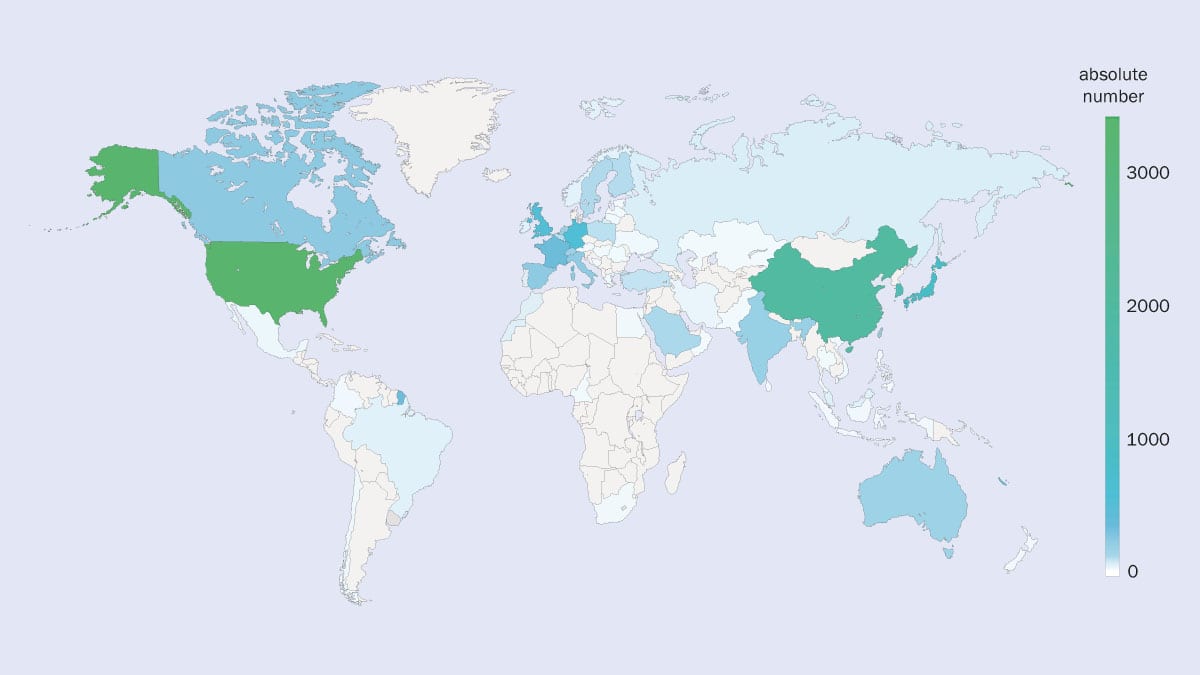
2 Power users
China and the US hold more patents in graphene than any other country, measured in terms of the nationality of inventors who took out patents with priority dates between 2000 and 2020. Based on a keyword search for “graphene” in the title or abstract of patent, the information shown includes everything from practical applications of graphene to methods for making this 2D material. (Courtesy: 2D Materials11 022002, IOP)
That’s because graphene is an almost completely transparent and highly conducting and so could replace indium tin oxide (ITO), which is widely used as a coating in smartphones and other touch-screen displays. Indeed, large graphene sheets deposited on substrates such as silicon dioxide have such a high tensile strength and are so flexible that they can achieve the required 5–10 mm for rollable e-paper – meaning it’s almost inevitable that graphene will soon become used in these applications.
Graphene is also a semiconductor, which in 2008 led researchers at Manchester to make the world’s smallest transistor – just one atom thick and 10 atoms wide. But a team in China, led by He Tian and Tian-Ling Ren at Tsinghua University, has recently bettered this making a viable graphene transistor gate about 0.34 nm long – roughly the size of a single carbon atom (Nature603 259). Over the next two decades, devices such as these could help the electronics industry to maintain Moore’s law – the two-yearly doubling in chip density that has been increasingly hard to sustain.
Sheets of possibility Graphene is a single layer of carbon atoms – just 0.345 nm deep – arranged in a strongly bonded hexagonal honeycomb lattice. It can show great strength, electrical conductivity and heat transfer. (Courtesy: Shutterstock/Ambelrip)
As far as sensors are concerned, graphene is really useful because it is just one atomic layer thick. Every atom is therefore exposed to its environment and is highly attuned to changes in surroundings. For chemical sensors, the goal is to be able to detect just one molecule. One firm making headway here is the University of Cambridge spin-out Paragraf, which claims to be the first company in the world to mass produce graphene electronics using standard semiconductor processes. It is initially focusing on biosensors and magnetic-field sensors although Paragraf has much bigger plans in store if its website is to be believed.
The company’s magnetic-field sensors, which measure the voltages generated by tiny magnetic fields via the Hall effect, can work all the way from cryogenic temperature up to 350 K with fields from 10 µT up to 30 T. That’s far better performance than conventional Hall-effect sensors, which use other semiconductors such as gallium arsenide.
3 Big money
Based on market reports published between 2021 and 2022, this graph shows the revenue and compound annual growth rate for the overall graphene market ◆ (red) and the three main submarkets in composites ▲ (orange), electronics ◼ (teal) and batteries ● (purple). (Courtesy: 2D Materials11 022002, IOP)
There has even been talk of using graphene in quantum computers. One promising development in that regard is bilayer graphene (BLG), which could be used to make long-lived, electrically controllable quantum bits (qubits) thanks to what are known as “valley states”. Researchers at ETH Zurich have recently made exciting progress in this area that could potentially deliver scaleable qubits although it’s still early days (Nature Phys.20 428).
As for graphene’s use as a composite, it’s all down to the material’s unique combination of strength, stiffness and lightness. It has an ultimate tensile strength of 130 GPa, which is roughly 300 times that of the 0.4 GPa for “A36” structural steel and 0.4 GPa for the Kevlar found in bullet-proof vests. Graphene is also a thousand times lighter than paper, with one square metre of graphene weighing just 0.77 mg.
Able to block radio waves and 10 times better than steel or Kevlar at withstanding an impact, graphene is ideal for 21st-century body armour. It’s also being eyed up by aerospace engineers, who have long been trying to make aircraft lighter and stronger by incorporating carbon fibre into the steel frames of the plane. But as it’s even stronger and lighter, graphene could be used in composites that replace steel entirely, improving the fuel efficiency of aircraft.
As for batteries – the third application mentioned in the new report – the hope is that electrodes made from graphene could dramatically improve charging speeds. But several companies, including the electronics giants Samsung and Huawei, are going further and developing whole battery chemistries based on graphene and other materials to exploit its unique properties.
These firms are promising batteries that could be charged faster and store more energy per unit volume than existing lithium-ion batteries. That could be great news for electric vehicles, which is the largest potential market in terms of volume. But what ultimately dictates whether these applications succeed will be the simple “cost per kilogramme” – and much more work will be have to be done before graphene batteries reach the market. It will happen, but probably not before the 2030s
A nearer term application of graphene batteries is expected to be in mobile devices, with Samsung and Huawei having already announced developments in this area. The demand is sure to be there: in fact, I am sure mobile-phone users will want to pay extra for a device that has higher energy density, lasts five times as long, and can be charged up to 60 times faster.
Looking ahead
Graphene has huge potential but the 2D Materials roadmap is a reminder that it’s never easy or quick for new technologies to displace incumbents. Products based on graphene will have to be much better and more cost effective than what’s already on the market if they are to win out or even stand a chance of success. I cannot stress this part enough: for graphene to work, it’s all a question of economics.
Vague claims about graphene’s merits won’t cut the mustard. Graphene has to provide concrete practical applications that will benefit consumers. If graphene is to fulfil its promise, it will simply have to beat incumbent technology hands-down on price and specific performance. But given the countless applications, some – I am sure – will win out. Like all successful new technology, graphene will one day will be a pivotal part of our lives, without anyone noticing it is even there.
This episode of Physics World Stories explores the science, politics and ethics in the Netflix series 3 Body Problem. Adapted from the celebrated Chinese novel The Three-Body Problem by Liu Cixin, the multi-layered story centres around humanity’s first contact with an alien civilization. As the drama unfolds, with physicists among its lead protagonists, the plot navigates the challenges of communicating with aliens across interstellar space – and the inevitable tensions that arise on Earth.
To discuss 3 Body Problem, podcast host Andrew Glester is joined by three special guests:
Matt Kenzie: the series’ science adviser, a particle physicist at the University of Cambridge. Kenzie’s role in informing the show’s scientific elements gives him unparalleled insight into the integration of physics into its narrative.
Jennifer Ouellette: a renowned science writer who reviewed Cixin’s book The Three-Body Problem for Physics World back in 2015. Ouellette shares her thoughts on the book’s themes, and assesses the merits of the TV adaptation by the creators of Game of Thrones.
Hannah Little: a linguist at the University of Liverpool who is also a member of the SETI Post-Detection Hub. That initiative, based at the University of St Andrews in Scotland, considers how we should communicate with aliens should we discover we are not alone in the cosmos.
The true useful life of Li-ion batteries is not well defined. Current operational cutoffs are often at 80% capacity retention, a holdover from the early electric vehicle industry that may not be applicable to other applications such as energy storage for the grid. Thus, there is little data in the open literature about systematic cycling of Li ion batteries beyond the traditional 80% cutoff.
In this webinar, we detail our ongoing study of battery-cycle aging at varied ambient temperature, discharge rate, and state-of-charge range for three different positive electrode chemistries: lithium iron phosphate, nickel cobalt aluminum oxide, and nickel manganese oxide. These commercial cells have been cycled for more than seven years and their capacity retention spans 80% to 40%. We cover trends that occur before and after 80% capacity, initial materials characterization, knee point occurrence, and sudden cell failure. This work represents the broadest assessment of commercial Li-ion battery aging in the open literature.
An interactive Q&A session follows the presentation.
Reed Wittman is a senior member of technical staff at Sandia National Laboratories. His work focuses on fundamentals of battery reliability and safety. This includes materials and electrochemical characterization of Li-ion battery degradation mechanisms during long-term cycling and fundamental origins of gas evolution in aqueous flow batteries. He earned his BSE in material science engineering at Arizona State University in 2013. He then went on to complete a PhD in energy science and engineering through the Bredesen Center, an interdisciplinary degree programme centred on all aspects of energy, at the University Tennessee and Oak Ridge National Laboratory. His PhD dissertation focused on using materials and electrochemical methods to understand the fundamental processes at the Zinc (Zn) electrode of alkaline Zn batteries.
Yulia Preger
Yuliya Preger is a principal member of technical staff in the Energy Storage Technology and Systems Group at Sandia National Laboratories. She earned her PhD and BS in chemical engineering from the University of Wisconsin-Madison and the Massachusetts Institute of Technology, respectively. Her current work is centred on the safety and reliability of batteries for grid-level energy-storage applications. Her publications span battery degradation and abuse response, application of power electronics to energy-storage safety, and system-level energy-storage safety analysis. Yuliya is co-founder of batteryarchive.org, the first public repository for visualization and comparison of battery degradation data across institutions, which has been used by thousands of individuals in academia and industry in more than 60 countries. She is currently leading the revision of the Department of Energy (DOE) Office of Electricity Energy Storage Safety Strategic Plan and the development of data-collection requirements for DOE-funded energy-storage projects across the US.