Now a team of nuclear physicists in the US, led by Krzysztof Starosta of the State University of New York at Stony Brook, has found the first evidence for the chirality of atomic nuclei (Phys. Rev. Lett. 2001 86 971).
Pasteur may have discovered chirality over 150 years ago, but Rod Clark of the Nuclear Science Division of the Lawrence Berkeley National Laboratory, USA explains in the April issue of Physics World why we will hear much about it in the future.
The future beckons – fibre optics is one of the many technologies in which physicists can succeed.
When Jack Kilby from Texas Instruments shared last year’s Nobel Prize for Physics for his part in the invention of the integrated circuit, it was long overdue recognition of the vital role that physics has played in the information-technology revolution. Walter Brattain, John Bardeen and William Shockley had already been awarded the Nobel prize for that other great physics invention – the transistor – back in 1956, while Charles Townes had shared the 1964 prize for developing the laser.
It is hard to overestimate the impact that these inventions have had on society. A survey carried out by the Financial Times last year showed that 14 of the world’s top 25 businesses were in the IT, computing or telecoms sectors, which simply would not exist without the laser, transistor or integrated circuit. Together these firms have a combined market capitalization of some $3300bn.
They include a host of familiar names such as Cisco Systems (2nd), Intel (3rd), Lucent Technologies (16th) and IBM (17th), as well as a string of mobile-phone companies like Vodafone Airtouch (6th) and network operators such as Deutsche Telekom (13th). And if one includes companies in the aerospace, defence, automobile, electrical and software sectors, then all but seven of the world’s top 25 firms are “physics based”.
Of course, not all high-tech start-up companies will rise to such heights, but these success stories illustrate the potential that exists for those that have the right products and want to grow. Apple, Intel, Microsoft, Cisco, Compaq and Sun Microsystems are among the many companies that started small and just got bigger and bigger. “History shows again and again that new business and innovation frequently come from the grass roots,” says David Potter, the physicist who founded Psion in 1980.
He should know. After initially focusing on the computer-games market – Psion’s original products included Hungry Horace and Flight Simulator – the company expanded into handheld computers, launching its first hardware product, the Psion Organiser, in 1984. “This was a virgin product in a virgin market – high-risk and high-reward territory,” recalls Potter.
By 1996 the firm’s turnover had grown to £124m and two years later it spun off its software division to create Symbian, a joint venture with Ericsson, Nokia, Motorola and Matsushita to develop a standard operating system to let mobile phones access the Internet. The company now employs more than 1300 staff worldwide and has a turnover of almost £160m.
Although consumers – and the stock market – have yet to be convinced by Psion’s latest Web-compatible handheld computing devices, Potter is in no doubt of the continual need to innovate. “In large companies we are trained to remove business risk,” he says. “[But] removing business risk can remove business opportunity. This is the paradox, which in Europe particularly we must confront. This is why Psion’s business model is based on change.”
Change and adapt
Oxford Lasers is another company that has succeeded in reinventing itself over the years. Set up in 1977 by Andrew Kearsley and Colin Webb from the physics department at Oxford University, the company made its name designing high-average-power copper lasers that were used for isotope separation in the nuclear industry. But with the slow down in the construction of new nuclear plants in the 1980s, the company realized that there was no more need for new methods of producing nuclear-reactor fuel. “Our main line of business was suddenly at an end and we were forced to find new markets in which to operate,” recalls Webb.
The firm therefore turned to high-speed imaging. Copper lasers can deliver very short bursts of high-energy pulses at high repetition rates, which makes them ideal for analysing, for example, the motion of fuel in internal combustion engines or the size of droplets in agricultural sprays. It also began to develop ways of using copper lasers for precision micromachining of hard materials, such as aerospace alloys. “One of the keys to our success has been the ability to innovate,” says Webb. “We have been able to rethink strategy and reinvent ourselves when new opportunities and technologies have been identified. The company has evolved into a much more market-led organization.”
Invest and innovate
Mike Tubbs, who works for the future and innovation unit of the UK’s Department of Trade and Industry, has analysed the factors that make certain physics-based companies succeed. “Generally speaking, those firms that invest heavily in R&D – and where the level of R&D increases with rising sales – do the best,” says Tubbs. “You’ll also find that they expand into international markets very early on in their lives, and many combine acquisition of another companies with organic growth. A good chief executive with the right leadership skills is another key factor.” He also thinks it is important, particularly in a company’s early days, to have one person doing the marketing and another doing the technical work. “That seems to be the ideal combination,” he says.
Renishaw is one firm that invests very heavily in R&D. The company, which was founded in 1973 by David McMurtry and John Deer while working for Rolls-Royce, currently ploughs back almost 9% of its turnover into R&D – far higher than the UK average of 2.9%. It makes automated, high-precision metrology equipment and systems, including Raman microscopes, computer-controlled machine tools and laser interferometer systems that allow the quality of manufactured products to be monitored quickly and repeatedly.
“We have a very simple strategy that we have honed over the years. That is only to develop products that can be protected by patents,” explains McMurtry, who is now chairman and chief executive. “On the open market, all businesses are exposed to fluctuations in exchange rates, so if you can offer customers a unique product that they can’t get elsewhere, then you can charge them what the product’s worth rather than what the market dictates. We only invest in products and processes where we can be the only player in town.”
One of the trickiest challenges facing Renishaw is recruiting technically skilled staff. The company employs over 1400 people including many physicists, particularly in optics. “Good physicists have a very broad approach and a very good aptitude for engineering,” says McMurtry. “But we are growing at 20% a year and have so many vacancies we just can’t fill. Getting good physicists is a real problem for us.”
Right place, right price, right products
Perhaps the archetypal physics-based success story is Oxford Instruments, which was founded as long ago as 1959 by Martin Wood – an engineer by training – who was then based in the physics department at Oxford University. It was the university’s first substantial spin-off, set up to develop high-field superconducting magnets for research in solid-state physics. From those early days in a garden shed in north Oxford, the company has expanded into a business with a turnover of £160m, employing some 2000 staff, selling a range of cryogenic, magnetic, medical, superconducting and analytical equipment.
“Basically we had the right products at the right cost for the right people at the right time,” recalls Peter Williams, who worked for the company from 1982 to 1999, including stints as chief executive and chairman. “There is no magic formula. We simply satisfied our customers’ and shareholders’ needs. However, if I had to put my finger on why Oxford Instruments did so well, I would say that our competitive advantage came from the unique technology that underlay the products. We were selling physics products to physicists so we had to be right at the cutting edge.”
He even believes that in some areas, such as magnetic resonance imaging (MRI), the company has been as close to the research frontier as any university department. “Our products in cryogenics and medical equipment were based on technology that was emerging directly from universities.”
But it hasn’t all been plain sailing. Like any mature business, Oxford Instruments has had its ups and downs. The biggest challenge that it faced in Williams’ time came in 1987 when General Electric – the company’s biggest customer for its magnet systems for MRI scanners – decided to make its own magnets. “Our customers became our competitors,” recalls Williams. Even Siemens, which was another key customer for Oxford Instruments’ magnets and had been manufacturing them under licence from it, was thinking of making all its own magnets.
“It was the joint venture that we established with Siemens in 1989 that saved us,” he explains. “Setting up that joint venture is probably the proudest moment of my career at the company, and the fact that it is still going some 12 years later is a sign of its success.” As Williams puts its: “Making deals is easy. Making them work is the challenge.”
To remain competitive, Oxford Instruments began a major reorganization to focus on magnets, instrumentation and medical instruments shortly after Williams stepped down as chairman in 1999. But he warns that the firm must not “lose sight of the original vision of the company that lives in the hearts and minds of employees”. In the 12 months to the end of March 2000 the firm recorded a loss of £0.8m on a turnover of £160.1m. “While the management are right to restructure on tighter markets,” he says, “they must remember that the reason they are doing so is to remain at the cutting edge of technology. Companies that want to change direction have to be clear about why they’re doing it. If they don’t, they’ll lose their competitive edge.”
But Williams, who chaired a government task force on finding ways of helping small firms to expand, says that the current economic climate makes now an excellent time to go into business. “Although there’s never a bad time to set up your own company,” he says, ” in the UK at least, there is now much more of a fiscal incentive to do so than there ever has been before.”
Now Ahmed Zewail and co-workers at the California Institute of Technology have developed a method of ultrafast electron diffraction that can resolve both the structure of a molecule and its dynamics during a chemical reaction in far greater detail (H Ihee et al. 2001 Science291 458).
The group now plans to investigate the structural dynamics of complex molecules, including biological structures – although the gas phase might pose a problem. In the April issue of Physics World, John R Helliwell of the Department of Chemistry, University of Manchester, UK, anticipates exciting times ahead as ultrafast spectroscopy and diffraction techniques join forces.
Physicists tend to concentrate on one problem at a time and get deeply involved in it, sometimes for months or even years, resenting interruptions to their train of thought. A physicist is, therefore, a specialist and might, in the UK at least, command a salary of anything from £16,000 to £45,000.
Someone in business, on the other hand, will work on many things simultaneously and, as a good people manager, will be open to interruptions from his or her staff. A good general manager, realizing the importance of those special staff whose job it is to obtain business, will work with his or her door open to the sales department. A businessperson is, therefore, a generalist. The managing director of a small company with a turnover of, say, £5m, will typically command a salary of £70,000 plus a car and other benefits.
The benefits of working for a company are the salary package, an understanding of people and technology internationally, self respect and possibly even the opportunity of finding a marriage partner. Working for a small company gives the employee a relatively high degree of independence and freedom. In a large company, in contrast, jobs are normally more constrained, but there is usually greater opportunity for structured training. And while publishing your research results may seem like an end in itself for academic physicists, it is important to remember that for those in business it is worthless unless it produces sales.
Skills to succeed
To work in a physics-based business, you obviously need an understanding of physics – normally accompanied by a degree in physics or a related subject. A driving licence and a passport are also essential. The physics business is international and many UK firms rely on exports, with up to 95% of their sales going overseas. The ability to speak at least one foreign language is therefore extremely helpful, as is previous relevant work experience.
For small companies and start-up businesses, success and survival are often one and the same thing. The quality of the staff is a major factor in determining whether or not a company succeeds. Tenacity, determination, self-confidence, attention to detail and a desire to make money are the important personal qualities that equip an individual for success in the physics business.
Communications are key to business success and the use of telephones, answering machines, faxes, e-mail and the Web are all de rigueur. In fact all channels of communication should be open all the time.
In working with customers and agents, the importance of “relationships” cannot be overemphasized. There is a need to build trust, keep promises, explain problems, be assertive, be imaginative and make friends. And remember – one enemy is equivalent to minus ten good friends!
Sales are the key
If you want to get to the top in a company, then the usual route is through sales or accountancy. Physicists working in research or product development might expect to be able to reach positions as departmental heads. But a move to sales, possibly via marketing, is probably necessary for further progression. It is certainly a good idea to collect a Master of Business Administration (MBA) degree en route.
In sales, the management of overseas agents is extremely important and the sales department might control more than 50 agents worldwide. Each requires a contract that defines the legal relationship between the agent and the company, along with the commissions the agent can expect for goods or services sold.
Product lines for scientific equipment broadly divide into three categories: components, which typically sell for about £5000; instruments (about £20,000); and systems (£200,000 and above). The way each is sold differs accordingly. Components can be marketed well using Web sites and hard-copy catalogues, which means that selling by telephone may be sufficient. Instruments, however, generally require individual product-information sheets or brochures and, quite possibly, the salesperson will need to visit the customer to close the sale. A much greater effort is normally required for a system sale, and certainly a strong relationship between company and customer will be formed before success is achieved.
In order to expand a company, you need to develop new products, penetrate new geographical territories and buy other companies (acquisitions). Companies have to keep ahead of their competitors and, when their rate of innovation reaches a plateau, this is the time that they employ techniques such as Total Quality Management (TQM) and Quality Circles. TQM is there to improve the quality of the product and the associated production process, thereby, hopefully, giving a competitive edge. With Quality Circles, members of different departments meet regularly to freely discuss these objectives with as few constraints as possible.
Inside knowledge
In order to keep going during a recession, a company has to take business away from its competitors and thereby increase its share of the market. The company may sell directly to Original Equipment Manufacturers (OEMs) that may be rival businesses and, as a last resort, the company will reduce overheads to ensure continued profitability.
Graduate or postgraduate physicists seeking work will wish to consider whether they would be more successful working for a large company or a small company. Which they choose will in part depend on their need for structure or freedom. While muddling through can be an effective means of ensuring profitability, the larger a company becomes, the more structure it will need to avoid chaos.
All limited companies have a board of directors that must consist of at least a managing director and a company secretary. A board of directors is a team of people with different skills and personalities who make different contributions to one another, thereby ensuring the profitable management of the company.
Matrix management is not uncommon in medium-sized companies. It means that, for example, product managers in each manufacturing unit have global responsibility for one product line while, at the same time, territory managers, in the UK and overseas, have responsibility for all product lines within their individual territories. Factory-based regional sales managers will sell the products of several product managers via the territory managers.
The product manager is an expert and might expect to spend up to three months per year away from home, visiting territory managers, customers and other experts, so that he or she can explore new ideas and technologies. The three largest sales regions are the US, Europe and the Far East, and each is usually controlled by a regional sales manager who would normally spend three months overseas on business. An international sales manager with global or semi-global responsibility, in contrast, might expect to spend six or more months away from home. An applications scientist is, however, unlikely to be away from home for more than one month in any particular year.
Working in industry gives you the chance to live abroad, in, say, America, Germany, Japan or Hong Kong, although generous expatriate salary packages are becoming less common except in the Middle East. But if you want to live overseas, then there are plenty of opportunities, particularly with medium and large employers seeking to expand their companies. Overseas offices are usually run by expatriates, often on three- or five-year contracts.
Larger, more highly structured, companies will have job descriptions, which are there to ensure that each employee fulfils every function of his or her job. They also provide a basis for an annual appraisal that is used to determine the next year’s salary.
Top tips in business
Not everyone you come across in the business world is honest, and it is important to recognize when someone is lying to you or disguising the truth. People who answer “yes” to every question are generally hiding something. Some people will avoid communicating at all, relying instead on image or a busy phone line to avoid addressing the important issues. There is a need to pin these types of people down and I would encourage new employees to ask “what” and “why” questions. Look out for effusion and evasion when you do eventually get an answer.
Graduates should get some work experience during their degree courses, preferably related to the work they want to do after graduation. An open reference, written “to whom it may concern”, should always be obtained after each period of employment. As people move or die and firms can close it is not always possible to obtain references at a later date.
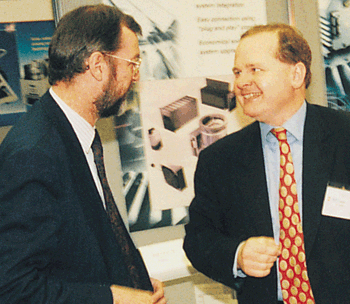
Network management The author (right) meeting the former UK science minister John Battle.
It is also a good idea to insure against redundancy when you buy a home or take a loan, and one might normally expect two to three periods of redundancy before the age of 40. Try to build up a network of friends and contacts, because this is most likely to provide continued support throughout one’s career and may also lead to employment.
When negotiating a salary you can generally expect to get the “going rate” or an individually tailored package if you are judged to be of special worth to a company. However, it is a good idea to find out the maximum salary on offer and – if you think you can get it – insist upon it. Obviously, salaries and costs of living vary from region to region, both globally and in the UK. If you live in, say, the north of England and earn £24,000 you will need £29,500 to maintain the same standard of living in the south.
The job market is often volatile and it is a good idea to cultivate contacts at a number of firms of recruitment consultants. There are over 10,000 such firms in the UK. It is a good idea to keep in touch with a few individual recruiters as they move around among the various recruitment consultancies.
There are three kinds of recruiters: head hunters for jobs that command salaries of over £40,000; permanent staffers for salaried permanent positions below £40,000; and short-term contract staffers. It is therefore important to make sure you’re talking to the right people!
Obviously, physicists can easily fit into a multitude of low-profile technical roles, but to adopt a business role they need to be sure that they project an appropriate image of themselves, and the company, which in some cases requires a significant change of outlook.
Going for the jugular
So do physicists make good business people? Well, if they possess the kind of killer instinct that drives great people to success, then they certainly can. Physicists have the ability to generate original ideas, and it is this originality, together with their intellect, that gives them an advantage. However, they must also be sure that they – or a responsible colleague – is well endowed with common sense, if they are not to be exploited in a commercially driven world.
Astronomers have long known that an isolated gravitational system, such as a star, has a negative heat capacity: when energy is added it expands and cools. Now Hellmut Haberland and co-workers at the University of Freiburg in Germany have demonstrated a more down-to-earth example. Recently they have shown that an isolated cluster of 147 sodium atoms has a negative heat capacity at its melting point (M Schmidt et al. 2001 Phys. Rev. Lett.86 1191).
Unusual negative heat capacities demonstrate that phase transitions in small systems are distinctly different from those of the macroscopic objects we are used to seeing in our everyday lives.
In the April issue of Physics World, Martin Jarrold of the Department of Chemistry, Northwestern University, USA, explains how metal clusters and nuclei are providing a unique window into thermodynamics at the nanoscale and will undoubtedly lead to further surprises.
Superconductivity – the complete loss of electrical resistance in certain metals when cooled to low temperatures – continues to hold surprises. Hot on the heels of the discovery of charge-induced superconductivity at 50 K on the surface of carbon-60 molecules late last year comes the discovery of bulk superconductivity at temperatures approaching 40 K in magnesium diboride. This almost doubles the previous record transition temperature, Tc, of simple intermetallic compounds – previously held by niobium germanium at 23.2 K. This record had not been challenged since the early 1970s, although in 1994 a much more complicated compound – yttrium palladium borocarbide – was found to have a Tc of about 23 K.
In bulk materials the transition temperature of magnesium diboride (MgB2) is only exceeded by the much more complicated perovskite cuprate structures. The new discovery provides a salutary reminder of the richness of the solid state and the way that interesting physics can emerge from quite unexpected areas. Who would have thought of looking for superconductivity in single crystals made of carbon-60, polymers or DNA molecules?
Chance breakthrough
The discovery of this latest superconductor was even more serendipitous than the discovery of the cuprate superconductors by Georg Bednorz and Alex Müller in 1986, for which they shared the Nobel prize a year later. Jun Akimitsu and co-workers at Aoyama-Gakuin University in Tokyo were not even searching for new superconductors when they discovered, quite by chance, that MgB2 loses its electrical resistance. At the time Akimitsu and co-workers were apparently characterizing materials to enhance the current-carrying properties of high-temperature superconductors – compounds that superconduct above the boiling point of liquid nitrogen, 77 K.
The discovery was announced in January at the Symposium on Transition Metal Oxides in Sendai, Japan. Many of those attending the conference immediately rushed home to confirm the result, exciting a major flurry of research on this new superconductor around the world (Physics World March p8, print version only). Akimitsu’s results have now been published (J Nagamatsu et al. 2001 Nature410 63).
In less than two months since the first announcement, almost 50 papers on MgB2have appeared on the Los Alamos preprint server. The Internet has finally come of age for superconductivity researchers. Anyone can share in the excitement of our rapidly emerging understanding of this new material by simply downloading the latest results. Not all the preprints are high quality, but most add something to the quickly developing picture.
The very rapid progress in understanding and applying this new material is due to the investment in research on the cuprate superconductors over the last 12 years or so. It is almost certain that everything that we need to know about MgB2 and its closely-related compounds will be published in the next six months.
Shelved for decades
One of the most bizarre aspects of this latest discovery is that magnesium diboride has been sitting on chemists’ shelves for almost 50 years. No one recognized that it was even an interesting metal – let alone a record-breaking superconductor. Many of the first measurements, including those made by our group at Birmingham, have simply used MgB2 powder straight from the bottle. Higher-quality materials can be synthesized by mixing, heating and sintering fine boron and magnesium powders together at around 950 oC – preferably under pressure.
Many groups are now trying to grow single crystals for more detailed scientific studies, thin films and superconducting junctions for device applications, and wires and tapes for superconducting magnets and power applications. Indeed, Paul Canfield’s group at the Ames Laboratory at Iowa State University in the US has recently reported the first MgB2wires (see xxx.lanl.gov/abs/cond-mat/0102289). These were made by simply exposing boron wires to magnesium vapour at high temperatures. This is a highly promising route for coating both the inner and outer surfaces of devices, such as filters and cavities for microwave communications and particle accelerators.
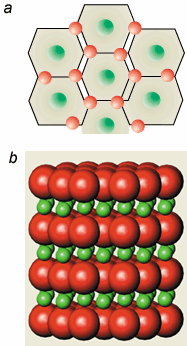
MgB2has a very simple structure in which the boron atoms are arranged in graphite-like planes with magnesium atoms at the centres of the honeycomb cells formed by the boron atoms (see figure). First-principles calculations of the electronic properties have recently been reported by Larry Boyer and colleagues at the Naval Research Laboratories in Washington and the Ames Laboratory (xxx.lanl.gov/abs/cond-mat/0101446). These calculations confirm that the magnesium atoms donate their outer two valence electrons to the strong covalently bonded network of boron atoms to form what is essentially “metallic” boron. Indeed, MgB2is closely analogous to the long sought after, but elusive, superconducting state of metallic hydrogen.
A traditional explanation
Unlike the high-temperature cuprate superconductors, early measurements suggest that MgB2 is a fairly conventional superconductor – albeit with an unexpectedly high transition temperature. In 1955 John Bardeen, Leon Cooper and Bob Schrieffer showed how interactions between the conducting electrons and the vibrational modes of the crystal lattice (phonons) could lead to a pairing of electrons and bulk superconductivity. The three received the 1972 Nobel Prize for Physics for their work.
They predicted that the transition temperature is proportional to the product of the average phonon frequency and an exponential factor that depends on both the number of conduction electrons and the strength of their interactions with the lattice vibrations. The superconductivity of MgB2 appears to be governed by the Bardeen-Cooper-Schrieffer (BCS) theory. The high transition temperature is thought to be due to the high vibrational frequencies of the light boron atoms, and the strong interaction between the electrons and the lattice vibrations.
Within a few weeks of the first discovery, Canfield and co-workers at Ames reported a significant increase (about 1 K) in the transition temperature when the boron-11 atoms were replaced by the less-abundant isotope boron-10. This is fairly convincing evidence for the importance of boron-related lattice vibrations (S L Bud’ko et al. 2001 Phys. Rev. Lett.86 1877). More recently, several groups have reported that the current-voltage characteristics of electrons tunnelling into the surface of grains are almost exactly as expected from the BCS theory. Meanwhile, a consortium of Japanese researchers has shown that nuclear magnetic-relaxation measurements are also consistent with conventional BCS behaviour.
Superconductivity always involves a delicate balance between the electronic and structural properties of a material. Varying the number of electrons donated to the boron conduction bands can dramatically affect the transition temperature. Indeed, Bob Cava and co-workers at Princeton University in the US have recently shown that the transition temperature of the compound falls if some of the magnesium atoms in MgB2 are replaced by aluminium (xxx.lanl.gov/abs/cond-mat/0102262). A group at the Chinese Academy of Sciences claims to have increased Tc by more than 5 K by doping MgB2 with copper. This has yet to be confirmed by other groups, but doping will certainly allow Tc to be tweaked a little.
High hopes for high supercurrents
Many groups have shown that densely sintered materials can carry very high currents, well in excess of 105 A cm-2 at low temperatures. This is a hundred times greater than the typical current densities in a 13 A copper cable. However, like all superconductors, the transition temperature and maximum superconducting current in MgB2 are seriously degraded in strong magnetic fields. Indeed, superconductivity is completely destroyed in fields of about 15 tesla.
Fortunately, the degradation of superconducting currents by magnetic fields is much less of a problem than it was for the early high-temperature cuprate superconductors. We can confidently expect major improvements in the maximum current that can be carried by MgB2 as materials scientists learn to optimize the superconducting properties. Currently, conventional superconductors like niobium tin and the bismuth-based cuprate superconductors easily outperform MgB2at the same temperatures. But this situation might be reversed if the electronic mean free path can be significantly shortened without changing any of the other properties significantly.
Cooling superconducting wires, cavities or devices to about 30 K, so that they operate well below the transition temperature, should not be a technological problem. Such temperatures can easily be reached without the need for liquid helium or nitrogen by using compact, and relatively inexpensive, mains-driven cryocoolers.
Why did it take so long?
Many people ask why superconductivity in such a simple compound as MgB2was not identified for almost 50 years. In the early 1950s, prior to BCS theory, Bert Matthias and John Hulm at the University of Chicago depended on empirical rules to guide them in their pioneering search for new superconductors. They were among the first to consider the wide range of simple intermetallic compounds containing non-metallic elements such as boron, carbon, sulphur and nitrogen.
Higher-temperature superconductors – such as niobium nitride, niobium carbide, niobium boride and molybdenum diboride with transition temperatures ranging from 4.74 – 14.7 K – were almost exclusively based on transition metals. It was also known that increasing the amount of boron in intermetallic compounds resulted in more strongly covalently bonded network structures, which were expected to be poorer conductors. Indeed, Matthias and Hulm were unable to discover superconductivity among any of the transition-metal diborides they investigated. Their empirical rules implied that there would be even less chance of finding superconductivity in a compound like magnesium diboride.
It is therefore sensible to ask whether there might be other binary and ternary intermetallic superconductors waiting to escape from the chemists’ shelves. Some groups are now testing all the black-looking powders they can find for potential superconductivity. Keep watching this space!
Physics has dined out on the invention of the transistor, the laser and various medical scanners for years. However, the success of these inventions has depended on researchers leaving their labs – where the experiment only has to work once – to enter the world of industry where engineers are more interested in devices that work for the millionth time, rather the first, and where, ultimately, a customer has to buy the product. And that’s what the physicists featured in the special physics goes commercial section are doing.
Many of the spin-offs and start-ups described are in the photonics and optical-communications sectors. The ongoing explosive growth in the volume of Internet traffic is fuelling demand for communications hardware, and lots of it. Products that can fully exploit the entire bandwidth offered by optical fibres are needed urgently, and inventing devices that can generate, control, amplify and detect pulses of light is the sort of high-tech thing that physicists are good at.
Unfortunately, the terms Internet and high-tech are dirty words on the business pages right now. However, it should be clear to everyone that Internet companies such as Amazon and LastMinute, and high-tech companies such as Lucent and Ericsson are in fact very different, even if they have been bracketed together in what has been called the “tech-stock bloodbath”. The value of companies that sell products and services on the Web – books, holidays, insurance and so on – soared about a year ago, before crashing back down to earth. The stock-market values of the high-tech firms that make the “picks and shovels” for the Internet – such as the lasers, switches, fibres and routers – also rose and fell, but to a much lesser extent. While jobs losses are inevitable as the high-techs strive to match supply and demand, they remain fundamentally sound businesses – unlike many of the Internet companies.
Moreover, although economics goes in cycles, the global need for information and communications is only going to increase. Physicists with good ideas and commercial nous – or at least the common sense to recruit someone with commercial skills – will continue to go far.
Welcome to the Best of PhysicsWeb
Ever since Physics World launched its Web site, physicsweb.org, in late 1997, the number of visitors to the site has been growing impressively, as has the content. In addition to selected articles from Physics World and a dedicated news service, physicsweb.org has offered a wide range of other resources, including lists of conferences, job adverts and the best set of physics links on the Web. This month sees the launch of a new service called the “Best of PhysicsWeb” that will bring together content about five of the most exciting areas of modern physics – astrophysics; atomic and quantum physics; condensed matter; optics and lasers; and particle and nuclear physics – in a single place on PhysicsWeb.
Articles from Physics World magazine will be complemented by PhysicsWeb news stories and a set of essential links to other sites on the Web. The pages will be continually updated and new areas will be added to ensure that the Best of PhysicsWeb remains the best place to start when you want to find out more about the cutting edge of modern physics. Check it out at physicsweb.org/bestof/
The rod-shaped molecules of a ‘nematic’ liquid crystal lie at about the same angle to the substrate, but they can orient themselves in any direction around the normal. This gives rise to a property known as birefringence, in which the liquid crystal has many different refractive indices, depending on which direction light enters the crystal. The degree of birefringence can be controlled by aligning the molecules using an electric field and by adjusting the molecular make-up of the surface on which the liquid crystal is created. When the molecules are lined up, the birefringent crystal splits incoming rays of light into two polarized beams – one polarized along the direction of orientation of the molecules, and the second exactly perpendicular to the first.
But the development of existing substrates has been a painstaking process of trial and error, and involved roughening the surfaces. Now Lee and Clark have discovered a simpler way to align the molecules. They deposited a thin layer of a silicon-based material onto a glass wafer, and then shone ultraviolet through a stencil to remove narrow strips of the material in a process akin to lithography. Tiny cells on this surface were then filled with the liquid crystal. Lee and Clark found that molecules in neighbouring smooth patches of liquid crystal line up with the molecules in the specially created boundary regions.
The new technique could open the door for the easy preparation of surfaces using lithography. “Virtually any complex pattern of alignment can be fabricated with ease at micrometre resolution”, say Lee and Clark. The researchers also believe the method could be used to manufacture two-dimensional photonic bandgap structures.
Devices already exist in which single electrons can be ‘handled’ – they hop along a series of specially designed conducting islands by ‘tunnelling’ through the potential barriers that separate them. But these devices are complicated and have not yet been made from silicon – an important requirement for any device that is to be incorporated into mass-produced electronics.
Fujiwara and Takahashi instead trapped a positive charge – known as a ‘hole’ because it is the space left by a migrating electron – and flipped it between two potential ‘wells’ in a nanometre-sized version of a charge-coupled device. A short pulse of light is used to create positive holes in a silicon wire, which is in contact with two closely spaced electrodes. A voltage is then applied to the wire through one of the electrodes, creating a local potential well in the wire, in which a hole becomes trapped. But when the voltage is switched to the second electrode, a new potential well develops and the first one disappears. The hole then jumps into the new well – and continues to hop backwards and forwards as the voltage alternates between the electrodes.
As it moves, the hole influences a ‘sensing’ current that flows past the potential wells, monitoring the exact position of the hole at any instant. This is an accurate measure of the current, which is defined as the movement of a charge carrier – in this case a positive hole – over time.
At present, our most precise measurements of current are much less accurate – by about six orders of magnitude – than our best measurements of quantities like time or length. The new device – which operates at 25 kelvin – could be a crucial step towards a new standard for current measurement. The ‘switching’ action of the device could also be used as a basis for a quantum computer: the path that a single charge follows at a branch in a silicon wire could represent an individual bit of information.