The quantum of conductance, G0, is defined by a simple equation: G0=2e2/h, where e is the charge on the electron and h is the Planck constant. The conductance of an individual nanotube is predicted to be 2G0, but experiments on multiwall nanotubes have measured odd multiples of G0 and, in some cases, fractional values. Sanvito and co-workers have carefully analyzed these experiments, in which Walt de Heer of Georgia Tech in the US and co-workers connected a multiwall nanotube to the gold tip of a scanning tunnelling microscope and immersed it in liquid mercury. When the tube touched the mercury, a circuit was formed that allowed precise conduction experiments to be made.
According to Sanvito and co-workers, the data can only be explained if two experimental conditions occur. First, the current must only be injected from the gold tip to the outermost layer of the nanotube. Second, the number of carbon layers in contact with the mercury must depend on the immersion depth. They find that fractional conductance can occur in multiwall nanotubes due to interwall interactions that modify the electron density of states near the Fermi level, and due to inhomogenities in the nanotubes.
The method works by solidifying a resin that hardens when exposed to light. The resin is solidified into a three-dimensional grid by placing it in the interference pattern set up by four intersecting laser beams. The pores in the resin are then filled with titanium dioxide, which is allowed to set. The resin is then burnt off to create the photonic crystal.
Other techniques for making photonic crystals rely on chemical deposition, or on adapting semiconductor fabrication techniques. However, both of these methods have a number of disadvantages. “Our technique is much more flexible than other methods,” says Turberfield. “It is fast, cheap, and very flexible.” The technique can also create structures with 10 times as many layers as structures produced by chemical deposition.
The next step, says Turberfield, is to create a material that has the same optical characteristics in all directions, and then introduce defects into the crystal. This will allow a wide range of photonic-based circuits to be fabricated.
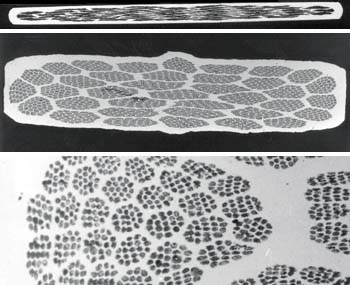
1 Inside a superconducting wire The cross-sections of high-temperature superconducting wires. Top, a Bi-2223 tape with dimensions of 4.1 mm x 0.2 mm. Middle, a Y-123 tape comprising 36,000 wire filaments that was made using a metal-alloy processing technique. The tape measures 3 mm x 0.6 mm. Bottom, a magnified view of the left-most bundle of filaments. The tapes were manufactured by American Superconductor Corporation.
Over a dozen years have passed since high-temperature superconductors were discovered amid a rash of over-enthusiastic claims that these materials would immediately revolutionize the power, transport and communications industries. The public perception may be that after years of research and unprecedented industrial investment there still seems to be no theory of high-temperature superconductivity, and no practical applications either. However, the reality is very different. Many aspects of the physics and chemistry of cuprate superconductors are now well understood, while the remaining problems are providing a rich source of new physics (see “The underdoped phase of cuprate superconductors” by Bertram Batlogg and Chandra Varma Physics World February 2000). More importantly, however, a wide range of major industrial applications are set to appear within the next few years.
The lure of high-temperature superconductors is partly psychological. Before one’s very eyes these materials become virtually perfect conductors when plunged into liquid nitrogen at 77 K, and become capable of levitating a magnet.
Superconductivity is the macroscopic evidence of a quantum-mechanical state and, as such, is a tangible entry point to the mysteries of the quantum world. However, it is the remarkable physical properties of superconductors that have driven commercial interest in these materials. Superconductors allow lossless electrical conduction and can carry current densities over 2000 times greater than copper wires. They are also used in a wide range of microwave and electronic devices, and in medical and geological scanners to detect magnetic fields less than a billionth of the size of the Earth’s field.
The key factor that has limited the widespread use of conventional low-temperature superconductors (LTS), such as niobium tin and niobium titanium, is the cost of cooling them to around 4 K with liquid-helium technology. In fact the cost of the LTS wire itself is rather low – it is about 16 times cheaper than copper for every metre capable of carrying 1000 amps.
With the discovery of materials such as mercury barium calcium copper oxide (HgBa2 Ca2 Cu3 O8 ), which is still superconducting at temperatures as high as 134 K, expectations of an immediate technology revolution based on high-temperature superconductors (HTS) were heightened. This was not to be, at least not in the short term. As with any new technology, it typically takes 10-15 years to solve the technical challenges and to reduce costs. In the case of high-temperature superconductors, particularly demanding issues are presented by the microstructure of these materials.
Physical properties and challenges
High-temperature superconductors are brittle ceramic materials in which elements such as yttrium and barium, or lanthanum and strontium, are sandwiched between layers of copper and oxygen atoms. This layered atomic structure causes the materials to have highly anisotropic physical and superconducting properties. It is possible to form single crystals, thin films or polycrystalline ceramics from these materials. However, in applications that require long flexible wires, we can only consider two types of wire “architecture”: either thin epitaxial films of HTS material grown on long flexible substrates, or polycrystalline filaments of HTS supported in a metallic wire matrix, which is more realistic to manufacture. When we use granular HTS ceramics, however, we have to ensure that the supercurrents will flow adequately from grain to grain – otherwise the grains are said to be “weak-linked”.
There are two key physical properties related to granular high-temperature superconductors. First, the “coherence length” – the length over which the superconducting wavefunction extends beyond a grain boundary. And second, the “upper critical field” – the maximum magnetic field below which the material remains superconducting. The two properties are inversely related: the longer the coherence length, the lower the upper critical field.
Several issues emerged from early investigations using granular ceramics. High-temperature superconductors have a very high upper critical field (greater than 180 T), which could open up a range of applications in extreme magnetic fields. In turn, however, the high critical field implies that the coherence length is very short, less than 2 nm. This means that the polycrystalline grains tend to be weak-linked unless the grain boundaries are both smooth at the single-atom level and free from disorder over a length scale significantly less than 2 nm.
In addition, high-temperature superconductors are quasi-two-dimensional structures comprising weakly coupled copper-oxide (CuO2 ) layers. They are therefore highly anisotropic. The coherence length in the direction perpendicular to these layers (the c-direction) is shorter still, less than 0.2 nm. This is so small – less than the spacing between some atoms – that the only way to prevent weak links forming between the grains is to align them such that their c-axes are directed perpendicular to the current flow. Grain alignment is referred to as “texturing” and may be accomplished by common metallurgical techniques.
These two factors – the coherence length and the anisotropy – mean that a polycrystalline HTS wire must be dense, have a high degree of grain alignment and have high-quality grain boundaries. Otherwise the critical current – the maximum electrical current that is in the superconductor – would seriously degrade in a weak magnetic field. Even in the absence of an external magnetic field, the critical current in a weak-linked superconductor may suffer from the “self field” generated when current passes through the wire.
Although there are now more than 50 known HTS materials, only two have been used successfully to form long-length HTS wires: the bismuth strontium calcium copper oxides Bi2 Sr2 Ca2 Cu3 O10 , (Bi-2223) and Bi2 Sr2 CaCu2 O8 (Bi-2212). No other HTS system has yet been textured in any practical sense to form long-length wires.
Wire manufacture
Wires of high-temperature superconductor comprising many filaments of Bi-2223 are typically processed by first packing a “precursor” powder into silver tubes. The precursor powder, containing Bi-2212, reacts to form superconducting Bi-2223 when heated. The loaded silver tubes are extruded and drawn until they reach about 1 mm in diameter. These wires may then be rebundled and drawn several times until the desired number of filaments and wire dimensions are reached. The resulting product is then rolled to a form a flat tape and heat-treated until the compound reacts to form Bi-2223.
During the various deformations, the grains in the Bi-2212 precursor and the resultant Bi-2223 become progressively aligned. The tape may be rolled and heat-treated several times until the grain alignment, density and concentration of Bi-2223 are optimized (figure 1).
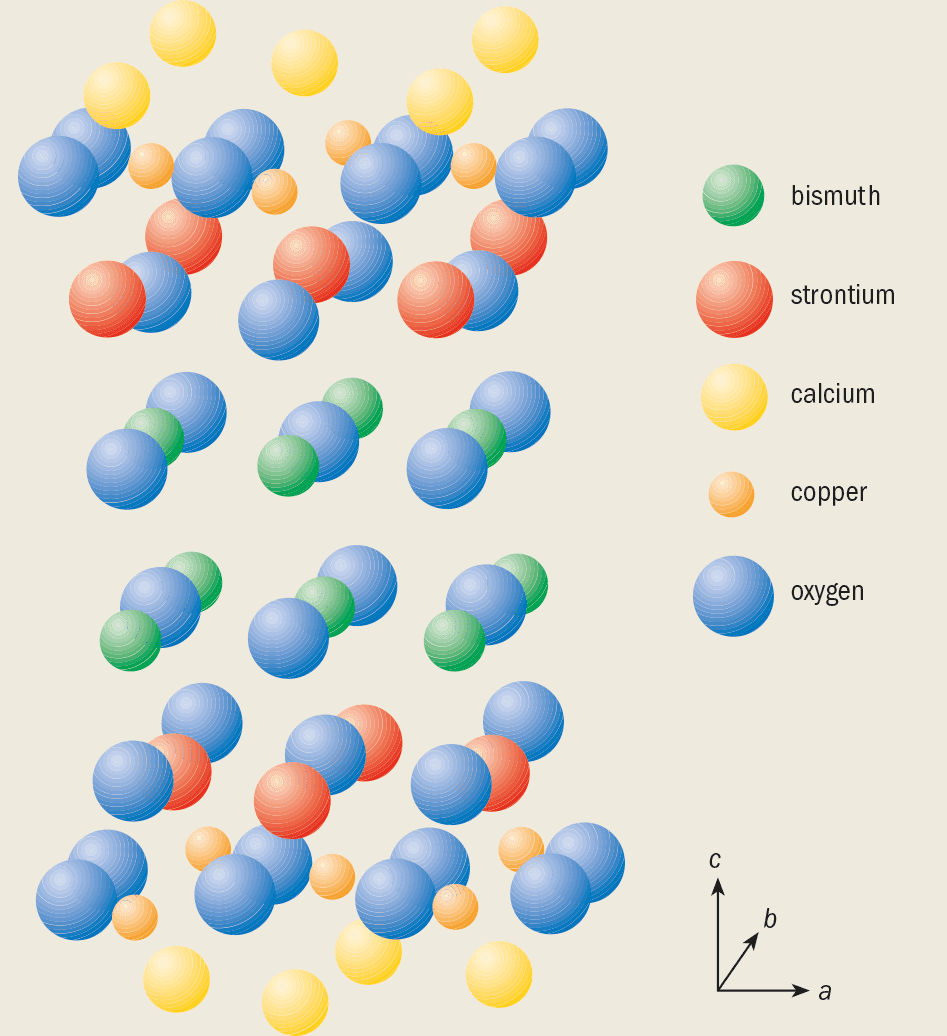
2 Weak bonds mean business The structure of the bismuth-based material Bi2Sr2CaCu2O8 (Bi-2212) used in the manufacture of HTS wires. The same loosely bonded bismuth-oxide double layer at the centre of the structure is also present in Bi2Sr2Ca2Cu3O10 (Bi-2223), and gives the materials the unique flexible properties that mean HTS wires can be made using common metallurgical techniques.
A unique advantage of bismuth-based systems is that texturing can be induced by progressively deforming Bi-2212 or Bi-2223. The flexible behaviour of these materials derives from the weak bonding across the double layer of bismuth oxide (see figure 2). As in mica or graphite, this weak bonding provides a “slip system”, which allows deformation-induced texturing – a classic technique in metallurgy. However, this double layer also seriously degrades the intrinsic performance of the bismuth-based superconductors.
The figure of merit of a superconductor is the “critical current density”, Jc , the maximum electrical current that can be supported per unit cross-sectional area of superconductor. However, for a composite wire conductor, which comprises both the superconductor and the silver matrix, a more practical figure of merit is the “engineering critical current density”, Je – this is the critical current per total cross-sectional area of the wire. Clearly Je = fJc where f, the “fill-factor”, reflects the relative ratio of superconductor to silver and may be anything from 15% to 50%. Ideally the fill factor should be as large as possible.
Among the HTS cuprates, bismuth-based systems have by far the lowest Jc in a magnetic field, which limits their use in practical applications. The weakly linked CuO2 layers readily decouple in an applied magnetic field, causing resistive conduction even though the HTS material remains strictly superconducting. This decoupling is governed by the spacing between the CuO2 layers. This spacing is large in Bi-2212 and Bi-2223 because the CO2 layers are separated by a double layer of bismuth oxide. As a result, the sustainable magnetic field for these two materials is two orders of magnitude lower than for yttrium barium copper oxide YBa2 Cu3 O7 (Y-123). Although this does not preclude the use of Bi-2223 in applications, it does mean that this material must be used at intermediate temperatures when large magnetic fields are required. For example, the operating temperature of HTS motors using Bi-2223 wires in 1-3 T magnetic fields is currently confined to below 35 K, even though the superconducting transition temperature of Bi-2223 is as high as 109 K.
The motivation for finding a practical wire technology for Y-123 is therefore obvious. Some hope is held for a coated-conductor technology that uses epitaxial thin films deposited on deformation-textured substrates. Short lengths of these so-called second-generation HTS wires have demonstrated Jc values as high as 10 MA cm-2. Currently the manufacturing process is prohibitively slow as it uses vacuum-deposition techniques. However, very promising results have recently been obtained using a rapid technique whereby the HTS material is deposited from solution.
A further practical issue lies in the cost of producing HTS wire. Silver remains an indispensable, yet expensive, component of Bi-2223 wire technology. Moreover, the processing of these wires is very slow, requiring up to a week for extrusion, drawing, rolling and heat treatment. According to a number of manufacturers, several years ago the cost of HTS wires was around $1500 per kiloamp per metre, divided almost equally between raw materials, mechanical treatment and heat treatment. Recently, however, American Superconductor Corporation announced that the cost of its commercial DC wire had fallen to $300 per kiloamp per metre, and ultimately the company expects to reduce the price to around $50 per kiloamp per metre. In part, such gains are based on the continual increase in Jc of production wires but, more importantly, Je has also steadily increased (figure 3).
3 The steady rise of HTS wires The improvement of the critical current density, Jc – the maximum electrical current that can be supported per unit cross-sectional area of superconductor – with time. The measurements were carried out on shortBi-2223 tapes at 77 K and in the absence of a magnetic field.
In spite of these challenges, enormous progress has been made in developing wire technology and in prototyping a broad range of HTS-based products, to the extent that several companies have now reached commercial levels. Virtually defect-free wires exceeding 100 A per strand at 77 K are now available in lengths of several hundred metres. And wires up to 1 km in length have also been demonstrated. Currently, several companies are rapidly scaling up their manufacturing capacity to several hundred kilometres of wire per year.
Many applications of high-temperature superconductors have been prototyped in recent years. These applications divide into two categories: wire based and film based. In both cases, wider issues involving cryogenics, the interface between the high-temperature superconductor and the ambient environment, so-called fringing fields and nonlinear scale-up issues have been addressed. Here we focus just on the wire-based applications.
HTS power cables
In most countries, the loss in distributing electrical power from power stations to consumers is at the 7-9% level, which is worth about £1.7 billion per year in the UK alone. This is a compelling motivation for superconducting cables, which – at least in a DC environment – could virtually eliminate such electrical losses. Although cooling losses would remain, these can be engineered to be small.
However, a more powerful motivation is that many of the cable conduits running into large cities and towns are already full. Any further growth in demand for power cables will encounter costly real-estate issues, such as the purchasing or leasing of new land corridors and the disruption caused during excavation. HTS cables offer a two- to tenfold increase in power capacity for the same cross-sectional area of cable. Thus, large cost savings may be achieved by “retro-fitting” HTS cables into existing conduits without the need to dig up streets.
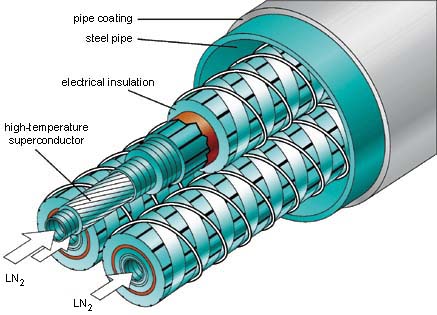
4 Anatomy of an HTS cable The cross-section of a three-core HTS cable showing the liquid-nitrogen (LN2) ducts along the core of each cable, and the spirally wound high-temperature superconductor tapes.
A broad range of prototype HTS cables has already been implemented. All have a similar design comprising concentric sheaths of insulation, cooling ducts, shielding, dielectric and conductor, and are cooled to 70-77 K using liquid nitrogen, which is pumped through the central core (figure 4). Several commercial-scale HTS cables will be tested in fully operational environments starting this year, including a Pirelli-led project at Detroit Edison in Michigan. Pirelli manufactures cable from HTS wires made by American Superconductor Corporation, and has teamed up with the US Department of Energy (DOE) and the Electric Power Research Institute (EPRI) in California for the project. Pirelli also runs a number of laboratory demonstrations in Europe with American Superconductor, Electricité de France and ENEL – the Italian power research institute, and the former Siemens cable division, which was recently acquired by Pirelli.
In addition, HTS cables will be demonstrated by Southwire in Georgia, US, but these will not be connected to the electricity grid. The Southwire team includes Intermagnetics General Corporation (IGC), which manufactures the HTS wire, the Oak Ridge and Argonne National Labs, Southern California Edison, Georgia Transmission, Southern Company and also EURUS Technologies.
Meanwhile, the Tokyo Electric Power Company, the largest private electric utility in the world, has funded demonstrations of HTS cables at Sumitomo Electric and Furukawa Electric. Other active HTS-cable programmes are maintained by BICC in the UK, Nordic Superconductors in Denmark, Australian Superconductors Ltd, and Fujikura and Chubu Electric Power Company in Japan.
Detroit Edison’s 100 MV A cable is 120 m long and comprises three single-phase HTS cables rated at 24 kV. It replaces nine copper cables at a substation in Detroit and supplies sufficient power for 30 000 residential customers. And, impressively, the total HTS conductor weighs 70 times less than the copper cables it replaces.
Provided operational demonstrations such as this prove successful, fully commercial implementations can be expected within the next few years. A recent study predicts that HTS cables will account for 56% of the underground-transmission market within 10 years of the first commercial sale.
Transforming transformers
Another promising area for applications of superconductors is transformers. Although HTS transformers have the potential to be more efficient than their non-superconducting counterparts, several other benefits may be even more important. A large HTS system (>30 MV A) is expected to weigh about half as much as a conventional transformer and have a smaller “footprint”. Furthermore, high-temperature superconductors offer the opportunity to eliminate the oil that is used for cooling and dielectric purposes. This is an important consideration. Transformer oil may weigh in excess of 70 tonnes, requires cycling and filtering, and represents a major fire and contamination risk. These last factors are critical when transformers are housed in confined spaces, underground or by waterways. In contrast, liquid nitrogen has ideal dielectric properties and represents a significantly lower environmental and fire risk.
In many countries the maximum transformer size is limited by the weight load of the trucks, road bridges and cranes needed to transport it. Weight reductions therefore become highly desirable under such constraints.
Moreover, HTS transformers can incorporate fault-current limiters, which protect other components in the system if there is a short circuit. They also enable low-impedance designs, which offer many other important benefits, such as improved voltage regulation and increased substation capacity. The total world market for transformers exceeding 30 MV A is estimated to be $3 billion per year.
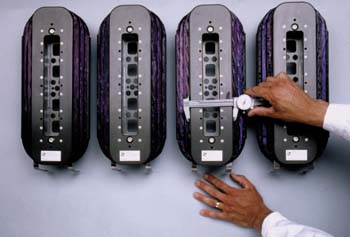
5 Bound for market The first commercial high-temperature superconducting motor – a 1000 hp AC synchronous “air-core” motor – built by American Superconductor Corporation and Reliance Electric contains these four HTS coils. The coils can sustain higher magnetic fields, deliver more power and weigh less than their conventional counterparts.
The efficiency of an HTS transformer is limited by the need for it to operate under AC conditions, and here the concept of lossless conduction fails. Dissipation occurs as magnetic flux is cycled in and out of the superconductor. In order to minimize AC losses, a completely different wire architecture is required compared with the DC wires discussed earlier.
AC superconducting wires again comprise of separate filaments, but these must be decoupled from each other using a high-resistance matrix and/or a resistive sheath. In addition, the filaments need to be twisted along the length of the conductor to reduce eddy currents between the filaments that contribute to electrical losses. Although low-loss AC superconductors are still in the early stages of development, significant progress has been made in many laboratories.
In spite of the infancy of the technology, an operational 630 kV A HTS transformer cooled using liquid nitrogen was installed in Zurich in March 1997. This was designed and constructed by Asea Brown Boveri using conventional DC wire from American Superconductor and was in operation for almost a year. And in May 1998 Waukesha Electric in Wisconsin, US, tested a 1 MV A single-phase transformer in conjunction with IGC, Oak Ridge, Rochester Gas & Electric and the Electric Power Research Institute. This was cryogenically cooled and energized to 11 000 V and 150 A. More recently, Asea Brown Boveri, American Superconductor and Electricité de France have teamed up in a four-year programme worth $15 million to develop AC wire for HTS transformers, and have initiated two new 10 MV A transformer projects in France and the US. The US project is in collaboration with the DOE, Southern California Edison and American Electric Power.
Motors and magnets shape up
According to industry reports, the total worldwide market for electric motors rated above 1000 horsepower (hp) is $1.3 billion per year. Moreover, such motors are estimated to use about 30% of all the electricity generated in the US. As with transformers, there are similar benefits associated with the conversion to HTS technology, which include reducing the size and losses by 50%, as well as improving stability during operation. A size reduction of this magnitude is a major benefit for certain applications, such as ship propulsion.
Currently, the only major programme in HTS motors is being undertaken by a long-standing partnership between American Superconductor and Reliance Electric, a subsidiary of Rockwell Automation. Following the success of a 286 hp prototype motor, the partners are due to complete the first commercial-scale HTS motor – a 1000 hp AC synchronous “air-core” motor. The cryo-cooled rotor contains four HTS coils, which allow higher magnetic fields than their conventional counterparts while eliminating the need for heavy iron cores (figure 5). Meanwhile, coils are currently being manufactured for a 5000 hp commercial prototype HTS motor due to be completed late in 2000, with the first sales expected the following year.
Based on the success of these earlier demonstrations, American Superconductor received a contract from the US Navy in June 1999 to design a 25 000 hp HTS ship-propulsion motor. To underscore their aggressive commitment to this technology, the company has recently created a new business unit focused on the design, development and manufacture of HTS motors and generators.
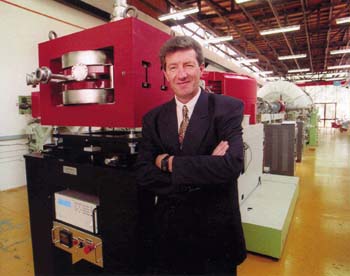
6 Pioneering product The author in front of the HTS magnet installed on a van der Graaf accelerator at the Institute for Geological and Nuclear Sciences in Wellington, New Zealand. The magnet was probably the first large-scale fully operational application of HTS technology and has been in operation for almost 3 years.
A range of demonstration HTS magnets has continued to be developed since HTS wire was first developed in the early 1990s. In March 1997 an HTS magnet was installed in the beamline of a carbon-dating van der Graaf accelerator at the Institute for Geological and Nuclear Sciences in Wellington, New Zealand, and has been operating ever since (figure 6). The magnet was built by a consortium of American Superconductor, Alphatech International based in Auckland and Industrial Research Ltd – a New Zealand government research institute. The Bi-2223 magnet is designed to operate at 50 K, and is cooled using a single-stage refrigerator. Although it only needs to develop a field of 0.74 T, the magnet has been in operation for nearly 3 years. This demonstration of long-term reliability, albeit in a moderately demanding application, is an important achievement for the wider commercialization of HTS technology in general – it was probably the first large-scale fully operational application of HTS technology in the world.
More impressive results from demonstration magnets have been reported. In July 1998 the Naval Research Laboratory in the US successfully tested an HTS electromagnet producing a record HTS magnetic field of 7.25 T using coils made by American Superconductor. And more recently Hitachi, together with the National Research Institute for Metals and the Tsukuba Magnet Laboratory in Japan, demonstrated a 23.4 T superconducting magnet with a 13 mm bore. This consisted of an 18 T low-temperature superconducting magnet with two Bi-2212 booster coils operating at 4.2 K, and is almost at the 23.5 T threshold needed for nuclear-magnetic-resonance applications at 1 GHz.
A number of other companies have similar ambitions, and 21 T coils made by IGC and also by Oxford Superconducting Technology have been demonstrated at the National High Magnetic Field Lab in Florida. In another development in late 1998, Oxford Magnet Technology and Siemens Corporate Technology built a prototype magnetic-resonance-imaging body scanner with two coils made from Bi-2223 wires, which were manufactured separately by Nordic Superconductor Technologies and by Vacuum-Schmelze.
Superconductors go from strength to strength
Other HTS technologies are also making their mark, most notably fault-current limiters and low-thermal-conductivity current leads to reduce heat leaks into the cryo-environment of low-temperature superconducting high-field magnets. Some 1600 of these current leads, each carrying 13 000 A, will be deployed on the low-temperature superconducting magnets in the Large Hadron Collider particle accelerator at CERN in Geneva. In parallel with these wire and bulk applications, a spectrum of thin-film applications for microwave antennas, filters and superconducting quantum interference devices has also emerged.
It is clear from the broad base of applications and their proximity to commercial-scale demonstrations that HTS technologies are on the threshold of the promised superconductor revolution. As manufacturers scale up production, prices will inevitably be driven down and the commercial viability will be further enhanced. Add to this the voracious appetite of the information-technology industry for faster communication, larger memory capacity and faster processing power, and it is clear that the market pull for electronic HTS technologies will grow dramatically in the next few decades. Already superconductivity appears to have established a secure beachhead on the technological and commercial landscape of the 21st century. Based on these considerations, a consortium of European companies has recently estimated that the total world market in superconducting products will reach £22 billion by 2020.
Finally, the recent appearance of new ruthenate-cuprate HTS materials, which exhibit ferromagnetism and superconductivity at the same time, overturns a long-held belief that these properties are generally incompatible. This serves to remind us again that novel materials with strange and unexpected properties will continue to appear, and our technology horizons will continue to expand.
The Millennium Dome in London – a £758m high-tech visitor attraction that was built largely with government money – is a national laughing stock in the UK. But at least the Dome opened on time. If only the same could be said for DIAMOND, a third-generation synchrotron radiation source that will be used by scientists from the UK and France. Seven years after the case for a new medium-energy synchrotron source was first made, the inability of the government’s Office of Science and Technology to decide where to build DIAMOND – which will cost about £550m to build and operate over a 20 year period – has moved from comedy to farce.
Like the Dome, DIAMOND will be a large circular structure. Electrons will hurtle around a storage ring with a circumference of 338 metres, releasing X-rays as they wiggle and undulate through the magnetic fields created by various insertion devices. These X-rays will be used for a wide range of experiments in biology, chemistry, physics and other sciences.
The UK science community first identified the need for a new synchrotron in a report presented by Michael Wolfson, professor of physics at York University, to the science board of the then Science and Engineering Research Council in April 1993. French scientists had started work on a similar project called SOLEIL the previous year. Paragraph 5.2 of Wolfson’s report reads: “We have accorded MES [a medium-energy synchrotron source] highest priority. The plan calls for detailed design to start early 1994, with a view to starting construction early in 1997. An urgent prerequisite will be to choose the site. Construction and commissioning would be completed by the end of 2001 when operation would begin.”
As of mid-February 2000, a decision has still not been taken on the site – even though the Wellcome Trust, a biomedical charity, has promised around £100m towards the cost of the facility, and the French have abandoned SOLEIL and joined the UK project. However, the government can still not decide if it wants to build the source at the Rutherford Appleton Laboratory near Oxford in the south of England, or at the Daresbury Laboratory near Manchester in the north.
A brief history reads as follows. In January last year the Wellcome Trust suggested to the Office of Science and Technology (OST) that an open competition should be held to select the site. The OST agreed but wanted to delay the selection process. At the end of April, however, the OST wrote to the Trust saying that it preferred the Rutherford lab. The Trust went along with this idea. On 4 October, however, Stephen Byers, the cabinet minister responsible for science, wrote to Wellcome stating that he was “minded to site the synchrotron at Daresbury”. This did not go down well with the Trust and the argument has raged on ever since.
In the meantime, the CLRC, the body that runs both Rutherford and Daresbury, has remained silent in public about the issue, while unions and staff at Daresbury – site of the UK’s existing second-generation synchrotron source – have waged a vigorous media campaign with the backing of local politicians, eminent scientists and Daresbury users.
There is little doubt that the discussions about where to site DIAMOND have been a shambles. Not since the government procrastinated at length over whether to site a national Astronomy Technology Centre in Edinburgh or Cambridge has a decision-making process so needlessly damaged scientific morale in the UK.
Indeed, the indecision has dragged on so long that a further delay of, say, six months would make little difference. Everyone agrees that DIAMOND is a 20 year investment. The UK and France will not miss out on any monumental discoveries if they delay DIAMOND by a further six months. The only option is to appoint a panel of independent experts to examine the pros and cons of the two sites and make a decision based on merit alone.
Our greatest endeavour in basic science over the past century has, undoubtedly, been the study of the electromagnetic, strong and weak forces. Although the general theory of relativity was formulated more than 80 years ago, gravitational forces are only now entering the arena of basic scientific research. This is happening because the greatest synthesis of all time, which describes the basic interactions of all the known elementary particles, has finally been achieved in the form of the Standard Model of particle physics. This synthesis is the result of the work of physicists the world over, who have dedicated themselves to the study of what happens when the stable building-blocks of matter (protons, electrons and nuclei) are made to interact at higher and higher energies.
The laboratories where physicists have experimentally tested the Standard Model are found around the world, and include famous European names such as CERN in Geneva, the DESY lab near Hamburg, and the Gran Sasso and Frascati labs in Italy. Physicists at Fermilab, Brookhaven and Stanford in the US have also made huge contributions, as have scientists at labs in China, the former Soviet Union and Japan.
However, I believe that none of these laboratories would exist today if, in the 1920s, modern science had followed the priorities dictated by Albert Einstein when he was at the pinnacle of his scientific power and glory. Einstein’s achievements represent the end point of classical physics, which began with the work of Galileo Galilei and Isaac Newton. Indeed, the mainstream of physics in the 20th century turned out to be quantum physics.
Nevertheless, I was delighted to find that Einstein was selected as “person of the 20th century” by Time magazine, thanks to the role that he played as an ambassador of science across the world. What surprised me, however, was that Einstein came top of Physics World‘s poll of more than 100 of the world’s leading physicists, who selected him as the greatest physicist of all time (December 1999 pp7-13).
Relative reputations
So why is Einstein held in such high regard? As far as the public is concerned, Einstein’s fame is based on two fascinating achievements: the principle of relativity and his deduction that light can be deflected by gravitational fields. Physicists, of course, are well aware of Einstein’s many other huge contributions to physics, but even they may not be fully aware of the role played by other scientists before him.
In fact, the first person to formulate the principle of relativity was Galilei (or Galileo, as he is known to English speakers). His formulation is so well written – “No matter which experiment you perform, it will be impossible to detect effects that depend on the velocity of a reference system provided that the velocity is constant” – that it does not exclude any force of nature, even those, such as electromagnetism, that Galilei knew nothing about. (Incidentally, the equations describing relativity were discovered before Einstein’s time by Hendrik Lorentz in his studies of electromagnetism.) Galilei was also probably convinced that the speed of light was finite. In fact, he tried to measure it, but failed because it is so fast.
However, Galilei succeeded in measuring the acceleration due to gravity – despite its high value – thanks to the invention of the pendulum and the discovery of the force of gravity using the inclined plane. Galilei’s measurements in turn enabled Newton to discover the law of gravitational interaction, which predicted, among other things, that a beam of light can be deflected by the force of gravity. (Indeed, Newton’s laws made predictions that were wrong by only a factor of two compared with Einstein’s calculations more than 200 years later.)
But how many people are aware of the contributions of Newton (in second place in the Physics World poll), Galilei (sixth) and Lorentz to these culturally fascinating discoveries of relativity and of the effects that mass has on space-time? I find it unfortunate that both of these discoveries tend to be fully attributed to Einstein. Here, however, I would like to praise the man who came eighth in the Physics World poll – Paul Dirac.
To do this I need to make a further point relating to CERN and the other particle-physics labs, and to the Standard Model. Suppose Einstein had been appointed “supreme advisor” by some enlightened “world prime minister” and had been asked to suggest the way forward for physics. Einstein’s top priority would, I believe, have been the study of gravitational forces. He would no doubt have recommended other avenues, but they would not have been his priorities. Indeed, I believe he would have ignored many other research activities and discoveries from his time, such as Rutherford’s discovery of the nucleus, Enrico Fermi’s rigorous mathematical formalism of the weak forces, and Hideki Yukawa’s description of the strong nuclear forces.
Making sense out of nonsense
In the 1920s the young English physicist Paul Dirac began trying to understand and describe the space-time evolution of the electron – the first elementary particle to have been discovered. Dirac was puzzled by an unprecedented property of space-time discovered by Lorentz in his studies of electromagnetic forces, whereby if space was real, time had to be imaginary, and vice versa. In other words, space and time had to be a “complex” mixture – the sum of a real and an imaginary quantity.
Furthermore, the “elementary particle” was the source of another disturbing puzzle. The study of hydrogen spectra in the 1920s revealed that an electron not only has an orbital angular momentum related to its motion about a nucleus, but also an intrinsic angular momentum or “spin”. But where did this spin come from? Why was the spin of the electron only half of the minimum value measured from atomic spectra? And why was the “gyromagnetic ratio” of the electron – the magnetic moment divided by its angular momentum – twice as large as the ratio measured from atomic spectra?
Dirac deemed that this tricky matter had to be understood, and decided to study the electron in complex space-time. In 1928 he published his now famous equation (see “Paul Dirac: the purest soul in physics” by Michael Berry Physics World February 1998 pp36-40).
The great novelty of the Dirac formalism was the introduction of the spinor, which is a mathematical function having four components. Imagine you want to move in space-time with a bicycle: you need two wheels. However, you could also move using a unicycle, as an acrobat would do. Similarly, before Dirac came along, mathematics used only one “function” to describe a particle: a scalar function. Dirac’s claim was that to describe an electron, you need a mathematical object having four components. In our daily life this would be like saying that to evolve in space-time we need a car with four wheels, not a unicycle with just one.
Dirac’s equation also came up with the seemingly nonsensical prediction of “negative energies”. Only a real genius could transform this catastrophic prediction into a formidable new frontier for science: the existence of the antielectron and of the “Dirac sea”. Dirac also realized that every particle in our world must have an antiparticle with an opposite charge. This discovery was the seed for the “radiative effects”, the “running” of the gauge couplings, and the correlation between the fundamental forces and their unification: in other words, it led physics to the triumph of the Standard Model.
The impact of the Dirac equation
I once had the privilege of speaking to the great Soviet physicist Piotr Kapitza, who was at Cambridge with Dirac, where they were both pupils of Rutherford. Every week the pair would attend a lecture. “No matter what the topic of the seminar,” Kapitza told me, “at the end of the lecture I would always address the same question to Dirac: ‘Paul, where is the antielectron?’.” Kapitza was a great friend of Dirac, but remained convinced that his equation was only creating trouble. His comments are a reminder that no-one at the time took Dirac’s equation seriously. No one suspected what a gold mine the equation would turn out to be.
The most spectacular consequence of the equation is the existence of “radiative effects”. In fact, the existence of the antielectron (or “positron” as it has become known) implied that when a particle (of any type) collided with its antiparticle they would annihilate each other, releasing their rest-mass energy as high-energy photons (or other gauge bosons). For example, in the case of a process described purely by quantum electrodynamics, a gamma-ray photon can create an electron-positron pair, which can transform itself back into a photon. This process, which is called “vacuum polarization”, was the first radiative effect to have been theoretically predicted.
The first physicist to compute the vacuum-polarization effects in the hydrogen atom was Victor Weisskopf. He predicted that the 2p1/2 level in a hydrogen atom should be very slightly higher in energy than the 2s1/2 level, by some 17 MHz. However, in 1947 Willis Lamb and Robert Retherford discovered that the 2p1/2 level was in fact lower than the 2s1/2 level by some 1000 ± 100 MHz.
It was this experimental discovery of the Lamb shift that prompted all theorists, including Weisskopf, Hans Bethe, Julian Schwinger and Richard Feynman, to compute the very simple radiative process in which an electron emits and then absorbs a photon. But had it not been for the discovery of the positron – and therefore the existence of electron-positron pairs – no one would have imagined that such radiative effects could exist in nature. And without “radiative effects”, there would have been no “running” of the gauge couplings, no correlation between the different forces and, ultimately, no grand unification of all the fundamental forces.
Think of a photon, which is governed by quantum electrodynamics, that can transform into a quark-antiquark pair (governed by quantum chromodynamics – the theory of the strong force) or into a W+W– pair (governed by quantum-flavour dynamics – the theory of the electroweak force), before both pairs annihilate and form a photon again. The annihilation allows these three theories to be present in radiative effects. Without these results, the problem of the renormalization of the gauge forces (with or without spontaneous symmetry breaking) would never have been conceived. And if that problem had not been solved – as it was in the early 1970s by the 1999 Nobel prize winners Gerard ‘t Hooft and Martinus Veltman – we would not have the Standard Model, with its many precise quantitative predictions that have been experimentally validated in labs all over the world.
The roots of the Standard Model are in the Dirac equation. We are all children of this equation. Without it there would be no particle-physics labs and no Standard Model. Of course – and fortunately for us – there are sound reasons to believe that there is a lot of new physics beyond the Standard Model. The recent results on neutrino oscillations (see Neutrino mass discovered) and the new values for direct “CP-violation” in K-meson physics (CP and T violations: new results leave open questions) are opening new avenues beyond the Standard Model. However, none of these discoveries are affected in any way by the gravitational force, which was Einstein’s main interest.
At the roots of everything
Early in the 1970s Weisskopf, Eugene Wigner, Bob Wilson and other eminent scientists attended a seminar held in Erice, Sicily, entitled “The Roots of Modern Physics”. At this seminar, they all concluded that the effective origin – the real seed of modern physics – was the Dirac equation.
Three decades later their conclusion has been further corroborated. Imagine modern physics without the possibility of particle-antiparticle symmetry and, consequently, no possibility of annihilation. There would be no “running” of the gauge couplings and no coupling among different gauge forces. Suppose that no one had ever tried to describe the evolution of an electron in space-time or thought through the extreme consequences of this work. We would be nowhere.
It is for these reasons that I believe that Paul Dirac had a much bigger impact on modern science in the 20th century than Albert Einstein.
Diodati says he became intrigued by the link between music and physics after thinking about the crescendo in Rossini’s La calunnia è un venticello, an aria from the Barber of Seville. The words in the aria describe an avalanche building up momentum, which eventually reaches the point where it causes an earthquake. “I was initially curious to verify if the musical crescendo had some mathematical properties that were similar to the physical crescendo of systems evolving towards catastrophe,” he says.
To satisfy his curiosity he turned to computer technology. “It is well known that it is possible to establish a correspondence between sounds and numbers,” Diodati explains in a paper presented to the Italian Congress of Acoustics. “Given a composition we can digitize it no matter how complex it is.”
A number of studies have looked at the frequency distributions within a piece of music by recording how often a given note is repeated. In a Beethoven piece, for example, the probability of each note recurring can be calculated exactly. Diodati, who is a professor of experimental physics and acoustics, extended this statistical principle to study how the intensity of a piece varies. He teamed up with Stefano Piazza, also of Perugia, and used a computer to split the electric signal from a musical recording into segments one-hundredth of a second long. He recorded the number of segments that exceeded a threshold amplitude, calling them “events”, and the distribution in the time between these events.
Diodati was amazed to discover that the intensity variation in Rossini’s crescendo obeyed the same power law as that seen in earthquakes, avalanches or volcanoes. That is to say, the words in the aria matched the music. “We have here a miracle,” exclaims Diodati. “Nature provides a genius with the ability to see, read, extract and reproduce with music, the dynamical synthesis of natural processes.”
Diodati then analysed other pieces of classical music in the same way and found similar intensity distributions. But the results were different when he scrutinized light music – Diodati discovered that jazz and pop music are less predictable. “Classical music seems to be at the border of chaos, while light music appears to be totally chaotic,” he says.
Despite the opinion of some experts that “music is not as tangible or measurable as a liquid or a solid”, Diodati believes that universal, objective features can be drawn from musical pieces. However, he emphasizes that his research can say nothing about personal, subjective taste and about whether lighter music is more or less musical than classical. His paper has now been used by several music teachers in Italy, who have introduced his ideas into their classes, but he presents his results as just a “nice curiosity”, with “no pretension at providing a new perspective in the field of musical analysis”.
Using citation data from the Institute for Scientific Information in Philadelphia, Katz has found that there is in fact a power-law or “fractal” relationship between the number of citations and the number of papers. In other words, larger countries publish more papers than smaller countries and receive disproportionately larger numbers of citations.
To take this effect into account, Katz has calculated an “adjusted relative citation impact”. This is the number of citations received by a country in a particular field, divided by the average number of citations that would be expected for a country of that size, based on the power-law relationship.
The results, which will be published shortly in the journal Science and Public Policy, are stunning. Although Switzerland retains its lead in physics, the US slips from second to eighth and the UK falls from fifth to sixth (see ). Other countries that appear to do worse in physics include Germany, which drops from sixth to eighth, and France, which falls from eighth to eleventh. Countries that move up the rankings include Canada, which moves from seventh to fourth, and Sweden, which jumps from ninth to fifth. Israel and the Netherlands climb to second and third place, respectively. A total of 170 nations were involved in the study.
Sir Robert May, the UK’s chief scientific adviser, used citation studies to emphasize the strength of UK science and to support his argument that it is better value for money to pay for research in a university, rather than a research institution (Physics World March 1997 p9). This analysis was partly responsible for the recent increase in the UK science budget.
The DAMA collaboration, which is lead by Rita Bernabei of the University of Rome, will present its results at the Fourth International Symposium on Sources and Detection of Dark Matter/Energy in the Universe at Marina del Rel, California, later today. The team’s latest paper, which is available at the Gran Sasso Web site, claims that a “cumulative analysis of all the available data favours the possible presence of a WIMP” with a mass between 44 and 62 GeV. However, many physicists remain sceptical about the results.
Up to 90% of the mass in the universe is thought to consist of so-called “dark matter” – matter that cannot be seen and only reveals its presence through its gravitational pull on visible matter. Failed stars such as brown dwarfs and so-called massive compact halo objects or MACHOs are known to comprise some of the dark matter in our galaxy. However, many physicists believe that exotic particles left over from the big bang are also responsible for some of the dark matter. These include WIMPs and other particles not included in the Standard Model of particle physics. WIMPs rarely interact with ordinary matter, which makes them exceedingly difficult to detect.
The DAMA experiment, which involves physicists from Italy and China, consists of a 100 kilograms of extremely pure sodium iodide (NaI) placed some 1400 metres underground in the Gran Sasso lab. The rocks overhead protected the NaI from cosmic rays, which can mimic a dark matter signal. It is also essential to isolate the detector from all background sources of radiation. On those rare occasions when a WIMP interacts with a nucleus in the NaI crystal, a small flash of light is released.
Over a three-year period the DAMA team looked for a seasonal variation in the detection rate as the Earth orbits the Sun, which itself is moving through the dark matter halo of our Milky Way galaxy. The number of WIMPs detected in June should be greater than the number detected in December by between about 5 and 10 percent. However, a large number of other processes also vary like this throughout the year, so there is a possibility that the variation seen by the Gran Sasso team is not due to dark matter particles.
“It is very difficult to ensure that you have got rid of every seasonal modulation, which is why there is a healthy level of scepticism over the results,” says Nigel Smith of the Rutherford Appleton Laboratory. Smith is a member of the UK Dark Matter Collaboration that is also using NaI detectors to search for dark matter.
The US-based Cryogenic Dark Matter Search (CDMS) is expected to announce at the symposium that it has not seen any WIMPs in the mass range predicted by the DAMA group.
The number of transistors on a silicon chip has doubled every 18 months, but many observers believe that semiconductor technology will reach its limit in a decade or so. This has prompted the development of new devices, including so-called quantum cellular automata (QCA). So far, however, QCA based on semiconductors have only been operated at very low temperatures. Cowburn and Welland have taken a different approach to QCA and used magnetic metals rather than semiconductors.
Each QCA network consists of a single elongated input dot followed by a chain of 69 circular dots. The dots were 110 nanometres wide, 10 nanometres thick and their centres were about 135 nanometres apart. They were fabricated in Supermalloy, a common magnetic alloy, with electron-beam lithography. The logical state of each dot is given by the direction of its magnetization (which can point in one of two directions), and the dots interact through magnetostatic interactions. An applied oscillating magnetic field provides energy for the system and acts as a clock.
The MIT team injected small quantities of air into a highly viscous liquid to stimulate the formation of air bubbles. As the bubbles reached the surface, da Silveira and colleagues punctured them with a needle. A high-speed camera recorded the collapse of the bubble.
They discovered that the bubble bursts slowly through the hole punctured in the surface, and that this hole widens as the air inside escapes. Meanwhile, the overhanging surface of the bubble is pulled back into the liquid by surface tension. As the bubble collapses under its own weight, its buckles, causing a series of ripples to rush across the liquid’s surface.
According to the experiments and calculations carried out by da Silveira and colleagues, there is a direct relationship between the number of ripples and the bubble radius and liquid viscosity.