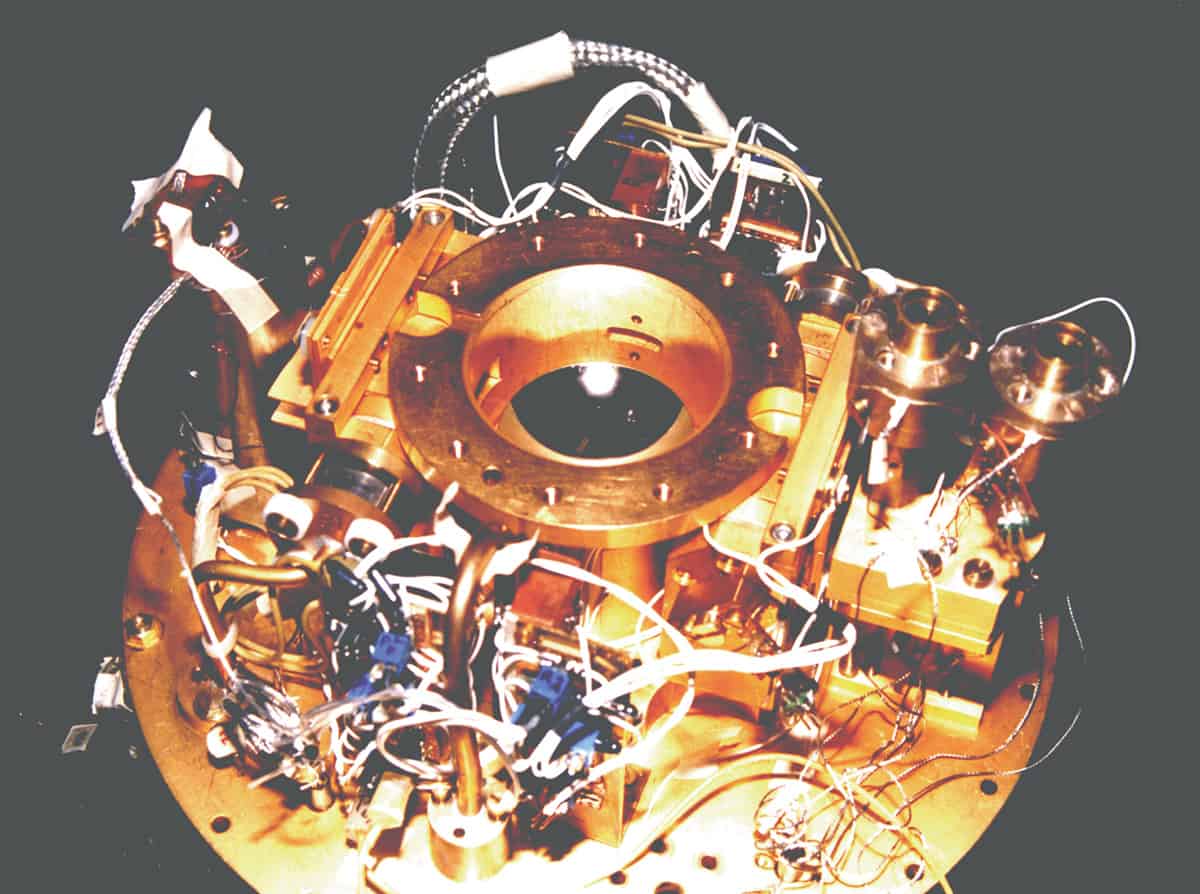
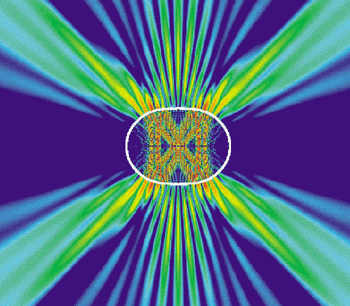
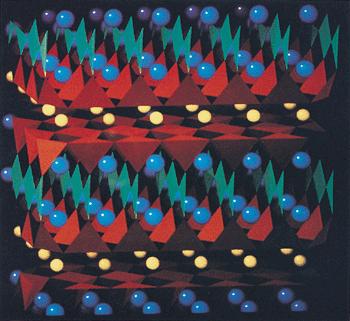
A pyramid of germanium atoms that formed spontaneously when germanium was deposited onto a silicon surface. Each round feature in the image is an individual atom. The pyramid is one of a billion others that formed on a sample 0.1 cm2. Its base is 10 nm wide.
Three massive scientific waves are gathering momentum as we approach the end of the 20th century. These waves are set to transform our lives in the 21st century to a far greater extent than our parents’ and grandparents’ lives were changed by advances made during this century. Nanoscale science, information science and molecular biology are all rapidly developing into engineering disciplines, and each will be responsible for the start of at least one major industrial revolution during the next 20 years.
The fact that all these revolutionary changes will occur simultaneously is unprecedented in human history. The technologies that will arise will also interact with each other to create entirely new fields of study, but the most fruitful territories for intellectual exploration and economic development will occur at the areas of overlap.
Nanometre-scale logic gates can now be fabricated thanks to advances in both nanoscale and information sciences. Meanwhile, biologists are beginning to use computational methods – so-called bio-informatics – to analyse the wealth of data from gene-sequencing projects to further advance our understanding of fundamental biology. Many people are at least aware of the remarkable advances being made in molecular biology, but the revolutions in information and nanoscale sciences are at least as profound, and are occurring in physics-based disciplines.
Towards the infinitesimal
Nanoscale science involves the study, understanding and control of matter at the atomic level. In the late 1950s only the Nobel prize winning physicist Richard Feynman truly understood that it would be possible to observe and manipulate individual atoms. Today hundreds of laboratories all over the world routinely use the scanning tunnelling microscope – which was invented in the early 1980s by Gerd Binning and Heinrich Rohrer at IBM’s Research Laboratory near Zurich – to obtain topographic maps of material surfaces in which it is possible to identify individual atoms. The beautiful pictures that have appeared in Physics World and elsewhere over the years have shown that it is even possible to build structures and spell out words by pushing individual atoms around on a surface.
In the next century “self-assembly” techniques will be the basis for manufacturing a wide range of objects, from electronic circuits to automobile tyres. In our laboratory at Hewlett Packard, we can create designer structures such as the nanoscale pyramid shown above. The base of the pyramid is just 10 nm wide. This pyramid literally assembled itself from a collection of germanium atoms deposited onto a silicon surface due to the collective forces that bind the atoms to each other. In fact it was one of over a billion similar structures that formed simultaneously on a 0.1 cm2 sample within a few seconds.
Many research groups worldwide are working hard to turn nanoscience into a technology. One goal is to build electronic circuits from vast numbers of self-assembled components. A potential advantage of such chemical self-assembly is that the cost of building electronic circuits will be perhaps a thousand times less than it is with existing silicon technology.
The integrated circuits of the future may look a lot more like photographic film than silicon chips, because they will be deposited onto flexible plastic substrates using a chemical bath. The individual components will be molecular switches and wires made from carbon nanotubes, each one containing specific chemical groups that will determine where it attaches to the substrate. Because they contain nanometre-scale objects, circuits built by self-assembly will have a much higher density of components and will be much faster than anything that can be built by current lithographic processes.
However, the basic architecture of these circuits will have to be able to compensate for wiring mistakes and nonfunctional devices because chemical processes are governed by statistics, and this makes it impossible to create perfect systems at a finite temperature. Such defect-tolerant circuitry could also be so cheap to manufacture that it would essentially be free, at which time hardware and software will merge to become the same thing. In this scenario, the programming of the circuits – in other words the product of human creativity – becomes the most valuable component of an electronic device.
The information revolution
In the past 20 years, physicists have realized that information is a physical entity and is subject to the same laws that govern the material universe. Once again, Feynman was one of the pioneers in this area, and his understanding has led to the exciting developments in quantum computing, quantum communications and quantum measurement that have been reported in both the technical and popular press recently (see Physics World March 1998).
Information science has also improved astronomers’ understanding of such exotic phenomena as black holes and the eventual fate of the universe through gedanken experiments that trace what happens when information is swallowed by a black hole. It is possible that new insights into a grand unified theory could come from the study of the quantum mechanical and relativistic implications of information, rather than by smashing particles together at ever higher energies. For example, theoretical analyses of quantum teleportation or non-demolition measurements of a quantum state at or across the edge of a black hole could provide crucial insights into quantum gravitation.
A magnified image of a bacterium that contains an array of nanometre-sized magnets (black) that acts as a compass. Such bacteria absorb iron from the environment and manufacture magnetite particles (Reused from R B Frankel et al. 1979 Science203 1356; courtesy J R Frankel)
An improved understanding of the physical nature of information should also make it easier to collect, store, process and retrieve information that is really important. Some people complain about information overload, but perhaps we suffer from just the opposite. People are actually inundated with raw unsorted data, which by itself is quite useless and requires huge amounts of energy and time to turn into useful information. Anyone who has used a search engine on the Web, and retrieved thousands of items that were irrelevant to the query, understands the problem. As we learn more about the nature of information, we will be able to use machines and algorithms to sort data and deliver the information that will then become part of our store of knowledge and which will help us to make decisions.
Of the three rapidly developing scientific areas, molecular biology is the most widely recognized by the general public. We are well on our way to having a map of the entire human genome. More significantly we are beginning to understand what functions the genome encodes and how they operate. For better or worse, this is leading to genetically altered plants and animals, and could also be the basis of engineering a much broader array of nonliving materials and products, such as drugs, speciality polymers and new materials.
From a physicist’s viewpoint, however, there will be many fascinating developments in the area where the three scientific disciplines of nanotechnology, molecular biology and information science overlap. These will very likely change the way physics is taught and the way the discipline is organized. Indeed several academic institutions and funding agencies are beginning to recognize that future research demands an interdisciplinary approach and have begun to restructure their science and engineering facilities.
Boom or bust
The major issue to realize about each of these incipient technologies is that progress is, and will continue to be, exponential rather than linear. What does that mean? Take computer chips as an example. In the last 21 years there have been seven new generations of computer chip, each of which contained four times as many transistors as the previous one. During that time, therefore, the improvement in the capability of computers to store and process data has increased by more than a factor of 47, or about 16 000 times. Chips have become much faster because the components in a chip can be arranged closer together as individual components have decreased in size.
These types of advances have led to the creation of entirely new products and services that could not have existed 21 years ago, such as laptop computers, mobile phones, inexpensive digital cameras and the Internet. With the advent of nano-, info- and bio-technologies – each of which has the capacity to grow exponentially for many decades into the future – we can expect the performance of many things that we are familiar with today to improve by factors of 10 000 or more. Even more important, we will see the invention of a wide variety of new goods and services that are impossible today, or are at least extremely expensive or slow. These are dramatic developments, and it will be very hard for humans to adjust to such a rapidly changing environment.
There are also major challenges in dealing with exponential processes. If a person or organization falls behind by just a few weeks, not only do they never catch up with the leader, they also fall further and further behind as time goes on, even if they are accelerating at the same rate as the front-runner. This happened during the late 1980s in the area of dynamic random-access memory (DRAM) chips, when several US companies fell behind their Asian competitors and have since exited the market completely. Exponential progress also makes technology forecasts highly unreliable – if today’s projection is just a few days off, then the error can be amplified to years or decades, depending on how far into the future you are peering.
In the electronics industry the most visible improvement has been in the numbers of transistors that can be integrated onto a single chip – the growth in this case is known as Moore’s Law, after one of the founders of Intel. In other industries, the improvement may be the rate at which information can be transferred or the volume of production of a drug. Exponential growth will occur in each of the nano-, info- and bio-sciences during the early part of the 21st century, each leading to at least one new industrial revolution.
Predicting the future
What can we confidently predict will arise from these new technologies? Nanotechnology will allow people to unobtrusively wear more computer power than is currently available in the largest supercomputers. One might wear it as a watch-like appliance or jewellery, it might fit inside the frame of a pair of glasses, or it might even be woven inside clothing. This computing power will be used to keep people informed, connected and entertained. The amount of information that people will be able to carry with them as back-up memory will be equivalent to the contents of every book ever written.
The World Wide Web will have evolved into an instantly accessible information utility, much like electricity or water. People will be able to go “on-line” with their wearable appliances and actually be able to find useful information that they want, and will be billed for the amount of information they access, just as they are now for linking up to an Internet provider by telephone. That information may be as mundane as the Web address of a good pizza parlour, or as complex as the detailed design of a spacecraft.
It will almost certainly be possible to read the entire genome of an individual human being in the time it now takes to perform a routine medical diagnosis using tools such as magnetic resonance imaging. A doctor will be able to diagnose an illness and prescribe specifically tailored treatments that best suit the individual.
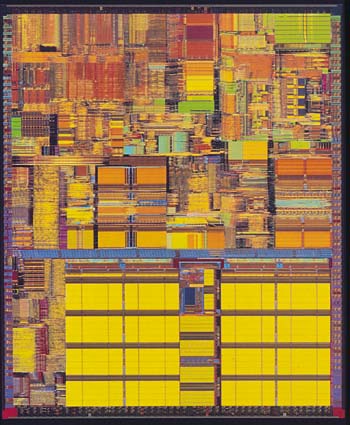
The latest Pentium III processor found in home computers contains over 9.5 million transistors on a single chip and is no larger than a thumbnail. (Courtesy: Intel)
In general, consumer goods will become cheaper, and information will become the most valuable commodity that we will be able to buy. This has the potential for truly liberating and augmenting human creativity, generating entirely new outlets for discovery, improving health and protecting freedom. It also has the potential for great mischief if governments or individuals misuse these tools. One only needs to think of “cyber terrorists” taking computer viruses to an extreme, or the manipulation of the truth as in George Orwell’s 1984. In order for society to survive in this environment, people will have to become more moral.
What types of wildcards could these technologies create? The first interstellar probes may be launched. These would be about the size of a baseball, but they could contain all the different types of instruments that we currently send to our planetary neighbours in probes the size of a bus. They would be so light that we could easily afford the cost of launching them. Their on-board electronics may be so efficient that they could operate for the decades it will take to reach our nearest stellar neighbours using only a single lithium-ion battery like those used in wristwatches today. Once they reach their destinations, the probes could send back images and information with the same quality as our current interplanetary probes. And we could be viewing these images before the 22nd century.
Another possibility is that with various sensors worn on (or perhaps in) the body one could record and store a lifetime’s experiences, and then recall them using wearable appliances. How would this change human behaviour if people knew that their every action was being recorded? And what types of protection would people have for their privacy?
In the next century machines could develop consciousness, which may be a dangerous prospect. Home-based computers may be able to process so much data – perhaps even as much as a thousand human brains – that a hacker could potentially write a self-awareness program. Your best friend, or your worst enemy, could be a household appliance! Would a person be charged with murder if they unplugged a sentient machine?
The future starts here
Any prediction of future technology, including this article, will be wildly over-optimistic in some areas, will fall drastically short in others, and will fail completely to account for the truly radical changes to come. The only thing that we can definitely predict about what technology and physics will look like next century is that it will be profoundly different from the way it is now. As long as we have curiosity and the means to pursue it, we will continue to make new discoveries and learn how to use them to modify our environment.
Rather than reaching the end of science, the beginning of the new millennium will be regarded as a time when we just started to look around us. There is certainly far more to discover than is currently known. The primary barriers to pushing the boundaries of physics are economic, political and social. These issues have always been more difficult to handle than the science.
Particle physics was born in 1897 with the discovery of the electron by J J Thomson, and many experimental and conceptual strides have been made in the century or so since this discovery. Several layers of the cosmic onion have been peeled away, and our current understanding of the subject is summarized in the so-called Standard Model, which has been tested with high precision at particle-physics laboratories around the world. There is no confirmed measurement from any laboratory experiment that contradicts the Standard Model. However, we particle physicists find it very unsatisfactory because its very successes raise many fundamental questions that cry out for answers.
Our challenge in the next millennium will be to transcend the Standard Model and reach a new level in the description of the constituents of matter and their interactions. It is very likely that this new understanding will make the Standard Model appear as primitive and incomplete as we now find the atomic model that described physics and chemistry at the end of the last century. Nevertheless, even atoms still have some relevance and utility, as do Maxwell’s equations and Newtonian gravity. Therefore, we may expect that any new theory developed in the next millennium will have the Standard Model embedded within it. So, let us first recapitulate the essential features of the Standard Model, before musing on its open problems and how to resolve them.
The triumph of the Standard Model
The fundamental particle interactions described by the Standard Model are the electromagnetic, weak and strong nuclear forces. It has been known from the early days of quantum physics that the electromagnetic forces between one charged particle and another are mediated by the exchange of the massless photon. Electromagnetic interactions are well described by the long-established quantum theory of electrodynamics, called QED. Meanwhile the strong nuclear interactions are described by quantum chromodynamics (QCD), and are mediated by massless bosons, called gluons. These were discovered at the DESY laboratory in Germany in 1979.
According to the unified theory of the weak and electromagnetic interactions – developed by Sheldon Glashow, Steven Weinberg and Abdus Salam in the 1960s – weak nuclear interactions such as beta decay should similarly be mediated by the exchange of charged (W+ and W–) and neutral (Z0) massive intermediate bosons. These were duly discovered at CERN, the European laboratory for particle physics near Geneva, in 1983 and weigh about 80 and 91 GeV c-2, respectively. Thus all the fundamental interactions have very similar structures, but the question of why only the weak bosons are massive is a puzzle to which we will return.
As already mentioned, the first elementary matter particle to be identified was the electron, which weighs about 0.5 MeV c-2 and has an intrinsic spin of 1/2. This was followed by the discoveries of other particles, called leptons, that do not feel the strong nuclear interactions: the unstable muon in 1936 (weighing about 100 MeV c-2) and the tau in 1975 (about 1780 MeV c-2). Each of these charged leptons has its own associated uncharged neutrino, and experiments at the Large Electron Positron (LEP) accelerator at CERN have shown that there can be no more similar neutrinos. Accelerator data have also established upper limits on the possible masses of the neutrinos, which are much less than those of the corresponding charged leptons.
The profusion of strongly interacting particles, known as hadrons, that have been discovered since the 1940s are known to be composite bound states of more elementary entities called quarks. We now know that there are six different types of quark, and that their masses range from a few MeV c-2, for the up and down quarks that make up conventional nuclear matter, to about 5 GeV c-2 for the bottom quark discovered in 1977. Meanwhile the top quark, which was discovered in 1994 during proton-antiproton collisions at Fermilab near Chicago, weighs in at around 170 GeV c-2 (figure 1).
Although the strong nuclear forces are – as their name suggests – strong, it is known that they get weaker at high energies, which corresponds to short distances. This property of “asymptotic freedom” is a central prediction of QCD. Like the other elementary-particle interactions, QCD is what we call a “gauge theory”. Most particle theories have symmetries under which the properties of a particle, such as its charge and spatial coordinates, can be changed without changing the predictions of the theory. The special feature of a gauge theory is that these transformations can be made independently at each point in space and time. This is possible if the exchange particles that mediate the interactions have integer spin: in other words, if they are bosons. In QED, the prototype gauge theory, the photon has a spin of 1. Gauge theories provide the only consistent description of the interactions of such particles. General relativity has a very similar structure to QED but with the role of the mediating boson being played by the elusive graviton, which has a spin of 2 and has yet to be detected.
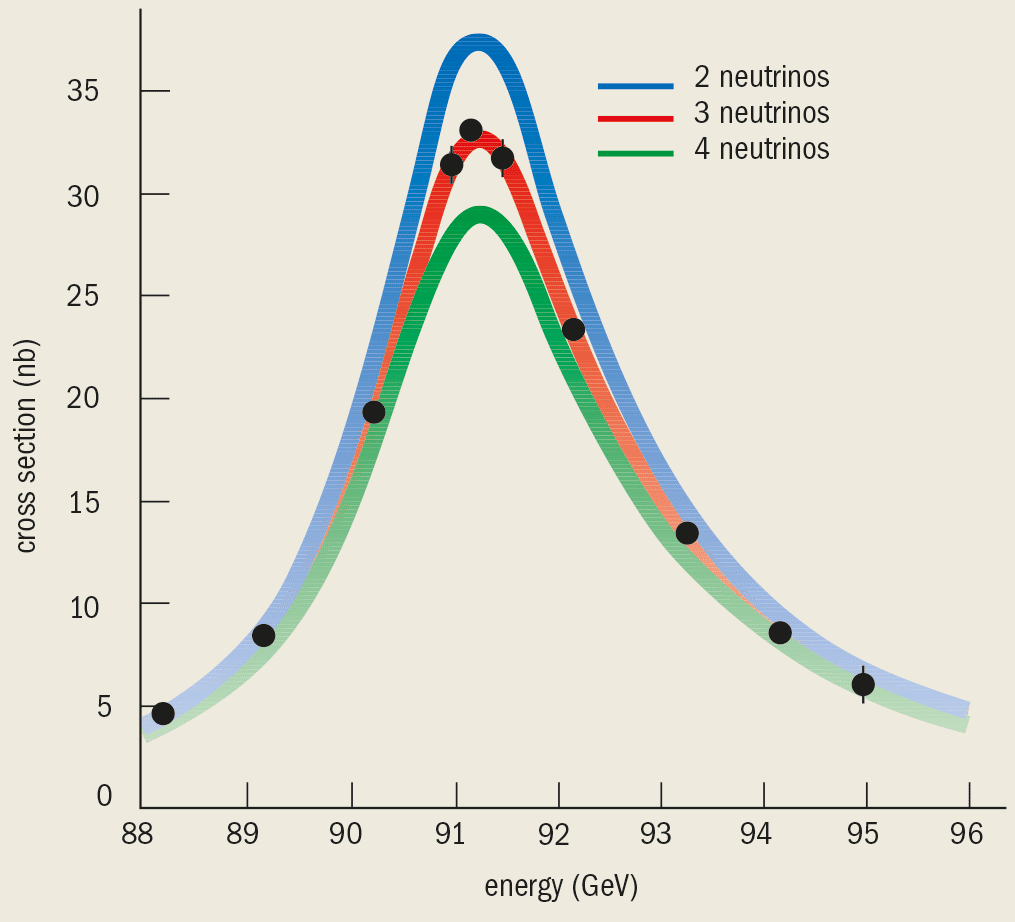
2 Precise predictions Over 20 million Z0 bosons have been produced in electron–positron collisions at the LEP and SLC accelerators, making it one of the most studied particles in high-energy physics. The number of Z0 bosons produced as a function of centre-of-mass energy is sensitive to the number of types of neutrino. Early measurements at the LEP experiments (black points) confirmed that there are precisely three types of neutrino.
Particle physics has been dominated in recent years by a series of precision tests of the Standard Model, including both its strong and electroweak sectors. The asymptotic freedom of the strong interactions has been confirmed in a large number of experiments with energies ranging from 1 GeV to about 200 GeV. Tests of the electroweak sector have been dominated by high-energy collisions between electrons and positrons at LEP, and at the Stanford Linear Collider (SLC) in California.
For the first few years of its operation, the beams at LEP were tuned so that their energies corresponded to the mass of the Z0 particle. At these specific energies, the rate at which the electron-positron interactions occur is enhanced, and a plot of the interaction rate versus energy shows a “resonance peak” (figure 2). A crucial role has been played by measurements at this Z0 resonance peak, which must be one of the most carefully studied resonances in particle physics, since 20 million measured Z0 bosons have contributed to it. The height and width of the peak depend on the number of ways that the short-lived Z0 particles decay. It also includes decay modes that cannot be detected directly, such as those into a pair of neutrinos. The LEP measurements tell us that there are precisely three neutrino species, no more and no less.
In addition to measuring the total interaction rates, LEP and the SLC have provided many other precision measurements, including the relative probabilities for the Z0 particle to decay into different heavy quarks, the angular distributions for particle production, and their dependencies on the particle spins.
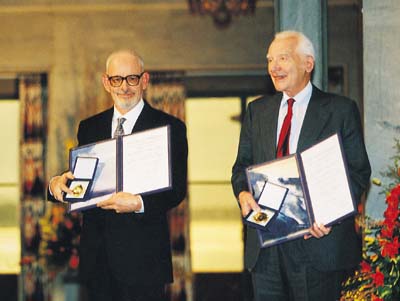
Many of these measurements are accurate to one part in a thousand, and none differs significantly from the Standard Model prediction. These predictions require calculations of the small quantum corrections due to “virtual” particles that are emitted by a particle and exist briefly before being reabsorbed. These corrections can be calculated reliably within the electroweak theory. In many quantum theories, these calculations are infinite, and it is not possible to make reliable predictions. It is one of the miracles of gauge theories that these infinities can be removed, allowing finite predictions for physical quantities to be made. This was first done for QED in the 1940s. In the early 1970s Gerard ‘t Hooft and Martinus Veltman proved that it could also be done for the electroweak theory – an achievement that has won them the 1999 Nobel Prize for Physics.
These so-called “loop calculations” are sensitive to the masses of the virtual particles that are too heavy to be produced directly at LEP or the SLC. In particular, the various measurements from the Z0 decays are quite sensitive to the mass of the top quark. Particle physicists were therefore able to successfully predict the mass of the top quark before it was discovered by confronting the Standard Model with all the measurements and determining which mass fitted best.
The LEP beam energies have now been raised well above the threshold for Z0 production so that pairs of W bosons can be created and studied in detail. According to the Standard Model, the W pairs can be produced if the electron and positron first create a photon or Z0 boson, or exchange a neutrino. All three contributions are required to explain the LEP data, and the measurements are in good agreement with theoretical predictions. Thus the Standard Model remains triumphant!
Standard Model shortfalls
There are still some key features of the theory that have not yet been tested. One of these is the origin of the particle masses. According to the Standard Model, the underlying field theory may be formulated in terms of massless particles, in a very symmetric way. However, the electroweak vacuum is believed to break this symmetry, and give different masses to different particles. The culprit for this spontaneous symmetry breakdown is believed to be a scalar field, which has an associated particle called the Higgs boson. The precision electroweak data described earlier are sensitive to the mass of this particle, and currently indicate that it weighs around 100 GeV c-2, with a uncertainty of a factor of about 2.
The search for the Higgs boson has been one of the continuing objectives of the LEP experimental programme (figure 3). These searches have so far been unsuccessful, and have established that its mass must exceed about 102 GeV c-2. The LEP experiments should be able to extend the search to around 110 GeV c-2. However, if the Higgs boson is heavier, its discovery may have to await future experiments at Fermilab in the US or at the Large Hadron Collider (LHC) at CERN.
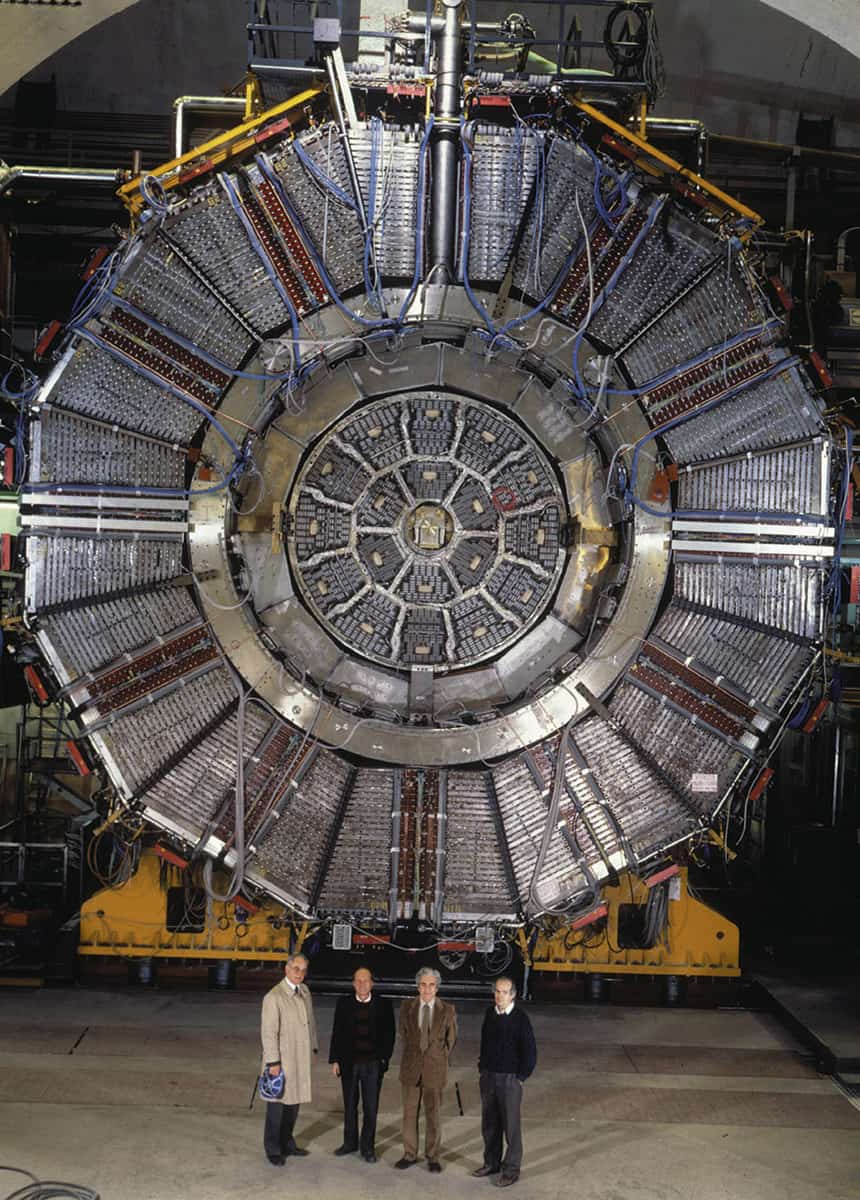
3 Experimental achievement An end view of the ALEPH experiment, one of the four detectors designed to measure particles produced in electron-positron annihilation experiments at CERN. Both experimental and theoretical ingenuity has contributed to the successes of particle physics. (Courtesy: CERN)
Another missing element in tests of the Standard Model is its mechanism for preferring matter over antimatter. This subject is potentially important for the history of the universe, which does not appear to contain any substantial amount of antimatter despite the natural expectation that it would initially have contained equal amounts of both matter and antimatter. In 1957 weak interactions were shown to violate not only parity (or mirror) symmetry, but also charge conjugation in which particles are replaced by their antiparticles. This means that, in general, particles spinning in one particular direction behave differently from particles spinning in the opposite direction. It also means that particles and antiparticles spinning in the same direction behave differently.
At first, it was thought that the combination of parity inversion and charge conjugation, known as CP, might be a “good” symmetry. In other words particles spinning in one direction would behave the same as antiparticles spinning in the opposite direction. However, an experiment in 1964 discovered that CP was also violated in the weak decays of neutral K mesons (which contain “strange” quarks). This means that matter does not behave in exactly the same way as antimatter, even if one reflects the experiment in a mirror in an attempt to recover the symmetry.
In 1973 Makoto Kobayashi and Toshikide Maskawa realized that this matter-antimatter asymmetry could be accommodated within the Standard Model if there were at least six quark species. Subsequently, much theoretical effort has been devoted to evaluating the Standard Model predictions for matter-antimatter asymmetries in different processes, and there is an extensive experimental programme to test these predictions. Follow-up experiments are consistent with the Standard Model, confirming recently that CP symmetry is violated directly in the decay of neutral K mesons (see Quinn and Hewett in further reading). However, experiments have not yet verified the characteristic predictions of the Standard Model for CP violation in other particle decays. There is currently great interest in the search for CP violation in decays of B mesons, which contain the bottom quark. Large numbers of B mesons will be produced in new accelerators called B factories, which began running this year at the Stanford Linear Accelerator Center (SLAC) in the US and the KEK laboratory in Japan.
Although the Standard Model of particle physics is very successful, with no confirmed accelerator data that contradict it, there are many theoretical reasons to consider it unsatisfactory and to expect some physics beyond the Standard Model. For example, even if one accepts the charges and spins of the quarks and leptons, the Standard Model contains 19 free parameters that are obtained from experiment. Having so many parameters is surely unacceptable for any candidate for a “theory of everything”. Attempts to go beyond the Standard Model typically try to simplify at least one of its aspects.
Towards grand unification
In a so-called grand unification theory one regards the strong, weak and electromagnetic interactions as different aspects of a single force, with a universal “coupling strength” that describes the probabilities of all the different types of particle interaction. This is made possible by the fact that the strengths of the different interactions vary with energy, as exemplified by the asymptotic freedom of the strong interactions. Calculations indicate that the coupling strengths may become equal at an energy around 1015 to 1016 GeV, relatively close to the so-called Planck energy scale of about 1019 GeV, where gravity becomes a strong force.
Many grand unified theories predict the appearance of novel interactions that may cause the proton to decay and/or give neutrinos mass. There have been many unsuccessful searches for proton decay, and its lifetime must be at least 1032 years. However, recent studies of solar and atmospheric neutrinos suggest that the various neutrino species may have different masses. If confirmed, this would constitute the first concrete evidence for physics beyond the Standard Model. It remains to be seen whether any of the neutrinos is heavy enough to make a significant contribution to the invisible “dark matter” in the universe (see Astrophysics and cosmology: the golden age by Michael Rowan-Robinson).
Other proposals for possible physics beyond the Standard Model try to understand the variety of quark and lepton types or “flavours”, and the origin of CP violation – in particular the complicated pattern of lepton masses and quark masses, and the rate at which particles containing different quarks decay. One of the ideas often discussed in this context is the possibility that leptons and quarks are not elementary, but bound states of even more fundamental constituents. So far, no compelling model of this type has emerged, so it will not be discussed further here. The stakes are high in constructing a theory of flavour and CP violation, since it may be a crucial ingredient in attempts to understand the asymmetry between matter and antimatter observed in the universe. (An example of a flavour-violating interaction would be if a muon and an electron were created in an electron-positron collision, rather than a muon and antimuon.)
A third set of proposed extensions to the Standard Model attempts to understand better the observed magnitudes of particle masses. The principal problem here is that the virtual particles in the new theory have very large effects on the mass of the Higgs boson. In principle, these effects could be cancelled by bizarre initial values of the parameters in the theory, so as to obtain acceptable physical values. But this is an unsatisfactory situation to be in.
One way to avoid this delicate fine-tuning of parameters is to postulate that the particles of the Standard Model are accompanied by partners with identical charges (and hence interactions), but with spins differing by half a unit. These “supersymmetric” particles therefore have opposite statistics from the particles in the Standard Model – fermions are accompanied by bosons, and vice versa. The corresponding virtual-particle effects have opposite signs and cancel automatically, so that the fine-tuning problem is avoided if the supersymmetric partners of the particles weigh less than about 1000 GeV c-2 (see Ellis in further reading).
One of the most intriguing aspects of many supersymmetric theories is that the lightest supersymmetric particle should be stable. It might therefore still be around in the universe today as a relic from the big bang, and might constitute much of the “cold” dark matter advocated by many astrophysicists and cosmologists. So far we have no direct evidence for supersymmetric particles, but we believe that pairs of them could be created in collisions just like any other particle, provided the energy is high enough.
Finally, many theorists believe that the underlying theory of everything that resolves all the open problems of the Standard Model will be provided by some incarnation of string theory. This is an apparently consistent quantum theory of gravity that requires supersymmetry and is rich enough to accommodate a grand unified theory. String theory embodies a very high degree of symmetry that extends and generalizes both the symmetry of the Standard Model and the general coordinate invariance of general relativity. It is a mesmerizingly beautiful theory that has already provided us with many elegant mathematical insights, and promises to revolutionize our vision of the geometry of space-time (see “The new universe around the next corner” by Lee Smolin).
The experimental calendar
Currently operating at CERN is the LEP electron–positron collider, which this year has been teased up to, and even slightly beyond, its design energy of 200 GeV in the centre of mass. The LEP beams may even be coaxed to slightly higher energies next year, the collider’s final year of operation.
Several new accelerators started to take data this year. These include the DAFNE kaon factory at Frascati in Italy, the B-meson factories at SLAC in the US and the KEK laboratory in Japan, and the Relativistic Heavy Ion Collider at the Brookhaven National Laboratory in the US.
Next year will see the return of the Fermilab Tevatron proton–antiproton collider, which will have a centre-of-mass energy of 2 TeV. The Tevatron will remain the world’s highest energy machine until the start-up of the LHC at CERN, scheduled for 2005. The LHC will provide proton-proton collisions at 14 TeV in the centre of mass, and heavy-ion collisions above 1000 TeV in the centre of mass.
Among the non-accelerator facilities, several underground experiments are looking for evidence of dark matter, and the immensely successful SuperKamiokande detector will continue to operate for the foreseeable future. It has recently complemented its studies of atmospheric neutrinos by starting to look at a beam of neutrinos directed from the KEK laboratory 250 km away. This long distance could be sufficient for the neutrinos to change from one flavour into another, if the previous atmospheric-neutrino data are interpreted correctly. This so-called K2K project will be joined in 2001in the same mine by the Kamland detector, which is designed to be sensitive to neutrinos emitted by Japanese nuclear power reactors.
In Canada, the SNO solar-neutrino experiment has started to take data now, and other solar-neutrino experiments, such as Borexino, are scheduled to come on-line within the next few years. In 2003 the Fermilab accelerator laboratory will start sending a neutrino beam to the MINOS detector in the Soudan mine 730 km away. It is also hoped that in 2005 CERN will start sending a neutrino beam over a similar distance to the Gran Sasso laboratory in Italy. Both of these projects will be seeking to confirm the oscillation interpretation of the atmospheric-neutrino data.
Underwater, meanwhile, a detector has been taking data in Lake Baikal in Siberia for some time, and two more experiments – ANTARES and NESTOR – are planned in the Mediterranean. In ice, AMANDA is already taking data in Antarctica, and may be followed by the larger ICECUBE detector. Meanwhile, the first part of the Auger experiment to detect ultrahigh-energy cosmic rays is currently under construction in Argentina, and new gamma-ray telescopes are planned, including GLAST which is due to be launched in 2005.
The next step
When and how might these ideas for possible physics beyond the Standard Model be tested? The calendar is largely determined by the opening of experimental opportunities at new accelerators. Non-accelerator facilities – experiments underground, underwater, in ice and in space – also have a role to play (see box). How can these experiments address the important open issues in particle physics?
First and foremost is the discovery of the Higgs boson: it may be found at LEP next year if it weighs less than about 110 GeV c-2. This is not unlikely, in view of the precision Standard Model measurements, and also in the light of supersymmetry, which predicts that at least one Higgs boson should weigh less than about 150 GeV c-2. We wait for rumours with bated breath!
If LEP is unlucky, the Tevatron collider has the next opportunity: it may have a chance if the Higgs mass is below about 170 GeV c-2, but this will depend how long and how well the accelerator runs. If the Higgs boson has not been found by 2005 – as is perhaps most likely – it will surely be found by experiments at the LHC, although this may take several years.
The flavour and CP problems are the primary objectives of the K and B factories. Within the next few years, they should tell us whether CP violation is described approximately by the mechanism proposed by Kobayashi and Maskawa within the Standard Model. If so, there will follow a period of detailed studies to look for possible deviations that might be due to supersymmetry, for instance. Here there may be a good research opportunity for the dedicated B experiment at the LHC collider.
What about more direct searches for supersymmetry? Here again, LEP has a chance to discover it, as does the Tevatron collider. Once more, the LHC will surely discover it, if this has not happened previously, and will make detailed measurements. However, in this case there may be serious competition from non-accelerator experiments looking directly or indirectly for supersymmetric dark-matter particles that are relics from the big bang. One experiment at the Gran Sasso laboratory in Italy has already reported that it may be seeing a signal for the elastic scattering of supersymmetric cold dark-matter particles with heavy nuclei, and other underground experiments are poised to match or surpass its sensitivity.
4 Neutrinos weigh in Results from SuperKamiokande in Japan suggest that neutrinos produced in cosmic rays transform from one type into another as they travel through space, something that can happen if neutrinos have mass.
Alternatively SuperKamiokande (figure 4) and the large underwater and ice experiments have a chance to see supersymmetric relics indirectly via their annihilation into neutrinos that yield detectable muons, while gamma-ray telescopes may be able to detect their annihilations into photons. These experiments have a window of opportunity until 2005, when the collider experiments at the LHC should settle the supersymmetric issue.
Grand unified theories (GUTs) are vulnerable on several fronts. The upcoming “long-baseline” neutrino experiments should establish whether one type of neutrino gradually transforms into another type as it travels over a long distance from source to detector. According to current atmospheric-neutrino data it is widely suspected that the muon neutrino transforms or “oscillates” into a tau neutrino. In parallel, the Kamland, Borexino and the Sudbury Neutrino Observatory (SNO) experiments should be able to pin down whether neutrino oscillations are responsible for the surprisingly small flux of solar neutrinos that has been detected so far. We should not forget the continuing search for proton decay. SuperKamiokande has not yet exhausted its sensitivity to the various possible decay modes.
A useful role may also be played by the future satellite measurements of the cosmic microwave background. NASA plan to launch the Microwave Anisotropy Probe in 2000, and the European Space Agency hope to launch the Planck Surveyor in 2007. These will test models of fundamental cosmology, which postulate new physics that should be integrated into the overall framework of particle physics.
What are the prospects for testing fundamental string theory? Here the crystal ball is rather cloudier, but the subject is regularly shaken by conceptual revolutions, and there may be experimental opportunities to test it or alternative quantum theories of gravity. Any such theory could be expected to predict some small effects suppressed in strength by (at least) some power of the characteristic energy scale divided by the Planck energy scale. These new effects may respect the usual laws of quantum field theory, in which case they could be detectable if they yield novel phenomena such as proton decay or neutrino masses, as in conventional GUTs. Alternatively, they may predict supermassive relics from the big bang, the decays of which might be responsible for generating cosmic rays with inexplicably ultrahigh energies.
An even more speculative possibility is that quantum gravity breaks the usual laws of quantum field theory by upsetting, for example, our conventional ideas of locality, causality and Lorentz invariance. In this case, the signatures of quantum gravity might be more distinctive. My colleagues and I have not been afraid to stick our necks out and make some speculative suggestions along this line, which may be unpopular with our “stringy” colleagues but have the merit that they can be tested experimentally. One suggestion is that the normal Schrödinger equation may need to be modified to reflect the loss of quantum coherence. This would consequently violate the most sacred theorem of quantum field theory – that the physics of a particle interaction remains the same when its charge, spatial coordinates and time are reversed. Neutral kaon decays provide the most sensitive microscopic laboratory for testing quantum mechanics, so here is a possible opportunity for the DAFNE kaon factory in Frascati, Italy.
Another speculative suggestion is that the velocity of light in the vacuum may not be an absolute quantity, but may depend on the photon energy, through a refractive index induced by quantum gravity. Distant astrophysical sources, such as gamma-ray bursters, pulsars and active galactic nuclei, may provide the most sensitive probes of this crazy idea, and have already been used to show that any such effect must be suppressed by at least one factor of the energy divided by 1016. Future gamma-ray telescopes such as the Gamma Large Area Space Telescope (GLAST) may be able to test this speculation more thoroughly.
Particle physics beyond 2010
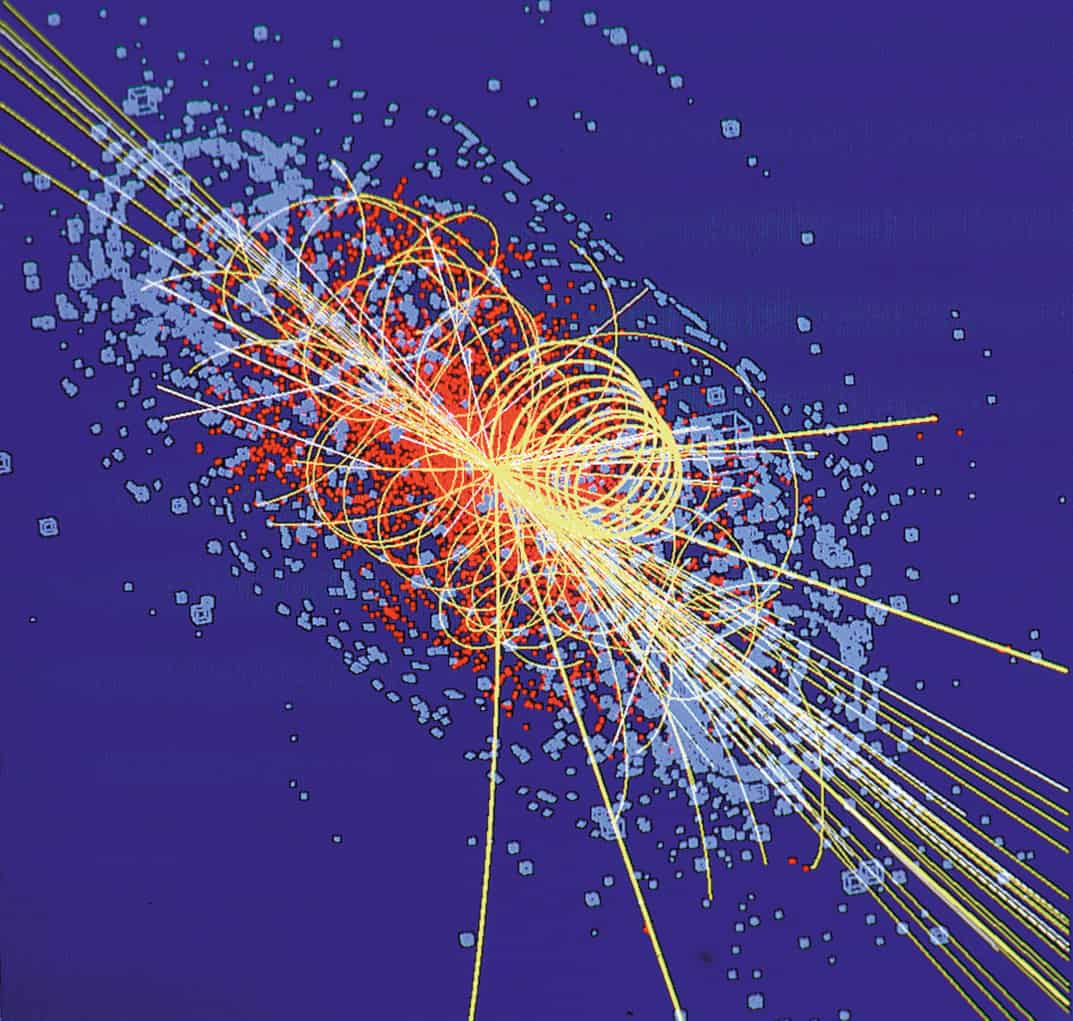
So far, so good, for the next decade, but what might be the questions still open after then, and how and when could we hope to address them? Here are just a few examples. I expect that even after the Higgs boson is discovered (figure 5), we will be clamouring to pin down its properties, to measure its decays and see whether it fits into a supersymmetric framework. We shall therefore need a Higgs “factory” to produce the Higgs boson in copious amounts, and to make more detailed studies of supersymmetry.
On the GUT front, even if neutrino oscillations are confirmed by long-baseline experiments, questions will remain, such as the overall scale of neutrino masses, lower-level oscillation effects, and the possible presence of CP violation in neutrino oscillations. We shall also want to push further the search for proton decay and supersymmetric relics, and will therefore need an underground detector that is even larger than the 50,000 tonne SuperKamiokande experiment. If the Auger observatory confirms the appearance of unexpected ultrahigh-energy cosmic rays, we shall want to explore the phenomenon further.
5 Hunting the Higgs boson A simulation of the particle tracks produced when a Higgs boson is created in proton–proton collisions at the LHC. (Courtesy: CERN)
The next high-energy particle accelerator now being discussed actively is a linear electron-positron collider with an energy up to 1 TeV in the centre of mass. If approved early in the new millennium, it could come into operation a few years after the LHC. Such a linear collider would be complementary to the LHC, and could make many interesting Higgs and supersymmetry measurements, assuming these particles are light enough to be produced.
However, not all the Higgs questions might be answered, even by a linear collider. This has motivated some interest in a muon collider, which might be able to study the direct production of the Higgs boson and measure its line shape, much as LEP and the SLC did for the Z0 boson. Going to higher energies would require another linear collider, or a muon collider, or a very large hadron collider. All these projects are technically very challenging, and much work is required to demonstrate the feasibility, in particular, of any muon collider.
A stepping stone on the route to a muon collider might be provided by a storage ring in which the muons are not forced to collide, but simply allowed to circulate and decay into neutrinos that could then be used in future long-baseline neutrino experiments. The energy spectra, types and charges of neutrinos resulting from muon decays are known precisely. Such neutrino beams are so intense that one could even envisage a beam directed several thousand kilometres towards an experiment on the other side of the Earth. This may enable CP-violating effects to be seen in neutrino oscillations.
What might constitute a future generation of non-accelerator experiments? One suggestion is a water-filled Cerenkov detector that is an order of magnitude larger than the SuperKamiokande detector and sited, perhaps, in a natural cavern. Experimentalists are thinking of instrumenting a cubic kilometre of material underwater or in ice. In space, they are thinking of a satellite that can look down at ultrahigh-energy cosmic-ray collisions in the atmosphere, covering an area two orders of magnitude greater than the Auger project.
Another proposal is to have a proton-decay experiment on the Moon, where there is no atmospheric-neutrino background that could mask a true signal. Particle physicists have already accustomed themselves to using the most extreme environments on and below the Earth’s surface to perform their experiments. The next step would surely be to use the solar system as a laboratory. This has already been proposed for experiments such as the Laser Interferometer Space Antenna, a multi-satellite experiment to measure gravitational waves in the fabric of space-time caused by distant astrophysical cataclysms.
The globe and beyond
This brief survey shows that the past achievements of particle physics leave open a number of very definite and important questions. Several interesting projects capable of addressing these questions are either operational or under construction, and there are many intriguing suggestions for subsequent generations of experiments. The laws of physics are universal, and particle physicists learnt long ago to tackle them internationally. Current projects, such as the LHC, are already organized on a global basis, and this principle will be applied even more universally to future projects. Already the globe is used as a laboratory: next the universe?
Physics in the 20th century is founded on the twin pillars of quantum mechanics and the theory of relativity. However, in spite of the enormous successes of each theory individually, the two appear to be incompatible. This embarrassing contradiction at the very heart of theoretical physics remains one of the great outstanding challenges in science.
The general theory of relativity gives a superbly accurate account of gravitation. Applying quantum mechanics to the gravitational field is the subject of quantum gravity. At first sight, constructing a theory of quantum gravity looks no more problematic than the theory of quantum electrodynamics (QED), which was satisfactorily worked out half a century ago.
Central to QED is the description of electromagnetic forces in terms of the exchange of so-called virtual photons. These are photons that are emitted and then quickly reabsorbed; the Heisenberg uncertainty principle means that they do not have to conserve energy and momentum. Thus the electrostatic repulsion between two electrons can be thought of as due to virtual photons being emitted by one electron and absorbed by the other.
Similarly, one could envisage the gravitational attraction between two bodies as being due to the exchange of virtual “gravitons” – the quanta of the gravitational field. The fact that nobody has ever detected a graviton is no surprise, because gravity is so much weaker than electromagnetism. It turns out that an exchange of single gravitons between point masses does indeed yield an expression for the gravitational field with its familiar inverse-square law.
Problems set in, however, when more complicated processes involving many gravitons are examined. Gravity differs crucially from electromagnetism inasmuch as the gravitational field is nonlinear. This nonlinearity arises because the gravitational field possesses energy, and energy has mass, which gravitates. In quantum language, this implies that gravitons will interact with other gravitons, unlike photons, which interact only with electric charges and currents and not with other photons. Because gravitons respond to each other, particles of matter are surrounded by complex networks of virtual gravitons that form “closed loops”, as well as “branching trees”.
In quantum field theory, closed loops are a sign of trouble; they normally produce infinite answers in calculations of physical processes. In QED, such loops occur when an electron emits and reabsorbs its own photon. The resulting infinities are removed by a mathematical procedure that is known as renormalization. If this is done properly, sensible answers are obtained. QED is termed a renormalizable theory because all such infinities can be removed by a systematic procedure; in effect, a single set of mathematical operations is sufficient to remove the infinities.
Unfortunately, no such systematic procedure exists when quantum mechanics is applied to general relativity; the theory is therefore “non-renormalizable”. Each process involving progressively more closed loops of gravitons introduces new varieties of infinite terms. This renders the theory useless for investigating almost all phenomena of interest, and suggests that there is something basically wrong with general relativity, quantum mechanics, or both.
Over the past few decades, several attempts have been made to evade the problem of non-renormalizability in quantum gravity. The most promising is superstring theory. This is based on the hypothesis that the fundamental entities from which the physical world is built are not particles but loops of string 1020 times smaller than an atomic nucleus. Roughly speaking, different vibrational modes of the strings correspond to different particles – electrons, quarks, neutrinos, photons, gravitons and so on. Interactions take place between strings as they do between particles, but, when processes involving closed loops are examined, the answers are found to be finite.
The natural scale that enters string theory is determined by the Planck energy, which is around 1019 GeV. This is 1017 times higher than the sorts of energies probed by the largest particle accelerators, so it is impossible to observe the stringy nature of matter directly. Theorists hope that, at everyday energy scales, familiar physics – general relativity, electromagnetism, the weak and strong nuclear forces, the familiar subatomic particles – will emerge from string theory as an approximation. Thus, superstring theory is not just a putative description of quantum gravity, but also an attempt to unify the forces and particles of nature.
Unfortunately, there is no unique low-energy limit to superstring theory and no unique superstring theory either. For a time this looked like an insuperable obstacle, but in recent years a more abstract mathematical scheme known as “M theory” has been constructed, and it appears to contain the various superstring theories within it.
It is too soon to say whether M theory will finally reconcile gravitation and quantum mechanics, but, if such a theory is to live up to expectations, it should explain some basic facts about the physical world. For example, four-dimensional space-time would have to emerge from the theory, rather than be put into it. The forces and particles of nature also ought to be described, preferably including their key properties, such as interaction strengths and masses. However, unless M theory, or a future variant, can be “projected down” into the relatively low-energy realm of laboratory physics to yield such information, it will remain little more than an elegant exercise in mathematics.
Quantum mechanics is a great deal more than a theory; it is a whole new way of looking at the world. When it was developed in the 1920s, quantum mechanics was viewed primarily as a way of making sense of the host of observations at the level of single electrons, atoms or molecules that could not be explained in terms of Newtonian mechanics and Maxwellian electrodynamics. Needless to say, it has been spectacularly successful in this task.
Around 75 years later, as we enter the new millennium, most physicists are confident that quantum mechanics is a fundamental and general description of the physical world. Indeed, serious attempts have been made to apply quantum ideas not merely to laboratory-scale inanimate matter but also, for example, to the workings of human consciousness and to the universe as a whole. Yet despite this confidence, the nagging questions that so vexed the founding fathers of quantum theory – and which many of them thought had finally been laid to rest after years of struggle – have refused to go away. Indeed, as we shall see, in many cases these questions have returned to haunt us in even more virulent forms. It is probably fair to say that, in the final years of this century, interest in the foundations of quantum mechanics is more widespread, and more intellectually respectable, than at any time since the invention of quantum theory.
I shall not have space here to discuss all the interesting technical advances of recent years, such as work on Zeno’s paradox or the properties of “post-selected” states. Instead I will confine myself to two aspects of the quantum world-view that are particularly alien to classical physics: these are “entanglement” and “non-realization”. These two topics are commonly associated with two famous paradoxes – the Einstein-Podolsky-Rosen (EPR) paradox and Schrödinger’s cat.
Quantum mechanics is usually interpreted as describing the statistical properties of “ensembles” of similarly prepared systems, such as the neutrons in a neutron beam, rather than individual particles. The ensemble is described by a wavefunction that can be a function of both space and time. This wavefunction, which is complex, contains all the information that it is possible to know about the particles in the ensemble. The probability of a particle being at a particular position is given by the product of the wavefunction and its complex conjugate at that point. Energy, momentum and other quantities that can be measured in an experiment are represented by “operators”, and their distributions can be calculated if the wavefunction is known. The indeterminacy or uncertainty principle means that it is impossible to assign definite values of certain pairs of variables, such as position and momentum, with arbitrary precision.
In quantum mechanics it is possible for a particle such as an electron to be in two or more different quantum states or “eigenstates” at the same time. These eigenstates correspond to definite, but different, values of a particular quantity such as momentum. However, when the momentum of a particular particle is measured, a definite value is always found – as experiment confirms! In the conventional or Copenhagen interpretation of quantum theory, the particle in question “collapses” into the eigenstate corresponding to that value, and remains in this state for future measurements. Or, to put it more accurately, those particles that, on measurement, are found to have a particular value of the momentum constitute a new ensemble for future measurements, with properties different from the original ensemble.
Entanglement and the EPR paradox
Although the standard interpretation of quantum mechanics does not allow the particles in an ensemble to possess definite values of all measurable properties simultaneously, it can be shown that the experimental predictions made by the theory are nevertheless compatible with the simultaneous existence of these properties. (This view is contrary to a long-standing misconception that may have resulted from a misreading of some early work by John von Neumann.) However, the simultaneous existence of these properties does require that certain non-standard, but not obviously unreasonable, assumptions are made about the effects of the measurement process.
The phenomenon of “entanglement” refers to the fact that the most general quantum description of an ensemble of systems in which each system is composed of two or more subsystems (such as pairs of electrons or photons) does not permit us to assign a definite quantum state to each of the individual subsystems. This turns out to have a much more dramatic consequence: if quantum mechanics gives the correct predictions for experiment and we are not prepared to relax very basic ideas about causality, then independent of any theoretical interpretation, the individual particles cannot be conceived of as possessing “properties” in their own right.
The experimental set-up used at the ENS in Paris to probe decoherence in quantum superpositions of mesoscopic electromagnetic fields. The superpositions are produced and probed by atom-cavity interactions. The decoherence is caused by cavity losses. The cavity is formed by two superconducting mirrors at the centre of the apparatus. One of the mirrors has been removed in this photograph.
To introduce the idea of “entanglement”, let us consider a single “spin-½” particle such as an electron. When the intrinsic angular momentum or “spin” of the particle is measured along any direction, the answer is always +h-bar/2 or – h-bar/2, where h-bar is the Planck constant divided by 2 pi. The most general pure quantum state of a spin-½ particle can be written as phi(n), where n is the unit vector in the direction along which the spin is guaranteed to be h-bar/2.
Now consider two distinguishable spin-½ particles: one possible pure state for this system would involve each particle being in a single-particle pure state. This is written formally as phi1(n1) x phi2(n2) where n1 is the unit vector for particle 1 and n2 is the unit vector for particle 2. In such a “product” state it is possible to view each particle as possessing properties in its own right.
Nothing really changes if we consider statistical mixtures of product states: the vectors n1 and n2 still exist for any given pair, but we may not know what these vectors are. For example, we may know that either particle 1 has its spin “up” and particle 2 has its spin “down”, or vice versa, without knowing which of these two possible states the system is in. In such a case the experimental properties are still compatible with the idea that the particles “possess” individual properties but we do not know what these properties are.
However, we can also form “quantum superpositions” of product states and, as we shall see below, these so-called entangled states can have unique and counterintuitive properties. The best-known example of an entangled state is that which corresponds to two spin-½ particles with a total spin of zero
Upsilon(1, 2) = (1/2½)[{phi1(n) x phi2(-n)} – {phi1(-n) x phi2(n)}]
where n is a unit vector in an arbitrary direction. If the spin of particle 1 along any axis is measured and found to be +½, then a measurement of the spin of particle 2 along the same axis is guaranteed to yield -½. This property, while surprising, is not the most important property of the entangled state. What is unique about the entangled state, by its very definition, is that it is impossible to assign a quantum state (even an unknown one!) to each of the particles individually. In other words, the individual particles cannot be regarded as possessing properties in their own right.
In 1964 the late John Bell showed that the possibility of entanglement had truly spectacular consequences. Bell considered an ensemble of pairs of spin-½ particles that have interacted in the past but are now so wide apart that they are space-like separated in the sense of special relativity (that is there is no time for a light signal to travel between them within the duration of the experiment). He then set out to find a description of the pairs, and their interactions with the measuring apparatus, which satisfied the three postulates that defined so-called “objective local” theories.
* Each particle is characterized by a set of variables. These variables might correspond to a quantum-mechanical wavefunction, but they do not have to. It is not excluded that the variables describing particles 1 and 2 have a strong statistical correlation.
* The statistical probability of a given outcome when the spin of particle 1 is measured along any axis is a function only of the properties of the relevant measuring apparatus and of the variables describing particle 1. In particular, the result is not physically affected either by the choice of measurement direction for particle 2, or by the outcome of that measurement. It is usually assumed that special relativity ensures, under appropriate experimental conditions, that this condition is satisfied.
* The properties of ensembles at a given time are determined only by the boundary conditions at earlier times: that is there is no “retrospective causality”.
Bell’s theorem effectively says that an objective local theory and quantum theory will give different predictions for the results of certain experiments (see box 1). The first step is to prepare an ensemble of pairs of quantum particles in such a way that we believe the correct quantum-mechanical description is given by an entangled state. If we then perform the experiment under suitably ideal conditions, and verify the predictions of quantum mechanics, we have shown that no theory of the objective local type can describe the physical world. Note that this conclusion is valid even if quantum mechanics is not the correct theory.
The history of experiments to compare the predictions of quantum mechanics and objective local theories goes back almost 30 years, including a remarkable series of experiments by Alain Aspect and co-workers at the Institut d’Optique in Paris in the early 1980s. With some exceptions that we believe we understand, these experiments have confirmed the statistical predictions of quantum mechanics under conditions that, although not 100% ideal, are sufficient to have convinced most physicists that nature cannot be described by any objective local theory.
Therefore, if one wishes to preserve the second and third postulates above – that is to preserve our usual conceptions about locality in special relativity and the “arrow of time” – we must then reject the first postulate. In other words we must accept that “isolated” physical subsystems need not possess “properties” in their own right. This conclusion, which again is independent of the validity of quantum mechanics, is highly counterintuitive.
In the last few years there have been a number of significant developments in this area. On the experimental side, Nicolas Gisin’s group at the University of Geneva has confirmed the quantum predictions at spatial separations of greater than 10 kilometres. These experiments, and indeed all of the experiments performed so far in this area, rely on statistical averages over a number of measurements. However, Daniel Greenberger, Michael Horne and Anton Zeilinger (GHZ) have shown that if one considers three particles, rather than pairs of particles, it is possible, in principle, to discriminate between the predictions of quantum mechanics and objective local theories with a single measurement. In the GHZ approach there exists, under certain conditions, an experiment such that objective local theories predict that the outcome is 100% “yes”, while quantum mechanics predicts 100% “no”. Experiments along these lines are currently being developed.
Entanglement has also played an important role in the emerging field of quantum information. For example, a quantum computer could, in principle, exploit entanglement to perform certain computational tasks much faster than a conventional or classical computer (see box 2).
1. Experimental tests of Bell's theorem
In a typical experimental test of Bell’s inequality, a source of entangled pairs of linearly polarized photons is placed between two polarizers. The probability of a photon passing through a polarizer depends on the angle between the polarization direction of the photon and the polarization axis of the polarizer. When this angle is zero, the photon always passes through. The probability of transmission falls as the angle increases, and reaches zero for an angle of 90°.
In the experiment we measure the probability that photon 1 passes through polarizer 1 and photon 2 passes through polarizer 2 as a function of the angle between the two axes of polarization. Quantum theory and objective local theories give different predictions for the result. In particular, objective local theories predicted that a particular combination of probabilities would be less than or equal to 2 – this is the famous Bell inequality. Quantum mechanics, on the other hand, predicts that the answer will be 2 x 2½. Experimental results to date strongly support the predictions of quantum theory.
2. Quantum information
One context in which entanglement has recently played an important role is the emerging field of “quantum information”. In a classical two-state system, a single binary digit can completely specify the state (e.g. 1 for “up”, 0 for “down”); the system thus carries one classical “bit” of information, and a set of L such classical systems carries L bits. A quantum two-state system, such as a single spin-½ particle, is already richer because two real numbers (e.g. the polar and azimuthal components of the unit vector n) are needed to specify the state. Moreover, these numbers can vary continuously between certain limits. The system is said to carry one quantum bit or “qubit” of information, and a set of L two-state quantum systems can carry L qubits. However, only one of the two binary values, 0 or 1, will be detected when the qubit is measured.
A classical 5-bit register can store exactly one of 32 different numbers: i.e. the register can be in one of 32 possible configurations 00000, 00001, 00010, … , 11111 representing the numbers 0 to 31. But a quantum register composed of 5 qubits can simultaneously store up to 32 numbers in a quantum superposition. Once the register is prepared in a superposition of many different numbers, we can perform mathematical operations on all of them at once. The operations are unitary transformations that entangle the qubits. During such an evolution each number in the superposition is affected, so we are performing a massive parallel computation.
This means that a quantum computer operating on L qubits can, in a single computational step, perform the same mathematical operation on 2L different input numbers, and the result will be a superposition of all the corresponding outputs. In order to accomplish the same task, any classical computer has to repeat the computation 2L times, or has to use 2L different processors working in parallel. In this way a quantum computer offers an enormous gain in the use of computational resources, such as time and memory, although only in certain types of computation.
Whether such a “quantum computer” can realistically be built with a value of L that is large enough to be of practical use is a topic of much debate. However, the mere possibility has led to an explosive renaissance of interest in the host of curious and classically counterintuitive properties associated with entangled states. Other phenomena that rely on nonlocal entanglement, such as quantum teleportation and various forms of quantum cryptography, have also been demonstrated in the laboratory (see further reading).
Non-realization and Schrödinger’s cat
The second major element of the quantum world-view that is also completely counterintuitive to classical thinking is “non-realization” or, as it is more commonly called, the quantum measurement paradox. This is most famously demonstrated by Schrödinger’s famous cat. In this thought experiment a cat is placed in a box, along with a radioactive atom that is connected to a vial containing a deadly poison. If the atom decays, it causes the vial to be smashed and the cat to be killed. When the box is closed we do not know if the atom has decayed or not. However, the atom is a quantum system, which means that it can be in both the decayed and non-decayed state at the same time. Therefore, the cat is also both dead and alive at the same time – which clearly does not happen in classical physics (or biology). However, when we open the box and look inside – that is when we make a measurement – the cat is either dead or alive.
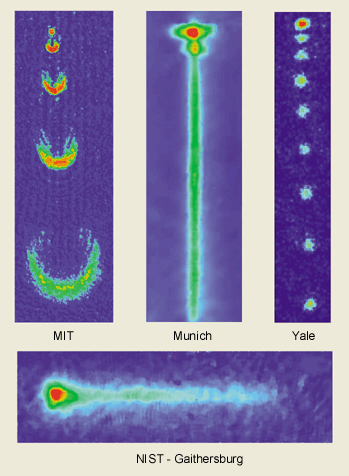
One of the most active areas of research in quantum physics is atom lasers. An atom laser is a collimated beam of atoms all moving with the same velocity, just like the photons in a laser beam. In addition to technological applications, atom lasers could be used in experiments that probe the foundations of quantum mechanics (see Physics World August 1999 p33).
Let us look at the situation more closely. Consider an ensemble of microscopic systems, such as electrons or photons, described by a state that is a quantum superposition of two orthogonal microstates, a and b. These microstates might be localized near one or other of the slits in a Young’s double-slit interference experiment. We know that any measurement that we carry out to discriminate between the states will always reveal that each individual system in the ensemble to be either in state a or in state b. There is, however, overwhelming experimental evidence that if a measurement is not made, then the system remains in a quantum superposition of the two states.
If now we introduce a device that will amplify the microstate a to produce some state A of the macroworld, and amplify microstate b to produce a state B that is macroscopically different from A, then this same device will amplify the superposition of a and b to produce a corresponding superposition of the macroscopically distinct states A and B. Moreover, if we continue to interpret the concept of superposition at the macrolevel in the same way that we do at the microlevel, we are apparently forced to conclude that the relevant part of the macroscopic world does not realize a definite macroscopic state until it is observed! In other words the cat can be both dead and alive at the same time before we look at it.
A standard reaction to this argument, which can be traced back to Heisenberg, relies on an idea called “decoherence”. In decoherence a macroscopic body interacts so strongly with its “environment” that its quantum state rapidly gets entangled with that of the environment. For example, the description of the cat by a superposition of “dead” and “alive” states is not realistic – we would certainly need, as a minimum, to “entangle” these states with the corresponding states of the vial containing the poison and so on. In such an entangled state quantum mechanics predicts that any measurement made on the system alone (i.e. with no corresponding measurement on the “environment”) should give statistical results identical to those that would be obtained from a classical probabilistic mixture of the states A and B. In this classical state each system in the ensemble is either definitely in state A or definitely in state B, but we do not know which. As a consequence, it is argued, we can legitimately say that by the time the amplification of the microstates has reached the macrolevel, each individual system “really is” in one state or the other.
There is no doubt that the phenomenon of decoherence is real – it has a very firm theoretical basis, and has been confirmed in a very elegant series of quantum-optics experiments by Serge Haroche, Jean-Michel Raimond and co-workers at the Ecole Normale Supérieure in Paris. The two states in these experiments differed by about 10 photons, so they are not perhaps “macroscopically” distinct, but the principle is the same.
The question is whether invoking decoherence really solves the quantum measurement problem. A substantial minority of physicists (including the current author) feel that it does not, and this has led to several interesting developments in both theory and experiment over the last couple of decades.
Theoretical work in this area can be classified into two broad areas. The first covers work that accepts that, in principle, the formalism of quantum mechanics gives a complete description of the physical world at all levels, including the macroscopic and even the cosmological levels. Physicists who adopt this approach seek to re-interpret the formalism in such a way as to avoid or reduce the problems associated with “non-realization”. Recent developments have included the “consistent-histories” interpretation and also its variants, the “Ithaca interpretation” of David Mermin, a vigorous revival of interest in the ideas of the late David Bohm, and various ideas in “quantum cosmology”.
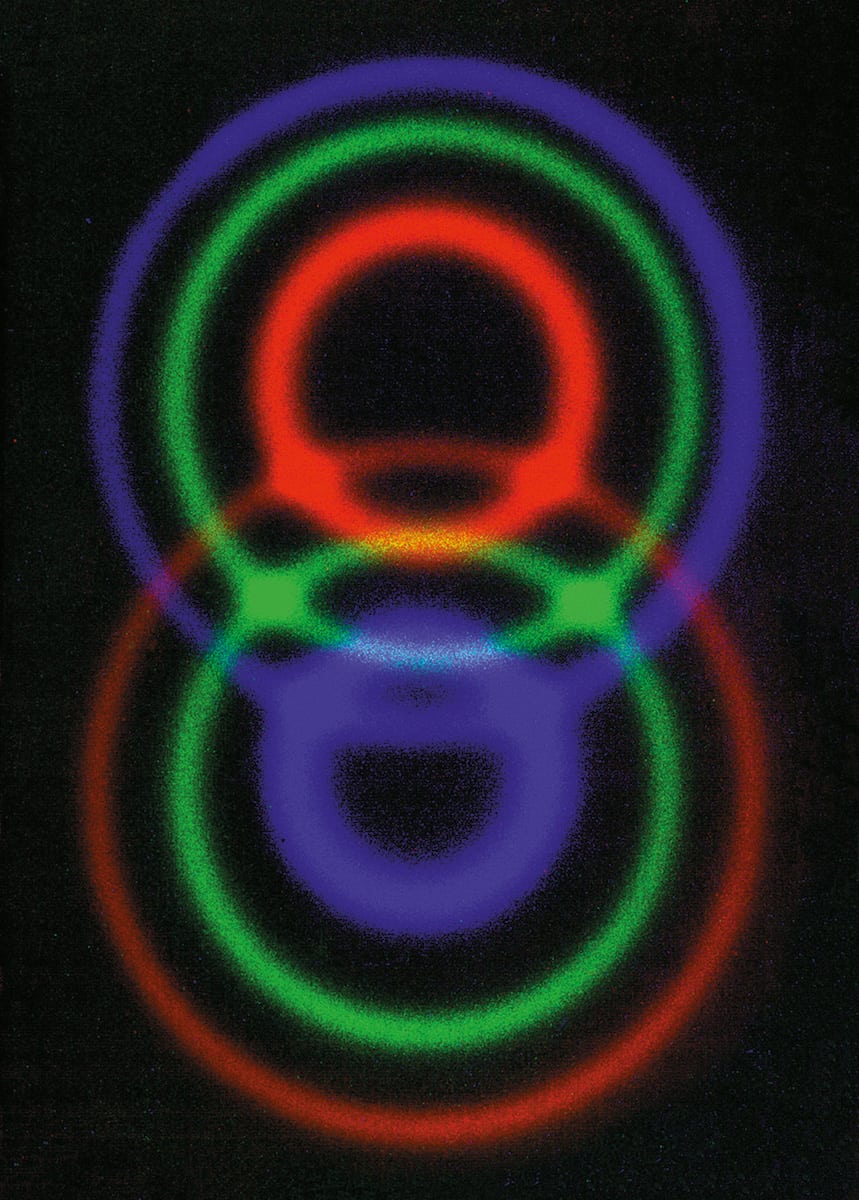
Entangled photons can be produced when an ultraviolet laser beam strikes a crystal with nonlinear optical properties. There is a small probability that one of the photons will spontaneously decay into a pair of photons with longer wavelengths (the sets of concentric rings above). Under certain conditions one of the “down-converted” photons will be polarized horizontally and the other will be polarized vertically. If the down-converted beams are made to overlap, the photons carry no individual polarizations – all we know is that the polarizations are different. This is an entangled state and such states can be used both to test Bell’s theorem and in various applications in quantum information – see boxes. (Courtesy: University of Innsbruck)
The second broad area covers “alternative” theories that, in general, do not preserve all the experimental predictions of standard quantum mechanics. These theories generally try to preserve the predictions of quantum mechanics at the atomic level, where the theory has been well tested, while providing a physical mechanism that allows a single definite macroscopic outcome to occur. Experimental tests of the alternative theories might be possible in the near future. The best-developed theory of this type is that advocated by Giancarlo Ghirardi, Alberto Rimini, Tullio Weber and Philip Pearle.
Over the last two decades it has become widely accepted that the traditional dogma – that is the belief that decoherence will always render macroscopic superpositions unobservable – may fail if the dissipative coupling between the system and the environment can be sufficiently controlled. Several experimental groups have therefore searched for evidence of macroscopic superpositions. The workhorse system for these experiments is a superconducting device that incorporates the Josephson effect, where it is not usually disputed that the states in question are indeed “macroscopically” distinct. These states differ in that 1015 or so electrons (about 1 microamp) are circulating in opposite directions: in one state the current is flowing in a clockwise direction, in the other the current is anticlockwise. What experimentalists look for in most of these experiments – and in related experiments on bio-magnetic molecules, mesoscopic devices and other systems – is evidence that quantum mechanics still gives reliable experimental predictions, even under conditions where the theory predicts superpositions of macroscopically distinct states. The evidence itself, however, is usually somewhat circumstantial in nature, involving phenomena such as tunnelling or resonance behaviour.
To date none of these experiments has produced any evidence for the breakdown of quantum mechanics. Indeed, in experiments where the parameters are well controlled, the agreement between experiment and the predictions of quantum theory has been quite satisfying. However, it is important to appreciate that no experiment to date has definitively excluded a “macrorealistic” view of the world in which a macroscopic object is in a definite macroscopic state at all times. The macrorealistic view is, needless to say, incompatible with the quantum picture. However, no one has shown so far that it makes experimental predictions that are incompatible with those of quantum theory for any experiments that have actually been performed. An experiment that, if successful, may be able to do this is currently being built by a group lead by Giordano Diambrini Palazzi of the University of Rome La Sapienza (www.roma1.infn.it/~webmqc/home.htm). If this experiment confirms the predictions of quantum mechanics, it will at the same time rule out the macrorealist view at the level of a Josephson device.
Quantum outlooks
Whither quantum mechanics in the next millennium? We do not know, of course, but here are two reasonable guesses for the short term. First, irrespective of whether or not “quantum computation” becomes a reality, the exploitation of the weird properties of entangled states is only in its infancy. Second, experimental work related to the measurement paradox will become progressively more sophisticated and eventually advance into the areas of the brain and of consciousness.
This, of course, assumes that physicists will maintain their current faith in quantum mechanics as a complete description of physical reality. This is something on which I would personally bet only at even odds for the year 2100, and bet heavily against as regards the year 3000!
Victor Weisskopf (left), George Brock Chisholm, Mark Oliphant and Leo Szilard at the first Pugwash conference in 1957 in Canada. The conference was held in the village of Pugwash in Nova Scotia.
Should scientists be concerned with the social impact of their work and the ethical issues it raises? Should they accept responsibility for the human and environmental consequences of scientific research? These questions did not arise in the distant past because there were very few such consequences. In those days science had no role in the day-to-day life of people or in the security of states. The only motivation for scientific pursuit was sheer curiosity – the same impulse that drives scientists today – with no avowed practical aims.
The detachment of scientists from general human affairs led them to build an ivory tower in which they sheltered, pretending that their work had nothing to do with human welfare. The aim of scientific research, they asserted, was to understand the laws of nature; since these are immutable and are not affected by human reactions and emotions, these reactions and emotions have no place in the study of nature.
As a result of this exclusivity, scientists developed certain precepts and principles about science to justify the separation from reality. These included: “science for its own sake”, “scientific inquiry can know no limits”, “science is rational and objective”, “science is neutral”, “science has nothing to do with politics”, “scientists are just technical workers” and “science cannot be blamed for its misapplication”. John Ziman has analysed each of these postulates and found them all wanting in the modern world.
Outside the ivory tower
The ivory-tower mentality was perhaps tenable in the past, when a scientific finding and its practical application were well separated in time and space. Following a discovery, it would take decades before an application was found, and then it would be taken up by different people, mostly engineers in polytechnics or industrial laboratories. Nowadays, the distinction between pure and applied research is barely discernible. Practical applications can follow immediately after scientific discoveries, and be pursued by the same people. Indeed, university scientists are encouraged to do applied research, to enable them to be financially self-sufficient.
The tremendous advances in pure science during the 20th century – particularly in physics during the first half and in biology during the second half – have completely changed the relationship between science and society. Science has become a dominant element in our lives. It has brought enormous improvements to the quality of life, but has also created grave perils. These include pollution of the environment, the squandering of vital resources, increases in transmittable diseases and, above all, a threat to the very existence of the human species through the development of weapons of mass destruction. Scientists can no longer claim that their work has nothing to do with the welfare of the individual or with state politics.
Scientists should not make such claims, but many of them do. Amazingly, many scientists still cling to the ivory-tower mentality, advocating a laissez-faire policy for science. Their logic rests mainly on the distinction between pure and applied science. It is the application of science that can be harmful, they claim. As far as pure science is concerned, the only obligation on the scientist is to make the results of research known to the public. What the public does with them is their business, they argue, and not that of the scientist.
Hideki Yukawa (left), Sin-ltiro Tomonaga and Iwao Ogawa at the first Pugwash conference in 1957.
However, as we have seen, the distinction between pure and applied science is largely non-existent. And for scientists to adopt an amoral attitude is unacceptable. It is, in my opinion, an immoral attitude because it eschews personal responsibility for the likely consequences of one’s actions.
We live in a world community with ever greater interdependence; an interdependence due largely to technical advancement arising from scientific research. An interdependent community offers great benefits to its members, but by the same token it imposes responsibilities on them. Every citizen has to be accountable for his or her deeds. We all have a responsibility to society.
This responsibility weighs particularly heavily on scientists for the very reason stated above: the dominant role played by science in modern society. The mathematician Michael Atiyah, who is currently president of the Pugwash Conferences on Science and World Affairs, explained the reasons for the special responsibility of scientists in his 1997 Schrödinger lecture: “First there is the argument of moral responsibility. If you create something, you should be concerned with the consequences. This should apply as much to making scientific discoveries as it does to having children.”
Atiyah went on to outline four further reasons why scientists needed to take responsibility for the consequences of their work.
Scientists will understand the technical problems better than the average politician or citizen, and knowledge brings with it responsibility.
Scientists can provide technical advice and assistance for solving the incidental problems that may emerge.
Scientists can warn of future dangers that may arise from current discoveries.
Scientists form an international fraternity that transcends natural boundaries, so they are well placed to take a global view in the interests of the human race.
In both his Schrödinger lecture and his 1995 presidential address to the Royal Society, Atiyah stressed the need for scientists to take responsibility for their work for yet another reason: the consequences to science of having a bad public image. The public does hold scientists responsible for the dangers arising from scientific advance: nuclear weapons are a menace and the public rightly blames the scientists; human cloning is distasteful and viewed by the public as immoral, and science as a whole is castigated for the few scientists who want to pursue it.
The general public, through elected governments, have the means to control science, either by withholding the purse, or by imposing restrictive regulations harmful to science. Clearly, it is far better that any control should be exercised by the scientists themselves.
It is most important that science improves its public image, that it regains the respect of the community for its integrity, and that it recaptures public trust in its pronouncements. Scientists must show by their conduct that it is possible to combine creativeness with compassion, caring for their fellow creatures as they let their imaginations roam, and being fully accountable for their actions as they venture into the unknown.
Actions for scientists, young and old
The fulfilment of these desiderata calls for certain measures to be taken. The first is an ethical code of conduct for scientists, along the lines of the Hippocratic oath taken by doctors. An ethical code of conduct for medical practitioners has been in existence for nearly two and a half millennia. In the past, and still today, the life of a patient is literally in the hands of the doctor, and it is essential to ensure that he or she wields this power responsibly, with the care of the patient being his or her foremost duty. This is why doctors take the Hippocratic oath when they qualify.
Nowadays, scientists can be said to have acquired a somewhat similar role in relation to humanity. The time has thus come for some kind of oath, or pledge, to be taken by individuals when receiving a degree in science. At the least, it would have an important symbolic value, but it might also generate awareness and stimulate thinking on the wider issues among young scientists.
Such oaths have been introduced by some professions (for example the Institute for Social Innovation) and various wordings have been proposed to suit different conditions. The following pledge, introduced by the Student Pugwash Group in the US, would be suitable for young scientists to take when they graduate.
I promise to work for a better world, where science and technology are used in socially responsible ways. I will not use my education for any purpose intended to harm human beings or the environment. Throughout my career, I will consider the ethical implications of my work before I take action. While the demands placed upon me may be great, I sign this declaration because I recognize that individual responsibility is the first step on the path to peace.
It should be noted that the pledge refers to harm to the environment that may result from science and technology, as well as harm to human beings. Taking such a pledge would not be compatible with careers related to chemical, biological or nuclear weapons.
I would like to see universities adopt the practice of students taking such a pledge when they graduate. A precondition for this would be the introduction of courses on the ethical aspects of science into the university curriculum.
While it is very important that new entrants into a scientific career become aware of their social responsibilities, it is also important that senior scientists are aware of such responsibilities. Therefore, I suggest that national academies of sciences (or corresponding bodies in countries where there are no academies) should explicitly include ethical issues in their terms of reference. The charters of some academies already contain clauses that allow them to be concerned with the social impact of scientific research. But I would like to see these clauses become mandatory. I urge all national academies of sciences to make explicit statements that ethical issues are an integral part of the work of scientists.
As a follow up to this general commitment, I suggest a specific task for the academies: the setting up of ethical committees – another practice borrowed from medicine. In many countries, a research project that involves patients has to be approved by the ethical committee of the hospital to ensure that the investigation will not put the patients’ health and welfare at a significant risk. I would like to see this practice extended to research work in general, starting with genetic engineering.
Eugene Rabinowitch (left), Alexander Tupolev, Alexander Topchiev, Alexander Haddow, Lord Hailsham (standing), Nevill Mott, Joseph Rotblat, Cecil Powell and Bertrand Russell at the 1962 Pugwash conference in London.
I suggest that ethical committees, composed of eminent scientists from different disciplines, be set up to examine the potentially harmful long-term effects of proposed research projects. Such ethical reviews could be carried out in parallel with the reviews that are already carried out for other reasons (such as scientific merit, cost and so on). The ethical committees should work under the auspices of the national academy in a particular country, but it would be essential to agree international criteria for these reviews so that the same standards would be applied everywhere.
The role of Pugwash and similar bodies
Apart from academies of sciences, there is also an important role for other, independent organizations that are specifically concerned with the ethical issues that arise from scientific research and its applications. These organizations can take on tasks that academies of sciences cannot because of restrictive terms of reference, or because the academies are either officially or indirectly organs of government.
A large number of such independent organizations of scientists are in existence, but the best known to me is the Pugwash movement, which describes itself as the “conscience of scientists” (see Rotblat in further reading) and describes its role as follows.
The Pugwash Movement is an expression of the awareness of the social and moral duty of scientists to help to prevent and overcome the actual and potential harmful effects of scientific and technological innovations, and to promote the use of science and technology for the purpose of peace.
During the 42 years of its existence, Pugwash has brought together, from around the world, scientists, other scholars and individuals experienced in government, diplomacy and the military. The aim is to reduce the danger of armed conflict, and to find co-operative solutions to global problems that lie at the intersection of science and world affairs.
The Pugwash movement and Joseph Rotblat (right) shared the 1995 Nobel Peace Prize “for their efforts to diminish the part played by nuclear arms in international politics and, in the longer run, to eliminate such arms”. Rotblat was the first physicist to resign from the Manhattan atomic bomb project for ethical reasons and is one of the founders of the Pugwash movement. Francesco Calogero (left) received the award on behalf of Pugwash.
The social conscience of Pugwash scientists found its main expression when dealing with the chief threat that has resulted from scientific research – the development of nuclear weapons. For many years Pugwash’s main task was to prevent the Cold War turning into a hot one that would lead to the destruction of our civilization and possibly the human species. The Pugwash effort was then concentrated on measures to halt the nuclear arms race by means of treaties of limited significance, such as the Partial Test Ban Treaty of 1963, the Anti-Ballistic Missile Treaty of 1972 and the Intermediate-Range Nuclear Forces Treaty of 1987 (see Evangelista in further reading).
When the Cold War ended, Pugwash turned its attention to the main objective – the elimination of nuclear weapons. The publications that resulted from this project contributed significantly towards making the issue of a nuclear-weapon-free world a subject of serious study. A direct outcome of the Pugwash project was the setting up of the Canberra Commission: the commission’s report, issued in 1996, is the most eloquent argument against the concept of nuclear deterrence.
The British Pugwash Group has followed up the international study with projects that have questioned the need for nuclear weapons in the UK, and looked at the role that the Atomic Weapons Establishment at Aldermaston could play in verifying a convention banning nuclear weapons (see Physics World July pp15-16).
Looking to the future
Can the scientific community make a direct contribution towards the elimination of nuclear weapons or other weapons of mass destruction? I believe it could, if it heeded the call issued by Hans Bethe a few years ago.
Today we are rightly in an era of disarmament and dismantlement of nuclear weapons. But in some countries nuclear weapons development still continues. Whether and when the various Nations of the World can agree to stop this is uncertain. But individual scientists can still influence this process by withholding their skills.
Accordingly, I call on all scientists in all countries to cease and desist from work creating, developing, improving and manufacturing further nuclear weapons – and, for that matter, other weapons of potential mass destruction such as chemical and biological weapons.
The elimination of nuclear weapons would remove the immediate danger to the human species, but would not guarantee security in the long run. Nuclear weapons cannot be disinvented; we cannot erase from our memories the knowledge of how to make them. Should there be a serious conflict between major powers in the future, nuclear arsenals could be rebuilt and we would find ourselves back in the climate of the Cold War. Therefore, ultimately we have to tackle the seemingly Utopian concept of a war-free world. “Eliminating the causes of war” will be the theme for the next Pugwash annual conference, to be held at Queens’ College, Cambridge, next August. This is truly a task fit for the next century.
“Oh no, not another survey.” “What a good idea.” “These answers are off the top of my head, but then so are your questions.”
These were just three of the comments that Physics World received when it decided to conduct a survey of physicists for this special millennium issue. We faxed and e-mailed a list of seven questions to over 250 physicists around the world. Some of the questions were direct: name the five physicists who have made the most important contributions to physics. Others were more general and open-ended: would you study physics if you were starting university this year? The answers were sometimes predictable, sometimes surprising, often stimulating and, on occasion, philosophical.
In asking who were the greatest physicists, we were deliberately vague about whether we were referring to the past 100 years, the past millennium, or simply all of time. If we had restricted ourselves to the 20th century, we would have overlooked Newton and Galileo, all the great physicists of the 19th century, and the discovery of X-rays, radioactivity and the electron in the late 1890s. And if we had restricted ourselves to the past millennium, we would have ignored Aristotle, Archimedes and others.
In the end we received some 130 replies. Most were enthusiastic, some were self-deprecating or doubtful, and a few were humorous. The biggest problem in physics is “getting tenure or quantum gravity” joked one astrophysicist. Some people were too busy to reply, others disagreed with the idea of ranking physicists or discoveries, and others just disagreed with us altogether: “Your questions are ridiculous,” replied one eminent surface scientist. Only two respondents pointed out that the millennium really comes to a close at the end of next year.
The choice of names was arbitrary in that we selected people who, in our opinion, either think deeply about physics, who look beyond the confines of their own research, or who always have something thought-provoking to say. At the same time we tried to strike a balance between theorists and experimentalists, between men and women, between different disciplines within physics, and among the different countries of the world. We chased and chased to achieve as fair a balance of opinions as possible but there are, inevitably, still some countries and areas of physics that are under-represented.
“I am not convinced at all by your choice of questions, they will probably lead to incoherent answers,” wrote one recent Nobel laureate, who declined to answer the questions. We are afraid that we disagree with him, and hope that you – when you have read the findings of the survey – will do so too.
Q1. What have been the three most important discoveries in physics?
Words like “important” and “discovery” may be dangerous as far as historians and sociologists of science are concerned, but the vast majority of physicists in our survey had no qualms about answering our first question. Time and time again three key discoveries were singled out: quantum mechanics, Einstein’s special and general theories of relativity, and Newtonian mechanics and gravitation. “In each of these three cases, the discovery in question not only revolutionized the branch of physics that it nominally addressed, but also provided a framework so deep and universal that all subsequent theories in physics have been formulated within it,” said quantum-computation pioneer David Deutsch of Oxford University.
String theorist Michio Kaku of the City University of New York was even more clear-cut: “The sum total of our physical knowledge of the universe is contained in two theories: relativity and quantum theory. This is the crowning achievement of 2000 years of investigation into the universe, since the time of the Greeks.”
Newton’s laws of motion and gravity were selected because together they represented the first major attempt to create laws of physics that can be expressed in mathematical terms and tested by experiment. They also overturned the long-held belief that heavenly bodies obey different principles to those on Earth. “Newton set the pattern for all of us to follow,” said Bernard Schutz from the Max Planck Institute for Gravitational Physics in Potsdam, Germany.
Practical view: many respondents see the laser as one of the key discoveries in physics. This image from Bell Labs in the US shows chaos in a laser cavity.
Einstein’s theories of relativity, on the other hand, showed that our intuitive understanding of physical quantities can be challenged at every level. “Part of the wonder of science is its ability to peel away layers of common intuition to reveal the true nature of our universe – to reveal features that are remarkable, stunning and sometimes rather distant from our day-to-day experiences,” enthused string theorist Brian Greene from Columbia University. “The special and general theories of relativity completely overturned previous conceptions of a universal, immutable space and time, and replaced them with a startling new framework in which space and time are fluid and malleable.” Einstein’s theories also have practical applications: for example satellite-based global positioning systems, which are widely used for navigation on the Earth, have to take general relativistic effects into account.
The other hugely popular choice, quantum mechanics, was dubbed “the most radically revisionist physical discovery of all time” by the physicist and Anglican priest John Polkinghorne. Or, as astrophysicist Piet Hut of the Institute for Advanced Study in Princeton explained: “Quantum mechanics completely overturned the classical notions of causality, objectivity and repeatability of experiments, introducing instead a form of spontaneity intrinsic to the natural world.” Many respondents also emphasized that quantum mechanics is not only elegant and powerful, but outstandingly useful as well. After all, quantum theory led to the development of semiconductors, transistors, lasers and – some might say – the entire microelectronics industry. It is also central to the design of new drugs and materials.
Maxwell’s unification of electricity and magnetism was another popular choice, because it was the inconsistency of electromagnetism with Newtonian physics that led to the development of special relativity. Electromagnetism also gave birth to the idea of fields, which have had “a huge impact, both from a practical and conceptual point of view” according to Daan Frenkel of the FOM Institute for Atomic and Molecular Physics in Amsterdam.
The realization that all matter is made of atoms was also mentioned many times. “I agree with Richard Feynman,” said Colin Humphreys, head of materials at Cambridge University, “when he said that if we could pass on just one sentence encapsulating the most important scientific knowledge we have, that sentence would be: ‘All things are made of atoms.’.”
Many respondents, however, chose individual moments of discovery that paved the way for new revolutions in physics. David Awschalom from the University of California at Santa Barbara, for example, selected Planck’s discovery of the quantum nature of light: “It was the first recognition of the fundamental inadequacy of classical physics. That was the hard part of quantum theory.”
Meanwhile, Lydia Iconomidou-Fayard of the Linear Accelerator Laboratory in Orsay, near Paris, chose the discovery of radioactivity: “It was the starting point for nuclear and high-energy research, and completely modified the view that people had of matter.”
Others chose the expansion of the universe, which led to the birth of modern cosmology, the invariance of the speed of light, which paved the way for relativity, and Thomson’s discovery of the electron – “the first fundamental particle and, unlike many fundamental particles discovered thereafter, incredibly useful” according to Humphreys. Rutherford’s discovery of the atomic nucleus was also selected several times, as was the discovery by Francis Crick, James Watson, Maurice Wilkens and others of the structure of DNA. The most recent discovery to receive a mention was last year’s evidence for neutrino mass, which was selected by astrophysicist Andrea Ghez of the University of California at Los Angeles.
Indeed, it is as one contemplates recent events that one realizes why historians and sociologists of science regard “discovery” as such a dangerous word. It suggests that the messy, complex process of science can be neatly packaged into individual breakthroughs, and implies that some sort of “ultimate truth” is out there, waiting to be unearthed. Even the theoretical physicist Paul Davies was not keen on the word, which he pointed out is often used by theorists to refer to the “invention” of a model. “Stephen Hawking is said to have ‘discovered’ that black holes are not black, but emit thermal radiation,” explained Davies. “Well, he didn’t. He discovered a mathematical model that predicts that. So are Newton’s laws of motion a discovery, or an invention, or what?” And if a phenomenon is predicted, rather than observed “out of the blue”, can that be called a discovery?
The word “important” can also be interpreted in many different ways. The discovery of quarks, for example, was important for theoretical physics, but it can hardly be said to have had much impact on everyday life. And to what extent is our judgement of importance affected by other factors, such as what we were taught in lectures as undergraduates? Some respondents therefore preferred to choose discoveries – or perhaps we should say “inventions” – that have had the most impact on society. Among those cited were the laser, the transistor, the telescope, the atom bomb and the scanning tunnelling microscope.
But the most unusual selection was made by Antonino Zichichi, a particle physicist at CERN, who proposed his own unique way of ranking the three most important discoveries. Zichichi selected three discoveries for which “the ratio of relevance divided by worldwide recognition is a maximum”. These were the discovery by Galileo that force is proportional to acceleration and not to speed, the discovery by Galvani that placing copper and zinc together produces electrical currents, and the discovery of “strange particles” by Clifford Butler and George Rochester at Manchester in 1947.
Q2. Which five physicists have made the most important contributions to physics?
“Some scientists are great because they are good all-rounders. Others make a major discovery by accident, but are not especially brilliant – just lucky. Others are brilliant, but never have a big discovery, although they can be immensely influential behind the scenes.” It was with these words of warning from Paul Davies that we added up the answers to this question in the Physics World office.
A total of 61 physicists received at least one vote, but it will come as no surprise to see Albert Einstein at the top of our list with 119 votes (see below). Einstein’s development of the special and general theories of relativity changed physics forever by revolutionizing the way in which we view space and time. Even one of his other “lesser” achievements, such as the explanation of the photoelectric effect, would have been enough to secure his reputation as one of the leading scientists of all time.
In second place with 96 votes is Isaac Newton – the man whose laws of mechanics and gravitation form the basis of vast swathes of classical physics, and who contributed much to the fields of optics, light and heat. Newton may have received fewer votes than Einstein because some respondents preferred to restrict their choices to scientists from the 20th century. Others felt that Galileo (6th in the list) deserved credit for paving the way for Newton’s discoveries.
In third place is the Scottish physicist James Clerk Maxwell, who expressed in his four famous equations two centuries of experimental discoveries in electricity and magnetism, and who successfully unified the two phenomena into one – electromagnetism. Although he mistakenly believed that electromagnetic radiation was carried through an invisible “ether”, Maxwell’s equations still remained valid even when Einstein’s theories disproved the notion of an ether. Maxwell also played a key role in the development of the kinetic theory of gases, as did his contemporary Ludwig Boltzmann (joint 11th), who laid the foundations of statistical physics, devised the notion of “entropy”, and did much to show that all matter is made from atoms.
The top 15 includes five physicists who worked on the development of quantum mechanics in the early part of the 20th century – Niels Bohr (4th), Werner Heisenberg (5th), Paul Dirac and Erwin Schrödinger (joint 8th) and Max Planck (11th). However, many respondents found it hard to select one individual from this group. Nobel prize winning particle theorist Steven Weinberg, who himself received two votes, went for Schrödinger. “He is really a stand-in for all the physicists who contributed to the discovery of quantum mechanics. I chose Schrödinger because it is his approach that turned out to be most useful.”
Although Dirac successfully developed relativistic quantum theory and predicted antimatter, it is Bohr who comes top of this sub-group – his 47 votes putting him 4th in the Physics World list. Bohr realized that the orbits of electrons in an atom are quantized, and although he stuck to his “semi-classical” view of the atom for many years, he inspired both Heisenberg and Schrödinger in the development of the matrix- and wave-mechanics versions of quantum theory. Bohr also contributed to the philosophical implications of physics, although his “Copenhagen interpretation” of quantum mechanics, which many physicists felt was the final word on the matter for many years, is increasingly being seen as inadequate.
Bohr’s early work was carried out as a post-doc at Manchester University with Ernest Rutherford (10th in the list), whose famous experiments on the scattering of alpha particles from gold films showed that atoms have a nucleus. Rutherford’s work opened the door to the whole field of nuclear physics – and eventually to the development of nuclear energy and weapons by, among others, the Italian all-rounder Enrico Fermi (14th).
Marie Curie, who discovered the elements radium and polonium as well as making many other contributions in nuclear physics, comes 15th on the list with six votes. The only other woman to receive a vote was Cecilia Payne-Gaposhkin, the British-born astrophysicist who discovered that stars are amazingly uniform in their composition and that hydrogen is millions of times more abundant than any other element in the universe.
The most modern physicist in the top 15 is Richard Feynman (7th), who died in 1988 and who did much to develop our understanding of quantum electrodynamics – the quantum theory of the electromagnetic interaction. The final berth in the top 15 goes to Michael Faraday (joint 11th with Boltzmann), who in 1821 discovered that a wire carrying a current could be made to rotate in a magnetic field. His discovery paved the way for the development of both Maxwell’s theory of electromagnetism and the motor, which forms the basis of most of modern industry.
Of the 61 physicists voted for by respondents, 11 are still alive today. The nuclear physicist Hans Bethe leads this group with 3 points. But what about Einstein himself? Which physicists did he admire the most? According to the archives, his top three physicists were all British: Newton, Faraday and Maxwell.
The top physicists of all time
1 Albert Einstein
1879-1955 German/Swiss/American
119 votes
2 Isaac Newton
1642-1727 British
96 votes
3 James Clerk Maxwell
1831-1879 British
67 votes
4 Niels Bohr
1885-1962 Danish
47 votes
5 Werner Heisenberg
1901-1976 German
30 votes
6 Galileo Galilei
1564-1642 Italian
27 votes
7 Richard Feynman
1918-1988 American
23 votes
8= Paul Dirac
1902-1984 British
22 votes
8= Erwin Schrödinger
1887-1961 Austrian
22 votes
10 Ernest Rutherford
1871-1937 New Zealander
20 votes
11= Ludwig Boltzmann 1844-1906 Austrian, Michael Faraday 1791-1867 British, Max Planck 1858-1947 German: 16 votes each
14 Enrico Fermi 1901-1954 Italian: 13 votes
15 Marie Curie 1867-1934 Polish/French: 6 votes
16= John Bardeen 1908-1991 American, Lev Landau 1908-1968 Russian: 4 votes each
18= John Bell 1928-1990 British, Hans Bethe born 1906 German/American, Josiah Gibbs 1839-1903 American: 3 votes each.
Two votes: Archimedes, Nicolas Copernicus, Pierre Curie, Gerard ‘t Hooft, Edwin Hubble, Johannes Kepler, Wolfgang Pauli, William Shockley, J J Thomson, Charles Townes, Steven Weinberg, Hideki Yukawa.
One vote: Carl Anderson, Aristotle, Charles Bennett, Gerd Binnig, Felix Bloch, Nicolas Carnot, Rudolf Clausius, Democritos, Christian Doppler, Thomas Edison, Euclid, Arthur Eddington, Leonhard Euler, Stephen Hawking, David Hilbert, Paul Langevin, Hendrik Lorentz, Albert Michelson, Lars Onsager, Cecilia Payne-Gaposchkin, Lord Rayleigh, Martin Rees, Heinrich Rohrer, Wilhelm Röntgen, Arthur Schawlow, Alan Turing, John Wheeler, Kent Wilson, Chen Ning Yang.
Names in bold indicate physicists who are still alive.
Q3. What is the biggest unsolved problem in your field?
Q4. What is the biggest unsolved problem in the rest of physics?
Answers to our third question were obviously influenced by the make-up of our sample. However, they were remarkably similar to the answers to the fourth question, and both sets of responses were dominated by three broad topics: particle physics (including the unification of the forces, quantum gravity, theories of everything and so on), astrophysics (the big bang, dark matter, the cosmological constant), and the many mysteries of quantum mechanics. As Anton Zeilinger from the University of Vienna said: “In quantum physics the biggest unsolved problem is the question of what we actually describe in our theory. What is observation? What is information?”.
Daniel Greenberger of the City College of New York expanded on the difficulties in quantum theory. “I don’t think we understand the true significance of non-local correlations that travel faster than light but do not let us communicate faster than light,” he said.
There were other, clearly defined problems that cropped up regularly in both sets of answers, and which are explored in more detail in articles elsewhere in this issue. These challenges include climate change, fusion energy, the structure of the nucleus and solar magnetism.
Current problems: condensed-matter physics is filled with challenges, such as why certain materials superconduct at high temperatures.
Many respondents also cited problems in condensed-matter physics, with the origins of high-temperature superconductivity being undoubtedly the most common. Other problems included turbulence, melting, the glass transition and the structure of liquids. “Most problems in condensed-matter physics are unsolved, sometimes because they are too complicated, and sometimes because no one has seen the simplifying pattern,” explained David Thouless from the University of Washington in Seattle. “Obvious guesses about a big breakthrough in understanding glass formation or protein folding will probably be wrong. On the experimental side, the search for a room-temperature superconductor is an exciting challenge.”
Complexity was a common theme, notably the application of ideas from physics to progressively larger and more complicated structures – and ultimately to the brain and living organisms. “The new frontier about which we know nothing is how to describe complex systems far from equilibrium in a unified way,” said Peter Wolynes, a biophysicist at the University of Illinois. “Such systems range from sand piles to biological cells to computers, but it is not clear whether or how the principles of statistical mechanics apply to them.”
The challenge, said Giorgio Margaritondo from the Ecole Polytechnique Fédérale de Lausanne in Switzerland, was “to develop a general theory of complex systems, in particular of living systems, without relying on a ‘reductionist’ approach, which is based on the illusion that complex systems can be explained based on an understanding of their more elementary components”.
Edward Teller, commonly referred to as “the father of the H-bomb”, made a similar point: “Physics seems to have explanations that are somewhat complete for everything except life,” he said. “Does the explanation of life require an entirely new approach?”
As for atomic, molecular and optical physics, Wolfgang Ketterle of the Massachusetts Institute of Technology said that while these fields do not have a holy grail, there are nevertheless many important goals. These include developing practical atom lasers, advancing the precision of atomic-physics measurements even further, studying fundamental interactions (such as new forces or the violation of time-reversal symmetry), and controlling more complicated quantum-mechanical states. “Maybe after advancing to single atoms, single photons and single quantum states, atomic physics will turn back and try to achieve absolute control over more complex systems – quantum computation is one aspect of this,” said Ketterle.
And although many respondents emphasized (in their answers to our first question) the importance of the discovery that the universe could be understood by physical laws, deep questions about the nature of these laws still remain. “To what extent are the laws of physics unique?” asked particle theorist Frank Wilczek from the Institute for Advanced Study in Princeton, before going on to outline three possibilities. “The first option is that there is a unique fundamental equation with a unique stable solution. The second is a unique, fundamental equation that has many consistent solutions, with the particular solution that describes our world being picked out by some historical accident. Perhaps different, distant parts of the universe, not yet observed, experience different laws. Thirdly, there are a range of possible equations, each of which is equivalent for ‘practical’ purposes and for which the first two options apply.”
Brian Greene from Columbia continued this philosophical thread within string theory. “String theory is in need of a full formulation of its basic structure – its basic equations, so to speak – that does not rely on approximate methods. This formulation should be so general that the notions of space and time should emerge from the equations, as opposed to being ‘put in by hand’.” He added that such a formulation would take us a giant step closer to solving what he called “the biggest unsolved problem in string theory”, which is whether string theory can successfully predict the most fundamental properties of the matter and forces of our universe. “[Can string theory say] why are there electrons and other particles, and why do they have the properties (mass, charge and so on) that they do? And why do we observe four forces and why do they have the properties they do?”
Greene went on to point out that the universe as we know it depends on delicate relationships between the properties of particles and forces. “If the strengths of the forces or masses of the particles were different by even a few per cent, stars would not ignite and the universe would be very, very different place. Can string theory explain the particle and force properties? That is, can it explain why the universe is the way it is?”
Wilczek ended with a word of warning. “I do not like this question because it encourages a dangerous tendency,” he said. “In science, while we should keep the ‘greatest’ unsolved problems in mind, in practice we have to balance the intrinsic grandeur of problems with our ability to solve them. This is a very basic point, which is often obscured or lost in popular treatments of science.”
Wilczek pointed to Galileo as an example. “He was surrounded by great professors of theology, Aristotelian philosophy, and so forth, who addressed all the ‘greatest’ questions about the nature of the universe, the meaning of life, and so on, in long treatises. But Galileo made a more lasting contribution by studying and figuring out precisely how balls roll down inclined planes.”
Q5. Would you study physics if you were starting university this year?
The vast majority of the physicists we contacted are happy with their subject. Some 70% of respondents said they would study physics if they were starting university this year, while 13% were undecided or not sure. Only 17% said they would not choose physics – and that included some who answered on the basis that they were being given a second life and that one lifetime in physics was enough. As one Japanese physicist put it: “I worked too hard. I want to enjoy life next time.”
However, the bald statistics do not tell the whole story, and the answers to this question encapsulate much that is good and bad about physics at the turn of the millennium. Jorgen Kjems, director of the Risø National Laboratory in Denmark, summed up the opinion of many: “I do not know of any other discipline that offers a similarly rich combination of mathematical rigour, room for imaginative creativity and rewarding interplay between experiment and theory.” Others called physics “the most grandiose science”, “the most fascinating activity for our brain”, “still the most fundamental of all sciences” and “the best training if you want to enter another field”.
But the responses of those who would not study physics again reveal a darker side to the subject. Martin Rees, the UK’s Astronomer Royal, said he would be “unlikely to be inspired by [today’s] typical student physics curriculum”, while others grumbled about poor pay, inadequate career structures and a lack of decent physics teachers.
The increasing stress placed on the “relevance” of basic research was also cited by several respondents. “The constraints imposed on the physicist today by government funding make the field far less attractive,” sighed astrophysicist Eugene Parker from the University of Chicago. “The idea that the relevance of projects in pure research must be evaluated before the research has been carried out threatens to be stifling.” Nevertheless, Parker would still chose to do physics if given the chance again.
Many respondents complained that physics is now simply too large. “Research activities have become too big, and the lead-in times are too long for young starters to make an impact,” warned John Eades from CERN.
Others said it was too hard to produce radical new results, with a lack of major breakthroughs on the horizon. “I have the feeling that physics is approaching a point of diminishing return; even if new results are constantly emerging, they are more costly and less fundamental in most cases,” said laser physicist Stig Stenholm from the Royal Institute of Technology in Stockholm.
Even Gerard ‘t Hooft from the University of Utrecht, who shared the 1999 Nobel prize for his theoretical contributions to the Standard Model, had his doubts about signing up for physics again. “I would do physics, but I am not sure whether it would be the right decision,” he said. “Physics is entering a phase where it is getting increasingly difficult for young people to produce interesting and important new results. Instead, the sociology of bluffing one’s peers about the purported importance of one’s results is becoming more important than it should be.”
Many respondents who answered “no” or “maybe” were tempted by the biosciences. As Michael Green, a particle theorist at Cambridge University, pointed out: “There is something attractive about a subject that is still in a relatively primitive state.”
That view was shared in industry too. “Physics is no longer one of the most exciting fields of research in which major new discoveries will be made,” said Charles Duke, vice-president for research at Xerox. “More attractive opportunities exist in molecular biology and information-systems research.” Duke would not study physics second time round.
Others saw computing as the better option. “On the whole, physics is boring,” complained Artur Ekert of Oxford University. “Information processing both by computers and biological systems sounds more attractive these days.” Edward Teller would also go into computing because “the application of new computing capabilities to science is apt to produce remarkable results”.
But the problem for most physicists is that they are in love with their subject. Michio Kaku expressed it best: “Even if job prospects are not very good, we physicists would rather starve than leave the field. I meet so many people today who say that now that they have a comfortable middle-class life, they deeply regret not sticking to physics when they were in college. Their decision to leave science will haunt them forever.”
Q6. If you were starting your research career in physics again, which areas of physics would you go into?
“It is important that students pay particular attention to two criteria when choosing a research field: having fun, and matching their talents and skills with the work required in that field.” That is the advice from astrophysicist John Bahcall from the Institute for Advanced Study in Princeton. And those who replied to our survey appear to have followed his advice because most seem happy with their careers to date. Indeed, the number of respondents who would choose the same field of physics again out-numbered those who would try something else by a factor of more than two to one.
To Mars and beyond: many physicists see great times ahead for astronomy and astrophysics, and would chose these fields if they were starting out as research students again.
It is hard to be categorical, but astronomers and astrophysicists appeared keenest to remain in the same field. “The study of the universe will become the major theme in physics in the 21st century,” predicted Nikos Prantzos of the Institut d’Astrophysique in Paris. “Astrophysics is where the action is today,” added Lincoln Wolfenstein of Carnegie Mellon University in the US. “There are new discoveries and new problems every year.”
Even Martin Rees, who had said he was underwhelmed by today’s undergraduate physics curricula, would remain in the field: “Astrophysics and cosmology have the highest ratio of problems to people, and an impressive rate of discovery at the present time.” Astrophysics and cosmology also appealed to many physicists outside the field.
However, many respondents would prefer to move into the biological sciences because they felt that they could make serious contributions more quickly and more easily in this field than in physics. “The central disciplines of physics are crowded with too many people chasing too few ideas,” explained David Thouless. “I would opt for physics applied to some biological subject, where the fashionable ideas are remote from physics.”
Andre Geim from the University of Nijmegen in the Netherlands selected biophysics or genetics, where, as he put it, “a physicist can really do something in an area where mostly craftsmen work”. Ian Aitchison, a theorist at Oxford University, would also choose biology: “The pace there is far quicker, new methods are coming in fast, and the chance of making a serious contribution is higher.” Others saw the interface of physics, biology and computing as one of the most promising areas for the 21st century.
But many physicists spoke up eloquently in praise of their own field. “I cannot imagine looking at anything more awe-inspiring than atomic arrangements in materials, or anything so easy to justify as contributing to the economy,” enthused Steve Pennycook, an electron microscopist from the Oak Ridge National Laboratory in the US. “I would certainly go into statistical physics again,” said Constantino Tsallis of the Brazilian Center for Research in Physics. “Its enormous complexity and richness make it irresistibly fascinating.”
John Houghton, who is co-chairman for science assessment on the Intergovernmental Panel on Climate Change, extolled the virtues of environmental physics. The field was, he said, “theoretically and experimentally extremely challenging. It also involves exciting areas of technology, science and computing, and is highly relevant to human society and its future”.
Chris Quigg, head of particle theory at Fermilab, praised high-energy physics. “I do think that the best days of particle physics lie ahead, and I wouldn’t hesitate to encourage a student – even a young me – to join in.”
Others had unusual reasons for choosing particular subjects. David Mermin from Cornell University, for example, chose quantum information theory because “it has some very interesting people working in it, and because one can always bail out into conventional computer science when it becomes obvious that no functioning quantum computer can be built”.
But the most honest assessment came from John Ziman, emeritus professor at Bristol University in the UK. “[I would choose] whatever area first captured my interest and attention, because once one gets into them, all fields of research are equally laborious and tedious, and all fields of research are equally fascinating and exhilarating.” Who could argue with that?
Q7. Stephen Hawking has said that there is a 50-50 chance that we will find a complete unified theory in the next 20 years. Do you agree that the end of theoretical physics is in sight?
Our final question was slightly different to the previous six, but the answer was a resounding no! Although our question was deliberately provocative – as Hawking’s friend Kip Thorne replied: “I cannot help but remark that your last question is outrageously worded” – several respondents noted that Hawking had made this statement at various stages in his career, including his inaugural lecture as the Lucasian professor of mathematics at Cambridge in 1980 and at various public lectures during the 1990s. Unfortunately Hawking himself declined to take part in our survey.
The most common criticism was equating the discovery of a theory that unified the four fundamental forces of nature – a so-called theory of everything – with the end of theoretical physics. Some theoretical particle physicists agreed with Hawking’s prediction about the chances of discovering a theory of everything, although several reckoned that it would take 50 to 100 years. Steven Weinberg, for example, said: “20 years is possible, but unlikely. I would guess 100 years for a ‘complete unified theory’. But a ‘complete unified theory’ would not be the end of theoretical physics.”
The end of physics? Stephen Hawking thinks we have a 50-50 chance of finding a complete unified theory within the next 20 years. Others disagree.
Tom Kibble from Imperial College, London, and Michio Kaku made similar points. “I agree that there is a 50-50 chance that we will find a complete unified field theory describing all the fundamental forces and particles within the next 20 years,” said Kibble. “[But] I strongly disagree with the idea that this will mean the end of theoretical physics – this is a reductionist myth. Knowing the basic laws – as we apparently do in condensed-matter physics, for example – certainly does not mean the end of surprising discoveries and exciting new theoretical developments. I am very confident that there will still be many exciting things for theoretical physicists to study.”
Kaku agreed that 20 years will be enough “to prove whether superstring theory is the theory of everything or the theory of nothing – there is no middle path. But even then, knowing the rules of chess does not mean we have become grand masters of chess. Similarly, knowing the rules of the unified field theory does not mean we have become grand masters of that theory. It may take us centuries before we exhaust the full implications and applications of a theory of everything”.
Gerard ‘t Hooft, however, was less optimistic about even the more limited interpretation of Hawking’s statement: “Absolutely not. He has been saying the same thing for more than 20 years. Physicists like him will say this again and again, always projecting the ultimate solution 20 years to the future. Although I do believe an ultimate theory is conceivable, we are many generations away from it.”
“Physics is not like getting to the top of Everest,” said Luciano Maiani, director general of CERN. “It is more like trying to get to absolute-zero temperature. As you get closer, new scales of phenomena appear and these call for a new effort and new understanding.” Current experiments in particle physics probe the Fermi scale – at energies of about 200 times the proton mass – and we know, said Maiani, that new phenomena – such as, perhaps, supersymmetry – must appear at an energy that may be about ten times larger. Quantum gravity, on the other hand, will not be testable until we reach the Planck scale, which is about 1019 times the proton mass. “Hawking’s ‘prediction’ is based on the idea that nothing happens in between,” said Maiani, “and that everything will follow if we can unite gravity to quantum theory, with a purely theoretical effort. I think this scenario is far from being proved and even far from being convincing.”
Eugene Parker at Chicago was not convinced either. “The idea that when the last field equation is written down on paper, physics will come to an end is naive in the extreme,” he said. “In 1865, for example, Maxwell completed the electromagnetic field equations by adding the displacement current to Ampère’s law. That was the beginning of electromagnetism, not the end. When Schrödinger and then Dirac wrote down the quantum-mechanical wave equation, that was the beginning of quantum mechanics, not the end. When Einstein wrote down the equations of general relativity, that was the beginning of modern gravitational theory and cosmology, not the end. You get the idea.”
Many respondents pointed out that the discovery of a theory of everything will have little impact on the rest of physics “A unified theory would be a tremendous breakthrough,” said astronomer Alex Filipenko at the University of California at Berkeley, “but it would not, for example, lead to solutions of many important problems in condensed-matter physics, biophysics, astrophysics, and so on. It certainly won’t give us a much clearer picture of the origin of life or of intelligence. Much will remain to be done!”
Princeton University’s Phil Anderson was more direct: “The question is an insult to me and to all those who call themselves theoretical physicists. A unified theory is unlikely to tell us much at all, though it may simplify a few questions about cosmology. Theoretical physics has plenty of problems on the frontier of complexity to keep us busy for quite a while. For instance, the problem of how life originated is at least partially a physics one.”
Jean Zinn-Justin, a theorist at the Saclay laboratory of the French atomic energy commission (CEA), continued in this vein. “Many major discoveries have happened in areas where the basic interactions were already well known,” said Zinn-Justin. The challenge, he added, is to understand what comes out of the interactions between many elementary constituents. “Nobody claims that the study of the brain reduces to understanding the connections between neurones and the chemistry involved in brain activity. It is possible to devise unending new systems with only nuclei, electrons and photons, so there will probably be interesting theoretical physics, as long as there are human beings around.”
“Reductionism has failed in a grandiose manner,” said Itamar Procaccia from the Weizmann Institute of Science in Israel. “To understand macroscopic phenomena, which are all around us, we cannot start from strings. Every level of description has its own logic, mathematics and phenomenology. A tremendous lot remains to be done even if a unified theory is achieved.”
New data and observations will also play a crucial role. “One simply cannot predict where the major advances will occur,” said Peter McClintock, a low-temperature physicist at Lancaster University in the UK. “But they will probably arise where experimentalists manage to falsify accepted theories.”
Astrophysicist Vera Rubin from the Carnegie Institute in Washington, DC, made a similar point. “Even if we believe in 20 years that all of physics is then known, I believe that later discoveries and astronomical observations will show that we were wrong. But that, of course, is the beauty of science. It is hard to believe that 500 years from now, some of our concepts will not be put in the ‘brilliant, but primitive’ class.”
A handful of respondents resorted to humour. “NO!” said Cornell’s David Mermin. “My guess is that more and more structure will be found at shorter and shorter length scales, until it becomes boring even to the particle physicists.” Chris Quigg of Fermilab obviously wanted the last word: “I hope that the end of foolish pronouncements by theoretical physicists is in sight!”
The experiment was carried out inside a vacuum chamber filled with a low density nitrogen or argon gas. A wave plate – in the form of a small circular piece of material – was inserted into the beam to reduce the strength of the signal at the centre of the beam. A series of lenses then focused the beam on a small spot in the middle of the vacuum chamber. Another set of lenses expanded the beam and sent the signal to a charged-couple device (CCD) camera. A second CCD camera, sitting on top of the chamber, looked for light scattered by the electrons trapped in the beam. Meyerhofer and Chaloupka were able to confirm that the electrons were trapped in the beam by comparing their experimental results with a earlier computer simulation.
Physicists have tried for years to develop a beam of atoms that could be focused as easily as electrons and photons. The helium atoms are fired at 1 km/s through a micron diameter nozzle past a set of fresnel plates – concentric rings of material of varying thickness. As the beam passes the plates, the wave patterns of the atoms interfere with one another, focusing the beam to a spot 2 micrometers wide. As well as being 10 times narrower than previous atom beams, such a beam is also 1000 times more intense, and 100 million times more dense. The researchers hope that by using a smaller nozzle they should be able to focus the beam to submicron levels.
The UK government has been trying for some time to incorporate private-sector practices into government-run research centres. AWE Management replaces Hunting-BRAE, who were awarded a seven-year contract to manage the UK nuclear programme in 1993. BNFL is expected to manage waste, decommissioning and “legacy clean-up” operations, Lockheed will control weapons and technology, while Serco will run the administration of the facility. The group is already considering closing AWE’s Burghfield site in Berkshire, and in the next four years all of AWE’s services are expected to move to Aldermaston, AWE’s main research facility. The number of staff is also predicted to drop to 3000 because of rationalisation and a reduction in the number of UK nuclear warheads.
As a water molecule is excited by the laser pulse, it can only drop back to a less excited state by releasing the excess energy. This energy causes the O-H bonds to stretch and vibrate. As the bonds vibrate they knock other water molecules, transferring energy to a different O-H bond. This energy transfer can take place within one-tenth of an attosecond (10-19 seconds). Woutersen and Bakker used two 200 femtosecond infrared pulses – one that was strong enough to excite the molecules and another, lower intensity pulse to probe them. The pulses were fired at ultra thin layers of pure water (H2O), or a mixture of ‘heavy water’ (D2O) and H2O water. The deuterium mixture enabled the rate of transfer of energy between the O-H bonds to be calculated by comparing the results with the pure water sample.